
ENVIRONMENTAL FACTORS Objectives At the end of
DP
Published · 41 slides · 0 views

1 / 1
Description
ENVIRONMENTAL FACTORS Objectives At the end of this unit you will be able to: Define the abiotic and biotic components of the environment List some of the abiotic and biotic components Explain how the abiotic and biotic components affect
Related Topics
Share
Embed code
Download this presentation From Below
"ENVIRONMENTAL FACTORS Objectives At the end of" is the property of its rightful owner. Permission is granted to download and print the materials on this website for personal, non-commercial use only, and to display it on your personal computer provided you do not modify the materials and that you retain all copyright notices contained in the materials. By downloading content from our website, you accept the terms of this agreement.
Presentation Transcript
01
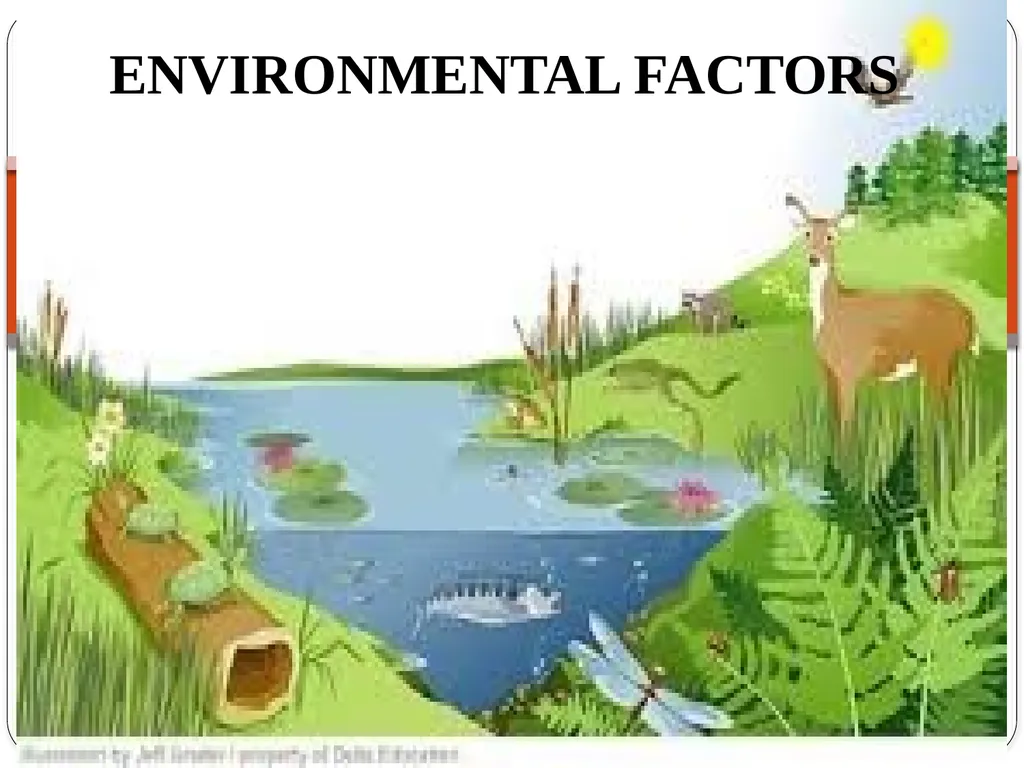
ENVIRONMENTAL FACTORS<br>
02
Objectives At the end of this unit you will be able to:
Define the abiotic and biotic components of the environment
List some of the abiotic and biotic components
Explain how the abiotic and biotic components affect organisms
Differentiate density dependent & density independent factors
Explain the rol of periodicity in environmental phenomena<br>
Define the abiotic and biotic components of the environment
List some of the abiotic and biotic components
Explain how the abiotic and biotic components affect organisms
Differentiate density dependent & density independent factors
Explain the rol of periodicity in environmental phenomena<br>
03
Environmental Factors Explain what does it mean by environmental factor ?
What types of factors are considered as environmental factor?<br>
What types of factors are considered as environmental factor?<br>
04
Cont… Environmental factor is any external force, substance, condition or threat in a habitat which surrounds and affects the normal life of organisms
It affects (controls) the distribution, abundance, growth and reproduction of organisms
Environmental factors include:
Temperature & sun light
Soil moisture
Soil salinity
Pathogens
Nutrient supply
Soil microbes
Competition
Other living organisms in the environment<br>
It affects (controls) the distribution, abundance, growth and reproduction of organisms
Environmental factors include:
Temperature & sun light
Soil moisture
Soil salinity
Pathogens
Nutrient supply
Soil microbes
Competition
Other living organisms in the environment<br>
05
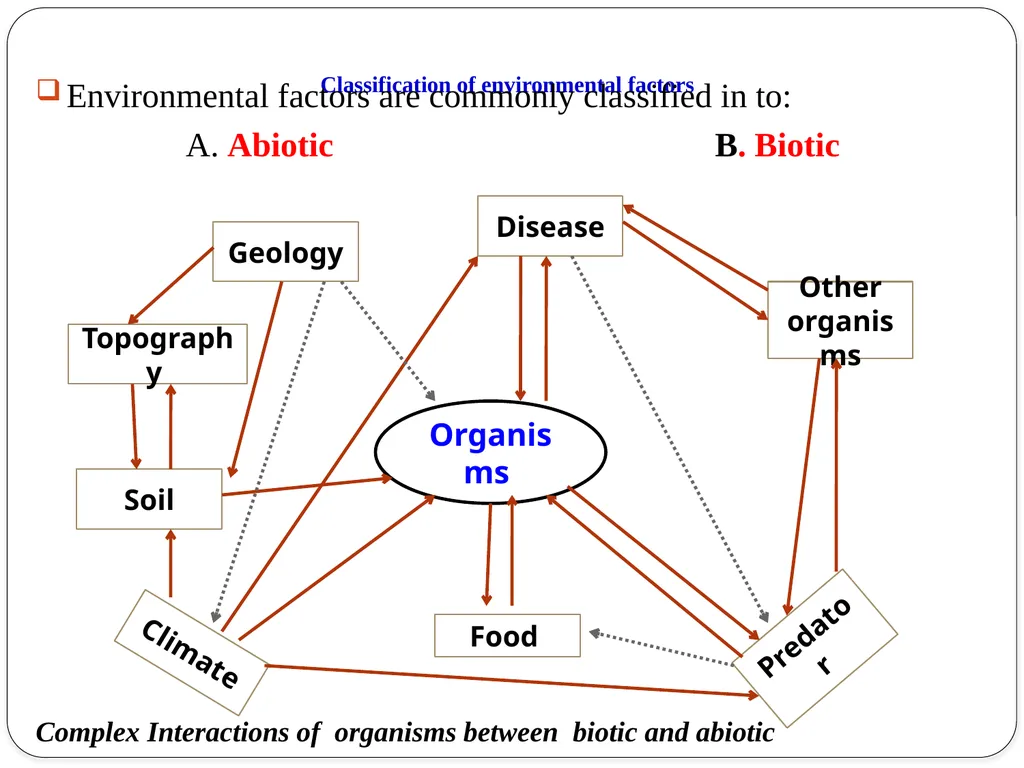
Classification of environmental factors Environmental factors are commonly classified in to:
A. Abiotic B. Biotic
Complex Interactions of organisms between biotic and abiotic Organisms Climate Other organisms Topography Soil Predator Food Geology Disease<br>
A. Abiotic B. Biotic
Complex Interactions of organisms between biotic and abiotic Organisms Climate Other organisms Topography Soil Predator Food Geology Disease<br>
06
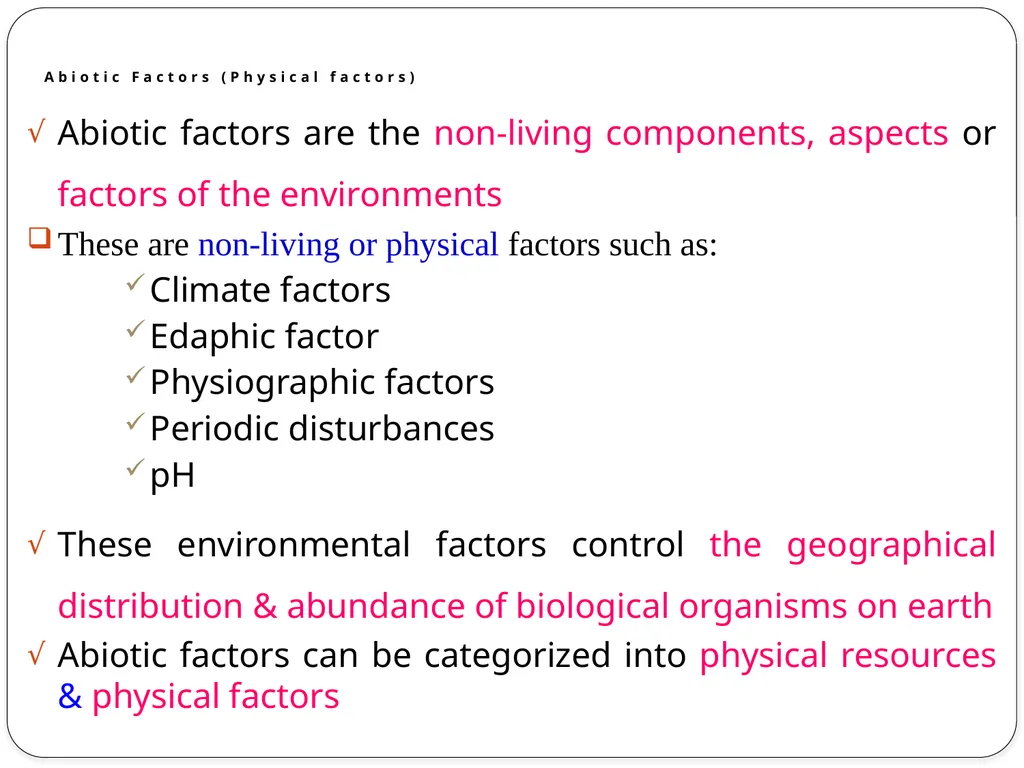
Abiotic Factors (Physical factors) Abiotic factors are the non-living components, aspects or factors of the environments
These are non-living or physical factors such as:
Climate factors
Edaphic factor
Physiographic factors
Periodic disturbances
pH
These environmental factors control the geographical distribution & abundance of biological organisms on earth
Abiotic factors can be categorized into physical resources & physical factors<br>
These are non-living or physical factors such as:
Climate factors
Edaphic factor
Physiographic factors
Periodic disturbances
pH
These environmental factors control the geographical distribution & abundance of biological organisms on earth
Abiotic factors can be categorized into physical resources & physical factors<br>
07
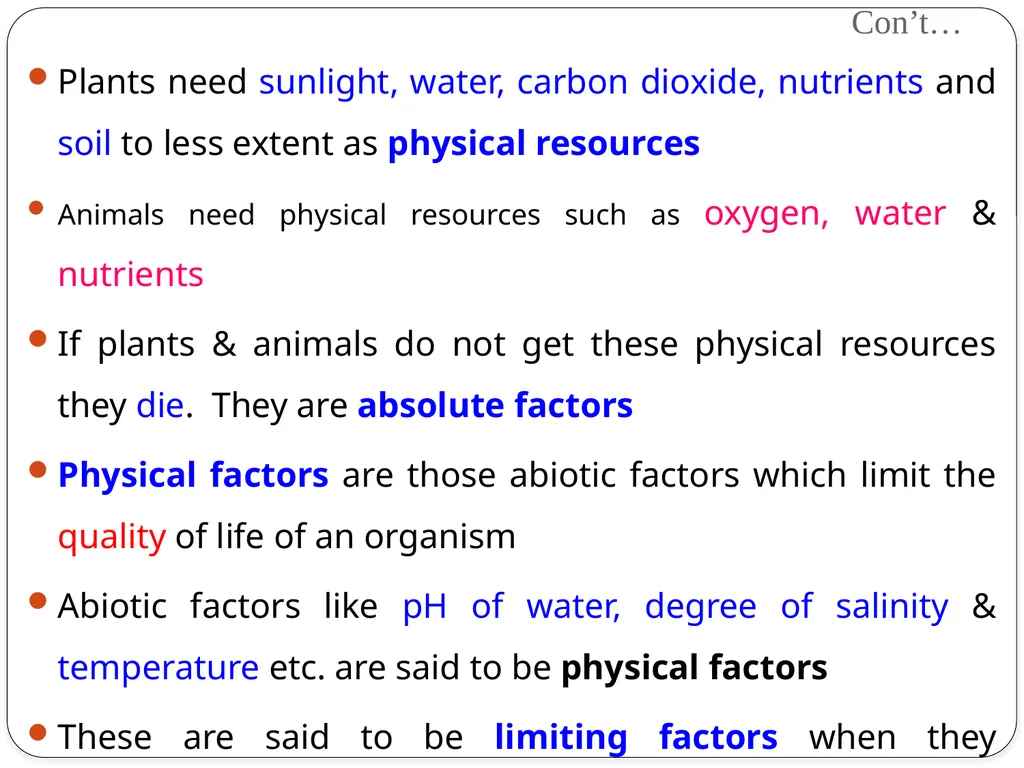
Con’t… Plants need sunlight, water, carbon dioxide, nutrients and soil to less extent as physical resources
Animals need physical resources such as oxygen, water & nutrients
If plants & animals do not get these physical resources they die. They are absolute factors
Physical factors are those abiotic factors which limit the quality of life of an organism
Abiotic factors like pH of water, degree of salinity & temperature etc. are said to be physical factors
These are said to be limiting factors when they determine the presence or absence of a species in an environment<br>
Animals need physical resources such as oxygen, water & nutrients
If plants & animals do not get these physical resources they die. They are absolute factors
Physical factors are those abiotic factors which limit the quality of life of an organism
Abiotic factors like pH of water, degree of salinity & temperature etc. are said to be physical factors
These are said to be limiting factors when they determine the presence or absence of a species in an environment<br>
08
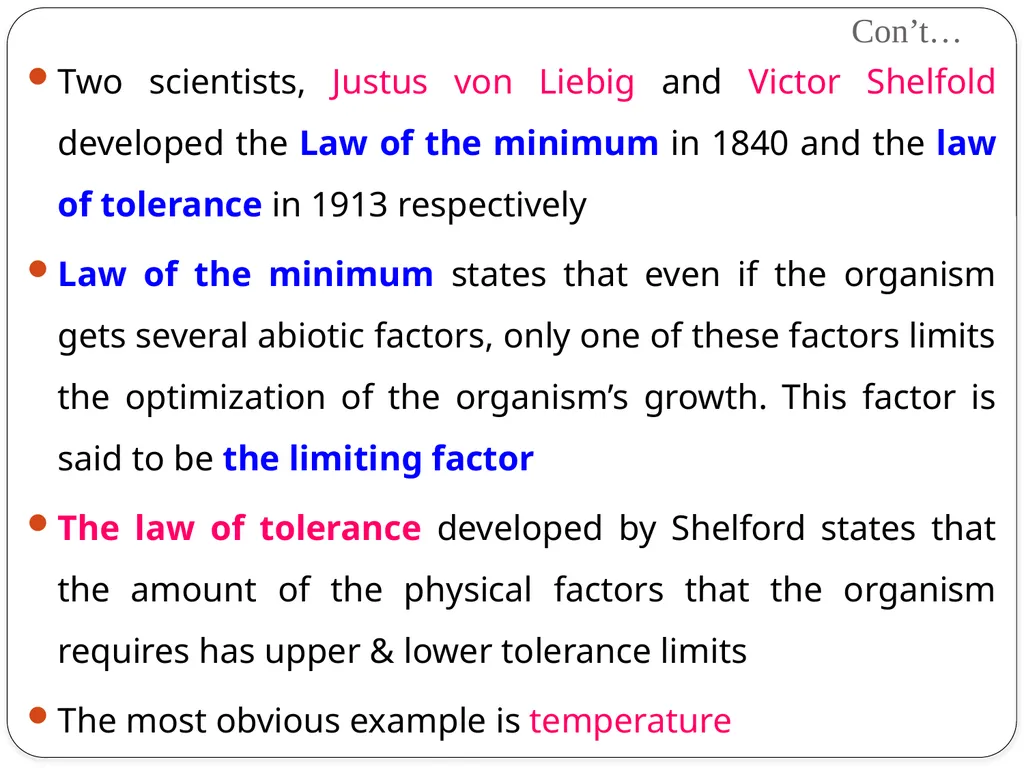
Con’t… Two scientists, Justus von Liebig and Victor Shelfold developed the Law of the minimum in 1840 and the law of tolerance in 1913 respectively
Law of the minimum states that even if the organism gets several abiotic factors, only one of these factors limits the optimization of the organism’s growth. This factor is said to be the limiting factor
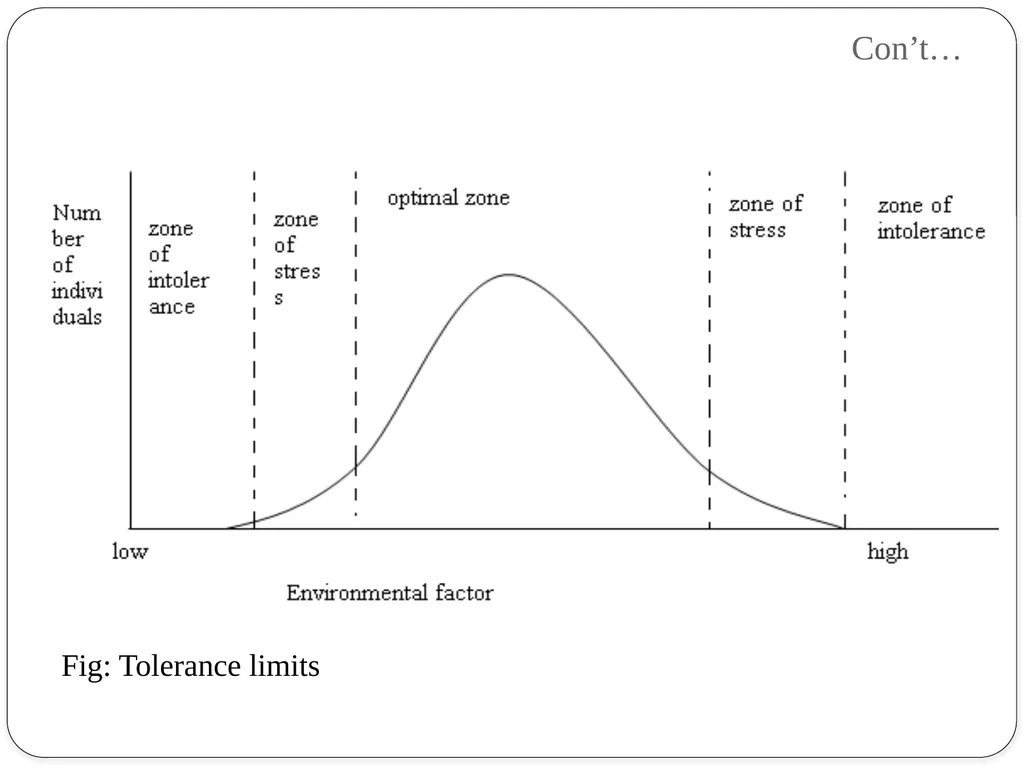
The law of tolerance developed by Shelford states that the amount of the physical factors that the organism requires has upper & lower tolerance limits
The most obvious example is temperature
No organism can live below zero, & no organism can live above 100 degree centigrade (extreme examples)<br>
Law of the minimum states that even if the organism gets several abiotic factors, only one of these factors limits the optimization of the organism’s growth. This factor is said to be the limiting factor
The law of tolerance developed by Shelford states that the amount of the physical factors that the organism requires has upper & lower tolerance limits
The most obvious example is temperature
No organism can live below zero, & no organism can live above 100 degree centigrade (extreme examples)<br>
09
Con’t… Fig: Tolerance limits<br>
10
Cont… Climatic factors
Is a summation of weather conditions over a long period of time
Four major abiotic components make up climate
These are: -Temperature
- Sunlight
- Precipitation, Water, gases and
- Wind Discuss how these Climate factors affect the life of organisms The intensity of these components negatively affect organisms in their environment<br>
Is a summation of weather conditions over a long period of time
Four major abiotic components make up climate
These are: -Temperature
- Sunlight
- Precipitation, Water, gases and
- Wind Discuss how these Climate factors affect the life of organisms The intensity of these components negatively affect organisms in their environment<br>
11
Con't… A. Temperature
Temperature exerts a profound influence on the physiological activities of organisms (directly or indirectly)
There are maximum and minimum temperature limits which the organism can tolerate
Temperature affects animal performance, microbial activities & photosynthesis in plants
Temperature extremes affect the effect of enzymes
Photosynthesis is one of the most fundamental characteristics of plants i.e. conversion of light energy into chemical energy of organic molecules.s<br>
Temperature exerts a profound influence on the physiological activities of organisms (directly or indirectly)
There are maximum and minimum temperature limits which the organism can tolerate
Temperature affects animal performance, microbial activities & photosynthesis in plants
Temperature extremes affect the effect of enzymes
Photosynthesis is one of the most fundamental characteristics of plants i.e. conversion of light energy into chemical energy of organic molecules.s<br>
12
Con't… Photosynthesis is the basis for the life of plants (their growth, reproduction) and it is also the ultimate source of energy for most heterotrophic organisms
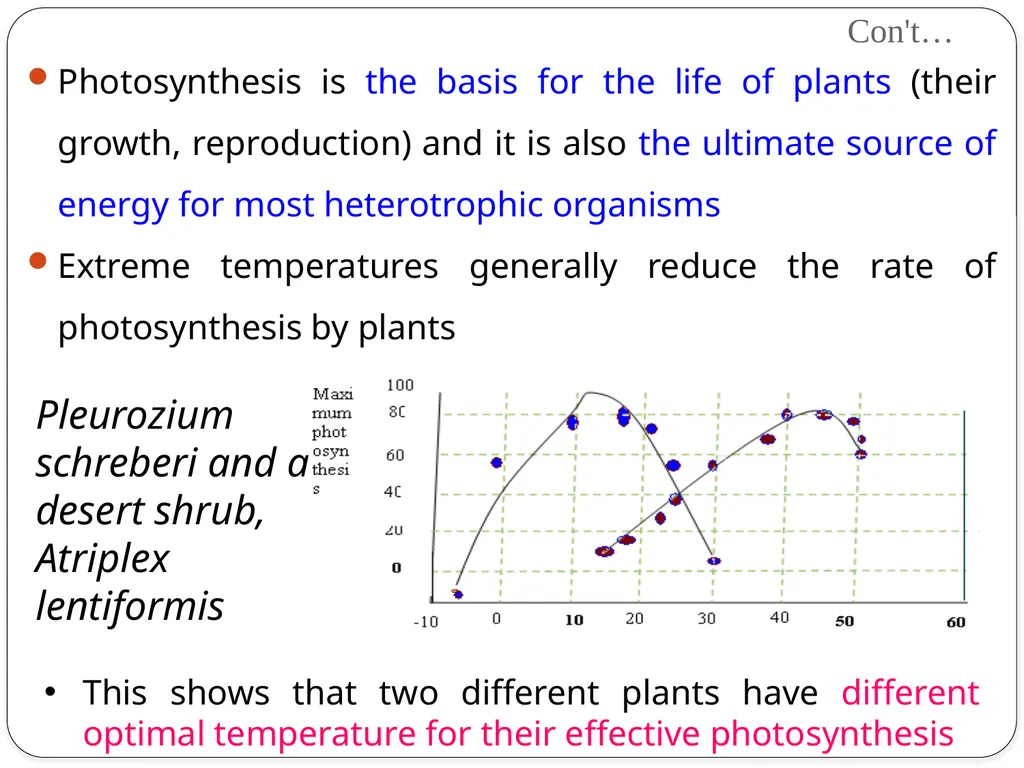
Extreme temperatures generally reduce the rate of photosynthesis by plants Pleurozium schreberi and a desert shrub, Atriplex lentiformis This shows that two different plants have different optimal temperature for their effective photosynthesis<br>
Extreme temperatures generally reduce the rate of photosynthesis by plants Pleurozium schreberi and a desert shrub, Atriplex lentiformis This shows that two different plants have different optimal temperature for their effective photosynthesis<br>
13
Con’t… This range of temperatures is therefore; called the biokinetic zone
Based on temperature tolerance, animals are classified as eurythermal (wide temperature tolerance) or stenothermal (narrow temperature tolerance)
The distribution of plants and animals is greatly influenced by extremes in temperature.<br>
Based on temperature tolerance, animals are classified as eurythermal (wide temperature tolerance) or stenothermal (narrow temperature tolerance)
The distribution of plants and animals is greatly influenced by extremes in temperature.<br>
14
Con’t… b. Sunlight
Light is another abiotic environment that affects living things directly or indirectly
It is the ultimate source of energy for the biological world
Without sunlight all life on earth cannot live excluding some microorganisms which are chemosynthetic
Light induce greater elongation & other development of plant tissue
Duration, quality & intensity of light exposure also affects plant growth
The photoperiod which is the difference in the relative duration of day light & darkness, influences stem elongation, flowering, fruit growth & other physiological processes in plants and animals<br>
Light is another abiotic environment that affects living things directly or indirectly
It is the ultimate source of energy for the biological world
Without sunlight all life on earth cannot live excluding some microorganisms which are chemosynthetic
Light induce greater elongation & other development of plant tissue
Duration, quality & intensity of light exposure also affects plant growth
The photoperiod which is the difference in the relative duration of day light & darkness, influences stem elongation, flowering, fruit growth & other physiological processes in plants and animals<br>
15
Con’t… Depending up on the day length required for the induction of flowering, plants are divided into three groups
1. Short day plants:-A plant that requires a long period of darkness, is termed a "short day" (long night) plants
Short-day plants form flowers only when day length is less than about 12 hours
Examples are Nicotiana, Chrysanthemum and Xanthium
2. Long day plants:-These bloom only when they receive more than 12 hours of light
Many of our summer blooming flowers and garden vegetables are long day plants
Example: Spinach, wheat, barley, clover and radish are examples of long day plants
3. Day-neutral plants:-These are not sensitive to day-length and bloom regardless of the photoperiod. Example Tomato, maize, sunflower, pea plant<br>
1. Short day plants:-A plant that requires a long period of darkness, is termed a "short day" (long night) plants
Short-day plants form flowers only when day length is less than about 12 hours
Examples are Nicotiana, Chrysanthemum and Xanthium
2. Long day plants:-These bloom only when they receive more than 12 hours of light
Many of our summer blooming flowers and garden vegetables are long day plants
Example: Spinach, wheat, barley, clover and radish are examples of long day plants
3. Day-neutral plants:-These are not sensitive to day-length and bloom regardless of the photoperiod. Example Tomato, maize, sunflower, pea plant<br>
16
Con’t… Intense light promote a high rate of transpiration and may cause dehydration of protoplasm
The length of light period (duration) also affects the structure of vegetative organs, growth, germination, pigmentation, nutrition requirement & even susceptibility to parasites
Light period also affects animals
breed during the winter whereas others are summer breeders
developmental process in many fish and in silk worms
locomotion in some aquatic organisms<br>
The length of light period (duration) also affects the structure of vegetative organs, growth, germination, pigmentation, nutrition requirement & even susceptibility to parasites
Light period also affects animals
breed during the winter whereas others are summer breeders
developmental process in many fish and in silk worms
locomotion in some aquatic organisms<br>
17
Con’t… Quality of light
The light coming from the sun is a mixture of different colors or colors of different wave lengths
Of these colors plants absorb blue & red portion of the light for photosynthesis
In aquatic ecosystem the quality of light is one of the limiting factors for photosynthesis<br>
The light coming from the sun is a mixture of different colors or colors of different wave lengths
Of these colors plants absorb blue & red portion of the light for photosynthesis
In aquatic ecosystem the quality of light is one of the limiting factors for photosynthesis<br>
18
Con’t… Light intensity
The intensity of light that reaches the earth surface varies according to the latitude and season of the year
The source of light also affects the growth & movement of organisms in a given ecosystem
The followings are the responses of plants to light source
Phototropism
Phototropism is the directional growth of plants in response to light where the direction of the stimulus determines the direction of growth; stems demonstrate positive phototropism i.e. they grow towards the light source while roots are negative phototropic (grows away from the direction of light source<br>
The intensity of light that reaches the earth surface varies according to the latitude and season of the year
The source of light also affects the growth & movement of organisms in a given ecosystem
The followings are the responses of plants to light source
Phototropism
Phototropism is the directional growth of plants in response to light where the direction of the stimulus determines the direction of growth; stems demonstrate positive phototropism i.e. they grow towards the light source while roots are negative phototropic (grows away from the direction of light source<br>
19
Con’t… Phototaxis
Phototaxis is the movement of the whole organism in response to a unilateral light source, where the stimulus determines the direction of movement (toward or away from stimulus of light).
Photokinesis
Photokinesis is the variation in intensity of locomotory activity of animals which is dependent on the intensity of light stimulation, and not the direction
Photonasty
Photonasty is the movement of parts of a plant in response to a light source, but the direction of the stimulus does not determine the direction of the movement of the plant<br>
Phototaxis is the movement of the whole organism in response to a unilateral light source, where the stimulus determines the direction of movement (toward or away from stimulus of light).
Photokinesis
Photokinesis is the variation in intensity of locomotory activity of animals which is dependent on the intensity of light stimulation, and not the direction
Photonasty
Photonasty is the movement of parts of a plant in response to a light source, but the direction of the stimulus does not determine the direction of the movement of the plant<br>
20
Con’t… c. Water
Plants and animals are distributed from the entirely aquatic environments to the dry deserts
Animals in aquatic environment have the problem of regulating the water balance of their body while terrestrial animals face the problem of desiccation
Plants can be classified into 3 groups based on their water requirements.
Hydrophytes are those plants which grow in water and water logged areas
Mesophytes grow in areas with moderate water requirements
Xerophytes are plants which grows in deserts or dry areas where the water source is a serious problem<br>
Plants and animals are distributed from the entirely aquatic environments to the dry deserts
Animals in aquatic environment have the problem of regulating the water balance of their body while terrestrial animals face the problem of desiccation
Plants can be classified into 3 groups based on their water requirements.
Hydrophytes are those plants which grow in water and water logged areas
Mesophytes grow in areas with moderate water requirements
Xerophytes are plants which grows in deserts or dry areas where the water source is a serious problem<br>
21
Con’t… Water requirements of animals
Water scarcity also affects terrestrial animals and the animals are exposed to desiccation
To cope up with the water shortage the animals developed just a few interesting adaptations
The body covering of organisms limits water loss
E.g. Chitinous body covering of insects, the scales of reptiles, the feathers of birds and the hair of mammals
Some mammals have few or no sweat glands and use other cooling devices
E.g. a camel<br>
Water scarcity also affects terrestrial animals and the animals are exposed to desiccation
To cope up with the water shortage the animals developed just a few interesting adaptations
The body covering of organisms limits water loss
E.g. Chitinous body covering of insects, the scales of reptiles, the feathers of birds and the hair of mammals
Some mammals have few or no sweat glands and use other cooling devices
E.g. a camel<br>
22
Con’t… d. Gases
Oxygen, carbon dioxide and nitrogen are the most important gases used by plants and animals
All aerobic organisms use oxygen during respiration to liberate energy from food
Carbon dioxide is used by green plants during photosynthesis in which plants make their own food
Plants get nitrogen through the action of certain bacteria, algae and the action of lighting
e. Wind
Winds carry water vapor which may condense and fall in the form of rain and snow<br>
Oxygen, carbon dioxide and nitrogen are the most important gases used by plants and animals
All aerobic organisms use oxygen during respiration to liberate energy from food
Carbon dioxide is used by green plants during photosynthesis in which plants make their own food
Plants get nitrogen through the action of certain bacteria, algae and the action of lighting
e. Wind
Winds carry water vapor which may condense and fall in the form of rain and snow<br>
23
Con’t… It also play role in flower pollination & seed dispersal of some plants
Wind can also cause erosion of soil which removes & redistribute top soil from degraded areas
It can also amplify the effects of temperature by increasing heat loss by evaporation & convection
It also increases the evaporation rate of animals & transpiration rate of plants resulting in more rapid water loss<br>
Wind can also cause erosion of soil which removes & redistribute top soil from degraded areas
It can also amplify the effects of temperature by increasing heat loss by evaporation & convection
It also increases the evaporation rate of animals & transpiration rate of plants resulting in more rapid water loss<br>
24
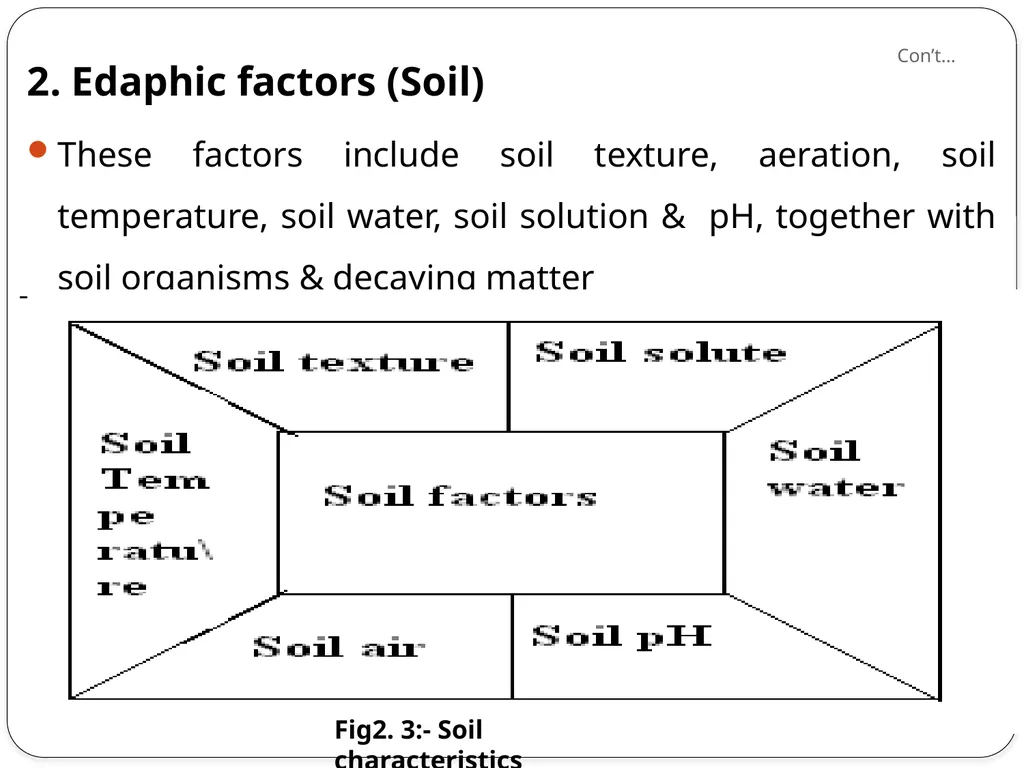
Con’t… 2. Edaphic factors (Soil)
These factors include soil texture, aeration, soil temperature, soil water, soil solution & pH, together with soil organisms & decaying matter Fig2. 3:- Soil characteristics<br>
These factors include soil texture, aeration, soil temperature, soil water, soil solution & pH, together with soil organisms & decaying matter Fig2. 3:- Soil characteristics<br>
25
Con’t… Soil texture
The size of soil particles varies from microscopic particles called clay to larger particles called sand
Loam soil is a mixture of sand & clay particles.
Sandy soils are well aerated, excess water drains away quickly, they warm up quickly during the day and is easy to cultivate
Sandy soils do not retain much water and soon dry out and contain few soil nutrients required for plant growth
Clay soils hold large amount of water and are rich in mineral nutrients
They are unsuitable in that they are badly aerated, soon become waterlogged and is difficult to cultivate; it is also cold during winter
Loam soils possess desirable properties of both sand and clay - it has a high water retaining capacity, good aeration, and good nutrient content and is easily cultivated<br>
The size of soil particles varies from microscopic particles called clay to larger particles called sand
Loam soil is a mixture of sand & clay particles.
Sandy soils are well aerated, excess water drains away quickly, they warm up quickly during the day and is easy to cultivate
Sandy soils do not retain much water and soon dry out and contain few soil nutrients required for plant growth
Clay soils hold large amount of water and are rich in mineral nutrients
They are unsuitable in that they are badly aerated, soon become waterlogged and is difficult to cultivate; it is also cold during winter
Loam soils possess desirable properties of both sand and clay - it has a high water retaining capacity, good aeration, and good nutrient content and is easily cultivated<br>
26
Con’t… Soil air
Soil air is found in those spaces between the soil particles that are not filled with soil water
In well-aerated soil at least 20% of its volume is made up of air
Soil temperature
Soil temperature is an important ecological factor
At low temperature, there is little decay by decay-causing microorganisms<br>
Soil air is found in those spaces between the soil particles that are not filled with soil water
In well-aerated soil at least 20% of its volume is made up of air
Soil temperature
Soil temperature is an important ecological factor
At low temperature, there is little decay by decay-causing microorganisms<br>
27
Con’t… Soil solution
Soil solution is the decaying remains of plants and animals, together with animal excretory products and faeces, form humus
This increases the fertility of the soil
Soil water
Generally, water present in soil in four forms<br>
Soil solution is the decaying remains of plants and animals, together with animal excretory products and faeces, form humus
This increases the fertility of the soil
Soil water
Generally, water present in soil in four forms<br>
28
Cont… i)Gravitational water: is a soil water found under gravitational influence.
It is not available to the plant, because it lies far below the reach of the roots
ii) Hygroscopic water: is a thin film of water which is tightly held by the soil particles
This water is also not available to the plants
iii)Chemical water: is a water present in the chemical compounds which is present in the particles of soil.
This is not available to the plants
iv) Capillary water:
It is a water exists between soil particles & in smaller capillary pores
It is an available forms of water to plants<br>
It is not available to the plant, because it lies far below the reach of the roots
ii) Hygroscopic water: is a thin film of water which is tightly held by the soil particles
This water is also not available to the plants
iii)Chemical water: is a water present in the chemical compounds which is present in the particles of soil.
This is not available to the plants
iv) Capillary water:
It is a water exists between soil particles & in smaller capillary pores
It is an available forms of water to plants<br>
29
Con’t… Soil pH
Acidity or alkalinity of soil (the pH of the soil) influences the biological activity in soil & the availability of certain minerals<br>
Acidity or alkalinity of soil (the pH of the soil) influences the biological activity in soil & the availability of certain minerals<br>
30
Con’t… 3. Physiographic factors (topographic factors)
The physiographic factors include factors such as altitude, slope of land and the position of the area in relation to the sun or rain-bearing winds
Altitude affects the distribution of vegetation through its effect on temperature, rainfall, and insulation
The rise in altitude reduces the absorption of solar radiation
The air temperature also drops as the altitude increases and this is true in soil temperature too
The fall in temperature of soil affects the activity of plant roots and reduces the absorption of water and mineral from the soil<br>
The physiographic factors include factors such as altitude, slope of land and the position of the area in relation to the sun or rain-bearing winds
Altitude affects the distribution of vegetation through its effect on temperature, rainfall, and insulation
The rise in altitude reduces the absorption of solar radiation
The air temperature also drops as the altitude increases and this is true in soil temperature too
The fall in temperature of soil affects the activity of plant roots and reduces the absorption of water and mineral from the soil<br>
31
Con’t… 4. Periodic disturbances
Catastrophic disturbances such as fire, hurricanes, typhoons, and volcanic eruptions can devastate biological communities
The area is re-colonized by organisms or repopulated by the survivors, but the structure of the community undergoes succession of changes<br>
Catastrophic disturbances such as fire, hurricanes, typhoons, and volcanic eruptions can devastate biological communities
The area is re-colonized by organisms or repopulated by the survivors, but the structure of the community undergoes succession of changes<br>
32
Biotic Factors (Biological factors) Biotic means living and biotic factors are the other, living parts of the ecosystem with which an organism must interact
The biotic factors with which an organism interacts depend on whether it is a producer, a consumer, or a decomposer
Producers are also known as autotrophs or self-feeders
Producers manufacture the organic compounds that they use as sources of energy and nutrients<br>
The biotic factors with which an organism interacts depend on whether it is a producer, a consumer, or a decomposer
Producers are also known as autotrophs or self-feeders
Producers manufacture the organic compounds that they use as sources of energy and nutrients<br>
33
Con’t… Most producers are green plants or algae that make organic compounds through photosynthesis
A few producers, including specialized bacteria, can extract inorganic compounds from the environment and convert them to organic nutrients in the absence of sunlight. This process is called chemosynthesis
Only producers can make their own food. They also provide food for the consumers & decomposers
Organisms that get their energy by feeding on other organisms are called heterotrophs, or other-feeders.
Others get their energy from dead plant & animal matter, called detritus<br>
A few producers, including specialized bacteria, can extract inorganic compounds from the environment and convert them to organic nutrients in the absence of sunlight. This process is called chemosynthesis
Only producers can make their own food. They also provide food for the consumers & decomposers
Organisms that get their energy by feeding on other organisms are called heterotrophs, or other-feeders.
Others get their energy from dead plant & animal matter, called detritus<br>
34
Con't…. A predator regards the organism as a source of energy and matter to be recycled.
A parasite is a type of consumer organism. As a consumer, it does not make its own food. It gets its food (energy and matter to be recycled) from its host
The organism's prey is a source of energy & matter
A symbiont is a factor that does not provide energy to the organism, but some how aids the organism in obtaining energy or matter from the ecosystem
Finally, a competitor reduces the organism's ability to harvest energy or matter to be recycled
The distribution and abundance of an organism will be affected by its interrelationships with the biotic environment<br>
A parasite is a type of consumer organism. As a consumer, it does not make its own food. It gets its food (energy and matter to be recycled) from its host
The organism's prey is a source of energy & matter
A symbiont is a factor that does not provide energy to the organism, but some how aids the organism in obtaining energy or matter from the ecosystem
Finally, a competitor reduces the organism's ability to harvest energy or matter to be recycled
The distribution and abundance of an organism will be affected by its interrelationships with the biotic environment<br>
35
Con’t… Humans are omnivores, consuming both producers & other consumers
Humans are also biotic factors in ecosystems
Other organisms are affected by human actions<br>
Humans are also biotic factors in ecosystems
Other organisms are affected by human actions<br>
36
Density dependent environmental factor Is the factor that have impact on the size of population whose effect is dependent on the number of individuals (density) in the population
It always influences change strength according to the density of individuals
When population density is:
Higher the effect can be more intense
Lower the effect can be minimum<br>
It always influences change strength according to the density of individuals
When population density is:
Higher the effect can be more intense
Lower the effect can be minimum<br>
37
Cont… It has population regulating effect
Example: Biotic factors like:
Weed
Pathogens
Competition
Predation
Migration
As the population increase:
food becomes scarce
infectious disease can spread easily and
many of its members migrate out<br>
Example: Biotic factors like:
Weed
Pathogens
Competition
Predation
Migration
As the population increase:
food becomes scarce
infectious disease can spread easily and
many of its members migrate out<br>
38
Density independent environmental factor Is a factor that affects the size of a population independent of the population density
It affects the population of organisms no matter how small or large
Examples, abiotic factors like:
Temperature
Floods
Forest fire
Drought<br>
It affects the population of organisms no matter how small or large
Examples, abiotic factors like:
Temperature
Floods
Forest fire
Drought<br>
39
Periodicity/Rhythmicity/ A rhythm is a recurrence (repetition) process of events
It is wave like in character, b/c maximum and minimum states appear at identical intervals of time
Example, the light phase and dark phase of a daily cycle
In ecology, Rhythmicity is a recurrence of daily, seasonal or annual changes
It occurs when the earth daily and annually moves with relative to the sun
As the season progress, day length and other conspicuous activities of organisms are changed<br>
It is wave like in character, b/c maximum and minimum states appear at identical intervals of time
Example, the light phase and dark phase of a daily cycle
In ecology, Rhythmicity is a recurrence of daily, seasonal or annual changes
It occurs when the earth daily and annually moves with relative to the sun
As the season progress, day length and other conspicuous activities of organisms are changed<br>
40
Cont… How organisms know rhythmicity?
All Animals and Plants posses an automatic biological clock
Biological clock is an internal physiological systems that controls the rhythm of behavior
It enables organisms to live in harmony with the rhythms of nature, such as the cycles of day and night and of the seasons
It is entrained (set and reset) by external environmental stimuli called as entrainers such as day length, lunar phase, temperature, humidity and so on<br>
All Animals and Plants posses an automatic biological clock
Biological clock is an internal physiological systems that controls the rhythm of behavior
It enables organisms to live in harmony with the rhythms of nature, such as the cycles of day and night and of the seasons
It is entrained (set and reset) by external environmental stimuli called as entrainers such as day length, lunar phase, temperature, humidity and so on<br>
41
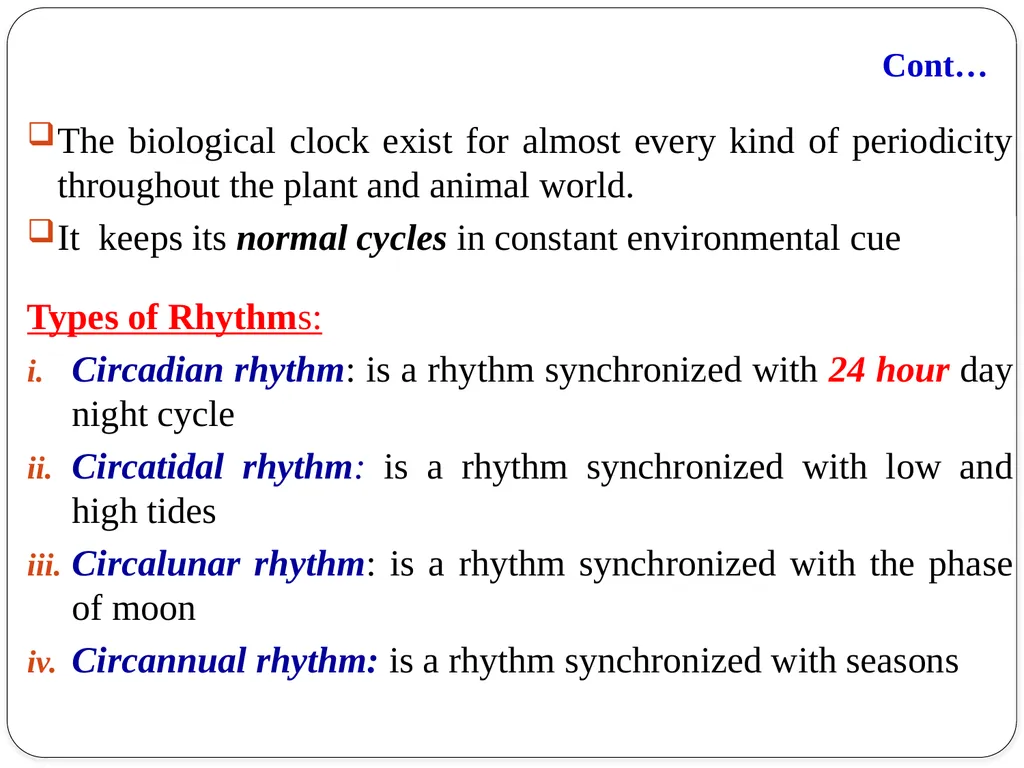
Cont… The biological clock exist for almost every kind of periodicity throughout the plant and animal world.
It keeps its normal cycles in constant environmental cue
Types of Rhythms:
Circadian rhythm: is a rhythm synchronized with 24 hour day night cycle
Circatidal rhythm: is a rhythm synchronized with low and high tides
Circalunar rhythm: is a rhythm synchronized with the phase of moon
Circannual rhythm: is a rhythm synchronized with seasons<br>
It keeps its normal cycles in constant environmental cue
Types of Rhythms:
Circadian rhythm: is a rhythm synchronized with 24 hour day night cycle
Circatidal rhythm: is a rhythm synchronized with low and high tides
Circalunar rhythm: is a rhythm synchronized with the phase of moon
Circannual rhythm: is a rhythm synchronized with seasons<br>