
ENVIRONMENTAL PROBLEMS IN ASSAM PREPARED BY
A
Published · 15 slides · 0 views
1 / 1

Description
ENVIRONMENTAL PROBLEMS IN ASSAM PREPARED BY ANINDITA CHAKRAVARTY THE SYLLABUS FOCUSSES ON 3 MAIN PROBLEMS SOLID WASTE MANAGEMENT DEFORESTATION WATERSHED MANAGEMENT SOLID WASTE MANAGEMENT Solid waste is the unwanted or useless solid
Related Topics
Share
Embed code
Download this presentation From Below
"ENVIRONMENTAL PROBLEMS IN ASSAM PREPARED BY" is the property of its rightful owner. Permission is granted to download and print the materials on this website for personal, non-commercial use only, and to display it on your personal computer provided you do not modify the materials and that you retain all copyright notices contained in the materials. By downloading content from our website, you accept the terms of this agreement.
Presentation Transcript
01
ENVIRONMENTAL PROBLEMS IN ASSAM PREPARED BY
ANINDITA CHAKRAVARTY<br>
ANINDITA CHAKRAVARTY<br>
02
THE SYLLABUS FOCUSSES ON 3 MAIN PROBLEMS SOLID WASTE MANAGEMENT
DEFORESTATION
WATERSHED MANAGEMENT<br>
DEFORESTATION
WATERSHED MANAGEMENT<br>
03
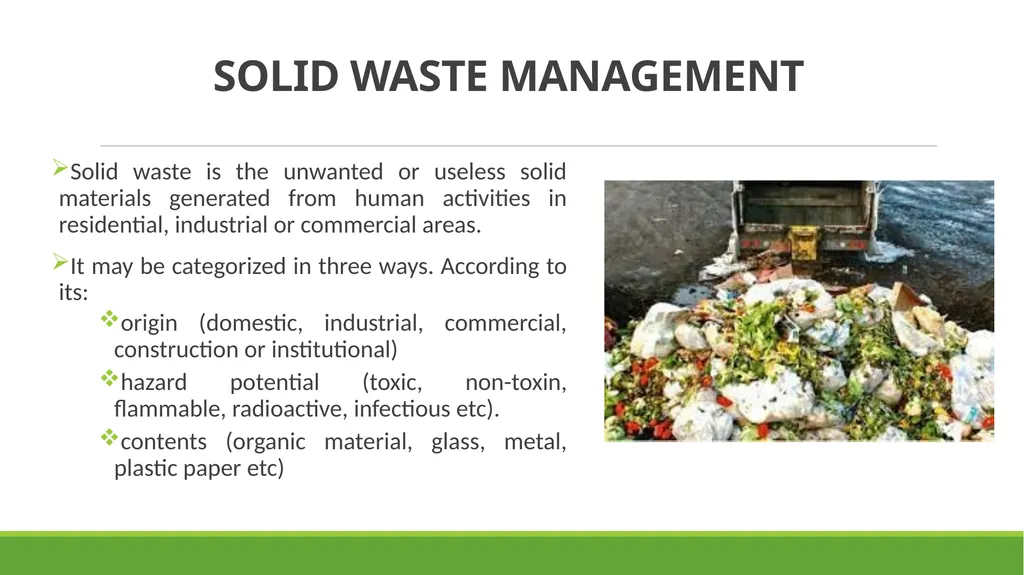
SOLID WASTE MANAGEMENT Solid waste is the unwanted or useless solid materials generated from human activities in residential, industrial or commercial areas.
It may be categorized in three ways. According to its:
origin (domestic, industrial, commercial, construction or institutional)
hazard potential (toxic, non-toxin, flammable, radioactive, infectious etc).
contents (organic material, glass, metal, plastic paper etc)<br>
It may be categorized in three ways. According to its:
origin (domestic, industrial, commercial, construction or institutional)
hazard potential (toxic, non-toxin, flammable, radioactive, infectious etc).
contents (organic material, glass, metal, plastic paper etc)<br>
04
Types of Solid Waste Municipal Solid Waste (MSW): It consists of household waste, construction and demolition debris (CnD), sanitation residue, and waste from streets, generated mainly from residential and commercial complexes. As per the MoEF it includes commercial and residential waste generated in municipal or notified areas in either solid or semi-solid form excluding industrial hazardous wastes but including treated bio-medical wastes;
Industrial Solid Waste (ISW): In a majority of cases it is termed as hazardous waste as they may contain toxic substances, are corrosive, highly inflammable, or react when exposed to certain things e.g. gases.
Biomedical waste or hospital waste: It is usually infectious waste that may include waste like sharps, soiled waste, disposables, anatomical waste, cultures, discarded medicines, chemical wastes, etc., usually in the form of disposable syringes, swabs, bandages, body fluids, human excreta, etc. These can be a serious threat to human health if not managed in a scientific and discriminate manner.<br>
Industrial Solid Waste (ISW): In a majority of cases it is termed as hazardous waste as they may contain toxic substances, are corrosive, highly inflammable, or react when exposed to certain things e.g. gases.
Biomedical waste or hospital waste: It is usually infectious waste that may include waste like sharps, soiled waste, disposables, anatomical waste, cultures, discarded medicines, chemical wastes, etc., usually in the form of disposable syringes, swabs, bandages, body fluids, human excreta, etc. These can be a serious threat to human health if not managed in a scientific and discriminate manner.<br>
05
Solid waste management Centralised method: This method involves collection of municipal waste from all over the local area and by means of landfilling, dump outside the city/nagar panchayat limits. This process looks at door-to-door collection of solid waste by waste pickers who hand over to the collection team who then discard the collected waste in the landfill. The waste pickers are employees of the Municipal Corporation or Nagar Panchayat. The collection team is generally contracted out by a tendering process.
De-centralized method: This is a model seen in a few places like Suryapet in Andhra Pradesh and Bangalore in Karnataka. The waste is collected ward-wise and is segregated at source into bio-degradable and non-biodegradable. The biodegradable waste is composted at a nearby facility by different methods of aerobic and anerobic composting. The non-biodegradable waste is further categorised into paper, plastic, metal and other waste and then further collected by recyclers for up-cycling or downcycling of products<br>
De-centralized method: This is a model seen in a few places like Suryapet in Andhra Pradesh and Bangalore in Karnataka. The waste is collected ward-wise and is segregated at source into bio-degradable and non-biodegradable. The biodegradable waste is composted at a nearby facility by different methods of aerobic and anerobic composting. The non-biodegradable waste is further categorised into paper, plastic, metal and other waste and then further collected by recyclers for up-cycling or downcycling of products<br>
06
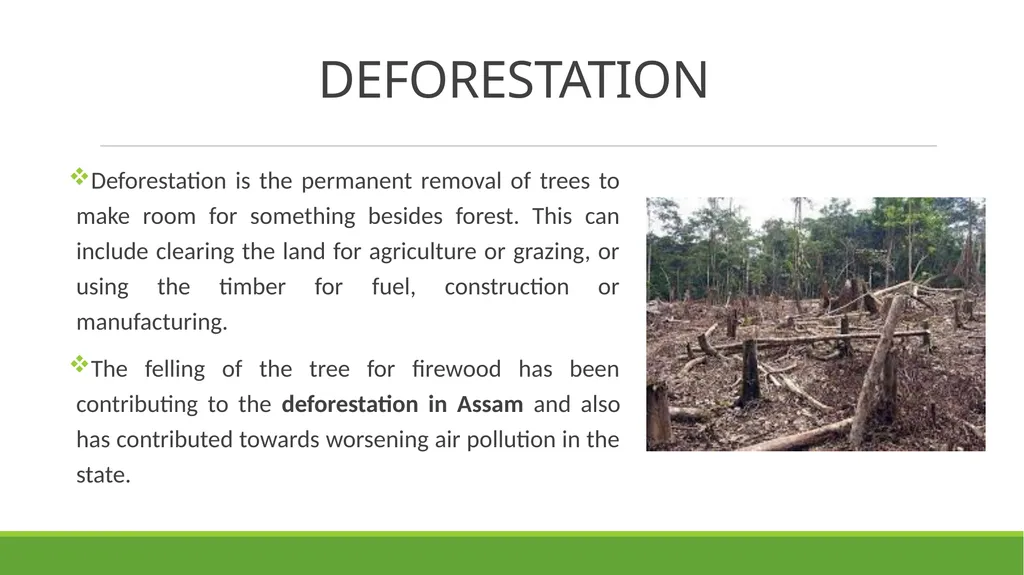
DEFORESTATION Deforestation is the permanent removal of trees to make room for something besides forest. This can include clearing the land for agriculture or grazing, or using the timber for fuel, construction or manufacturing.
The felling of the tree for firewood has been contributing to the deforestation in Assam and also has contributed towards worsening air pollution in the state.<br>
The felling of the tree for firewood has been contributing to the deforestation in Assam and also has contributed towards worsening air pollution in the state.<br>
07
Causes of Deforestation Agricultural activities-Due to the overgrowing demand for food products, a huge amount of trees are felled to grow crops, and 33% of agriculture-caused deforestation is because of subsistence agriculture.
Livestock Grazing- Farmers often clear the land by cutting down trees and burning them to raise livestock and grow food.
Urbanization-Further, to gain access to these forests, the construction of roads is undertaken; here again, trees are chopped to build roads
Desertification of land-It occurs due to land abuse, making it unfit for the growth of trees. Many industries in petrochemicals release their waste into rivers, which results in soil erosion and make it unfit to grow plants and trees.
Mining-Oil and coal mining requires a considerable amount of forest land. Apart from this, roads and highways have to be built to make way for trucks and other equipment
Forest fires-It happens due to extreme warm summers and milder winters. Fires, whether caused by man or nature, results in a massive loss of forest cover.<br>
Livestock Grazing- Farmers often clear the land by cutting down trees and burning them to raise livestock and grow food.
Urbanization-Further, to gain access to these forests, the construction of roads is undertaken; here again, trees are chopped to build roads
Desertification of land-It occurs due to land abuse, making it unfit for the growth of trees. Many industries in petrochemicals release their waste into rivers, which results in soil erosion and make it unfit to grow plants and trees.
Mining-Oil and coal mining requires a considerable amount of forest land. Apart from this, roads and highways have to be built to make way for trucks and other equipment
Forest fires-It happens due to extreme warm summers and milder winters. Fires, whether caused by man or nature, results in a massive loss of forest cover.<br>
08
Effects of Deforestation 1. Climate Imbalance and Climate Change
2. Increase in Global Warming
3. Soil Erosion: The fertile soil is held in place by intricate root structures of many layers of trees. With the clearance of tree cover, the land is directly exposed to the sun, making it dry.
4. Floods : When it rains, trees absorb and store a large amount of water with the help of their roots. When they are cut down, the flow of water is disrupted, and the soil loses its ability to retain water. It leads to floods in some areas and droughts in others.
5. Wildlife Extinction & Habitat Loss- Due to the massive felling down of trees, various animal species are lost.
6. The Decline in Life Quality of People- People in millions all over the world depend on forests for hunting, small-scale agriculture, gathering, and medicine<br>
2. Increase in Global Warming
3. Soil Erosion: The fertile soil is held in place by intricate root structures of many layers of trees. With the clearance of tree cover, the land is directly exposed to the sun, making it dry.
4. Floods : When it rains, trees absorb and store a large amount of water with the help of their roots. When they are cut down, the flow of water is disrupted, and the soil loses its ability to retain water. It leads to floods in some areas and droughts in others.
5. Wildlife Extinction & Habitat Loss- Due to the massive felling down of trees, various animal species are lost.
6. The Decline in Life Quality of People- People in millions all over the world depend on forests for hunting, small-scale agriculture, gathering, and medicine<br>
09
Solutions to Deforestation 1. Government Regulations :The best solution to deforestation is to curb the felling of trees by enforcing a series of rules and laws to govern it.
2. Banning Clear-Cutting of Forests: This will curb the total depletion of the forest cover. It is a practical solution and is very feasible.
3. Reforestation and Afforestation: Land skinned of its tree cover for urban settlements should be urged to plant trees in the vicinity and replace the cut trees. Also, the cutting must be replaced by planting young trees to replace the older ones that were cut.
4. Educate Others: Still, many are entirely unaware of the global warming problem we’re facing. Educate your friends, family, and community by sharing the deforestation facts, and its causes and effects.<br>
2. Banning Clear-Cutting of Forests: This will curb the total depletion of the forest cover. It is a practical solution and is very feasible.
3. Reforestation and Afforestation: Land skinned of its tree cover for urban settlements should be urged to plant trees in the vicinity and replace the cut trees. Also, the cutting must be replaced by planting young trees to replace the older ones that were cut.
4. Educate Others: Still, many are entirely unaware of the global warming problem we’re facing. Educate your friends, family, and community by sharing the deforestation facts, and its causes and effects.<br>
10
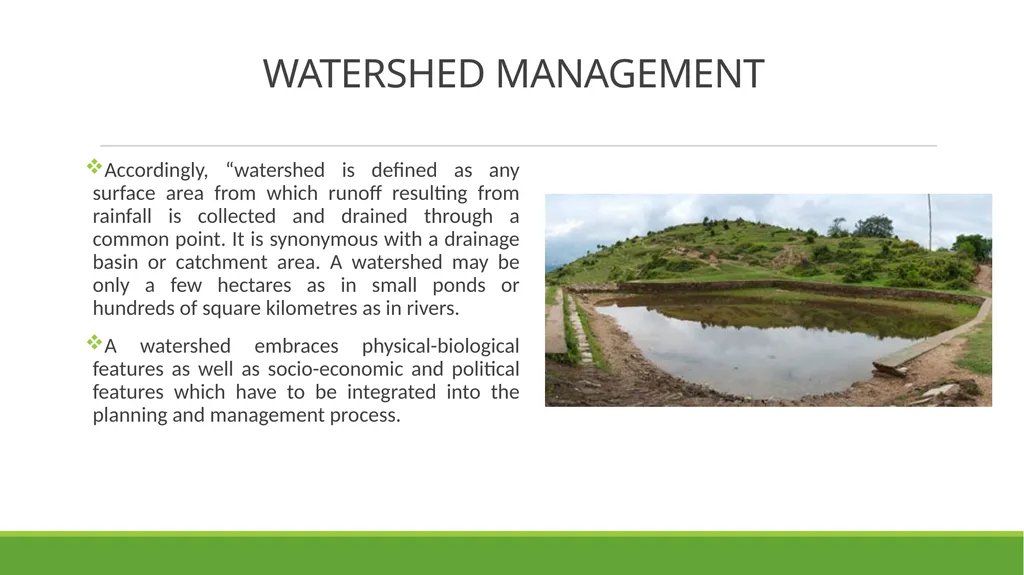
WATERSHED MANAGEMENT Accordingly, “watershed is defined as any surface area from which runoff resulting from rainfall is collected and drained through a common point. It is synonymous with a drainage basin or catchment area. A watershed may be only a few hectares as in small ponds or hundreds of square kilometres as in rivers.
A watershed embraces physical-biological features as well as socio-economic and political features which have to be integrated into the planning and management process.<br>
A watershed embraces physical-biological features as well as socio-economic and political features which have to be integrated into the planning and management process.<br>
11
Meaning Watershed management is the most important practice in agriculture, especially in dryland agriculture.
It play a greater role in conserving the runoff water from various source. The rain water harvesting is the major source of water in watershed. That harvested water is used to irrigate the crops under water stress condition in the dry areas.
It is also applied to the crops as a supplemental irrigation or as life-saving irrigation to different agricultural crops. Watershed management become most important and a necessary thing to save the crops from various stresses occurring during the crop period.
The main purpose of watershed management programme in dryland areas is to optimum and collective use of agricultural lands, water, vegetation in a particular area for providing facility to reduce the drought impacts, moderate floods, reduce soil erosion, increasing availability of water and increase food, fuel, fodder and fibre on sustainability basis.<br>
It play a greater role in conserving the runoff water from various source. The rain water harvesting is the major source of water in watershed. That harvested water is used to irrigate the crops under water stress condition in the dry areas.
It is also applied to the crops as a supplemental irrigation or as life-saving irrigation to different agricultural crops. Watershed management become most important and a necessary thing to save the crops from various stresses occurring during the crop period.
The main purpose of watershed management programme in dryland areas is to optimum and collective use of agricultural lands, water, vegetation in a particular area for providing facility to reduce the drought impacts, moderate floods, reduce soil erosion, increasing availability of water and increase food, fuel, fodder and fibre on sustainability basis.<br>
12
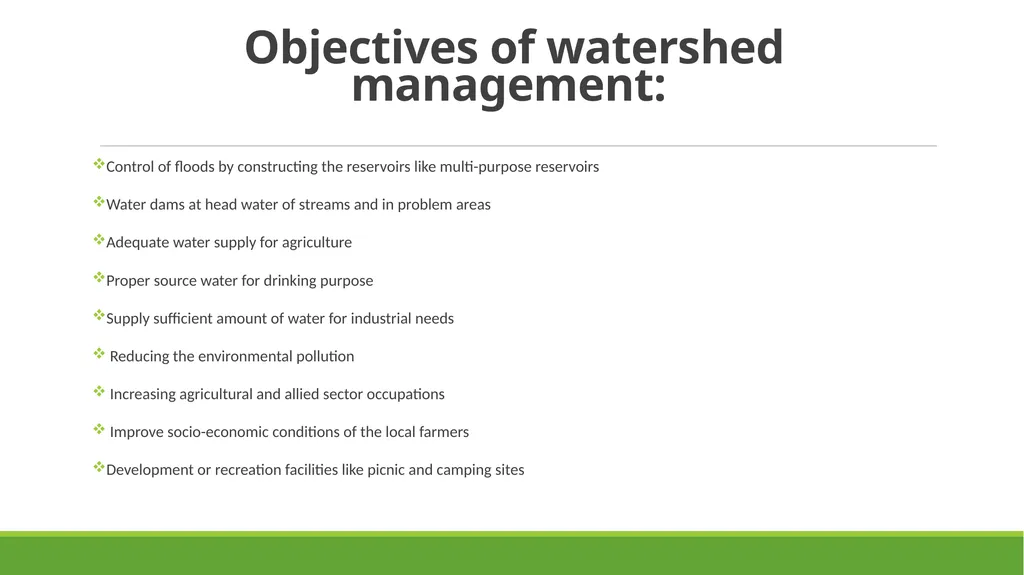
Objectives of watershed management: Control of floods by constructing the reservoirs like multi-purpose reservoirs
Water dams at head water of streams and in problem areas
Adequate water supply for agriculture
Proper source water for drinking purpose
Supply sufficient amount of water for industrial needs
Reducing the environmental pollution
Increasing agricultural and allied sector occupations
Improve socio-economic conditions of the local farmers
Development or recreation facilities like picnic and camping sites<br>
Water dams at head water of streams and in problem areas
Adequate water supply for agriculture
Proper source water for drinking purpose
Supply sufficient amount of water for industrial needs
Reducing the environmental pollution
Increasing agricultural and allied sector occupations
Improve socio-economic conditions of the local farmers
Development or recreation facilities like picnic and camping sites<br>
13
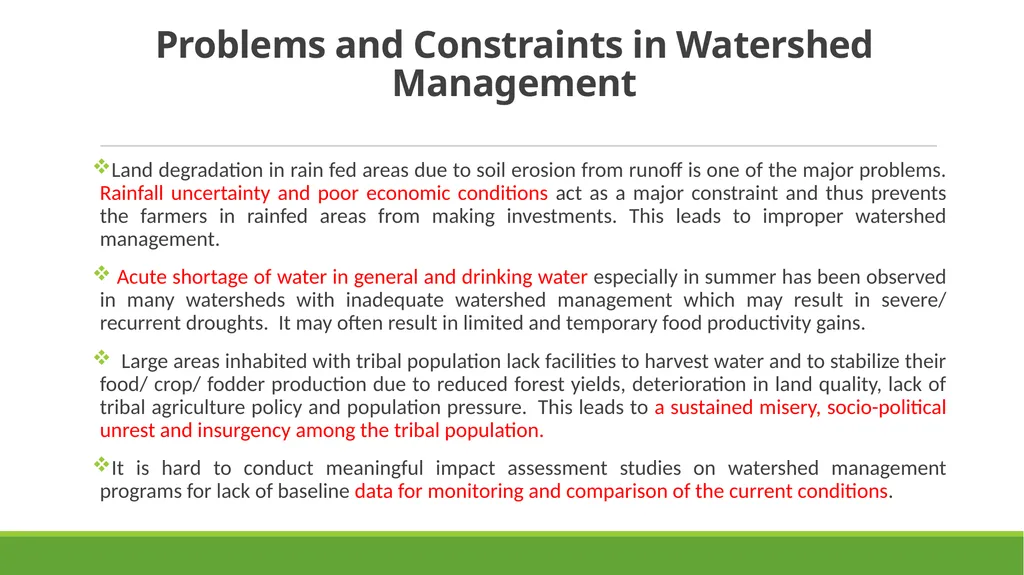
Problems and Constraints in Watershed Management Land degradation in rain fed areas due to soil erosion from runoff is one of the major problems. Rainfall uncertainty and poor economic conditions act as a major constraint and thus prevents the farmers in rainfed areas from making investments. This leads to improper watershed management.
Acute shortage of water in general and drinking water especially in summer has been observed in many watersheds with inadequate watershed management which may result in severe/ recurrent droughts. It may often result in limited and temporary food productivity gains.
Large areas inhabited with tribal population lack facilities to harvest water and to stabilize their food/ crop/ fodder production due to reduced forest yields, deterioration in land quality, lack of tribal agriculture policy and population pressure. This leads to a sustained misery, socio-political unrest and insurgency among the tribal population.
It is hard to conduct meaningful impact assessment studies on watershed management programs for lack of baseline data for monitoring and comparison of the current conditions.<br>
Acute shortage of water in general and drinking water especially in summer has been observed in many watersheds with inadequate watershed management which may result in severe/ recurrent droughts. It may often result in limited and temporary food productivity gains.
Large areas inhabited with tribal population lack facilities to harvest water and to stabilize their food/ crop/ fodder production due to reduced forest yields, deterioration in land quality, lack of tribal agriculture policy and population pressure. This leads to a sustained misery, socio-political unrest and insurgency among the tribal population.
It is hard to conduct meaningful impact assessment studies on watershed management programs for lack of baseline data for monitoring and comparison of the current conditions.<br>
14
THANK YOU<br>