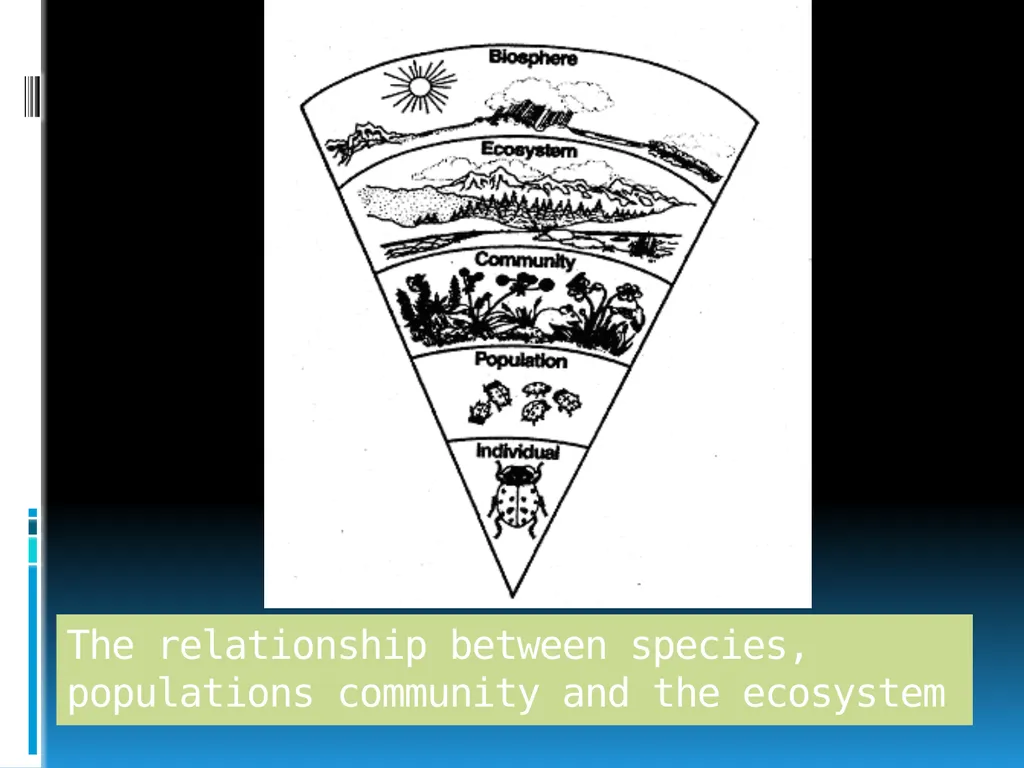
04
Population size is affected by: Inborn factors
Environmental changes<br>
05
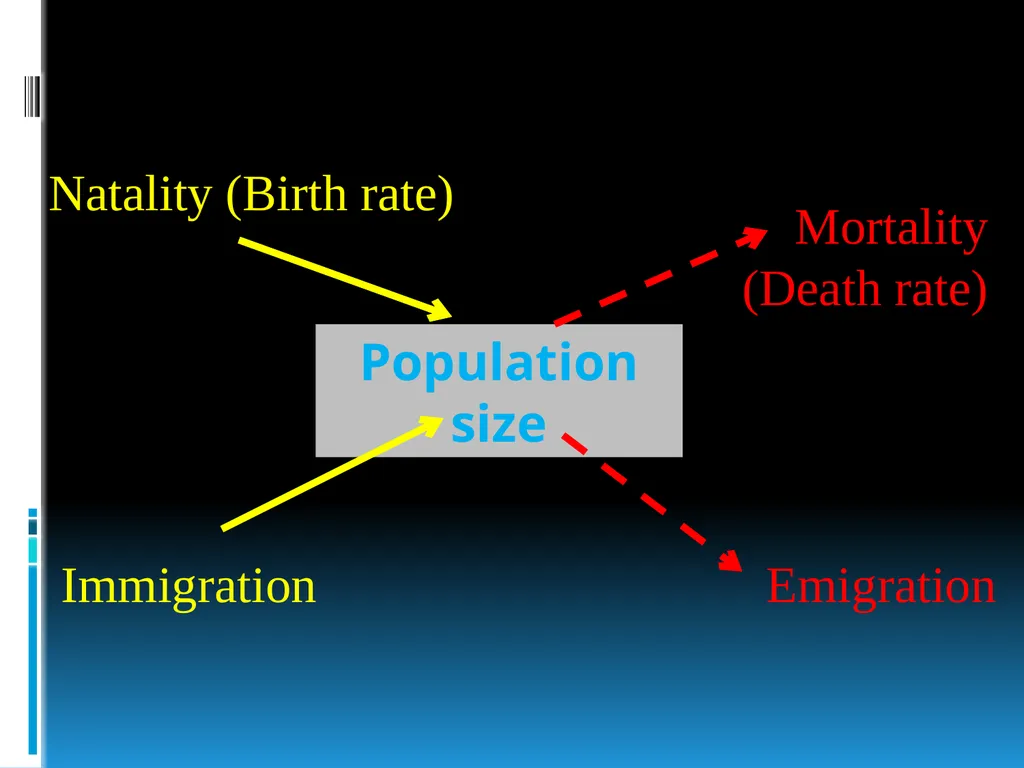
Population size Emigration Mortality
(Death rate) Immigration Natality (Birth rate)<br>
06
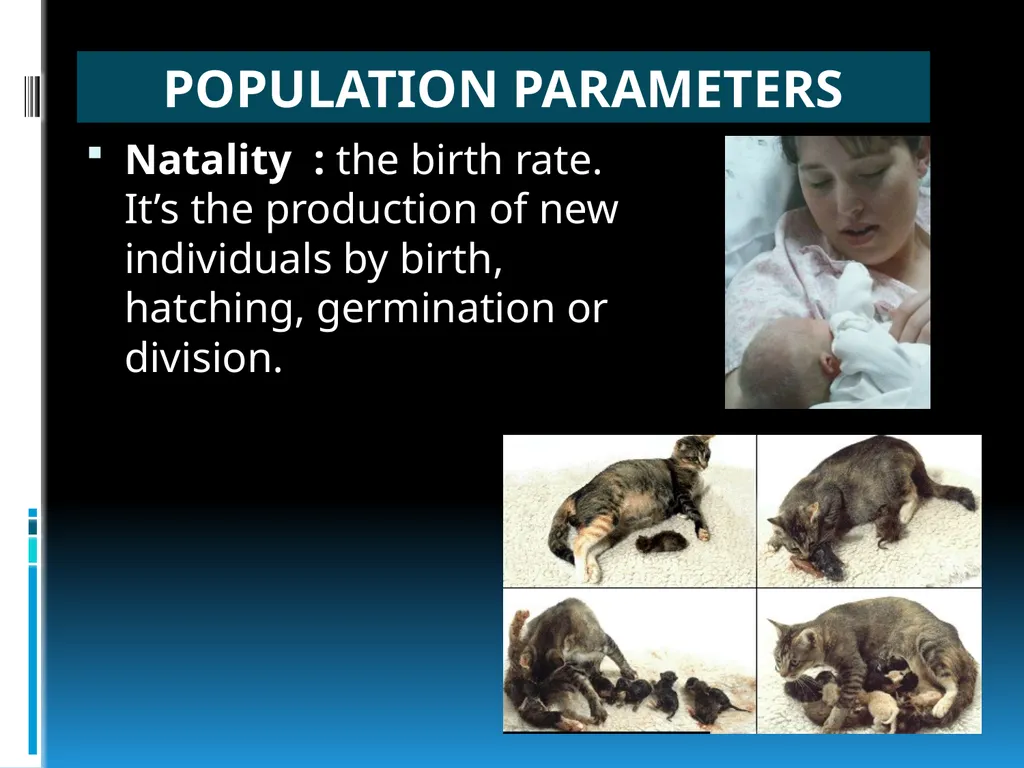
Natality : the birth rate. It’s the production of new individuals by birth, hatching, germination or division. POPULATION PARAMETERS<br>
07
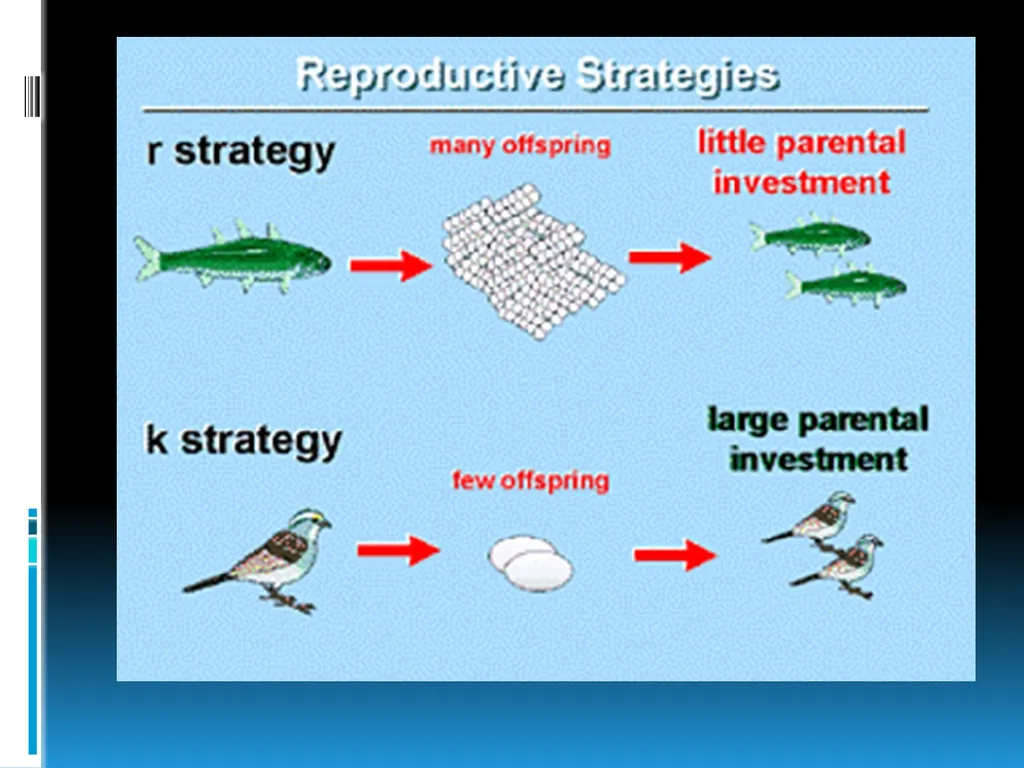
Natality strategies R-STRATEGY
Many offspring
Low parental care and low chances of survival
Typical of pioneer species
e.g. ?
K-STRATEGY
Few offspring
High amount of parental care and survival
Usually climax species.
e.g. ?<br>
08
Human natality Fertility rate- no. of births per 1000 females of child-bearing age per year.
Fecundity rate- Average number of children born in one generation per female of child-bearing age.<br>
09
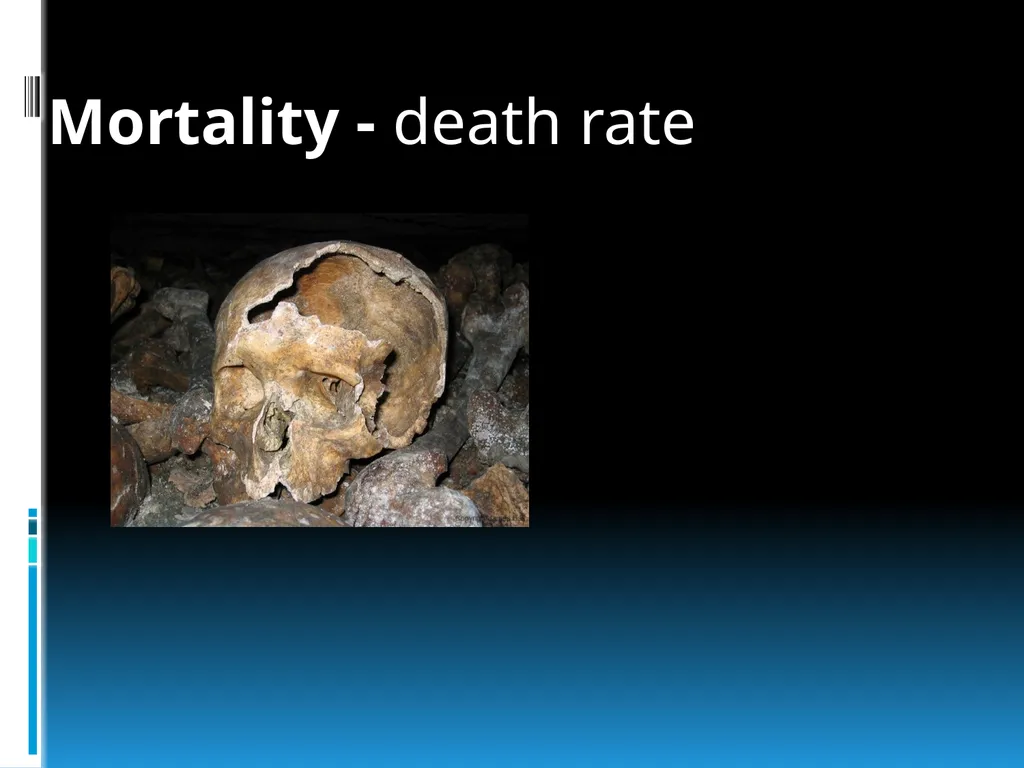
Mortality - death rate<br>
10
SURVIVORSHIP CURVES PG 272-273<br>
11
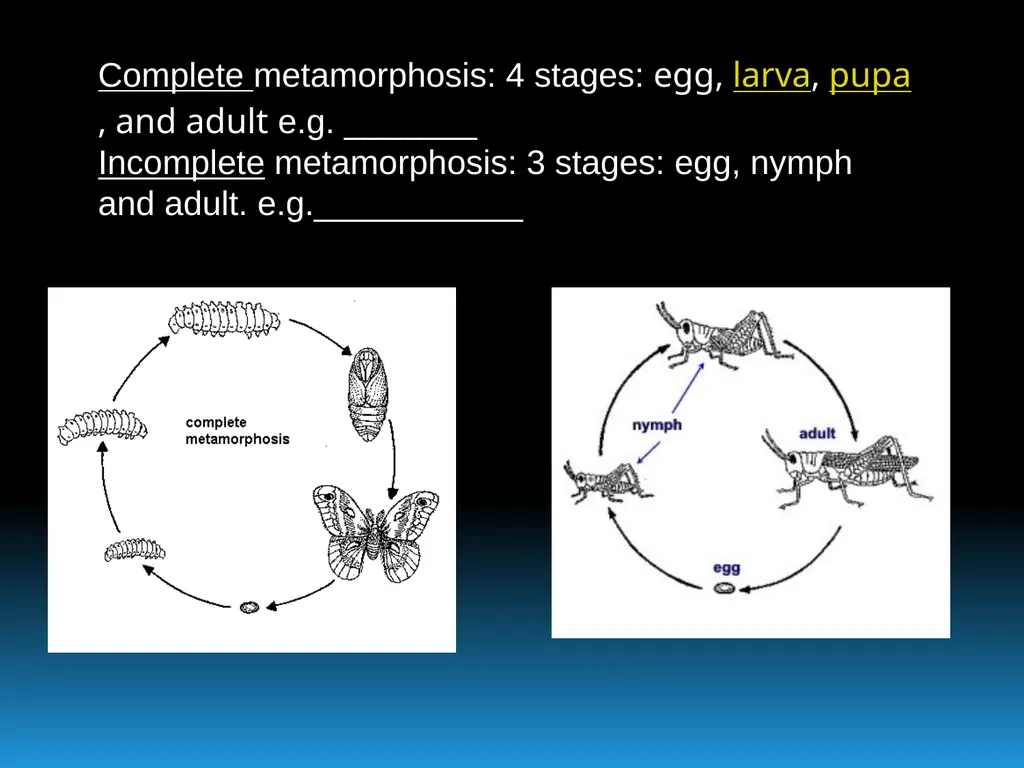
Complete metamorphosis: 4 stages: egg, larva, pupa , and adult e.g. _______
Incomplete metamorphosis: 3 stages: egg, nymph and adult. e.g.___________<br>
12
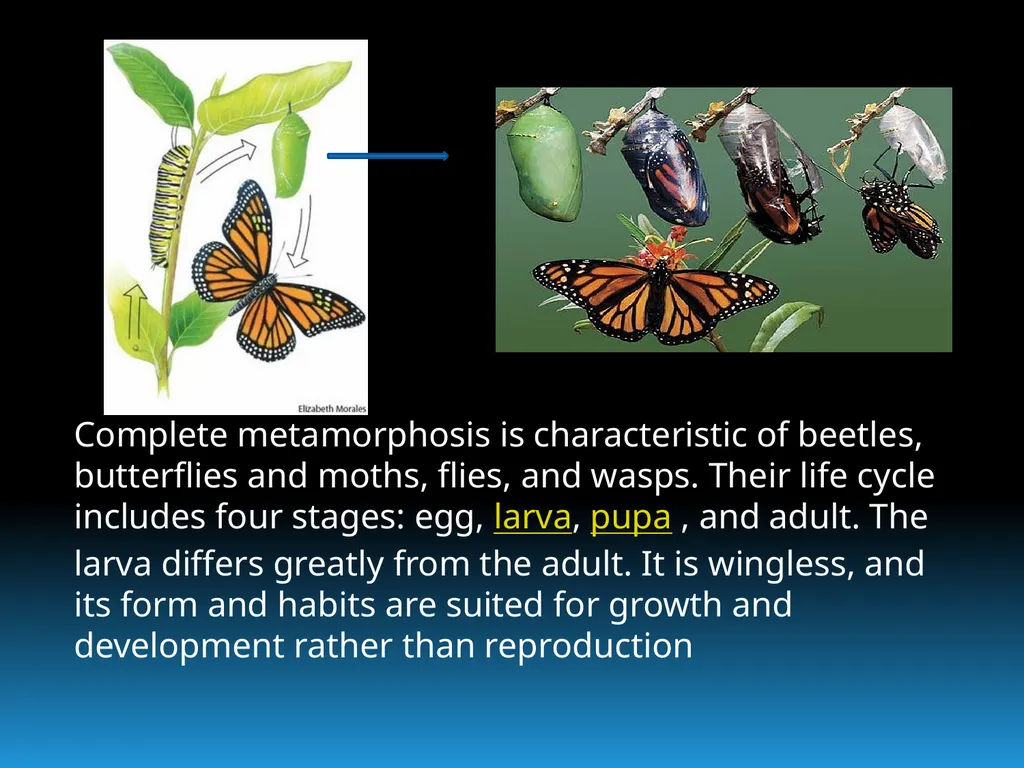
Complete metamorphosis is characteristic of beetles, butterflies and moths, flies, and wasps. Their life cycle includes four stages: egg, larva, pupa , and adult. The larva differs greatly from the adult. It is wingless, and its form and habits are suited for growth and development rather than reproduction<br>
13
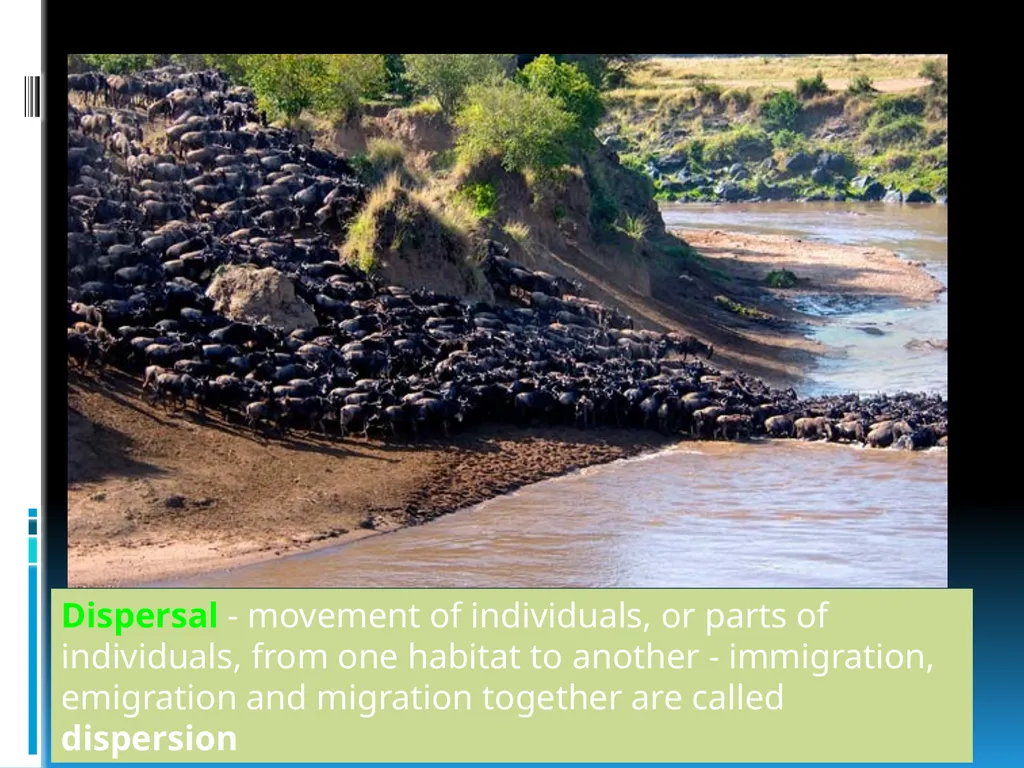
Dispersal - movement of individuals, or parts of individuals, from one habitat to another - immigration, emigration and migration together are called dispersion<br>
14
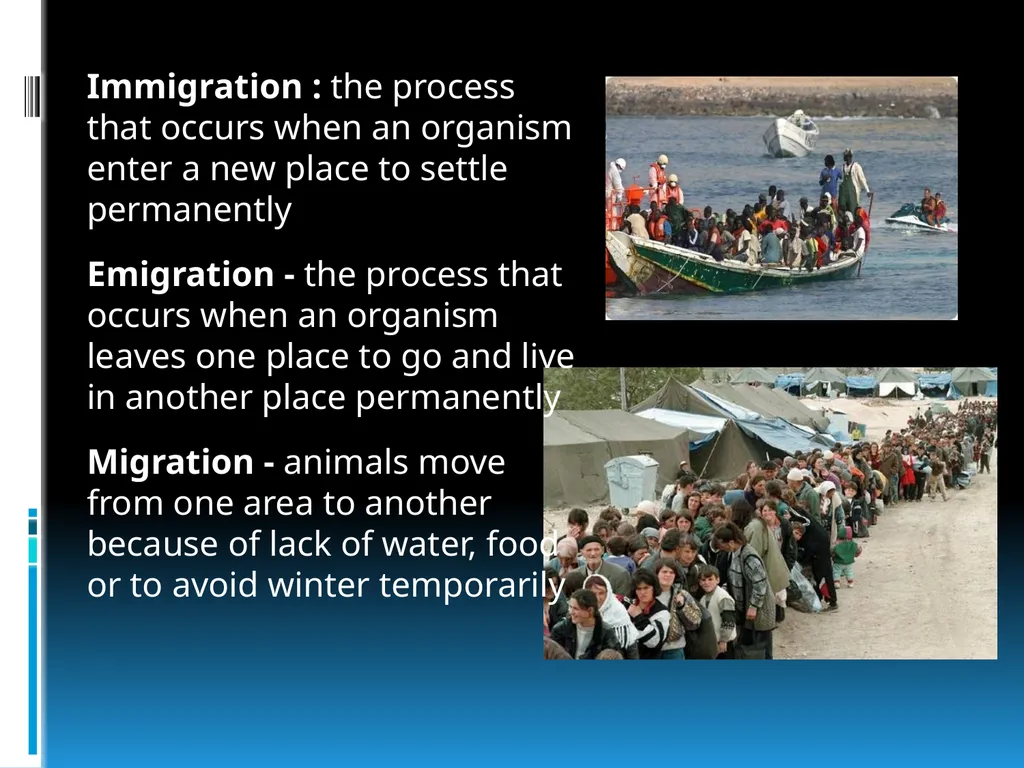
Immigration : the process that occurs when an organism enter a new place to settle permanently
Emigration - the process that occurs when an organism leaves one place to go and live in another place permanently
Migration - animals move from one area to another because of lack of water, food or to avoid winter temporarily<br>
15
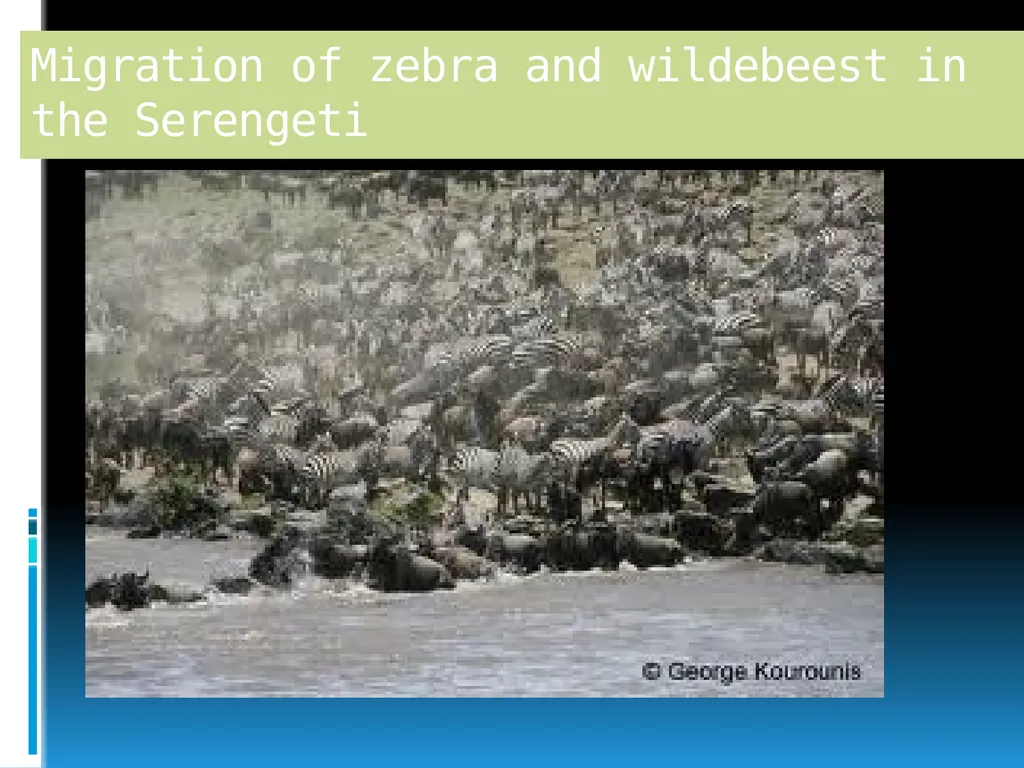
Migration of zebra and wildebeest in the Serengeti<br>
16
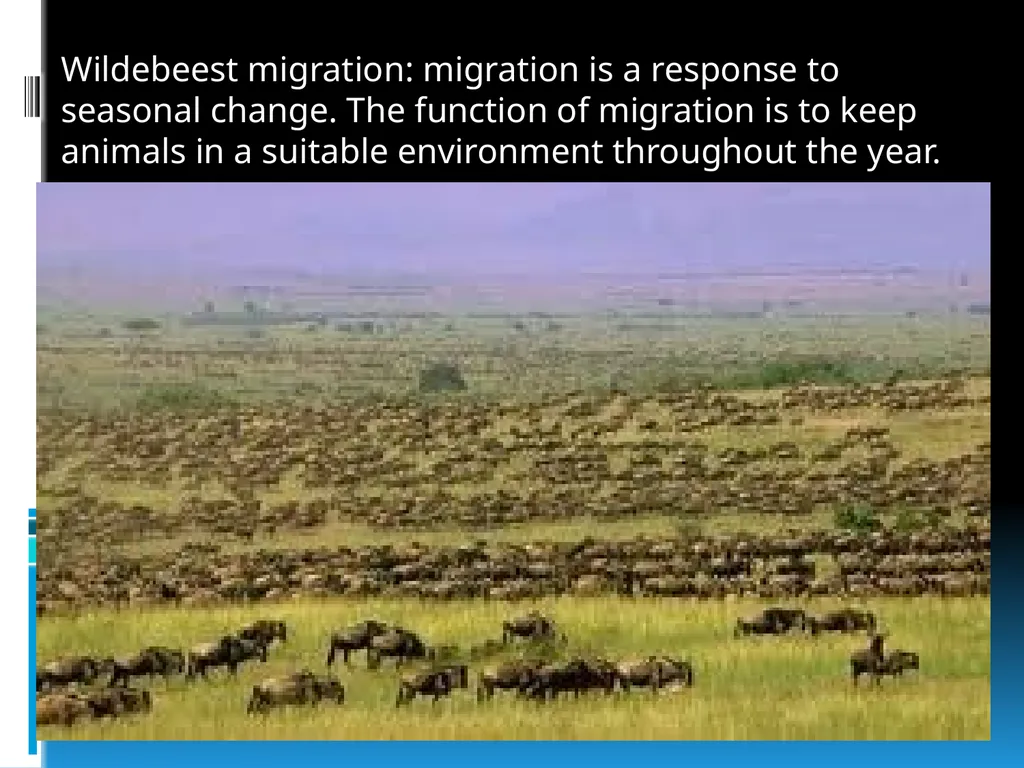
Wildebeest migration: migration is a response to seasonal change. The function of migration is to keep animals in a suitable environment throughout the year. Wildebeest migration: migration is a response to seasonal change. The function of migration is to keep animals in a suitable environment throughout the year.<br>
17
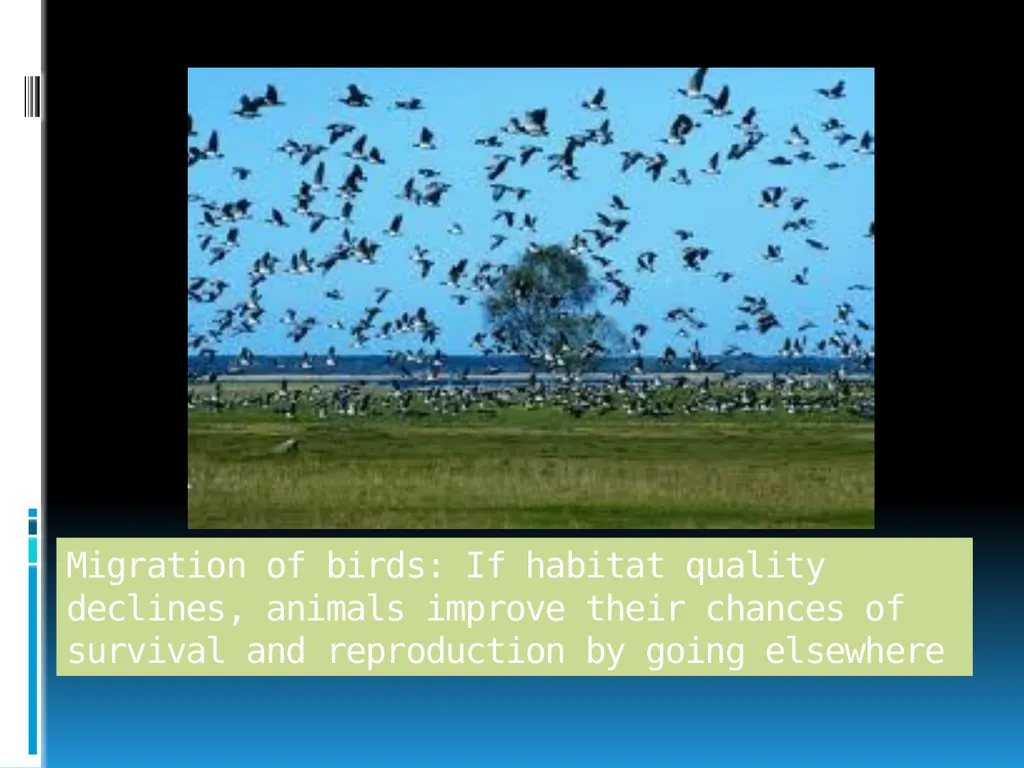
Migration of birds: If habitat quality declines, animals improve their chances of survival and reproduction by going elsewhere<br>
18
Effects of dispersal are affected by:
Population density and
Time between movements (rate)<br>
20
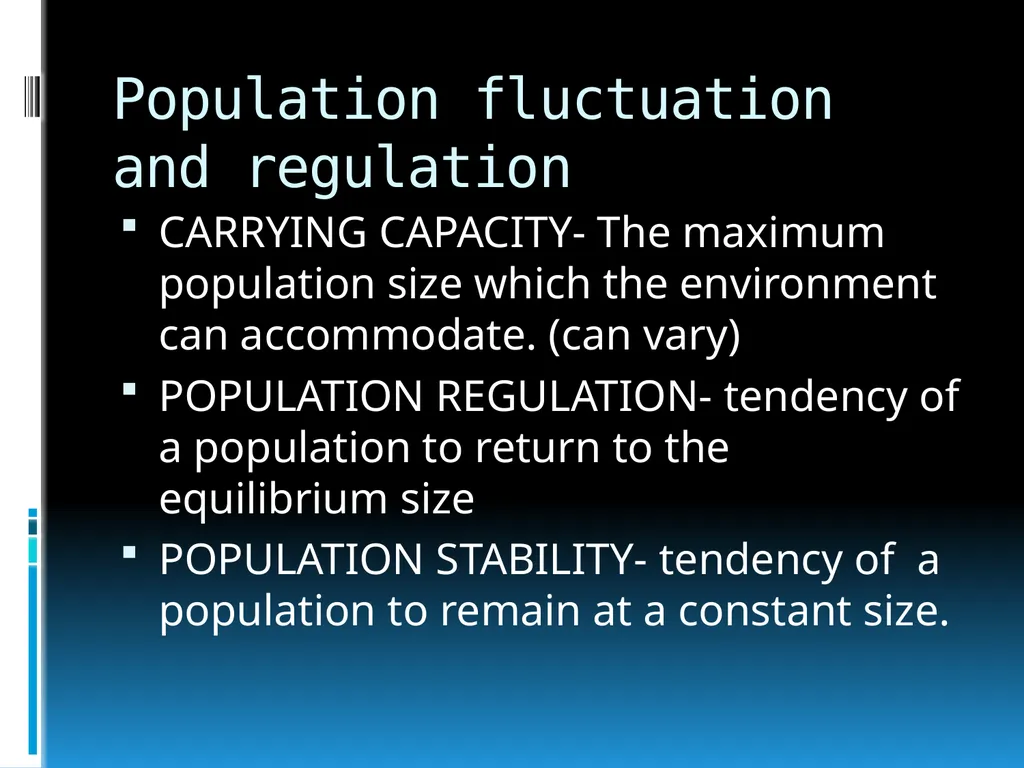
Population fluctuation and regulation CARRYING CAPACITY- The maximum population size which the environment can accommodate. (can vary)
POPULATION REGULATION- tendency of a population to return to the equilibrium size
POPULATION STABILITY- tendency of a population to remain at a constant size.<br>
21
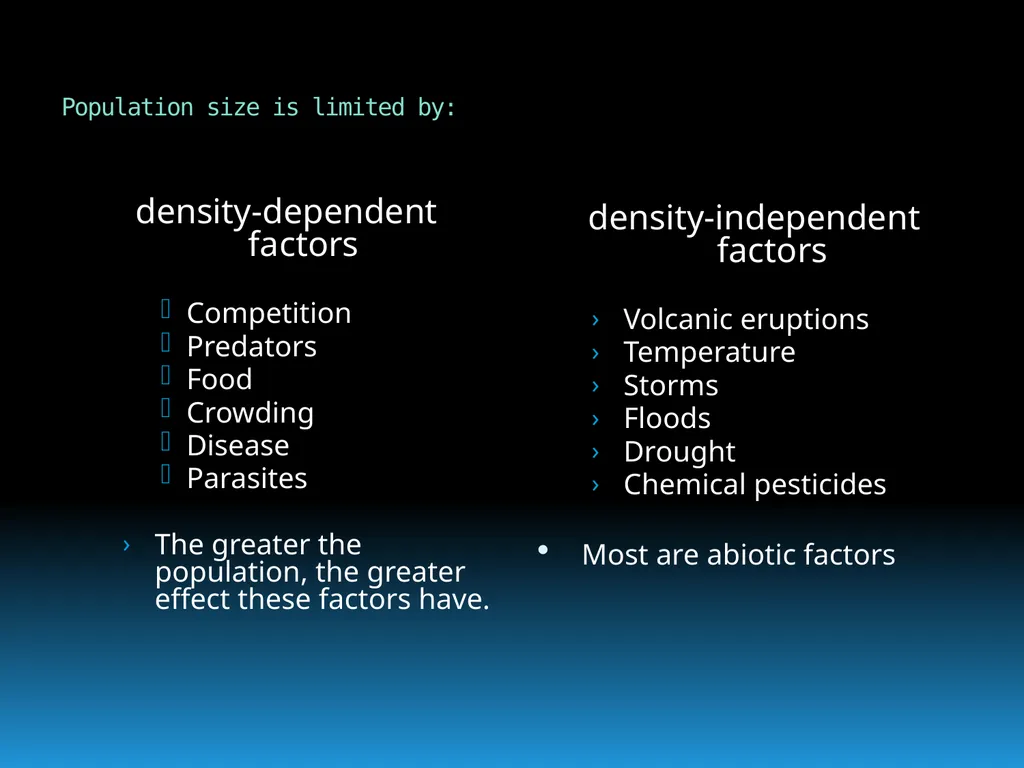
Population size is limited by: density-dependent factors
Competition
Predators
Food
Crowding
Disease
Parasites
The greater the population, the greater effect these factors have. density-independent factors
Volcanic eruptions
Temperature
Storms
Floods
Drought
Chemical pesticides
Most are abiotic factors<br>
22
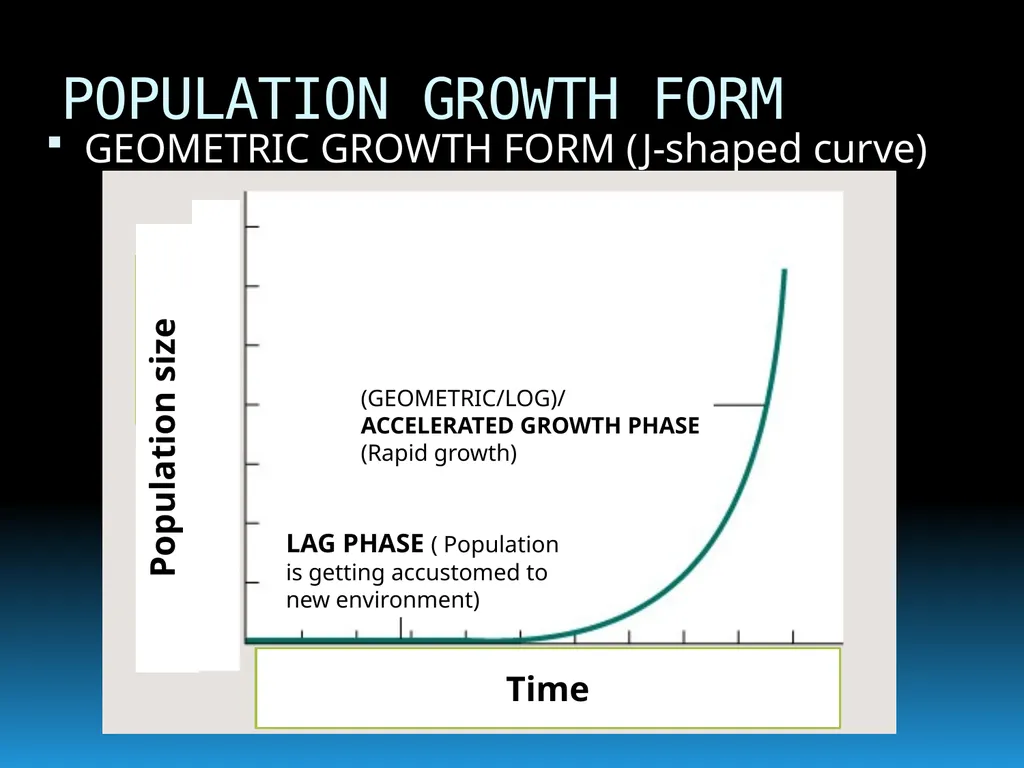
POPULATION GROWTH FORM GEOMETRIC GROWTH FORM (J-shaped curve) LAG PHASE ( Population is getting accustomed to new environment) (GEOMETRIC/LOG)/ACCELERATED GROWTH PHASE (Rapid growth) Time Population size<br>
23
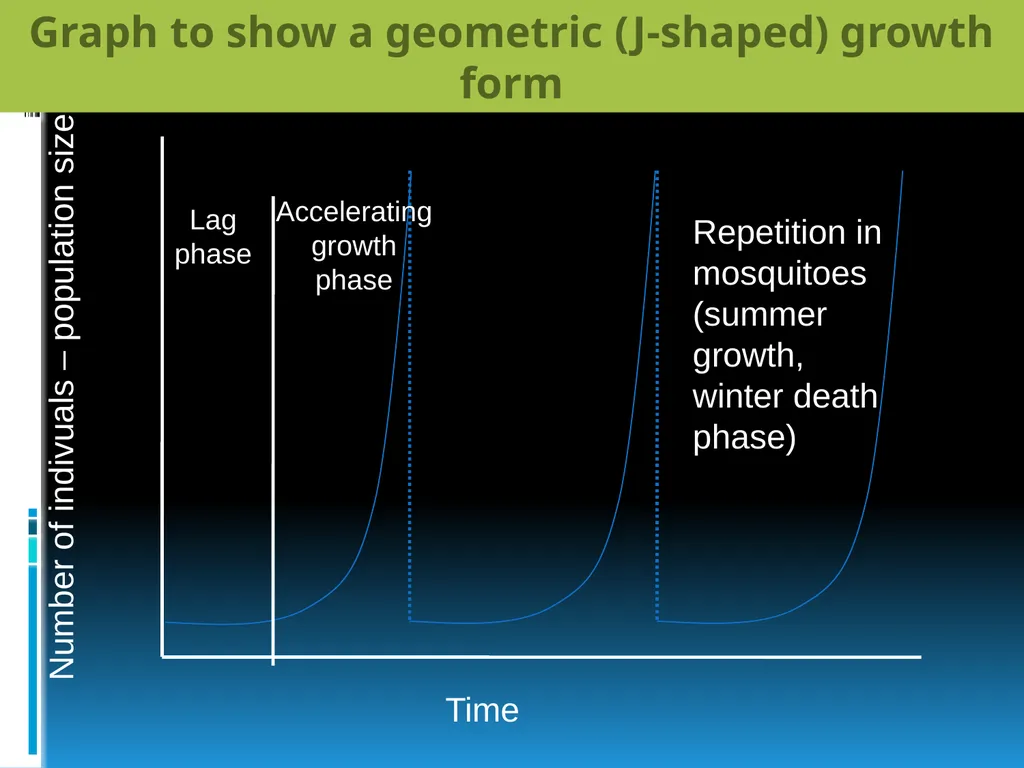
Time Number of indivuals – population size Graph to show a geometric (J-shaped) growth form Lag phase Accelerating growth phase Repetition in mosquitoes (summer growth, winter death phase)<br>
24
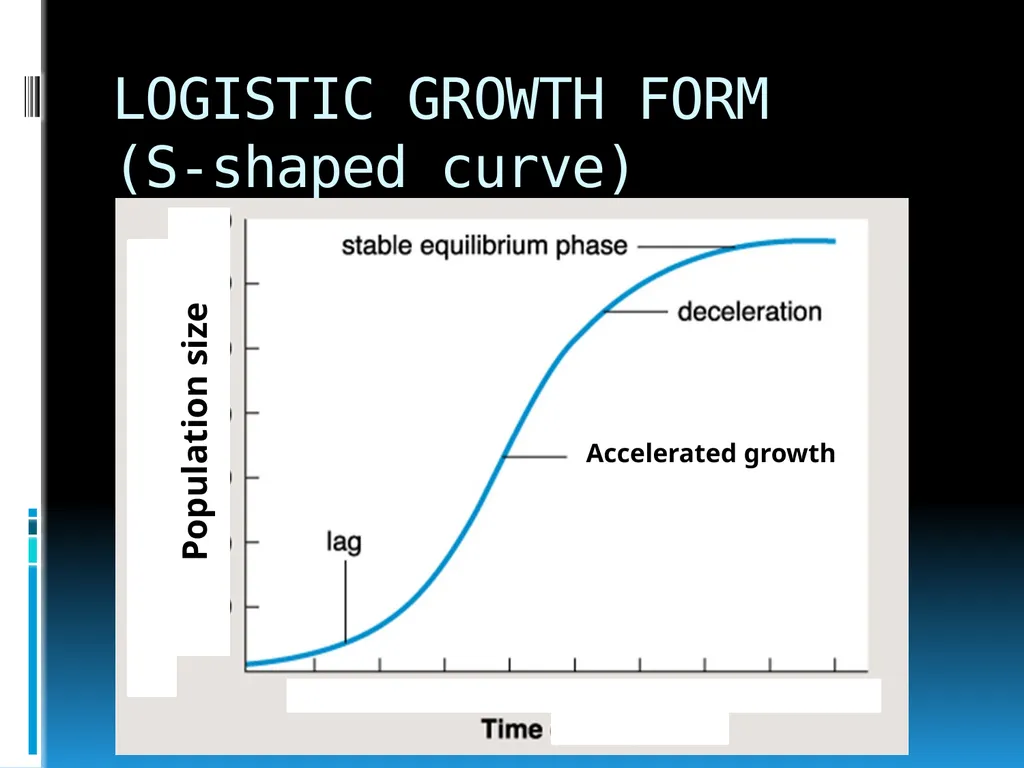
LOGISTIC GROWTH FORM �(S-shaped curve) Accelerated growth Population size<br>
25
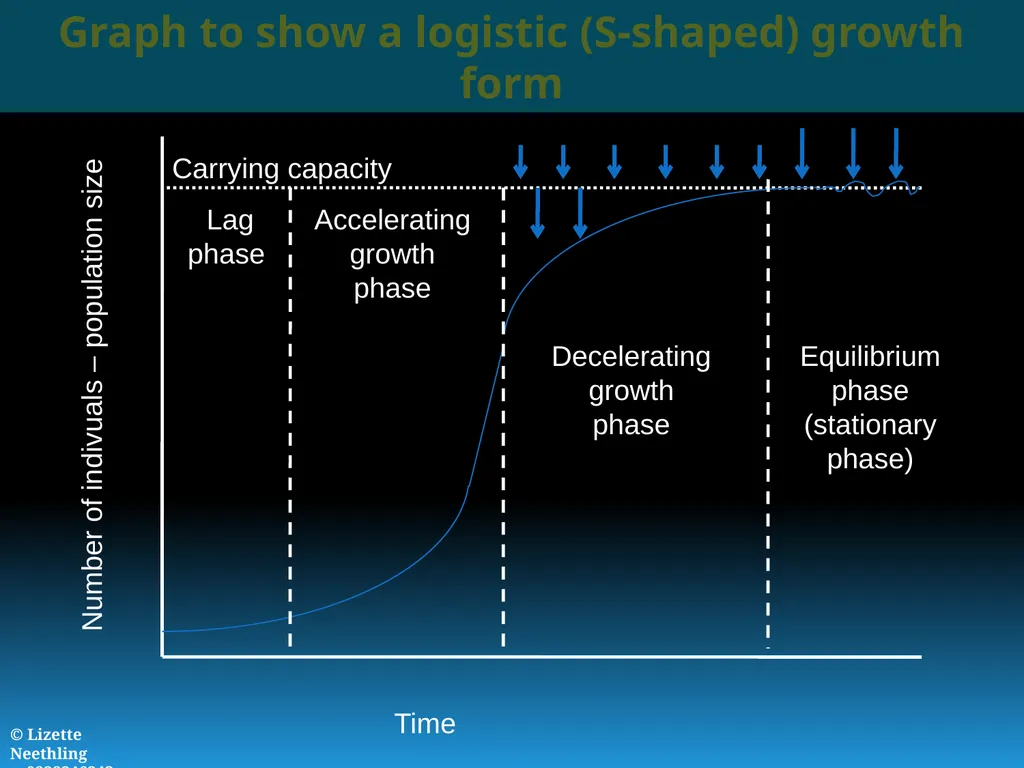
Time Number of indivuals – population size Carrying capacity Lag phase Accelerating growth phase Decelerating growth phase Equilibrium phase
(stationary phase) Environmental resistance Graph to show a logistic (S-shaped) growth form © Lizette Neethling
0828246343<br>
26
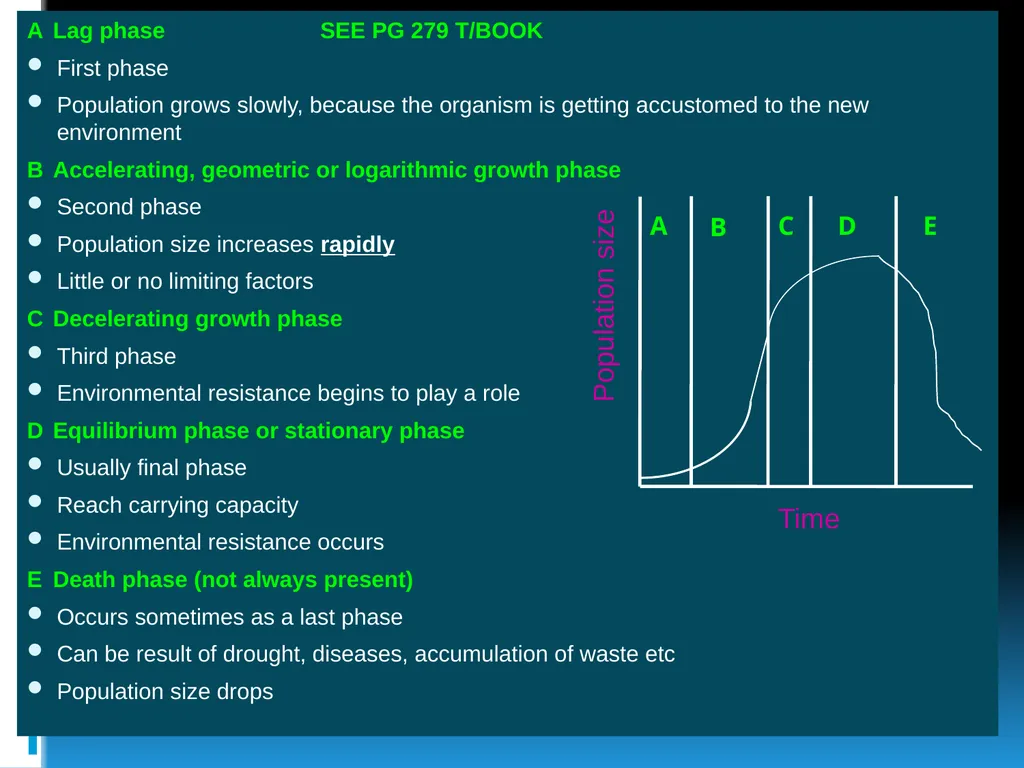
A Lag phase SEE PG 279 T/BOOK
First phase
Population grows slowly, because the organism is getting accustomed to the new environment
B Accelerating, geometric or logarithmic growth phase
Second phase
Population size increases rapidly
Little or no limiting factors
C Decelerating growth phase
Third phase
Environmental resistance begins to play a role
D Equilibrium phase or stationary phase
Usually final phase
Reach carrying capacity
Environmental resistance occurs
E Death phase (not always present)
Occurs sometimes as a last phase
Can be result of drought, diseases, accumulation of waste etc
Population size drops Time Population size A B C D E<br>
27
ACTIVTIY 3.1.2 pg 280�PART A- Classwork/homework<br>
28
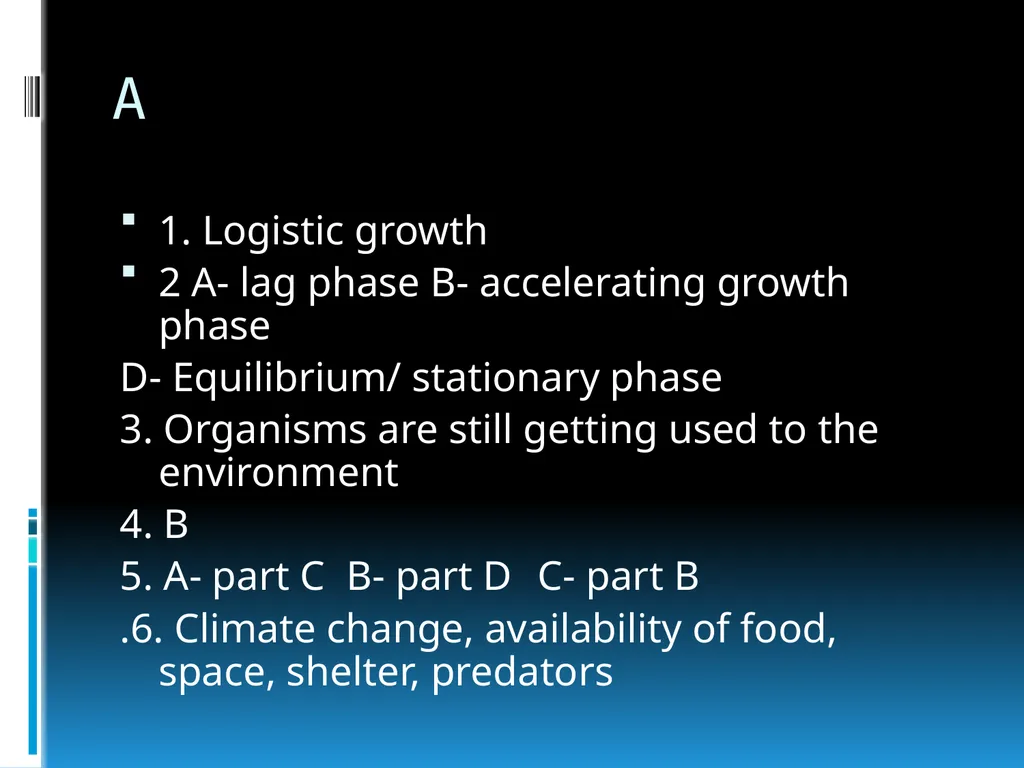
A 1. Logistic growth
2 A- lag phase B- accelerating growth phase
D- Equilibrium/ stationary phase
3. Organisms are still getting used to the environment
4. B
5. A- part C B- part D C- part B
.6. Climate change, availability of food, space, shelter, predators<br>
29
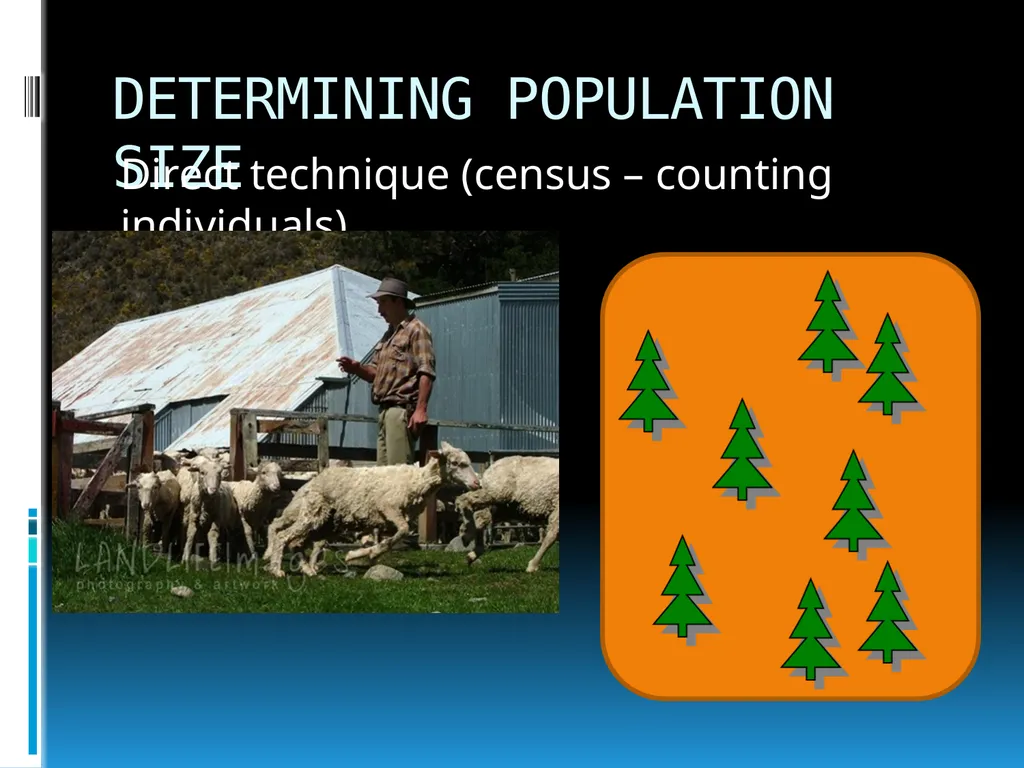
DETERMINING POPULATION SIZE Direct technique (census – counting individuals)<br>
30
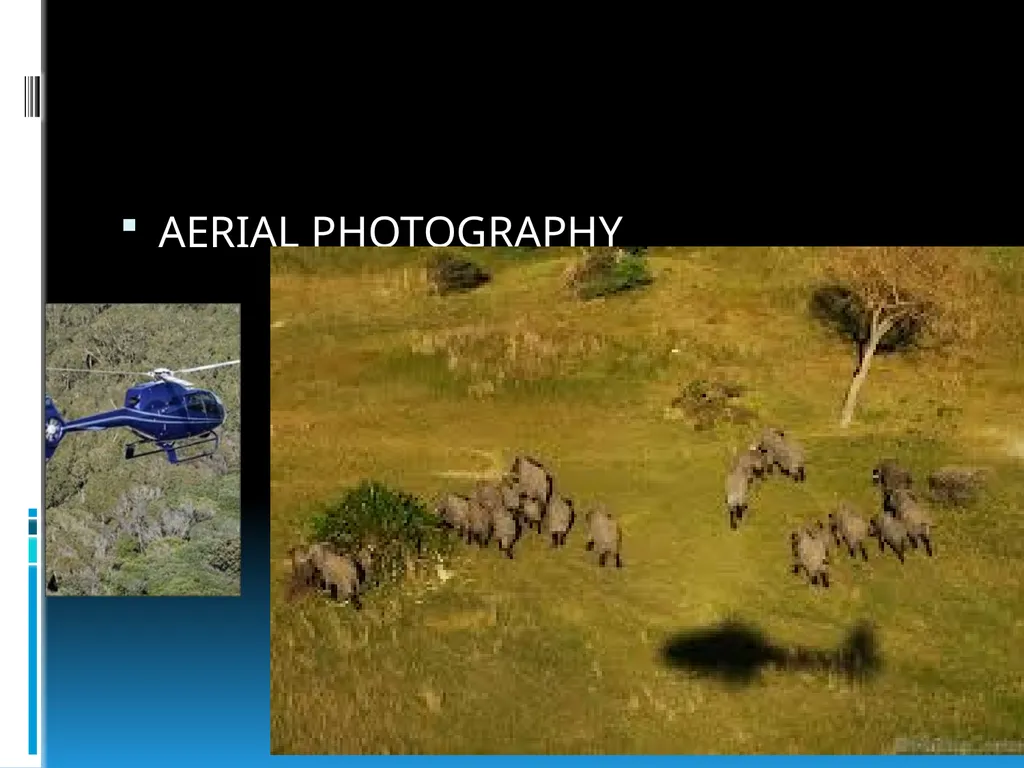
AERIAL PHOTOGRAPHY<br>
31
The direct method – best for slow moving organisms<br>
32
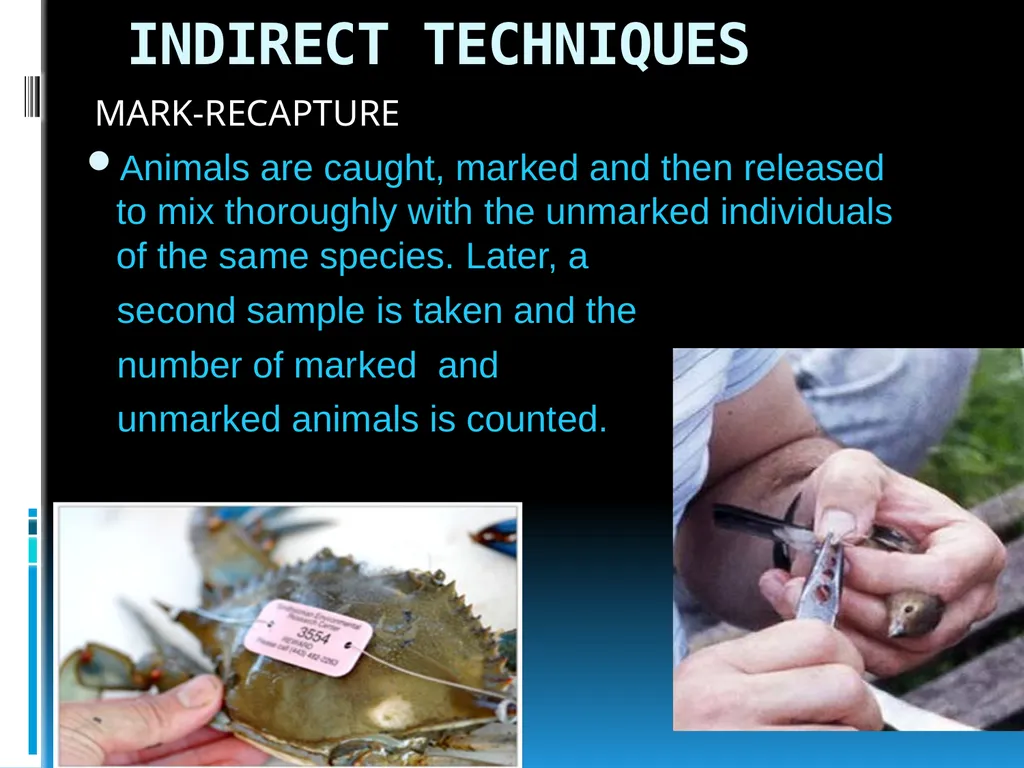
INDIRECT TECHNIQUES MARK-RECAPTURE
Animals are caught, marked and then released to mix thoroughly with the unmarked individuals of the same species. Later, a
second sample is taken and the
number of marked and
unmarked animals is counted.<br>
33
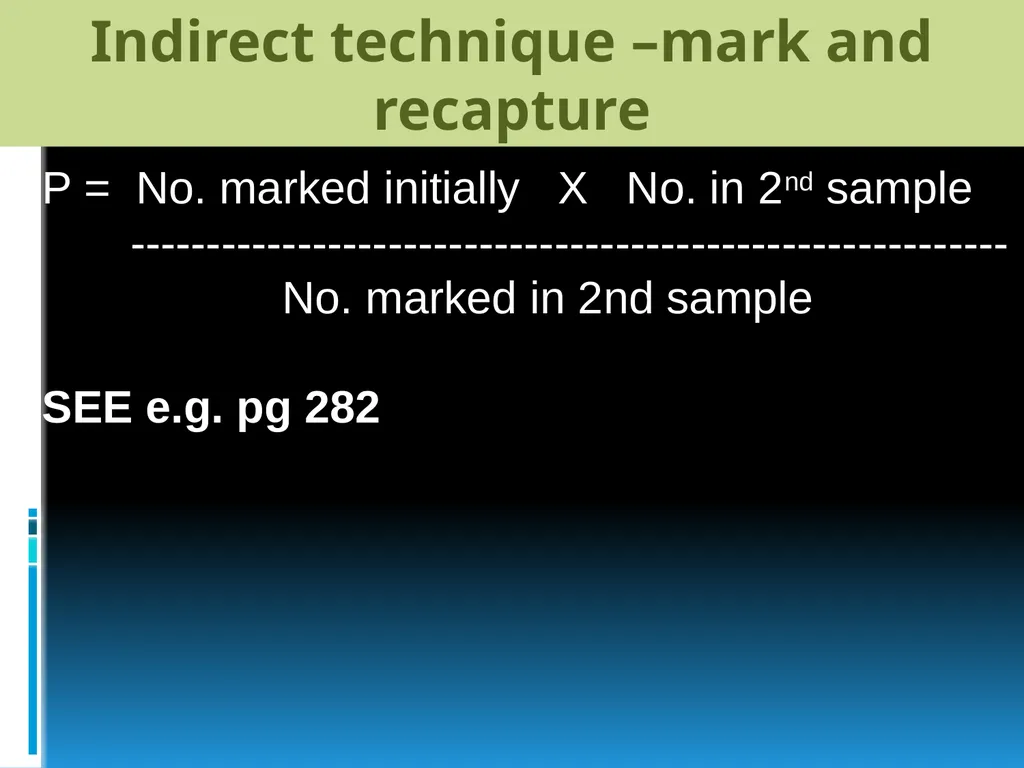
P = No. marked initially X No. in 2nd sample� ----------------------------------------------------------� No. marked in 2nd sample
SEE e.g. pg 282 Indirect technique –mark and recapture<br>
34
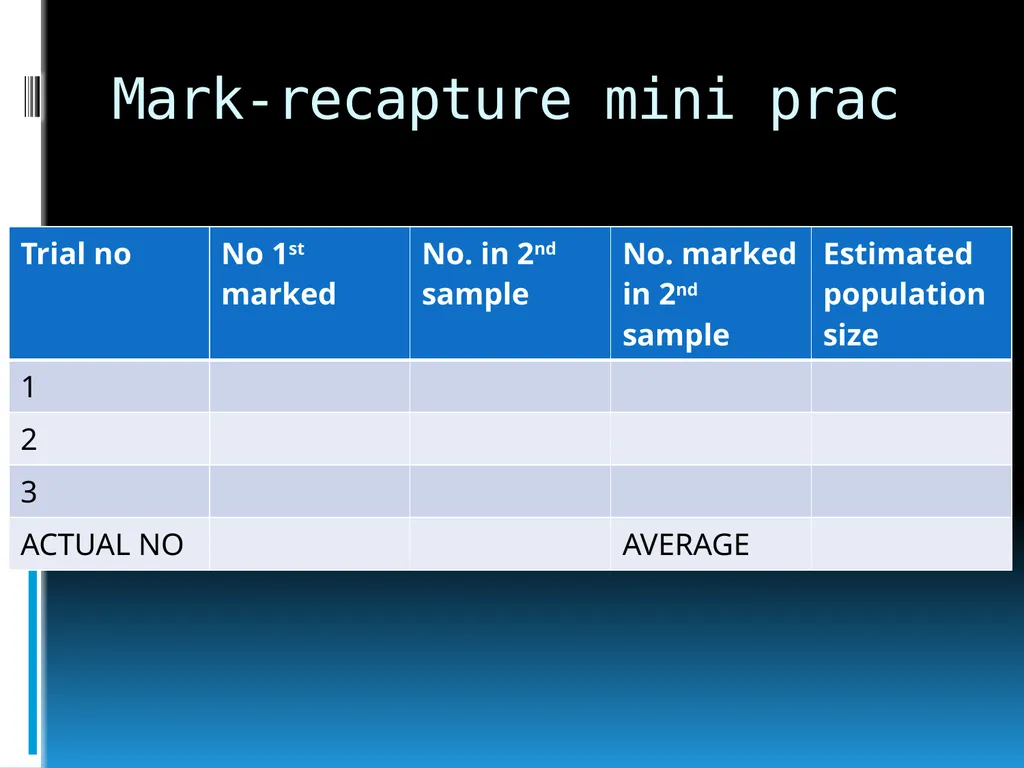
Mark-recapture mini prac<br>
35
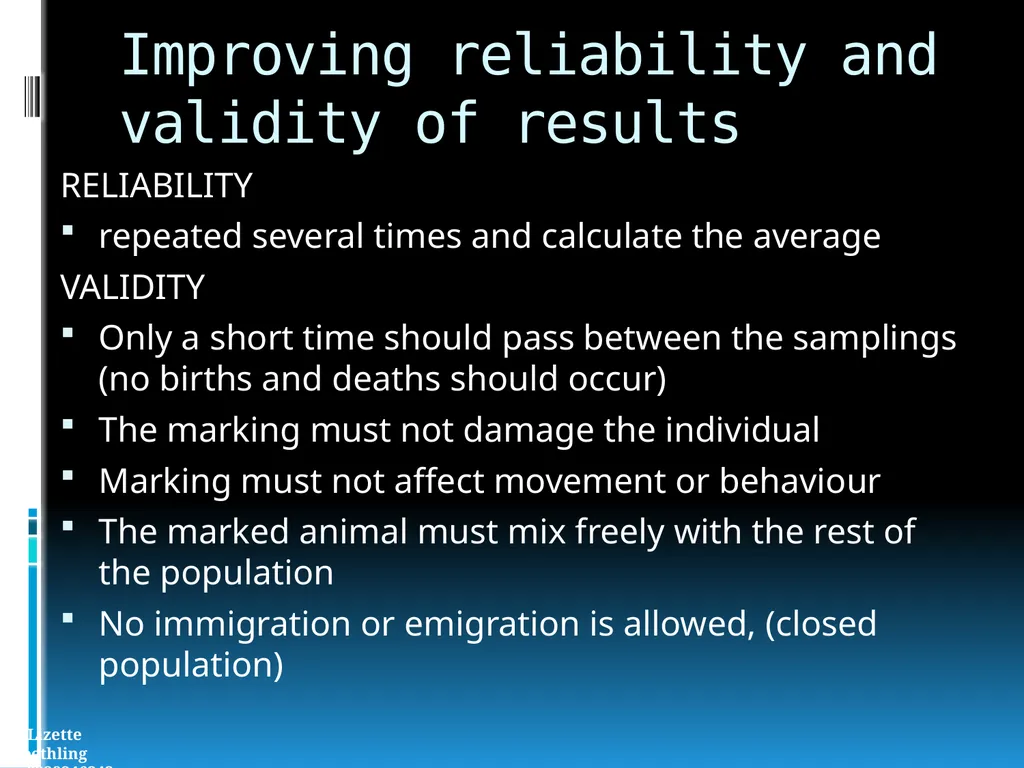
RELIABILITY
repeated several times and calculate the average
VALIDITY
Only a short time should pass between the samplings (no births and deaths should occur)
The marking must not damage the individual
Marking must not affect movement or behaviour
The marked animal must mix freely with the rest of the population
No immigration or emigration is allowed, (closed population) © Lizette Neethling
0828246343 Improving reliability and validity of results<br>
36
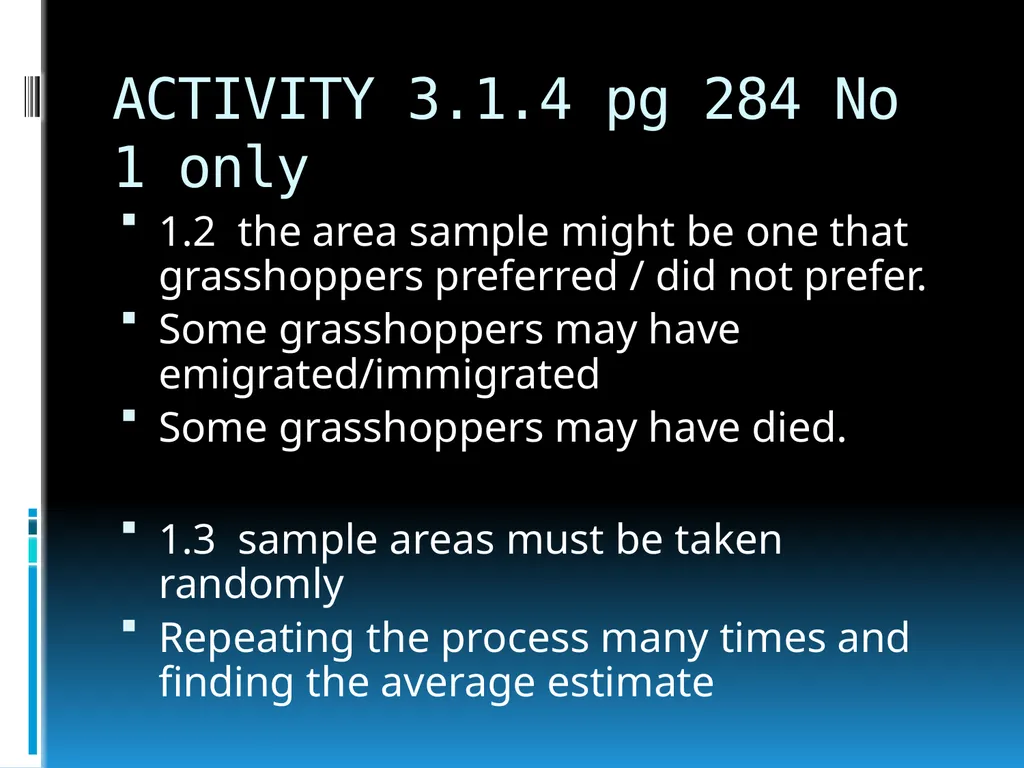
ACTIVITY 3.1.4 pg 284 No 1 only 1.2 the area sample might be one that grasshoppers preferred / did not prefer.
Some grasshoppers may have emigrated/immigrated
Some grasshoppers may have died.
1.3 sample areas must be taken randomly
Repeating the process many times and finding the average estimate<br>
37
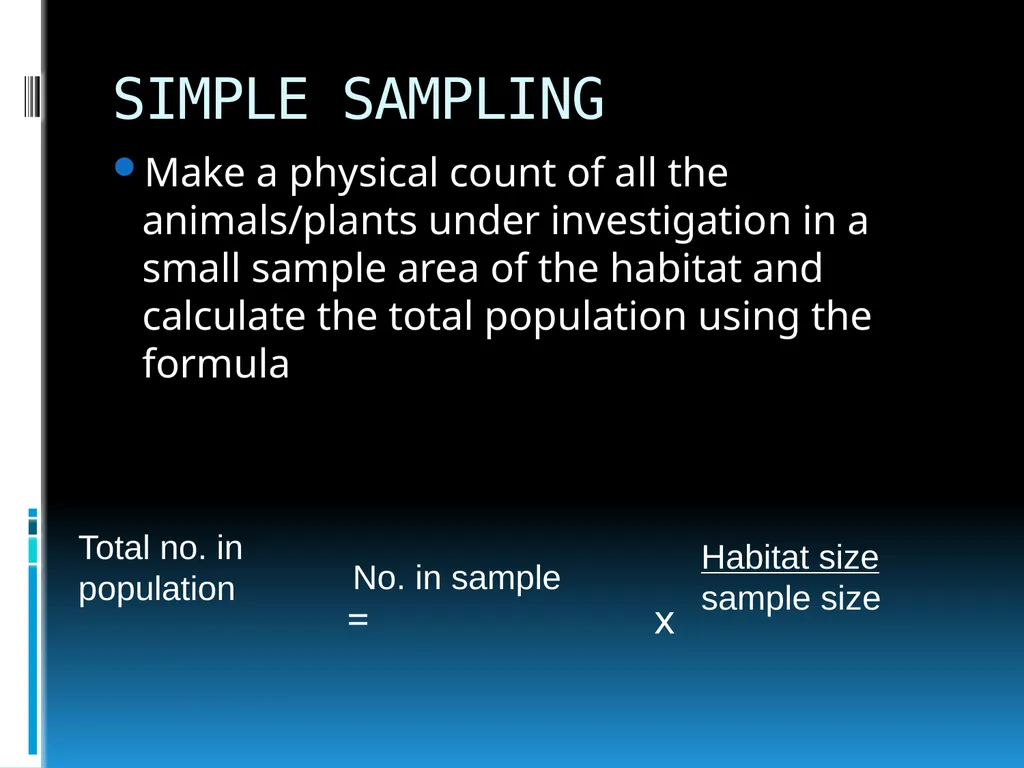
SIMPLE SAMPLING Make a physical count of all the animals/plants under investigation in a small sample area of the habitat and calculate the total population using the formula
= x Total no. in population No. in sample Habitat size sample size<br>
38
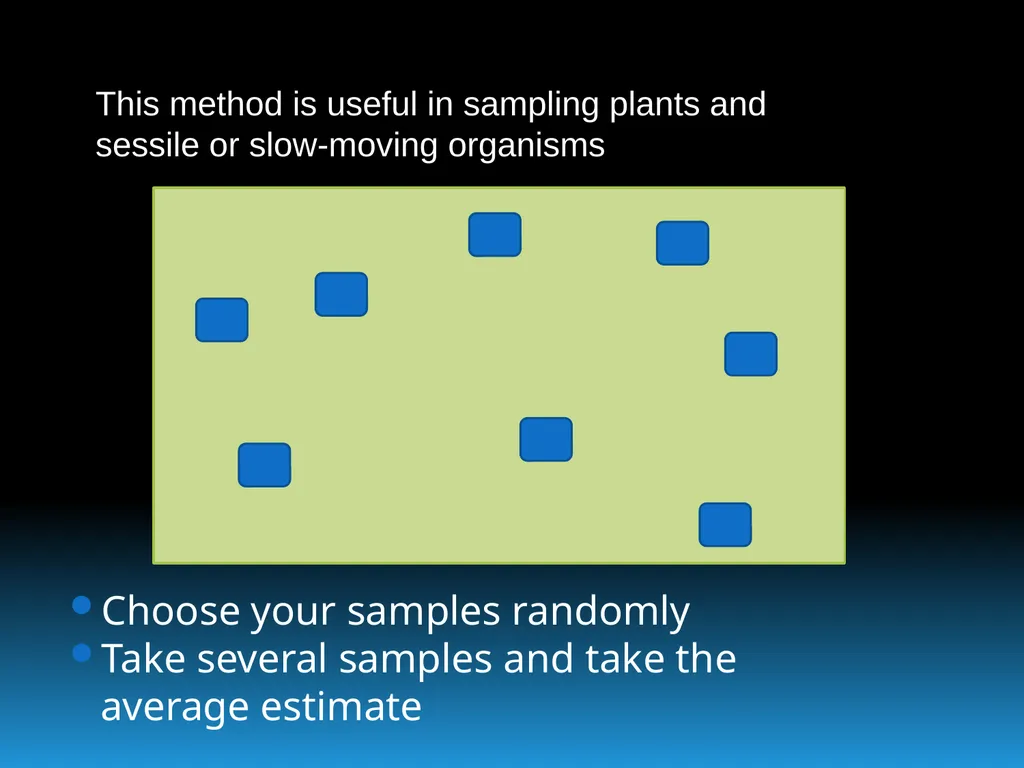
This method is useful in sampling plants and sessile or slow-moving organisms Choose your samples randomly
Take several samples and take the
average estimate<br>
39
Random sampling: a sample that is not deliberately selected but is selected by chance. This means that any area being sampled or any individual in a population being sampled has an equal probability of being selected<br>
40
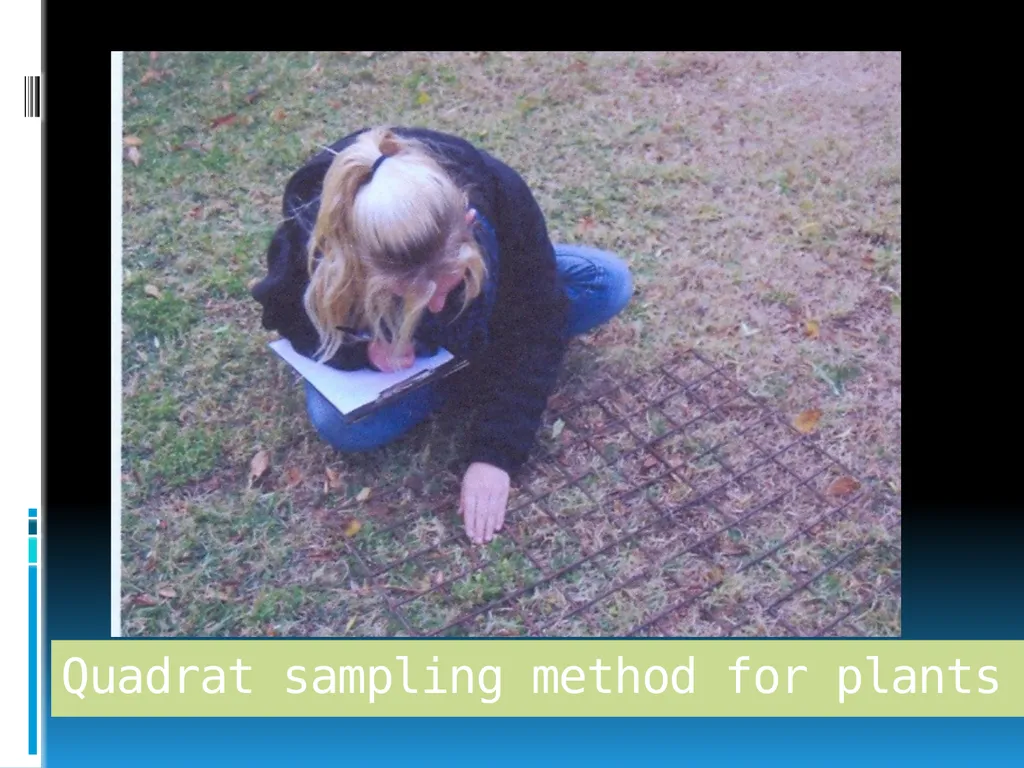
Quadrat sampling method for plants<br>
41
ACTIVITY 3.1.6 PG 287 For the counting, those that are in the block or half or more in are counted as being in.<br>