
Equal Opportunity & Nondiscrimination Investigator



Description: Equal Opportunity Nondiscrimination Investigator Training Human Resources Division August 6-7, 2025 MinnState.edu Outline of Todays Presentation Brief review Investigation Techniques Designated Officer Tasks Jurisdiction and scope
Related Topics
Download Presentation
"Equal Opportunity & Nondiscrimination Investigator" is the property of its rightful owner. Permission is granted to download and print the materials on this website for personal, non-commercial use only, and to display it on your personal computer provided you do not modify the materials and that you retain all copyright notices contained in the materials. By downloading content from our website, you accept the terms of this agreement.
Presentation Transcript
slide1. Equal Opportunity & Nondiscrimination Investigator Training Human Resources Division August 6-7, 2025 MinnState.edu<br>
slide2. Outline of Today’s Presentation Brief review
Investigation Techniques<br>
slide3. Designated Officer Tasks Jurisdiction and scope
Conflicts of interest
Interim actions re: health, safety concerns
Primary person to ensure process moves forward through each relevant step of the procedure
Release of information requests<br>
slide4. Investigator Tasks Conducts a fact-finding inquiry or investigation of the complaint, including scheduling and holding interviews and requesting record information; may delegate this to another trained investigator
Informs involved parties of right a union representative or support person to accompany them during investigative interviews, as appropriate
Informs involved parties of the protection and prohibition of retaliation per policy
Creates, gathers, and maintains investigative documents as appropriate<br>
slide5. Investigator, Continued Writes investigation report with organized attachments
Outlines facts in the investigative report based on information collected through the interview process and review of gathered documents
Primary person to ensure process moves forward through the investigative steps
Handles all data in accordance with applicable federal and state privacy laws, consulting with the campus Data Practices Officer when necessary
Provides all investigative materials to the Designated Officer for recordkeeping<br>
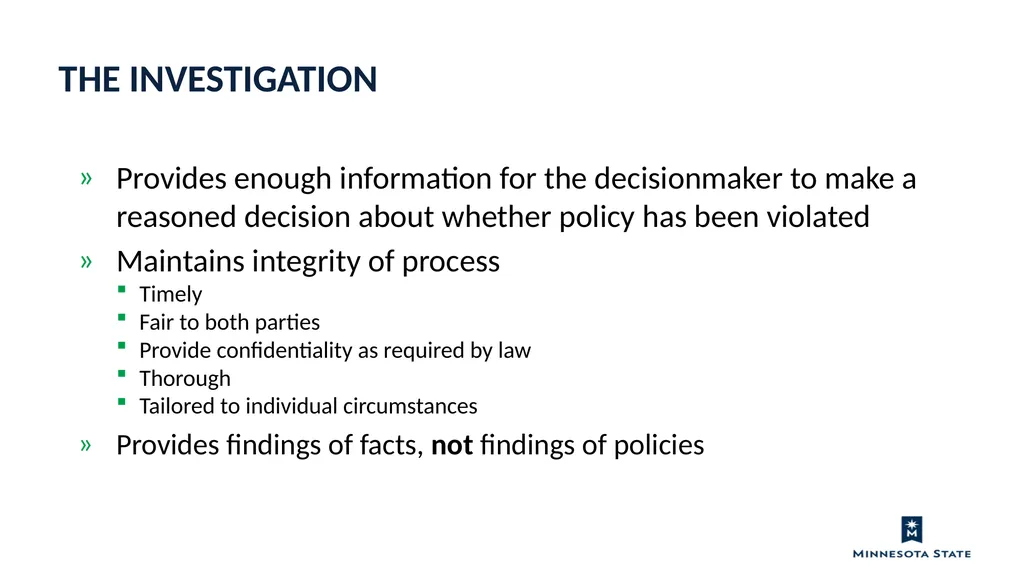
slide6. The Investigation Provides enough information for the decisionmaker to make a reasoned decision about whether policy has been violated
Maintains integrity of process
Timely
Fair to both parties
Provide confidentiality as required by law
Thorough
Tailored to individual circumstances
Provides findings of facts, not findings of policies<br>
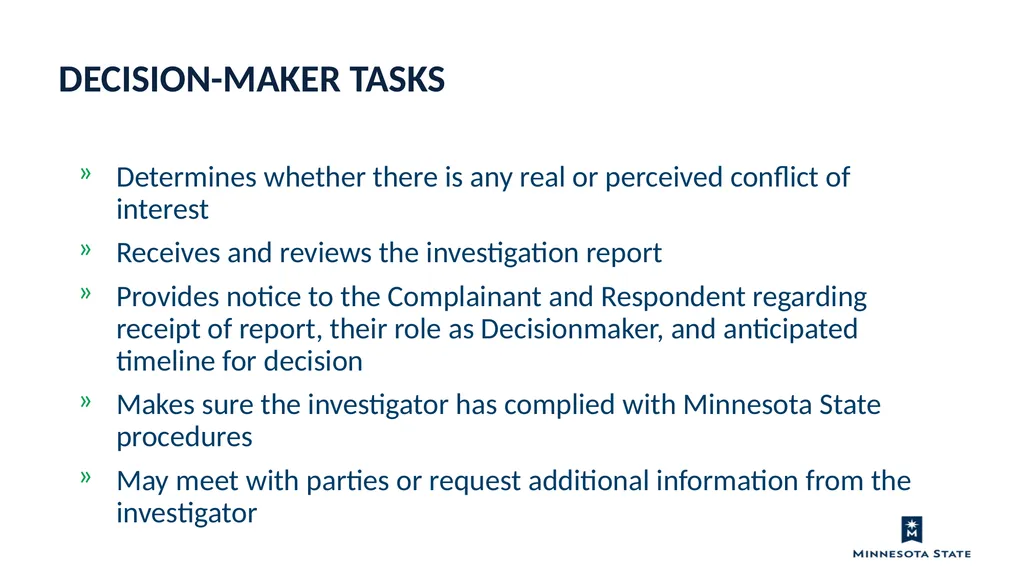
slide7. Decision-maker Tasks Determines whether there is any real or perceived conflict of interest
Receives and reviews the investigation report
Provides notice to the Complainant and Respondent regarding receipt of report, their role as Decisionmaker, and anticipated timeline for decision
Makes sure the investigator has complied with Minnesota State procedures
May meet with parties or request additional information from the investigator<br>
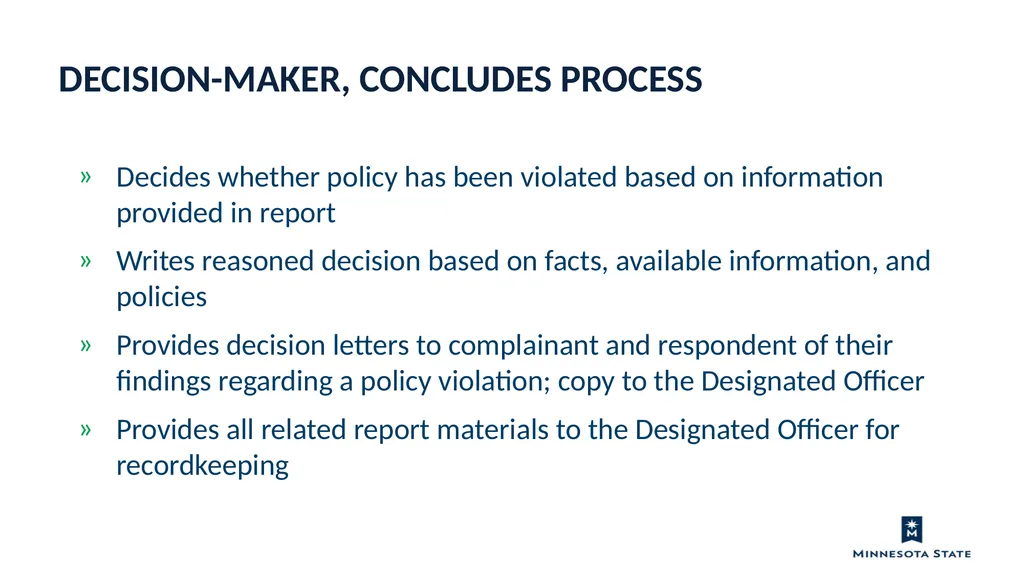
slide8. Decision-maker, concludes process Decides whether policy has been violated based on information provided in report
Writes reasoned decision based on facts, available information, and policies
Provides decision letters to complainant and respondent of their findings regarding a policy violation; copy to the Designated Officer
Provides all related report materials to the Designated Officer for recordkeeping<br>
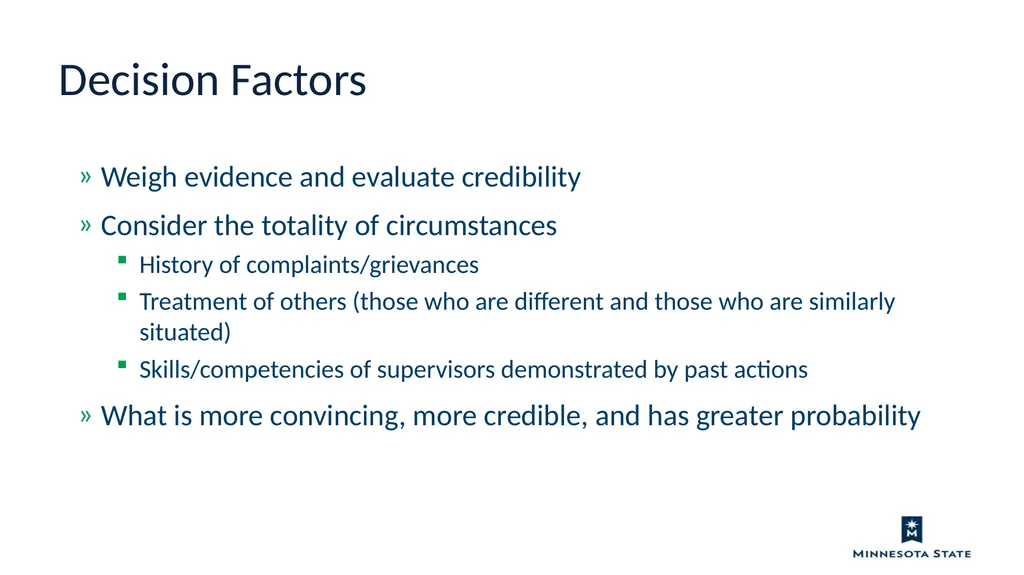
slide9. Decision Factors Weigh evidence and evaluate credibility
Consider the totality of circumstances
History of complaints/grievances
Treatment of others (those who are different and those who are similarly situated)
Skills/competencies of supervisors demonstrated by past actions
What is more convincing, more credible, and has greater probability<br>
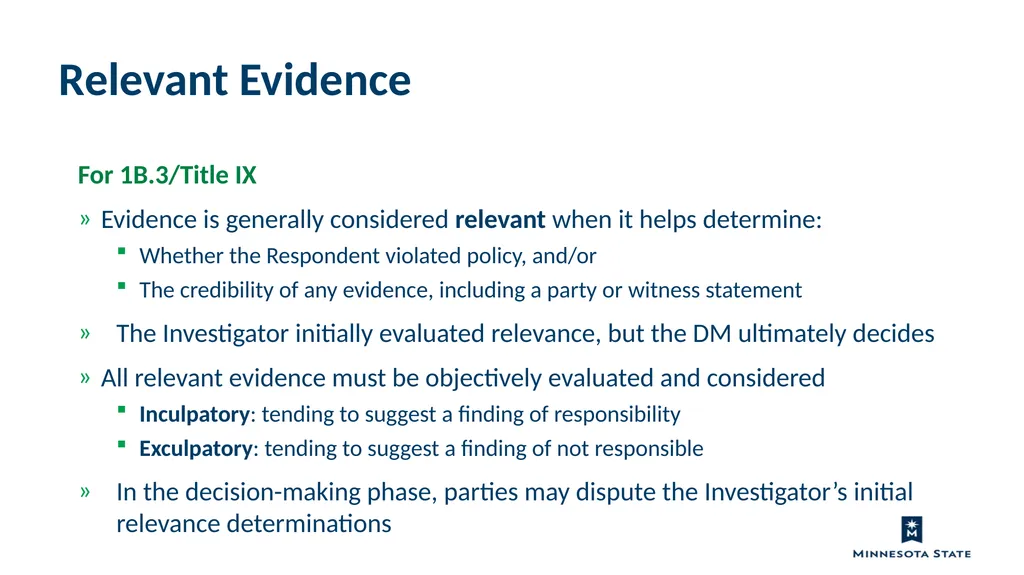
slide10. Relevant Evidence For 1B.3/Title IX
Evidence is generally considered relevant when it helps determine:
Whether the Respondent violated policy, and/or
The credibility of any evidence, including a party or witness statement
The Investigator initially evaluated relevance, but the DM ultimately decides
All relevant evidence must be objectively evaluated and considered
Inculpatory: tending to suggest a finding of responsibility
Exculpatory: tending to suggest a finding of not responsible
In the decision-making phase, parties may dispute the Investigator’s initial relevance determinations<br>
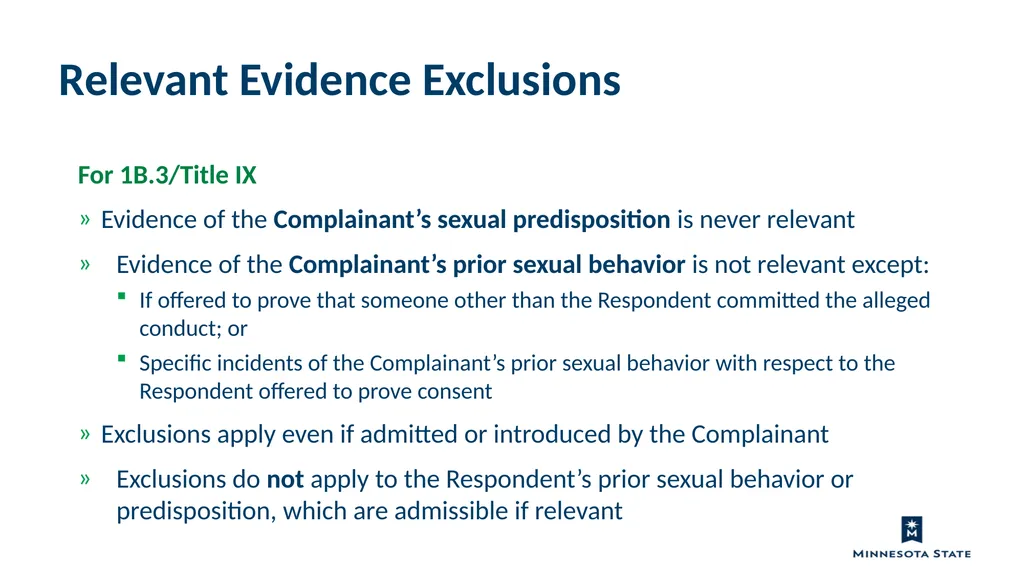
slide11. Relevant Evidence Exclusions For 1B.3/Title IX
Evidence of the Complainant’s sexual predisposition is never relevant
Evidence of the Complainant’s prior sexual behavior is not relevant except:
If offered to prove that someone other than the Respondent committed the alleged conduct; or
Specific incidents of the Complainant’s prior sexual behavior with respect to the Respondent offered to prove consent
Exclusions apply even if admitted or introduced by the Complainant
Exclusions do not apply to the Respondent’s prior sexual behavior or predisposition, which are admissible if relevant<br>
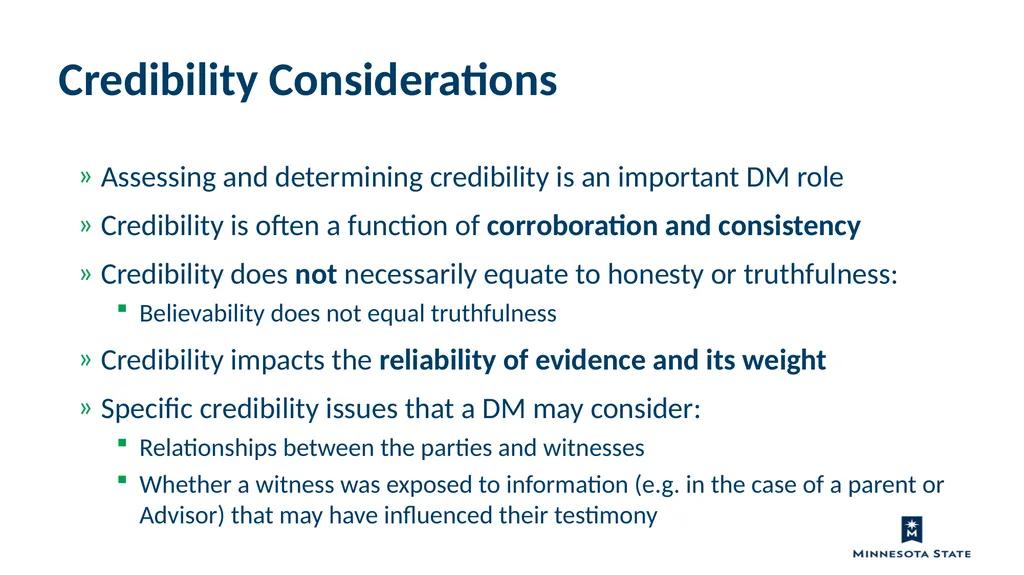
slide12. Credibility Considerations Assessing and determining credibility is an important DM role
Credibility is often a function of corroboration and consistency
Credibility does not necessarily equate to honesty or truthfulness:
Believability does not equal truthfulness
Credibility impacts the reliability of evidence and its weight
Specific credibility issues that a DM may consider:
Relationships between the parties and witnesses
Whether a witness was exposed to information (e.g. in the case of a parent or Advisor) that may have influenced their testimony<br>
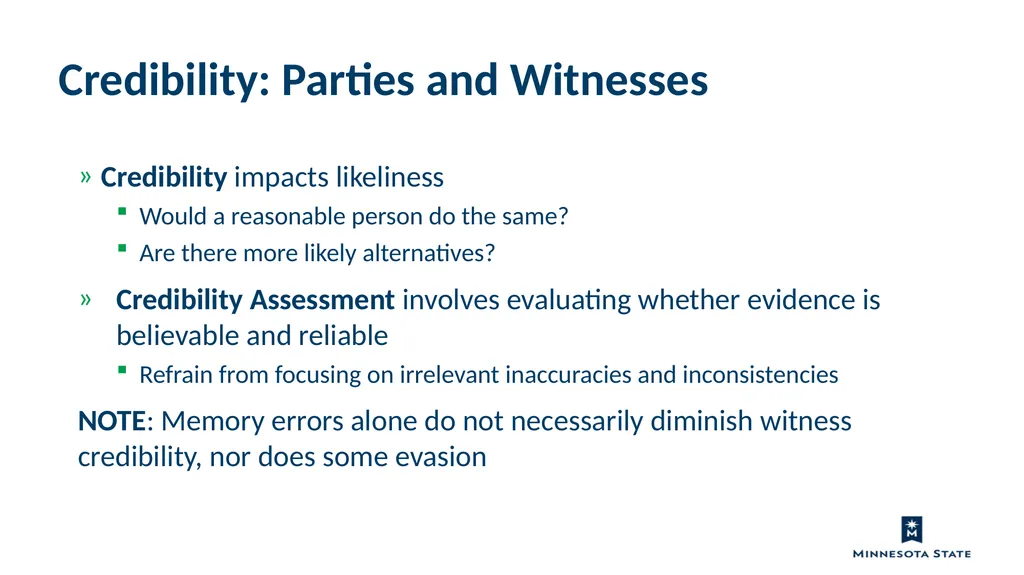
slide13. Credibility: Parties and Witnesses Credibility impacts likeliness
Would a reasonable person do the same?
Are there more likely alternatives?
Credibility Assessment involves evaluating whether evidence is believable and reliable
Refrain from focusing on irrelevant inaccuracies and inconsistencies
NOTE: Memory errors alone do not necessarily diminish witness credibility, nor does some evasion<br>
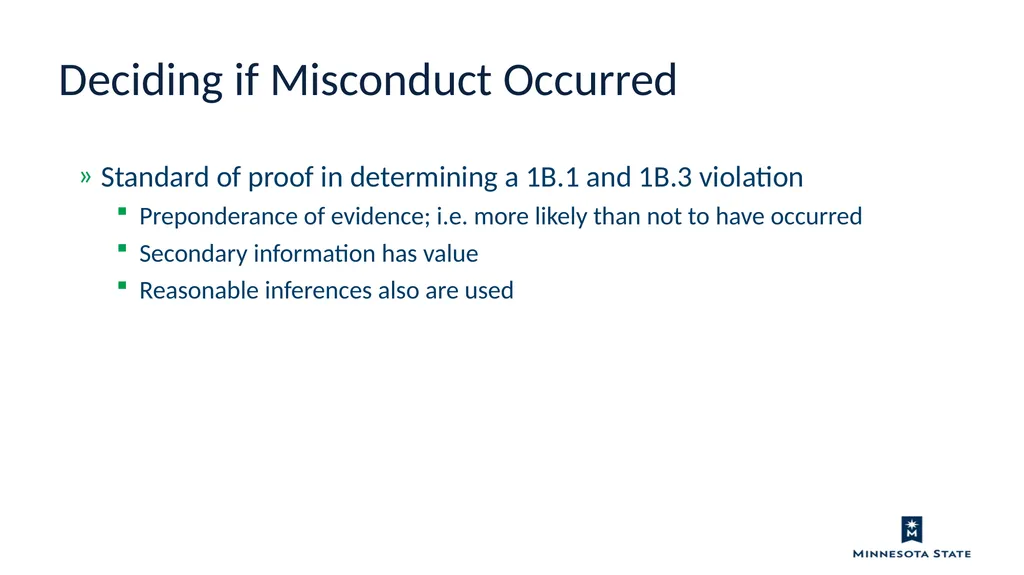
slide14. Deciding if Misconduct Occurred Standard of proof in determining a 1B.1 and 1B.3 violation
Preponderance of evidence; i.e. more likely than not to have occurred
Secondary information has value
Reasonable inferences also are used<br>
slide15. Investigation Skill-building Maegen Sincleair Usher, JD (she/her)
Investigation Specialist & Lead Deputy Title IX Coordinator
Metro State University<br>
slide16. Part 1: Investigation Strategy<br>
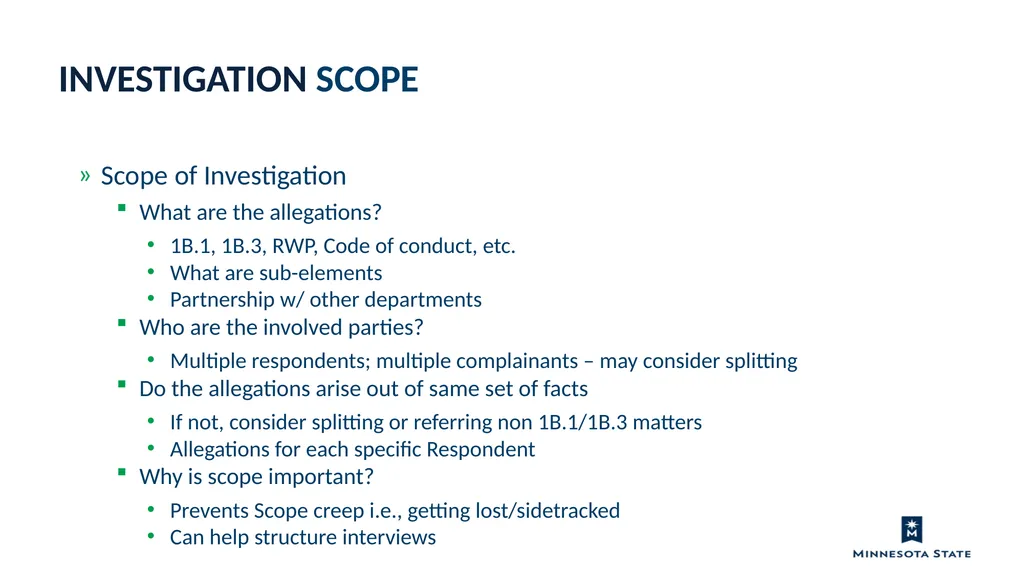
slide17. Investigation Scope Scope of Investigation
What are the allegations?
1B.1, 1B.3, RWP, Code of conduct, etc.
What are sub-elements
Partnership w/ other departments
Who are the involved parties?
Multiple respondents; multiple complainants – may consider splitting
Do the allegations arise out of same set of facts
If not, consider splitting or referring non 1B.1/1B.3 matters
Allegations for each specific Respondent
Why is scope important?
Prevents Scope creep i.e., getting lost/sidetracked
Can help structure interviews<br>
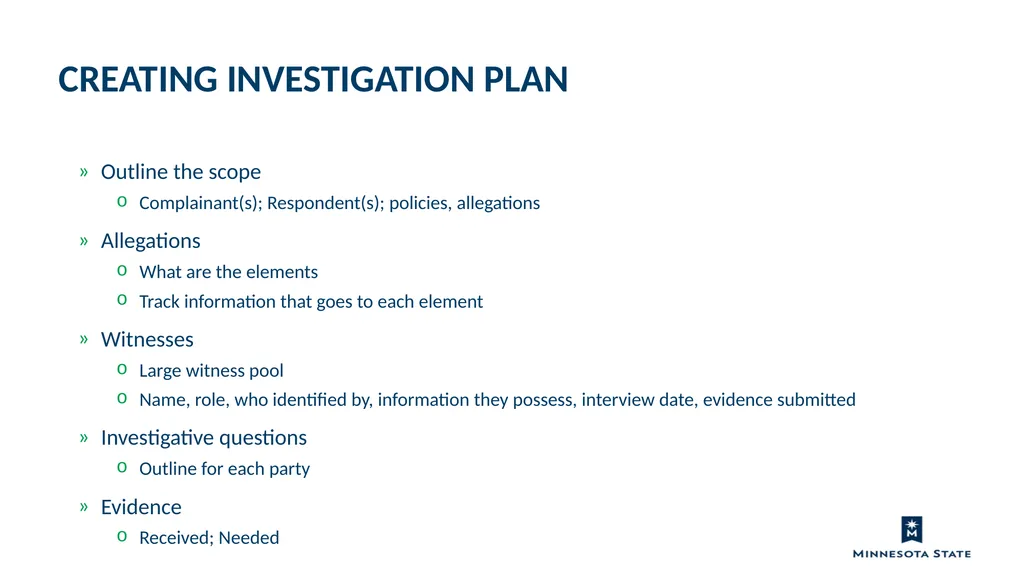
slide18. Creating investigation plan Outline the scope
Complainant(s); Respondent(s); policies, allegations
Allegations
What are the elements
Track information that goes to each element
Witnesses
Large witness pool
Name, role, who identified by, information they possess, interview date, evidence submitted
Investigative questions
Outline for each party
Evidence
Received; Needed<br>
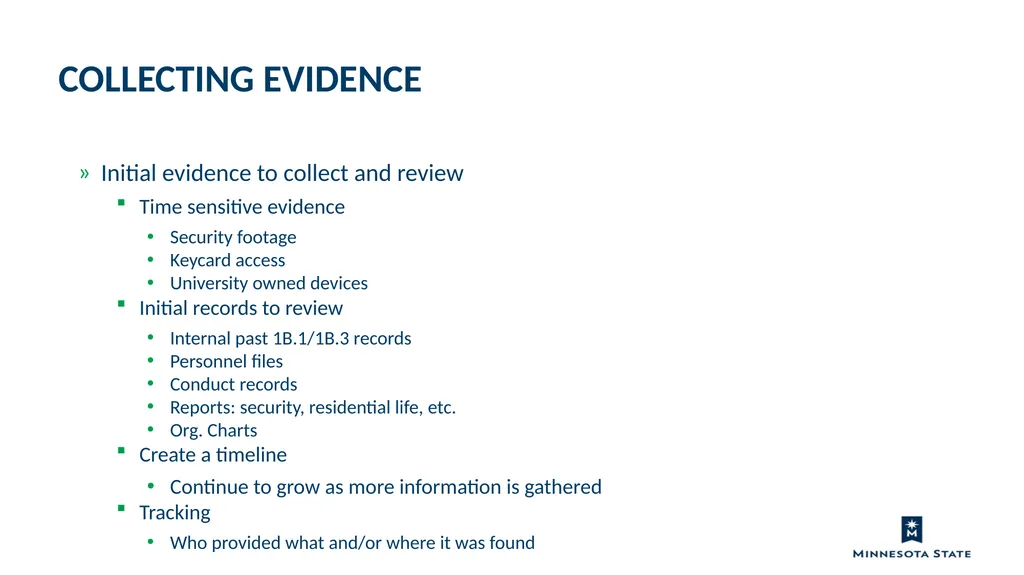
slide19. Collecting Evidence Initial evidence to collect and review
Time sensitive evidence
Security footage
Keycard access
University owned devices
Initial records to review
Internal past 1B.1/1B.3 records
Personnel files
Conduct records
Reports: security, residential life, etc.
Org. Charts
Create a timeline
Continue to grow as more information is gathered
Tracking
Who provided what and/or where it was found<br>
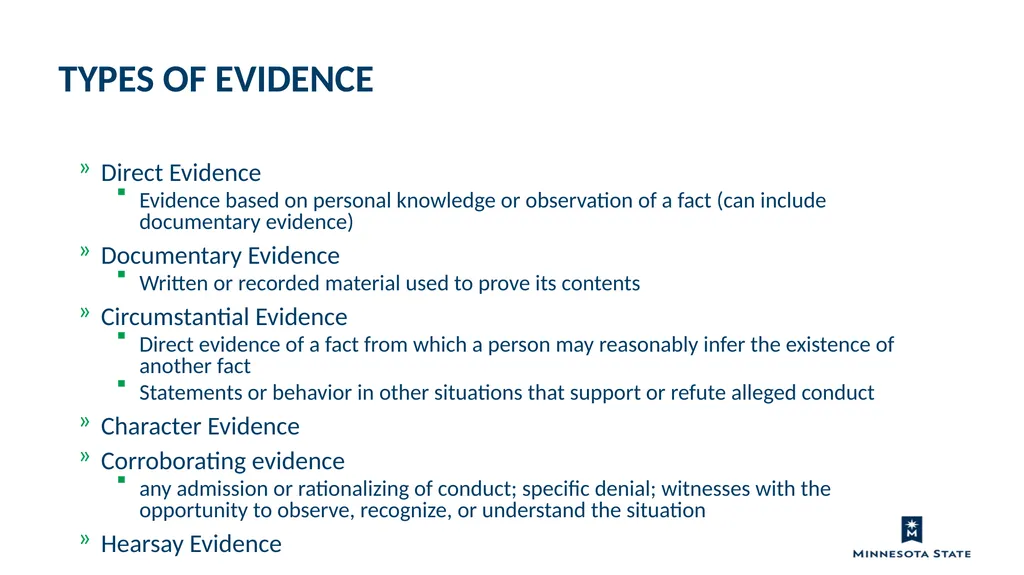
slide20. Types of Evidence Direct Evidence
Evidence based on personal knowledge or observation of a fact (can include documentary evidence)
Documentary Evidence
Written or recorded material used to prove its contents
Circumstantial Evidence
Direct evidence of a fact from which a person may reasonably infer the existence of another fact
Statements or behavior in other situations that support or refute alleged conduct
Character Evidence
Corroborating evidence
any admission or rationalizing of conduct; specific denial; witnesses with the opportunity to observe, recognize, or understand the situation
Hearsay Evidence<br>
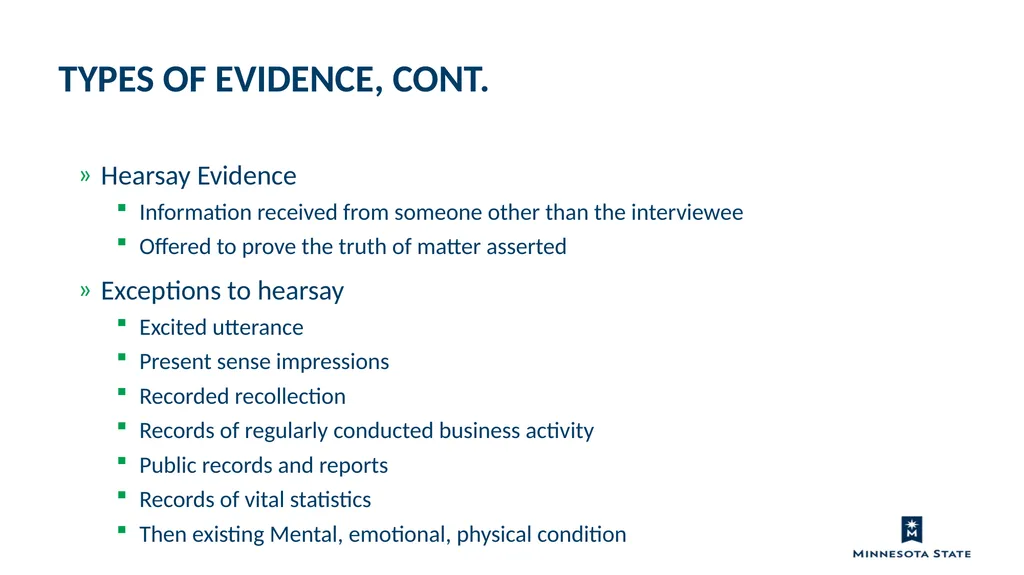
slide21. Types of Evidence, cont. Hearsay Evidence
Information received from someone other than the interviewee
Offered to prove the truth of matter asserted
Exceptions to hearsay
Excited utterance
Present sense impressions
Recorded recollection
Records of regularly conducted business activity
Public records and reports
Records of vital statistics
Then existing Mental, emotional, physical condition<br>
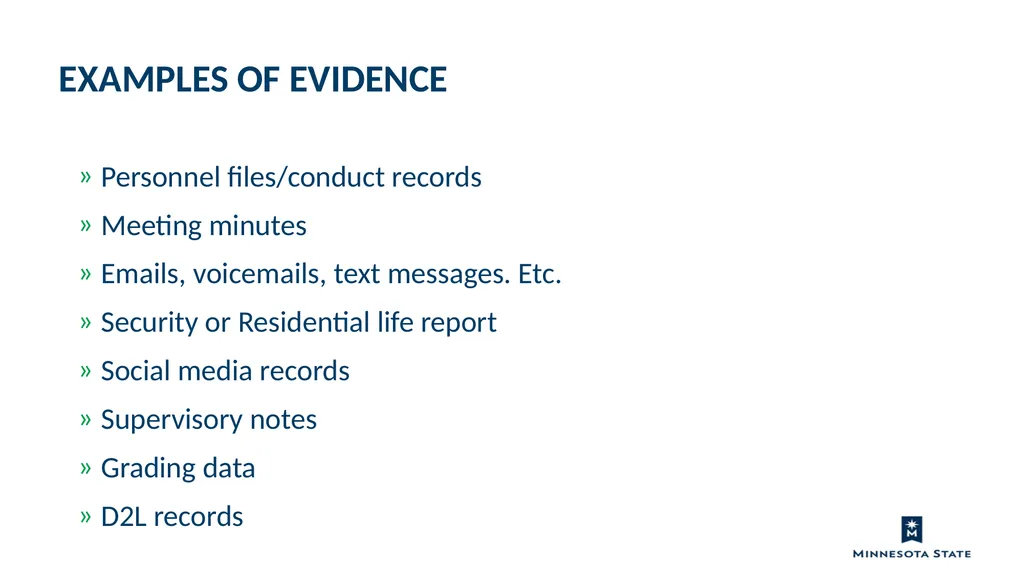
slide22. Examples of evidence Personnel files/conduct records
Meeting minutes
Emails, voicemails, text messages. Etc.
Security or Residential life report
Social media records
Supervisory notes
Grading data
D2L records<br>
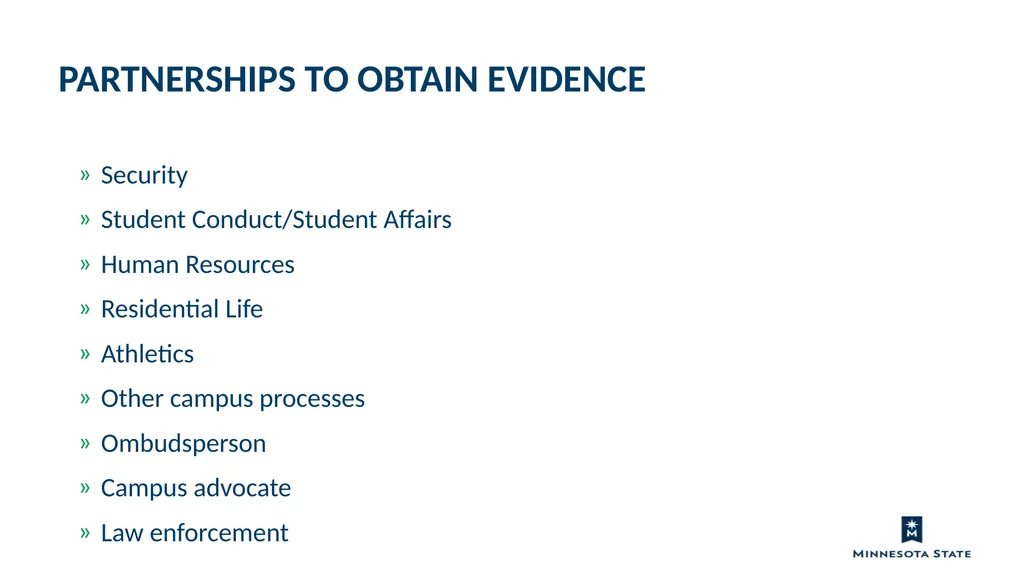
slide23. Partnerships to obtain evidence Security
Student Conduct/Student Affairs
Human Resources
Residential Life
Athletics
Other campus processes
Ombudsperson
Campus advocate
Law enforcement<br>
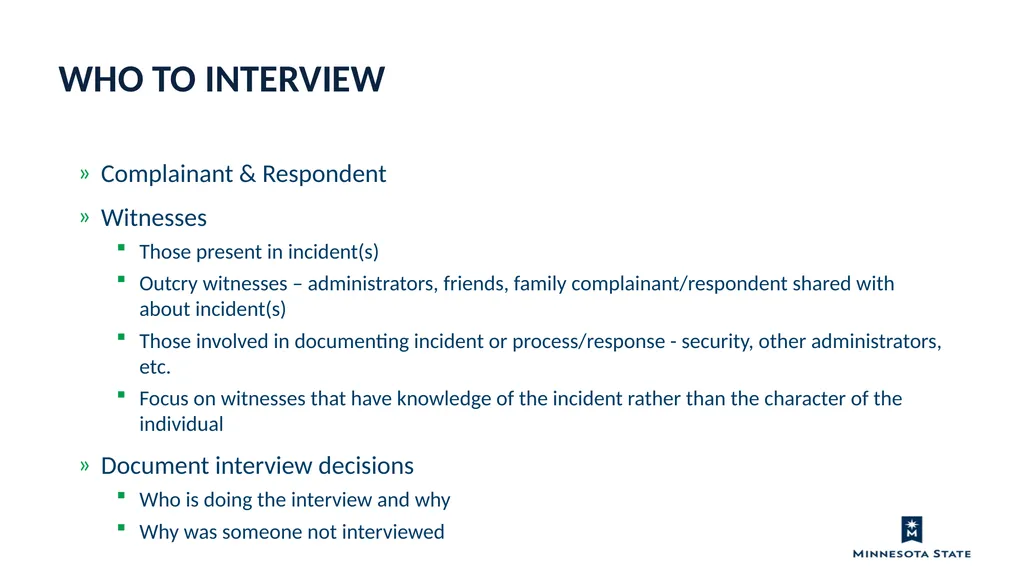
slide24. Who to interview Complainant & Respondent
Witnesses
Those present in incident(s)
Outcry witnesses – administrators, friends, family complainant/respondent shared with about incident(s)
Those involved in documenting incident or process/response - security, other administrators, etc.
Focus on witnesses that have knowledge of the incident rather than the character of the individual
Document interview decisions
Who is doing the interview and why
Why was someone not interviewed<br>
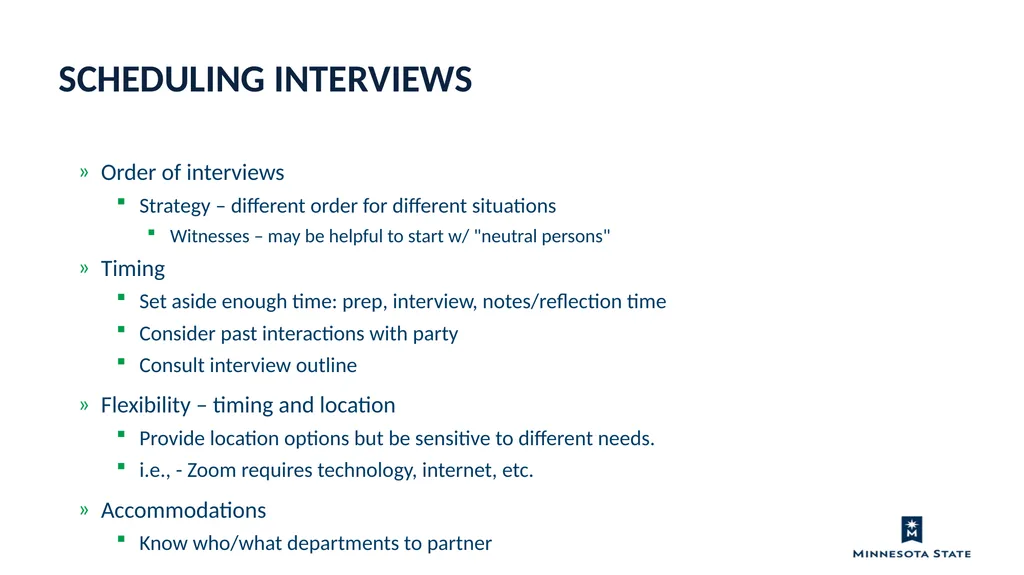
slide25. Scheduling Interviews Order of interviews
Strategy – different order for different situations
Witnesses – may be helpful to start w/ "neutral persons"
Timing
Set aside enough time: prep, interview, notes/reflection time
Consider past interactions with party
Consult interview outline
Flexibility – timing and location
Provide location options but be sensitive to different needs.
i.e., - Zoom requires technology, internet, etc.
Accommodations
Know who/what departments to partner<br>
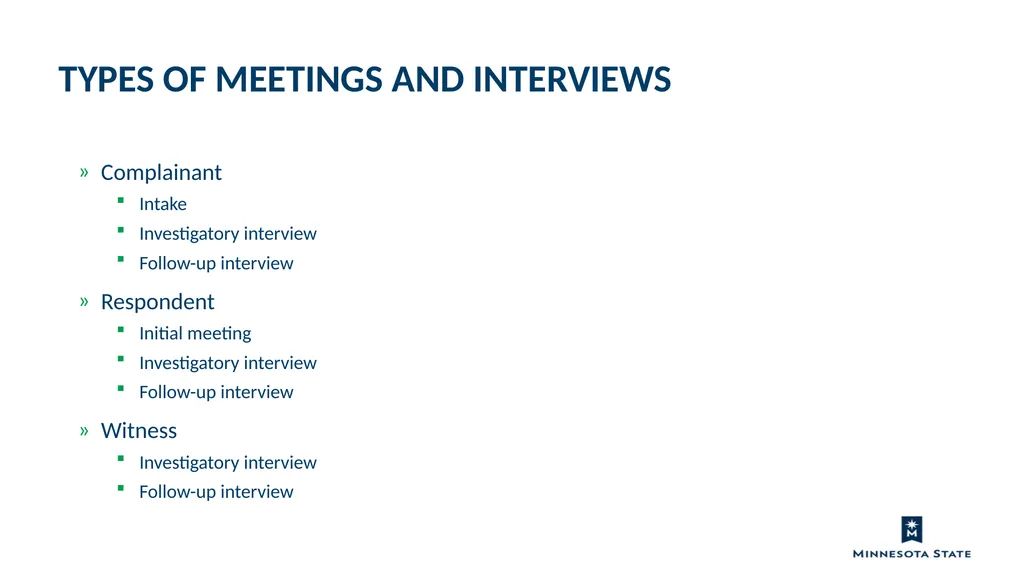
slide26. Types of meetings and interviews Complainant
Intake
Investigatory interview
Follow-up interview
Respondent
Initial meeting
Investigatory interview
Follow-up interview
Witness
Investigatory interview
Follow-up interview<br>
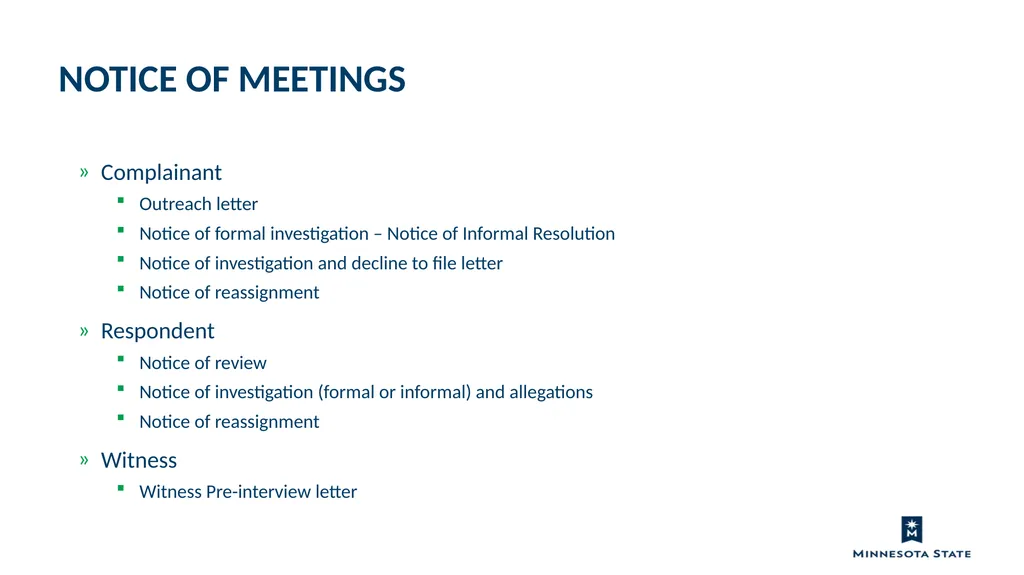
slide27. Notice of Meetings Complainant
Outreach letter
Notice of formal investigation – Notice of Informal Resolution
Notice of investigation and decline to file letter
Notice of reassignment
Respondent
Notice of review
Notice of investigation (formal or informal) and allegations
Notice of reassignment
Witness
Witness Pre-interview letter<br>
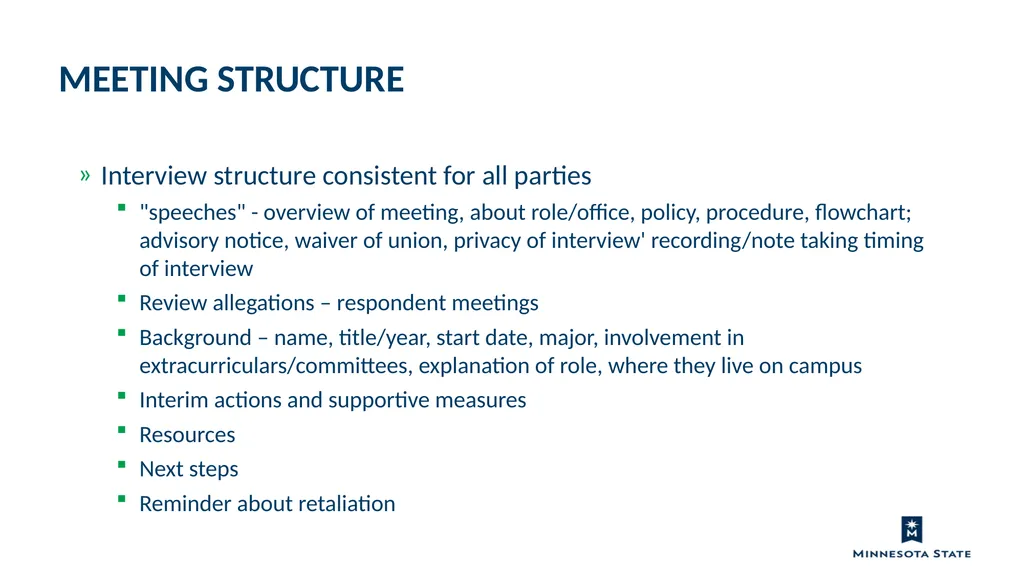
slide28. Meeting structure Interview structure consistent for all parties
"speeches" - overview of meeting, about role/office, policy, procedure, flowchart; advisory notice, waiver of union, privacy of interview' recording/note taking timing of interview
Review allegations – respondent meetings
Background – name, title/year, start date, major, involvement in extracurriculars/committees, explanation of role, where they live on campus
Interim actions and supportive measures
Resources
Next steps
Reminder about retaliation<br>
slide29. Part 2: Strategies for managing investigation-based challenges<br>
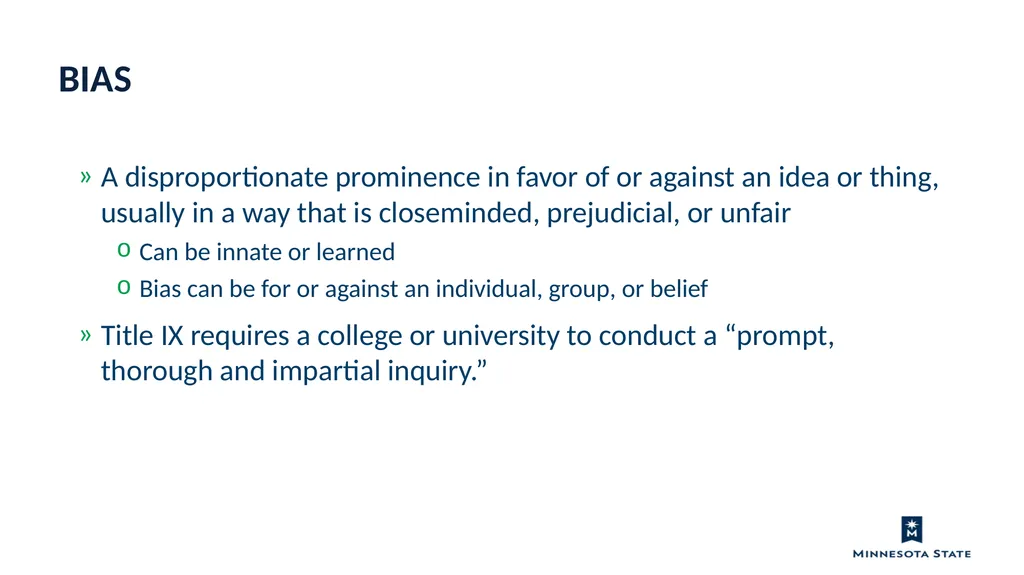
slide30. Bias A disproportionate prominence in favor of or against an idea or thing, usually in a way that is closeminded, prejudicial, or unfair
Can be innate or learned
Bias can be for or against an individual, group, or belief
Title IX requires a college or university to conduct a “prompt, thorough and impartial inquiry.” <br>
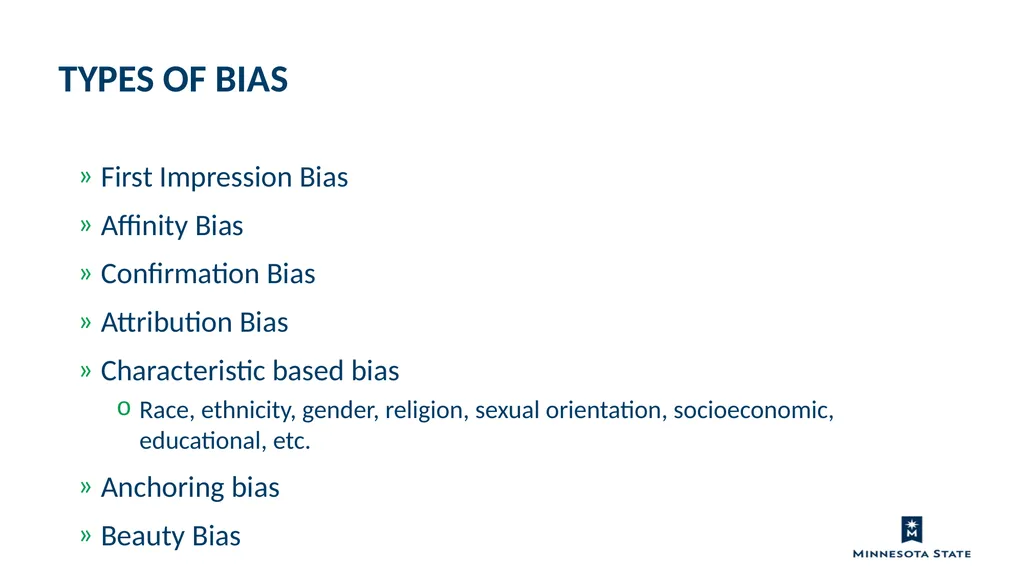
slide31. Types of Bias First Impression Bias
Affinity Bias
Confirmation Bias
Attribution Bias
Characteristic based bias
Race, ethnicity, gender, religion, sexual orientation, socioeconomic, educational, etc.
Anchoring bias
Beauty Bias<br>
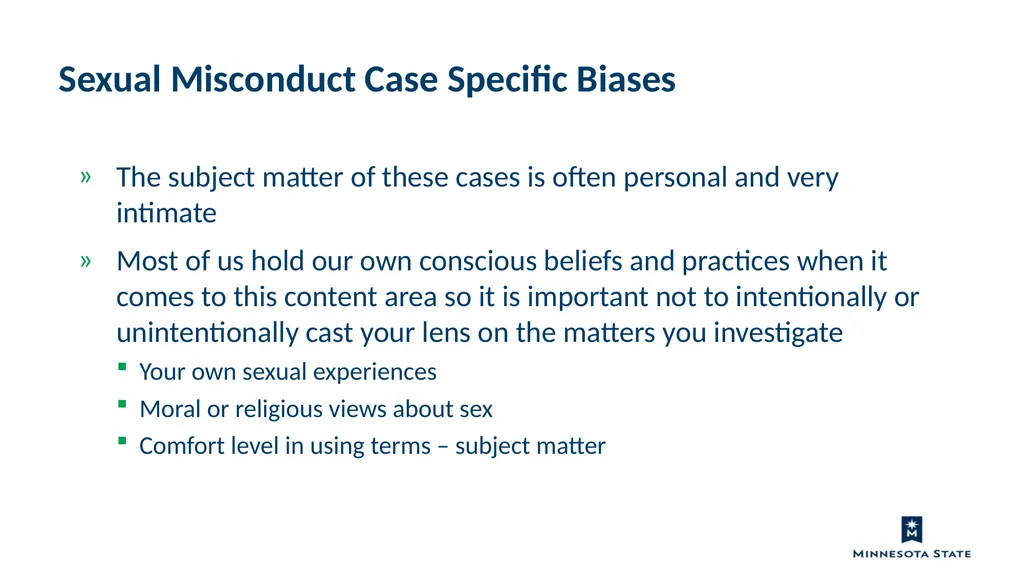
slide32. Sexual Misconduct Case Specific Biases The subject matter of these cases is often personal and very intimate
Most of us hold our own conscious beliefs and practices when it comes to this content area so it is important not to intentionally or unintentionally cast your lens on the matters you investigate
Your own sexual experiences
Moral or religious views about sex
Comfort level in using terms – subject matter<br>
slide33. Alcohol and Drug Use Biases You may have your own views on and experiences with:
Alcohol use
Drug use
These things may have impacted your life<br>
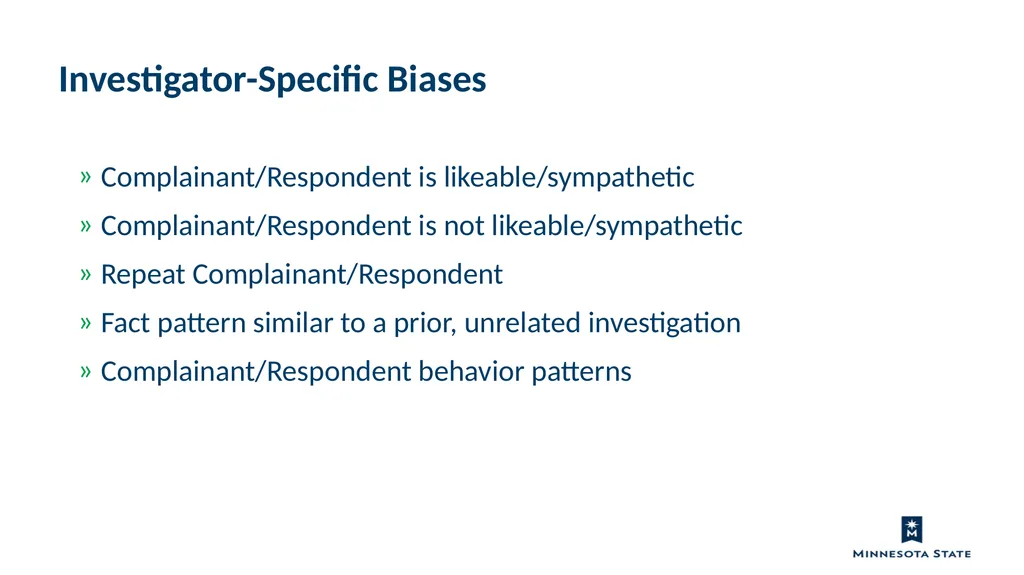
slide34. Investigator-Specific Biases Complainant/Respondent is likeable/sympathetic
Complainant/Respondent is not likeable/sympathetic
Repeat Complainant/Respondent
Fact pattern similar to a prior, unrelated investigation
Complainant/Respondent behavior patterns<br>
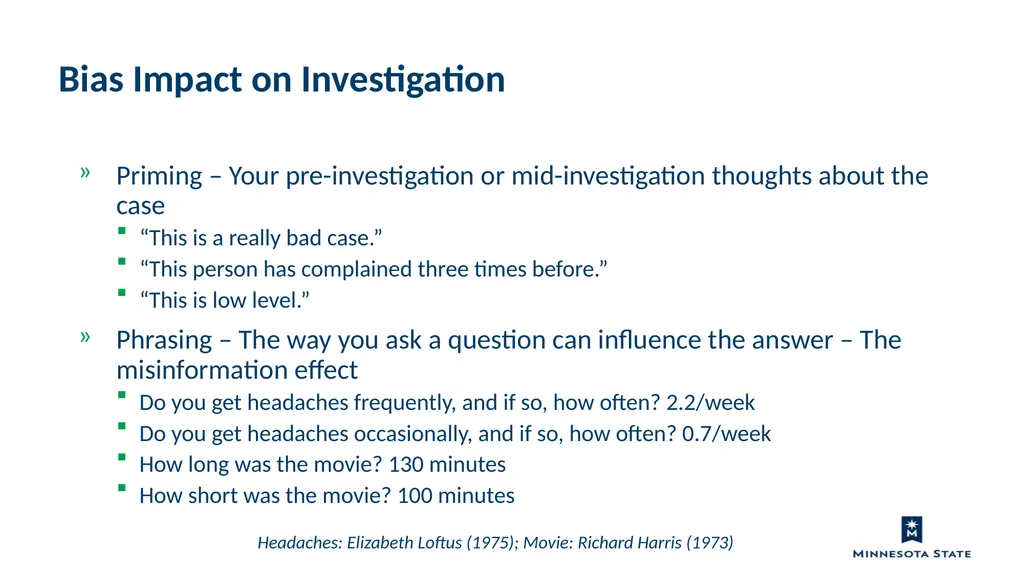
slide35. Bias Impact on Investigation Priming – Your pre-investigation or mid-investigation thoughts about the case
“This is a really bad case.”
“This person has complained three times before.”
“This is low level.”
Phrasing – The way you ask a question can influence the answer – The misinformation effect
Do you get headaches frequently, and if so, how often? 2.2/week
Do you get headaches occasionally, and if so, how often? 0.7/week
How long was the movie? 130 minutes
How short was the movie? 100 minutes
Headaches: Elizabeth Loftus (1975); Movie: Richard Harris (1973)<br>
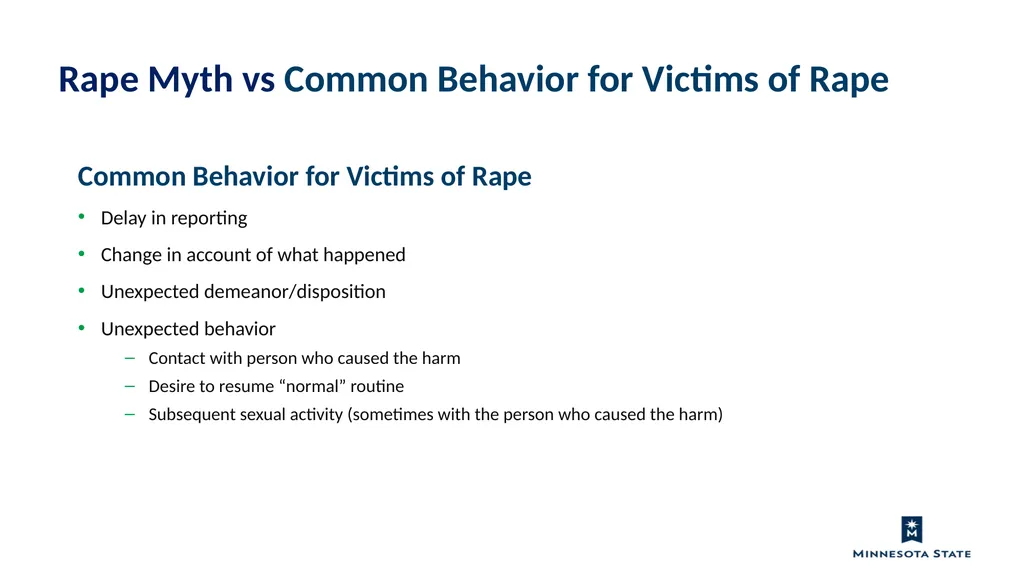
slide36. Rape Myth vs Common Behavior for Victims of Rape Common Behavior for Victims of Rape
Delay in reporting
Change in account of what happened
Unexpected demeanor/disposition
Unexpected behavior
Contact with person who caused the harm
Desire to resume “normal” routine
Subsequent sexual activity (sometimes with the person who caused the harm)<br>
slide37. Neurobiological Responses to Trauma<br>
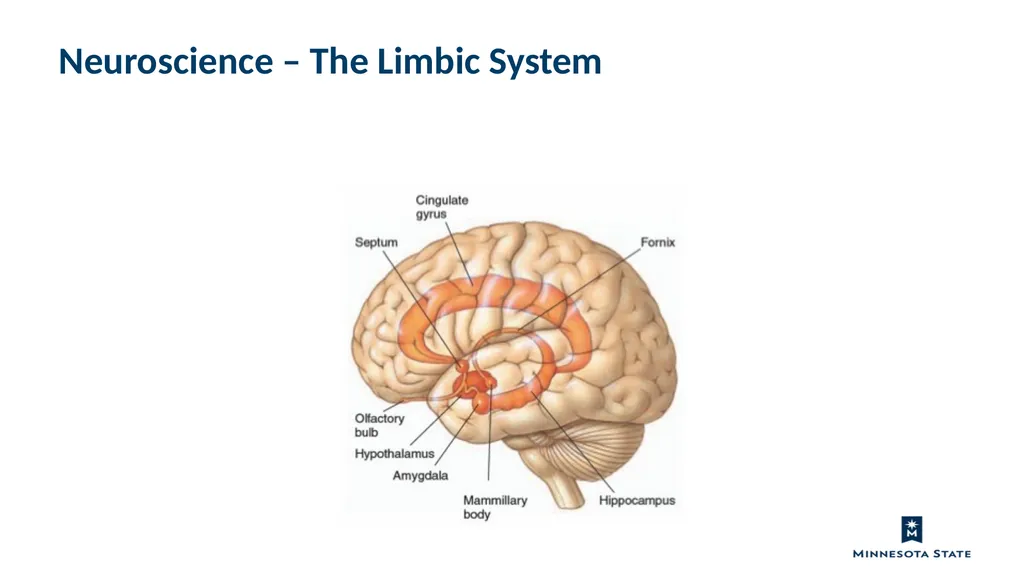
slide38. Neuroscience – The Limbic System<br>
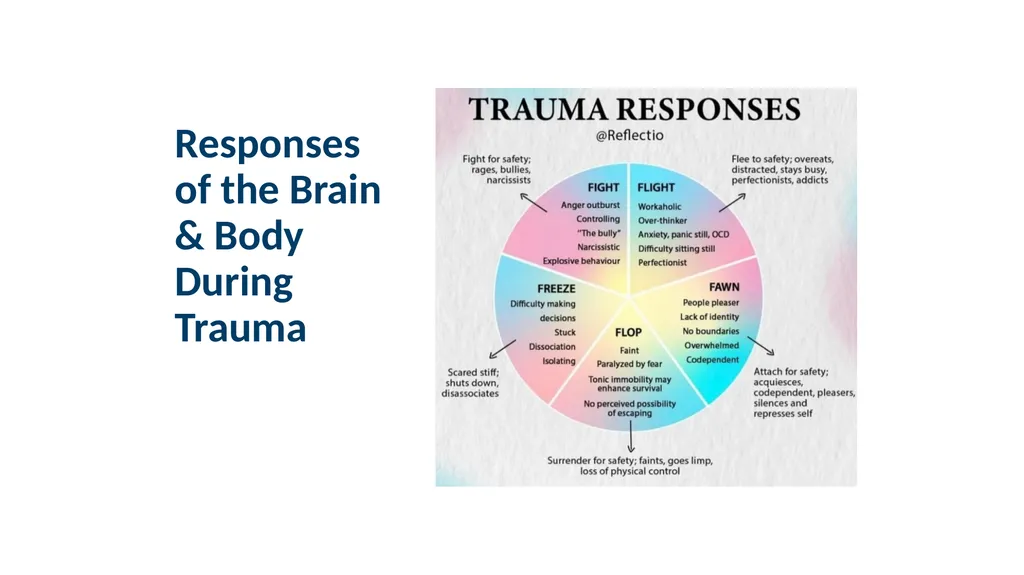
slide39. Responses of the Brain & Body During Trauma<br>
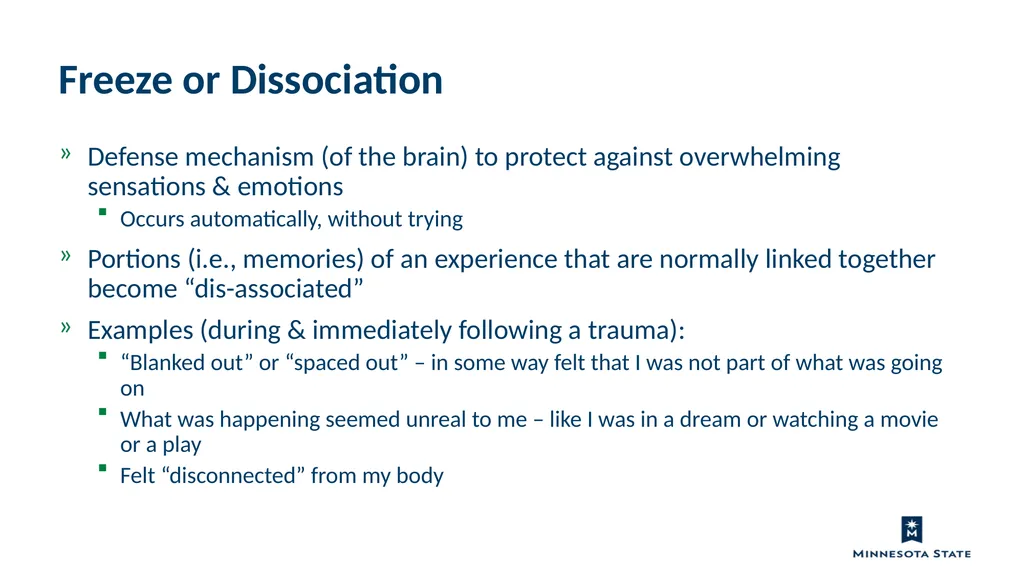
slide40. Freeze or Dissociation Defense mechanism (of the brain) to protect against overwhelming sensations & emotions
Occurs automatically, without trying
Portions (i.e., memories) of an experience that are normally linked together become “dis-associated”
Examples (during & immediately following a trauma):
“Blanked out” or “spaced out” – in some way felt that I was not part of what was going on
What was happening seemed unreal to me – like I was in a dream or watching a movie or a play
Felt “disconnected” from my body<br>
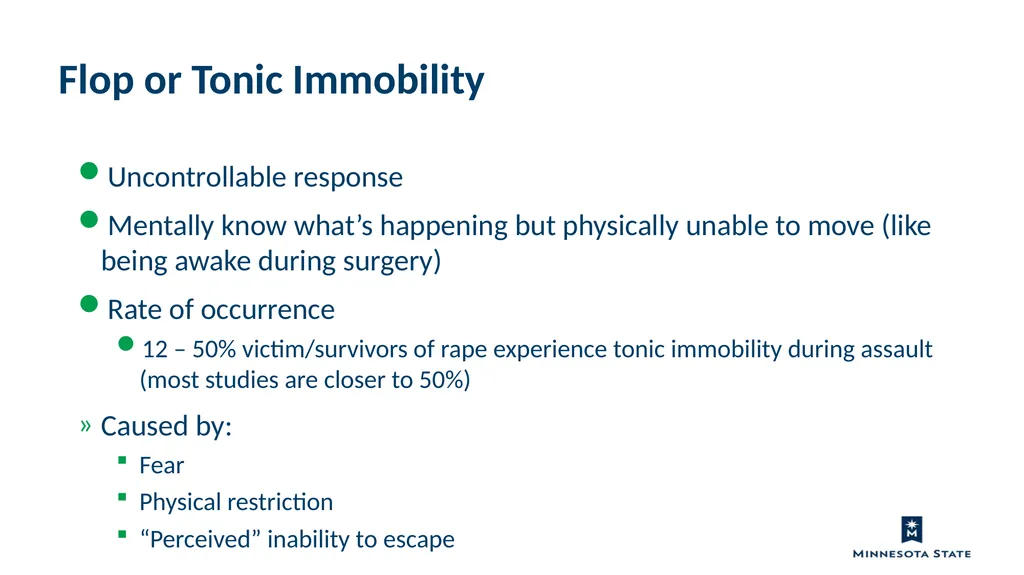
slide41. Flop or Tonic Immobility Uncontrollable response
Mentally know what’s happening but physically unable to move (like being awake during surgery)
Rate of occurrence
12 – 50% victim/survivors of rape experience tonic immobility during assault (most studies are closer to 50%)
Caused by:
Fear
Physical restriction
“Perceived” inability to escape<br>
slide42. Autonomic Responses and the Body Physiology
Heart rate, respirations, dilated pupils, dry mouth, knot in the stomach
Affective (mood and emotion) responses
Fear, helplessness, horror
Cognitive (thought) processing
Memory – fragmented, out of sequence
Time distortion
Increased confabulation
Trauma memory and recall<br>
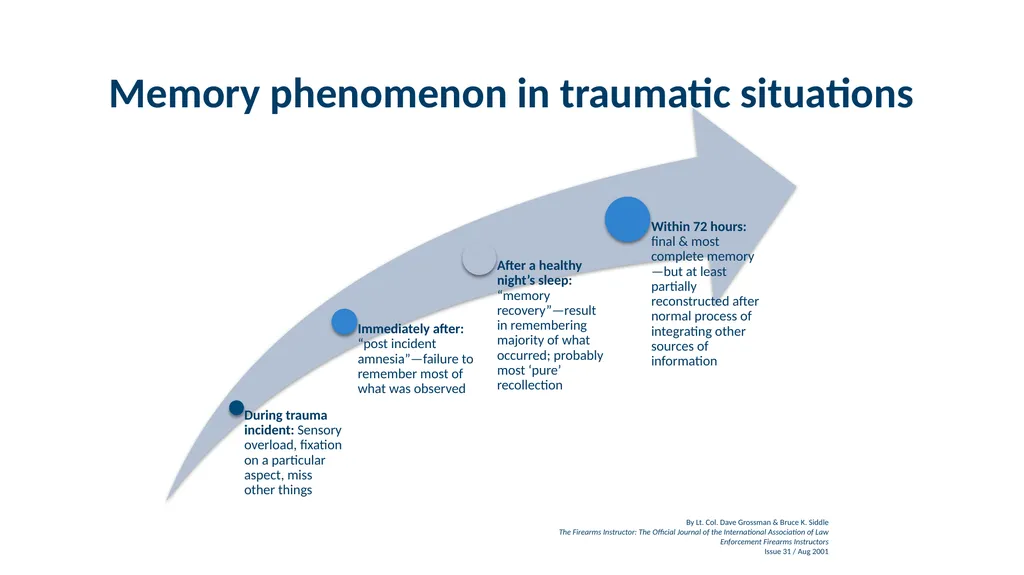
slide43. Memory phenomenon in traumatic situations By Lt. Col. Dave Grossman & Bruce K. Siddle The Firearms Instructor: The Official Journal of the International Association of Law Enforcement Firearms Instructors Issue 31 / Aug 2001<br>
slide44. Impact of Trauma on Victim/Survivor Behavior The effects of trauma can influence behavior of a victim/survivor during an interview
People are often reluctant to recall experiences that evoke negative feelings and emotions such as anger, fear, humiliation, or sadness
--Strand, 2013<br>
slide45. Parallel Proceedings Independent from any civil or criminal proceeding
Not required to delay, and in most cases should not delay due to other proceedings
May contact prosecutor/law enforcement to coordinator when feasible
Gather available information:
Police Report
Court records<br>
slide46. Best Practices Rely on the policy and procedure
Adhere to the policy and procedure
Let the evidence lead you<br>
slide47. Part 3: Interviewing Approaches<br>
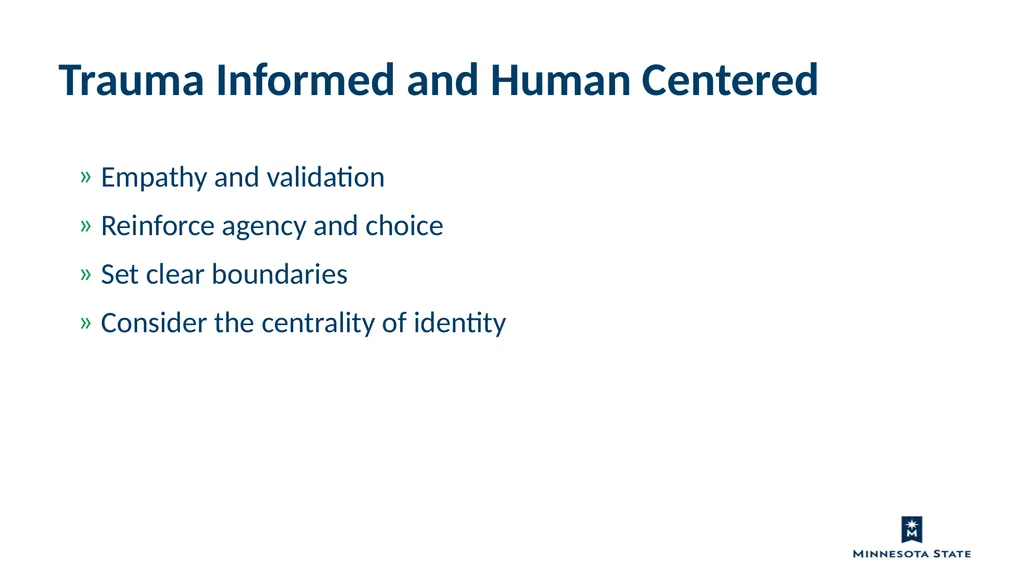
slide48. Trauma Informed and Human Centered Empathy and validation
Reinforce agency and choice
Set clear boundaries
Consider the centrality of identity<br>
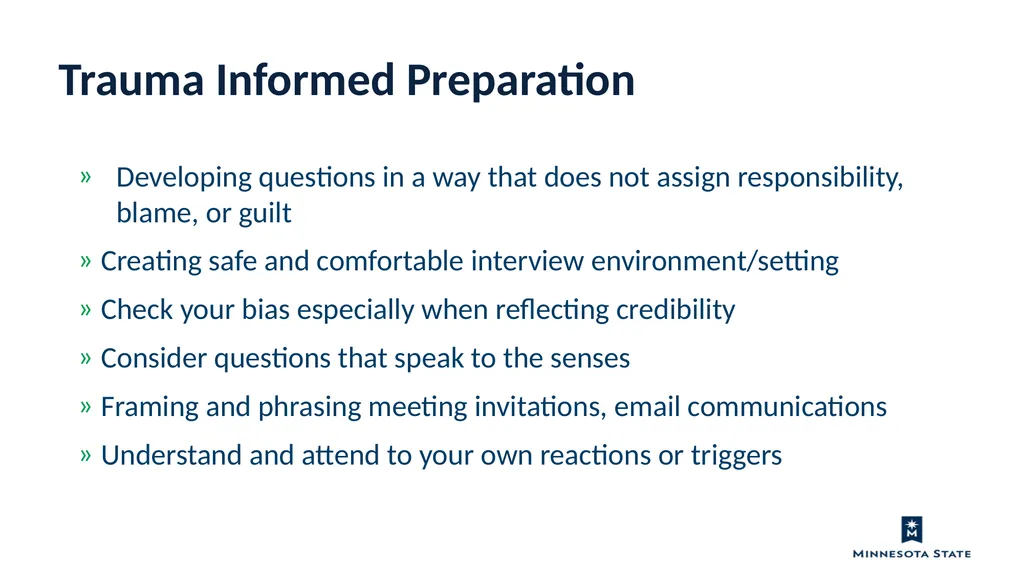
slide49. Trauma Informed Preparation Developing questions in a way that does not assign responsibility, blame, or guilt
Creating safe and comfortable interview environment/setting
Check your bias especially when reflecting credibility
Consider questions that speak to the senses
Framing and phrasing meeting invitations, email communications
Understand and attend to your own reactions or triggers<br>
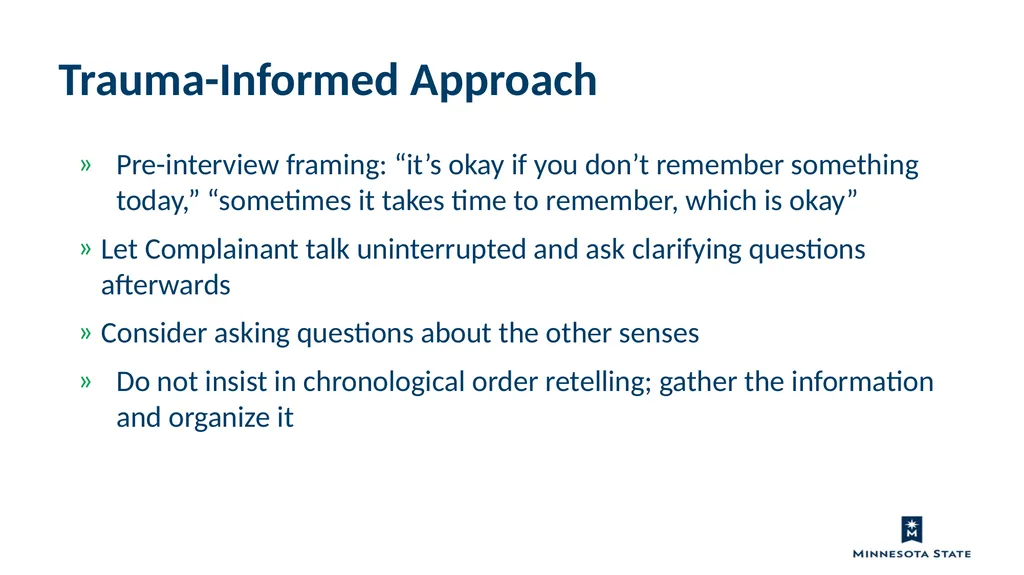
slide50. Trauma-Informed Approach Pre-interview framing: “it’s okay if you don’t remember something today,” “sometimes it takes time to remember, which is okay”
Let Complainant talk uninterrupted and ask clarifying questions afterwards
Consider asking questions about the other senses
Do not insist in chronological order retelling; gather the information and organize it<br>
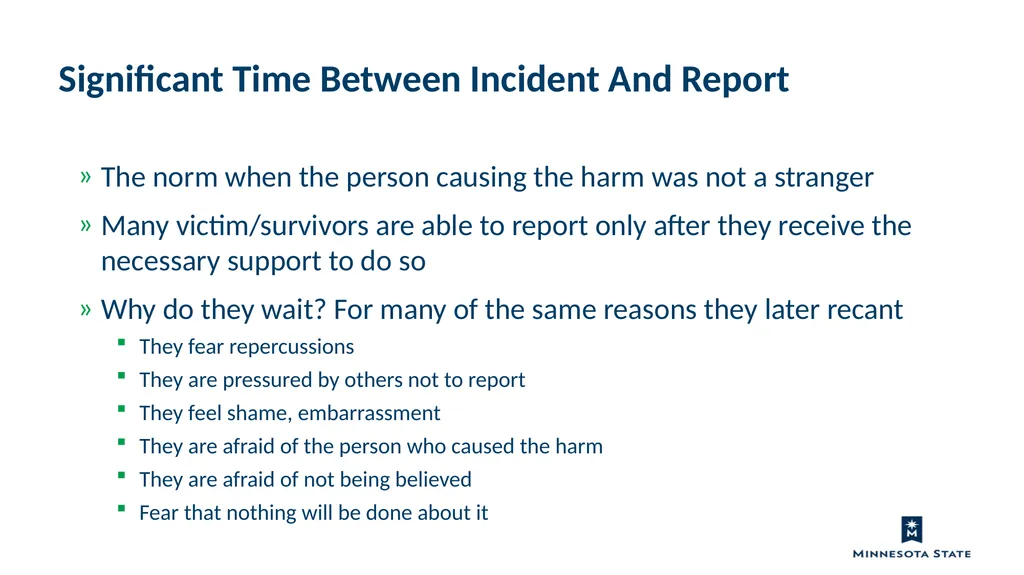
slide51. Significant Time Between Incident And Report The norm when the person causing the harm was not a stranger
Many victim/survivors are able to report only after they receive the necessary support to do so
Why do they wait? For many of the same reasons they later recant
They fear repercussions
They are pressured by others not to report
They feel shame, embarrassment
They are afraid of the person who caused the harm
They are afraid of not being believed
Fear that nothing will be done about it<br>
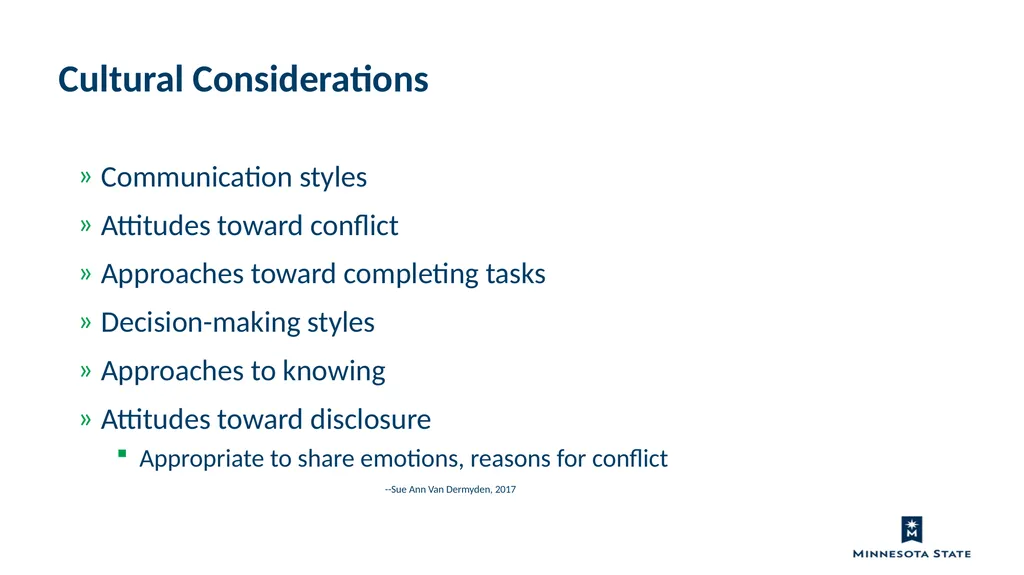
slide52. Cultural Considerations Communication styles
Attitudes toward conflict
Approaches toward completing tasks
Decision-making styles
Approaches to knowing
Attitudes toward disclosure
Appropriate to share emotions, reasons for conflict
--Sue Ann Van Dermyden, 2017<br>
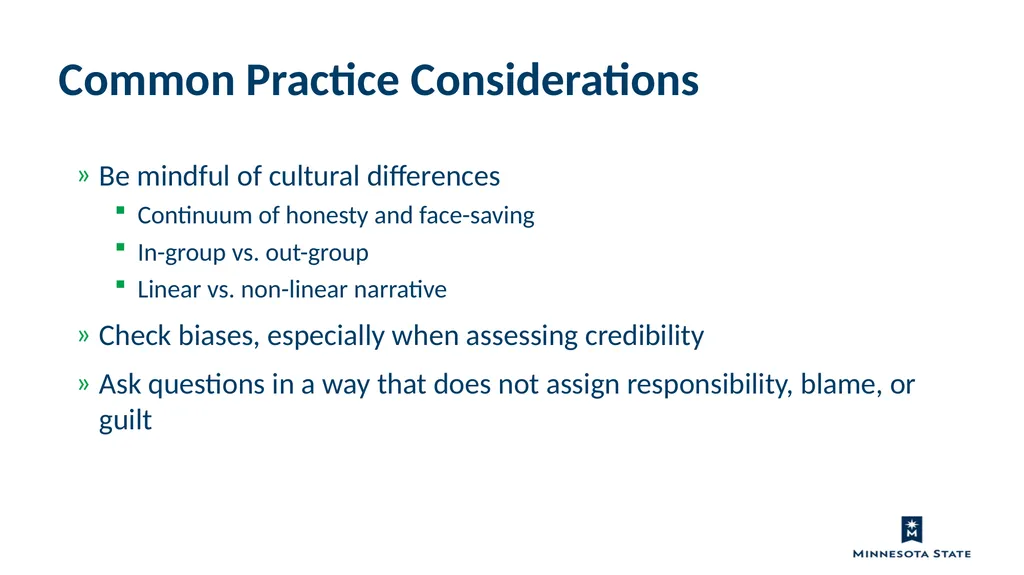
slide53. Common Practice Considerations Be mindful of cultural differences
Continuum of honesty and face-saving
In-group vs. out-group
Linear vs. non-linear narrative
Check biases, especially when assessing credibility
Ask questions in a way that does not assign responsibility, blame, or guilt<br>
slide54. Investigation Clarification Policy elements
Components defined
Evaluation considerations
Evidence and credibility
For 1B.3.1 (Title IX) Consent construct
Force
Incapacity
Consent<br>
slide55. Determine goals of questions Who, what, where, when, why, how
Intake meeting vs. Investigatory interview
Refine scope
What information are you missing or have questions
Read through reports/complaints and note any questions
Policy elements
Policy element handout<br>
slide56. How to structure questions Start with broad/open ended questions
Allow to tell their story/experience however they choose
Where they start/end their story and what they emphasize can be very telling and important for you to have.
Clarifying questions
Funnel approach
Ask to clarify meaning of words/descriptors
Allow for Silence
Additional questions/things left unanswered
Closing questions
Is there anything else you think I should know?
Anything I didn't ask that you thought I would ask about?
Is there anyone that you think I should talk to? Why?<br>
slide57. Interview questions for ALL Interview questions for all parties
Allow them chance to share their story/experience
Ask the who/what/where/when/how questions
Summarizing Information back
Policy elements
Effect/impact<br>
slide58. Interview questions continued... Interviewee specific questions
Respondent – make sure to review allegations before questions
Complainant – clarify protected class and identity
What they observed/their perspective of incident(s)
Inconsistencies with other parties/witnesses
Evidence specific questions – what they have, might have seen/been part of, etc.
Desired outcome/resolution<br>
slide59. Interview Considerations For credibility Look for consistency with out-cry witnesses or contemporaneous reports
Assess demeanor
Inherent Plausibility
Consider relevant past acts; are there alternative versions that are more plausible
Compare overlap/consistency with other statements
Interviewee who derails questions and/or focuses on irrelevant information
Providing inconsistent statements
Motives/Relationships
Positionality
Mind/memory altering substances<br>
slide60. Analyzing certain qualities and factors Demeanor: noted reactions to allegations or information shared; behaviors or feelings shared with others
Logic and consistency: consistency with what others shared (including possible witnesses); plausible explanations
Corroborating evidence: any admission or rationalizing of conduct; specific denial; witnesses with the opportunity to observe, recognize, or understand the situation
Circumstantial evidence: statements or behavior in other situations that support or refute alleged conduct
Trauma-informed approach: note that trauma itself is not evidence to support or not support<br>
slide61. Each interview might look different Emotion – crying, anger, indifference, being conflicted, shock, trauma, etc.
Timing – short answers, decisions to make, communication styles, etc.
How you ask questions
Credibility concerns
Effort needed to structure interview – redirect, diffuse conversation, etc.<br>
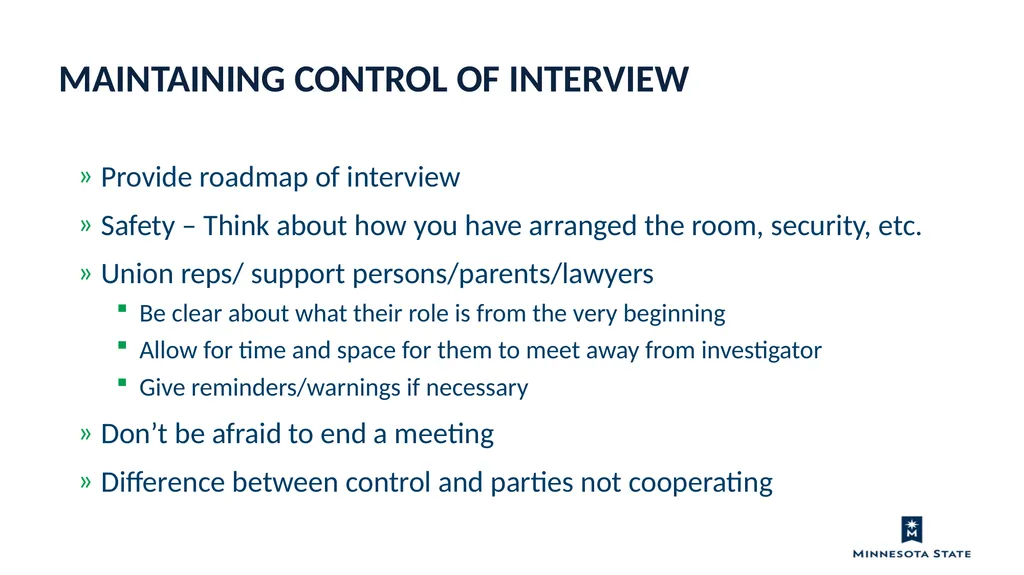
slide62. Maintaining control of interview Provide roadmap of interview
Safety – Think about how you have arranged the room, security, etc.
Union reps/ support persons/parents/lawyers
Be clear about what their role is from the very beginning
Allow for time and space for them to meet away from investigator
Give reminders/warnings if necessary
Don’t be afraid to end a meeting
Difference between control and parties not cooperating<br>
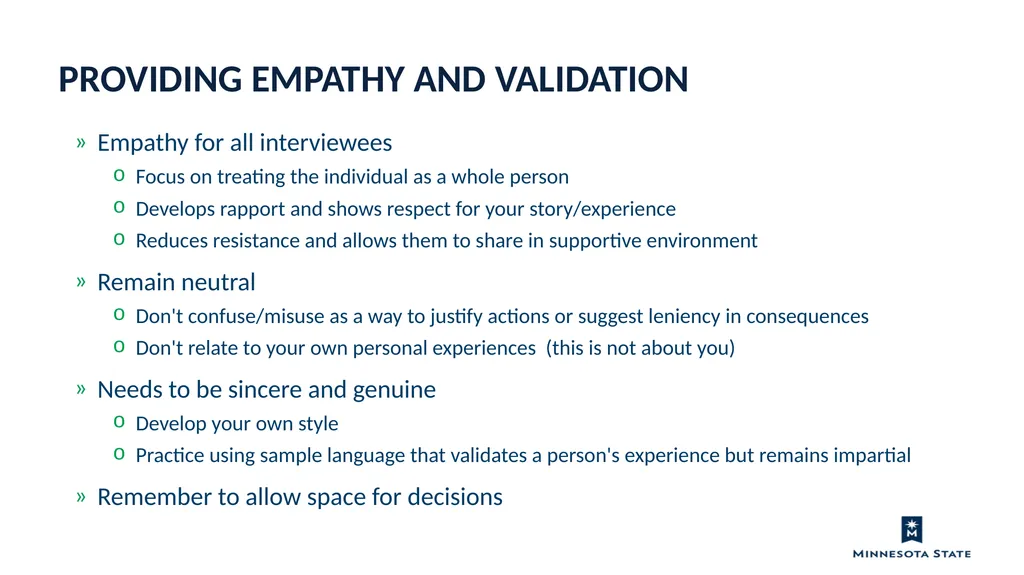
slide63. Providing empathy and validation Empathy for all interviewees
Focus on treating the individual as a whole person
Develops rapport and shows respect for your story/experience
Reduces resistance and allows them to share in supportive environment
Remain neutral
Don't confuse/misuse as a way to justify actions or suggest leniency in consequences
Don't relate to your own personal experiences (this is not about you)
Needs to be sincere and genuine
Develop your own style
Practice using sample language that validates a person's experience but remains impartial
Remember to allow space for decisions<br>
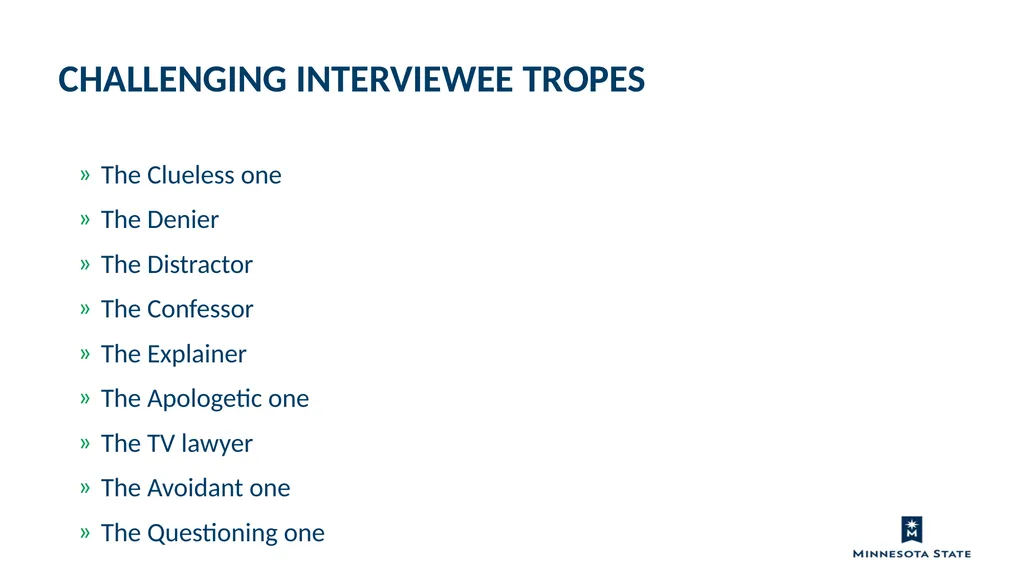
slide64. Challenging interviewee tropes The Clueless one
The Denier
The Distractor
The Confessor
The Explainer
The Apologetic one
The TV lawyer
The Avoidant one
The Questioning one<br>
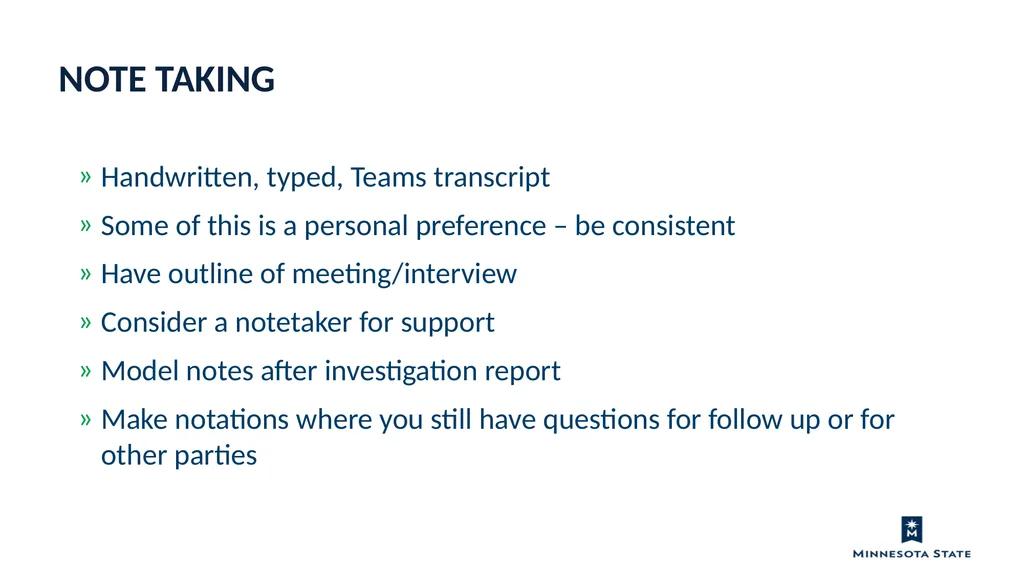
slide65. Note taking Handwritten, typed, Teams transcript
Some of this is a personal preference – be consistent
Have outline of meeting/interview
Consider a notetaker for support
Model notes after investigation report
Make notations where you still have questions for follow up or for other parties<br>
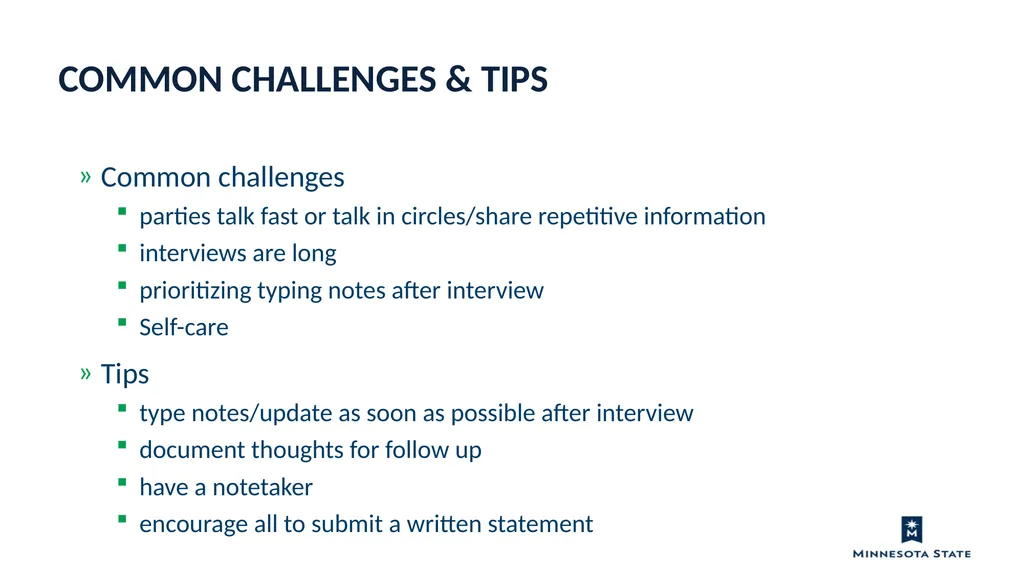
slide66. Common challenges & tips Common challenges
parties talk fast or talk in circles/share repetitive information
interviews are long
prioritizing typing notes after interview
Self-care
Tips
type notes/update as soon as possible after interview
document thoughts for follow up
have a notetaker
encourage all to submit a written statement<br>
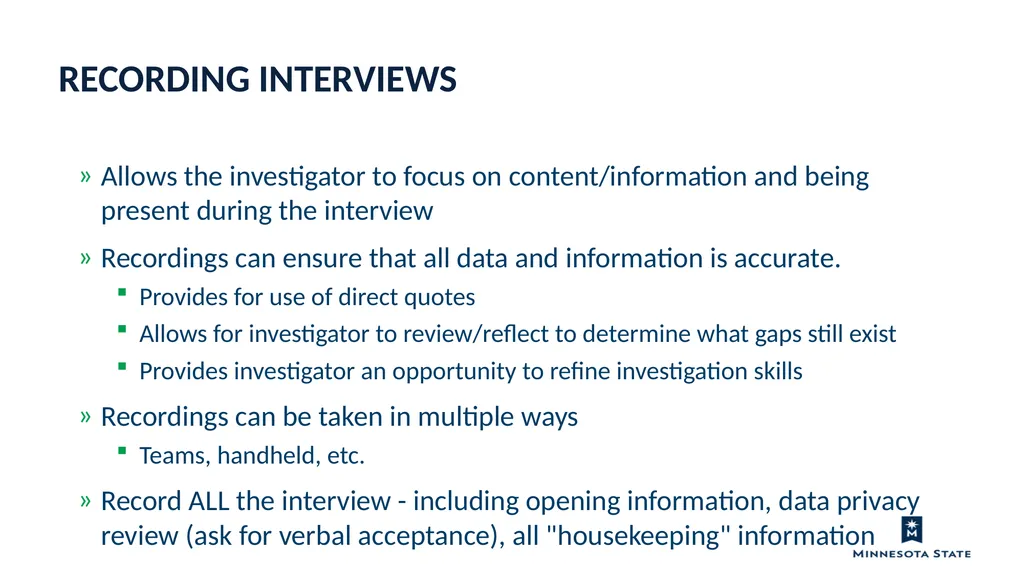
slide67. Recording interviews Allows the investigator to focus on content/information and being present during the interview
Recordings can ensure that all data and information is accurate.
Provides for use of direct quotes
Allows for investigator to review/reflect to determine what gaps still exist
Provides investigator an opportunity to refine investigation skills
Recordings can be taken in multiple ways
Teams, handheld, etc.
Record ALL the interview - including opening information, data privacy review (ask for verbal acceptance), all "housekeeping" information<br>
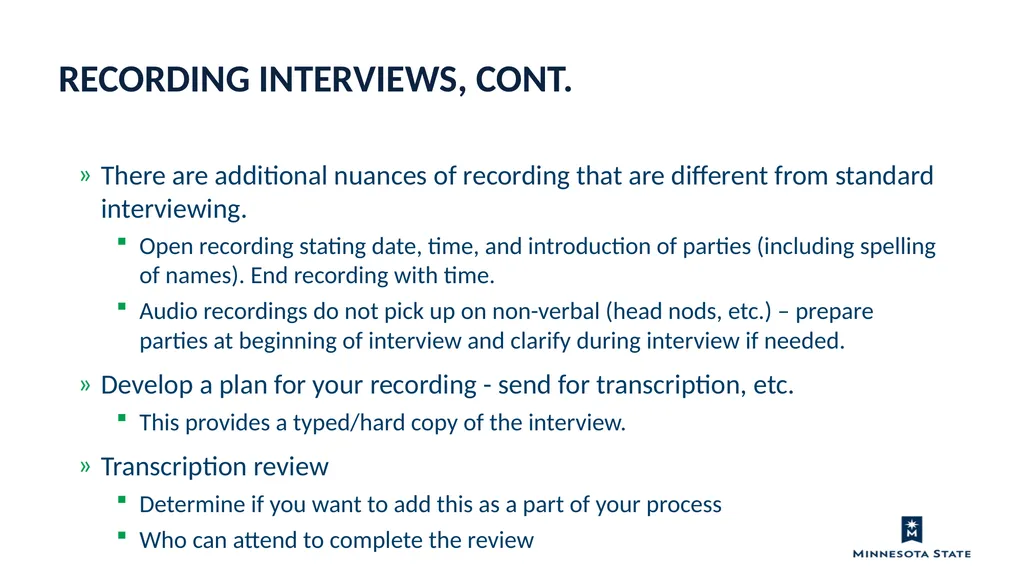
slide68. Recording interviews, cont. There are additional nuances of recording that are different from standard interviewing.
Open recording stating date, time, and introduction of parties (including spelling of names). End recording with time.
Audio recordings do not pick up on non-verbal (head nods, etc.) – prepare parties at beginning of interview and clarify during interview if needed.
Develop a plan for your recording - send for transcription, etc.
This provides a typed/hard copy of the interview.
Transcription review
Determine if you want to add this as a part of your process
Who can attend to complete the review<br>
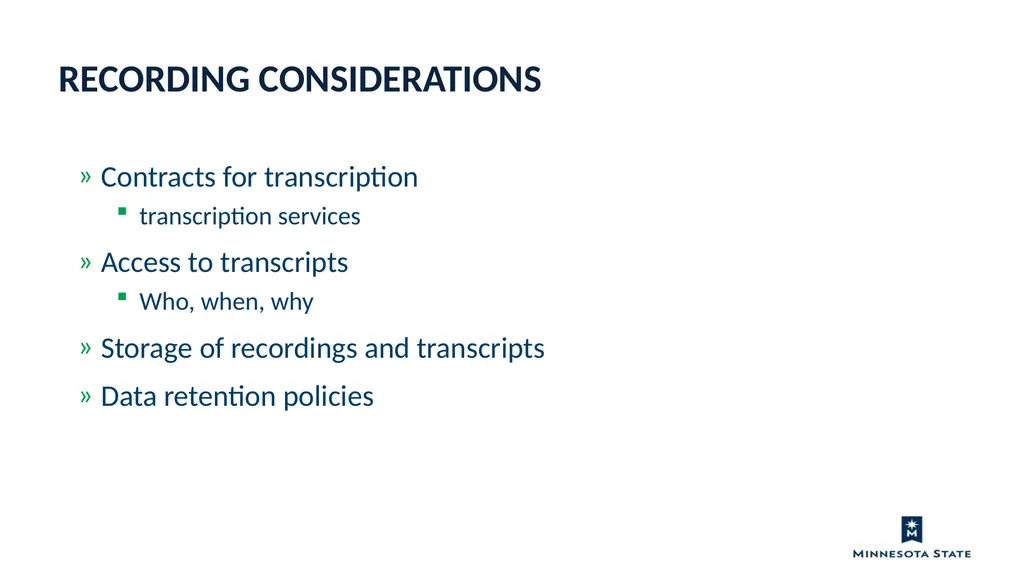
slide69. Recording considerations Contracts for transcription
transcription services
Access to transcripts
Who, when, why
Storage of recordings and transcripts
Data retention policies<br>
slide70. Part 4: Components of Investigation Report<br>
slide71. Goals of Investigatory report Present findings in a well-written and well-organized format
Document the steps taken during the investigation
Document the evidence collected and reviewed
Provide a clear, objective picture of investigation to the DM
Should contain all information a DM needs to make their decision<br>
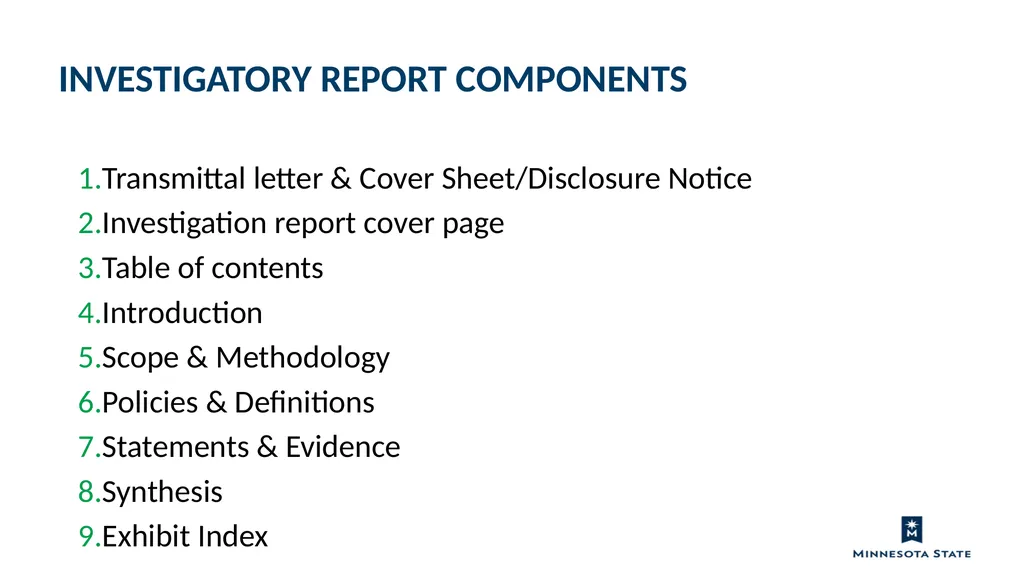
slide72. Investigatory report components Transmittal letter & Cover Sheet/Disclosure Notice
Investigation report cover page
Table of contents
Introduction
Scope & Methodology
Policies & Definitions
Statements & Evidence
Synthesis
Exhibit Index<br>
slide73. Technical writing Technical Writing
Focuses on explaining complex concepts clearly
Instructional, procedural, and often involves guidelines/manuals
Primary goal is to make technical information easy to understand and use
Written for a specific audience<br>
slide74. objective writing Objective Writing
Impersonal and factual
Focuses on being neutral and informative, ensuring the reader can make their own judgments
Focuses on credibility but avoids overt persuasions
Presenting facts without bias
Written for a general audience<br>
slide75. Technical vs objective writing Comparing technical and objective writing:
Both require clarity, structure and accuracy
Both are focused on fact-based and credible information
Share a purpose to explain or instruct without bias
Best practices:
Be concise and avoid unnecessary complexity.
Stick to facts and connect to relevant exhibits attached to investigatory report
Avoid language that can be misinterpreted<br>
slide76. Assignment to Decisionmaker DM Assignment Memo - Introduction of the investigation to DM
Investigators contact information
Parties' contact information
DM Checklist
MoveIT Securely Instructions
Investigation report and exhibits
Notice of DM Assignment sent to Complainant(s) and Respondent(s)
Update internal tracking
Copies to system office<br>
slide77. Thank you. 30 East 7th Street, Suite 350
St. Paul, MN 55101-7804
651-201-1800
888-667-2848 MinnState.edu This document is available in alternative formats to individuals with disabilities. To request an alternate format, contact Human Resources at 651-201-1664.
Individuals with hearing or speech disabilities may contact us via their preferred Telecommunications Relay Service.
Minnesota State is an affirmative action, equal opportunity employer and educator.<br>
slide2. Outline of Today’s Presentation Brief review
Investigation Techniques<br>
slide3. Designated Officer Tasks Jurisdiction and scope
Conflicts of interest
Interim actions re: health, safety concerns
Primary person to ensure process moves forward through each relevant step of the procedure
Release of information requests<br>
slide4. Investigator Tasks Conducts a fact-finding inquiry or investigation of the complaint, including scheduling and holding interviews and requesting record information; may delegate this to another trained investigator
Informs involved parties of right a union representative or support person to accompany them during investigative interviews, as appropriate
Informs involved parties of the protection and prohibition of retaliation per policy
Creates, gathers, and maintains investigative documents as appropriate<br>
slide5. Investigator, Continued Writes investigation report with organized attachments
Outlines facts in the investigative report based on information collected through the interview process and review of gathered documents
Primary person to ensure process moves forward through the investigative steps
Handles all data in accordance with applicable federal and state privacy laws, consulting with the campus Data Practices Officer when necessary
Provides all investigative materials to the Designated Officer for recordkeeping<br>
slide6. The Investigation Provides enough information for the decisionmaker to make a reasoned decision about whether policy has been violated
Maintains integrity of process
Timely
Fair to both parties
Provide confidentiality as required by law
Thorough
Tailored to individual circumstances
Provides findings of facts, not findings of policies<br>
slide7. Decision-maker Tasks Determines whether there is any real or perceived conflict of interest
Receives and reviews the investigation report
Provides notice to the Complainant and Respondent regarding receipt of report, their role as Decisionmaker, and anticipated timeline for decision
Makes sure the investigator has complied with Minnesota State procedures
May meet with parties or request additional information from the investigator<br>
slide8. Decision-maker, concludes process Decides whether policy has been violated based on information provided in report
Writes reasoned decision based on facts, available information, and policies
Provides decision letters to complainant and respondent of their findings regarding a policy violation; copy to the Designated Officer
Provides all related report materials to the Designated Officer for recordkeeping<br>
slide9. Decision Factors Weigh evidence and evaluate credibility
Consider the totality of circumstances
History of complaints/grievances
Treatment of others (those who are different and those who are similarly situated)
Skills/competencies of supervisors demonstrated by past actions
What is more convincing, more credible, and has greater probability<br>
slide10. Relevant Evidence For 1B.3/Title IX
Evidence is generally considered relevant when it helps determine:
Whether the Respondent violated policy, and/or
The credibility of any evidence, including a party or witness statement
The Investigator initially evaluated relevance, but the DM ultimately decides
All relevant evidence must be objectively evaluated and considered
Inculpatory: tending to suggest a finding of responsibility
Exculpatory: tending to suggest a finding of not responsible
In the decision-making phase, parties may dispute the Investigator’s initial relevance determinations<br>
slide11. Relevant Evidence Exclusions For 1B.3/Title IX
Evidence of the Complainant’s sexual predisposition is never relevant
Evidence of the Complainant’s prior sexual behavior is not relevant except:
If offered to prove that someone other than the Respondent committed the alleged conduct; or
Specific incidents of the Complainant’s prior sexual behavior with respect to the Respondent offered to prove consent
Exclusions apply even if admitted or introduced by the Complainant
Exclusions do not apply to the Respondent’s prior sexual behavior or predisposition, which are admissible if relevant<br>
slide12. Credibility Considerations Assessing and determining credibility is an important DM role
Credibility is often a function of corroboration and consistency
Credibility does not necessarily equate to honesty or truthfulness:
Believability does not equal truthfulness
Credibility impacts the reliability of evidence and its weight
Specific credibility issues that a DM may consider:
Relationships between the parties and witnesses
Whether a witness was exposed to information (e.g. in the case of a parent or Advisor) that may have influenced their testimony<br>
slide13. Credibility: Parties and Witnesses Credibility impacts likeliness
Would a reasonable person do the same?
Are there more likely alternatives?
Credibility Assessment involves evaluating whether evidence is believable and reliable
Refrain from focusing on irrelevant inaccuracies and inconsistencies
NOTE: Memory errors alone do not necessarily diminish witness credibility, nor does some evasion<br>
slide14. Deciding if Misconduct Occurred Standard of proof in determining a 1B.1 and 1B.3 violation
Preponderance of evidence; i.e. more likely than not to have occurred
Secondary information has value
Reasonable inferences also are used<br>
slide15. Investigation Skill-building Maegen Sincleair Usher, JD (she/her)
Investigation Specialist & Lead Deputy Title IX Coordinator
Metro State University<br>
slide16. Part 1: Investigation Strategy<br>
slide17. Investigation Scope Scope of Investigation
What are the allegations?
1B.1, 1B.3, RWP, Code of conduct, etc.
What are sub-elements
Partnership w/ other departments
Who are the involved parties?
Multiple respondents; multiple complainants – may consider splitting
Do the allegations arise out of same set of facts
If not, consider splitting or referring non 1B.1/1B.3 matters
Allegations for each specific Respondent
Why is scope important?
Prevents Scope creep i.e., getting lost/sidetracked
Can help structure interviews<br>
slide18. Creating investigation plan Outline the scope
Complainant(s); Respondent(s); policies, allegations
Allegations
What are the elements
Track information that goes to each element
Witnesses
Large witness pool
Name, role, who identified by, information they possess, interview date, evidence submitted
Investigative questions
Outline for each party
Evidence
Received; Needed<br>
slide19. Collecting Evidence Initial evidence to collect and review
Time sensitive evidence
Security footage
Keycard access
University owned devices
Initial records to review
Internal past 1B.1/1B.3 records
Personnel files
Conduct records
Reports: security, residential life, etc.
Org. Charts
Create a timeline
Continue to grow as more information is gathered
Tracking
Who provided what and/or where it was found<br>
slide20. Types of Evidence Direct Evidence
Evidence based on personal knowledge or observation of a fact (can include documentary evidence)
Documentary Evidence
Written or recorded material used to prove its contents
Circumstantial Evidence
Direct evidence of a fact from which a person may reasonably infer the existence of another fact
Statements or behavior in other situations that support or refute alleged conduct
Character Evidence
Corroborating evidence
any admission or rationalizing of conduct; specific denial; witnesses with the opportunity to observe, recognize, or understand the situation
Hearsay Evidence<br>
slide21. Types of Evidence, cont. Hearsay Evidence
Information received from someone other than the interviewee
Offered to prove the truth of matter asserted
Exceptions to hearsay
Excited utterance
Present sense impressions
Recorded recollection
Records of regularly conducted business activity
Public records and reports
Records of vital statistics
Then existing Mental, emotional, physical condition<br>
slide22. Examples of evidence Personnel files/conduct records
Meeting minutes
Emails, voicemails, text messages. Etc.
Security or Residential life report
Social media records
Supervisory notes
Grading data
D2L records<br>
slide23. Partnerships to obtain evidence Security
Student Conduct/Student Affairs
Human Resources
Residential Life
Athletics
Other campus processes
Ombudsperson
Campus advocate
Law enforcement<br>
slide24. Who to interview Complainant & Respondent
Witnesses
Those present in incident(s)
Outcry witnesses – administrators, friends, family complainant/respondent shared with about incident(s)
Those involved in documenting incident or process/response - security, other administrators, etc.
Focus on witnesses that have knowledge of the incident rather than the character of the individual
Document interview decisions
Who is doing the interview and why
Why was someone not interviewed<br>
slide25. Scheduling Interviews Order of interviews
Strategy – different order for different situations
Witnesses – may be helpful to start w/ "neutral persons"
Timing
Set aside enough time: prep, interview, notes/reflection time
Consider past interactions with party
Consult interview outline
Flexibility – timing and location
Provide location options but be sensitive to different needs.
i.e., - Zoom requires technology, internet, etc.
Accommodations
Know who/what departments to partner<br>
slide26. Types of meetings and interviews Complainant
Intake
Investigatory interview
Follow-up interview
Respondent
Initial meeting
Investigatory interview
Follow-up interview
Witness
Investigatory interview
Follow-up interview<br>
slide27. Notice of Meetings Complainant
Outreach letter
Notice of formal investigation – Notice of Informal Resolution
Notice of investigation and decline to file letter
Notice of reassignment
Respondent
Notice of review
Notice of investigation (formal or informal) and allegations
Notice of reassignment
Witness
Witness Pre-interview letter<br>
slide28. Meeting structure Interview structure consistent for all parties
"speeches" - overview of meeting, about role/office, policy, procedure, flowchart; advisory notice, waiver of union, privacy of interview' recording/note taking timing of interview
Review allegations – respondent meetings
Background – name, title/year, start date, major, involvement in extracurriculars/committees, explanation of role, where they live on campus
Interim actions and supportive measures
Resources
Next steps
Reminder about retaliation<br>
slide29. Part 2: Strategies for managing investigation-based challenges<br>
slide30. Bias A disproportionate prominence in favor of or against an idea or thing, usually in a way that is closeminded, prejudicial, or unfair
Can be innate or learned
Bias can be for or against an individual, group, or belief
Title IX requires a college or university to conduct a “prompt, thorough and impartial inquiry.” <br>
slide31. Types of Bias First Impression Bias
Affinity Bias
Confirmation Bias
Attribution Bias
Characteristic based bias
Race, ethnicity, gender, religion, sexual orientation, socioeconomic, educational, etc.
Anchoring bias
Beauty Bias<br>
slide32. Sexual Misconduct Case Specific Biases The subject matter of these cases is often personal and very intimate
Most of us hold our own conscious beliefs and practices when it comes to this content area so it is important not to intentionally or unintentionally cast your lens on the matters you investigate
Your own sexual experiences
Moral or religious views about sex
Comfort level in using terms – subject matter<br>
slide33. Alcohol and Drug Use Biases You may have your own views on and experiences with:
Alcohol use
Drug use
These things may have impacted your life<br>
slide34. Investigator-Specific Biases Complainant/Respondent is likeable/sympathetic
Complainant/Respondent is not likeable/sympathetic
Repeat Complainant/Respondent
Fact pattern similar to a prior, unrelated investigation
Complainant/Respondent behavior patterns<br>
slide35. Bias Impact on Investigation Priming – Your pre-investigation or mid-investigation thoughts about the case
“This is a really bad case.”
“This person has complained three times before.”
“This is low level.”
Phrasing – The way you ask a question can influence the answer – The misinformation effect
Do you get headaches frequently, and if so, how often? 2.2/week
Do you get headaches occasionally, and if so, how often? 0.7/week
How long was the movie? 130 minutes
How short was the movie? 100 minutes
Headaches: Elizabeth Loftus (1975); Movie: Richard Harris (1973)<br>
slide36. Rape Myth vs Common Behavior for Victims of Rape Common Behavior for Victims of Rape
Delay in reporting
Change in account of what happened
Unexpected demeanor/disposition
Unexpected behavior
Contact with person who caused the harm
Desire to resume “normal” routine
Subsequent sexual activity (sometimes with the person who caused the harm)<br>
slide37. Neurobiological Responses to Trauma<br>
slide38. Neuroscience – The Limbic System<br>
slide39. Responses of the Brain & Body During Trauma<br>
slide40. Freeze or Dissociation Defense mechanism (of the brain) to protect against overwhelming sensations & emotions
Occurs automatically, without trying
Portions (i.e., memories) of an experience that are normally linked together become “dis-associated”
Examples (during & immediately following a trauma):
“Blanked out” or “spaced out” – in some way felt that I was not part of what was going on
What was happening seemed unreal to me – like I was in a dream or watching a movie or a play
Felt “disconnected” from my body<br>
slide41. Flop or Tonic Immobility Uncontrollable response
Mentally know what’s happening but physically unable to move (like being awake during surgery)
Rate of occurrence
12 – 50% victim/survivors of rape experience tonic immobility during assault (most studies are closer to 50%)
Caused by:
Fear
Physical restriction
“Perceived” inability to escape<br>
slide42. Autonomic Responses and the Body Physiology
Heart rate, respirations, dilated pupils, dry mouth, knot in the stomach
Affective (mood and emotion) responses
Fear, helplessness, horror
Cognitive (thought) processing
Memory – fragmented, out of sequence
Time distortion
Increased confabulation
Trauma memory and recall<br>
slide43. Memory phenomenon in traumatic situations By Lt. Col. Dave Grossman & Bruce K. Siddle The Firearms Instructor: The Official Journal of the International Association of Law Enforcement Firearms Instructors Issue 31 / Aug 2001<br>
slide44. Impact of Trauma on Victim/Survivor Behavior The effects of trauma can influence behavior of a victim/survivor during an interview
People are often reluctant to recall experiences that evoke negative feelings and emotions such as anger, fear, humiliation, or sadness
--Strand, 2013<br>
slide45. Parallel Proceedings Independent from any civil or criminal proceeding
Not required to delay, and in most cases should not delay due to other proceedings
May contact prosecutor/law enforcement to coordinator when feasible
Gather available information:
Police Report
Court records<br>
slide46. Best Practices Rely on the policy and procedure
Adhere to the policy and procedure
Let the evidence lead you<br>
slide47. Part 3: Interviewing Approaches<br>
slide48. Trauma Informed and Human Centered Empathy and validation
Reinforce agency and choice
Set clear boundaries
Consider the centrality of identity<br>
slide49. Trauma Informed Preparation Developing questions in a way that does not assign responsibility, blame, or guilt
Creating safe and comfortable interview environment/setting
Check your bias especially when reflecting credibility
Consider questions that speak to the senses
Framing and phrasing meeting invitations, email communications
Understand and attend to your own reactions or triggers<br>
slide50. Trauma-Informed Approach Pre-interview framing: “it’s okay if you don’t remember something today,” “sometimes it takes time to remember, which is okay”
Let Complainant talk uninterrupted and ask clarifying questions afterwards
Consider asking questions about the other senses
Do not insist in chronological order retelling; gather the information and organize it<br>
slide51. Significant Time Between Incident And Report The norm when the person causing the harm was not a stranger
Many victim/survivors are able to report only after they receive the necessary support to do so
Why do they wait? For many of the same reasons they later recant
They fear repercussions
They are pressured by others not to report
They feel shame, embarrassment
They are afraid of the person who caused the harm
They are afraid of not being believed
Fear that nothing will be done about it<br>
slide52. Cultural Considerations Communication styles
Attitudes toward conflict
Approaches toward completing tasks
Decision-making styles
Approaches to knowing
Attitudes toward disclosure
Appropriate to share emotions, reasons for conflict
--Sue Ann Van Dermyden, 2017<br>
slide53. Common Practice Considerations Be mindful of cultural differences
Continuum of honesty and face-saving
In-group vs. out-group
Linear vs. non-linear narrative
Check biases, especially when assessing credibility
Ask questions in a way that does not assign responsibility, blame, or guilt<br>
slide54. Investigation Clarification Policy elements
Components defined
Evaluation considerations
Evidence and credibility
For 1B.3.1 (Title IX) Consent construct
Force
Incapacity
Consent<br>
slide55. Determine goals of questions Who, what, where, when, why, how
Intake meeting vs. Investigatory interview
Refine scope
What information are you missing or have questions
Read through reports/complaints and note any questions
Policy elements
Policy element handout<br>
slide56. How to structure questions Start with broad/open ended questions
Allow to tell their story/experience however they choose
Where they start/end their story and what they emphasize can be very telling and important for you to have.
Clarifying questions
Funnel approach
Ask to clarify meaning of words/descriptors
Allow for Silence
Additional questions/things left unanswered
Closing questions
Is there anything else you think I should know?
Anything I didn't ask that you thought I would ask about?
Is there anyone that you think I should talk to? Why?<br>
slide57. Interview questions for ALL Interview questions for all parties
Allow them chance to share their story/experience
Ask the who/what/where/when/how questions
Summarizing Information back
Policy elements
Effect/impact<br>
slide58. Interview questions continued... Interviewee specific questions
Respondent – make sure to review allegations before questions
Complainant – clarify protected class and identity
What they observed/their perspective of incident(s)
Inconsistencies with other parties/witnesses
Evidence specific questions – what they have, might have seen/been part of, etc.
Desired outcome/resolution<br>
slide59. Interview Considerations For credibility Look for consistency with out-cry witnesses or contemporaneous reports
Assess demeanor
Inherent Plausibility
Consider relevant past acts; are there alternative versions that are more plausible
Compare overlap/consistency with other statements
Interviewee who derails questions and/or focuses on irrelevant information
Providing inconsistent statements
Motives/Relationships
Positionality
Mind/memory altering substances<br>
slide60. Analyzing certain qualities and factors Demeanor: noted reactions to allegations or information shared; behaviors or feelings shared with others
Logic and consistency: consistency with what others shared (including possible witnesses); plausible explanations
Corroborating evidence: any admission or rationalizing of conduct; specific denial; witnesses with the opportunity to observe, recognize, or understand the situation
Circumstantial evidence: statements or behavior in other situations that support or refute alleged conduct
Trauma-informed approach: note that trauma itself is not evidence to support or not support<br>
slide61. Each interview might look different Emotion – crying, anger, indifference, being conflicted, shock, trauma, etc.
Timing – short answers, decisions to make, communication styles, etc.
How you ask questions
Credibility concerns
Effort needed to structure interview – redirect, diffuse conversation, etc.<br>
slide62. Maintaining control of interview Provide roadmap of interview
Safety – Think about how you have arranged the room, security, etc.
Union reps/ support persons/parents/lawyers
Be clear about what their role is from the very beginning
Allow for time and space for them to meet away from investigator
Give reminders/warnings if necessary
Don’t be afraid to end a meeting
Difference between control and parties not cooperating<br>
slide63. Providing empathy and validation Empathy for all interviewees
Focus on treating the individual as a whole person
Develops rapport and shows respect for your story/experience
Reduces resistance and allows them to share in supportive environment
Remain neutral
Don't confuse/misuse as a way to justify actions or suggest leniency in consequences
Don't relate to your own personal experiences (this is not about you)
Needs to be sincere and genuine
Develop your own style
Practice using sample language that validates a person's experience but remains impartial
Remember to allow space for decisions<br>
slide64. Challenging interviewee tropes The Clueless one
The Denier
The Distractor
The Confessor
The Explainer
The Apologetic one
The TV lawyer
The Avoidant one
The Questioning one<br>
slide65. Note taking Handwritten, typed, Teams transcript
Some of this is a personal preference – be consistent
Have outline of meeting/interview
Consider a notetaker for support
Model notes after investigation report
Make notations where you still have questions for follow up or for other parties<br>
slide66. Common challenges & tips Common challenges
parties talk fast or talk in circles/share repetitive information
interviews are long
prioritizing typing notes after interview
Self-care
Tips
type notes/update as soon as possible after interview
document thoughts for follow up
have a notetaker
encourage all to submit a written statement<br>
slide67. Recording interviews Allows the investigator to focus on content/information and being present during the interview
Recordings can ensure that all data and information is accurate.
Provides for use of direct quotes
Allows for investigator to review/reflect to determine what gaps still exist
Provides investigator an opportunity to refine investigation skills
Recordings can be taken in multiple ways
Teams, handheld, etc.
Record ALL the interview - including opening information, data privacy review (ask for verbal acceptance), all "housekeeping" information<br>
slide68. Recording interviews, cont. There are additional nuances of recording that are different from standard interviewing.
Open recording stating date, time, and introduction of parties (including spelling of names). End recording with time.
Audio recordings do not pick up on non-verbal (head nods, etc.) – prepare parties at beginning of interview and clarify during interview if needed.
Develop a plan for your recording - send for transcription, etc.
This provides a typed/hard copy of the interview.
Transcription review
Determine if you want to add this as a part of your process
Who can attend to complete the review<br>
slide69. Recording considerations Contracts for transcription
transcription services
Access to transcripts
Who, when, why
Storage of recordings and transcripts
Data retention policies<br>
slide70. Part 4: Components of Investigation Report<br>
slide71. Goals of Investigatory report Present findings in a well-written and well-organized format
Document the steps taken during the investigation
Document the evidence collected and reviewed
Provide a clear, objective picture of investigation to the DM
Should contain all information a DM needs to make their decision<br>
slide72. Investigatory report components Transmittal letter & Cover Sheet/Disclosure Notice
Investigation report cover page
Table of contents
Introduction
Scope & Methodology
Policies & Definitions
Statements & Evidence
Synthesis
Exhibit Index<br>
slide73. Technical writing Technical Writing
Focuses on explaining complex concepts clearly
Instructional, procedural, and often involves guidelines/manuals
Primary goal is to make technical information easy to understand and use
Written for a specific audience<br>
slide74. objective writing Objective Writing
Impersonal and factual
Focuses on being neutral and informative, ensuring the reader can make their own judgments
Focuses on credibility but avoids overt persuasions
Presenting facts without bias
Written for a general audience<br>
slide75. Technical vs objective writing Comparing technical and objective writing:
Both require clarity, structure and accuracy
Both are focused on fact-based and credible information
Share a purpose to explain or instruct without bias
Best practices:
Be concise and avoid unnecessary complexity.
Stick to facts and connect to relevant exhibits attached to investigatory report
Avoid language that can be misinterpreted<br>
slide76. Assignment to Decisionmaker DM Assignment Memo - Introduction of the investigation to DM
Investigators contact information
Parties' contact information
DM Checklist
MoveIT Securely Instructions
Investigation report and exhibits
Notice of DM Assignment sent to Complainant(s) and Respondent(s)
Update internal tracking
Copies to system office<br>
slide77. Thank you. 30 East 7th Street, Suite 350
St. Paul, MN 55101-7804
651-201-1800
888-667-2848 MinnState.edu This document is available in alternative formats to individuals with disabilities. To request an alternate format, contact Human Resources at 651-201-1664.
Individuals with hearing or speech disabilities may contact us via their preferred Telecommunications Relay Service.
Minnesota State is an affirmative action, equal opportunity employer and educator.<br>