
Establishing QI Structures QUALITY IMPROVEMENT
TA
Published · 35 slides · 0 views
1 / 1




Description
Establishing QI Structures QUALITY IMPROVEMENT TRAINING TRANS NZOIA JULY 2022 Learning Objectives By the end of this session, participants will be able to: Describe establishing a QI structure Define roles and responsibilities of members of
Related Topics
Share
Embed code
Download this presentation From Below
"Establishing QI Structures QUALITY IMPROVEMENT" is the property of its rightful owner. Permission is granted to download and print the materials on this website for personal, non-commercial use only, and to display it on your personal computer provided you do not modify the materials and that you retain all copyright notices contained in the materials. By downloading content from our website, you accept the terms of this agreement.
Presentation Transcript
01
Establishing QI Structures QUALITY IMPROVEMENT TRAINING
TRANS NZOIA
JULY 2022<br>
TRANS NZOIA
JULY 2022<br>
02
Learning Objectives By the end of this session, participants will be able to:
Describe establishing a QI structure
Define roles and responsibilities of members of a QI Team
Identify good candidates for QI Team members and leaders
Describing stages of team formation
Attitude and QI success
Describing roles and responsibilities of QITs & WITs<br>
Describe establishing a QI structure
Define roles and responsibilities of members of a QI Team
Identify good candidates for QI Team members and leaders
Describing stages of team formation
Attitude and QI success
Describing roles and responsibilities of QITs & WITs<br>
03
ESTABLISHING A QI STRUCTURES 7/3/22 3 How is QIT Formed:
Nominated by the top leadership and should include members of the Health Facility Management Team and Middle Management Quality Improvement Team (QITs)
The Quality Improvement Teams should aim at improving the speed of decision-making and enhance commitment for quality improvement in the hospital/health facility<br>
Nominated by the top leadership and should include members of the Health Facility Management Team and Middle Management Quality Improvement Team (QITs)
The Quality Improvement Teams should aim at improving the speed of decision-making and enhance commitment for quality improvement in the hospital/health facility<br>
04
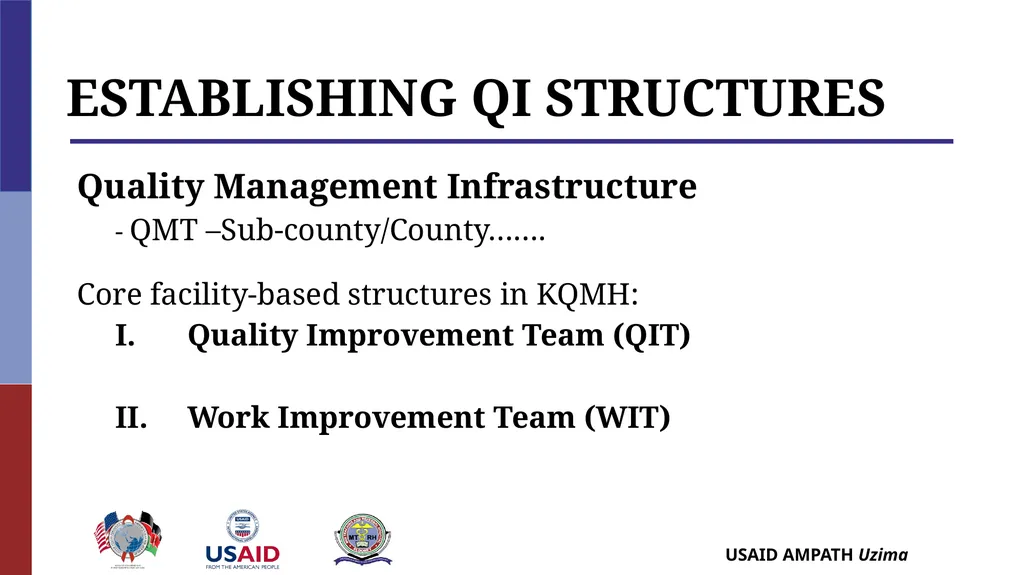
ESTABLISHING QI STRUCTURES Quality Management Infrastructure
- QMT –Sub-county/County…….
Core facility-based structures in KQMH:
Quality Improvement Team (QIT)
Work Improvement Team (WIT)<br>
- QMT –Sub-county/County…….
Core facility-based structures in KQMH:
Quality Improvement Team (QIT)
Work Improvement Team (WIT)<br>
05
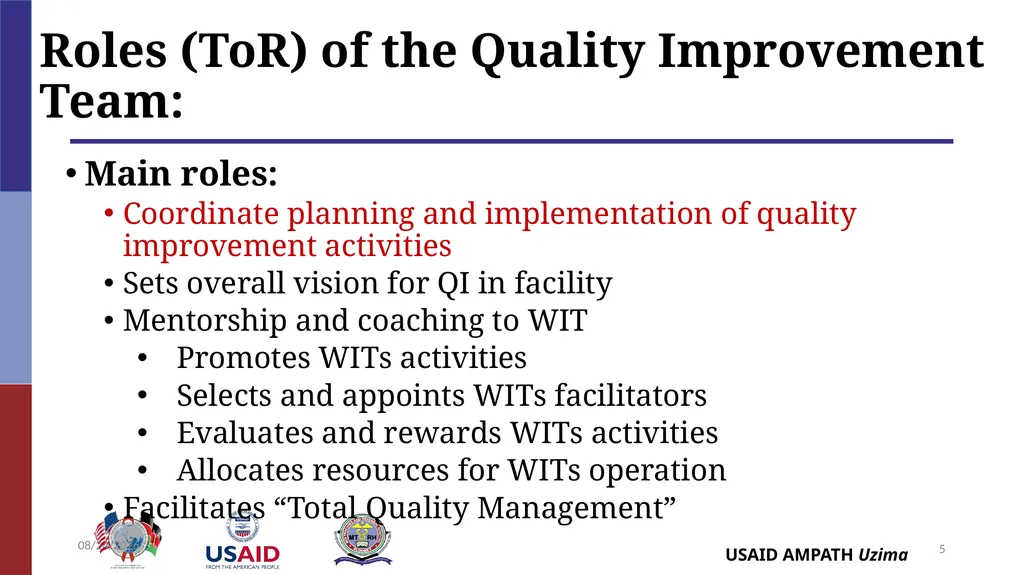
Roles (ToR) of the Quality Improvement Team: 7/3/22 5 Main roles:
Coordinate planning and implementation of quality improvement activities
Sets overall vision for QI in facility
Mentorship and coaching to WIT
Promotes WITs activities
Selects and appoints WITs facilitators
Evaluates and rewards WITs activities
Allocates resources for WITs operation
Facilitates “Total Quality Management”<br>
Coordinate planning and implementation of quality improvement activities
Sets overall vision for QI in facility
Mentorship and coaching to WIT
Promotes WITs activities
Selects and appoints WITs facilitators
Evaluates and rewards WITs activities
Allocates resources for WITs operation
Facilitates “Total Quality Management”<br>
06
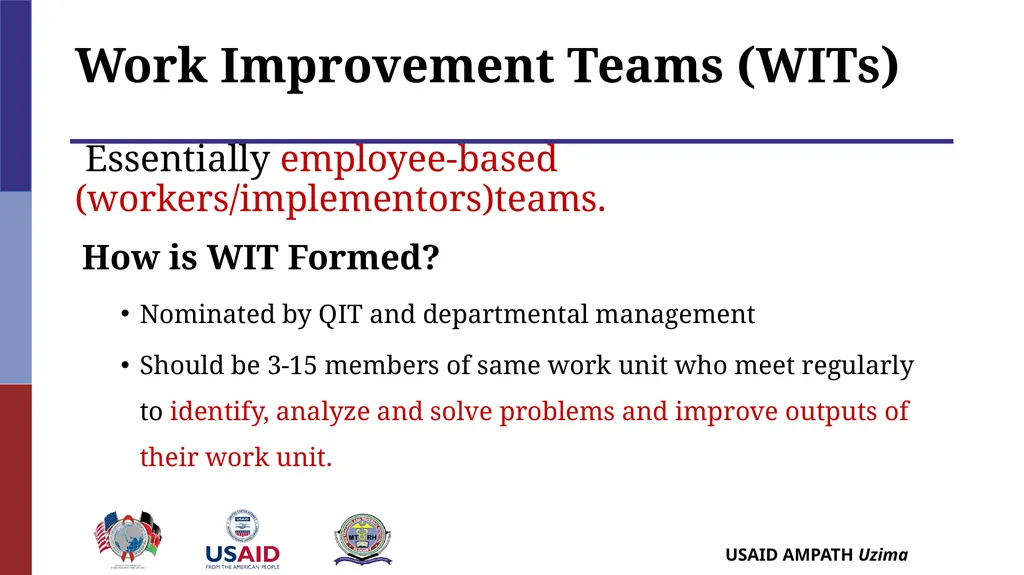
Work Improvement Teams (WITs)
Essentially employee-based (workers/implementors)teams. How is WIT Formed?
Nominated by QIT and departmental management
Should be 3-15 members of same work unit who meet regularly to identify, analyze and solve problems and improve outputs of their work unit.<br>
Nominated by QIT and departmental management
Should be 3-15 members of same work unit who meet regularly to identify, analyze and solve problems and improve outputs of their work unit.<br>
07
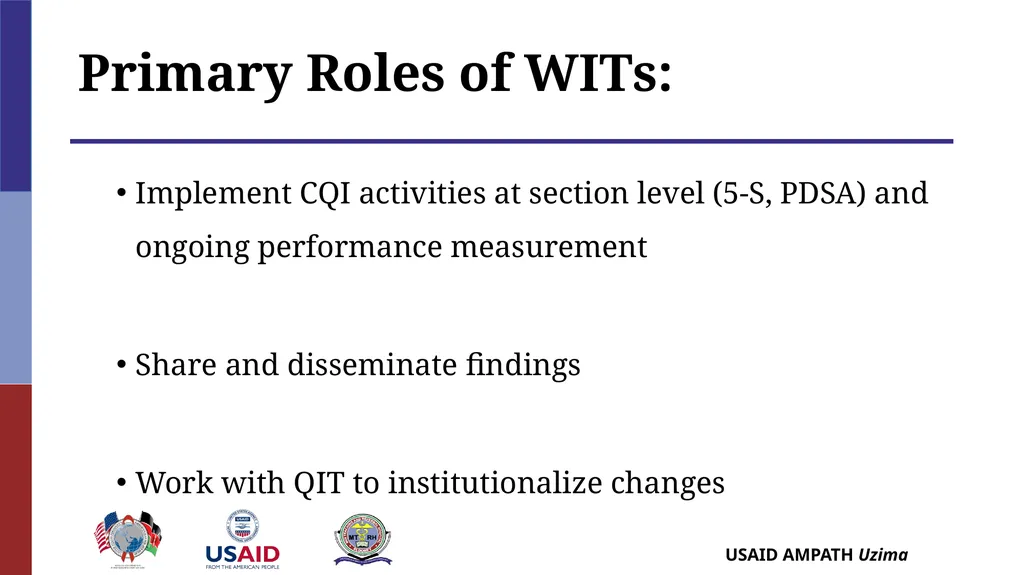
Primary Roles of WITs: Implement CQI activities at section level (5-S, PDSA) and ongoing performance measurement
Share and disseminate findings
Work with QIT to institutionalize changes<br>
Share and disseminate findings
Work with QIT to institutionalize changes<br>
08
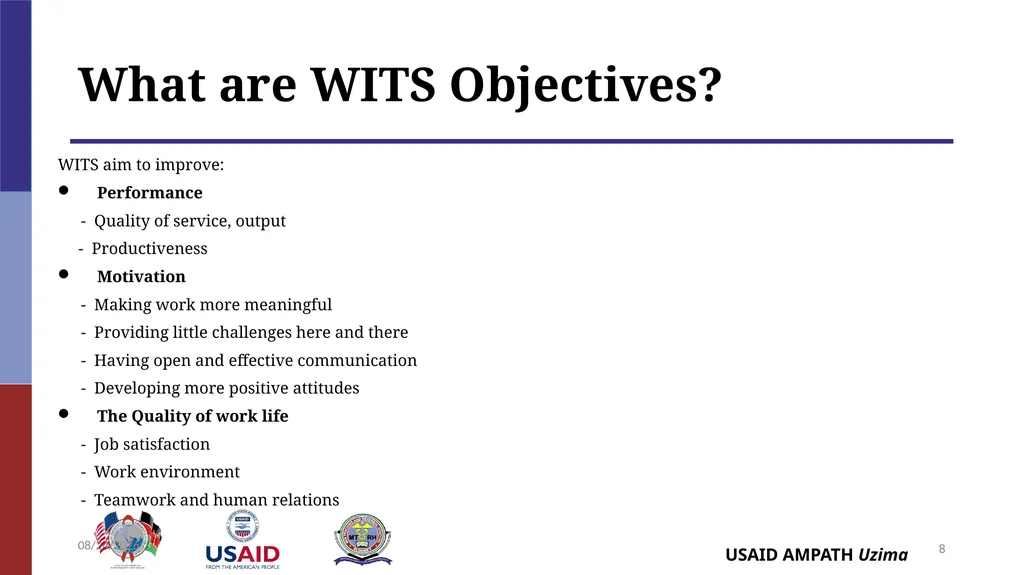
What are WITS Objectives? WITS aim to improve:
Performance
- Quality of service, output
- Productiveness
Motivation
- Making work more meaningful
- Providing little challenges here and there
- Having open and effective communication
- Developing more positive attitudes
The Quality of work life
- Job satisfaction
- Work environment
- Teamwork and human relations 7/3/22 8<br>
Performance
- Quality of service, output
- Productiveness
Motivation
- Making work more meaningful
- Providing little challenges here and there
- Having open and effective communication
- Developing more positive attitudes
The Quality of work life
- Job satisfaction
- Work environment
- Teamwork and human relations 7/3/22 8<br>
09
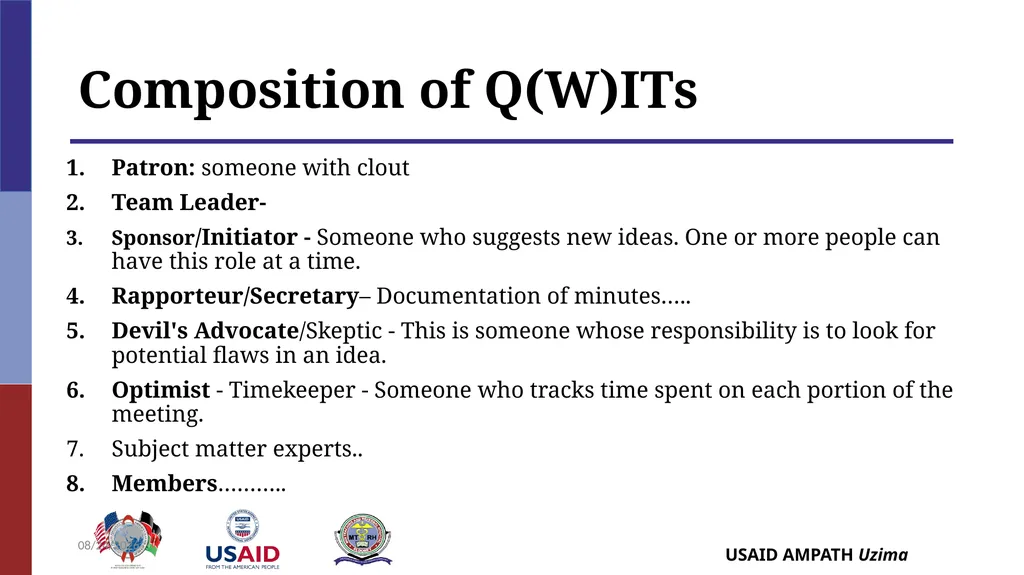
Composition of Q(W)ITs 7/3/22 Patron: someone with clout
Team Leader-
Sponsor/Initiator - Someone who suggests new ideas. One or more people can have this role at a time.
Rapporteur/Secretary– Documentation of minutes…..
Devil's Advocate/Skeptic - This is someone whose responsibility is to look for potential flaws in an idea.
Optimist - Timekeeper - Someone who tracks time spent on each portion of the meeting.
Subject matter experts..
Members………..<br>
Team Leader-
Sponsor/Initiator - Someone who suggests new ideas. One or more people can have this role at a time.
Rapporteur/Secretary– Documentation of minutes…..
Devil's Advocate/Skeptic - This is someone whose responsibility is to look for potential flaws in an idea.
Optimist - Timekeeper - Someone who tracks time spent on each portion of the meeting.
Subject matter experts..
Members………..<br>
10
QI TEAM RESPONSIBILITIES: SPONSOR/INITIATOR Charters the improvement teams
Provides the initial improvement goal and monitors the team progress.
Develops the initial QI charter, before teams refine it further.
Supports the QI teams through the implementation process
This role can be a group of people or a person e.g. the ScHMT can be the sponsor of a QI initiative.<br>
Provides the initial improvement goal and monitors the team progress.
Develops the initial QI charter, before teams refine it further.
Supports the QI teams through the implementation process
This role can be a group of people or a person e.g. the ScHMT can be the sponsor of a QI initiative.<br>
11
QI team responsibilities: leader Organizes and directs the work of the QI Team
Develops meeting agendas and timelines, recruits members and monitors progress
Identifies need for other technical and QI support
Acts as the link between service delivery and facility management
Provides management updates
Bears responsibility for implementing change<br>
Develops meeting agendas and timelines, recruits members and monitors progress
Identifies need for other technical and QI support
Acts as the link between service delivery and facility management
Provides management updates
Bears responsibility for implementing change<br>
12
QI Team Responsibilities: QI Expert Establishes a contract with the QI Team Leader to define how to intervene, whether through the Leader or directly with the QI Team
Guides QI Leadership Team through the QI process
Improvement steps
QI Tools
Analyses
Monitors QI Team effectiveness and suggests ways to enhance performance<br>
Guides QI Leadership Team through the QI process
Improvement steps
QI Tools
Analyses
Monitors QI Team effectiveness and suggests ways to enhance performance<br>
13
QI Team Responsibilities: Members Present reality in analysis of the current situation
Represent the concerns of the provider/supplier/customer/beneficiary group, as appropriate
Carry out assignments between meetings<br>
Represent the concerns of the provider/supplier/customer/beneficiary group, as appropriate
Carry out assignments between meetings<br>
14
QI Team Responsibilities: Rapporteur Records and maintains QI Team documents
Meeting notes (agendas, minutes, attendees)
Results of analyses
Team storyboard
Provides communication among QI Team members, QI Team Leadership and external people
Ensures ideas are captured and displayed during discussion – newsprint
Prepares publications and information releases<br>
Meeting notes (agendas, minutes, attendees)
Results of analyses
Team storyboard
Provides communication among QI Team members, QI Team Leadership and external people
Ensures ideas are captured and displayed during discussion – newsprint
Prepares publications and information releases<br>
15
QUALITY IMPROVEMENT TEAMS (QITs) & WORK IMPROVEMENT TEAMS (WITs) FOR PRODUCTIVITY AND QUALITY IMPROVEMENT<br>
16
A Team is a group of people working together to achieve a common goal for which they share responsibility
Team work is solving problems together whereby all members have the ability to influence decisions and apply their strengths effectively Definitions<br>
Team work is solving problems together whereby all members have the ability to influence decisions and apply their strengths effectively Definitions<br>
17
Team work is not… A group of people and one ‘STAR’ who does all of the work.
Neither is it ………
A group of people and a leader dictating to them what to do.<br>
Neither is it ………
A group of people and a leader dictating to them what to do.<br>
18
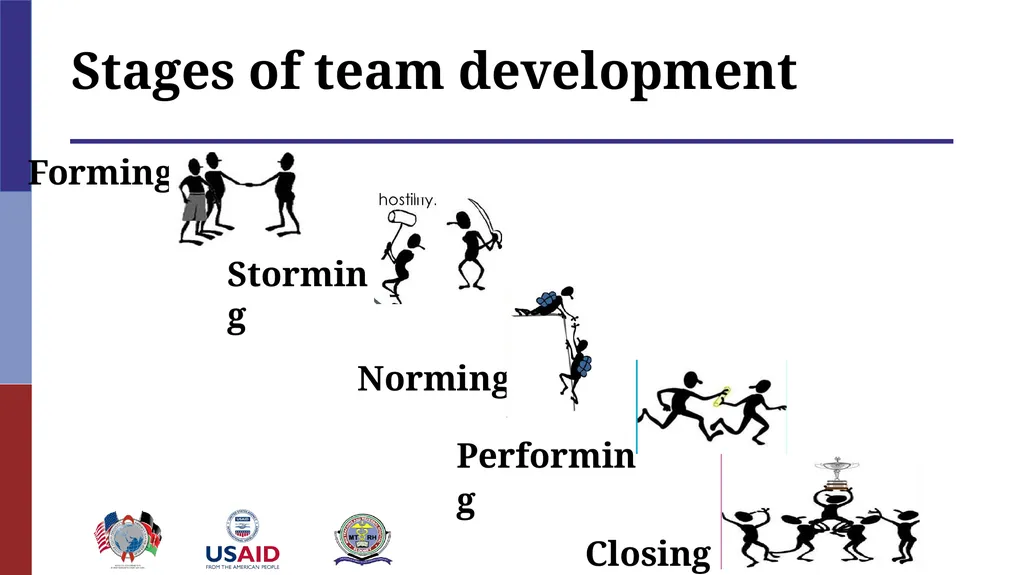
TEAM DYNAMICS Stages of team development;
Forming; inclusion and acceptance
Storming; Assert control fight for own voice
Norming; Teams have clarity on the goal and objectives, want to accomplish goal.
Performing; Highly effective problem solving stage
Closing;
All teams go through this process but not necessarily in the order above<br>
Forming; inclusion and acceptance
Storming; Assert control fight for own voice
Norming; Teams have clarity on the goal and objectives, want to accomplish goal.
Performing; Highly effective problem solving stage
Closing;
All teams go through this process but not necessarily in the order above<br>
19
Forming Storming Norming Performing Closing Stages of team development<br>
20
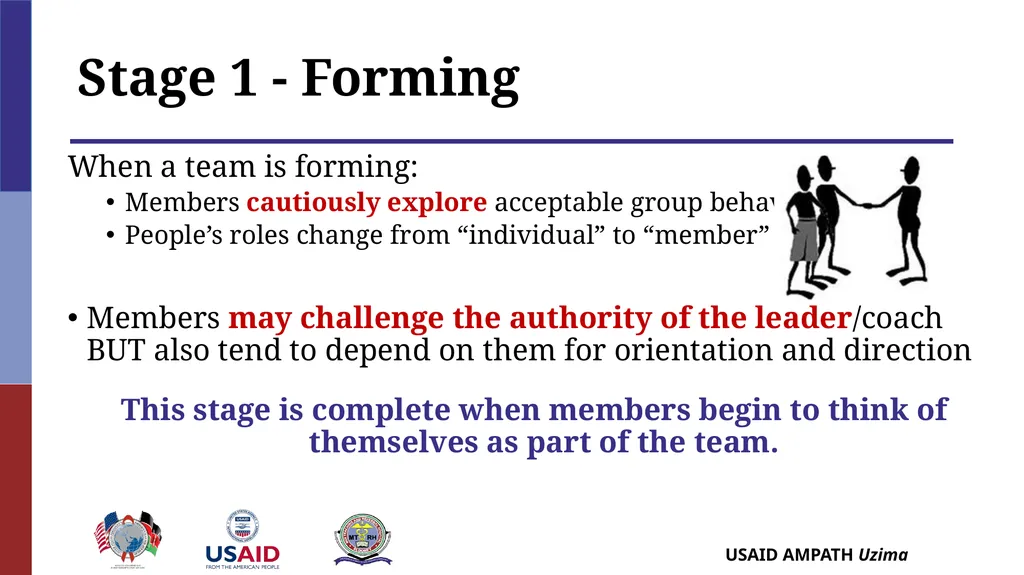
Stage 1 - Forming When a team is forming:
Members cautiously explore acceptable group behavior
People’s roles change from “individual” to “member”
Members may challenge the authority of the leader/coach BUT also tend to depend on them for orientation and direction
This stage is complete when members begin to think of themselves as part of the team.<br>
Members cautiously explore acceptable group behavior
People’s roles change from “individual” to “member”
Members may challenge the authority of the leader/coach BUT also tend to depend on them for orientation and direction
This stage is complete when members begin to think of themselves as part of the team.<br>
21
Stage 2 - Storming Storming is critical to effective group development
Tasks ahead may seem harder than expected
Some team members may become impatient, argumentative and resist collaborating with each other
This stage provides the opportunity for individuals to establish their own expertise within the group
They will forge ways of working together and respect each other’s point of view
This stage is complete when there is a relatively clear hierarchy of leadership within the group<br>
Tasks ahead may seem harder than expected
Some team members may become impatient, argumentative and resist collaborating with each other
This stage provides the opportunity for individuals to establish their own expertise within the group
They will forge ways of working together and respect each other’s point of view
This stage is complete when there is a relatively clear hierarchy of leadership within the group<br>
22
Stage 3 - Norming During this stage members realize their:
Common goals
Begin to accept the team
Roles and the individuality of fellow members
As a result conflicts are minimal and there is more cooperation
This stage is complete when the group structure becomes established and the team develops a shared understanding of how a team member should behave.<br>
Common goals
Begin to accept the team
Roles and the individuality of fellow members
As a result conflicts are minimal and there is more cooperation
This stage is complete when the group structure becomes established and the team develops a shared understanding of how a team member should behave.<br>
23
Stage 4 - Performing During this stage:
The team starts identifying, solving problems, choosing and implementing changes
Members accept each other’s strengths, weaknesses, and know their own roles
It is during this stage that the team performs at its best.<br>
The team starts identifying, solving problems, choosing and implementing changes
Members accept each other’s strengths, weaknesses, and know their own roles
It is during this stage that the team performs at its best.<br>
24
Stage 5 - Closing The work of a problem-solving or quality improvement team is intended to end when process improvements are in place
The team must deal with either the success or failure of their efforts and the dissolution of the team
The team should identify lessons learned and plan how they will be communicated
The leader and team celebrate their successes and provide support if the project has not been successful<br>
The team must deal with either the success or failure of their efforts and the dissolution of the team
The team should identify lessons learned and plan how they will be communicated
The leader and team celebrate their successes and provide support if the project has not been successful<br>
25
Success of KQMH-5S-CQI (KAIZEN) implementation depends on:
Leadership
Commitment
Positive mindset & Everyone’s participation<br>
Leadership
Commitment
Positive mindset & Everyone’s participation<br>
26
“Attitude is a little thing that makes a big difference.” ~Winston Churchill<br>
27
“The greatest discovery of my generation is that human beings can alter their lives by altering their attitudes of mind”.
William James of Harvard University<br>
William James of Harvard University<br>
28
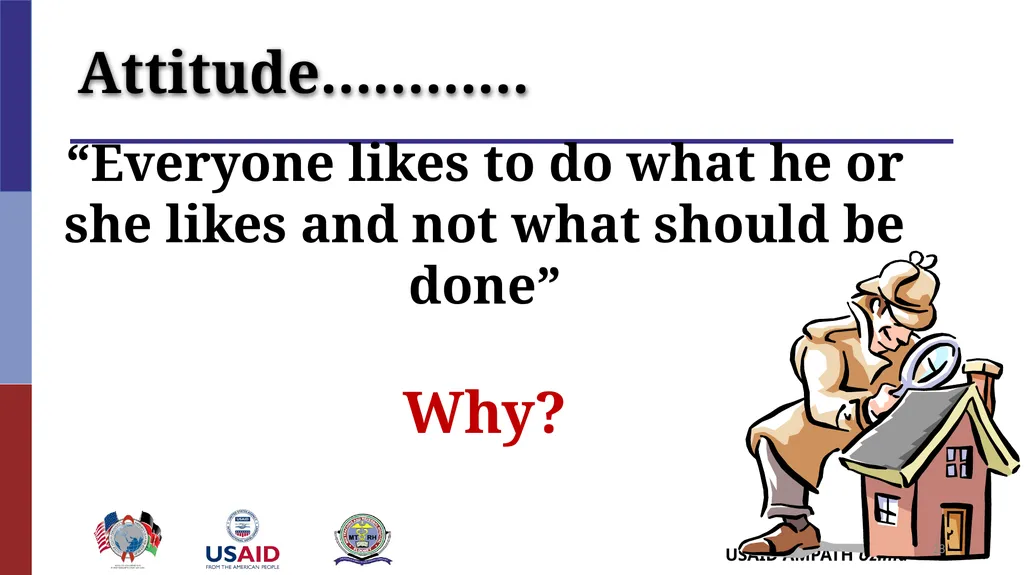
“Everyone likes to do what he or she likes and not what should be done”
Why? 28 Attitude…………<br>
Why? 28 Attitude…………<br>
29
Answer is…. “Knowledge and Skills aren’t enough. It’s your positive attitude which makes the difference”. 29<br>
30
So, let’s ask ourselves these important questions……
Can an executive be a good executive without a good attitude?
Can a student be a good student without a good attitude?
Can parents, teachers, employers or employees be good in their roles without a good attitude?
Yatafakari Hayo!!<br>
Can an executive be a good executive without a good attitude?
Can a student be a good student without a good attitude?
Can parents, teachers, employers or employees be good in their roles without a good attitude?
Yatafakari Hayo!!<br>
31
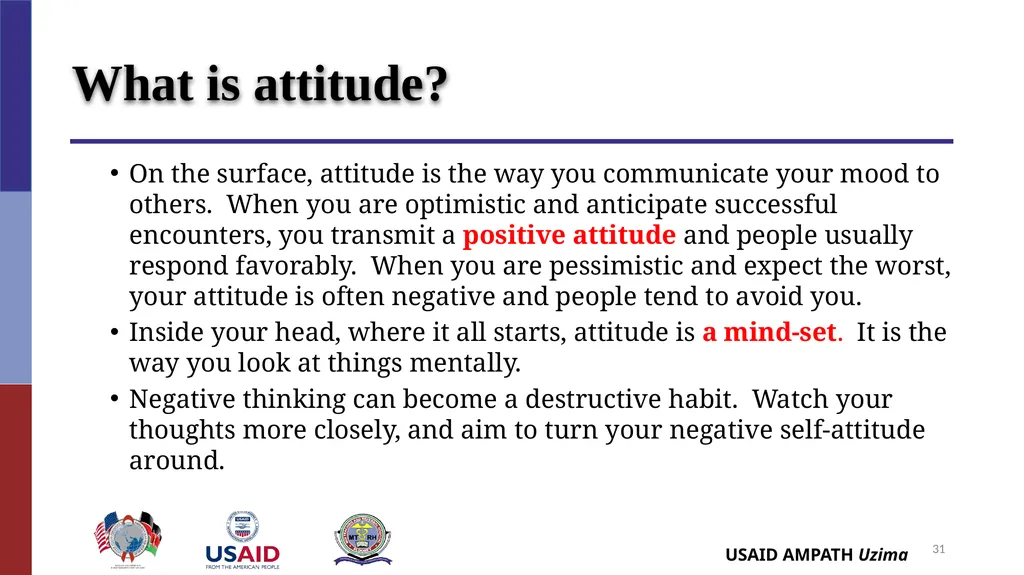
What is attitude? On the surface, attitude is the way you communicate your mood to others. When you are optimistic and anticipate successful encounters, you transmit a positive attitude and people usually respond favorably. When you are pessimistic and expect the worst, your attitude is often negative and people tend to avoid you.
Inside your head, where it all starts, attitude is a mind-set. It is the way you look at things mentally.
Negative thinking can become a destructive habit. Watch your thoughts more closely, and aim to turn your negative self-attitude around. 31<br>
Inside your head, where it all starts, attitude is a mind-set. It is the way you look at things mentally.
Negative thinking can become a destructive habit. Watch your thoughts more closely, and aim to turn your negative self-attitude around. 31<br>
32
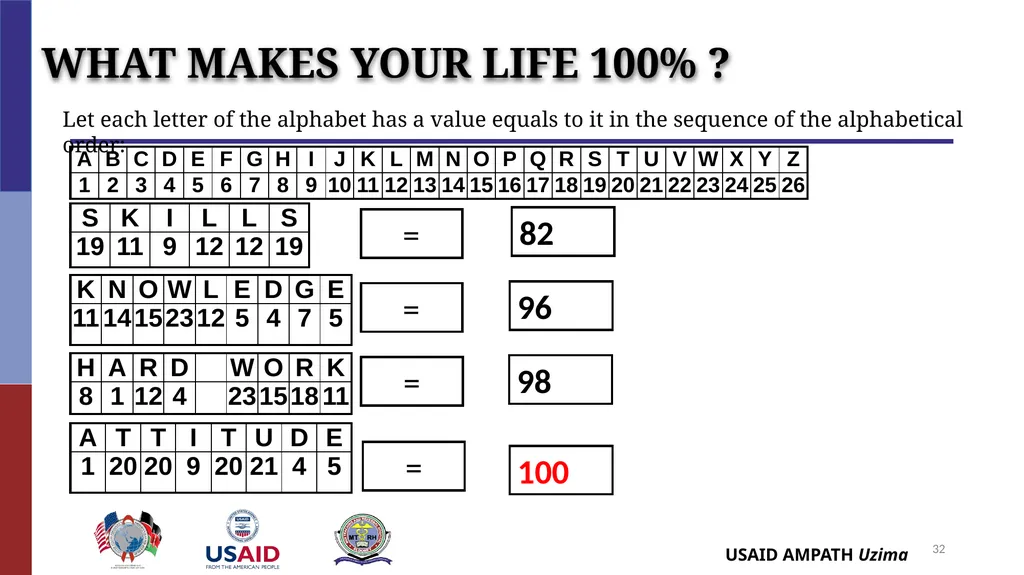
WHAT MAKES YOUR LIFE 100% ? = = = = 82 96 98 100 Let each letter of the alphabet has a value equals to it in the sequence of the alphabetical order: 32<br>
33
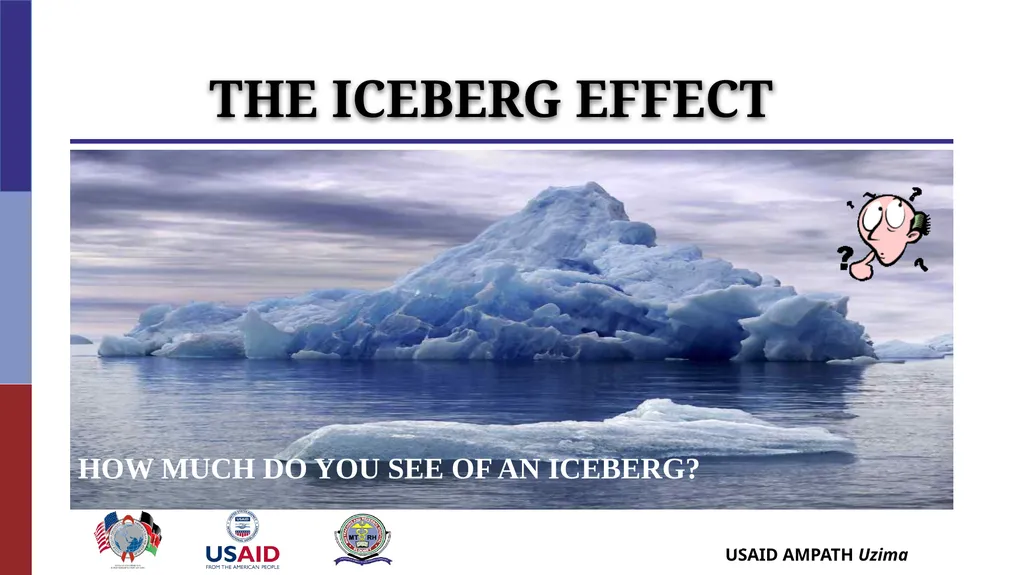
THE ICEBERG 33 HOW MUCH DO YOU SEE OF AN ICEBERG? THE ICEBERG EFFECT<br>
34
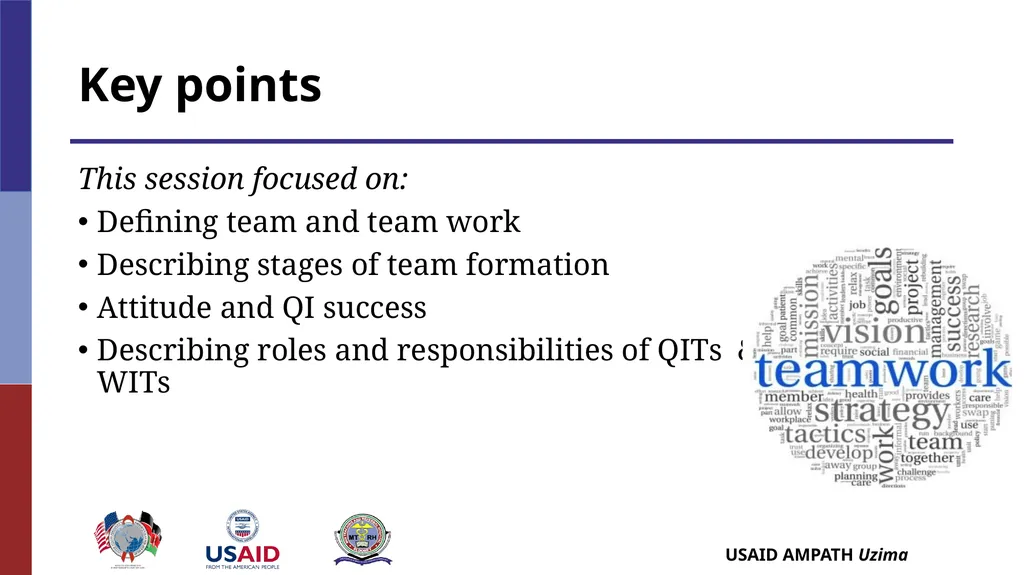
Key points This session focused on:
Defining team and team work
Describing stages of team formation
Attitude and QI success
Describing roles and responsibilities of QITs & WITs<br>
Defining team and team work
Describing stages of team formation
Attitude and QI success
Describing roles and responsibilities of QITs & WITs<br>
35
THANK YOU info@ampathkenya.org | www.ampathkenya.org | @ampathkenya<br>