
Ethics of Interpretation AK Flowerree Texas Tech
MS
Published · 22 slides · 0 views

1 / 1
Description
Ethics of Interpretation AK Flowerree Texas Tech University Ethics of Interpretation Is she grandstanding, or merely animated and sincere? Is the group rioting or protesting? Was she acting out and seeking attention, or was her outburst an
Related Topics
Share
Embed code
Download this presentation From Below
"Ethics of Interpretation AK Flowerree Texas Tech" is the property of its rightful owner. Permission is granted to download and print the materials on this website for personal, non-commercial use only, and to display it on your personal computer provided you do not modify the materials and that you retain all copyright notices contained in the materials. By downloading content from our website, you accept the terms of this agreement.
Presentation Transcript
01
Ethics of Interpretation AK Flowerree
Texas Tech University<br>
Texas Tech University<br>
02
Ethics of Interpretation Is she grandstanding, or merely animated and sincere?
Is the group rioting or protesting?
Was she acting out and seeking attention, or was her outburst an attempt to express her individuality and break free from socially oppressive norms?
Did this student not turn in work because they are lazy and unmotivated or because of crippling anxiety and depression?
Does the leader give a speech of hope and unity, or blather on with wishful thinking?
Is this man flexing his privilege and entitlement, or merely asking for a fair hearing?
Am I overreacting? Or is he gaslighting me? Contested Action: there is agreement on the basic form of the act – certain bodily movements were performed – but there is not agreement on the significance or moral status of those bodily movements.
Interpretation determines which reactive attitudes (if any) apply
We wrong another person when we fail to treat them as we ought<br>
03
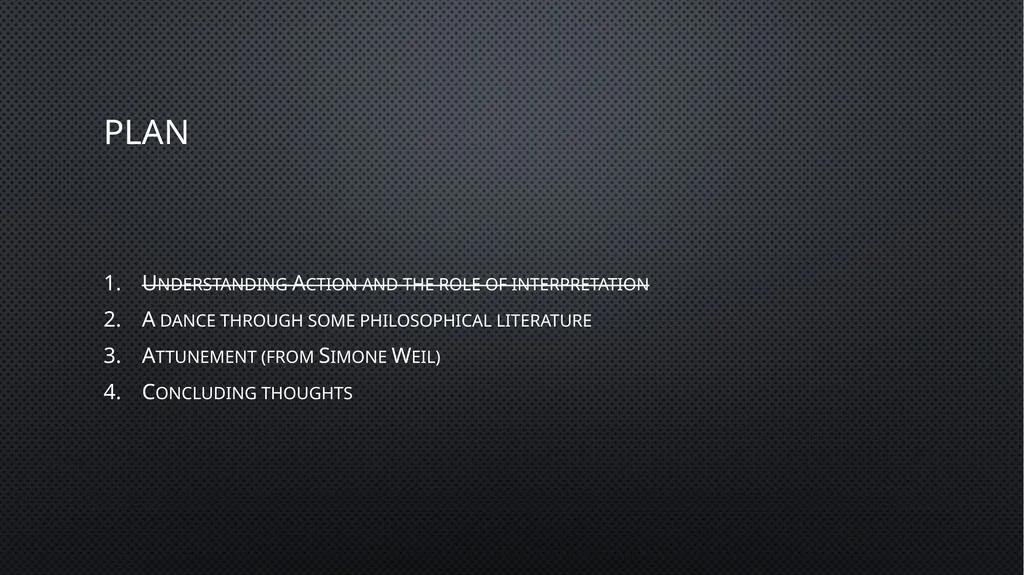
Plan Understanding Action and the role of interpretation
A dance through some philosophical literature
Attunement (from Simone Weil)
Concluding thoughts<br>
A dance through some philosophical literature
Attunement (from Simone Weil)
Concluding thoughts<br>
04
1. Understanding Action What is an action?
Mere act: series of bodily movements
Action: a description of the act that includes the agent’s reason for acting
Interpreting an action involves situating it within its broader meaning, settling not just which act/action was performed, but also the ethical and interpersonal significance of that act/action.<br>
05
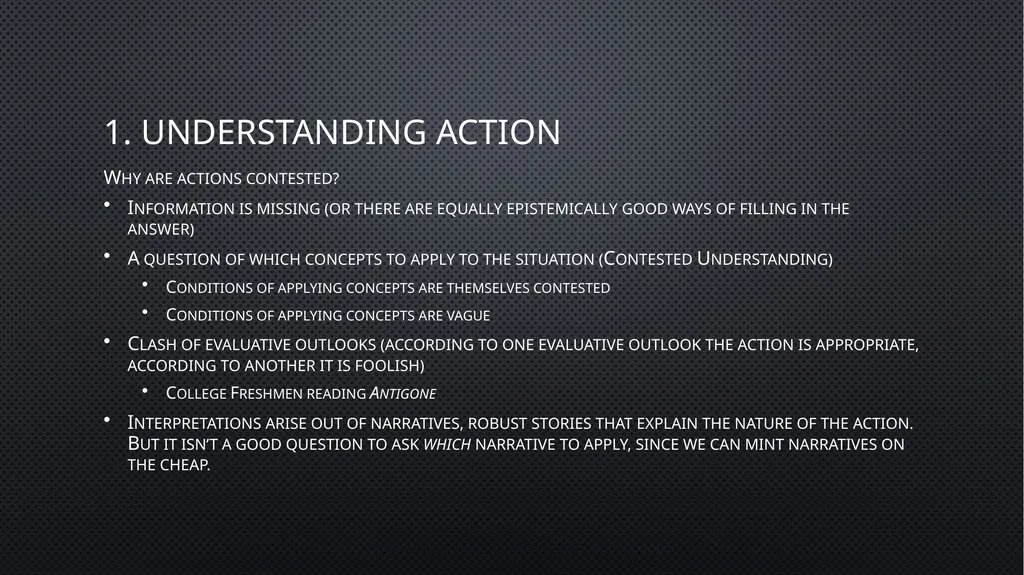
1. Understanding Action Why are actions contested?
Information is missing (or there are equally epistemically good ways of filling in the answer)
A question of which concepts to apply to the situation (Contested Understanding)
Conditions of applying concepts are themselves contested
Conditions of applying concepts are vague
Clash of evaluative outlooks (according to one evaluative outlook the action is appropriate, according to another it is foolish)
College Freshmen reading Antigone
Interpretations arise out of narratives, robust stories that explain the nature of the action. But it isn’t a good question to ask which narrative to apply, since we can mint narratives on the cheap.<br>
06
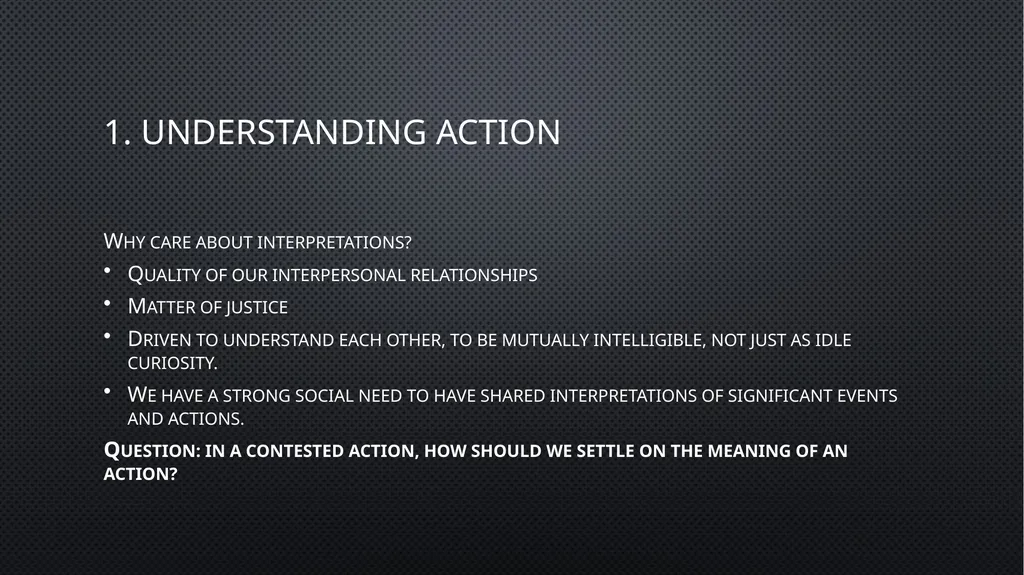
1. Understanding Action Why care about interpretations?
Quality of our interpersonal relationships
Matter of justice
Driven to understand each other, to be mutually intelligible, not just as idle curiosity.
We have a strong social need to have shared interpretations of significant events and actions.
Question: in a contested action, how should we settle on the meaning of an action?<br>
07
Plan Understanding Action and the role of interpretation
A dance through some philosophical literature
Attunement (from Simone Weil)
Concluding thoughts<br>
A dance through some philosophical literature
Attunement (from Simone Weil)
Concluding thoughts<br>
08
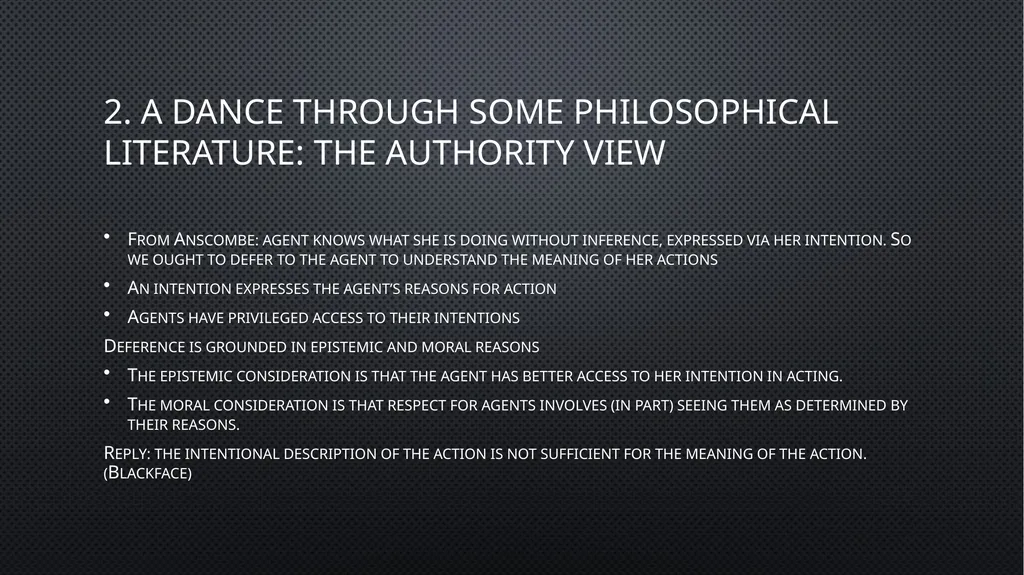
2. A Dance through some philosophical literature: The Authority View From Anscombe: agent knows what she is doing without inference, expressed via her intention. So we ought to defer to the agent to understand the meaning of her actions
An intention expresses the agent’s reasons for action
Agents have privileged access to their intentions
Deference is grounded in epistemic and moral reasons
The epistemic consideration is that the agent has better access to her intention in acting.
The moral consideration is that respect for agents involves (in part) seeing them as determined by their reasons.
Reply: the intentional description of the action is not sufficient for the meaning of the action. (Blackface)<br>
09
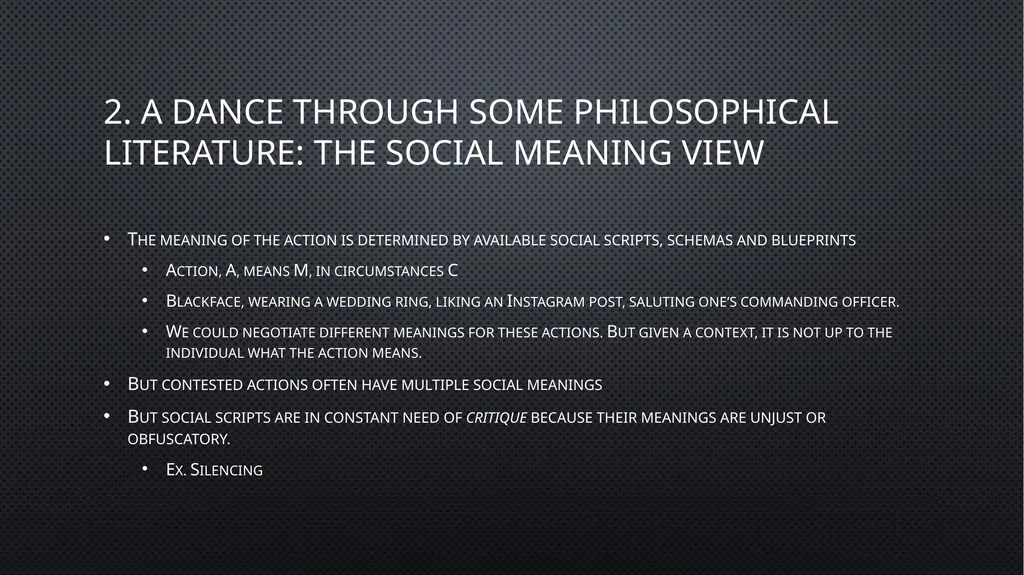
2. A Dance through some philosophical literature: The Social Meaning View The meaning of the action is determined by available social scripts, schemas and blueprints
Action, A, means M, in circumstances C
Blackface, wearing a wedding ring, liking an Instagram post, saluting one’s commanding officer.
We could negotiate different meanings for these actions. But given a context, it is not up to the individual what the action means.
But contested actions often have multiple social meanings
But social scripts are in constant need of critique because their meanings are unjust or obfuscatory.
Ex. Silencing<br>
10
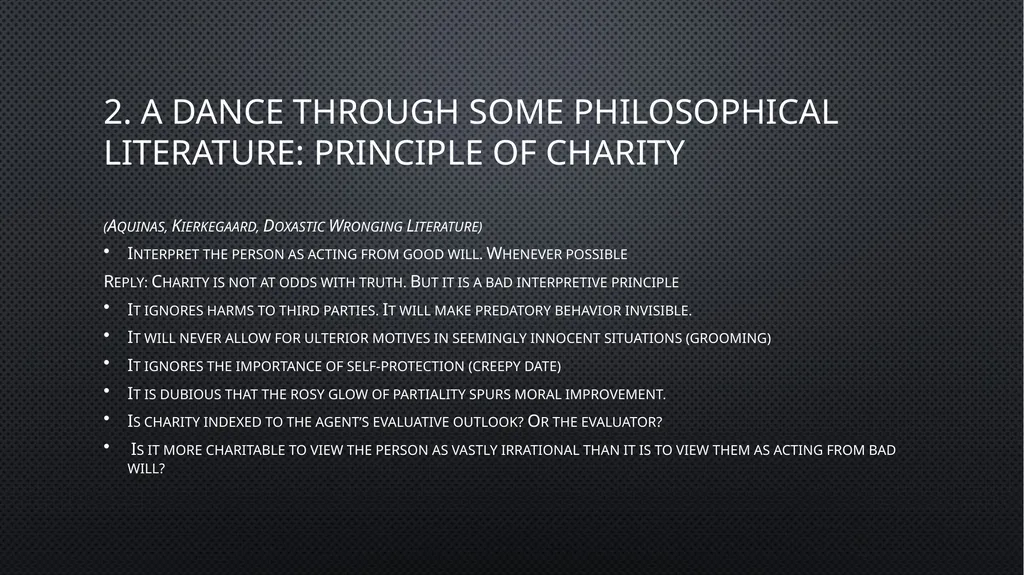
2. A Dance through some philosophical literature: Principle of Charity (Aquinas, Kierkegaard, Doxastic Wronging Literature)
Interpret the person as acting from good will. Whenever possible
Reply: Charity is not at odds with truth. But it is a bad interpretive principle
It ignores harms to third parties. It will make predatory behavior invisible.
It will never allow for ulterior motives in seemingly innocent situations (grooming)
It ignores the importance of self-protection (creepy date)
It is dubious that the rosy glow of partiality spurs moral improvement.
Is charity indexed to the agent’s evaluative outlook? Or the evaluator?
Is it more charitable to view the person as vastly irrational than it is to view them as acting from bad will?<br>
11
Plan Understanding Action and the role of interpretation
A dance through some philosophical literature
Attunement (from Simone Weil)
Concluding thoughts<br>
A dance through some philosophical literature
Attunement (from Simone Weil)
Concluding thoughts<br>
12
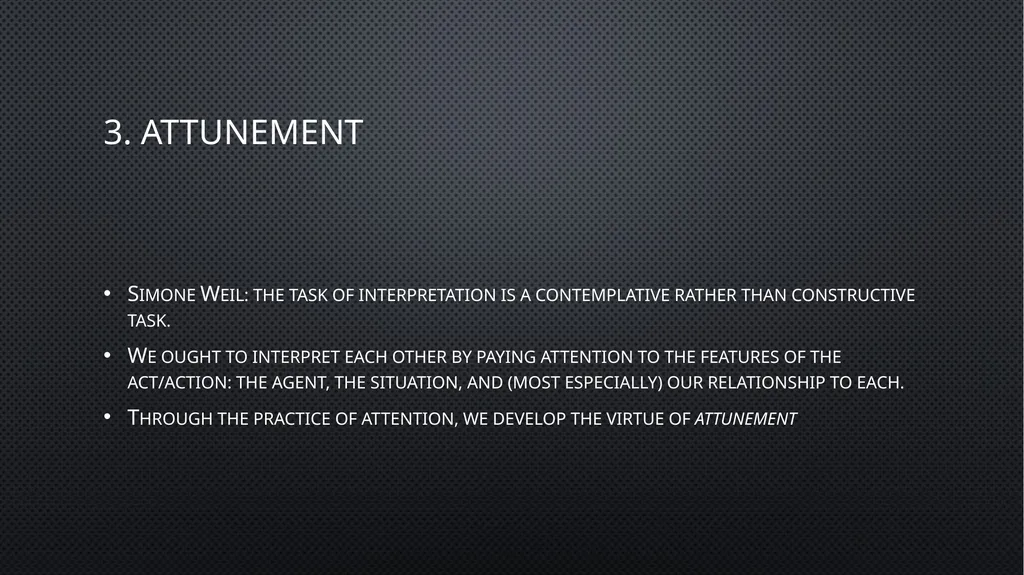
3. Attunement Simone Weil: the task of interpretation is a contemplative rather than constructive task.
We ought to interpret each other by paying attention to the features of the act/action: the agent, the situation, and (most especially) our relationship to each.
Through the practice of attention, we develop the virtue of attunement<br>
We ought to interpret each other by paying attention to the features of the act/action: the agent, the situation, and (most especially) our relationship to each.
Through the practice of attention, we develop the virtue of attunement<br>
13
3. Attunement In “Gravity and Grace,” Weil writes
“We have to try to cure our faults by attention and not by will… if we turn our mind towards the good, it is impossible that little by little the whole soul will not be attracted thereto in spite of itself….The authentic and pure values – truth, beauty and goodness – in the same activity of a human being are the result of one and the same act, a certain application of the full attention to the object.”<br>
“We have to try to cure our faults by attention and not by will… if we turn our mind towards the good, it is impossible that little by little the whole soul will not be attracted thereto in spite of itself….The authentic and pure values – truth, beauty and goodness – in the same activity of a human being are the result of one and the same act, a certain application of the full attention to the object.”<br>
14
3. Attunement Consider the person who is hungry and asks for food:
Weil writes, “To know that this man who is hungry and thirsty really exists as much as I do – that is enough, the rest follows of itself.”
In order to ignore this man’s need, we must convince ourselves that he does not really need it, or we cannot really help him. But if we are properly attuned to his need, and our ability to help, we will be unable to arrive at any other conclusion than that we must help him. And so, for Weil, the wisdom that is needed to interpret the meaning of an action is given to us through the practice of attention.<br>
15
3. Attunement “We read, but also we are read by, others. Interferences in these readings. Forcing someone to read himself as we read him (slavery). Forcing others to read us as we read ourselves (conquest)”
Dangers: deferring to self, deferring to social norms<br>
Dangers: deferring to self, deferring to social norms<br>
16
3. Attunement Deferring to self: Distortion
Our personal history, our emotional reactions, our ego will distort our reading of the situation<br>
Our personal history, our emotional reactions, our ego will distort our reading of the situation<br>
17
3. Attunement Social Deference: Peer Pressure
We harm our interpersonal relationship by failing to take proper care to understand the other person.<br>
We harm our interpersonal relationship by failing to take proper care to understand the other person.<br>
18
3. Attunement Social Deference: Contingent, Unhelpful or unkind scripts
Social scripts can be a source of error because they are based on contingent features that may or may not track anything of value.
Joan of Arc.
Canonized as a saint in 1920
Condemned as a witch, a heretic.
Social meanings are contingent:1430s or the 1920s or the 2020s. Which one is relevant?
we must recognize our own role in determining the interpretation.<br>
19
3. Attunement: Distortions We are angry/fearful/self-protective
We defer to the cultural scripts rather than seeing the individual
We defer to the mob mentality rather than weighing the details of the case
We value the wrong things
We are distracted
Power distorts our interpretations (Manne)<br>
We defer to the cultural scripts rather than seeing the individual
We defer to the mob mentality rather than weighing the details of the case
We value the wrong things
We are distracted
Power distorts our interpretations (Manne)<br>
20
3. Attunement as corrective it reveals to us the assumptions we are making about our interpretation. It lays bare how much work goes into constructing a reading, and makes salient the interpretive moves we are making. Interpretations of others are more fundamentally readings of ourselves. They reflect us as much as they reflect those we read. We see ourselves in our readings.
the result is not a debunking of readings. It’s not that the contingency and constructedness of readings makes it any less important or legitimate to read the actions of others. Instead, attunement helps us avoid error. The primary accomplishment is that we understand our own relationship to the interpretation of others, and so understand our own limitations. Practicing attunement ought to bring with it increased compassion and humility in our judgments.
And finally, attunement also makes central what we take to be valuable, appropriate, respectful and required. Attunement puts in bold relief our normative commitments. Attunement can draw our attention to our conception of the good and the role that normative commitments play in interpreting the actions of others.<br>
21
Plan Understanding Action and the role of interpretation
A dance through some philosophical literature
Attunement (from Simone Weil)
Concluding thoughts<br>
A dance through some philosophical literature
Attunement (from Simone Weil)
Concluding thoughts<br>
22
3. Conclusion how should we interpret contested actions?
We should attend carefully to the person, action, and circumstances.
by carefully attending to the details of the situation, the moral features will become salient to us.
The process of attention helps us to reflect on potential distortions in our interpretation, and so avoid error
The practice of attention is a skill that can be improved through practice, and we can expect that by careful attention, we will grow better at interpreting the actions of others, more humble about the potential for interference and error, and more attuned to the value and worth of the other person.<br>