
ETHNIC GROUPS Presentation, Graphic Organizers, &
LV
Published · 50 slides · 0 views
1 / 1

Description
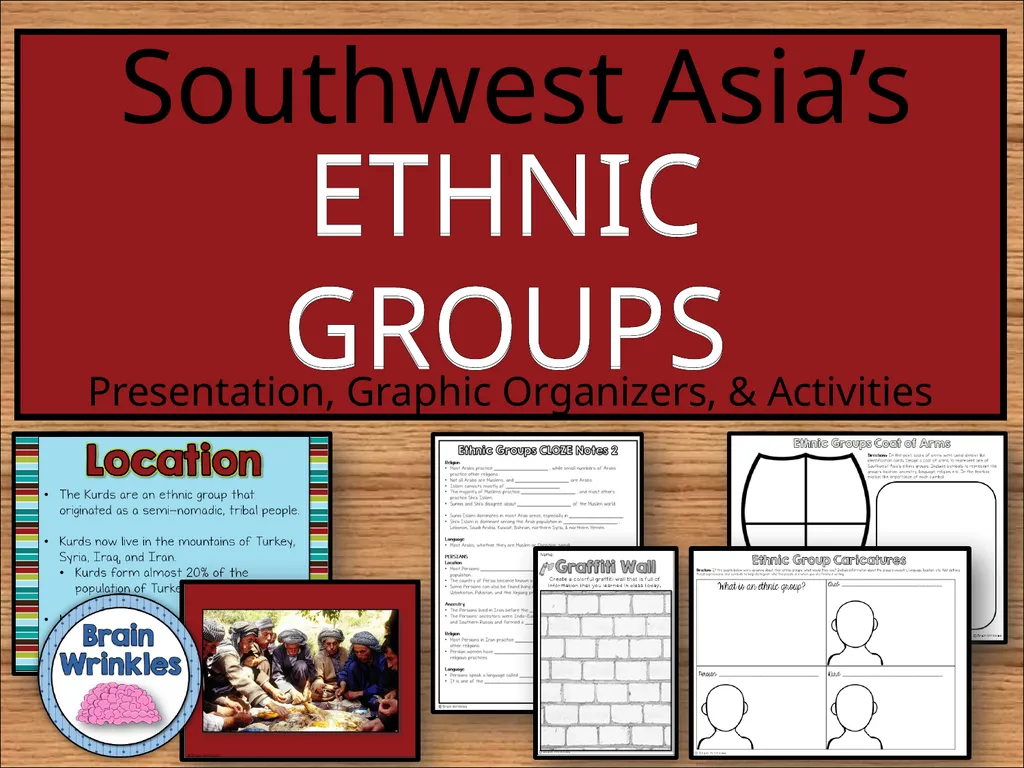
ETHNIC GROUPS Presentation, Graphic Organizers, Activities Southwest Asias ETHNIC GROUPS STANDARDS: SS7G8 Analyze the diverse cultural characteristics of the people who live in Southwest Asia (Middle East). Explain the differences
Related Topics
Share
Embed code
Download this presentation From Below
"ETHNIC GROUPS Presentation, Graphic Organizers, &" is the property of its rightful owner. Permission is granted to download and print the materials on this website for personal, non-commercial use only, and to display it on your personal computer provided you do not modify the materials and that you retain all copyright notices contained in the materials. By downloading content from our website, you accept the terms of this agreement.
Presentation Transcript
01
ETHNIC
GROUPS Presentation, Graphic Organizers, & Activities Southwest Asia’s ETHNIC
GROUPS<br>
GROUPS Presentation, Graphic Organizers, & Activities Southwest Asia’s ETHNIC
GROUPS<br>
02
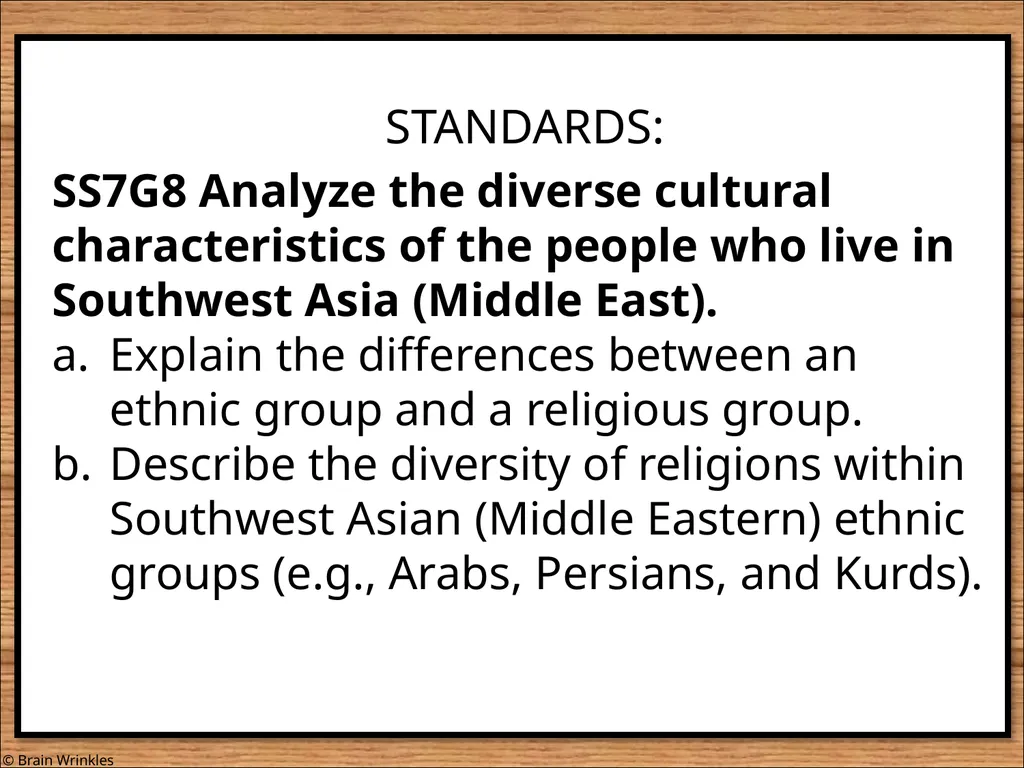
STANDARDS:
SS7G8 Analyze the diverse cultural characteristics of the people who live in Southwest Asia (Middle East).
Explain the differences between an ethnic group and a religious group.
Describe the diversity of religions within Southwest Asian (Middle Eastern) ethnic groups (e.g., Arabs, Persians, and Kurds). © Brain Wrinkles<br>
SS7G8 Analyze the diverse cultural characteristics of the people who live in Southwest Asia (Middle East).
Explain the differences between an ethnic group and a religious group.
Describe the diversity of religions within Southwest Asian (Middle Eastern) ethnic groups (e.g., Arabs, Persians, and Kurds). © Brain Wrinkles<br>
03
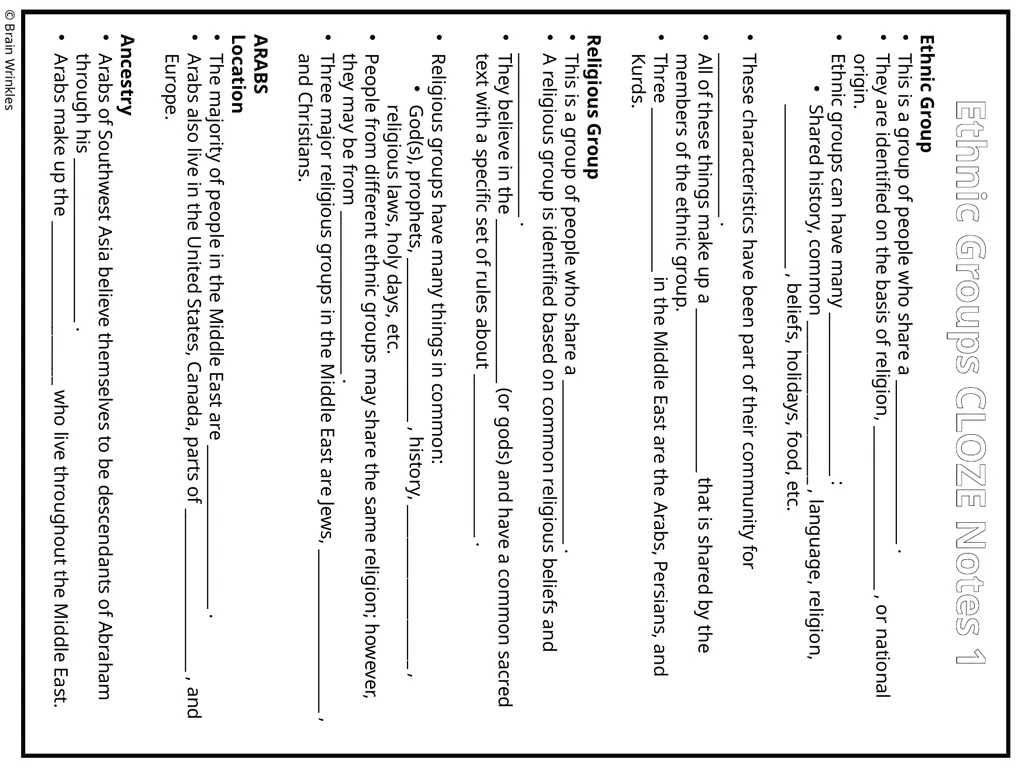
Ethnic Groups CLOZE Notes 1 Ethnic Group
This is a group of people who share a ____________________ .
They are identified on the basis of religion, ____________________ , or national origin.
Ethnic groups can have many ____________________ :
Shared history, common ____________________ , language, religion, ____________________ , beliefs, holidays, food, etc.
These characteristics have been part of their community for ____________________ .
All of these things make up a ____________________ that is shared by the members of the ethnic group.
Three ____________________ in the Middle East are the Arabs, Persians, and Kurds.
Religious Group
This is a group of people who share a ____________________ .
A religious group is identified based on common religious beliefs and ____________________ .
They believe in the ____________________ (or gods) and have a common sacred text with a specific set of rules about ____________________ .
Religious groups have many things in common:
God(s), prophets, ____________________ , history, ____________________ , religious laws, holy days, etc.
People from different ethnic groups may share the same religion; however, they may be from ____________________ .
Three major religious groups in the Middle East are Jews, ____________________ , and Christians.
ARABS
Location
The majority of people in the Middle East are ____________________ .
Arabs also live in the United States, Canada, parts of ____________________ , and Europe.
Ancestry
Arabs of Southwest Asia believe themselves to be descendants of Abraham through his ____________________ .
Arabs make up the ____________________ who live throughout the Middle East. © Brain Wrinkles<br>
This is a group of people who share a ____________________ .
They are identified on the basis of religion, ____________________ , or national origin.
Ethnic groups can have many ____________________ :
Shared history, common ____________________ , language, religion, ____________________ , beliefs, holidays, food, etc.
These characteristics have been part of their community for ____________________ .
All of these things make up a ____________________ that is shared by the members of the ethnic group.
Three ____________________ in the Middle East are the Arabs, Persians, and Kurds.
Religious Group
This is a group of people who share a ____________________ .
A religious group is identified based on common religious beliefs and ____________________ .
They believe in the ____________________ (or gods) and have a common sacred text with a specific set of rules about ____________________ .
Religious groups have many things in common:
God(s), prophets, ____________________ , history, ____________________ , religious laws, holy days, etc.
People from different ethnic groups may share the same religion; however, they may be from ____________________ .
Three major religious groups in the Middle East are Jews, ____________________ , and Christians.
ARABS
Location
The majority of people in the Middle East are ____________________ .
Arabs also live in the United States, Canada, parts of ____________________ , and Europe.
Ancestry
Arabs of Southwest Asia believe themselves to be descendants of Abraham through his ____________________ .
Arabs make up the ____________________ who live throughout the Middle East. © Brain Wrinkles<br>
04
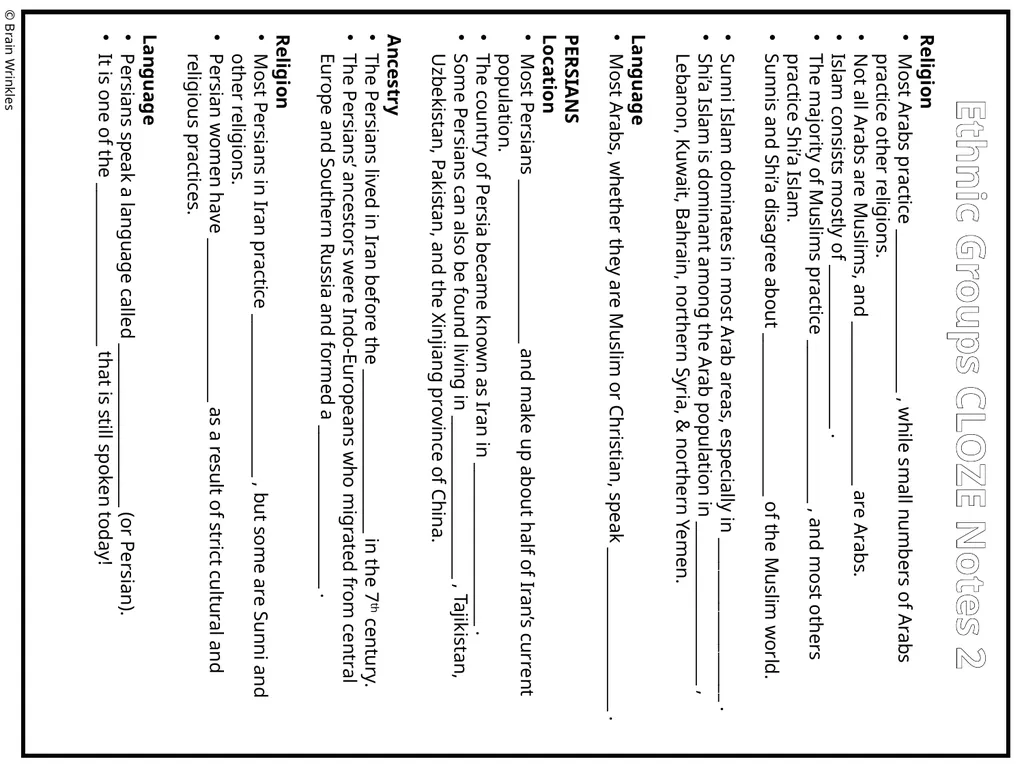
Ethnic Groups CLOZE Notes 2 Religion
Most Arabs practice ____________________ , while small numbers of Arabs practice other religions.
Not all Arabs are Muslims, and ____________________ are Arabs.
Islam consists mostly of ____________________ .
The majority of Muslims practice ____________________ , and most others practice Shi’a Islam.
Sunnis and Shi’a disagree about ____________________ of the Muslim world.
Sunni Islam dominates in most Arab areas, especially in ____________________ .
Shi’a Islam is dominant among the Arab population in ____________________ , Lebanon, Kuwait, Bahrain, northern Syria, & northern Yemen.
Language
Most Arabs, whether they are Muslim or Christian, speak ____________________ .
PERSIANS
Location
Most Persians ____________________ and make up about half of Iran’s current population.
The country of Persia became known as Iran in ____________________ .
Some Persians can also be found living in ____________________ , Tajikistan, Uzbekistan, Pakistan, and the Xinjiang province of China.
Ancestry
The Persians lived in Iran before the ____________________ in the 7th century.
The Persians’ ancestors were Indo-Europeans who migrated from central Europe and Southern Russia and formed a ____________________ .
Religion
Most Persians in Iran practice ____________________ , but some are Sunni and other religions.
Persian women have ____________________ as a result of strict cultural and religious practices.
Language
Persians speak a language called ____________________ (or Persian).
It is one of the ____________________ that is still spoken today! © Brain Wrinkles<br>
Most Arabs practice ____________________ , while small numbers of Arabs practice other religions.
Not all Arabs are Muslims, and ____________________ are Arabs.
Islam consists mostly of ____________________ .
The majority of Muslims practice ____________________ , and most others practice Shi’a Islam.
Sunnis and Shi’a disagree about ____________________ of the Muslim world.
Sunni Islam dominates in most Arab areas, especially in ____________________ .
Shi’a Islam is dominant among the Arab population in ____________________ , Lebanon, Kuwait, Bahrain, northern Syria, & northern Yemen.
Language
Most Arabs, whether they are Muslim or Christian, speak ____________________ .
PERSIANS
Location
Most Persians ____________________ and make up about half of Iran’s current population.
The country of Persia became known as Iran in ____________________ .
Some Persians can also be found living in ____________________ , Tajikistan, Uzbekistan, Pakistan, and the Xinjiang province of China.
Ancestry
The Persians lived in Iran before the ____________________ in the 7th century.
The Persians’ ancestors were Indo-Europeans who migrated from central Europe and Southern Russia and formed a ____________________ .
Religion
Most Persians in Iran practice ____________________ , but some are Sunni and other religions.
Persian women have ____________________ as a result of strict cultural and religious practices.
Language
Persians speak a language called ____________________ (or Persian).
It is one of the ____________________ that is still spoken today! © Brain Wrinkles<br>
05
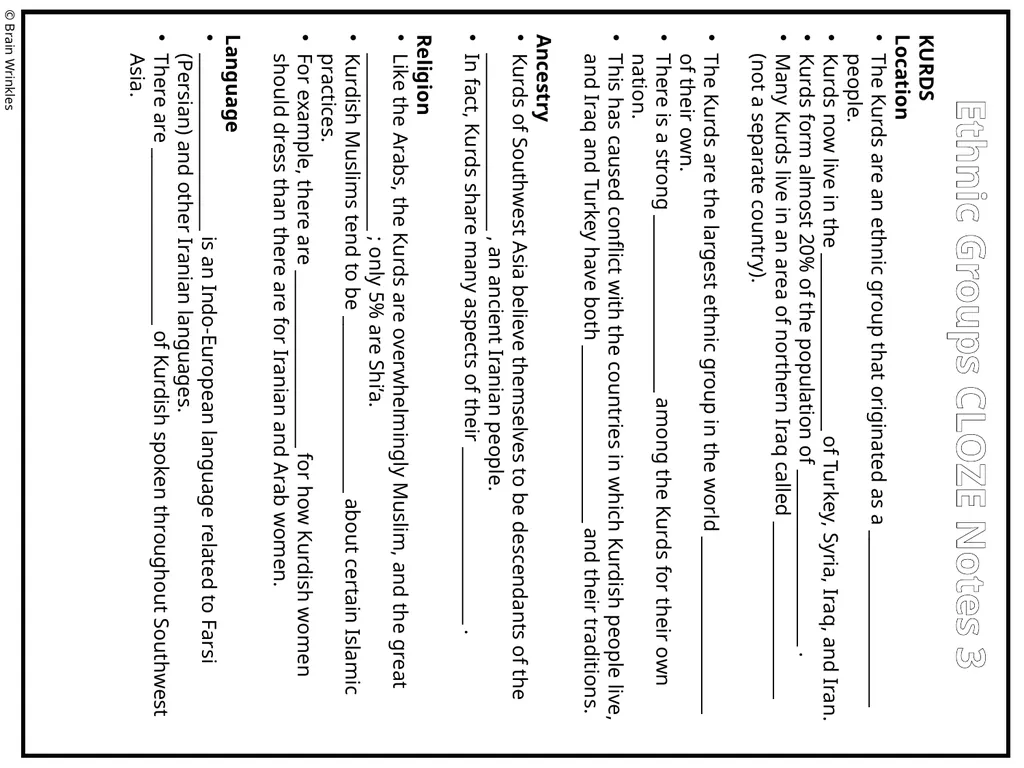
Ethnic Groups CLOZE Notes 3 KURDS
Location
The Kurds are an ethnic group that originated as a ____________________ people.
Kurds now live in the ____________________ of Turkey, Syria, Iraq, and Iran.
Kurds form almost 20% of the population of ____________________ .
Many Kurds live in an area of northern Iraq called ____________________ (not a separate country).
The Kurds are the largest ethnic group in the world ____________________ of their own.
There is a strong ____________________ among the Kurds for their own nation.
This has caused conflict with the countries in which Kurdish people live, and Iraq and Turkey have both ____________________ and their traditions.
Ancestry
Kurds of Southwest Asia believe themselves to be descendants of the ____________________ , an ancient Iranian people.
In fact, Kurds share many aspects of their ____________________ .
Religion
Like the Arabs, the Kurds are overwhelmingly Muslim, and the great ____________________ ; only 5% are Shi’a.
Kurdish Muslims tend to be ____________________ about certain Islamic practices.
For example, there are ____________________ for how Kurdish women should dress than there are for Iranian and Arab women.
Language
____________________ is an Indo-European language related to Farsi (Persian) and other Iranian languages.
There are ____________________ of Kurdish spoken throughout Southwest Asia. © Brain Wrinkles<br>
The Kurds are an ethnic group that originated as a ____________________ people.
Kurds now live in the ____________________ of Turkey, Syria, Iraq, and Iran.
Kurds form almost 20% of the population of ____________________ .
Many Kurds live in an area of northern Iraq called ____________________ (not a separate country).
The Kurds are the largest ethnic group in the world ____________________ of their own.
There is a strong ____________________ among the Kurds for their own nation.
This has caused conflict with the countries in which Kurdish people live, and Iraq and Turkey have both ____________________ and their traditions.
Ancestry
Kurds of Southwest Asia believe themselves to be descendants of the ____________________ , an ancient Iranian people.
In fact, Kurds share many aspects of their ____________________ .
Religion
Like the Arabs, the Kurds are overwhelmingly Muslim, and the great ____________________ ; only 5% are Shi’a.
Kurdish Muslims tend to be ____________________ about certain Islamic practices.
For example, there are ____________________ for how Kurdish women should dress than there are for Iranian and Arab women.
Language
____________________ is an Indo-European language related to Farsi (Persian) and other Iranian languages.
There are ____________________ of Kurdish spoken throughout Southwest Asia. © Brain Wrinkles<br>
06
Ethnic
Groups Southwest Asia’s © Brain Wrinkles Arabs, Persians, & Kurds<br>
Groups Southwest Asia’s © Brain Wrinkles Arabs, Persians, & Kurds<br>
07
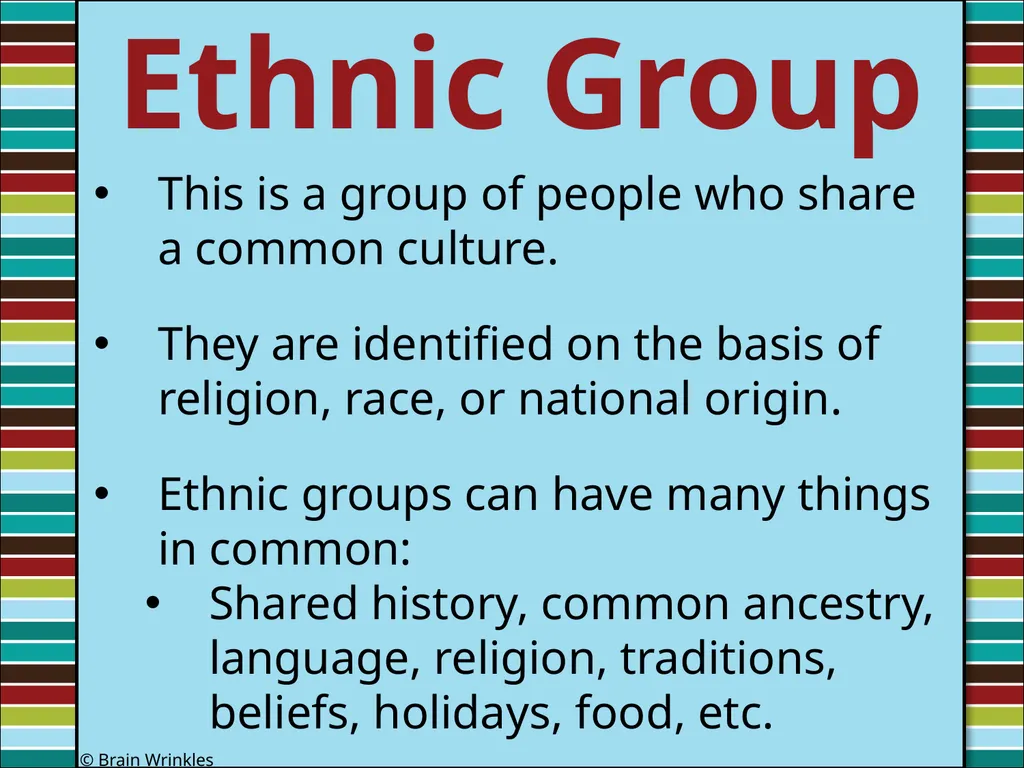
Ethnic Group This is a group of people who share a common culture.
They are identified on the basis of religion, race, or national origin.
Ethnic groups can have many things in common:
Shared history, common ancestry, language, religion, traditions, beliefs, holidays, food, etc. © Brain Wrinkles<br>
They are identified on the basis of religion, race, or national origin.
Ethnic groups can have many things in common:
Shared history, common ancestry, language, religion, traditions, beliefs, holidays, food, etc. © Brain Wrinkles<br>
08
Ethnic Group These characteristics have been part of their community for generations.
All of these things make up a common culture that is shared by the members of the ethnic group.
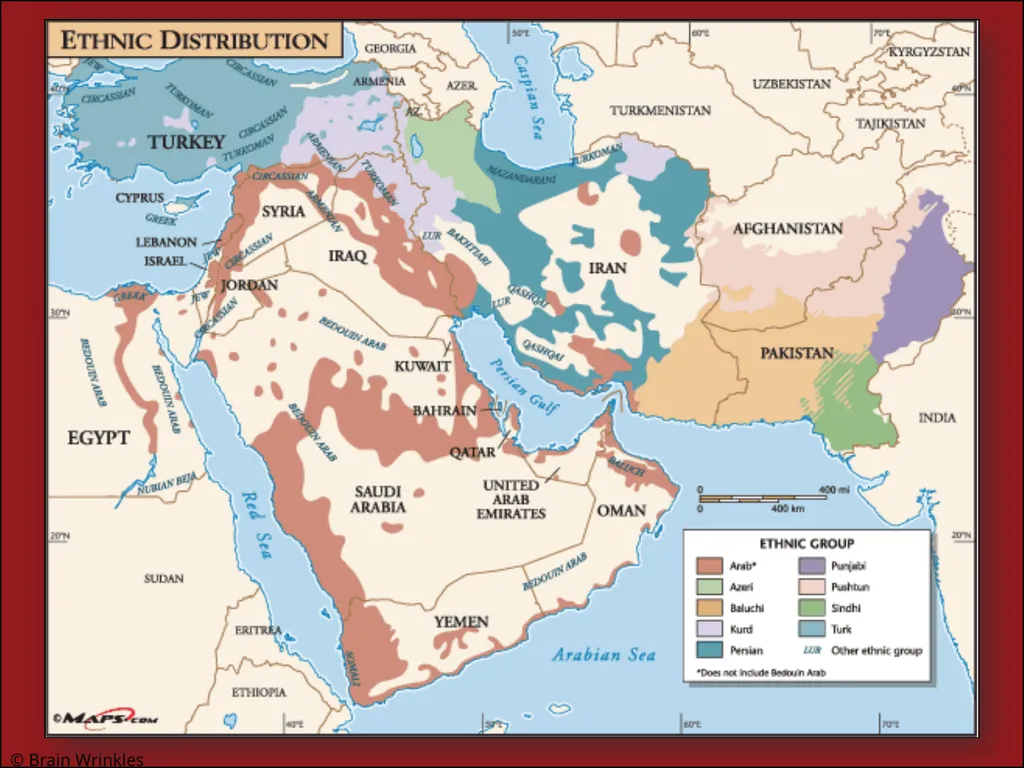
Three major ethnic groups in the Middle East are the Arabs, Persians, and Kurds. © Brain Wrinkles<br>
All of these things make up a common culture that is shared by the members of the ethnic group.
Three major ethnic groups in the Middle East are the Arabs, Persians, and Kurds. © Brain Wrinkles<br>
09
© Brain Wrinkles<br>
10
Religious Group This is a group of people who share a belief system.
A religious group is identified based on common religious beliefs and practices.
They believe in the same god (or gods) and have a common sacred text with a specific set of rules about how to live. © Brain Wrinkles<br>
A religious group is identified based on common religious beliefs and practices.
They believe in the same god (or gods) and have a common sacred text with a specific set of rules about how to live. © Brain Wrinkles<br>
11
Religious Group Religious groups have many things in common:
God(s), prophets, prayers, history, sacred text, religious laws, holy days, etc.
People from different ethnic groups may share the same religion; however, they may be from different cultures.
Three major religious groups in the Middle East are Jews, Muslims, and Christians. © Brain Wrinkles<br>
God(s), prophets, prayers, history, sacred text, religious laws, holy days, etc.
People from different ethnic groups may share the same religion; however, they may be from different cultures.
Three major religious groups in the Middle East are Jews, Muslims, and Christians. © Brain Wrinkles<br>
12
© Brain Wrinkles<br>
13
© Brain Wrinkles ARABS<br>
14
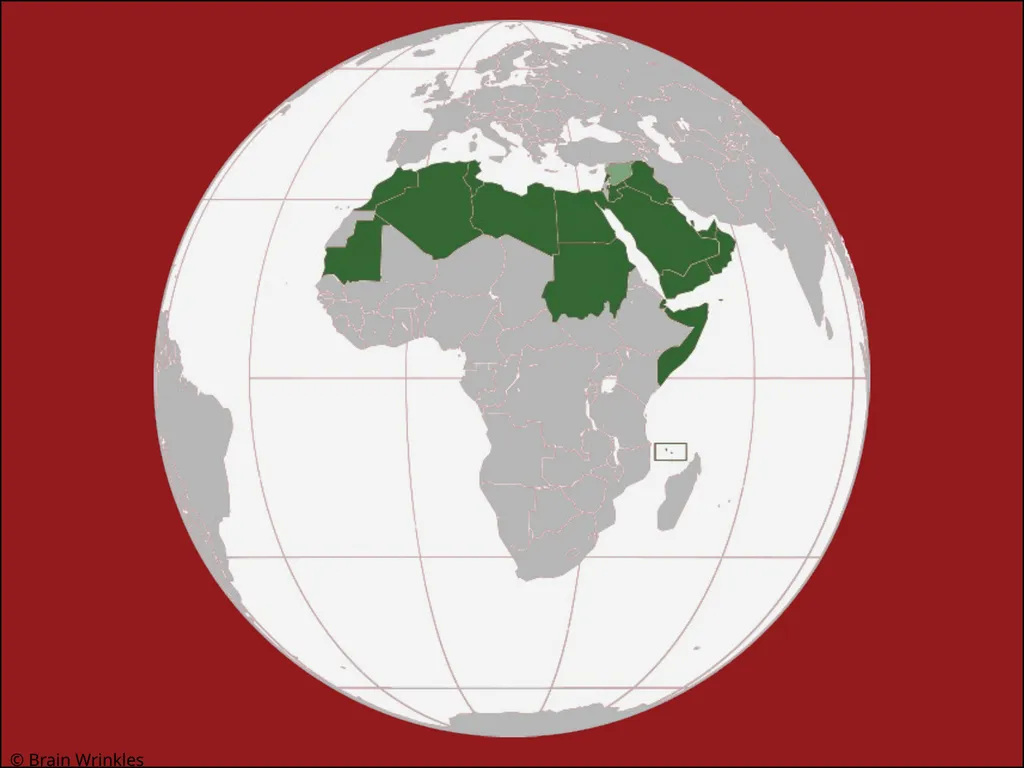
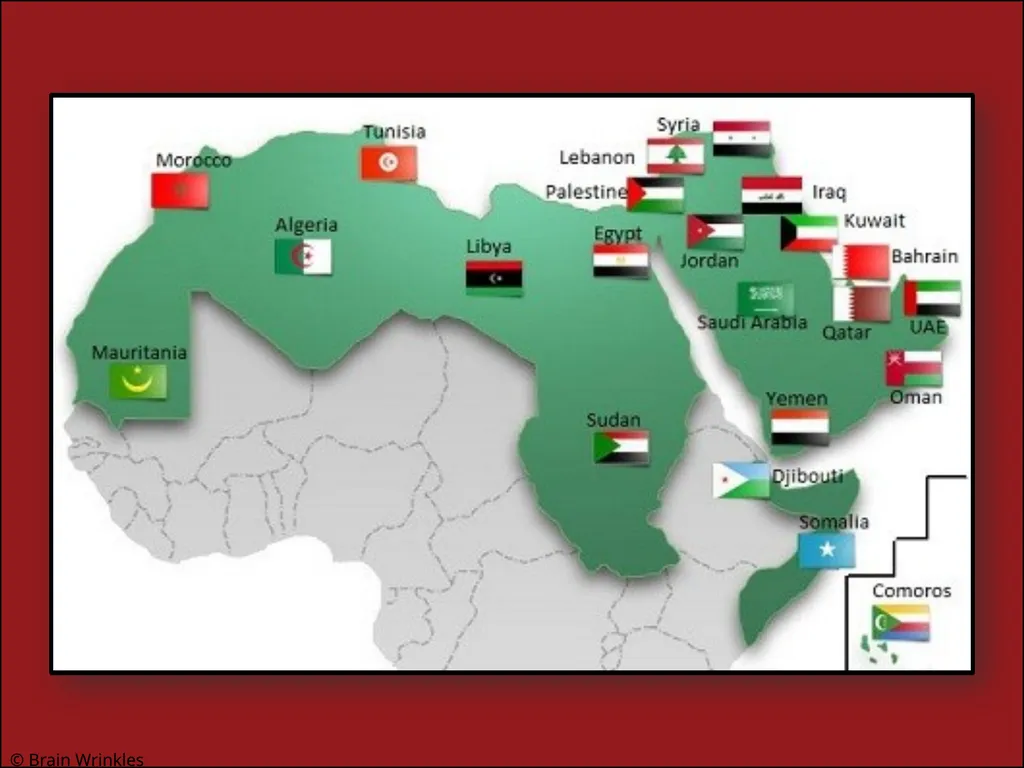
Location The majority of people in the Middle East are Arabs.
Arabs also live in the United States, Canada, parts of northern Africa, and Europe. © Brain Wrinkles<br>
Arabs also live in the United States, Canada, parts of northern Africa, and Europe. © Brain Wrinkles<br>
15
© Brain Wrinkles<br>
16
© Brain Wrinkles<br>
17
Ancestry Arabs of Southwest Asia believe themselves to be descendants of Abraham through his son Ishmael.
Arabs make up the majority of the people who live throughout the Middle East. © Brain Wrinkles<br>
Arabs make up the majority of the people who live throughout the Middle East. © Brain Wrinkles<br>
18
© Brain Wrinkles<br>
19
Religion Most Arabs practice Islam, while small numbers of Arabs practice other religions.
Not all Arabs are Muslims, and not all Muslims are Arabs.
Islam consists mostly of two different groups.
The majority of Muslims practice Sunni Islam, and most others practice Shi’a Islam.
Sunnis and Shi’a disagree about who is in charge of the Muslim world. © Brain Wrinkles<br>
Not all Arabs are Muslims, and not all Muslims are Arabs.
Islam consists mostly of two different groups.
The majority of Muslims practice Sunni Islam, and most others practice Shi’a Islam.
Sunnis and Shi’a disagree about who is in charge of the Muslim world. © Brain Wrinkles<br>
20
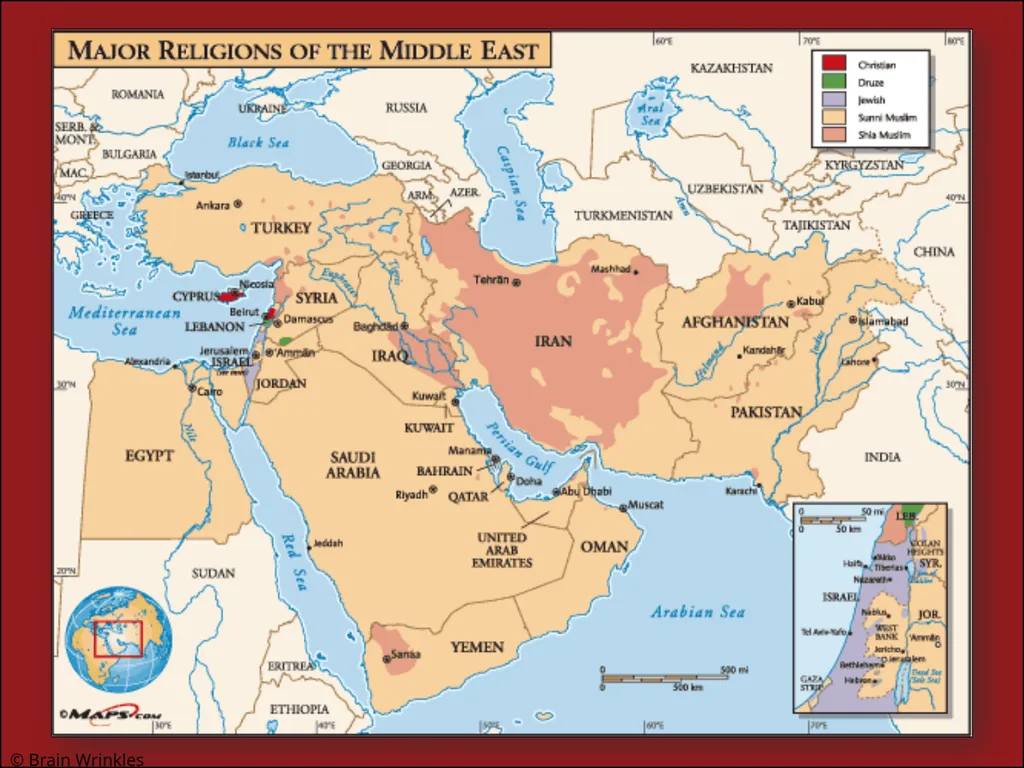
Religion Sunni Islam dominates in most Arab areas, especially in North Africa.
Shi’a Islam is dominant among the Arab population in southern Iraq, Lebanon, Kuwait, Bahrain, northern Syria, & northern Yemen. © Brain Wrinkles<br>
Shi’a Islam is dominant among the Arab population in southern Iraq, Lebanon, Kuwait, Bahrain, northern Syria, & northern Yemen. © Brain Wrinkles<br>
21
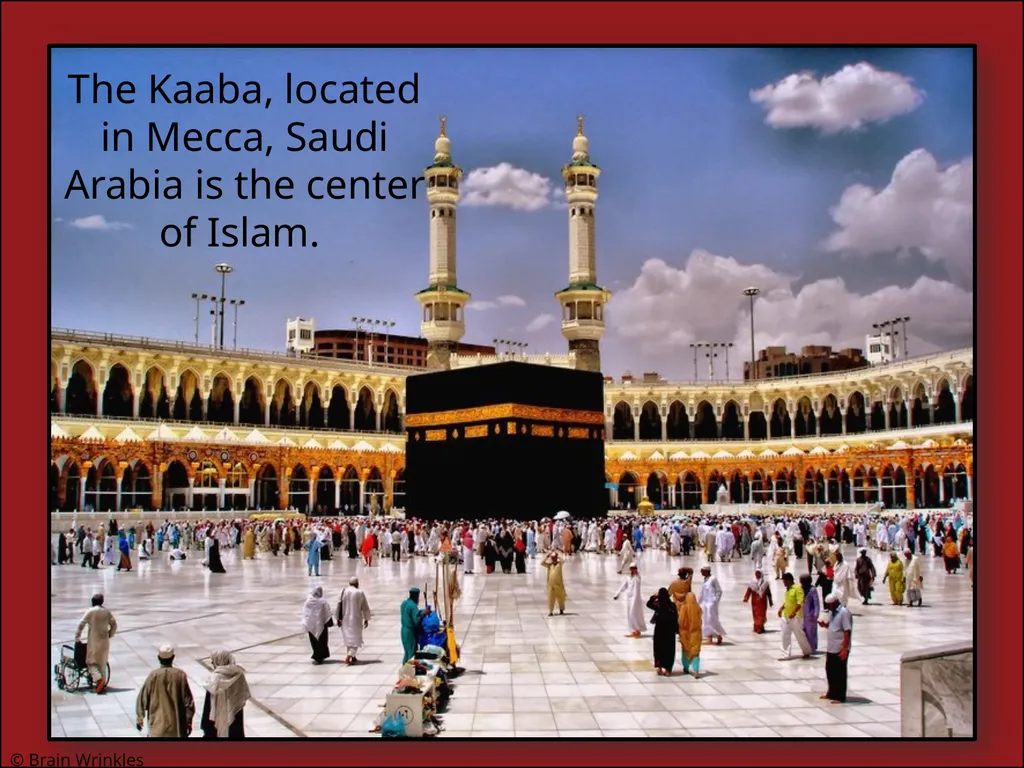
© Brain Wrinkles The Kaaba, located in Mecca, Saudi Arabia is the center of Islam.<br>
22
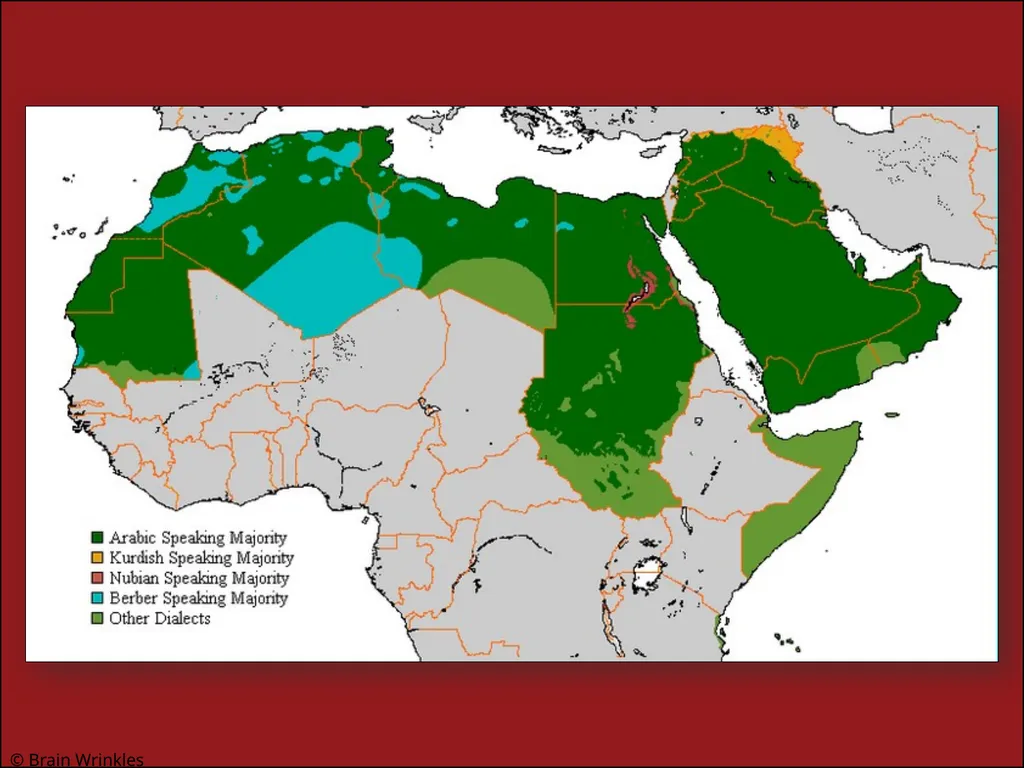
Language Most Arabs, whether they are Muslim or Christian, speak Arabic. © Brain Wrinkles<br>
23
© Brain Wrinkles<br>
24
© Brain Wrinkles PERSIANS<br>
25
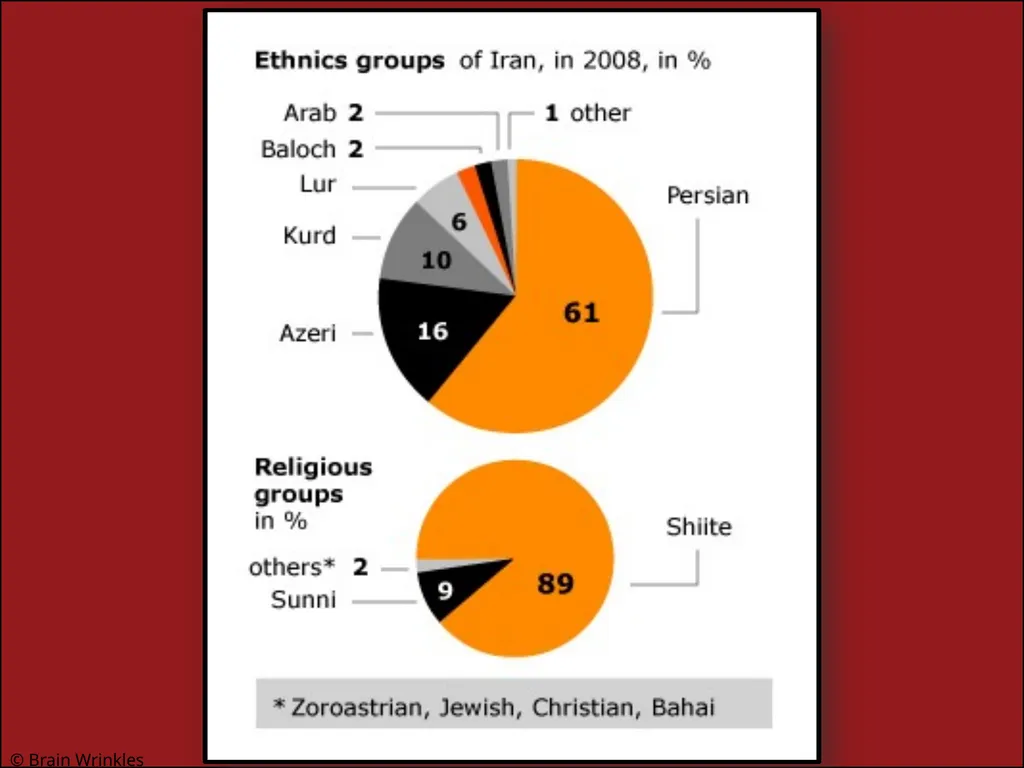
Location Most Persians live in Iran and make up about half of Iran’s current population.
The country of Persia became known as Iran in 1935.
Some Persians can also be found living in Afghanistan, Tajikistan, Uzbekistan, Pakistan, and the Xinjiang province of China. © Brain Wrinkles<br>
The country of Persia became known as Iran in 1935.
Some Persians can also be found living in Afghanistan, Tajikistan, Uzbekistan, Pakistan, and the Xinjiang province of China. © Brain Wrinkles<br>
26
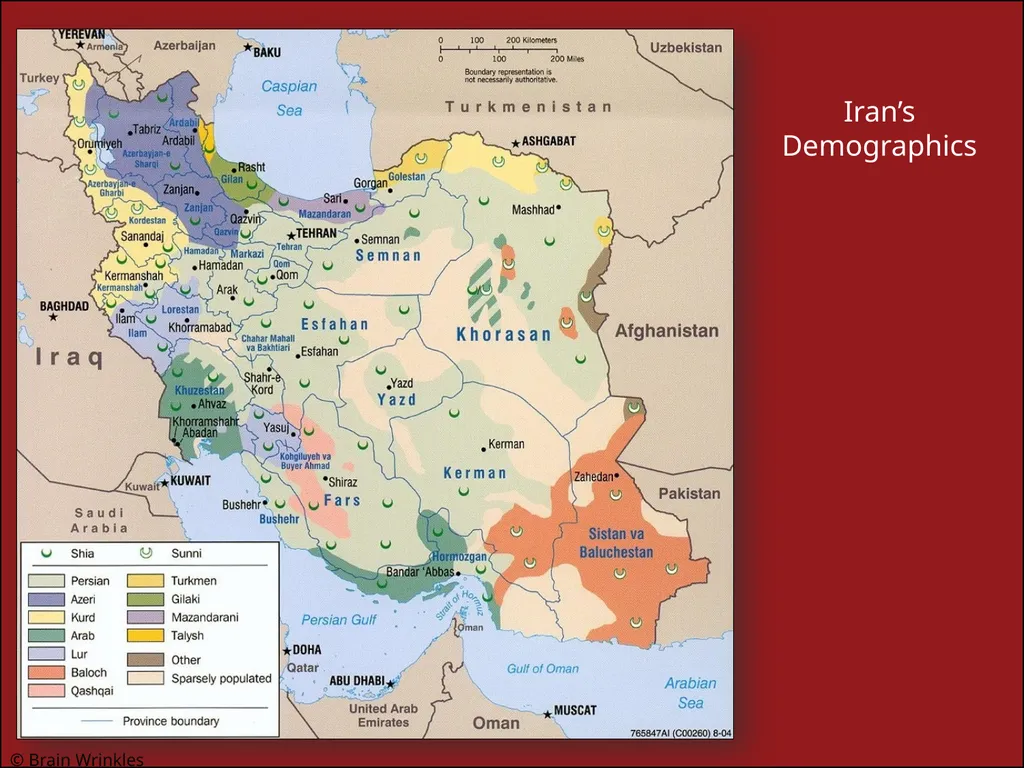
© Brain Wrinkles Iran’s Demographics<br>
27
Ancestry The Persians lived in Iran before the arrival of Islam in the 7th century.
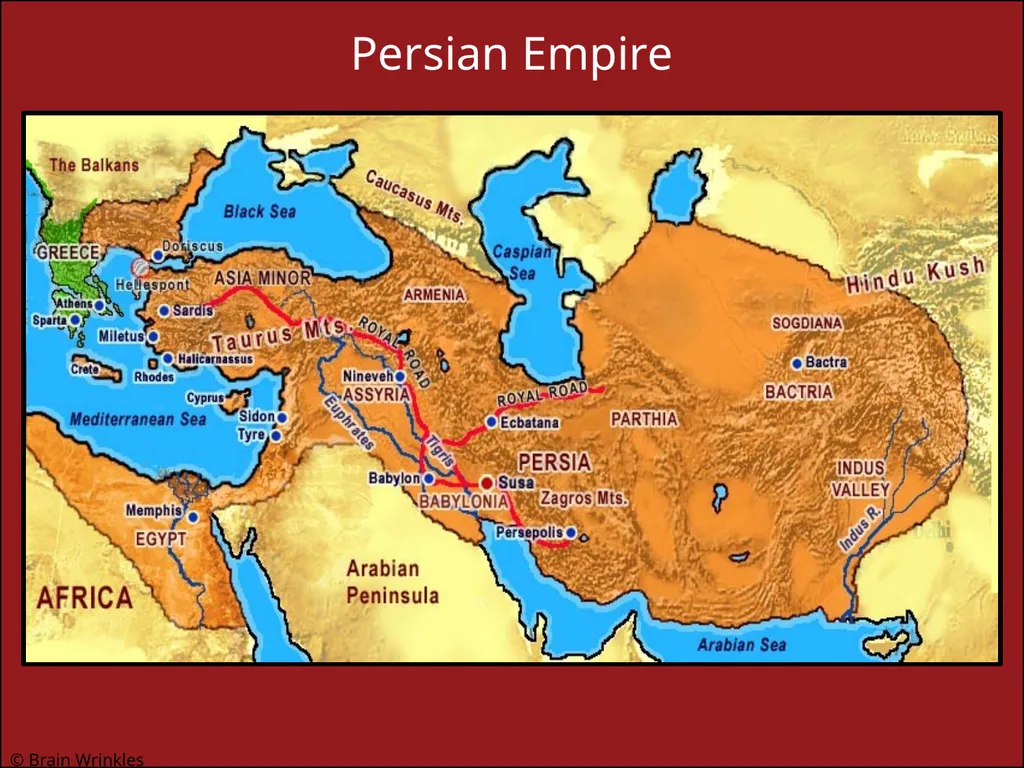
The Persians’ ancestors were Indo-Europeans who migrated from central Europe and Southern Russia and formed a great empire. © Brain Wrinkles<br>
The Persians’ ancestors were Indo-Europeans who migrated from central Europe and Southern Russia and formed a great empire. © Brain Wrinkles<br>
28
© Brain Wrinkles Persian Empire<br>
29
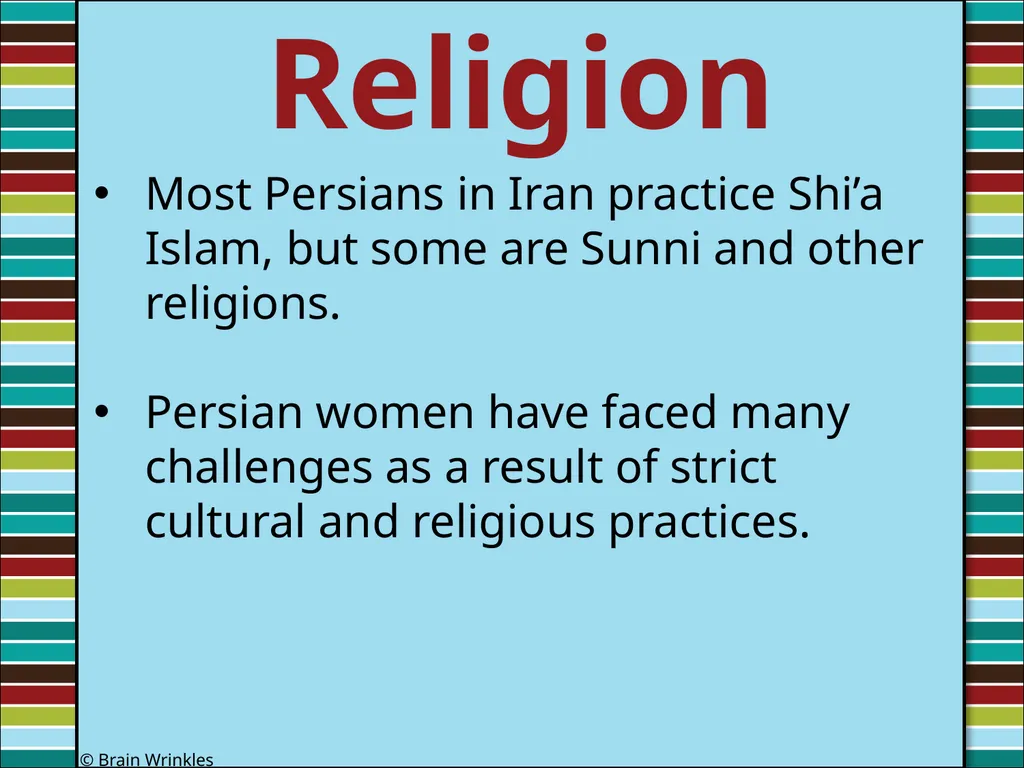
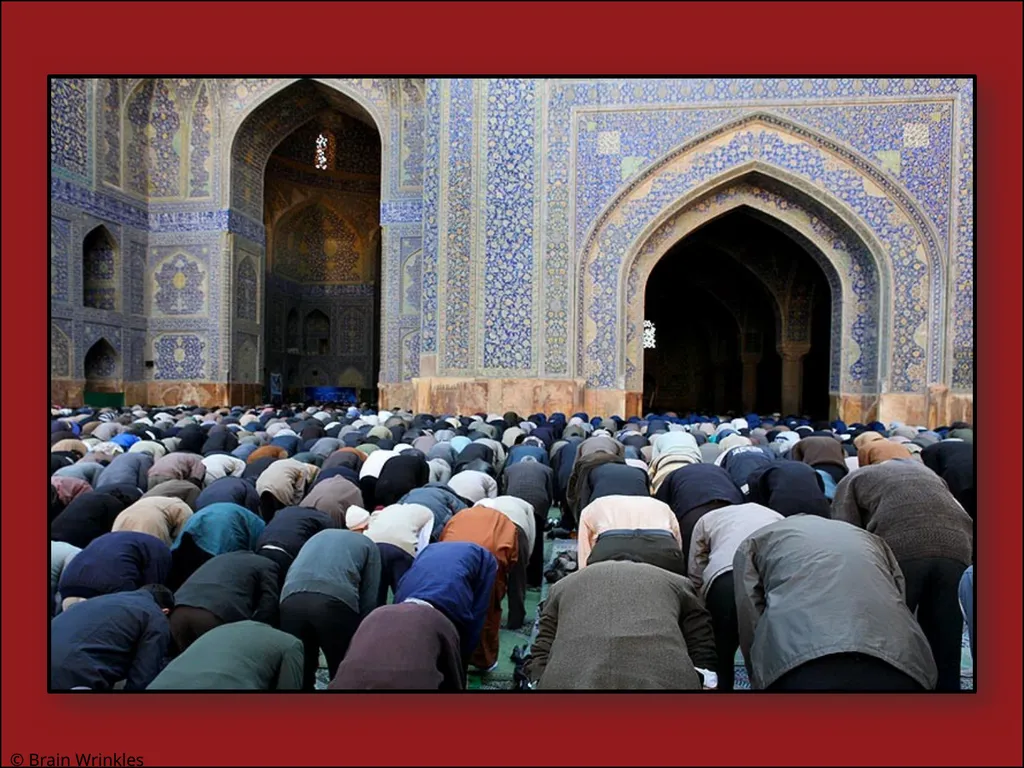
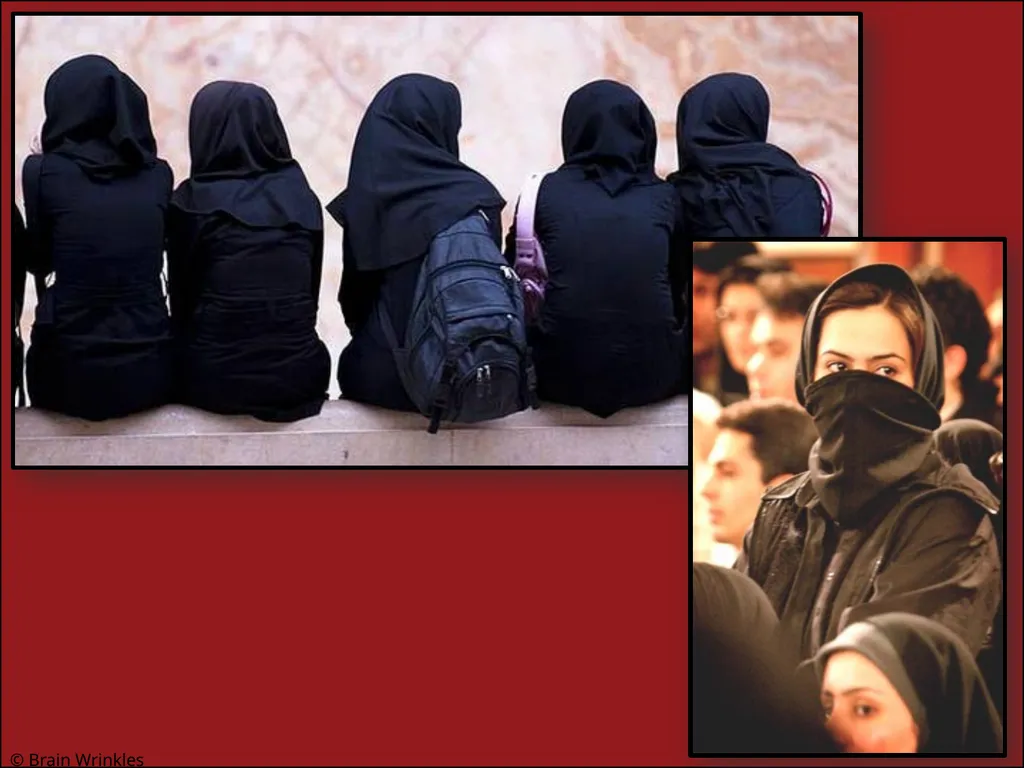
Religion Most Persians in Iran practice Shi’a Islam, but some are Sunni and other religions.
Persian women have faced many challenges as a result of strict cultural and religious practices. © Brain Wrinkles<br>
Persian women have faced many challenges as a result of strict cultural and religious practices. © Brain Wrinkles<br>
30
© Brain Wrinkles<br>
31
© Brain Wrinkles<br>
32
© Brain Wrinkles<br>
33
Language Persians speak a language called Farsi (or Persian).
It is one of the oldest languages that is still spoken today! © Brain Wrinkles<br>
It is one of the oldest languages that is still spoken today! © Brain Wrinkles<br>
34
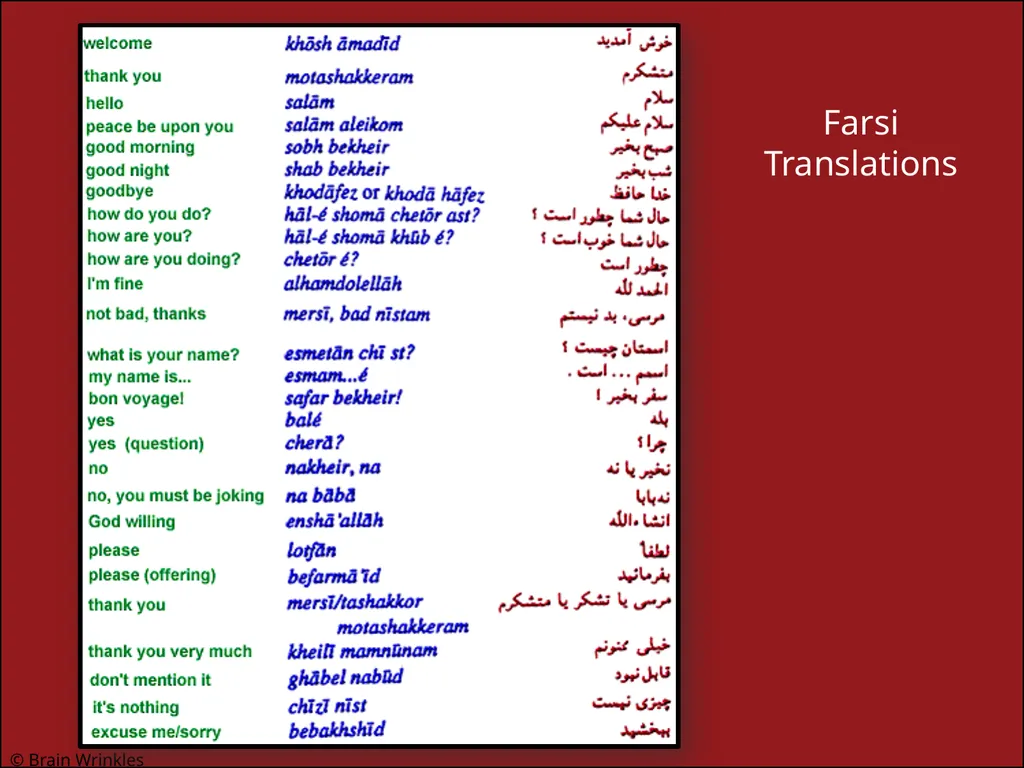
© Brain Wrinkles Farsi
Translations<br>
Translations<br>
35
© Brain Wrinkles KURDS<br>
36
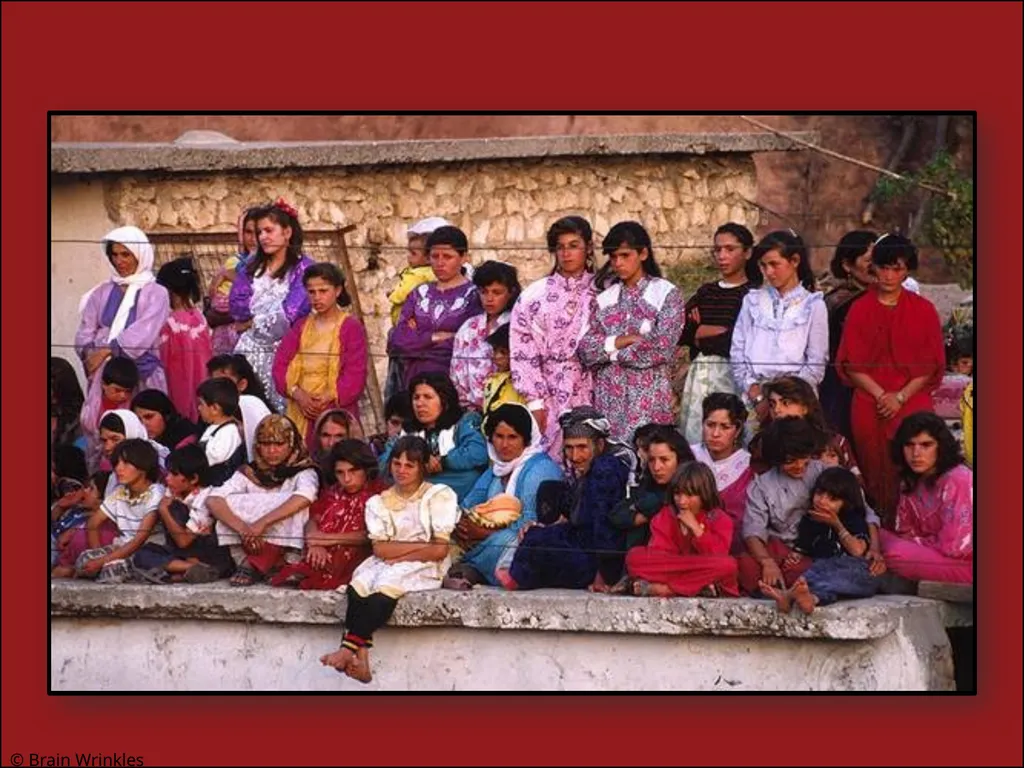
Location The Kurds are an ethnic group that originated as a semi-nomadic, tribal people.
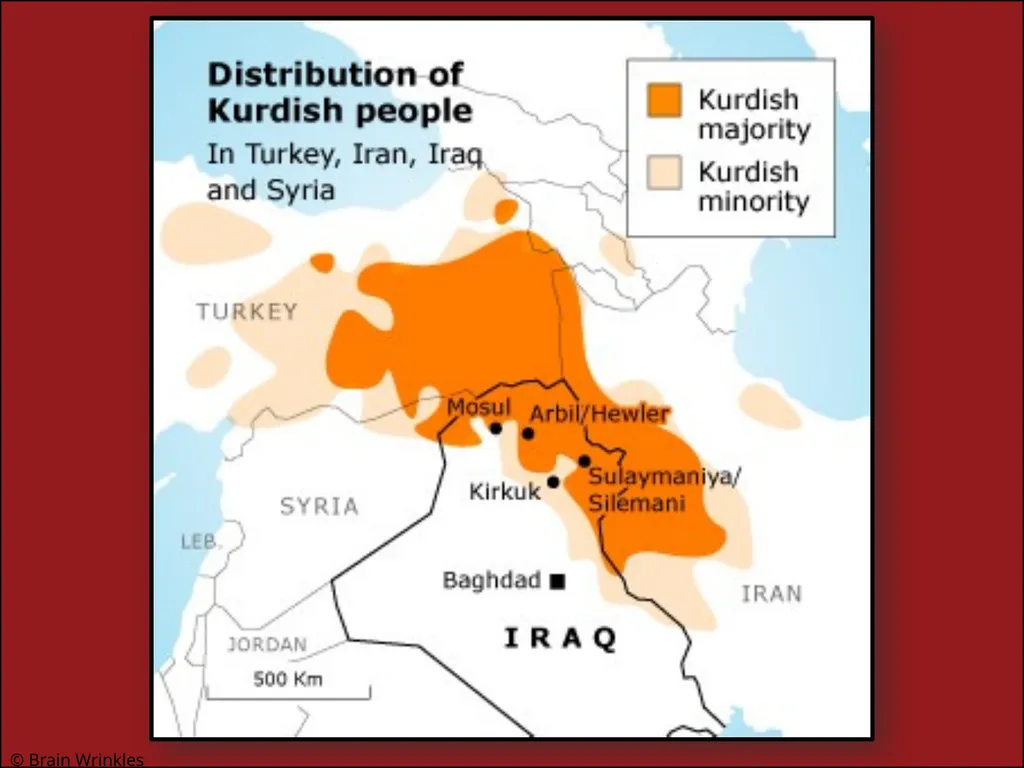
Kurds now live in the mountains of Turkey, Syria, Iraq, and Iran.
Kurds form almost 20% of the population of Turkey and Iraq.
Many Kurds live in an area of northern Iraq called Kurdistan (not a separate country). © Brain Wrinkles<br>
Kurds now live in the mountains of Turkey, Syria, Iraq, and Iran.
Kurds form almost 20% of the population of Turkey and Iraq.
Many Kurds live in an area of northern Iraq called Kurdistan (not a separate country). © Brain Wrinkles<br>
37
© Brain Wrinkles<br>
38
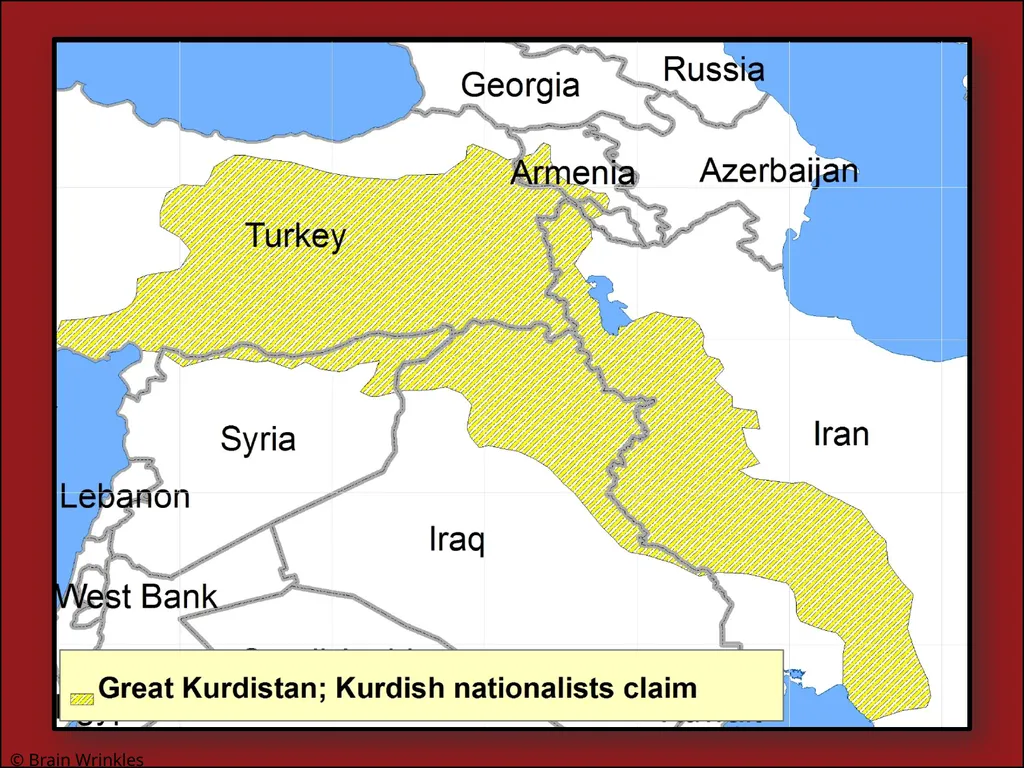
Location The Kurds are the largest ethnic group in the world without a country of their own.
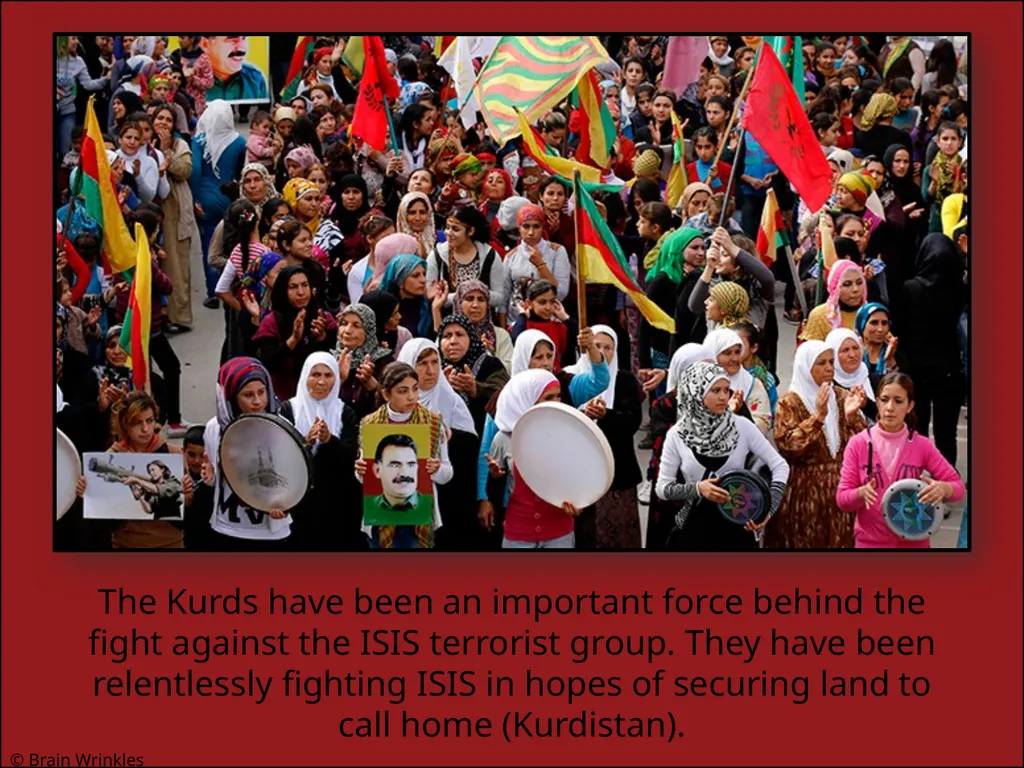
There is a strong nationalist movement among the Kurds for their own nation.
This has caused conflict with the countries in which Kurdish people live, and Iraq and Turkey have both suppressed the Kurds and their traditions. © Brain Wrinkles<br>
There is a strong nationalist movement among the Kurds for their own nation.
This has caused conflict with the countries in which Kurdish people live, and Iraq and Turkey have both suppressed the Kurds and their traditions. © Brain Wrinkles<br>
39
© Brain Wrinkles<br>
40
© Brain Wrinkles The Kurds have been an important force behind the fight against the ISIS terrorist group. They have been relentlessly fighting ISIS in hopes of securing land to call home (Kurdistan).<br>
41
Ancestry Kurds of Southwest Asia believe themselves to be descendants of the Medes, an ancient Iranian people.
In fact, Kurds share many aspects of their culture with Iranians. © Brain Wrinkles<br>
In fact, Kurds share many aspects of their culture with Iranians. © Brain Wrinkles<br>
42
© Brain Wrinkles<br>
43
Religion Like the Arabs, the Kurds are overwhelmingly Muslim, and the great majority are Sunni; only 5% are Shi’a.
Kurdish Muslims tend to be less strict about certain Islamic practices.
For example, there are fewer laws for how Kurdish women should dress than there are for Iranian and Arab women. © Brain Wrinkles<br>
Kurdish Muslims tend to be less strict about certain Islamic practices.
For example, there are fewer laws for how Kurdish women should dress than there are for Iranian and Arab women. © Brain Wrinkles<br>
44
© Brain Wrinkles<br>
45
Language Kurdish is an Indo-European language related to Farsi (Persian) and other Iranian languages.
There are many different dialects of Kurdish spoken throughout Southwest Asia. © Brain Wrinkles<br>
There are many different dialects of Kurdish spoken throughout Southwest Asia. © Brain Wrinkles<br>
46
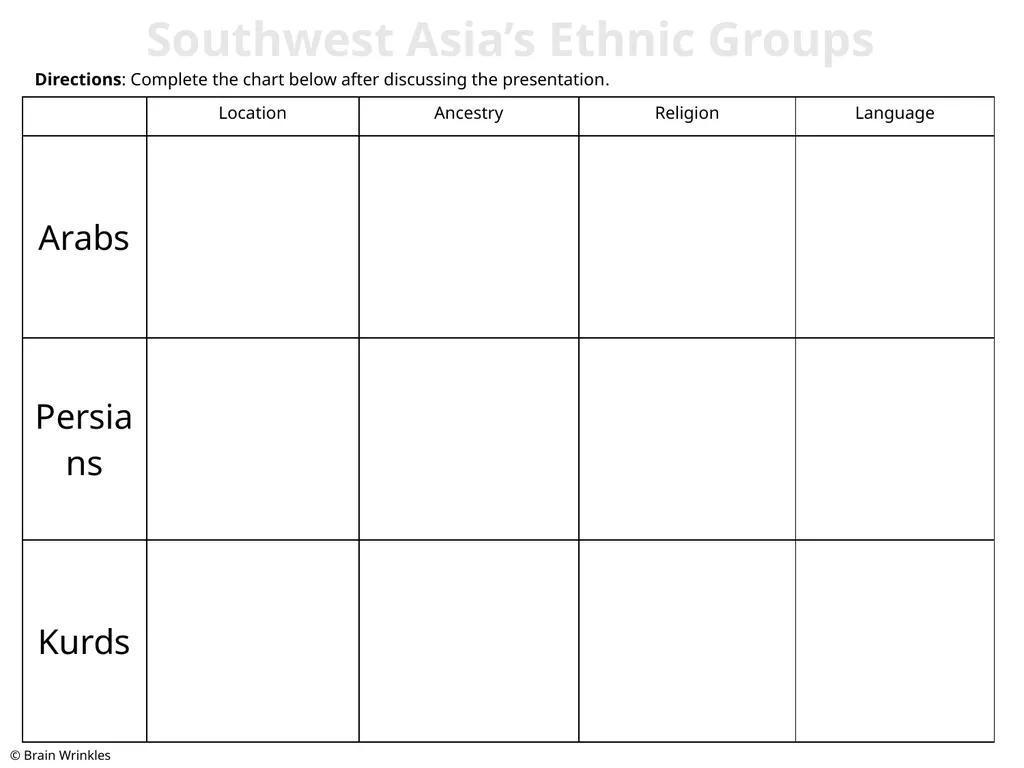
© Brain Wrinkles Southwest Asia’s Ethnic Groups Directions: Complete the chart below after discussing the presentation.<br>
47
Directions: If the people below were speaking about their ethnic groups, what would they say? Include information about the group’s ancestry, language, location, etc. Add clothing, facial expressions, and symbols to help distinguish who the people are when you are finished writing. Ethnic Group Caricatures © Brain Wrinkles<br>
48
Ethnic Groups Coat of Arms Directions: In the past, coats of arms were used almost like identification cards. Design a coat of arms to represent one of Southwest Asia’s ethnic groups. Include symbols to represent the group’s location, ancestry, language, religion, etc. In the textbox, explain the importance of each symbol. © Brain Wrinkles<br>
49
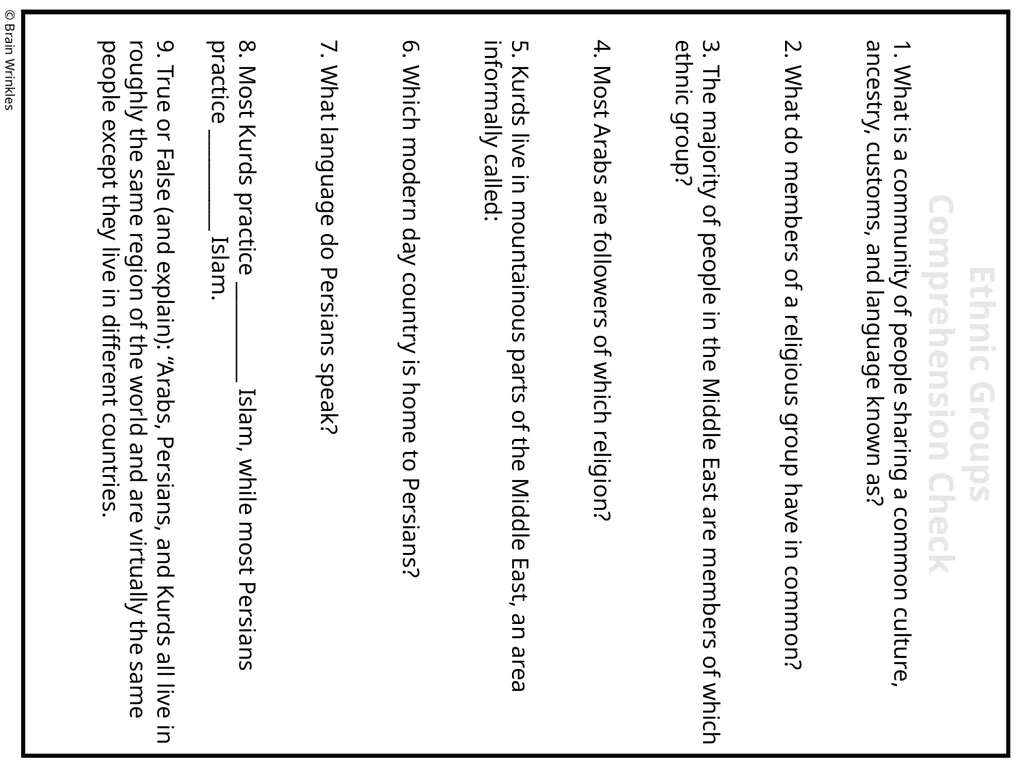
Ethnic Groups
Comprehension Check 1. What is a community of people sharing a common culture, ancestry, customs, and language known as?
2. What do members of a religious group have in common?
3. The majority of people in the Middle East are members of which ethnic group?
4. Most Arabs are followers of which religion?
5. Kurds live in mountainous parts of the Middle East, an area informally called:
6. Which modern day country is home to Persians?
7. What language do Persians speak?
8. Most Kurds practice __________ Islam, while most Persians practice __________ Islam.
9. True or False (and explain): “Arabs, Persians, and Kurds all live in roughly the same region of the world and are virtually the same people except they live in different countries. © Brain Wrinkles<br>
Comprehension Check 1. What is a community of people sharing a common culture, ancestry, customs, and language known as?
2. What do members of a religious group have in common?
3. The majority of people in the Middle East are members of which ethnic group?
4. Most Arabs are followers of which religion?
5. Kurds live in mountainous parts of the Middle East, an area informally called:
6. Which modern day country is home to Persians?
7. What language do Persians speak?
8. Most Kurds practice __________ Islam, while most Persians practice __________ Islam.
9. True or False (and explain): “Arabs, Persians, and Kurds all live in roughly the same region of the world and are virtually the same people except they live in different countries. © Brain Wrinkles<br>
50
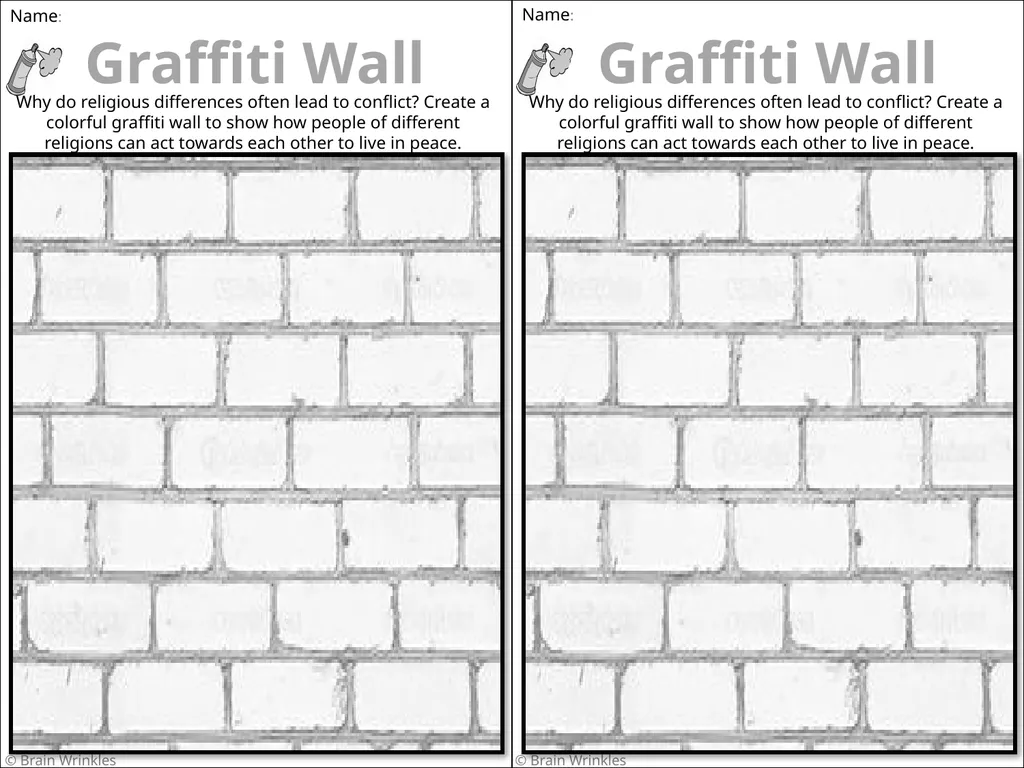
Graffiti Wall Why do religious differences often lead to conflict? Create a colorful graffiti wall to show how people of different religions can act towards each other to live in peace. © Brain Wrinkles © Brain Wrinkles Name: Name: Graffiti Wall Why do religious differences often lead to conflict? Create a colorful graffiti wall to show how people of different religions can act towards each other to live in peace.<br>