
Evaluating individuals Evaluating classes Noting
Description: Evaluating individuals Evaluating classes Noting unusual patterns or trends Identifying gaps in learning Use of scores To show overall classroom trends with respect to the learning progression To show the status of each individual student
Related Topics
Download Presentation
"Evaluating individuals Evaluating classes Noting" is the property of its rightful owner. Permission is granted to download and print the materials on this website for personal, non-commercial use only, and to display it on your personal computer provided you do not modify the materials and that you retain all copyright notices contained in the materials. By downloading content from our website, you accept the terms of this agreement.
Presentation Transcript
slide1. Evaluating individuals
Evaluating classes
Noting unusual patterns or trends
Identifying gaps in learning Use of scores<br>
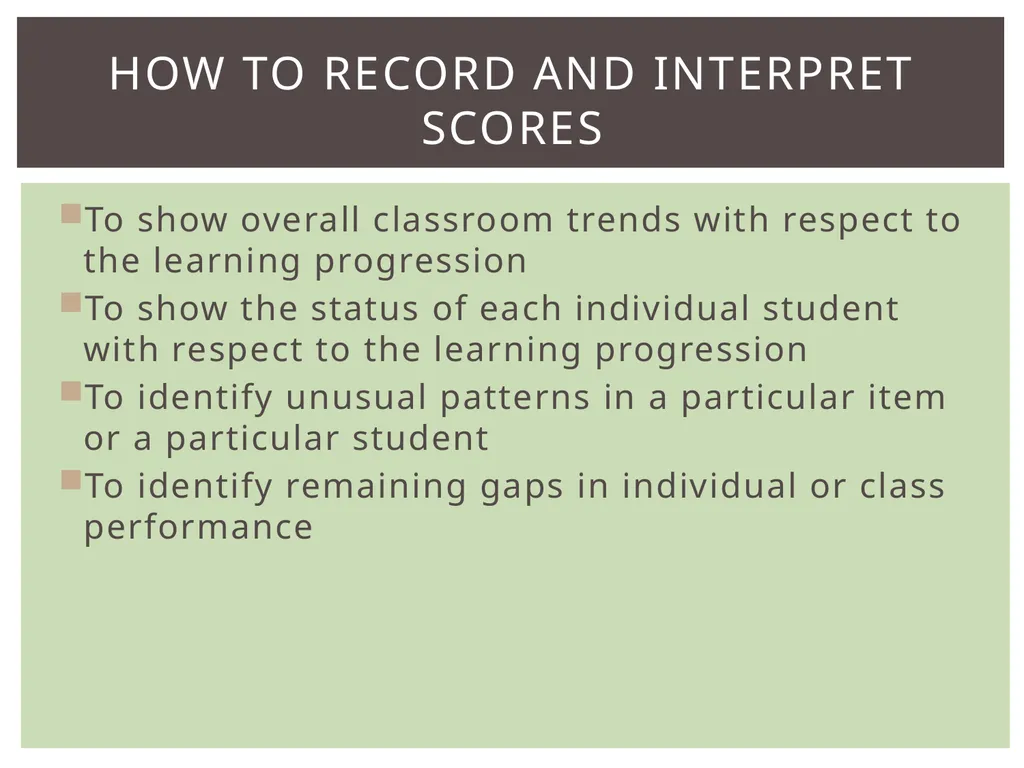
slide2. To show overall classroom trends with respect to the learning progression
To show the status of each individual student with respect to the learning progression
To identify unusual patterns in a particular item or a particular student
To identify remaining gaps in individual or class performance How to record and interpret scores<br>
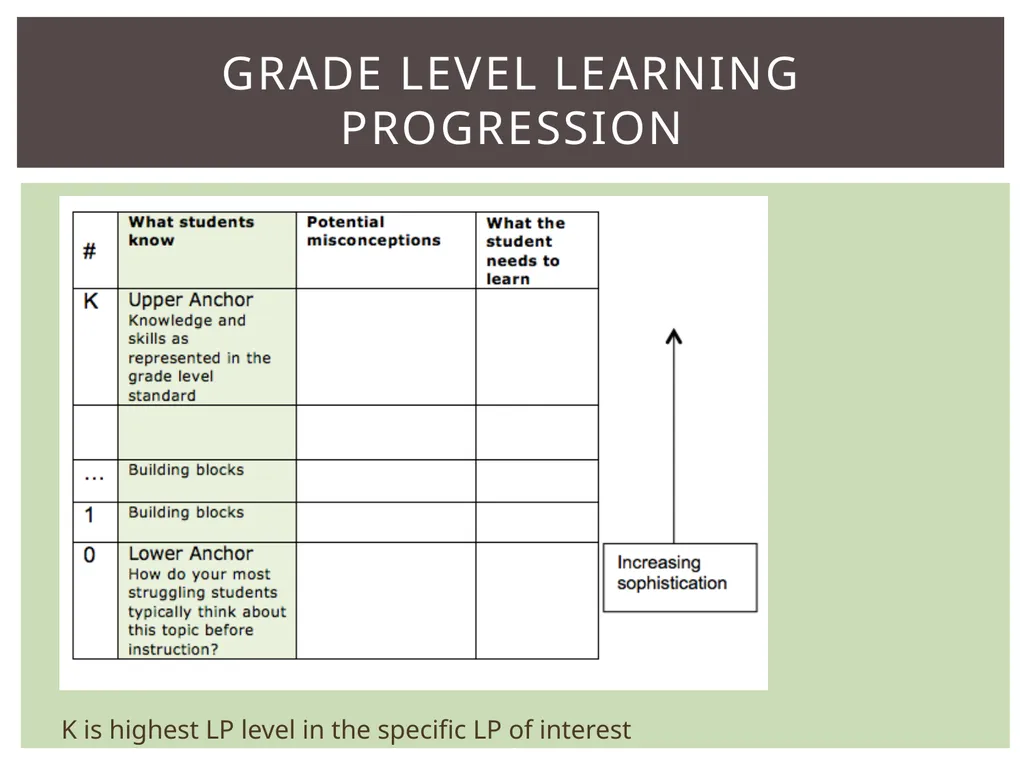
slide3. Grade level learning progression K is highest LP level in the specific LP of interest<br>
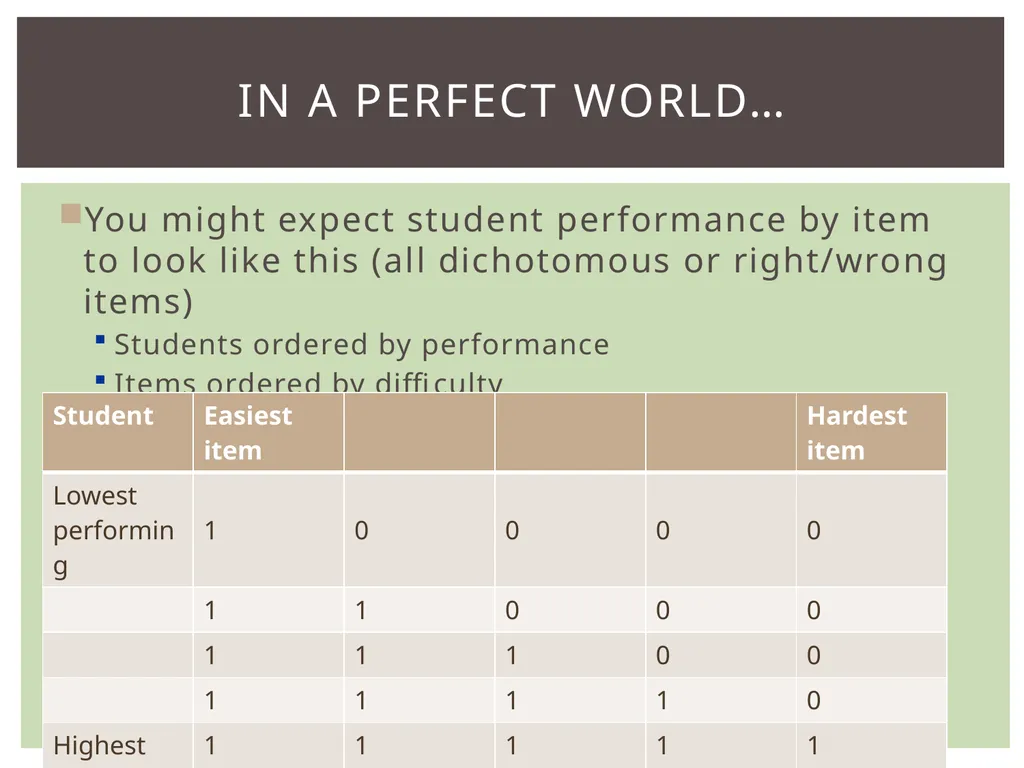
slide4. You might expect student performance by item to look like this (all dichotomous or right/wrong items)
Students ordered by performance
Items ordered by difficulty In a perfect world…<br>
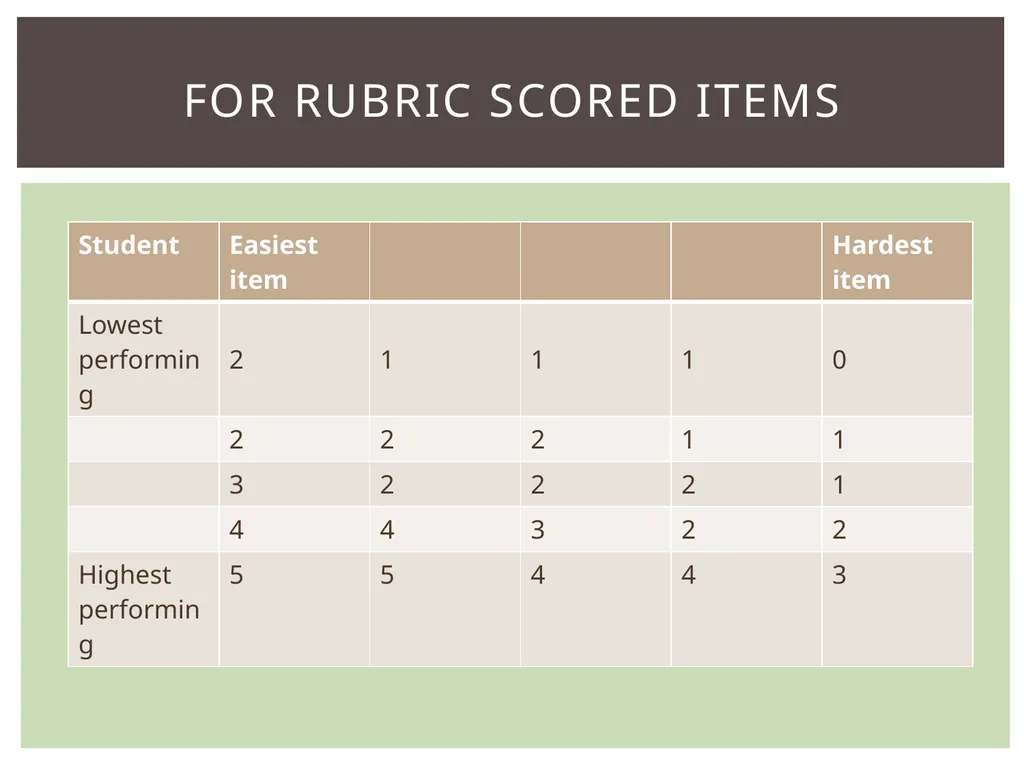
slide5. For rubric scored items<br>
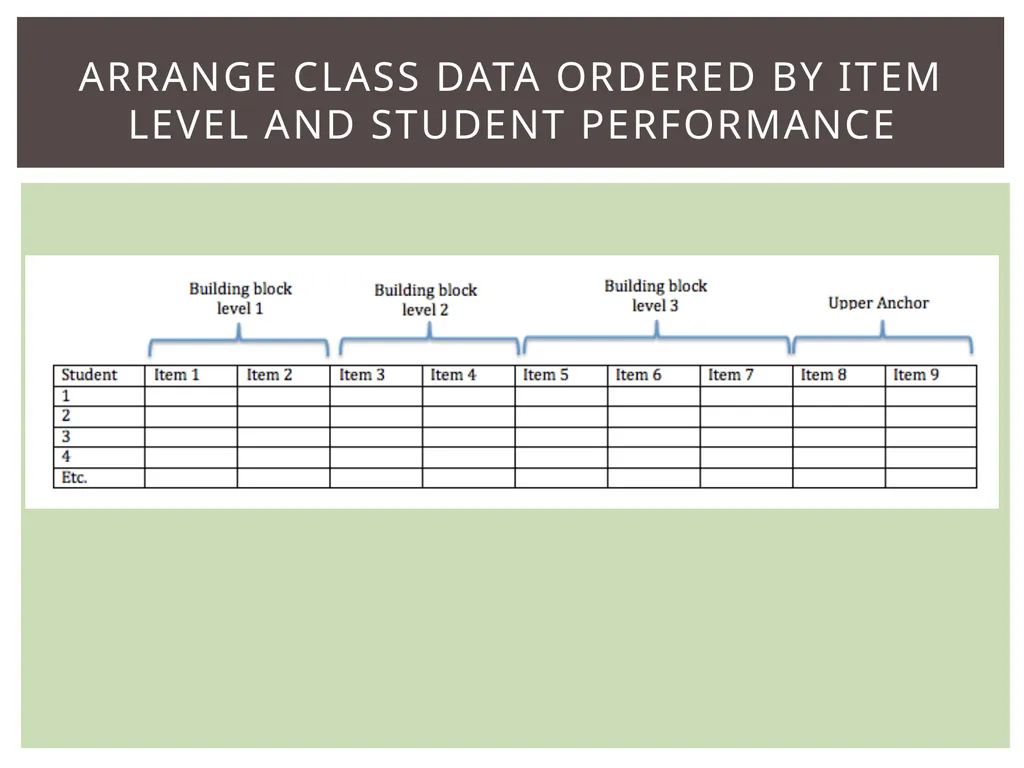
slide6. Arrange class data ordered by item level and student performance<br>
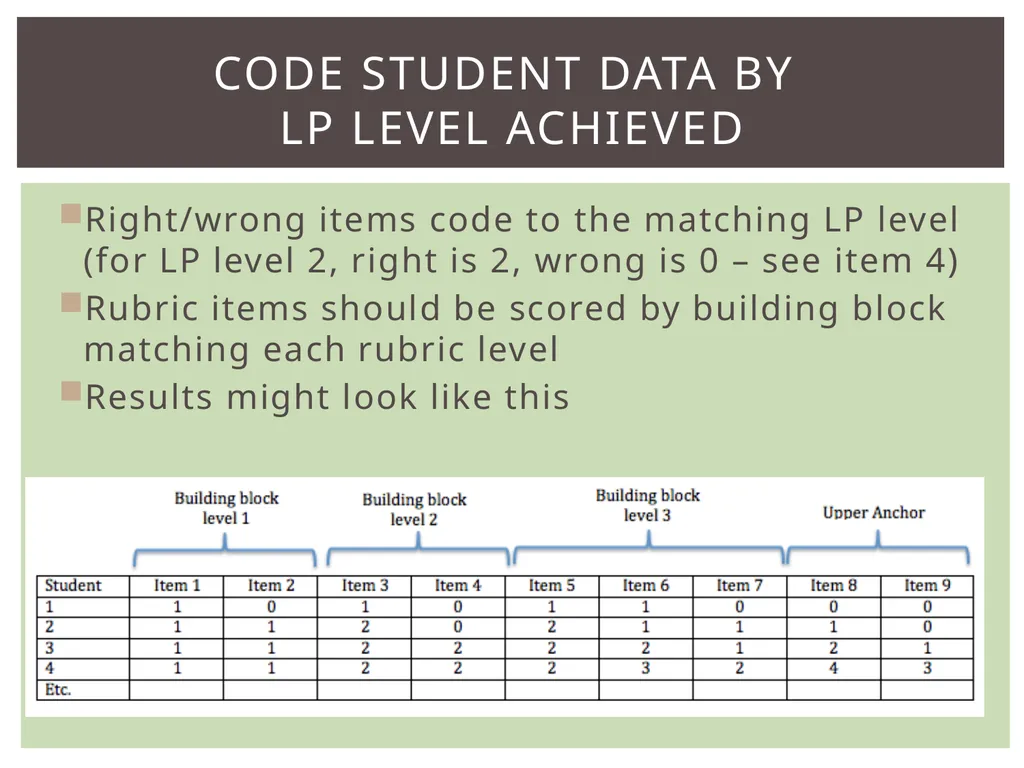
slide7. Right/wrong items code to the matching LP level (for LP level 2, right is 2, wrong is 0 – see item 4)
Rubric items should be scored by building block matching each rubric level
Results might look like this Code student data by LP level achieved<br>
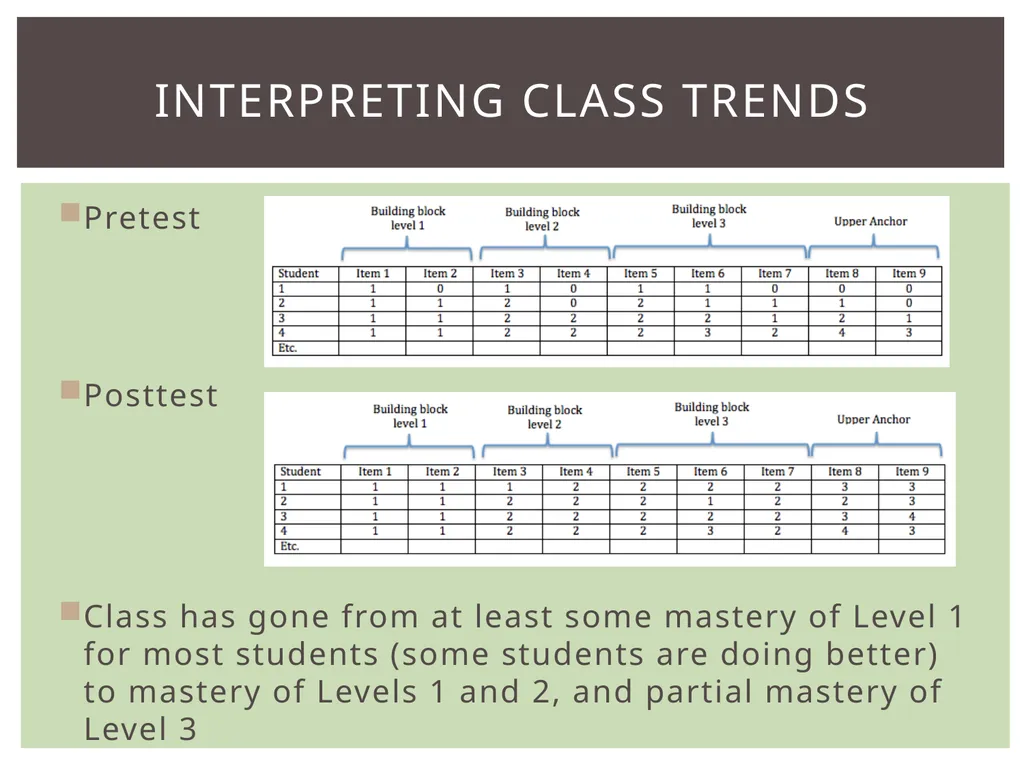
slide8. Pretest
Posttest
Class has gone from at least some mastery of Level 1 for most students (some students are doing better) to mastery of Levels 1 and 2, and partial mastery of Level 3 Interpreting Class trends<br>
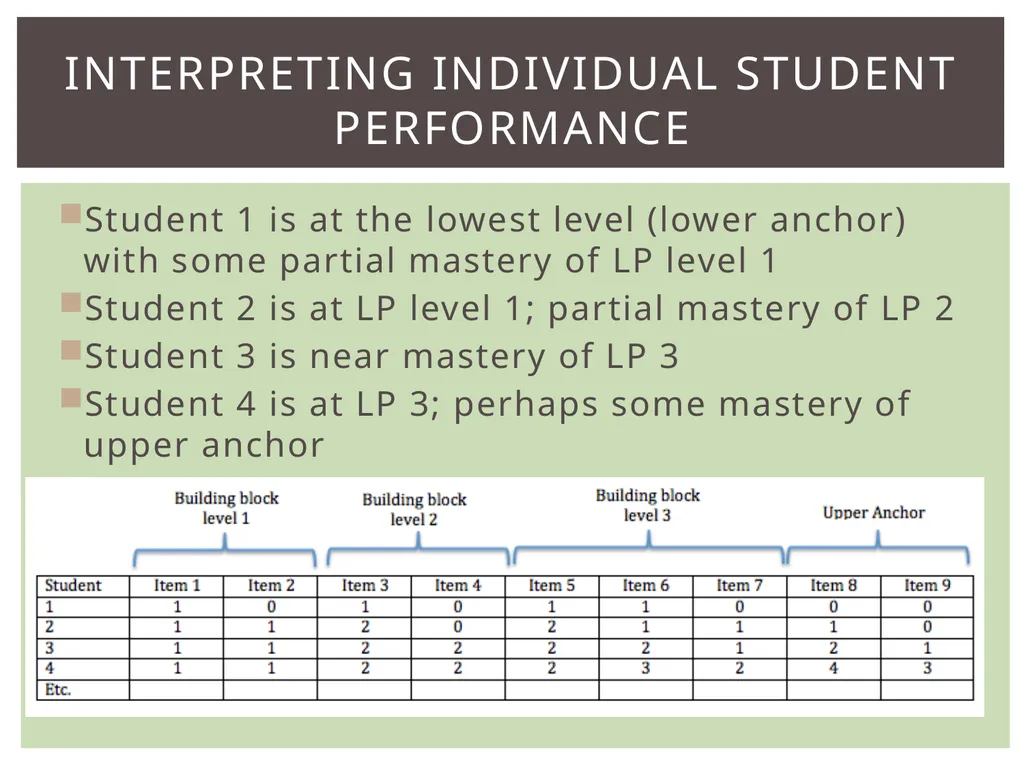
slide9. Student 1 is at the lowest level (lower anchor) with some partial mastery of LP level 1
Student 2 is at LP level 1; partial mastery of LP 2
Student 3 is near mastery of LP 3
Student 4 is at LP 3; perhaps some mastery of upper anchor Interpreting individual student performance<br>
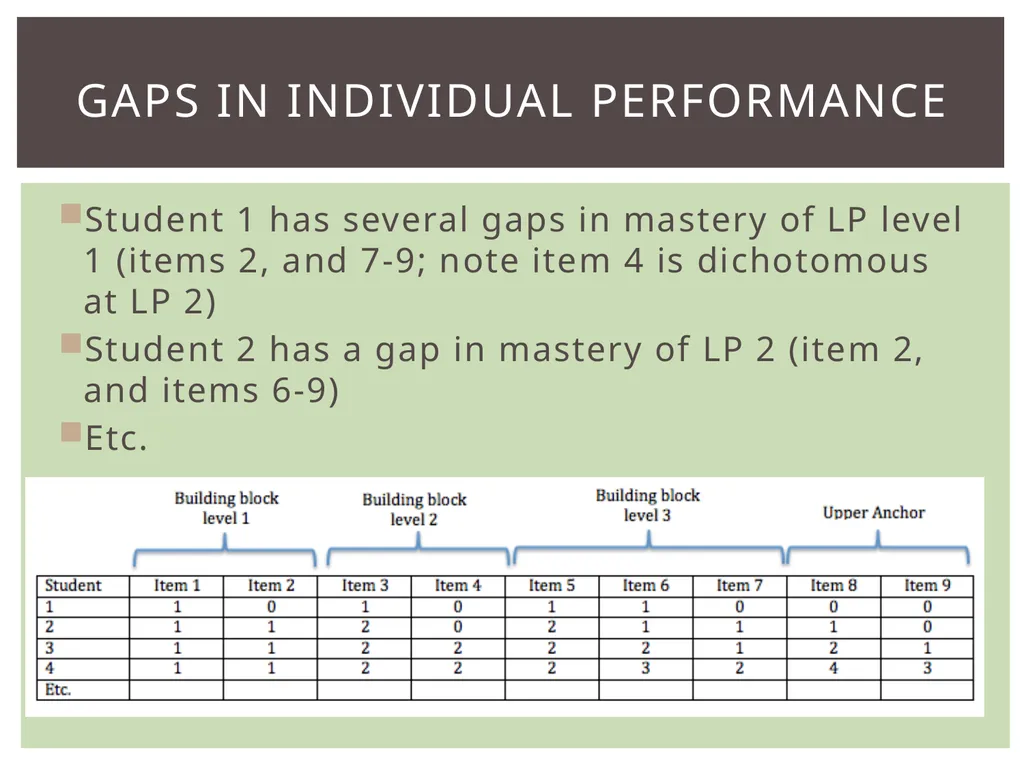
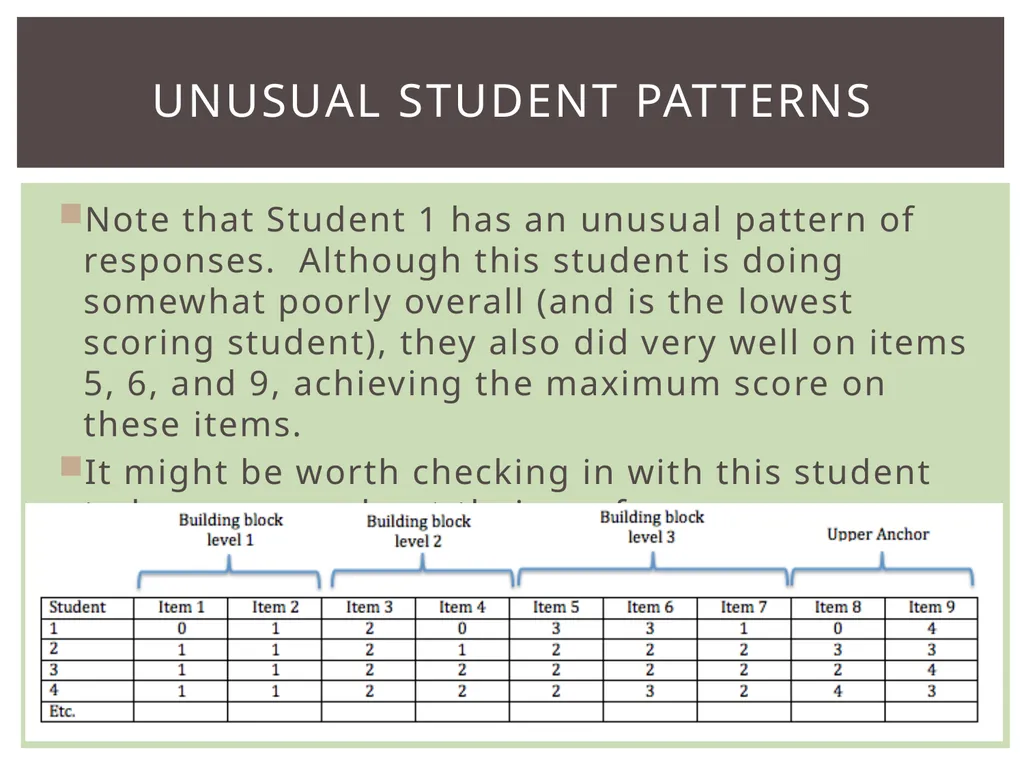
slide10. Gaps in individual performance Student 1 has several gaps in mastery of LP level 1 (items 2, and 7-9; note item 4 is dichotomous at LP 2)
Student 2 has a gap in mastery of LP 2 (item 2, and items 6-9)
Etc.<br>
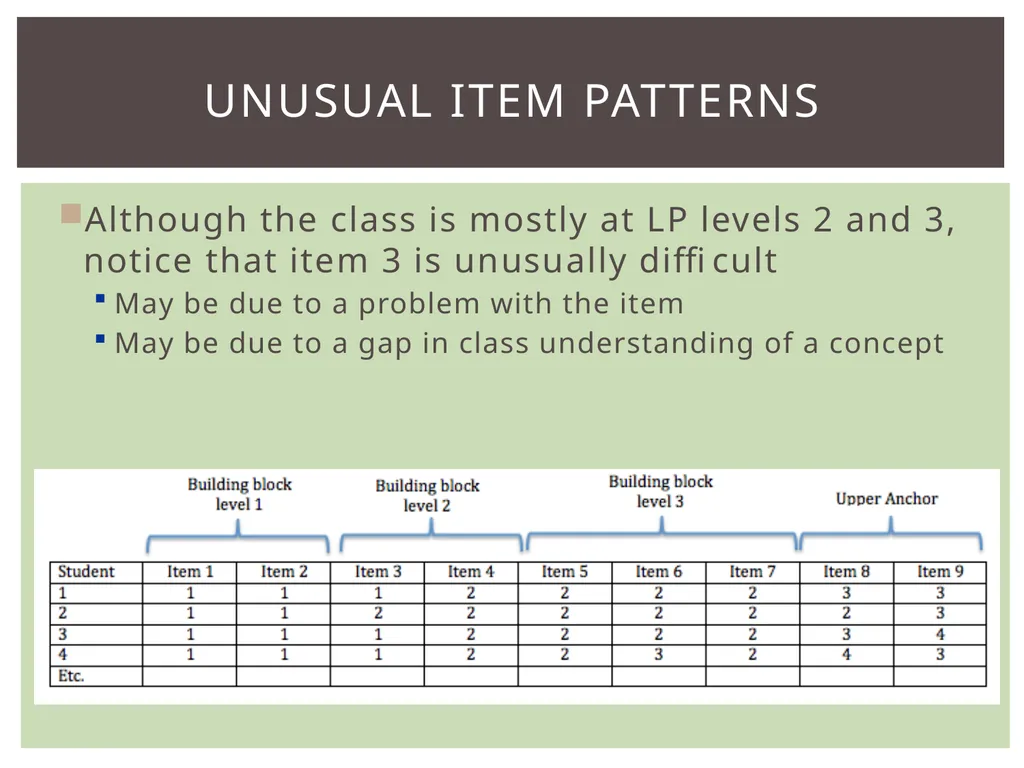
slide11. Although the class is mostly at LP levels 2 and 3, notice that item 3 is unusually difficult
May be due to a problem with the item
May be due to a gap in class understanding of a concept Unusual item patterns<br>
slide12. Note that Student 1 has an unusual pattern of responses. Although this student is doing somewhat poorly overall (and is the lowest scoring student), they also did very well on items 5, 6, and 9, achieving the maximum score on these items.
It might be worth checking in with this student to learn more about their performance. Unusual student patterns<br>
slide13. Wilson, M. (2005). Constructing measures: An item response modeling approach. New York: Psychology Press, Taylor & Francis Group.
Wilson, M., & Sloane, K. (2000). From principles to practice: An embedded assessment system. Applied Measurement in Education, 13 (2), pp. 181-208.
Wright, B., & Masters, G. (1982). Rating Scale Analysis. Chicago: MESA Press. bibliography<br>
slide14. Use of Scores PPT by the Oregon Department of Education and Berkeley Evaluation and Assessment Research Center is licensed under a CC BY 4.0.
You are free to:
Share — copy and redistribute the material in any medium or format
Adapt — remix, transform, and build upon the material
Under the following terms:
Attribution — You must give appropriate credit, provide a link to the license, and indicate if changes were made. You may do so in any reasonable manner, but not in any way that suggests the licensor endorses you or your use.
NonCommercial — You may not use the material for commercial purposes.
ShareAlike — If you remix, transform, or build upon the material, you must distribute your contributions under the same license as the original.
Oregon Department of Education welcomes editing of these resources and would greatly appreciate being able to learn from the changes made. To share an edited version of this resource, please contact Cristen McLean, cristen.mclean@state.or.us. Creative Commons License<br>
Evaluating classes
Noting unusual patterns or trends
Identifying gaps in learning Use of scores<br>
slide2. To show overall classroom trends with respect to the learning progression
To show the status of each individual student with respect to the learning progression
To identify unusual patterns in a particular item or a particular student
To identify remaining gaps in individual or class performance How to record and interpret scores<br>
slide3. Grade level learning progression K is highest LP level in the specific LP of interest<br>
slide4. You might expect student performance by item to look like this (all dichotomous or right/wrong items)
Students ordered by performance
Items ordered by difficulty In a perfect world…<br>
slide5. For rubric scored items<br>
slide6. Arrange class data ordered by item level and student performance<br>
slide7. Right/wrong items code to the matching LP level (for LP level 2, right is 2, wrong is 0 – see item 4)
Rubric items should be scored by building block matching each rubric level
Results might look like this Code student data by LP level achieved<br>
slide8. Pretest
Posttest
Class has gone from at least some mastery of Level 1 for most students (some students are doing better) to mastery of Levels 1 and 2, and partial mastery of Level 3 Interpreting Class trends<br>
slide9. Student 1 is at the lowest level (lower anchor) with some partial mastery of LP level 1
Student 2 is at LP level 1; partial mastery of LP 2
Student 3 is near mastery of LP 3
Student 4 is at LP 3; perhaps some mastery of upper anchor Interpreting individual student performance<br>
slide10. Gaps in individual performance Student 1 has several gaps in mastery of LP level 1 (items 2, and 7-9; note item 4 is dichotomous at LP 2)
Student 2 has a gap in mastery of LP 2 (item 2, and items 6-9)
Etc.<br>
slide11. Although the class is mostly at LP levels 2 and 3, notice that item 3 is unusually difficult
May be due to a problem with the item
May be due to a gap in class understanding of a concept Unusual item patterns<br>
slide12. Note that Student 1 has an unusual pattern of responses. Although this student is doing somewhat poorly overall (and is the lowest scoring student), they also did very well on items 5, 6, and 9, achieving the maximum score on these items.
It might be worth checking in with this student to learn more about their performance. Unusual student patterns<br>
slide13. Wilson, M. (2005). Constructing measures: An item response modeling approach. New York: Psychology Press, Taylor & Francis Group.
Wilson, M., & Sloane, K. (2000). From principles to practice: An embedded assessment system. Applied Measurement in Education, 13 (2), pp. 181-208.
Wright, B., & Masters, G. (1982). Rating Scale Analysis. Chicago: MESA Press. bibliography<br>
slide14. Use of Scores PPT by the Oregon Department of Education and Berkeley Evaluation and Assessment Research Center is licensed under a CC BY 4.0.
You are free to:
Share — copy and redistribute the material in any medium or format
Adapt — remix, transform, and build upon the material
Under the following terms:
Attribution — You must give appropriate credit, provide a link to the license, and indicate if changes were made. You may do so in any reasonable manner, but not in any way that suggests the licensor endorses you or your use.
NonCommercial — You may not use the material for commercial purposes.
ShareAlike — If you remix, transform, or build upon the material, you must distribute your contributions under the same license as the original.
Oregon Department of Education welcomes editing of these resources and would greatly appreciate being able to learn from the changes made. To share an edited version of this resource, please contact Cristen McLean, cristen.mclean@state.or.us. Creative Commons License<br>