
Evelyn Namakula Mayanja Ph.D Adjunct Professor,



Description: Evelyn Namakula Mayanja Ph.D Adjunct Professor, University of Winnipeg BEYOND NUMBERS: WOMEN LEADERSHIP AND POLITICAL PARTICIPATION IN UGANDA 1 PRESENTATION OUTLINE Introduction History of Womens political engagement The NRM and womens
Related Topics
Download Presentation
"Evelyn Namakula Mayanja Ph.D Adjunct Professor," is the property of its rightful owner. Permission is granted to download and print the materials on this website for personal, non-commercial use only, and to display it on your personal computer provided you do not modify the materials and that you retain all copyright notices contained in the materials. By downloading content from our website, you accept the terms of this agreement.
Presentation Transcript
slide1. Evelyn Namakula Mayanja Ph.D
Adjunct Professor, University of Winnipeg BEYOND NUMBERS:
WOMEN LEADERSHIP AND POLITICAL PARTICIPATION IN UGANDA 1<br>
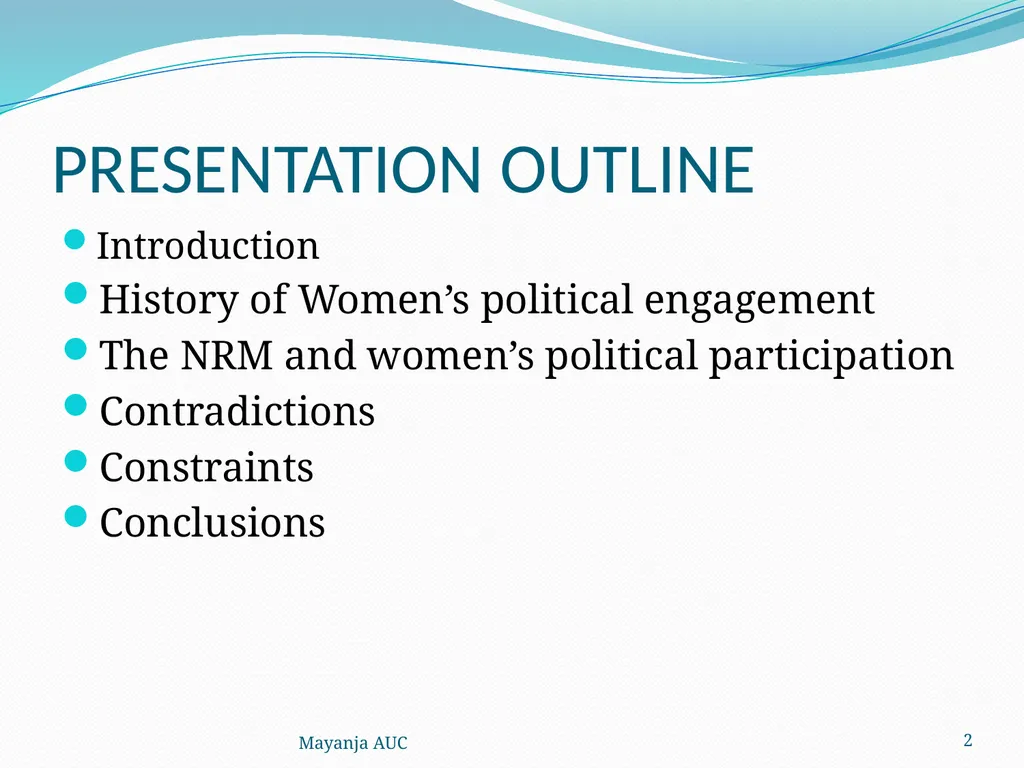
slide2. PRESENTATION OUTLINE Introduction
History of Women’s political engagement
The NRM and women’s political participation
Contradictions
Constraints
Conclusions 2 Mayanja AUC<br>
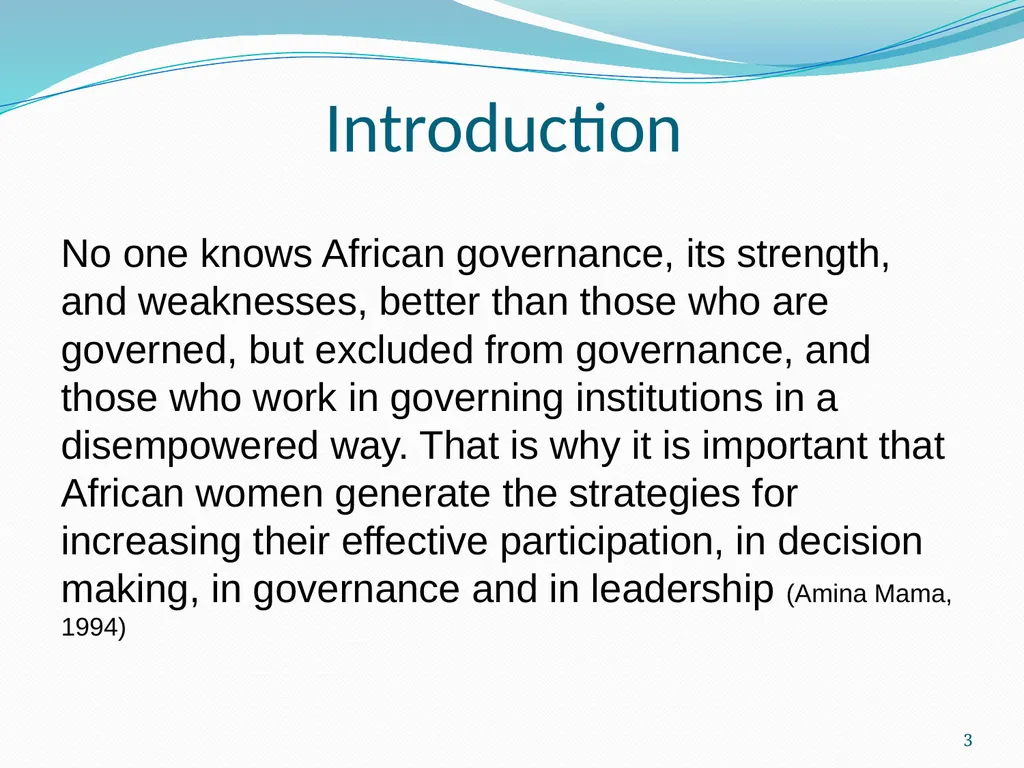
slide3. Introduction 3 No one knows African governance, its strength, and weaknesses, better than those who are governed, but excluded from governance, and those who work in governing institutions in a disempowered way. That is why it is important that African women generate the strategies for increasing their effective participation, in decision making, in governance and in leadership (Amina Mama, 1994)<br>
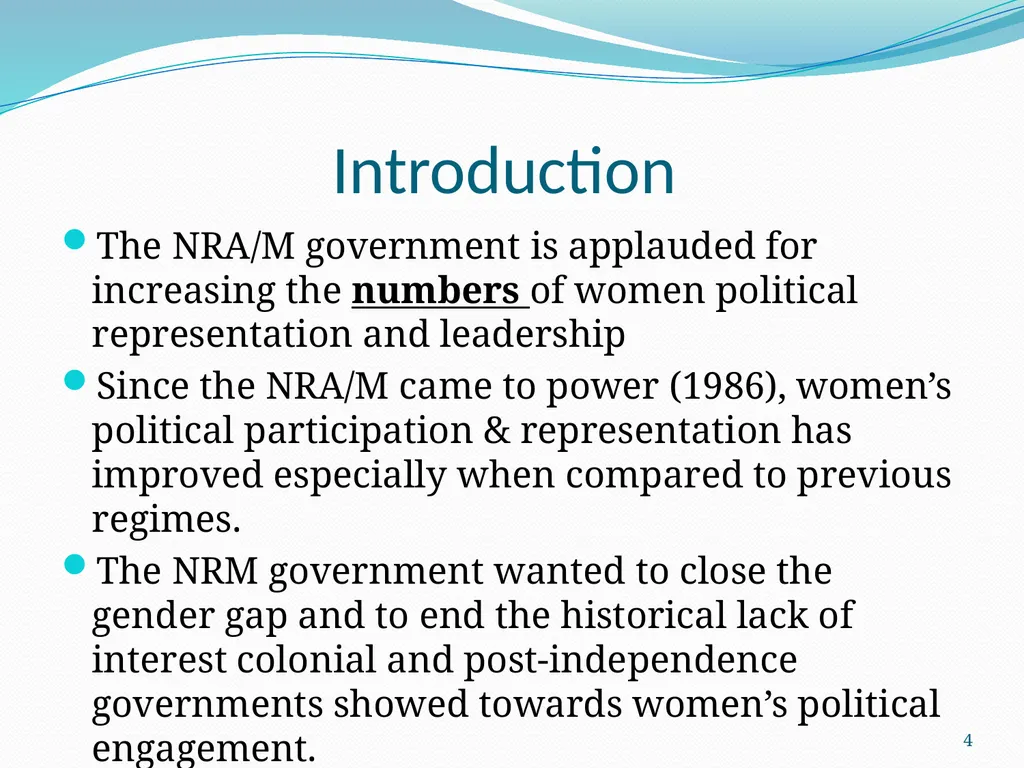
slide4. Introduction The NRA/M government is applauded for increasing the numbers of women political representation and leadership
Since the NRA/M came to power (1986), women’s political participation & representation has improved especially when compared to previous regimes.
The NRM government wanted to close the gender gap and to end the historical lack of interest colonial and post-independence governments showed towards women’s political engagement. 4<br>
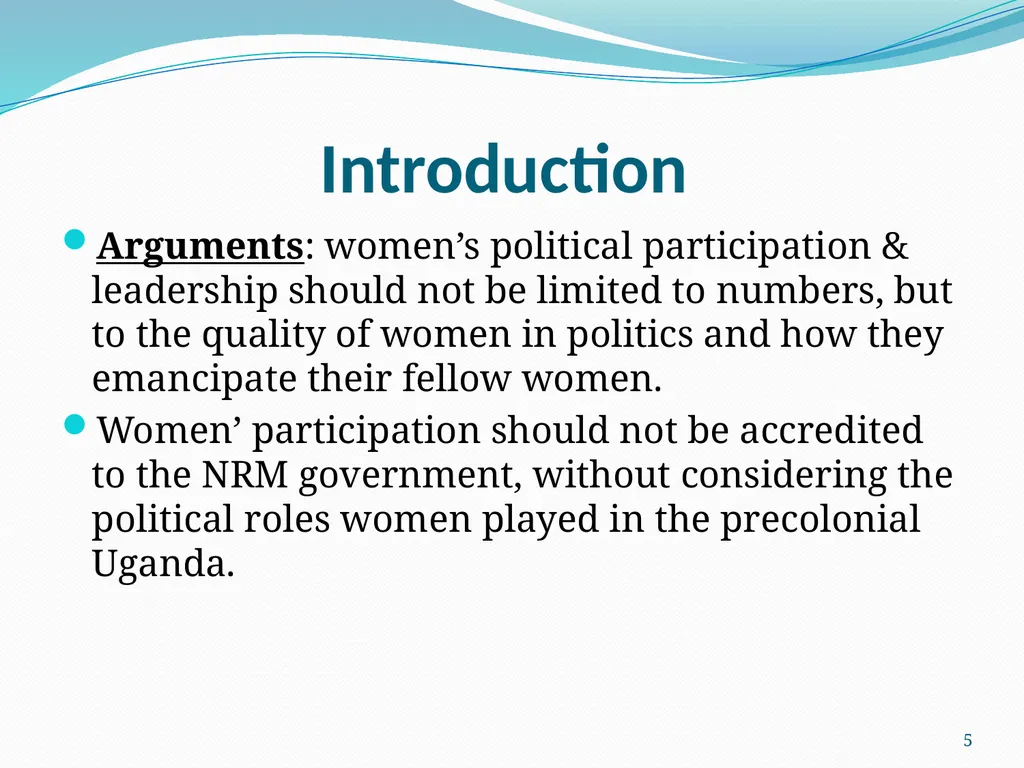
slide5. Introduction Arguments: women’s political participation & leadership should not be limited to numbers, but to the quality of women in politics and how they emancipate their fellow women.
Women’ participation should not be accredited to the NRM government, without considering the political roles women played in the precolonial Uganda. 5<br>
slide6. Introduction What is the history of women’s political participation in Uganda?
Who benefits from Women’s political representation?
What are the constraints confronting women’s political engagements? 6<br>
slide7. History of Women’s political engagement Precolonial era
Colonial era
Postindependence era 7<br>
slide8. Precolonial Era Political institutions varied from tribe to tribe.
Precolonial Africa was oral.
Precolonial literature was written by missionaries and explorer “through the cultural biases and perceptions of European males during the period of slavery or colonialism.” (Gordon & Gordon p. 294).
Precolonial literature about Africa “produced a literature which describes not Africa but the British response to it.” (Hammond, D. & Jablow, A 1985). 8<br>
slide9. Precolonial Era Early European presentation of Africa: savages and animists who would have perished without European intervention.
Women depicted as “servile beasts of burden.” (Gordon & Gordon p. 294)
Meier zu Selhausen and Weisdorf (2016: 231) argued that colonization “ignited a century-long transformation …., notably after 1950, women started to catch up with men within most areas, a change partially ascribable to the efforts by colonial administration.” 9<br>
slide10. Precolonial Era Men’s engagement in formal politics was conspicuous.
Internal cultural structures & arrangement between sexes allowed women to participate in politics ‘formally & informally’, or ‘directly & indirect’. (Lebeuf 1963; Tamale 2000; Gordon & Gordon 2013)
Women organizations with parallel authority structures to those of males eg. women’s chieftaincies, courts, village and market authorities, age grade and apprenticeship institutions. (Gordon 2013) 10<br>
slide11. Precolonial Era Women wielded power according to the political organizations of their communities as kings, queen mothers, queen-sisters; princesses, chiefs, priestesses, and warriors.
Two main types of political organizations: kingdoms & non-state political systems.
Their rights, dignity, leadership and political participation were not a contentious issue. Although there were variations, “the structures and foundations were essentially the same.” 11<br>
slide12. Colonial Era Uganda British Protectorate 1894- 1962
Victorian England (and other European societies) women were marginalized, excluded from politics & their roles subordinated.
Colonizers mentality: Politics as a man’s preserve.
Introduction of capitalism and the ‘capitalization’ of relationships, economics, and politics.
Commodification of land & introduction of cash crops.
Clientelism & land ownership reserved for men.
Women exclusion from education. 12<br>
slide13. Colonial Era Voting requirements
“An African resident of an electoral district of 21 years of age was entitled to vote provided he was able to read and write in his own language or was the owner of freehold or mailo land or had occupied land for the previous two years or had been in regular paid employment for seven years or had an income of £ 100 a year or property worth £ 400”. (Morris, H. and Read, H. 1966: 57) 13<br>
slide14. Colonial Era Women rallied together to challenge the oppressive structures and policies.
They organized themselves into movements and engaged in anticolonial fights. E.g the Young Women’s Christian Association (YWCA) and its subsidiary the Young Wives Group (YWG) fought for women’s emancipation and rights to education, property ownership and inheritance, voting rights and the right to political participation (Tripp 2000). 14<br>
slide15. Postindependence Era Women contributed to Uganda’s struggle for independence.
Socio- political institutions became a “replicas of their colonial predecessors”. (Gordon & Gordon 2013: 298).
Gender relationship dictated by Westernized ‘Black’ elites- ‘Black Skins in White Masks’ (Fanon 1963)
Foreign political models.
Endemic violence. 15<br>
slide16. The NRM & Women representation NRA/M Bush war (1980-1985)- Women’s roles
Conduits of intelligence.
Hid rebels from the government’s Uganda National Liberation Army (UNLA).
Spied on the enemies
Supplied fighters with basic necessities
Hid wounded soldiers, treated & took them to hospital.
Became combatants. 16<br>
slide17. The NRM & Women representation NRA/M assumed power January 26, 1986- to date
Women empowerment part of the NRM Ten-Point programme – The NRM’s “political Bible”
Museveni’s arguments: women “occupy key positions in the Civil Service and parastatals and nobody will be discriminated against on the basis of her sex.” (Museveni 2000:83 )
Affirmative action for women was necessary to break with Uganda’s history of marginalization and political exclusion. 17<br>
slide18. The NRM & Women representation Women had not been brought into the main stream of our political, economic, and social life. We are determined to do just that because we cannot talk about democracy without involving women in the nation’s governance: the form slightly more than 50 percent of our population. If democracy is about equality and social justice, then women, who contribute around 60 percent to our agricultural production (the mainstay of our economy) and produce 80 percent of our food, have to be taken more seriously. (Museveni 2000: 82-83) 18<br>
slide19. The NRM & Women representation Three major reforms
(1). Decentralization and creation of grassroots democracy with mandatory positions for women on all Resistance Committees (RC1 – RC 5).
(2). Creating the Ministry of Women in Development.
(3). Establishing a Women’s Desk within the NRM Secretariat to direct Women’s Affairs at every level of the NRC. 19<br>
slide20. The NRM & Women representation He appointed women in key government positions
He enacted laws & policies to promote women’s political participation and leadership.
The 1995 constitution
The 1997 Local Government Act
The 1997 Electoral Commission Act
The 2007 Uganda Gender Policy Act
The Press and Journalists Act and the Electronic Media Act 20<br>
slide21. Contradictions 1). Increase in the ‘numbers’ of women in politics has not emancipated other women.
2).Affirmative action has not transformed the dictatorial and patriarchal political space. Women continue to struggle for their political rights and equality.
3). Museveni continues to utilize clientelism, neo- patrimonialism, violence, money and natural charm to entrench his power. 21<br>
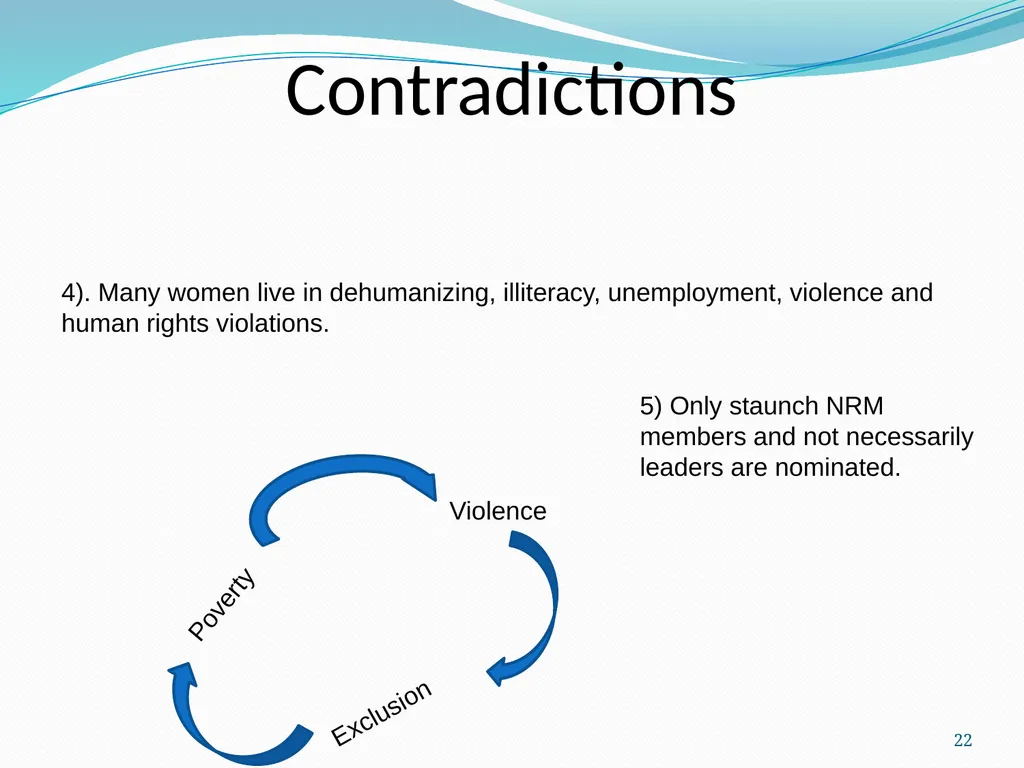
slide22. Contradictions Poverty Exclusion 22 Violence 4). Many women live in dehumanizing, illiteracy, unemployment, violence and human rights violations. 5) Only staunch NRM members and not necessarily leaders are nominated.<br>
slide23. Constraints 1). Women nominated in such positions have,
…no means of asserting their rights to be fronted as candidates in open election, of bringing membership pressure to bear on party executives to introduce a gendered voting gap. Instead, they have been recruited to the project of legitimizing the Movement’s no-party state, risking the discrediting of the entire project of representing women’s interests in the political arena should the present system collapse. (Goetz 2002: 23<br>
slide24. Constraints 2). Low literacy levels &lack of campaigning resources.
3).Uganda’s political system is marred with corruption and vote rigging.
4). Cultural views and the violent political environment.
5). The NRM’s patronage & clientelism system undermines women’s effectiveness to represent women’s interests and to promote the common good.
6). Sex discrimination 24<br>
slide25. Conclusions/suggestion Need to decolonize the political space
Bridge the gap of gender inequality in education and employment.
Real democracy
Recognize women’s talents and skills vs protecting male privileges 25<br>
slide26. References Amina Mama at the African Women and Governance Training Workshop organized by Abantu (people) for development, Entebbe, July 1994.
Gordon,A. & Gordon,G. (2007). Understanding Contemporary Africa. London: Lynne Rienner Publisher.
Hammond, Dorothy, and Jablow, Alta. (1970). “The Africa That Never Was; Four Centuries of British Writing About Africa. New York: Twayne Publishers, 1970.
Brantlinger, P. (1985)"Victorians and Africans: The genealogy of the myth of the dark continent." Critical Inquiry 12.1: 166-203.
Meier Zu Selhausen, Felix, and Jacob Weisdorf. 2016. “A Colonial Legacy of African Gender Inequality? Evidence from Christian Kampala, 1895-2011.” The Economic History Review 69 (1): 229–57.
(Other references to be added later) 26<br>
Adjunct Professor, University of Winnipeg BEYOND NUMBERS:
WOMEN LEADERSHIP AND POLITICAL PARTICIPATION IN UGANDA 1<br>
slide2. PRESENTATION OUTLINE Introduction
History of Women’s political engagement
The NRM and women’s political participation
Contradictions
Constraints
Conclusions 2 Mayanja AUC<br>
slide3. Introduction 3 No one knows African governance, its strength, and weaknesses, better than those who are governed, but excluded from governance, and those who work in governing institutions in a disempowered way. That is why it is important that African women generate the strategies for increasing their effective participation, in decision making, in governance and in leadership (Amina Mama, 1994)<br>
slide4. Introduction The NRA/M government is applauded for increasing the numbers of women political representation and leadership
Since the NRA/M came to power (1986), women’s political participation & representation has improved especially when compared to previous regimes.
The NRM government wanted to close the gender gap and to end the historical lack of interest colonial and post-independence governments showed towards women’s political engagement. 4<br>
slide5. Introduction Arguments: women’s political participation & leadership should not be limited to numbers, but to the quality of women in politics and how they emancipate their fellow women.
Women’ participation should not be accredited to the NRM government, without considering the political roles women played in the precolonial Uganda. 5<br>
slide6. Introduction What is the history of women’s political participation in Uganda?
Who benefits from Women’s political representation?
What are the constraints confronting women’s political engagements? 6<br>
slide7. History of Women’s political engagement Precolonial era
Colonial era
Postindependence era 7<br>
slide8. Precolonial Era Political institutions varied from tribe to tribe.
Precolonial Africa was oral.
Precolonial literature was written by missionaries and explorer “through the cultural biases and perceptions of European males during the period of slavery or colonialism.” (Gordon & Gordon p. 294).
Precolonial literature about Africa “produced a literature which describes not Africa but the British response to it.” (Hammond, D. & Jablow, A 1985). 8<br>
slide9. Precolonial Era Early European presentation of Africa: savages and animists who would have perished without European intervention.
Women depicted as “servile beasts of burden.” (Gordon & Gordon p. 294)
Meier zu Selhausen and Weisdorf (2016: 231) argued that colonization “ignited a century-long transformation …., notably after 1950, women started to catch up with men within most areas, a change partially ascribable to the efforts by colonial administration.” 9<br>
slide10. Precolonial Era Men’s engagement in formal politics was conspicuous.
Internal cultural structures & arrangement between sexes allowed women to participate in politics ‘formally & informally’, or ‘directly & indirect’. (Lebeuf 1963; Tamale 2000; Gordon & Gordon 2013)
Women organizations with parallel authority structures to those of males eg. women’s chieftaincies, courts, village and market authorities, age grade and apprenticeship institutions. (Gordon 2013) 10<br>
slide11. Precolonial Era Women wielded power according to the political organizations of their communities as kings, queen mothers, queen-sisters; princesses, chiefs, priestesses, and warriors.
Two main types of political organizations: kingdoms & non-state political systems.
Their rights, dignity, leadership and political participation were not a contentious issue. Although there were variations, “the structures and foundations were essentially the same.” 11<br>
slide12. Colonial Era Uganda British Protectorate 1894- 1962
Victorian England (and other European societies) women were marginalized, excluded from politics & their roles subordinated.
Colonizers mentality: Politics as a man’s preserve.
Introduction of capitalism and the ‘capitalization’ of relationships, economics, and politics.
Commodification of land & introduction of cash crops.
Clientelism & land ownership reserved for men.
Women exclusion from education. 12<br>
slide13. Colonial Era Voting requirements
“An African resident of an electoral district of 21 years of age was entitled to vote provided he was able to read and write in his own language or was the owner of freehold or mailo land or had occupied land for the previous two years or had been in regular paid employment for seven years or had an income of £ 100 a year or property worth £ 400”. (Morris, H. and Read, H. 1966: 57) 13<br>
slide14. Colonial Era Women rallied together to challenge the oppressive structures and policies.
They organized themselves into movements and engaged in anticolonial fights. E.g the Young Women’s Christian Association (YWCA) and its subsidiary the Young Wives Group (YWG) fought for women’s emancipation and rights to education, property ownership and inheritance, voting rights and the right to political participation (Tripp 2000). 14<br>
slide15. Postindependence Era Women contributed to Uganda’s struggle for independence.
Socio- political institutions became a “replicas of their colonial predecessors”. (Gordon & Gordon 2013: 298).
Gender relationship dictated by Westernized ‘Black’ elites- ‘Black Skins in White Masks’ (Fanon 1963)
Foreign political models.
Endemic violence. 15<br>
slide16. The NRM & Women representation NRA/M Bush war (1980-1985)- Women’s roles
Conduits of intelligence.
Hid rebels from the government’s Uganda National Liberation Army (UNLA).
Spied on the enemies
Supplied fighters with basic necessities
Hid wounded soldiers, treated & took them to hospital.
Became combatants. 16<br>
slide17. The NRM & Women representation NRA/M assumed power January 26, 1986- to date
Women empowerment part of the NRM Ten-Point programme – The NRM’s “political Bible”
Museveni’s arguments: women “occupy key positions in the Civil Service and parastatals and nobody will be discriminated against on the basis of her sex.” (Museveni 2000:83 )
Affirmative action for women was necessary to break with Uganda’s history of marginalization and political exclusion. 17<br>
slide18. The NRM & Women representation Women had not been brought into the main stream of our political, economic, and social life. We are determined to do just that because we cannot talk about democracy without involving women in the nation’s governance: the form slightly more than 50 percent of our population. If democracy is about equality and social justice, then women, who contribute around 60 percent to our agricultural production (the mainstay of our economy) and produce 80 percent of our food, have to be taken more seriously. (Museveni 2000: 82-83) 18<br>
slide19. The NRM & Women representation Three major reforms
(1). Decentralization and creation of grassroots democracy with mandatory positions for women on all Resistance Committees (RC1 – RC 5).
(2). Creating the Ministry of Women in Development.
(3). Establishing a Women’s Desk within the NRM Secretariat to direct Women’s Affairs at every level of the NRC. 19<br>
slide20. The NRM & Women representation He appointed women in key government positions
He enacted laws & policies to promote women’s political participation and leadership.
The 1995 constitution
The 1997 Local Government Act
The 1997 Electoral Commission Act
The 2007 Uganda Gender Policy Act
The Press and Journalists Act and the Electronic Media Act 20<br>
slide21. Contradictions 1). Increase in the ‘numbers’ of women in politics has not emancipated other women.
2).Affirmative action has not transformed the dictatorial and patriarchal political space. Women continue to struggle for their political rights and equality.
3). Museveni continues to utilize clientelism, neo- patrimonialism, violence, money and natural charm to entrench his power. 21<br>
slide22. Contradictions Poverty Exclusion 22 Violence 4). Many women live in dehumanizing, illiteracy, unemployment, violence and human rights violations. 5) Only staunch NRM members and not necessarily leaders are nominated.<br>
slide23. Constraints 1). Women nominated in such positions have,
…no means of asserting their rights to be fronted as candidates in open election, of bringing membership pressure to bear on party executives to introduce a gendered voting gap. Instead, they have been recruited to the project of legitimizing the Movement’s no-party state, risking the discrediting of the entire project of representing women’s interests in the political arena should the present system collapse. (Goetz 2002: 23<br>
slide24. Constraints 2). Low literacy levels &lack of campaigning resources.
3).Uganda’s political system is marred with corruption and vote rigging.
4). Cultural views and the violent political environment.
5). The NRM’s patronage & clientelism system undermines women’s effectiveness to represent women’s interests and to promote the common good.
6). Sex discrimination 24<br>
slide25. Conclusions/suggestion Need to decolonize the political space
Bridge the gap of gender inequality in education and employment.
Real democracy
Recognize women’s talents and skills vs protecting male privileges 25<br>
slide26. References Amina Mama at the African Women and Governance Training Workshop organized by Abantu (people) for development, Entebbe, July 1994.
Gordon,A. & Gordon,G. (2007). Understanding Contemporary Africa. London: Lynne Rienner Publisher.
Hammond, Dorothy, and Jablow, Alta. (1970). “The Africa That Never Was; Four Centuries of British Writing About Africa. New York: Twayne Publishers, 1970.
Brantlinger, P. (1985)"Victorians and Africans: The genealogy of the myth of the dark continent." Critical Inquiry 12.1: 166-203.
Meier Zu Selhausen, Felix, and Jacob Weisdorf. 2016. “A Colonial Legacy of African Gender Inequality? Evidence from Christian Kampala, 1895-2011.” The Economic History Review 69 (1): 229–57.
(Other references to be added later) 26<br>