
EXAMPLE AI-ProblemS MODULE - I 20MCA188 ARTIFICIAL
Description: EXAMPLE AI-ProblemS MODULE - I 20MCA188 ARTIFICIAL INTELLIGENCE (Elective-2) Selma Joseph A. Example problems The vacuum cleaner world Description This world has just two locations: squares A and B. The vacuum agent perceives which square
Related Topics
Download Presentation
"EXAMPLE AI-ProblemS MODULE - I 20MCA188 ARTIFICIAL" is the property of its rightful owner. Permission is granted to download and print the materials on this website for personal, non-commercial use only, and to display it on your personal computer provided you do not modify the materials and that you retain all copyright notices contained in the materials. By downloading content from our website, you accept the terms of this agreement.
Presentation Transcript
slide1. EXAMPLE AI-ProblemS MODULE - I 20MCA188 ARTIFICIAL
INTELLIGENCE (Elective-2) Selma Joseph A.<br>
slide2. Example problems The vacuum cleaner world
Description
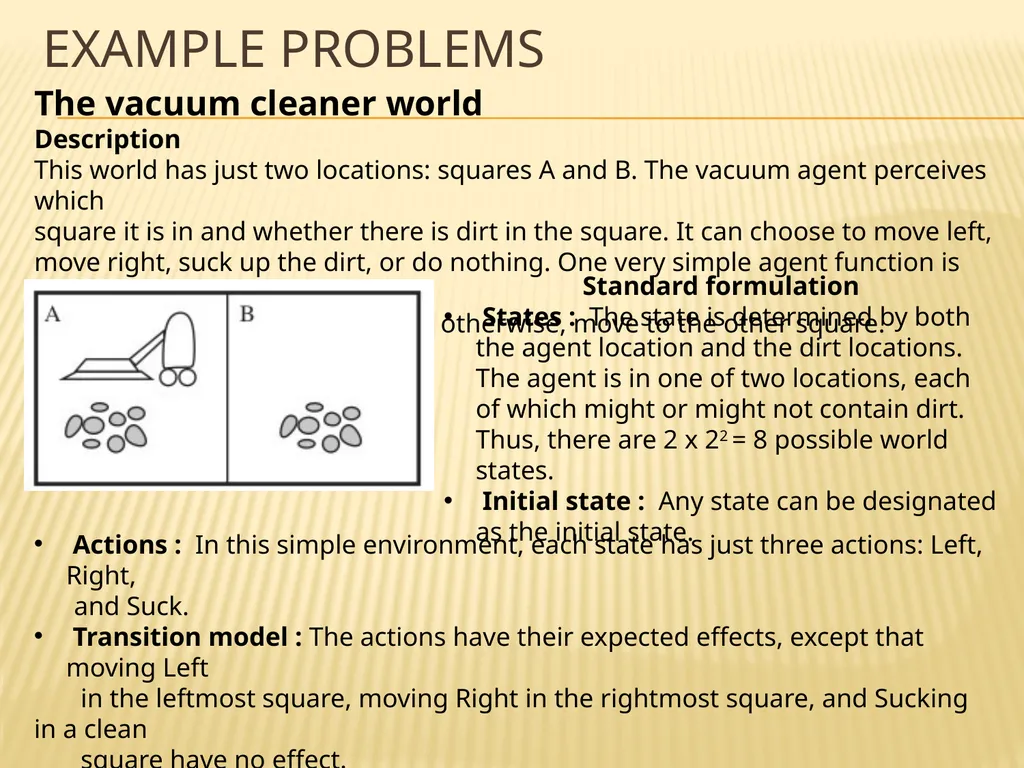
This world has just two locations: squares A and B. The vacuum agent perceives which
square it is in and whether there is dirt in the square. It can choose to move left, move right, suck up the dirt, or do nothing. One very simple agent function is the following: if the
current square is dirty, then suck; otherwise, move to the other square. Standard formulation
States : The state is determined by both the agent location and the dirt locations. The agent is in one of two locations, each of which might or might not contain dirt. Thus, there are 2 x 22 = 8 possible world states.
Initial state : Any state can be designated as the initial state. Actions : In this simple environment, each state has just three actions: Left, Right,
and Suck.
Transition model : The actions have their expected effects, except that moving Left
in the leftmost square, moving Right in the rightmost square, and Sucking in a clean
square have no effect.
Goal test : This checks whether all the squares are clean.
Path cost : Each step costs 1, so the path cost is the number of steps in the path.<br>
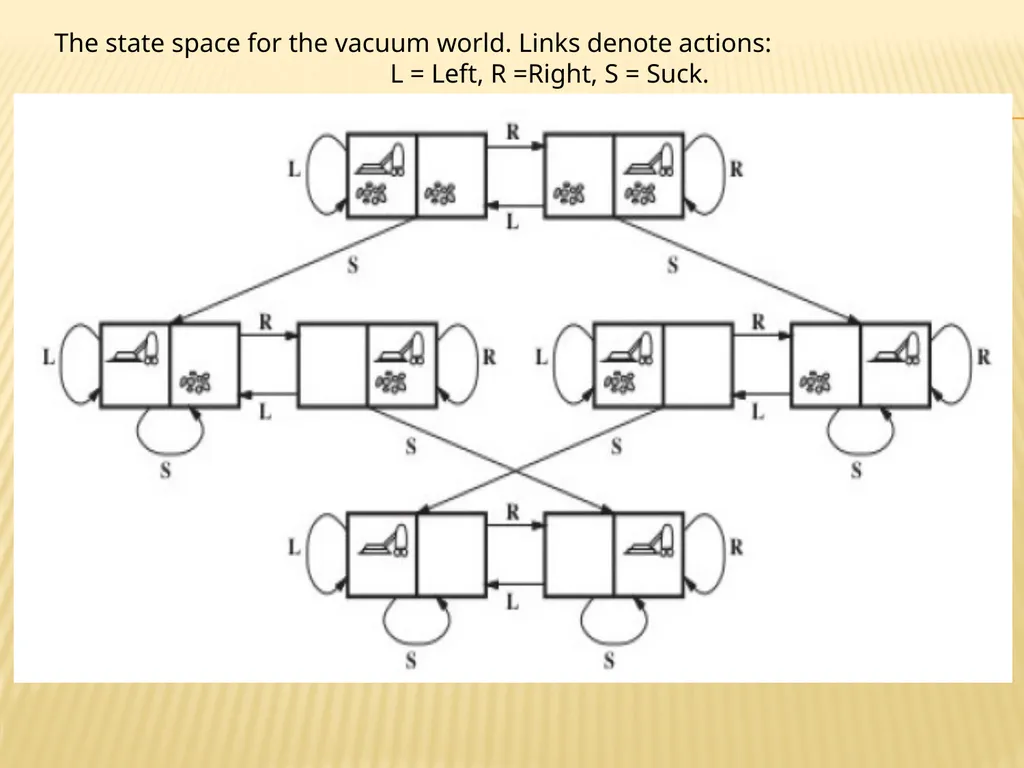
slide3. The state space for the vacuum world. Links denote actions: L = Left, R =Right, S = Suck.<br>
slide4. 8-puzzle problem Description
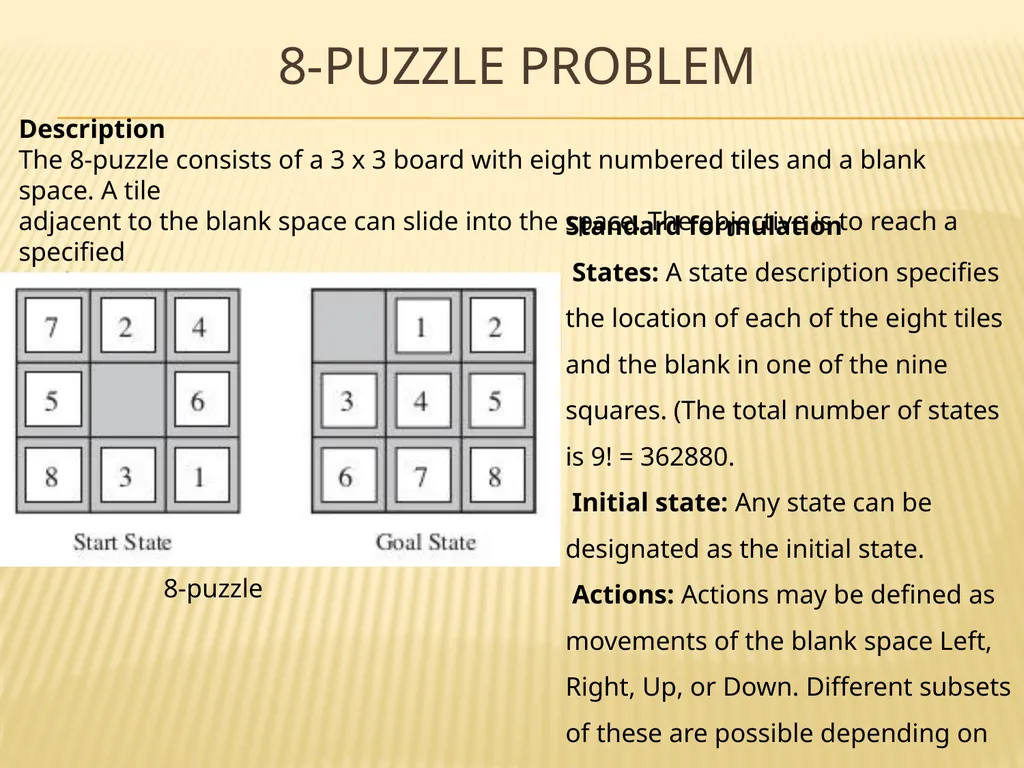
The 8-puzzle consists of a 3 x 3 board with eight numbered tiles and a blank space. A tile
adjacent to the blank space can slide into the space. The objective is to reach a specified
goal state. 8-puzzle Standard formulation
States: A state description specifies the location of each of the eight tiles and the blank in one of the nine squares. (The total number of states is 9! = 362880.
Initial state: Any state can be designated as the initial state.
Actions: Actions may be defined as movements of the blank space Left, Right, Up, or Down. Different subsets of these are possible depending on where the blank is.<br>
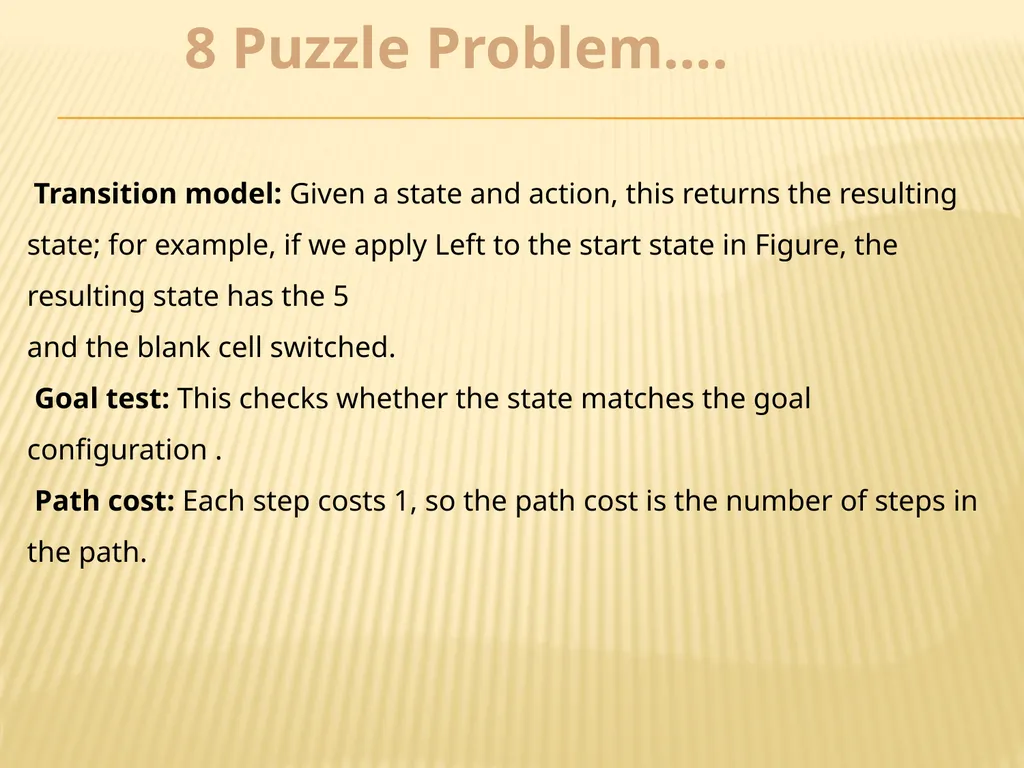
slide5. Transition model: Given a state and action, this returns the resulting state; for example, if we apply Left to the start state in Figure, the resulting state has the 5
and the blank cell switched.
Goal test: This checks whether the state matches the goal configuration .
Path cost: Each step costs 1, so the path cost is the number of steps in the path. 8 Puzzle Problem….<br>
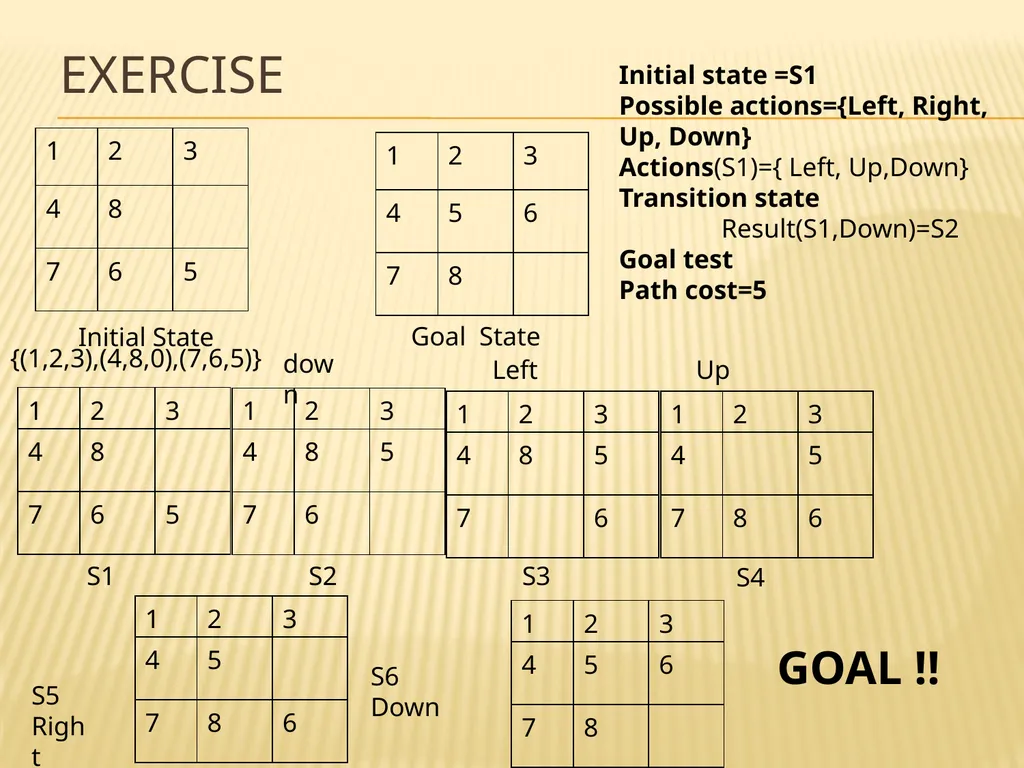
slide6. EXERCISE Initial State Goal State S1 Initial state =S1
Possible actions={Left, Right, Up, Down}
Actions(S1)={ Left, Up,Down}
Transition state
Result(S1,Down)=S2
Goal test
Path cost=5 down {(1,2,3),(4,8,0),(7,6,5)} S2 S3 Left Up S4 S5 Right S6
Down GOAL !!<br>
slide7. Missionaries and cannibals problem It is an AI famous problem formulation from an analytical viewpoint.
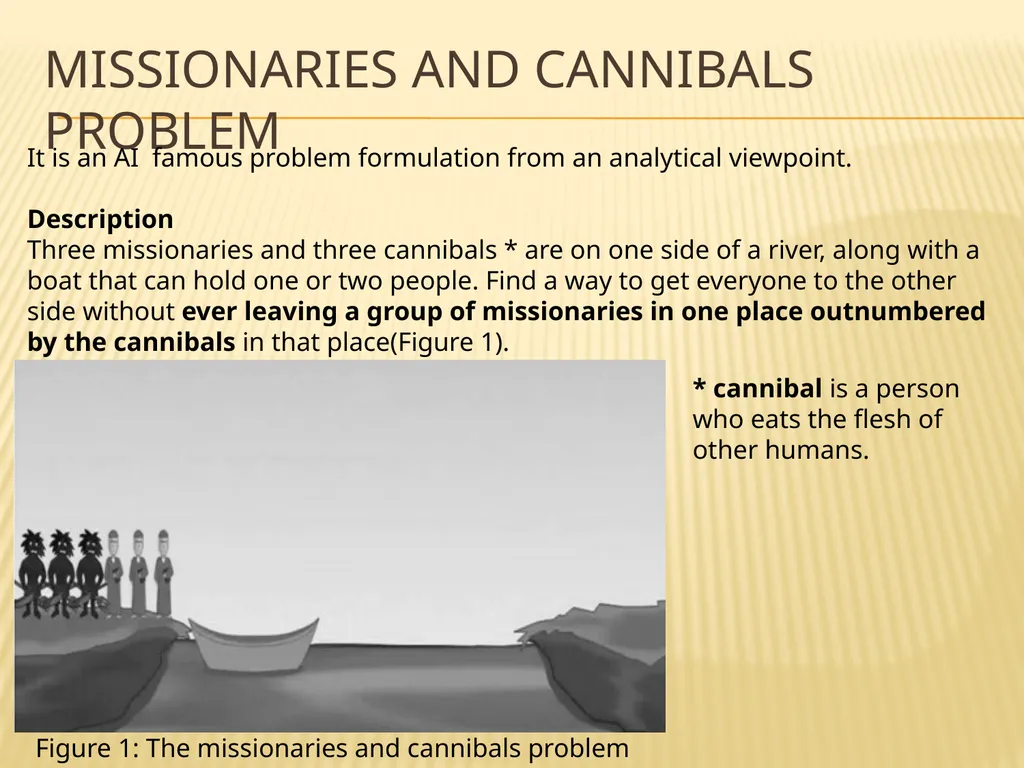
Description
Three missionaries and three cannibals * are on one side of a river, along with a boat that can hold one or two people. Find a way to get everyone to the other side without ever leaving a group of missionaries in one place outnumbered by the cannibals in that place(Figure 1). Figure 1: The missionaries and cannibals problem * cannibal is a person who eats the flesh of other humans.<br>
slide8. Standard formulation
Ignore all irrelevant parts of the problem (e.g., weather conditions, possible presence of crocodiles in the river, etc.).
States:
Each state is represented by an ordered sequence of 3 numbers (x; y; z) where
x : number of missionaries on initial river bank
y : number of cannibals on initial river bank
z : number of boats on initial river bank
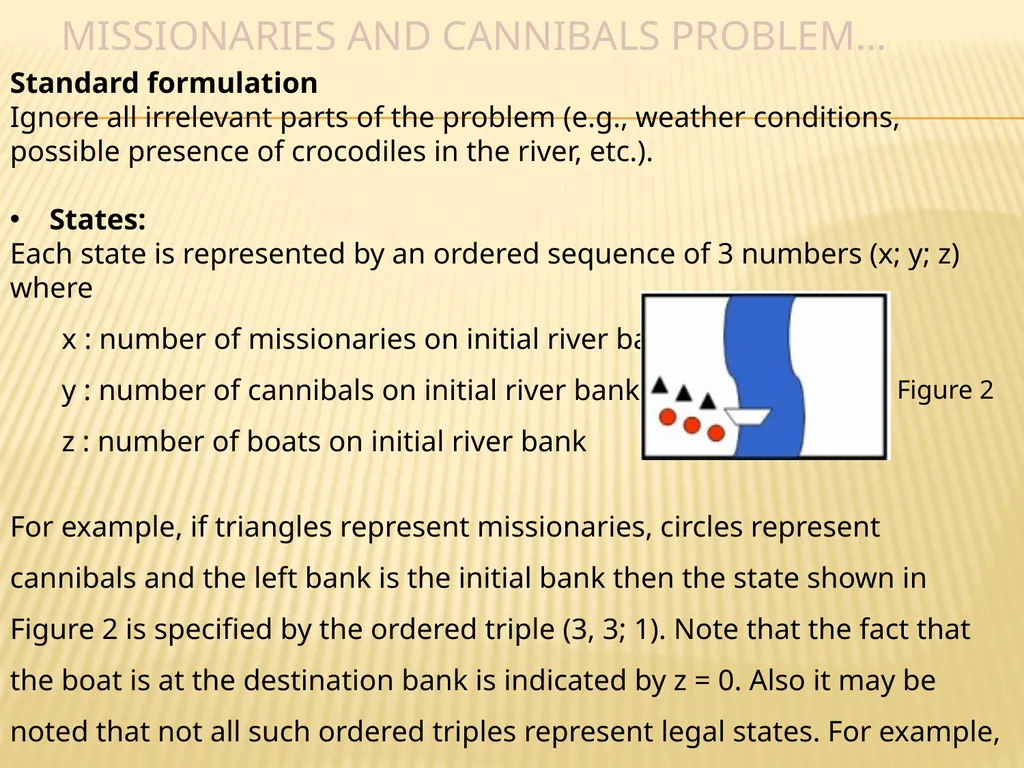
For example, if triangles represent missionaries, circles represent cannibals and the left bank is the initial bank then the state shown in Figure 2 is specified by the ordered triple (3, 3; 1). Note that the fact that the boat is at the destination bank is indicated by z = 0. Also it may be noted that not all such ordered triples represent legal states. For example, the triple (2; 3; 1) is not allowed because it represents a state where the number of cannibals outnumber the missionaries. Missionaries and cannibals problem… Figure 2<br>
slide9. Initial state: The ordered sequence = (3; 3; 1) (see Figure 1).
Actions: Take two missionaries, two cannibals, or one of each across in the boat. We have to take care to avoid illegal states.
Transition model: Given a state and action, this returns the resulting state; for example, if we apply the action ”Take 1 cannibal” to the state (0; 2; 0) the resulting state is (0; 3; 1).
Goal test: We have reached state (0; 0; 0).
Path cost: Number of crossings.
Solution
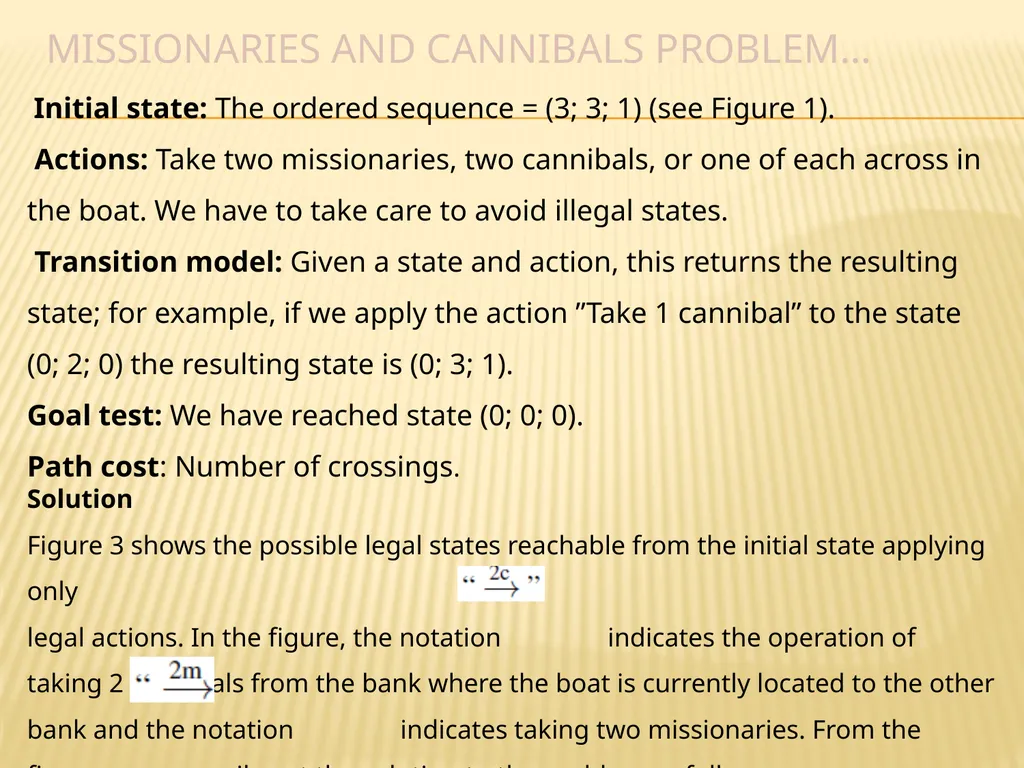
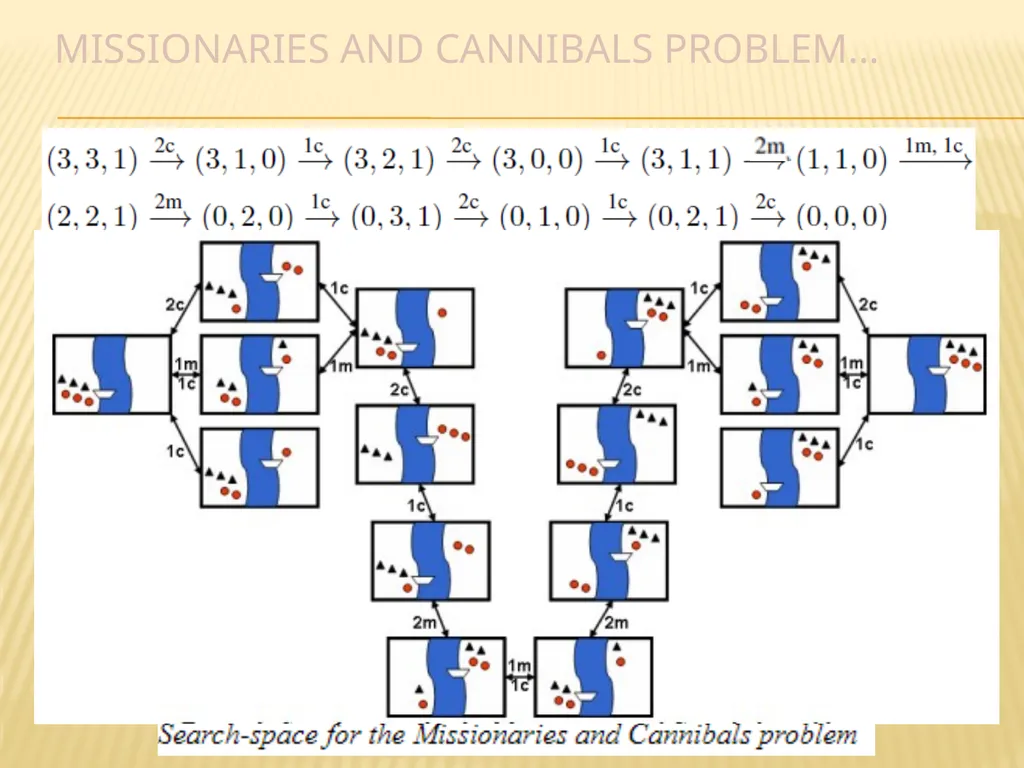
Figure 3 shows the possible legal states reachable from the initial state applying only
legal actions. In the figure, the notation indicates the operation of taking 2 cannibals from the bank where the boat is currently located to the other bank and the notation indicates taking two missionaries. From the figure we can easily get the solution to the problem as follows: (https://www.youtube.com/watch?v=W9NEWxabGmg) Missionaries and cannibals problem…<br>
slide10. Missionaries and cannibals problem…<br>
slide11. Cryptarithmetic pROBLEM This is an example for a special type of problem known as “constraint satisfaction problem”.
Description
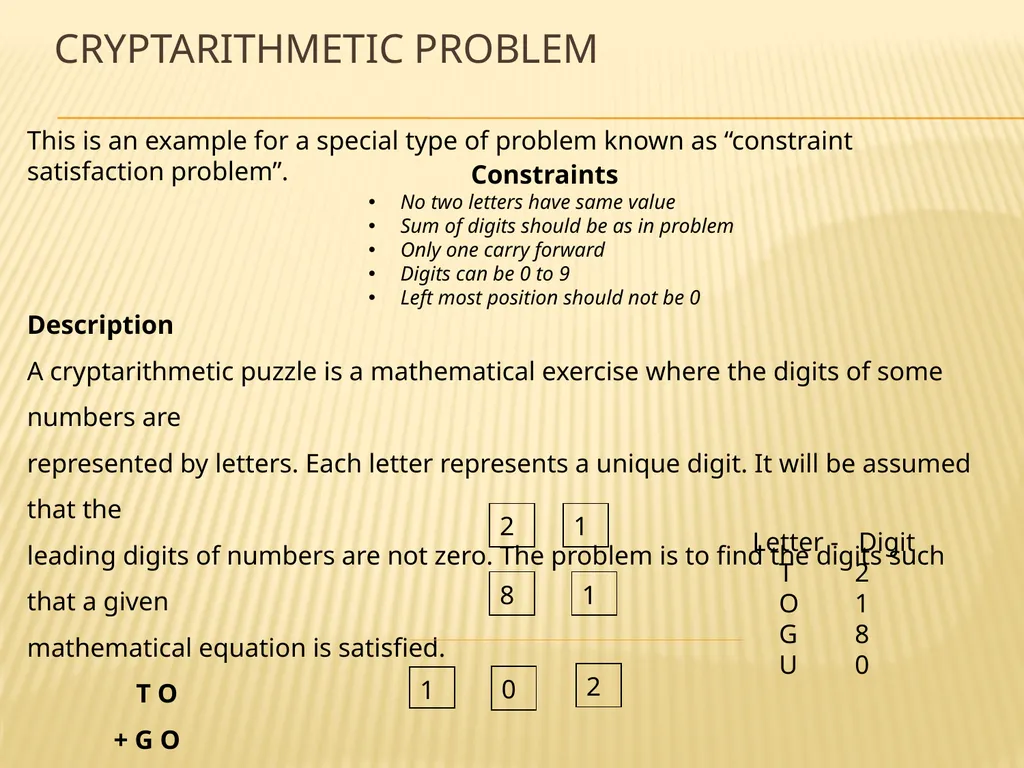
A cryptarithmetic puzzle is a mathematical exercise where the digits of some numbers are
represented by letters. Each letter represents a unique digit. It will be assumed that the
leading digits of numbers are not zero. The problem is to find the digits such that a given
mathematical equation is satisfied.
T O
+ G O
-----------
O U T Constraints
No two letters have same value
Sum of digits should be as in problem
Only one carry forward
Digits can be 0 to 9
Left most position should not be 0 Letter - Digit
T 2
O 1
G 8
U 0<br>
slide12. Cryptarithmetic Problem… Problem formulation
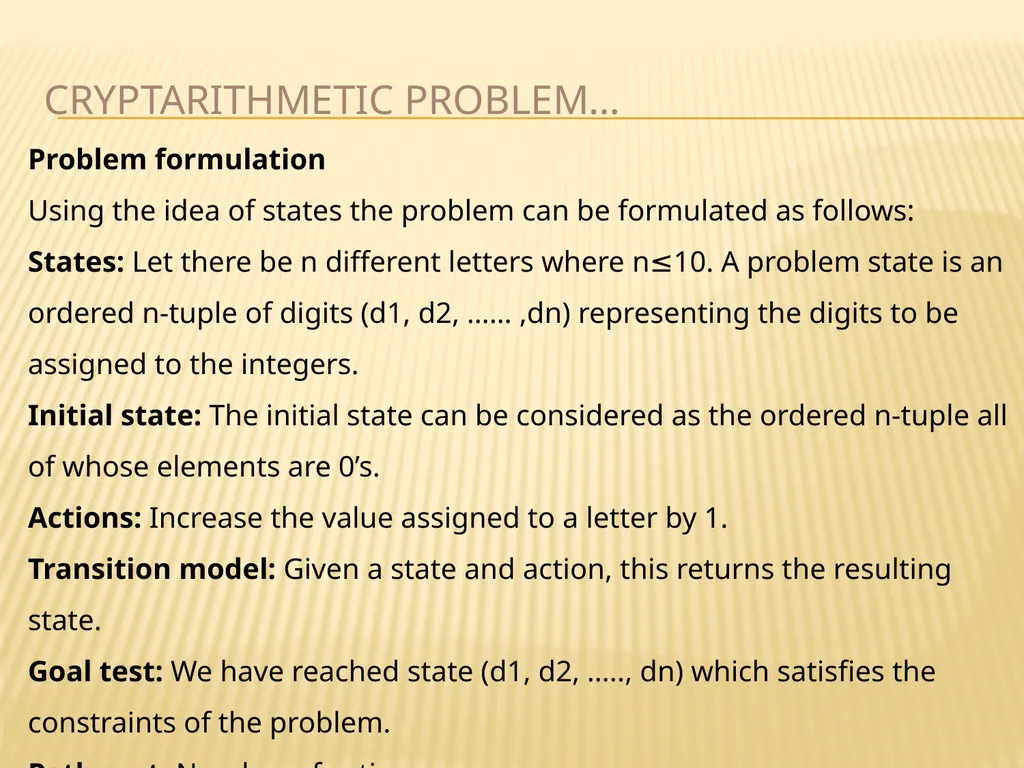
Using the idea of states the problem can be formulated as follows:
States: Let there be n different letters where n≤10. A problem state is an ordered n-tuple of digits (d1, d2, …… ,dn) representing the digits to be assigned to the integers.
Initial state: The initial state can be considered as the ordered n-tuple all of whose elements are 0’s.
Actions: Increase the value assigned to a letter by 1.
Transition model: Given a state and action, this returns the resulting state.
Goal test: We have reached state (d1, d2, ….., dn) which satisfies the constraints of the problem.
Path cost: Number of actions.<br>
slide13. Cryptarithmetic Problem… Solution
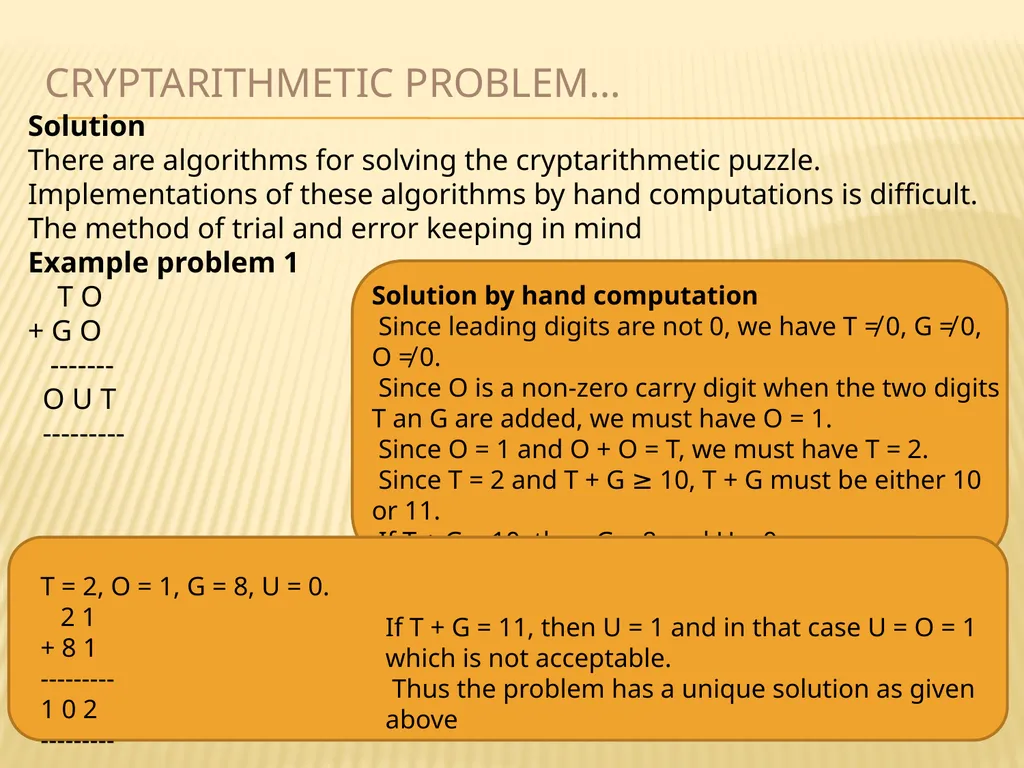
There are algorithms for solving the cryptarithmetic puzzle. Implementations of these algorithms by hand computations is difficult. The method of trial and error keeping in mind
Example problem 1
T O
+ G O
-------
O U T
--------- Solution by hand computation
Since leading digits are not 0, we have T ≠ 0, G ≠ 0, O ≠ 0.
Since O is a non-zero carry digit when the two digits T an G are added, we must have O = 1.
Since O = 1 and O + O = T, we must have T = 2.
Since T = 2 and T + G ≥ 10, T + G must be either 10 or 11.
If T + G = 10, then G = 8 and U = 0.
This gives a solution to the problem, namely, T = 2, O = 1, G = 8, U = 0.
2 1
+ 8 1
---------
1 0 2
---------
. If T + G = 11, then U = 1 and in that case U = O = 1 which is not acceptable.
Thus the problem has a unique solution as given above<br>
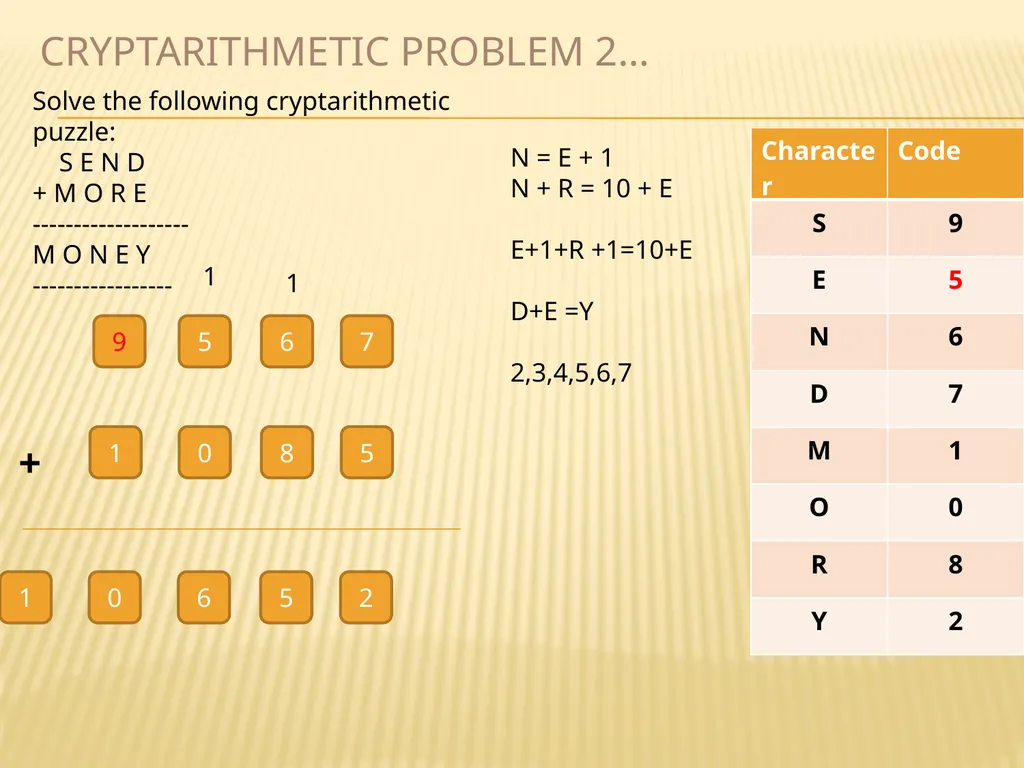
slide14. Cryptarithmetic Problem 2… Solve the following cryptarithmetic puzzle:
S E N D
+ M O R E
-------------------
M O N E Y
----------------- 1 5 7 6 1 0 5 8 0 6 2 5 9 + N = E + 1
N + R = 10 + E
E+1+R +1=10+E
D+E =Y
2,3,4,5,6,7 1 1<br>
slide15. Cryptarithmetic Problem 2… Solution
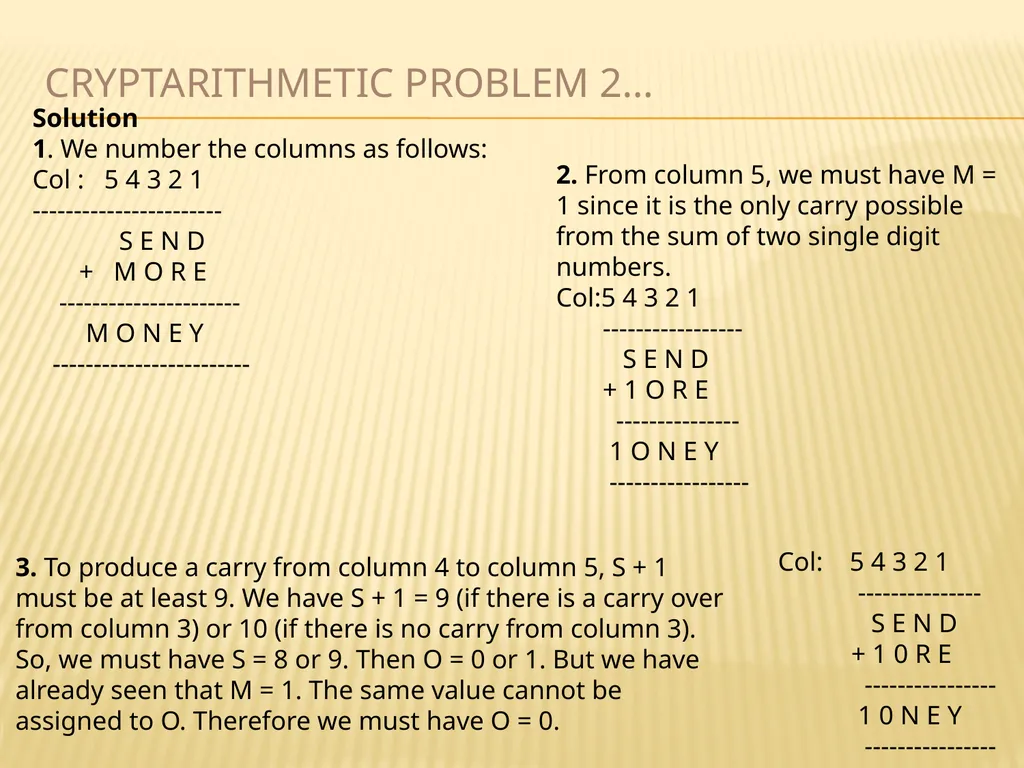
1. We number the columns as follows:
Col : 5 4 3 2 1
-----------------------
S E N D
+ M O R E
----------------------
M O N E Y
------------------------ 2. From column 5, we must have M = 1 since it is the only carry possible from the sum of two single digit numbers.
Col:5 4 3 2 1
-----------------
S E N D
+ 1 O R E
---------------
1 O N E Y
----------------- 3. To produce a carry from column 4 to column 5, S + 1 must be at least 9. We have S + 1 = 9 (if there is a carry over from column 3) or 10 (if there is no carry from column 3). So, we must have S = 8 or 9. Then O = 0 or 1. But we have already seen that M = 1. The same value cannot be assigned to O. Therefore we must have O = 0. Col: 5 4 3 2 1
---------------
S E N D
+ 1 0 R E
----------------
1 0 N E Y
----------------<br>
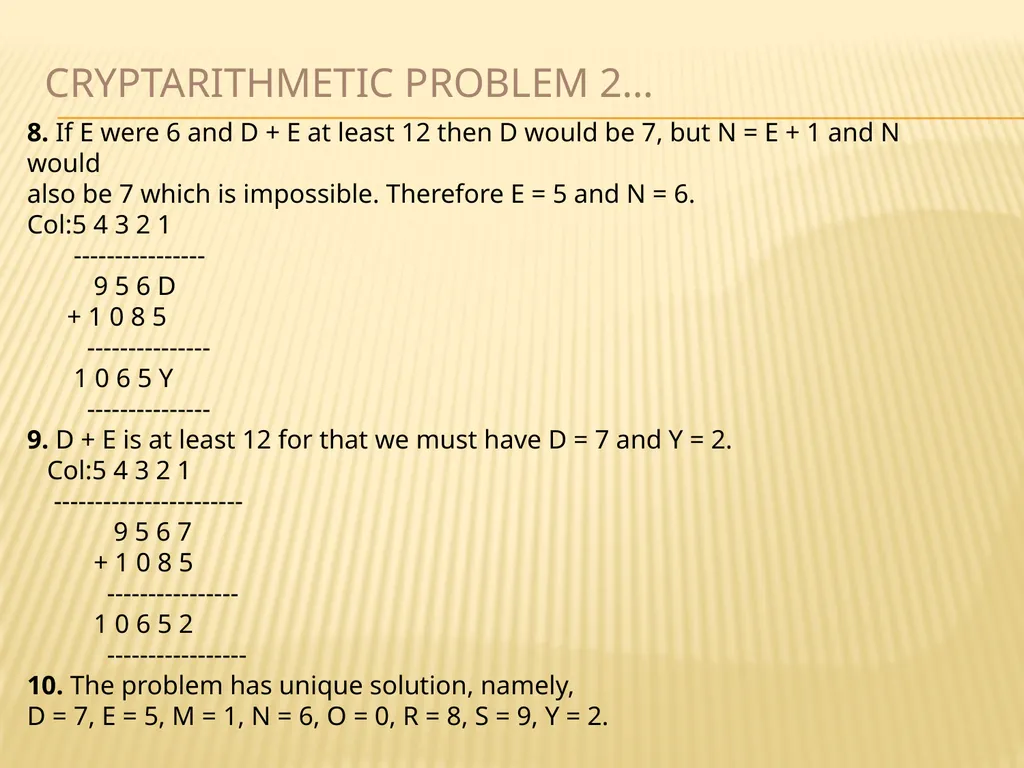
slide16. Cryptarithmetic Problem 2… 8. If E were 6 and D + E at least 12 then D would be 7, but N = E + 1 and N would
also be 7 which is impossible. Therefore E = 5 and N = 6.
Col:5 4 3 2 1
----------------
9 5 6 D
+ 1 0 8 5
---------------
1 0 6 5 Y
---------------
9. D + E is at least 12 for that we must have D = 7 and Y = 2.
Col:5 4 3 2 1
-----------------------
9 5 6 7
+ 1 0 8 5
----------------
1 0 6 5 2
-----------------
10. The problem has unique solution, namely,
D = 7, E = 5, M = 1, N = 6, O = 0, R = 8, S = 9, Y = 2.<br>
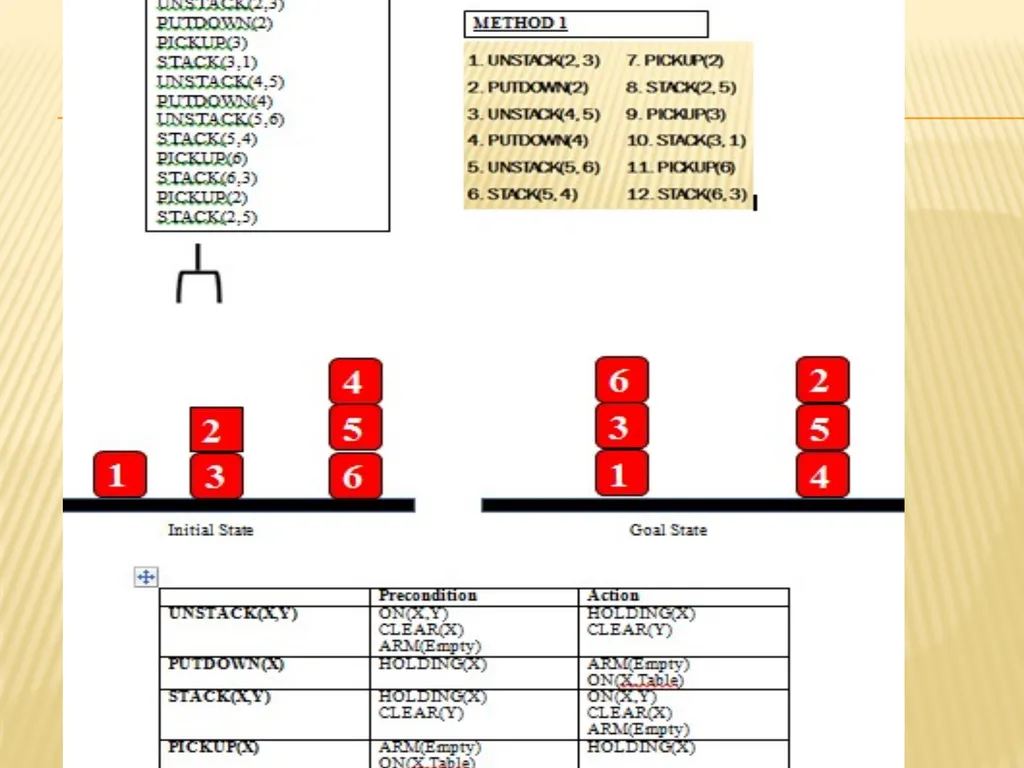
slide17. Blocks world problem Blocks world (or, the world of blocks) is a model domain used in artificial intelligence to
explore different approaches to automated reasoning. This model is used to illustrate that
a given algorithm can perform planning, or that it is efficient in terms of the number of
calculations required to find a solution or in terms of the length of that solution.
Description
There is a table on which some uniform blocks (cubes) are placed. Some blocks may or
may not be stacked on other blocks. We have a robot arm to pick up or put down the blocks. The robot arm can move only one block at a time, and no other block should be stacked on top of the block which is to be moved by the robot arm. The problem is to change the configuration of the blocks from a given initial state to a given goal state.<br>
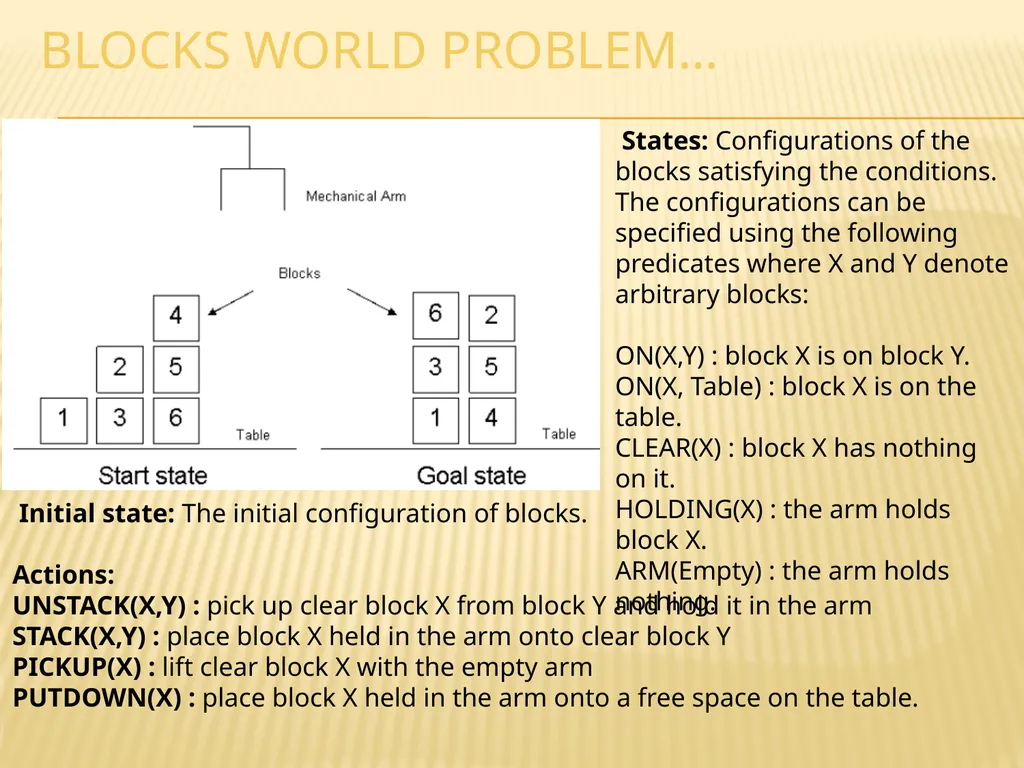
slide18. Blocks world problem… States: Configurations of the blocks satisfying the conditions. The configurations can be specified using the following predicates where X and Y denote arbitrary blocks:
ON(X,Y) : block X is on block Y.
ON(X, Table) : block X is on the table.
CLEAR(X) : block X has nothing on it.
HOLDING(X) : the arm holds block X.
ARM(Empty) : the arm holds nothing. Initial state: The initial configuration of blocks.
Actions:
UNSTACK(X,Y) : pick up clear block X from block Y and hold it in the arm
STACK(X,Y) : place block X held in the arm onto clear block Y
PICKUP(X) : lift clear block X with the empty arm
PUTDOWN(X) : place block X held in the arm onto a free space on the table.<br>
slide19. Solution
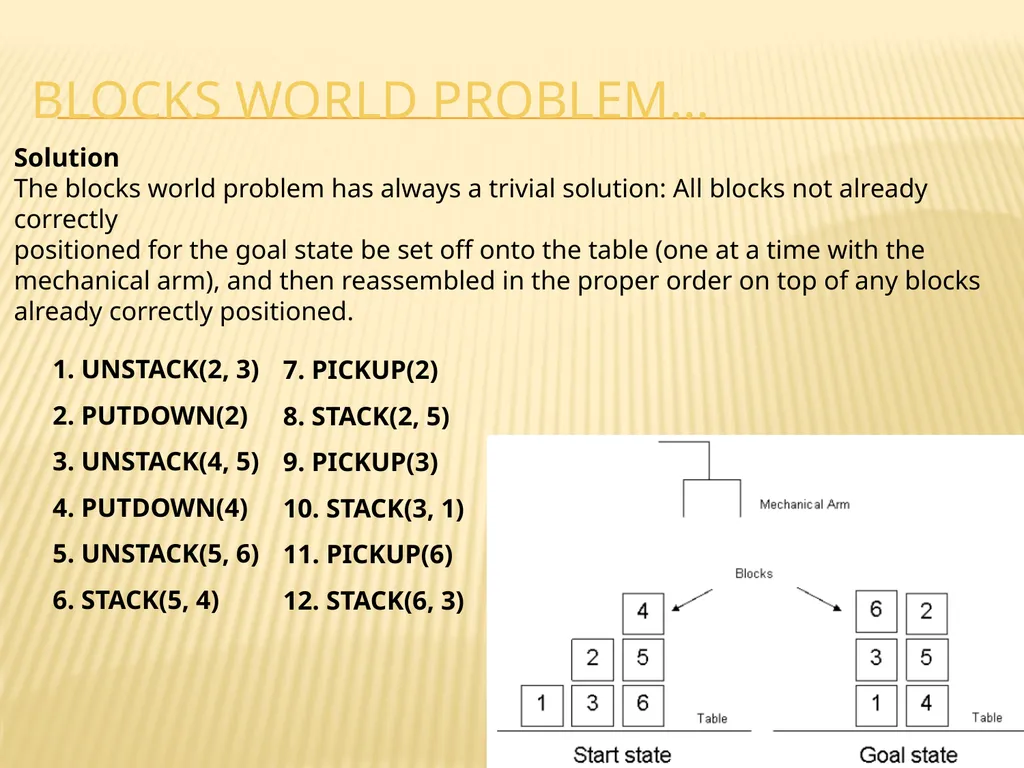
The blocks world problem has always a trivial solution: All blocks not already correctly
positioned for the goal state be set off onto the table (one at a time with the mechanical arm), and then reassembled in the proper order on top of any blocks already correctly positioned. Blocks world problem… 1. UNSTACK(2, 3)
2. PUTDOWN(2)
3. UNSTACK(4, 5)
4. PUTDOWN(4)
5. UNSTACK(5, 6)
6. STACK(5, 4) 7. PICKUP(2)
8. STACK(2, 5)
9. PICKUP(3)
10. STACK(3, 1)
11. PICKUP(6)
12. STACK(6, 3)<br>
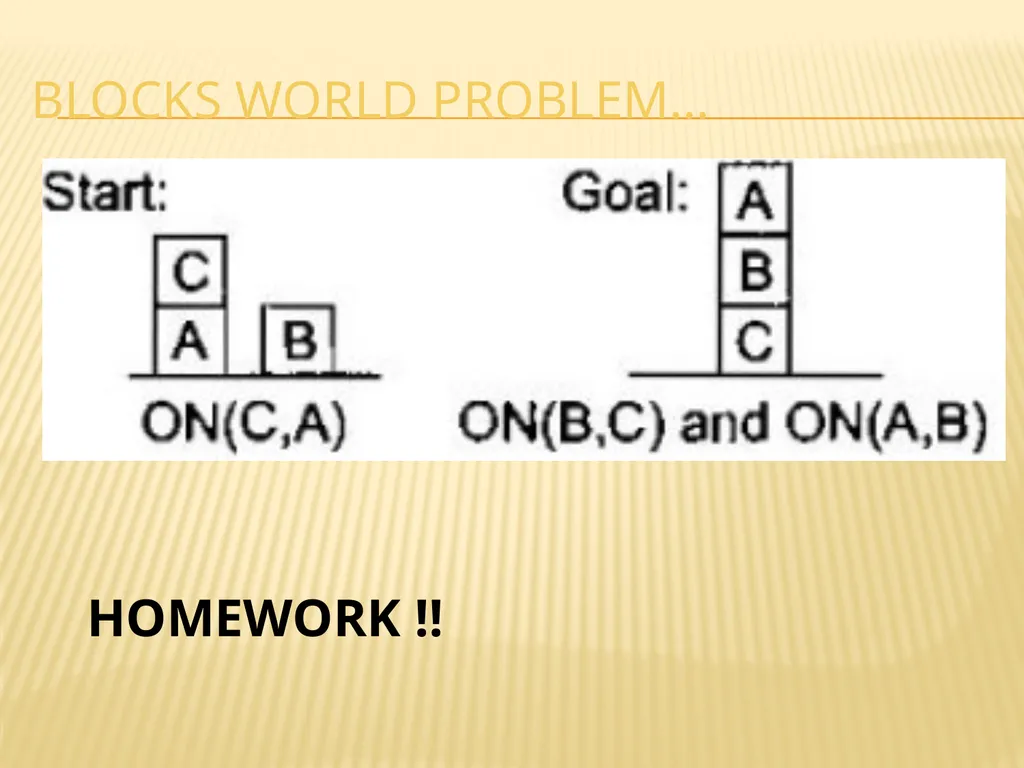
slide21. Blocks world problem… HOMEWORK !!<br>
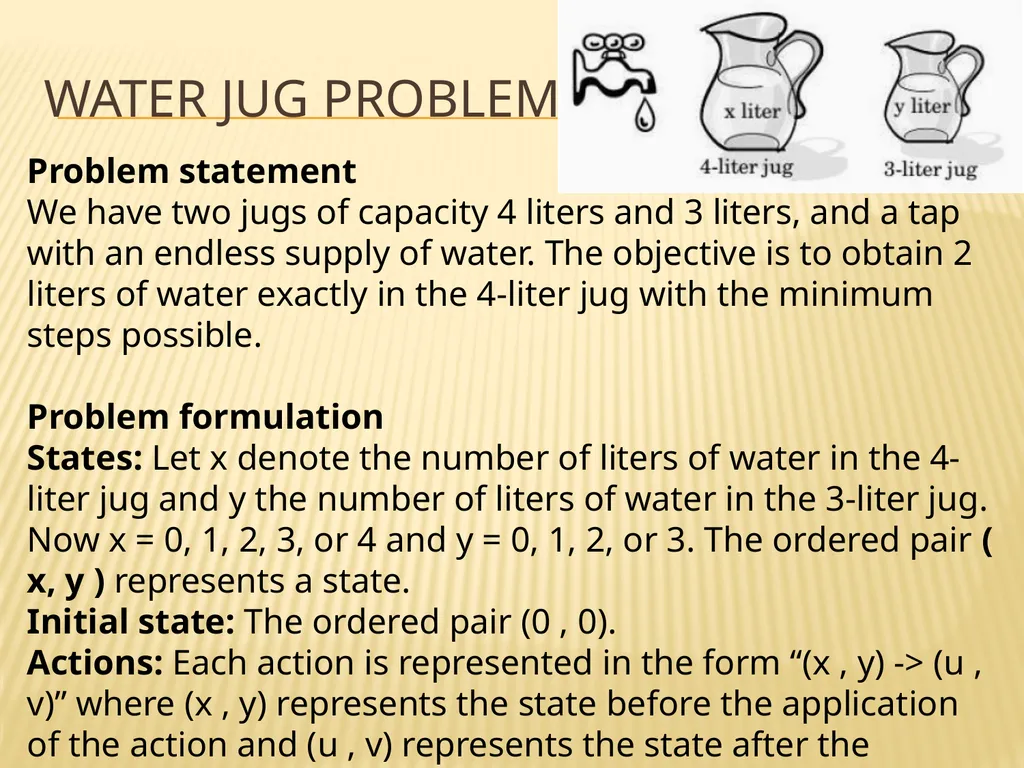
slide22. Water jug problem Problem statement
We have two jugs of capacity 4 liters and 3 liters, and a tap with an endless supply of water. The objective is to obtain 2 liters of water exactly in the 4-liter jug with the minimum steps possible.
Problem formulation
States: Let x denote the number of liters of water in the 4-liter jug and y the number of liters of water in the 3-liter jug. Now x = 0, 1, 2, 3, or 4 and y = 0, 1, 2, or 3. The ordered pair ( x, y ) represents a state.
Initial state: The ordered pair (0 , 0).
Actions: Each action is represented in the form “(x , y) -> (u , v)” where (x , y) represents the state before the application of the action and (u , v) represents the state after the application of the action.<br>
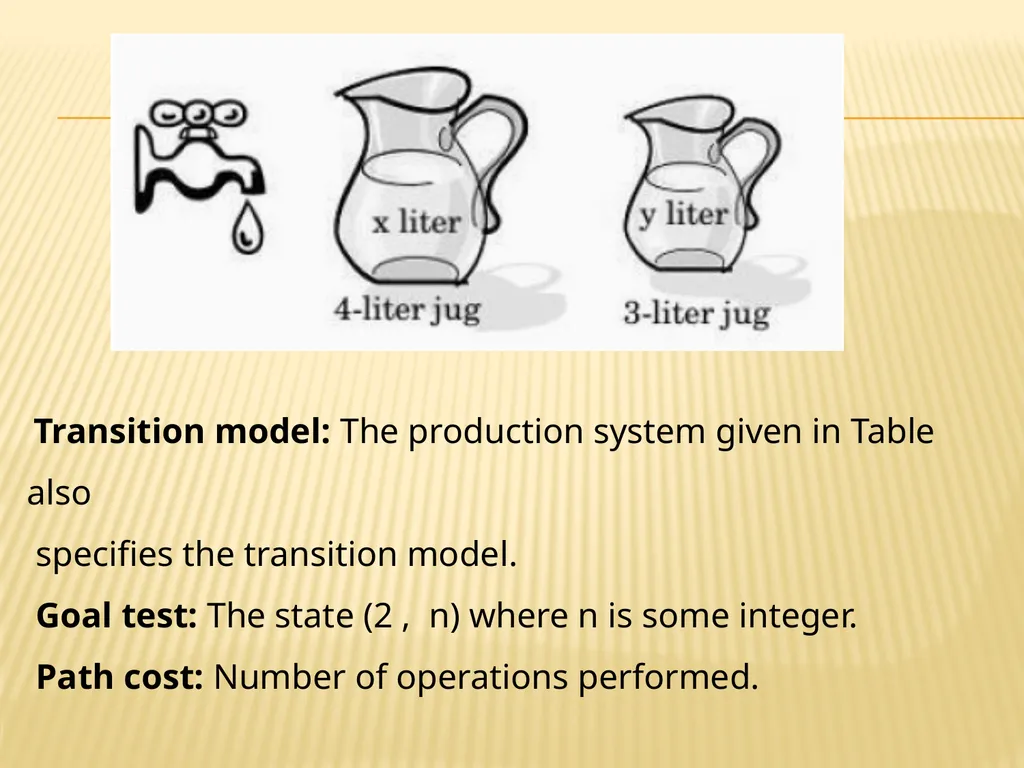
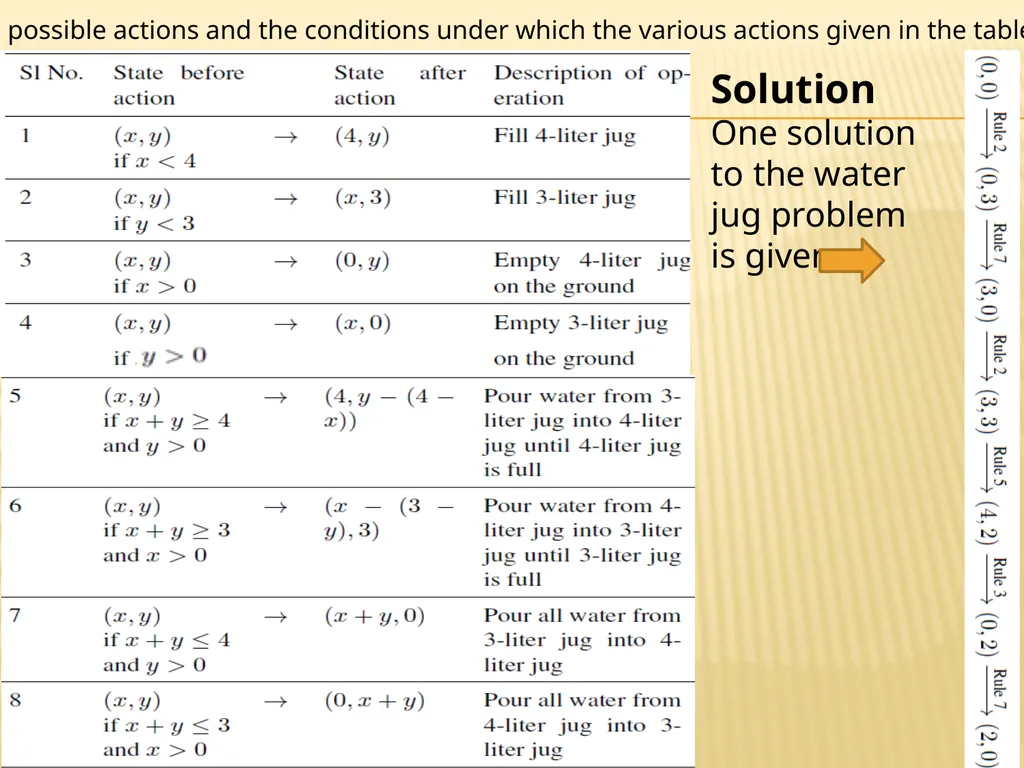
slide23. Transition model: The production system given in Table also
specifies the transition model.
Goal test: The state (2 , n) where n is some integer.
Path cost: Number of operations performed.<br>
slide24. The possible actions and the conditions under which the various actions given in the table: Solution
One solution to the water jug problem is given<br>
INTELLIGENCE (Elective-2) Selma Joseph A.<br>
slide2. Example problems The vacuum cleaner world
Description
This world has just two locations: squares A and B. The vacuum agent perceives which
square it is in and whether there is dirt in the square. It can choose to move left, move right, suck up the dirt, or do nothing. One very simple agent function is the following: if the
current square is dirty, then suck; otherwise, move to the other square. Standard formulation
States : The state is determined by both the agent location and the dirt locations. The agent is in one of two locations, each of which might or might not contain dirt. Thus, there are 2 x 22 = 8 possible world states.
Initial state : Any state can be designated as the initial state. Actions : In this simple environment, each state has just three actions: Left, Right,
and Suck.
Transition model : The actions have their expected effects, except that moving Left
in the leftmost square, moving Right in the rightmost square, and Sucking in a clean
square have no effect.
Goal test : This checks whether all the squares are clean.
Path cost : Each step costs 1, so the path cost is the number of steps in the path.<br>
slide3. The state space for the vacuum world. Links denote actions: L = Left, R =Right, S = Suck.<br>
slide4. 8-puzzle problem Description
The 8-puzzle consists of a 3 x 3 board with eight numbered tiles and a blank space. A tile
adjacent to the blank space can slide into the space. The objective is to reach a specified
goal state. 8-puzzle Standard formulation
States: A state description specifies the location of each of the eight tiles and the blank in one of the nine squares. (The total number of states is 9! = 362880.
Initial state: Any state can be designated as the initial state.
Actions: Actions may be defined as movements of the blank space Left, Right, Up, or Down. Different subsets of these are possible depending on where the blank is.<br>
slide5. Transition model: Given a state and action, this returns the resulting state; for example, if we apply Left to the start state in Figure, the resulting state has the 5
and the blank cell switched.
Goal test: This checks whether the state matches the goal configuration .
Path cost: Each step costs 1, so the path cost is the number of steps in the path. 8 Puzzle Problem….<br>
slide6. EXERCISE Initial State Goal State S1 Initial state =S1
Possible actions={Left, Right, Up, Down}
Actions(S1)={ Left, Up,Down}
Transition state
Result(S1,Down)=S2
Goal test
Path cost=5 down {(1,2,3),(4,8,0),(7,6,5)} S2 S3 Left Up S4 S5 Right S6
Down GOAL !!<br>
slide7. Missionaries and cannibals problem It is an AI famous problem formulation from an analytical viewpoint.
Description
Three missionaries and three cannibals * are on one side of a river, along with a boat that can hold one or two people. Find a way to get everyone to the other side without ever leaving a group of missionaries in one place outnumbered by the cannibals in that place(Figure 1). Figure 1: The missionaries and cannibals problem * cannibal is a person who eats the flesh of other humans.<br>
slide8. Standard formulation
Ignore all irrelevant parts of the problem (e.g., weather conditions, possible presence of crocodiles in the river, etc.).
States:
Each state is represented by an ordered sequence of 3 numbers (x; y; z) where
x : number of missionaries on initial river bank
y : number of cannibals on initial river bank
z : number of boats on initial river bank
For example, if triangles represent missionaries, circles represent cannibals and the left bank is the initial bank then the state shown in Figure 2 is specified by the ordered triple (3, 3; 1). Note that the fact that the boat is at the destination bank is indicated by z = 0. Also it may be noted that not all such ordered triples represent legal states. For example, the triple (2; 3; 1) is not allowed because it represents a state where the number of cannibals outnumber the missionaries. Missionaries and cannibals problem… Figure 2<br>
slide9. Initial state: The ordered sequence = (3; 3; 1) (see Figure 1).
Actions: Take two missionaries, two cannibals, or one of each across in the boat. We have to take care to avoid illegal states.
Transition model: Given a state and action, this returns the resulting state; for example, if we apply the action ”Take 1 cannibal” to the state (0; 2; 0) the resulting state is (0; 3; 1).
Goal test: We have reached state (0; 0; 0).
Path cost: Number of crossings.
Solution
Figure 3 shows the possible legal states reachable from the initial state applying only
legal actions. In the figure, the notation indicates the operation of taking 2 cannibals from the bank where the boat is currently located to the other bank and the notation indicates taking two missionaries. From the figure we can easily get the solution to the problem as follows: (https://www.youtube.com/watch?v=W9NEWxabGmg) Missionaries and cannibals problem…<br>
slide10. Missionaries and cannibals problem…<br>
slide11. Cryptarithmetic pROBLEM This is an example for a special type of problem known as “constraint satisfaction problem”.
Description
A cryptarithmetic puzzle is a mathematical exercise where the digits of some numbers are
represented by letters. Each letter represents a unique digit. It will be assumed that the
leading digits of numbers are not zero. The problem is to find the digits such that a given
mathematical equation is satisfied.
T O
+ G O
-----------
O U T Constraints
No two letters have same value
Sum of digits should be as in problem
Only one carry forward
Digits can be 0 to 9
Left most position should not be 0 Letter - Digit
T 2
O 1
G 8
U 0<br>
slide12. Cryptarithmetic Problem… Problem formulation
Using the idea of states the problem can be formulated as follows:
States: Let there be n different letters where n≤10. A problem state is an ordered n-tuple of digits (d1, d2, …… ,dn) representing the digits to be assigned to the integers.
Initial state: The initial state can be considered as the ordered n-tuple all of whose elements are 0’s.
Actions: Increase the value assigned to a letter by 1.
Transition model: Given a state and action, this returns the resulting state.
Goal test: We have reached state (d1, d2, ….., dn) which satisfies the constraints of the problem.
Path cost: Number of actions.<br>
slide13. Cryptarithmetic Problem… Solution
There are algorithms for solving the cryptarithmetic puzzle. Implementations of these algorithms by hand computations is difficult. The method of trial and error keeping in mind
Example problem 1
T O
+ G O
-------
O U T
--------- Solution by hand computation
Since leading digits are not 0, we have T ≠ 0, G ≠ 0, O ≠ 0.
Since O is a non-zero carry digit when the two digits T an G are added, we must have O = 1.
Since O = 1 and O + O = T, we must have T = 2.
Since T = 2 and T + G ≥ 10, T + G must be either 10 or 11.
If T + G = 10, then G = 8 and U = 0.
This gives a solution to the problem, namely, T = 2, O = 1, G = 8, U = 0.
2 1
+ 8 1
---------
1 0 2
---------
. If T + G = 11, then U = 1 and in that case U = O = 1 which is not acceptable.
Thus the problem has a unique solution as given above<br>
slide14. Cryptarithmetic Problem 2… Solve the following cryptarithmetic puzzle:
S E N D
+ M O R E
-------------------
M O N E Y
----------------- 1 5 7 6 1 0 5 8 0 6 2 5 9 + N = E + 1
N + R = 10 + E
E+1+R +1=10+E
D+E =Y
2,3,4,5,6,7 1 1<br>
slide15. Cryptarithmetic Problem 2… Solution
1. We number the columns as follows:
Col : 5 4 3 2 1
-----------------------
S E N D
+ M O R E
----------------------
M O N E Y
------------------------ 2. From column 5, we must have M = 1 since it is the only carry possible from the sum of two single digit numbers.
Col:5 4 3 2 1
-----------------
S E N D
+ 1 O R E
---------------
1 O N E Y
----------------- 3. To produce a carry from column 4 to column 5, S + 1 must be at least 9. We have S + 1 = 9 (if there is a carry over from column 3) or 10 (if there is no carry from column 3). So, we must have S = 8 or 9. Then O = 0 or 1. But we have already seen that M = 1. The same value cannot be assigned to O. Therefore we must have O = 0. Col: 5 4 3 2 1
---------------
S E N D
+ 1 0 R E
----------------
1 0 N E Y
----------------<br>
slide16. Cryptarithmetic Problem 2… 8. If E were 6 and D + E at least 12 then D would be 7, but N = E + 1 and N would
also be 7 which is impossible. Therefore E = 5 and N = 6.
Col:5 4 3 2 1
----------------
9 5 6 D
+ 1 0 8 5
---------------
1 0 6 5 Y
---------------
9. D + E is at least 12 for that we must have D = 7 and Y = 2.
Col:5 4 3 2 1
-----------------------
9 5 6 7
+ 1 0 8 5
----------------
1 0 6 5 2
-----------------
10. The problem has unique solution, namely,
D = 7, E = 5, M = 1, N = 6, O = 0, R = 8, S = 9, Y = 2.<br>
slide17. Blocks world problem Blocks world (or, the world of blocks) is a model domain used in artificial intelligence to
explore different approaches to automated reasoning. This model is used to illustrate that
a given algorithm can perform planning, or that it is efficient in terms of the number of
calculations required to find a solution or in terms of the length of that solution.
Description
There is a table on which some uniform blocks (cubes) are placed. Some blocks may or
may not be stacked on other blocks. We have a robot arm to pick up or put down the blocks. The robot arm can move only one block at a time, and no other block should be stacked on top of the block which is to be moved by the robot arm. The problem is to change the configuration of the blocks from a given initial state to a given goal state.<br>
slide18. Blocks world problem… States: Configurations of the blocks satisfying the conditions. The configurations can be specified using the following predicates where X and Y denote arbitrary blocks:
ON(X,Y) : block X is on block Y.
ON(X, Table) : block X is on the table.
CLEAR(X) : block X has nothing on it.
HOLDING(X) : the arm holds block X.
ARM(Empty) : the arm holds nothing. Initial state: The initial configuration of blocks.
Actions:
UNSTACK(X,Y) : pick up clear block X from block Y and hold it in the arm
STACK(X,Y) : place block X held in the arm onto clear block Y
PICKUP(X) : lift clear block X with the empty arm
PUTDOWN(X) : place block X held in the arm onto a free space on the table.<br>
slide19. Solution
The blocks world problem has always a trivial solution: All blocks not already correctly
positioned for the goal state be set off onto the table (one at a time with the mechanical arm), and then reassembled in the proper order on top of any blocks already correctly positioned. Blocks world problem… 1. UNSTACK(2, 3)
2. PUTDOWN(2)
3. UNSTACK(4, 5)
4. PUTDOWN(4)
5. UNSTACK(5, 6)
6. STACK(5, 4) 7. PICKUP(2)
8. STACK(2, 5)
9. PICKUP(3)
10. STACK(3, 1)
11. PICKUP(6)
12. STACK(6, 3)<br>
slide21. Blocks world problem… HOMEWORK !!<br>
slide22. Water jug problem Problem statement
We have two jugs of capacity 4 liters and 3 liters, and a tap with an endless supply of water. The objective is to obtain 2 liters of water exactly in the 4-liter jug with the minimum steps possible.
Problem formulation
States: Let x denote the number of liters of water in the 4-liter jug and y the number of liters of water in the 3-liter jug. Now x = 0, 1, 2, 3, or 4 and y = 0, 1, 2, or 3. The ordered pair ( x, y ) represents a state.
Initial state: The ordered pair (0 , 0).
Actions: Each action is represented in the form “(x , y) -> (u , v)” where (x , y) represents the state before the application of the action and (u , v) represents the state after the application of the action.<br>
slide23. Transition model: The production system given in Table also
specifies the transition model.
Goal test: The state (2 , n) where n is some integer.
Path cost: Number of operations performed.<br>
slide24. The possible actions and the conditions under which the various actions given in the table: Solution
One solution to the water jug problem is given<br>