
Example assignment brief Unit 9: Working with a
BR
Published · 12 slides · 0 views
1 / 1
Description
Example assignment brief Unit 9: Working with a Fashion Design Brief BTEC International Level 2 in Art and Design Species You should ensure the following sections of this assignment brief are appropriate for your programme and learners, and
Related Topics
Share
Embed code
Download this presentation From Below
"Example assignment brief Unit 9: Working with a" is the property of its rightful owner. Permission is granted to download and print the materials on this website for personal, non-commercial use only, and to display it on your personal computer provided you do not modify the materials and that you retain all copyright notices contained in the materials. By downloading content from our website, you accept the terms of this agreement.
Presentation Transcript
01
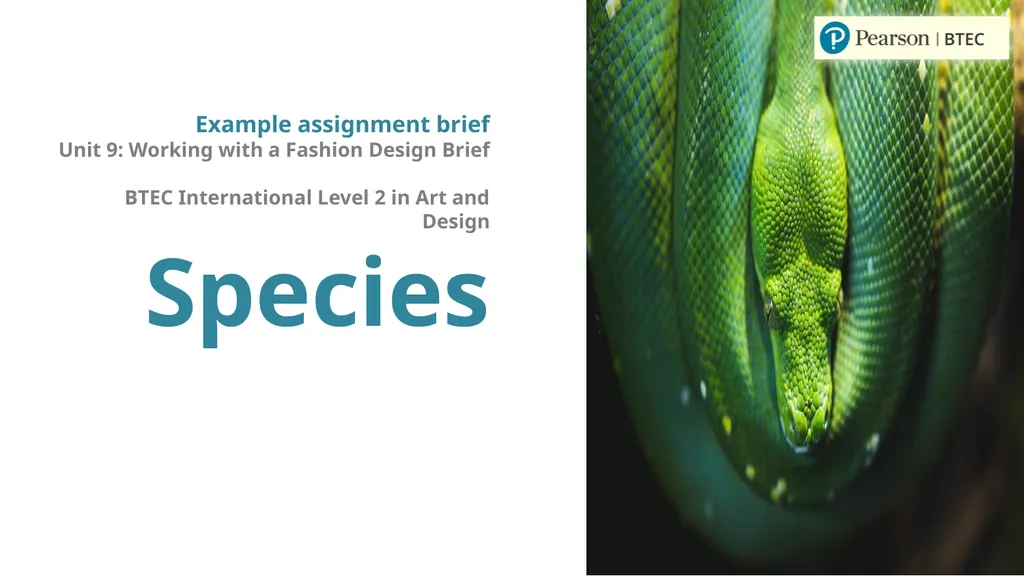
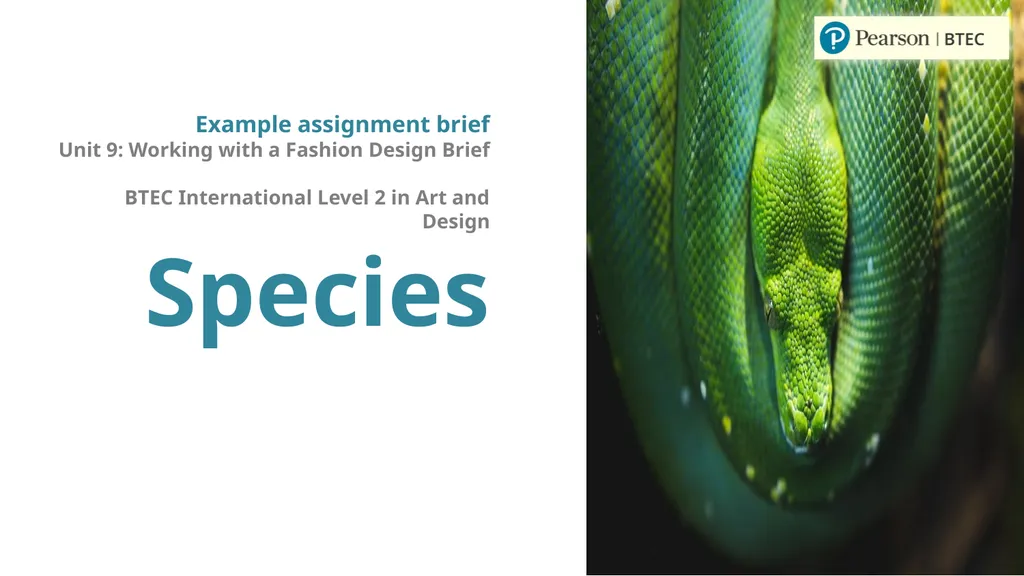
Example assignment brief
Unit 9: Working with a Fashion Design Brief
BTEC International Level 2 in Art and Design
Species<br>
Unit 9: Working with a Fashion Design Brief
BTEC International Level 2 in Art and Design
Species<br>
02
You should ensure the following sections of this assignment brief are appropriate for your programme and learners, and adapt as necessary e.g.:
Requirements: to indicate the types of media and outcomes.
Requirements – detail: to indicate the specific requirements for focused programmes, i.e. if the programme is 2D or 3D orientated, it would be advisable to set narrower outcome requirements.
Inspiration: to use examples of sources relevant to the programme.
Guidance: to indicate the specific expectations of how learners will develop and submit work. Additional deadlines can be included for different tasks within the assignment if needed. Guidance for teachers on using example assignment briefs
(delete slide prior to handing out to learners)
Example Assignment Briefs (EABs) are provided for use and guidance. They have been developed to provide realistic vocational scenarios as client briefs. The content demonstrates how briefs can be used for assignments for assessment of units.
EABs can be adapted in any way to meet the needs of your learners and programme, however they must maintain the required features of an assignment for a BTEC qualification. Please see published BTEC support and training for more information on setting and adapting assignments. Species<br>
Requirements: to indicate the types of media and outcomes.
Requirements – detail: to indicate the specific requirements for focused programmes, i.e. if the programme is 2D or 3D orientated, it would be advisable to set narrower outcome requirements.
Inspiration: to use examples of sources relevant to the programme.
Guidance: to indicate the specific expectations of how learners will develop and submit work. Additional deadlines can be included for different tasks within the assignment if needed. Guidance for teachers on using example assignment briefs
(delete slide prior to handing out to learners)
Example Assignment Briefs (EABs) are provided for use and guidance. They have been developed to provide realistic vocational scenarios as client briefs. The content demonstrates how briefs can be used for assignments for assessment of units.
EABs can be adapted in any way to meet the needs of your learners and programme, however they must maintain the required features of an assignment for a BTEC qualification. Please see published BTEC support and training for more information on setting and adapting assignments. Species<br>
03
Client
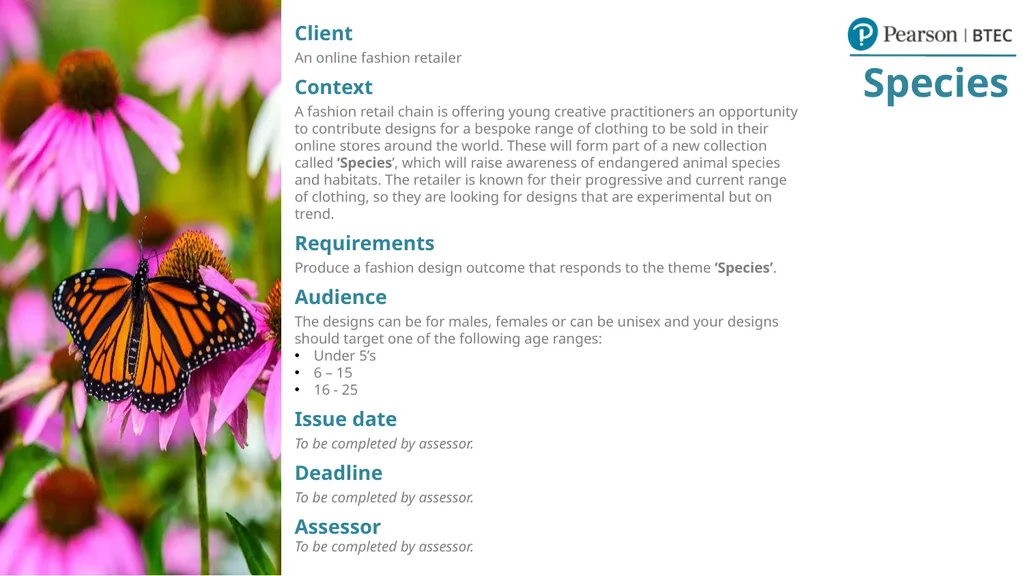
An online fashion retailer
Context
A fashion retail chain is offering young creative practitioners an opportunity to contribute designs for a bespoke range of clothing to be sold in their online stores around the world. These will form part of a new collection called ‘Species’, which will raise awareness of endangered animal species and habitats. The retailer is known for their progressive and current range of clothing, so they are looking for designs that are experimental but on trend.
Requirements
Produce a fashion design outcome that responds to the theme ‘Species’.
Audience
The designs can be for males, females or can be unisex and your designs should target one of the following age ranges:
Under 5’s
6 – 15
16 - 25
Issue date
To be completed by assessor.
Deadline
To be completed by assessor.
Assessor
To be completed by assessor. Brief Species<br>
An online fashion retailer
Context
A fashion retail chain is offering young creative practitioners an opportunity to contribute designs for a bespoke range of clothing to be sold in their online stores around the world. These will form part of a new collection called ‘Species’, which will raise awareness of endangered animal species and habitats. The retailer is known for their progressive and current range of clothing, so they are looking for designs that are experimental but on trend.
Requirements
Produce a fashion design outcome that responds to the theme ‘Species’.
Audience
The designs can be for males, females or can be unisex and your designs should target one of the following age ranges:
Under 5’s
6 – 15
16 - 25
Issue date
To be completed by assessor.
Deadline
To be completed by assessor.
Assessor
To be completed by assessor. Brief Species<br>
04
Client Background
Our Philosophy
“We are committed to producing original and highly individual ranges of clothing for young people at affordable prices. We set out to offer as many combinations of styles as possible to allow people to create their own personal look and express their attitude by mixing and matching our products. No two people are alike, and neither are their clothing choices. We want to embrace this and use it in all our designs and ranges.’’
Focus
To produce fashionable products in an ethical way and demonstrate a responsible attitude towards people and the environment.
Requirements – detail:
The designs can be for males, females or can be unisex and your designs should specifically target one of the following age ranges:
Under 5’s
6–15
16–25
The retailer has asked you to design and produce a full garment suitable for your selected target audience. You are free to design any style of garment you want from leisure wear to sportswear, or even formal evening wear. Species<br>
Our Philosophy
“We are committed to producing original and highly individual ranges of clothing for young people at affordable prices. We set out to offer as many combinations of styles as possible to allow people to create their own personal look and express their attitude by mixing and matching our products. No two people are alike, and neither are their clothing choices. We want to embrace this and use it in all our designs and ranges.’’
Focus
To produce fashionable products in an ethical way and demonstrate a responsible attitude towards people and the environment.
Requirements – detail:
The designs can be for males, females or can be unisex and your designs should specifically target one of the following age ranges:
Under 5’s
6–15
16–25
The retailer has asked you to design and produce a full garment suitable for your selected target audience. You are free to design any style of garment you want from leisure wear to sportswear, or even formal evening wear. Species<br>
05
Inspiration:
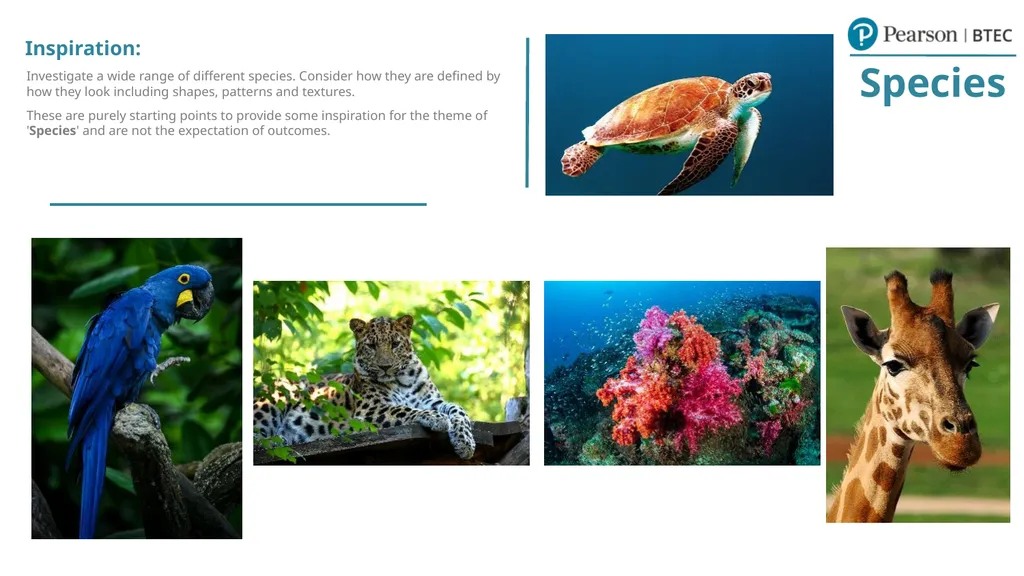
Investigate a wide range of different species. Consider how they are defined by how they look including shapes, patterns and textures.
These are purely starting points to provide some inspiration for the theme of 'Species' and are not the expectation of outcomes. Species<br>
Investigate a wide range of different species. Consider how they are defined by how they look including shapes, patterns and textures.
These are purely starting points to provide some inspiration for the theme of 'Species' and are not the expectation of outcomes. Species<br>
06
Guidance overview
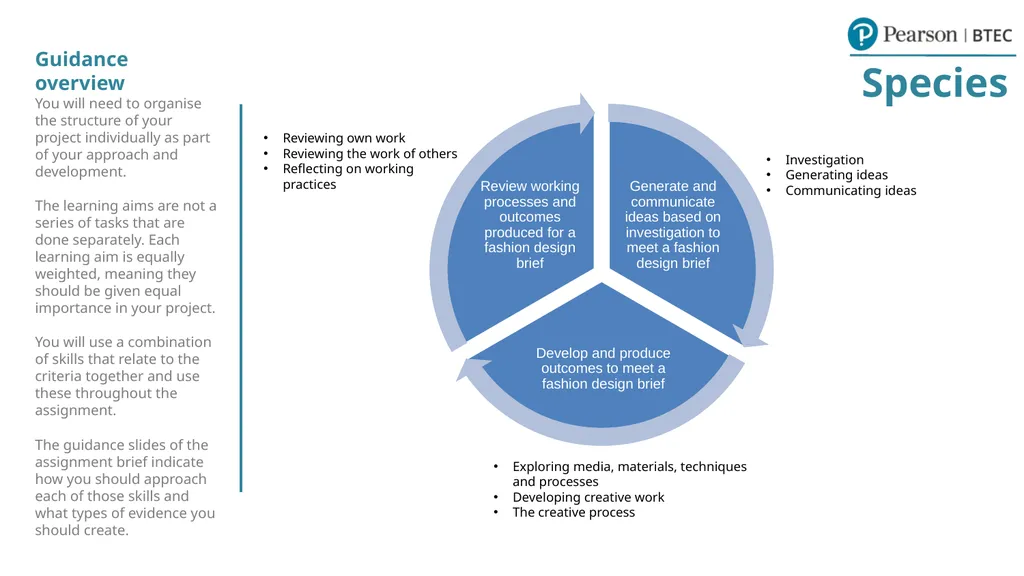
You will need to organise the structure of your project individually as part of your approach and development.
The learning aims are not a series of tasks that are done separately. Each learning aim is equally weighted, meaning they should be given equal importance in your project.
You will use a combination of skills that relate to the criteria together and use these throughout the assignment.
The guidance slides of the assignment brief indicate how you should approach each of those skills and what types of evidence you should create. Investigation
Generating ideas
Communicating ideas Exploring media, materials, techniques and processes
Developing creative work
The creative process Reviewing own work
Reviewing the work of others
Reflecting on working practices Species<br>
You will need to organise the structure of your project individually as part of your approach and development.
The learning aims are not a series of tasks that are done separately. Each learning aim is equally weighted, meaning they should be given equal importance in your project.
You will use a combination of skills that relate to the criteria together and use these throughout the assignment.
The guidance slides of the assignment brief indicate how you should approach each of those skills and what types of evidence you should create. Investigation
Generating ideas
Communicating ideas Exploring media, materials, techniques and processes
Developing creative work
The creative process Reviewing own work
Reviewing the work of others
Reflecting on working practices Species<br>
07
INVESTIGATION
Research and explore the work of other artists, designers and craftspeople who have explored and responded to similar themes.
It is important to explore the work of a diverse range of fashion designers to understand the media, materials, techniques and processes they use. You should also look at artists who work in other specialist areas such as textiles, fine art, graphic design, photography or craft. These artists could offer inspiration for new approaches to the theme.
Research should continue throughout the project to continually inform your ideas and development.
Things to consider when reflecting on your research into the work of other practitioners:
Why you have chosen to look at this particular work?
Why was the work made?
How does the work use formal elements, styles, traditions, narratives and concepts?
What media, materials, techniques and processes have been used to create the work?
How does the work relate to your own practice?
Evidence could include:
Research into the theme
Research into the work of other artists and designers
Target audience research
Inspirational sources research.
All research should be carefully reviewed and annotated. Species Guidance<br>
Research and explore the work of other artists, designers and craftspeople who have explored and responded to similar themes.
It is important to explore the work of a diverse range of fashion designers to understand the media, materials, techniques and processes they use. You should also look at artists who work in other specialist areas such as textiles, fine art, graphic design, photography or craft. These artists could offer inspiration for new approaches to the theme.
Research should continue throughout the project to continually inform your ideas and development.
Things to consider when reflecting on your research into the work of other practitioners:
Why you have chosen to look at this particular work?
Why was the work made?
How does the work use formal elements, styles, traditions, narratives and concepts?
What media, materials, techniques and processes have been used to create the work?
How does the work relate to your own practice?
Evidence could include:
Research into the theme
Research into the work of other artists and designers
Target audience research
Inspirational sources research.
All research should be carefully reviewed and annotated. Species Guidance<br>
08
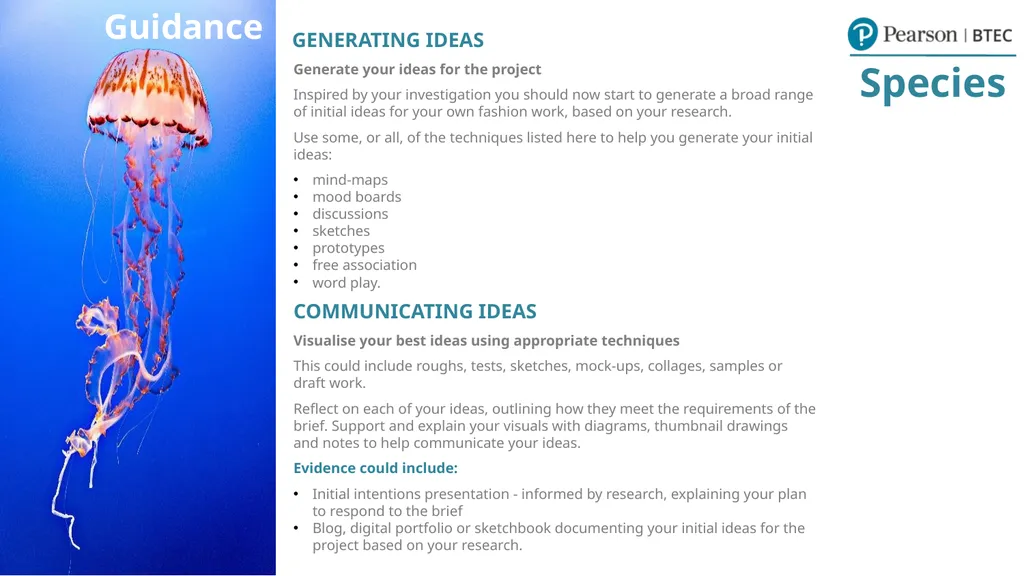
Guidance GENERATING IDEAS
Generate your ideas for the project
Inspired by your investigation you should now start to generate a broad range of initial ideas for your own fashion work, based on your research.
Use some, or all, of the techniques listed here to help you generate your initial ideas:
mind-maps
mood boards
discussions
sketches
prototypes
free association
word play.
COMMUNICATING IDEAS
Visualise your best ideas using appropriate techniques
This could include roughs, tests, sketches, mock-ups, collages, samples or draft work.
Reflect on each of your ideas, outlining how they meet the requirements of the brief. Support and explain your visuals with diagrams, thumbnail drawings and notes to help communicate your ideas.
Evidence could include:
Initial intentions presentation - informed by research, explaining your plan to respond to the brief
Blog, digital portfolio or sketchbook documenting your initial ideas for the project based on your research. Species<br>
Generate your ideas for the project
Inspired by your investigation you should now start to generate a broad range of initial ideas for your own fashion work, based on your research.
Use some, or all, of the techniques listed here to help you generate your initial ideas:
mind-maps
mood boards
discussions
sketches
prototypes
free association
word play.
COMMUNICATING IDEAS
Visualise your best ideas using appropriate techniques
This could include roughs, tests, sketches, mock-ups, collages, samples or draft work.
Reflect on each of your ideas, outlining how they meet the requirements of the brief. Support and explain your visuals with diagrams, thumbnail drawings and notes to help communicate your ideas.
Evidence could include:
Initial intentions presentation - informed by research, explaining your plan to respond to the brief
Blog, digital portfolio or sketchbook documenting your initial ideas for the project based on your research. Species<br>
09
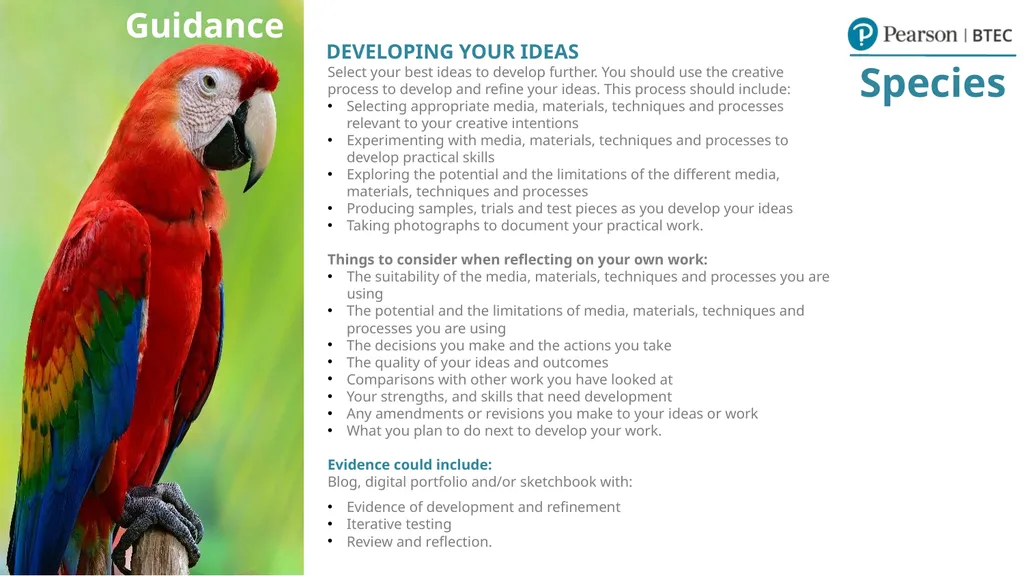
DEVELOPING YOUR IDEAS
Select your best ideas to develop further. You should use the creative process to develop and refine your ideas. This process should include:
Selecting appropriate media, materials, techniques and processes relevant to your creative intentions
Experimenting with media, materials, techniques and processes to develop practical skills
Exploring the potential and the limitations of the different media, materials, techniques and processes
Producing samples, trials and test pieces as you develop your ideas
Taking photographs to document your practical work.
Things to consider when reflecting on your own work:
The suitability of the media, materials, techniques and processes you are using
The potential and the limitations of media, materials, techniques and processes you are using
The decisions you make and the actions you take
The quality of your ideas and outcomes
Comparisons with other work you have looked at
Your strengths, and skills that need development
Any amendments or revisions you make to your ideas or work
What you plan to do next to develop your work.
Evidence could include:
Blog, digital portfolio and/or sketchbook with:
Evidence of development and refinement
Iterative testing
Review and reflection. Species Guidance<br>
Select your best ideas to develop further. You should use the creative process to develop and refine your ideas. This process should include:
Selecting appropriate media, materials, techniques and processes relevant to your creative intentions
Experimenting with media, materials, techniques and processes to develop practical skills
Exploring the potential and the limitations of the different media, materials, techniques and processes
Producing samples, trials and test pieces as you develop your ideas
Taking photographs to document your practical work.
Things to consider when reflecting on your own work:
The suitability of the media, materials, techniques and processes you are using
The potential and the limitations of media, materials, techniques and processes you are using
The decisions you make and the actions you take
The quality of your ideas and outcomes
Comparisons with other work you have looked at
Your strengths, and skills that need development
Any amendments or revisions you make to your ideas or work
What you plan to do next to develop your work.
Evidence could include:
Blog, digital portfolio and/or sketchbook with:
Evidence of development and refinement
Iterative testing
Review and reflection. Species Guidance<br>
10
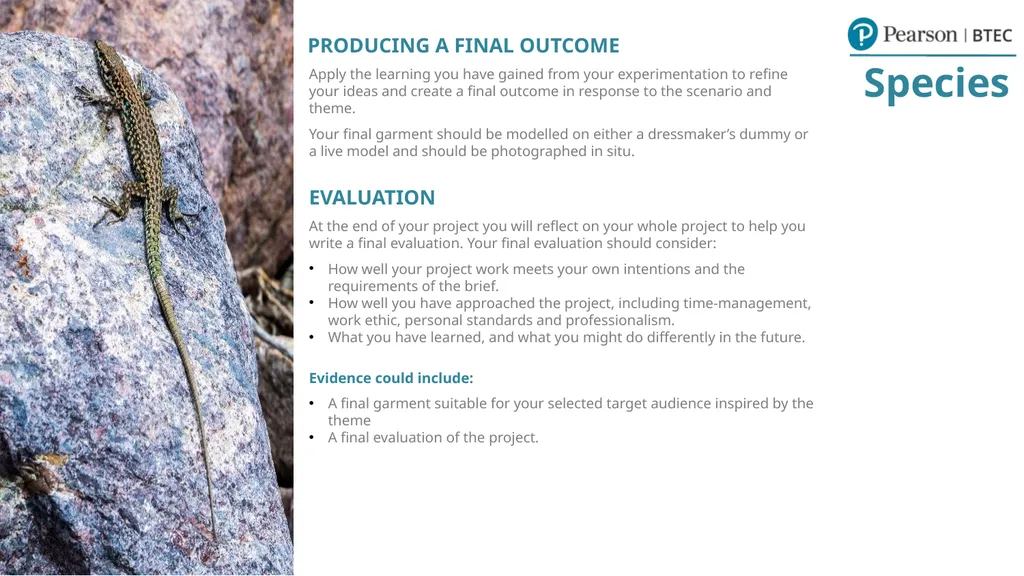
Guidance PRODUCING A FINAL OUTCOME
Apply the learning you have gained from your experimentation to refine your ideas and create a final outcome in response to the scenario and theme.
Your final garment should be modelled on either a dressmaker’s dummy or a live model and should be photographed in situ.
EVALUATION
At the end of your project you will reflect on your whole project to help you write a final evaluation. Your final evaluation should consider:
How well your project work meets your own intentions and the requirements of the brief.
How well you have approached the project, including time-management, work ethic, personal standards and professionalism.
What you have learned, and what you might do differently in the future.
Evidence could include:
A final garment suitable for your selected target audience inspired by the theme
A final evaluation of the project. Species<br>
Apply the learning you have gained from your experimentation to refine your ideas and create a final outcome in response to the scenario and theme.
Your final garment should be modelled on either a dressmaker’s dummy or a live model and should be photographed in situ.
EVALUATION
At the end of your project you will reflect on your whole project to help you write a final evaluation. Your final evaluation should consider:
How well your project work meets your own intentions and the requirements of the brief.
How well you have approached the project, including time-management, work ethic, personal standards and professionalism.
What you have learned, and what you might do differently in the future.
Evidence could include:
A final garment suitable for your selected target audience inspired by the theme
A final evaluation of the project. Species<br>
11
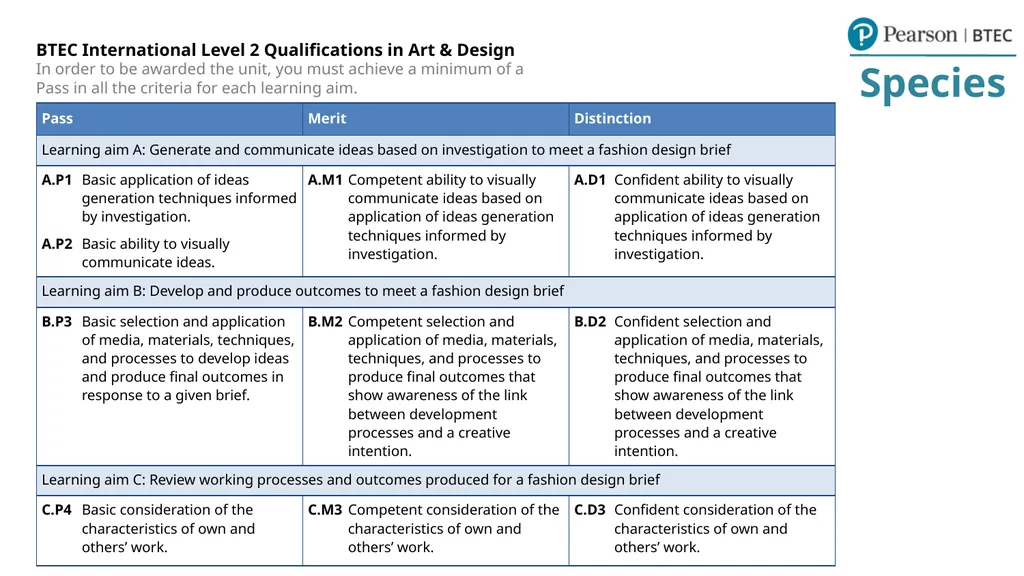
BTEC International Level 2 Qualifications in Art & Design
In order to be awarded the unit, you must achieve a minimum of a Pass in all the criteria for each learning aim. Species<br>
In order to be awarded the unit, you must achieve a minimum of a Pass in all the criteria for each learning aim. Species<br>
12
Acknowledgements Images:
123RF: baryla (slide 4), whitcomberd (slide 5, bottom centre right)
Alamy Stock Photo: Don Johnston_IH (slide 3), Kevidisi/Stockimo (slide 8)
Shutterstock: Chamathkt9 (slide 1), Rhiev (slide 5, top), Lim Sern Wang (slide 5, far bottom left), hecke61 (slide 5, bottom centre left), Alexius Sutandio (slide 5, far bottom right), SunyawitPhoto (slide 7), BOONCHUAY PROMJIAM (slide 9), AdamCh (slide 10).<br>
123RF: baryla (slide 4), whitcomberd (slide 5, bottom centre right)
Alamy Stock Photo: Don Johnston_IH (slide 3), Kevidisi/Stockimo (slide 8)
Shutterstock: Chamathkt9 (slide 1), Rhiev (slide 5, top), Lim Sern Wang (slide 5, far bottom left), hecke61 (slide 5, bottom centre left), Alexius Sutandio (slide 5, far bottom right), SunyawitPhoto (slide 7), BOONCHUAY PROMJIAM (slide 9), AdamCh (slide 10).<br>