
Experiences and Challenges in Financing Renewable
EM
Published · 34 slides · 0 views
1 / 1
Description
Experiences and Challenges in Financing Renewable Energy and Battery Energy Storage System (BESS) Projects in North Macedonia Market experience Financing barriers BESS bankability Recommendations September 2026 Viktor Delov Senior
Related Topics
Share
Embed code
Download this presentation From Below
"Experiences and Challenges in Financing Renewable" is the property of its rightful owner. Permission is granted to download and print the materials on this website for personal, non-commercial use only, and to display it on your personal computer provided you do not modify the materials and that you retain all copyright notices contained in the materials. By downloading content from our website, you accept the terms of this agreement.
Presentation Transcript
01
Experiences and Challenges in Financing Renewable Energy and Battery Energy Storage System (BESS) Projects in North Macedonia Market experience • Financing barriers • BESS bankability • Recommendations September 2026 Viktor Delov
Senior Regional Relationship Manager – Power Markets<br>
Senior Regional Relationship Manager – Power Markets<br>
02
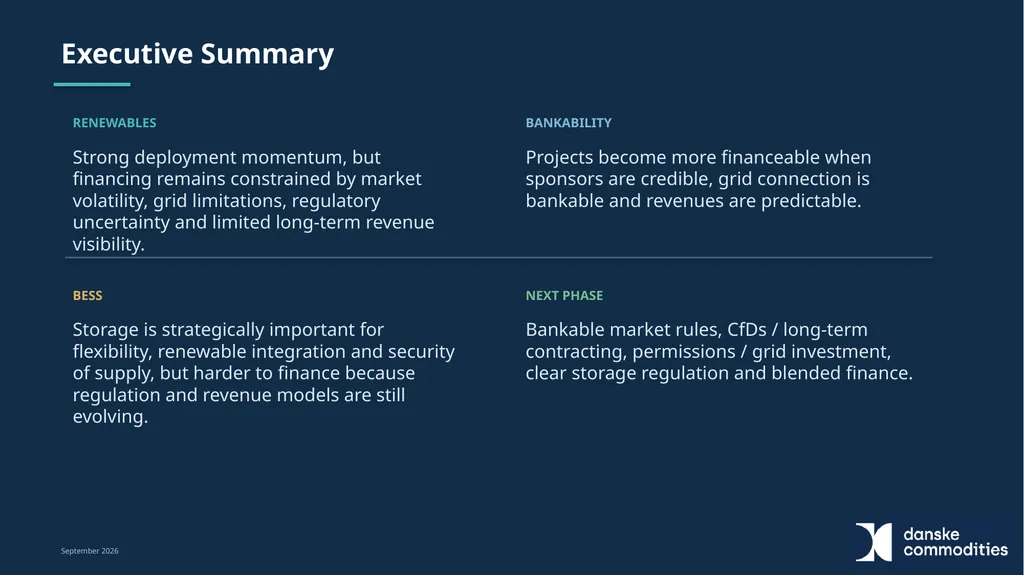
Executive Summary RENEWABLES Strong deployment momentum, but financing remains constrained by market volatility, grid limitations, regulatory uncertainty and limited long-term revenue visibility. BANKABILITY Projects become more financeable when sponsors are credible, grid connection is bankable and revenues are predictable. BESS Storage is strategically important for flexibility, renewable integration and security of supply, but harder to finance because regulation and revenue models are still evolving. NEXT PHASE Bankable market rules, CfDs / long-term contracting, permissions / grid investment, clear storage regulation and blended finance. September 2026<br>
03
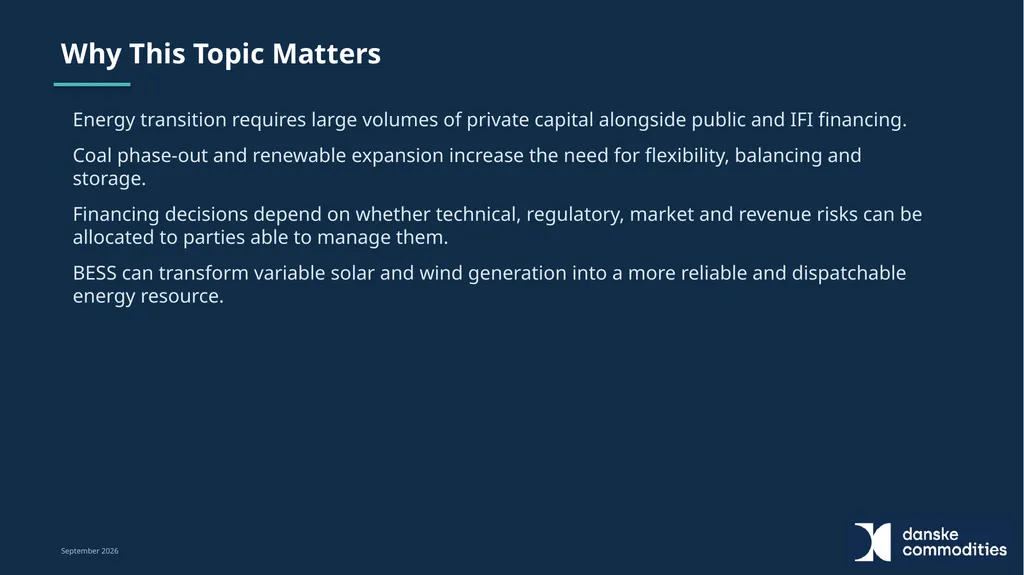
Why This Topic Matters Energy transition requires large volumes of private capital alongside public and IFI financing.
Coal phase-out and renewable expansion increase the need for flexibility, balancing and storage.
Financing decisions depend on whether technical, regulatory, market and revenue risks can be allocated to parties able to manage them.
BESS can transform variable solar and wind generation into a more reliable and dispatchable energy resource. September 2026<br>
Coal phase-out and renewable expansion increase the need for flexibility, balancing and storage.
Financing decisions depend on whether technical, regulatory, market and revenue risks can be allocated to parties able to manage them.
BESS can transform variable solar and wind generation into a more reliable and dispatchable energy resource. September 2026<br>
04
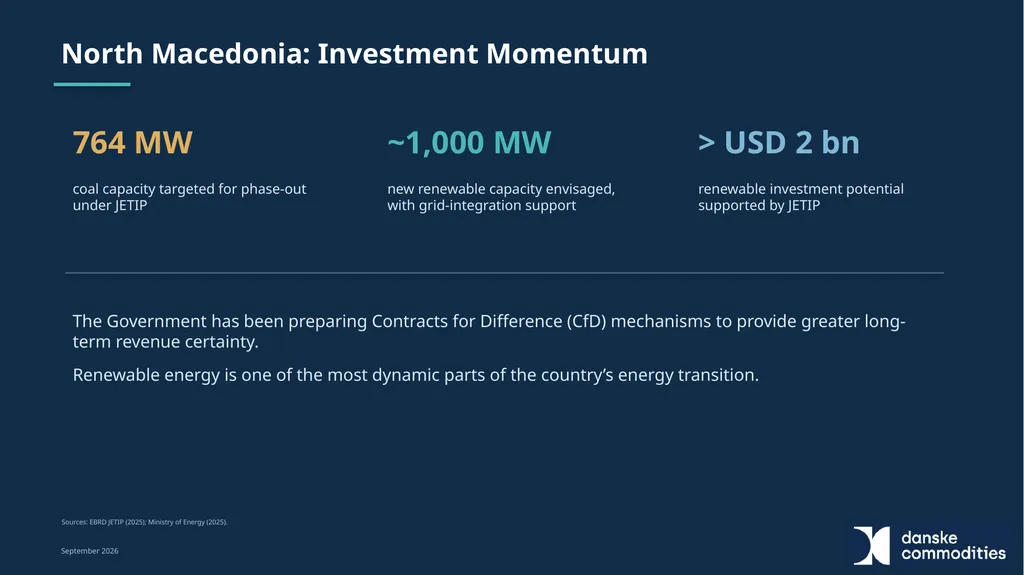
North Macedonia: Investment Momentum 764 MW coal capacity targeted for phase-out under JETIP ~1,000 MW new renewable capacity envisaged, with grid-integration support > USD 2 bn renewable investment potential supported by JETIP The Government has been preparing Contracts for Difference (CfD) mechanisms to provide greater long-term revenue certainty.
Renewable energy is one of the most dynamic parts of the country’s energy transition. September 2026 Sources: EBRD JETIP (2025); Ministry of Energy (2025).<br>
Renewable energy is one of the most dynamic parts of the country’s energy transition. September 2026 Sources: EBRD JETIP (2025); Ministry of Energy (2025).<br>
05
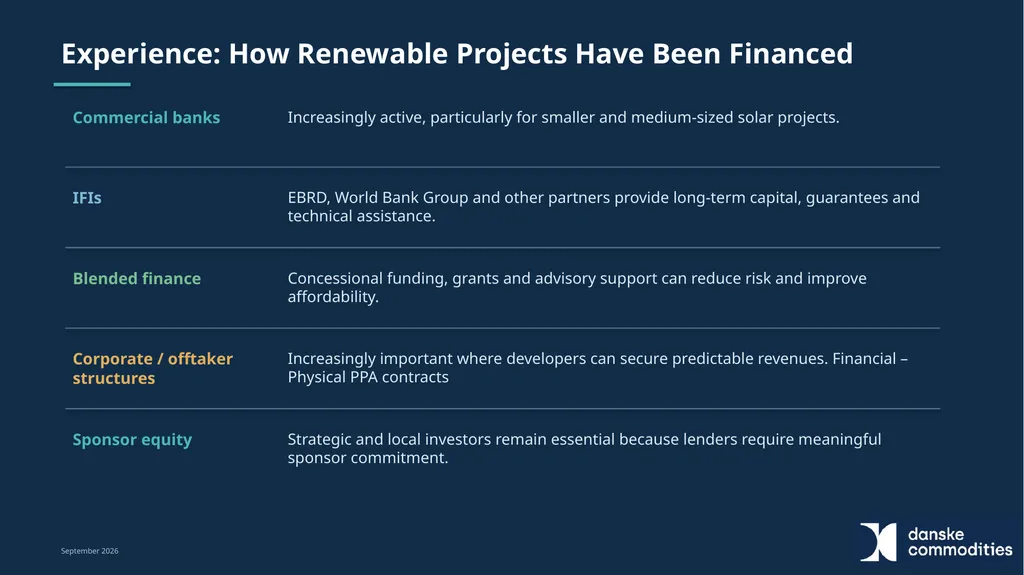
Experience: How Renewable Projects Have Been Financed Commercial banks Increasingly active, particularly for smaller and medium-sized solar projects. IFIs EBRD, World Bank Group and other partners provide long-term capital, guarantees and technical assistance. Blended finance Concessional funding, grants and advisory support can reduce risk and improve affordability. Corporate / offtaker structures Increasingly important where developers can secure predictable revenues. Financial –Physical PPA contracts Sponsor equity Strategic and local investors remain essential because lenders require meaningful sponsor commitment. September 2026<br>
06
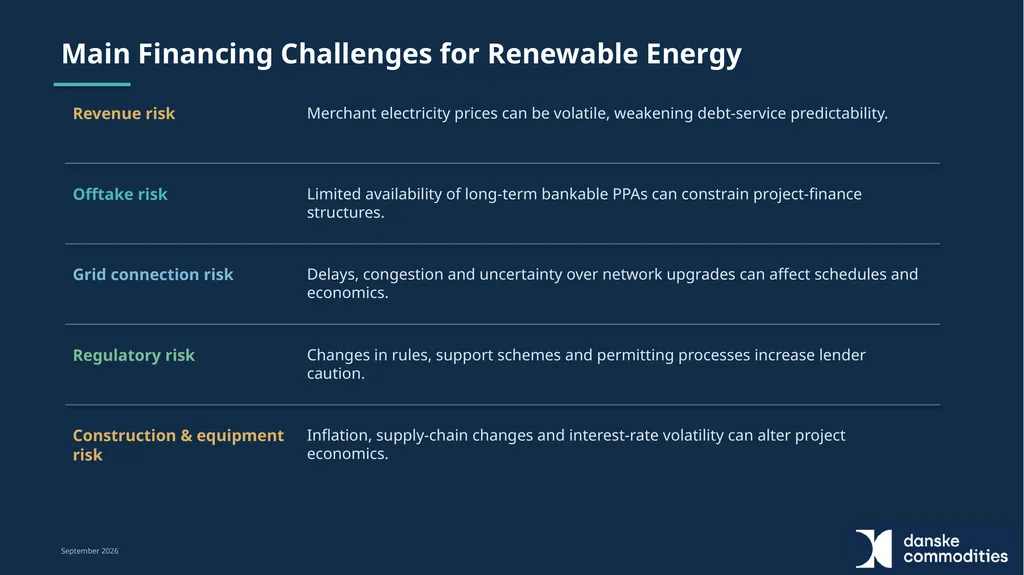
Main Financing Challenges for Renewable Energy Revenue risk Merchant electricity prices can be volatile, weakening debt-service predictability. Offtake risk Limited availability of long-term bankable PPAs can constrain project-finance structures. Grid connection risk Delays, congestion and uncertainty over network upgrades can affect schedules and economics. Regulatory risk Changes in rules, support schemes and permitting processes increase lender caution. Construction & equipment risk Inflation, supply-chain changes and interest-rate volatility can alter project economics. September 2026<br>
07
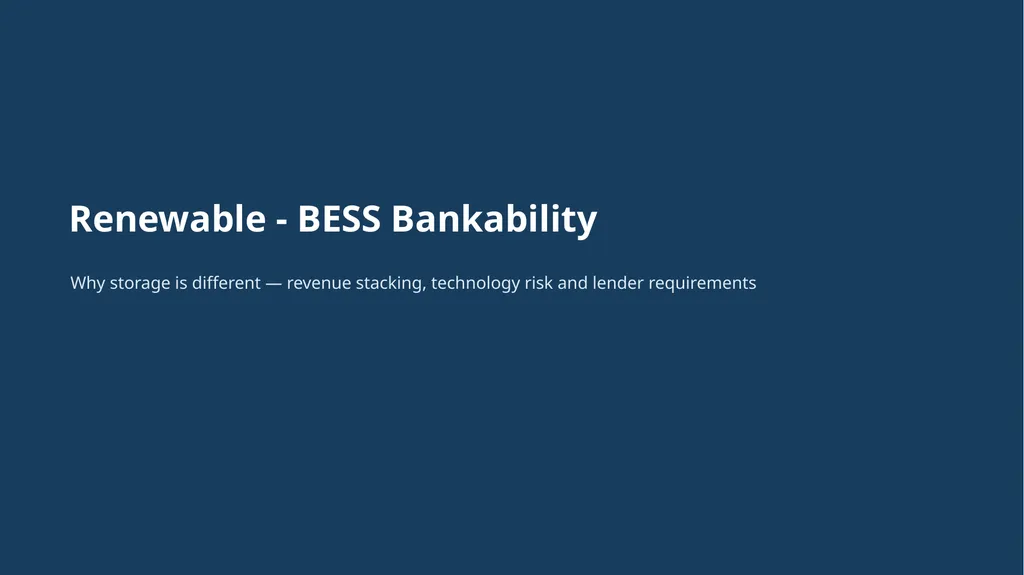
Renewable - BESS Bankability Why storage is different — revenue stacking, technology risk and lender requirements<br>
08
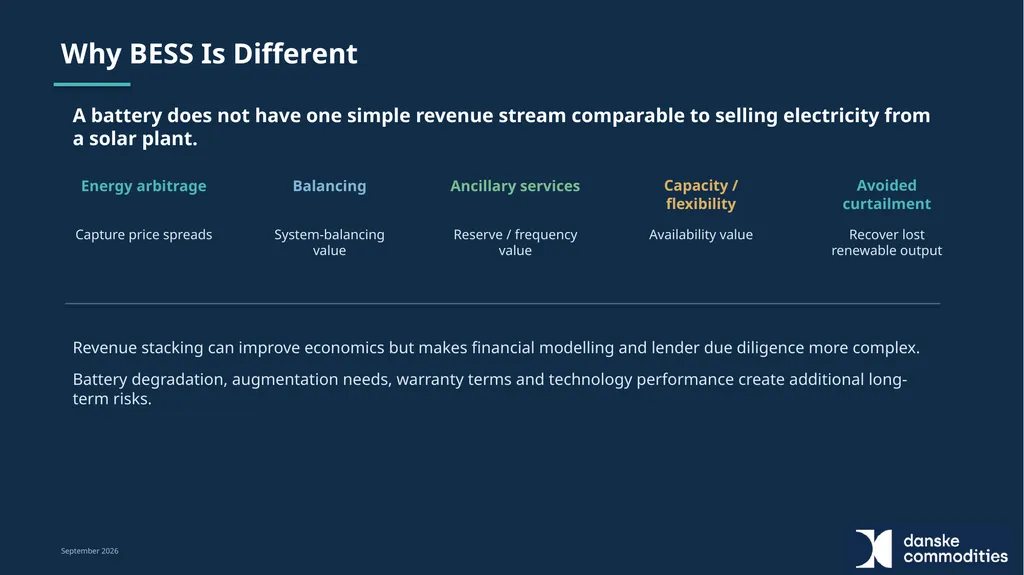
Why BESS Is Different A battery does not have one simple revenue stream comparable to selling electricity from a solar plant. Energy arbitrage Capture price spreads Balancing System-balancing value Ancillary services Reserve / frequency value Capacity / flexibility Availability value Avoided curtailment Recover lost renewable output Revenue stacking can improve economics but makes financial modelling and lender due diligence more complex.
Battery degradation, augmentation needs, warranty terms and technology performance create additional long-term risks. September 2026<br>
Battery degradation, augmentation needs, warranty terms and technology performance create additional long-term risks. September 2026<br>
09
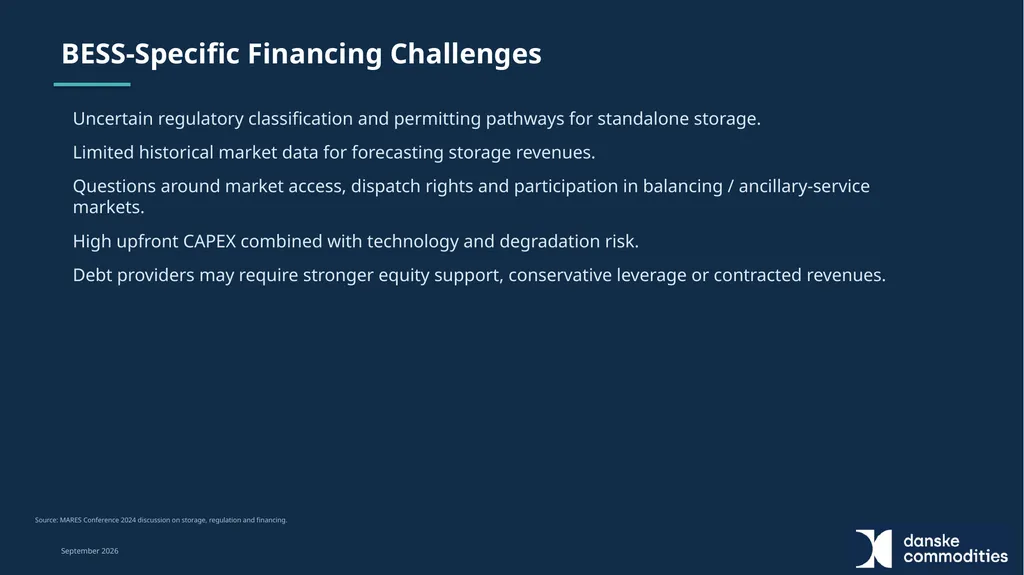
BESS-Specific Financing Challenges Uncertain regulatory classification and permitting pathways for standalone storage.
Limited historical market data for forecasting storage revenues.
Questions around market access, dispatch rights and participation in balancing / ancillary-service markets.
High upfront CAPEX combined with technology and degradation risk.
Debt providers may require stronger equity support, conservative leverage or contracted revenues. September 2026 Source: MARES Conference 2024 discussion on storage, regulation and financing.<br>
Limited historical market data for forecasting storage revenues.
Questions around market access, dispatch rights and participation in balancing / ancillary-service markets.
High upfront CAPEX combined with technology and degradation risk.
Debt providers may require stronger equity support, conservative leverage or contracted revenues. September 2026 Source: MARES Conference 2024 discussion on storage, regulation and financing.<br>
10
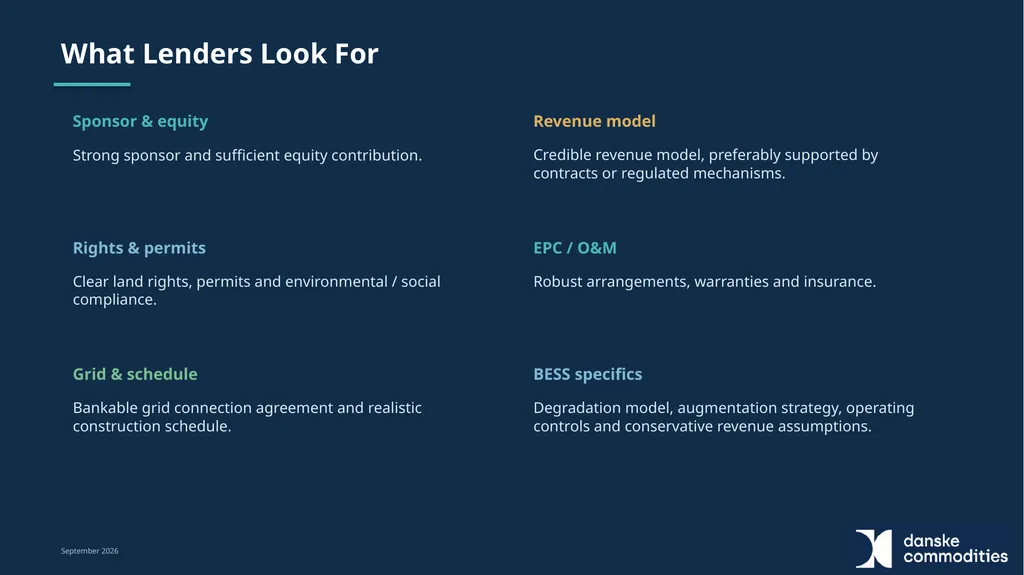
What Lenders Look For Sponsor & equity Strong sponsor and sufficient equity contribution. Rights & permits Clear land rights, permits and environmental / social compliance. Grid & schedule Bankable grid connection agreement and realistic construction schedule. Revenue model Credible revenue model, preferably supported by contracts or regulated mechanisms. EPC / O&M Robust arrangements, warranties and insurance. BESS specifics Degradation model, augmentation strategy, operating controls and conservative revenue assumptions. September 2026<br>
11
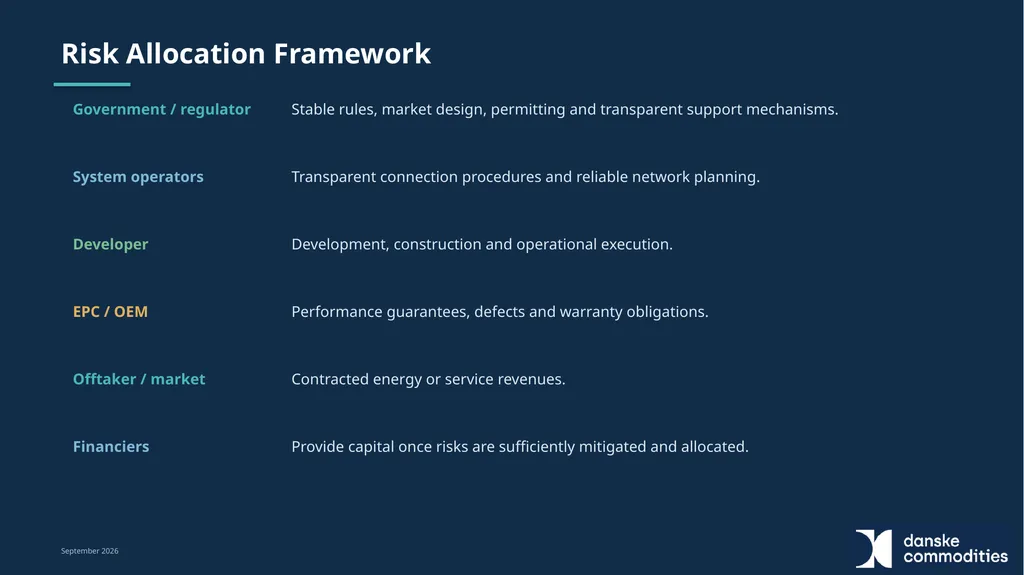
Risk Allocation Framework Government / regulator Stable rules, market design, permitting and transparent support mechanisms. System operators Transparent connection procedures and reliable network planning. Developer Development, construction and operational execution. EPC / OEM Performance guarantees, defects and warranty obligations. Offtaker / market Contracted energy or service revenues. Financiers Provide capital once risks are sufficiently mitigated and allocated. September 2026<br>
12
The Role of CfDs and Long-Term Revenue Contracts Merchant-price exposure is one of the largest barriers to high leverage.
CfDs can provide more predictable revenues and reduce financing costs when well designed.
Long-term corporate PPAs can also support bankability, although credit quality and contract terms matter.
For BESS, similar mechanisms may be needed for capacity or availability where merchant revenues alone are insufficient. September 2026 Sources: Ministry of Energy CfD announcements (2025); EBRD strategy.<br>
CfDs can provide more predictable revenues and reduce financing costs when well designed.
Long-term corporate PPAs can also support bankability, although credit quality and contract terms matter.
For BESS, similar mechanisms may be needed for capacity or availability where merchant revenues alone are insufficient. September 2026 Sources: Ministry of Energy CfD announcements (2025); EBRD strategy.<br>
13
Danske Commodities: Market Experience Optimisation, risk off-take, bankability and commercial structures<br>
14
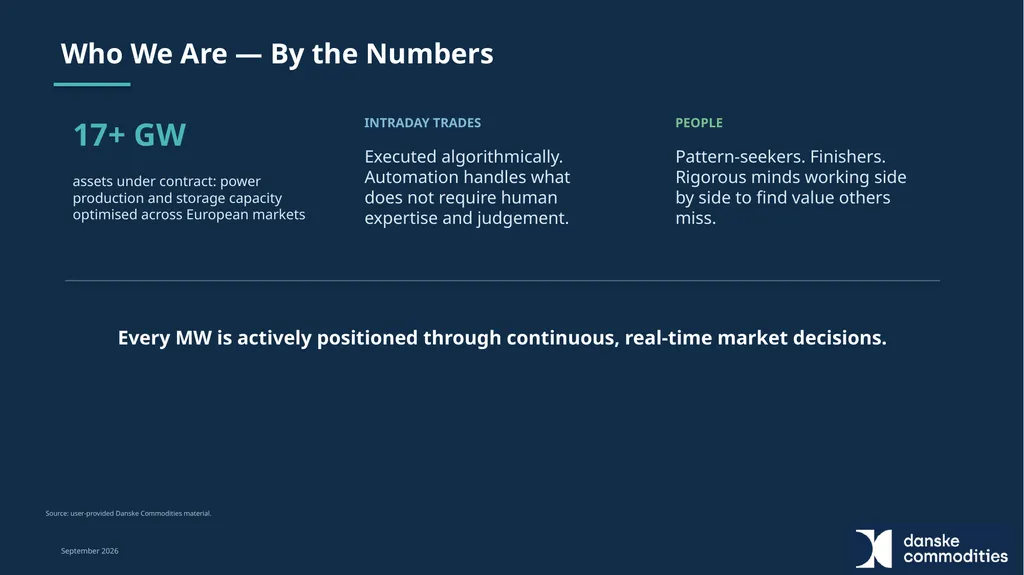
Who We Are — By the Numbers 17+ GW assets under contract: power production and storage capacity optimised across European markets INTRADAY TRADES Executed algorithmically. Automation handles what does not require human expertise and judgement. PEOPLE Pattern-seekers. Finishers. Rigorous minds working side by side to find value others miss. Every MW is actively positioned through continuous, real-time market decisions. September 2026 Source: user-provided Danske Commodities material.<br>
15
Asset Owners — Your Assets. Fully Optimised. Danske Commodities takes on trading and optimization, so asset owners do not have to build the capability or manage the risk in-house.
Traders, quants and engineers work across day-ahead, intraday and ancillary-services markets, finding value in gaps, shifts and moments others may miss.
Owners stay focused on ownership and strategy; the optimizer focuses on ensuring the asset earns what it should. WHAT WE OFFER — MORE FROM EVERY MEGAWATT Not just market access: every position is optimised for maximum value. Profit-share-based optimisation aligns incentives. Dispatch, balancing responsibility and market exposure can be managed on the owner’s behalf. September 2026 Source: user-provided Danske Commodities material.<br>
Traders, quants and engineers work across day-ahead, intraday and ancillary-services markets, finding value in gaps, shifts and moments others may miss.
Owners stay focused on ownership and strategy; the optimizer focuses on ensuring the asset earns what it should. WHAT WE OFFER — MORE FROM EVERY MEGAWATT Not just market access: every position is optimised for maximum value. Profit-share-based optimisation aligns incentives. Dispatch, balancing responsibility and market exposure can be managed on the owner’s behalf. September 2026 Source: user-provided Danske Commodities material.<br>
16
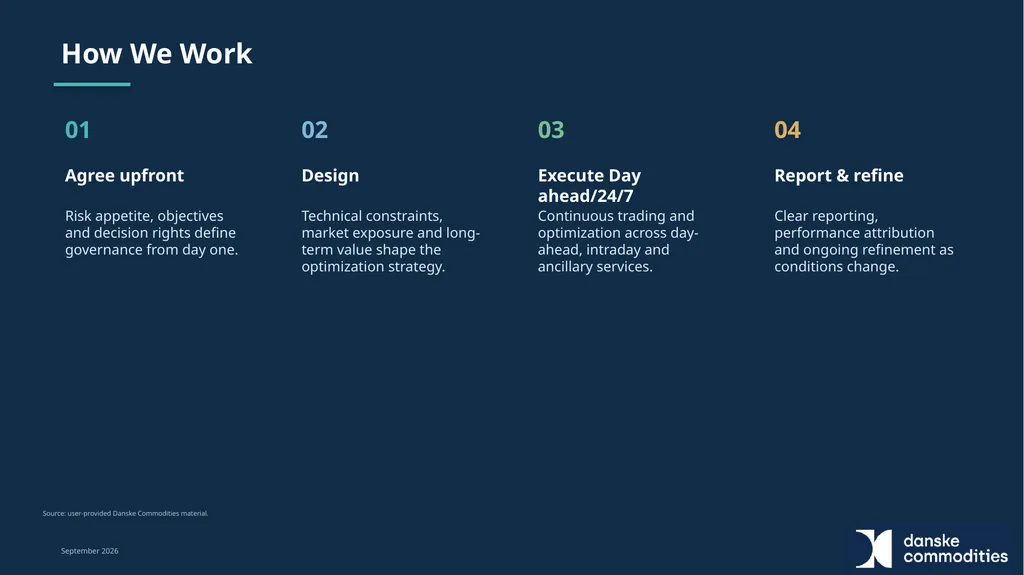
How We Work 01 Agree upfront Risk appetite, objectives and decision rights define governance from day one. 02 Design Technical constraints, market exposure and long-term value shape the optimization strategy. 03 Execute Day ahead/24/7 Continuous trading and optimization across day-ahead, intraday and ancillary services. 04 Report & refine Clear reporting, performance attribution and ongoing refinement as conditions change. September 2026 Source: user-provided Danske Commodities material.<br>
17
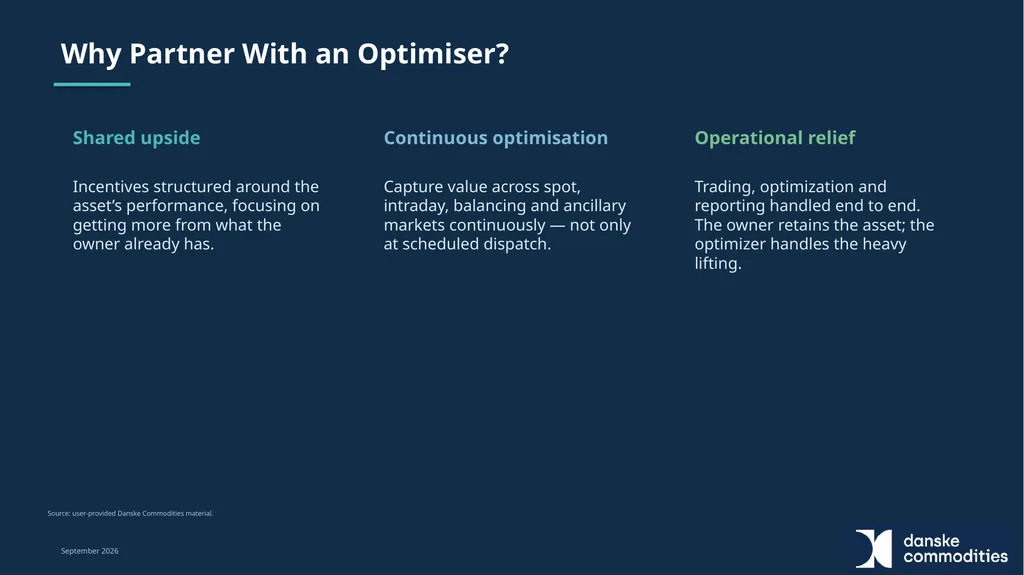
Why Partner With an Optimiser? Shared upside Incentives structured around the asset’s performance, focusing on getting more from what the owner already has. Continuous optimisation Capture value across spot, intraday, balancing and ancillary markets continuously — not only at scheduled dispatch. Operational relief Trading, optimization and reporting handled end to end. The owner retains the asset; the optimizer handles the heavy lifting. September 2026 Source: user-provided Danske Commodities material.<br>
18
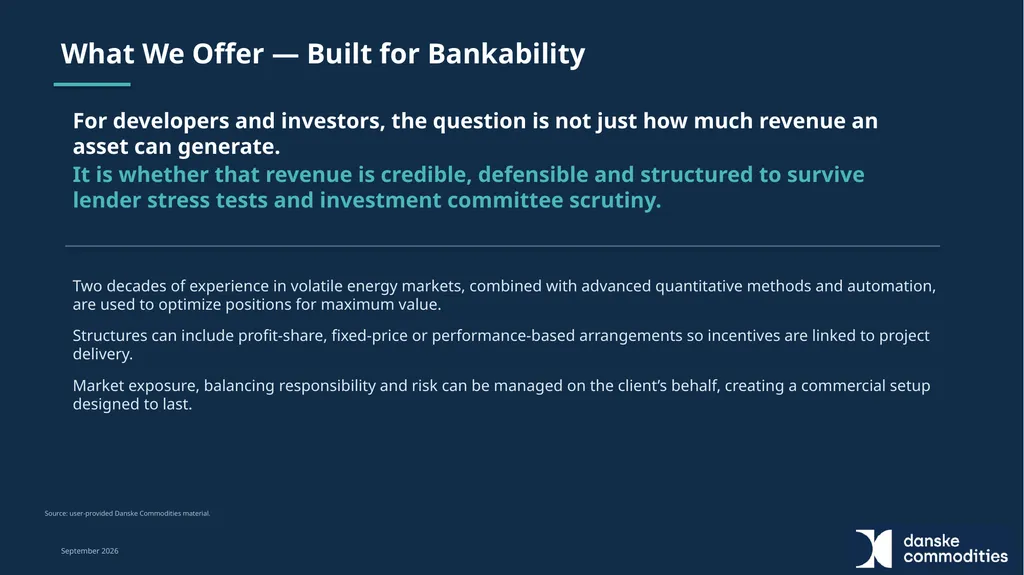
What We Offer — Built for Bankability For developers and investors, the question is not just how much revenue an asset can generate. It is whether that revenue is credible, defensible and structured to survive lender stress tests and investment committee scrutiny. Two decades of experience in volatile energy markets, combined with advanced quantitative methods and automation, are used to optimize positions for maximum value.
Structures can include profit-share, fixed-price or performance-based arrangements so incentives are linked to project delivery.
Market exposure, balancing responsibility and risk can be managed on the client’s behalf, creating a commercial setup designed to last. September 2026 Source: user-provided Danske Commodities material.<br>
Structures can include profit-share, fixed-price or performance-based arrangements so incentives are linked to project delivery.
Market exposure, balancing responsibility and risk can be managed on the client’s behalf, creating a commercial setup designed to last. September 2026 Source: user-provided Danske Commodities material.<br>
19
Backed by Equinor — Strength You Can Rely On Equinor backing provides financial strength, long-term commitment and genuine skin in the game.
That backing allows Danske Commodities to take on market risk, commit across cycles and stand behind optimization strategies even in volatile conditions.
For BESS, renewables and hybrid projects, this can mean stronger counterparty credibility, greater resilience and confidence that revenues are protected and optimized over time — throughout the asset lifecycle.
Equinor is a major international energy provider balancing global oil and gas production with strategic long-term investments including offshore wind and carbon capture technology. September 2026 Source: user-provided Danske Commodities material.<br>
That backing allows Danske Commodities to take on market risk, commit across cycles and stand behind optimization strategies even in volatile conditions.
For BESS, renewables and hybrid projects, this can mean stronger counterparty credibility, greater resilience and confidence that revenues are protected and optimized over time — throughout the asset lifecycle.
Equinor is a major international energy provider balancing global oil and gas production with strategic long-term investments including offshore wind and carbon capture technology. September 2026 Source: user-provided Danske Commodities material.<br>
20
What is the market asking for?<br>
21
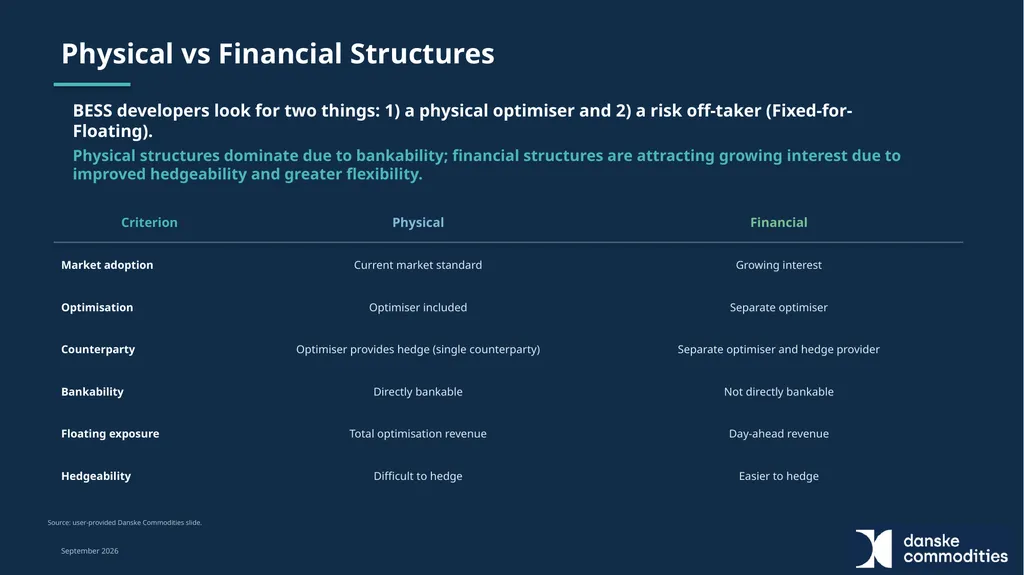
Physical vs Financial Structures BESS developers look for two things: 1) a physical optimiser and 2) a risk off-taker (Fixed-for-Floating). Physical structures dominate due to bankability; financial structures are attracting growing interest due to improved hedgeability and greater flexibility. Criterion Physical Financial Market adoption Current market standard Growing interest Optimisation Optimiser included Separate optimiser Counterparty Optimiser provides hedge (single counterparty) Separate optimiser and hedge provider Bankability Directly bankable Not directly bankable Floating exposure Total optimisation revenue Day-ahead revenue Hedgeability Difficult to hedge Easier to hedge September 2026 Source: user-provided Danske Commodities slide.<br>
22
COMMERCIAL STRUCTURES Current Models & Their Limitations Why existing BESS offtake structures can fall short for customers, lenders and risk managers.<br>
23
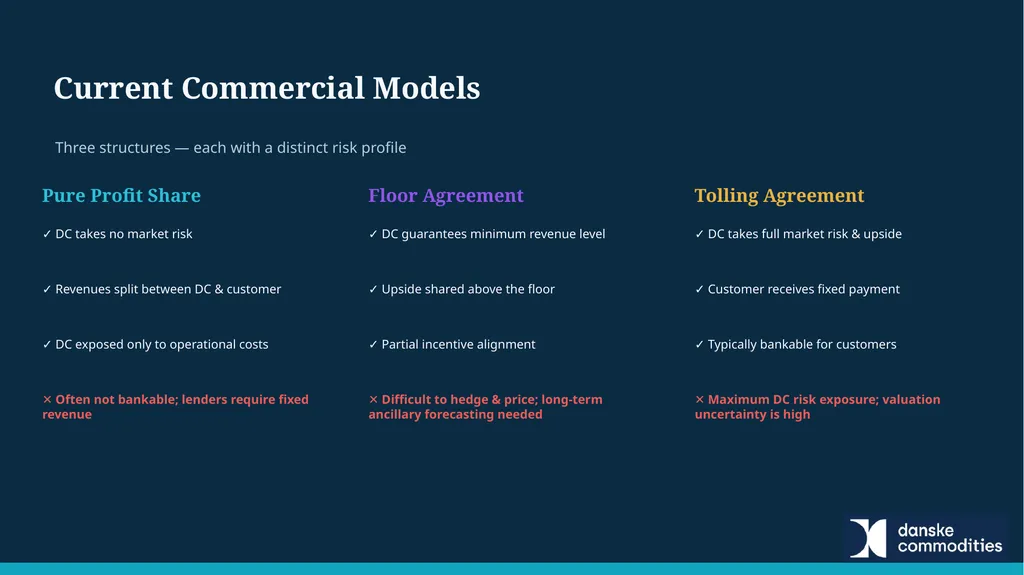
Current Commercial Models Three structures — each with a distinct risk profile Pure Profit Share ✓ DC takes no market risk ✓ Revenues split between DC & customer ✓ DC exposed only to operational costs ✕ Often not bankable; lenders require fixed revenue Floor Agreement ✓ DC guarantees minimum revenue level ✓ Upside shared above the floor ✓ Partial incentive alignment ✕ Difficult to hedge & price; long-term ancillary forecasting needed Tolling Agreement ✓ DC takes full market risk & upside ✓ Customer receives fixed payment ✓ Typically bankable for customers ✕ Maximum DC risk exposure; valuation uncertainty is high<br>
24
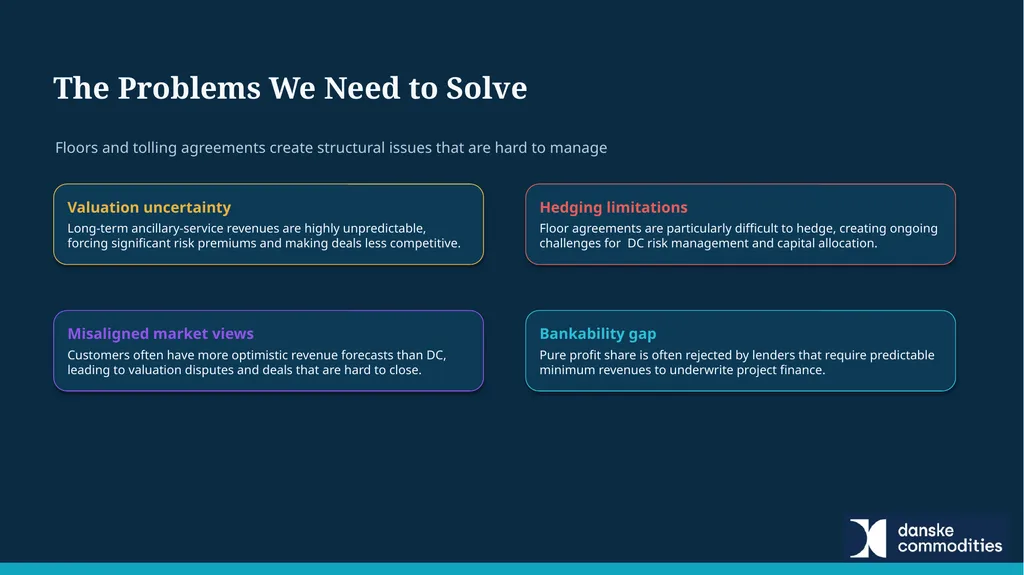
The Problems We Need to Solve Floors and tolling agreements create structural issues that are hard to manage Valuation uncertainty Long-term ancillary-service revenues are highly unpredictable, forcing significant risk premiums and making deals less competitive. Hedging limitations Floor agreements are particularly difficult to hedge, creating ongoing challenges for DC risk management and capital allocation. Misaligned market views Customers often have more optimistic revenue forecasts than DC, leading to valuation disputes and deals that are hard to close. Bankability gap Pure profit share is often rejected by lenders that require predictable minimum revenues to underwrite project finance.<br>
25
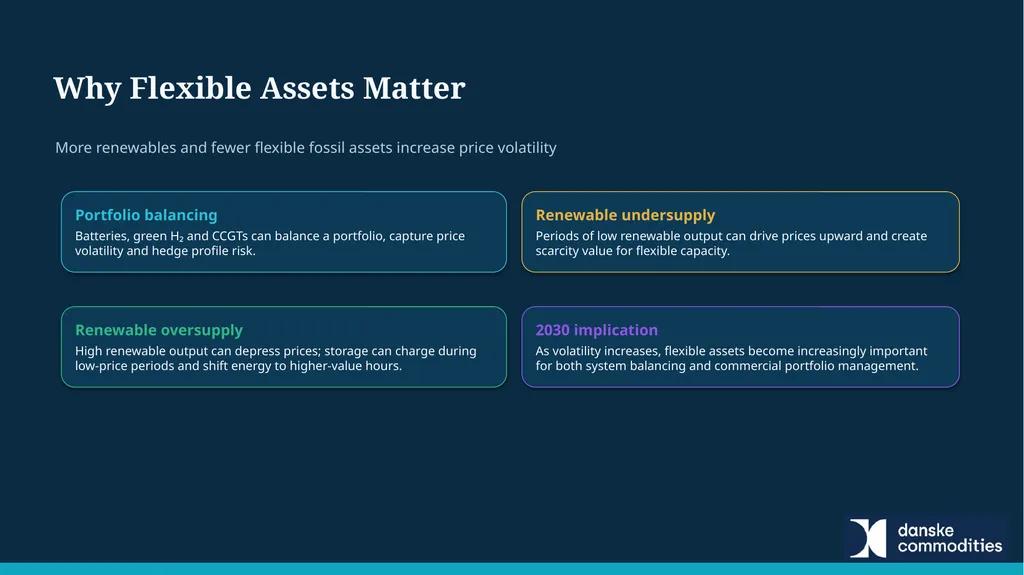
Why Flexible Assets Matter More renewables and fewer flexible fossil assets increase price volatility Portfolio balancing Batteries, green H₂ and CCGTs can balance a portfolio, capture price volatility and hedge profile risk. Renewable undersupply Periods of low renewable output can drive prices upward and create scarcity value for flexible capacity. Renewable oversupply High renewable output can depress prices; storage can charge during low-price periods and shift energy to higher-value hours. 2030 implication As volatility increases, flexible assets become increasingly important for both system balancing and commercial portfolio management.<br>
26
NEW PRODUCT Day-Ahead Swap with Benchmarked Profit Share A two-layer structure designed to separate market risk cleanly while preserving bankability and upside participation.<br>
27
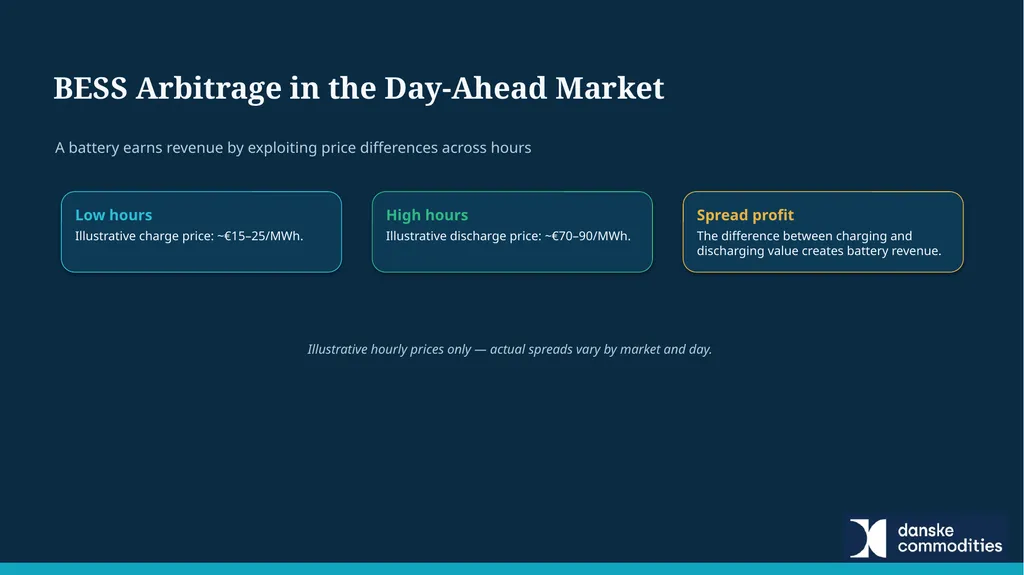
BESS Arbitrage in the Day-Ahead Market A battery earns revenue by exploiting price differences across hours Low hours Illustrative charge price: ~€15–25/MWh. High hours Illustrative discharge price: ~€70–90/MWh. Spread profit The difference between charging and discharging value creates battery revenue. Illustrative hourly prices only — actual spreads vary by market and day.<br>
28
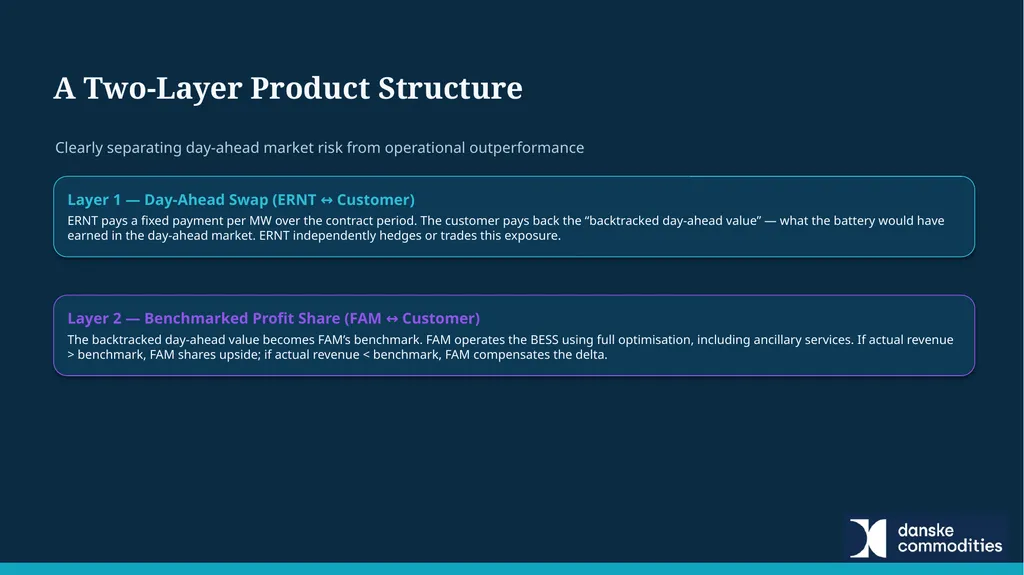
A Two-Layer Product Structure Clearly separating day-ahead market risk from operational outperformance Layer 1 — Day-Ahead Swap (ERNT ↔ Customer) ERNT pays a fixed payment per MW over the contract period. The customer pays back the “backtracked day-ahead value” — what the battery would have earned in the day-ahead market. ERNT independently hedges or trades this exposure. Layer 2 — Benchmarked Profit Share (FAM ↔ Customer) The backtracked day-ahead value becomes FAM’s benchmark. FAM operates the BESS using full optimisation, including ancillary services. If actual revenue > benchmark, FAM shares upside; if actual revenue < benchmark, FAM compensates the delta.<br>
29
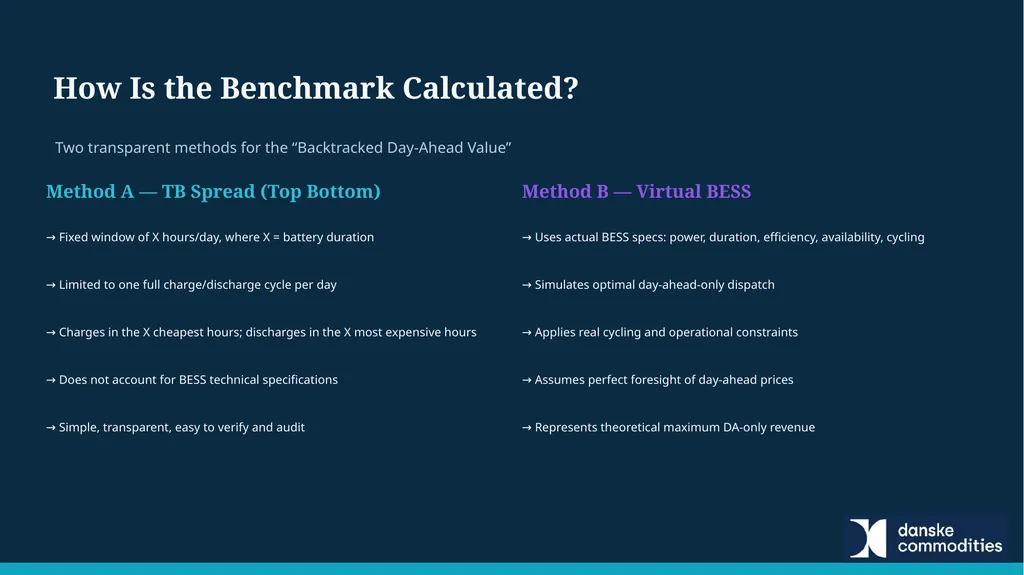
How Is the Benchmark Calculated? Two transparent methods for the “Backtracked Day-Ahead Value” Method A — TB Spread (Top Bottom) → Fixed window of X hours/day, where X = battery duration → Limited to one full charge/discharge cycle per day → Charges in the X cheapest hours; discharges in the X most expensive hours → Does not account for BESS technical specifications → Simple, transparent, easy to verify and audit Method B — Virtual BESS → Uses actual BESS specs: power, duration, efficiency, availability, cycling → Simulates optimal day-ahead-only dispatch → Applies real cycling and operational constraints → Assumes perfect foresight of day-ahead prices → Represents theoretical maximum DA-only revenue<br>
30
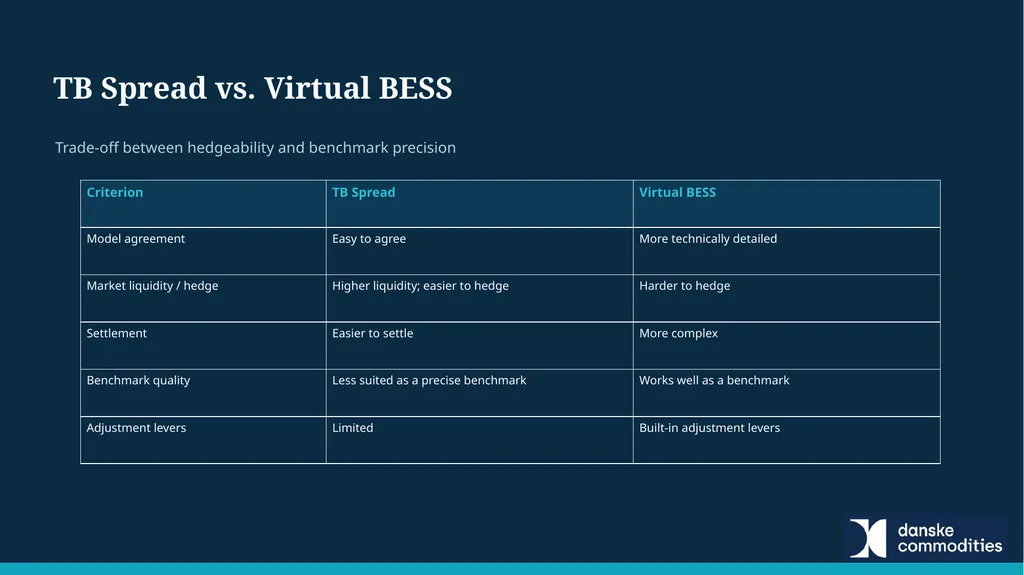
TB Spread vs. Virtual BESS Trade-off between hedgeability and benchmark precision<br>
31
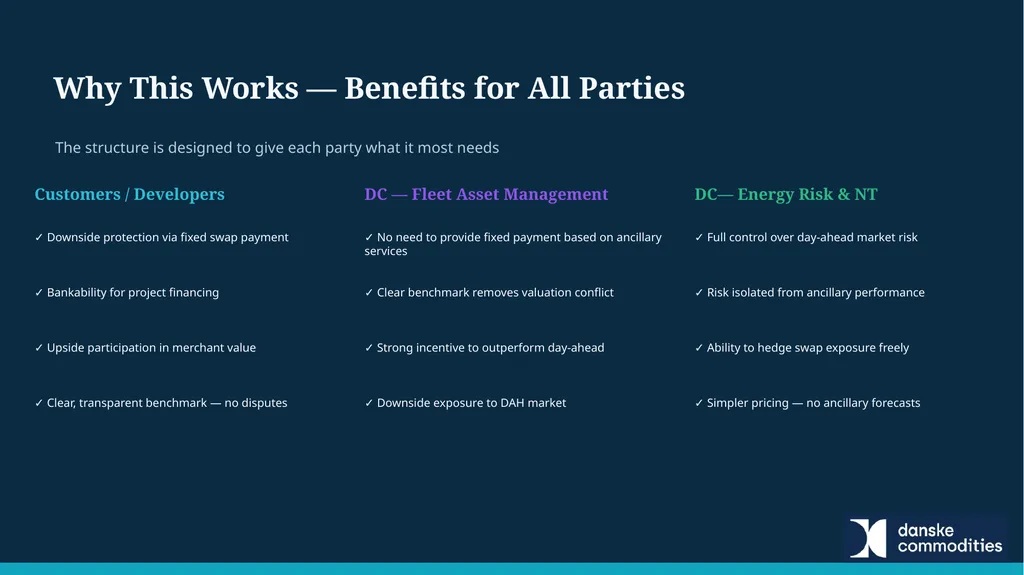
Why This Works — Benefits for All Parties The structure is designed to give each party what it most needs Customers / Developers ✓ Downside protection via fixed swap payment ✓ Bankability for project financing ✓ Upside participation in merchant value ✓ Clear, transparent benchmark — no disputes DC — Fleet Asset Management ✓ No need to provide fixed payment based on ancillary services ✓ Clear benchmark removes valuation conflict ✓ Strong incentive to outperform day-ahead ✓ Downside exposure to DAH market DC— Energy Risk & NT ✓ Full control over day-ahead market risk ✓ Risk isolated from ancillary performance ✓ Ability to hedge swap exposure freely ✓ Simpler pricing — no ancillary forecasts<br>
32
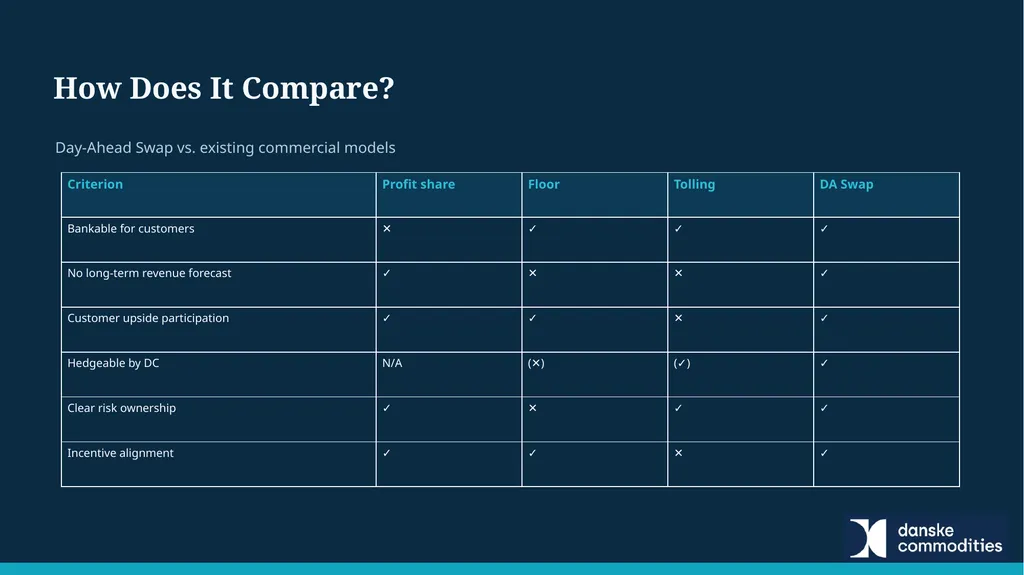
How Does It Compare? Day-Ahead Swap vs. existing commercial models<br>
33
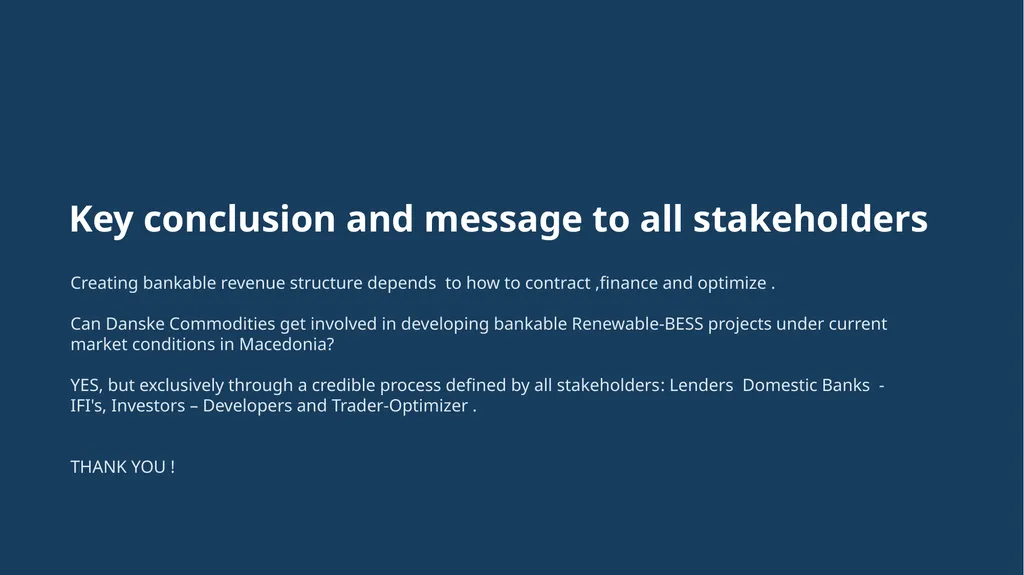
Key conclusion and message to all stakeholders Creating bankable revenue structure depends to how to contract ,finance and optimize .
Can Danske Commodities get involved in developing bankable Renewable-BESS projects under current market conditions in Macedonia?
YES, but exclusively through a credible process defined by all stakeholders: Lenders Domestic Banks - IFI's, Investors – Developers and Trader-Optimizer .
THANK YOU !<br>
Can Danske Commodities get involved in developing bankable Renewable-BESS projects under current market conditions in Macedonia?
YES, but exclusively through a credible process defined by all stakeholders: Lenders Domestic Banks - IFI's, Investors – Developers and Trader-Optimizer .
THANK YOU !<br>