Experiment to draw B- H curve Ballistic method Circuit Description A specimen of the given ferromagnetic material is taken in the form of a ring (Rowland ring). A primary coil P1 is wound closely over the specimen ring. This winding is
"Experiment to draw B- H curve Ballistic method" is the property of its rightful owner. Permission is granted to
download and print the materials on this website for personal, non-commercial use only, and to display it
on your personal computer provided you do not modify the materials and that you retain all copyright
notices contained in the materials. By downloading content from our website, you accept the terms of this
agreement.
Presentation Transcript
01
Experiment to draw B- H curve Ballistic method<br>
02
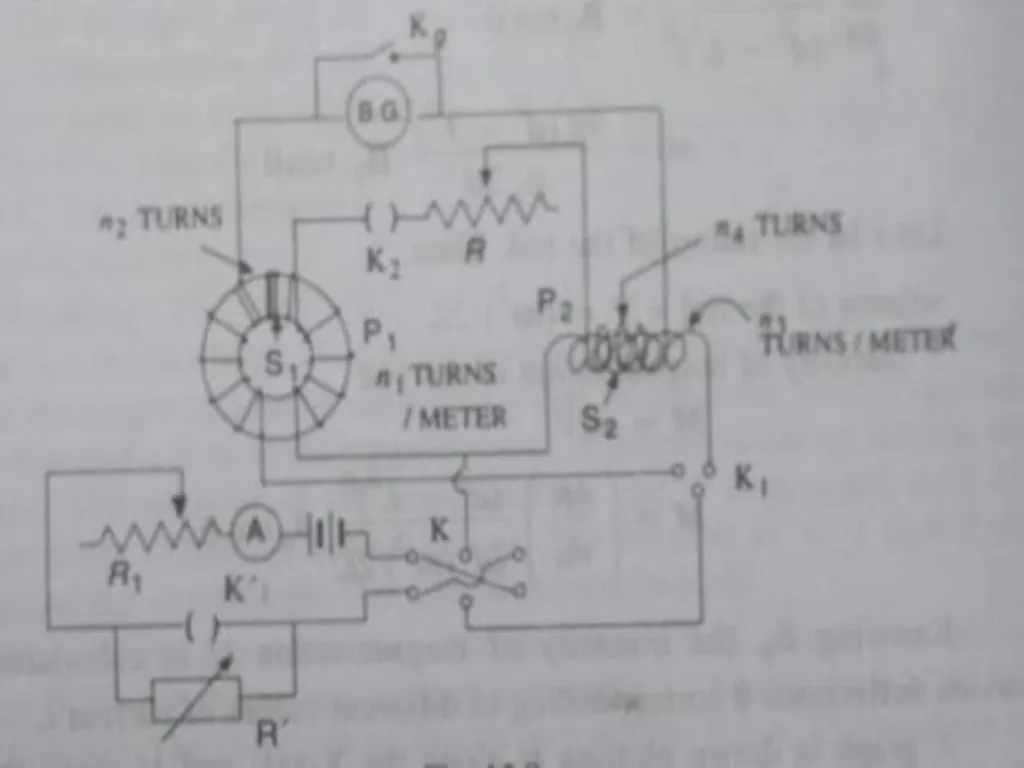
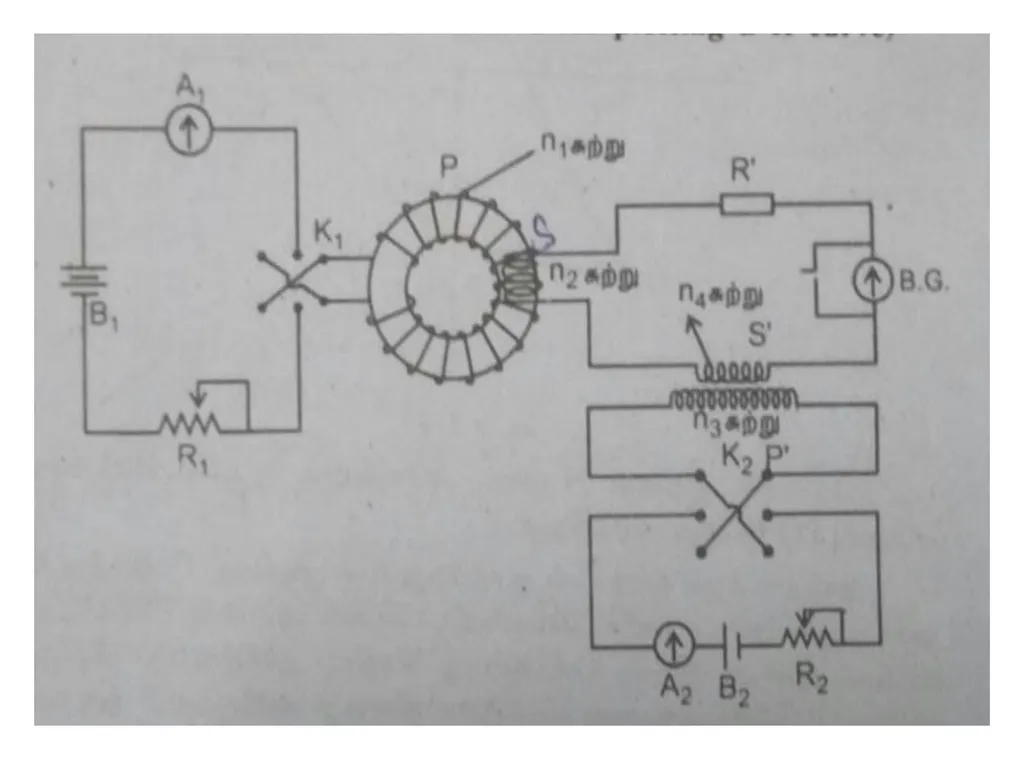
Circuit Description A specimen of the given ferromagnetic material is taken in the form of a ring (Rowland ring).
A primary coil P1 is wound closely over the specimen ring.
This winding is connected in series with a battery B, an ammeter A, a rheostat R1, and a resistance R’ through a reversing key K and a two-way key K1.
A tap key K‘ connected across R' facilitates either its inclusion or removal from the circuit.<br>
03
The secondary winding S1 over the specimen, consists of a few turns of closely wound wire.
This winding S1 is connected in series with a rheostat R, a ballistic galvanometer and the secondary winding S2 of a standard solenoid through a key K2.
Kg is the damping [ஒடுக்கம்] key across the ballistic galvanometer.
P2 is the primary winding of the standard solenoid.
The two way key K1 connects either P1 or P2 the battery circuit.<br>
04
Number of turns of the winding P1 = n1 turns per metre
Total number of turns of the winding S1 = n2 turns
Number of turns of the winding P2 = n3 turns per metre
Total number of turns of the winding S2 = n4 turns
Area of cross-section of the specimen = A Sq. meters
Area of cross-section of the standard solenoid = a sq. metres<br>
05
When the key K1, is closed to the left, a current i passes through the magnetising coil P1.
The ring is magnetised.
The intensity of the magnetizing field = H = n1i
The magnetisation of the specimen develops a magnetic flux density B inside the ring.
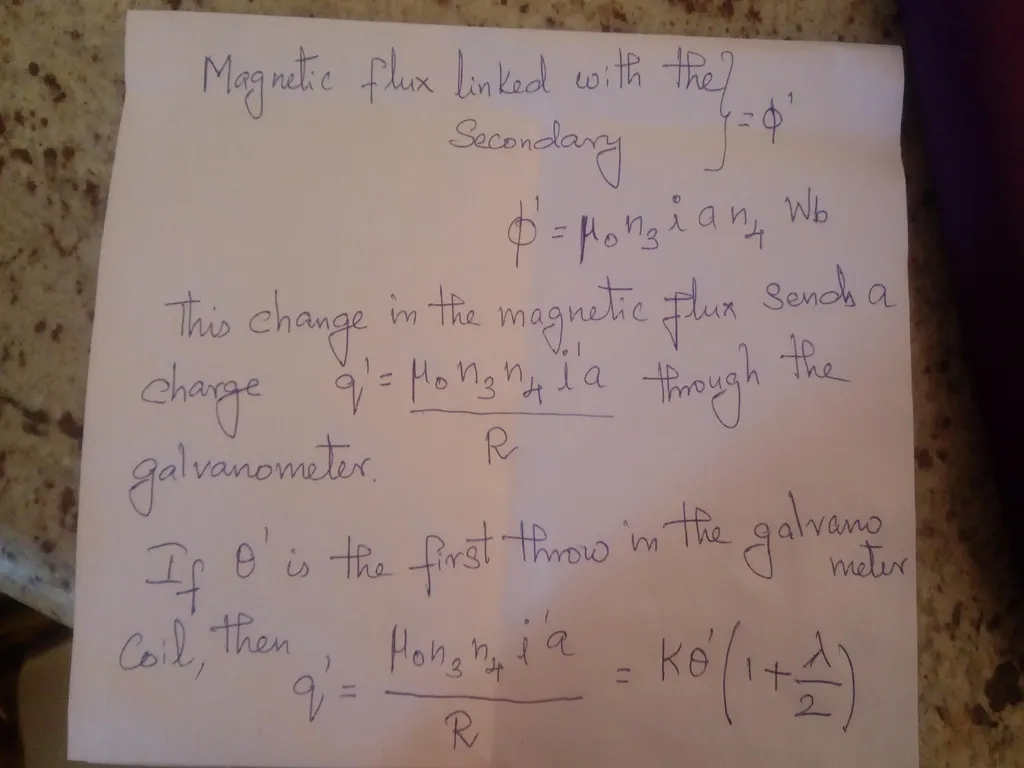
Then, the total flux linked with the secondary = φ = n2BA.
This is the change of flux in the secondary.
It sets up an induced emf in the secondary circuit.
If R is the total resistance of the secondary circuit, then the charge passing through the ballistic galvanometer<br>
06
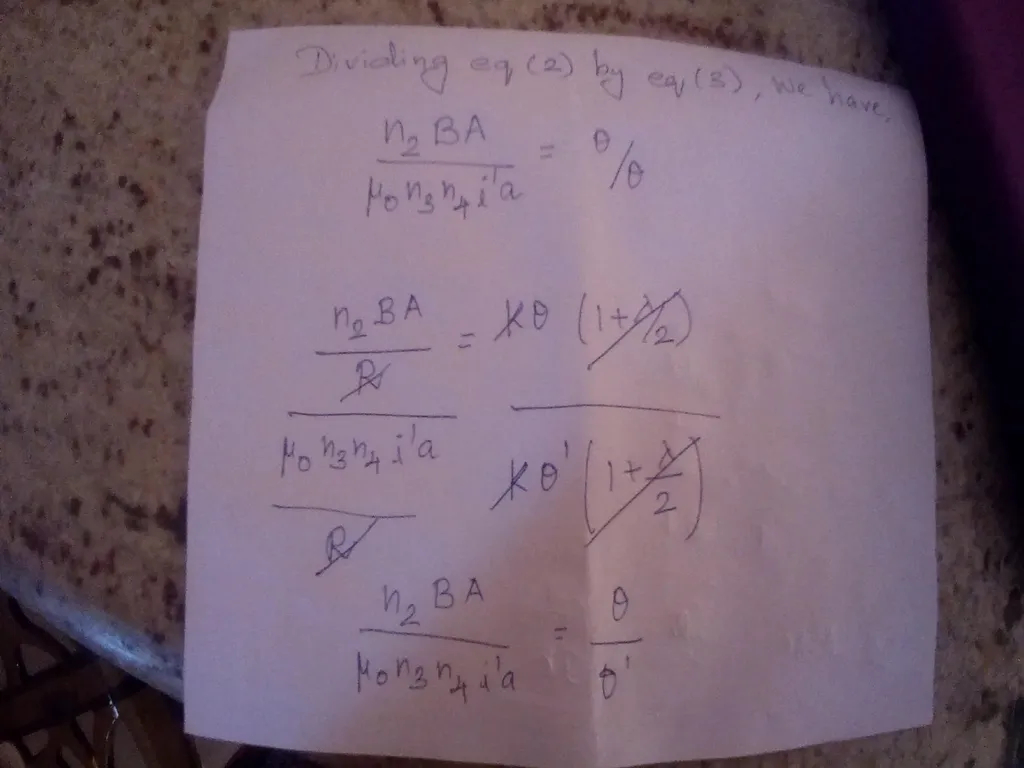
q = n2BA/R.
If θ is the first throw of the ballistic galvanometer coil, then
q = n2BA/R = Kθ (1 + λ/2).
where K is the ballistic constant
λ is the logarithmic decrement of the ballistic galvanometer.<br>
07
To eliminate K and a A known current i' is passed through the primary of the standard solenoid by closing the key K, to the right.<br>
08
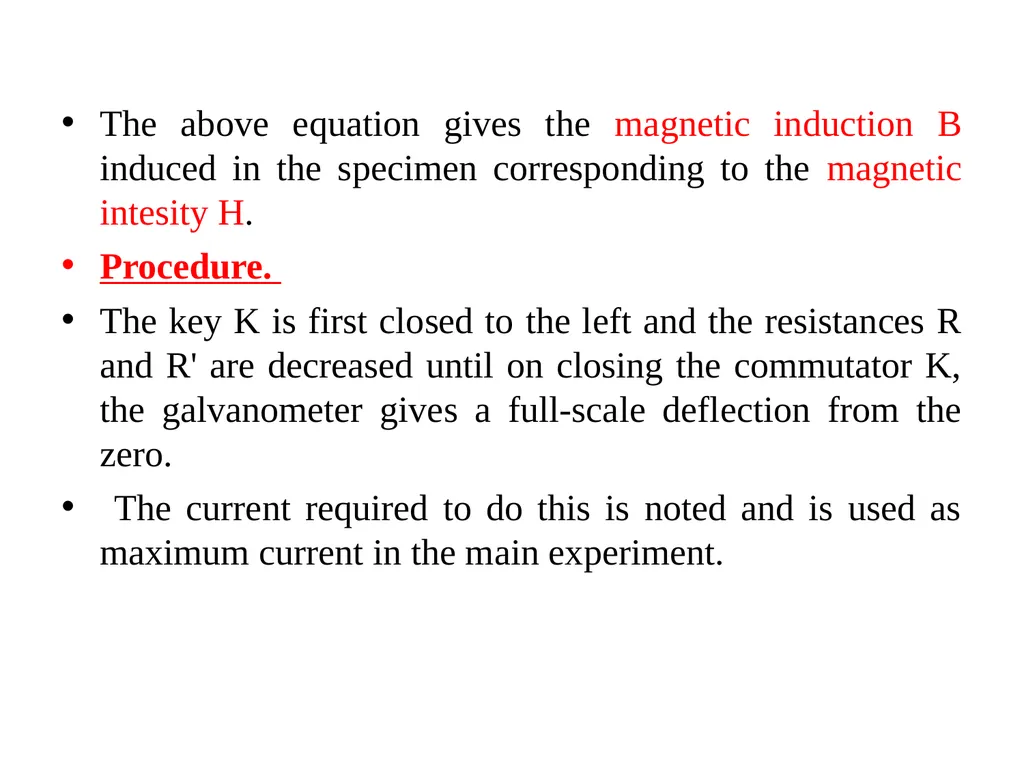
The above equation gives the magnetic induction B induced in the specimen corresponding to the magnetic intesity H.
Procedure.
The key K is first closed to the left and the resistances R and R' are decreased until on closing the commutator K, the galvanometer gives a full-scale deflection from the zero.
The current required to do this is noted and is used as maximum current in the main experiment.<br>
09
The residual magnetism in the specimen is reduced to zero follows:
The galvanometer circuit is first broken and the resistances R' are reduced to the minimum.
The current passing through the primary of the ring solenoid is then reversed many times by means of the commutator K.
R and R' are gradually increased until the current which is reversed is very small<br>
10
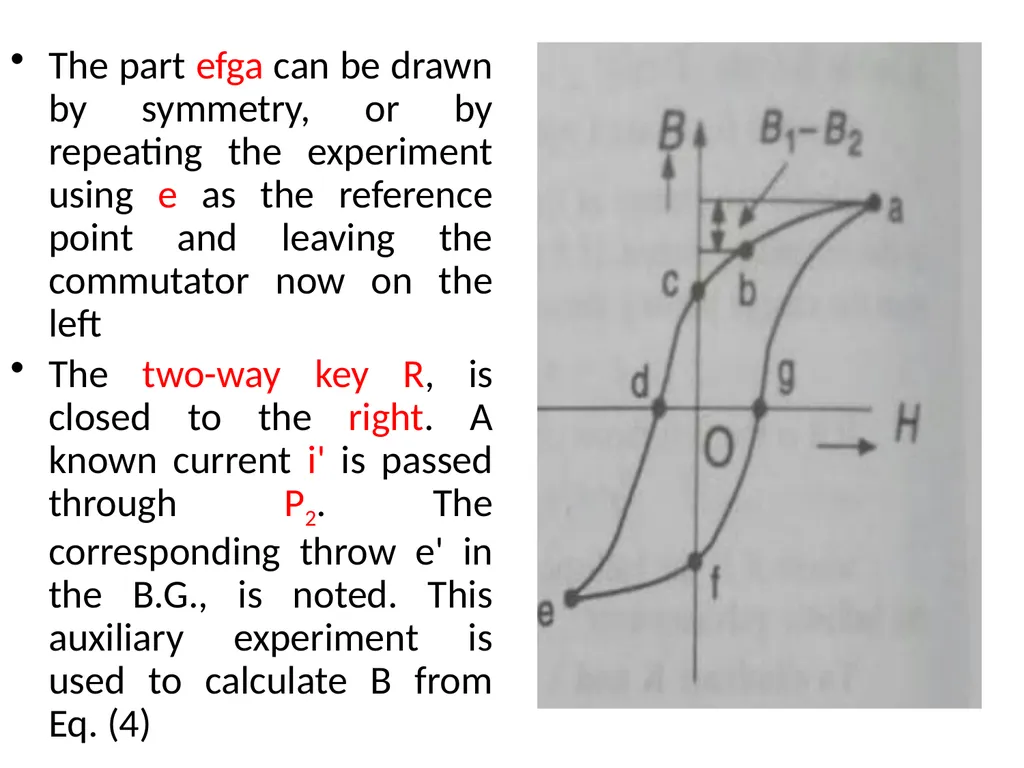
The part efga can be drawn by symmetry, or by repeating the experiment using e as the reference point and leaving the commutator now on the left
The two-way key R, is closed to the right. A known current i' is passed through P2. The corresponding throw e' in the B.G., is noted. This auxiliary experiment is used to calculate B from Eq. (4)<br>
11
The galvanometer is again put in the circuit by closing key K, The key K' is closed and resistance R, is given a value corresponding to the maximum current В.
The commutator K is closed to the right and the first throw , of the galvanometer is noted. The current i, is also noted from the ammeter. The values of B, and H, are calculated by using Eqs. (4) and (1) respectively. The corresponding point on the B-H curve is a (Fig. 15.9)<br>
12
The value of magnetising field H, is calculated by noting ammeter reading.
The corresponding point on the graph is denoted by the point b.
This process is repeated by gradually increasing R', until current and hence H becomes zero.
The graph corresponding to these readings is ac.
After each measurement, the specimen is returned to the state a by the reversal of maximum current.
Hence point a works as the reference point.<br>