Experimental Plan and Study Design Janice Weinberg ScD Professor of Biostatistics Boston University School of Public Health What to do: Connect the experimental plan study design to the study question(s) aims Justify your choice of
"Experimental Plan and Study Design Janice Weinberg" is the property of its rightful owner. Permission is granted to
download and print the materials on this website for personal, non-commercial use only, and to display it
on your personal computer provided you do not modify the materials and that you retain all copyright
notices contained in the materials. By downloading content from our website, you accept the terms of this
agreement.
Presentation Transcript
01
Experimental Plan and Study Design Janice Weinberg ScD
Professor of Biostatistics
Boston University School of Public Health<br>
02
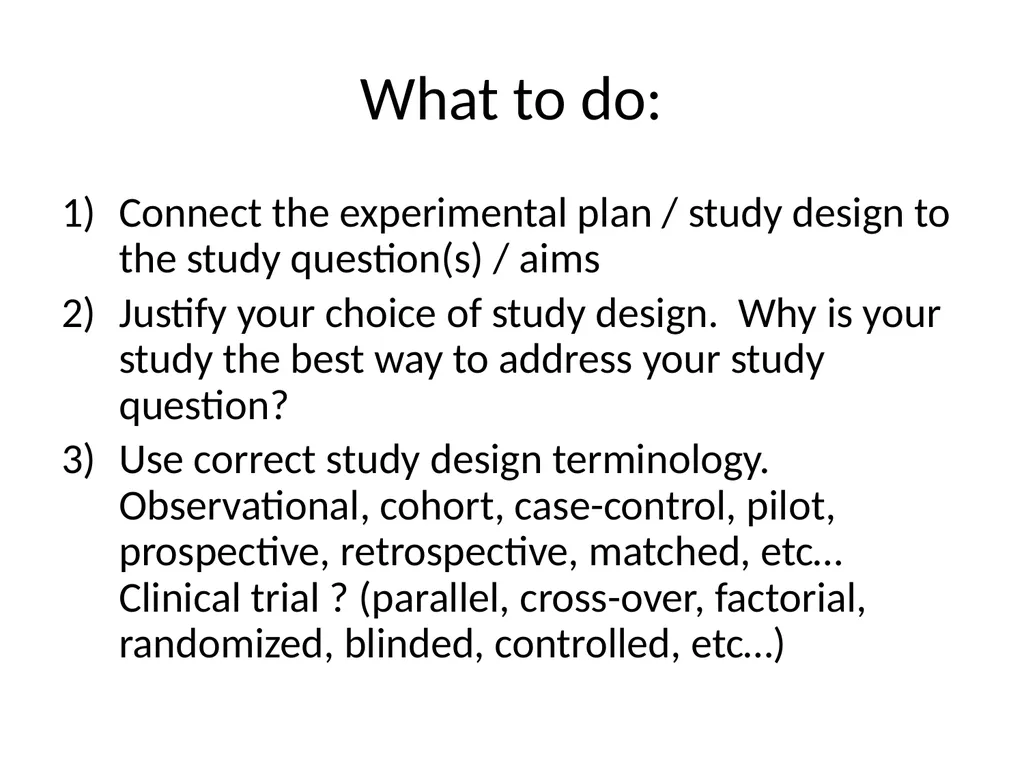
What to do: Connect the experimental plan / study design to the study question(s) / aims
Justify your choice of study design. Why is your study the best way to address your study question?
Use correct study design terminology. Observational, cohort, case-control, pilot, prospective, retrospective, matched, etc… Clinical trial ? (parallel, cross-over, factorial, randomized, blinded, controlled, etc…)<br>
03
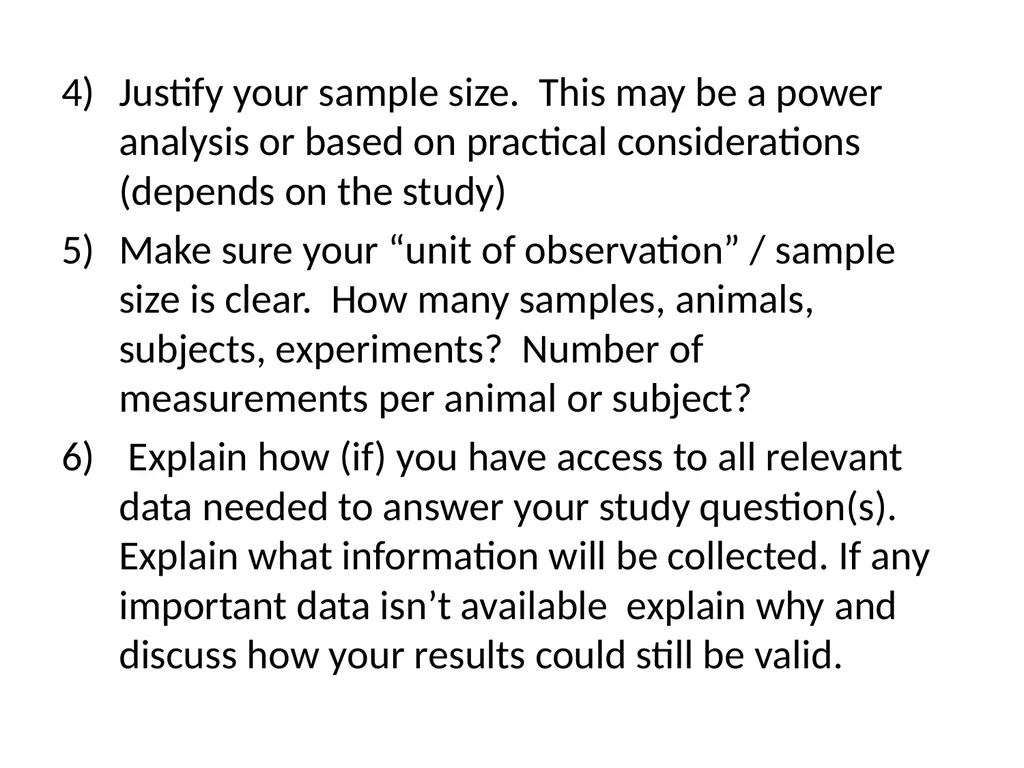
Justify your sample size. This may be a power analysis or based on practical considerations (depends on the study)
Make sure your “unit of observation” / sample size is clear. How many samples, animals, subjects, experiments? Number of measurements per animal or subject?
Explain how (if) you have access to all relevant data needed to answer your study question(s). Explain what information will be collected. If any important data isn’t available explain why and discuss how your results could still be valid.<br>
04
Consider sources of bias. Explain how you will control for these sources or explain why you will still get useful results in spite of them
Consider possible “effect modification”. Could results differ for subgroups of individuals? Possibly make this part of your plan
Address loss to follow-up in a prospective study. Explain how you will minimize loss to follow-up and missing data<br>
05
Make a picture!
Study design illustration
Study flow chart
Study evaluation chart<br>
06
Pet Peeves Obviously trying to sound “smart”. We know you are smart. Focus on being clear.
A list of study procedures over time in the text, instead of using a chart. “At baseline we will collect A,B,C and D. At Week 1 we will collect A,B and C. At Week 2 we will collect A,B and C. At week 3 we will collect A,B,C and D.” (and so on…)<br>
07
Pet Peeves No study design illustration
A sample size calculation for an outcome that is not primary (or secondary) or that has no connection to the study question(s)
Unclear connection between the study design, study question(s) and analytic plan<br>
08
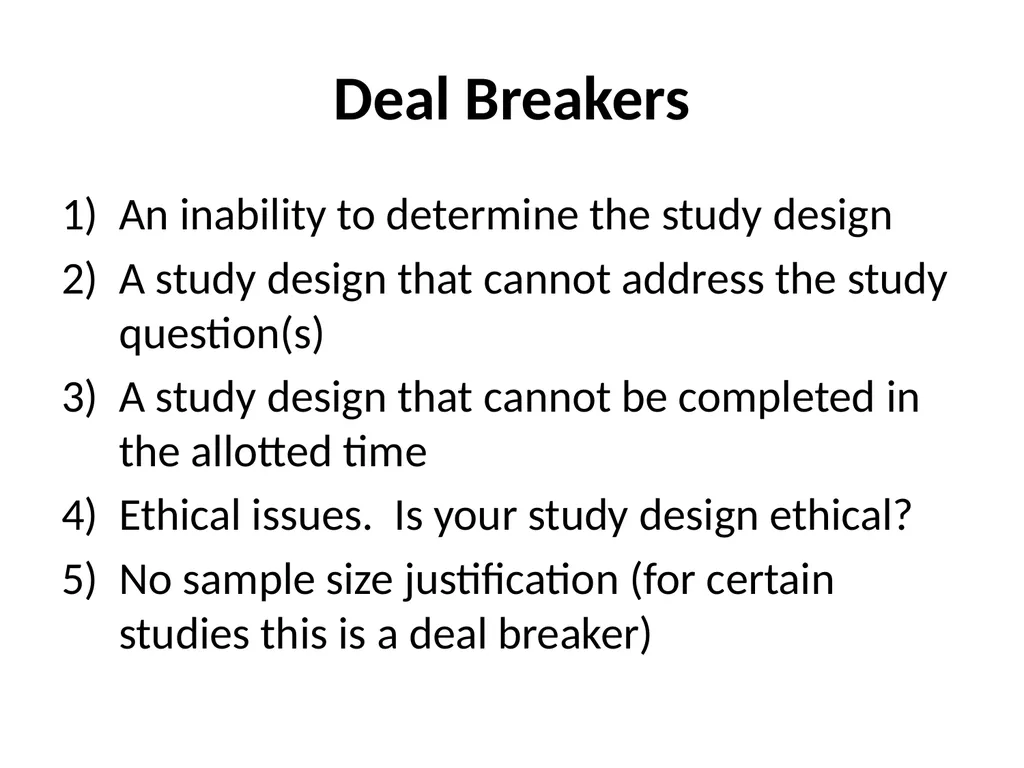
Deal Breakers An inability to determine the study design
A study design that cannot address the study question(s)
A study design that cannot be completed in the allotted time
Ethical issues. Is your study design ethical?
No sample size justification (for certain studies this is a deal breaker)<br>