
Exploiting Off-the-Shelf Virtual Memory Mechanisms
Description: Exploiting Off-the-Shelf Virtual Memory Mechanisms to Boost Software Transactional Memory Amin Mohtasham, Paulo Ferreira and João Barreto Exploiting Off-the-Shelf Virtual Memory Mechanisms to Boost Software Transactional Memory Amin
Related Topics
Download Presentation
"Exploiting Off-the-Shelf Virtual Memory Mechanisms" is the property of its rightful owner. Permission is granted to download and print the materials on this website for personal, non-commercial use only, and to display it on your personal computer provided you do not modify the materials and that you retain all copyright notices contained in the materials. By downloading content from our website, you accept the terms of this agreement.
Presentation Transcript
slide1. Exploiting Off-the-Shelf Virtual Memory Mechanisms to Boost Software Transactional Memory Amin Mohtasham, Paulo Ferreira and João Barreto Exploiting Off-the-Shelf Virtual Memory Mechanisms to Boost Software Transactional Memory Amin Mohtasham Email: amohtasham@gsd.inesc-id.pt<br>
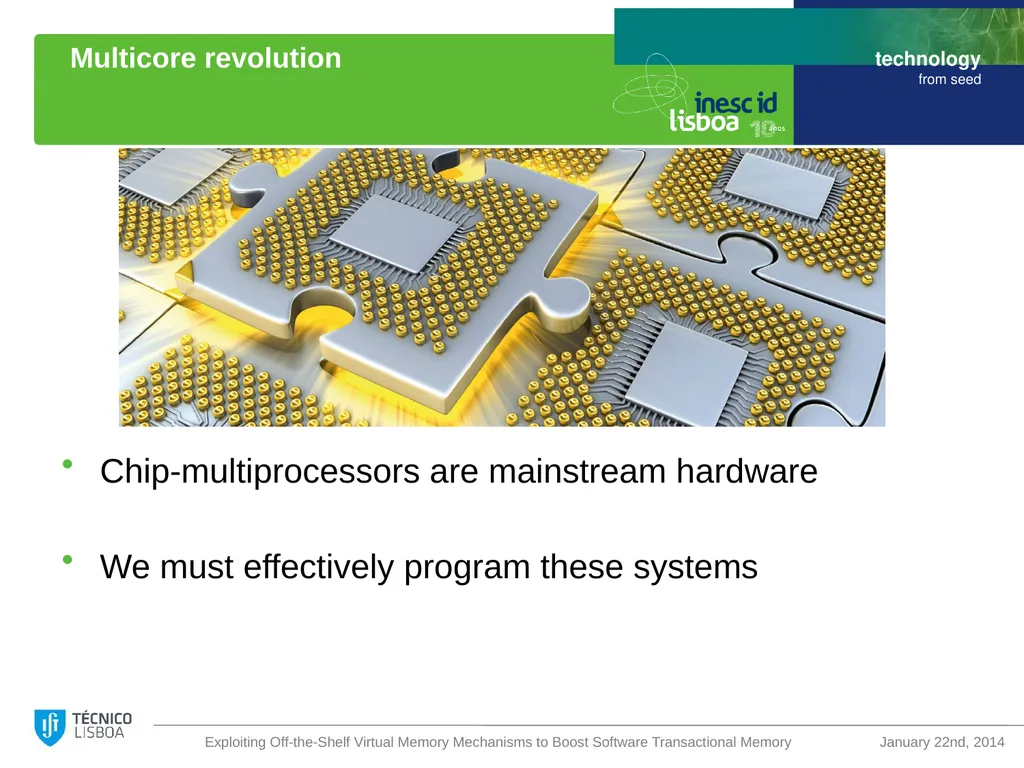
slide2. Multicore revolution Chip-multiprocessors are mainstream hardware
We must effectively program these systems Exploiting Off-the-Shelf Virtual Memory Mechanisms to Boost Software Transactional Memory January 22nd, 2014<br>
slide3. Lock-based methods Parallel Programming with traditional locks is difficult There is a trade-off between complexity and performance Exploiting Off-the-Shelf Virtual Memory Mechanisms to Boost Software Transactional Memory January 22nd, 2014<br>
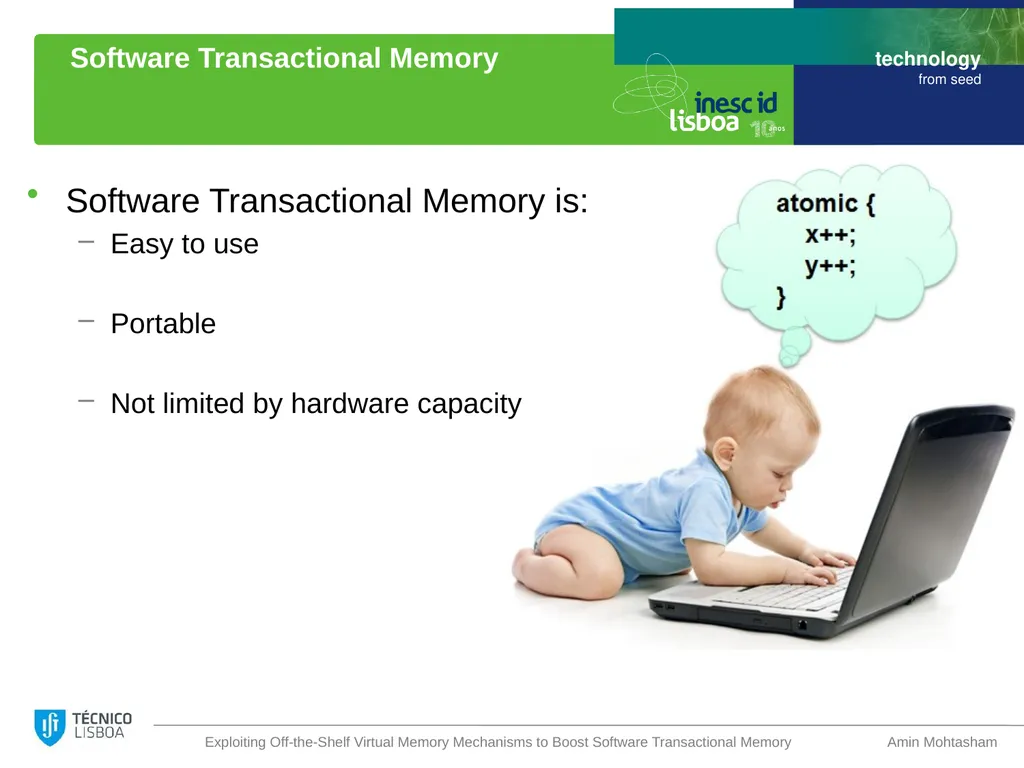
slide4. Software Transactional Memory Exploiting Off-the-Shelf Virtual Memory Mechanisms to Boost Software Transactional Memory Amin Mohtasham Software Transactional Memory is:
Easy to use
Portable
Not limited by hardware capacity<br>
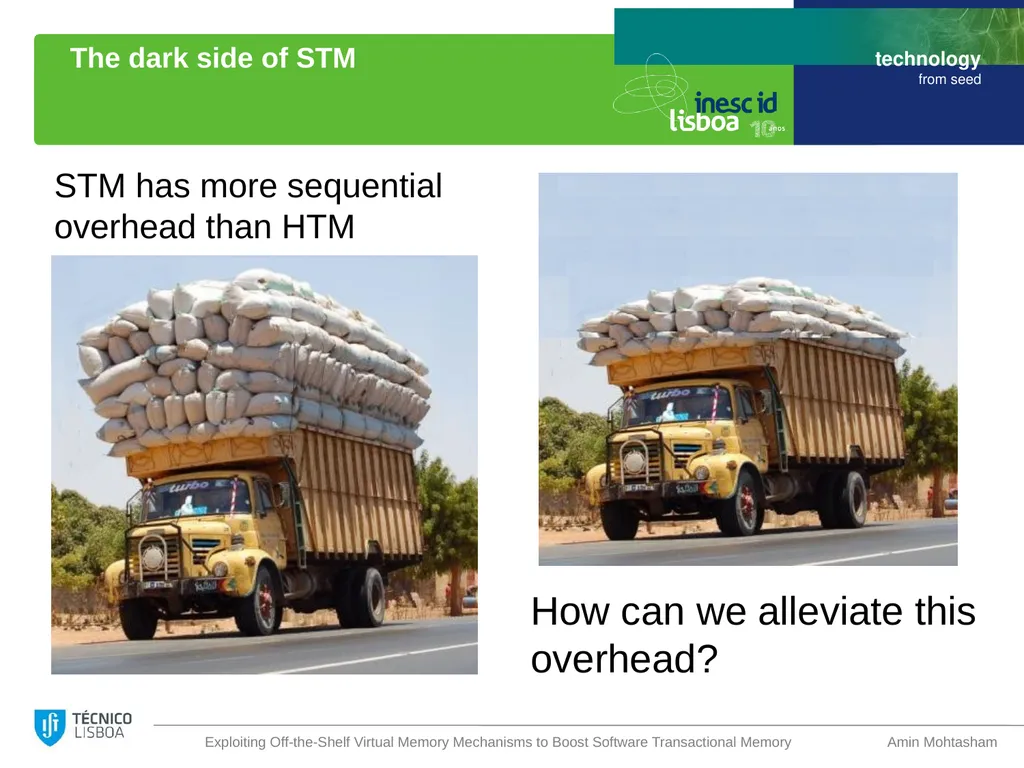
slide5. The dark side of STM STM has more sequential overhead than HTM How can we alleviate this overhead? Exploiting Off-the-Shelf Virtual Memory Mechanisms to Boost Software Transactional Memory Amin Mohtasham<br>
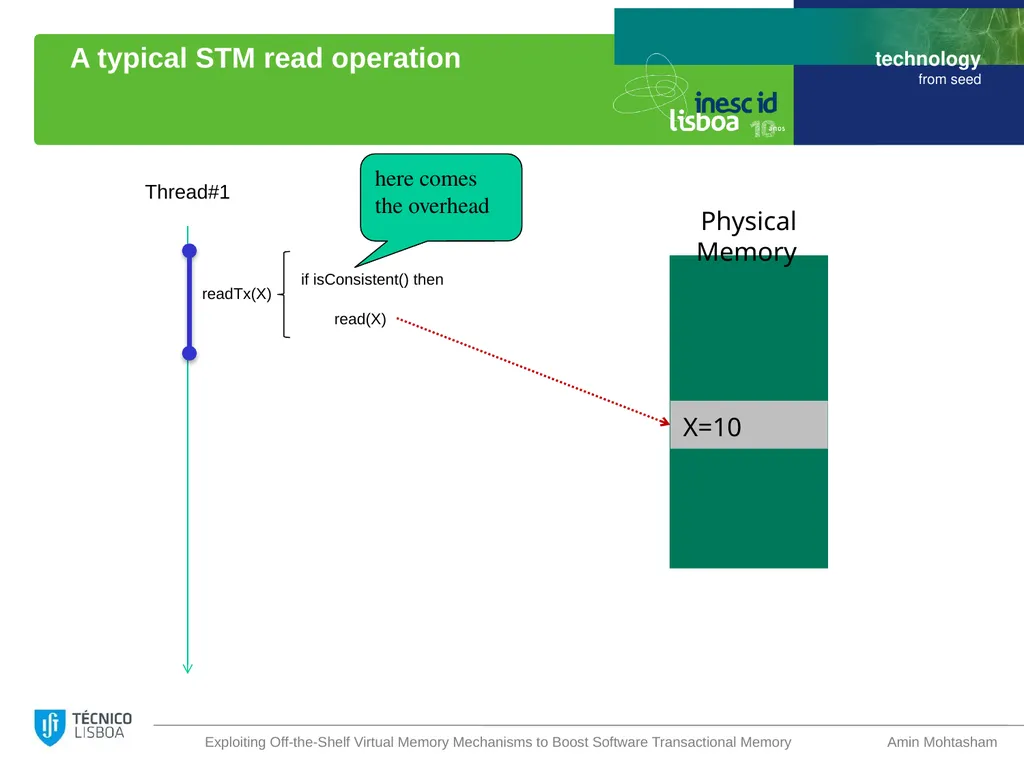
slide6. A typical STM read operation Amin Mohtasham Exploiting Off-the-Shelf Virtual Memory Mechanisms to Boost Software Transactional Memory Physical Memory Thread#1 X=10 readTx(X) read(X) if isConsistent() then here comes the overhead<br>
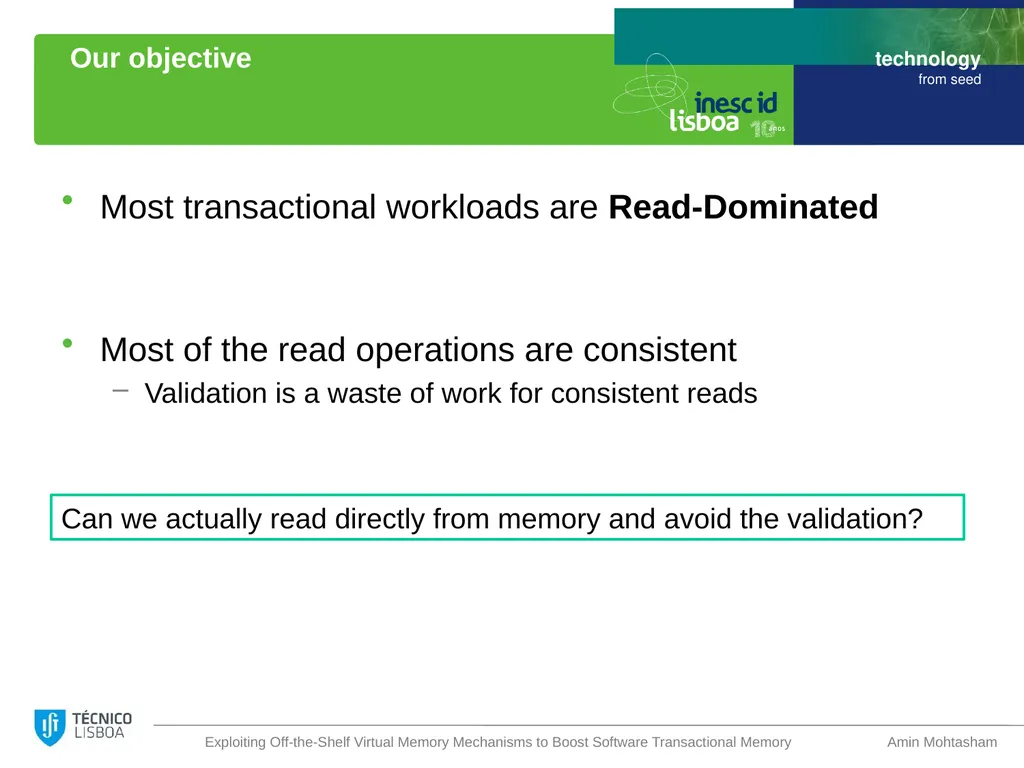
slide7. Our objective Most transactional workloads are Read-Dominated
Most of the read operations are consistent
Validation is a waste of work for consistent reads Exploiting Off-the-Shelf Virtual Memory Mechanisms to Boost Software Transactional Memory Amin Mohtasham Can we actually read directly from memory and avoid the validation?<br>
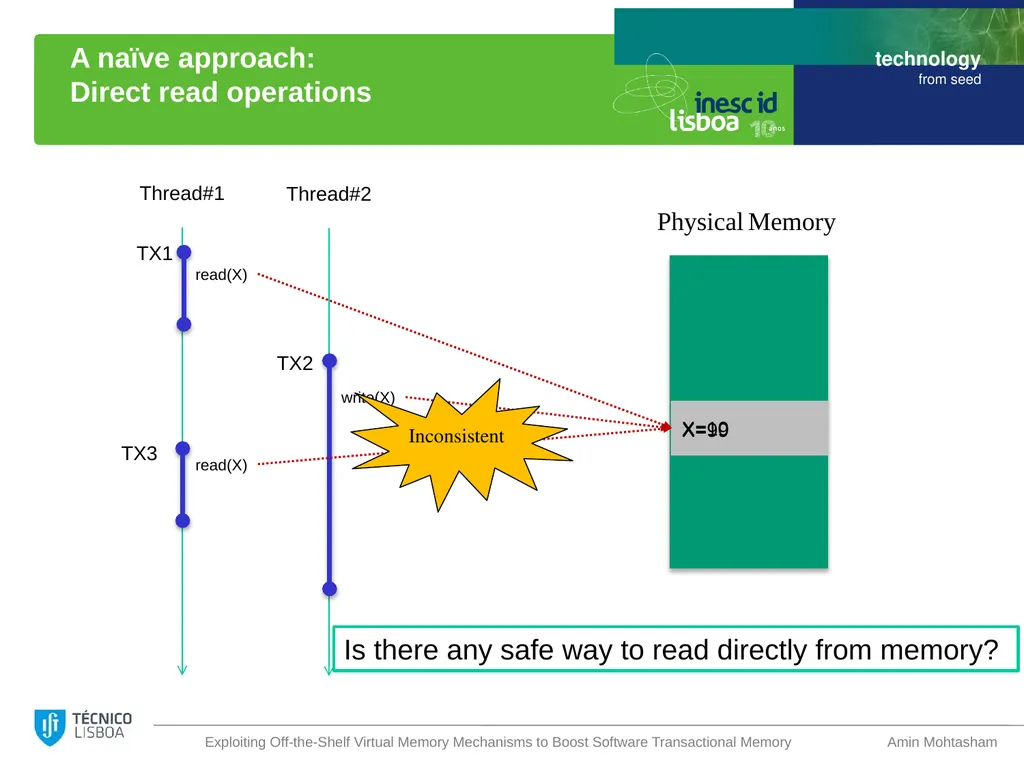
slide8. A naïve approach: Direct read operations Amin Mohtasham Exploiting Off-the-Shelf Virtual Memory Mechanisms to Boost Software Transactional Memory Physical Memory Thread#1 X=10 read(X) Thread#2 write(X) read(X) TX1 TX2 TX3 Is there any safe way to read directly from memory? Inconsistent X=99<br>
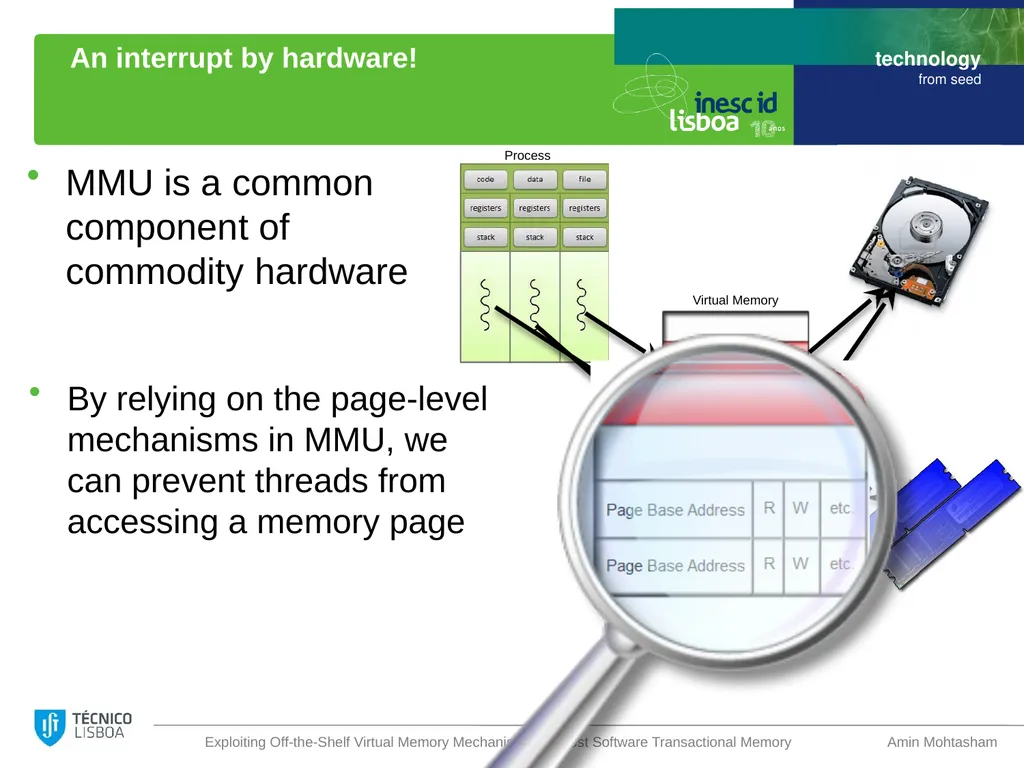
slide9. An interrupt by hardware! Exploiting Off-the-Shelf Virtual Memory Mechanisms to Boost Software Transactional Memory Process Virtual Memory MMU is a common component of commodity hardware By relying on the page-level mechanisms in MMU, we can prevent threads from accessing a memory page Amin Mohtasham<br>
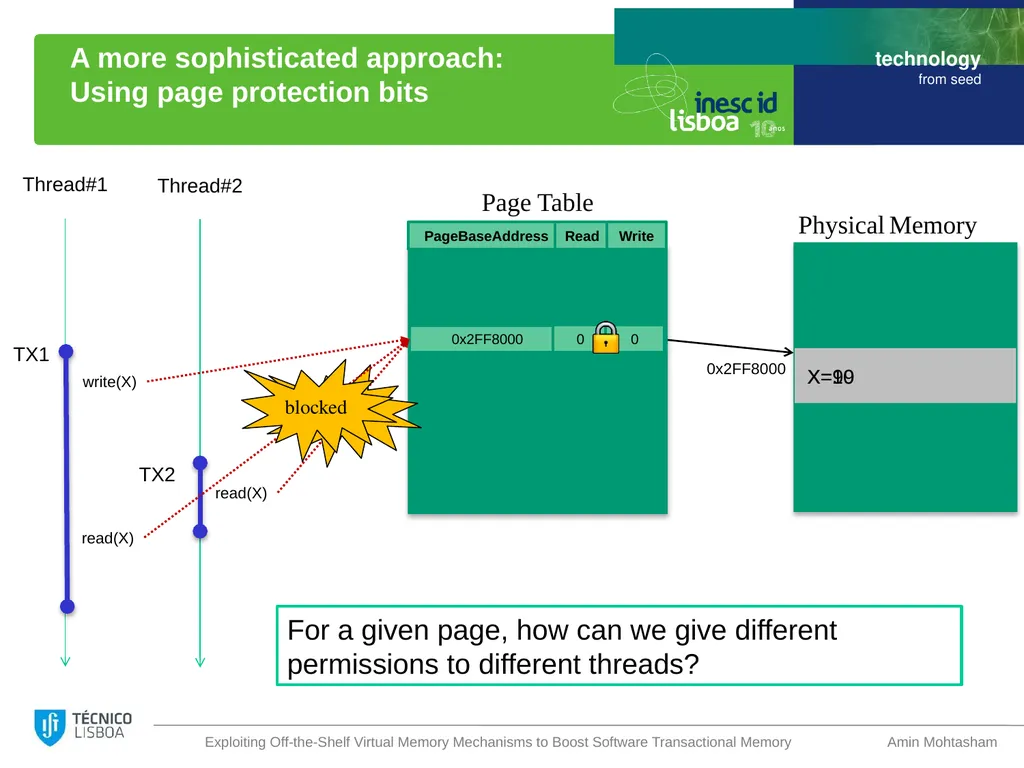
slide10. A more sophisticated approach: Using page protection bits Page Table Physical Memory Exploiting Off-the-Shelf Virtual Memory Mechanisms to Boost Software Transactional Memory Amin Mohtasham PageBaseAddress Read Write 0x2FF8000 1 1 Thread#2 Thread#1 write(X) read(X) TX1 TX2 read(X) blocked blocked 0x2FF8000 X=10 X=99 For a given page, how can we give different permissions to different threads?<br>
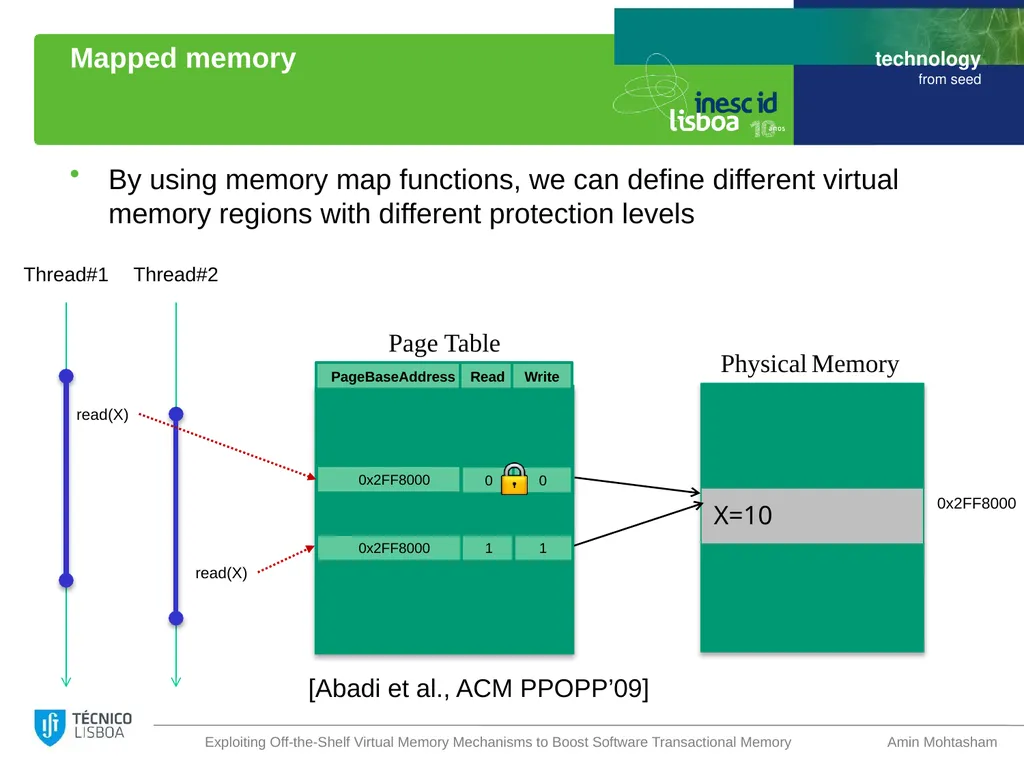
slide11. Mapped memory By using memory map functions, we can define different virtual memory regions with different protection levels Amin Mohtasham Exploiting Off-the-Shelf Virtual Memory Mechanisms to Boost Software Transactional Memory Page Table Physical Memory PageBaseAddress Read Write 0x2FF8000 0x2FF8000 0x2FF8000 Thread#1 Thread#2 read(X) read(X) X=10 [Abadi et al., ACM PPOPP’09]<br>
slide12. Proof of concept: PGSTM At most, one writer transaction at each time
Using a single global lock
Multiple read-only transactions can at each time
Read-only transactions can execute in parallel, as long as they do not read from pages being written Exploiting Off-the-Shelf Virtual Memory Mechanisms to Boost Software Transactional Memory Amin Mohtasham<br>
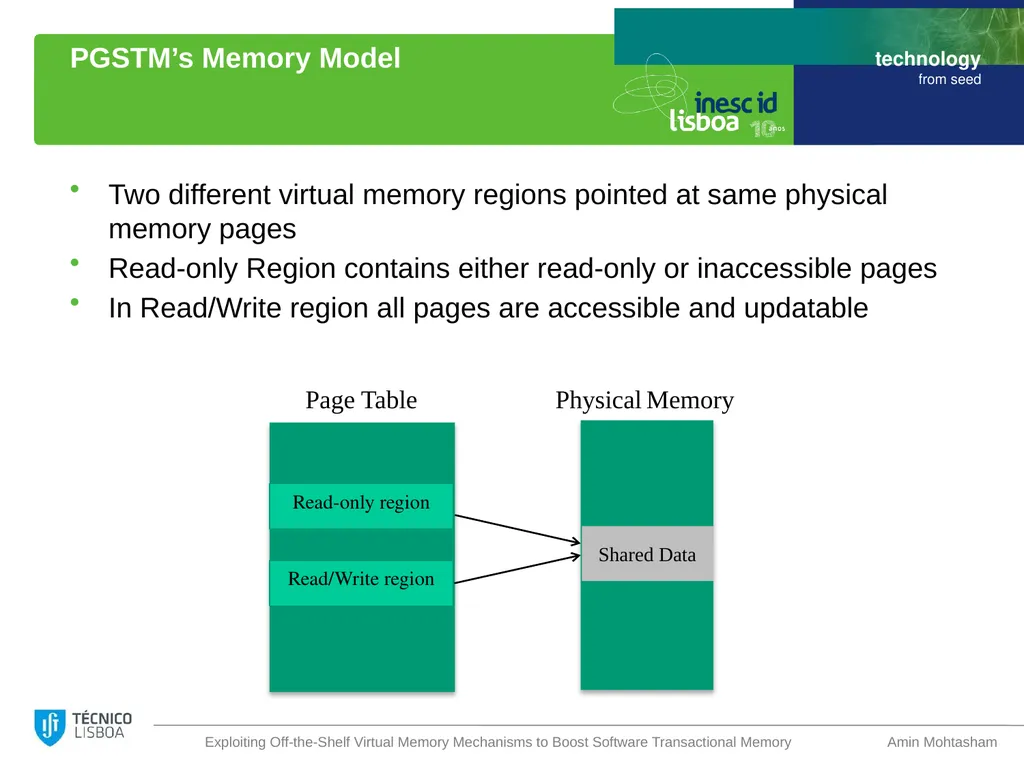
slide13. PGSTM’s Memory Model Amin Mohtasham Exploiting Off-the-Shelf Virtual Memory Mechanisms to Boost Software Transactional Memory Page Table Physical Memory Shared Data Read-only region Read/Write region Two different virtual memory regions pointed at same physical memory pages
Read-only Region contains either read-only or inaccessible pages
In Read/Write region all pages are accessible and updatable<br>
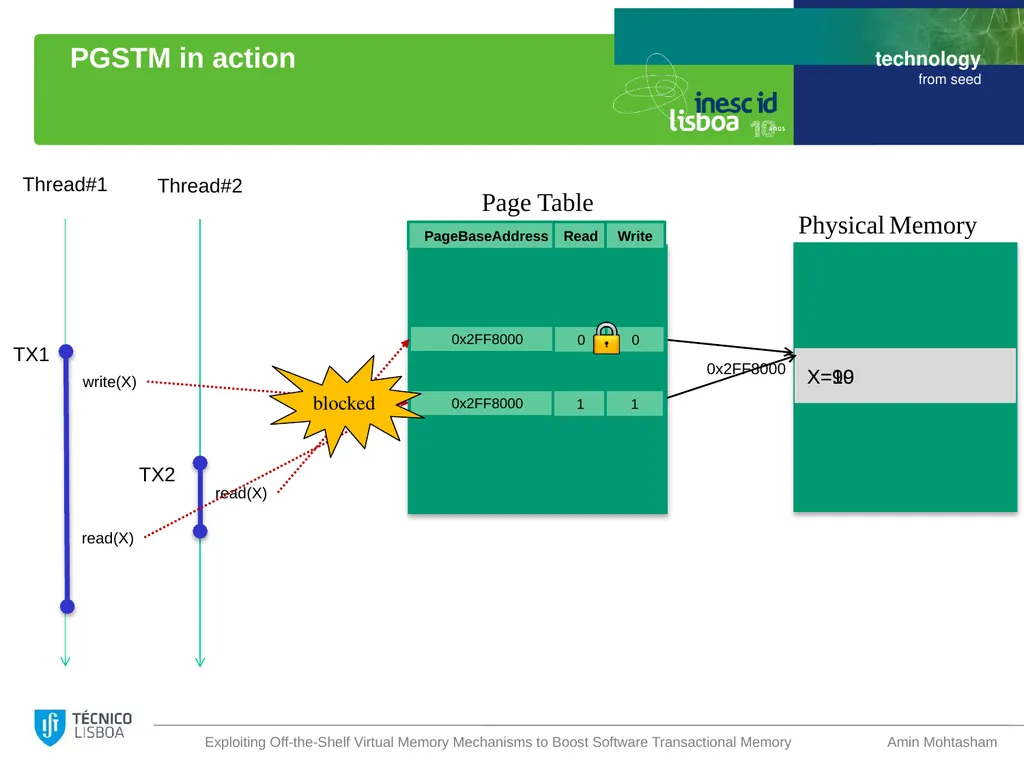
slide14. PGSTM in action Amin Mohtasham Exploiting Off-the-Shelf Virtual Memory Mechanisms to Boost Software Transactional Memory Page Table Physical Memory PageBaseAddress Read Write 0x2FF8000 0x2FF8000 X=10 Thread#2 Thread#1 write(X) read(X) TX1 TX2 read(X) 0x2FF8000 blocked X=99<br>
slide15. When to unlock a page? Can we unlock the page when the writer commits?
It is not safe if there are other active read-only transactions running
Unlock only after such active transactions complete Amin Mohtasham Exploiting Off-the-Shelf Virtual Memory Mechanisms to Boost Software Transactional Memory<br>
slide16. Evaluation environment List look-up benchmark
Read-only transactions search for a random element
Read/Write transactions modify a random element
We compare our results with TML [Dalessandro et al.,Europar’10] Exploiting Off-the-Shelf Virtual Memory Mechanisms to Boost Software Transactional Memory Amin Mohtasham<br>
slide17. TML: Transactional Mutex Locks At most, one writer transaction at each time
Using a single global lock
Read-only transactions can not run in parallel with the writer transaction
With the lowest sequential overhead Amin Mohtasham Exploiting Off-the-Shelf Virtual Memory Mechanisms to Boost Software Transactional Memory<br>
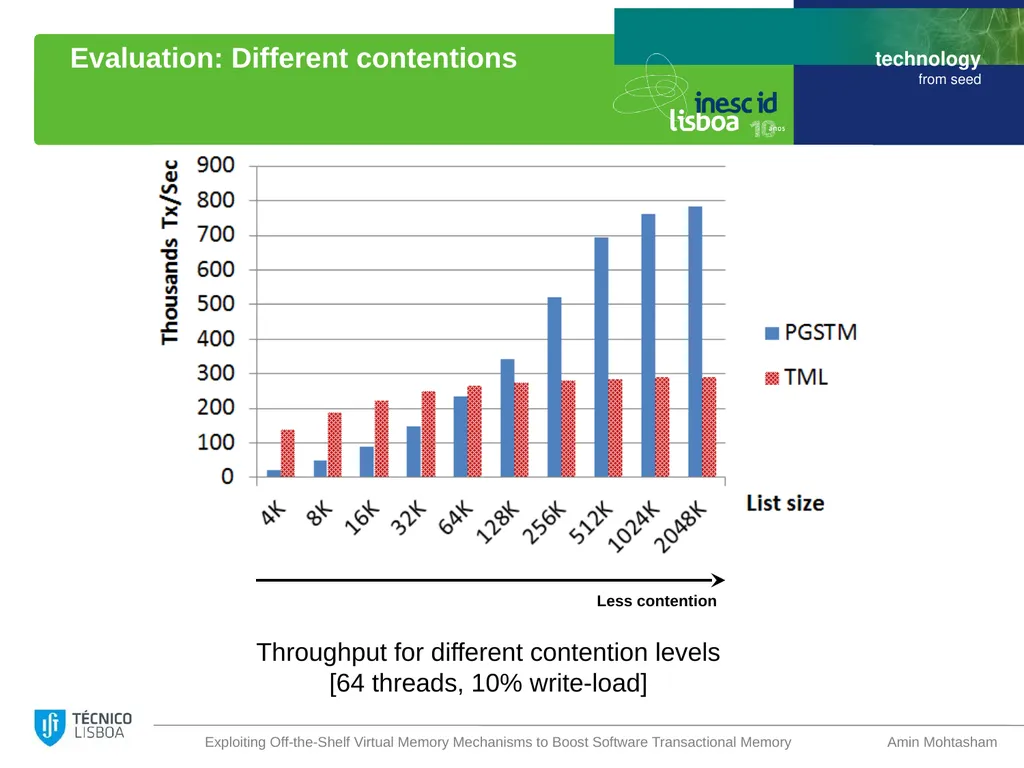
slide18. Evaluation: Different contentions Exploiting Off-the-Shelf Virtual Memory Mechanisms to Boost Software Transactional Memory Throughput for different contention levels
[64 threads, 10% write-load] Amin Mohtasham Less contention<br>
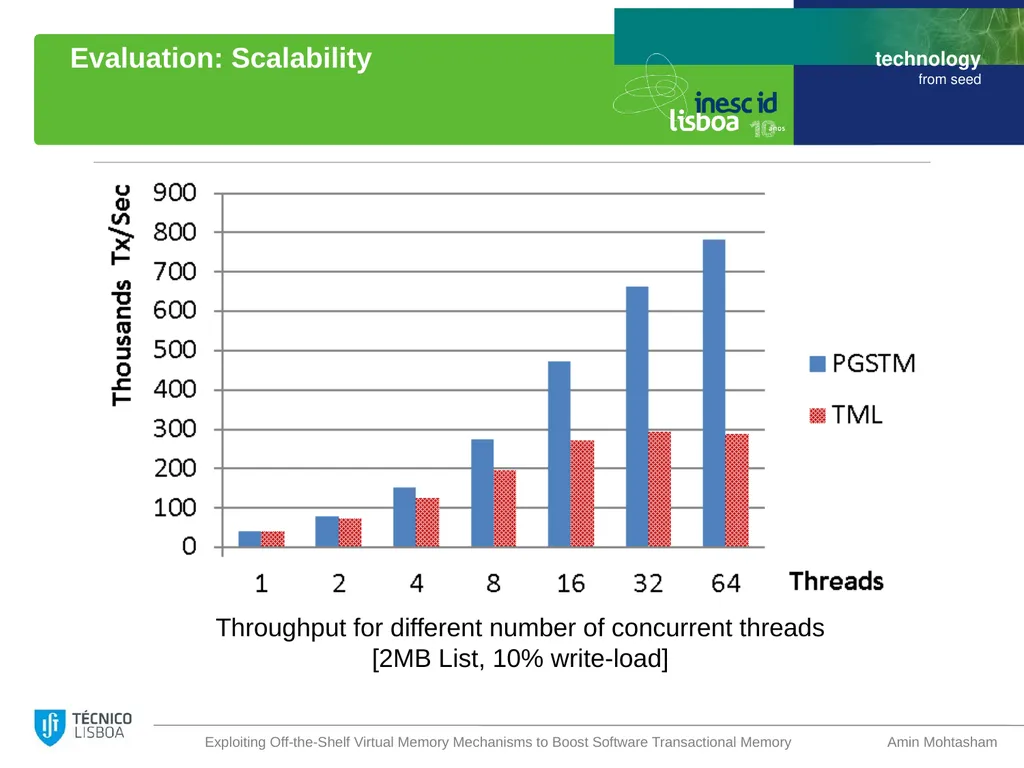
slide19. Evaluation: Scalability Exploiting Off-the-Shelf Virtual Memory Mechanisms to Boost Software Transactional Memory Throughput for different number of concurrent threads
[2MB List, 10% write-load] Amin Mohtasham<br>
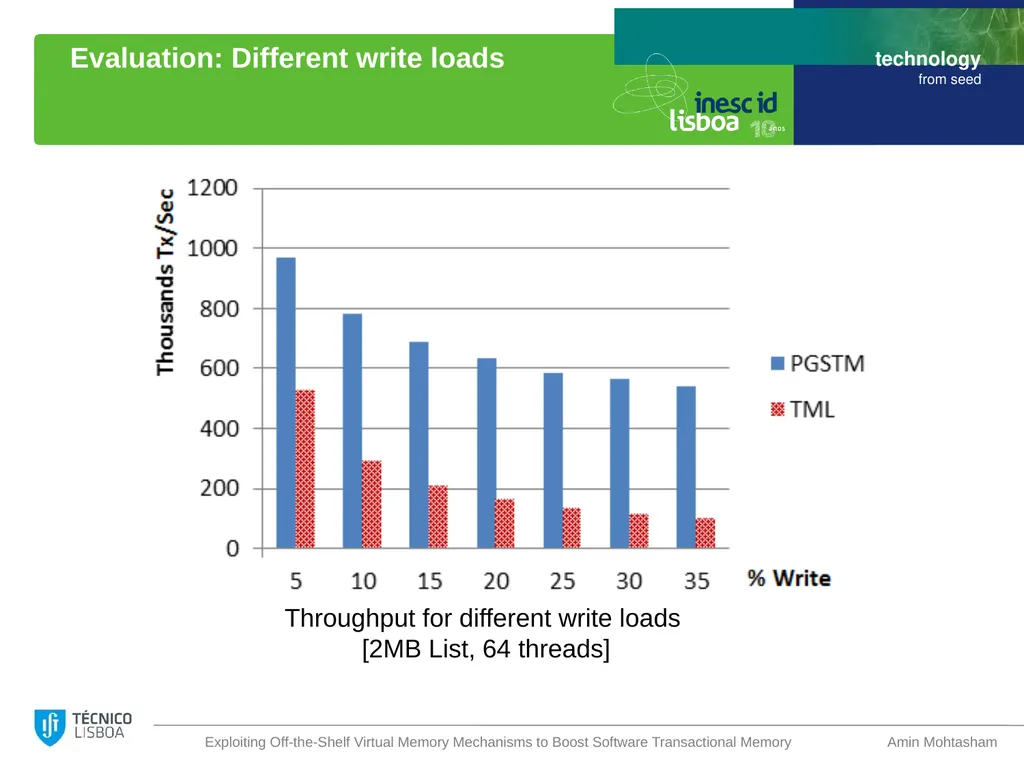
slide20. Evaluation: Different write loads Exploiting Off-the-Shelf Virtual Memory Mechanisms to Boost Software Transactional Memory Throughput for different write loads
[2MB List, 64 threads] Amin Mohtasham<br>
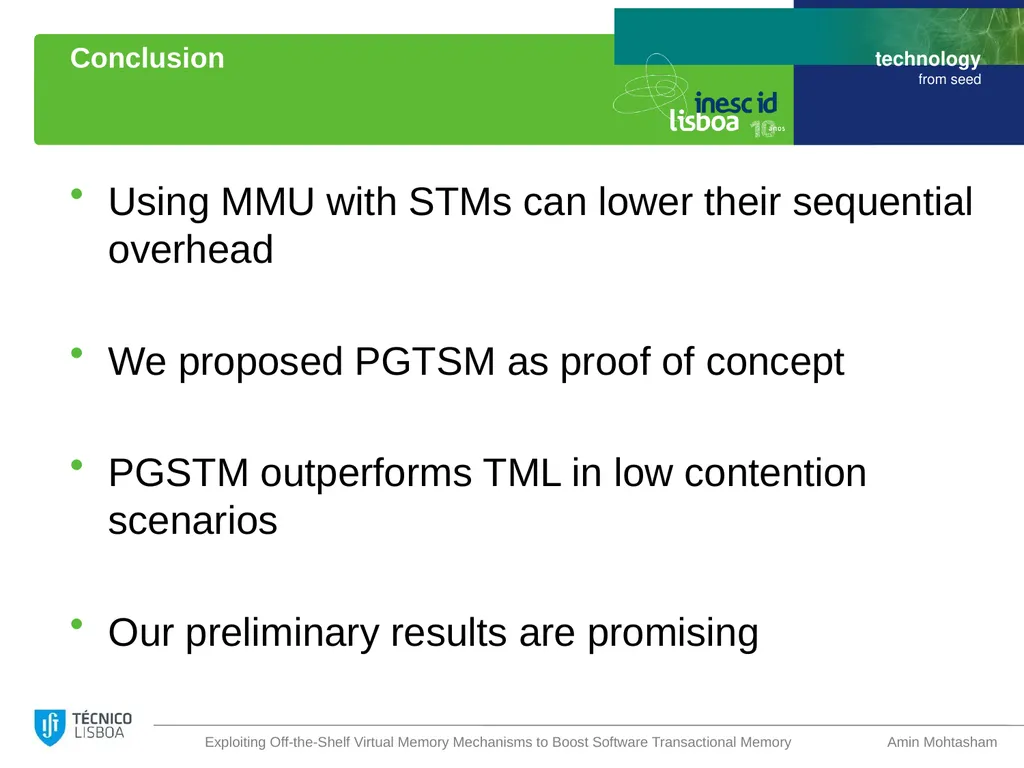
slide21. Conclusion Using MMU with STMs can lower their sequential overhead
We proposed PGTSM as proof of concept
PGSTM outperforms TML in low contention scenarios
Our preliminary results are promising Exploiting Off-the-Shelf Virtual Memory Mechanisms to Boost Software Transactional Memory Amin Mohtasham<br>
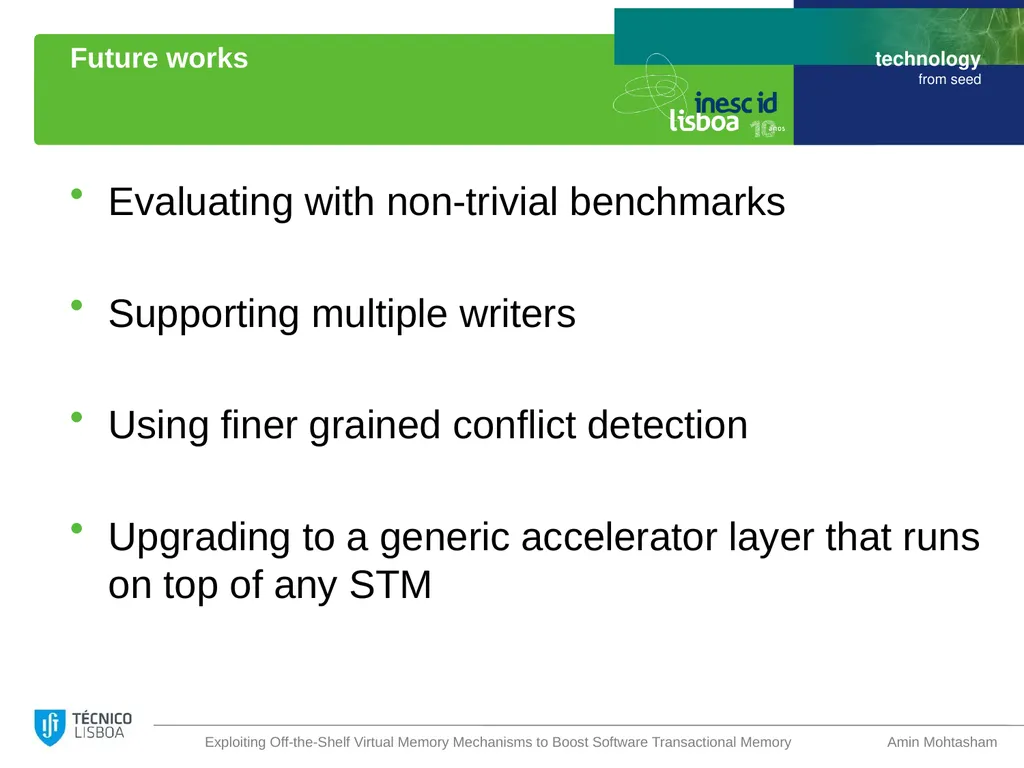
slide22. Future works Evaluating with non-trivial benchmarks
Supporting multiple writers
Using finer grained conflict detection
Upgrading to a generic accelerator layer that runs on top of any STM Exploiting Off-the-Shelf Virtual Memory Mechanisms to Boost Software Transactional Memory Amin Mohtasham<br>
slide23. Exploiting Off-the-Shelf Virtual Memory Mechanisms to Boost Software Transactional Memory Amin Mohtasham<br>
slide2. Multicore revolution Chip-multiprocessors are mainstream hardware
We must effectively program these systems Exploiting Off-the-Shelf Virtual Memory Mechanisms to Boost Software Transactional Memory January 22nd, 2014<br>
slide3. Lock-based methods Parallel Programming with traditional locks is difficult There is a trade-off between complexity and performance Exploiting Off-the-Shelf Virtual Memory Mechanisms to Boost Software Transactional Memory January 22nd, 2014<br>
slide4. Software Transactional Memory Exploiting Off-the-Shelf Virtual Memory Mechanisms to Boost Software Transactional Memory Amin Mohtasham Software Transactional Memory is:
Easy to use
Portable
Not limited by hardware capacity<br>
slide5. The dark side of STM STM has more sequential overhead than HTM How can we alleviate this overhead? Exploiting Off-the-Shelf Virtual Memory Mechanisms to Boost Software Transactional Memory Amin Mohtasham<br>
slide6. A typical STM read operation Amin Mohtasham Exploiting Off-the-Shelf Virtual Memory Mechanisms to Boost Software Transactional Memory Physical Memory Thread#1 X=10 readTx(X) read(X) if isConsistent() then here comes the overhead<br>
slide7. Our objective Most transactional workloads are Read-Dominated
Most of the read operations are consistent
Validation is a waste of work for consistent reads Exploiting Off-the-Shelf Virtual Memory Mechanisms to Boost Software Transactional Memory Amin Mohtasham Can we actually read directly from memory and avoid the validation?<br>
slide8. A naïve approach: Direct read operations Amin Mohtasham Exploiting Off-the-Shelf Virtual Memory Mechanisms to Boost Software Transactional Memory Physical Memory Thread#1 X=10 read(X) Thread#2 write(X) read(X) TX1 TX2 TX3 Is there any safe way to read directly from memory? Inconsistent X=99<br>
slide9. An interrupt by hardware! Exploiting Off-the-Shelf Virtual Memory Mechanisms to Boost Software Transactional Memory Process Virtual Memory MMU is a common component of commodity hardware By relying on the page-level mechanisms in MMU, we can prevent threads from accessing a memory page Amin Mohtasham<br>
slide10. A more sophisticated approach: Using page protection bits Page Table Physical Memory Exploiting Off-the-Shelf Virtual Memory Mechanisms to Boost Software Transactional Memory Amin Mohtasham PageBaseAddress Read Write 0x2FF8000 1 1 Thread#2 Thread#1 write(X) read(X) TX1 TX2 read(X) blocked blocked 0x2FF8000 X=10 X=99 For a given page, how can we give different permissions to different threads?<br>
slide11. Mapped memory By using memory map functions, we can define different virtual memory regions with different protection levels Amin Mohtasham Exploiting Off-the-Shelf Virtual Memory Mechanisms to Boost Software Transactional Memory Page Table Physical Memory PageBaseAddress Read Write 0x2FF8000 0x2FF8000 0x2FF8000 Thread#1 Thread#2 read(X) read(X) X=10 [Abadi et al., ACM PPOPP’09]<br>
slide12. Proof of concept: PGSTM At most, one writer transaction at each time
Using a single global lock
Multiple read-only transactions can at each time
Read-only transactions can execute in parallel, as long as they do not read from pages being written Exploiting Off-the-Shelf Virtual Memory Mechanisms to Boost Software Transactional Memory Amin Mohtasham<br>
slide13. PGSTM’s Memory Model Amin Mohtasham Exploiting Off-the-Shelf Virtual Memory Mechanisms to Boost Software Transactional Memory Page Table Physical Memory Shared Data Read-only region Read/Write region Two different virtual memory regions pointed at same physical memory pages
Read-only Region contains either read-only or inaccessible pages
In Read/Write region all pages are accessible and updatable<br>
slide14. PGSTM in action Amin Mohtasham Exploiting Off-the-Shelf Virtual Memory Mechanisms to Boost Software Transactional Memory Page Table Physical Memory PageBaseAddress Read Write 0x2FF8000 0x2FF8000 X=10 Thread#2 Thread#1 write(X) read(X) TX1 TX2 read(X) 0x2FF8000 blocked X=99<br>
slide15. When to unlock a page? Can we unlock the page when the writer commits?
It is not safe if there are other active read-only transactions running
Unlock only after such active transactions complete Amin Mohtasham Exploiting Off-the-Shelf Virtual Memory Mechanisms to Boost Software Transactional Memory<br>
slide16. Evaluation environment List look-up benchmark
Read-only transactions search for a random element
Read/Write transactions modify a random element
We compare our results with TML [Dalessandro et al.,Europar’10] Exploiting Off-the-Shelf Virtual Memory Mechanisms to Boost Software Transactional Memory Amin Mohtasham<br>
slide17. TML: Transactional Mutex Locks At most, one writer transaction at each time
Using a single global lock
Read-only transactions can not run in parallel with the writer transaction
With the lowest sequential overhead Amin Mohtasham Exploiting Off-the-Shelf Virtual Memory Mechanisms to Boost Software Transactional Memory<br>
slide18. Evaluation: Different contentions Exploiting Off-the-Shelf Virtual Memory Mechanisms to Boost Software Transactional Memory Throughput for different contention levels
[64 threads, 10% write-load] Amin Mohtasham Less contention<br>
slide19. Evaluation: Scalability Exploiting Off-the-Shelf Virtual Memory Mechanisms to Boost Software Transactional Memory Throughput for different number of concurrent threads
[2MB List, 10% write-load] Amin Mohtasham<br>
slide20. Evaluation: Different write loads Exploiting Off-the-Shelf Virtual Memory Mechanisms to Boost Software Transactional Memory Throughput for different write loads
[2MB List, 64 threads] Amin Mohtasham<br>
slide21. Conclusion Using MMU with STMs can lower their sequential overhead
We proposed PGTSM as proof of concept
PGSTM outperforms TML in low contention scenarios
Our preliminary results are promising Exploiting Off-the-Shelf Virtual Memory Mechanisms to Boost Software Transactional Memory Amin Mohtasham<br>
slide22. Future works Evaluating with non-trivial benchmarks
Supporting multiple writers
Using finer grained conflict detection
Upgrading to a generic accelerator layer that runs on top of any STM Exploiting Off-the-Shelf Virtual Memory Mechanisms to Boost Software Transactional Memory Amin Mohtasham<br>
slide23. Exploiting Off-the-Shelf Virtual Memory Mechanisms to Boost Software Transactional Memory Amin Mohtasham<br>