Fall Prevention and Management for Individuals with Vision Loss Beth Barstow PhD, OTRL, SCLV, OTCAVR,FAOTA Program Director and Professor Occupational Therapy The University of Alabama Session Objectives By the end of the session, the
"Fall Prevention and Management for Individuals" is the property of its rightful owner. Permission is granted to
download and print the materials on this website for personal, non-commercial use only, and to display it
on your personal computer provided you do not modify the materials and that you retain all copyright
notices contained in the materials. By downloading content from our website, you accept the terms of this
agreement.
Presentation Transcript
01
Fall Prevention and Management for Individuals with Vision Loss Beth Barstow PhD, OTR/L, SCLV, OTCAVR,FAOTA
Program Director and Professor
Occupational Therapy
The University of Alabama<br>
02
Session Objectives By the end of the session, the learner will:
Identify multiple contributors to falls among older adults with low vision
Recognize the relationship between vision loss and occupational performance
Differentiate vision-related vs. non-vision related fall risk factors
Develop discipline-specific and interdisciplinary intervention strategies<br>
03
Case The Referral
Client Profile
Patricia Walker is a 78-year-old retired elementary school teacher.
Current Diagnoses
Age-related macular degeneration
Hypertension
Osteoarthritis
Type II diabetes
Living Situation
Lives alone
Single-family home
Remains active in church activities
Drives locally during daytime<br>
04
Case The Referral
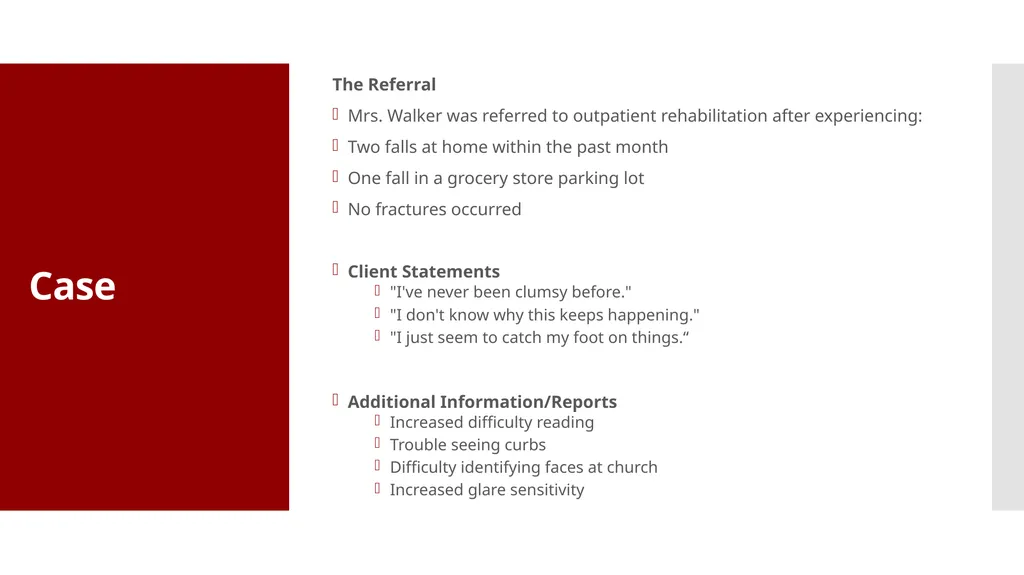
Mrs. Walker was referred to outpatient rehabilitation after experiencing:
Two falls at home within the past month
One fall in a grocery store parking lot
No fractures occurred
Client Statements
"I've never been clumsy before."
"I don't know why this keeps happening."
"I just seem to catch my foot on things.“
Additional Information/Reports
Increased difficulty reading
Trouble seeing curbs
Difficulty identifying faces at church
Increased glare sensitivity<br>
05
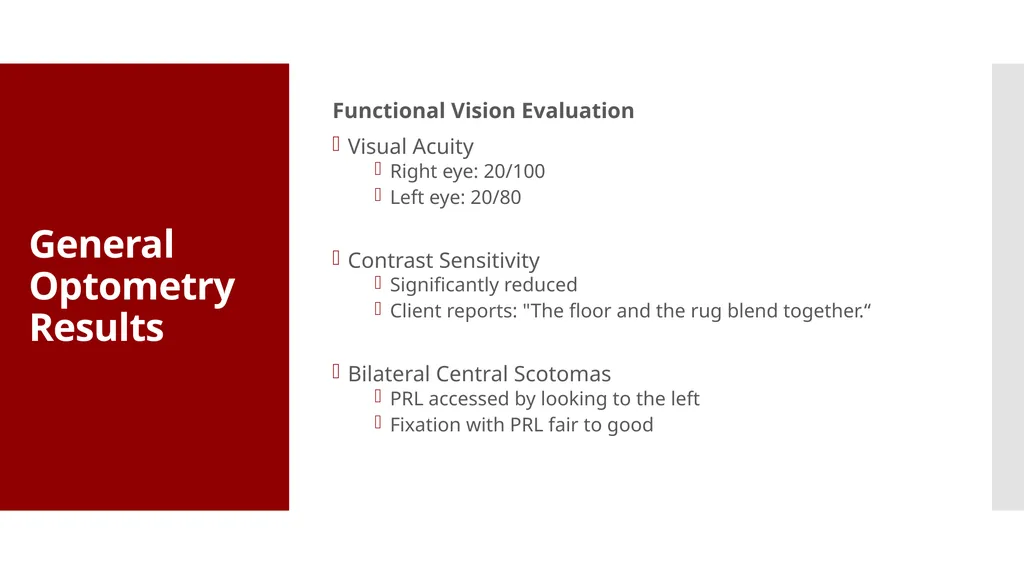
General Optometry Results Functional Vision Evaluation
Visual Acuity
Right eye: 20/100
Left eye: 20/80
Contrast Sensitivity
Significantly reduced
Client reports: "The floor and the rug blend together.“
Bilateral Central Scotomas
PRL accessed by looking to the left
Fixation with PRL fair to good<br>
06
Time for thoughts and questions<br>
07
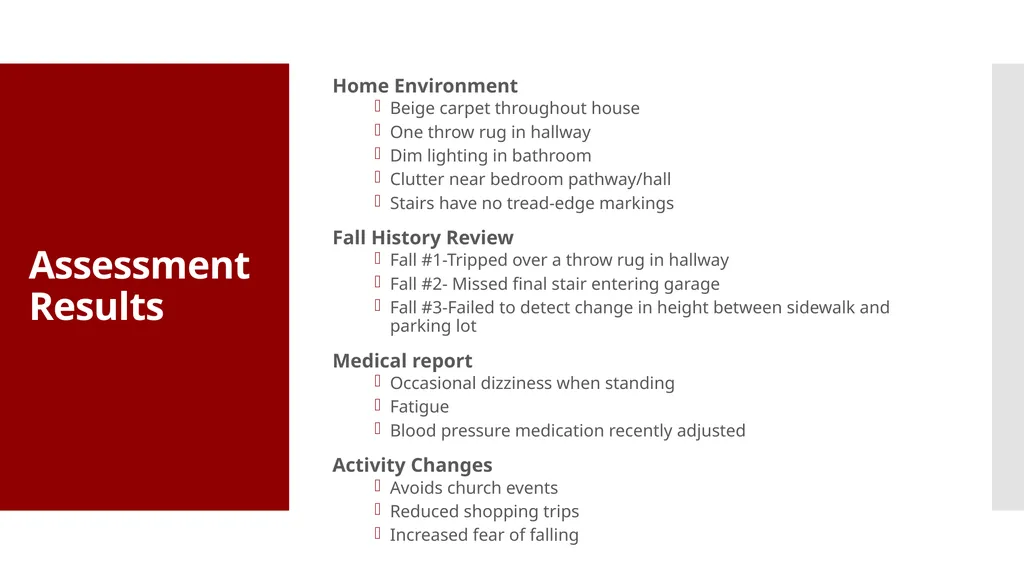
Assessment Results Home Environment
Beige carpet throughout house
One throw rug in hallway
Dim lighting in bathroom
Clutter near bedroom pathway/hall
Stairs have no tread-edge markings
Fall History Review
Fall #1-Tripped over a throw rug in hallway
Fall #2- Missed final stair entering garage
Fall #3-Failed to detect change in height between sidewalk and parking lot
Medical report
Occasional dizziness when standing
Fatigue
Blood pressure medication recently adjusted
Activity Changes
Avoids church events
Reduced shopping trips
Increased fear of falling<br>
08
Time for thoughts and questions<br>
09
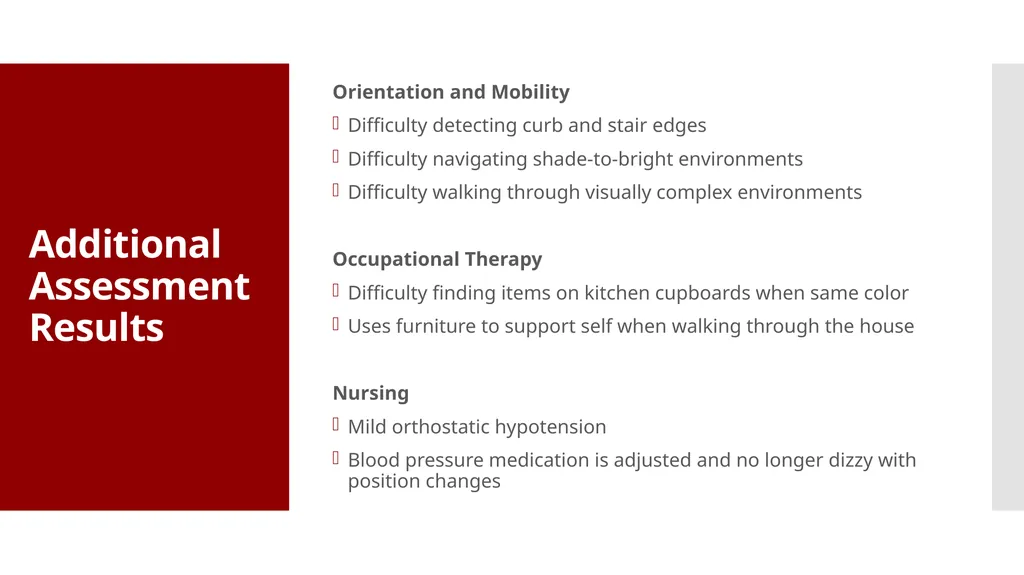
Additional Assessment Results Orientation and Mobility
Difficulty detecting curb and stair edges
Difficulty navigating shade-to-bright environments
Difficulty walking through visually complex environments
Occupational Therapy
Difficulty finding items on kitchen cupboards when same color
Uses furniture to support self when walking through the house
Nursing
Mild orthostatic hypotension
Blood pressure medication is adjusted and no longer dizzy with position changes<br>
10
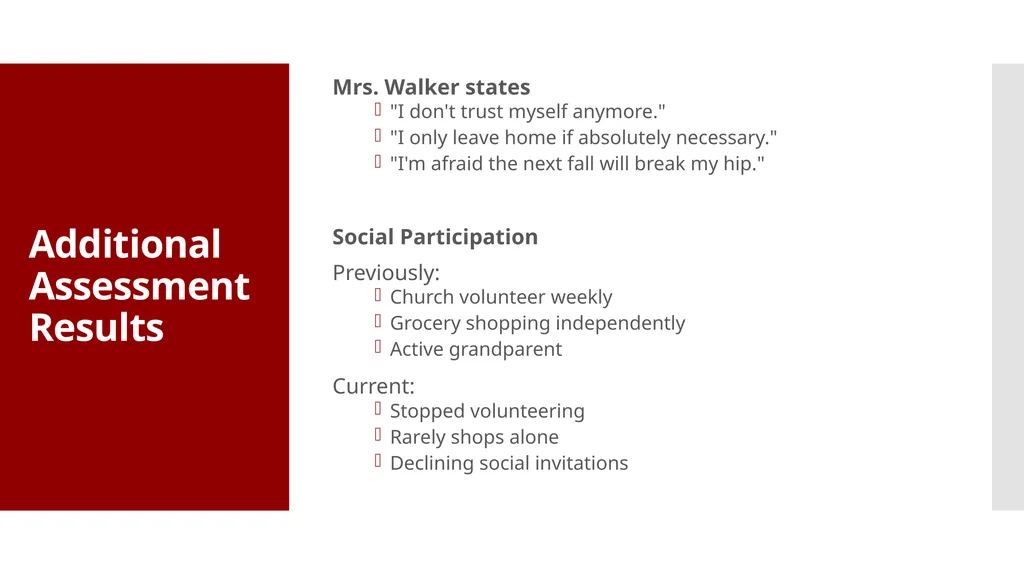
Additional Assessment Results Mrs. Walker states
"I don't trust myself anymore."
"I only leave home if absolutely necessary."
"I'm afraid the next fall will break my hip."
Social Participation
Previously:
Church volunteer weekly
Grocery shopping independently
Active grandparent
Current:
Stopped volunteering
Rarely shops alone
Declining social invitations<br>
11
Time for thoughts and questions<br>
12
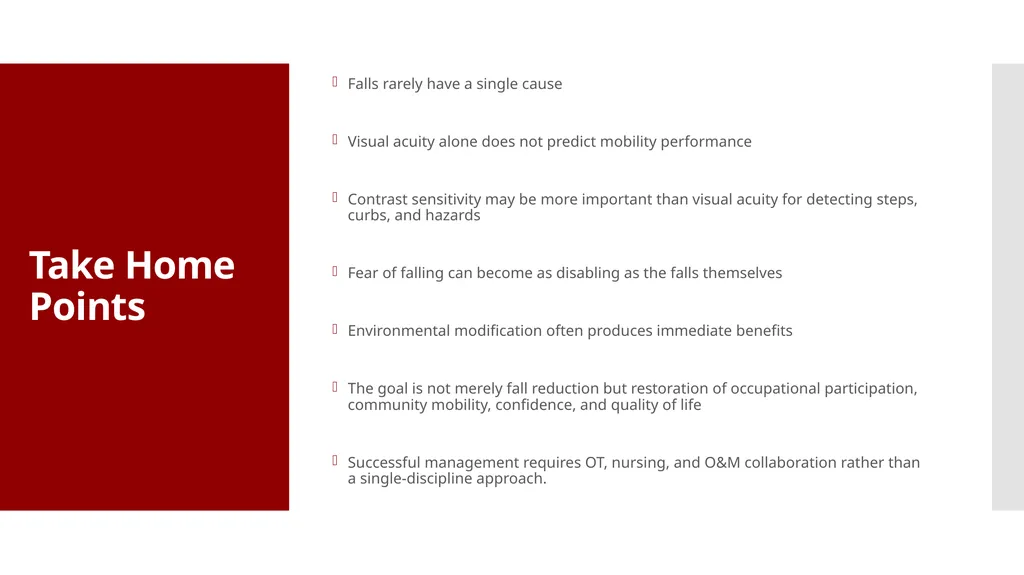
Take Home Points Falls rarely have a single cause
Visual acuity alone does not predict mobility performance
Contrast sensitivity may be more important than visual acuity for detecting steps, curbs, and hazards
Fear of falling can become as disabling as the falls themselves
Environmental modification often produces immediate benefits
The goal is not merely fall reduction but restoration of occupational participation, community mobility, confidence, and quality of life
Successful management requires OT, nursing, and O&M collaboration rather than a single-discipline approach.<br>