
Fall Protection Safety Objectives The purpose of
LV
Published · 72 slides · 0 views

1 / 1



Description
Fall Protection Safety Objectives The purpose of this class is to provide an overall awareness pertaining to fall hazards and methods of fall prevention and fall arrest. Upon completion of this course, students will be able to: Identify
Related Topics
Share
Embed code
Download this presentation From Below
"Fall Protection Safety Objectives The purpose of" is the property of its rightful owner. Permission is granted to download and print the materials on this website for personal, non-commercial use only, and to display it on your personal computer provided you do not modify the materials and that you retain all copyright notices contained in the materials. By downloading content from our website, you accept the terms of this agreement.
Presentation Transcript
01
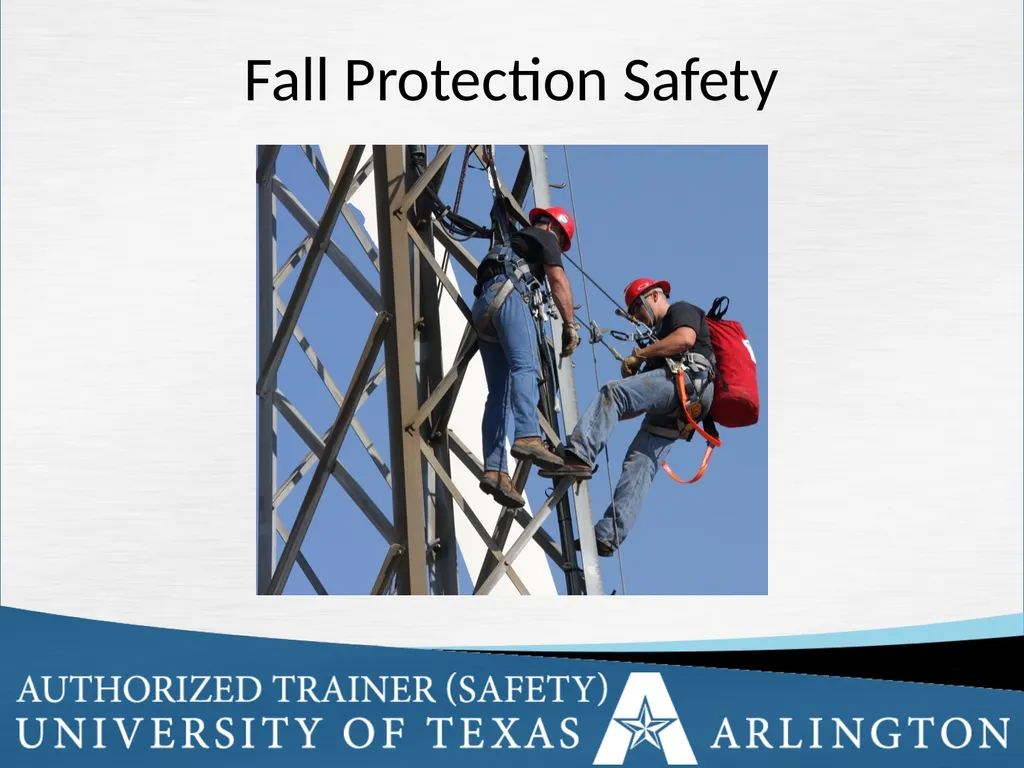
Fall Protection Safety<br>
02
Objectives The purpose of this class is to provide an overall awareness pertaining to fall hazards and methods of fall prevention and fall arrest.
Upon completion of this course, students will be able to:
Identify fall hazards and when fall protection is needed.
Identify methods of fall prevention as well as types of fall protection and their basic components.
Recognize and discuss good work practices based on OSHA guidelines and describe the primary components of an OSHA compliant fall protection program.<br>
Upon completion of this course, students will be able to:
Identify fall hazards and when fall protection is needed.
Identify methods of fall prevention as well as types of fall protection and their basic components.
Recognize and discuss good work practices based on OSHA guidelines and describe the primary components of an OSHA compliant fall protection program.<br>
03
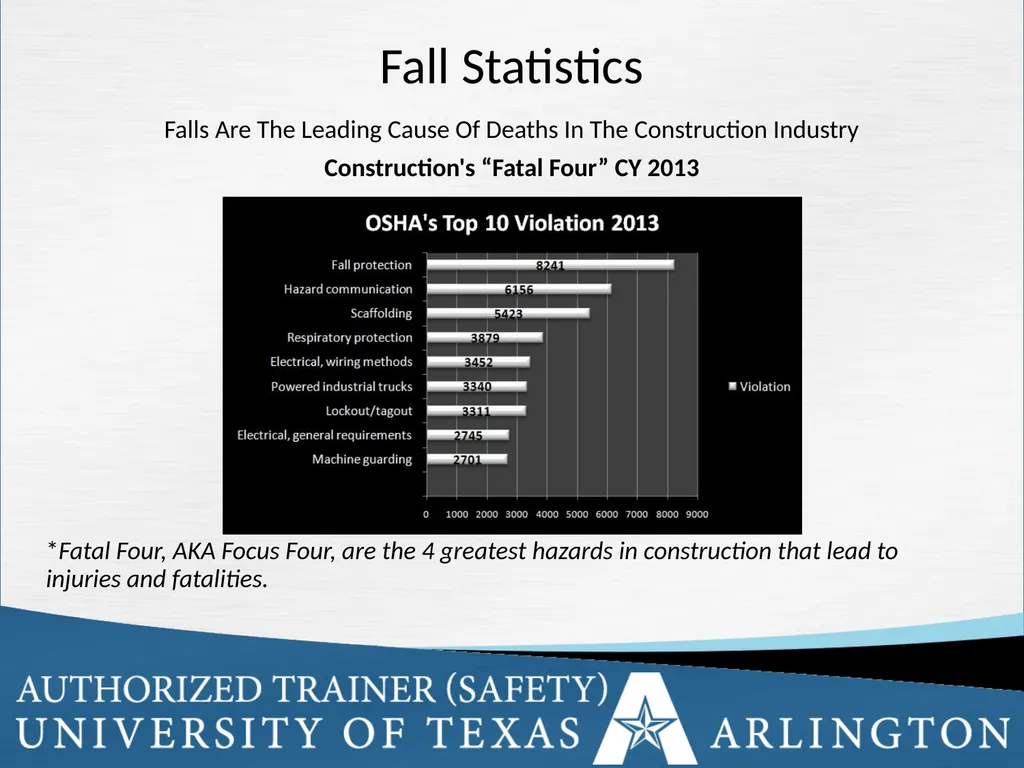
Fall Statistics Falls Are The Leading Cause Of Deaths In The Construction Industry
Construction's “Fatal Four” CY 2013
*Fatal Four, AKA Focus Four, are the 4 greatest hazards in construction that lead to injuries and fatalities.<br>
Construction's “Fatal Four” CY 2013
*Fatal Four, AKA Focus Four, are the 4 greatest hazards in construction that lead to injuries and fatalities.<br>
04
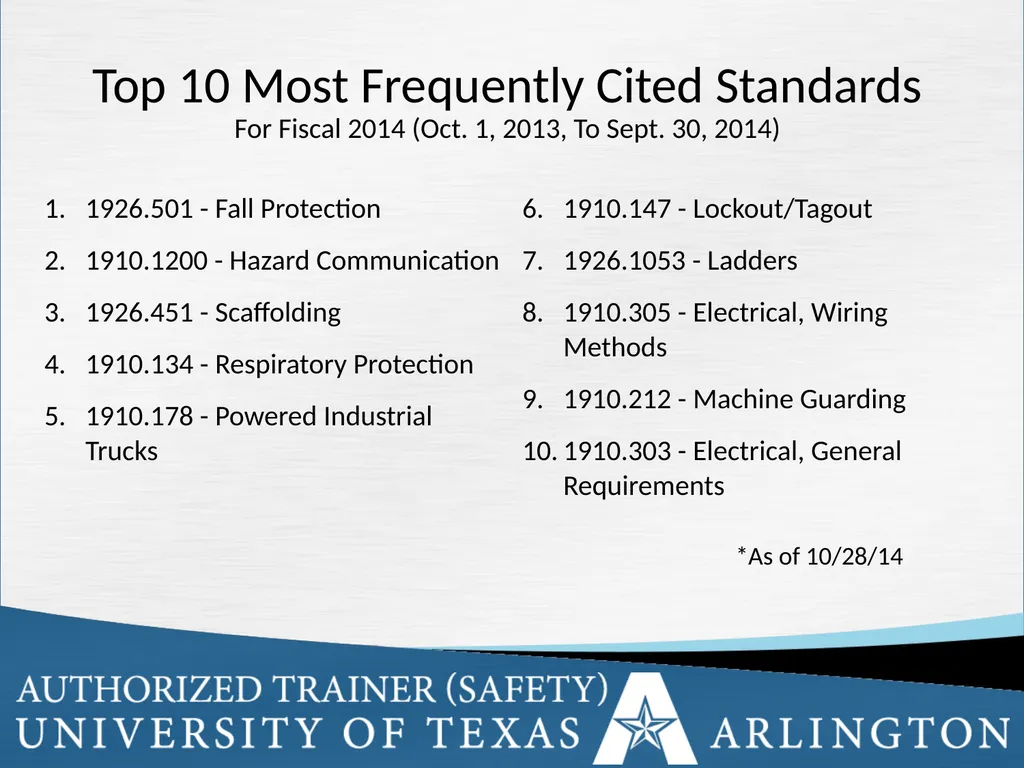
Top 10 Most Frequently Cited Standards
For Fiscal 2014 (Oct. 1, 2013, To Sept. 30, 2014) *As of 10/28/14<br>
05
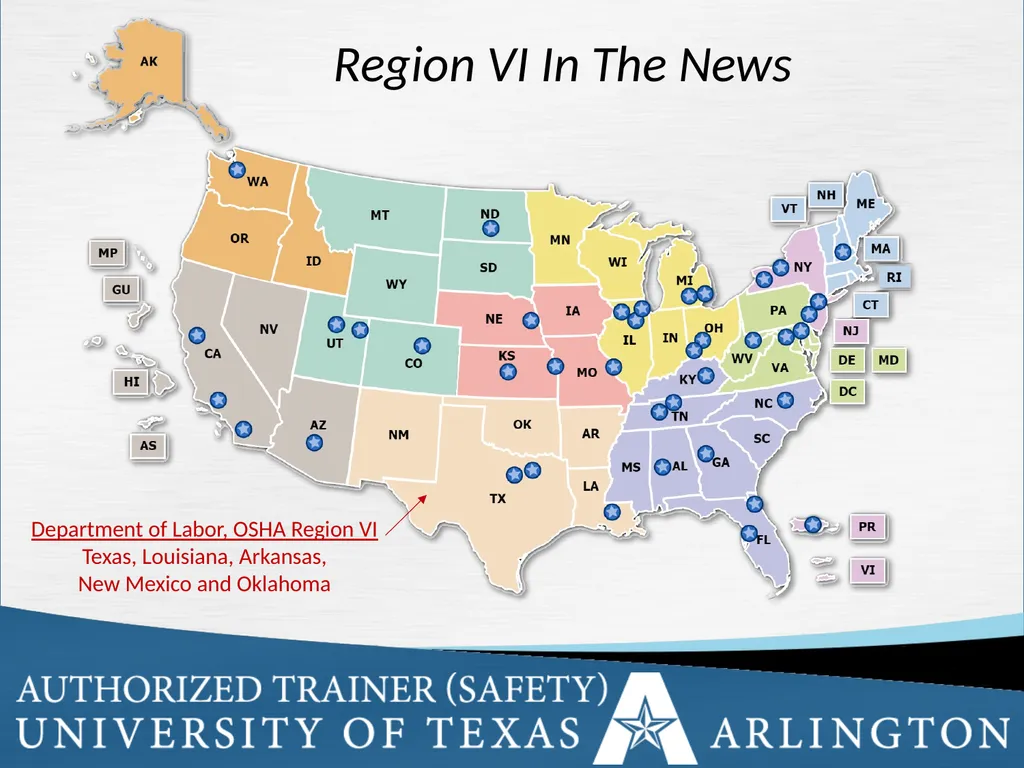
Region VI In The News Department of Labor, OSHA Region VI
Texas, Louisiana, Arkansas,
New Mexico and Oklahoma<br>
Texas, Louisiana, Arkansas,
New Mexico and Oklahoma<br>
06
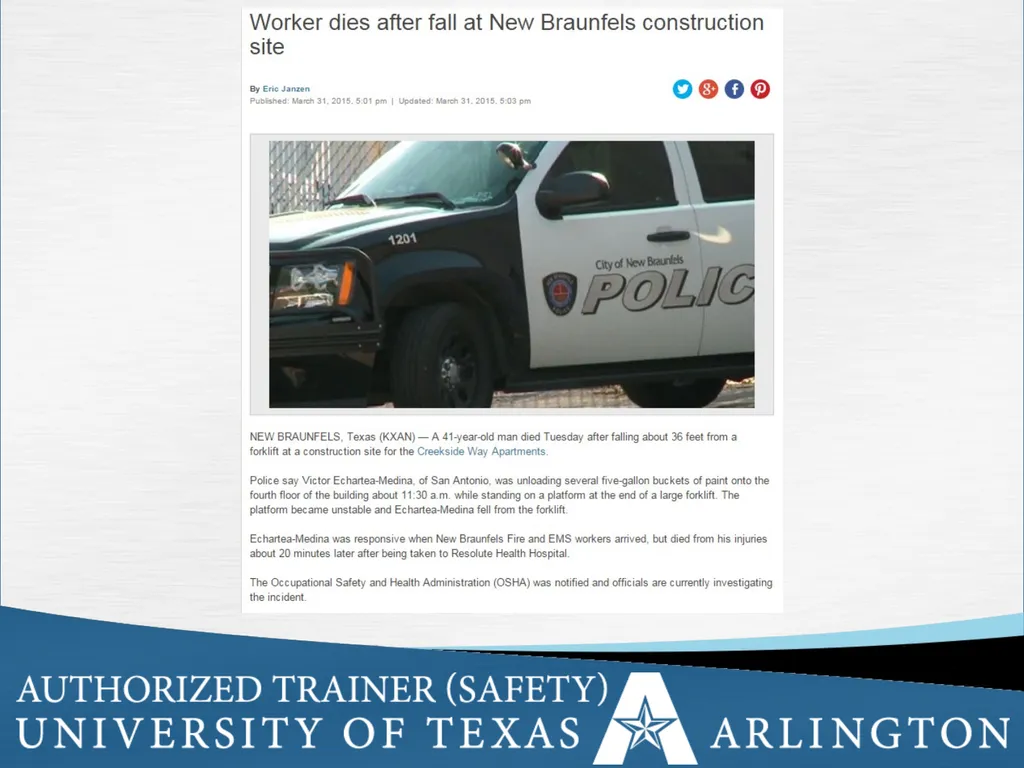
TEXAS<br>
07
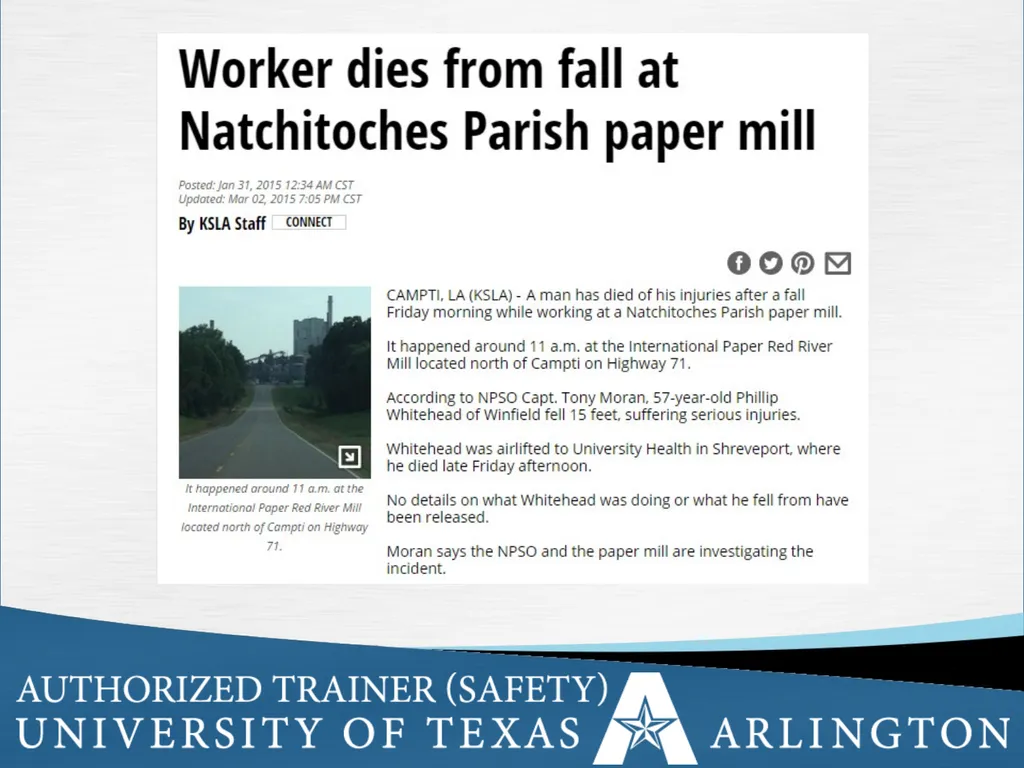
LOUISIANA<br>
08
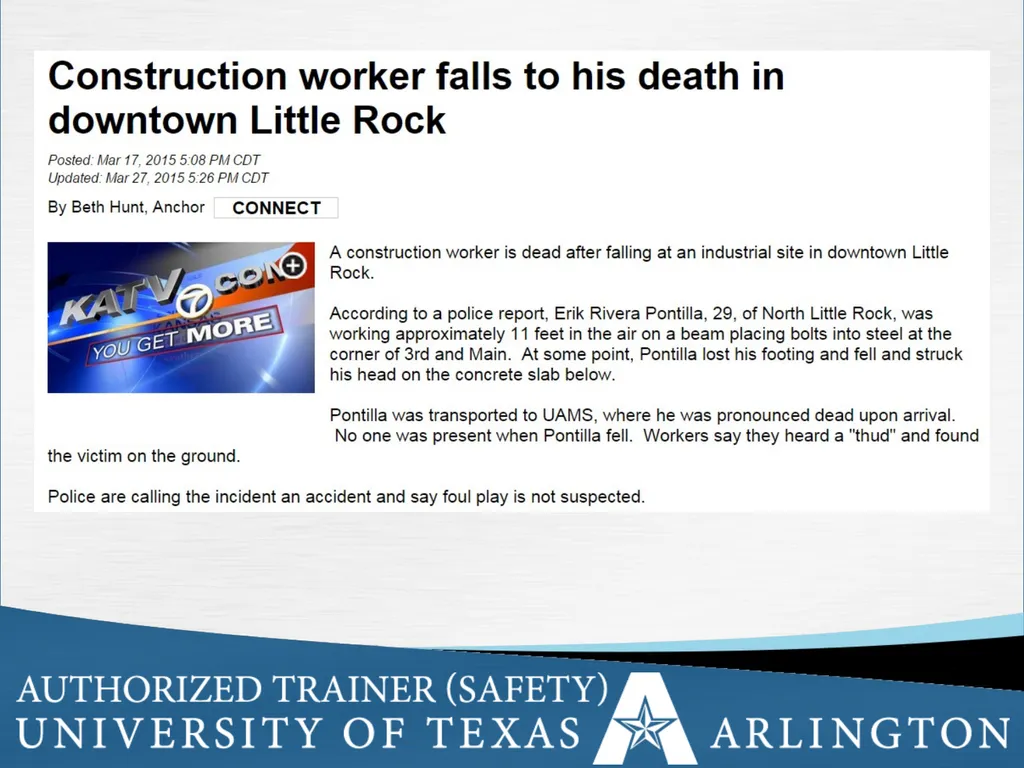
ARKANSAS<br>
09
Have you ever fallen or
known someone who fell?<br>
known someone who fell?<br>
10
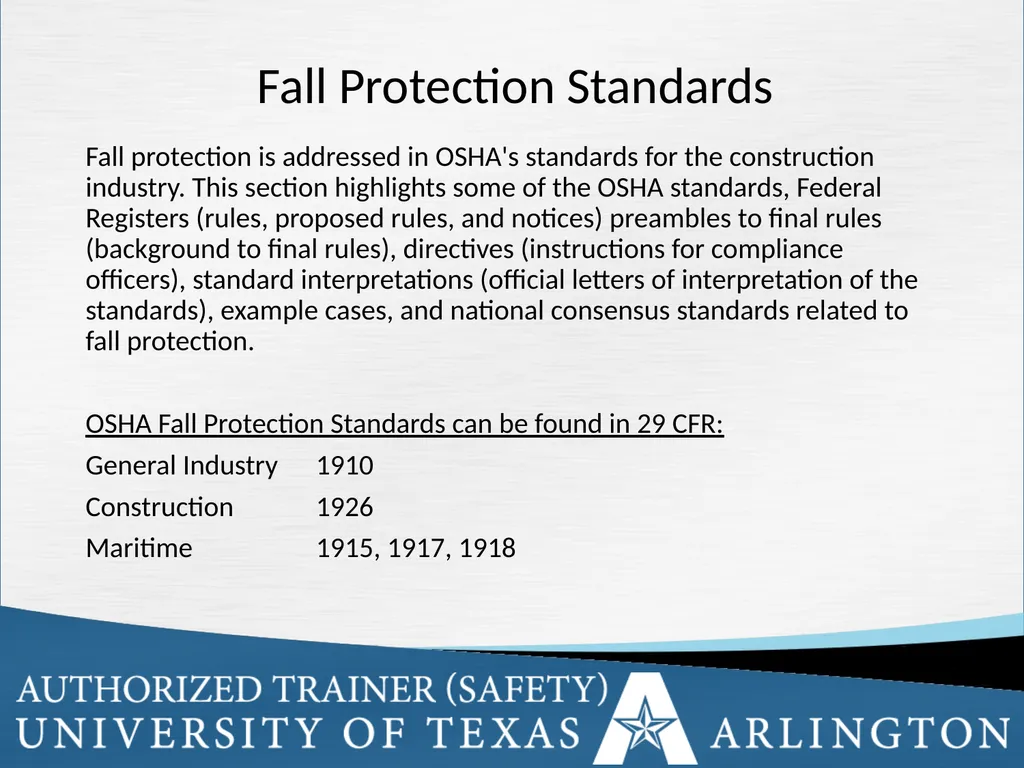
Fall Protection Standards Fall protection is addressed in OSHA's standards for the construction industry. This section highlights some of the OSHA standards, Federal Registers (rules, proposed rules, and notices) preambles to final rules (background to final rules), directives (instructions for compliance officers), standard interpretations (official letters of interpretation of the standards), example cases, and national consensus standards related to fall protection.
OSHA Fall Protection Standards can be found in 29 CFR:
General Industry 1910
Construction 1926
Maritime 1915, 1917, 1918<br>
OSHA Fall Protection Standards can be found in 29 CFR:
General Industry 1910
Construction 1926
Maritime 1915, 1917, 1918<br>
11
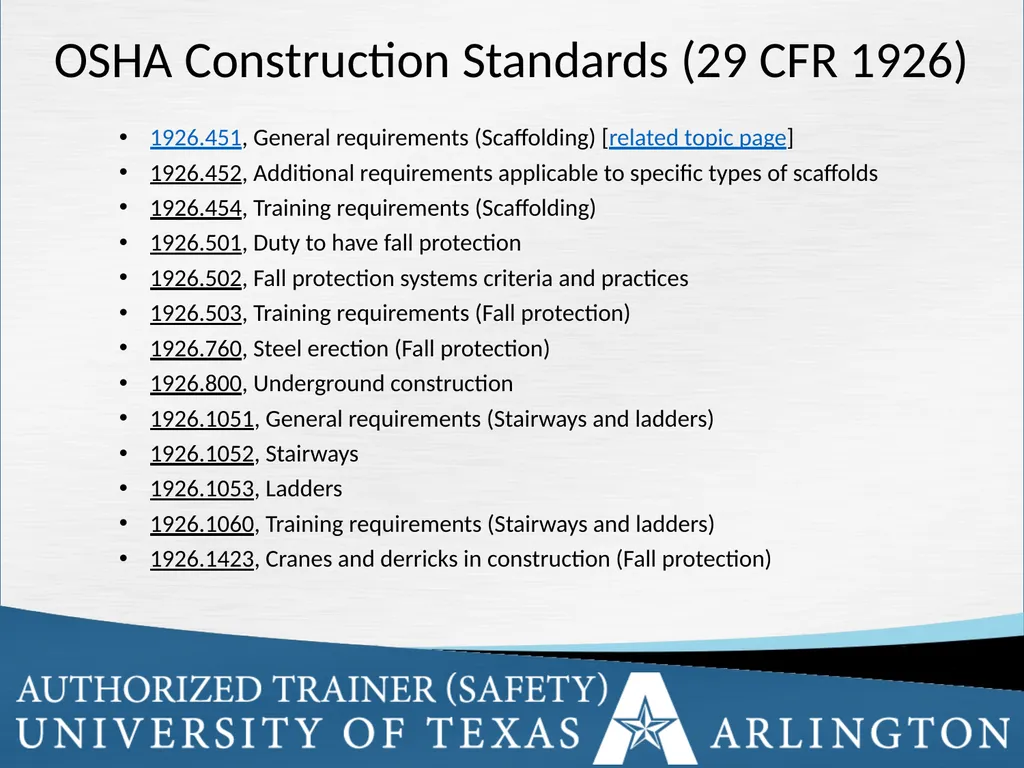
OSHA Construction Standards (29 CFR 1926) 1926.451, General requirements (Scaffolding) [related topic page]
1926.452, Additional requirements applicable to specific types of scaffolds
1926.454, Training requirements (Scaffolding)
1926.501, Duty to have fall protection
1926.502, Fall protection systems criteria and practices
1926.503, Training requirements (Fall protection)
1926.760, Steel erection (Fall protection)
1926.800, Underground construction
1926.1051, General requirements (Stairways and ladders)
1926.1052, Stairways
1926.1053, Ladders
1926.1060, Training requirements (Stairways and ladders)
1926.1423, Cranes and derricks in construction (Fall protection)<br>
1926.452, Additional requirements applicable to specific types of scaffolds
1926.454, Training requirements (Scaffolding)
1926.501, Duty to have fall protection
1926.502, Fall protection systems criteria and practices
1926.503, Training requirements (Fall protection)
1926.760, Steel erection (Fall protection)
1926.800, Underground construction
1926.1051, General requirements (Stairways and ladders)
1926.1052, Stairways
1926.1053, Ladders
1926.1060, Training requirements (Stairways and ladders)
1926.1423, Cranes and derricks in construction (Fall protection)<br>
12
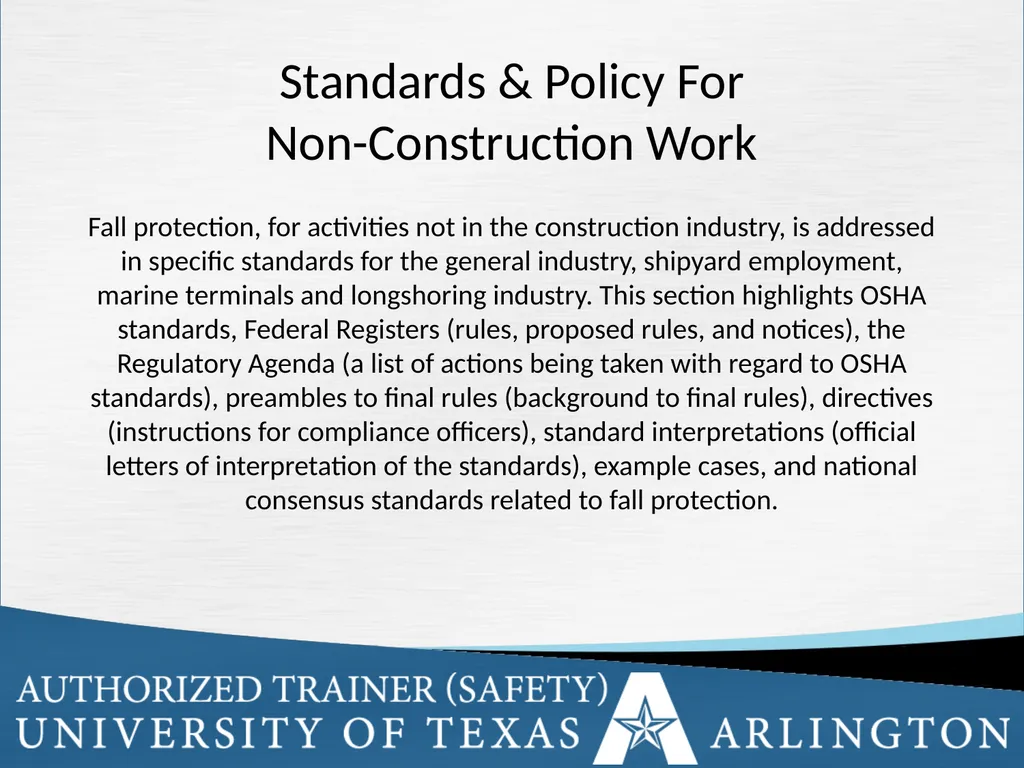
Fall protection, for activities not in the construction industry, is addressed in specific standards for the general industry, shipyard employment, marine terminals and longshoring industry. This section highlights OSHA standards, Federal Registers (rules, proposed rules, and notices), the Regulatory Agenda (a list of actions being taken with regard to OSHA standards), preambles to final rules (background to final rules), directives (instructions for compliance officers), standard interpretations (official letters of interpretation of the standards), example cases, and national consensus standards related to fall protection. Standards & Policy For
Non-Construction Work<br>
Non-Construction Work<br>
13
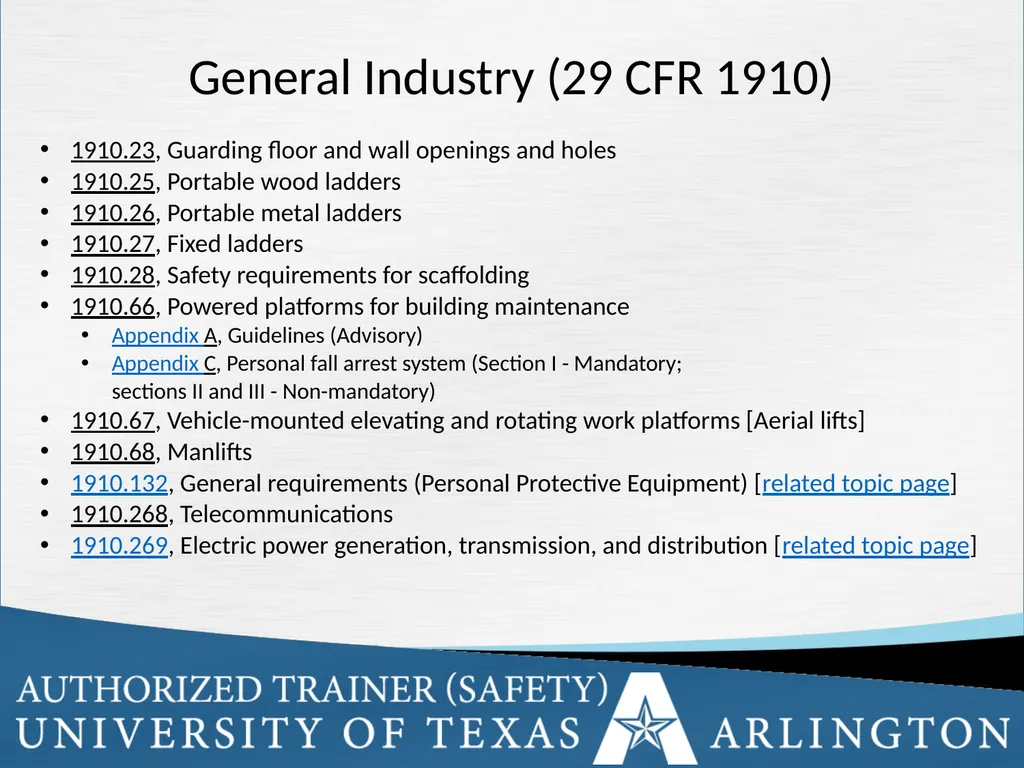
General Industry (29 CFR 1910) 1910.23, Guarding floor and wall openings and holes
1910.25, Portable wood ladders
1910.26, Portable metal ladders
1910.27, Fixed ladders
1910.28, Safety requirements for scaffolding
1910.66, Powered platforms for building maintenance
Appendix A, Guidelines (Advisory)
Appendix C, Personal fall arrest system (Section I - Mandatory; sections II and III - Non-mandatory)
1910.67, Vehicle-mounted elevating and rotating work platforms [Aerial lifts]
1910.68, Manlifts
1910.132, General requirements (Personal Protective Equipment) [related topic page]
1910.268, Telecommunications
1910.269, Electric power generation, transmission, and distribution [related topic page]<br>
1910.25, Portable wood ladders
1910.26, Portable metal ladders
1910.27, Fixed ladders
1910.28, Safety requirements for scaffolding
1910.66, Powered platforms for building maintenance
Appendix A, Guidelines (Advisory)
Appendix C, Personal fall arrest system (Section I - Mandatory; sections II and III - Non-mandatory)
1910.67, Vehicle-mounted elevating and rotating work platforms [Aerial lifts]
1910.68, Manlifts
1910.132, General requirements (Personal Protective Equipment) [related topic page]
1910.268, Telecommunications
1910.269, Electric power generation, transmission, and distribution [related topic page]<br>
14
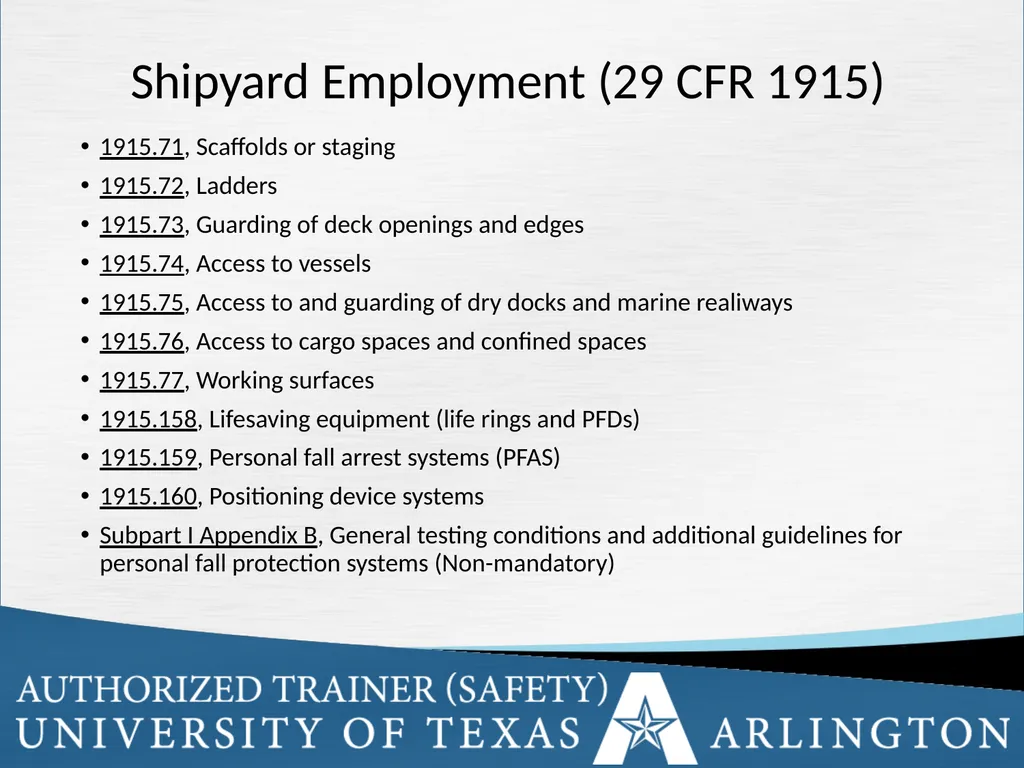
Shipyard Employment (29 CFR 1915) 1915.71, Scaffolds or staging
1915.72, Ladders
1915.73, Guarding of deck openings and edges
1915.74, Access to vessels
1915.75, Access to and guarding of dry docks and marine realiways
1915.76, Access to cargo spaces and confined spaces
1915.77, Working surfaces
1915.158, Lifesaving equipment (life rings and PFDs)
1915.159, Personal fall arrest systems (PFAS)
1915.160, Positioning device systems
Subpart I Appendix B, General testing conditions and additional guidelines for personal fall protection systems (Non-mandatory)<br>
1915.72, Ladders
1915.73, Guarding of deck openings and edges
1915.74, Access to vessels
1915.75, Access to and guarding of dry docks and marine realiways
1915.76, Access to cargo spaces and confined spaces
1915.77, Working surfaces
1915.158, Lifesaving equipment (life rings and PFDs)
1915.159, Personal fall arrest systems (PFAS)
1915.160, Positioning device systems
Subpart I Appendix B, General testing conditions and additional guidelines for personal fall protection systems (Non-mandatory)<br>
15
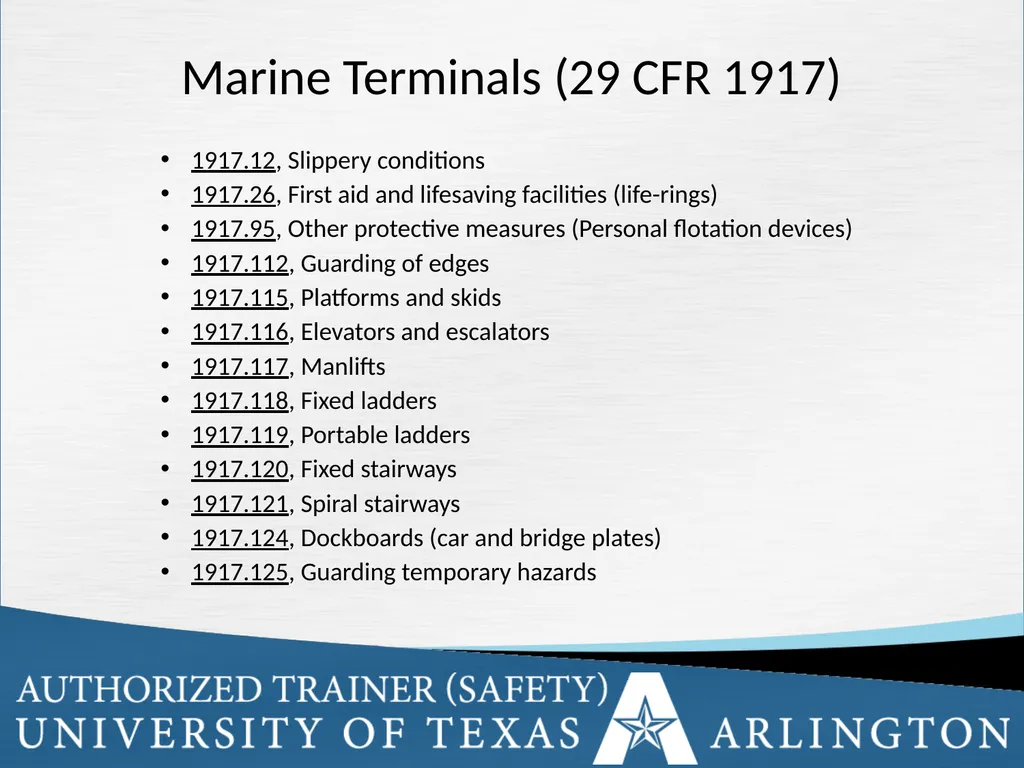
Marine Terminals (29 CFR 1917) 1917.12, Slippery conditions
1917.26, First aid and lifesaving facilities (life-rings)
1917.95, Other protective measures (Personal flotation devices)
1917.112, Guarding of edges
1917.115, Platforms and skids
1917.116, Elevators and escalators
1917.117, Manlifts
1917.118, Fixed ladders
1917.119, Portable ladders
1917.120, Fixed stairways
1917.121, Spiral stairways
1917.124, Dockboards (car and bridge plates)
1917.125, Guarding temporary hazards<br>
1917.26, First aid and lifesaving facilities (life-rings)
1917.95, Other protective measures (Personal flotation devices)
1917.112, Guarding of edges
1917.115, Platforms and skids
1917.116, Elevators and escalators
1917.117, Manlifts
1917.118, Fixed ladders
1917.119, Portable ladders
1917.120, Fixed stairways
1917.121, Spiral stairways
1917.124, Dockboards (car and bridge plates)
1917.125, Guarding temporary hazards<br>
16
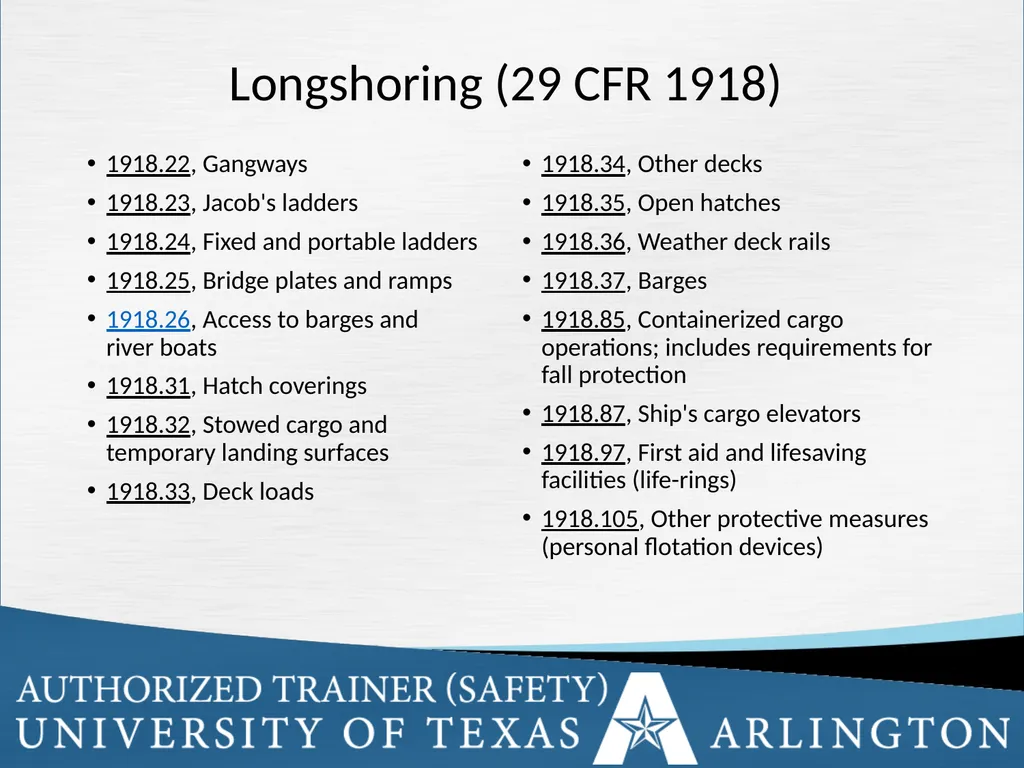
Longshoring (29 CFR 1918) 1918.22, Gangways
1918.23, Jacob's ladders
1918.24, Fixed and portable ladders
1918.25, Bridge plates and ramps
1918.26, Access to barges and river boats
1918.31, Hatch coverings
1918.32, Stowed cargo and temporary landing surfaces
1918.33, Deck loads 1918.34, Other decks
1918.35, Open hatches
1918.36, Weather deck rails
1918.37, Barges
1918.85, Containerized cargo operations; includes requirements for fall protection
1918.87, Ship's cargo elevators
1918.97, First aid and lifesaving facilities (life-rings)
1918.105, Other protective measures (personal flotation devices)<br>
1918.23, Jacob's ladders
1918.24, Fixed and portable ladders
1918.25, Bridge plates and ramps
1918.26, Access to barges and river boats
1918.31, Hatch coverings
1918.32, Stowed cargo and temporary landing surfaces
1918.33, Deck loads 1918.34, Other decks
1918.35, Open hatches
1918.36, Weather deck rails
1918.37, Barges
1918.85, Containerized cargo operations; includes requirements for fall protection
1918.87, Ship's cargo elevators
1918.97, First aid and lifesaving facilities (life-rings)
1918.105, Other protective measures (personal flotation devices)<br>
17
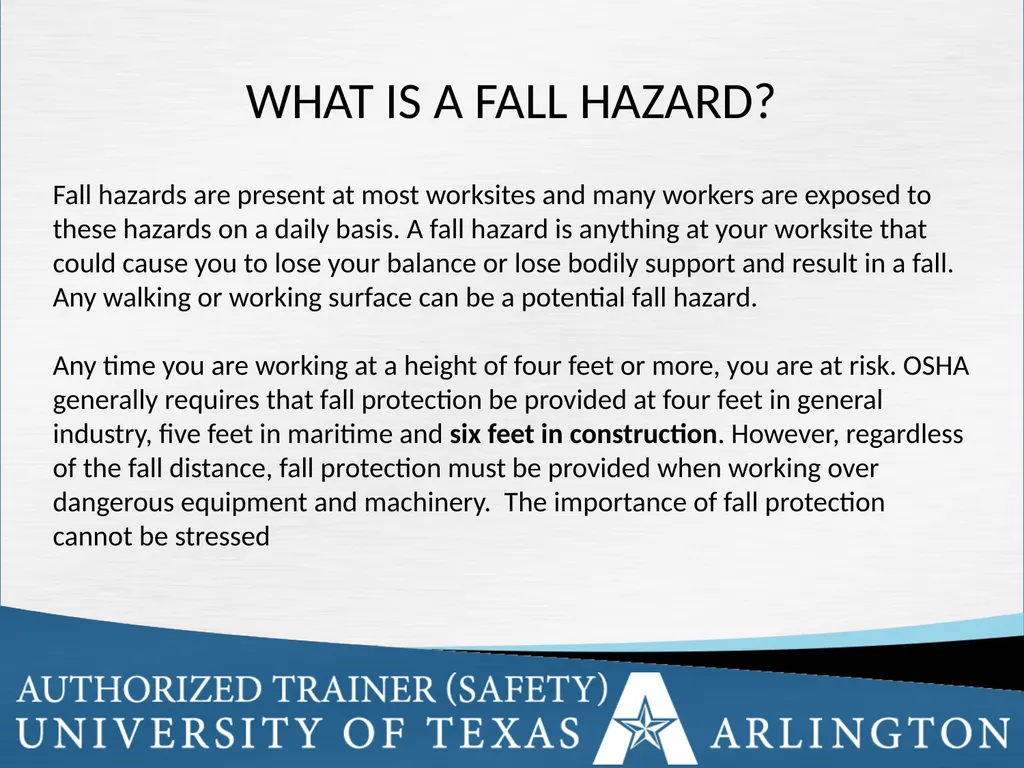
Fall hazards are present at most worksites and many workers are exposed to these hazards on a daily basis. A fall hazard is anything at your worksite that could cause you to lose your balance or lose bodily support and result in a fall. Any walking or working surface can be a potential fall hazard.
Any time you are working at a height of four feet or more, you are at risk. OSHA generally requires that fall protection be provided at four feet in general industry, five feet in maritime and six feet in construction. However, regardless of the fall distance, fall protection must be provided when working over dangerous equipment and machinery. The importance of fall protection cannot be stressed WHAT IS A FALL HAZARD?<br>
Any time you are working at a height of four feet or more, you are at risk. OSHA generally requires that fall protection be provided at four feet in general industry, five feet in maritime and six feet in construction. However, regardless of the fall distance, fall protection must be provided when working over dangerous equipment and machinery. The importance of fall protection cannot be stressed WHAT IS A FALL HAZARD?<br>
18
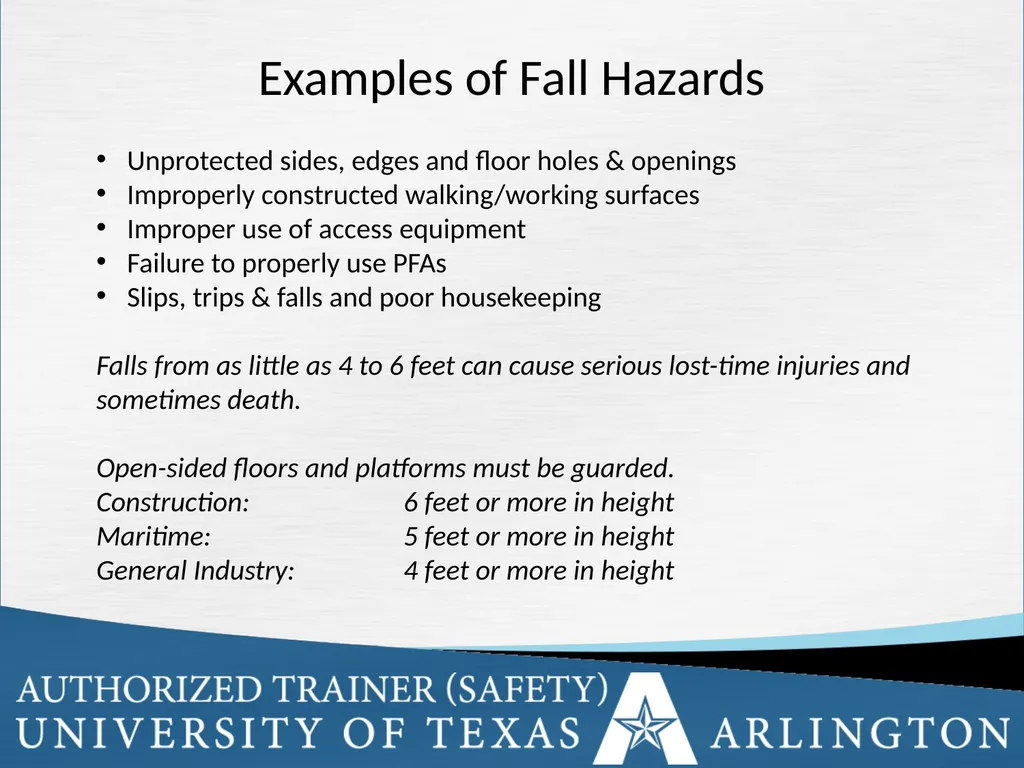
Examples of Fall Hazards Unprotected sides, edges and floor holes & openings
Improperly constructed walking/working surfaces
Improper use of access equipment
Failure to properly use PFAs
Slips, trips & falls and poor housekeeping
Falls from as little as 4 to 6 feet can cause serious lost-time injuries and sometimes death.
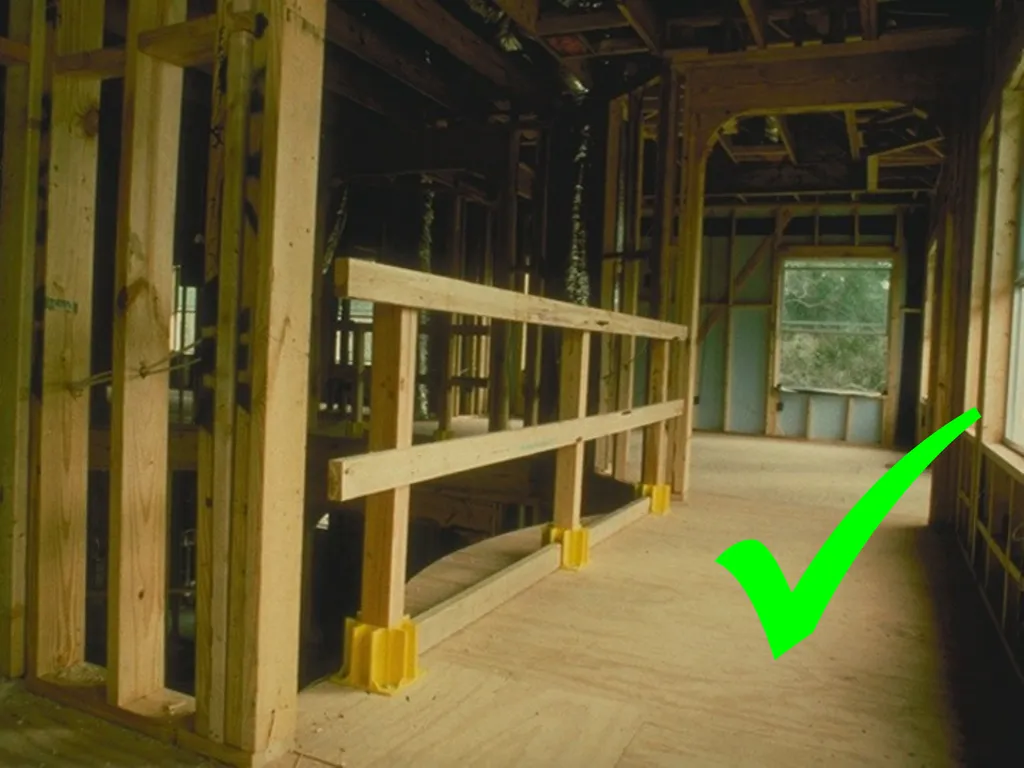
Open-sided floors and platforms must be guarded.
Construction: 6 feet or more in height
Maritime: 5 feet or more in height
General Industry: 4 feet or more in height<br>
Improperly constructed walking/working surfaces
Improper use of access equipment
Failure to properly use PFAs
Slips, trips & falls and poor housekeeping
Falls from as little as 4 to 6 feet can cause serious lost-time injuries and sometimes death.
Open-sided floors and platforms must be guarded.
Construction: 6 feet or more in height
Maritime: 5 feet or more in height
General Industry: 4 feet or more in height<br>
19
Fall Hazards Can Be Prevented Using
Fall Prevention, Fall Restraint & Fall Arrest<br>
20
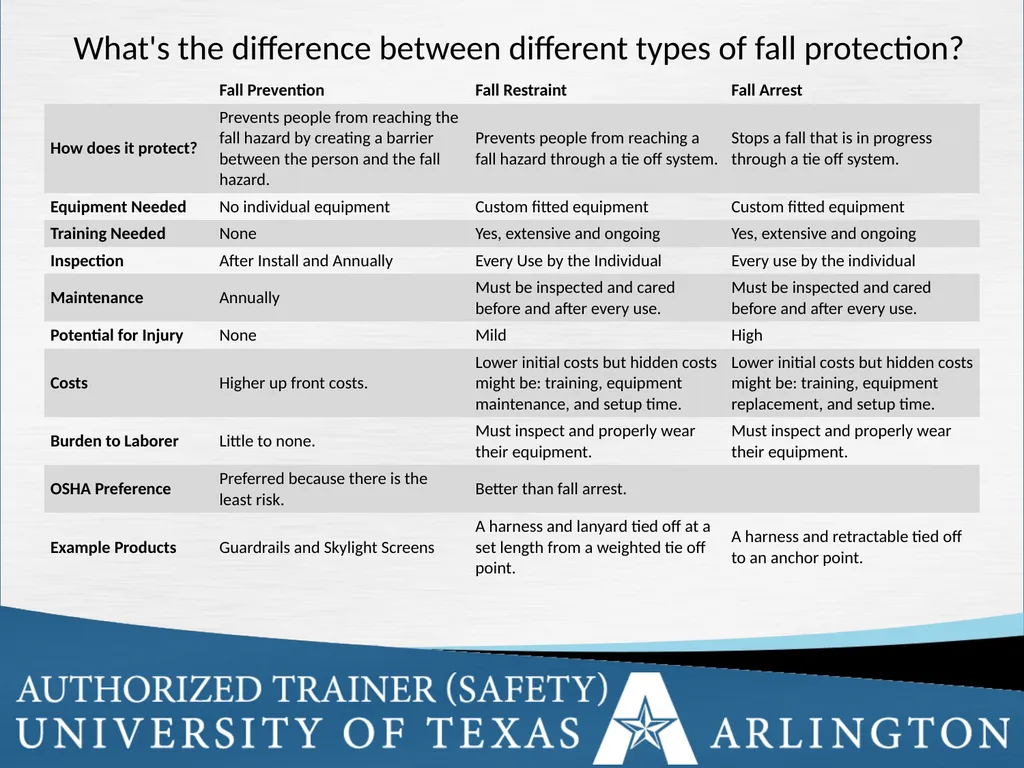
What's the difference between different types of fall protection?<br>
21
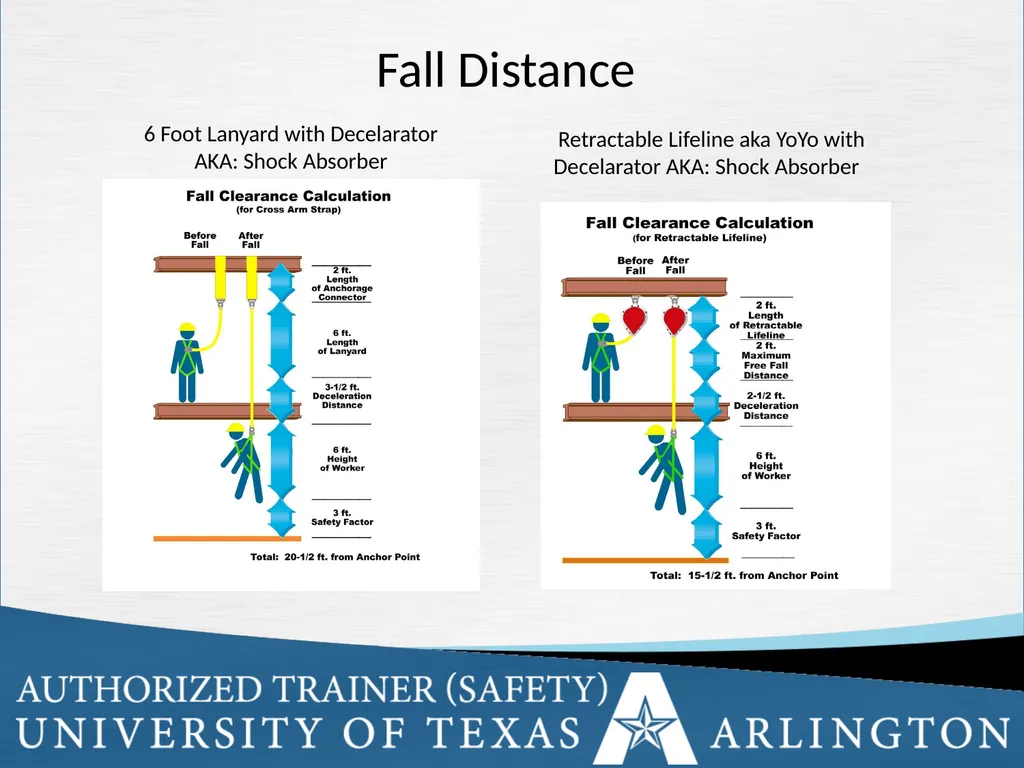
Fall Distance 6 Foot Lanyard with Decelarator
AKA: Shock Absorber Retractable Lifeline aka YoYo with Decelarator AKA: Shock Absorber<br>
AKA: Shock Absorber Retractable Lifeline aka YoYo with Decelarator AKA: Shock Absorber<br>
22
Anatomy of a Fall
How fast can you fall? You may think that you can catch yourself before falling too far and too much damage is done.<br>
23
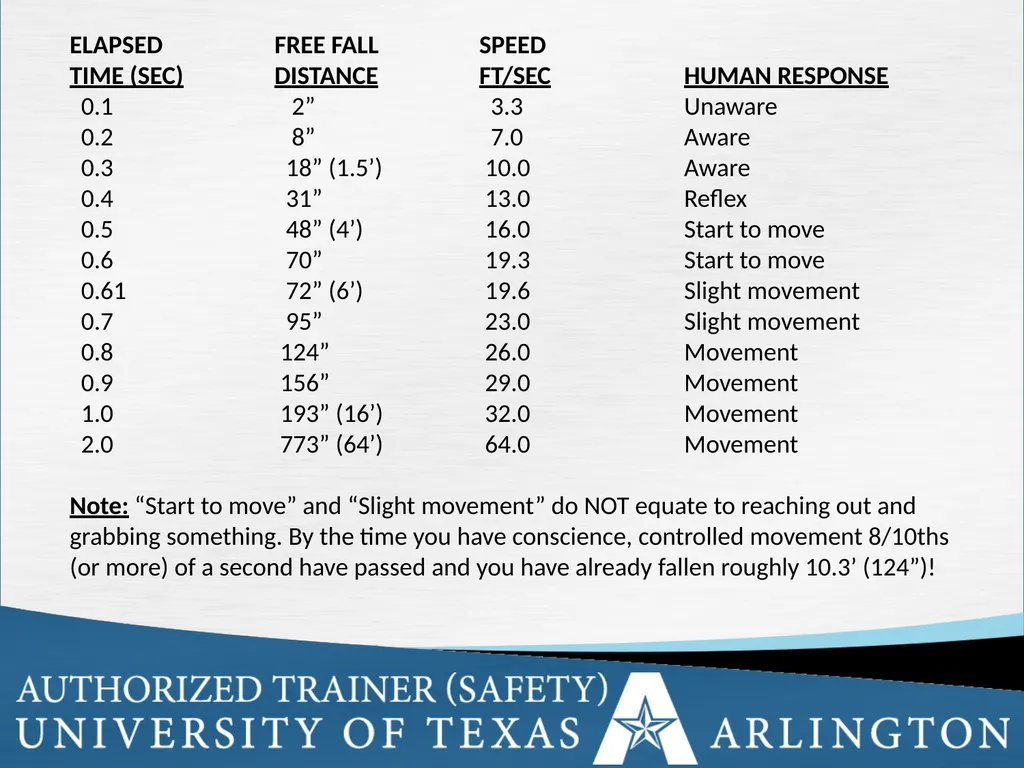
ELAPSED FREE FALL SPEED
TIME (SEC) DISTANCE FT/SEC HUMAN RESPONSE
0.1 2” 3.3 Unaware
0.2 8” 7.0 Aware
0.3 18” (1.5’) 10.0 Aware
0.4 31” 13.0 Reflex
0.5 48” (4’) 16.0 Start to move
0.6 70” 19.3 Start to move
0.61 72” (6’) 19.6 Slight movement
0.7 95” 23.0 Slight movement
0.8 124” 26.0 Movement
0.9 156” 29.0 Movement
1.0 193” (16’) 32.0 Movement
2.0 773” (64’) 64.0 Movement
Note: “Start to move” and “Slight movement” do NOT equate to reaching out and grabbing something. By the time you have conscience, controlled movement 8/10ths (or more) of a second have passed and you have already fallen roughly 10.3’ (124”)!<br>
TIME (SEC) DISTANCE FT/SEC HUMAN RESPONSE
0.1 2” 3.3 Unaware
0.2 8” 7.0 Aware
0.3 18” (1.5’) 10.0 Aware
0.4 31” 13.0 Reflex
0.5 48” (4’) 16.0 Start to move
0.6 70” 19.3 Start to move
0.61 72” (6’) 19.6 Slight movement
0.7 95” 23.0 Slight movement
0.8 124” 26.0 Movement
0.9 156” 29.0 Movement
1.0 193” (16’) 32.0 Movement
2.0 773” (64’) 64.0 Movement
Note: “Start to move” and “Slight movement” do NOT equate to reaching out and grabbing something. By the time you have conscience, controlled movement 8/10ths (or more) of a second have passed and you have already fallen roughly 10.3’ (124”)!<br>
24
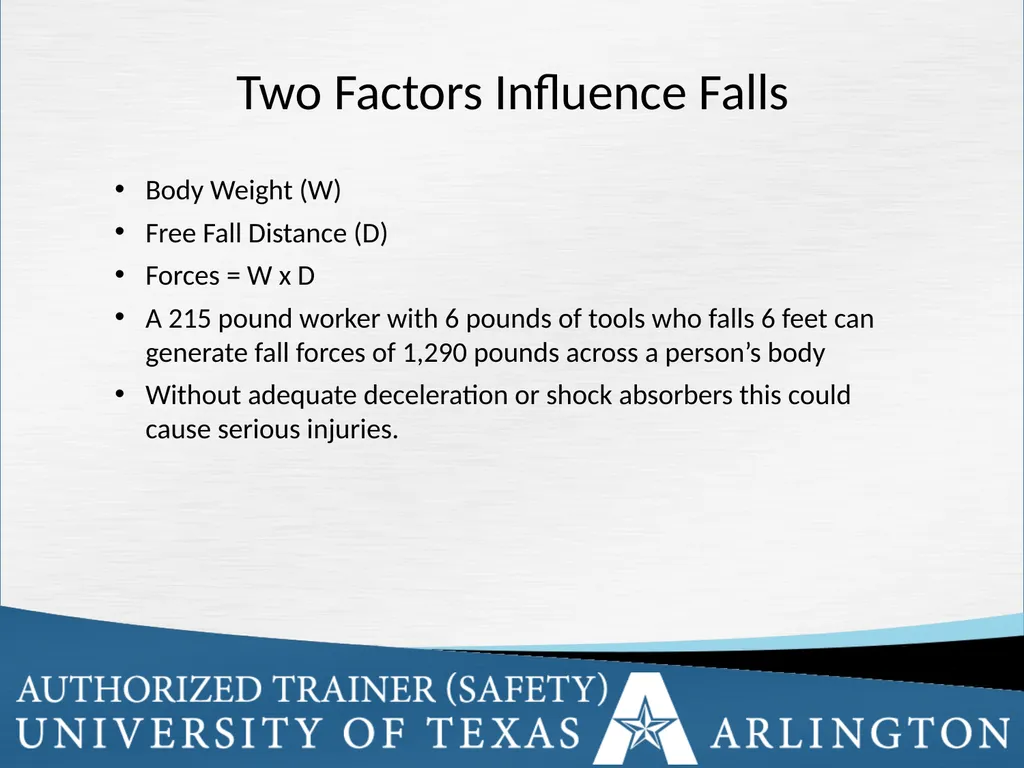
Two Factors Influence Falls Body Weight (W)
Free Fall Distance (D)
Forces = W x D
A 215 pound worker with 6 pounds of tools who falls 6 feet can generate fall forces of 1,290 pounds across a person’s body
Without adequate deceleration or shock absorbers this could cause serious injuries.<br>
Free Fall Distance (D)
Forces = W x D
A 215 pound worker with 6 pounds of tools who falls 6 feet can generate fall forces of 1,290 pounds across a person’s body
Without adequate deceleration or shock absorbers this could cause serious injuries.<br>
25
Roofs
Wall Openings
Excavations
Rebar Hazards
Floor Holes and Openings Fall Hazards Examples<br>
Wall Openings
Excavations
Rebar Hazards
Floor Holes and Openings Fall Hazards Examples<br>
26
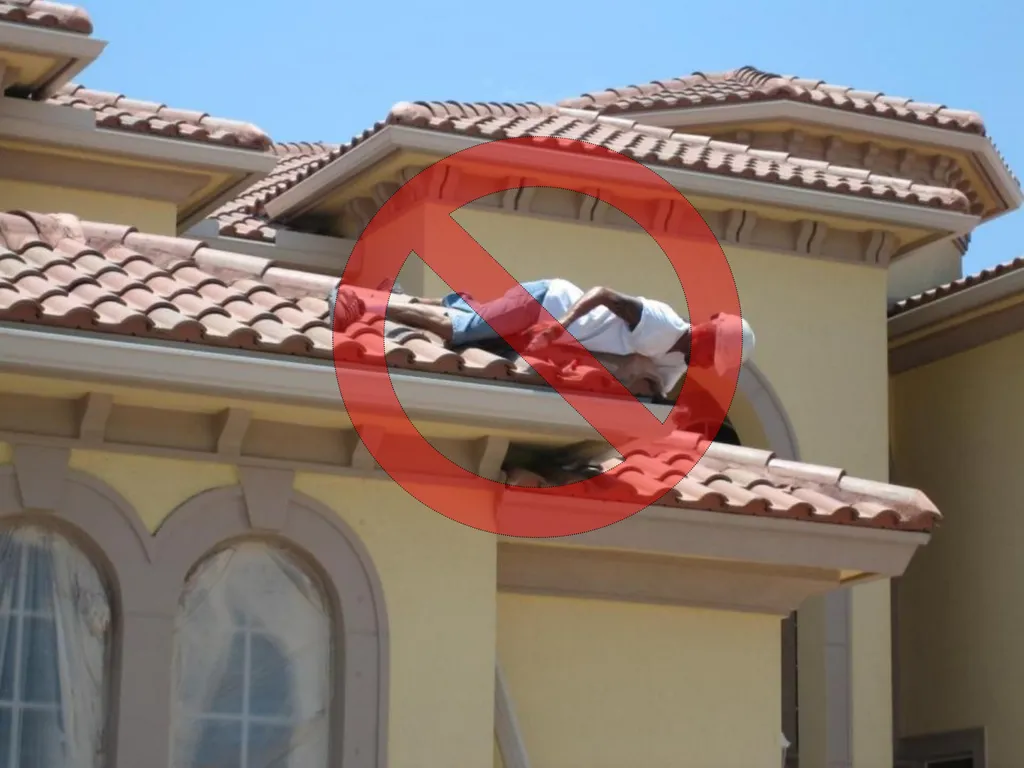
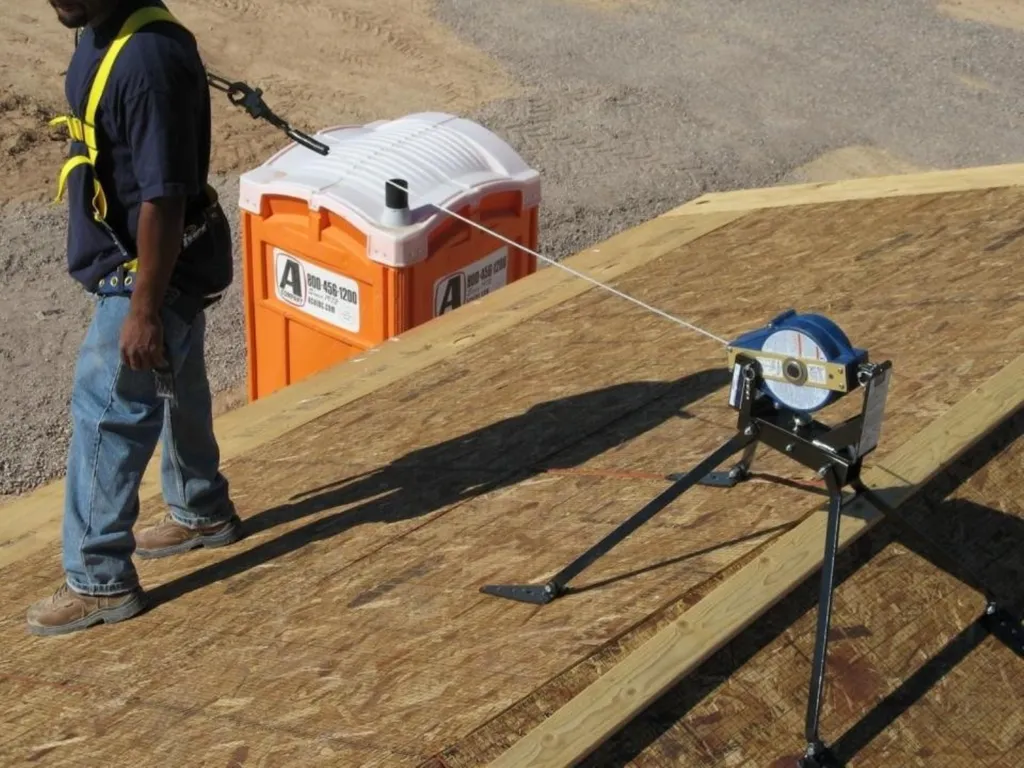
Roofs<br>
27
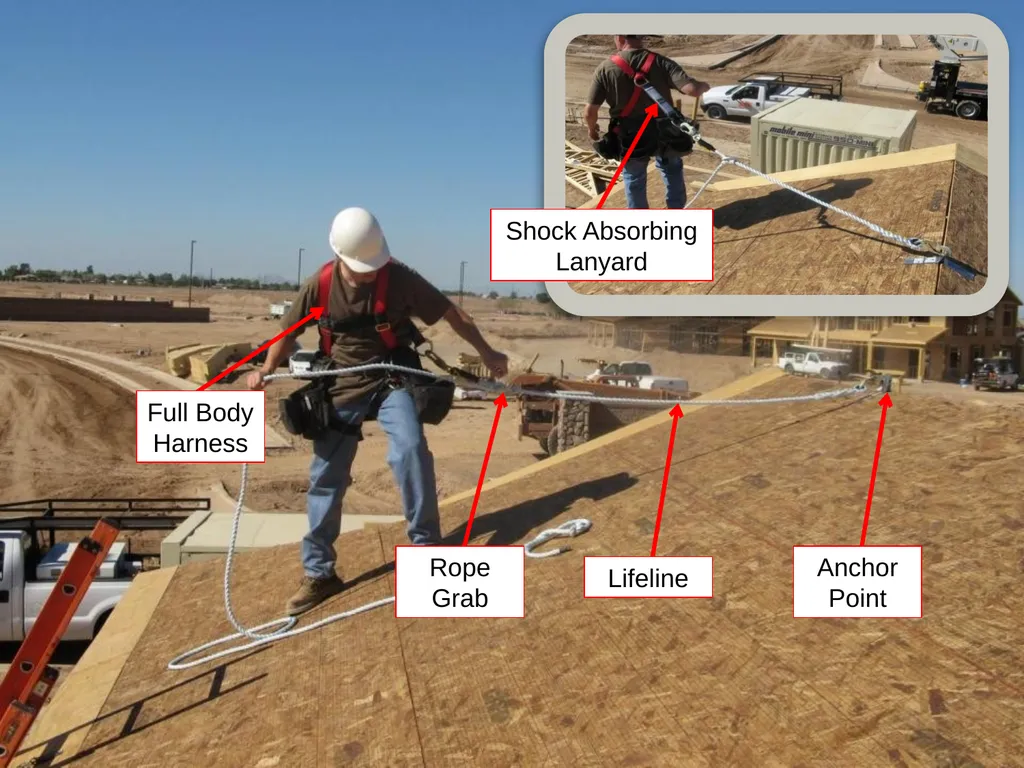
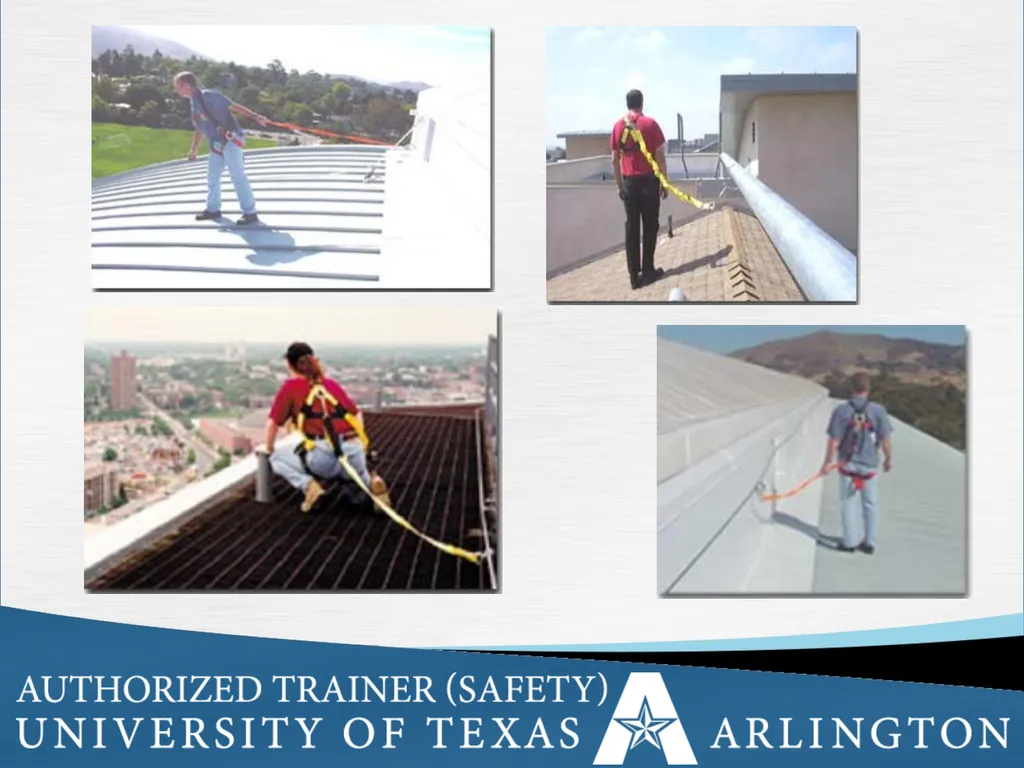
Lifeline Anchor Point Rope Grab Full Body Harness Shock Absorbing Lanyard<br>
28
Wall Openings<br>
29
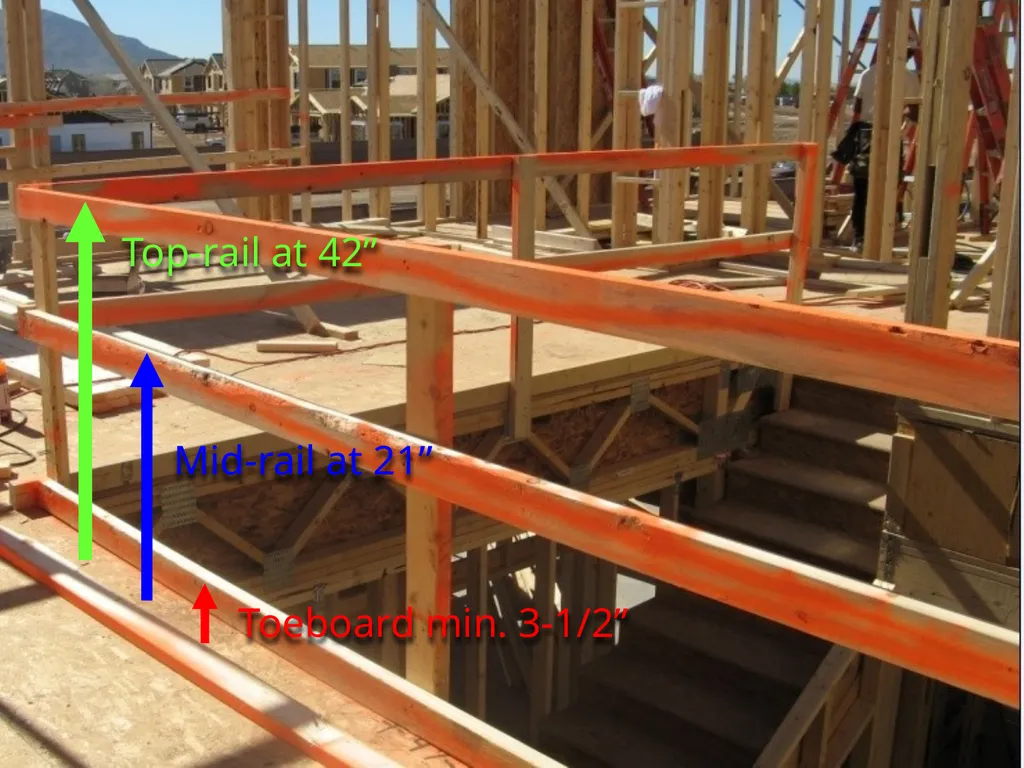
Mid-rail at 21”<br>
30
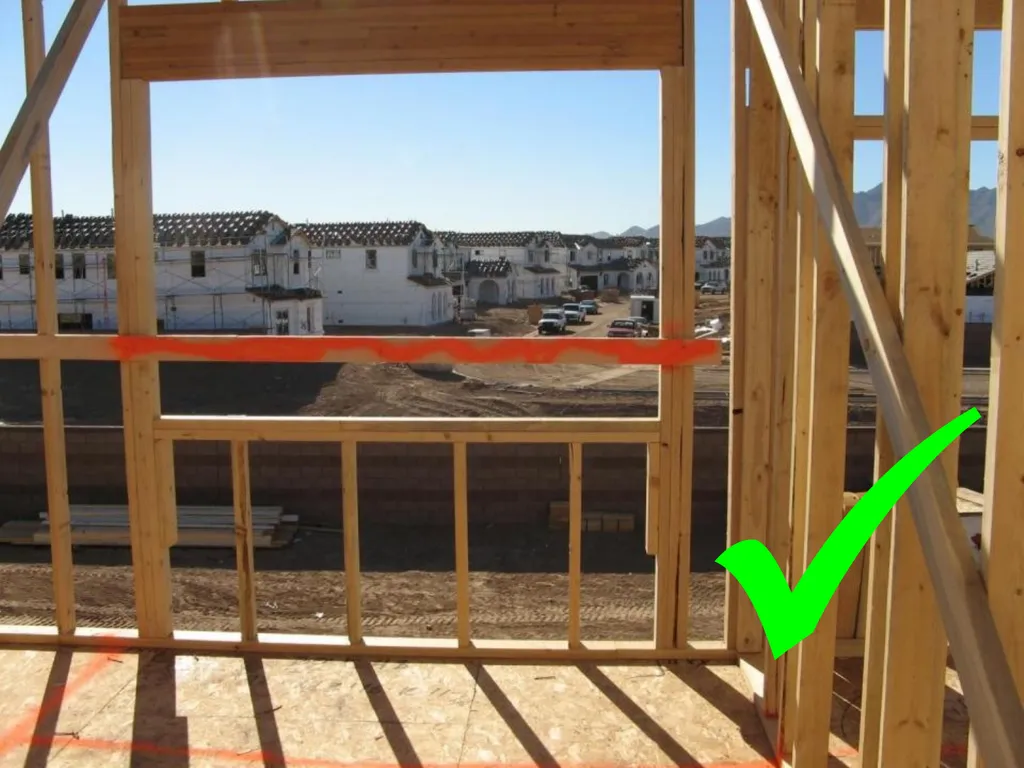
Wall openings greater than 18” need to be protected<br>
31
Rebar Hazards<br>
32
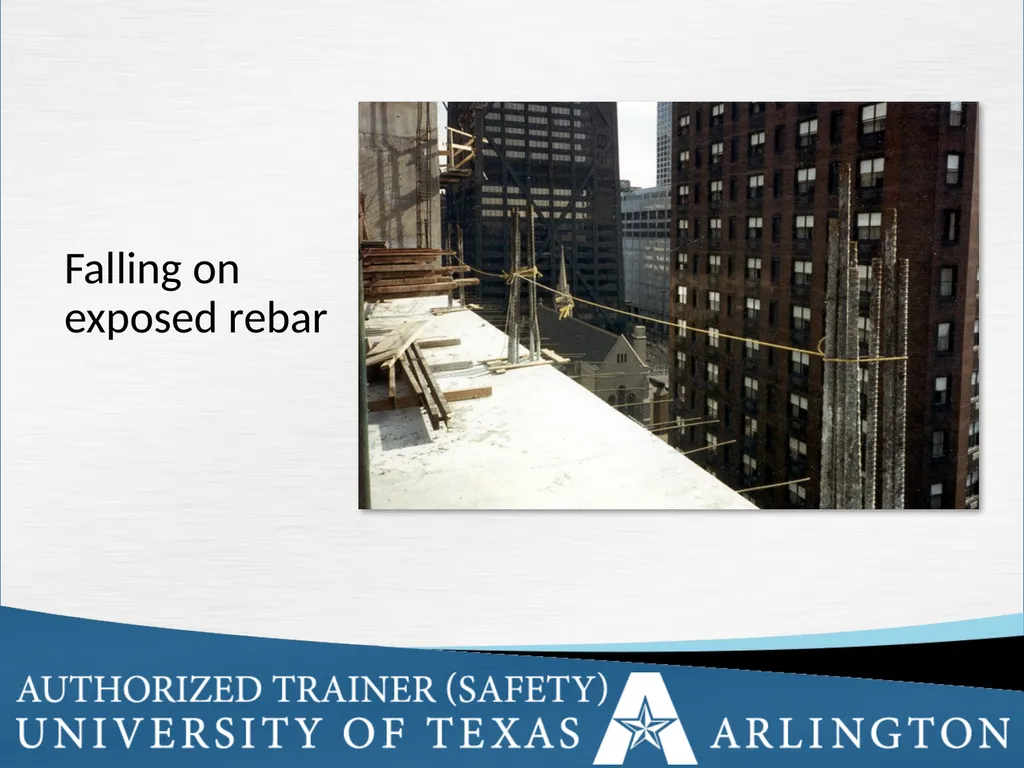
Falling on exposed rebar<br>
33
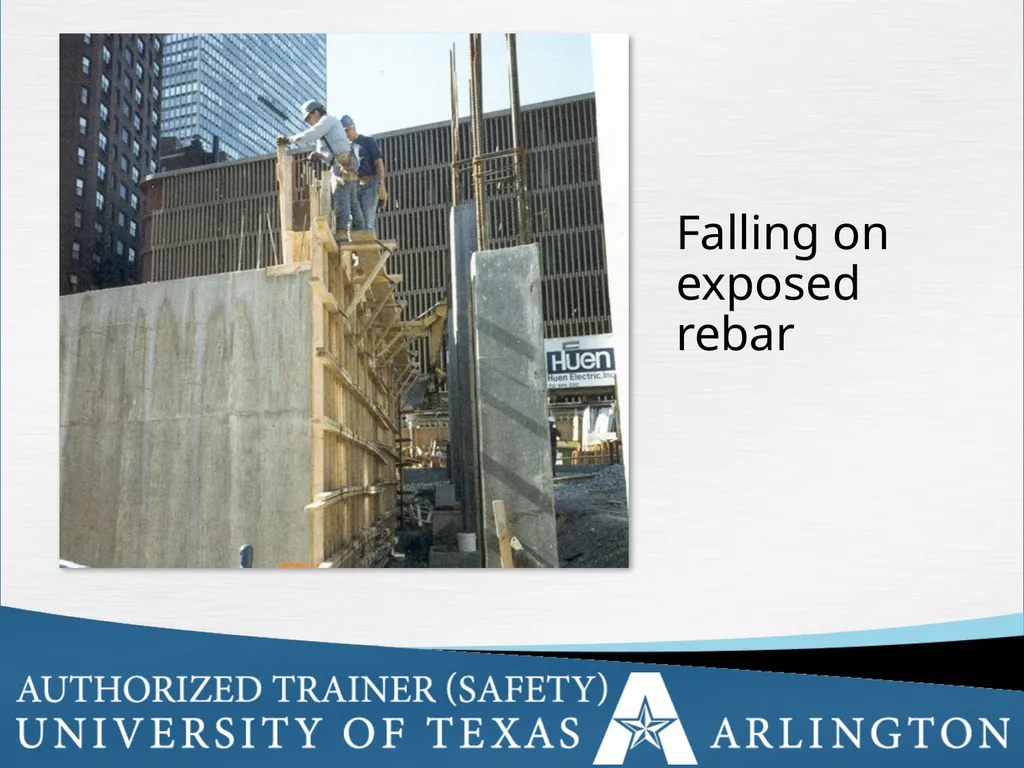
Falling on exposed rebar<br>
34
Floor Holes<br>
35
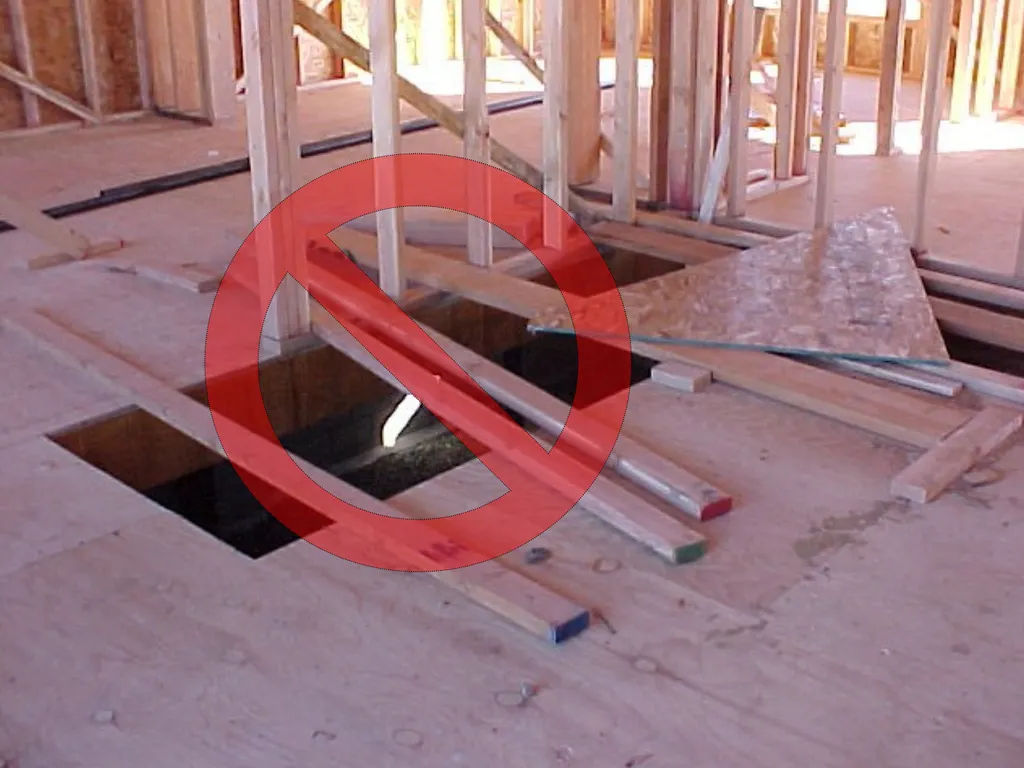
Unguarded Floor Openings<br>
36
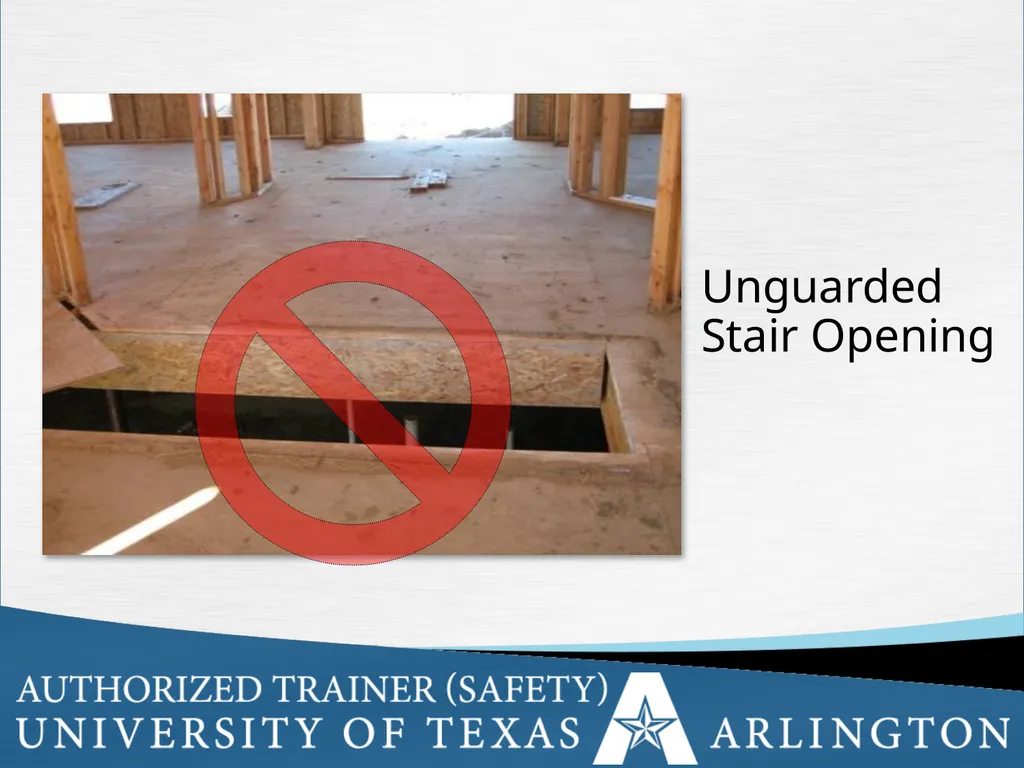
Unguarded Stair Opening<br>
37
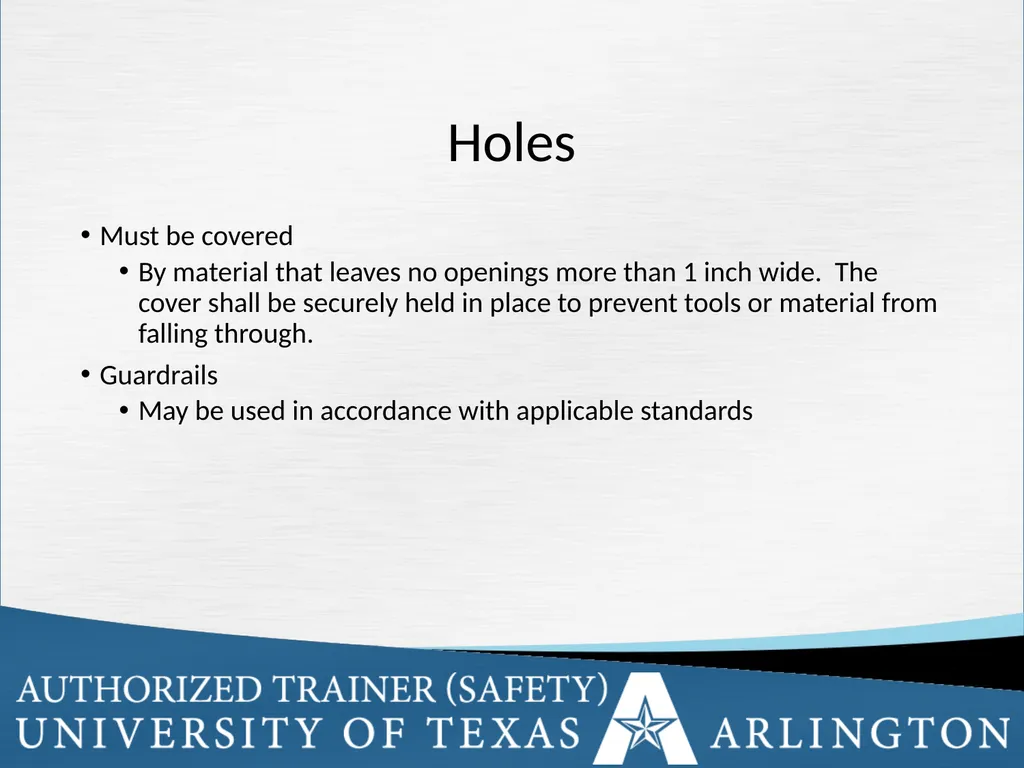
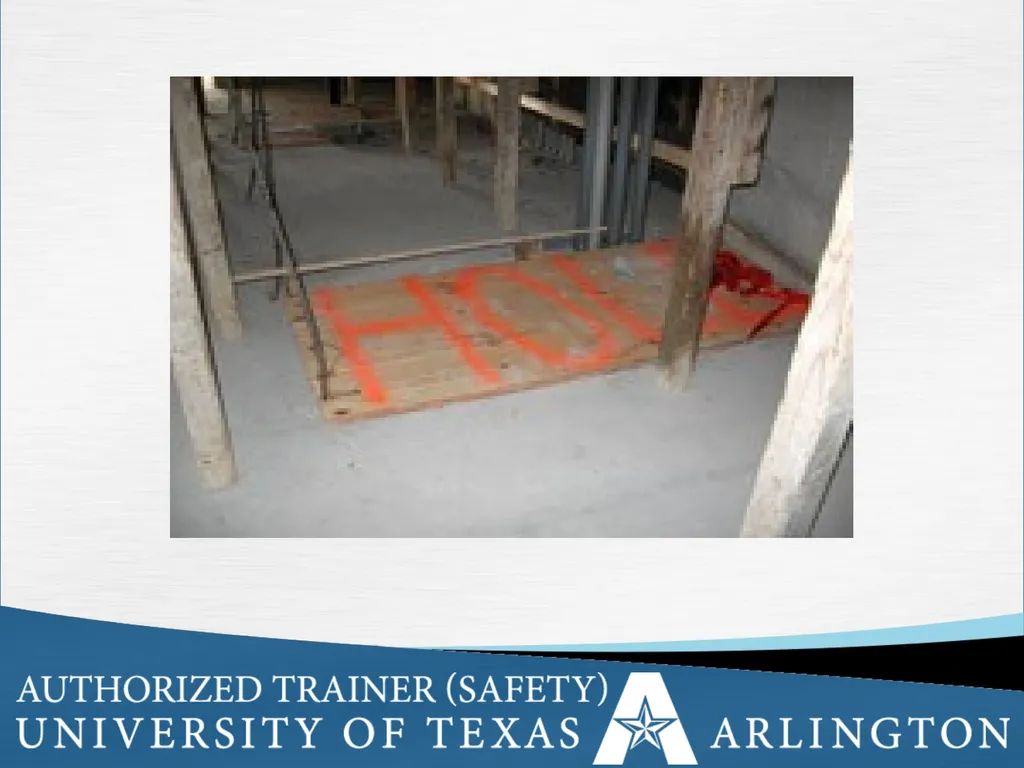
Holes Must be covered
By material that leaves no openings more than 1 inch wide. The cover shall be securely held in place to prevent tools or material from falling through.
Guardrails
May be used in accordance with applicable standards<br>
By material that leaves no openings more than 1 inch wide. The cover shall be securely held in place to prevent tools or material from falling through.
Guardrails
May be used in accordance with applicable standards<br>
38
44 Employers have the option of having workers work from scaffolds (in compliance with Subpart L), ladders (in compliance with Subpart X) or aerial lifts (in compliance with 29 CFR 1926.453) instead of complying with 1926.501(b)(13). Alternate Work Methods<br>
39
Climbing the structural cross-braces of a scaffold is a hazard, and forbidden by OSHA.
Safe access options include: portable ladders,
hook-on ladders, attachable ladders, stair towers, stairway-type ladders, ramps, walkways, or built-in ladders. Scaffolds<br>
40
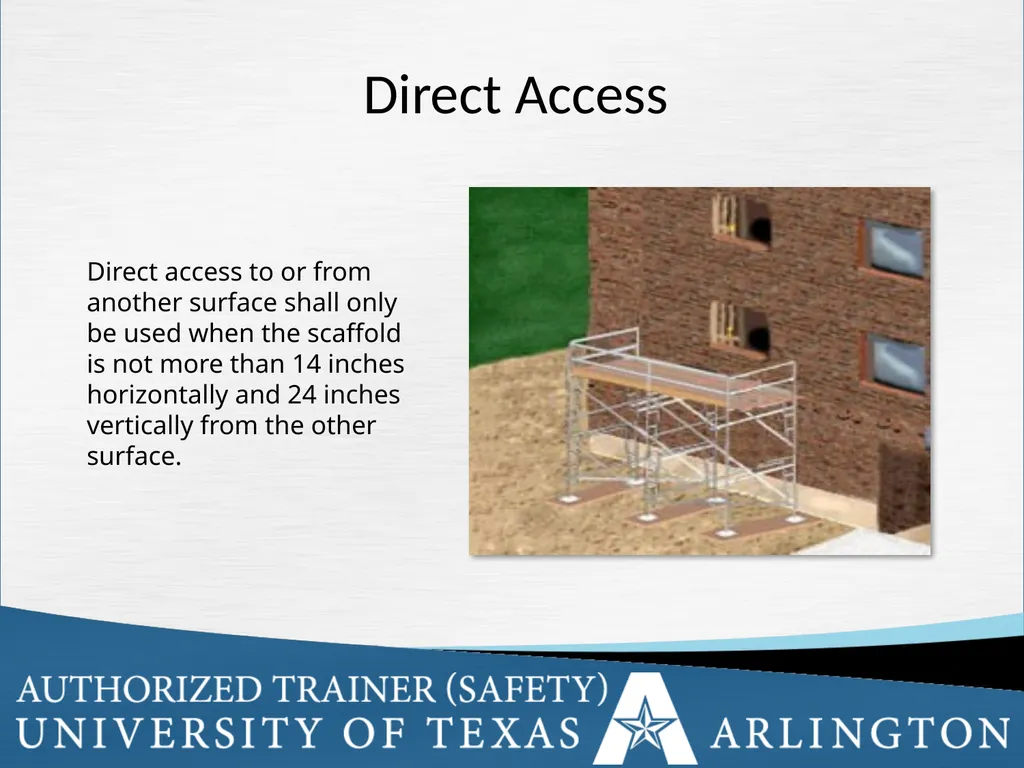
Direct Access Direct access to or from another surface shall only be used when the scaffold is not more than 14 inches horizontally and 24 inches vertically from the other surface.<br>
41
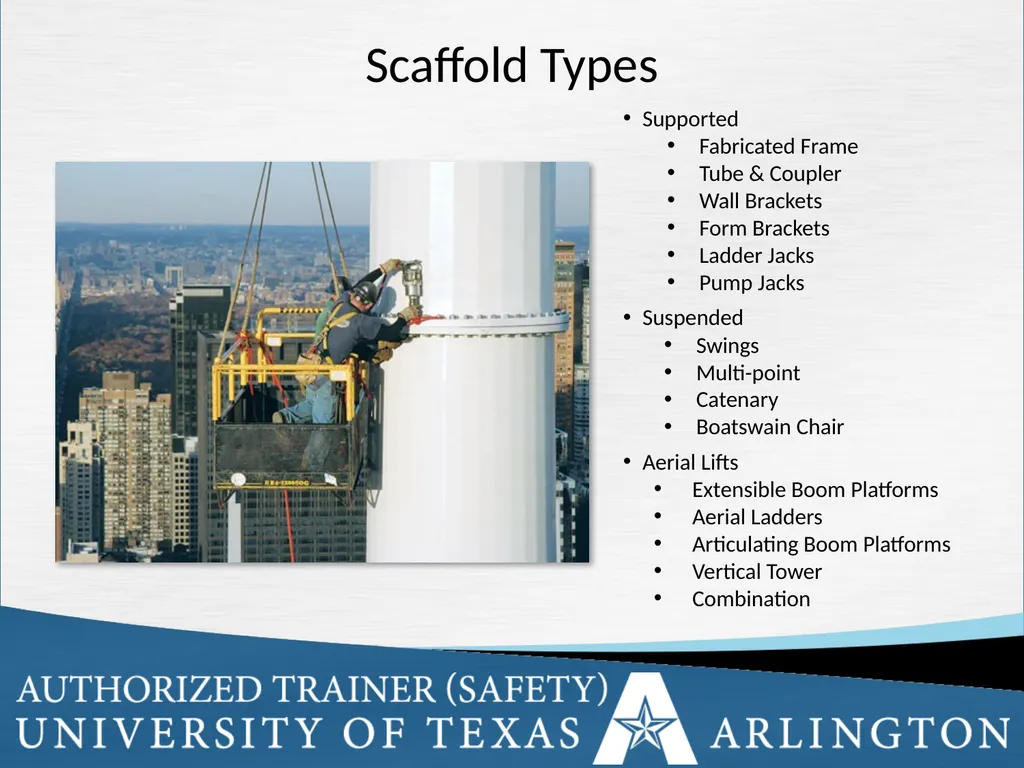
Scaffold Types Supported
Fabricated Frame
Tube & Coupler
Wall Brackets
Form Brackets
Ladder Jacks
Pump Jacks
Suspended
Swings
Multi-point
Catenary
Boatswain Chair
Aerial Lifts
Extensible Boom Platforms
Aerial Ladders
Articulating Boom Platforms
Vertical Tower
Combination<br>
Fabricated Frame
Tube & Coupler
Wall Brackets
Form Brackets
Ladder Jacks
Pump Jacks
Suspended
Swings
Multi-point
Catenary
Boatswain Chair
Aerial Lifts
Extensible Boom Platforms
Aerial Ladders
Articulating Boom Platforms
Vertical Tower
Combination<br>
42
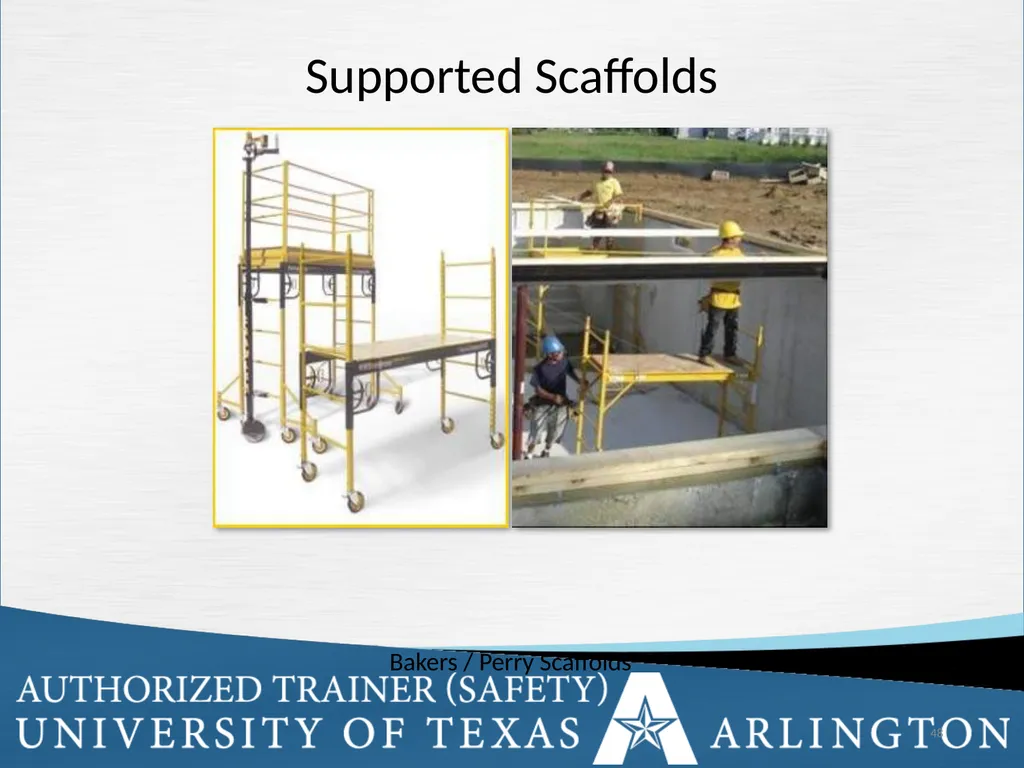
48 Bakers / Perry Scaffolds Supported Scaffolds<br>
43
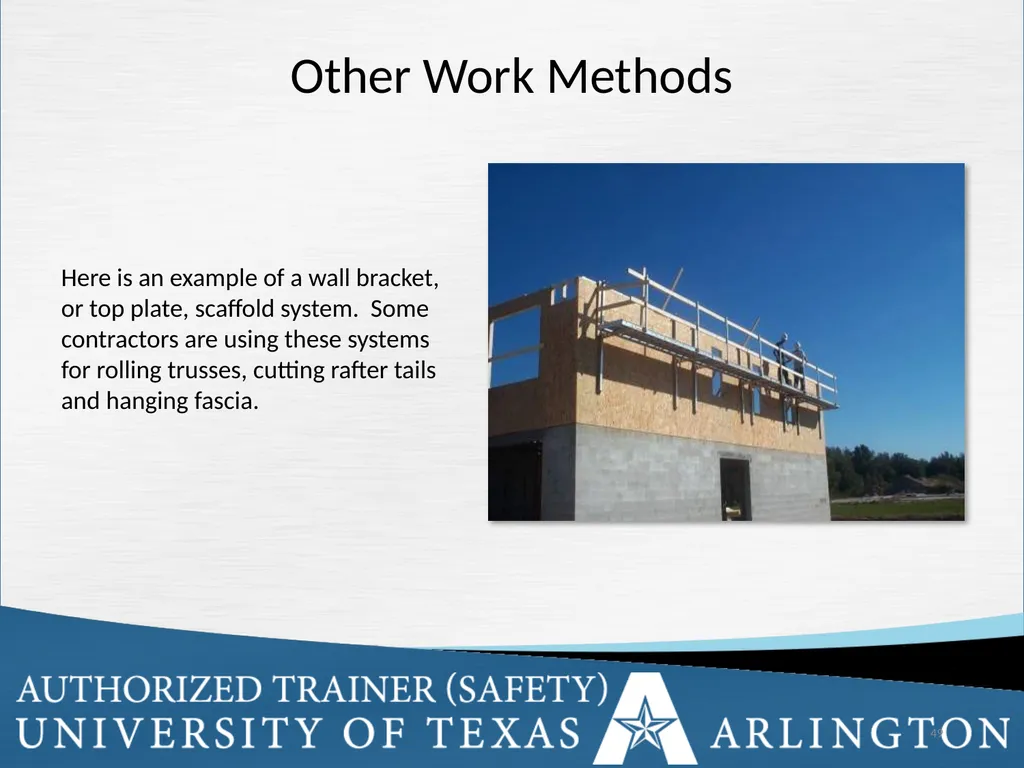
49 Here is an example of a wall bracket, or top plate, scaffold system. Some contractors are using these systems for rolling trusses, cutting rafter tails and hanging fascia. Other Work Methods<br>
44
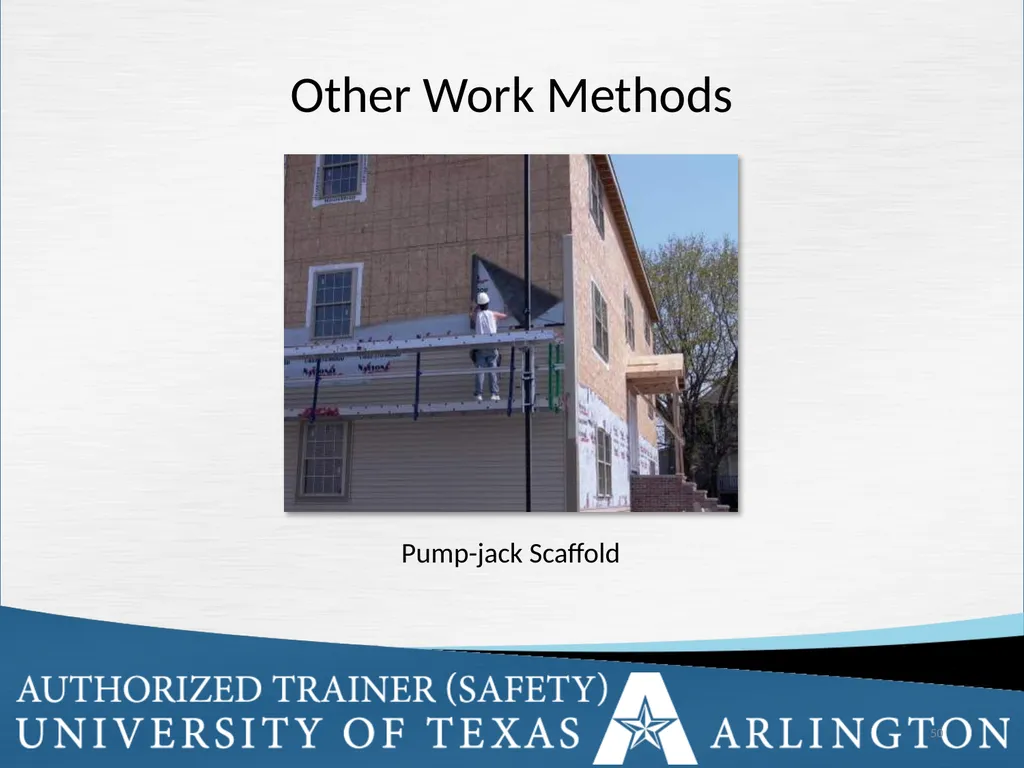
50 Pump-jack Scaffold Other Work Methods<br>
45
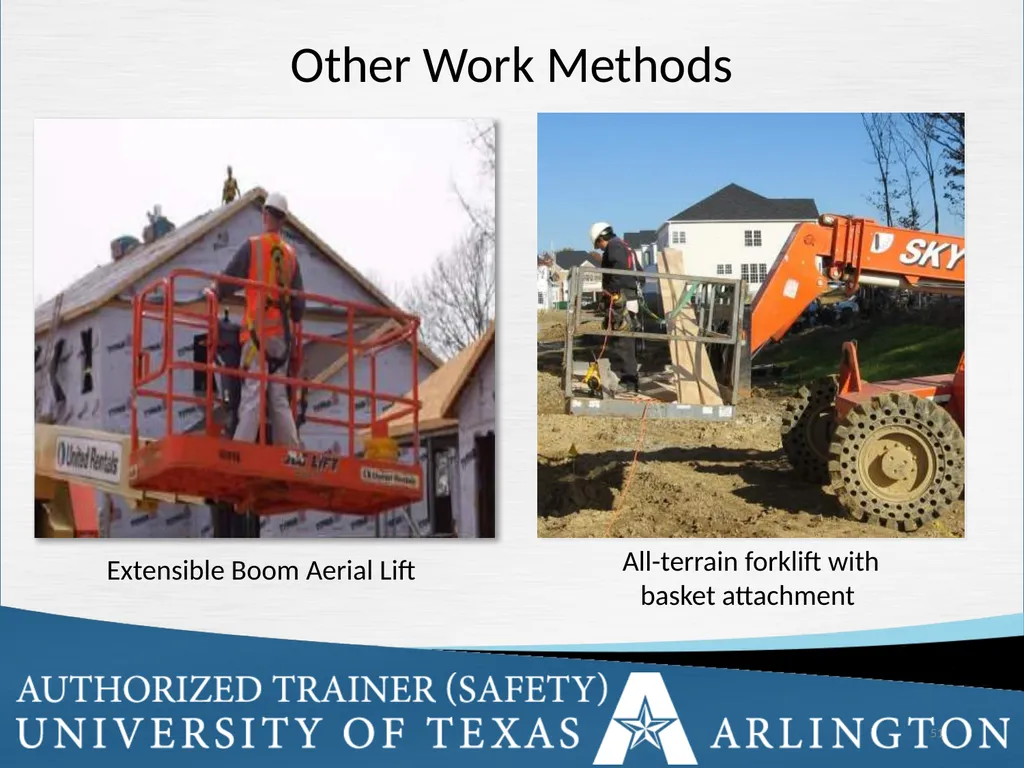
51 Extensible Boom Aerial Lift Other Work Methods All-terrain forklift with
basket attachment<br>
basket attachment<br>
46
52 Extensible Boom Aerial Lift
Alternative for reaching heights if properly used
PFAS or fall restraint must be worn and lanyard attached to boom or basket when working from an aerial lift - 1926.453(b)(2)(v) Other Work Methods<br>
Alternative for reaching heights if properly used
PFAS or fall restraint must be worn and lanyard attached to boom or basket when working from an aerial lift - 1926.453(b)(2)(v) Other Work Methods<br>
47
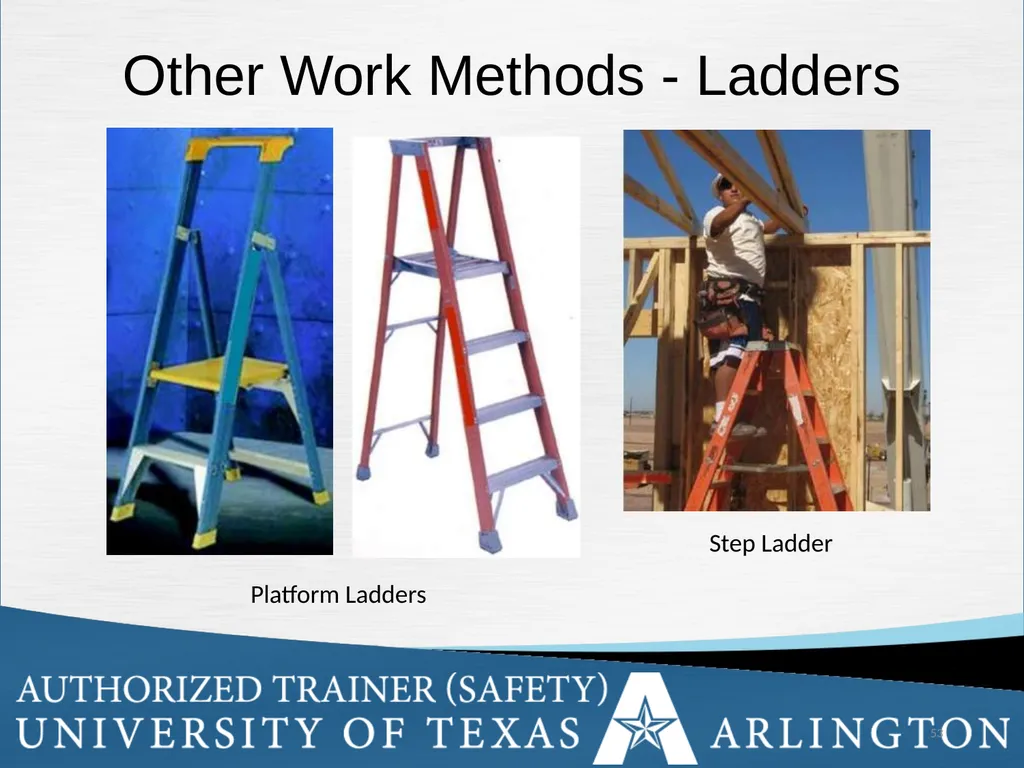
53 Platform Ladders Other Work Methods - Ladders Step Ladder<br>
48
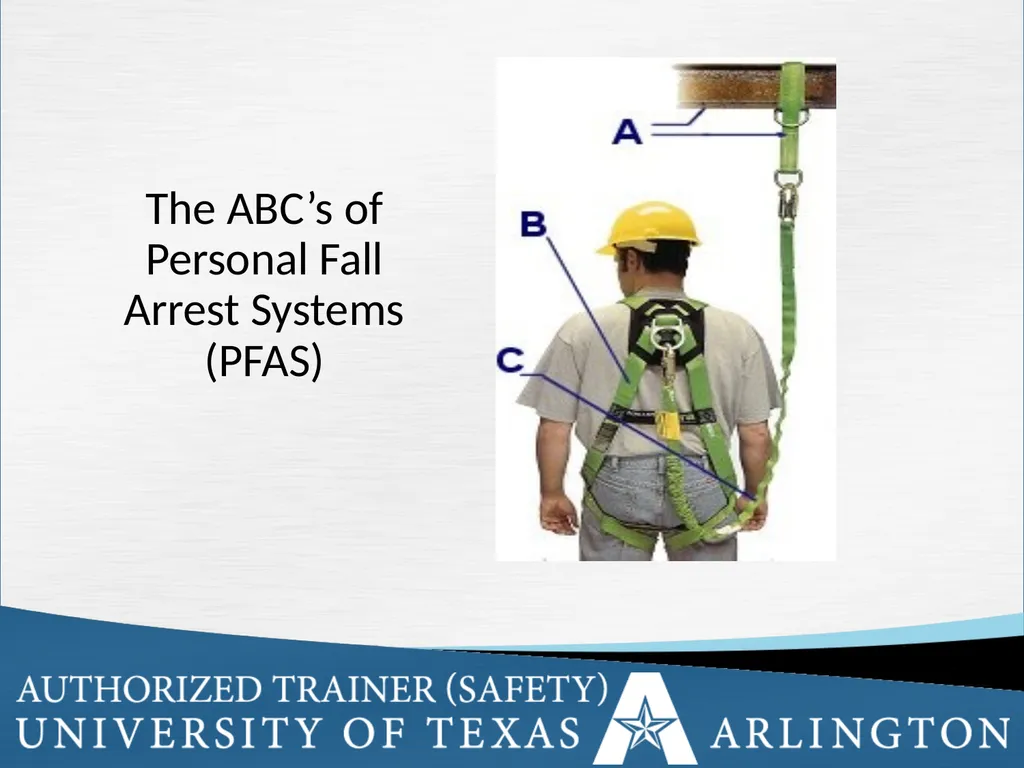
The ABC’s of Personal Fall Arrest Systems (PFAS)<br>
49
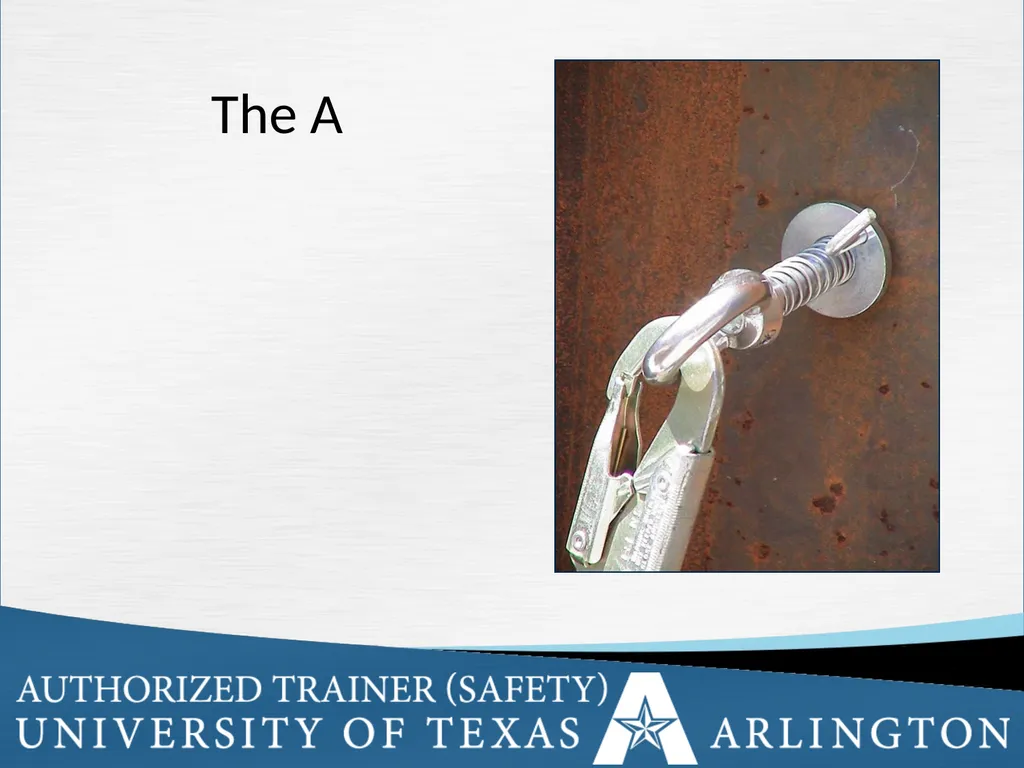
The A<br>
50
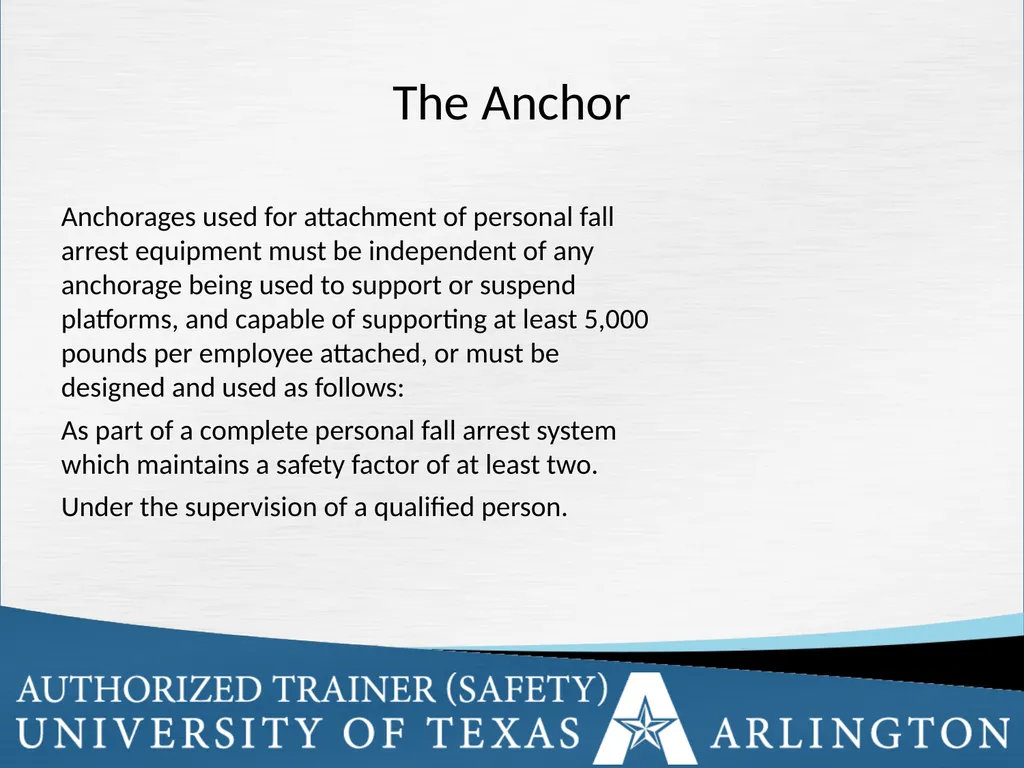
The Anchor Anchorages used for attachment of personal fall arrest equipment must be independent of any anchorage being used to support or suspend platforms, and capable of supporting at least 5,000 pounds per employee attached, or must be designed and used as follows:
As part of a complete personal fall arrest system which maintains a safety factor of at least two.
Under the supervision of a qualified person.<br>
As part of a complete personal fall arrest system which maintains a safety factor of at least two.
Under the supervision of a qualified person.<br>
51
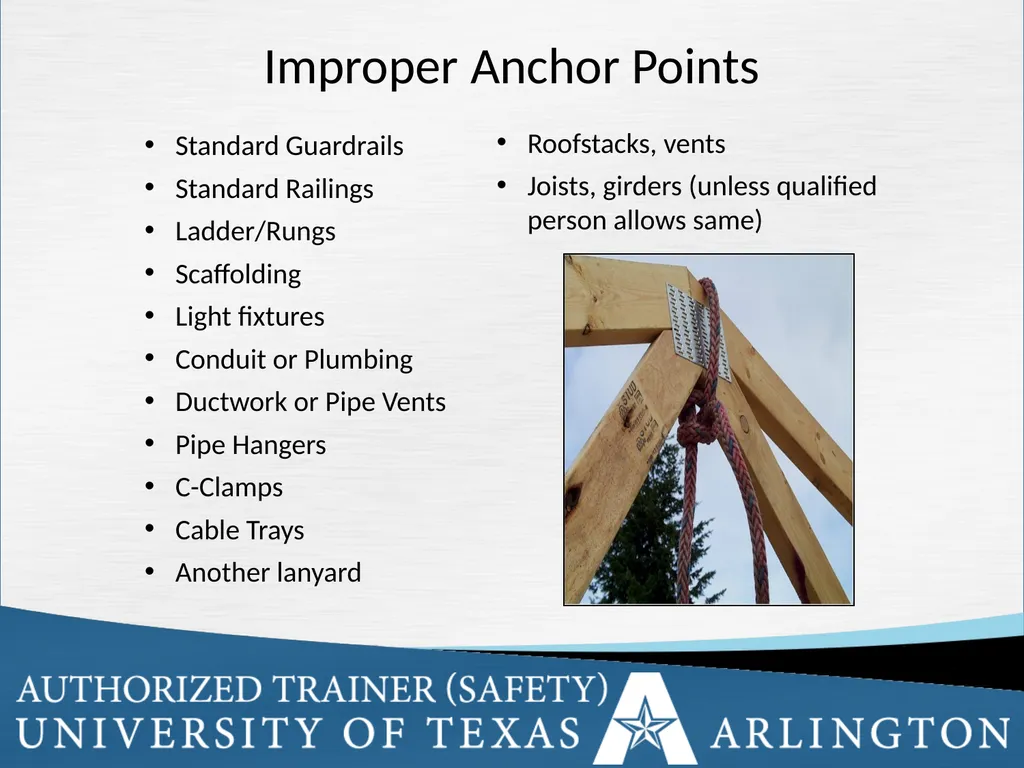
Improper Anchor Points Standard Guardrails
Standard Railings
Ladder/Rungs
Scaffolding
Light fixtures
Conduit or Plumbing
Ductwork or Pipe Vents
Pipe Hangers
C-Clamps
Cable Trays
Another lanyard Roofstacks, vents
Joists, girders (unless qualified person allows same)<br>
Standard Railings
Ladder/Rungs
Scaffolding
Light fixtures
Conduit or Plumbing
Ductwork or Pipe Vents
Pipe Hangers
C-Clamps
Cable Trays
Another lanyard Roofstacks, vents
Joists, girders (unless qualified person allows same)<br>
52
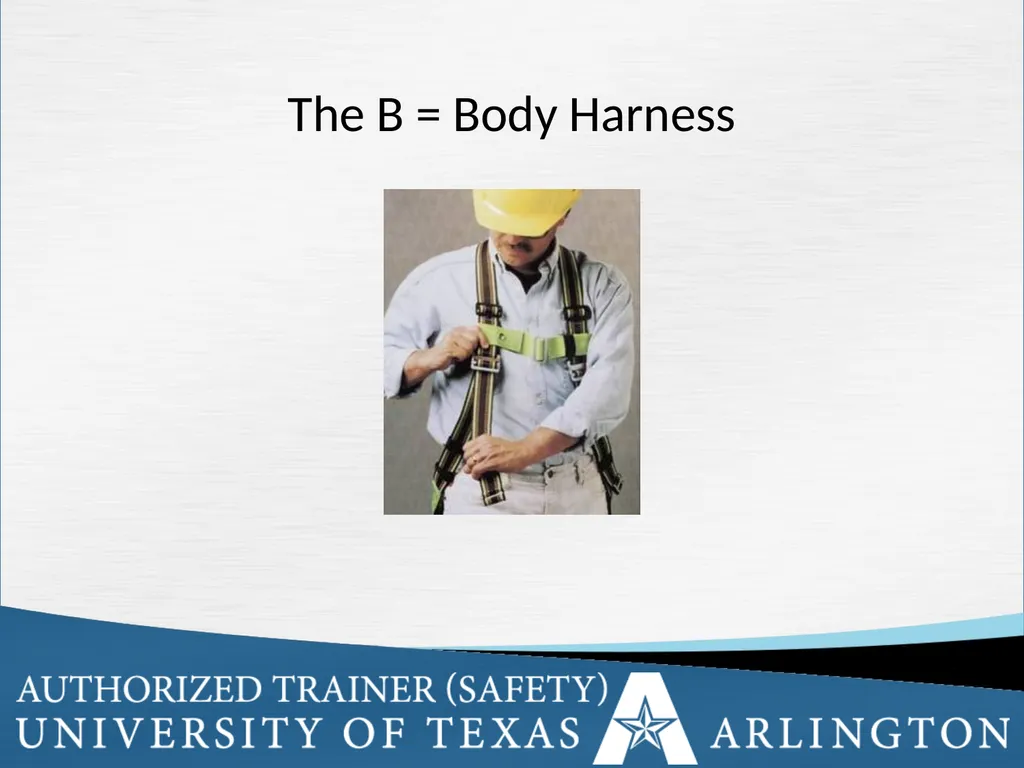
The B = Body Harness<br>
53
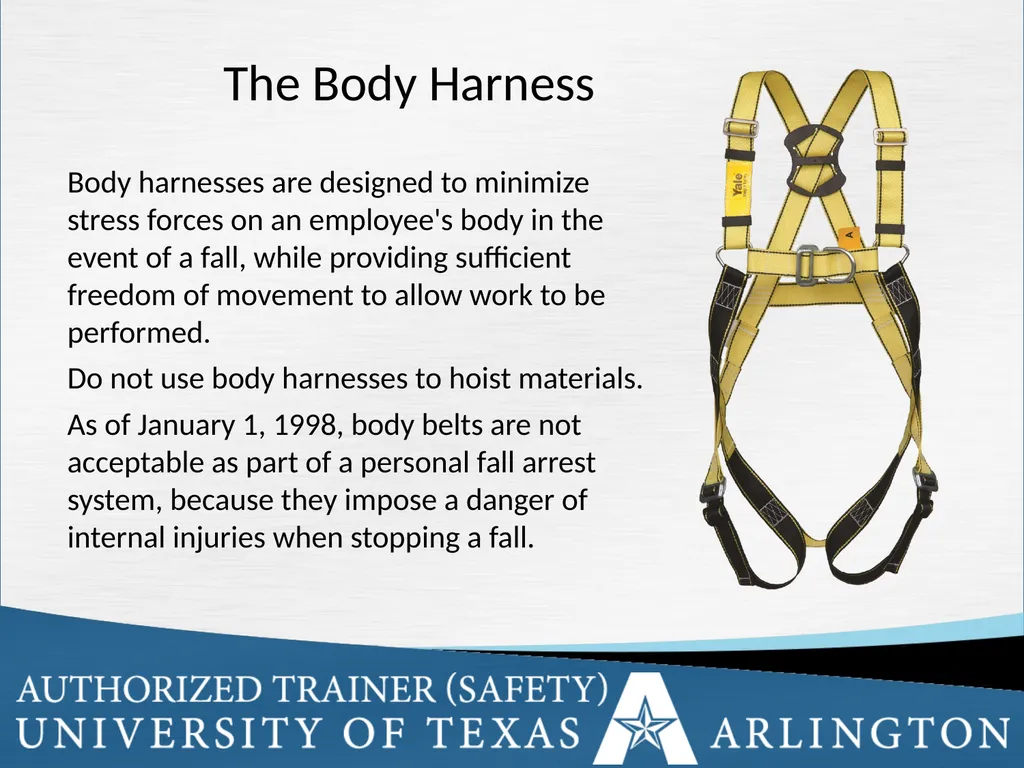
The Body Harness Body harnesses are designed to minimize stress forces on an employee's body in the event of a fall, while providing sufficient freedom of movement to allow work to be performed.
Do not use body harnesses to hoist materials.
As of January 1, 1998, body belts are not acceptable as part of a personal fall arrest system, because they impose a danger of internal injuries when stopping a fall.<br>
Do not use body harnesses to hoist materials.
As of January 1, 1998, body belts are not acceptable as part of a personal fall arrest system, because they impose a danger of internal injuries when stopping a fall.<br>
54
Need to be inspected frequently
Daily before use by the worker 502(d)(21)
Recommend monthly inspections by Competent Person
Should never be modified
Should be taken out of service immediately if defective or exposed to an impact 502 (d)(9) The Body Harness<br>
Daily before use by the worker 502(d)(21)
Recommend monthly inspections by Competent Person
Should never be modified
Should be taken out of service immediately if defective or exposed to an impact 502 (d)(9) The Body Harness<br>
55
Proper Adjustment is Key Be able to reach your D-Ring with your thumb
Maximum four (flat) fingers of slack at the legs, straps as high as comfortably possible
Ensure chest strap is across the chest/breastbone
Have a buddy double check for twist…etc.<br>
Maximum four (flat) fingers of slack at the legs, straps as high as comfortably possible
Ensure chest strap is across the chest/breastbone
Have a buddy double check for twist…etc.<br>
56
Adequate Anchorages are Crucial 29 CFR 1926 Subpart M Appendix C (h):
OSHA’s stance on importance of anchorage points
Planning by employer is VITAL
No planning – employees tend to find their own anchorage or don’t use any
Must support 5000 pounds per employee attached<br>
Planning by employer is VITAL
No planning – employees tend to find their own anchorage or don’t use any
Must support 5000 pounds per employee attached<br>
57
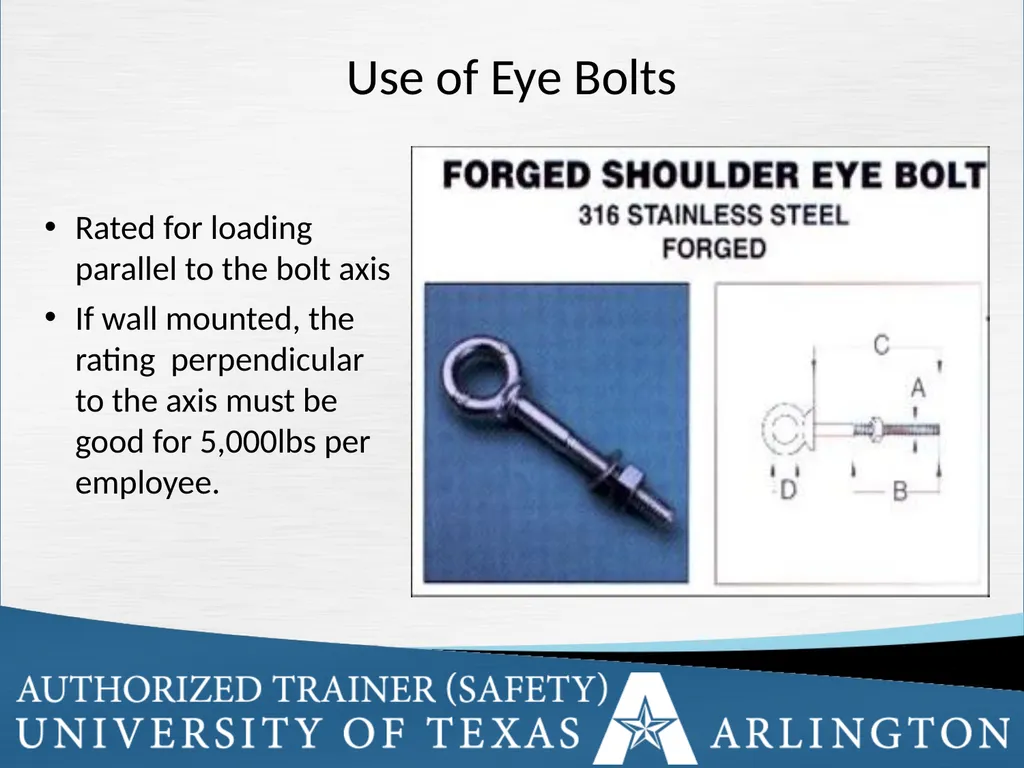
Use of Eye Bolts Rated for loading parallel to the bolt axis
If wall mounted, the rating perpendicular to the axis must be good for 5,000lbs per employee.<br>
If wall mounted, the rating perpendicular to the axis must be good for 5,000lbs per employee.<br>
58
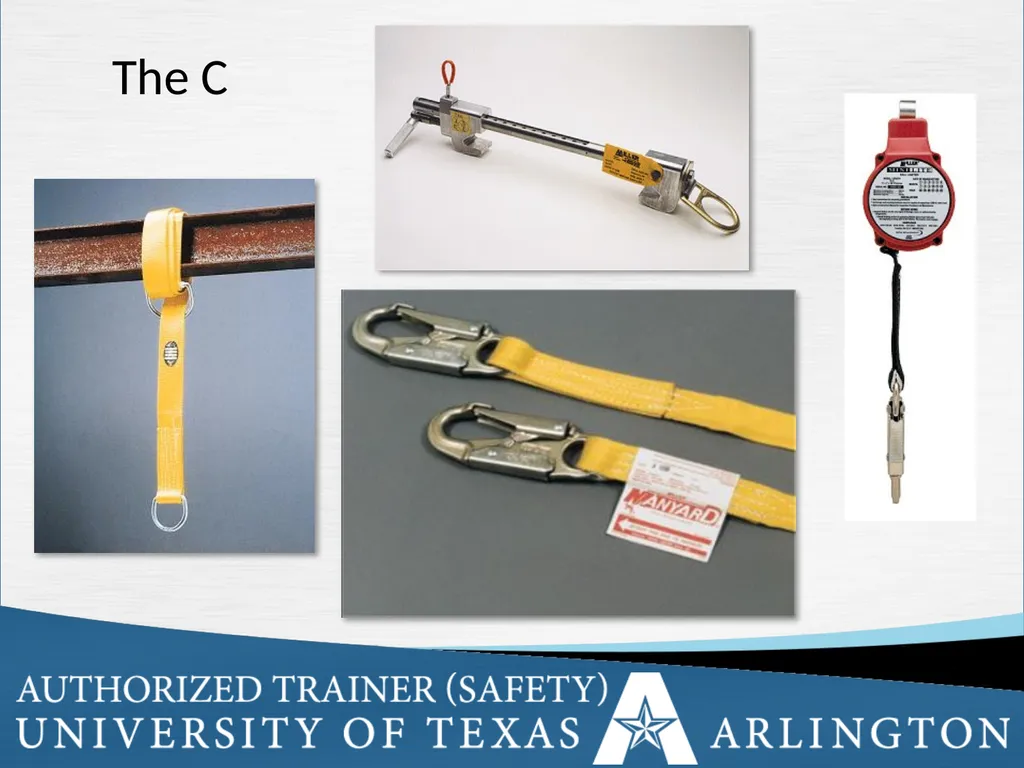
The C<br>
59
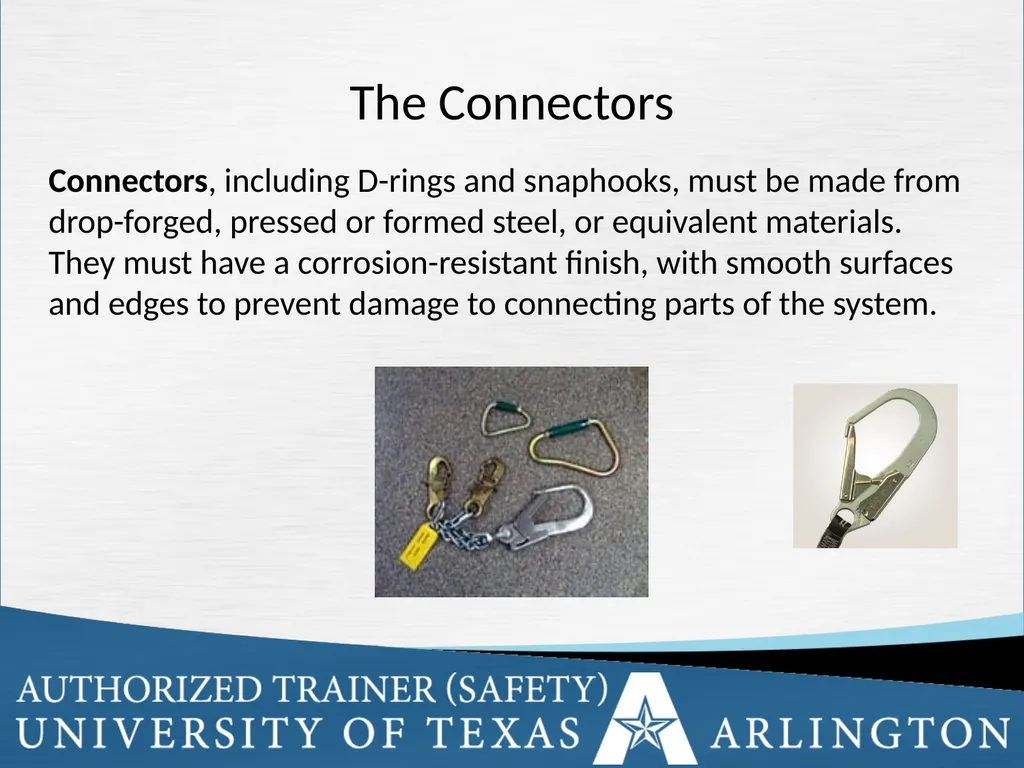
The Connectors Connectors, including D-rings and snaphooks, must be made from drop-forged, pressed or formed steel, or equivalent materials. They must have a corrosion-resistant finish, with smooth surfaces and edges to prevent damage to connecting parts of the system.<br>
60
Connector (Lanyards) Should be inspected before each use
Should not be tied back to themselves
Should be worn with timpact absorber/shock pack at the D-ring
Should have the appropriate clip for the intended anchorage points<br>
Should not be tied back to themselves
Should be worn with timpact absorber/shock pack at the D-ring
Should have the appropriate clip for the intended anchorage points<br>
61
Retractable Lifelines Very effective for vertical applications
Will normally lock up in 1 to 2 feet, minimizing total fall distance and impact forces on the employee’s body<br>
Will normally lock up in 1 to 2 feet, minimizing total fall distance and impact forces on the employee’s body<br>
62
SRL and Deceleration Devices Self retracting lifelines which limit free fall to 2’ or < must capable of sustaining minimum tensile load of 3000lbs to device is fully extended position
SRL which don’t limit fall to 2’ or < ripstich lanyards and tearing type lanyards must maintain min tensile load of 5,000lbs to lifeline/lanyard in fully extended position<br>
SRL which don’t limit fall to 2’ or < ripstich lanyards and tearing type lanyards must maintain min tensile load of 5,000lbs to lifeline/lanyard in fully extended position<br>
63
Do Not Hook Lanyards to Retractables This can cause hook failures and affect the locking capability of the retractable
The retractable should be attached directly to the D-ring
No plan for SWING factor in the event of a fall.<br>
The retractable should be attached directly to the D-ring
No plan for SWING factor in the event of a fall.<br>
64
Review What are the 4 greatest hazards in construction?
At what height must we have fall prevention or fall protection in:
Construction
Maritime
General Industry
Name 3 alternate work methods to help eliminate or reduce the risk of falls.
What are the A, B, C of a personal fall arrest system?<br>
At what height must we have fall prevention or fall protection in:
Construction
Maritime
General Industry
Name 3 alternate work methods to help eliminate or reduce the risk of falls.
What are the A, B, C of a personal fall arrest system?<br>
65
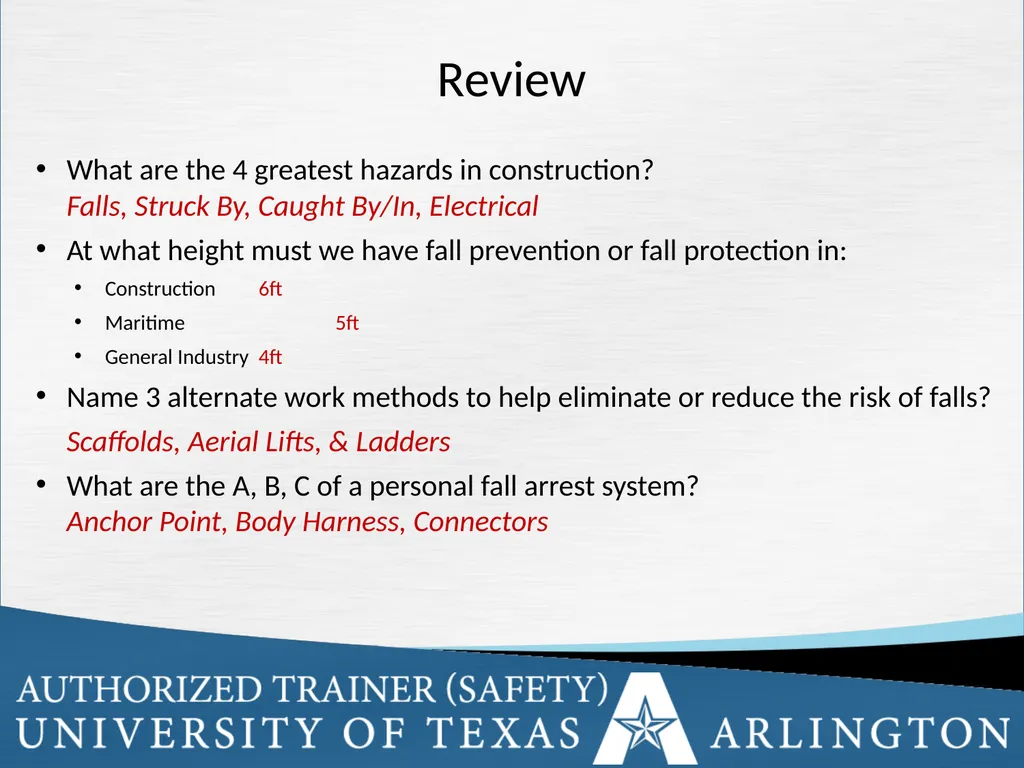
Review What are the 4 greatest hazards in construction?
Falls, Struck By, Caught By/In, Electrical
At what height must we have fall prevention or fall protection in:
Construction 6ft
Maritime 5ft
General Industry 4ft
Name 3 alternate work methods to help eliminate or reduce the risk of falls?
Scaffolds, Aerial Lifts, & Ladders
What are the A, B, C of a personal fall arrest system? Anchor Point, Body Harness, Connectors<br>
At what height must we have fall prevention or fall protection in:
Construction 6ft
Maritime 5ft
General Industry 4ft
Name 3 alternate work methods to help eliminate or reduce the risk of falls?
Scaffolds, Aerial Lifts, & Ladders
What are the A, B, C of a personal fall arrest system? Anchor Point, Body Harness, Connectors<br>