Fat Accessibility Concerns in Academic Libraries: A Primer Roger Chabot, MLIS, PhD 19 June 2025 Anti-Fatness Anti-fatness and anti-fat bias are umbrella terms that describe the attitudes, behaviours, and social systems that specifically
"Fat Accessibility Concerns in Academic Libraries:" is the property of its rightful owner. Permission is granted to
download and print the materials on this website for personal, non-commercial use only, and to display it
on your personal computer provided you do not modify the materials and that you retain all copyright
notices contained in the materials. By downloading content from our website, you accept the terms of this
agreement.
Presentation Transcript
01
Fat Accessibility Concerns in Academic Libraries: A Primer Roger Chabot, MLIS, PhD
19 June 2025<br>
02
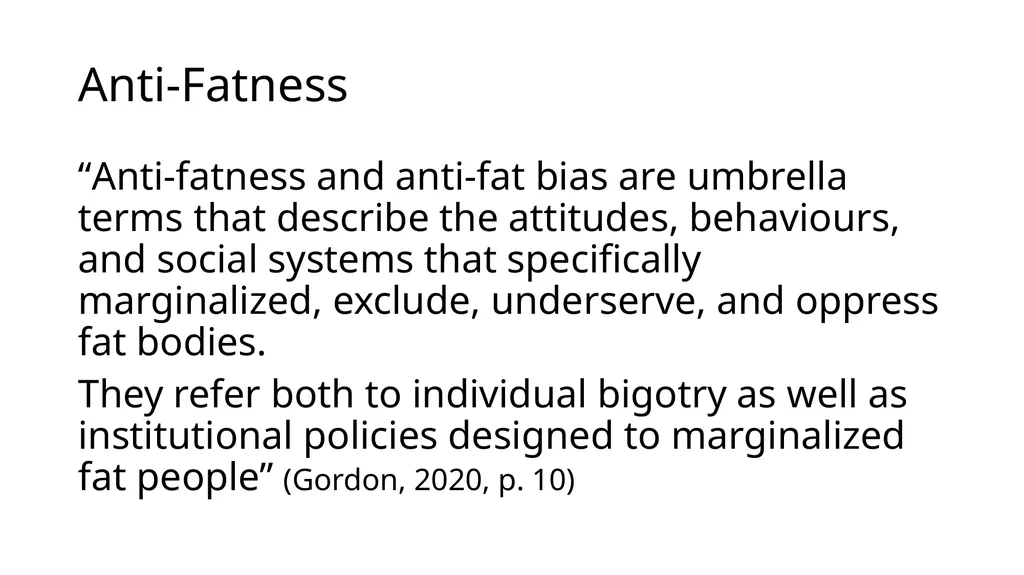
Anti-Fatness “Anti-fatness and anti-fat bias are umbrella terms that describe the attitudes, behaviours, and social systems that specifically marginalized, exclude, underserve, and oppress fat bodies.
They refer both to individual bigotry as well as institutional policies designed to marginalized fat people” (Gordon, 2020, p. 10)<br>
03
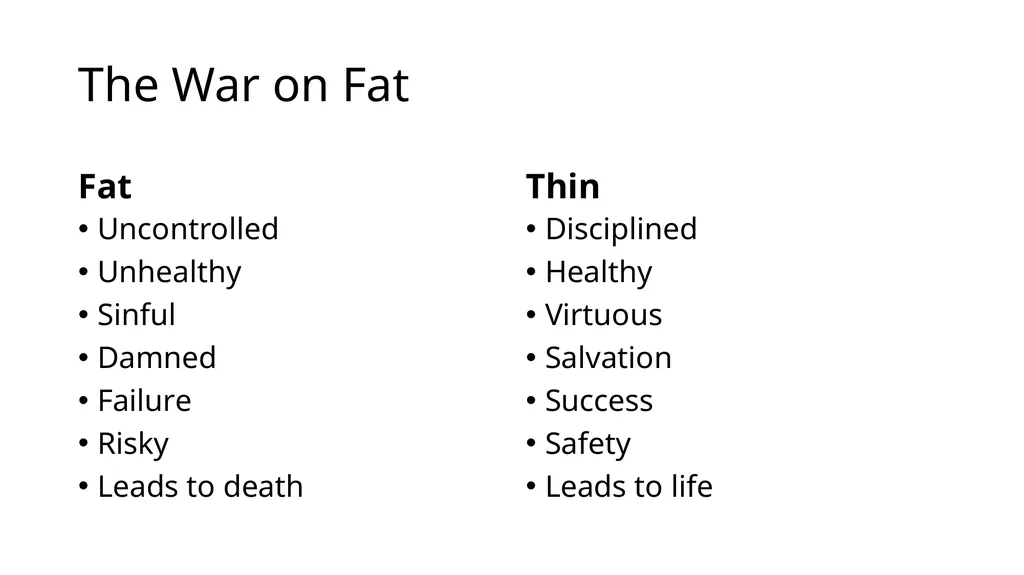
The War on Fat Fat Uncontrolled
Unhealthy
Sinful
Damned
Failure
Risky
Leads to death Thin Disciplined
Healthy
Virtuous
Salvation
Success
Safety
Leads to life<br>
04
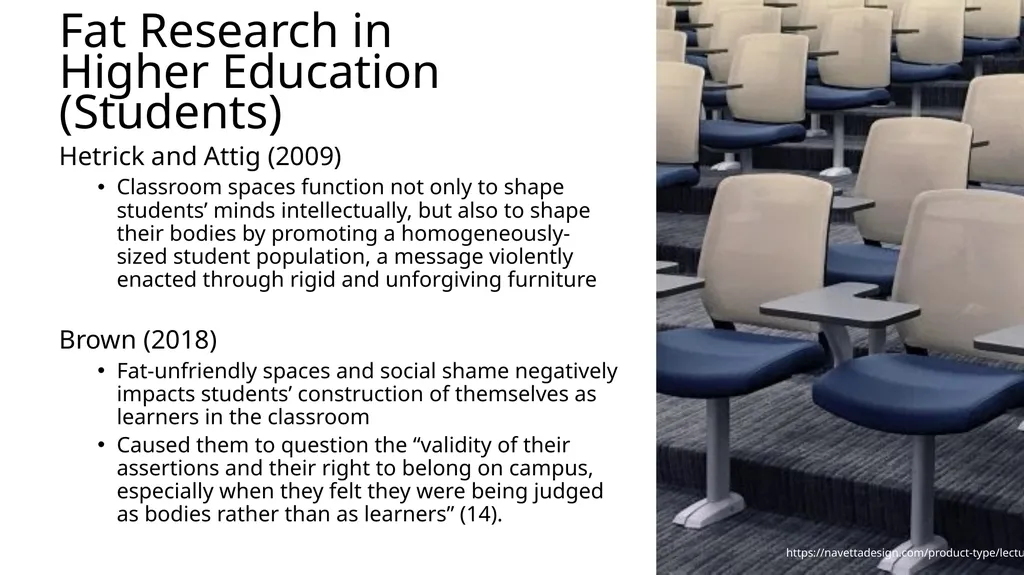
Fat Research in Higher Education (Students) Hetrick and Attig (2009)
Classroom spaces function not only to shape students’ minds intellectually, but also to shape their bodies by promoting a homogeneously-sized student population, a message violently enacted through rigid and unforgiving furniture
Brown (2018)
Fat-unfriendly spaces and social shame negatively impacts students’ construction of themselves as learners in the classroom
Caused them to question the “validity of their assertions and their right to belong on campus, especially when they felt they were being judged as bodies rather than as learners” (14). https://navettadesign.com/product-type/lecture-hall/<br>
05
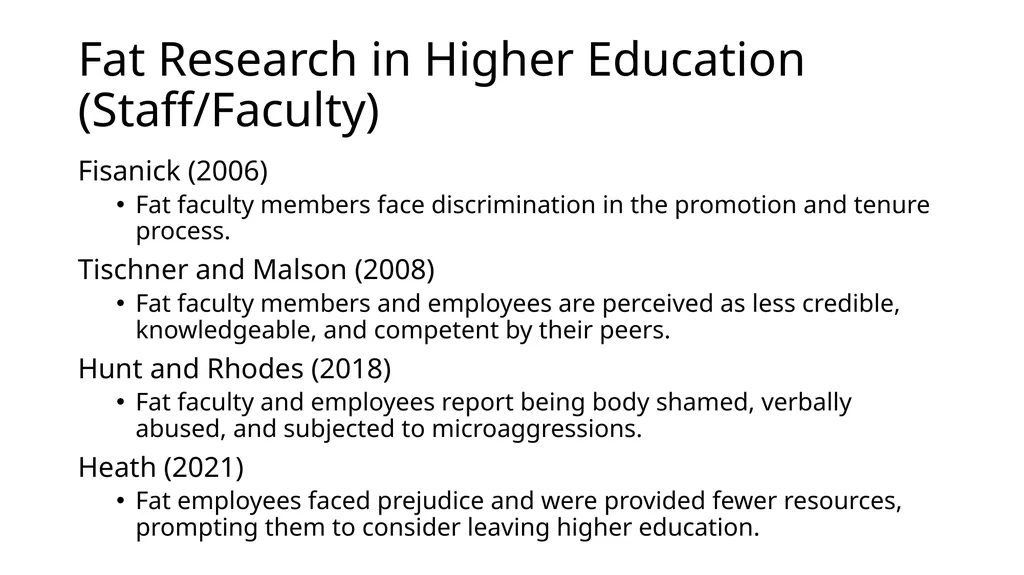
Fat Research in Higher Education (Staff/Faculty) Fisanick (2006)
Fat faculty members face discrimination in the promotion and tenure process.
Tischner and Malson (2008)
Fat faculty members and employees are perceived as less credible, knowledgeable, and competent by their peers.
Hunt and Rhodes (2018)
Fat faculty and employees report being body shamed, verbally abused, and subjected to microaggressions.
Heath (2021)
Fat employees faced prejudice and were provided fewer resources, prompting them to consider leaving higher education.<br>
06
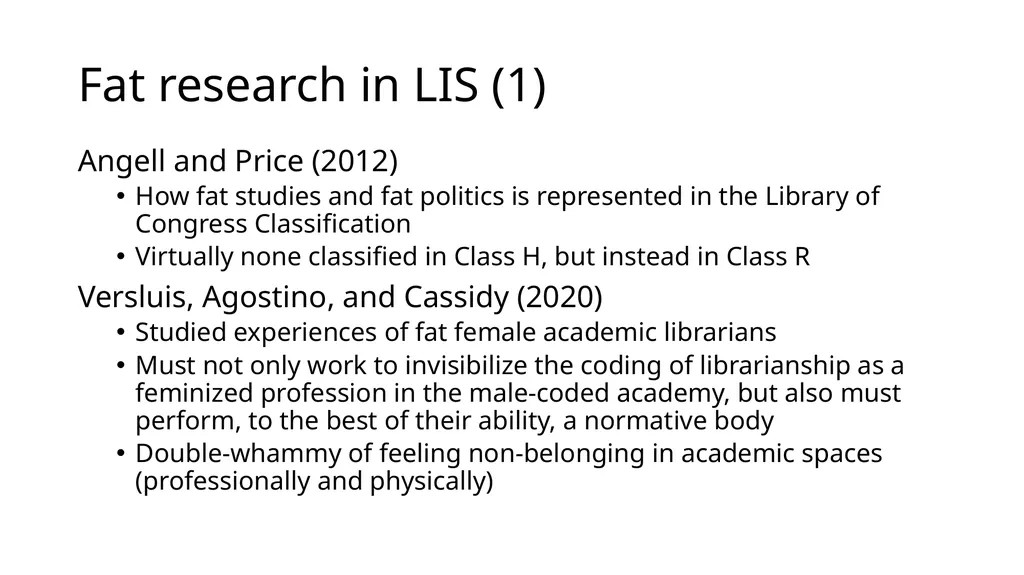
Fat research in LIS (1) Angell and Price (2012)
How fat studies and fat politics is represented in the Library of Congress Classification
Virtually none classified in Class H, but instead in Class R
Versluis, Agostino, and Cassidy (2020)
Studied experiences of fat female academic librarians
Must not only work to invisibilize the coding of librarianship as a feminized profession in the male-coded academy, but also must perform, to the best of their ability, a normative body
Double-whammy of feeling non-belonging in academic spaces (professionally and physically)<br>
07
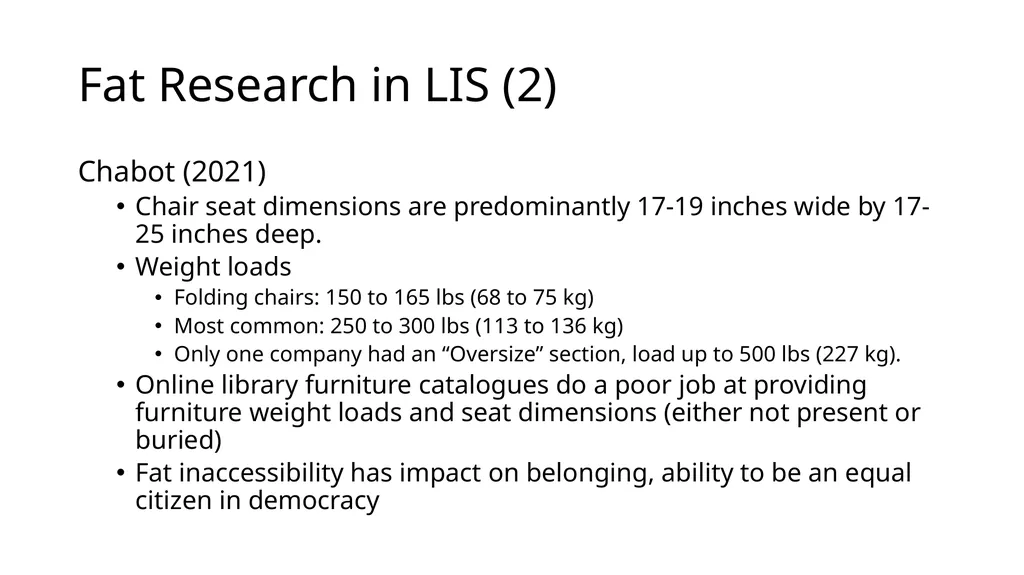
Fat Research in LIS (2) Chabot (2021)
Chair seat dimensions are predominantly 17-19 inches wide by 17-25 inches deep.
Weight loads
Folding chairs: 150 to 165 lbs (68 to 75 kg)
Most common: 250 to 300 lbs (113 to 136 kg)
Only one company had an “Oversize” section, load up to 500 lbs (227 kg).
Online library furniture catalogues do a poor job at providing furniture weight loads and seat dimensions (either not present or buried)
Fat inaccessibility has impact on belonging, ability to be an equal citizen in democracy<br>
08
Is your library reproducing anti-fatness?<br>
09
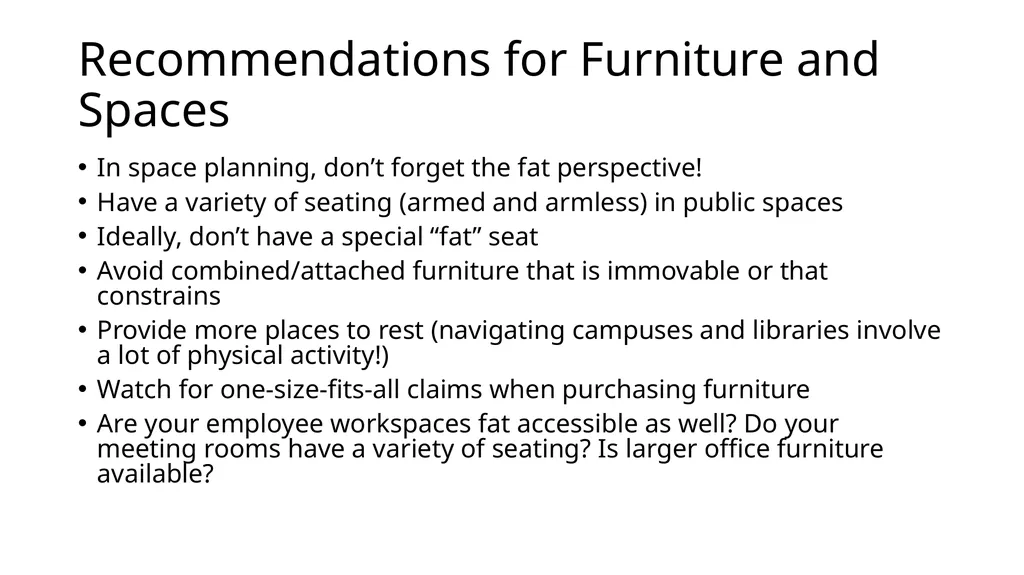
Recommendations for Furniture and Spaces In space planning, don’t forget the fat perspective!
Have a variety of seating (armed and armless) in public spaces
Ideally, don’t have a special “fat” seat
Avoid combined/attached furniture that is immovable or that constrains
Provide more places to rest (navigating campuses and libraries involve a lot of physical activity!)
Watch for one-size-fits-all claims when purchasing furniture
Are your employee workspaces fat accessible as well? Do your meeting rooms have a variety of seating? Is larger office furniture available?<br>
10
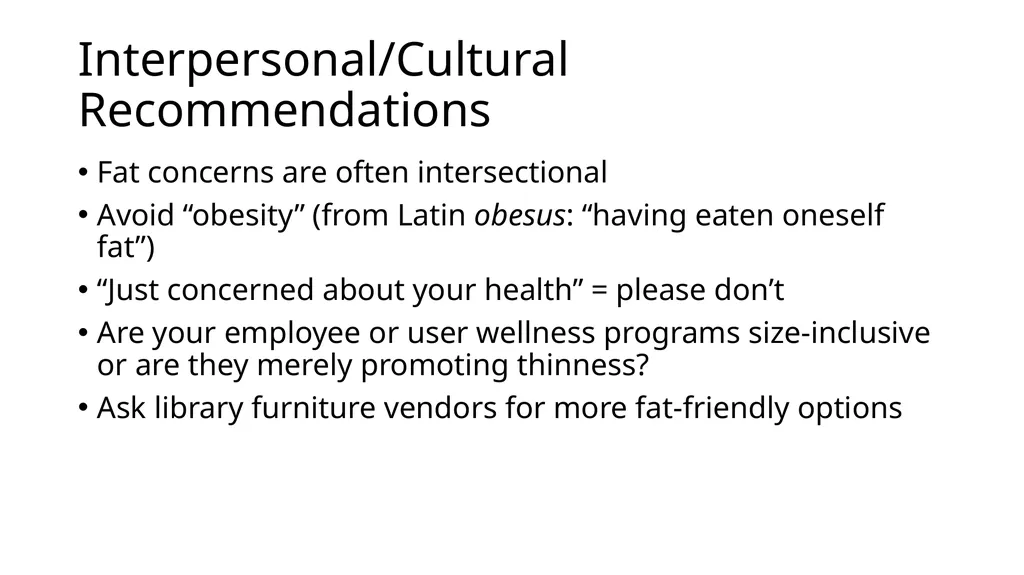
Interpersonal/Cultural Recommendations Fat concerns are often intersectional
Avoid “obesity” (from Latin obesus: “having eaten oneself fat”)
“Just concerned about your health” = please don’t
Are your employee or user wellness programs size-inclusive or are they merely promoting thinness?
Ask library furniture vendors for more fat-friendly options<br>
11
Contact & References rchabot2@uwo.ca
Angell, Katelyn, and Charlotte Price. 2012. “Fat Bodies in Thin Books: Information Bias and Body Image in Academic Libraries.” Fat Studies 1 (2): 153-65.
Brown, Heather. 2018. “‘There’s Always Stomach on the Table and Then I Gotta Write!’: Physical Space and Learning in Fat College Women.” Fat Studies 7 (1): 11-20.
Chabot, Roger. 2021. “Is the Library for ‘Every Body’? Examining Fatphobia in Library Spaces through Online Library Furniture Catalogues.” Canadian Journal of Information and Library Science 44 (2–3): 12–30.
Fisanick, Christina. 2006. “Evaluating the Absent Presence: The Professor’s Body at Tenure and Promotion.” The Review of Education, Pedagogy, and Cultural Studies 28: 325–38.
Gordon, Aubrey. 2020. What We Don’t Talk About When We Talk About Fat. Beacon Press.
Heath, Wesley. 2021. “Making Room for Fat Student Affairs Professionals in Higher Education.” PhD diss., Louisiana State University.
Hetrick, Ashley, and Derek Attig. 2009. “Sitting Pretty: Fat Bodies, Classroom Desks, and Academic Excess.” In The Fat Studies Reader, edited by Esther Rothblum, and Sondra Solovay, 197-204. New York: New York University Press.
Hunt, Andrea, and Tammy Rhodes. 2018. “Fat Pedagogy and Microaggressions: Experiences of Professionals Working in Higher Education Settings.” Fat Studies 7 (1): 21-32
Tischner, Irmgard, and Helen Malson. 2008. “Exploring the Politics of Women’s In/Visible ‘Large’ Bodies.” Feminism & Psychology 18: 260–7.
Versluis, Ali, Carli Agostino, and Melanie Cassidy. 2020. “Fat, Fit, and Fem: Exploring Performative Femininity for Fat Female Librarians.” In Deconstructing Service in Libraries: Intersections of Identities and Expectations, edited by Veronica Arellano Douglas, and Joanna Gadsby, 55-77.<br>