
FCW-4 Counselling: Theory and Practice (Unit 1)
T
Published · 32 slides · 0 views

1 / 1
Description
FCW-4 Counselling: Theory and Practice (Unit 1) Dr. Jaimon Varghese 11-01-2019 11:13:09 1 Counselling: Theory Practice Learner Objectives 1. Develop holistic understanding of counselling as a tool for help 2. Acquire knowledge, skills and
Related Topics
Share
Embed code
Download this presentation From Below
"FCW-4 Counselling: Theory and Practice (Unit 1)" is the property of its rightful owner. Permission is granted to download and print the materials on this website for personal, non-commercial use only, and to display it on your personal computer provided you do not modify the materials and that you retain all copyright notices contained in the materials. By downloading content from our website, you accept the terms of this agreement.
Presentation Transcript
01
FCW-4
Counselling:
Theory and Practice
(Unit 1) Dr. Jaimon Varghese 11-01-2019 11:13:09 1 Counselling: Theory & Practice<br>
02
Learner Objectives 1. Develop holistic understanding of counselling as a tool for help
2. Acquire knowledge, skills and attitudes for counselling
3. Develop insight in need and areas of counselling in different situations
4. To develop counselling competencies in students for working in various specialized set ups 11-01-2019 11:13:09 Counselling: Theory & Practice 2<br>
2. Acquire knowledge, skills and attitudes for counselling
3. Develop insight in need and areas of counselling in different situations
4. To develop counselling competencies in students for working in various specialized set ups 11-01-2019 11:13:09 Counselling: Theory & Practice 2<br>
03
Unit - 1
Basics of Counselling 1. Conceptual understanding, goals, principles of counselling
2. Process and stages in counselling
3. Tools and techniques of counselling
4. Counselling situations – developmental, preventive, facilitative, crisis intervention 11-01-2019 11:13:09 Counselling: Theory & Practice 3<br>
2. Process and stages in counselling
3. Tools and techniques of counselling
4. Counselling situations – developmental, preventive, facilitative, crisis intervention 11-01-2019 11:13:09 Counselling: Theory & Practice 3<br>
04
Conceptual understanding of counselling F.P. Robinson describes counselling as aiding normal people to achieve higher level adjustment skills which manifest themselves as increased maturity, independence, personal integration and responsibility (Pathare, 2010:189) 11-01-2019 11:13:09 Counselling: Theory & Practice 4<br>
05
Conceptual understanding of counselling G.W. Gustad has defined counselling as a learning-oriented process, carried on in a simple one to-one social environment, in which a counsellor, professionally competent in relevant psychological skills and knowledge, seeks to assist the client by methods appropriate to the latter’s needs and within the context of the total personnel programme, 11-01-2019 11:13:09 Counselling: Theory & Practice 5<br>
06
Conceptual understanding of counselling to learn more about himself, to learn to put such understanding into effect in relation to more clearly perceived, realistically defined goals to the end that the client may become a happier and more productive member of his society” (Journal of Vocational Psychology, No.36) (Pathare, 2010:189) . 11-01-2019 11:13:09 Counselling: Theory & Practice 6<br>
07
Goals of counselling General goal
increasing human effectiveness”
altering how people feel, think and act so that they may live their lives more effectively
Specific goal (Pathare, 2010:195-197)
i. Counselling for healthy development of personality (self actualisation) 11-01-2019 11:13:09 Counselling: Theory & Practice 7<br>
increasing human effectiveness”
altering how people feel, think and act so that they may live their lives more effectively
Specific goal (Pathare, 2010:195-197)
i. Counselling for healthy development of personality (self actualisation) 11-01-2019 11:13:09 Counselling: Theory & Practice 7<br>
08
Goals of counselling Specific goal (Pathare, 2010:195-197)
ii. Counselling as providing support and guidance (crisis intervention )
iii. Counselling as emotional release (catharsis)
iv. Counselling for awareness (self)
v. Counselling for value clarification and change 11-01-2019 11:13:09 Counselling: Theory & Practice 8<br>
ii. Counselling as providing support and guidance (crisis intervention )
iii. Counselling as emotional release (catharsis)
iv. Counselling for awareness (self)
v. Counselling for value clarification and change 11-01-2019 11:13:09 Counselling: Theory & Practice 8<br>
09
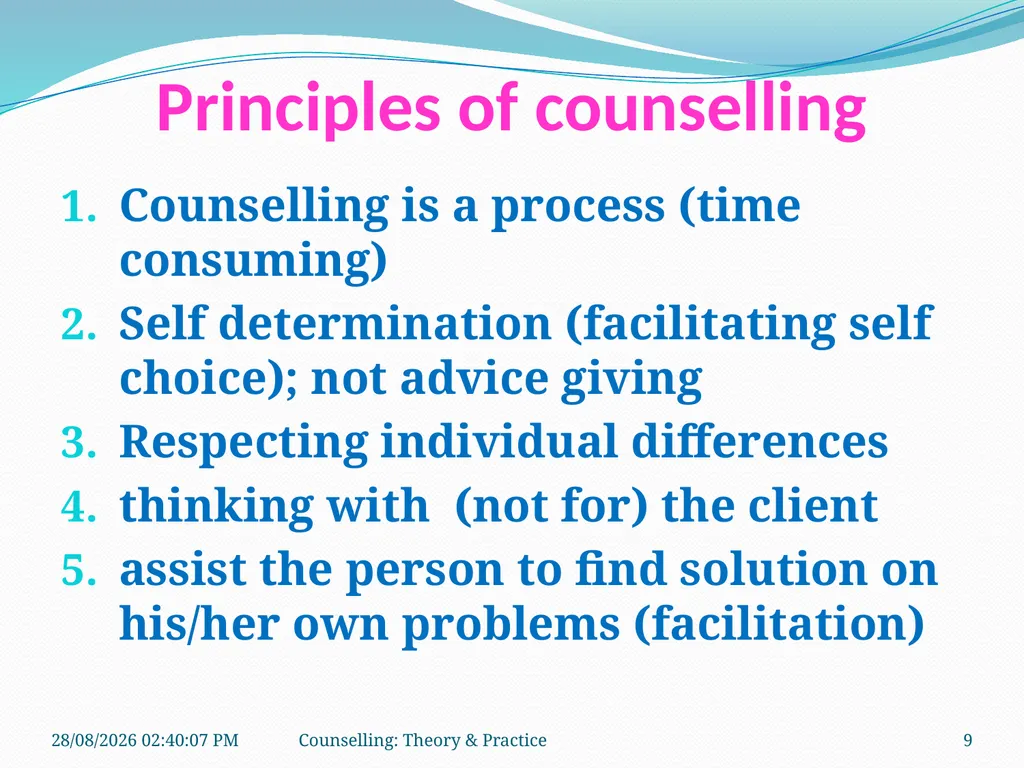
Principles of counselling Counselling is a process (time consuming)
Self determination (facilitating self choice); not advice giving
Respecting individual differences
thinking with (not for) the client
assist the person to find solution on his/her own problems (facilitation) 11-01-2019 11:13:09 Counselling: Theory & Practice 9<br>
Self determination (facilitating self choice); not advice giving
Respecting individual differences
thinking with (not for) the client
assist the person to find solution on his/her own problems (facilitation) 11-01-2019 11:13:09 Counselling: Theory & Practice 9<br>
10
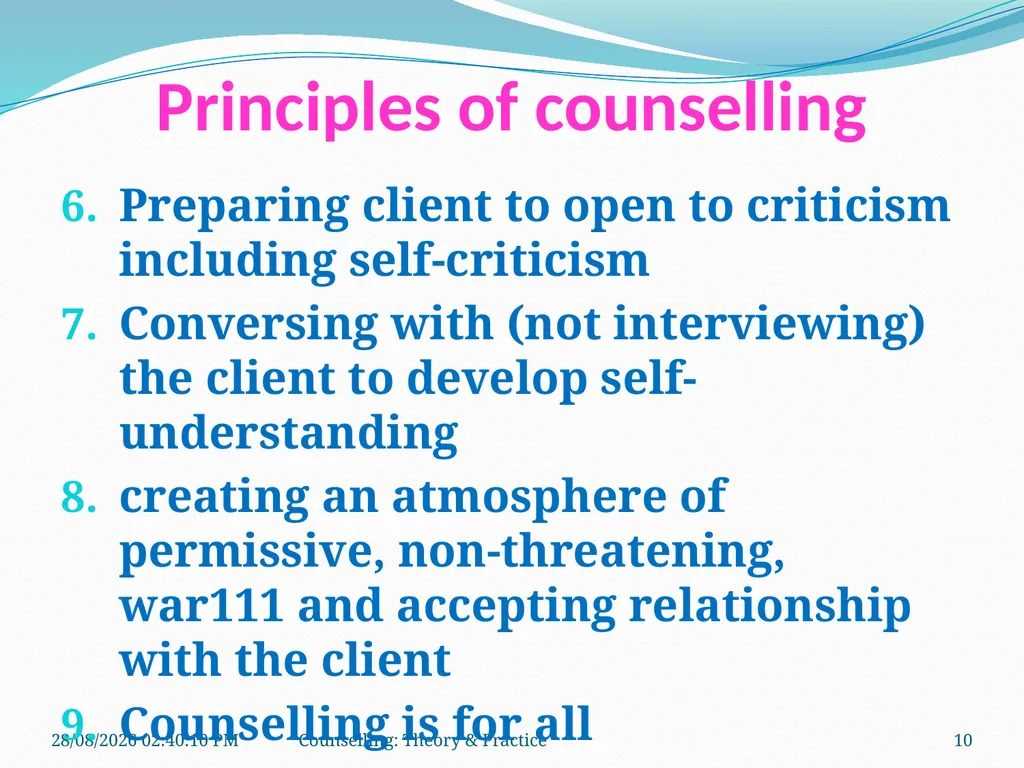
Principles of counselling Preparing client to open to criticism including self-criticism
Conversing with (not interviewing) the client to develop self-understanding
creating an atmosphere of permissive, non-threatening, war111 and accepting relationship with the client
Counselling is for all 11-01-2019 11:13:09 Counselling: Theory & Practice 10<br>
Conversing with (not interviewing) the client to develop self-understanding
creating an atmosphere of permissive, non-threatening, war111 and accepting relationship with the client
Counselling is for all 11-01-2019 11:13:09 Counselling: Theory & Practice 10<br>
11
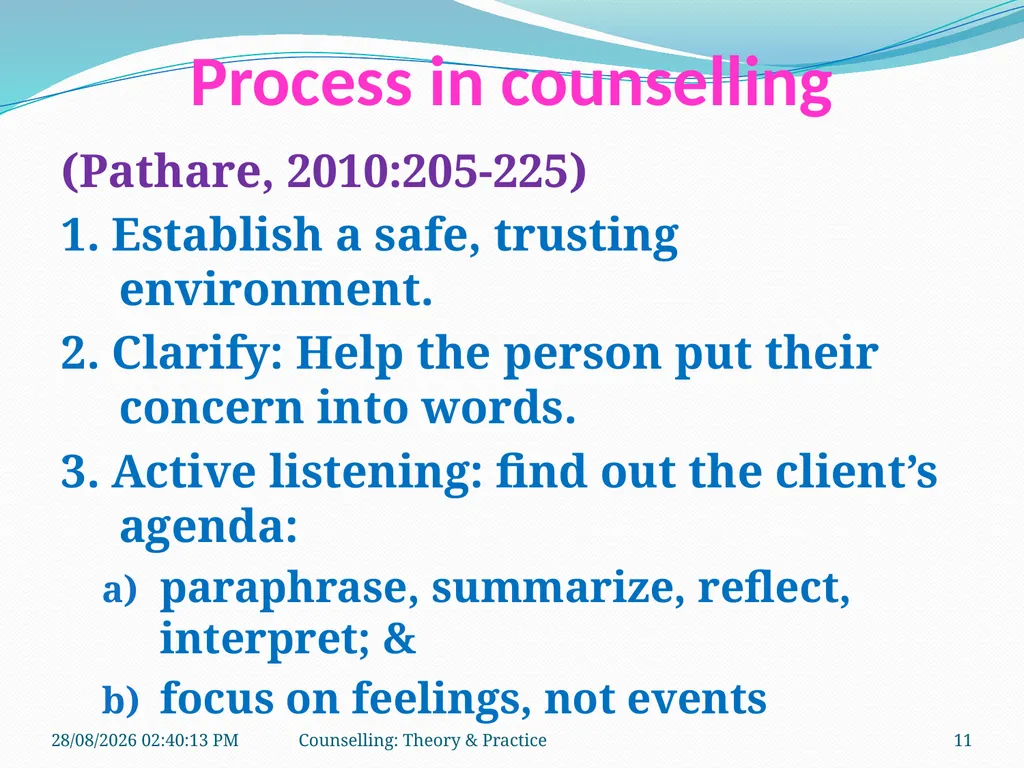
Process in counselling (Pathare, 2010:205-225)
1. Establish a safe, trusting environment.
2. Clarify: Help the person put their concern into words.
3. Active listening: find out the client’s agenda:
paraphrase, summarize, reflect, interpret; &
focus on feelings, not events 11-01-2019 11:13:09 Counselling: Theory & Practice 11<br>
1. Establish a safe, trusting environment.
2. Clarify: Help the person put their concern into words.
3. Active listening: find out the client’s agenda:
paraphrase, summarize, reflect, interpret; &
focus on feelings, not events 11-01-2019 11:13:09 Counselling: Theory & Practice 11<br>
12
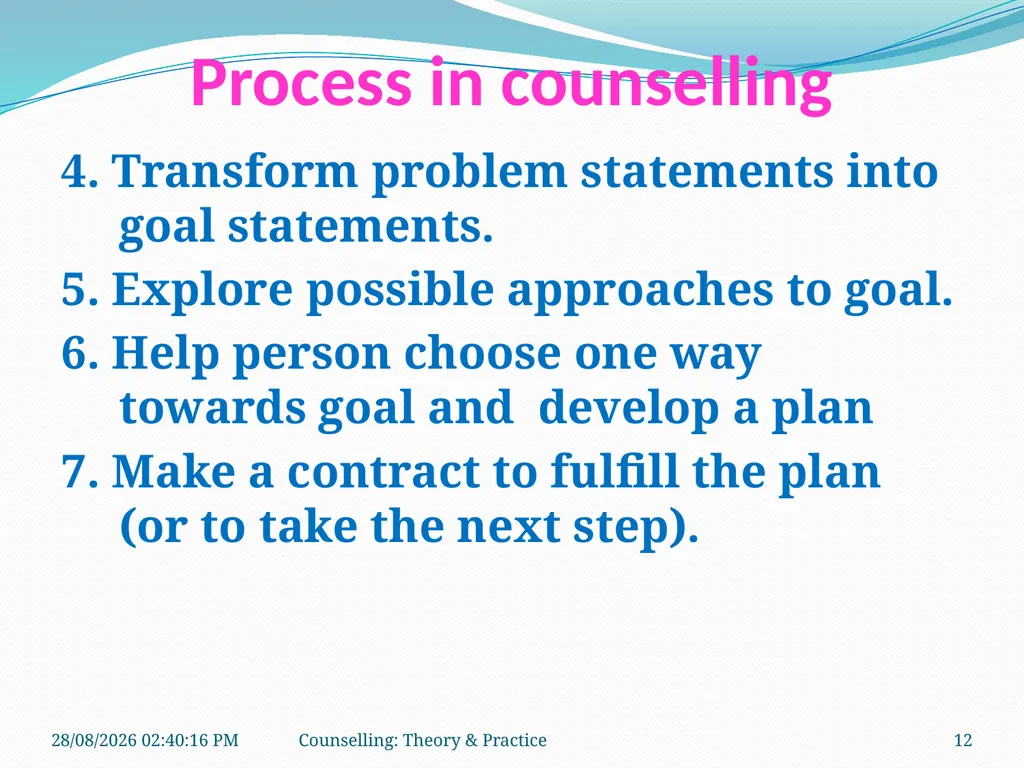
Process in counselling 4. Transform problem statements into goal statements.
5. Explore possible approaches to goal.
6. Help person choose one way towards goal and develop a plan
7. Make a contract to fulfill the plan (or to take the next step). 11-01-2019 11:13:09 Counselling: Theory & Practice 12<br>
5. Explore possible approaches to goal.
6. Help person choose one way towards goal and develop a plan
7. Make a contract to fulfill the plan (or to take the next step). 11-01-2019 11:13:09 Counselling: Theory & Practice 12<br>
13
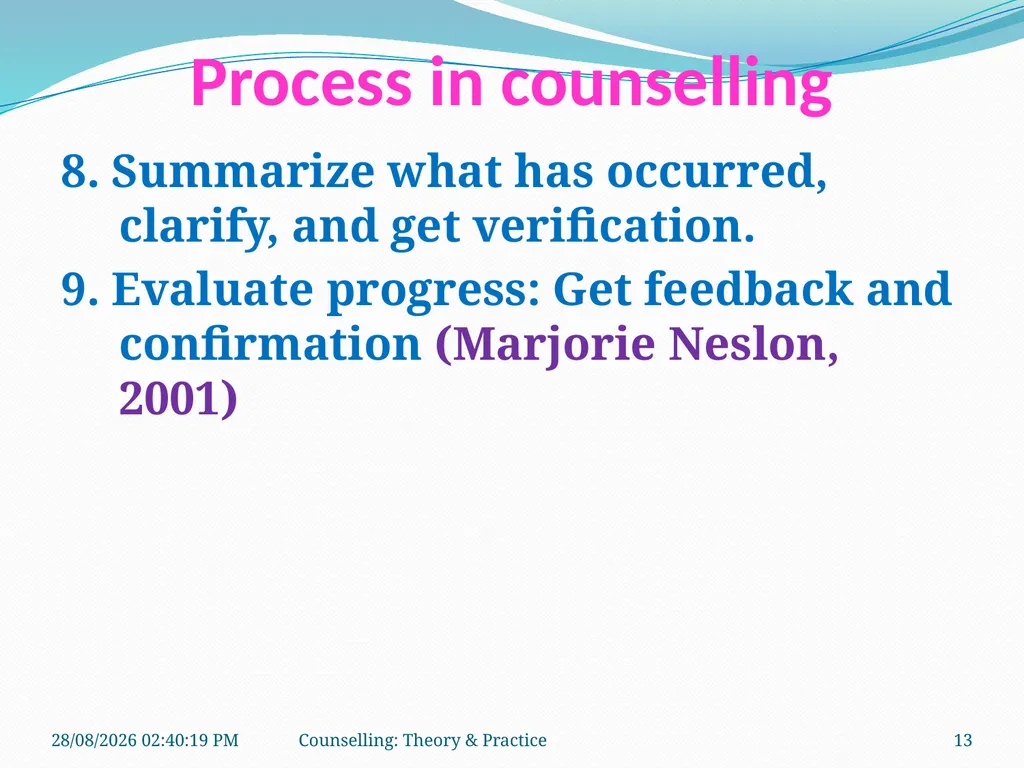
Process in counselling 8. Summarize what has occurred, clarify, and get verification.
9. Evaluate progress: Get feedback and confirmation (Marjorie Neslon, 2001) 11-01-2019 11:13:09 Counselling: Theory & Practice 13<br>
9. Evaluate progress: Get feedback and confirmation (Marjorie Neslon, 2001) 11-01-2019 11:13:09 Counselling: Theory & Practice 13<br>
14
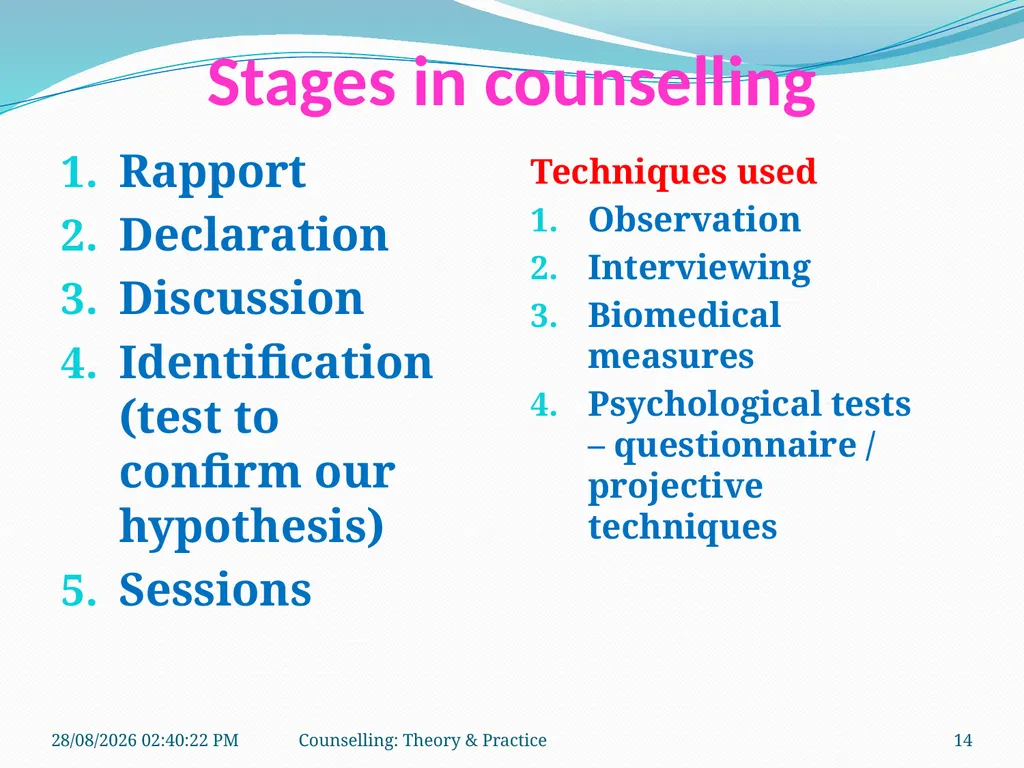
Stages in counselling Rapport
Declaration
Discussion
Identification (test to confirm our hypothesis)
Sessions 11-01-2019 11:13:09 Counselling: Theory & Practice 14 Techniques used
Observation
Interviewing
Biomedical measures
Psychological tests – questionnaire / projective techniques<br>
Declaration
Discussion
Identification (test to confirm our hypothesis)
Sessions 11-01-2019 11:13:09 Counselling: Theory & Practice 14 Techniques used
Observation
Interviewing
Biomedical measures
Psychological tests – questionnaire / projective techniques<br>
15
Stages in counselling Psychological tests to confirm counsellor’s hypotheses on the problem identified 11-01-2019 11:13:09 Counselling: Theory & Practice 15<br>
16
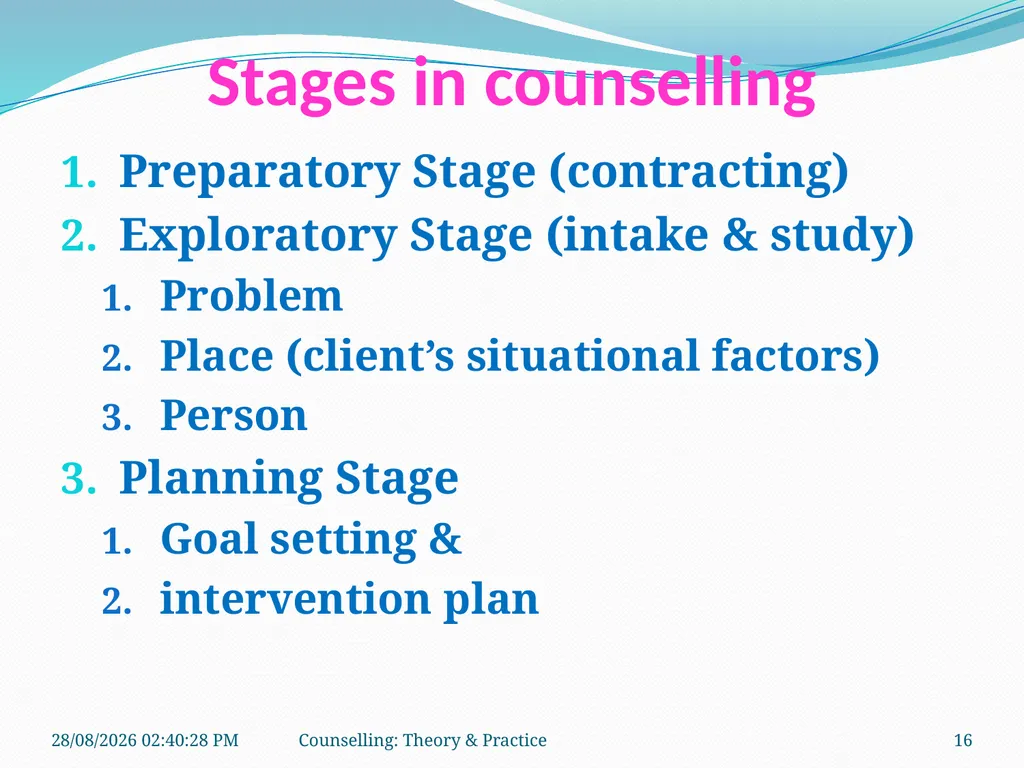
Stages in counselling Preparatory Stage (contracting)
Exploratory Stage (intake & study)
Problem
Place (client’s situational factors)
Person
Planning Stage
Goal setting &
intervention plan 11-01-2019 11:13:09 Counselling: Theory & Practice 16<br>
Exploratory Stage (intake & study)
Problem
Place (client’s situational factors)
Person
Planning Stage
Goal setting &
intervention plan 11-01-2019 11:13:09 Counselling: Theory & Practice 16<br>
17
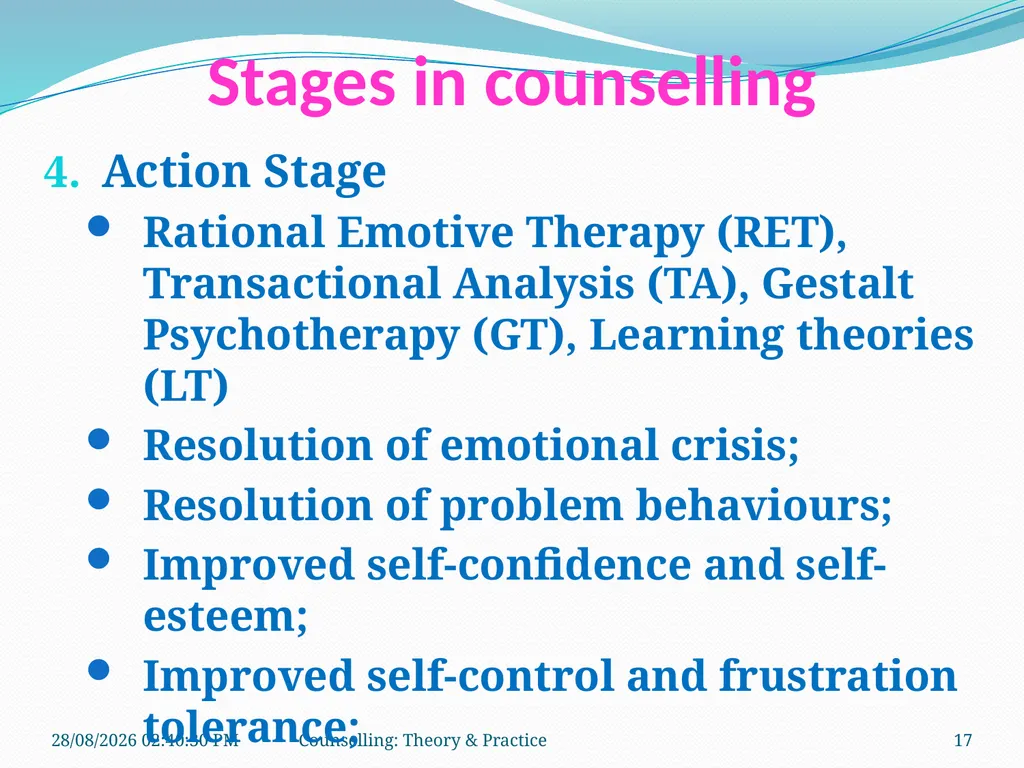
Stages in counselling Action Stage
Rational Emotive Therapy (RET), Transactional Analysis (TA), Gestalt Psychotherapy (GT), Learning theories (LT)
Resolution of emotional crisis;
Resolution of problem behaviours;
Improved self-confidence and self-esteem;
Improved self-control and frustration tolerance; 11-01-2019 11:13:09 Counselling: Theory & Practice 17<br>
Rational Emotive Therapy (RET), Transactional Analysis (TA), Gestalt Psychotherapy (GT), Learning theories (LT)
Resolution of emotional crisis;
Resolution of problem behaviours;
Improved self-confidence and self-esteem;
Improved self-control and frustration tolerance; 11-01-2019 11:13:09 Counselling: Theory & Practice 17<br>
18
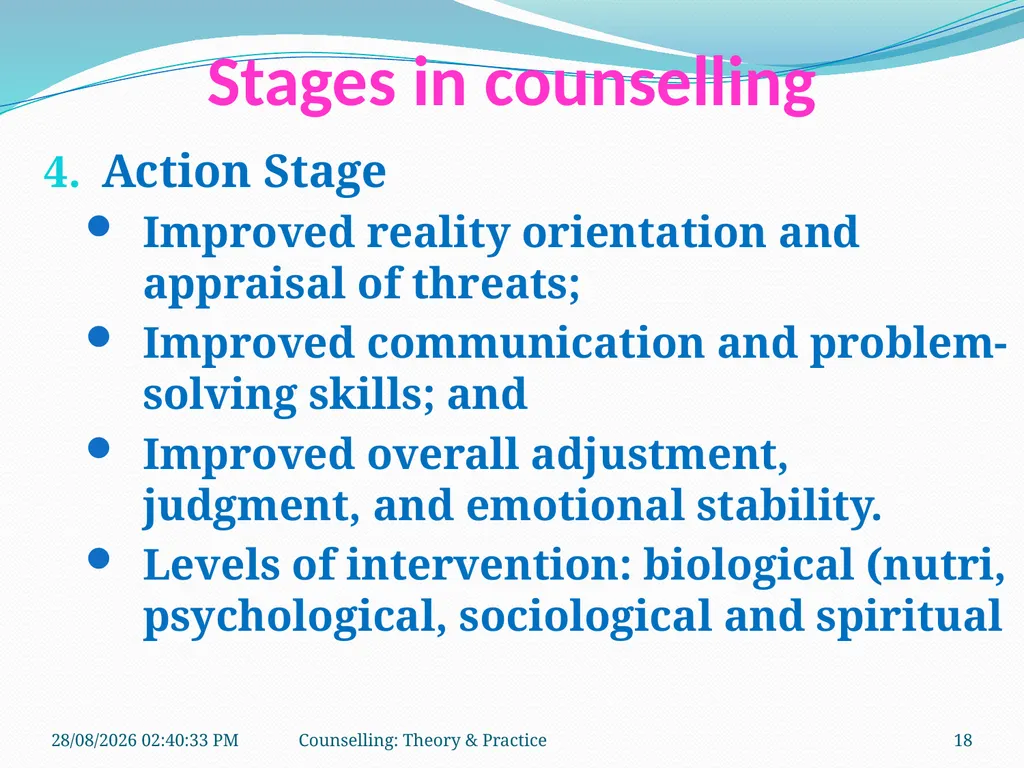
Stages in counselling Action Stage
Improved reality orientation and appraisal of threats;
Improved communication and problem-solving skills; and
Improved overall adjustment, judgment, and emotional stability.
Levels of intervention: biological (nutri, psychological, sociological and spiritual 11-01-2019 11:13:09 Counselling: Theory & Practice 18<br>
Improved reality orientation and appraisal of threats;
Improved communication and problem-solving skills; and
Improved overall adjustment, judgment, and emotional stability.
Levels of intervention: biological (nutri, psychological, sociological and spiritual 11-01-2019 11:13:09 Counselling: Theory & Practice 18<br>
19
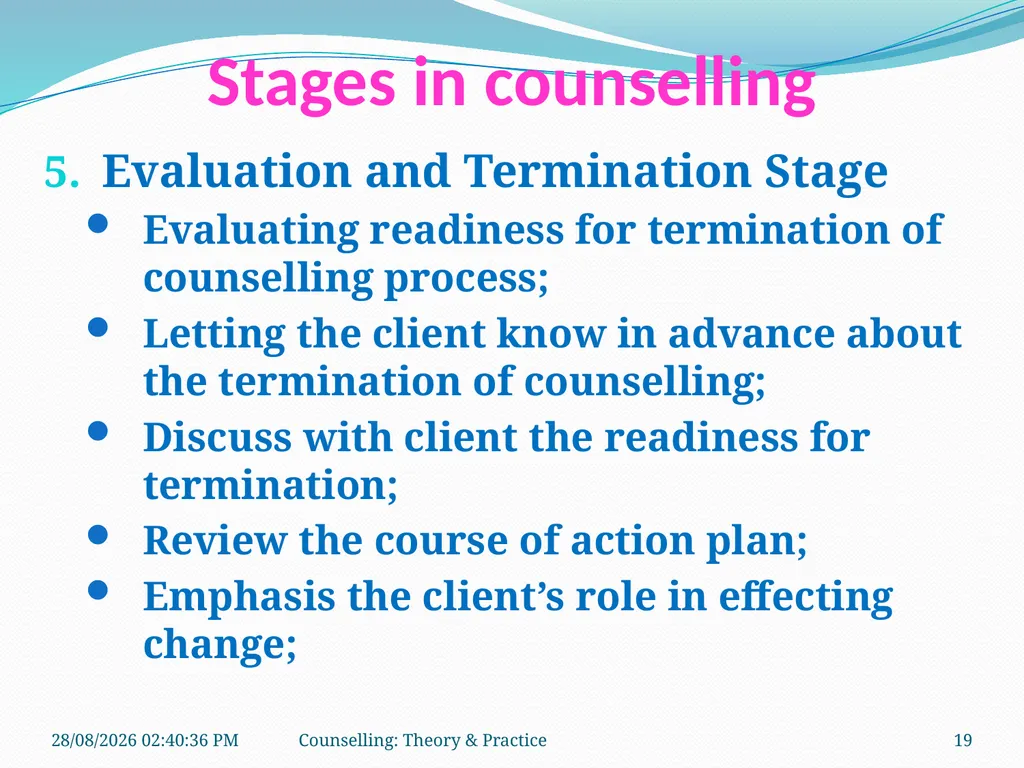
Stages in counselling Evaluation and Termination Stage
Evaluating readiness for termination of counselling process;
Letting the client know in advance about the termination of counselling;
Discuss with client the readiness for termination;
Review the course of action plan;
Emphasis the client’s role in effecting change; 11-01-2019 11:13:09 Counselling: Theory & Practice 19<br>
Evaluating readiness for termination of counselling process;
Letting the client know in advance about the termination of counselling;
Discuss with client the readiness for termination;
Review the course of action plan;
Emphasis the client’s role in effecting change; 11-01-2019 11:13:09 Counselling: Theory & Practice 19<br>
20
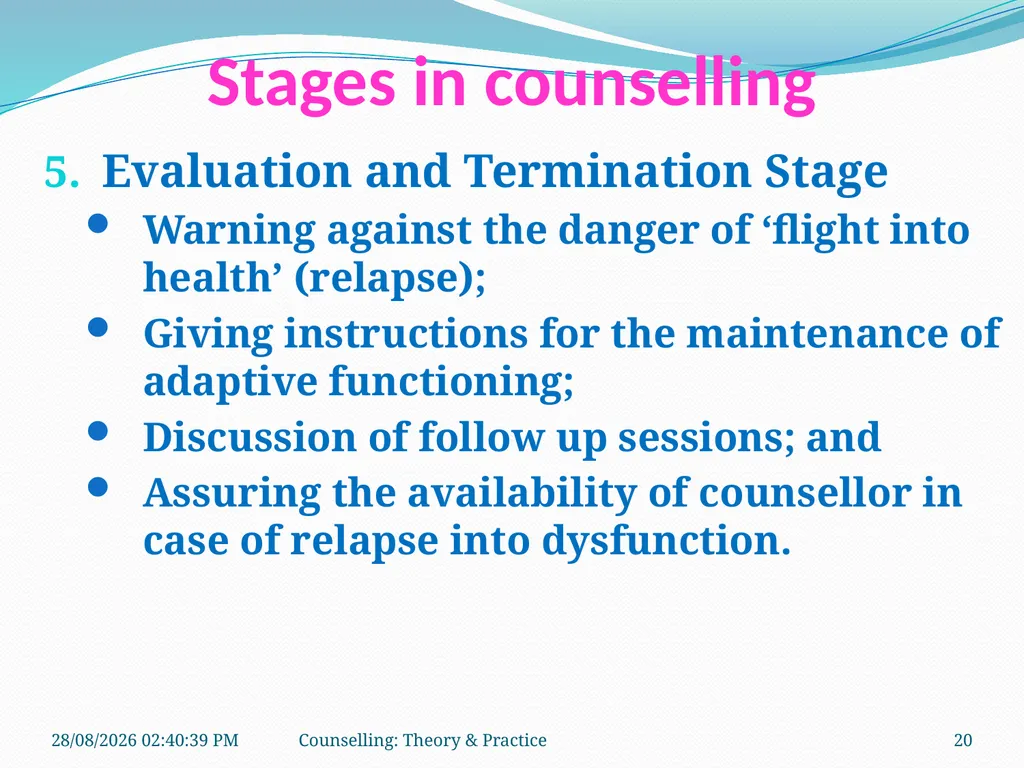
Stages in counselling Evaluation and Termination Stage
Warning against the danger of ‘flight into health’ (relapse);
Giving instructions for the maintenance of adaptive functioning;
Discussion of follow up sessions; and
Assuring the availability of counsellor in case of relapse into dysfunction. 11-01-2019 11:13:09 Counselling: Theory & Practice 20<br>
Warning against the danger of ‘flight into health’ (relapse);
Giving instructions for the maintenance of adaptive functioning;
Discussion of follow up sessions; and
Assuring the availability of counsellor in case of relapse into dysfunction. 11-01-2019 11:13:09 Counselling: Theory & Practice 20<br>
21
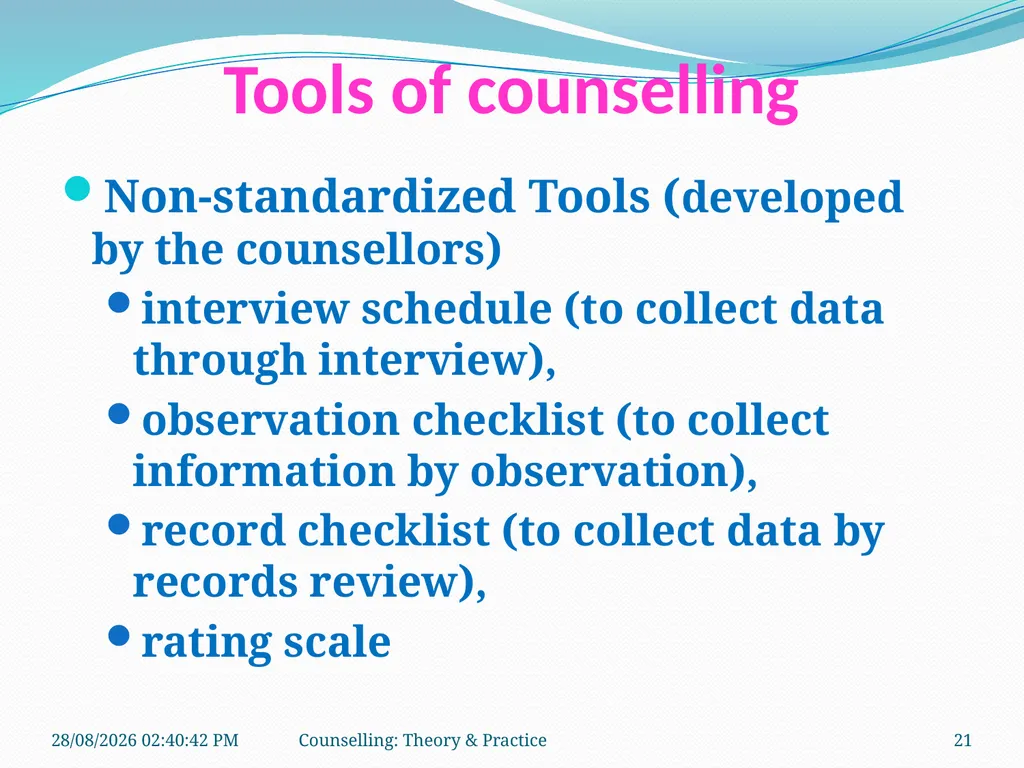
Tools of counselling Non-standardized Tools (developed by the counsellors)
interview schedule (to collect data through interview),
observation checklist (to collect information by observation),
record checklist (to collect data by records review),
rating scale 11-01-2019 11:13:09 Counselling: Theory & Practice 21<br>
interview schedule (to collect data through interview),
observation checklist (to collect information by observation),
record checklist (to collect data by records review),
rating scale 11-01-2019 11:13:09 Counselling: Theory & Practice 21<br>
22
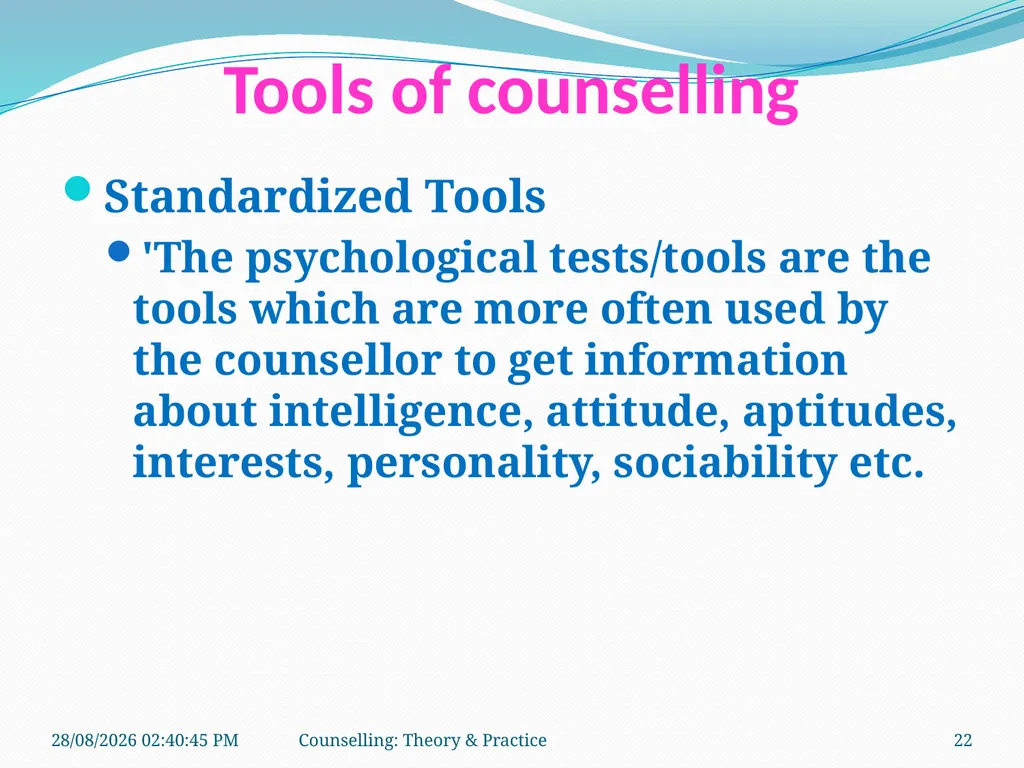
Tools of counselling Standardized Tools
'The psychological tests/tools are the tools which are more often used by the counsellor to get information about intelligence, attitude, aptitudes, interests, personality, sociability etc. 11-01-2019 11:13:09 Counselling: Theory & Practice 22<br>
'The psychological tests/tools are the tools which are more often used by the counsellor to get information about intelligence, attitude, aptitudes, interests, personality, sociability etc. 11-01-2019 11:13:09 Counselling: Theory & Practice 22<br>
23
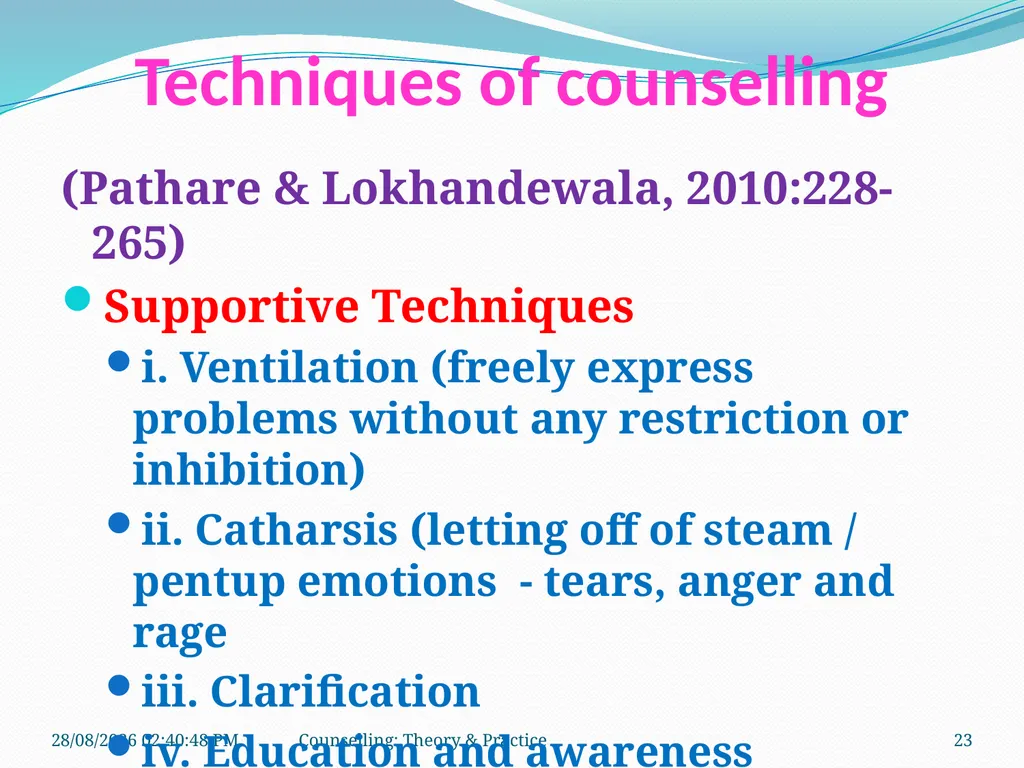
Techniques of counselling (Pathare & Lokhandewala, 2010:228-265)
Supportive Techniques
i. Ventilation (freely express problems without any restriction or inhibition)
ii. Catharsis (letting off of steam / pentup emotions - tears, anger and rage
iii. Clarification
iv. Education and awareness
v. Guidance and Suggestion 11-01-2019 11:13:09 Counselling: Theory & Practice 23<br>
Supportive Techniques
i. Ventilation (freely express problems without any restriction or inhibition)
ii. Catharsis (letting off of steam / pentup emotions - tears, anger and rage
iii. Clarification
iv. Education and awareness
v. Guidance and Suggestion 11-01-2019 11:13:09 Counselling: Theory & Practice 23<br>
24
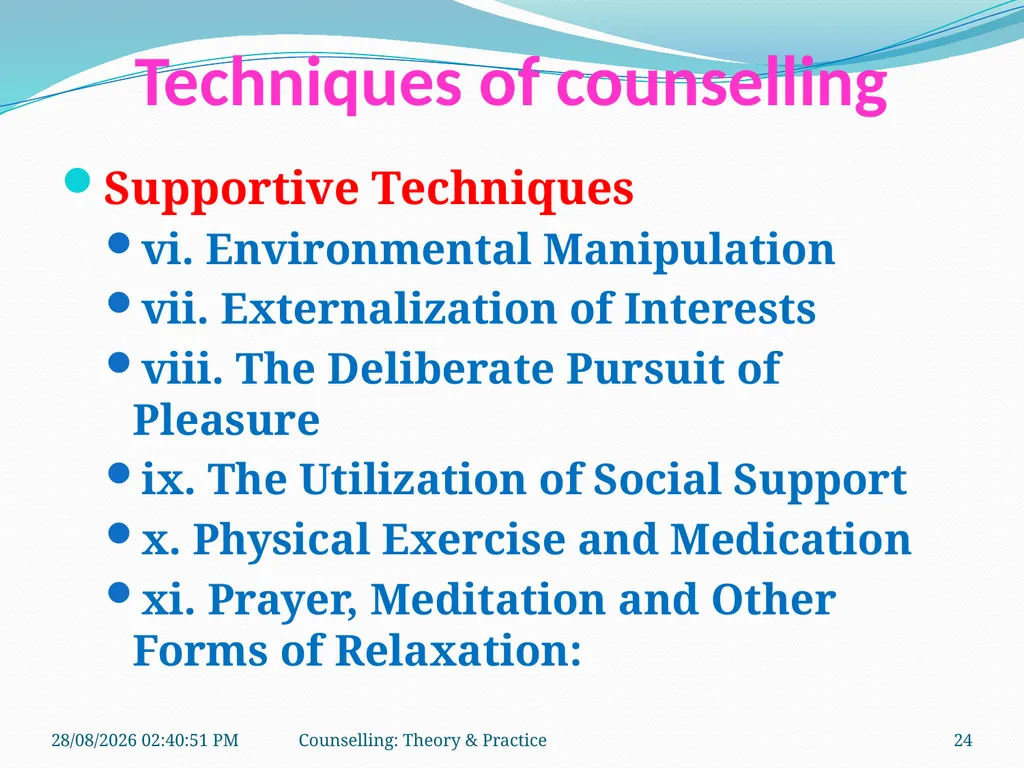
Techniques of counselling Supportive Techniques
vi. Environmental Manipulation
vii. Externalization of Interests
viii. The Deliberate Pursuit of Pleasure
ix. The Utilization of Social Support
x. Physical Exercise and Medication
xi. Prayer, Meditation and Other Forms of Relaxation: 11-01-2019 11:13:09 Counselling: Theory & Practice 24<br>
vi. Environmental Manipulation
vii. Externalization of Interests
viii. The Deliberate Pursuit of Pleasure
ix. The Utilization of Social Support
x. Physical Exercise and Medication
xi. Prayer, Meditation and Other Forms of Relaxation: 11-01-2019 11:13:09 Counselling: Theory & Practice 24<br>
25
Techniques of counselling Behavioural (modification )Techniques
i. Classical Conditioning Theory (Pavlov)
ii. Instrumental Conditioning (Skinner)
iii. Observational Learning (Bandura) - attention, retention, reproduction and motivation
iv. Systematic desensitization
v. Flooding 11-01-2019 11:13:09 Counselling: Theory & Practice 25<br>
i. Classical Conditioning Theory (Pavlov)
ii. Instrumental Conditioning (Skinner)
iii. Observational Learning (Bandura) - attention, retention, reproduction and motivation
iv. Systematic desensitization
v. Flooding 11-01-2019 11:13:09 Counselling: Theory & Practice 25<br>
26
Techniques of counselling Behavioural (modification )Techniques
vi. Shaping (reinforcement)
vii. Chaining (forward / backward)
viii. Covert conditioning (mental rehearsal)
ix. Contingency management (tokenism)
x. Assertiveness training
xi. Aversion therapy
xii. Biofeedback 11-01-2019 11:13:09 Counselling: Theory & Practice 26<br>
vi. Shaping (reinforcement)
vii. Chaining (forward / backward)
viii. Covert conditioning (mental rehearsal)
ix. Contingency management (tokenism)
x. Assertiveness training
xi. Aversion therapy
xii. Biofeedback 11-01-2019 11:13:09 Counselling: Theory & Practice 26<br>
27
Techniques of counselling Cognitive Techniques in Counselling
Rational-Emotive (demonstrates the relationship between irrational ideas and unhappiness)
Cognitive-Behavioural - insight therapy changing negative thought patterns and maladaptive beliefs
Reality therapy- people are responsible for their behaviour
Transactional Analysis 11-01-2019 11:13:09 Counselling: Theory & Practice 27<br>
Rational-Emotive (demonstrates the relationship between irrational ideas and unhappiness)
Cognitive-Behavioural - insight therapy changing negative thought patterns and maladaptive beliefs
Reality therapy- people are responsible for their behaviour
Transactional Analysis 11-01-2019 11:13:09 Counselling: Theory & Practice 27<br>
28
Techniques of counselling Psychoanalytical Techniques
1. Free Associations Method
2. The Interpretation of Faulty Acts (Freudian Slips and Mistakes)
3. The Interpretation of Dreams
4. The Interpretation of Symbols 11-01-2019 11:13:09 Counselling: Theory & Practice 28<br>
1. Free Associations Method
2. The Interpretation of Faulty Acts (Freudian Slips and Mistakes)
3. The Interpretation of Dreams
4. The Interpretation of Symbols 11-01-2019 11:13:09 Counselling: Theory & Practice 28<br>
29
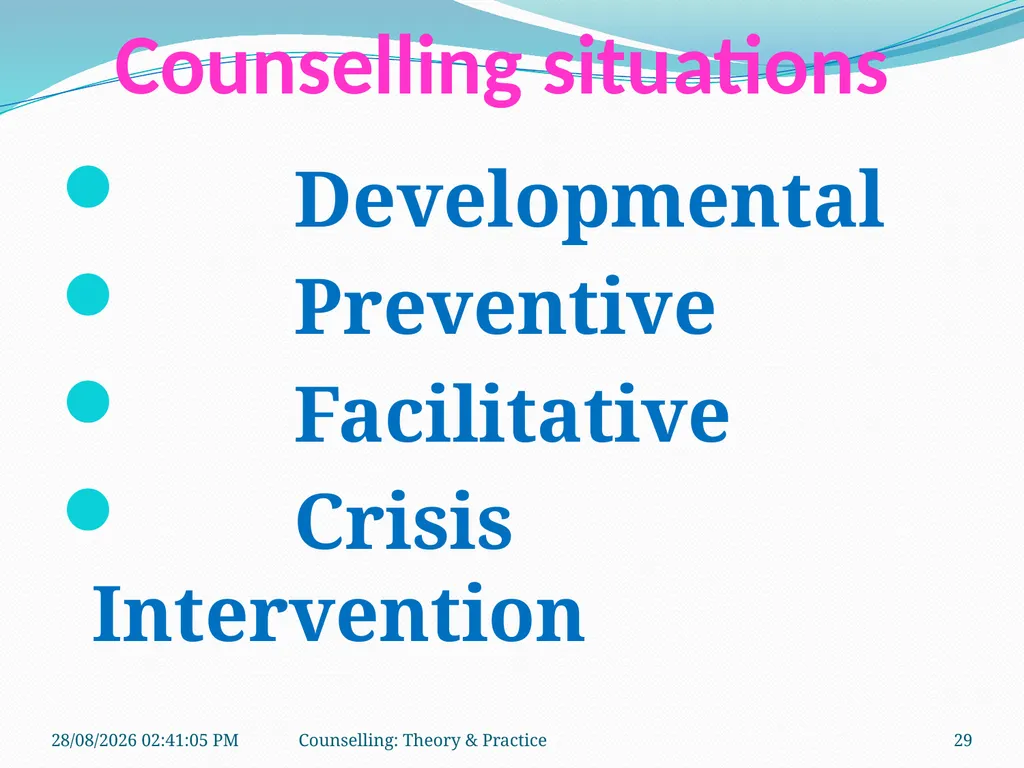
Counselling situations Developmental
Preventive
Facilitative
Crisis Intervention 11-01-2019 11:13:09 Counselling: Theory & Practice 29<br>
Preventive
Facilitative
Crisis Intervention 11-01-2019 11:13:09 Counselling: Theory & Practice 29<br>
30
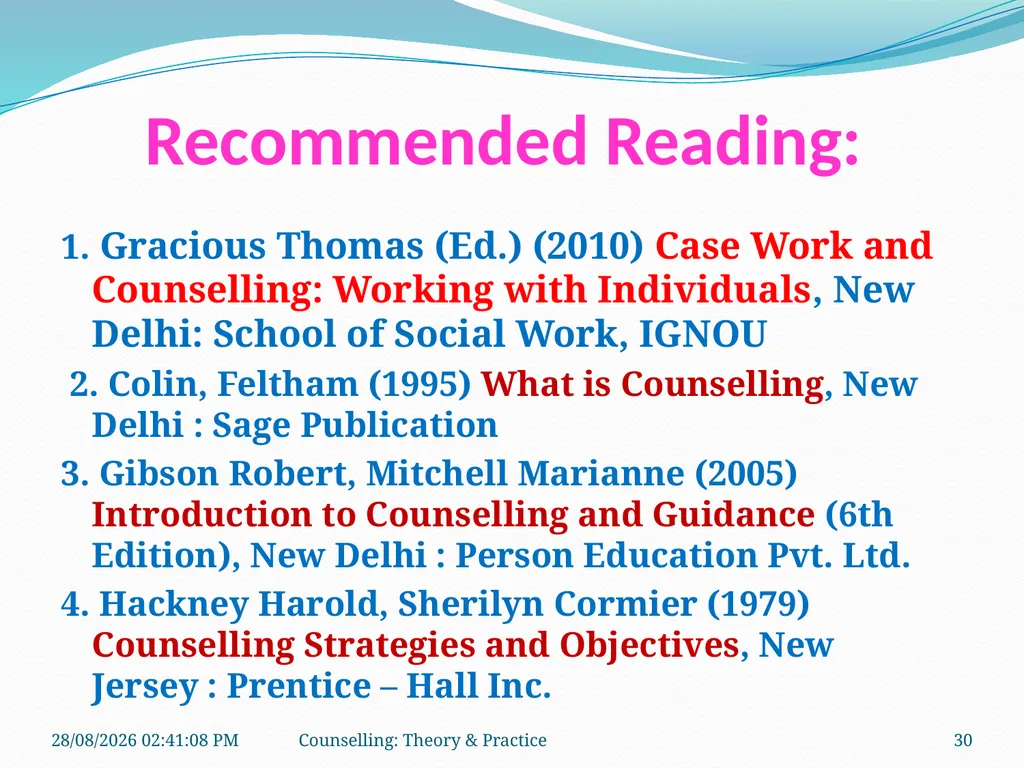
Recommended Reading: 1. Gracious Thomas (Ed.) (2010) Case Work and Counselling: Working with Individuals, New Delhi: School of Social Work, IGNOU
2. Colin, Feltham (1995) What is Counselling, New Delhi : Sage Publication
3. Gibson Robert, Mitchell Marianne (2005) Introduction to Counselling and Guidance (6th Edition), New Delhi : Person Education Pvt. Ltd.
4. Hackney Harold, Sherilyn Cormier (1979) Counselling Strategies and Objectives, New Jersey : Prentice – Hall Inc. 11-01-2019 11:13:09 Counselling: Theory & Practice 30<br>
2. Colin, Feltham (1995) What is Counselling, New Delhi : Sage Publication
3. Gibson Robert, Mitchell Marianne (2005) Introduction to Counselling and Guidance (6th Edition), New Delhi : Person Education Pvt. Ltd.
4. Hackney Harold, Sherilyn Cormier (1979) Counselling Strategies and Objectives, New Jersey : Prentice – Hall Inc. 11-01-2019 11:13:09 Counselling: Theory & Practice 30<br>
31
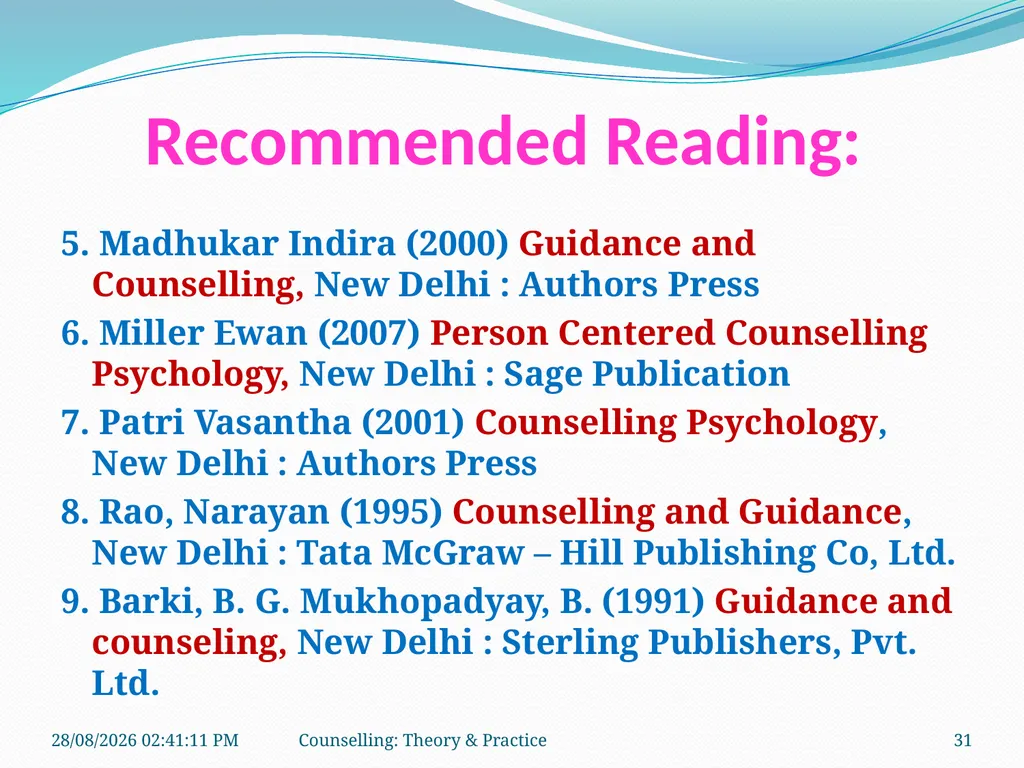
Recommended Reading: 5. Madhukar Indira (2000) Guidance and Counselling, New Delhi : Authors Press
6. Miller Ewan (2007) Person Centered Counselling Psychology, New Delhi : Sage Publication
7. Patri Vasantha (2001) Counselling Psychology, New Delhi : Authors Press
8. Rao, Narayan (1995) Counselling and Guidance, New Delhi : Tata McGraw – Hill Publishing Co, Ltd.
9. Barki, B. G. Mukhopadyay, B. (1991) Guidance and counseling, New Delhi : Sterling Publishers, Pvt. Ltd. 11-01-2019 11:13:09 Counselling: Theory & Practice 31<br>
6. Miller Ewan (2007) Person Centered Counselling Psychology, New Delhi : Sage Publication
7. Patri Vasantha (2001) Counselling Psychology, New Delhi : Authors Press
8. Rao, Narayan (1995) Counselling and Guidance, New Delhi : Tata McGraw – Hill Publishing Co, Ltd.
9. Barki, B. G. Mukhopadyay, B. (1991) Guidance and counseling, New Delhi : Sterling Publishers, Pvt. Ltd. 11-01-2019 11:13:09 Counselling: Theory & Practice 31<br>
32
Thank You 11-01-2019 11:13:09 Counselling: Theory & Practice 32<br>