
february 20, 2019 | WESTBOROUGH, MA Jonathan

Description: february 20, 2019 WESTBOROUGH, MA Jonathan Lowell (413) 540-4658 jlowelliso-ne.com Interconnection Reliability Operating Limit Critical Infrastructure Protection Cost Recovery 2 Generators designated by the ISO as critical to the
Related Topics
Download Presentation
"february 20, 2019 | WESTBOROUGH, MA Jonathan" is the property of its rightful owner. Permission is granted to download and print the materials on this website for personal, non-commercial use only, and to display it on your personal computer provided you do not modify the materials and that you retain all copyright notices contained in the materials. By downloading content from our website, you accept the terms of this agreement.
Presentation Transcript
slide1. february 20, 2019 | WESTBOROUGH, MA Jonathan Lowell (413) 540-4658 | jlowell@iso-ne.com Interconnection Reliability Operating Limit Critical Infrastructure Protection Cost Recovery<br>
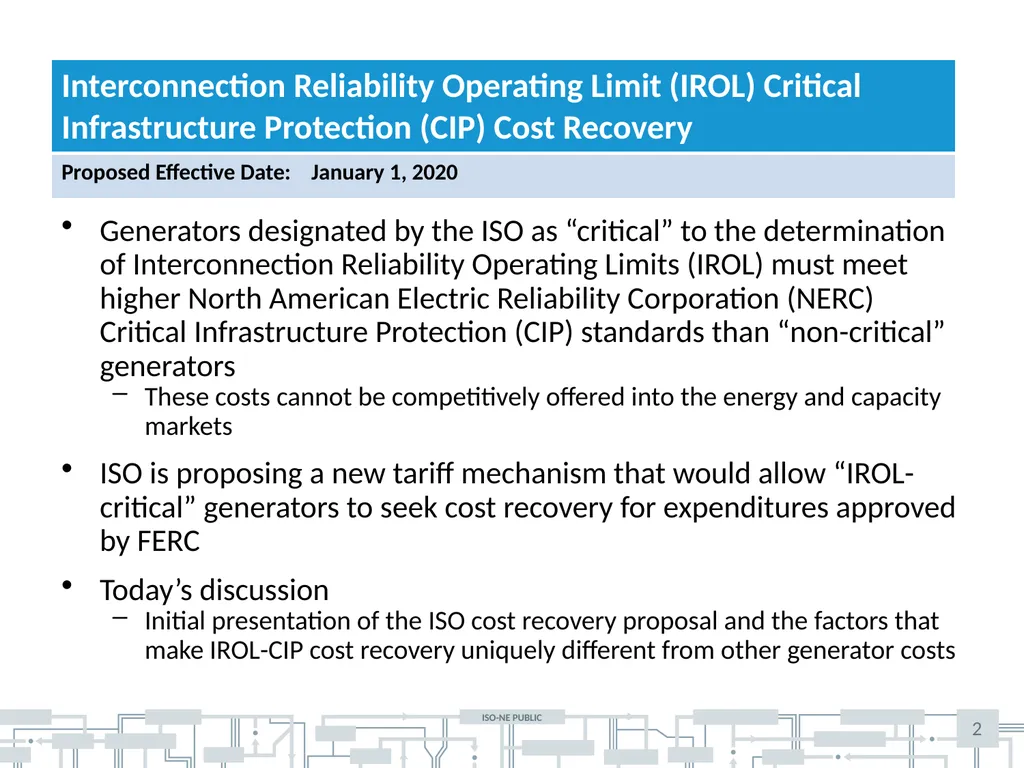
slide2. 2 Generators designated by the ISO as “critical” to the determination of Interconnection Reliability Operating Limits (IROL) must meet higher North American Electric Reliability Corporation (NERC) Critical Infrastructure Protection (CIP) standards than “non-critical” generators
These costs cannot be competitively offered into the energy and capacity markets
ISO is proposing a new tariff mechanism that would allow “IROL-critical” generators to seek cost recovery for expenditures approved by FERC
Today’s discussion
Initial presentation of the ISO cost recovery proposal and the factors that make IROL-CIP cost recovery uniquely different from other generator costs<br>
slide3. IROL cip Background<br>
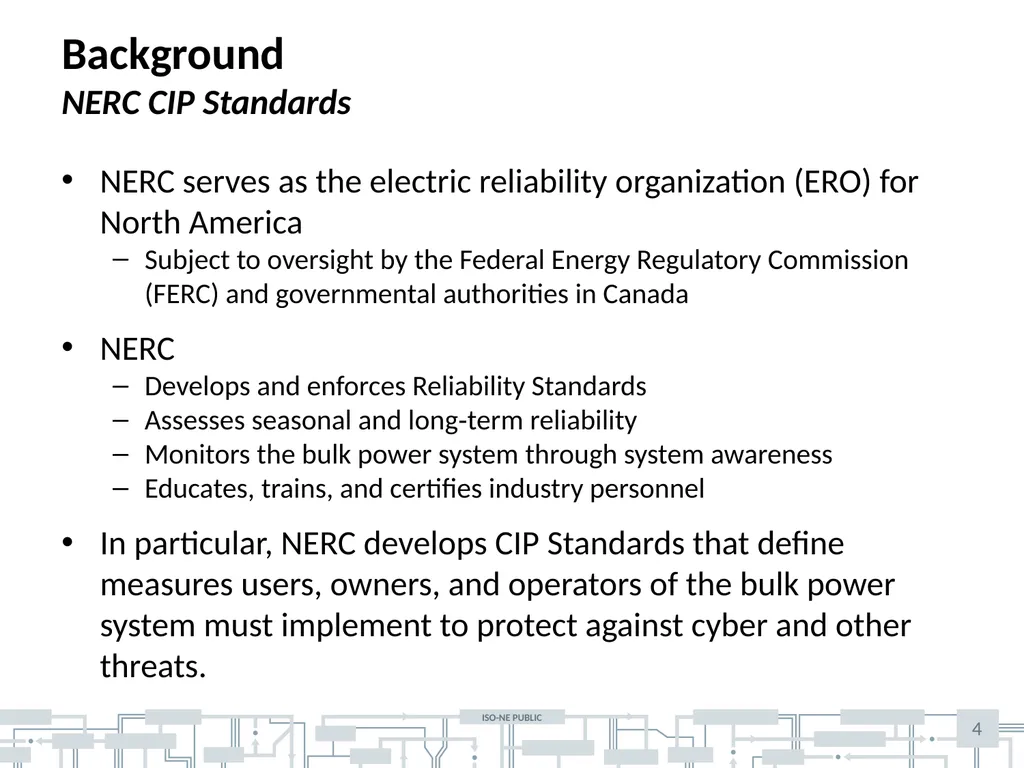
slide4. Background NERC CIP Standards NERC serves as the electric reliability organization (ERO) for North America
Subject to oversight by the Federal Energy Regulatory Commission (FERC) and governmental authorities in Canada
NERC
Develops and enforces Reliability Standards
Assesses seasonal and long‐term reliability
Monitors the bulk power system through system awareness
Educates, trains, and certifies industry personnel
In particular, NERC develops CIP Standards that define measures users, owners, and operators of the bulk power system must implement to protect against cyber and other threats. 4<br>
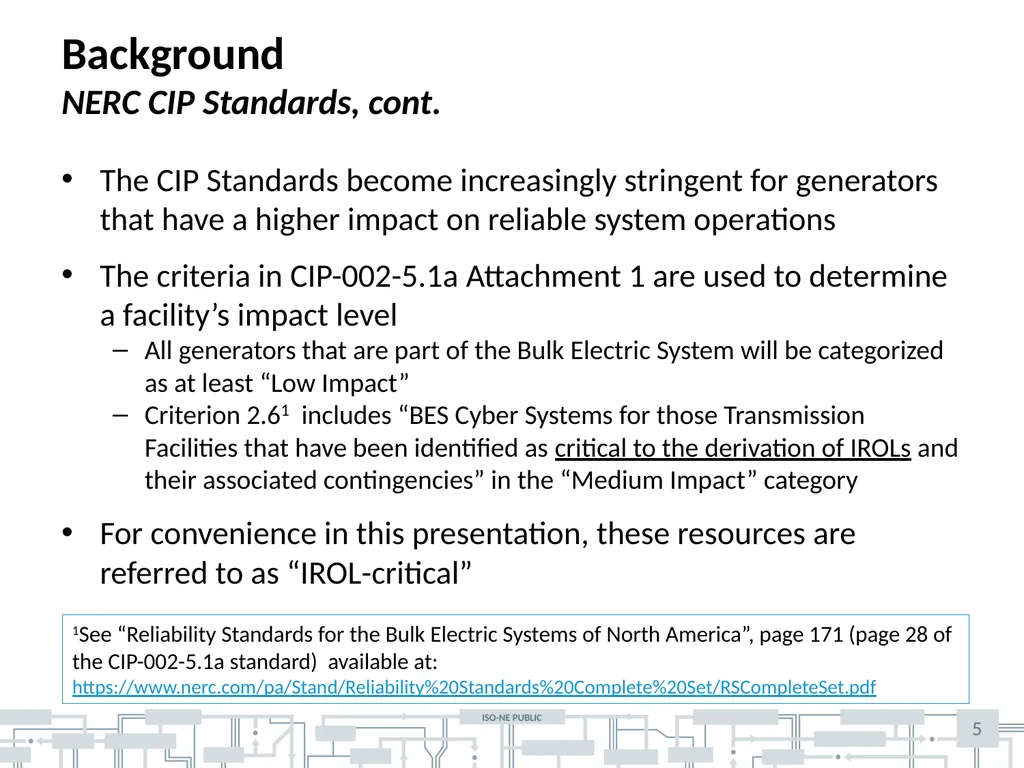
slide5. Background NERC CIP Standards, cont. The CIP Standards become increasingly stringent for generators that have a higher impact on reliable system operations
The criteria in CIP-002-5.1a Attachment 1 are used to determine a facility’s impact level
All generators that are part of the Bulk Electric System will be categorized as at least “Low Impact”
Criterion 2.61 includes “BES Cyber Systems for those Transmission Facilities that have been identified as critical to the derivation of IROLs and their associated contingencies” in the “Medium Impact” category
For convenience in this presentation, these resources are referred to as “IROL-critical” 1See “Reliability Standards for the Bulk Electric Systems of North America”, page 171 (page 28 of
the CIP-002-5.1a standard) available at:
https://www.nerc.com/pa/Stand/Reliability%20Standards%20Complete%20Set/RSCompleteSet.pdf 5<br>
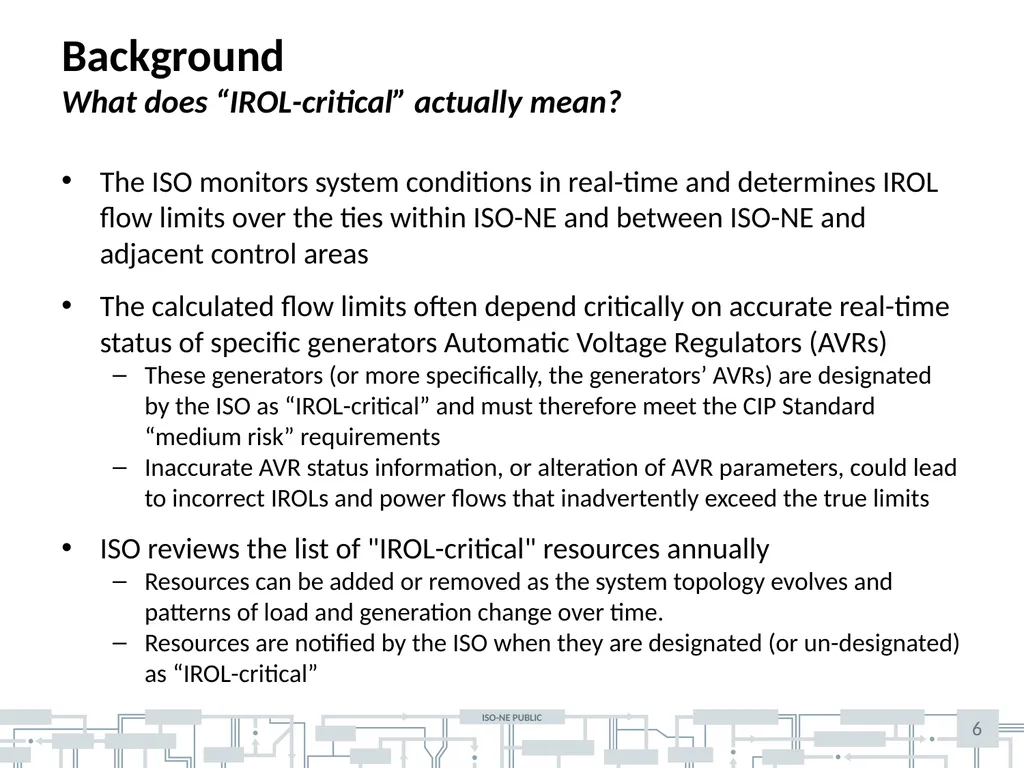
slide6. 6 Background What does “IROL-critical” actually mean? The ISO monitors system conditions in real-time and determines IROL flow limits over the ties within ISO-NE and between ISO-NE and adjacent control areas
The calculated flow limits often depend critically on accurate real-time status of specific generators Automatic Voltage Regulators (AVRs)
These generators (or more specifically, the generators’ AVRs) are designated by the ISO as “IROL-critical” and must therefore meet the CIP Standard “medium risk” requirements
Inaccurate AVR status information, or alteration of AVR parameters, could lead to incorrect IROLs and power flows that inadvertently exceed the true limits
ISO reviews the list of "IROL-critical" resources annually
Resources can be added or removed as the system topology evolves and patterns of load and generation change over time.
Resources are notified by the ISO when they are designated (or un-designated) as “IROL-critical”<br>
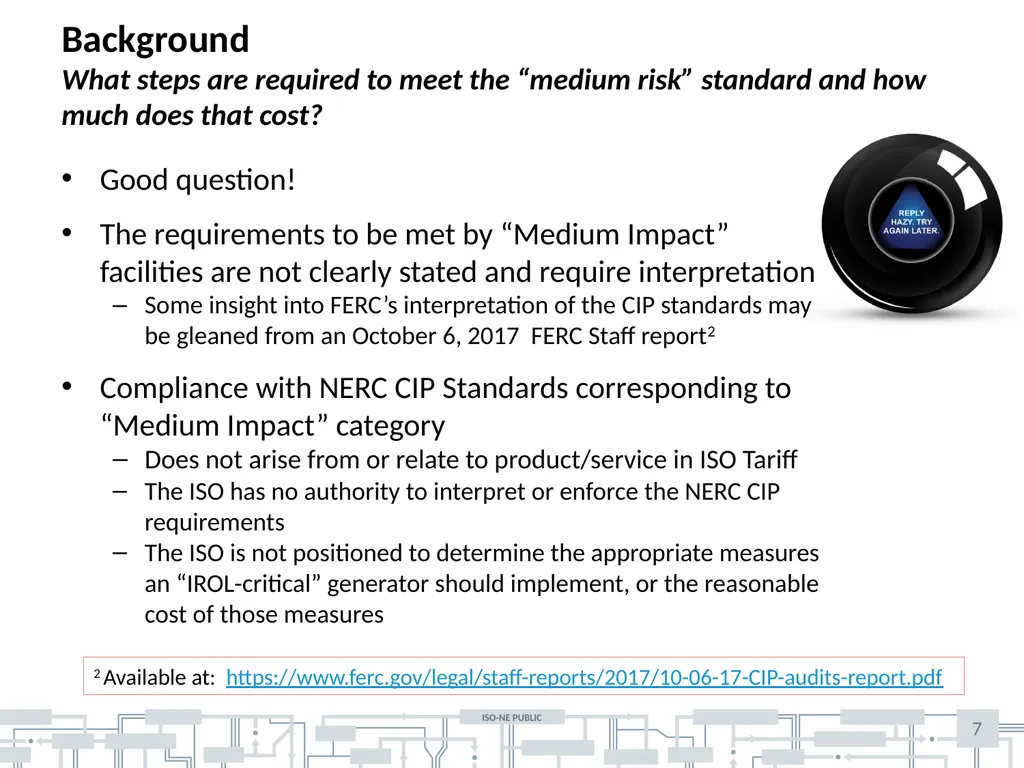
slide7. Background What steps are required to meet the “medium risk” standard and how much does that cost? Good question!
The requirements to be met by “Medium Impact” facilities are not clearly stated and require interpretation
Some insight into FERC’s interpretation of the CIP standards may be gleaned from an October 6, 2017 FERC Staff report2
Compliance with NERC CIP Standards corresponding to “Medium Impact” category
Does not arise from or relate to product/service in ISO Tariff
The ISO has no authority to interpret or enforce the NERC CIP requirements
The ISO is not positioned to determine the appropriate measures an “IROL-critical” generator should implement, or the reasonable cost of those measures 2 Available at: https://www.ferc.gov/legal/staff-reports/2017/10-06-17-CIP-audits-report.pdf 7<br>
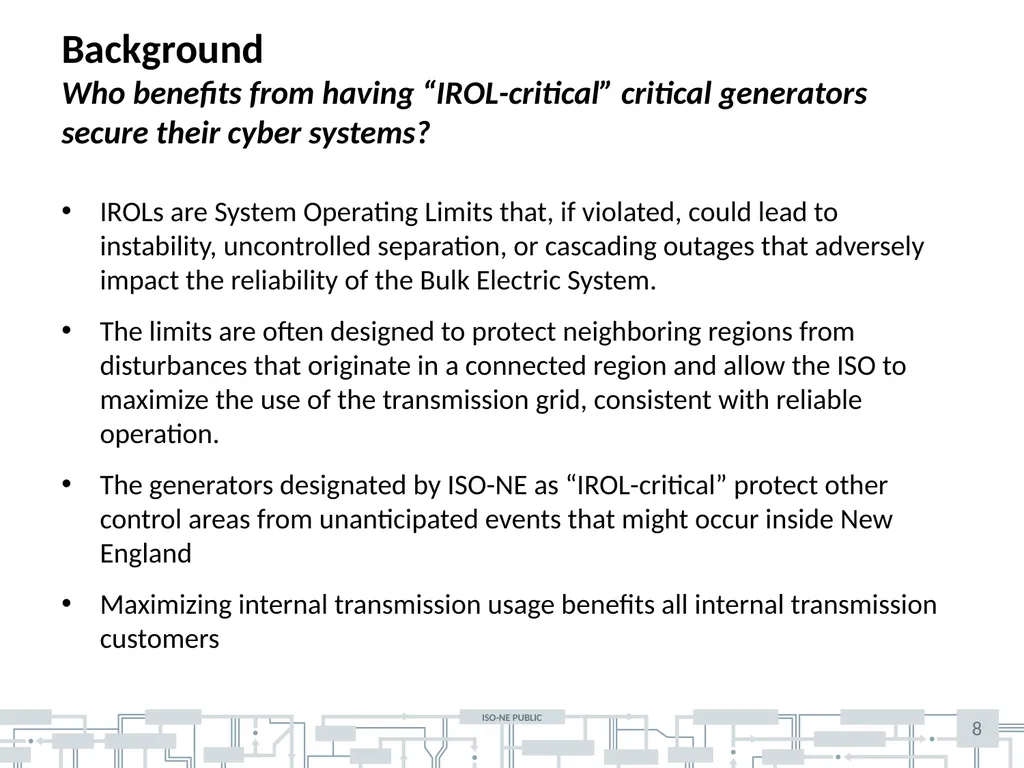
slide8. Background Who benefits from having “IROL-critical” critical generators secure their cyber systems? IROLs are System Operating Limits that, if violated, could lead to instability, uncontrolled separation, or cascading outages that adversely impact the reliability of the Bulk Electric System.
The limits are often designed to protect neighboring regions from disturbances that originate in a connected region and allow the ISO to maximize the use of the transmission grid, consistent with reliable operation.
The generators designated by ISO-NE as “IROL-critical” protect other control areas from unanticipated events that might occur inside New England
Maximizing internal transmission usage benefits all internal transmission customers 8<br>
slide9. IROL-cip compensation proposal New OATT Schedule 17<br>
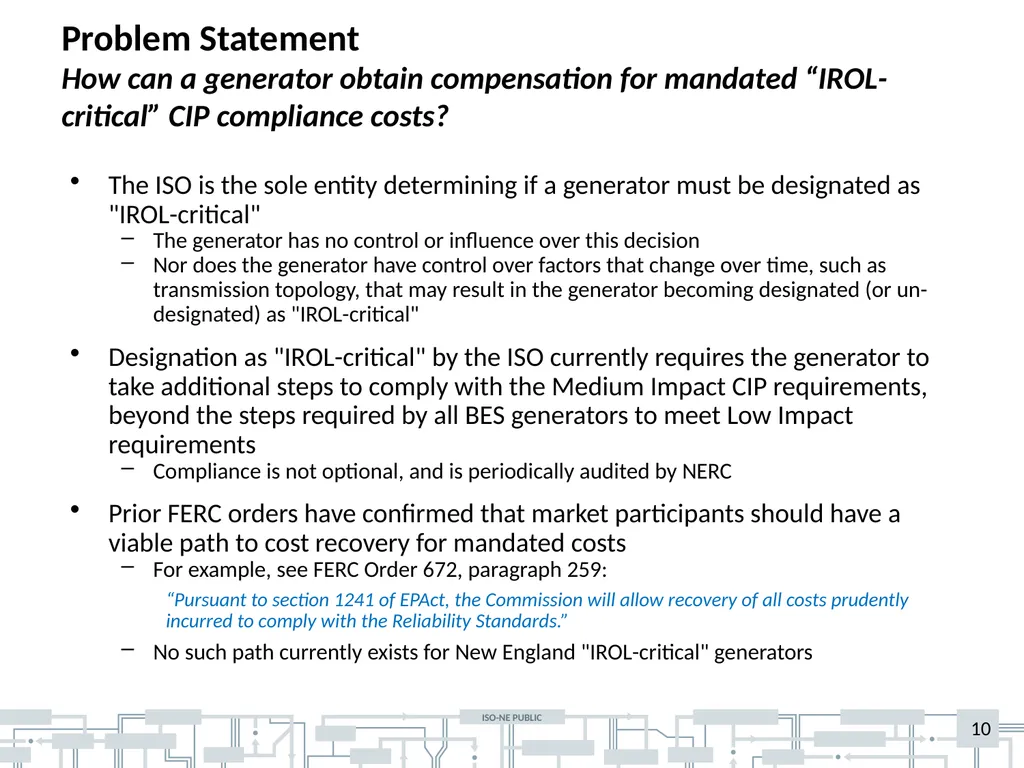
slide10. Problem Statement How can a generator obtain compensation for mandated “IROL-critical” CIP compliance costs? The ISO is the sole entity determining if a generator must be designated as "IROL-critical"
The generator has no control or influence over this decision
Nor does the generator have control over factors that change over time, such as transmission topology, that may result in the generator becoming designated (or un-designated) as "IROL-critical"
Designation as "IROL-critical" by the ISO currently requires the generator to take additional steps to comply with the Medium Impact CIP requirements, beyond the steps required by all BES generators to meet Low Impact requirements
Compliance is not optional, and is periodically audited by NERC
Prior FERC orders have confirmed that market participants should have a viable path to cost recovery for mandated costs
For example, see FERC Order 672, paragraph 259:
“Pursuant to section 1241 of EPAct, the Commission will allow recovery of all costs prudently incurred to comply with the Reliability Standards.”
No such path currently exists for New England "IROL-critical" generators 10<br>
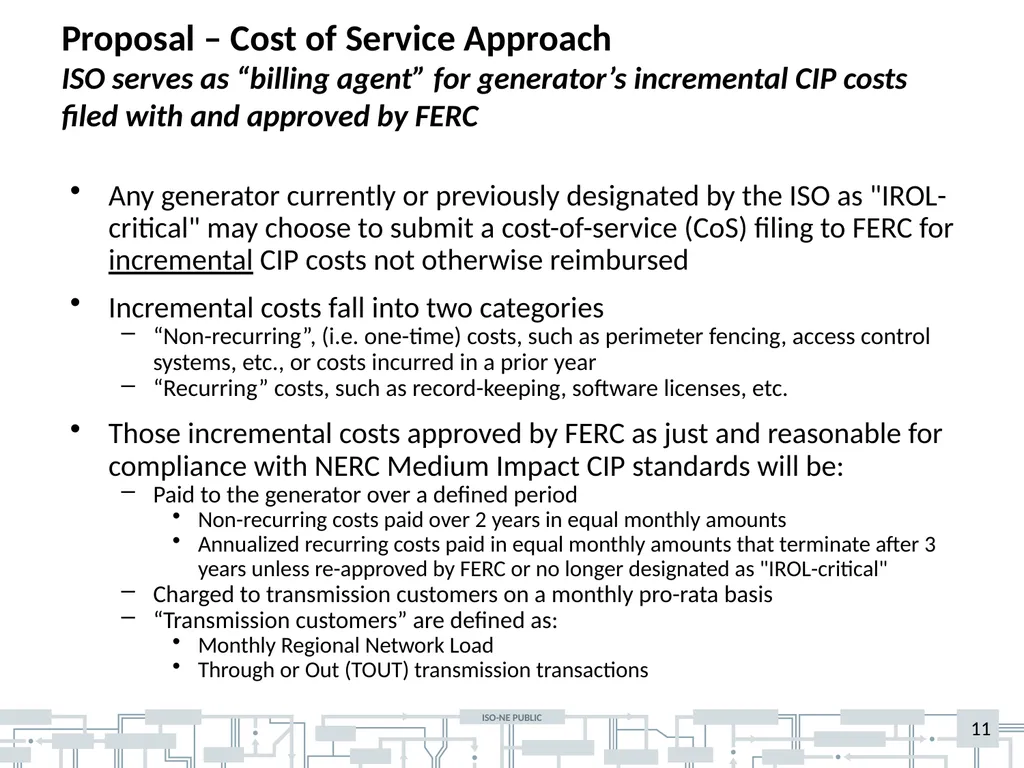
slide11. Proposal – Cost of Service Approach ISO serves as “billing agent” for generator’s incremental CIP costs filed with and approved by FERC Any generator currently or previously designated by the ISO as "IROL-critical" may choose to submit a cost-of-service (CoS) filing to FERC for incremental CIP costs not otherwise reimbursed
Incremental costs fall into two categories
“Non-recurring”, (i.e. one-time) costs, such as perimeter fencing, access control systems, etc., or costs incurred in a prior year
“Recurring” costs, such as record-keeping, software licenses, etc.
Those incremental costs approved by FERC as just and reasonable for compliance with NERC Medium Impact CIP standards will be:
Paid to the generator over a defined period
Non-recurring costs paid over 2 years in equal monthly amounts
Annualized recurring costs paid in equal monthly amounts that terminate after 3 years unless re-approved by FERC or no longer designated as "IROL-critical"
Charged to transmission customers on a monthly pro-rata basis
“Transmission customers” are defined as:
Monthly Regional Network Load
Through or Out (TOUT) transmission transactions 11<br>
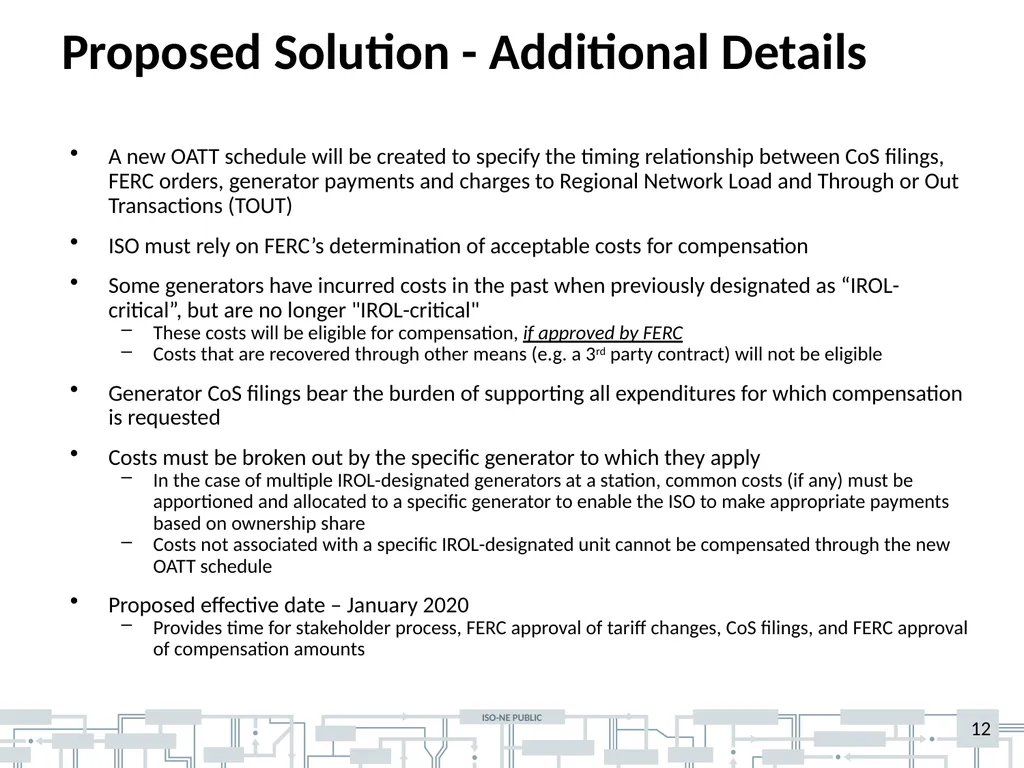
slide12. Proposed Solution - Additional Details A new OATT schedule will be created to specify the timing relationship between CoS filings, FERC orders, generator payments and charges to Regional Network Load and Through or Out Transactions (TOUT)
ISO must rely on FERC’s determination of acceptable costs for compensation
Some generators have incurred costs in the past when previously designated as “IROL-critical”, but are no longer "IROL-critical"
These costs will be eligible for compensation, if approved by FERC
Costs that are recovered through other means (e.g. a 3rd party contract) will not be eligible
Generator CoS filings bear the burden of supporting all expenditures for which compensation is requested
Costs must be broken out by the specific generator to which they apply
In the case of multiple IROL-designated generators at a station, common costs (if any) must be apportioned and allocated to a specific generator to enable the ISO to make appropriate payments based on ownership share
Costs not associated with a specific IROL-designated unit cannot be compensated through the new OATT schedule
Proposed effective date – January 2020
Provides time for stakeholder process, FERC approval of tariff changes, CoS filings, and FERC approval of compensation amounts 12<br>
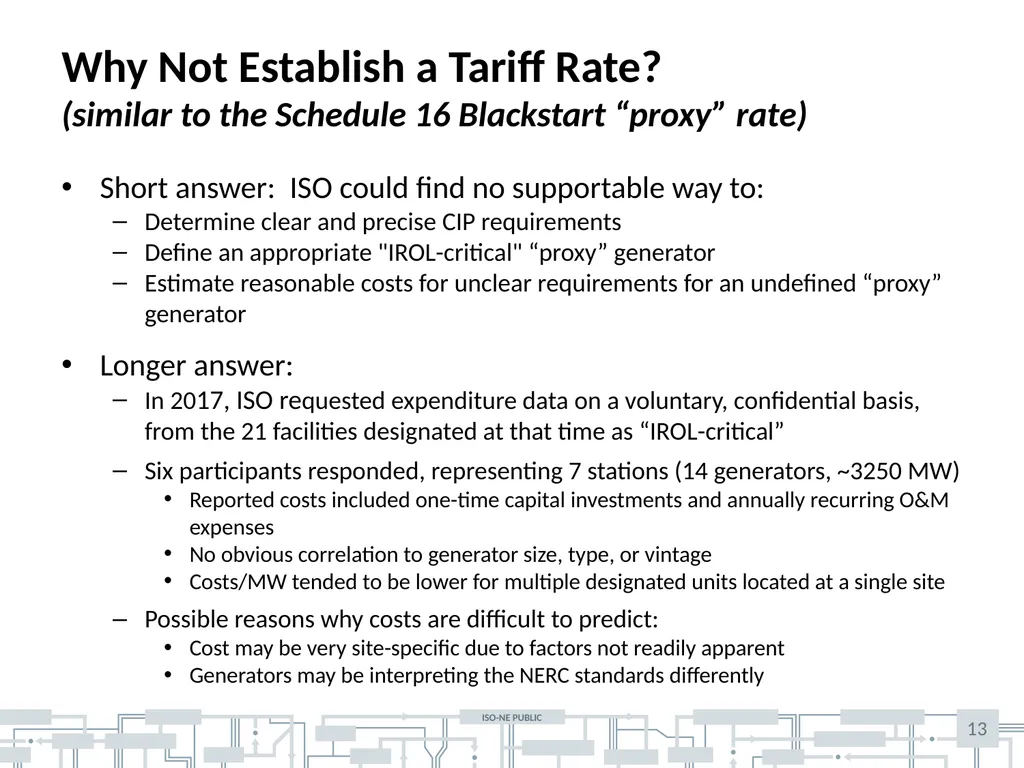
slide13. 13 Why Not Establish a Tariff Rate? (similar to the Schedule 16 Blackstart “proxy” rate) Short answer: ISO could find no supportable way to:
Determine clear and precise CIP requirements
Define an appropriate "IROL-critical" “proxy” generator
Estimate reasonable costs for unclear requirements for an undefined “proxy” generator
Longer answer:
In 2017, ISO requested expenditure data on a voluntary, confidential basis, from the 21 facilities designated at that time as “IROL-critical”
Six participants responded, representing 7 stations (14 generators, ~3250 MW)
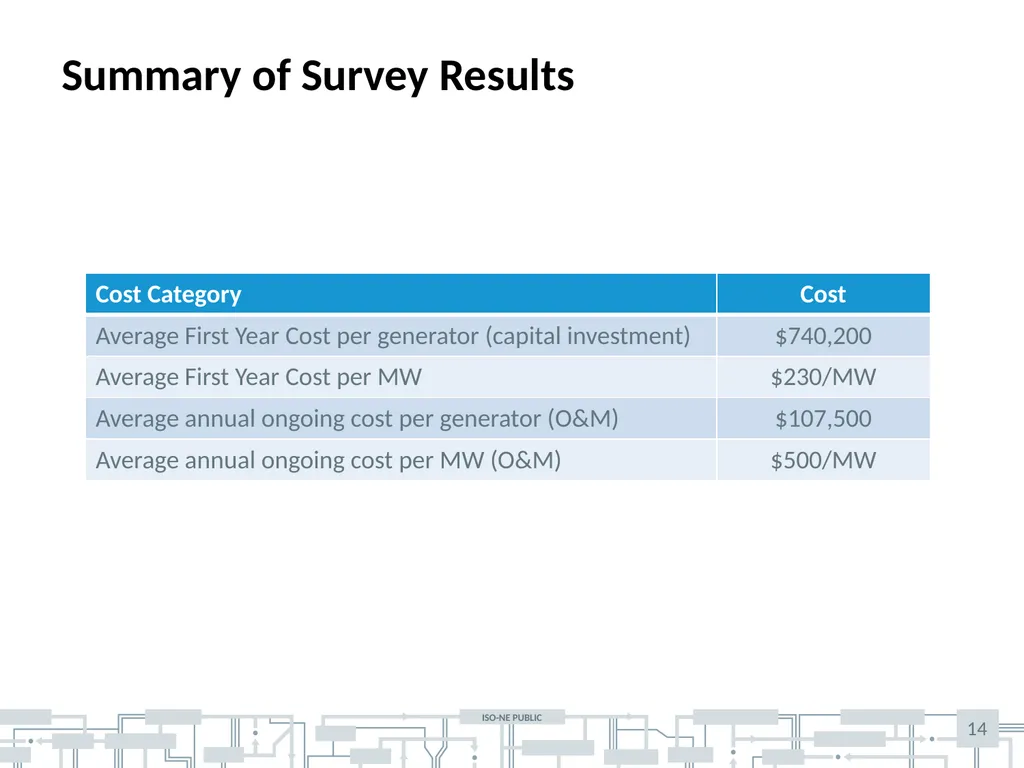
Reported costs included one-time capital investments and annually recurring O&M expenses
No obvious correlation to generator size, type, or vintage
Costs/MW tended to be lower for multiple designated units located at a single site
Possible reasons why costs are difficult to predict:
Cost may be very site-specific due to factors not readily apparent
Generators may be interpreting the NERC standards differently<br>
slide14. 14 Summary of Survey Results<br>
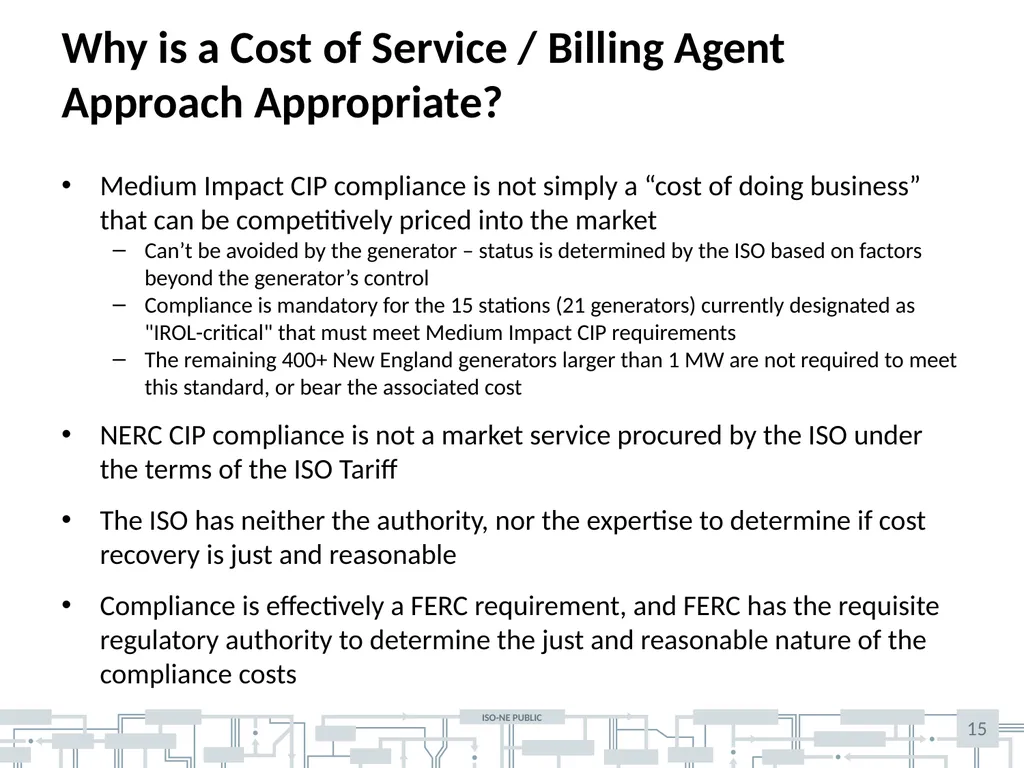
slide15. 15 Why is a Cost of Service / Billing Agent Approach Appropriate? Medium Impact CIP compliance is not simply a “cost of doing business” that can be competitively priced into the market
Can’t be avoided by the generator – status is determined by the ISO based on factors beyond the generator’s control
Compliance is mandatory for the 15 stations (21 generators) currently designated as "IROL-critical" that must meet Medium Impact CIP requirements
The remaining 400+ New England generators larger than 1 MW are not required to meet this standard, or bear the associated cost
NERC CIP compliance is not a market service procured by the ISO under the terms of the ISO Tariff
The ISO has neither the authority, nor the expertise to determine if cost recovery is just and reasonable
Compliance is effectively a FERC requirement, and FERC has the requisite regulatory authority to determine the just and reasonable nature of the compliance costs<br>
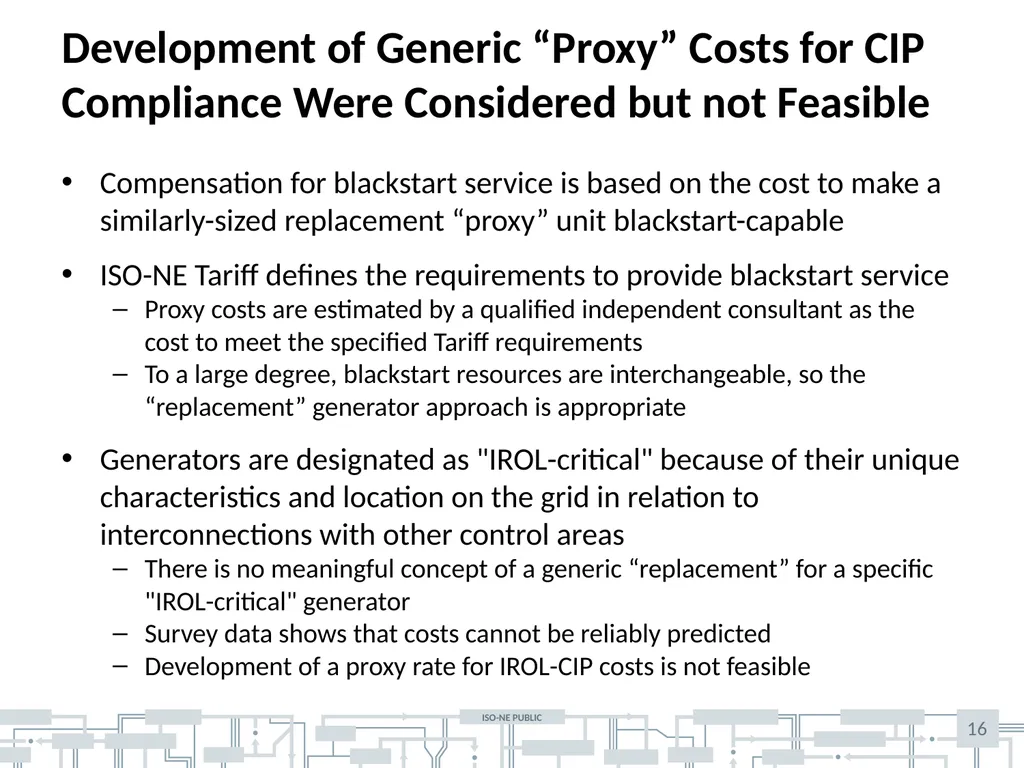
slide16. 16 Development of Generic “Proxy” Costs for CIP Compliance Were Considered but not Feasible Compensation for blackstart service is based on the cost to make a similarly-sized replacement “proxy” unit blackstart-capable
ISO-NE Tariff defines the requirements to provide blackstart service
Proxy costs are estimated by a qualified independent consultant as the cost to meet the specified Tariff requirements
To a large degree, blackstart resources are interchangeable, so the “replacement” generator approach is appropriate
Generators are designated as "IROL-critical" because of their unique characteristics and location on the grid in relation to interconnections with other control areas
There is no meaningful concept of a generic “replacement” for a specific "IROL-critical" generator
Survey data shows that costs cannot be reliably predicted
Development of a proxy rate for IROL-CIP costs is not feasible<br>
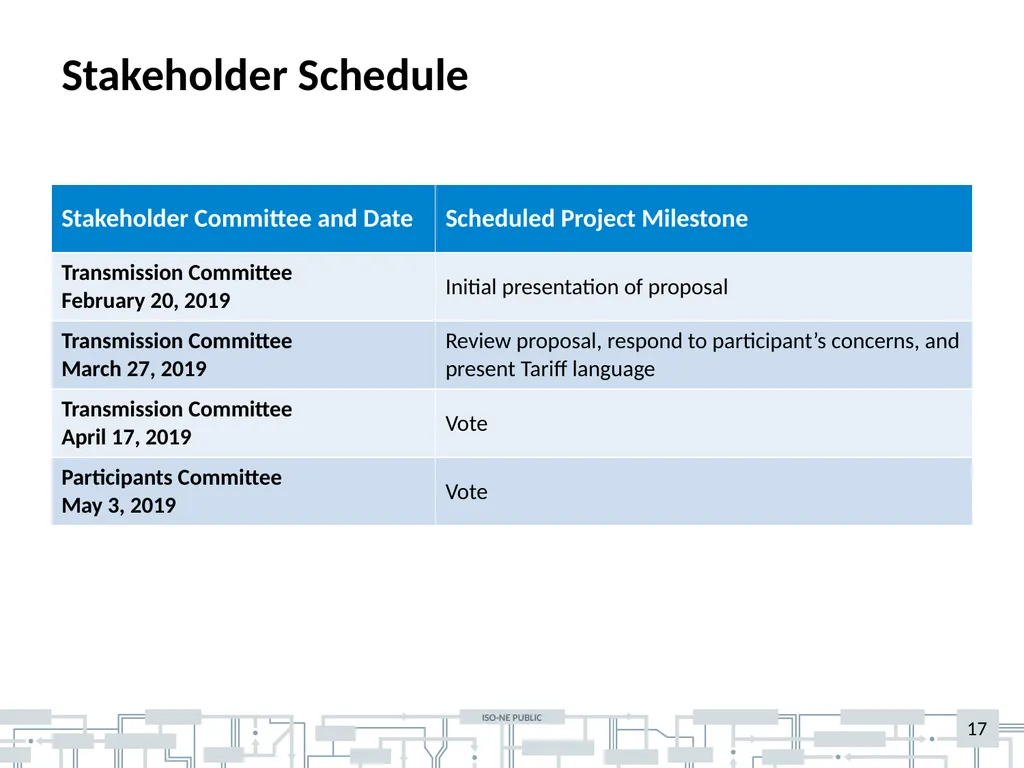
slide17. Stakeholder Schedule 17<br>
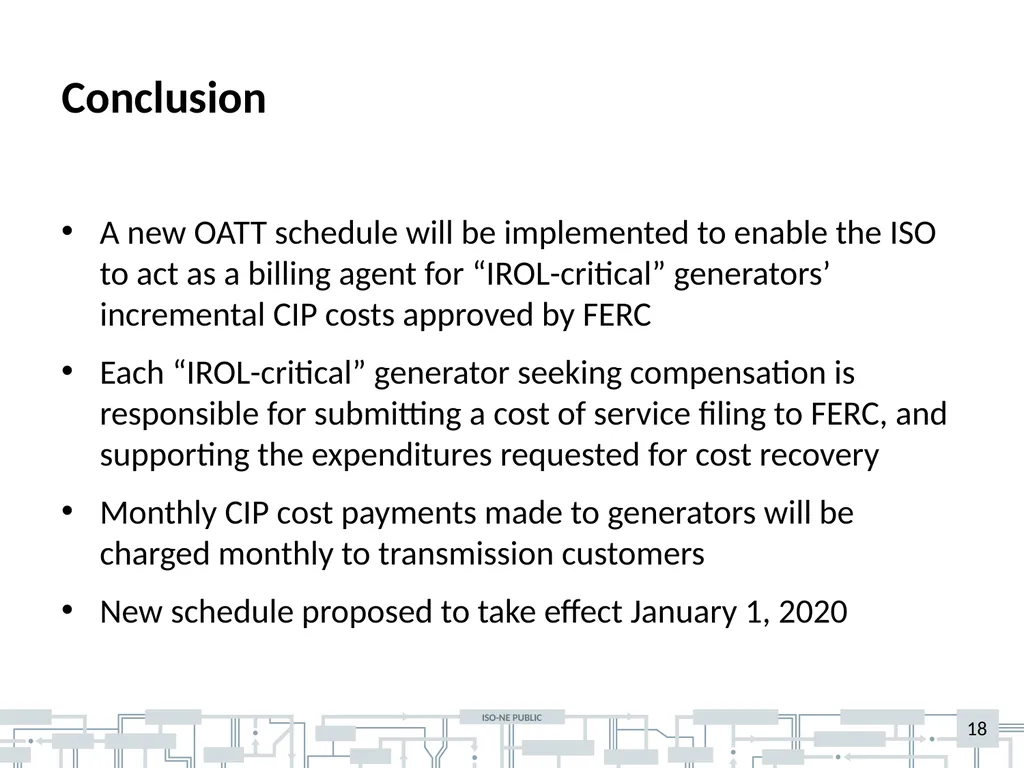
slide18. Conclusion A new OATT schedule will be implemented to enable the ISO to act as a billing agent for “IROL-critical” generators’ incremental CIP costs approved by FERC
Each “IROL-critical” generator seeking compensation is responsible for submitting a cost of service filing to FERC, and supporting the expenditures requested for cost recovery
Monthly CIP cost payments made to generators will be charged monthly to transmission customers
New schedule proposed to take effect January 1, 2020 18<br>
slide19. Jon Lowell (413) 540-4658 | jlowell@iso-ne.com 19<br>
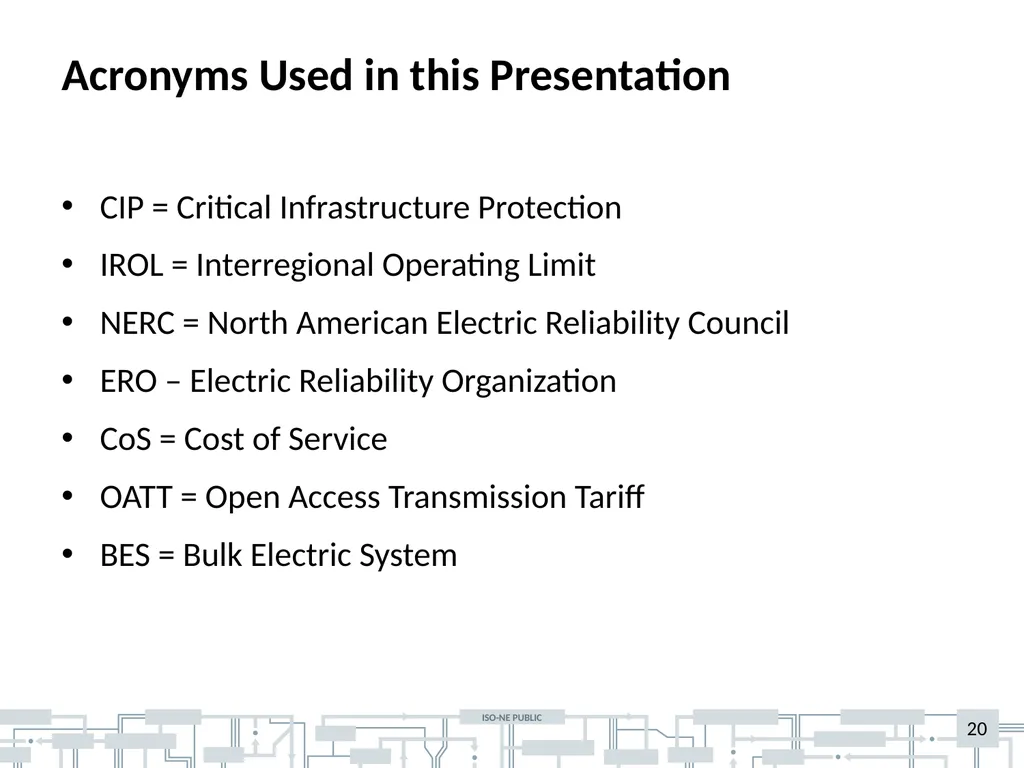
slide20. Acronyms Used in this Presentation CIP = Critical Infrastructure Protection
IROL = Interregional Operating Limit
NERC = North American Electric Reliability Council
ERO – Electric Reliability Organization
CoS = Cost of Service
OATT = Open Access Transmission Tariff
BES = Bulk Electric System 20<br>
slide2. 2 Generators designated by the ISO as “critical” to the determination of Interconnection Reliability Operating Limits (IROL) must meet higher North American Electric Reliability Corporation (NERC) Critical Infrastructure Protection (CIP) standards than “non-critical” generators
These costs cannot be competitively offered into the energy and capacity markets
ISO is proposing a new tariff mechanism that would allow “IROL-critical” generators to seek cost recovery for expenditures approved by FERC
Today’s discussion
Initial presentation of the ISO cost recovery proposal and the factors that make IROL-CIP cost recovery uniquely different from other generator costs<br>
slide3. IROL cip Background<br>
slide4. Background NERC CIP Standards NERC serves as the electric reliability organization (ERO) for North America
Subject to oversight by the Federal Energy Regulatory Commission (FERC) and governmental authorities in Canada
NERC
Develops and enforces Reliability Standards
Assesses seasonal and long‐term reliability
Monitors the bulk power system through system awareness
Educates, trains, and certifies industry personnel
In particular, NERC develops CIP Standards that define measures users, owners, and operators of the bulk power system must implement to protect against cyber and other threats. 4<br>
slide5. Background NERC CIP Standards, cont. The CIP Standards become increasingly stringent for generators that have a higher impact on reliable system operations
The criteria in CIP-002-5.1a Attachment 1 are used to determine a facility’s impact level
All generators that are part of the Bulk Electric System will be categorized as at least “Low Impact”
Criterion 2.61 includes “BES Cyber Systems for those Transmission Facilities that have been identified as critical to the derivation of IROLs and their associated contingencies” in the “Medium Impact” category
For convenience in this presentation, these resources are referred to as “IROL-critical” 1See “Reliability Standards for the Bulk Electric Systems of North America”, page 171 (page 28 of
the CIP-002-5.1a standard) available at:
https://www.nerc.com/pa/Stand/Reliability%20Standards%20Complete%20Set/RSCompleteSet.pdf 5<br>
slide6. 6 Background What does “IROL-critical” actually mean? The ISO monitors system conditions in real-time and determines IROL flow limits over the ties within ISO-NE and between ISO-NE and adjacent control areas
The calculated flow limits often depend critically on accurate real-time status of specific generators Automatic Voltage Regulators (AVRs)
These generators (or more specifically, the generators’ AVRs) are designated by the ISO as “IROL-critical” and must therefore meet the CIP Standard “medium risk” requirements
Inaccurate AVR status information, or alteration of AVR parameters, could lead to incorrect IROLs and power flows that inadvertently exceed the true limits
ISO reviews the list of "IROL-critical" resources annually
Resources can be added or removed as the system topology evolves and patterns of load and generation change over time.
Resources are notified by the ISO when they are designated (or un-designated) as “IROL-critical”<br>
slide7. Background What steps are required to meet the “medium risk” standard and how much does that cost? Good question!
The requirements to be met by “Medium Impact” facilities are not clearly stated and require interpretation
Some insight into FERC’s interpretation of the CIP standards may be gleaned from an October 6, 2017 FERC Staff report2
Compliance with NERC CIP Standards corresponding to “Medium Impact” category
Does not arise from or relate to product/service in ISO Tariff
The ISO has no authority to interpret or enforce the NERC CIP requirements
The ISO is not positioned to determine the appropriate measures an “IROL-critical” generator should implement, or the reasonable cost of those measures 2 Available at: https://www.ferc.gov/legal/staff-reports/2017/10-06-17-CIP-audits-report.pdf 7<br>
slide8. Background Who benefits from having “IROL-critical” critical generators secure their cyber systems? IROLs are System Operating Limits that, if violated, could lead to instability, uncontrolled separation, or cascading outages that adversely impact the reliability of the Bulk Electric System.
The limits are often designed to protect neighboring regions from disturbances that originate in a connected region and allow the ISO to maximize the use of the transmission grid, consistent with reliable operation.
The generators designated by ISO-NE as “IROL-critical” protect other control areas from unanticipated events that might occur inside New England
Maximizing internal transmission usage benefits all internal transmission customers 8<br>
slide9. IROL-cip compensation proposal New OATT Schedule 17<br>
slide10. Problem Statement How can a generator obtain compensation for mandated “IROL-critical” CIP compliance costs? The ISO is the sole entity determining if a generator must be designated as "IROL-critical"
The generator has no control or influence over this decision
Nor does the generator have control over factors that change over time, such as transmission topology, that may result in the generator becoming designated (or un-designated) as "IROL-critical"
Designation as "IROL-critical" by the ISO currently requires the generator to take additional steps to comply with the Medium Impact CIP requirements, beyond the steps required by all BES generators to meet Low Impact requirements
Compliance is not optional, and is periodically audited by NERC
Prior FERC orders have confirmed that market participants should have a viable path to cost recovery for mandated costs
For example, see FERC Order 672, paragraph 259:
“Pursuant to section 1241 of EPAct, the Commission will allow recovery of all costs prudently incurred to comply with the Reliability Standards.”
No such path currently exists for New England "IROL-critical" generators 10<br>
slide11. Proposal – Cost of Service Approach ISO serves as “billing agent” for generator’s incremental CIP costs filed with and approved by FERC Any generator currently or previously designated by the ISO as "IROL-critical" may choose to submit a cost-of-service (CoS) filing to FERC for incremental CIP costs not otherwise reimbursed
Incremental costs fall into two categories
“Non-recurring”, (i.e. one-time) costs, such as perimeter fencing, access control systems, etc., or costs incurred in a prior year
“Recurring” costs, such as record-keeping, software licenses, etc.
Those incremental costs approved by FERC as just and reasonable for compliance with NERC Medium Impact CIP standards will be:
Paid to the generator over a defined period
Non-recurring costs paid over 2 years in equal monthly amounts
Annualized recurring costs paid in equal monthly amounts that terminate after 3 years unless re-approved by FERC or no longer designated as "IROL-critical"
Charged to transmission customers on a monthly pro-rata basis
“Transmission customers” are defined as:
Monthly Regional Network Load
Through or Out (TOUT) transmission transactions 11<br>
slide12. Proposed Solution - Additional Details A new OATT schedule will be created to specify the timing relationship between CoS filings, FERC orders, generator payments and charges to Regional Network Load and Through or Out Transactions (TOUT)
ISO must rely on FERC’s determination of acceptable costs for compensation
Some generators have incurred costs in the past when previously designated as “IROL-critical”, but are no longer "IROL-critical"
These costs will be eligible for compensation, if approved by FERC
Costs that are recovered through other means (e.g. a 3rd party contract) will not be eligible
Generator CoS filings bear the burden of supporting all expenditures for which compensation is requested
Costs must be broken out by the specific generator to which they apply
In the case of multiple IROL-designated generators at a station, common costs (if any) must be apportioned and allocated to a specific generator to enable the ISO to make appropriate payments based on ownership share
Costs not associated with a specific IROL-designated unit cannot be compensated through the new OATT schedule
Proposed effective date – January 2020
Provides time for stakeholder process, FERC approval of tariff changes, CoS filings, and FERC approval of compensation amounts 12<br>
slide13. 13 Why Not Establish a Tariff Rate? (similar to the Schedule 16 Blackstart “proxy” rate) Short answer: ISO could find no supportable way to:
Determine clear and precise CIP requirements
Define an appropriate "IROL-critical" “proxy” generator
Estimate reasonable costs for unclear requirements for an undefined “proxy” generator
Longer answer:
In 2017, ISO requested expenditure data on a voluntary, confidential basis, from the 21 facilities designated at that time as “IROL-critical”
Six participants responded, representing 7 stations (14 generators, ~3250 MW)
Reported costs included one-time capital investments and annually recurring O&M expenses
No obvious correlation to generator size, type, or vintage
Costs/MW tended to be lower for multiple designated units located at a single site
Possible reasons why costs are difficult to predict:
Cost may be very site-specific due to factors not readily apparent
Generators may be interpreting the NERC standards differently<br>
slide14. 14 Summary of Survey Results<br>
slide15. 15 Why is a Cost of Service / Billing Agent Approach Appropriate? Medium Impact CIP compliance is not simply a “cost of doing business” that can be competitively priced into the market
Can’t be avoided by the generator – status is determined by the ISO based on factors beyond the generator’s control
Compliance is mandatory for the 15 stations (21 generators) currently designated as "IROL-critical" that must meet Medium Impact CIP requirements
The remaining 400+ New England generators larger than 1 MW are not required to meet this standard, or bear the associated cost
NERC CIP compliance is not a market service procured by the ISO under the terms of the ISO Tariff
The ISO has neither the authority, nor the expertise to determine if cost recovery is just and reasonable
Compliance is effectively a FERC requirement, and FERC has the requisite regulatory authority to determine the just and reasonable nature of the compliance costs<br>
slide16. 16 Development of Generic “Proxy” Costs for CIP Compliance Were Considered but not Feasible Compensation for blackstart service is based on the cost to make a similarly-sized replacement “proxy” unit blackstart-capable
ISO-NE Tariff defines the requirements to provide blackstart service
Proxy costs are estimated by a qualified independent consultant as the cost to meet the specified Tariff requirements
To a large degree, blackstart resources are interchangeable, so the “replacement” generator approach is appropriate
Generators are designated as "IROL-critical" because of their unique characteristics and location on the grid in relation to interconnections with other control areas
There is no meaningful concept of a generic “replacement” for a specific "IROL-critical" generator
Survey data shows that costs cannot be reliably predicted
Development of a proxy rate for IROL-CIP costs is not feasible<br>
slide17. Stakeholder Schedule 17<br>
slide18. Conclusion A new OATT schedule will be implemented to enable the ISO to act as a billing agent for “IROL-critical” generators’ incremental CIP costs approved by FERC
Each “IROL-critical” generator seeking compensation is responsible for submitting a cost of service filing to FERC, and supporting the expenditures requested for cost recovery
Monthly CIP cost payments made to generators will be charged monthly to transmission customers
New schedule proposed to take effect January 1, 2020 18<br>
slide19. Jon Lowell (413) 540-4658 | jlowell@iso-ne.com 19<br>
slide20. Acronyms Used in this Presentation CIP = Critical Infrastructure Protection
IROL = Interregional Operating Limit
NERC = North American Electric Reliability Council
ERO – Electric Reliability Organization
CoS = Cost of Service
OATT = Open Access Transmission Tariff
BES = Bulk Electric System 20<br>