
Finance Overview CSU East Bay June 2011
T
Published · 47 slides · 0 views

1 / 1










Description
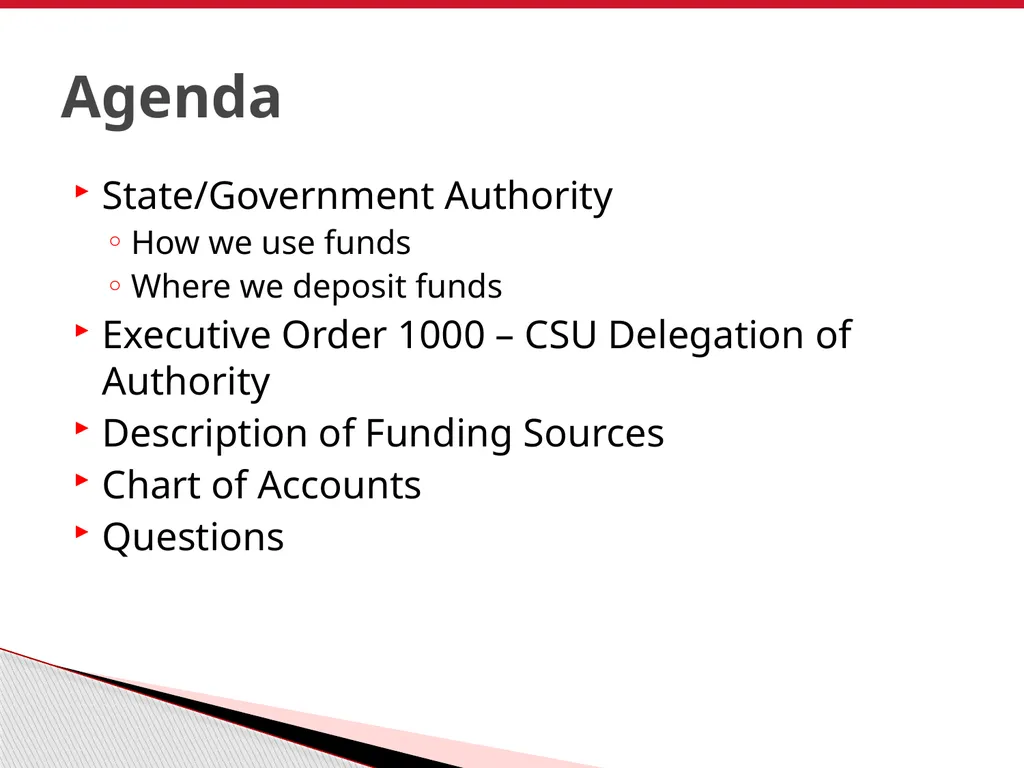
Finance Overview CSU East Bay June 2011 StateGovernment Authority How we use funds Where we deposit funds Executive Order 1000 CSU Delegation of Authority Description of Funding Sources Chart of Accounts Questions Agenda StateGovernment
Related Topics
Share
Embed code
Download this presentation From Below
"Finance Overview CSU East Bay June 2011" is the property of its rightful owner. Permission is granted to download and print the materials on this website for personal, non-commercial use only, and to display it on your personal computer provided you do not modify the materials and that you retain all copyright notices contained in the materials. By downloading content from our website, you accept the terms of this agreement.
Presentation Transcript
01
Finance Overview CSU East Bay
June 2011<br>
June 2011<br>
02
State/Government Authority
How we use funds
Where we deposit funds
Executive Order 1000 – CSU Delegation of Authority
Description of Funding Sources
Chart of Accounts
Questions Agenda<br>
How we use funds
Where we deposit funds
Executive Order 1000 – CSU Delegation of Authority
Description of Funding Sources
Chart of Accounts
Questions Agenda<br>
03
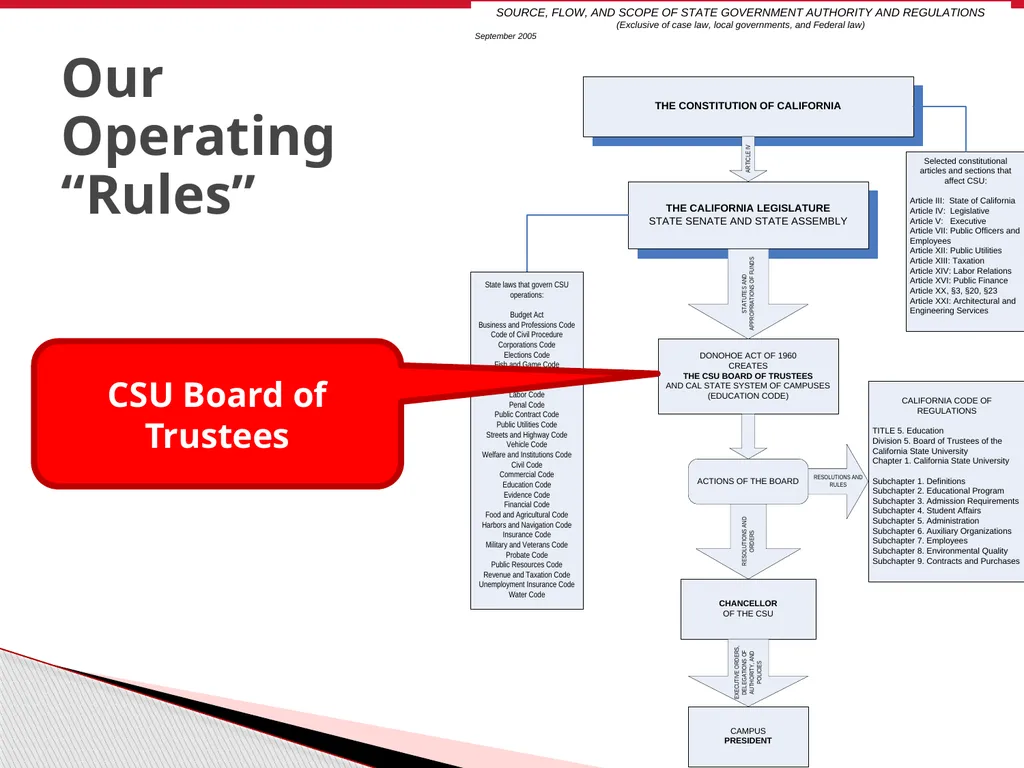
State/Government Flow of Authority<br>
04
Our Operating “Rules” CSU Board of Trustees<br>
05
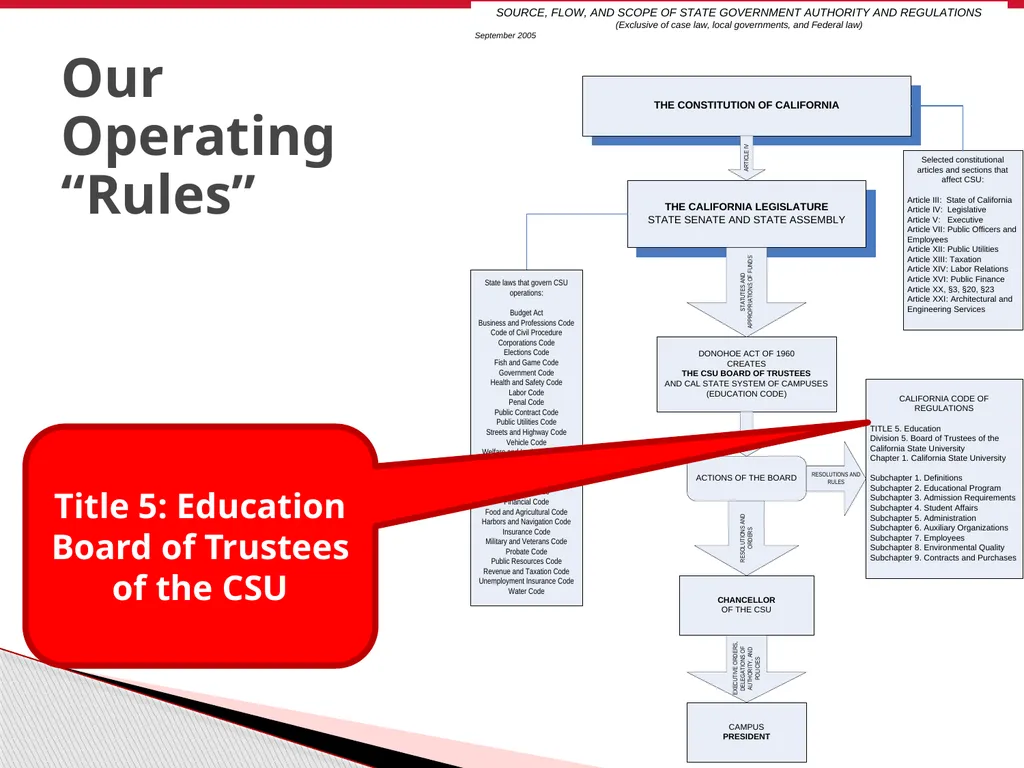
Our Operating “Rules” Title 5: Education
Board of Trustees of the CSU<br>
Board of Trustees of the CSU<br>
06
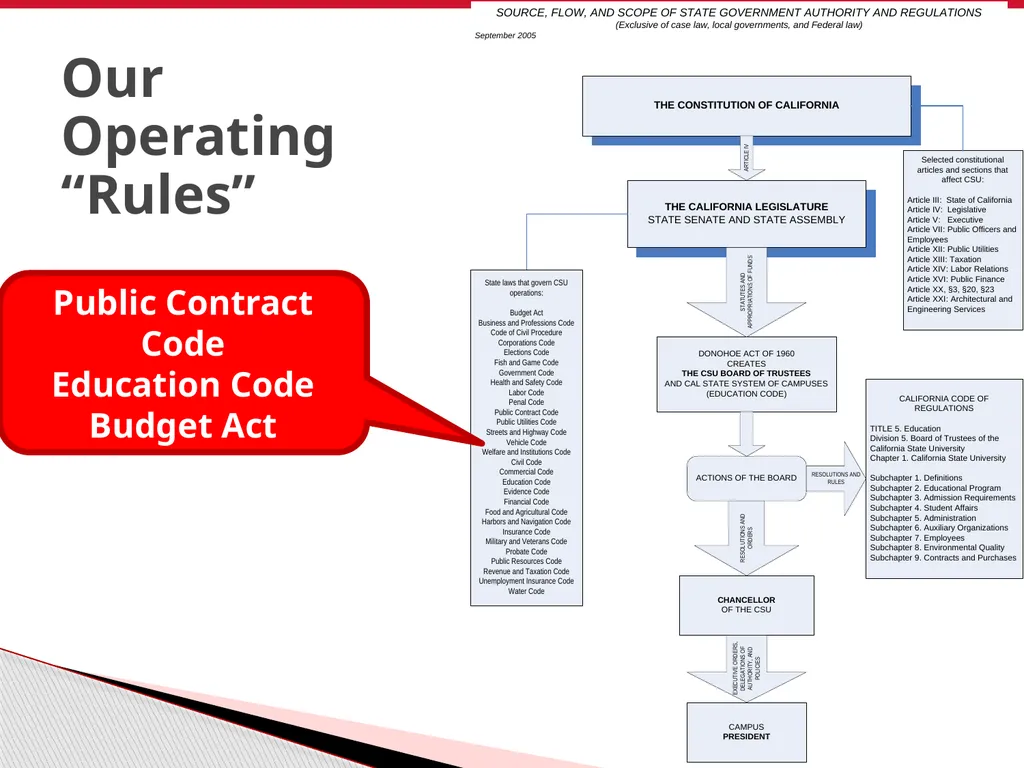
Our Operating “Rules” Public Contract Code
Education Code
Budget Act<br>
Education Code
Budget Act<br>
07
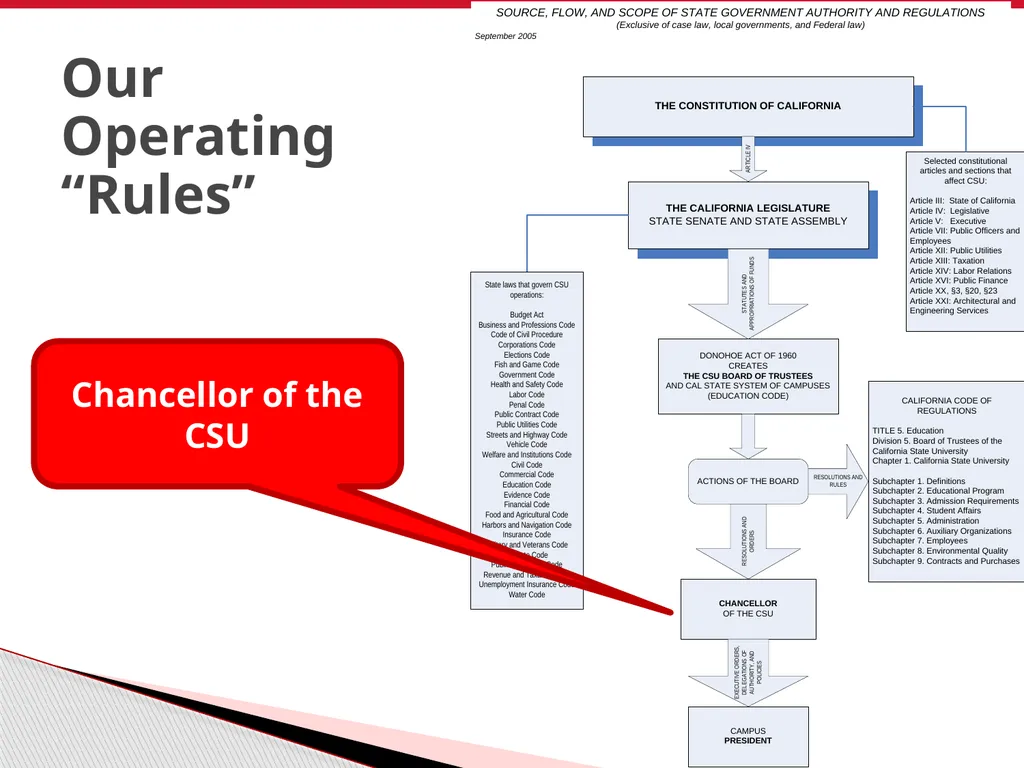
Our Operating “Rules” Chancellor of the CSU<br>
08
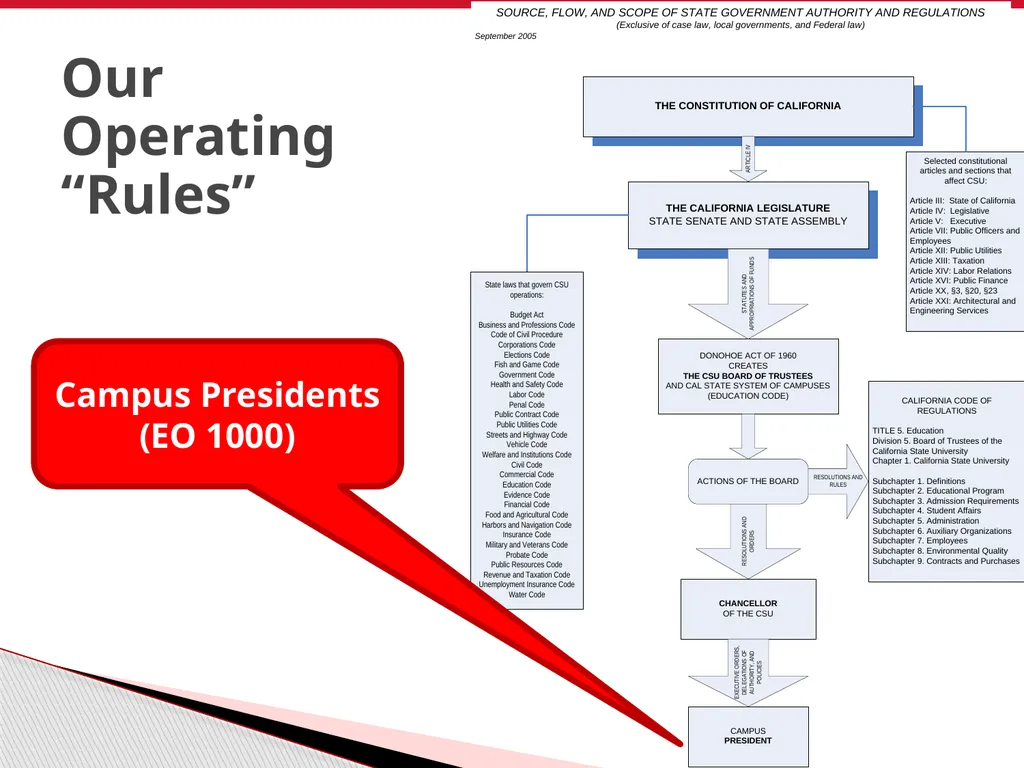
Our Operating “Rules” Campus Presidents
(EO 1000)<br>
(EO 1000)<br>
09
Some more specific authorities<br>
10
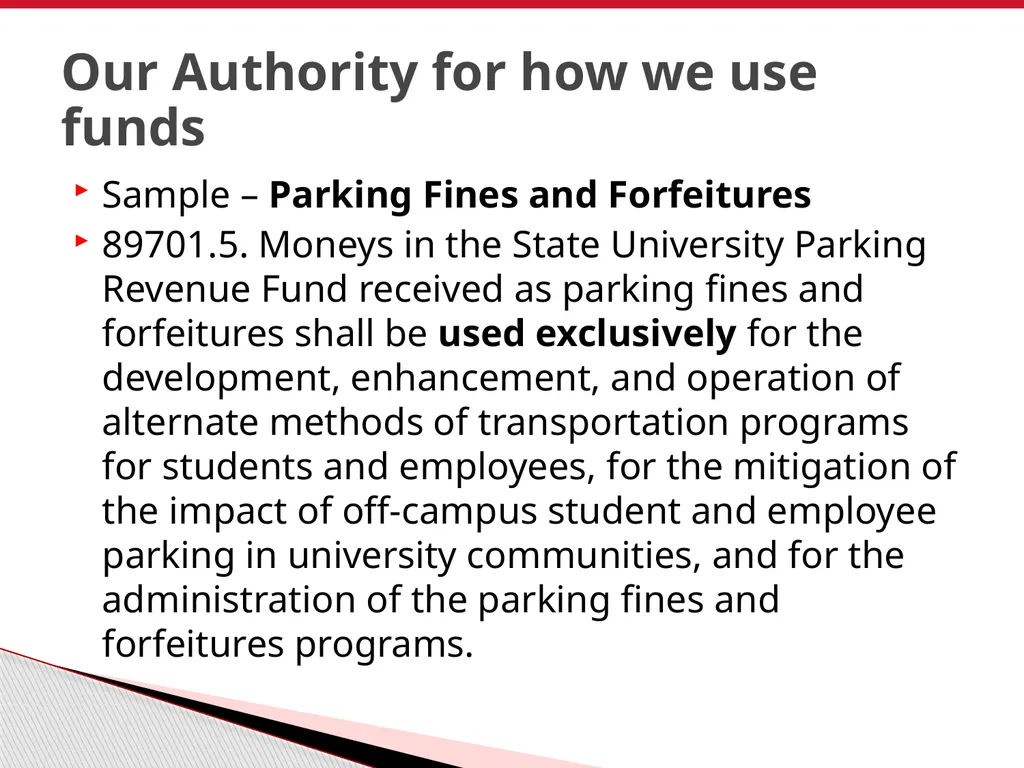
Sample – Parking Fines and Forfeitures
89701.5. Moneys in the State University Parking Revenue Fund received as parking fines and forfeitures shall be used exclusively for the development, enhancement, and operation of alternate methods of transportation programs for students and employees, for the mitigation of the impact of off-campus student and employee parking in university communities, and for the administration of the parking fines and forfeitures programs. Our Authority for how we use funds<br>
89701.5. Moneys in the State University Parking Revenue Fund received as parking fines and forfeitures shall be used exclusively for the development, enhancement, and operation of alternate methods of transportation programs for students and employees, for the mitigation of the impact of off-campus student and employee parking in university communities, and for the administration of the parking fines and forfeitures programs. Our Authority for how we use funds<br>
11
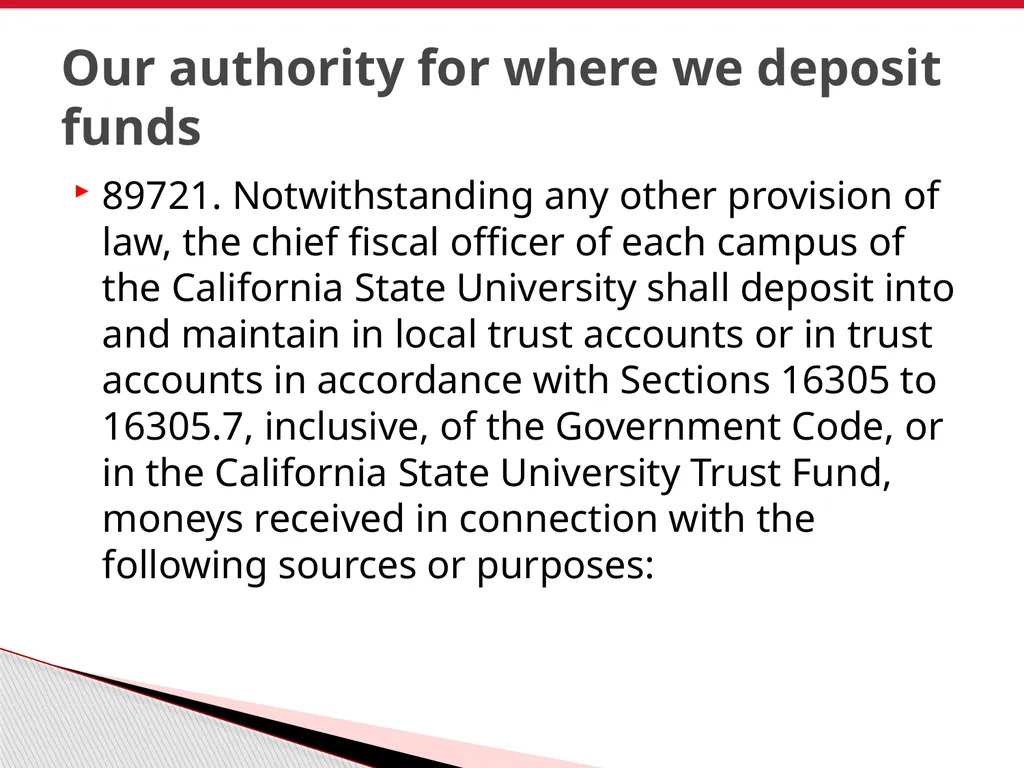
89721. Notwithstanding any other provision of law, the chief fiscal officer of each campus of the California State University shall deposit into and maintain in local trust accounts or in trust accounts in accordance with Sections 16305 to 16305.7, inclusive, of the Government Code, or in the California State University Trust Fund, moneys received in connection with the following sources or purposes: Our authority for where we deposit funds<br>
12
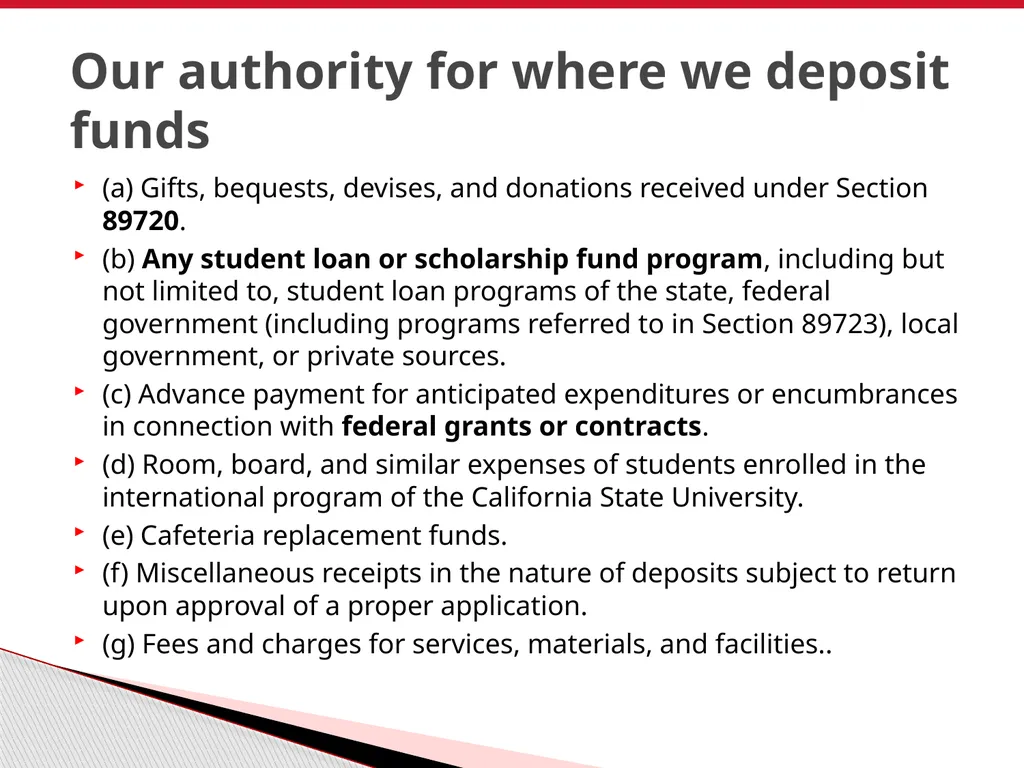
(a) Gifts, bequests, devises, and donations received under Section 89720.
(b) Any student loan or scholarship fund program, including but not limited to, student loan programs of the state, federal government (including programs referred to in Section 89723), local government, or private sources.
(c) Advance payment for anticipated expenditures or encumbrances in connection with federal grants or contracts.
(d) Room, board, and similar expenses of students enrolled in the international program of the California State University.
(e) Cafeteria replacement funds.
(f) Miscellaneous receipts in the nature of deposits subject to return upon approval of a proper application.
(g) Fees and charges for services, materials, and facilities.. Our authority for where we deposit funds<br>
(b) Any student loan or scholarship fund program, including but not limited to, student loan programs of the state, federal government (including programs referred to in Section 89723), local government, or private sources.
(c) Advance payment for anticipated expenditures or encumbrances in connection with federal grants or contracts.
(d) Room, board, and similar expenses of students enrolled in the international program of the California State University.
(e) Cafeteria replacement funds.
(f) Miscellaneous receipts in the nature of deposits subject to return upon approval of a proper application.
(g) Fees and charges for services, materials, and facilities.. Our authority for where we deposit funds<br>
13
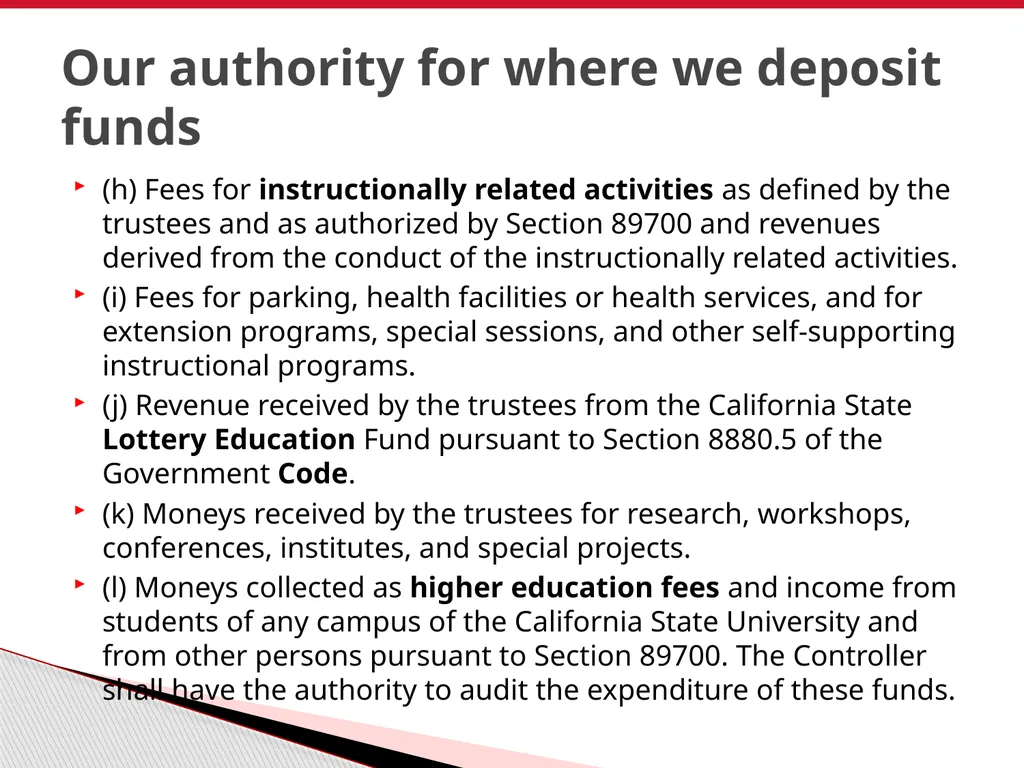
(h) Fees for instructionally related activities as defined by the trustees and as authorized by Section 89700 and revenues derived from the conduct of the instructionally related activities.
(i) Fees for parking, health facilities or health services, and for extension programs, special sessions, and other self-supporting instructional programs.
(j) Revenue received by the trustees from the California State Lottery Education Fund pursuant to Section 8880.5 of the Government Code.
(k) Moneys received by the trustees for research, workshops, conferences, institutes, and special projects.
(l) Moneys collected as higher education fees and income from students of any campus of the California State University and from other persons pursuant to Section 89700. The Controller shall have the authority to audit the expenditure of these funds. Our authority for where we deposit funds<br>
(i) Fees for parking, health facilities or health services, and for extension programs, special sessions, and other self-supporting instructional programs.
(j) Revenue received by the trustees from the California State Lottery Education Fund pursuant to Section 8880.5 of the Government Code.
(k) Moneys received by the trustees for research, workshops, conferences, institutes, and special projects.
(l) Moneys collected as higher education fees and income from students of any campus of the California State University and from other persons pursuant to Section 89700. The Controller shall have the authority to audit the expenditure of these funds. Our authority for where we deposit funds<br>
14
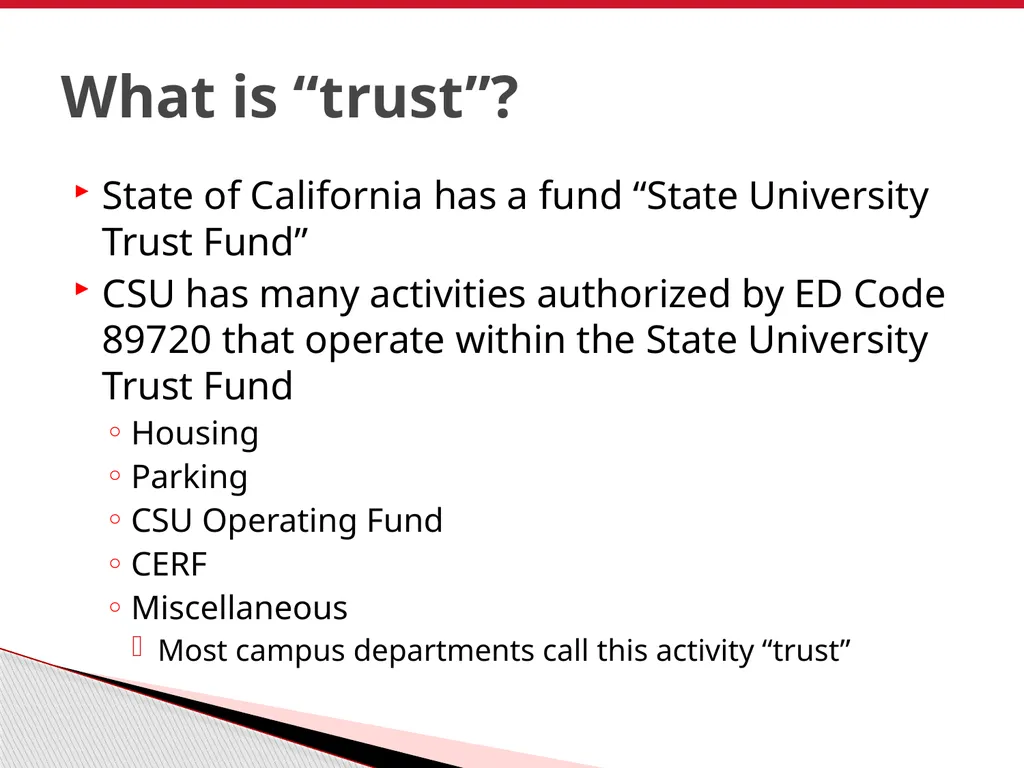
State of California has a fund “State University Trust Fund”
CSU has many activities authorized by ED Code 89720 that operate within the State University Trust Fund
Housing
Parking
CSU Operating Fund
CERF
Miscellaneous
Most campus departments call this activity “trust” What is “trust”?<br>
CSU has many activities authorized by ED Code 89720 that operate within the State University Trust Fund
Housing
Parking
CSU Operating Fund
CERF
Miscellaneous
Most campus departments call this activity “trust” What is “trust”?<br>
15
EO 1000 – Delegation of Fiscal Authority to Campus<br>
16
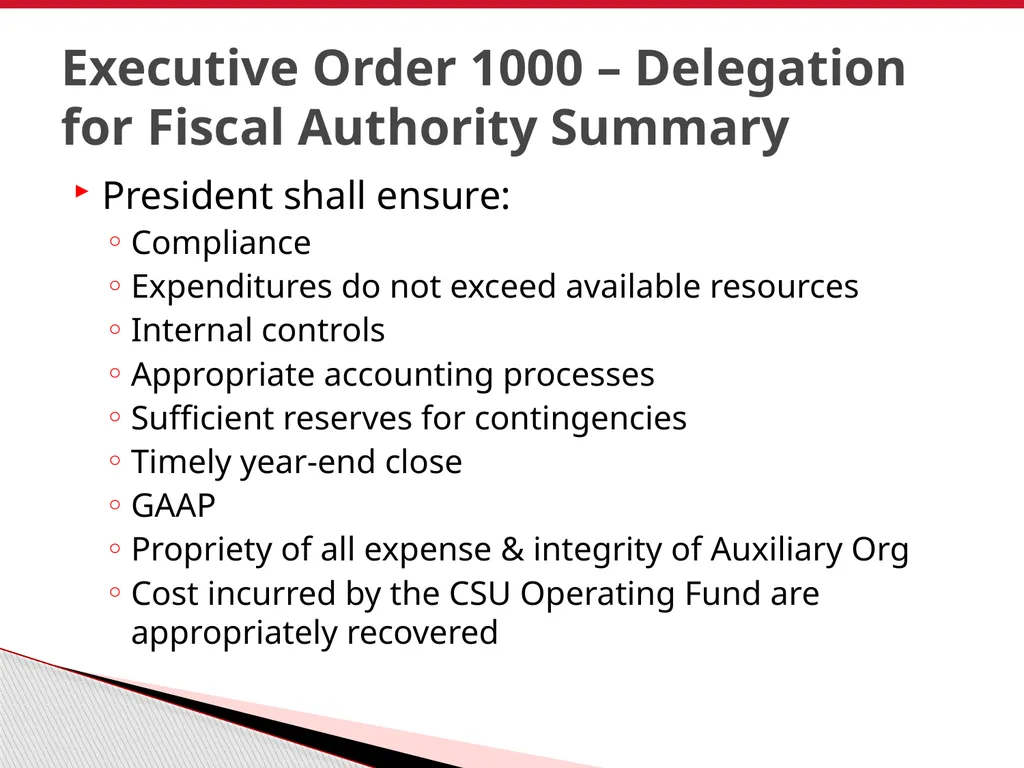
President shall ensure:
Compliance
Expenditures do not exceed available resources
Internal controls
Appropriate accounting processes
Sufficient reserves for contingencies
Timely year-end close
GAAP
Propriety of all expense & integrity of Auxiliary Org
Cost incurred by the CSU Operating Fund are appropriately recovered Executive Order 1000 – Delegation for Fiscal Authority Summary<br>
Compliance
Expenditures do not exceed available resources
Internal controls
Appropriate accounting processes
Sufficient reserves for contingencies
Timely year-end close
GAAP
Propriety of all expense & integrity of Auxiliary Org
Cost incurred by the CSU Operating Fund are appropriately recovered Executive Order 1000 – Delegation for Fiscal Authority Summary<br>
17
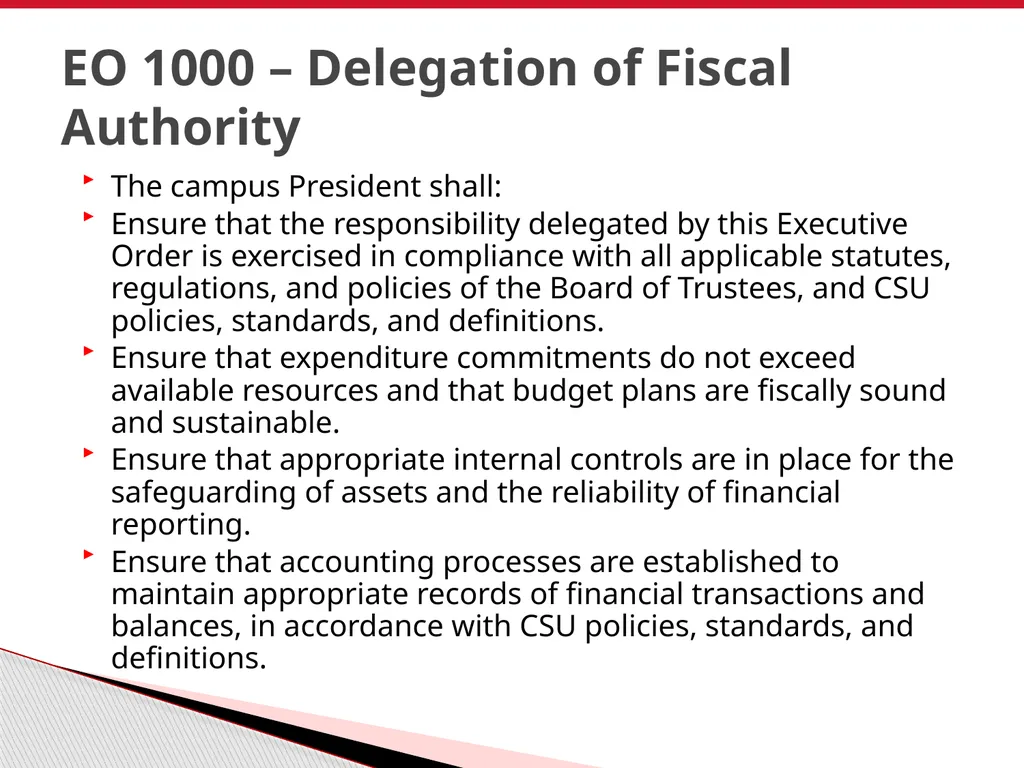
The campus President shall:
Ensure that the responsibility delegated by this Executive Order is exercised in compliance with all applicable statutes, regulations, and policies of the Board of Trustees, and CSU policies, standards, and definitions.
Ensure that expenditure commitments do not exceed available resources and that budget plans are fiscally sound and sustainable.
Ensure that appropriate internal controls are in place for the safeguarding of assets and the reliability of financial reporting.
Ensure that accounting processes are established to maintain appropriate records of financial transactions and balances, in accordance with CSU policies, standards, and definitions. EO 1000 – Delegation of Fiscal Authority<br>
Ensure that the responsibility delegated by this Executive Order is exercised in compliance with all applicable statutes, regulations, and policies of the Board of Trustees, and CSU policies, standards, and definitions.
Ensure that expenditure commitments do not exceed available resources and that budget plans are fiscally sound and sustainable.
Ensure that appropriate internal controls are in place for the safeguarding of assets and the reliability of financial reporting.
Ensure that accounting processes are established to maintain appropriate records of financial transactions and balances, in accordance with CSU policies, standards, and definitions. EO 1000 – Delegation of Fiscal Authority<br>
18
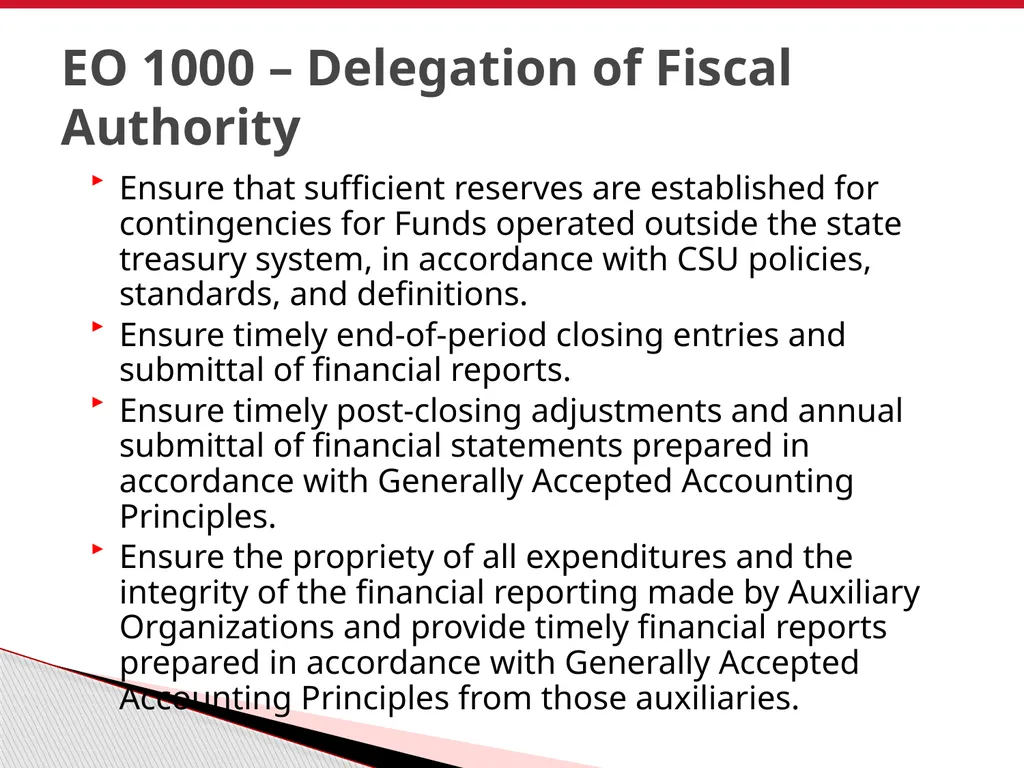
Ensure that sufficient reserves are established for contingencies for Funds operated outside the state treasury system, in accordance with CSU policies, standards, and definitions.
Ensure timely end-of-period closing entries and submittal of financial reports.
Ensure timely post-closing adjustments and annual submittal of financial statements prepared in accordance with Generally Accepted Accounting Principles.
Ensure the propriety of all expenditures and the integrity of the financial reporting made by Auxiliary Organizations and provide timely financial reports prepared in accordance with Generally Accepted Accounting Principles from those auxiliaries. EO 1000 – Delegation of Fiscal Authority<br>
Ensure timely end-of-period closing entries and submittal of financial reports.
Ensure timely post-closing adjustments and annual submittal of financial statements prepared in accordance with Generally Accepted Accounting Principles.
Ensure the propriety of all expenditures and the integrity of the financial reporting made by Auxiliary Organizations and provide timely financial reports prepared in accordance with Generally Accepted Accounting Principles from those auxiliaries. EO 1000 – Delegation of Fiscal Authority<br>
19
Ensure that costs incurred by the CSU Operating Fund (see Section III: CSU Fund Categories and Types) for services, products, and facilities provided to other CSU funds and to Auxiliary Organizations are properly and consistently recovered with cash and/or a documented exchange of value. Allowable direct costs incurred by the CSU Operating Fund shall be allocated and recovered based on actual costs incurred. Allowable and allocable indirect costs shall be allocated and recovered according to a cost allocation plan that utilizes a documented and consistent methodology including identification of indirect costs and a basis for allocation. The campus Chief Financial Officer, or designee, shall annually approve and implement the cost allocation plan. EO 1000 – Delegation of Fiscal Authority<br>
20
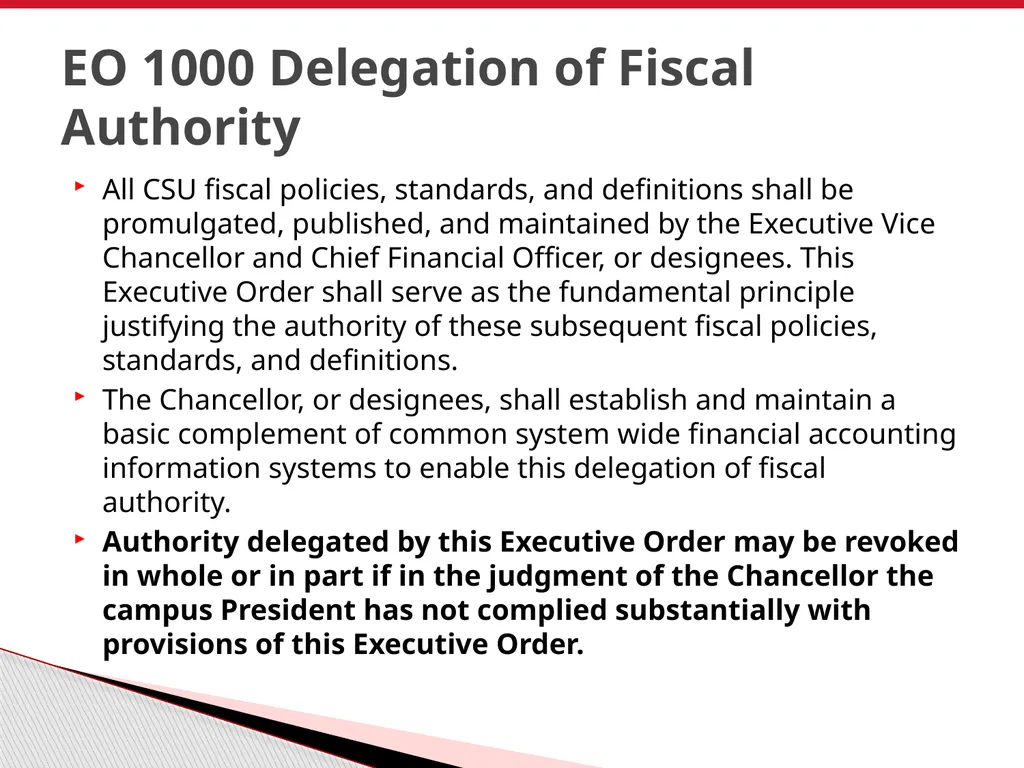
All CSU fiscal policies, standards, and definitions shall be promulgated, published, and maintained by the Executive Vice Chancellor and Chief Financial Officer, or designees. This Executive Order shall serve as the fundamental principle justifying the authority of these subsequent fiscal policies, standards, and definitions.
The Chancellor, or designees, shall establish and maintain a basic complement of common system wide financial accounting information systems to enable this delegation of fiscal authority.
Authority delegated by this Executive Order may be revoked in whole or in part if in the judgment of the Chancellor the campus President has not complied substantially with provisions of this Executive Order. EO 1000 Delegation of Fiscal Authority<br>
The Chancellor, or designees, shall establish and maintain a basic complement of common system wide financial accounting information systems to enable this delegation of fiscal authority.
Authority delegated by this Executive Order may be revoked in whole or in part if in the judgment of the Chancellor the campus President has not complied substantially with provisions of this Executive Order. EO 1000 Delegation of Fiscal Authority<br>
21
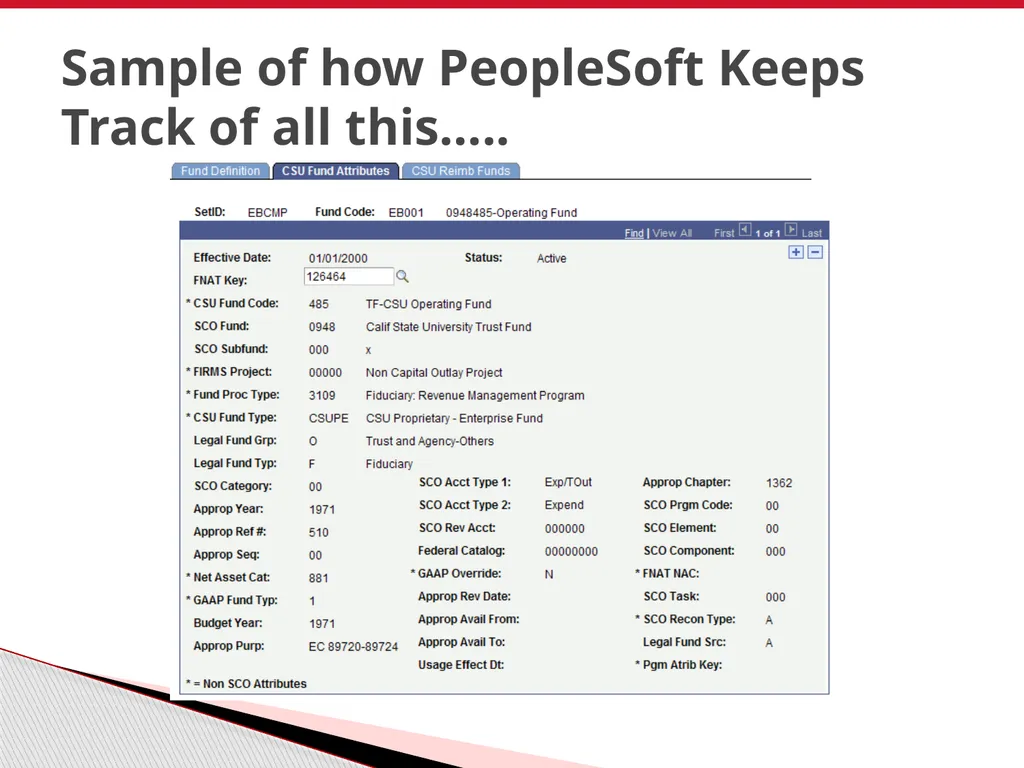
Sample of how PeopleSoft Keeps Track of all this…..<br>
22
Common Funding Source CSU East Bay<br>
23
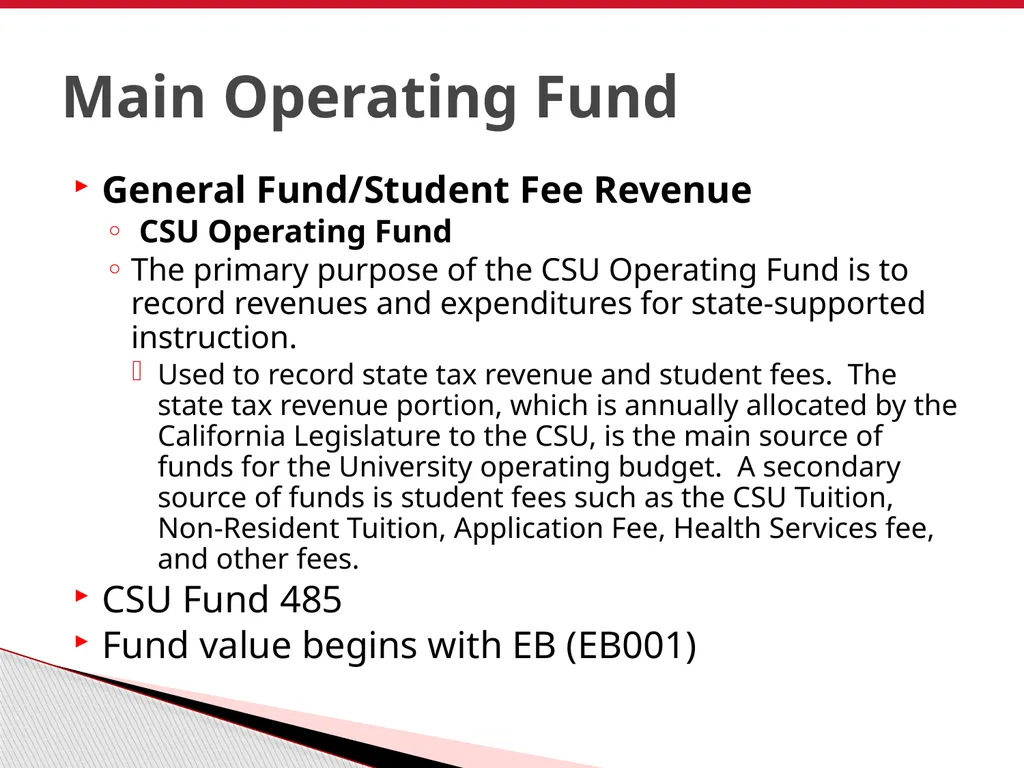
Main Operating Fund General Fund/Student Fee Revenue
CSU Operating Fund
The primary purpose of the CSU Operating Fund is to record revenues and expenditures for state-supported instruction.
Used to record state tax revenue and student fees. The state tax revenue portion, which is annually allocated by the California Legislature to the CSU, is the main source of funds for the University operating budget. A secondary source of funds is student fees such as the CSU Tuition, Non-Resident Tuition, Application Fee, Health Services fee, and other fees.
CSU Fund 485
Fund value begins with EB (EB001)<br>
CSU Operating Fund
The primary purpose of the CSU Operating Fund is to record revenues and expenditures for state-supported instruction.
Used to record state tax revenue and student fees. The state tax revenue portion, which is annually allocated by the California Legislature to the CSU, is the main source of funds for the University operating budget. A secondary source of funds is student fees such as the CSU Tuition, Non-Resident Tuition, Application Fee, Health Services fee, and other fees.
CSU Fund 485
Fund value begins with EB (EB001)<br>
24
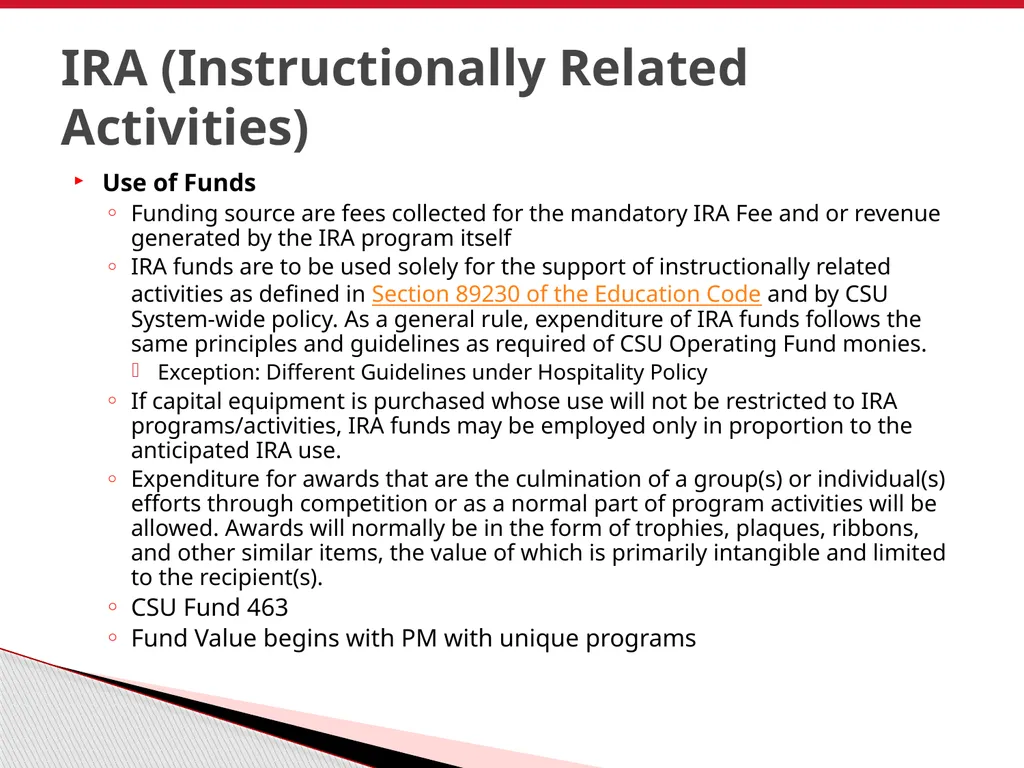
IRA (Instructionally Related Activities) Use of Funds
Funding source are fees collected for the mandatory IRA Fee and or revenue generated by the IRA program itself
IRA funds are to be used solely for the support of instructionally related activities as defined in Section 89230 of the Education Code and by CSU System-wide policy. As a general rule, expenditure of IRA funds follows the same principles and guidelines as required of CSU Operating Fund monies.
Exception: Different Guidelines under Hospitality Policy
If capital equipment is purchased whose use will not be restricted to IRA programs/activities, IRA funds may be employed only in proportion to the anticipated IRA use.
Expenditure for awards that are the culmination of a group(s) or individual(s) efforts through competition or as a normal part of program activities will be allowed. Awards will normally be in the form of trophies, plaques, ribbons, and other similar items, the value of which is primarily intangible and limited to the recipient(s).
CSU Fund 463
Fund Value begins with PM with unique programs<br>
Funding source are fees collected for the mandatory IRA Fee and or revenue generated by the IRA program itself
IRA funds are to be used solely for the support of instructionally related activities as defined in Section 89230 of the Education Code and by CSU System-wide policy. As a general rule, expenditure of IRA funds follows the same principles and guidelines as required of CSU Operating Fund monies.
Exception: Different Guidelines under Hospitality Policy
If capital equipment is purchased whose use will not be restricted to IRA programs/activities, IRA funds may be employed only in proportion to the anticipated IRA use.
Expenditure for awards that are the culmination of a group(s) or individual(s) efforts through competition or as a normal part of program activities will be allowed. Awards will normally be in the form of trophies, plaques, ribbons, and other similar items, the value of which is primarily intangible and limited to the recipient(s).
CSU Fund 463
Fund Value begins with PM with unique programs<br>
25
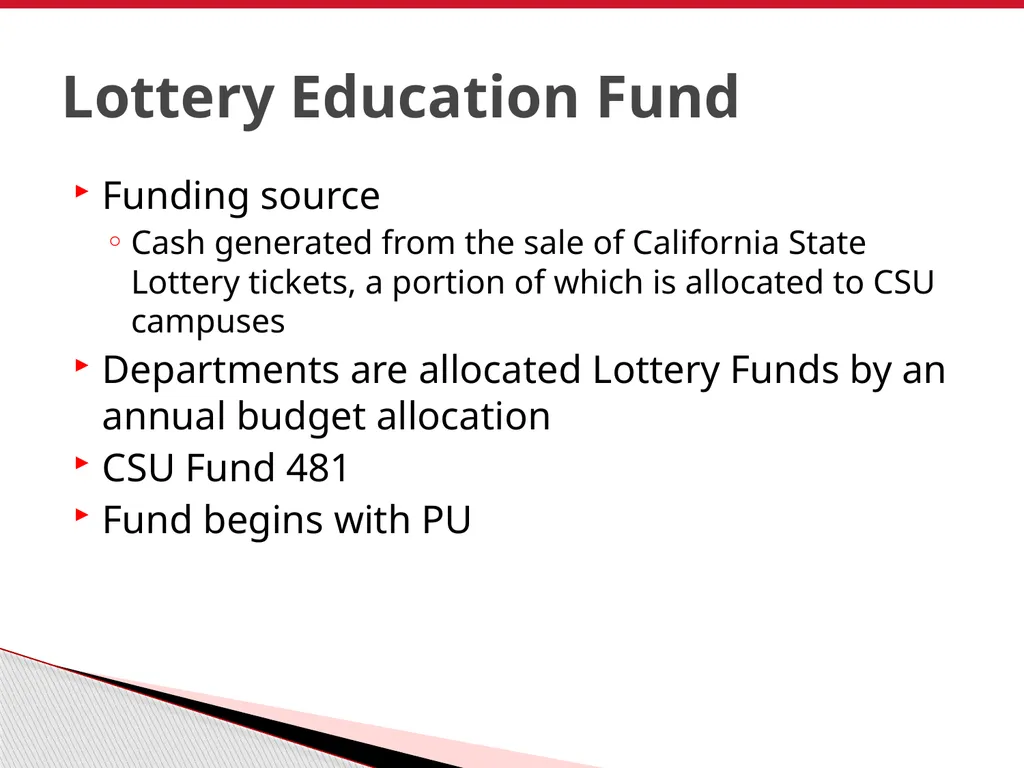
Funding source
Cash generated from the sale of California State Lottery tickets, a portion of which is allocated to CSU campuses
Departments are allocated Lottery Funds by an annual budget allocation
CSU Fund 481
Fund begins with PU Lottery Education Fund<br>
Cash generated from the sale of California State Lottery tickets, a portion of which is allocated to CSU campuses
Departments are allocated Lottery Funds by an annual budget allocation
CSU Fund 481
Fund begins with PU Lottery Education Fund<br>
26
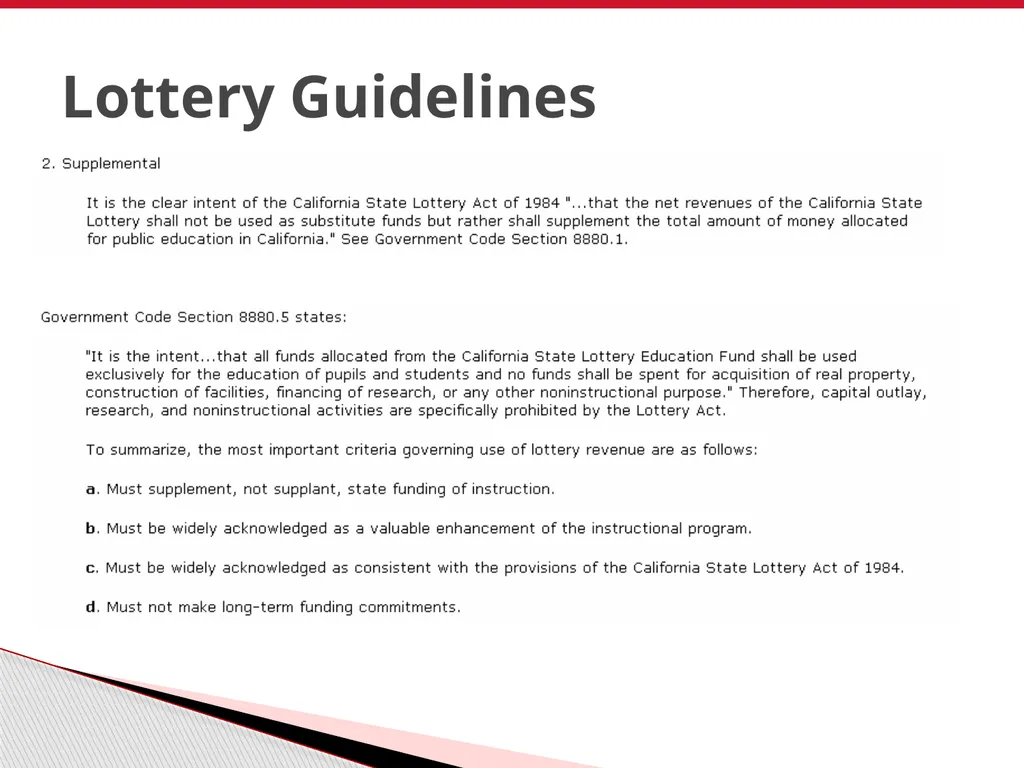
Lottery Guidelines<br>
27
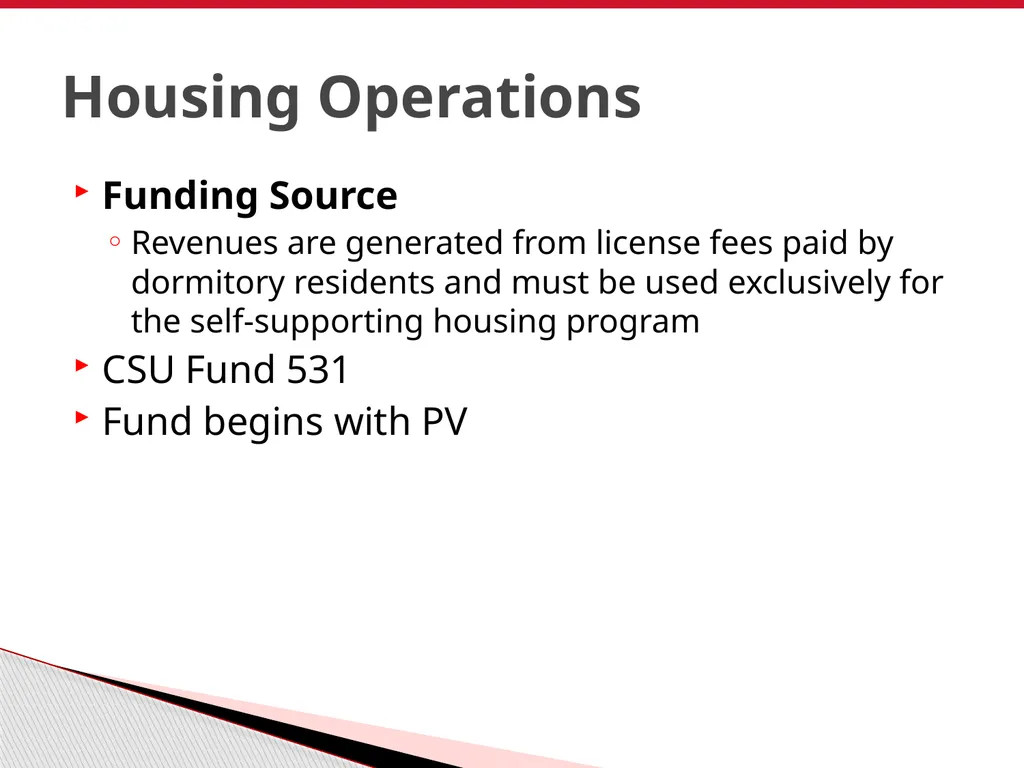
Funding Source
Revenues are generated from license fees paid by dormitory residents and must be used exclusively for the self-supporting housing program
CSU Fund 531
Fund begins with PV Housing Operations<br>
Revenues are generated from license fees paid by dormitory residents and must be used exclusively for the self-supporting housing program
CSU Fund 531
Fund begins with PV Housing Operations<br>
28
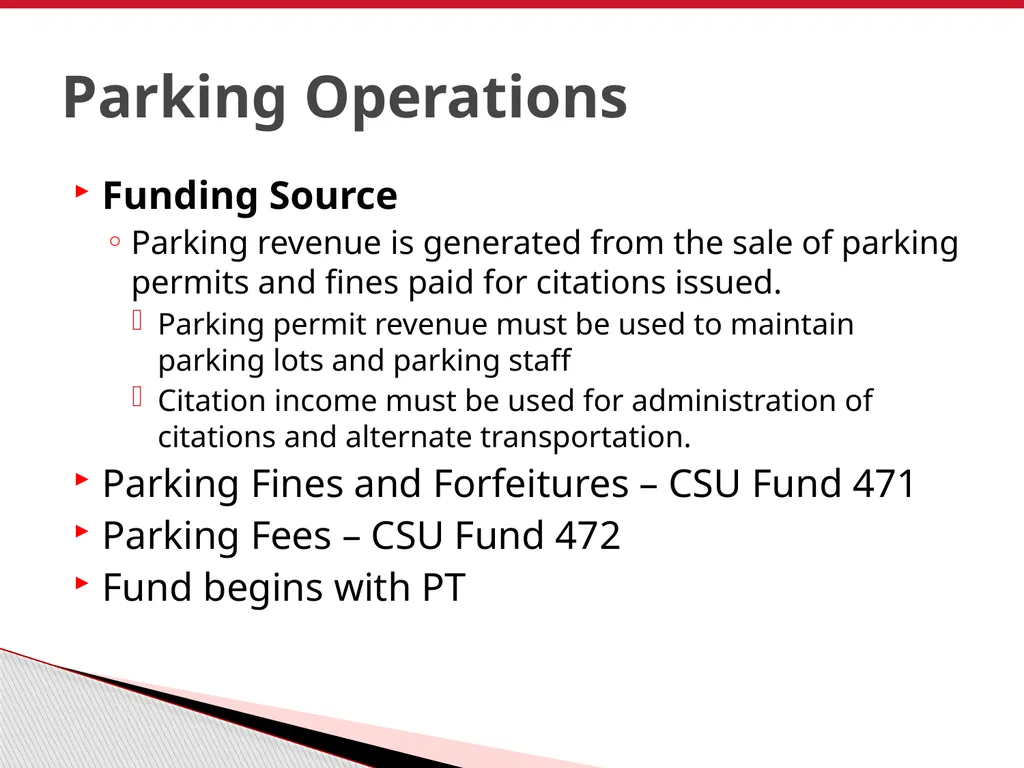
Funding Source
Parking revenue is generated from the sale of parking permits and fines paid for citations issued.
Parking permit revenue must be used to maintain parking lots and parking staff
Citation income must be used for administration of citations and alternate transportation.
Parking Fines and Forfeitures – CSU Fund 471
Parking Fees – CSU Fund 472
Fund begins with PT Parking Operations<br>
Parking revenue is generated from the sale of parking permits and fines paid for citations issued.
Parking permit revenue must be used to maintain parking lots and parking staff
Citation income must be used for administration of citations and alternate transportation.
Parking Fines and Forfeitures – CSU Fund 471
Parking Fees – CSU Fund 472
Fund begins with PT Parking Operations<br>
29
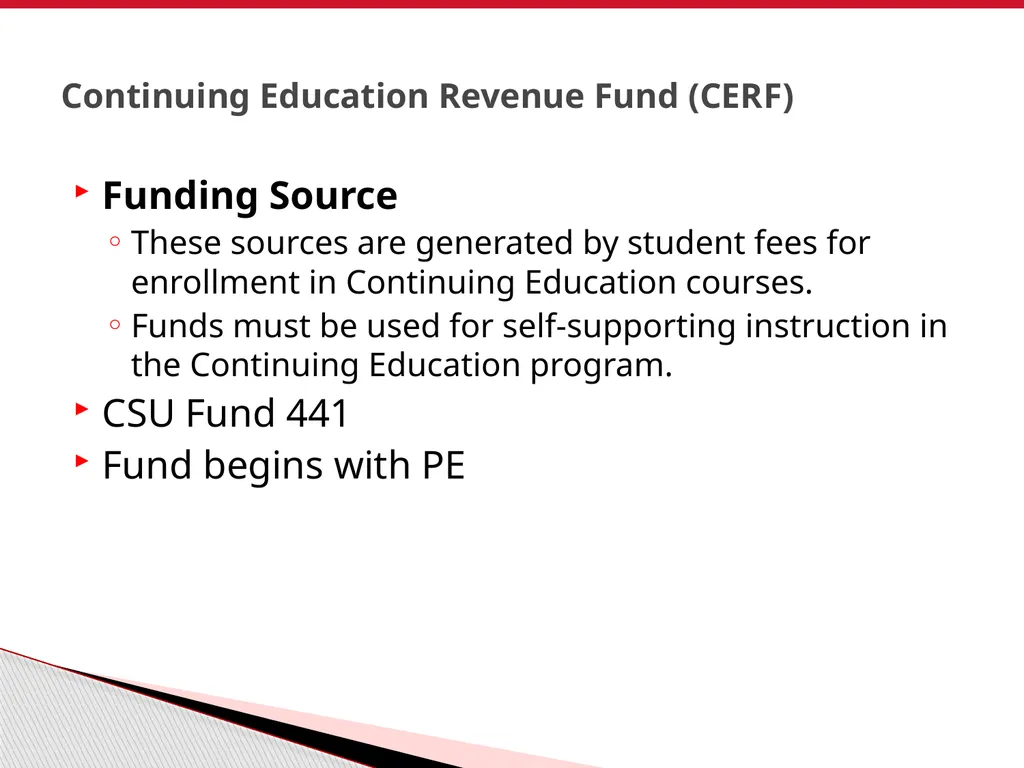
Funding Source
These sources are generated by student fees for enrollment in Continuing Education courses.
Funds must be used for self-supporting instruction in the Continuing Education program.
CSU Fund 441
Fund begins with PE Continuing Education Revenue Fund (CERF)<br>
These sources are generated by student fees for enrollment in Continuing Education courses.
Funds must be used for self-supporting instruction in the Continuing Education program.
CSU Fund 441
Fund begins with PE Continuing Education Revenue Fund (CERF)<br>
30
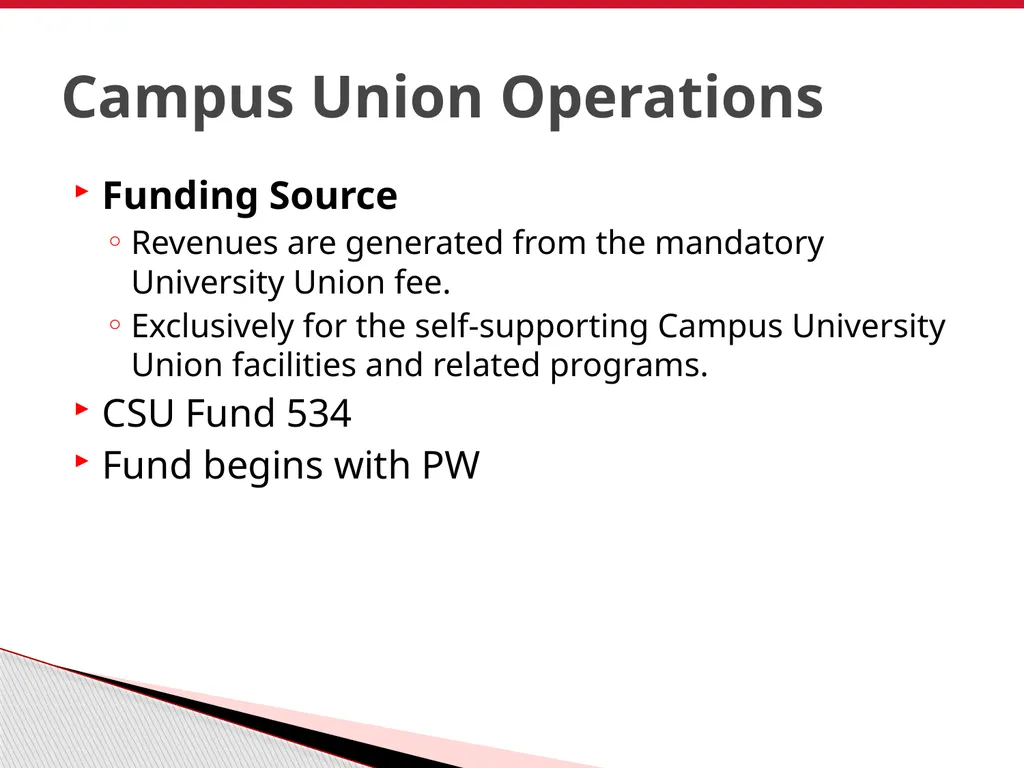
Funding Source
Revenues are generated from the mandatory University Union fee.
Exclusively for the self-supporting Campus University Union facilities and related programs.
CSU Fund 534
Fund begins with PW Campus Union Operations<br>
Revenues are generated from the mandatory University Union fee.
Exclusively for the self-supporting Campus University Union facilities and related programs.
CSU Fund 534
Fund begins with PW Campus Union Operations<br>
31
Associated Student Fee
ASI is a separate legal entity
Established by EC 89720- 89724
CSU Fund 461
PS Fund AS ASI<br>
ASI is a separate legal entity
Established by EC 89720- 89724
CSU Fund 461
PS Fund AS ASI<br>
32
Dxxxx – Donor restricted funds. These funds are classified as restricted for current use which is interpreted from the gift agreement where the donors record their intended use of the gift and/or list any restriction. In 2012-13 existing balances of this type were transferred from the Ed Foundation EKxxx funds to the University for better accessibility and spending by departments. All Dxxxx funds are governed by the University Trust Fund Agreements signed by the department administrators and approvers. While scholarships, if allowed by the gift, may be funded from Dxxxx funds they must be transferred to a PIxxx fund to be expended for that purpose.
PIxxx – These scholarship funds are only used for issuing scholarships to students. Scholarships are funded from various sources including endowment funds (L0xxx) which are held by the Ed Foundation. Transfers to fund these scholarships can occur from Dxxxx funds to PIxxx funds. Scholarships are the only expenses allowed from PIxxx funds. Additional Funds<br>
PIxxx – These scholarship funds are only used for issuing scholarships to students. Scholarships are funded from various sources including endowment funds (L0xxx) which are held by the Ed Foundation. Transfers to fund these scholarships can occur from Dxxxx funds to PIxxx funds. Scholarships are the only expenses allowed from PIxxx funds. Additional Funds<br>
33
Additional Funds Lxxxx- Endowment funds are held solely by the Ed Foundation and are invested under a policy that stresses preservation of the principal while maximizing investment earning. An annual payout of roughly 4% is issued on the approval of the Ed Foundation board and these payouts may be directed to either PIxxx or Dxxxx funds in accordance with the terms outlined in the donor gift agreement. With rare exceptions that are driven by the terms of the donor gift agreement, the principal amount is never spent so that it will act as a continuing source of revenue.
Wxxxx- Grant and Contract fiscal activity that were previously housed at the Foundation. These funds are administered by Office of Research and Sponsored Programs (ORSP), a component of Academic Affairs, and each expenditure must be reviewed and approved by ORSP before it can be charged to these funds. The spending rules for these funds are specified within the grants or contracts which outline the activity to be performed and any restrictions.<br>
Wxxxx- Grant and Contract fiscal activity that were previously housed at the Foundation. These funds are administered by Office of Research and Sponsored Programs (ORSP), a component of Academic Affairs, and each expenditure must be reviewed and approved by ORSP before it can be charged to these funds. The spending rules for these funds are specified within the grants or contracts which outline the activity to be performed and any restrictions.<br>
34
Funding Source
There are two sources of funds for CSU capital outlay programs
state tax revenues appropriated by the state legislature
the proceeds from the sale of bonds.
funding is allocated to the University as either
Minor Capital Outlay (projects of $600,000 or less)
Major Capital Outlay (projects greater than $600,000).
The funding must be used for the construction projects specified. Capital Outlay<br>
There are two sources of funds for CSU capital outlay programs
state tax revenues appropriated by the state legislature
the proceeds from the sale of bonds.
funding is allocated to the University as either
Minor Capital Outlay (projects of $600,000 or less)
Major Capital Outlay (projects greater than $600,000).
The funding must be used for the construction projects specified. Capital Outlay<br>
35
Chart of Accounts<br>
36
Fund – Tied to a specific purpose (Trial Balance)
DeptID – Campus Organization (Same in HR)
Account – Type of Expenditure
Program – On Going Revenue & Expense
Project – Time specific Revenue & Expense
Class – Dept level information Rev & Expense ChartField Overview<br>
DeptID – Campus Organization (Same in HR)
Account – Type of Expenditure
Program – On Going Revenue & Expense
Project – Time specific Revenue & Expense
Class – Dept level information Rev & Expense ChartField Overview<br>
37
Identifies funding that has a specific defined purpose FUND<br>
38
A unique department within the University organization
Can also be used to identify a major program within a department, example: Utilities Department<br>
Can also be used to identify a major program within a department, example: Utilities Department<br>
39
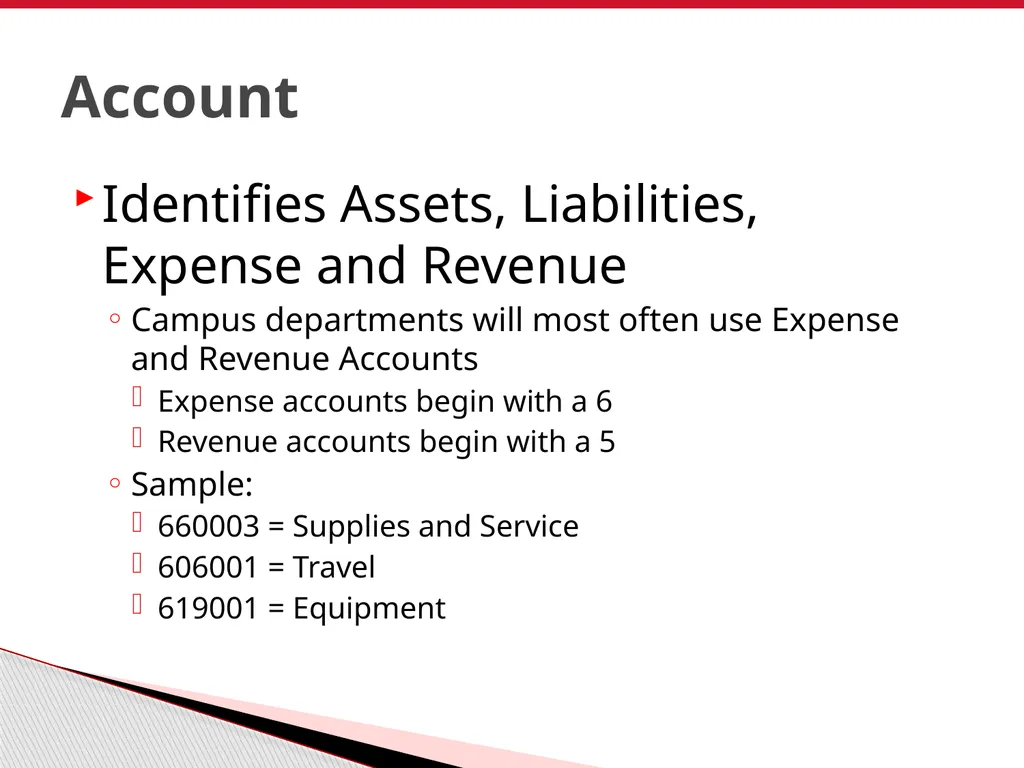
Identifies Assets, Liabilities, Expense and Revenue
Campus departments will most often use Expense and Revenue Accounts
Expense accounts begin with a 6
Revenue accounts begin with a 5
Sample:
660003 = Supplies and Service
606001 = Travel
619001 = Equipment Account<br>
Campus departments will most often use Expense and Revenue Accounts
Expense accounts begin with a 6
Revenue accounts begin with a 5
Sample:
660003 = Supplies and Service
606001 = Travel
619001 = Equipment Account<br>
40
Identifies major on-going activity
Used with Revenue and Expense only
Example:
Defines IRA Programs
IA003 – Art Gallery
IA013 – Music Jazz Studies Program<br>
Used with Revenue and Expense only
Example:
Defines IRA Programs
IA003 – Art Gallery
IA013 – Music Jazz Studies Program<br>
41
Defines activity with a start and end date
Capital Outlay projects
Continuing Education
Faculty Support Grants Project<br>
Capital Outlay projects
Continuing Education
Faculty Support Grants Project<br>
42
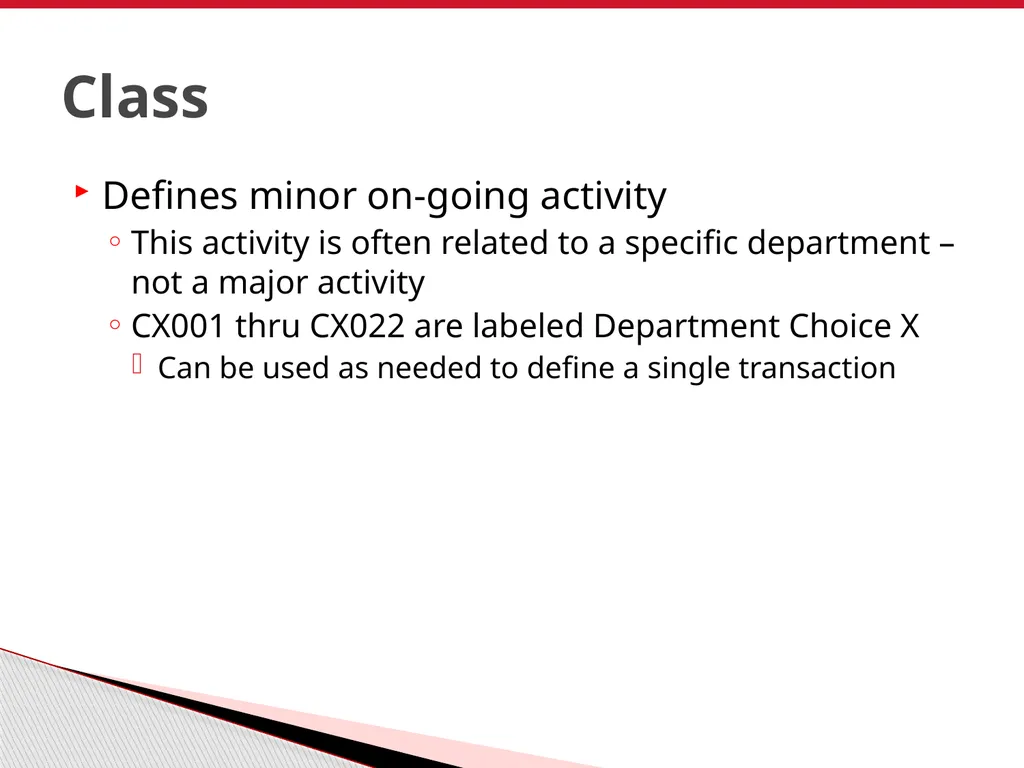
Defines minor on-going activity
This activity is often related to a specific department – not a major activity
CX001 thru CX022 are labeled Department Choice X
Can be used as needed to define a single transaction Class<br>
This activity is often related to a specific department – not a major activity
CX001 thru CX022 are labeled Department Choice X
Can be used as needed to define a single transaction Class<br>
43
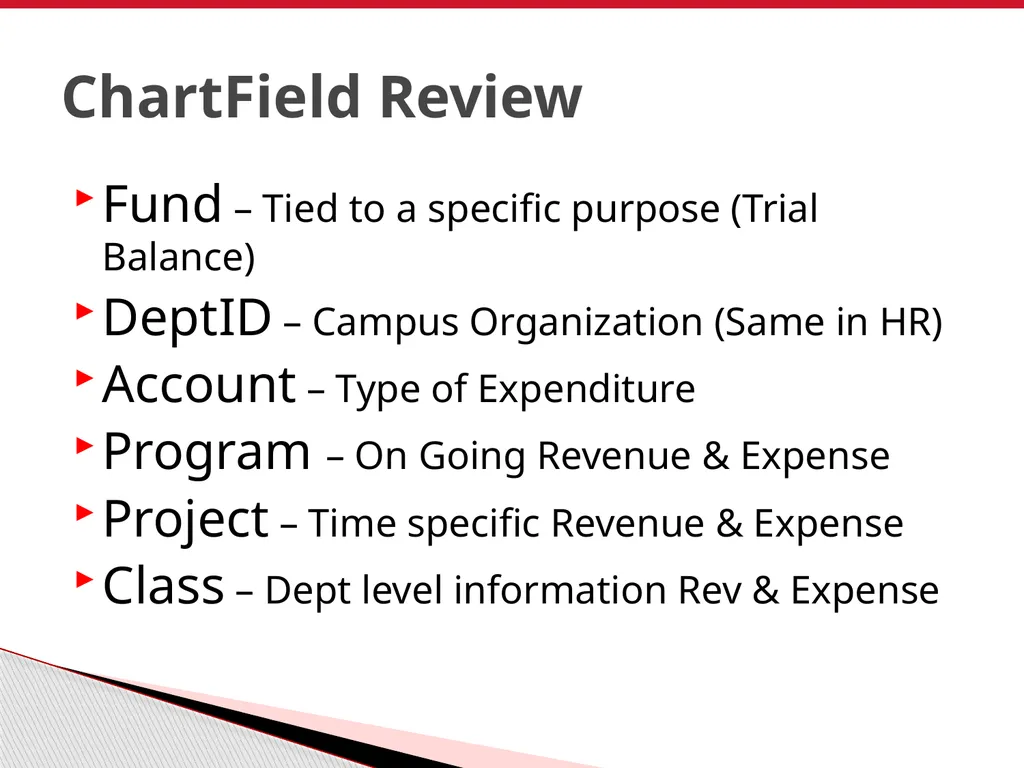
Fund – Tied to a specific purpose (Trial Balance)
DeptID – Campus Organization (Same in HR)
Account – Type of Expenditure
Program – On Going Revenue & Expense
Project – Time specific Revenue & Expense
Class – Dept level information Rev & Expense ChartField Review<br>
DeptID – Campus Organization (Same in HR)
Account – Type of Expenditure
Program – On Going Revenue & Expense
Project – Time specific Revenue & Expense
Class – Dept level information Rev & Expense ChartField Review<br>
44
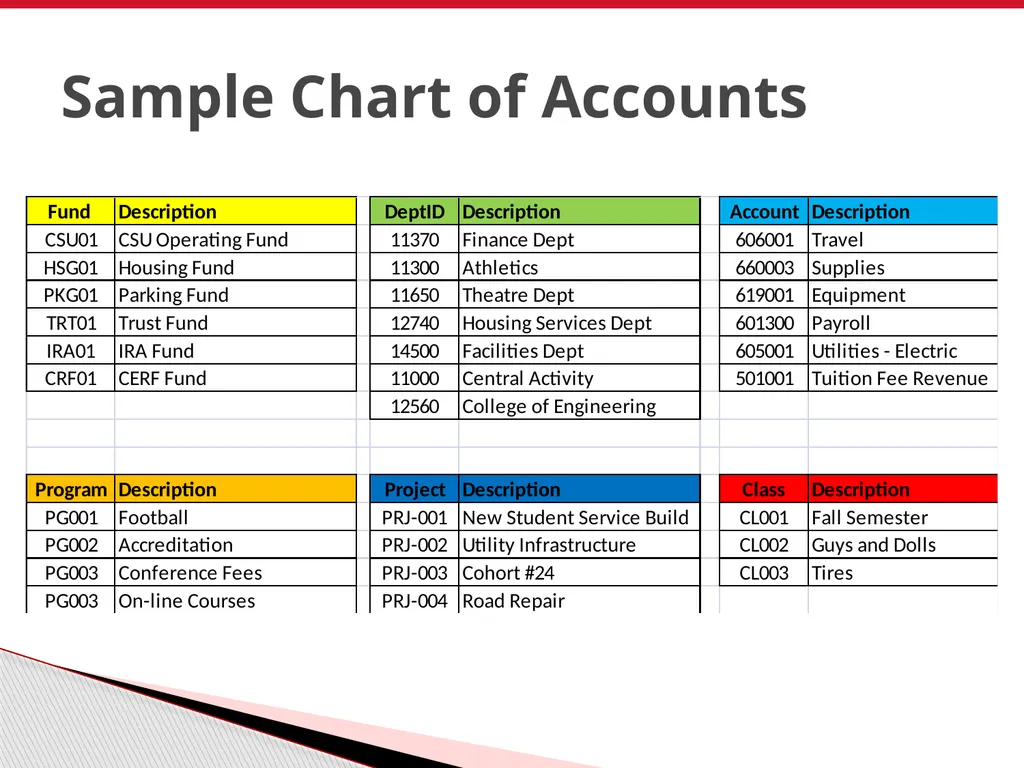
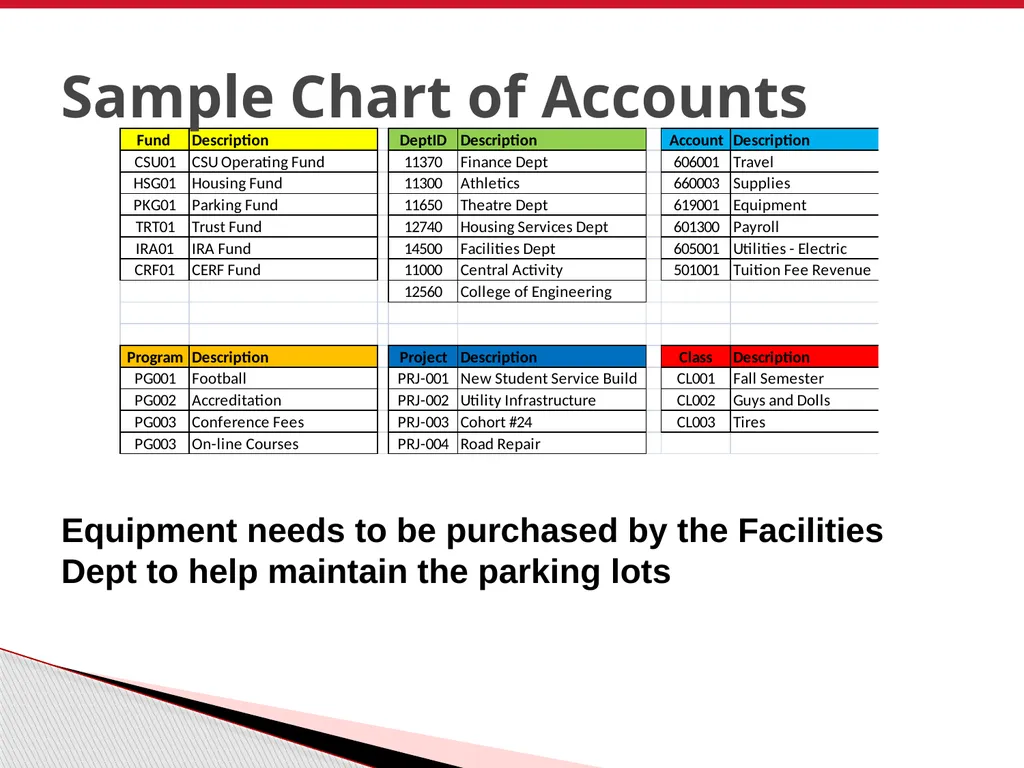
Sample Chart of Accounts<br>
45
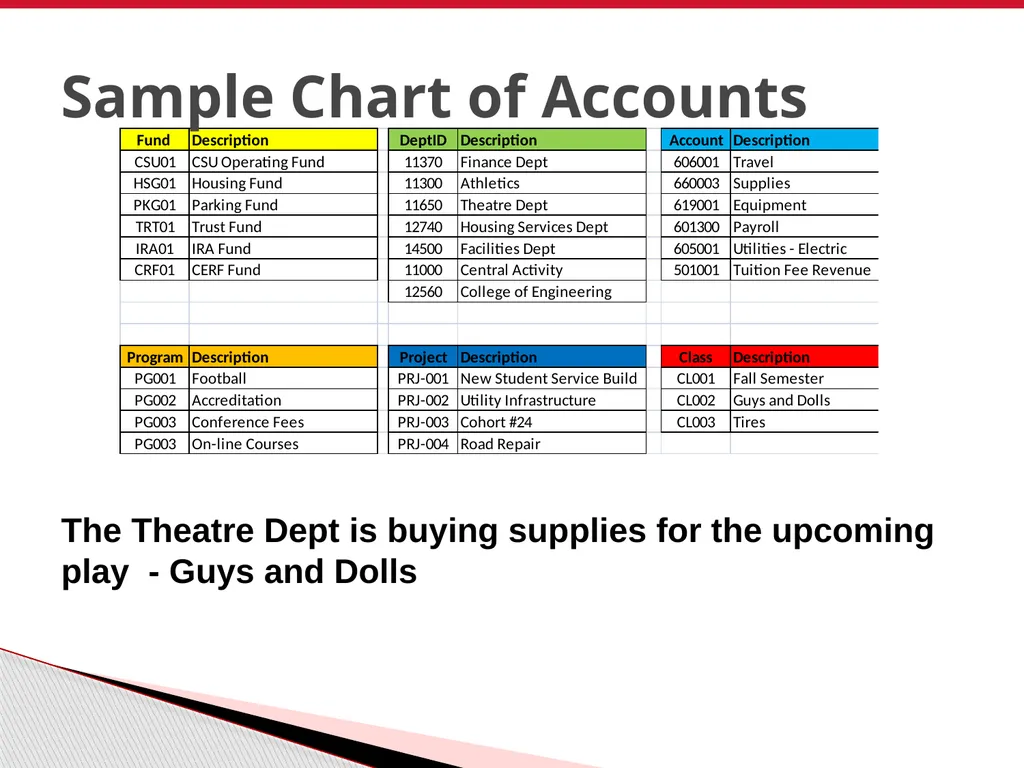
Sample Chart of Accounts The Theatre Dept is buying supplies for the upcoming play - Guys and Dolls<br>
46
Sample Chart of Accounts Equipment needs to be purchased by the Facilities Dept to help maintain the parking lots<br>
47
Questions<br>