Finite States: Base Elements in a Computing
Description: Finite States: Base Elements in a Computing Orchestra Ronald Finkbine, Ph.D. Department of Computer Science Indiana University Southeast rfinkbinius.edu Introduction Software Complexity Programmer Understandability Maintainability Reduce
Related Topics
Download Presentation
"Finite States: Base Elements in a Computing" is the property of its rightful owner. Permission is granted to download and print the materials on this website for personal, non-commercial use only, and to display it on your personal computer provided you do not modify the materials and that you retain all copyright notices contained in the materials. By downloading content from our website, you accept the terms of this agreement.
Presentation Transcript
slide1. Finite States: Base Elements in a Computing Orchestra Ronald Finkbine, Ph.D.Department of Computer ScienceIndiana University Southeastrfinkbin@ius.edu<br>
slide2. Introduction Software Complexity
Programmer Understandability
Maintainability
Reduce by tools
Reduce by techniques<br>
slide3. Definitions Finite State Machine, any program
DFA, 4 tuple
States
Transitions
Start state
Accept states
Moore Machine
Mealy Machine<br>
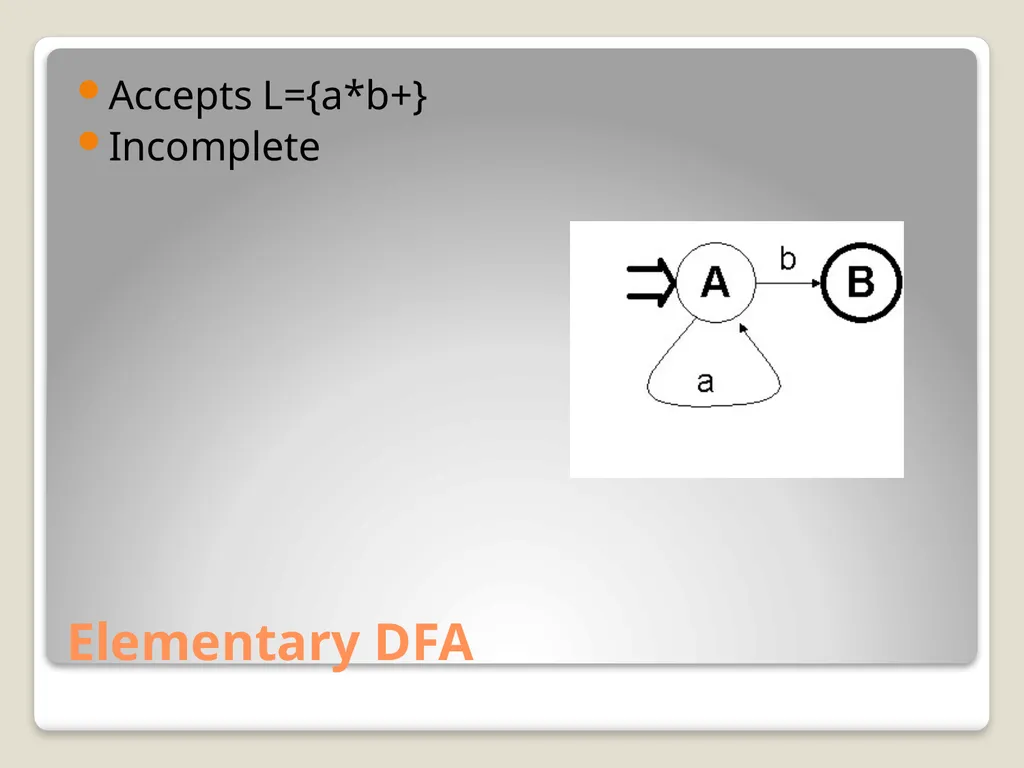
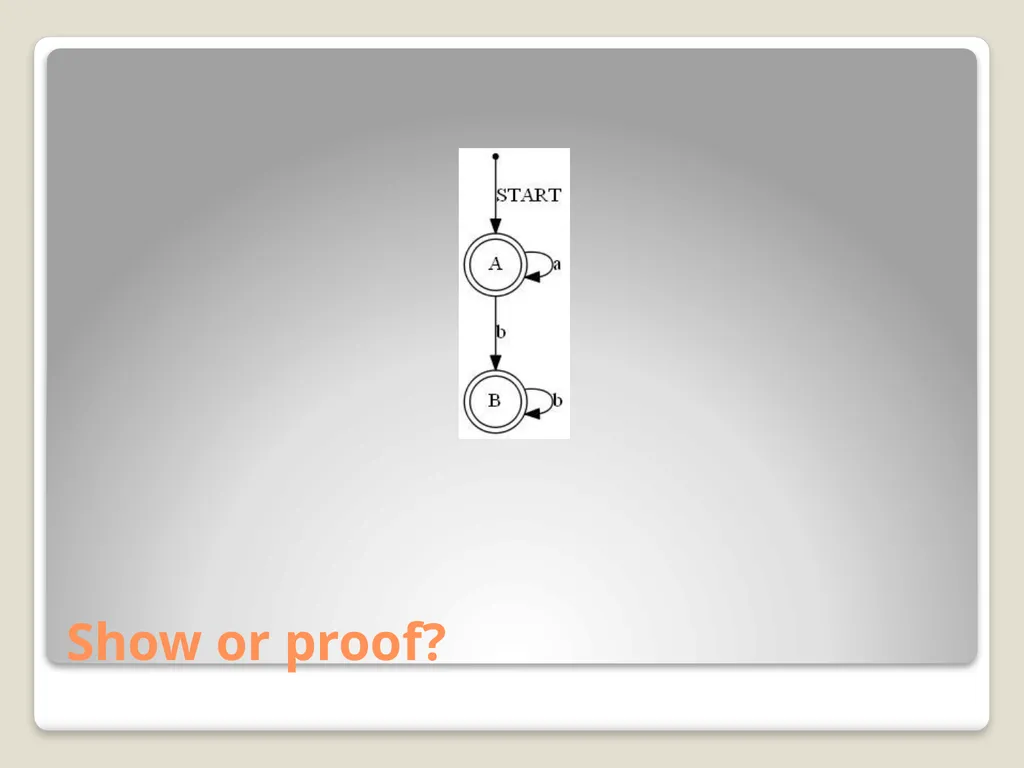
slide4. Elementary DFA Accepts L={a*b+}
Incomplete<br>
slide5. Benefits of DFAs High-reliability
Proof or show?
Mathematics is a modeling method
Proofs are social constructs
Diagrammetics<br>
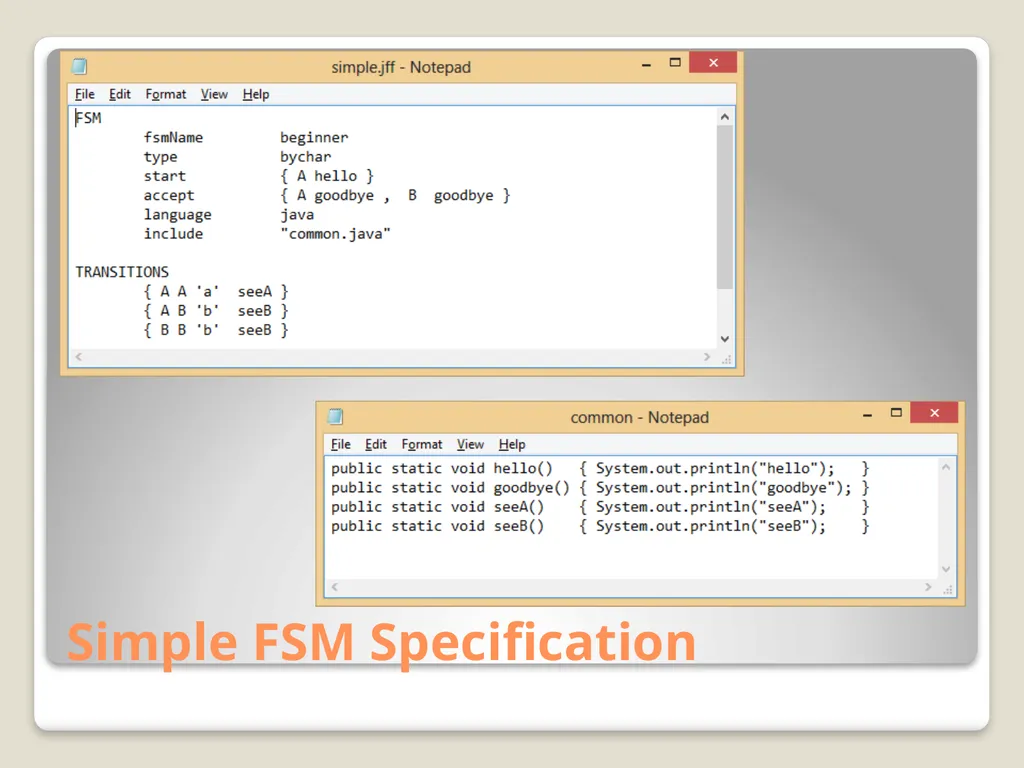
slide6. Simple FSM Specification<br>
slide7. Pictures are good Graphviz.org
dot -v -Tjpeg -o beginner.jpg beginner.dot<br>
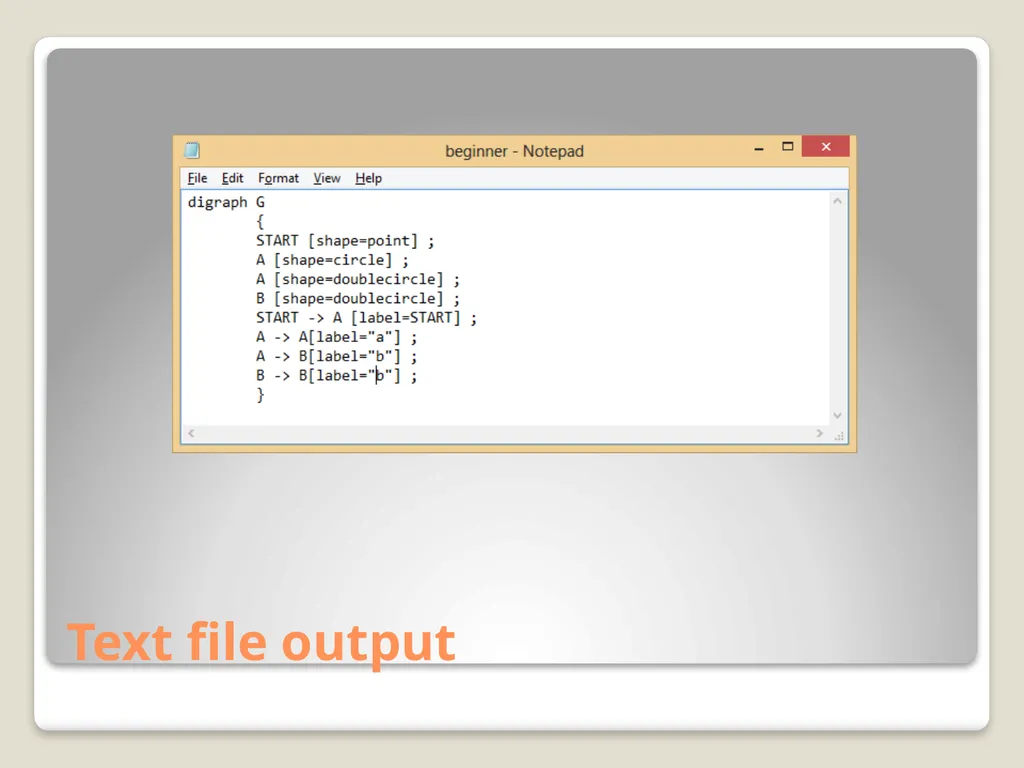
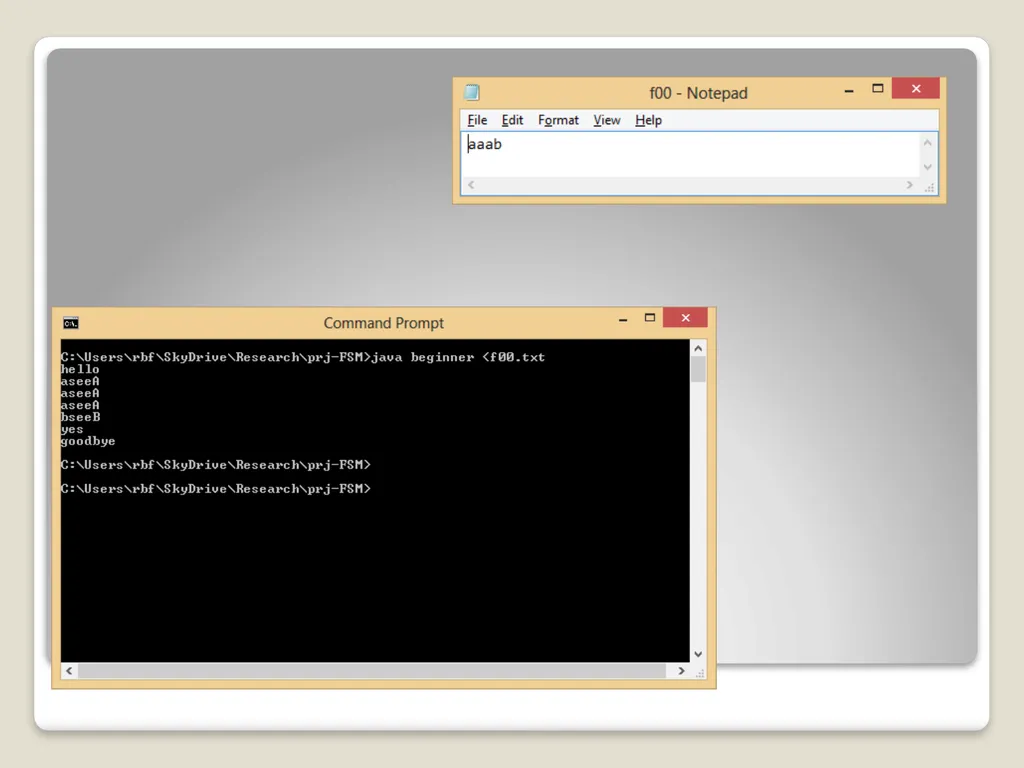
slide8. Text file output<br>
slide9. Show or proof?<br>
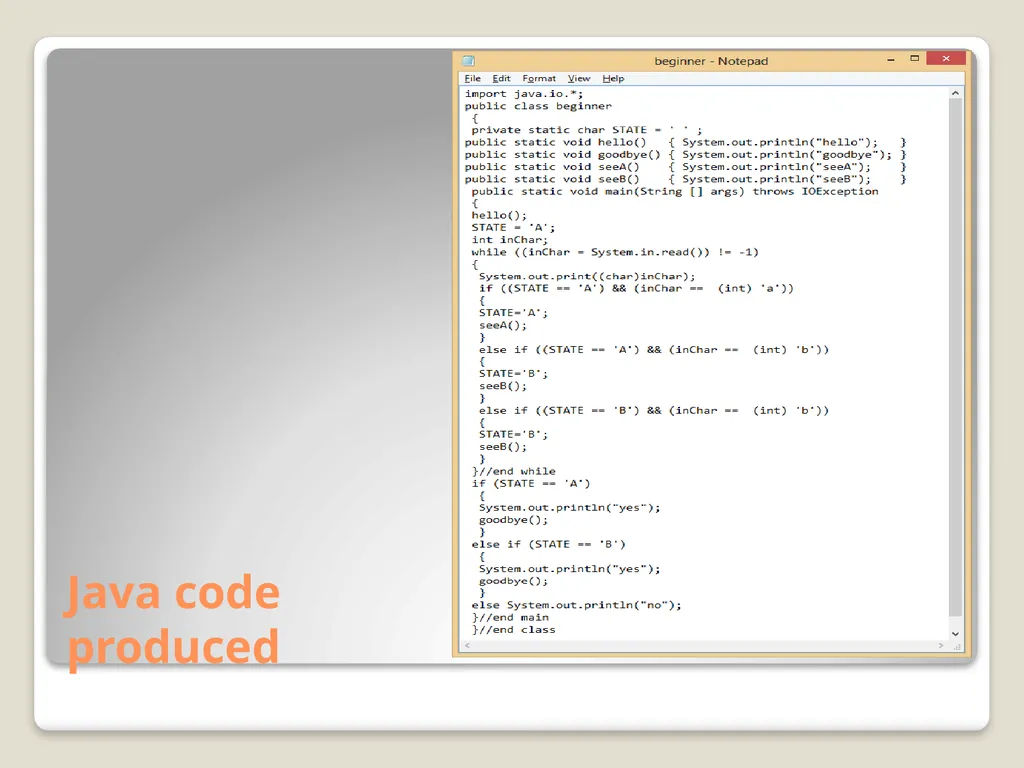
slide10. Java code produced<br>
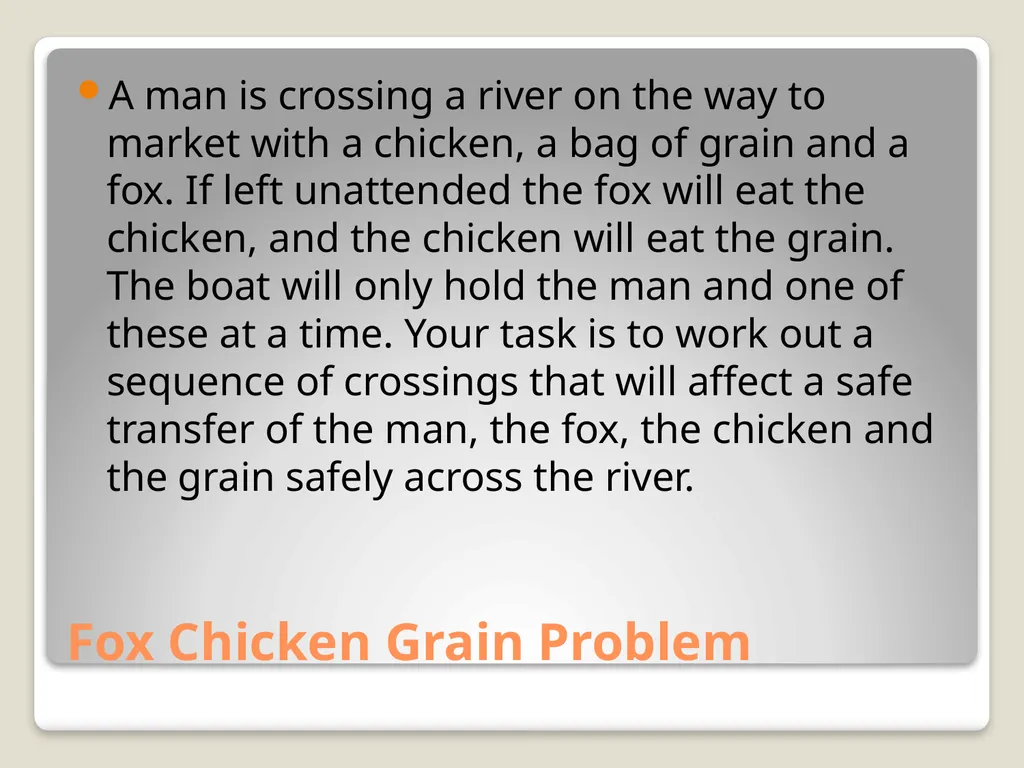
slide12. Fox Chicken Grain Problem A man is crossing a river on the way to market with a chicken, a bag of grain and a fox. If left unattended the fox will eat the chicken, and the chicken will eat the grain. The boat will only hold the man and one of these at a time. Your task is to work out a sequence of crossings that will affect a safe transfer of the man, the fox, the chicken and the grain safely across the river.<br>
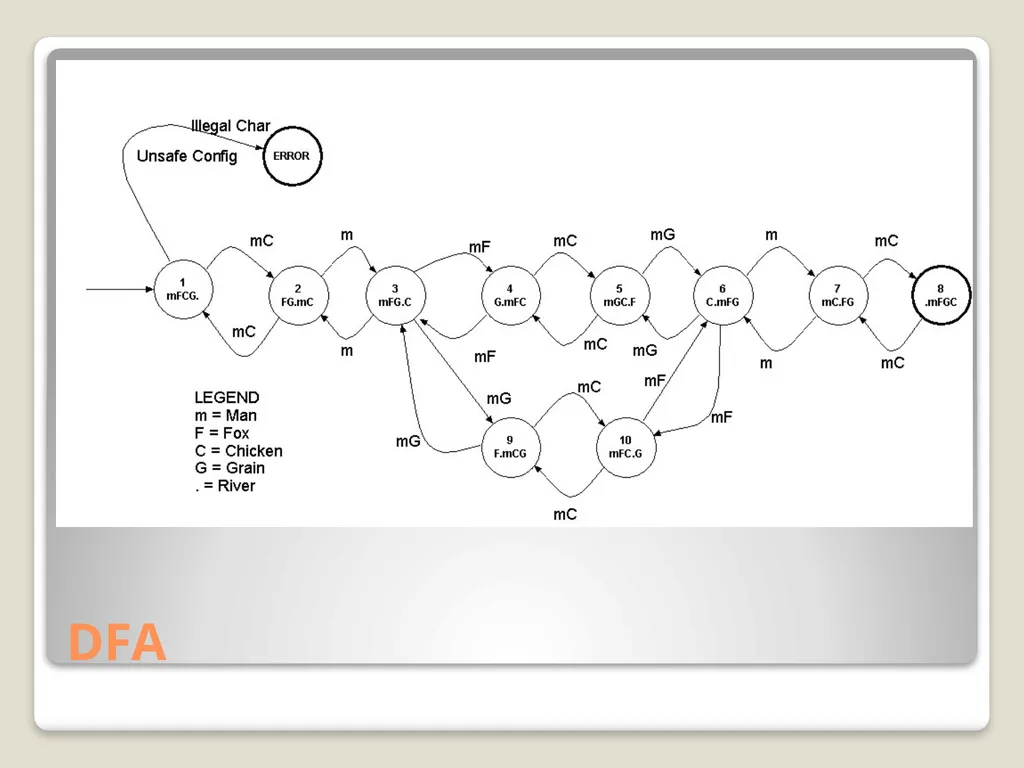
slide13. DFA<br>
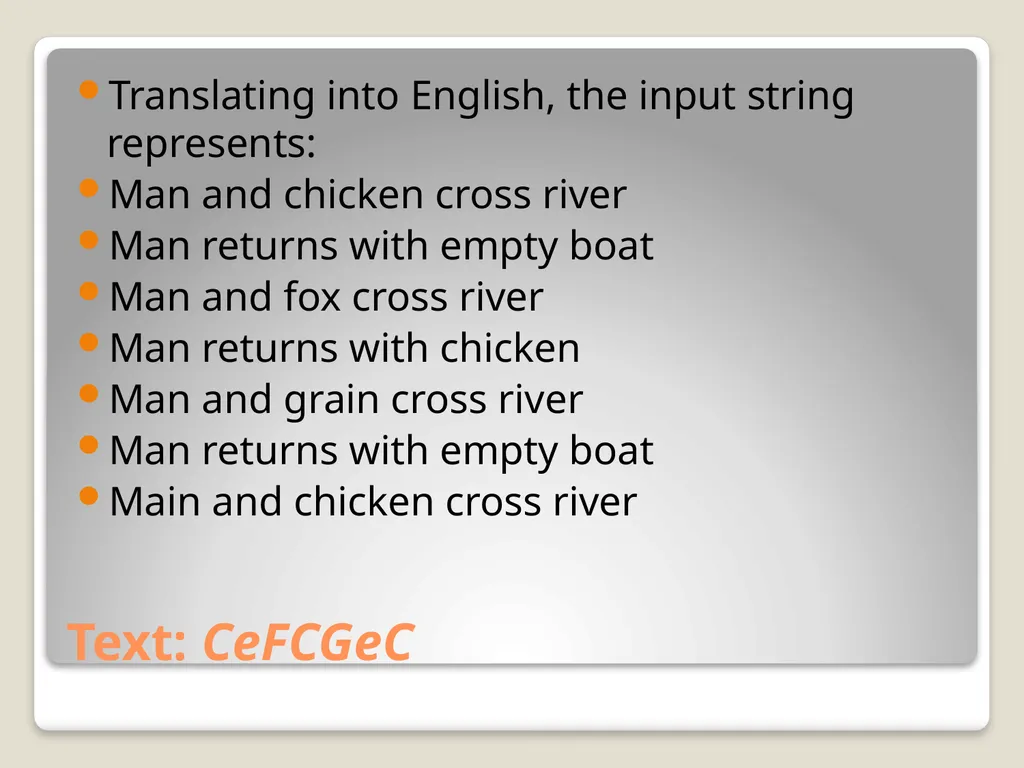
slide14. Text: CeFCGeC Translating into English, the input string represents:
Man and chicken cross river
Man returns with empty boat
Man and fox cross river
Man returns with chicken
Man and grain cross river
Man returns with empty boat
Main and chicken cross river<br>
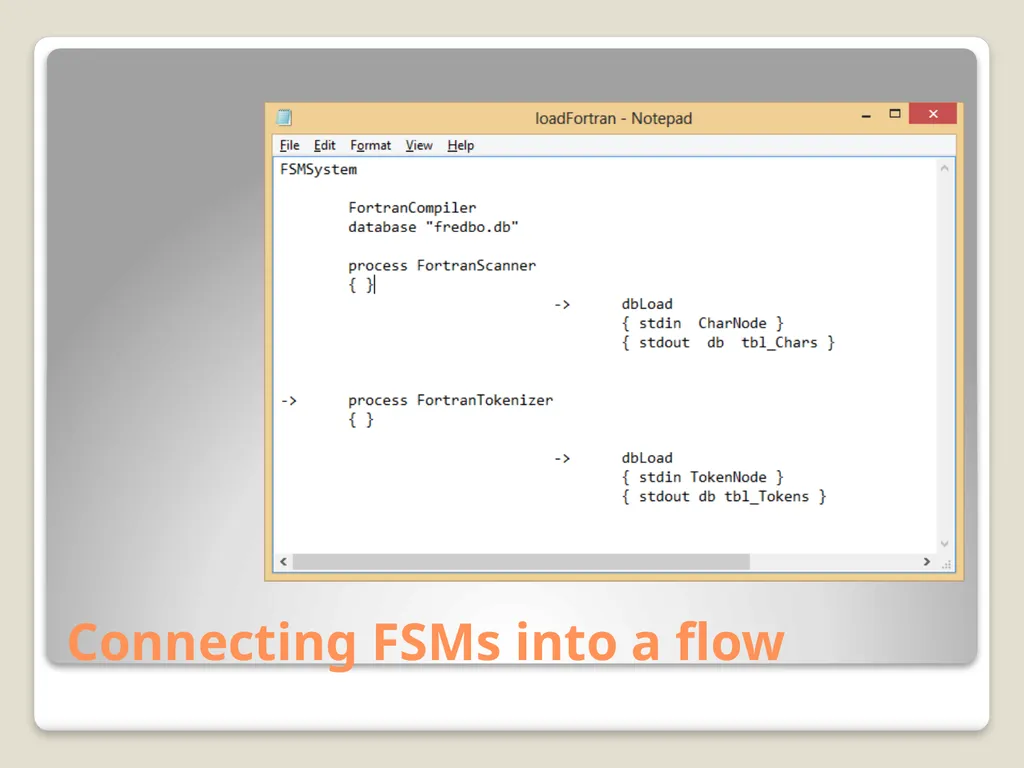
slide15. Connecting FSMs into a flow<br>
slide16. Benefits FSMs are complete programs
Lead to parallelism
Not restricted to single language
Not sharing spaces, better security
Limits programming options, reduces programming complexity, GOOD
Data in single layer, in surface pipe<br>
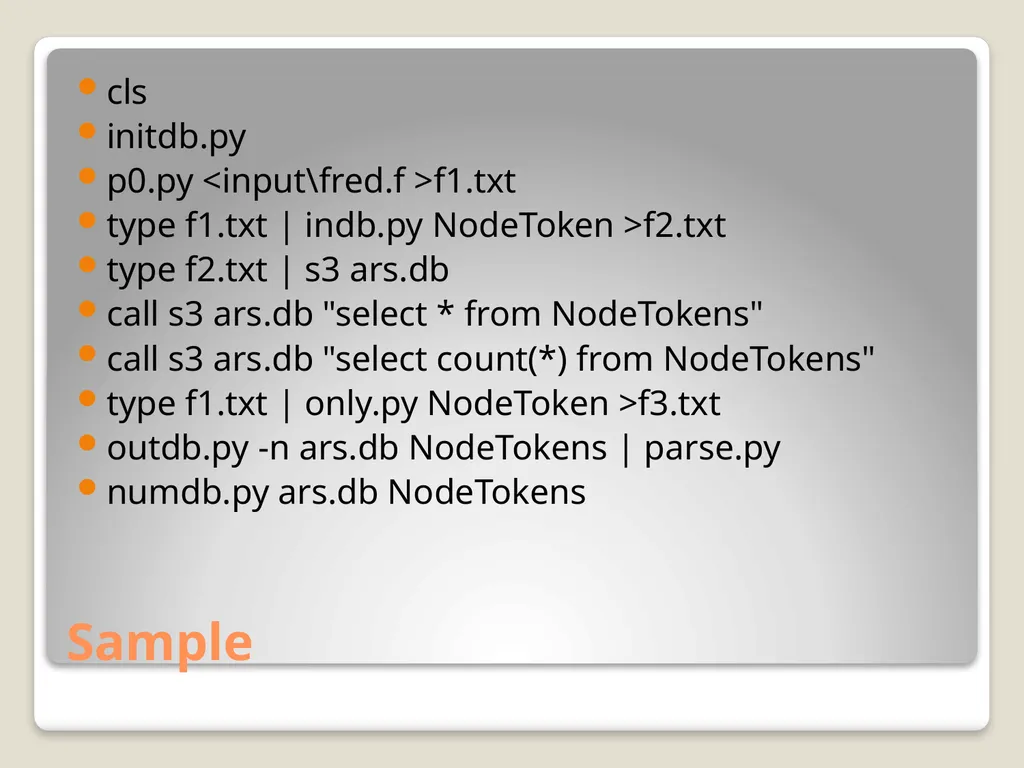
slide17. Sample cls
initdb.py
p0.py <input\fred.f >f1.txt
type f1.txt | indb.py NodeToken >f2.txt
type f2.txt | s3 ars.db
call s3 ars.db "select * from NodeTokens"
call s3 ars.db "select count(*) from NodeTokens"
type f1.txt | only.py NodeToken >f3.txt
outdb.py -n ars.db NodeTokens | parse.py
numdb.py ars.db NodeTokens<br>
slide18. FSMs can be everywhere Software Complexity
Programmer Understandability
Maintainability
Reduce by tools
Reduce by techniques<br>
slide2. Introduction Software Complexity
Programmer Understandability
Maintainability
Reduce by tools
Reduce by techniques<br>
slide3. Definitions Finite State Machine, any program
DFA, 4 tuple
States
Transitions
Start state
Accept states
Moore Machine
Mealy Machine<br>
slide4. Elementary DFA Accepts L={a*b+}
Incomplete<br>
slide5. Benefits of DFAs High-reliability
Proof or show?
Mathematics is a modeling method
Proofs are social constructs
Diagrammetics<br>
slide6. Simple FSM Specification<br>
slide7. Pictures are good Graphviz.org
dot -v -Tjpeg -o beginner.jpg beginner.dot<br>
slide8. Text file output<br>
slide9. Show or proof?<br>
slide10. Java code produced<br>
slide12. Fox Chicken Grain Problem A man is crossing a river on the way to market with a chicken, a bag of grain and a fox. If left unattended the fox will eat the chicken, and the chicken will eat the grain. The boat will only hold the man and one of these at a time. Your task is to work out a sequence of crossings that will affect a safe transfer of the man, the fox, the chicken and the grain safely across the river.<br>
slide13. DFA<br>
slide14. Text: CeFCGeC Translating into English, the input string represents:
Man and chicken cross river
Man returns with empty boat
Man and fox cross river
Man returns with chicken
Man and grain cross river
Man returns with empty boat
Main and chicken cross river<br>
slide15. Connecting FSMs into a flow<br>
slide16. Benefits FSMs are complete programs
Lead to parallelism
Not restricted to single language
Not sharing spaces, better security
Limits programming options, reduces programming complexity, GOOD
Data in single layer, in surface pipe<br>
slide17. Sample cls
initdb.py
p0.py <input\fred.f >f1.txt
type f1.txt | indb.py NodeToken >f2.txt
type f2.txt | s3 ars.db
call s3 ars.db "select * from NodeTokens"
call s3 ars.db "select count(*) from NodeTokens"
type f1.txt | only.py NodeToken >f3.txt
outdb.py -n ars.db NodeTokens | parse.py
numdb.py ars.db NodeTokens<br>
slide18. FSMs can be everywhere Software Complexity
Programmer Understandability
Maintainability
Reduce by tools
Reduce by techniques<br>