
FinTech and Regulation September 22, 2016 Kim
PC
Published · 54 slides · 0 views

1 / 1
Description
FinTech and Regulation September 22, 2016 Kim Prior 2 Agenda FinTech Overview what is FinTech? Types of FinTech products and services How is FinTech Regulated? Regulatory Iniatives to Promote FinTech Effect of FinTech on Existing
Related Topics
Share
Embed code
Download this presentation From Below
"FinTech and Regulation September 22, 2016 Kim" is the property of its rightful owner. Permission is granted to download and print the materials on this website for personal, non-commercial use only, and to display it on your personal computer provided you do not modify the materials and that you retain all copyright notices contained in the materials. By downloading content from our website, you accept the terms of this agreement.
Presentation Transcript
01
FinTech and Regulation September 22, 2016
Kim Prior<br>
Kim Prior<br>
02
2 Agenda FinTech Overview – what is FinTech? Types of FinTech products and services
How is FinTech Regulated?
Regulatory Iniatives to Promote FinTech
Effect of FinTech on Existing Financial Insitutions<br>
How is FinTech Regulated?
Regulatory Iniatives to Promote FinTech
Effect of FinTech on Existing Financial Insitutions<br>
03
FinTech Overview<br>
04
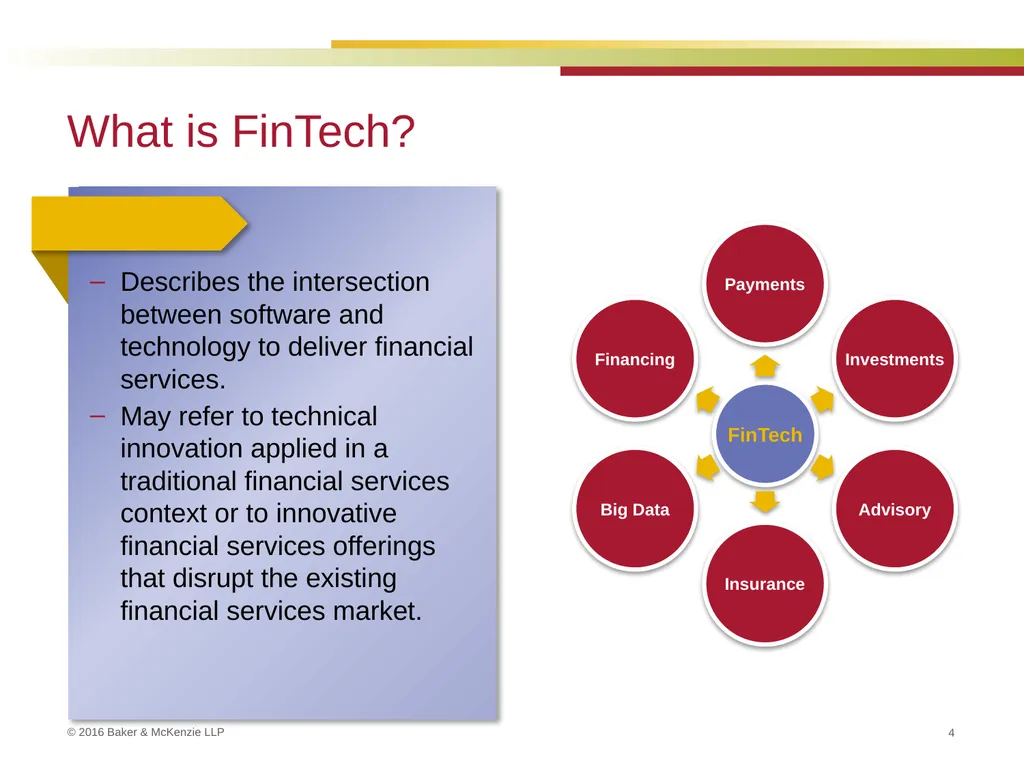
4 What is FinTech? Describes the intersection between software and technology to deliver financial services.
May refer to technical innovation applied in a traditional financial services context or to innovative financial services offerings that disrupt the existing financial services market.<br>
May refer to technical innovation applied in a traditional financial services context or to innovative financial services offerings that disrupt the existing financial services market.<br>
05
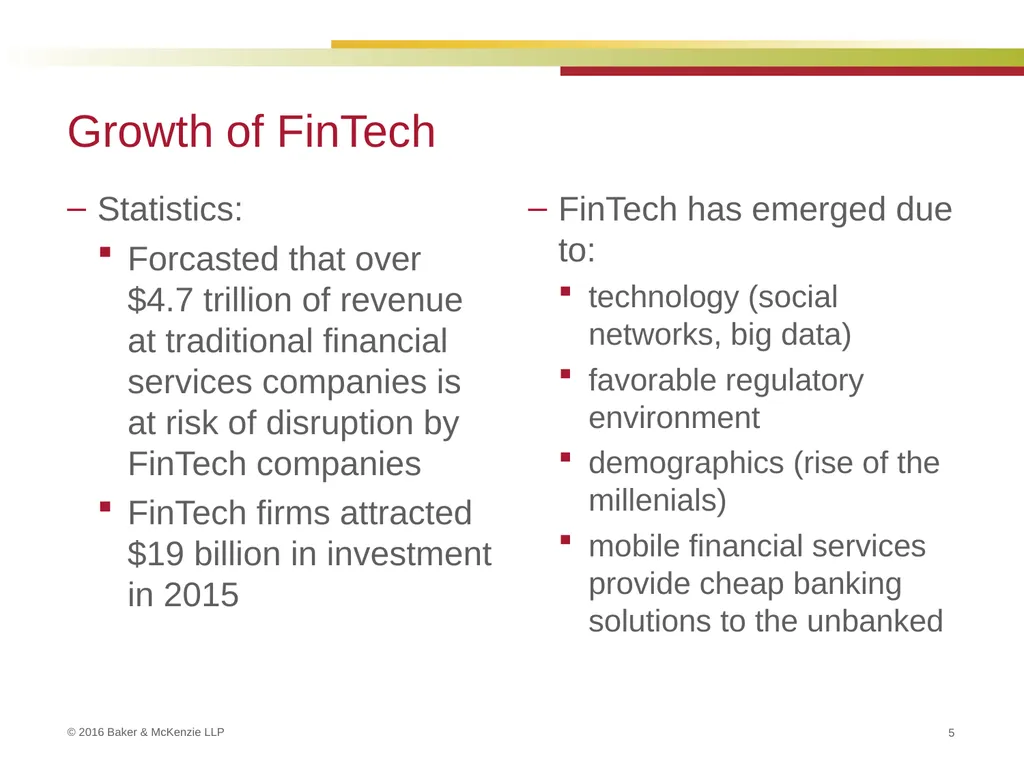
5 Growth of FinTech Statistics:
Forcasted that over $4.7 trillion of revenue at traditional financial services companies is at risk of disruption by FinTech companies
FinTech firms attracted $19 billion in investment in 2015 FinTech has emerged due to:
technology (social networks, big data)
favorable regulatory environment
demographics (rise of the millenials)
mobile financial services provide cheap banking solutions to the unbanked<br>
Forcasted that over $4.7 trillion of revenue at traditional financial services companies is at risk of disruption by FinTech companies
FinTech firms attracted $19 billion in investment in 2015 FinTech has emerged due to:
technology (social networks, big data)
favorable regulatory environment
demographics (rise of the millenials)
mobile financial services provide cheap banking solutions to the unbanked<br>
06
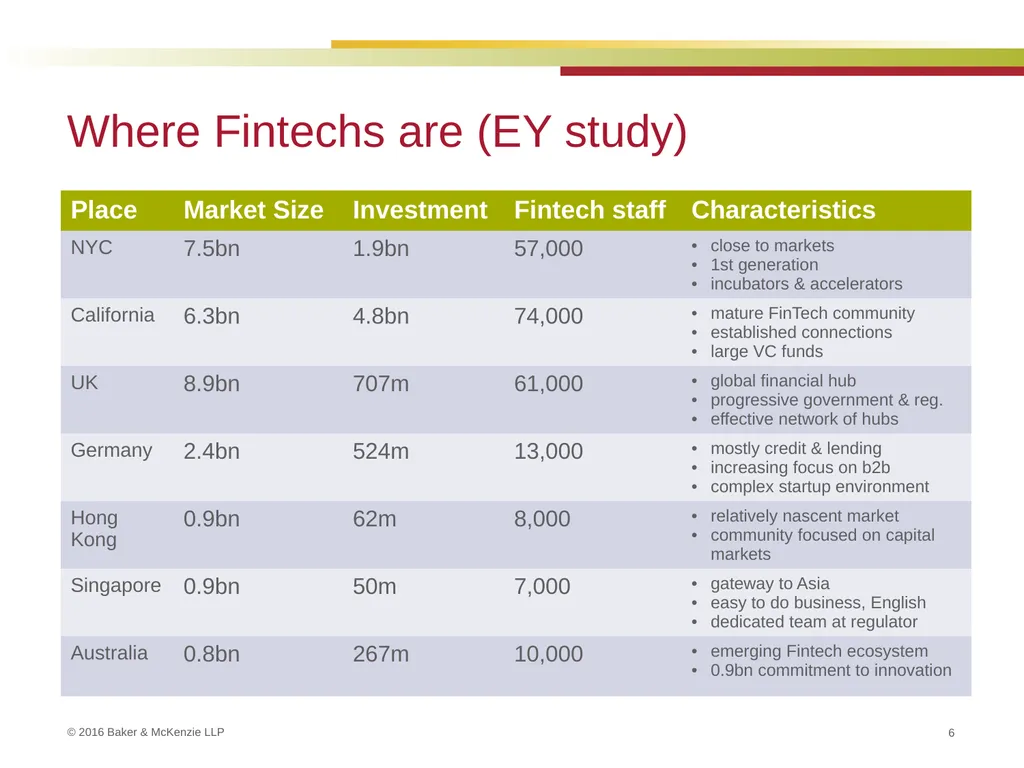
6 Where Fintechs are (EY study)<br>
07
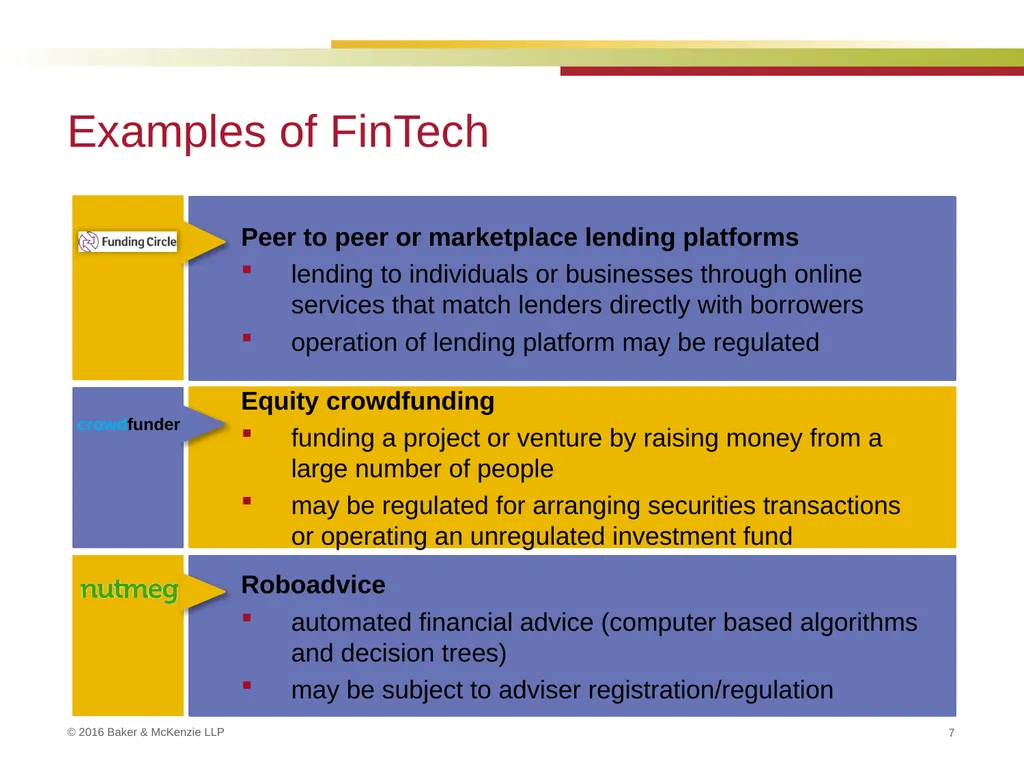
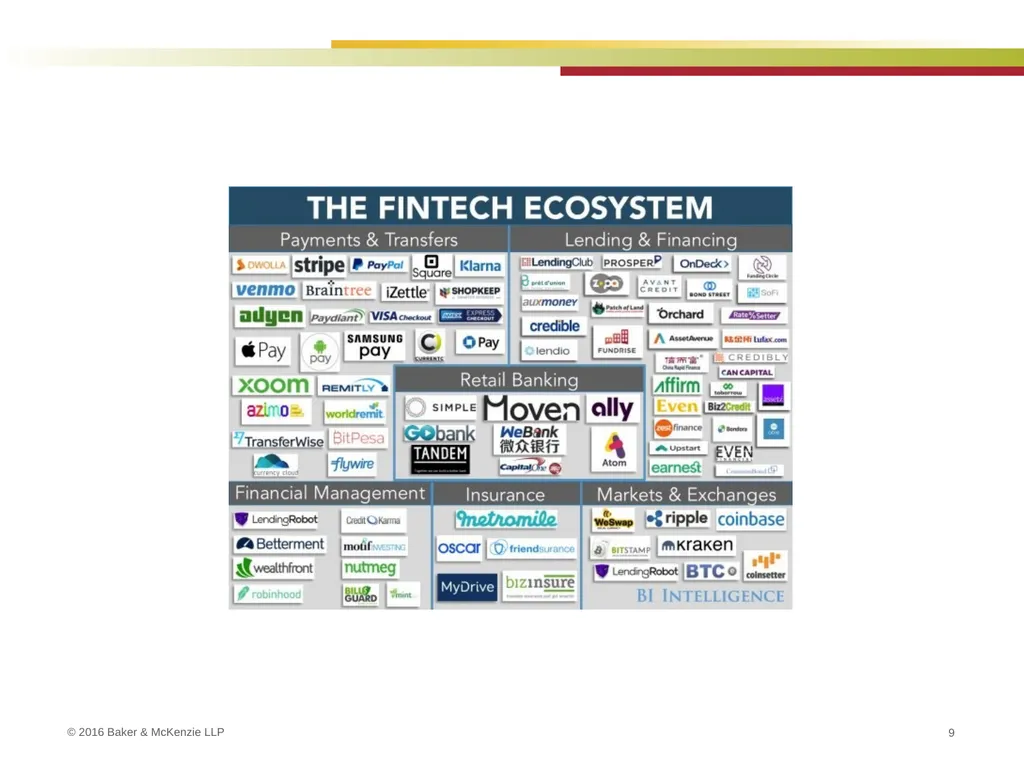
7 Examples of FinTech Peer to peer or marketplace lending platforms
lending to individuals or businesses through online services that match lenders directly with borrowers
operation of lending platform may be regulated Equity crowdfunding
funding a project or venture by raising money from a large number of people
may be regulated for arranging securities transactions or operating an unregulated investment fund Roboadvice
automated financial advice (computer based algorithms and decision trees)
may be subject to adviser registration/regulation crowdfunder<br>
lending to individuals or businesses through online services that match lenders directly with borrowers
operation of lending platform may be regulated Equity crowdfunding
funding a project or venture by raising money from a large number of people
may be regulated for arranging securities transactions or operating an unregulated investment fund Roboadvice
automated financial advice (computer based algorithms and decision trees)
may be subject to adviser registration/regulation crowdfunder<br>
08
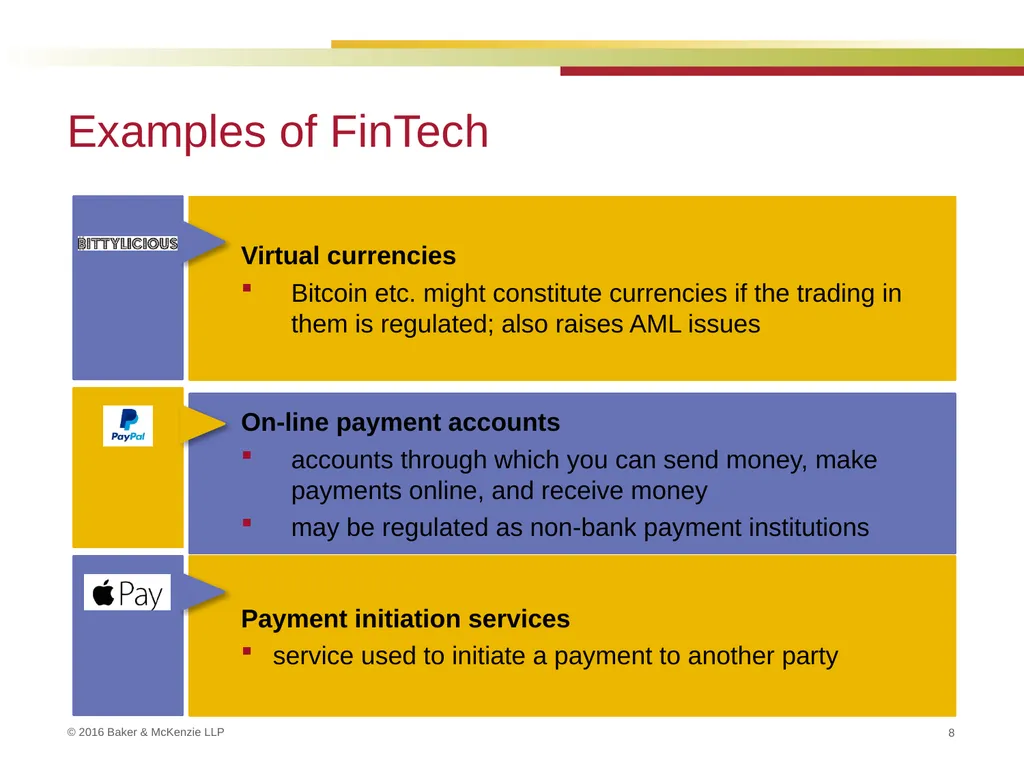
8 Examples of FinTech Virtual currencies
Bitcoin etc. might constitute currencies if the trading in them is regulated; also raises AML issues On-line payment accounts
accounts through which you can send money, make payments online, and receive money
may be regulated as non-bank payment institutions Payment initiation services
service used to initiate a payment to another party<br>
Bitcoin etc. might constitute currencies if the trading in them is regulated; also raises AML issues On-line payment accounts
accounts through which you can send money, make payments online, and receive money
may be regulated as non-bank payment institutions Payment initiation services
service used to initiate a payment to another party<br>
09
9<br>
10
10 Marketplace Lending Typical model for marketplace lending:
borrowers apply for a loan on a marketplace platform;
accepted loan applications are then originated by a partner bank (LendingClub and Prosper use Utah-based WebBank);
the MPL performs the underwriting of the loans, using criteria agreed with the partner bank
platforms purchase the loan from the partner bank;
the platform issues a note to lenders, instead of a contract.
Marketplace or “peer-to-peer” lending platforms make a profit from arrangment fees rather than the spread between lending and deposit rates
Marketplace lending has grown due to low interest rates, low default rates, improved lending process and scarcity of consumer credit<br>
borrowers apply for a loan on a marketplace platform;
accepted loan applications are then originated by a partner bank (LendingClub and Prosper use Utah-based WebBank);
the MPL performs the underwriting of the loans, using criteria agreed with the partner bank
platforms purchase the loan from the partner bank;
the platform issues a note to lenders, instead of a contract.
Marketplace or “peer-to-peer” lending platforms make a profit from arrangment fees rather than the spread between lending and deposit rates
Marketplace lending has grown due to low interest rates, low default rates, improved lending process and scarcity of consumer credit<br>
11
11 Marketplace Lending Partnerships between banks and MPLs are becoming increasingly common in the US. BBVA Compass bank, for example, partners with OnDeck to originate small business loans through the platform by referring customers for smaller loan amounts.
Other bank partnerships focus on funding, i.e. rather than simply referring the loan on to an MPL, the bank provides the funding themselves. For example, LendingClub and Citigroup announced a partnership in April 2015 in which Citigroup provides borrowers on the platform with funding through the Varadero Capital hedge fund, which takes on the first loss risk.
These arrangements allow banks to provide funding to higher risk individuals or SMEs, while passing much of the credit risk on to investors.<br>
Other bank partnerships focus on funding, i.e. rather than simply referring the loan on to an MPL, the bank provides the funding themselves. For example, LendingClub and Citigroup announced a partnership in April 2015 in which Citigroup provides borrowers on the platform with funding through the Varadero Capital hedge fund, which takes on the first loss risk.
These arrangements allow banks to provide funding to higher risk individuals or SMEs, while passing much of the credit risk on to investors.<br>
12
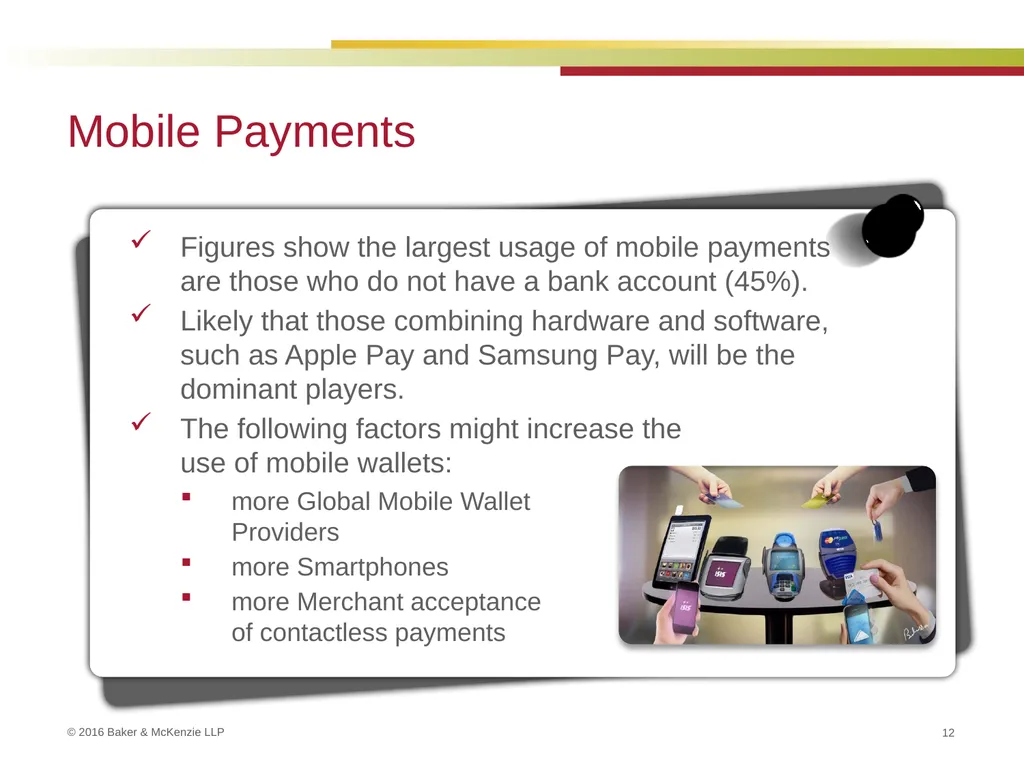
12 Mobile Payments Figures show the largest usage of mobile payments
are those who do not have a bank account (45%).
Likely that those combining hardware and software, such as Apple Pay and Samsung Pay, will be the dominant players.
The following factors might increase the use of mobile wallets:
more Global Mobile Wallet Providers
more Smartphones
more Merchant acceptance of contactless payments<br>
Likely that those combining hardware and software, such as Apple Pay and Samsung Pay, will be the dominant players.
The following factors might increase the use of mobile wallets:
more Global Mobile Wallet Providers
more Smartphones
more Merchant acceptance of contactless payments<br>
13
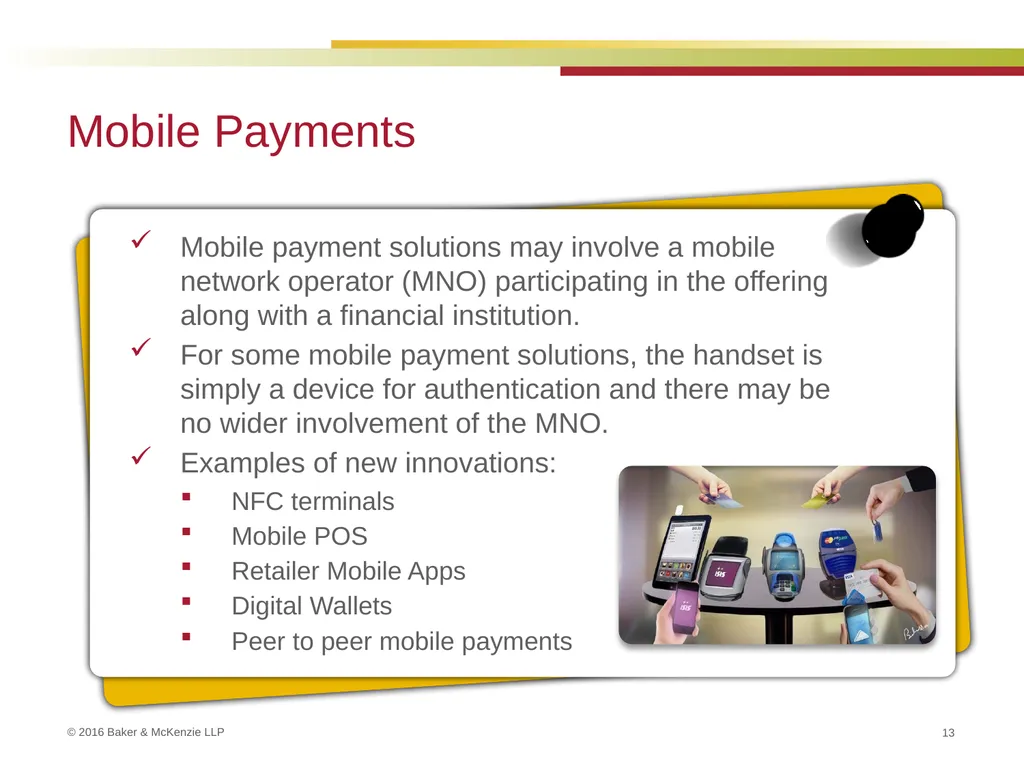
13 Mobile Payments Mobile payment solutions may involve a mobile
network operator (MNO) participating in the offering
along with a financial institution.
For some mobile payment solutions, the handset is simply a device for authentication and there may be no wider involvement of the MNO.
Examples of new innovations:
NFC terminals
Mobile POS
Retailer Mobile Apps
Digital Wallets
Peer to peer mobile payments<br>
For some mobile payment solutions, the handset is simply a device for authentication and there may be no wider involvement of the MNO.
Examples of new innovations:
NFC terminals
Mobile POS
Retailer Mobile Apps
Digital Wallets
Peer to peer mobile payments<br>
14
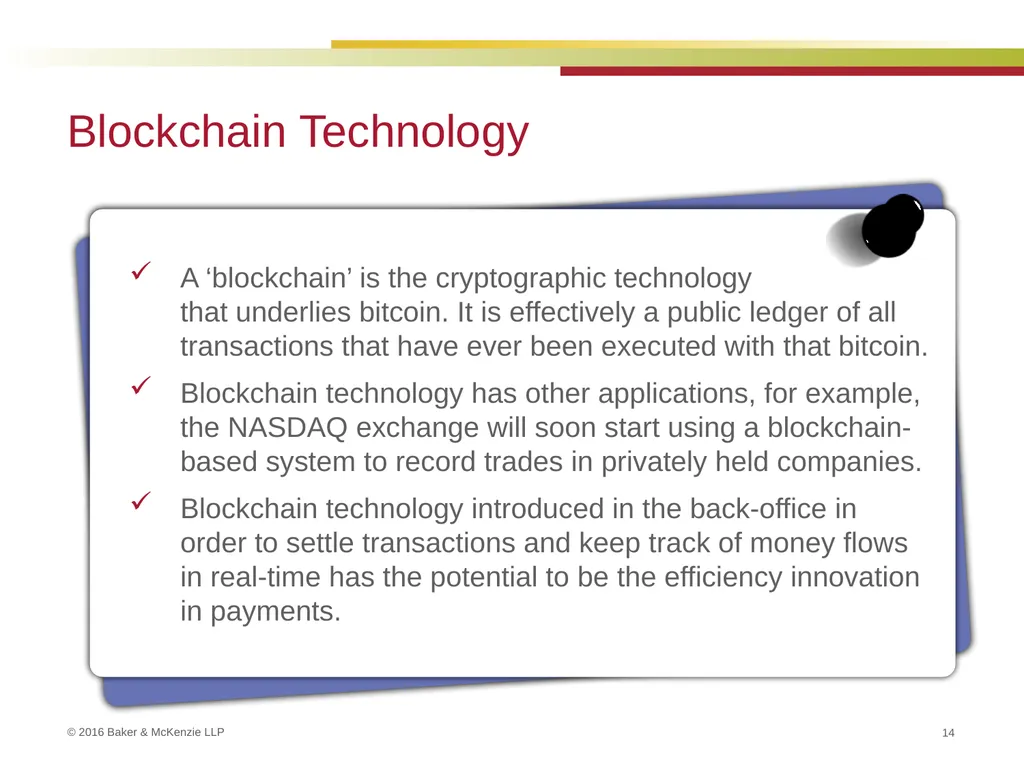
A ‘blockchain’ is the cryptographic technology
that underlies bitcoin. It is effectively a public ledger of all transactions that have ever been executed with that bitcoin.
Blockchain technology has other applications, for example, the NASDAQ exchange will soon start using a blockchain-based system to record trades in privately held companies.
Blockchain technology introduced in the back-office in order to settle transactions and keep track of money flows in real-time has the potential to be the efficiency innovation in payments. 14 Blockchain Technology<br>
Blockchain technology has other applications, for example, the NASDAQ exchange will soon start using a blockchain-based system to record trades in privately held companies.
Blockchain technology introduced in the back-office in order to settle transactions and keep track of money flows in real-time has the potential to be the efficiency innovation in payments. 14 Blockchain Technology<br>
15
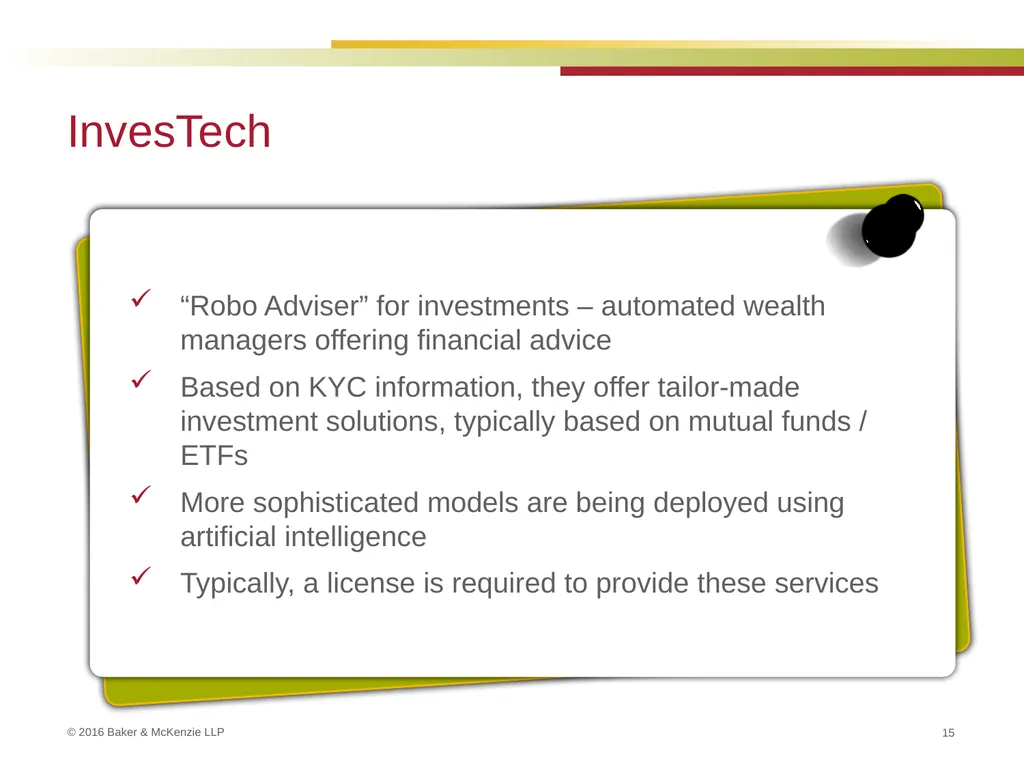
15 InvesTech “Robo Adviser” for investments – automated wealth managers offering financial advice
Based on KYC information, they offer tailor-made investment solutions, typically based on mutual funds / ETFs
More sophisticated models are being deployed using artificial intelligence
Typically, a license is required to provide these services<br>
Based on KYC information, they offer tailor-made investment solutions, typically based on mutual funds / ETFs
More sophisticated models are being deployed using artificial intelligence
Typically, a license is required to provide these services<br>
16
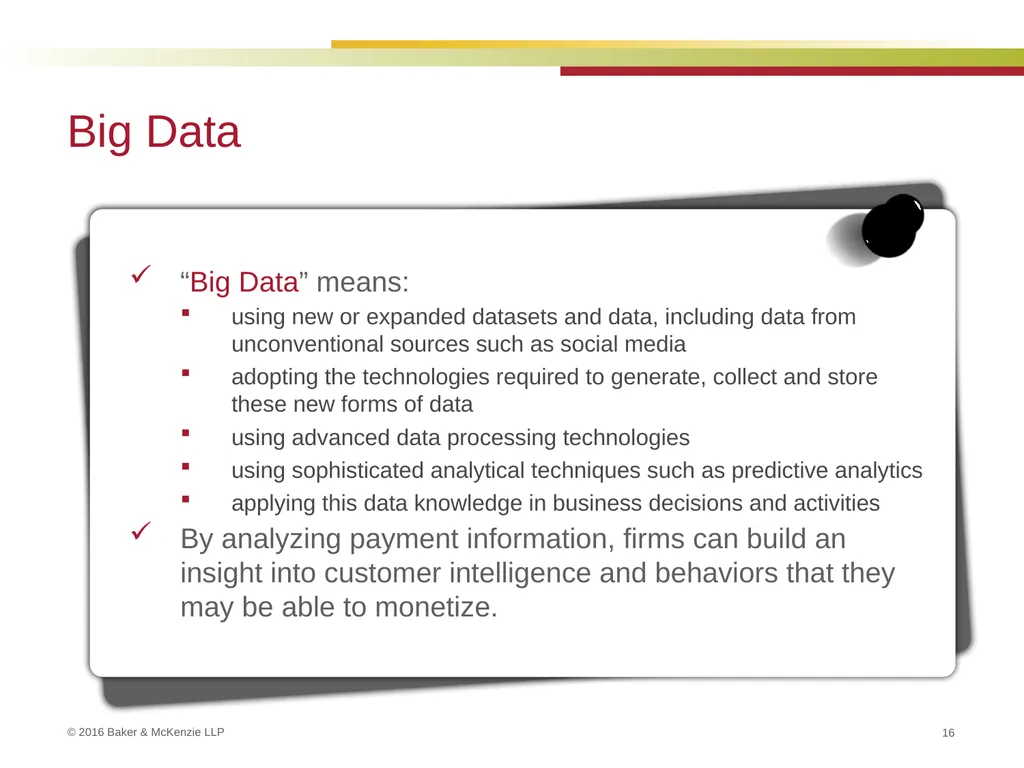
“Big Data” means:
using new or expanded datasets and data, including data from unconventional sources such as social media
adopting the technologies required to generate, collect and store these new forms of data
using advanced data processing technologies
using sophisticated analytical techniques such as predictive analytics
applying this data knowledge in business decisions and activities
By analyzing payment information, firms can build an insight into customer intelligence and behaviors that they may be able to monetize. 16 Big Data<br>
using new or expanded datasets and data, including data from unconventional sources such as social media
adopting the technologies required to generate, collect and store these new forms of data
using advanced data processing technologies
using sophisticated analytical techniques such as predictive analytics
applying this data knowledge in business decisions and activities
By analyzing payment information, firms can build an insight into customer intelligence and behaviors that they may be able to monetize. 16 Big Data<br>
17
17 Big Data Offers can be driven by analytics into a combination of historical payments information and big data analysis of demographics, location positioning and peer group analysis.
By understanding customer behavior, firms can target new customers and cross-sell to existing customers.
Firms can incorporate transactional-level data analysis within credit risk model development.
Firms can give customers access to their own data, and help them manage their finances via apps that make use of the data.
Big Data can be used to identify problems, for example, how credit lines are being used against agreed limits and to identify payments patterns of potential interest.<br>
By understanding customer behavior, firms can target new customers and cross-sell to existing customers.
Firms can incorporate transactional-level data analysis within credit risk model development.
Firms can give customers access to their own data, and help them manage their finances via apps that make use of the data.
Big Data can be used to identify problems, for example, how credit lines are being used against agreed limits and to identify payments patterns of potential interest.<br>
18
18 RegTech RegTech broadly means technologies that facilitate
the delivery of regulatory requirements.
Deutsche Bank, JP Morgan, Santander and HSBC have all allocated teams to explore investment opportunities in the RegTech sector.
Governments are beginning to work with companies to identify ways to support the adoption of new technologies to facilitate the delivery of regulatory requirements.
RegTech can reduce a client’s regulatory and compliance costs, automate the certain compliance tasks and reduce risks.<br>
Deutsche Bank, JP Morgan, Santander and HSBC have all allocated teams to explore investment opportunities in the RegTech sector.
Governments are beginning to work with companies to identify ways to support the adoption of new technologies to facilitate the delivery of regulatory requirements.
RegTech can reduce a client’s regulatory and compliance costs, automate the certain compliance tasks and reduce risks.<br>
19
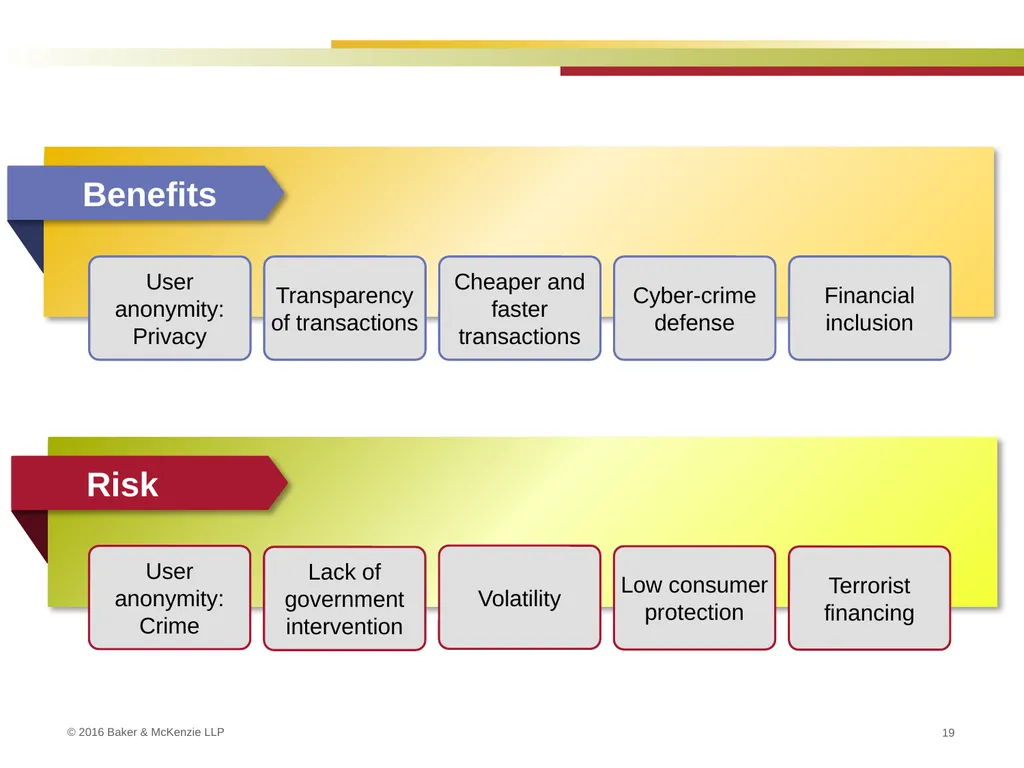
19 User anonymity: Privacy Transparency of transactions Cheaper and faster transactions Cyber-crime defense User anonymity: Crime Lack of government intervention Volatility Low consumer protection Terrorist financing Financial inclusion<br>
20
20 Additional Risks from FinTech Businesses focused on the “Tech” and not the “Fin”
may lack banking experience
Cybercrime
Data security/data protection
Potential user anonymity/AML risk
Volatility created by ease and speed of transfer of funds
Increasing regulatory scrutiny<br>
may lack banking experience
Cybercrime
Data security/data protection
Potential user anonymity/AML risk
Volatility created by ease and speed of transfer of funds
Increasing regulatory scrutiny<br>
21
Regulation of FinTech<br>
22
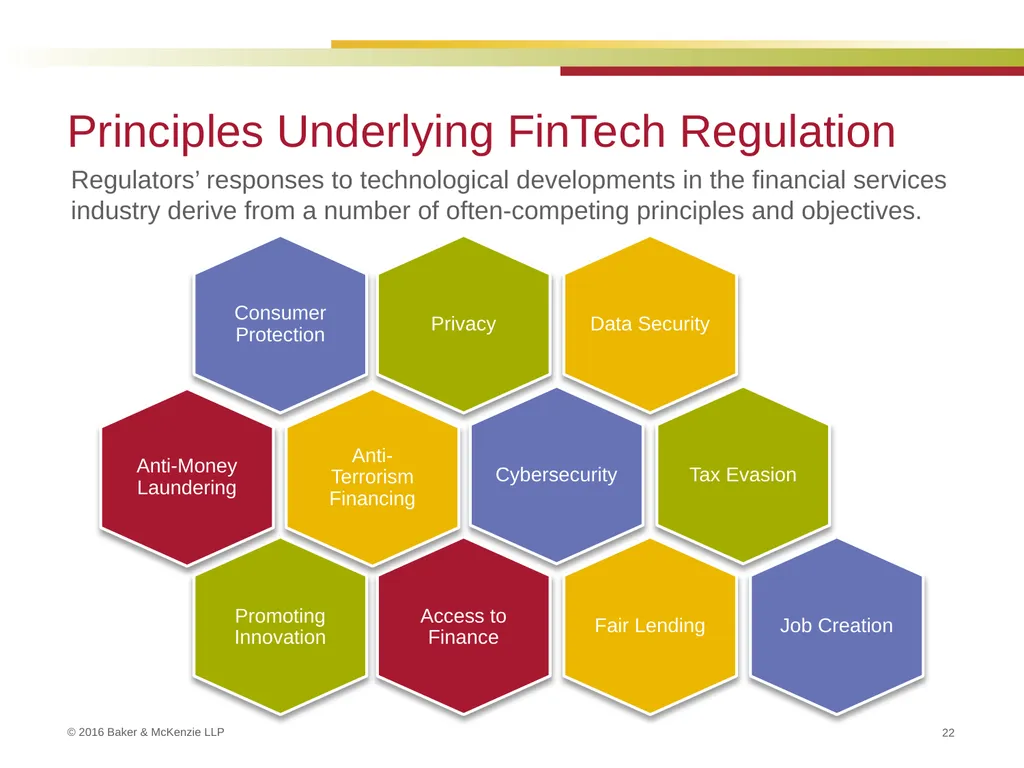
22 Principles Underlying FinTech Regulation Data Security Privacy Cybersecurity Tax Evasion Fair Lending Access to Finance Regulators’ responses to technological developments in the financial services industry derive from a number of often-competing principles and objectives. Job Creation Consumer Protection Anti-Terrorism Financing Promoting Innovation Anti-Money Laundering<br>
23
23 Factors Impacting Regulatory Authority Company Domicile
Activities & Practices
Product Offerings
Size
Customer Type
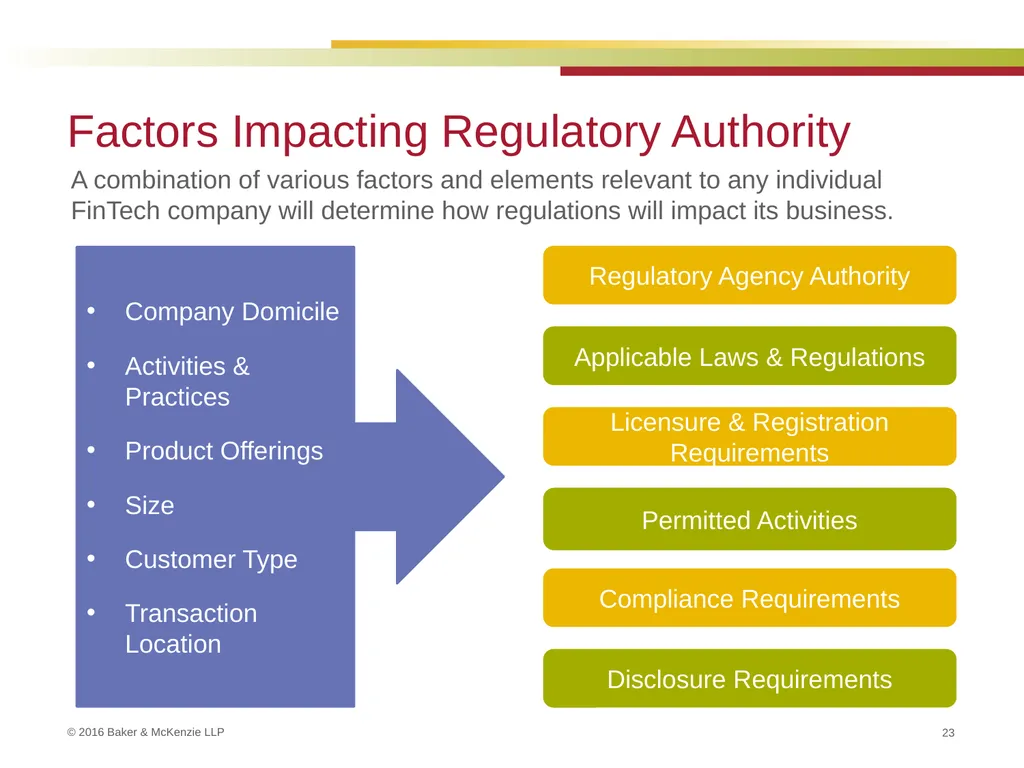
Transaction Location Regulatory Agency Authority Applicable Laws & Regulations Licensure & Registration Requirements Permitted Activities Compliance Requirements Disclosure Requirements A combination of various factors and elements relevant to any individual FinTech company will determine how regulations will impact its business.<br>
Activities & Practices
Product Offerings
Size
Customer Type
Transaction Location Regulatory Agency Authority Applicable Laws & Regulations Licensure & Registration Requirements Permitted Activities Compliance Requirements Disclosure Requirements A combination of various factors and elements relevant to any individual FinTech company will determine how regulations will impact its business.<br>
24
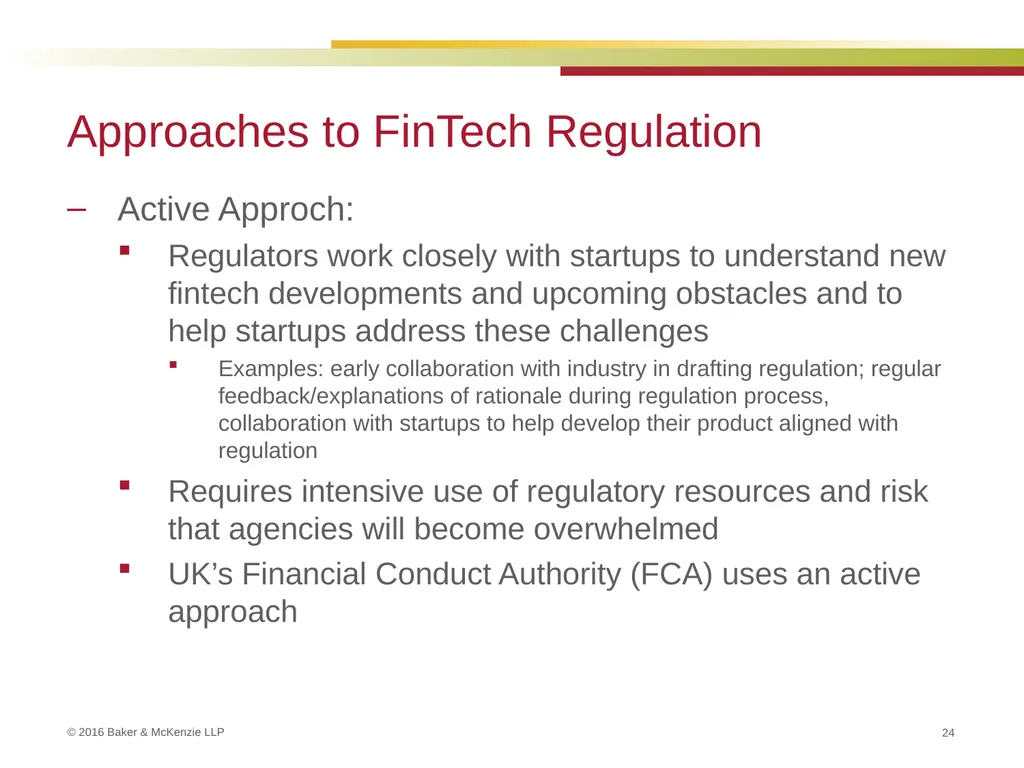
24 Approaches to FinTech Regulation Active Approch:
Regulators work closely with startups to understand new fintech developments and upcoming obstacles and to help startups address these challenges
Examples: early collaboration with industry in drafting regulation; regular feedback/explanations of rationale during regulation process, collaboration with startups to help develop their product aligned with regulation
Requires intensive use of regulatory resources and risk that agencies will become overwhelmed
UK’s Financial Conduct Authority (FCA) uses an active approach<br>
Regulators work closely with startups to understand new fintech developments and upcoming obstacles and to help startups address these challenges
Examples: early collaboration with industry in drafting regulation; regular feedback/explanations of rationale during regulation process, collaboration with startups to help develop their product aligned with regulation
Requires intensive use of regulatory resources and risk that agencies will become overwhelmed
UK’s Financial Conduct Authority (FCA) uses an active approach<br>
25
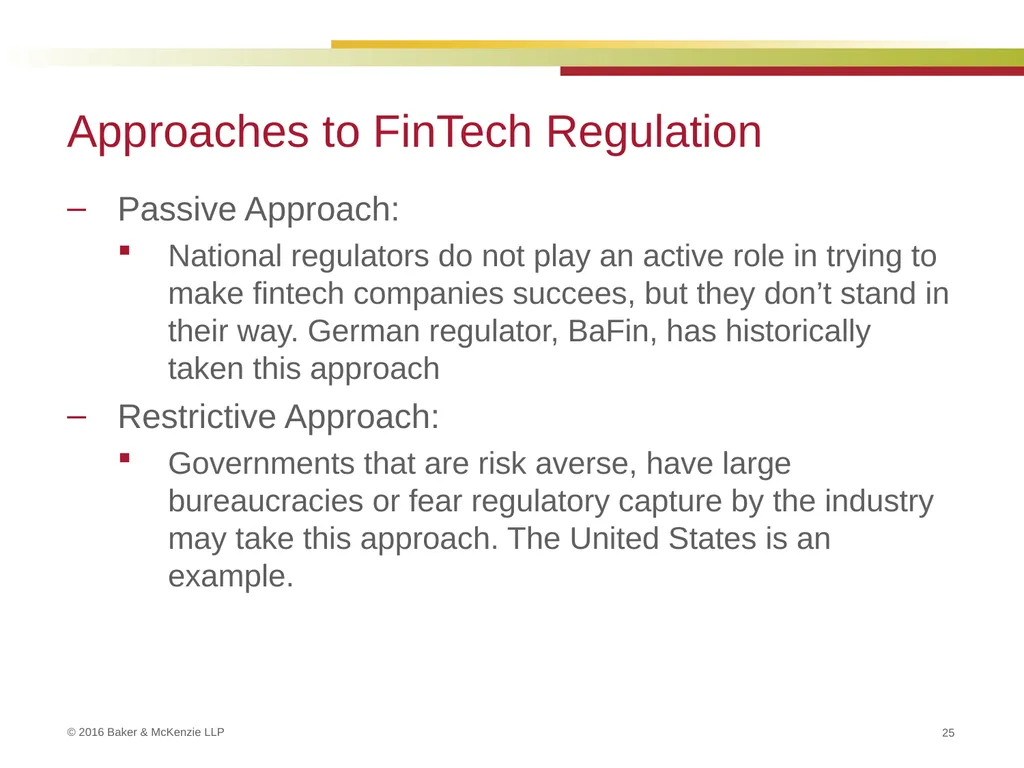
25 Approaches to FinTech Regulation Passive Approach:
National regulators do not play an active role in trying to make fintech companies succees, but they don’t stand in their way. German regulator, BaFin, has historically taken this approach
Restrictive Approach:
Governments that are risk averse, have large bureaucracies or fear regulatory capture by the industry may take this approach. The United States is an example.<br>
National regulators do not play an active role in trying to make fintech companies succees, but they don’t stand in their way. German regulator, BaFin, has historically taken this approach
Restrictive Approach:
Governments that are risk averse, have large bureaucracies or fear regulatory capture by the industry may take this approach. The United States is an example.<br>
26
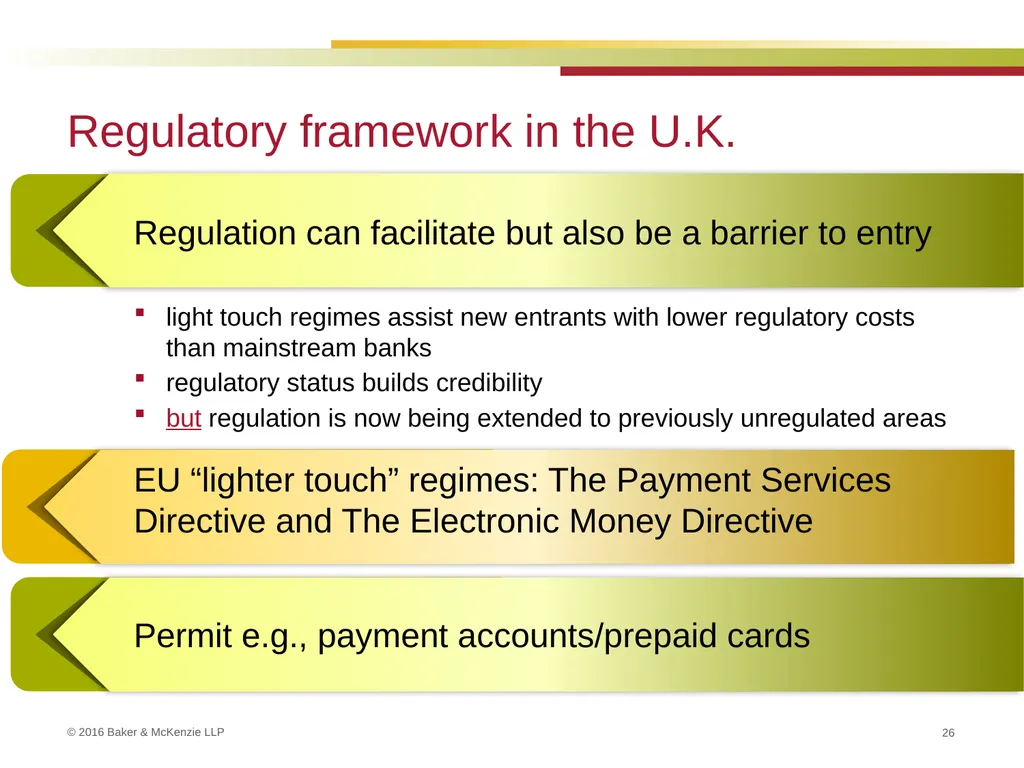
26 Regulatory framework in the U.K. Regulation can facilitate but also be a barrier to entry light touch regimes assist new entrants with lower regulatory costs than mainstream banks
regulatory status builds credibility
but regulation is now being extended to previously unregulated areas EU “lighter touch” regimes: The Payment Services Directive and The Electronic Money Directive Permit e.g., payment accounts/prepaid cards<br>
regulatory status builds credibility
but regulation is now being extended to previously unregulated areas EU “lighter touch” regimes: The Payment Services Directive and The Electronic Money Directive Permit e.g., payment accounts/prepaid cards<br>
27
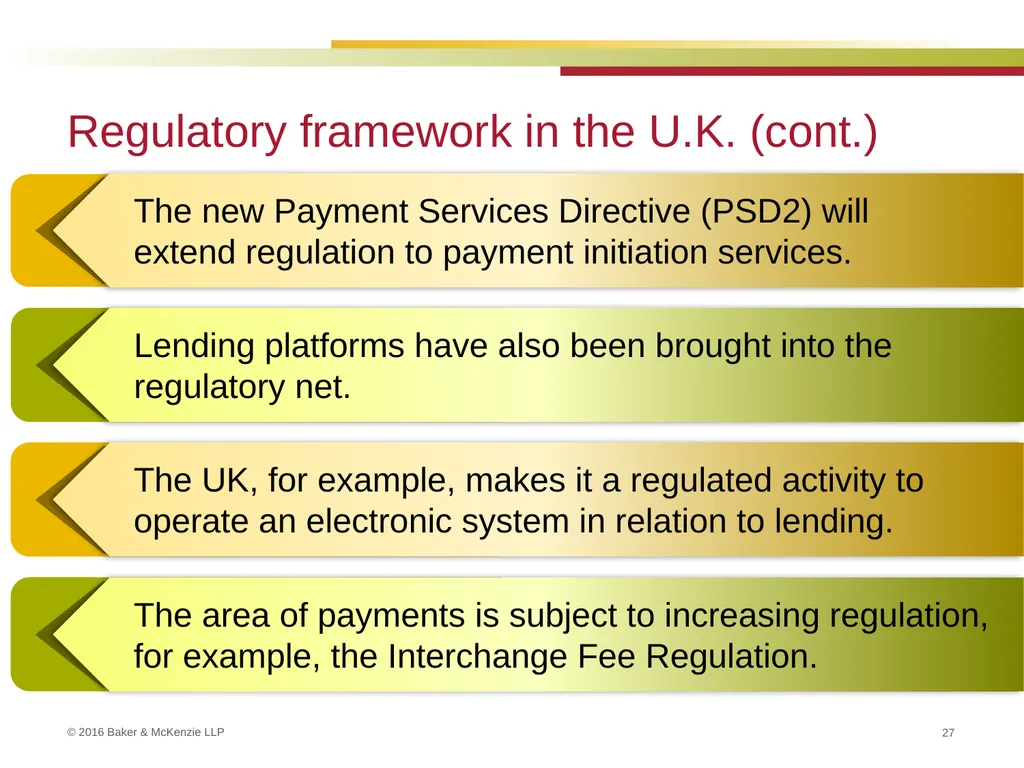
27 Regulatory framework in the U.K. (cont.) The new Payment Services Directive (PSD2) will extend regulation to payment initiation services. The UK, for example, makes it a regulated activity to operate an electronic system in relation to lending. The area of payments is subject to increasing regulation, for example, the Interchange Fee Regulation. Lending platforms have also been brought into the regulatory net.<br>
28
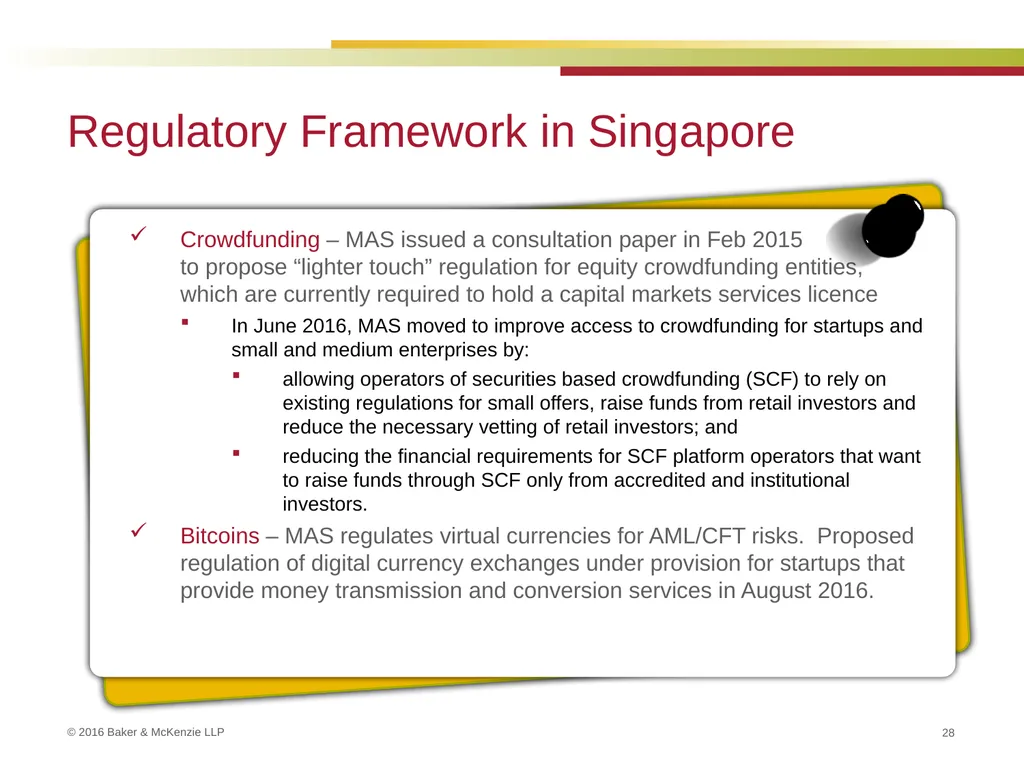
28 Regulatory Framework in Singapore Crowdfunding – MAS issued a consultation paper in Feb 2015
to propose “lighter touch” regulation for equity crowdfunding entities,
which are currently required to hold a capital markets services licence
In June 2016, MAS moved to improve access to crowdfunding for startups and small and medium enterprises by:
allowing operators of securities based crowdfunding (SCF) to rely on existing regulations for small offers, raise funds from retail investors and reduce the necessary vetting of retail investors; and
reducing the financial requirements for SCF platform operators that want to raise funds through SCF only from accredited and institutional investors.
Bitcoins – MAS regulates virtual currencies for AML/CFT risks. Proposed regulation of digital currency exchanges under provision for startups that provide money transmission and conversion services in August 2016.<br>
In June 2016, MAS moved to improve access to crowdfunding for startups and small and medium enterprises by:
allowing operators of securities based crowdfunding (SCF) to rely on existing regulations for small offers, raise funds from retail investors and reduce the necessary vetting of retail investors; and
reducing the financial requirements for SCF platform operators that want to raise funds through SCF only from accredited and institutional investors.
Bitcoins – MAS regulates virtual currencies for AML/CFT risks. Proposed regulation of digital currency exchanges under provision for startups that provide money transmission and conversion services in August 2016.<br>
29
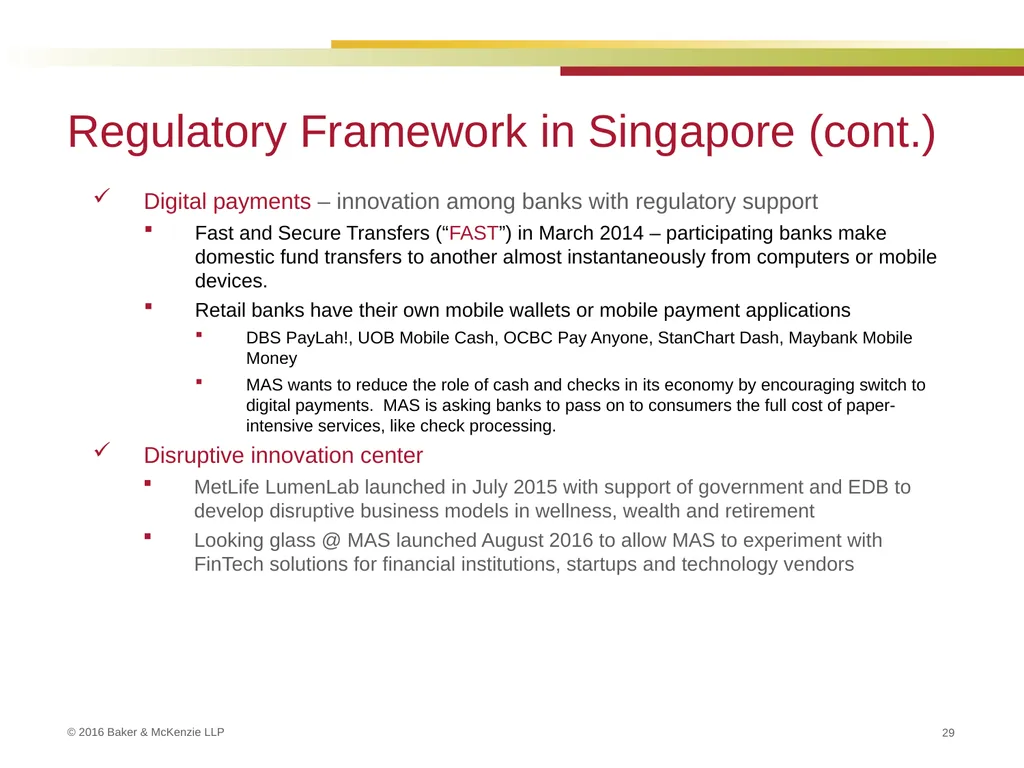
29 Regulatory Framework in Singapore (cont.) Digital payments – innovation among banks with regulatory support
Fast and Secure Transfers (“FAST”) in March 2014 – participating banks make domestic fund transfers to another almost instantaneously from computers or mobile devices.
Retail banks have their own mobile wallets or mobile payment applications
DBS PayLah!, UOB Mobile Cash, OCBC Pay Anyone, StanChart Dash, Maybank Mobile Money
MAS wants to reduce the role of cash and checks in its economy by encouraging switch to digital payments. MAS is asking banks to pass on to consumers the full cost of paper-intensive services, like check processing.
Disruptive innovation center
MetLife LumenLab launched in July 2015 with support of government and EDB to develop disruptive business models in wellness, wealth and retirement
Looking glass @ MAS launched August 2016 to allow MAS to experiment with FinTech solutions for financial institutions, startups and technology vendors<br>
Fast and Secure Transfers (“FAST”) in March 2014 – participating banks make domestic fund transfers to another almost instantaneously from computers or mobile devices.
Retail banks have their own mobile wallets or mobile payment applications
DBS PayLah!, UOB Mobile Cash, OCBC Pay Anyone, StanChart Dash, Maybank Mobile Money
MAS wants to reduce the role of cash and checks in its economy by encouraging switch to digital payments. MAS is asking banks to pass on to consumers the full cost of paper-intensive services, like check processing.
Disruptive innovation center
MetLife LumenLab launched in July 2015 with support of government and EDB to develop disruptive business models in wellness, wealth and retirement
Looking glass @ MAS launched August 2016 to allow MAS to experiment with FinTech solutions for financial institutions, startups and technology vendors<br>
30
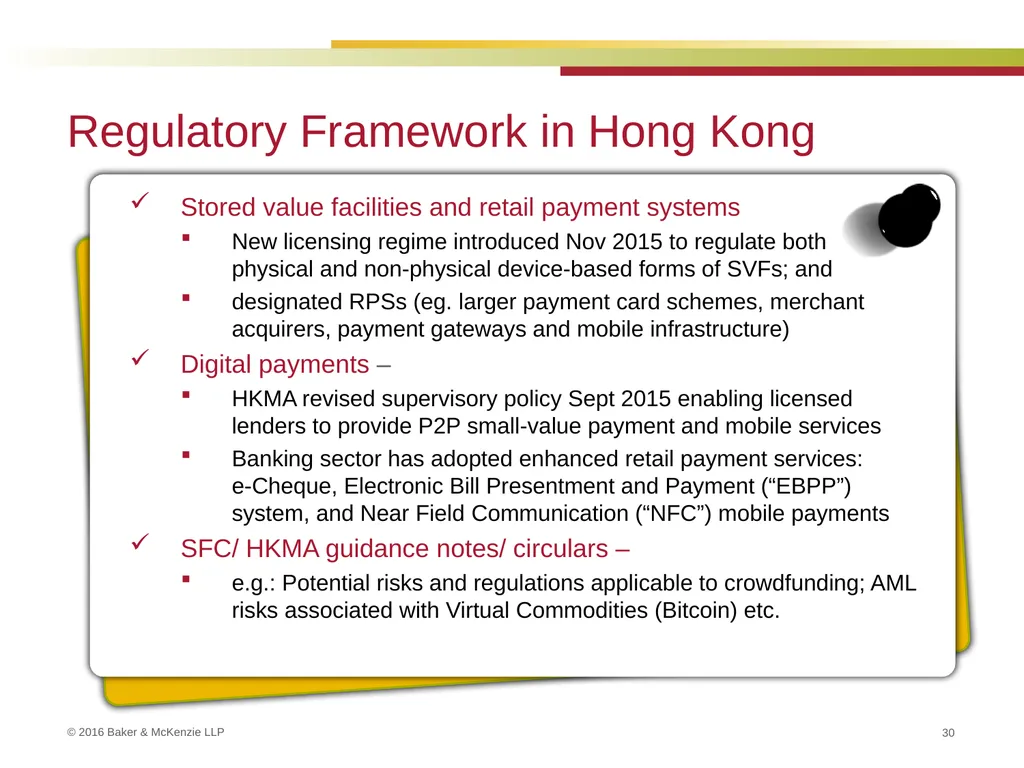
30 Regulatory Framework in Hong Kong Stored value facilities and retail payment systems
New licensing regime introduced Nov 2015 to regulate both physical and non-physical device-based forms of SVFs; and
designated RPSs (eg. larger payment card schemes, merchant acquirers, payment gateways and mobile infrastructure)
Digital payments –
HKMA revised supervisory policy Sept 2015 enabling licensed lenders to provide P2P small-value payment and mobile services
Banking sector has adopted enhanced retail payment services: e-Cheque, Electronic Bill Presentment and Payment (“EBPP”) system, and Near Field Communication (“NFC”) mobile payments
SFC/ HKMA guidance notes/ circulars –
e.g.: Potential risks and regulations applicable to crowdfunding; AML risks associated with Virtual Commodities (Bitcoin) etc.<br>
New licensing regime introduced Nov 2015 to regulate both physical and non-physical device-based forms of SVFs; and
designated RPSs (eg. larger payment card schemes, merchant acquirers, payment gateways and mobile infrastructure)
Digital payments –
HKMA revised supervisory policy Sept 2015 enabling licensed lenders to provide P2P small-value payment and mobile services
Banking sector has adopted enhanced retail payment services: e-Cheque, Electronic Bill Presentment and Payment (“EBPP”) system, and Near Field Communication (“NFC”) mobile payments
SFC/ HKMA guidance notes/ circulars –
e.g.: Potential risks and regulations applicable to crowdfunding; AML risks associated with Virtual Commodities (Bitcoin) etc.<br>
31
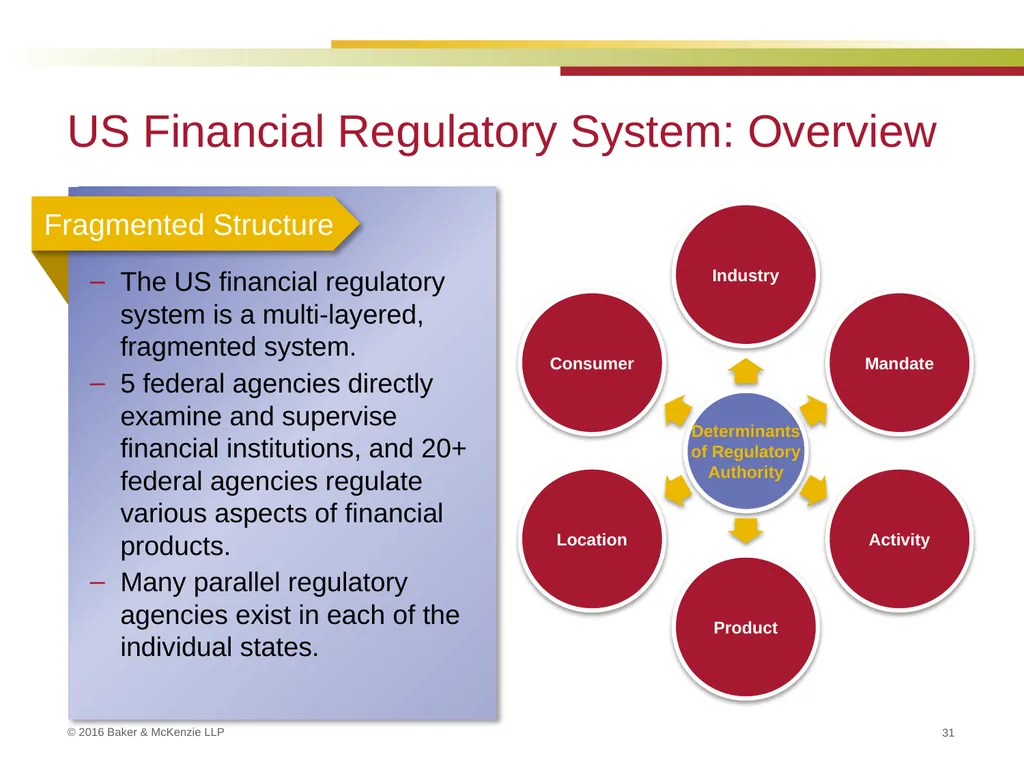
31 US Financial Regulatory System: Overview The US financial regulatory system is a multi-layered, fragmented system.
5 federal agencies directly examine and supervise financial institutions, and 20+ federal agencies regulate various aspects of financial products.
Many parallel regulatory agencies exist in each of the individual states.<br>
5 federal agencies directly examine and supervise financial institutions, and 20+ federal agencies regulate various aspects of financial products.
Many parallel regulatory agencies exist in each of the individual states.<br>
32
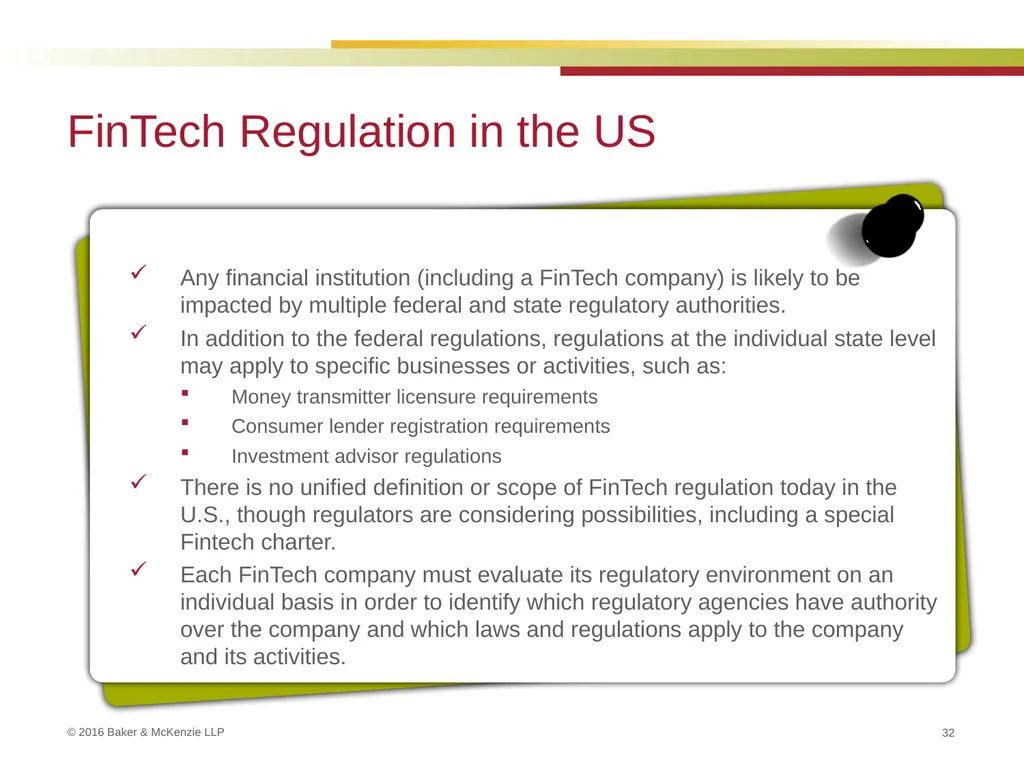
32 FinTech Regulation in the US Any financial institution (including a FinTech company) is likely to be impacted by multiple federal and state regulatory authorities.
In addition to the federal regulations, regulations at the individual state level may apply to specific businesses or activities, such as:
Money transmitter licensure requirements
Consumer lender registration requirements
Investment advisor regulations
There is no unified definition or scope of FinTech regulation today in the U.S., though regulators are considering possibilities, including a special Fintech charter.
Each FinTech company must evaluate its regulatory environment on an individual basis in order to identify which regulatory agencies have authority over the company and which laws and regulations apply to the company and its activities.<br>
In addition to the federal regulations, regulations at the individual state level may apply to specific businesses or activities, such as:
Money transmitter licensure requirements
Consumer lender registration requirements
Investment advisor regulations
There is no unified definition or scope of FinTech regulation today in the U.S., though regulators are considering possibilities, including a special Fintech charter.
Each FinTech company must evaluate its regulatory environment on an individual basis in order to identify which regulatory agencies have authority over the company and which laws and regulations apply to the company and its activities.<br>
33
Regulatory Initiatives to Encourage FinTech<br>
34
34 Regulatory Sandbox A “regulatory sandbox” is a safe space where businesses
can test innovative products without immediately incurring the
normal regulatory consequences (e.g., no enforcement actions).
In the UK, the FCA will authorize sandbox firms with restrictions (non-banks only), allowing them to test their ideas. However, there have been doubts over how effective this will be as firms will still need to be authorized, which requires time and resources.
Singapore also issued guidance to establish a regulatory sandbox in June 2016 , though the sandbox will have little involvement by regulators
Australia and Hong Kong are also in the process of developing a regulatory sandbox
One US regulator is considering a sandbox, though no safe harbors from regulation would be available<br>
In the UK, the FCA will authorize sandbox firms with restrictions (non-banks only), allowing them to test their ideas. However, there have been doubts over how effective this will be as firms will still need to be authorized, which requires time and resources.
Singapore also issued guidance to establish a regulatory sandbox in June 2016 , though the sandbox will have little involvement by regulators
Australia and Hong Kong are also in the process of developing a regulatory sandbox
One US regulator is considering a sandbox, though no safe harbors from regulation would be available<br>
35
35 Passport System Allows a company to “passport” its business to another country without applying for a separate license in that country.
System used by the UK and EU (should be watched as a result of Brexit)
Encourges innovation by significantly reducing the costs of duplicative applications, audits, and reporting requirements in multiple jurisdictions
U.S. does not have this concept throughout the many states<br>
System used by the UK and EU (should be watched as a result of Brexit)
Encourges innovation by significantly reducing the costs of duplicative applications, audits, and reporting requirements in multiple jurisdictions
U.S. does not have this concept throughout the many states<br>
36
36 FinTech Bridges Fintech bridges are cooperation agreements or partnerships between countries for the purpose of making it easier for FinTech companies to pursue new opportunities in both countries and attract investment.
Makes compliance in multiple countries easier and cheaper for FinTech companies.
Recent Agreements:
UK and Australia (March 2016)
Australia and Singapore (April 2016)
UK and Singapore (May 2016)<br>
Makes compliance in multiple countries easier and cheaper for FinTech companies.
Recent Agreements:
UK and Australia (March 2016)
Australia and Singapore (April 2016)
UK and Singapore (May 2016)<br>
37
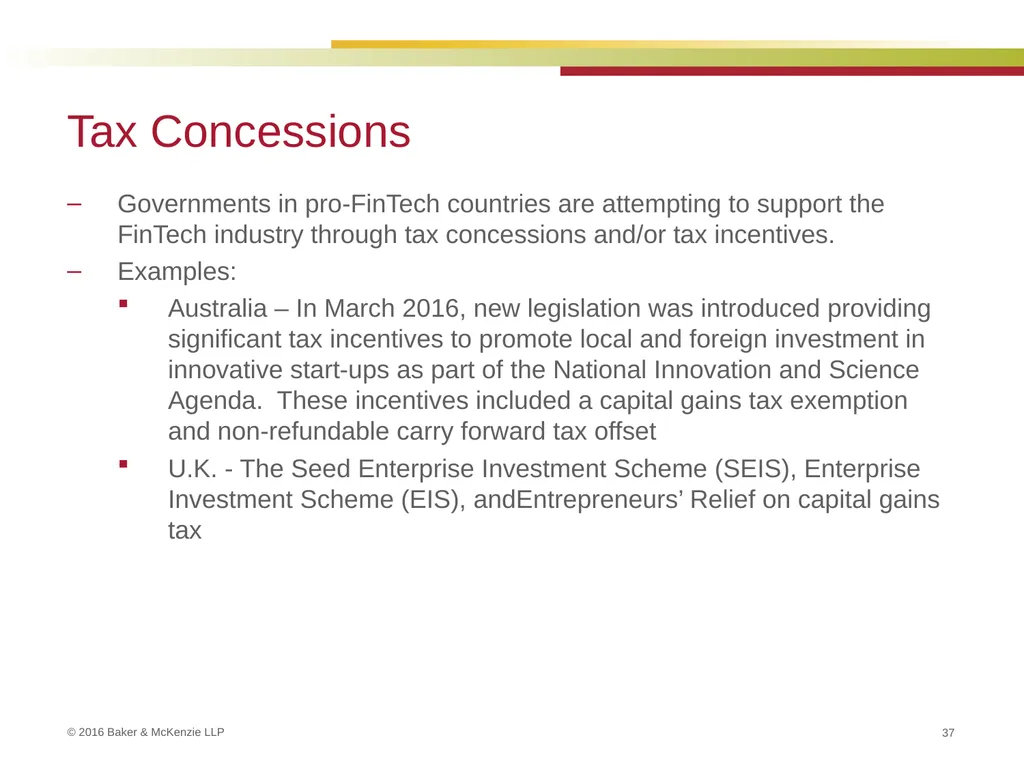
37 Tax Concessions Governments in pro-FinTech countries are attempting to support the FinTech industry through tax concessions and/or tax incentives.
Examples:
Australia – In March 2016, new legislation was introduced providing significant tax incentives to promote local and foreign investment in innovative start-ups as part of the National Innovation and Science Agenda. These incentives included a capital gains tax exemption and non-refundable carry forward tax offset
U.K. - The Seed Enterprise Investment Scheme (SEIS), Enterprise Investment Scheme (EIS), andEntrepreneurs’ Relief on capital gains tax<br>
Examples:
Australia – In March 2016, new legislation was introduced providing significant tax incentives to promote local and foreign investment in innovative start-ups as part of the National Innovation and Science Agenda. These incentives included a capital gains tax exemption and non-refundable carry forward tax offset
U.K. - The Seed Enterprise Investment Scheme (SEIS), Enterprise Investment Scheme (EIS), andEntrepreneurs’ Relief on capital gains tax<br>
38
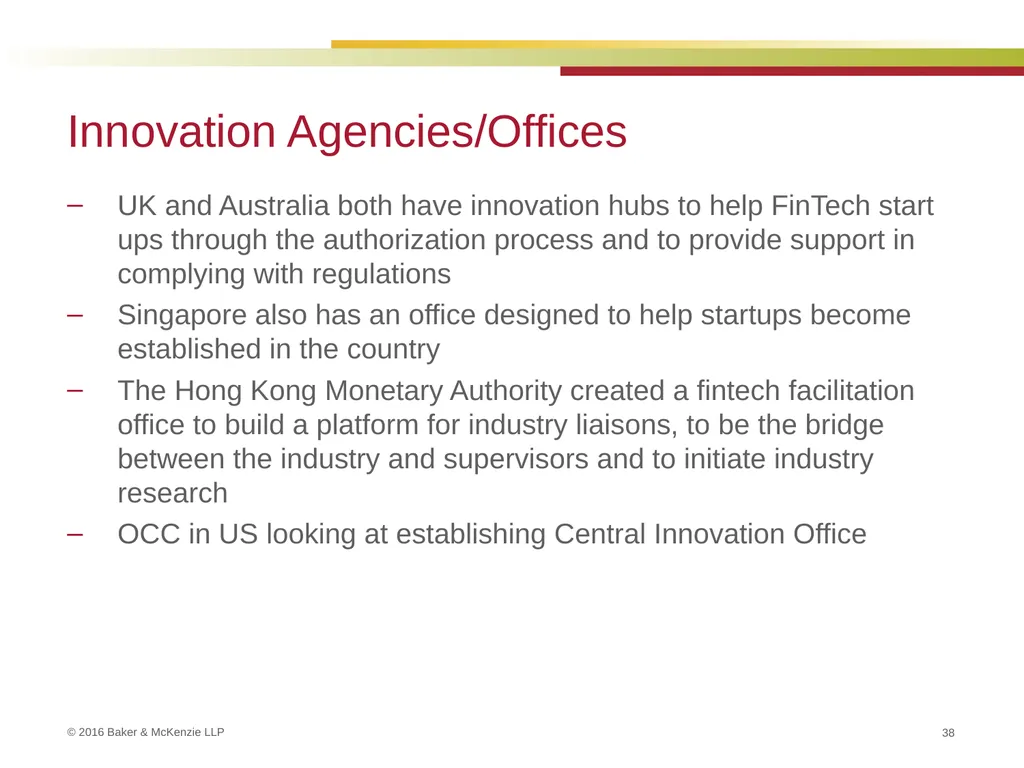
38 Innovation Agencies/Offices UK and Australia both have innovation hubs to help FinTech start ups through the authorization process and to provide support in complying with regulations
Singapore also has an office designed to help startups become established in the country
The Hong Kong Monetary Authority created a fintech facilitation office to build a platform for industry liaisons, to be the bridge between the industry and supervisors and to initiate industry research
OCC in US looking at establishing Central Innovation Office<br>
Singapore also has an office designed to help startups become established in the country
The Hong Kong Monetary Authority created a fintech facilitation office to build a platform for industry liaisons, to be the bridge between the industry and supervisors and to initiate industry research
OCC in US looking at establishing Central Innovation Office<br>
39
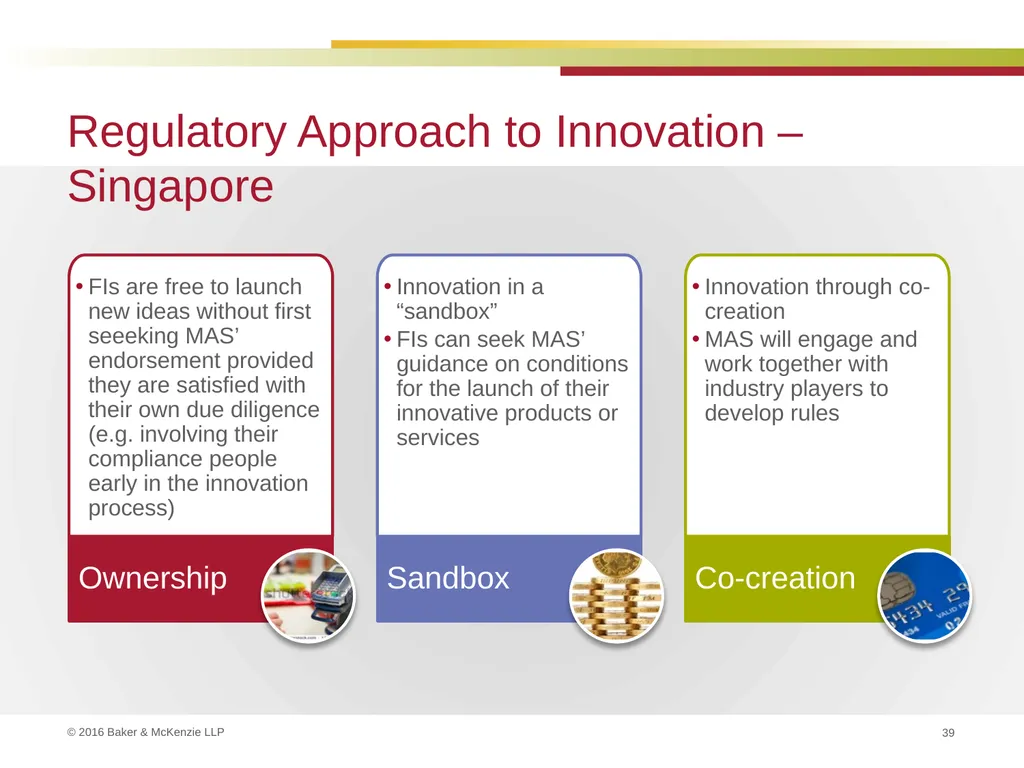
39 Regulatory Approach to Innovation – Singapore<br>
40
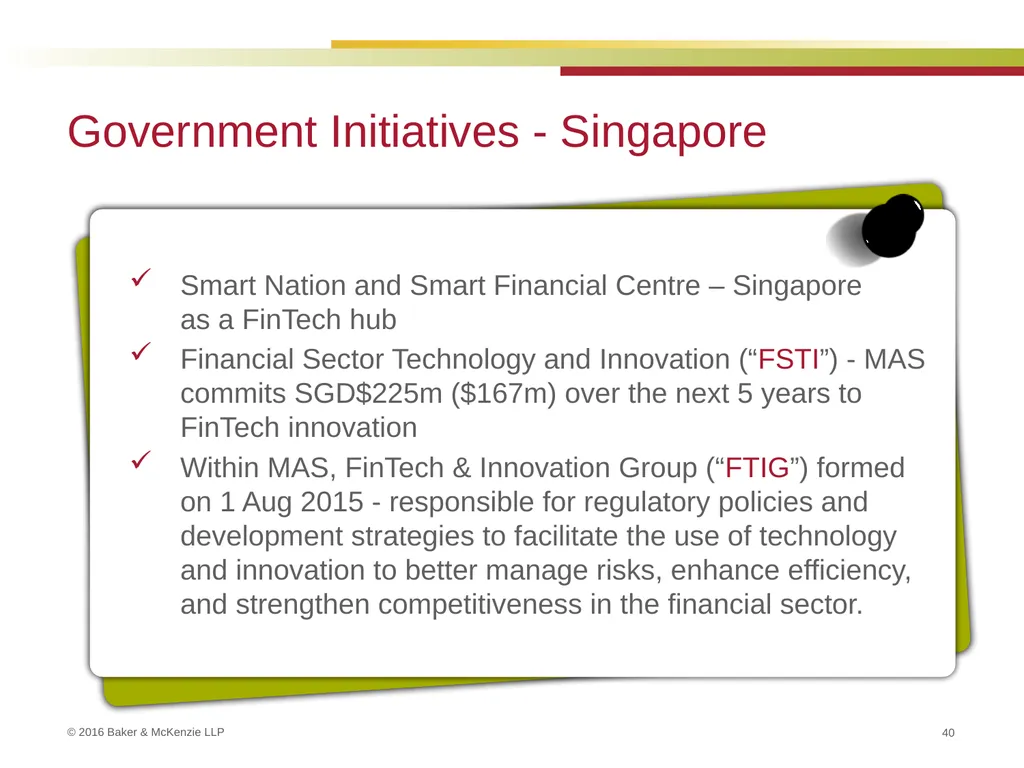
40 Government Initiatives - Singapore Smart Nation and Smart Financial Centre – Singapore
as a FinTech hub
Financial Sector Technology and Innovation (“FSTI”) - MAS commits SGD$225m ($167m) over the next 5 years to FinTech innovation
Within MAS, FinTech & Innovation Group (“FTIG”) formed on 1 Aug 2015 - responsible for regulatory policies and development strategies to facilitate the use of technology and innovation to better manage risks, enhance efficiency, and strengthen competitiveness in the financial sector.<br>
Financial Sector Technology and Innovation (“FSTI”) - MAS commits SGD$225m ($167m) over the next 5 years to FinTech innovation
Within MAS, FinTech & Innovation Group (“FTIG”) formed on 1 Aug 2015 - responsible for regulatory policies and development strategies to facilitate the use of technology and innovation to better manage risks, enhance efficiency, and strengthen competitiveness in the financial sector.<br>
41
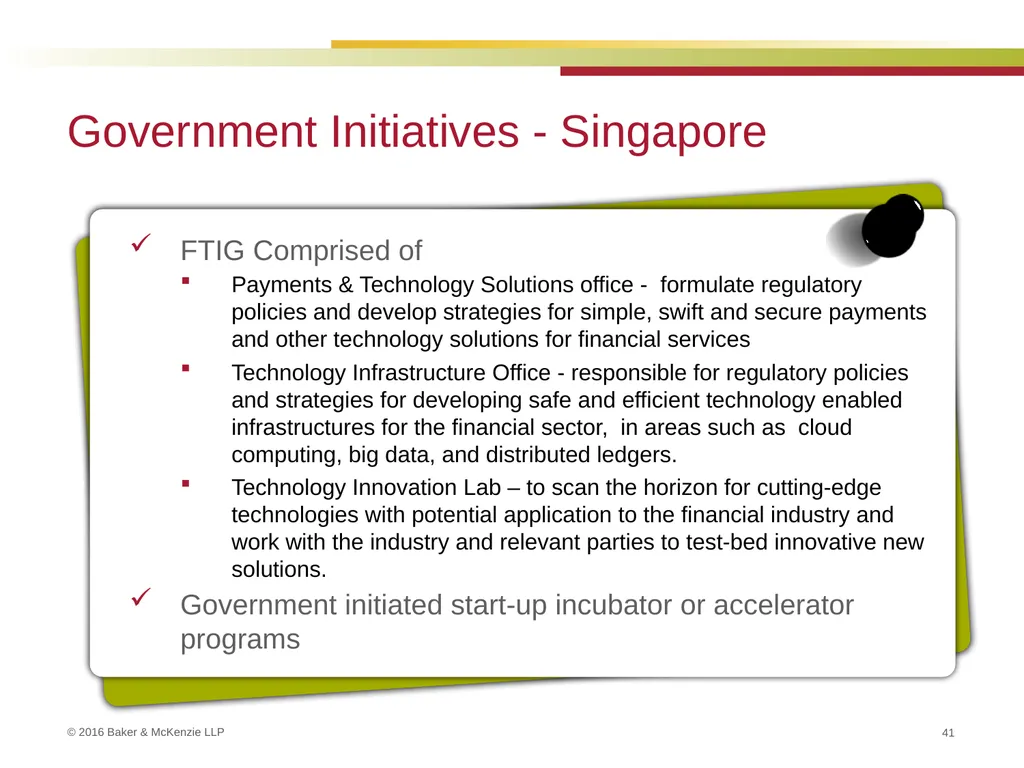
41 Government Initiatives - Singapore FTIG Comprised of
Payments & Technology Solutions office - formulate regulatory policies and develop strategies for simple, swift and secure payments and other technology solutions for financial services
Technology Infrastructure Office - responsible for regulatory policies and strategies for developing safe and efficient technology enabled infrastructures for the financial sector, in areas such as cloud computing, big data, and distributed ledgers.
Technology Innovation Lab – to scan the horizon for cutting-edge technologies with potential application to the financial industry and work with the industry and relevant parties to test-bed innovative new solutions.
Government initiated start-up incubator or accelerator programs<br>
Payments & Technology Solutions office - formulate regulatory policies and develop strategies for simple, swift and secure payments and other technology solutions for financial services
Technology Infrastructure Office - responsible for regulatory policies and strategies for developing safe and efficient technology enabled infrastructures for the financial sector, in areas such as cloud computing, big data, and distributed ledgers.
Technology Innovation Lab – to scan the horizon for cutting-edge technologies with potential application to the financial industry and work with the industry and relevant parties to test-bed innovative new solutions.
Government initiated start-up incubator or accelerator programs<br>
42
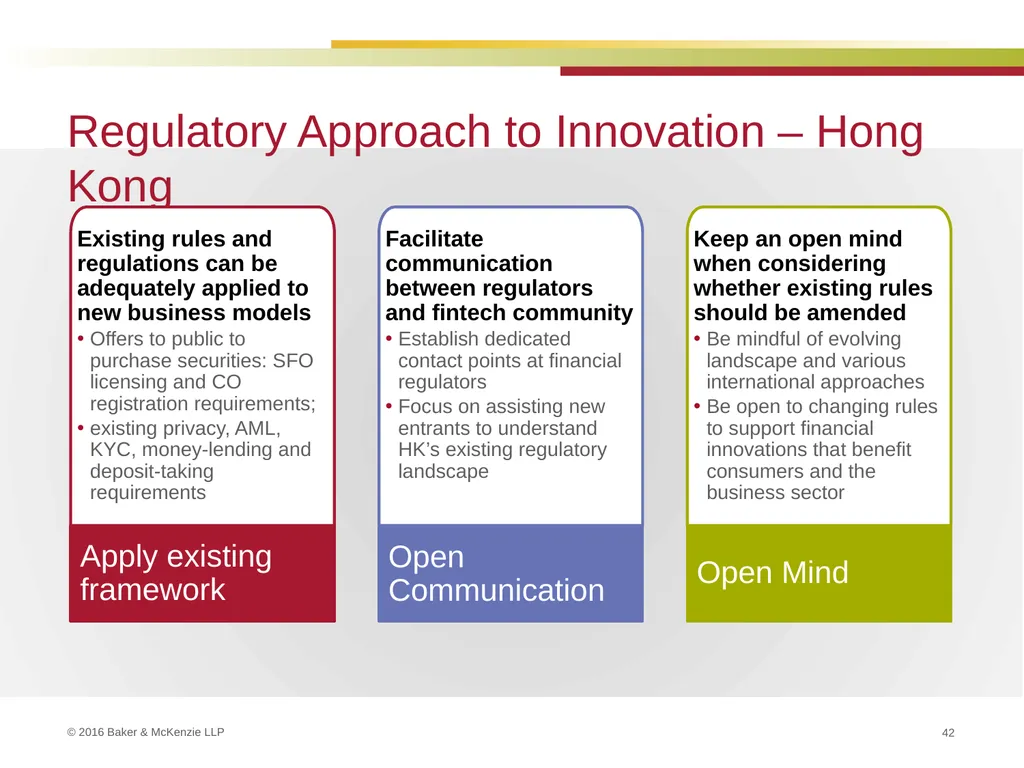
42 Regulatory Approach to Innovation – Hong Kong<br>
43
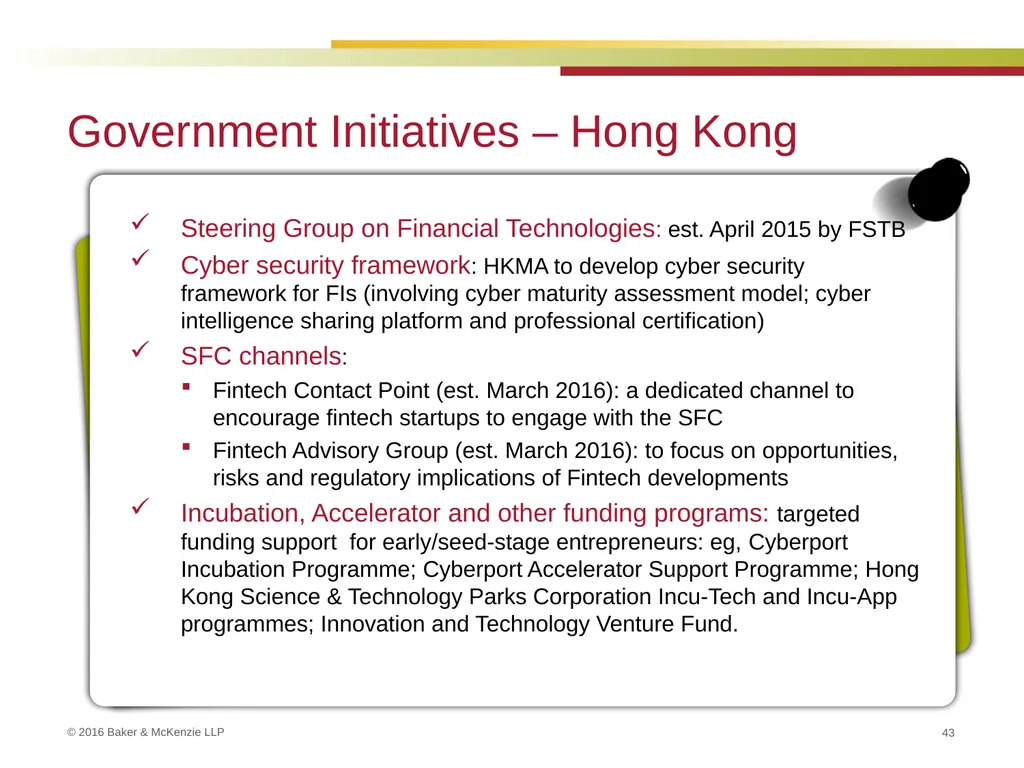
43 Government Initiatives – Hong Kong Steering Group on Financial Technologies: est. April 2015 by FSTB
Cyber security framework: HKMA to develop cyber security framework for FIs (involving cyber maturity assessment model; cyber intelligence sharing platform and professional certification)
SFC channels:
Fintech Contact Point (est. March 2016): a dedicated channel to encourage fintech startups to engage with the SFC
Fintech Advisory Group (est. March 2016): to focus on opportunities, risks and regulatory implications of Fintech developments
Incubation, Accelerator and other funding programs: targeted funding support for early/seed-stage entrepreneurs: eg, Cyberport Incubation Programme; Cyberport Accelerator Support Programme; Hong Kong Science & Technology Parks Corporation Incu-Tech and Incu-App programmes; Innovation and Technology Venture Fund.<br>
Cyber security framework: HKMA to develop cyber security framework for FIs (involving cyber maturity assessment model; cyber intelligence sharing platform and professional certification)
SFC channels:
Fintech Contact Point (est. March 2016): a dedicated channel to encourage fintech startups to engage with the SFC
Fintech Advisory Group (est. March 2016): to focus on opportunities, risks and regulatory implications of Fintech developments
Incubation, Accelerator and other funding programs: targeted funding support for early/seed-stage entrepreneurs: eg, Cyberport Incubation Programme; Cyberport Accelerator Support Programme; Hong Kong Science & Technology Parks Corporation Incu-Tech and Incu-App programmes; Innovation and Technology Venture Fund.<br>
44
Effect on Existing Financial Institutions<br>
45
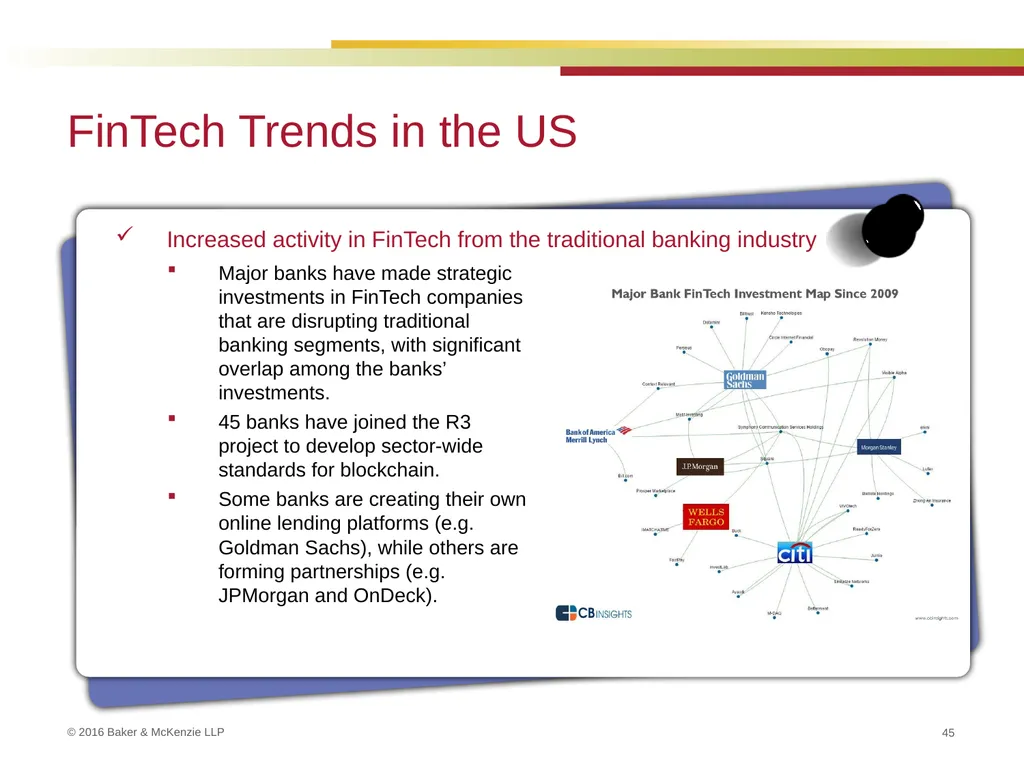
45 FinTech Trends in the US Increased activity in FinTech from the traditional banking industry Major banks have made strategic investments in FinTech companies that are disrupting traditional banking segments, with significant overlap among the banks’ investments.
45 banks have joined the R3 project to develop sector-wide standards for blockchain.
Some banks are creating their own online lending platforms (e.g. Goldman Sachs), while others are forming partnerships (e.g. JPMorgan and OnDeck).<br>
45 banks have joined the R3 project to develop sector-wide standards for blockchain.
Some banks are creating their own online lending platforms (e.g. Goldman Sachs), while others are forming partnerships (e.g. JPMorgan and OnDeck).<br>
46
46 Bank Investment in FinTech Many major banks around the world now have either a startup program to incubate fintech companies, is putting aside venture capital to fund them or is partnering with, acquiring or launching their own fintech startup.
Barclays is creating a global community for fintech innovation, including opening an accelerator in New York’s Silicon Alley.
Within AsiaPacific, ANZ Bank has appointed “an international panel of technology experts” to advise its Board on the strategic application of new and emerging technologies and technological trends that could affect the bank’s strategy<br>
Barclays is creating a global community for fintech innovation, including opening an accelerator in New York’s Silicon Alley.
Within AsiaPacific, ANZ Bank has appointed “an international panel of technology experts” to advise its Board on the strategic application of new and emerging technologies and technological trends that could affect the bank’s strategy<br>
47
47 Banks vs. Startups - Challenges Banks:
Banks are investing more heavily in innovation, but haven’t fully diffused their innovation strategies throughout their organizations
Banks will have to find a way to develop new platforms compatible with infrastructure
Digital disruption has the potential to shrink the role and relevance of today’s banks, and simultaneously help them create better, faster, cheaper services that make them an even more essential part of everyday life for institutions and individuals Startups:
startups are trying to navigate the regulatory landscape
startups will have to find a way to maintain profitability while facing increased regulations, higher costs, and larger infrastructures that will be more difficult to change and manage<br>
Banks are investing more heavily in innovation, but haven’t fully diffused their innovation strategies throughout their organizations
Banks will have to find a way to develop new platforms compatible with infrastructure
Digital disruption has the potential to shrink the role and relevance of today’s banks, and simultaneously help them create better, faster, cheaper services that make them an even more essential part of everyday life for institutions and individuals Startups:
startups are trying to navigate the regulatory landscape
startups will have to find a way to maintain profitability while facing increased regulations, higher costs, and larger infrastructures that will be more difficult to change and manage<br>
48
48 Existing FIs vs. FinTech – Regulatory Obligations Existing FIs have defined and known regulatory licensure and compliance obligations – banking and securities
New Fintech companies, in certain jurisdictions (e.g., UK), have lighter regulation, which makes it easier and cheaper for them to compete
In other jurisdictions, such as the U.S., because of lack of regulation of certain Fintech companies, licensure and compliance obligations can be more costly and burdensome<br>
New Fintech companies, in certain jurisdictions (e.g., UK), have lighter regulation, which makes it easier and cheaper for them to compete
In other jurisdictions, such as the U.S., because of lack of regulation of certain Fintech companies, licensure and compliance obligations can be more costly and burdensome<br>
49
49 Challenges Facing Fintech in U.S. – Regulatory Perspective In the U.S., banks and financial institutions have a clear understanding of regulators and regulations.
No definitive regulations or regulators for FinTech firms yet. Proposals by regulators indicate that regulators are approaching FinTech regulation through existing structure and without coordination with other regulators, even with respect to the same technology.
U.S. regulators are asserting examination and enforcement authority without clear regulations or guidance (e.g., CFTC finding through enforcement action that bitcoin is a commodity and must be licensed/regulated to participate in bitcoin derivative transactions)<br>
No definitive regulations or regulators for FinTech firms yet. Proposals by regulators indicate that regulators are approaching FinTech regulation through existing structure and without coordination with other regulators, even with respect to the same technology.
U.S. regulators are asserting examination and enforcement authority without clear regulations or guidance (e.g., CFTC finding through enforcement action that bitcoin is a commodity and must be licensed/regulated to participate in bitcoin derivative transactions)<br>
50
50 Advantages Banks have over FinTech Reasons why nonbank fintech firms still face big challenges in competing with banks:
Banks have have history and trust with their customers
Banks are far too ingrained with their customers to be removed within any foreseeable time frame. Business partners and customers have been using the services of banks since well before the technology boom. There is a history and trust that exists between banks and their customers that fintech is still years away from rivaling.
Banks have the deeper pockets
The market capitalization of FinTech companies is significantly lower than traditional banks. Banks also usually have better name recognition. Having such a large market cap is a signal of security to customers. On the other hand, smaller cap companies are more susceptible to turbulence and market volatility — things business customers would rather avoid.<br>
Banks have have history and trust with their customers
Banks are far too ingrained with their customers to be removed within any foreseeable time frame. Business partners and customers have been using the services of banks since well before the technology boom. There is a history and trust that exists between banks and their customers that fintech is still years away from rivaling.
Banks have the deeper pockets
The market capitalization of FinTech companies is significantly lower than traditional banks. Banks also usually have better name recognition. Having such a large market cap is a signal of security to customers. On the other hand, smaller cap companies are more susceptible to turbulence and market volatility — things business customers would rather avoid.<br>
51
51 Bank Advantages (cont.) Banks’ have larger sales forces and customer service infrastructure.
Banks maintain robust sales and development programs. Although Fintech has made strides in improving the efficiency and ease of use for consumer products, traditional financial institutions have the physical sales force that is best equipped to help customers recognize and navigate technological and structural changes.
Fintech companies usually have smaller marketing and sales organizational structures, favoring digital solutions over humans. Customers often need and prefer personal interaction and confirmation when dealing with money management and making any changes.<br>
Banks maintain robust sales and development programs. Although Fintech has made strides in improving the efficiency and ease of use for consumer products, traditional financial institutions have the physical sales force that is best equipped to help customers recognize and navigate technological and structural changes.
Fintech companies usually have smaller marketing and sales organizational structures, favoring digital solutions over humans. Customers often need and prefer personal interaction and confirmation when dealing with money management and making any changes.<br>
52
52 Bank Advantages (cont.) Banks have big data.
Although several fintech startups are exploring big data opportunities, banks still have the upper hand with respect to big data.
After years of data collection, banks have amassed large incumbent customer bases and data records regarding customer transactions and behavior. This information is a tremendous asset that banks posses, not fintech companies. This data can be leveraged to identify customers ripe for new payment services and to mitigate and underwrite risk in innovative ways.<br>
Although several fintech startups are exploring big data opportunities, banks still have the upper hand with respect to big data.
After years of data collection, banks have amassed large incumbent customer bases and data records regarding customer transactions and behavior. This information is a tremendous asset that banks posses, not fintech companies. This data can be leveraged to identify customers ripe for new payment services and to mitigate and underwrite risk in innovative ways.<br>
53
53 Takeaways Banks should continue to monitor developments in the FinTech space, including regulation, new products and activities
Banks should be proactive in determining how they can compete or partner with Fintech companies to provide more efficient and desirable services to customers
Banks should look at how Fintech companies can assist with meeting regulatory obligations and reducing risk through innovative technologies<br>
Banks should be proactive in determining how they can compete or partner with Fintech companies to provide more efficient and desirable services to customers
Banks should look at how Fintech companies can assist with meeting regulatory obligations and reducing risk through innovative technologies<br>
54
FinTech and Regulation<br>