
FIRST AND SECOND QUARTERLY REPORT ON THE
Description: FIRST AND SECOND QUARTERLY REPORT ON THE PERFORMANCE OF THE DEPARTMENT IN MEETING ITS PREDETERMINED OBJECTIVES FOR 202526 Portfolio Committee on Basic Education 25 November 2025 PRESENTATION OUTLINE Performance Indicators and Targets B)
Related Topics
Download Presentation
"FIRST AND SECOND QUARTERLY REPORT ON THE" is the property of its rightful owner. Permission is granted to download and print the materials on this website for personal, non-commercial use only, and to display it on your personal computer provided you do not modify the materials and that you retain all copyright notices contained in the materials. By downloading content from our website, you accept the terms of this agreement.
Presentation Transcript
slide1. FIRST AND SECOND QUARTERLY
REPORT ON THE PERFORMANCE OF THE DEPARTMENT IN MEETING ITS PREDETERMINED OBJECTIVES FOR 2025/26 Portfolio Committee on Basic Education
25 November 2025<br>
slide2. PRESENTATION OUTLINE Performance Indicators and Targets
B) Quarter 2 of 2025/26 Expenditure<br>
slide3. PURPOSE To report to the Portfolio Committee on Basic Education:
The First and Second Quarter Outputs of the Department against the planned targets of the pre-determined objectives in the Annual Performance Plan (APP) for the financial year 2025/26.
2025/26 Expenditure against the Budget<br>
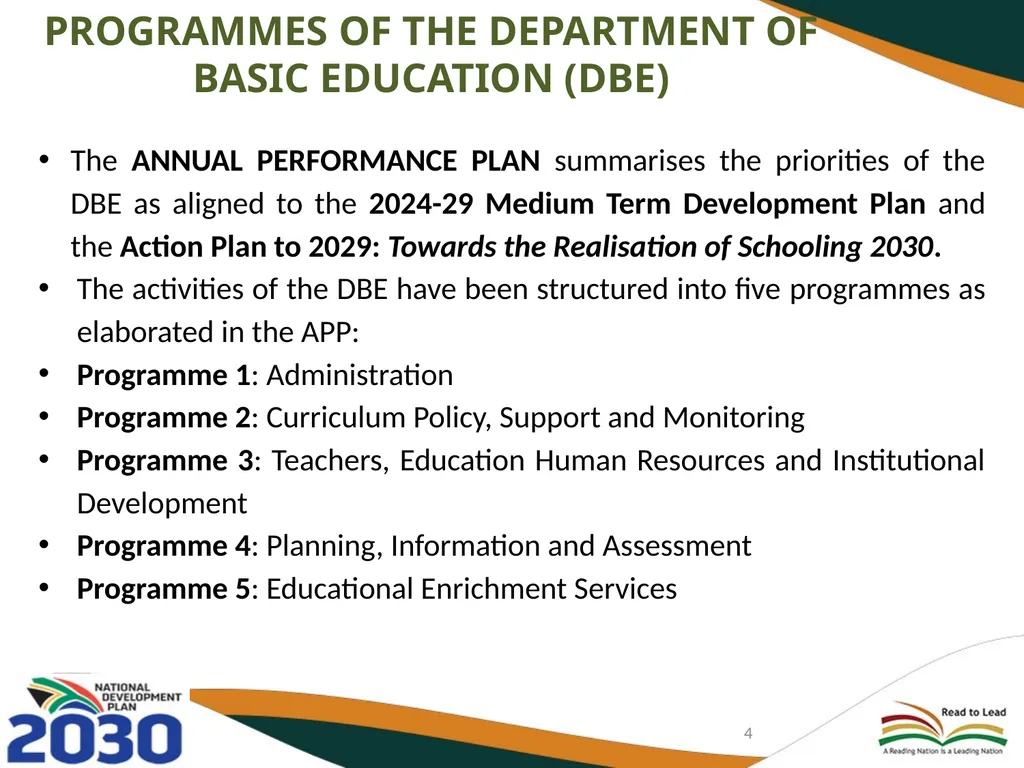
slide4. PROGRAMMES OF THE DEPARTMENT OF BASIC EDUCATION (DBE) The ANNUAL PERFORMANCE PLAN summarises the priorities of the DBE as aligned to the 2024-29 Medium Term Development Plan and the Action Plan to 2029: Towards the Realisation of Schooling 2030.
The activities of the DBE have been structured into five programmes as elaborated in the APP:
Programme 1: Administration
Programme 2: Curriculum Policy, Support and Monitoring
Programme 3: Teachers, Education Human Resources and Institutional Development
Programme 4: Planning, Information and Assessment
Programme 5: Educational Enrichment Services 4<br>
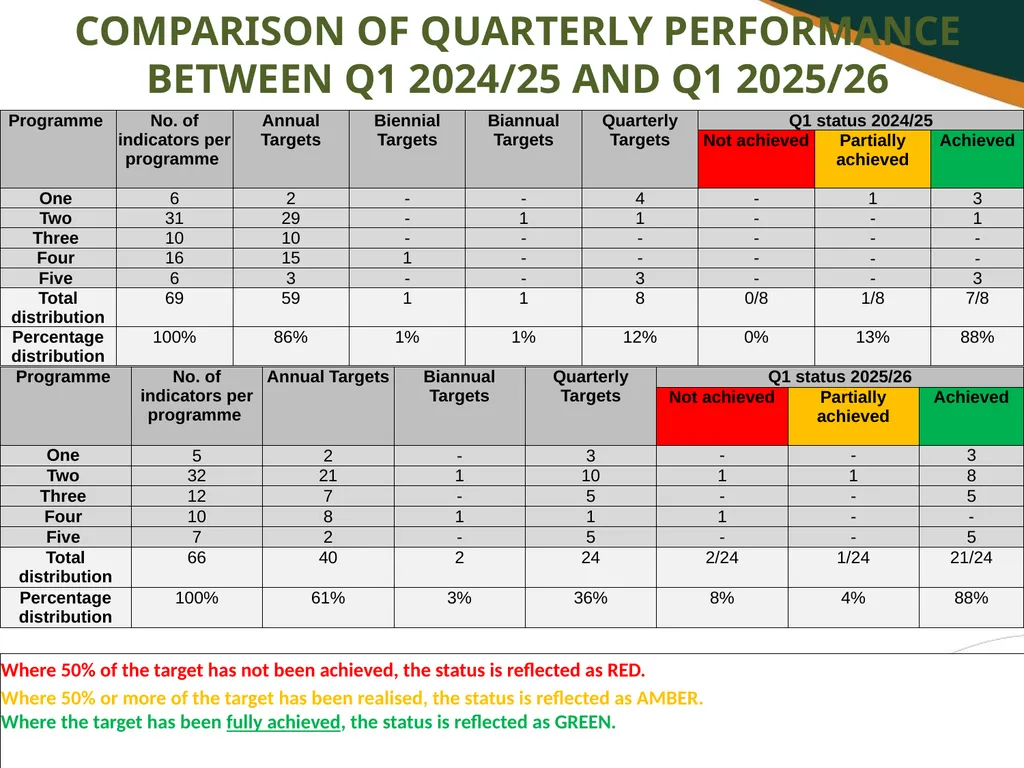
slide5. COMPARISON OF QUARTERLY PERFORMANCE BETWEEN Q1 2024/25 AND Q1 2025/26 5<br>
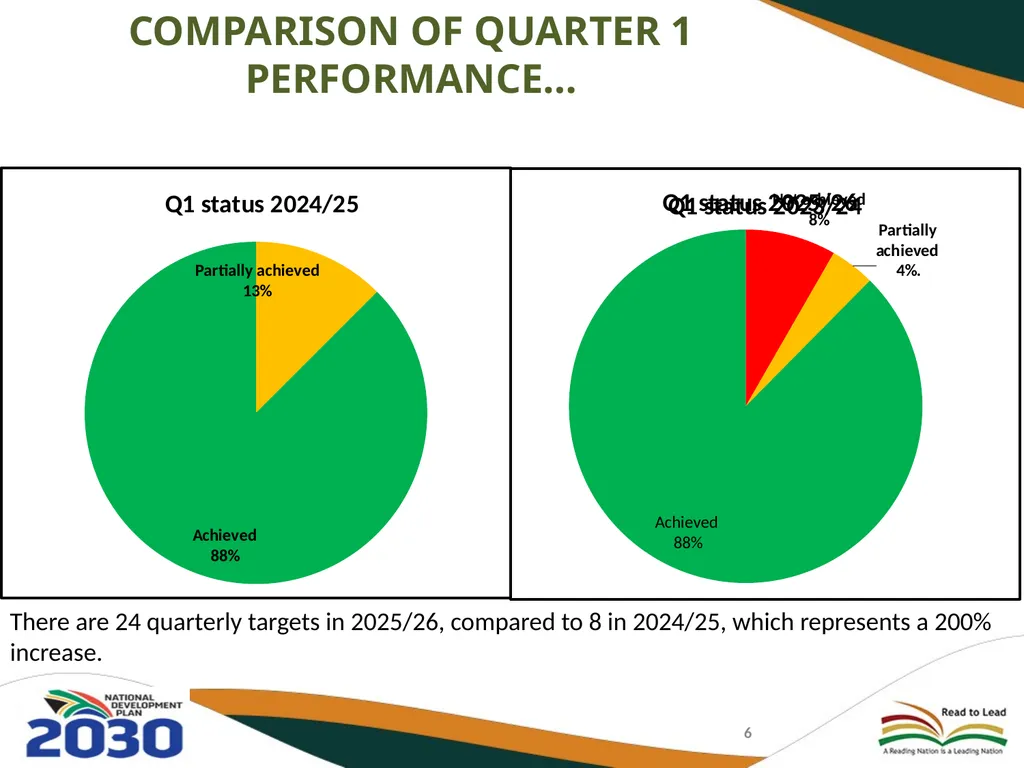
slide6. COMPARISON OF QUARTER 1 PERFORMANCE… 6 There are 24 quarterly targets in 2025/26, compared to 8 in 2024/25, which represents a 200% increase.<br>
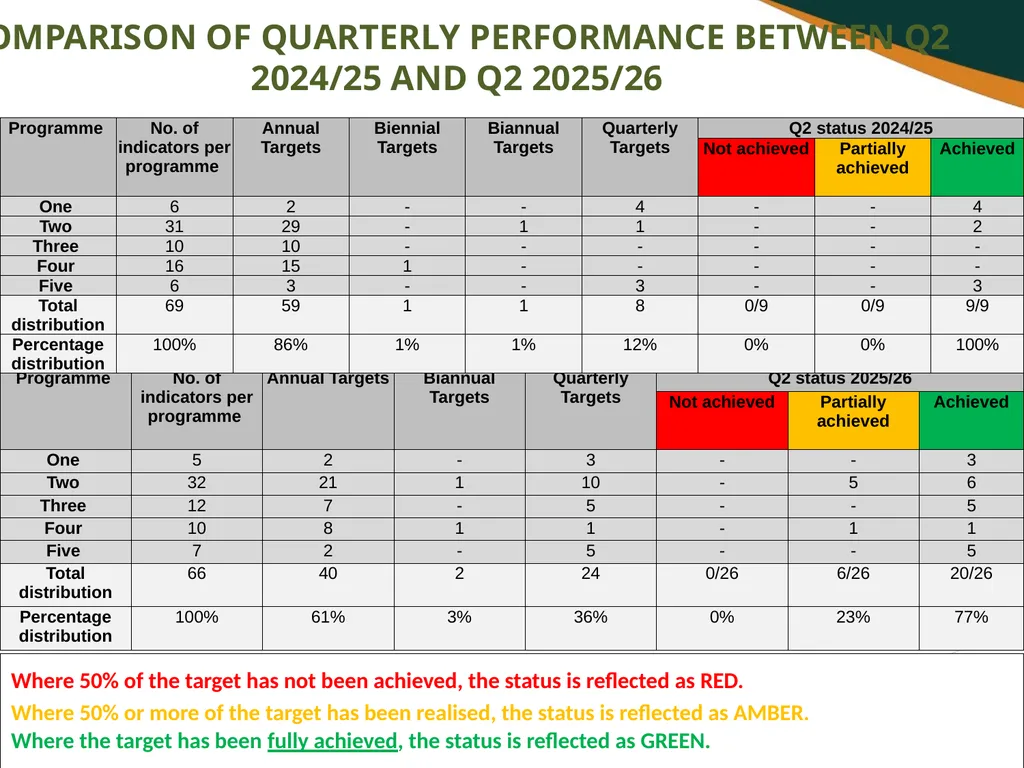
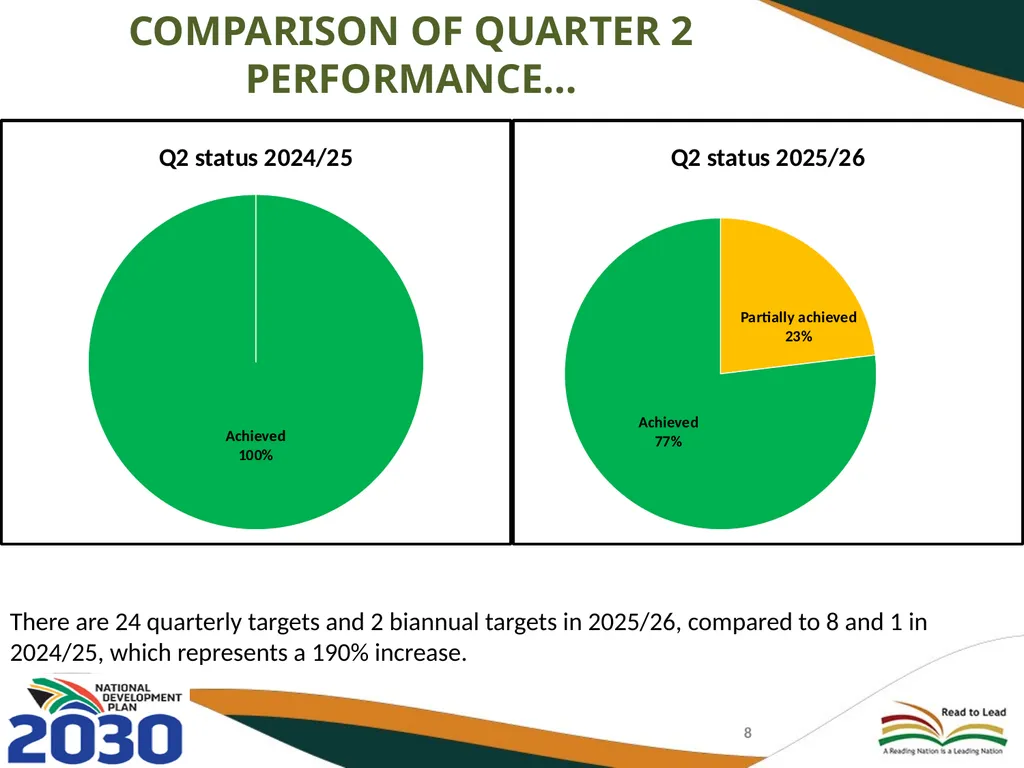
slide7. COMPARISON OF QUARTERLY PERFORMANCE BETWEEN Q2 2024/25 AND Q2 2025/26 7<br>
slide8. COMPARISON OF QUARTER 2 PERFORMANCE… 8 There are 24 quarterly targets and 2 biannual targets in 2025/26, compared to 8 and 1 in 2024/25, which represents a 190% increase.<br>
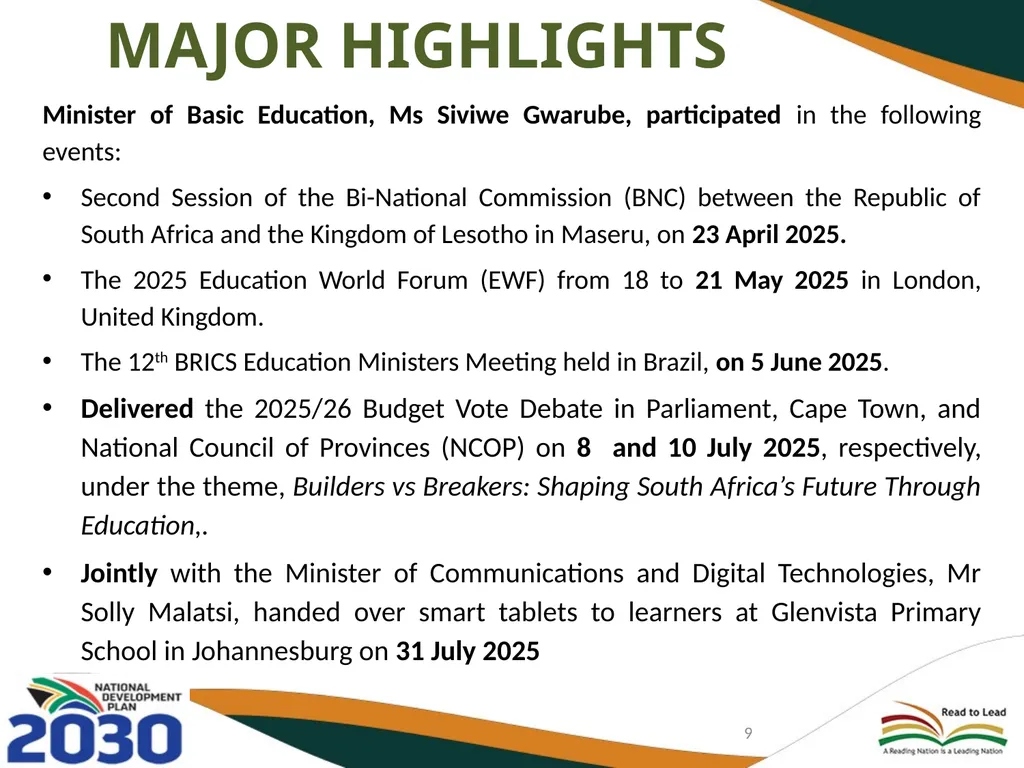
slide9. MAJOR HIGHLIGHTS Minister of Basic Education, Ms Siviwe Gwarube, participated in the following events:
Second Session of the Bi-National Commission (BNC) between the Republic of South Africa and the Kingdom of Lesotho in Maseru, on 23 April 2025.
The 2025 Education World Forum (EWF) from 18 to 21 May 2025 in London, United Kingdom.
The 12th BRICS Education Ministers Meeting held in Brazil, on 5 June 2025.
Delivered the 2025/26 Budget Vote Debate in Parliament, Cape Town, and National Council of Provinces (NCOP) on 8 and 10 July 2025, respectively, under the theme, Builders vs Breakers: Shaping South Africa’s Future Through Education,.
Jointly with the Minister of Communications and Digital Technologies, Mr Solly Malatsi, handed over smart tablets to learners at Glenvista Primary School in Johannesburg on 31 July 2025 9<br>
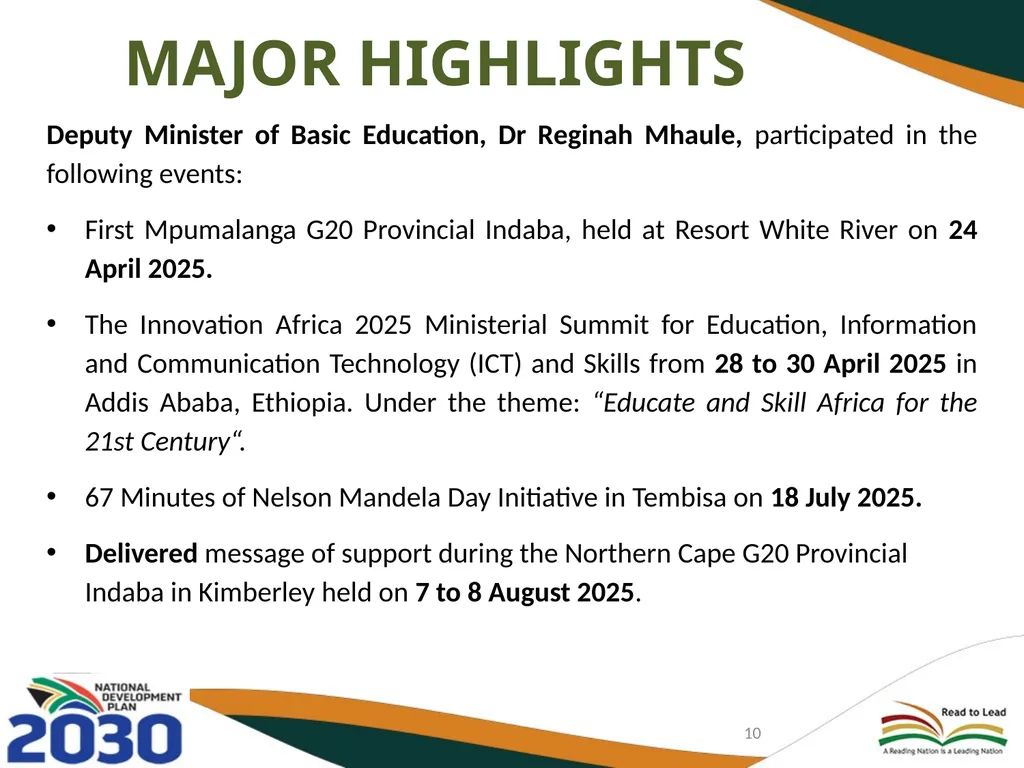
slide10. MAJOR HIGHLIGHTS Deputy Minister of Basic Education, Dr Reginah Mhaule, participated in the following events:
First Mpumalanga G20 Provincial Indaba, held at Resort White River on 24 April 2025.
The Innovation Africa 2025 Ministerial Summit for Education, Information and Communication Technology (ICT) and Skills from 28 to 30 April 2025 in Addis Ababa, Ethiopia. Under the theme: “Educate and Skill Africa for the 21st Century“.
67 Minutes of Nelson Mandela Day Initiative in Tembisa on 18 July 2025.
Delivered message of support during the Northern Cape G20 Provincial Indaba in Kimberley held on 7 to 8 August 2025. 10<br>
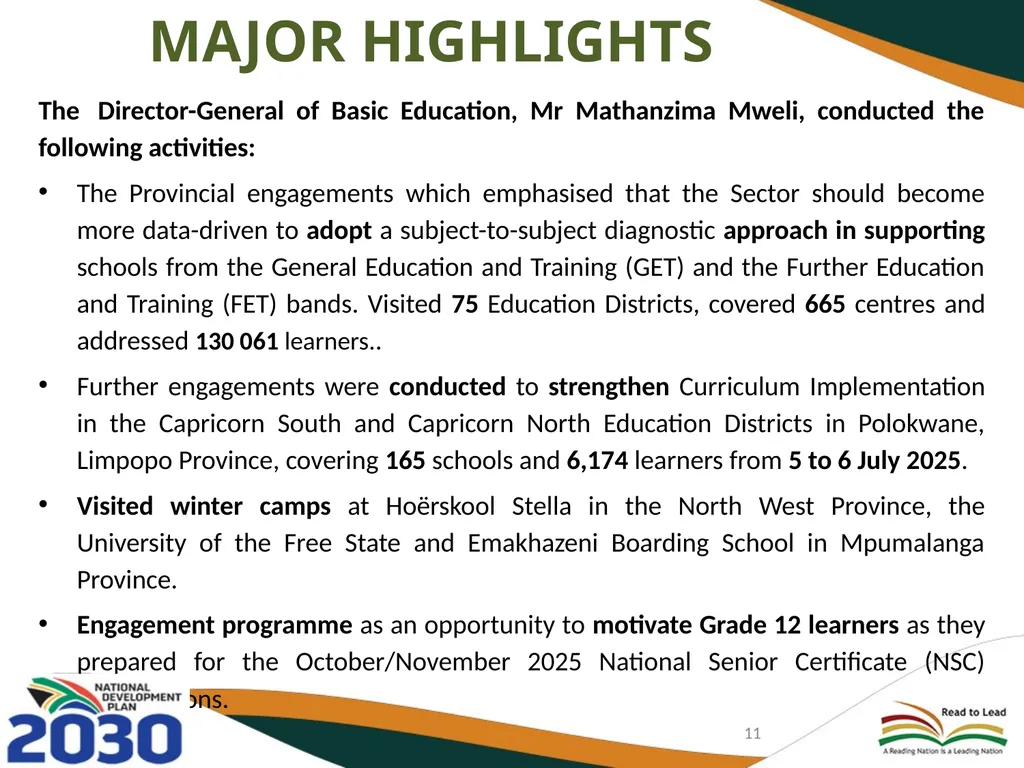
slide11. MAJOR HIGHLIGHTS The Director-General of Basic Education, Mr Mathanzima Mweli, conducted the following activities:
The Provincial engagements which emphasised that the Sector should become more data-driven to adopt a subject-to-subject diagnostic approach in supporting schools from the General Education and Training (GET) and the Further Education and Training (FET) bands. Visited 75 Education Districts, covered 665 centres and addressed 130 061 learners..
Further engagements were conducted to strengthen Curriculum Implementation in the Capricorn South and Capricorn North Education Districts in Polokwane, Limpopo Province, covering 165 schools and 6,174 learners from 5 to 6 July 2025.
Visited winter camps at Hoërskool Stella in the North West Province, the University of the Free State and Emakhazeni Boarding School in Mpumalanga Province.
Engagement programme as an opportunity to motivate Grade 12 learners as they prepared for the October/November 2025 National Senior Certificate (NSC) examinations. 11<br>
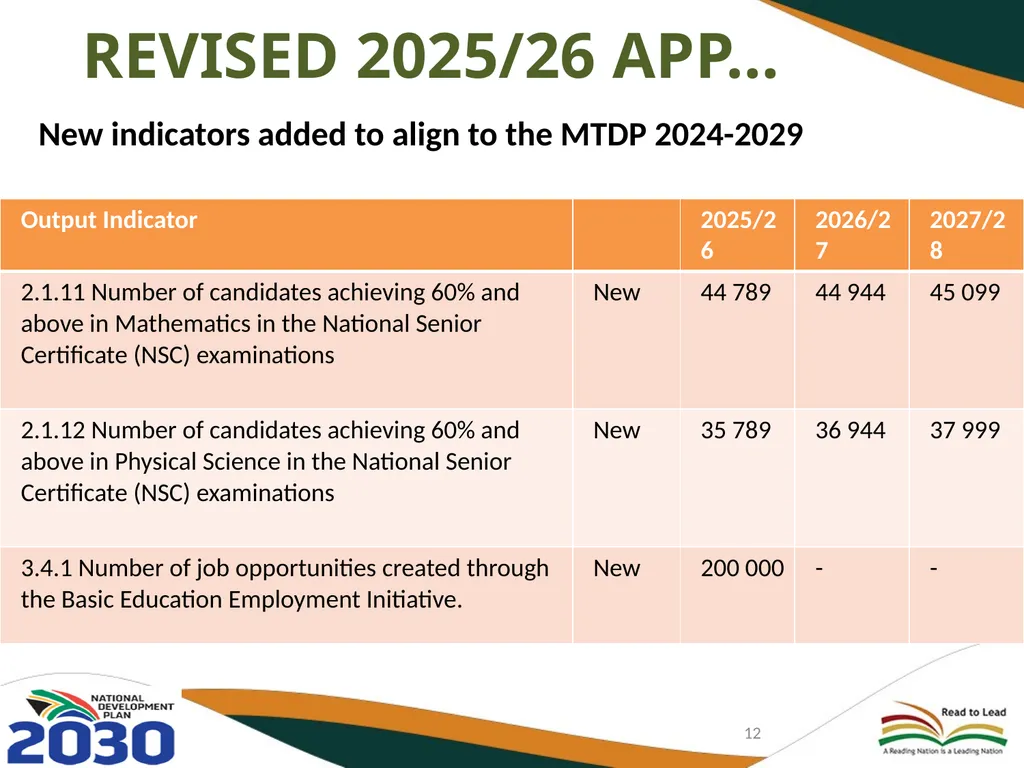
slide12. REVISED 2025/26 APP… New indicators added to align to the MTDP 2024-2029 12<br>
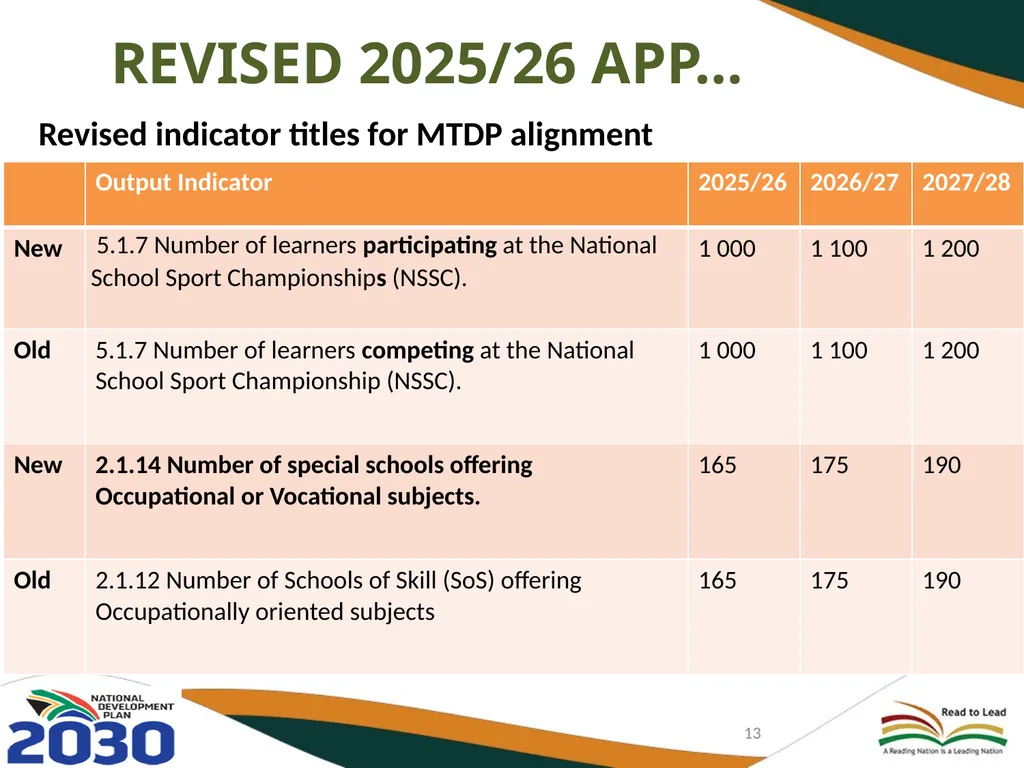
slide13. REVISED 2025/26 APP… Revised indicator titles for MTDP alignment 13<br>
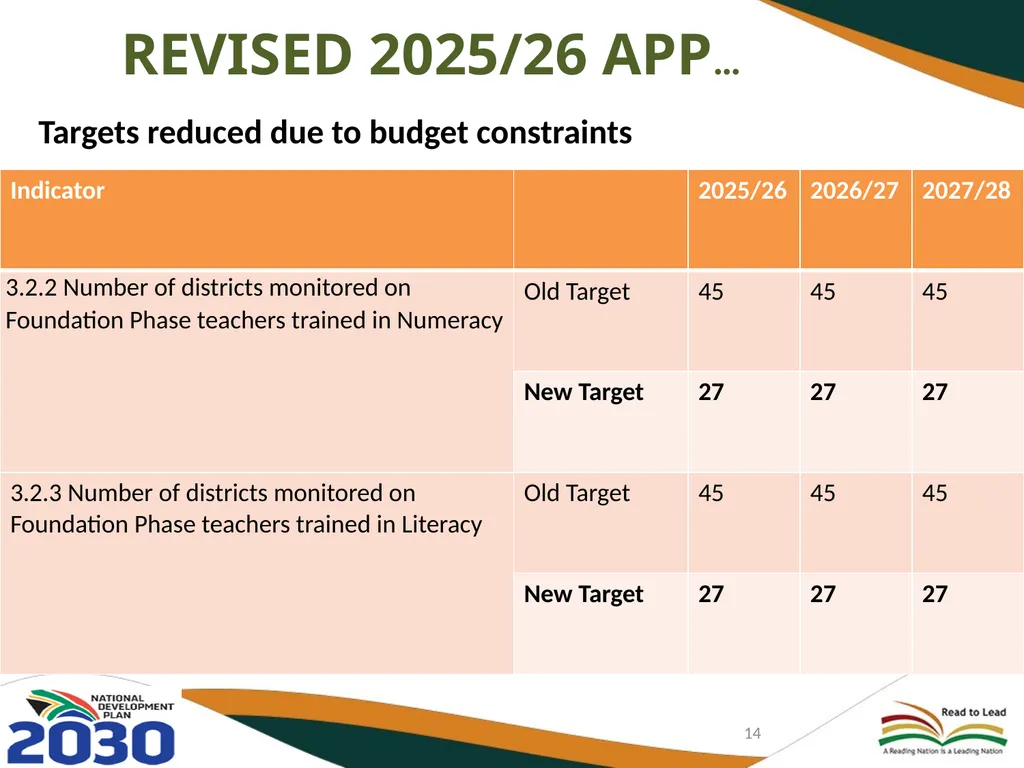
slide14. REVISED 2025/26 APP… Targets reduced due to budget constraints 14<br>
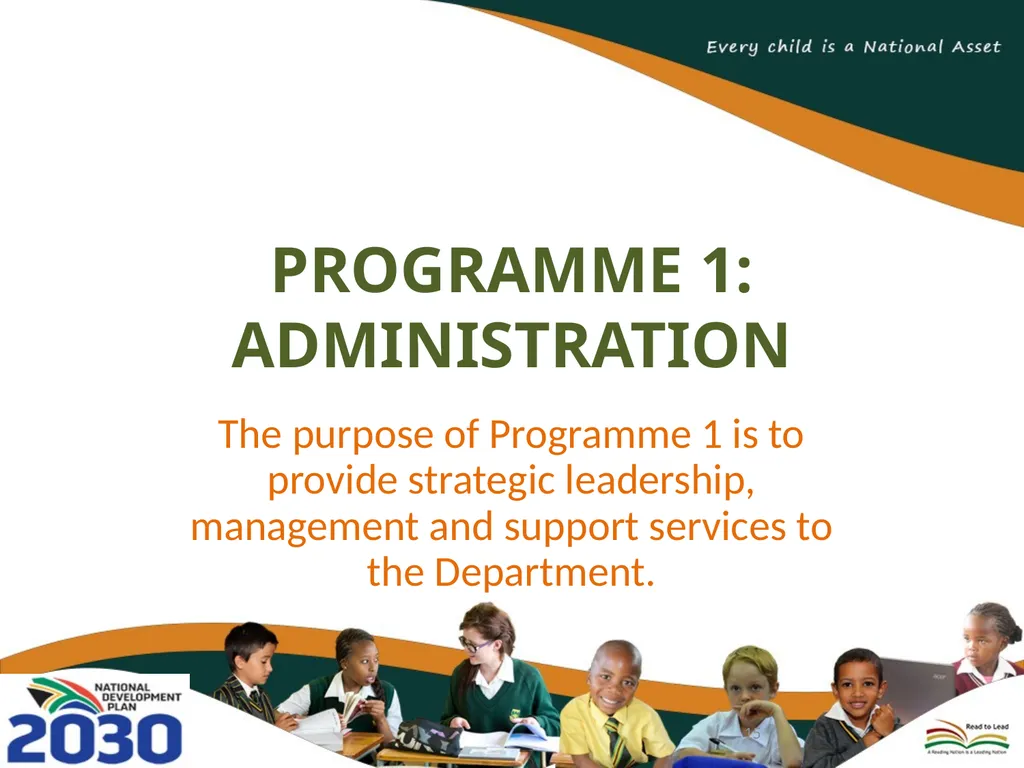
slide15. PROGRAMME 1: ADMINISTRATION The purpose of Programme 1 is to provide strategic leadership, management and support services to the Department. 15<br>
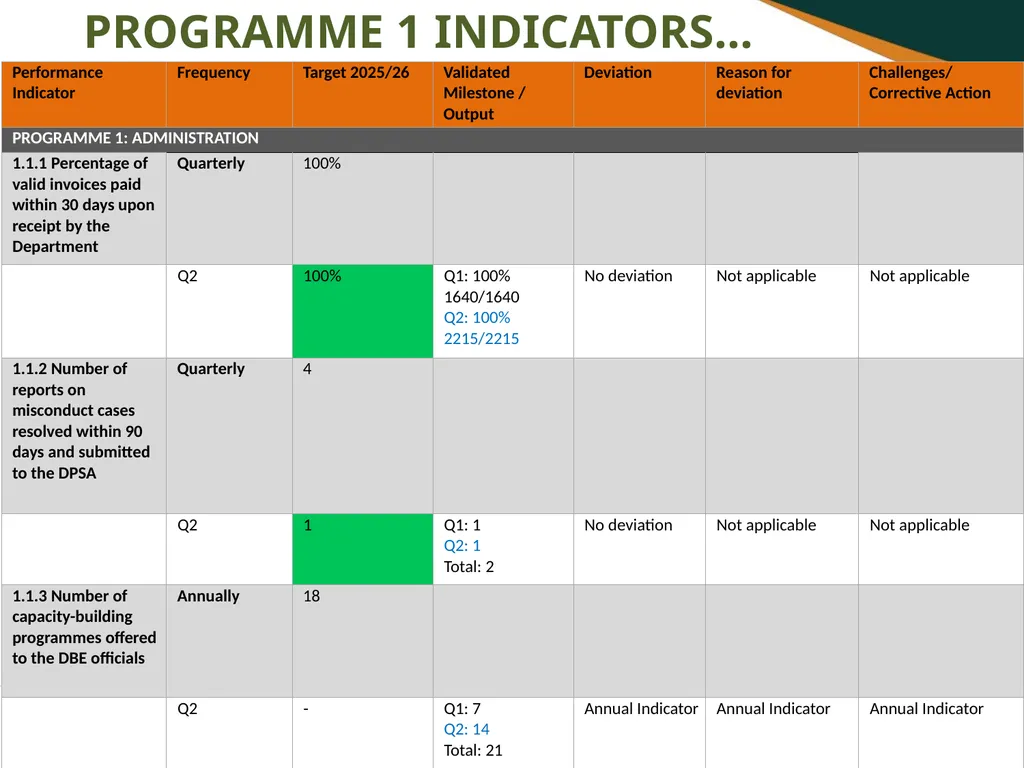
slide16. PROGRAMME 1 INDICATORS… 16<br>
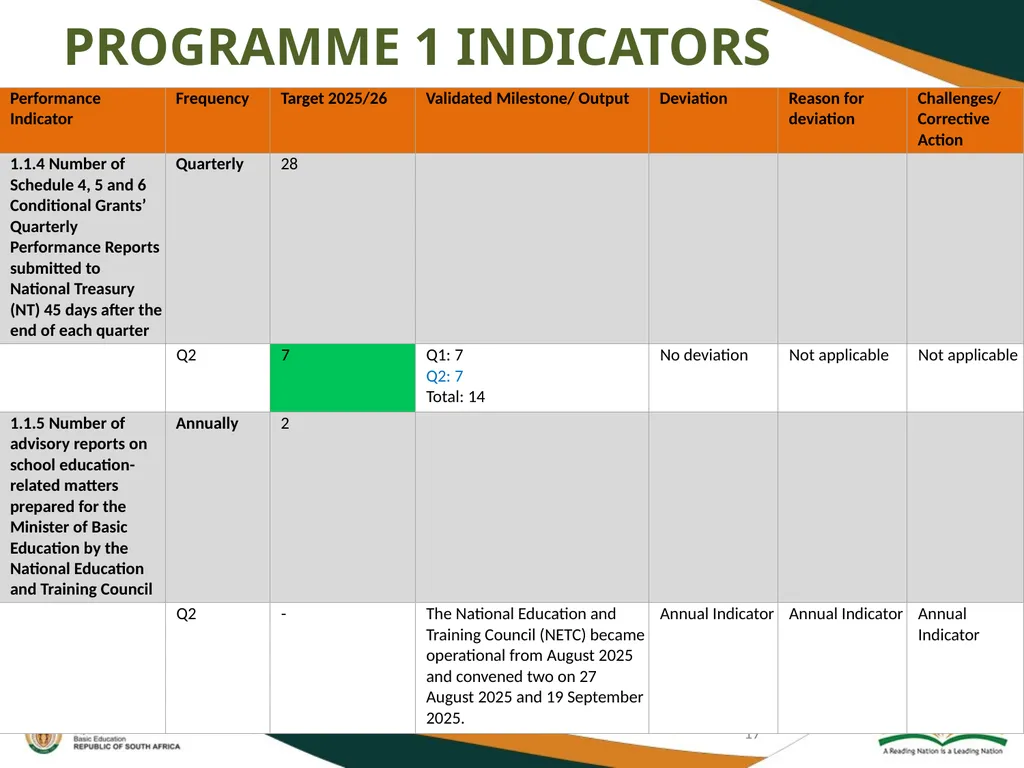
slide17. PROGRAMME 1 INDICATORS 17<br>
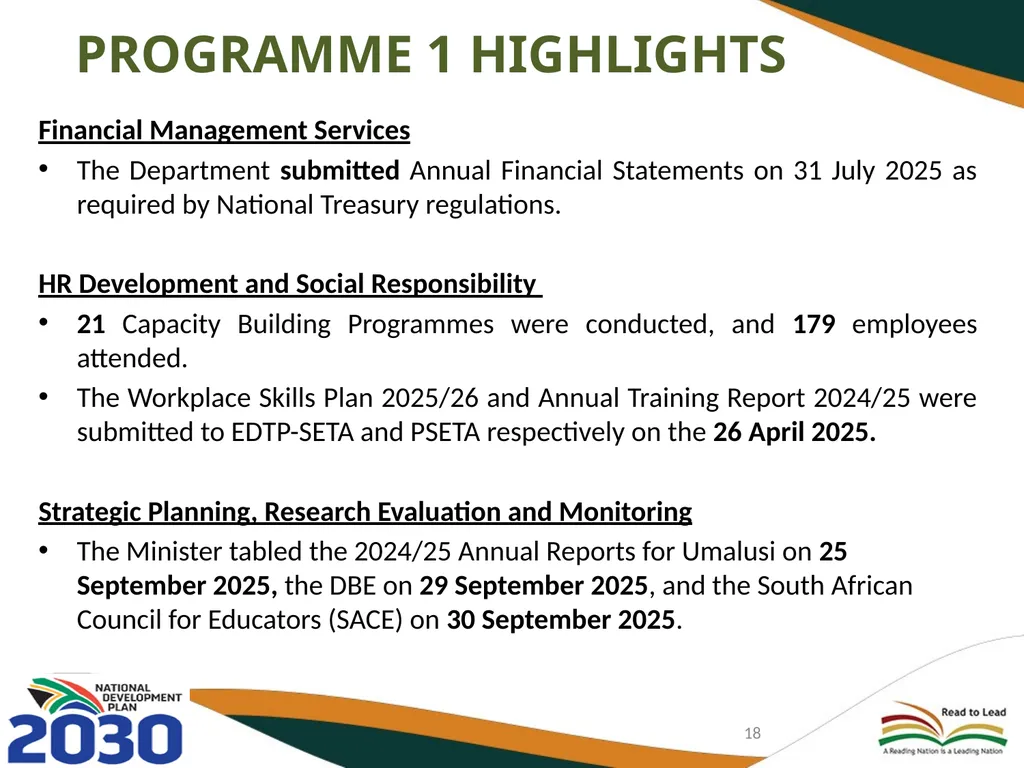
slide18. PROGRAMME 1 HIGHLIGHTS Financial Management Services
The Department submitted Annual Financial Statements on 31 July 2025 as required by National Treasury regulations.
HR Development and Social Responsibility
21 Capacity Building Programmes were conducted, and 179 employees attended.
The Workplace Skills Plan 2025/26 and Annual Training Report 2024/25 were submitted to EDTP-SETA and PSETA respectively on the 26 April 2025.
Strategic Planning, Research Evaluation and Monitoring
The Minister tabled the 2024/25 Annual Reports for Umalusi on 25 September 2025, the DBE on 29 September 2025, and the South African Council for Educators (SACE) on 30 September 2025. 18<br>
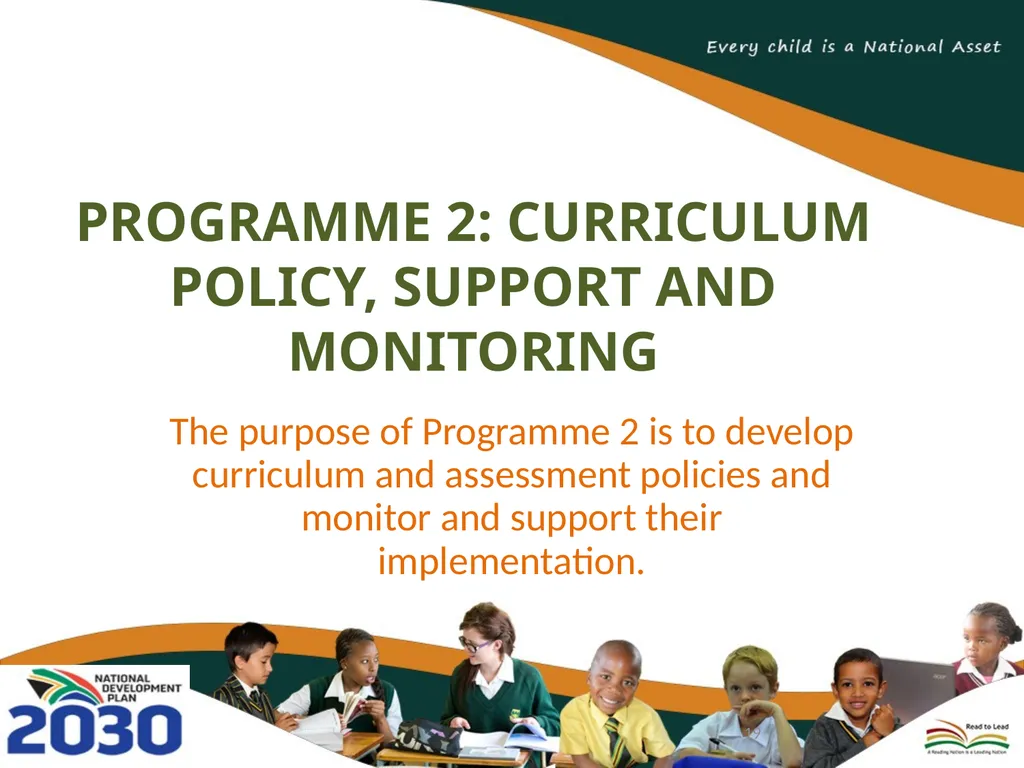
slide19. PROGRAMME 2: CURRICULUM POLICY, SUPPORT AND MONITORING The purpose of Programme 2 is to develop curriculum and assessment policies and monitor and support their implementation. 19<br>
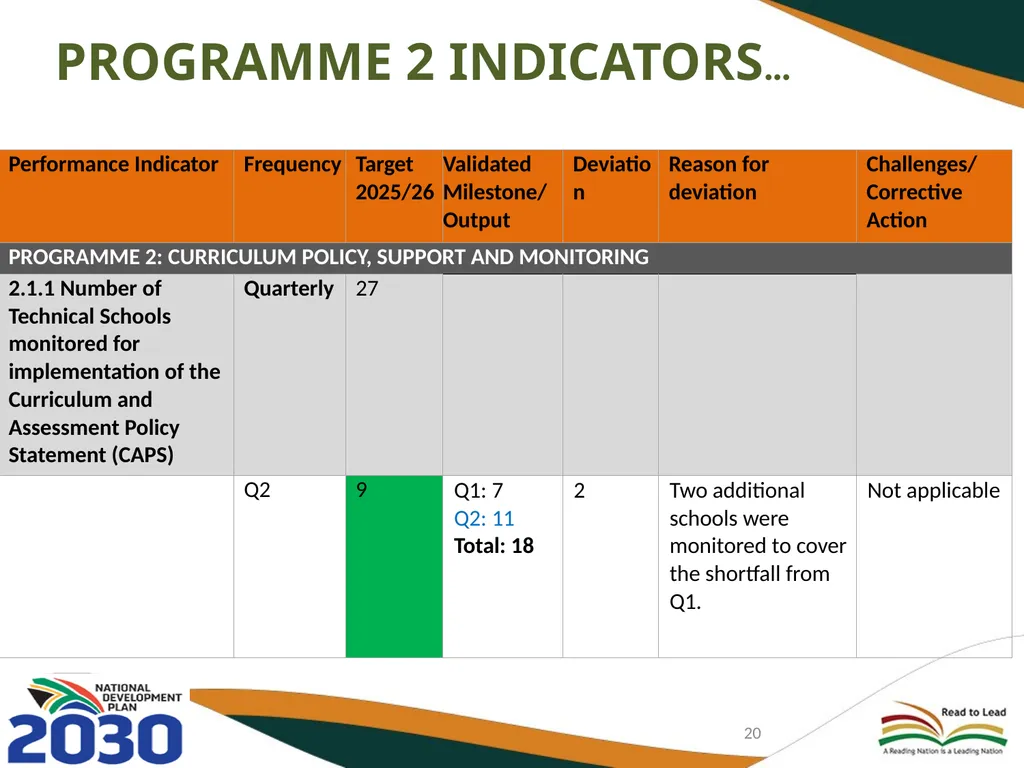
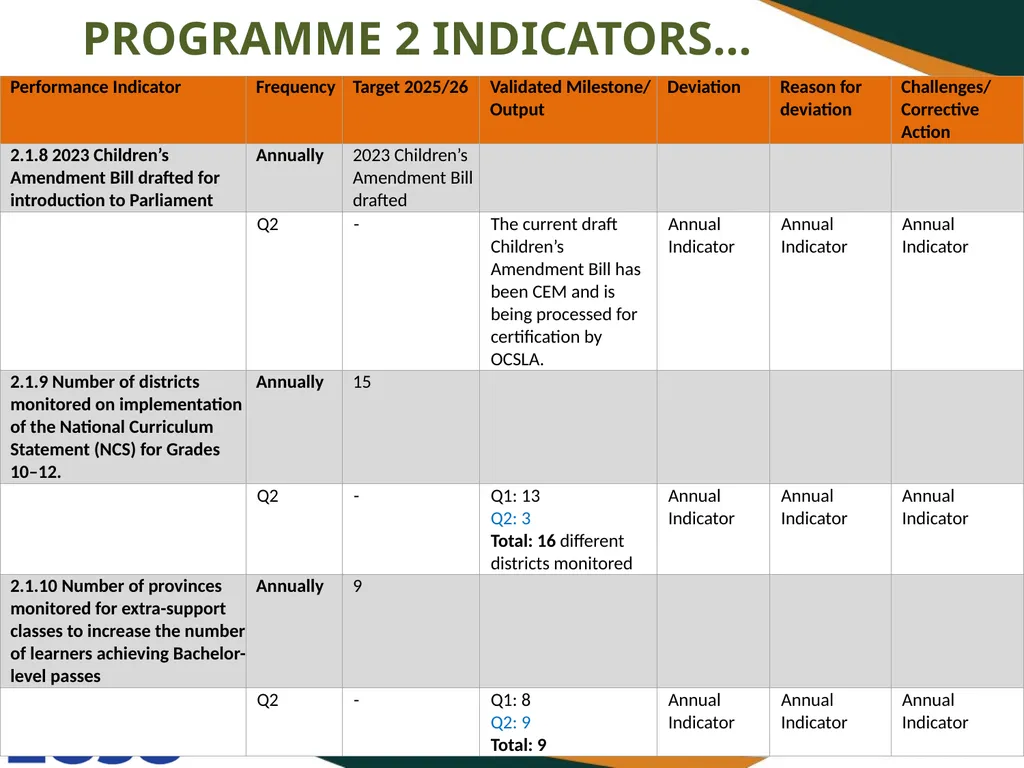
slide20. PROGRAMME 2 INDICATORS… 20<br>
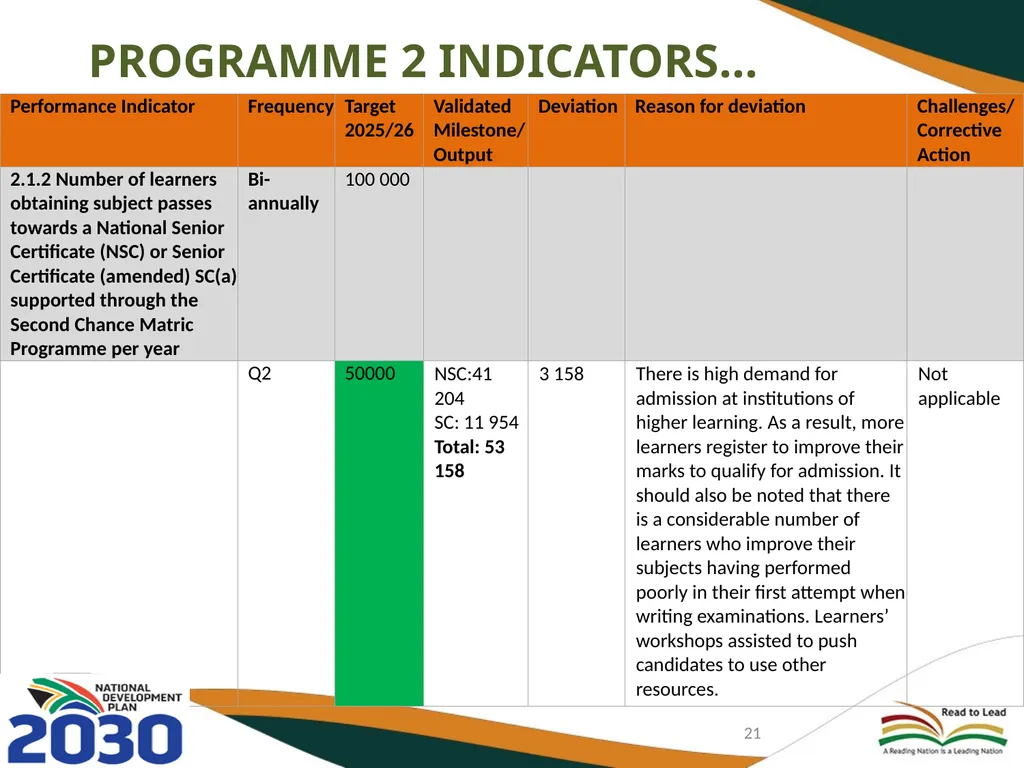
slide21. PROGRAMME 2 INDICATORS… 21<br>
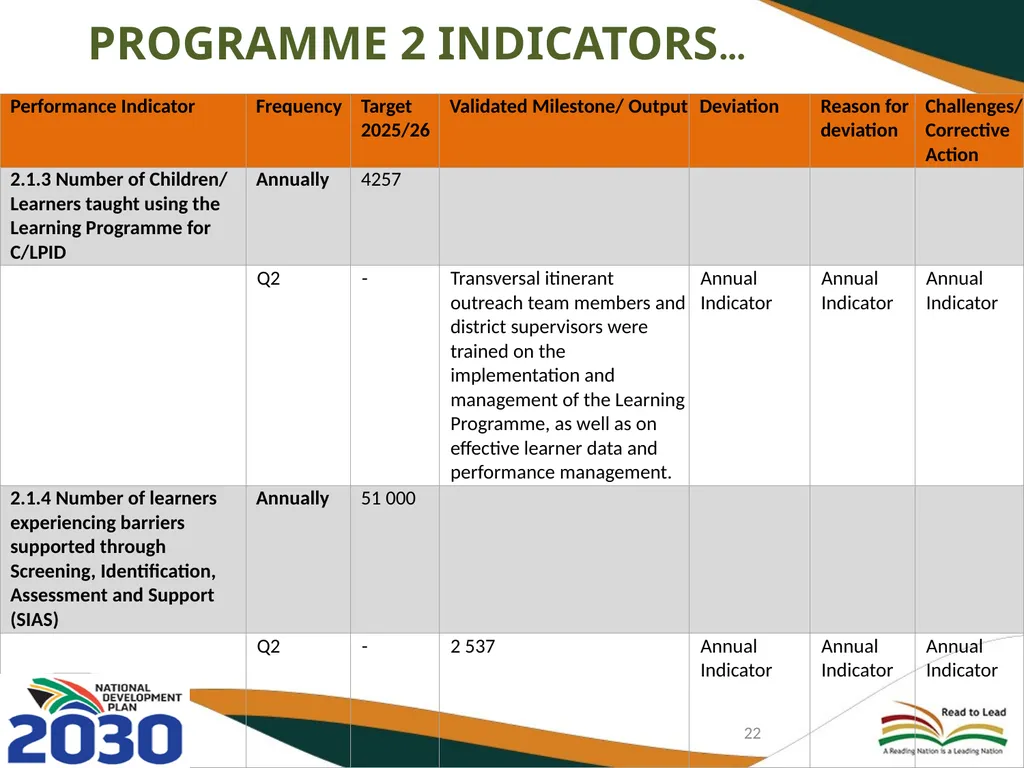
slide22. PROGRAMME 2 INDICATORS… 22<br>
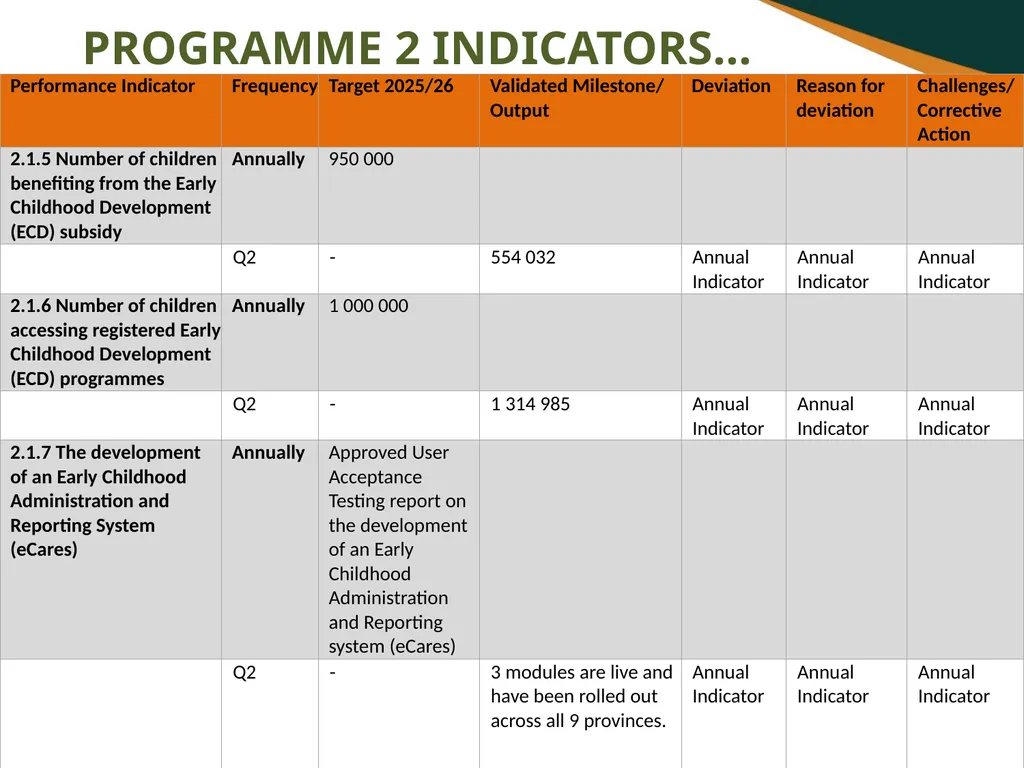
slide23. PROGRAMME 2 INDICATORS… 23<br>
slide24. PROGRAMME 2 INDICATORS… 24<br>
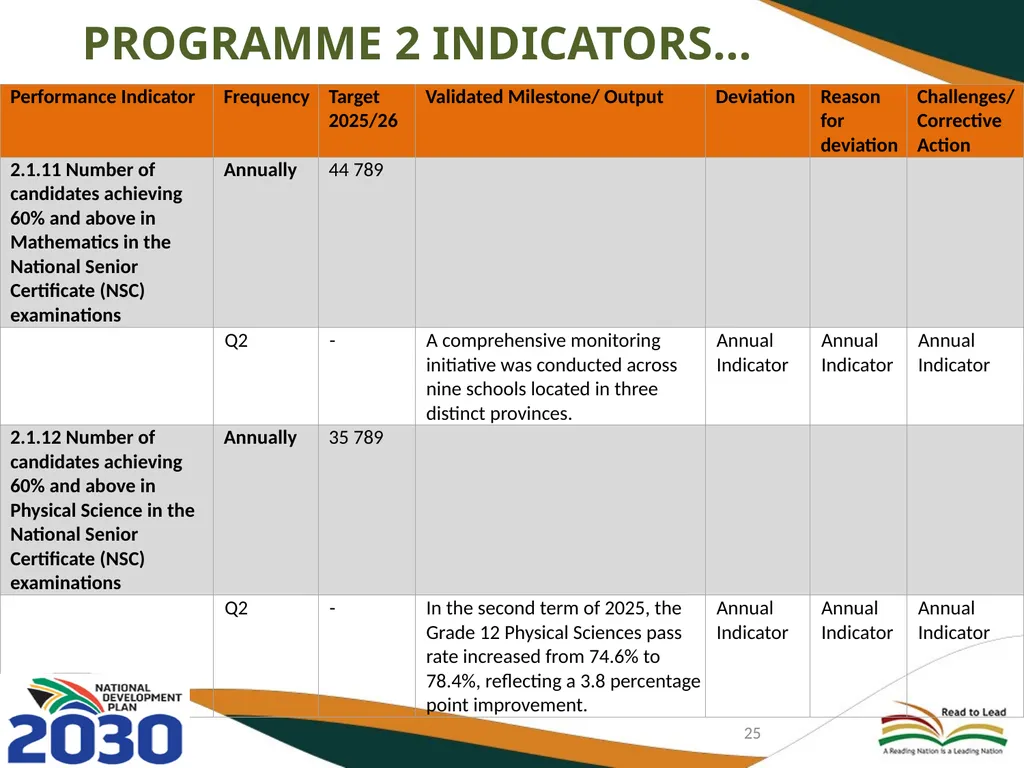
slide25. PROGRAMME 2 INDICATORS… 25<br>
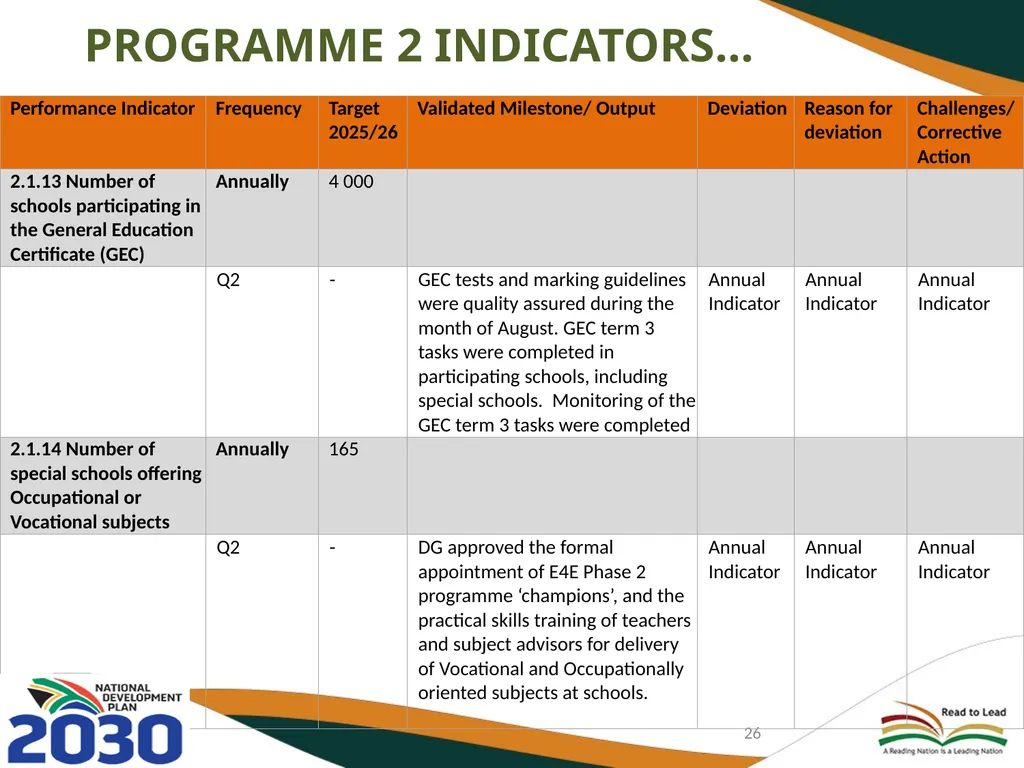
slide26. PROGRAMME 2 INDICATORS… 26<br>
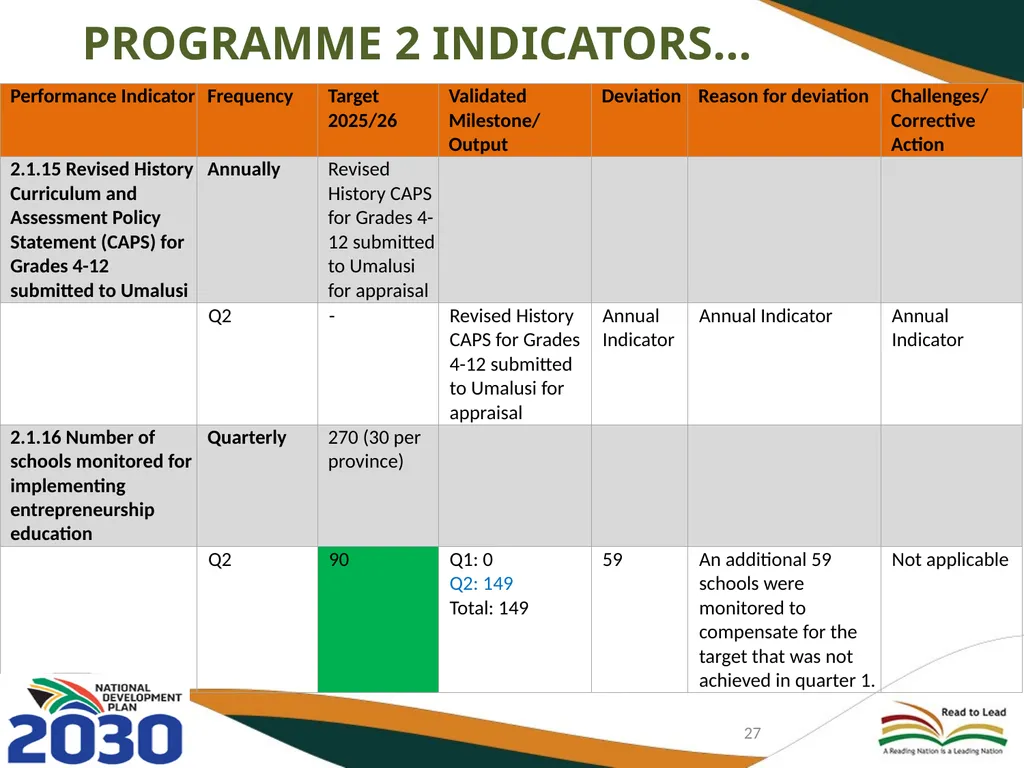
slide27. PROGRAMME 2 INDICATORS… 27<br>
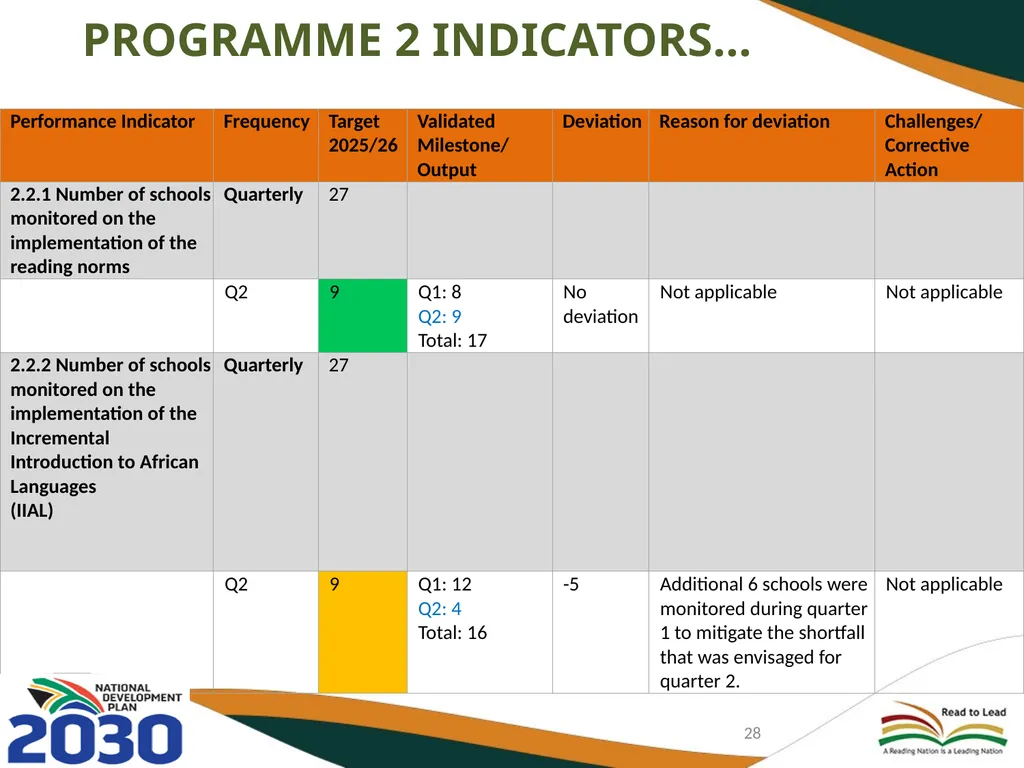
slide28. PROGRAMME 2 INDICATORS… 28<br>
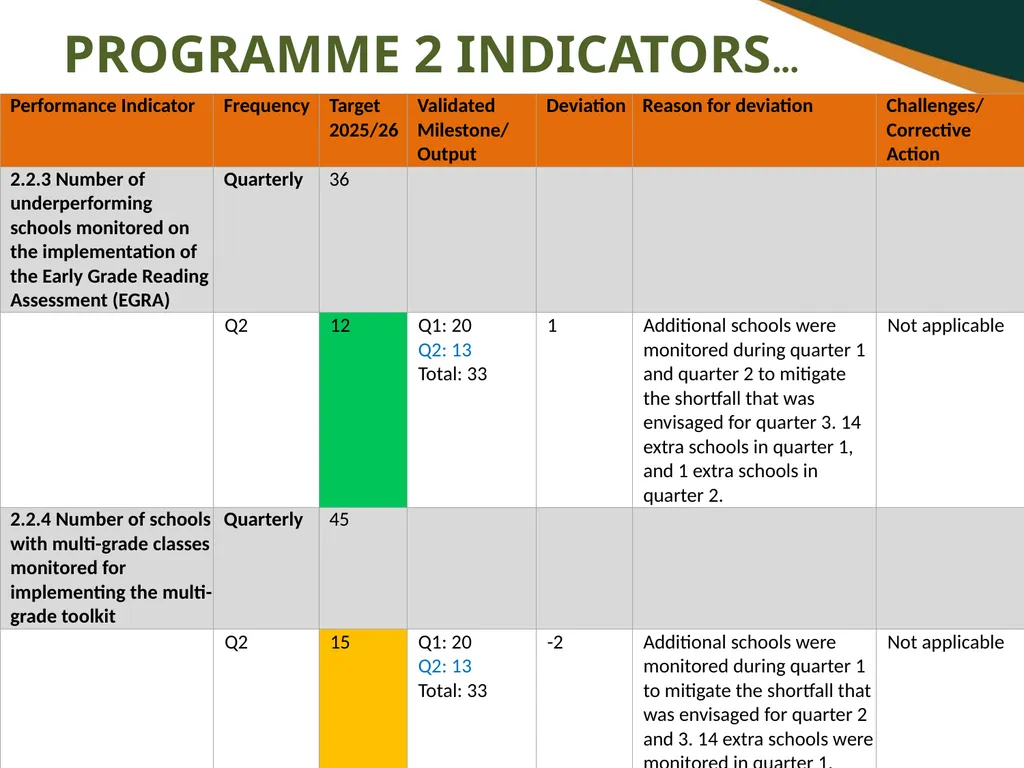
slide29. PROGRAMME 2 INDICATORS… 29<br>
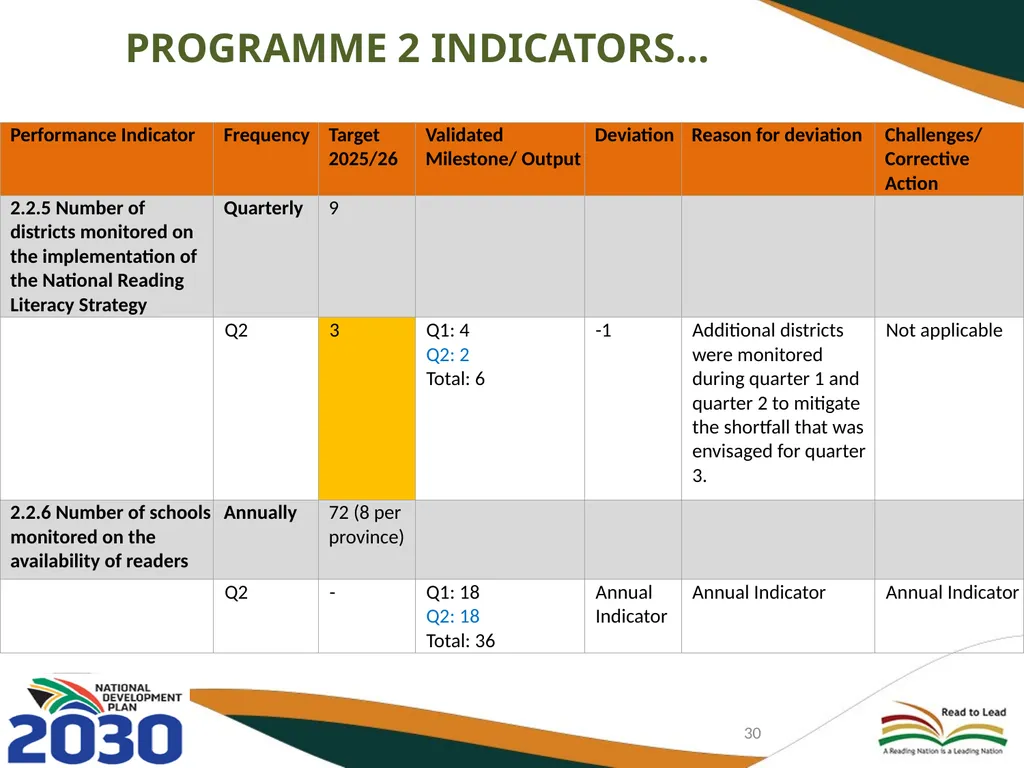
slide30. PROGRAMME 2 INDICATORS… 30<br>
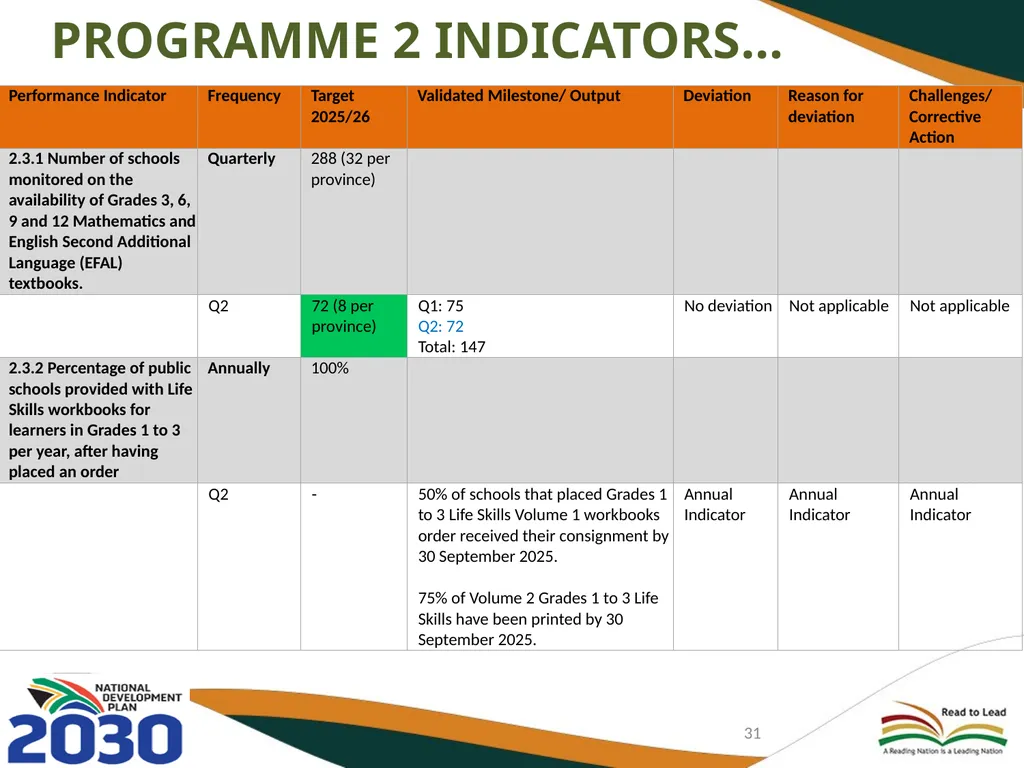
slide31. PROGRAMME 2 INDICATORS… 31<br>
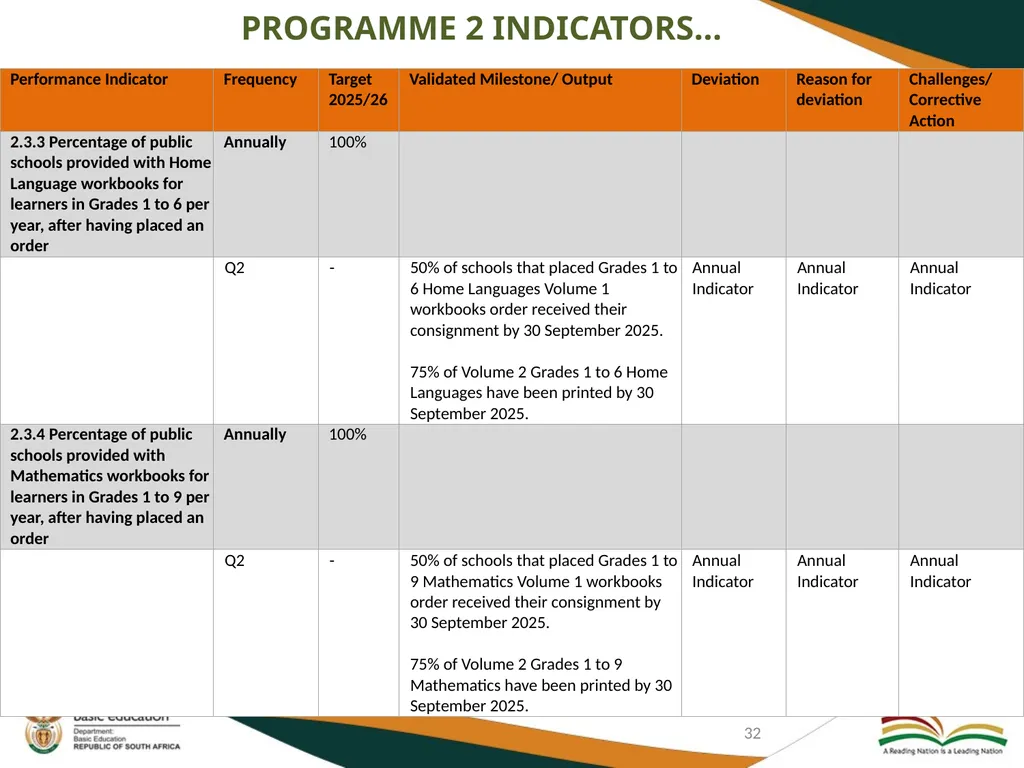
slide32. PROGRAMME 2 INDICATORS… 32<br>
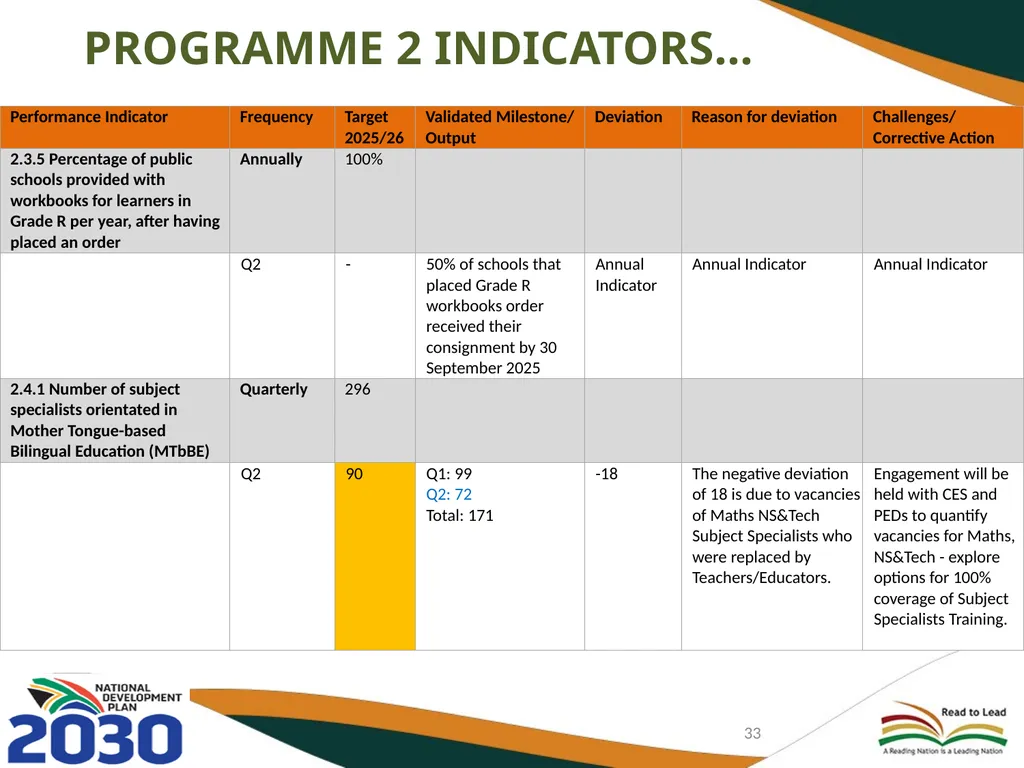
slide33. PROGRAMME 2 INDICATORS… 33<br>
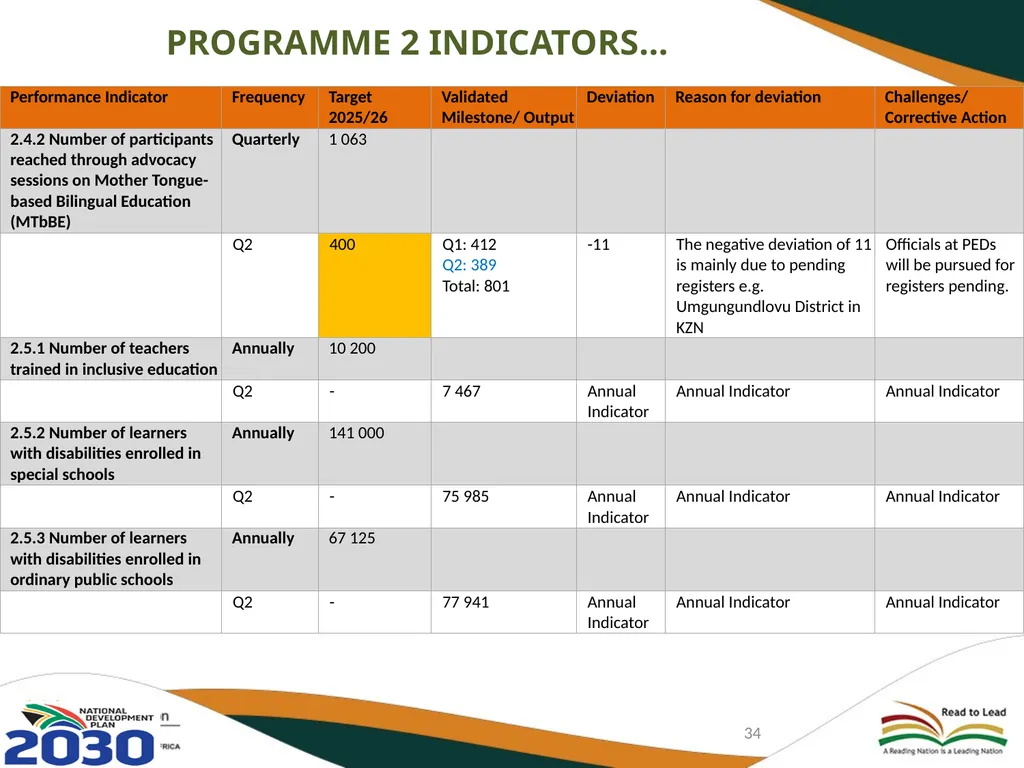
slide34. PROGRAMME 2 INDICATORS… 34<br>
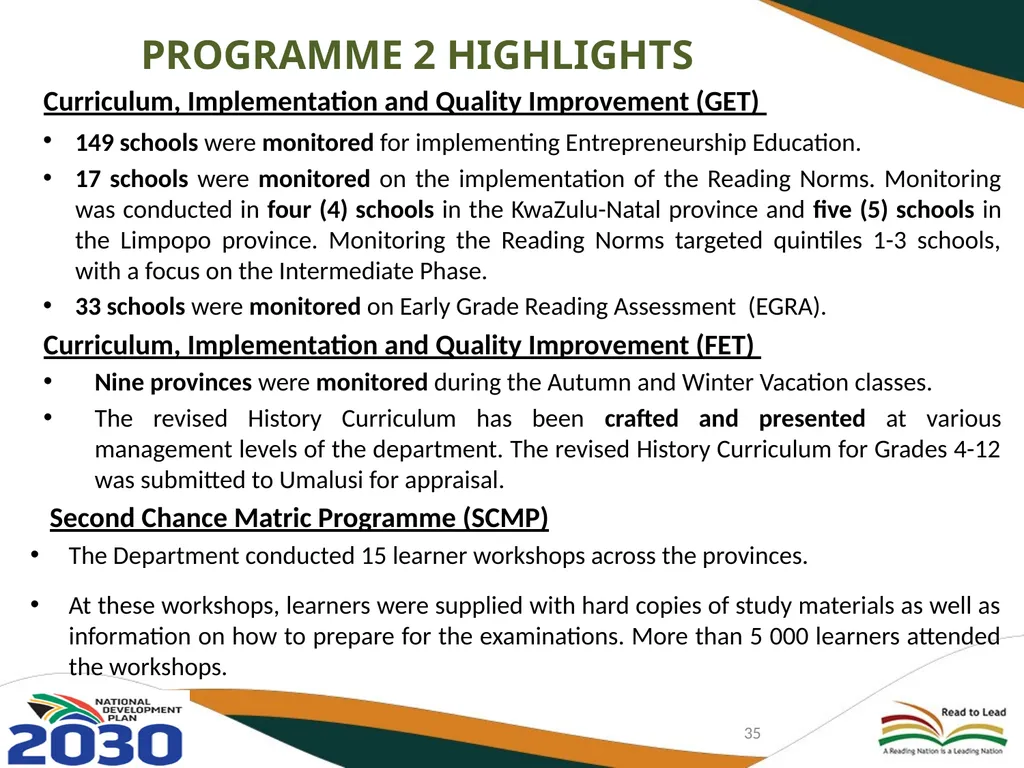
slide35. PROGRAMME 2 HIGHLIGHTS Curriculum, Implementation and Quality Improvement (GET)
149 schools were monitored for implementing Entrepreneurship Education.
17 schools were monitored on the implementation of the Reading Norms. Monitoring was conducted in four (4) schools in the KwaZulu-Natal province and five (5) schools in the Limpopo province. Monitoring the Reading Norms targeted quintiles 1-3 schools, with a focus on the Intermediate Phase.
33 schools were monitored on Early Grade Reading Assessment (EGRA).
Curriculum, Implementation and Quality Improvement (FET)
Nine provinces were monitored during the Autumn and Winter Vacation classes.
The revised History Curriculum has been crafted and presented at various management levels of the department. The revised History Curriculum for Grades 4-12 was submitted to Umalusi for appraisal.
Second Chance Matric Programme (SCMP)
The Department conducted 15 learner workshops across the provinces.
At these workshops, learners were supplied with hard copies of study materials as well as information on how to prepare for the examinations. More than 5 000 learners attended the workshops. 35<br>
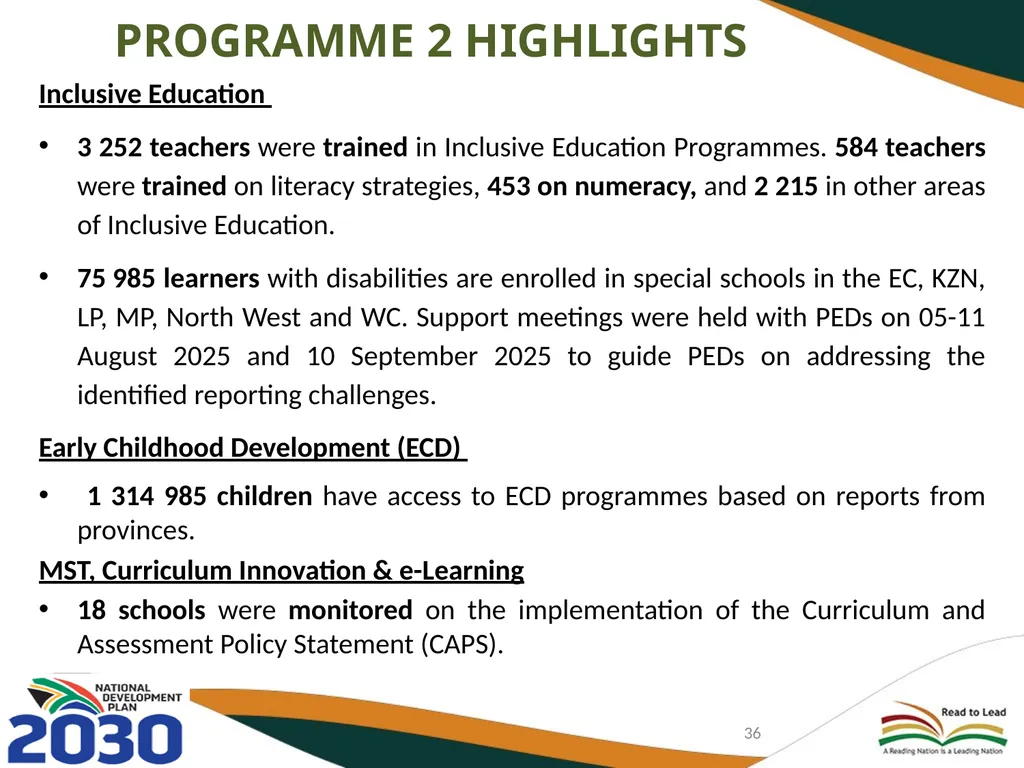
slide36. PROGRAMME 2 HIGHLIGHTS Inclusive Education
3 252 teachers were trained in Inclusive Education Programmes. 584 teachers were trained on literacy strategies, 453 on numeracy, and 2 215 in other areas of Inclusive Education.
75 985 learners with disabilities are enrolled in special schools in the EC, KZN, LP, MP, North West and WC. Support meetings were held with PEDs on 05-11 August 2025 and 10 September 2025 to guide PEDs on addressing the identified reporting challenges.
Early Childhood Development (ECD)
1 314 985 children have access to ECD programmes based on reports from provinces.
MST, Curriculum Innovation & e-Learning
18 schools were monitored on the implementation of the Curriculum and Assessment Policy Statement (CAPS). 36<br>
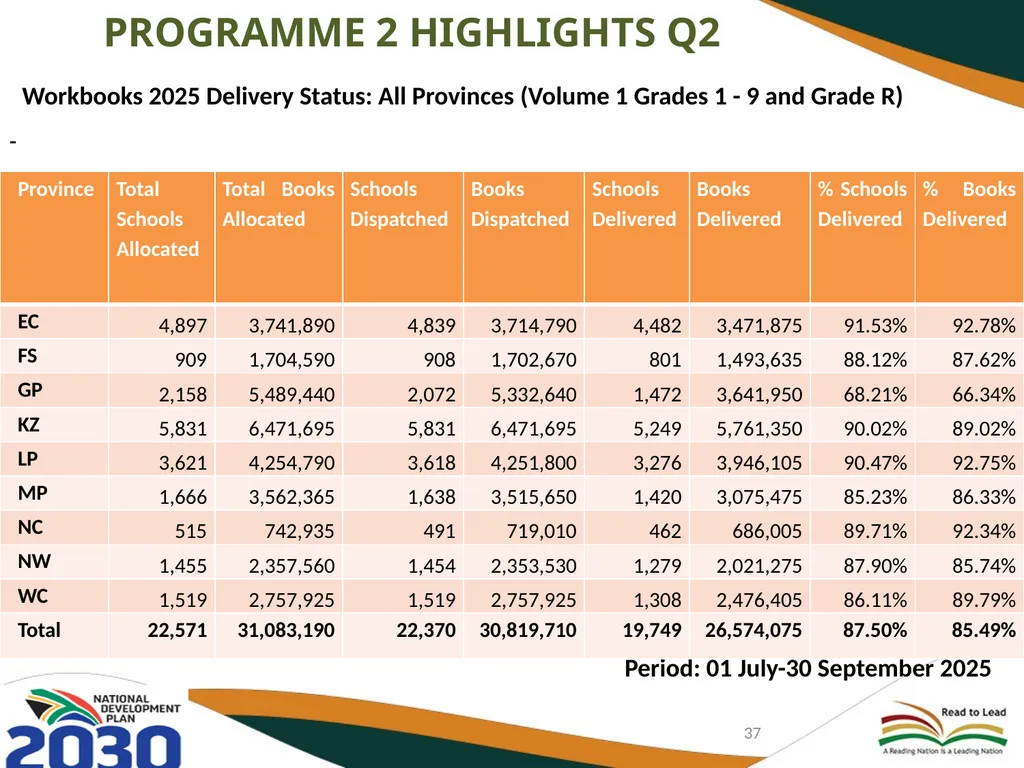
slide37. PROGRAMME 2 HIGHLIGHTS Q2 Period: 01 July-30 September 2025 37 Workbooks 2025 Delivery Status: All Provinces (Volume 1 Grades 1 - 9 and Grade R)<br>
slide38. PROGRAMME 3: TEACHERS, EDUCATION HUMAN RESOURCES AND INSTITUTIONAL DEVELOPMENT The purpose of Programme 3 is to promote quality teaching and institutional performance through the effective supply, development and utilisation of human resources. 38<br>
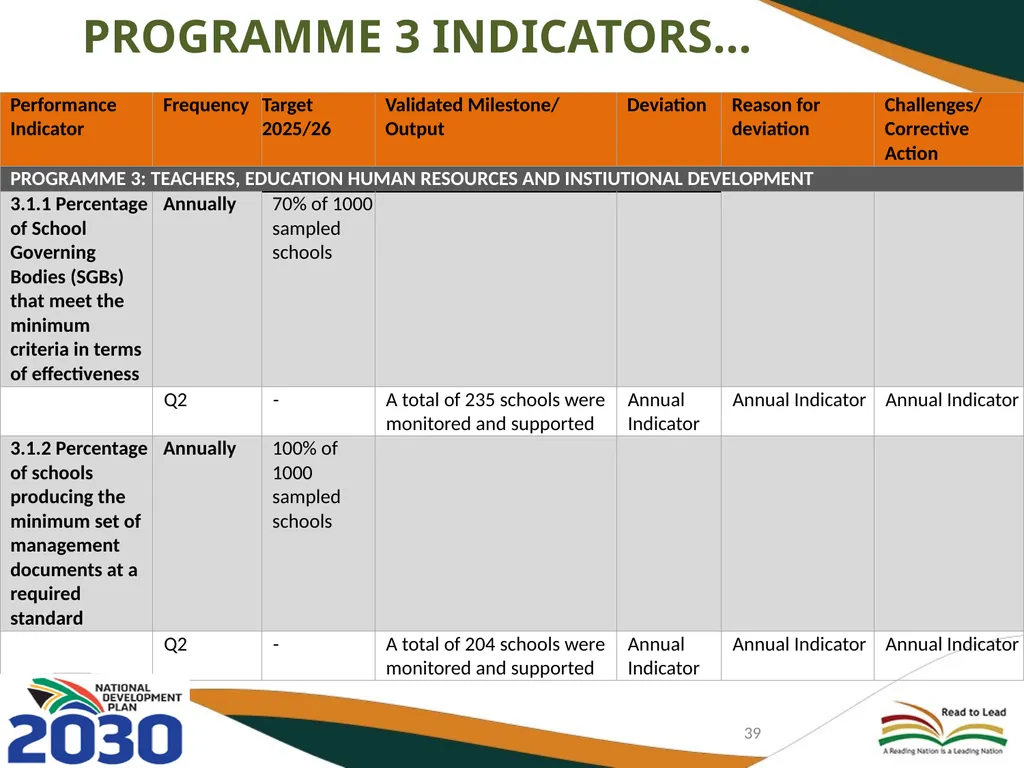
slide39. PROGRAMME 3 INDICATORS… 39<br>
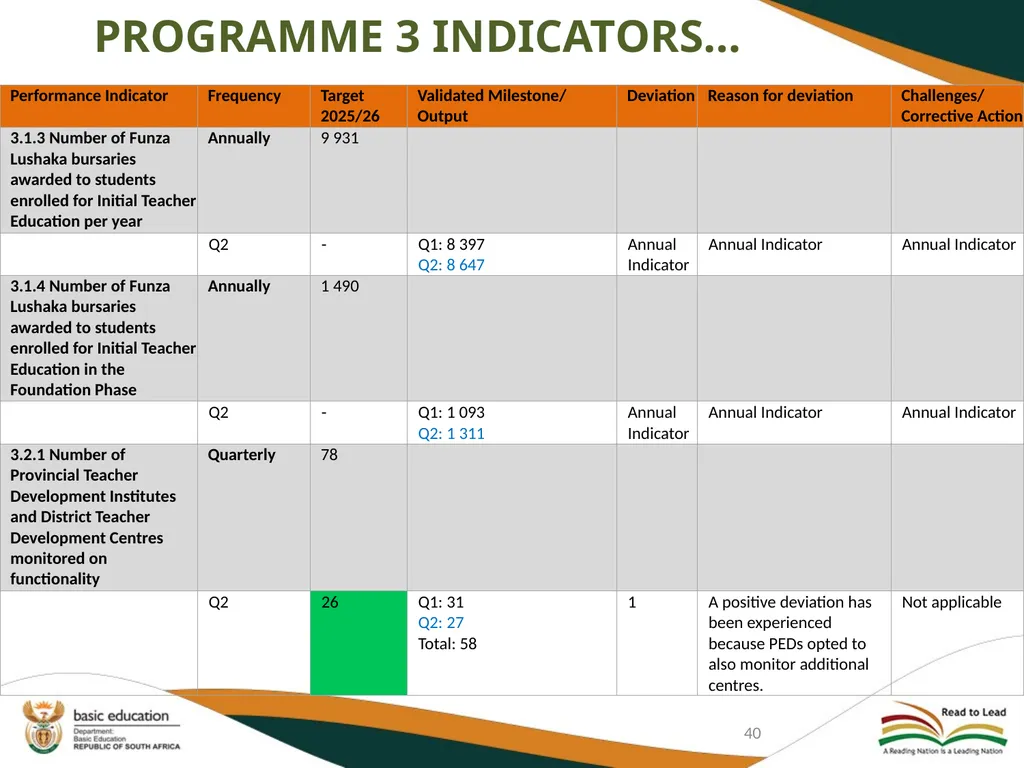
slide40. PROGRAMME 3 INDICATORS… 40<br>
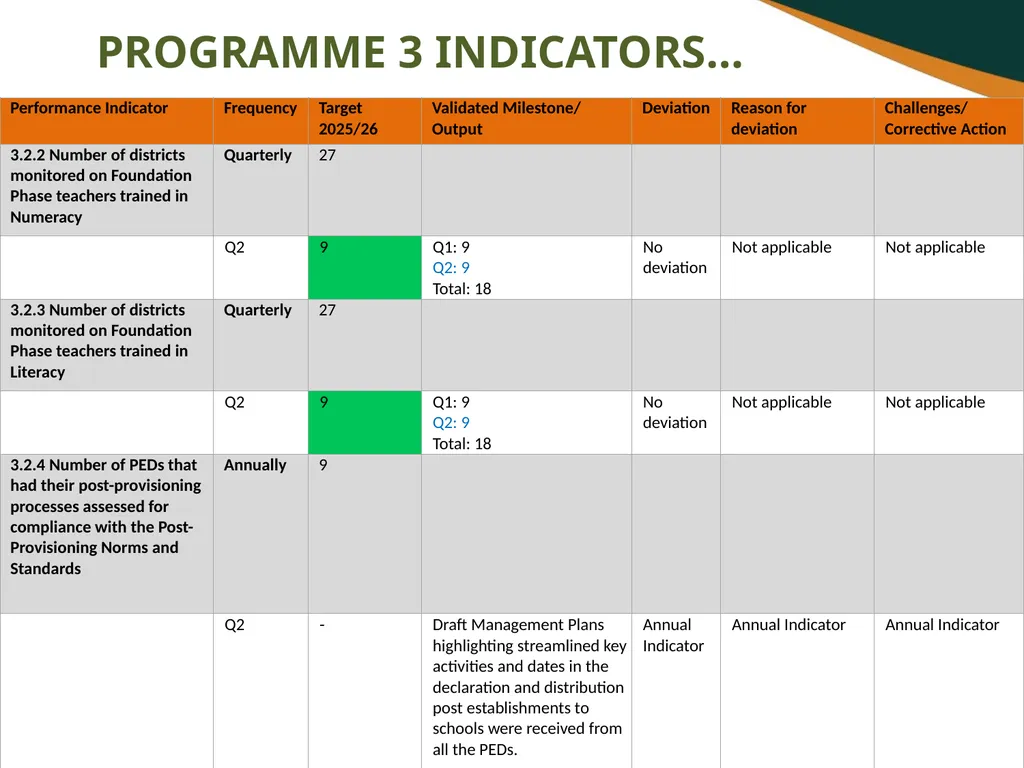
slide41. PROGRAMME 3 INDICATORS… 41<br>
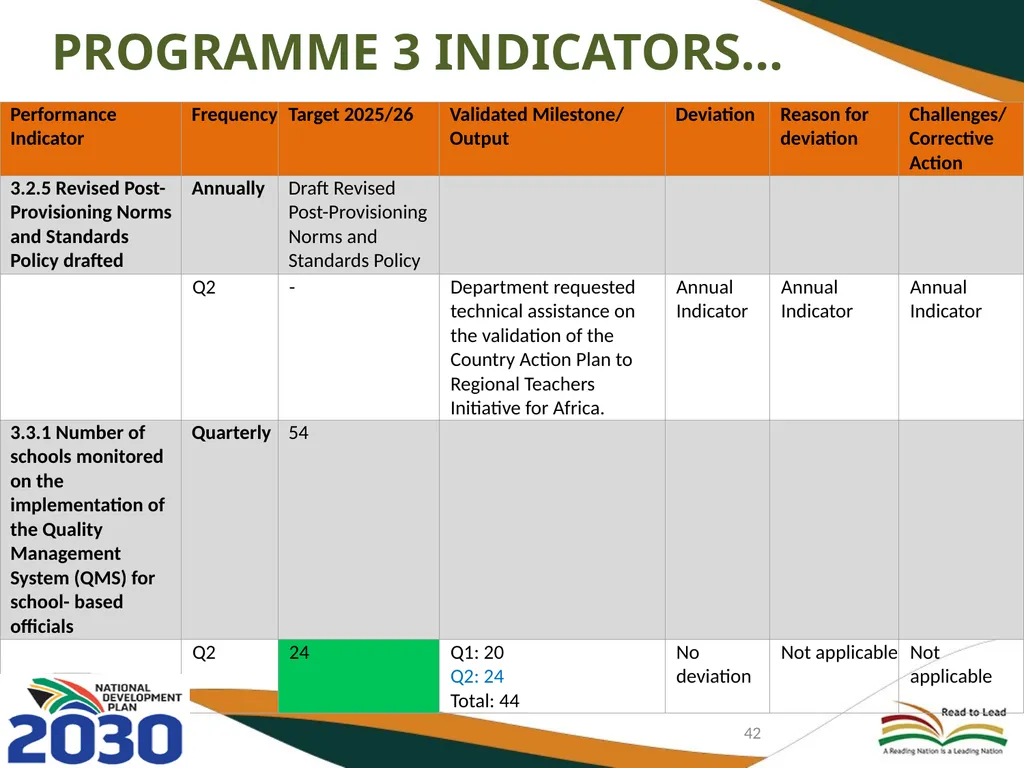
slide42. PROGRAMME 3 INDICATORS… 42<br>
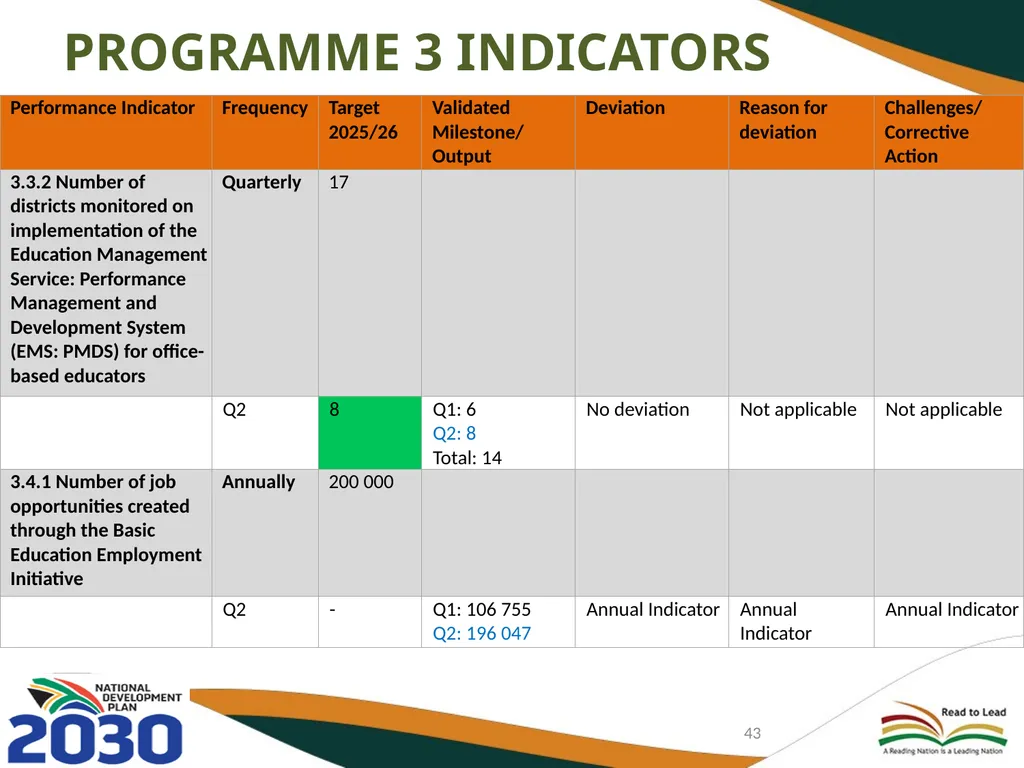
slide43. PROGRAMME 3 INDICATORS 43<br>
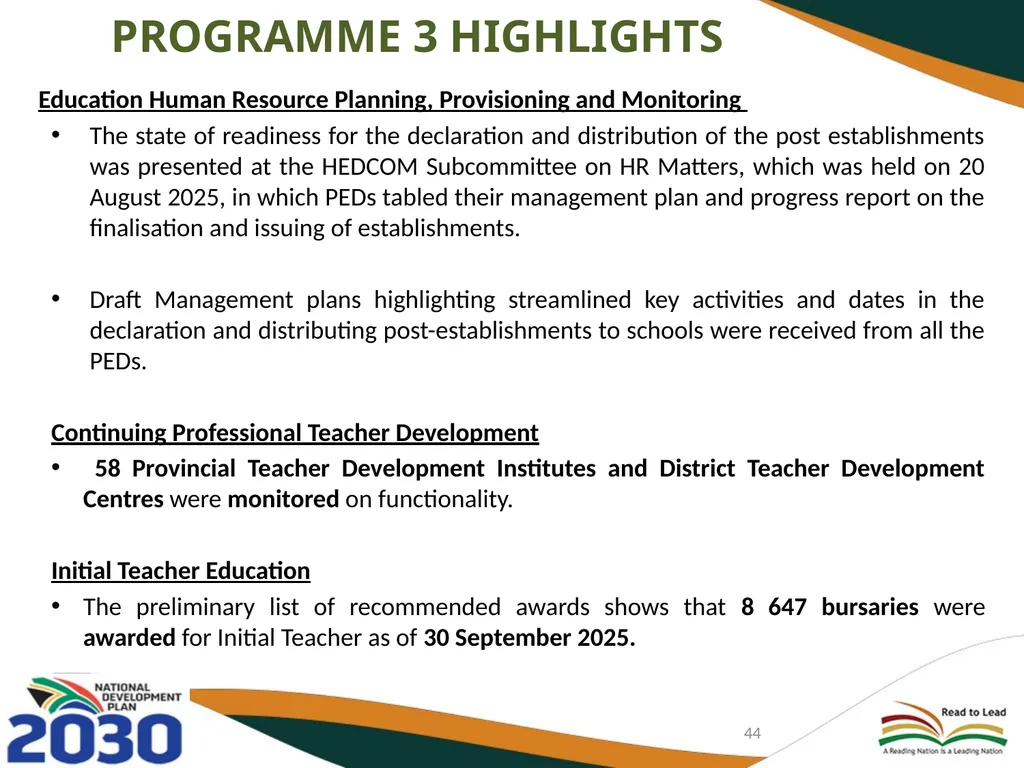
slide44. PROGRAMME 3 HIGHLIGHTS Education Human Resource Planning, Provisioning and Monitoring
The state of readiness for the declaration and distribution of the post establishments was presented at the HEDCOM Subcommittee on HR Matters, which was held on 20 August 2025, in which PEDs tabled their management plan and progress report on the finalisation and issuing of establishments.
Draft Management plans highlighting streamlined key activities and dates in the declaration and distributing post-establishments to schools were received from all the PEDs.
Continuing Professional Teacher Development
58 Provincial Teacher Development Institutes and District Teacher Development Centres were monitored on functionality.
Initial Teacher Education
The preliminary list of recommended awards shows that 8 647 bursaries were awarded for Initial Teacher as of 30 September 2025. 44<br>
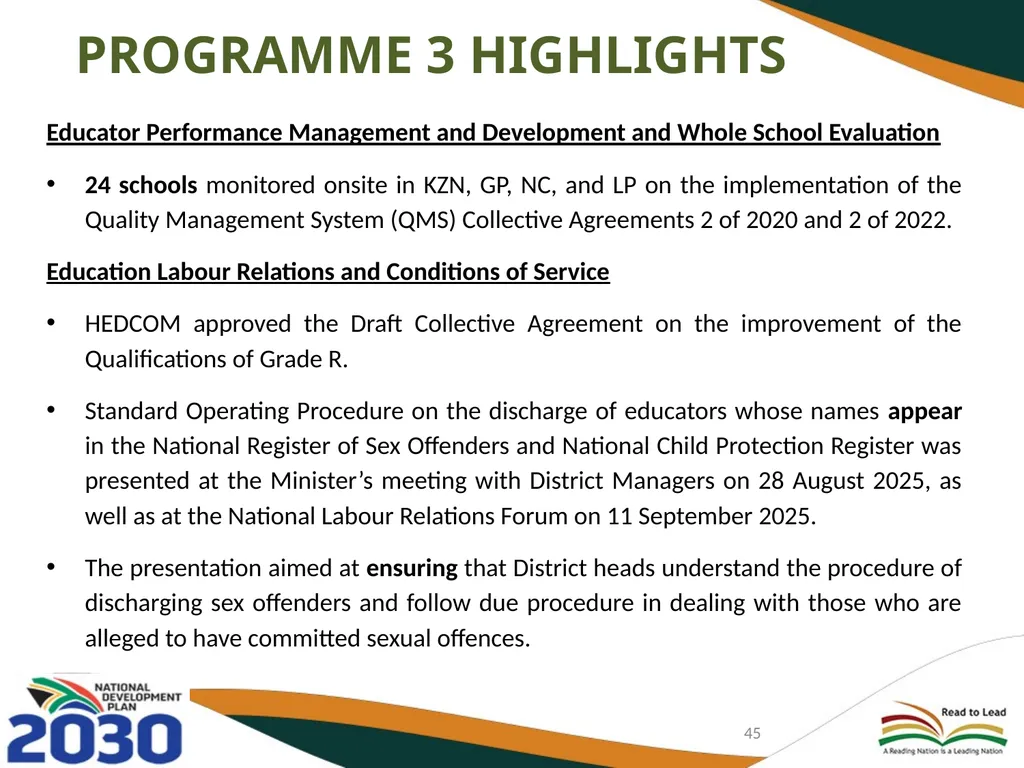
slide45. PROGRAMME 3 HIGHLIGHTS Educator Performance Management and Development and Whole School Evaluation
24 schools monitored onsite in KZN, GP, NC, and LP on the implementation of the Quality Management System (QMS) Collective Agreements 2 of 2020 and 2 of 2022.
Education Labour Relations and Conditions of Service
HEDCOM approved the Draft Collective Agreement on the improvement of the Qualifications of Grade R.
Standard Operating Procedure on the discharge of educators whose names appear in the National Register of Sex Offenders and National Child Protection Register was presented at the Minister’s meeting with District Managers on 28 August 2025, as well as at the National Labour Relations Forum on 11 September 2025.
The presentation aimed at ensuring that District heads understand the procedure of discharging sex offenders and follow due procedure in dealing with those who are alleged to have committed sexual offences. 45<br>
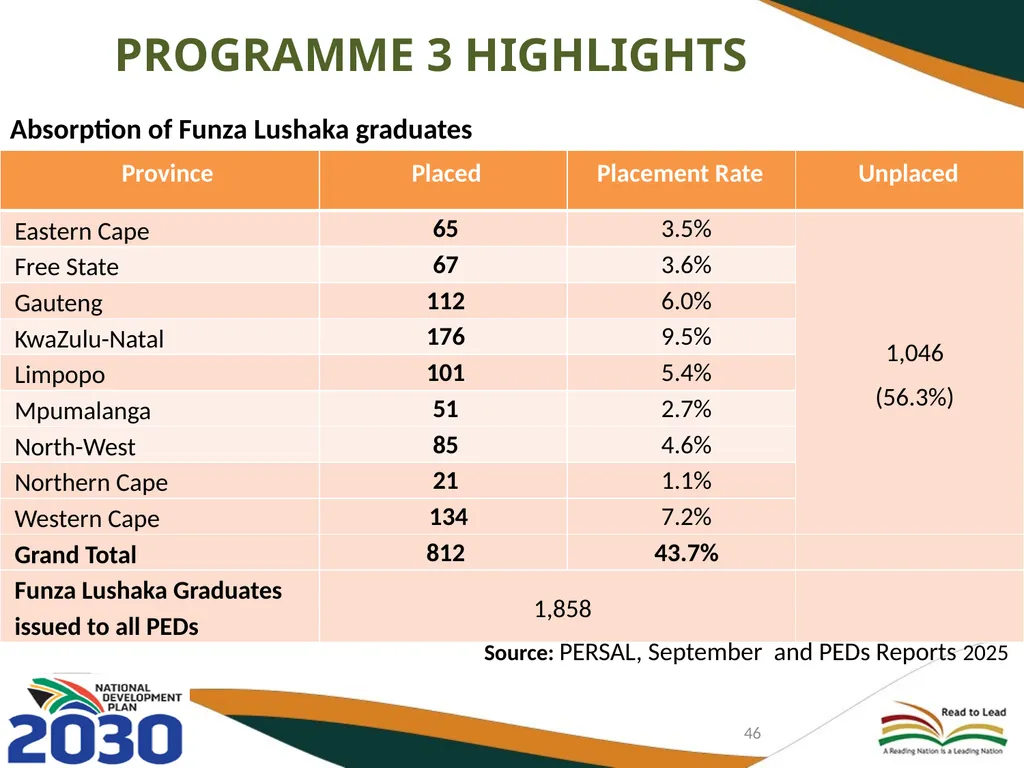
slide46. PROGRAMME 3 HIGHLIGHTS Source: PERSAL, September and PEDs Reports 2025 Absorption of Funza Lushaka graduates 46<br>
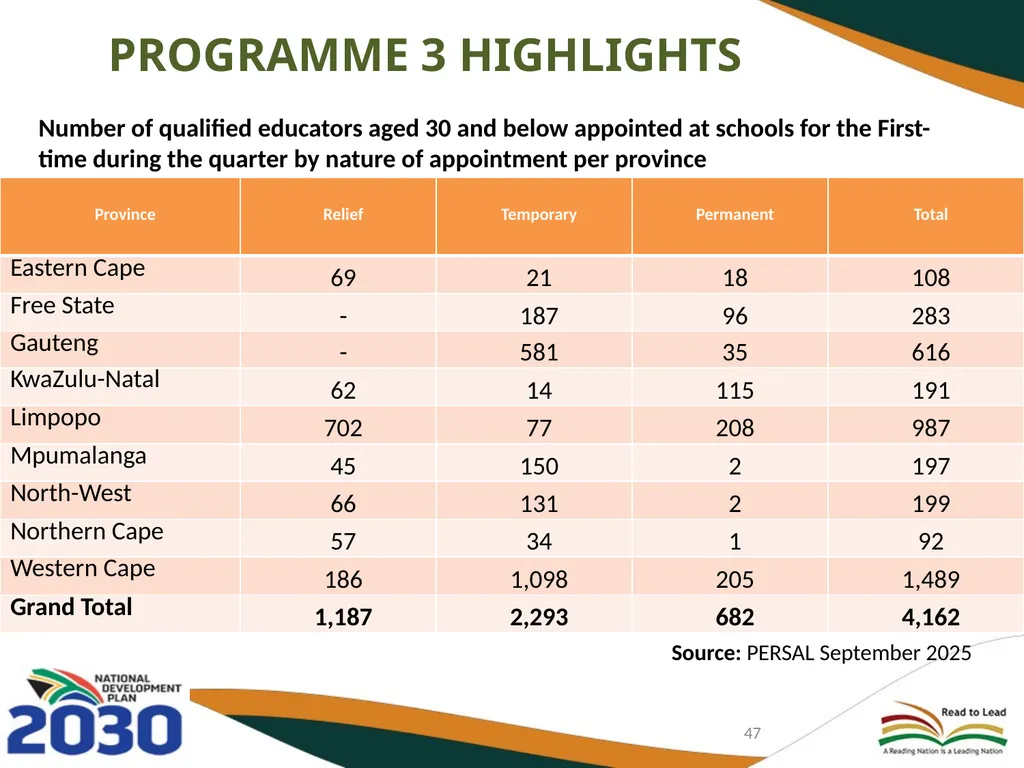
slide47. PROGRAMME 3 HIGHLIGHTS Number of qualified educators aged 30 and below appointed at schools for the First- time during the quarter by nature of appointment per province 47 Source: PERSAL September 2025<br>
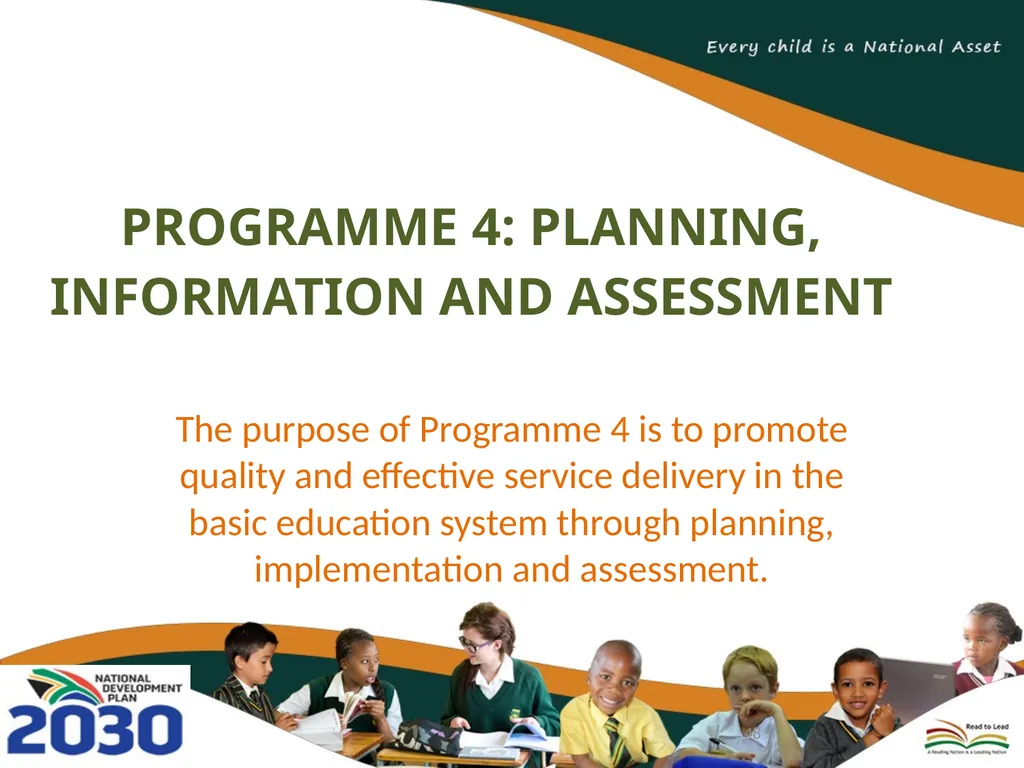
slide48. PROGRAMME 4: PLANNING, INFORMATION AND ASSESSMENT The purpose of Programme 4 is to promote quality and effective service delivery in the basic education system through planning, implementation and assessment. 48<br>
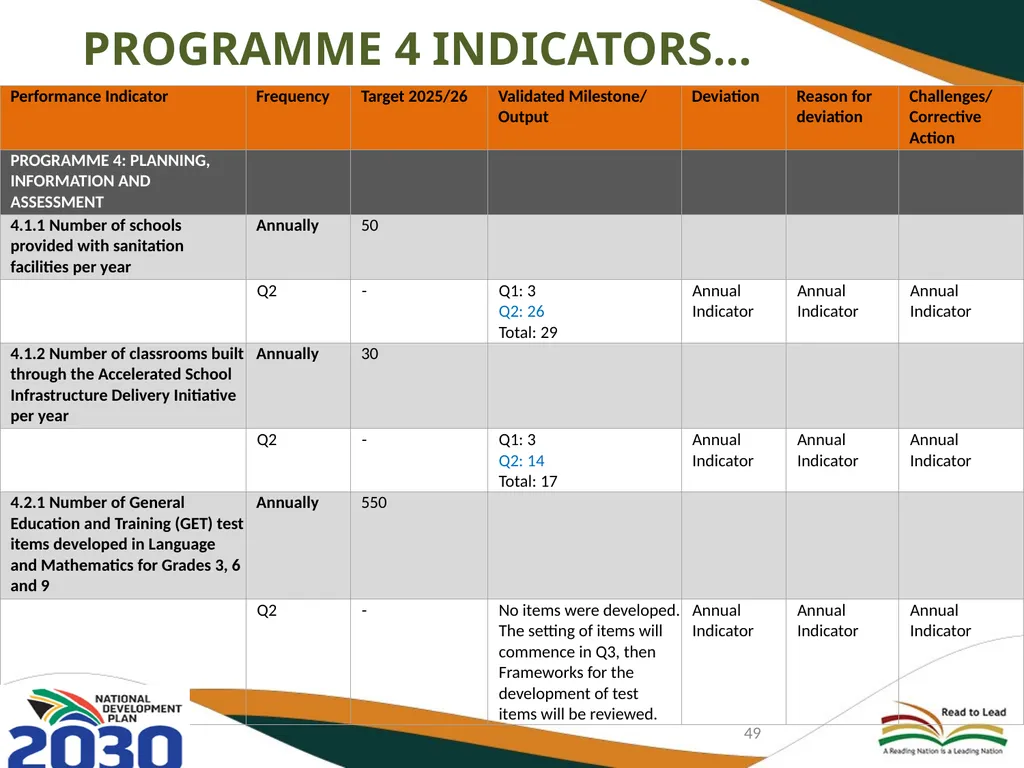
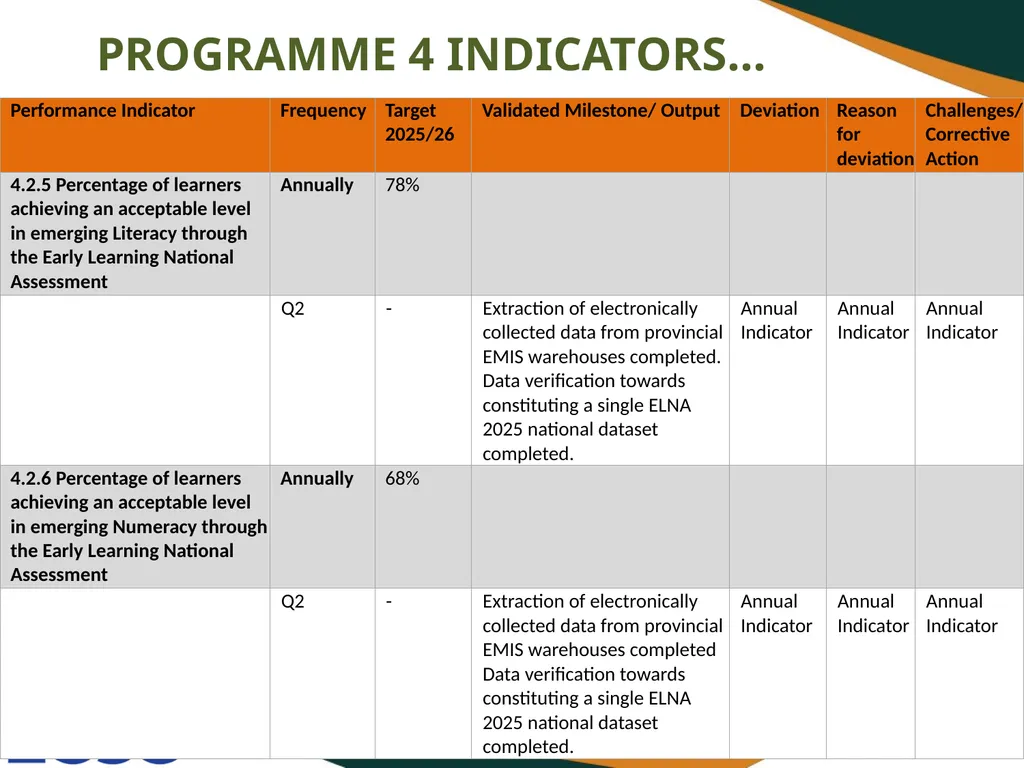
slide49. PROGRAMME 4 INDICATORS… 49<br>
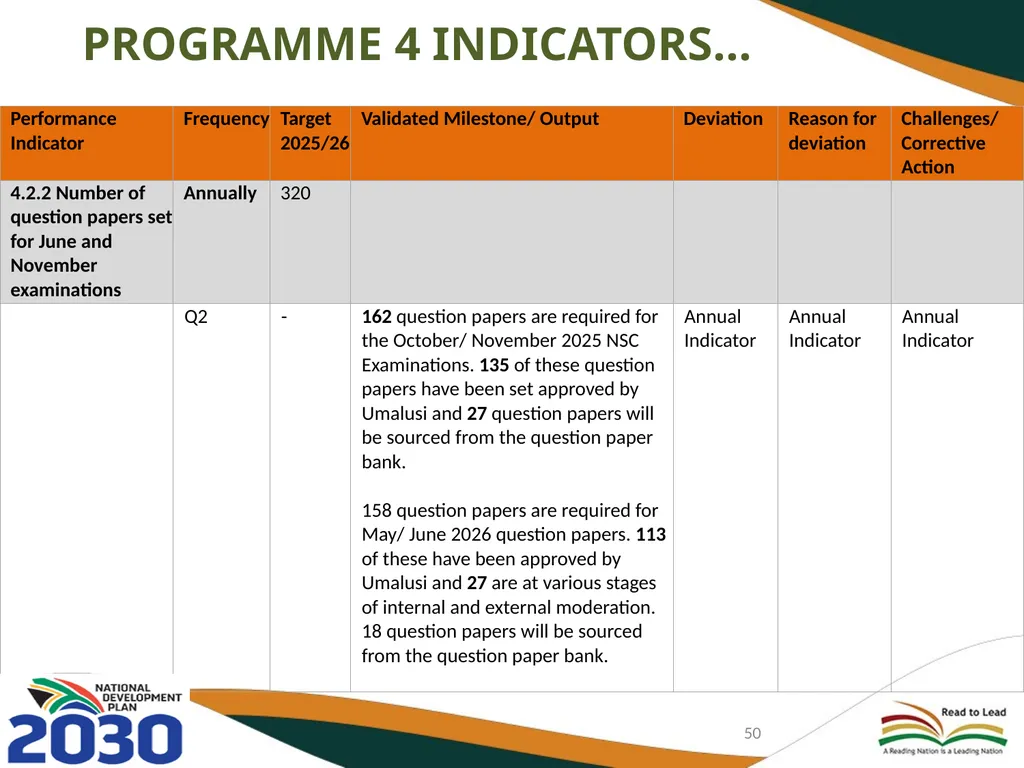
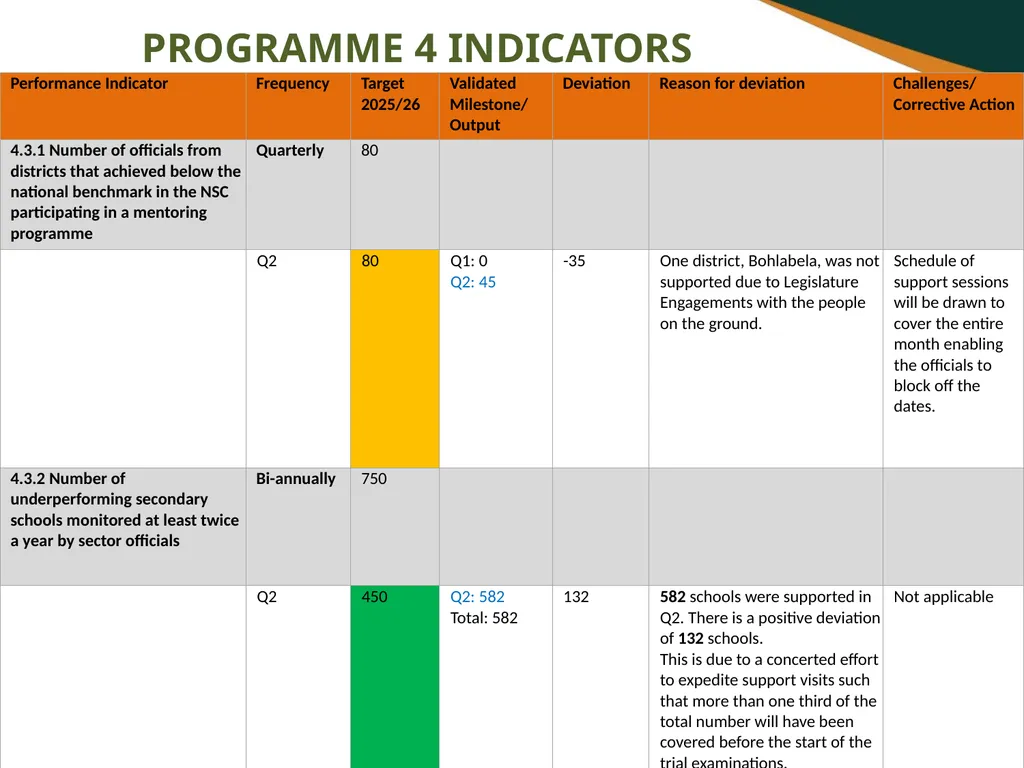
slide50. PROGRAMME 4 INDICATORS… 50<br>
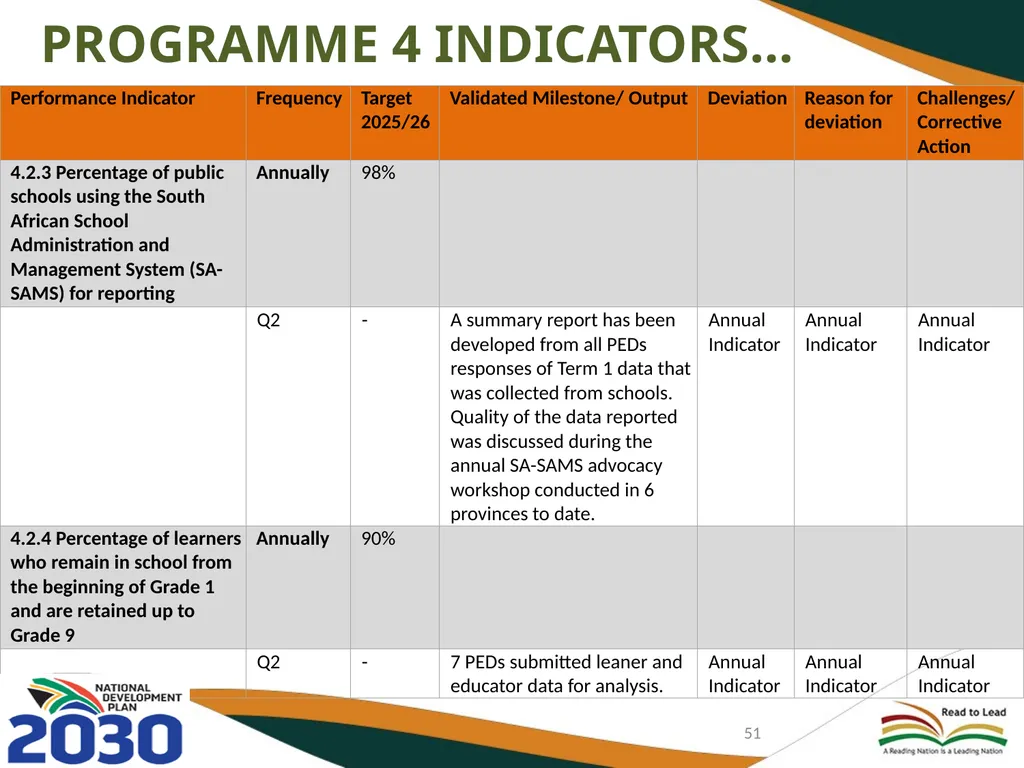
slide51. PROGRAMME 4 INDICATORS… 51<br>
slide52. PROGRAMME 4 INDICATORS… 52<br>
slide53. PROGRAMME 4 INDICATORS 53<br>
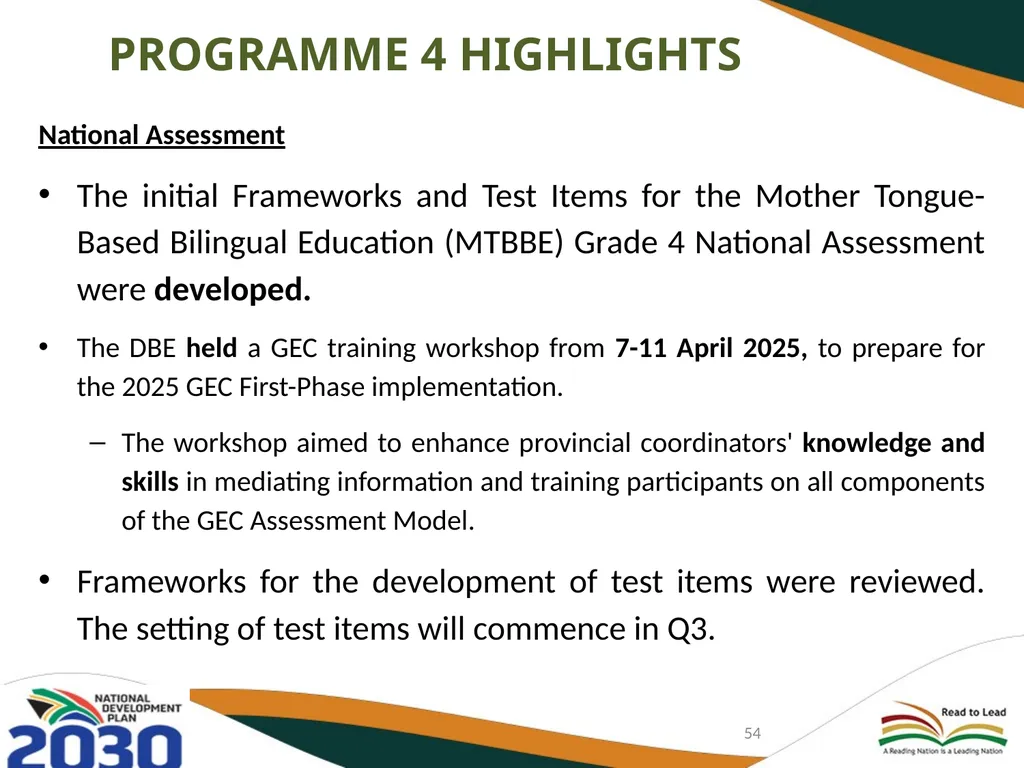
slide54. PROGRAMME 4 HIGHLIGHTS National Assessment
The initial Frameworks and Test Items for the Mother Tongue-Based Bilingual Education (MTBBE) Grade 4 National Assessment were developed.
The DBE held a GEC training workshop from 7-11 April 2025, to prepare for the 2025 GEC First-Phase implementation.
The workshop aimed to enhance provincial coordinators' knowledge and skills in mediating information and training participants on all components of the GEC Assessment Model.
Frameworks for the development of test items were reviewed. The setting of test items will commence in Q3. 54<br>
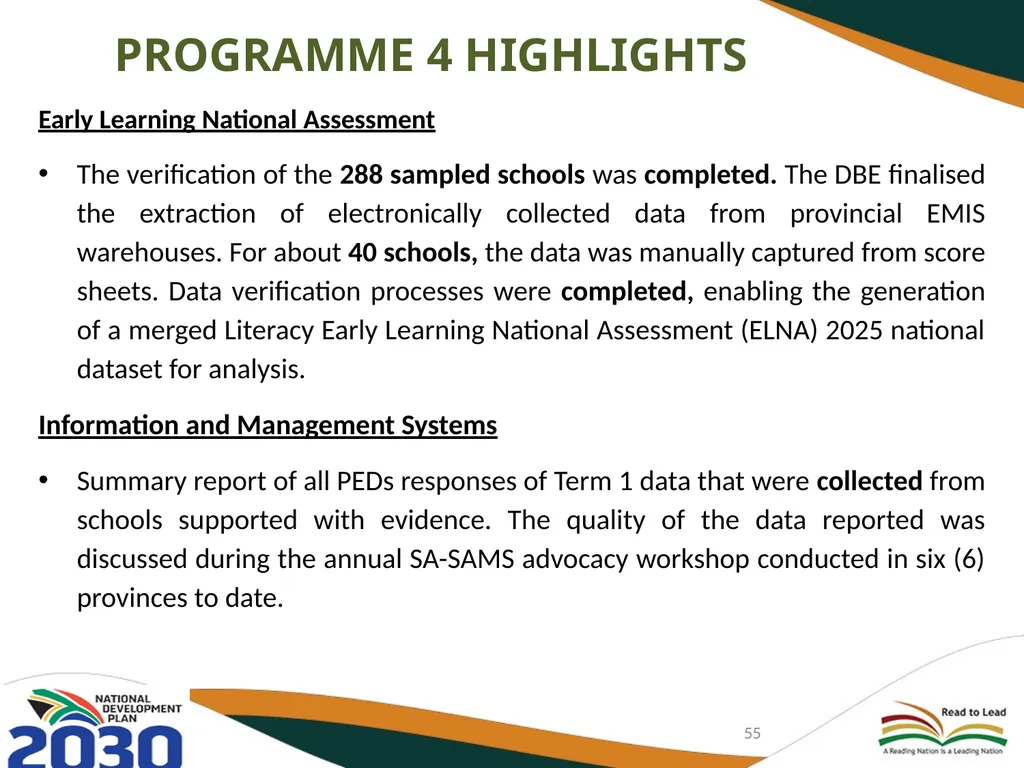
slide55. PROGRAMME 4 HIGHLIGHTS Early Learning National Assessment
The verification of the 288 sampled schools was completed. The DBE finalised the extraction of electronically collected data from provincial EMIS warehouses. For about 40 schools, the data was manually captured from score sheets. Data verification processes were completed, enabling the generation of a merged Literacy Early Learning National Assessment (ELNA) 2025 national dataset for analysis.
Information and Management Systems
Summary report of all PEDs responses of Term 1 data that were collected from schools supported with evidence. The quality of the data reported was discussed during the annual SA-SAMS advocacy workshop conducted in six (6) provinces to date. 55<br>
slide56. PROGRAMME 4 HIGHLIGHTS Provincial and District Planning and Implementation Support
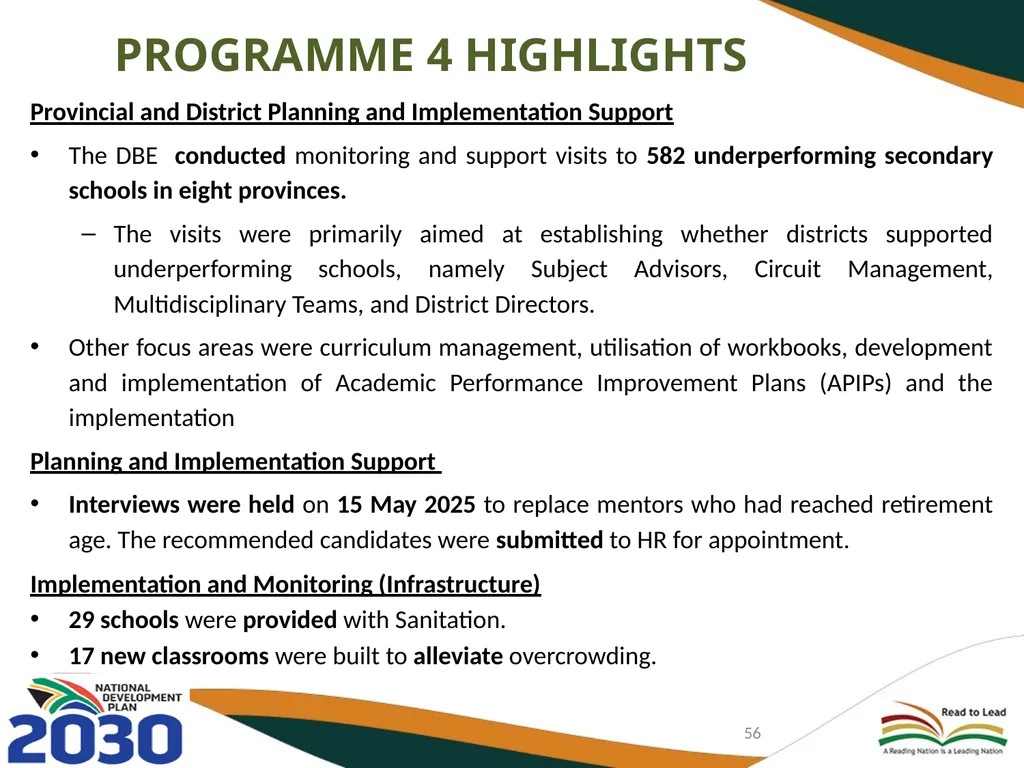
The DBE conducted monitoring and support visits to 582 underperforming secondary schools in eight provinces.
The visits were primarily aimed at establishing whether districts supported underperforming schools, namely Subject Advisors, Circuit Management, Multidisciplinary Teams, and District Directors.
Other focus areas were curriculum management, utilisation of workbooks, development and implementation of Academic Performance Improvement Plans (APIPs) and the implementation
Planning and Implementation Support
Interviews were held on 15 May 2025 to replace mentors who had reached retirement age. The recommended candidates were submitted to HR for appointment.
Implementation and Monitoring (Infrastructure)
29 schools were provided with Sanitation.
17 new classrooms were built to alleviate overcrowding. 56<br>
slide57. PROGRAMME 5: EDUCATIONAL ENRICHMENT SERVICES The purpose of Programme 5 is to develop policies and programmes to improve the quality of learning in schools. 57<br>
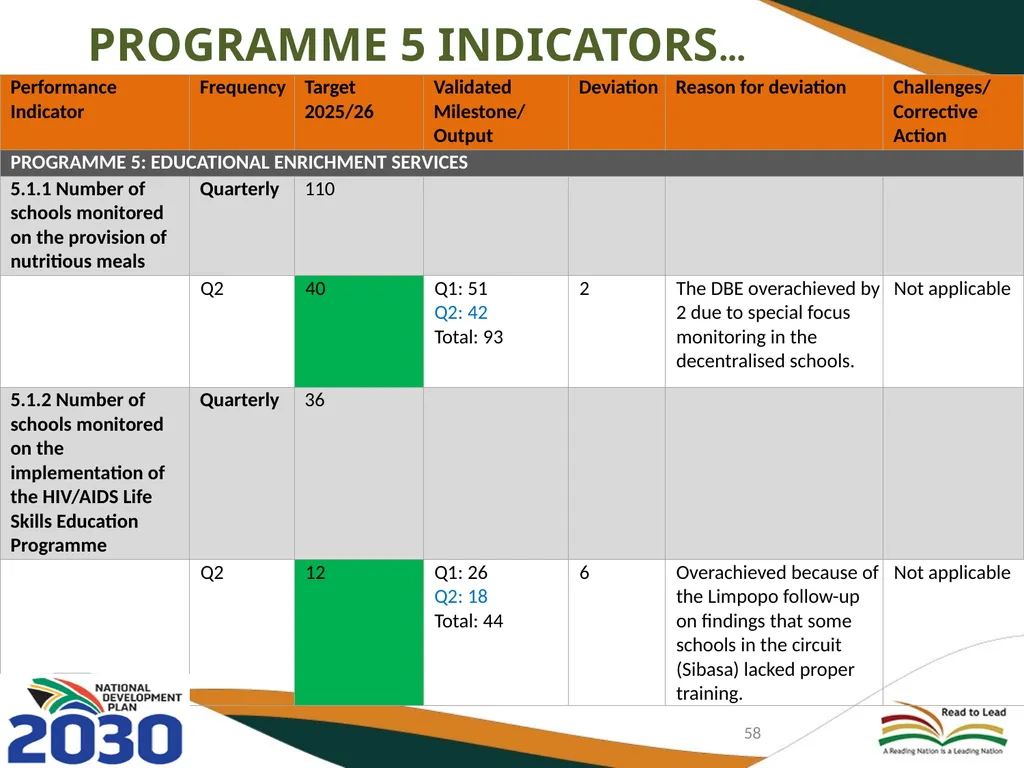
slide58. PROGRAMME 5 INDICATORS… 58<br>
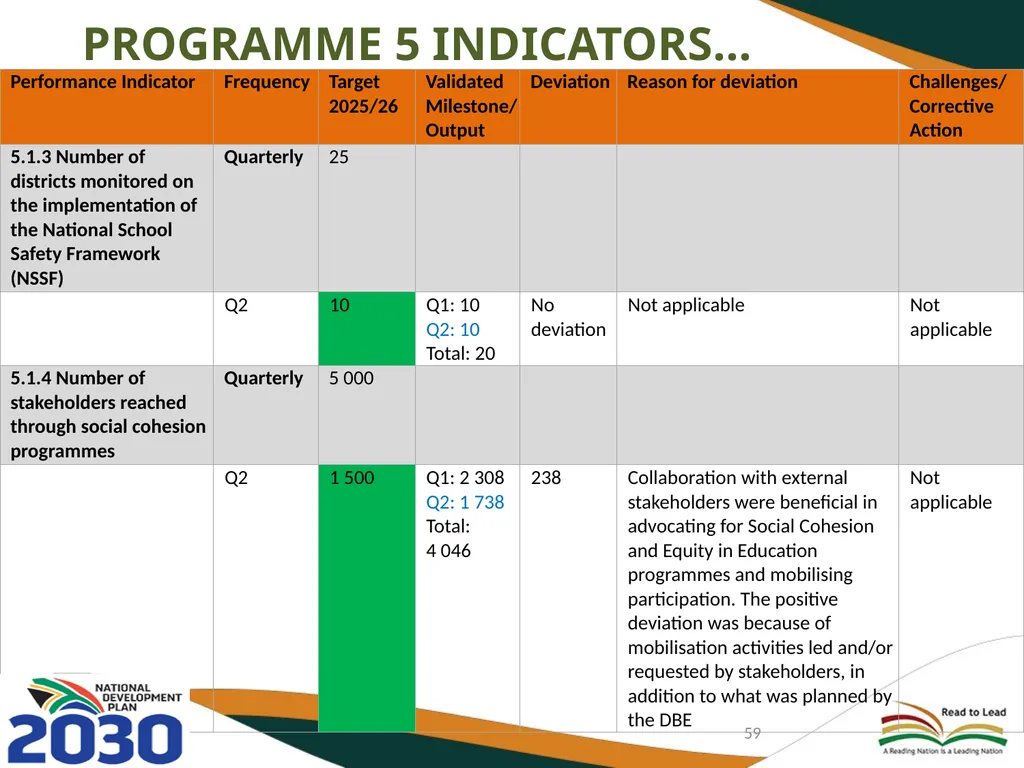
slide59. PROGRAMME 5 INDICATORS… 59<br>
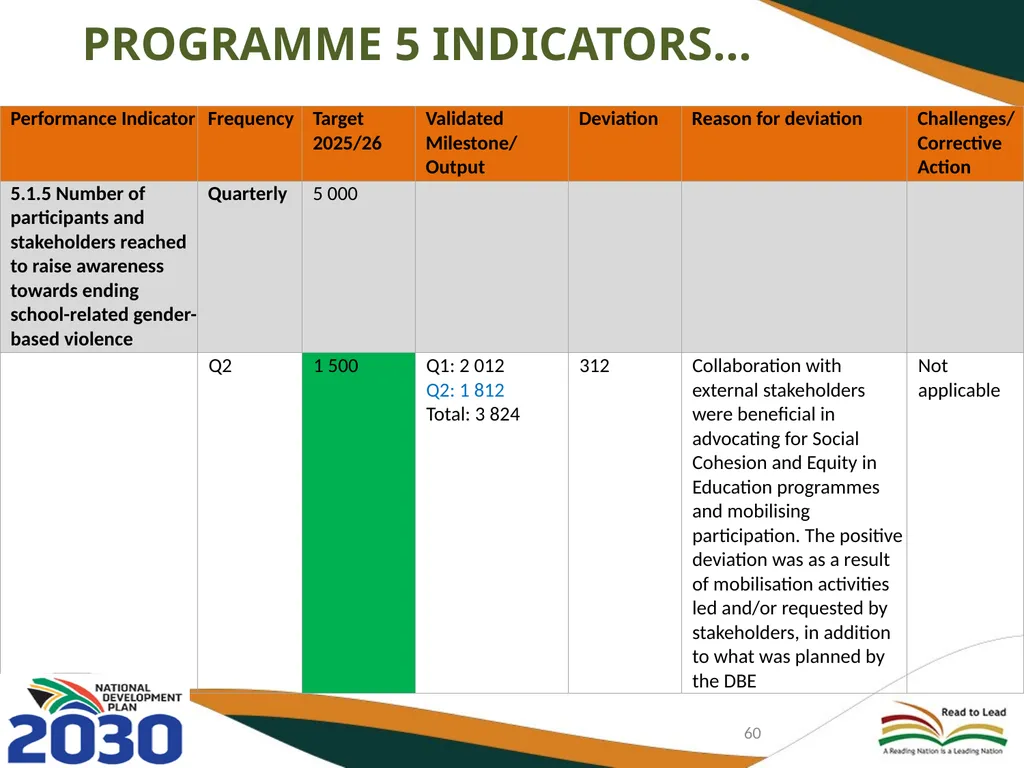
slide60. PROGRAMME 5 INDICATORS… 60<br>
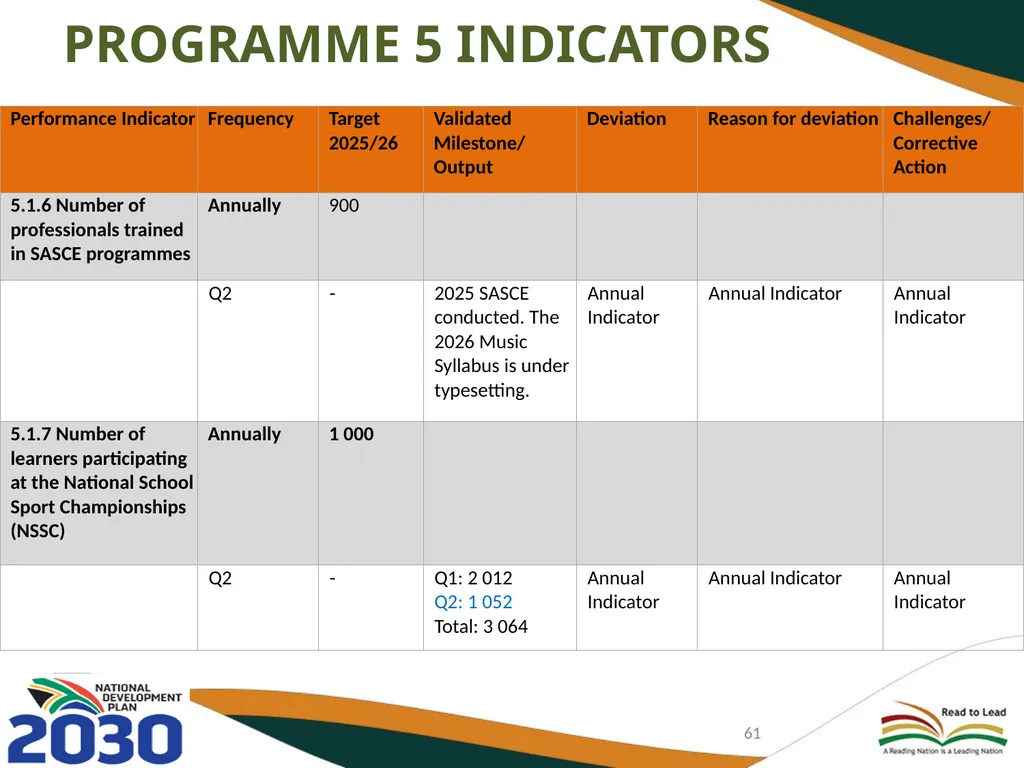
slide61. PROGRAMME 5 INDICATORS 61<br>
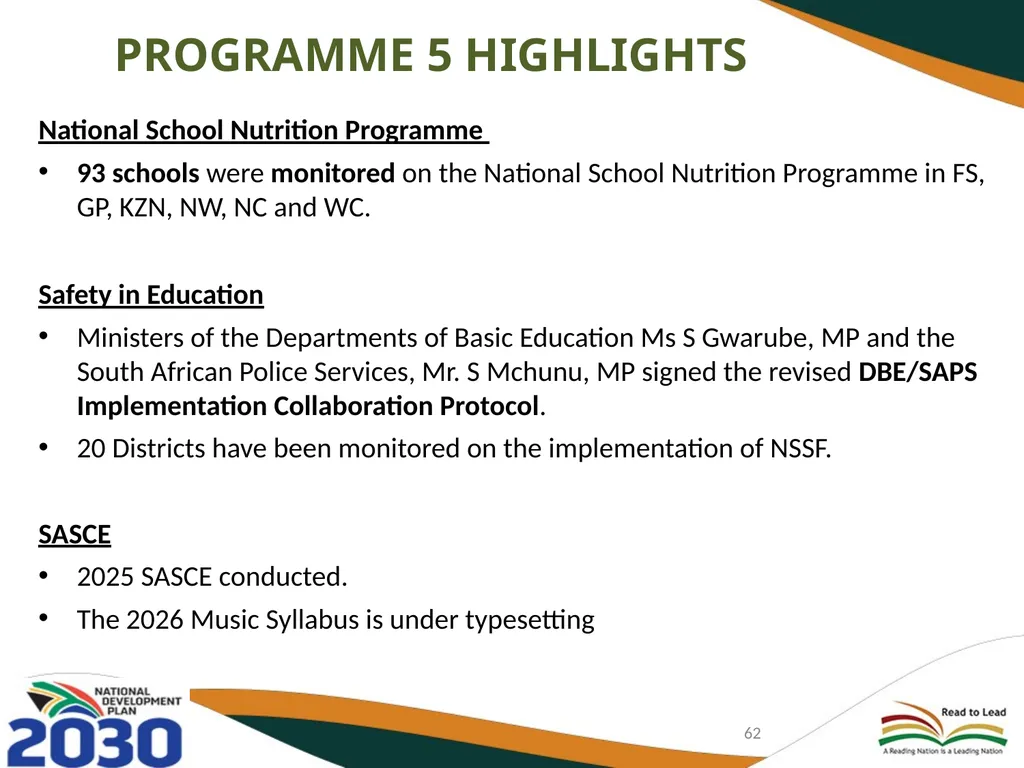
slide62. PROGRAMME 5 HIGHLIGHTS National School Nutrition Programme
93 schools were monitored on the National School Nutrition Programme in FS, GP, KZN, NW, NC and WC.
Safety in Education
Ministers of the Departments of Basic Education Ms S Gwarube, MP and the South African Police Services, Mr. S Mchunu, MP signed the revised DBE/SAPS Implementation Collaboration Protocol.
20 Districts have been monitored on the implementation of NSSF.
SASCE
2025 SASCE conducted.
The 2026 Music Syllabus is under typesetting 62<br>
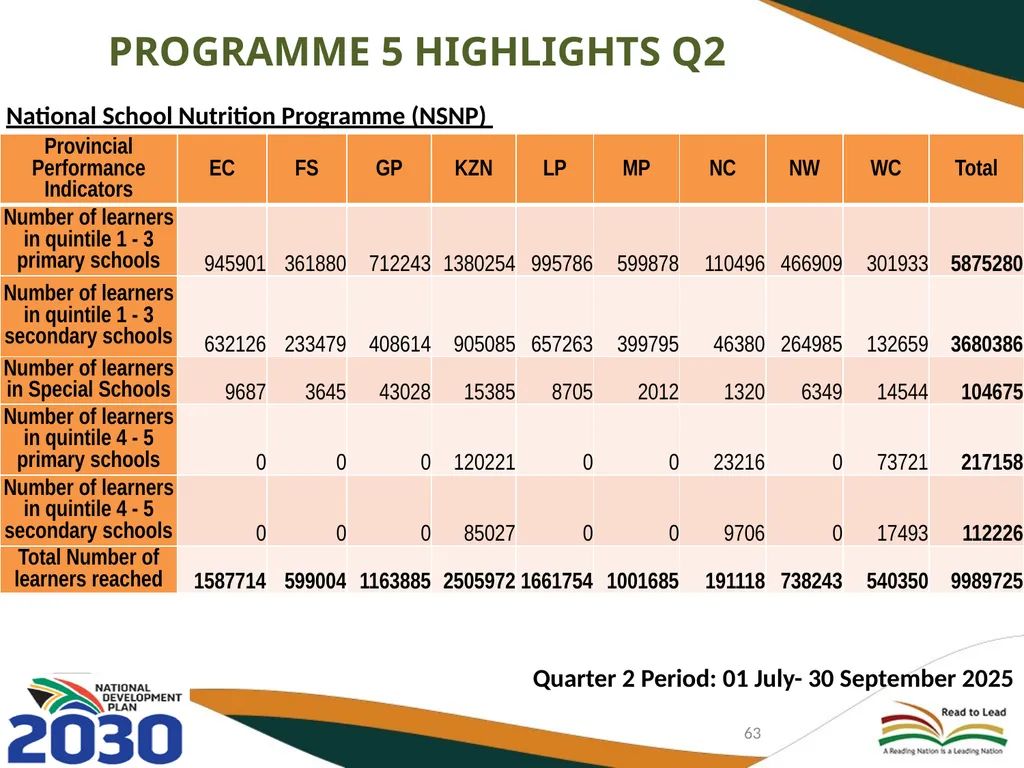
slide63. PROGRAMME 5 HIGHLIGHTS Q2 National School Nutrition Programme (NSNP) Quarter 2 Period: 01 July- 30 September 2025 63<br>
slide64. QUARTER 2 PRESENTATION TO PORTFOLIO COMMITTEE ON BASIC EDUCATION 2025/26 FINANCIAL YEAR 64<br>
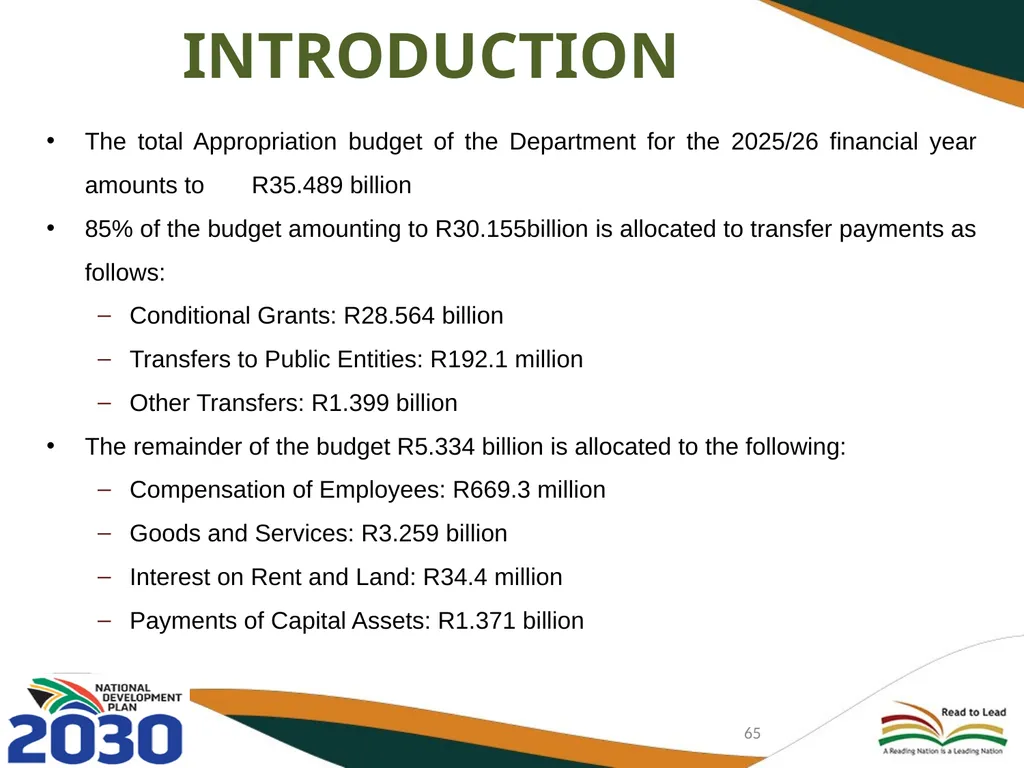
slide65. INTRODUCTION The total Appropriation budget of the Department for the 2025/26 financial year amounts to R35.489 billion
85% of the budget amounting to R30.155billion is allocated to transfer payments as follows:
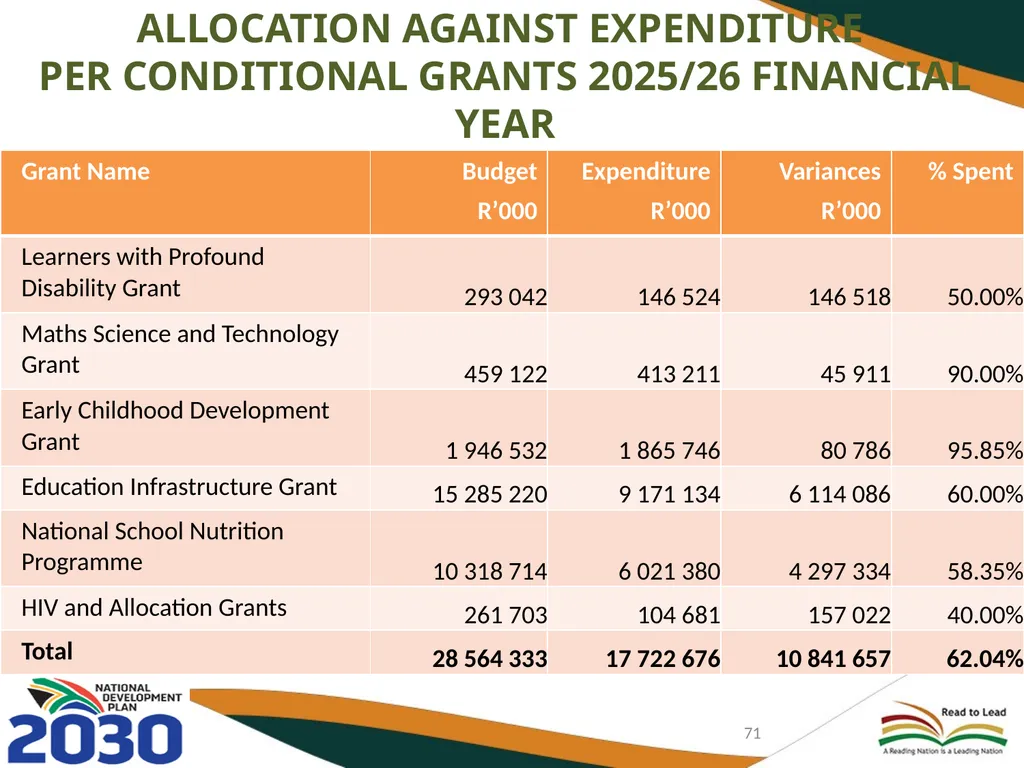
Conditional Grants: R28.564 billion
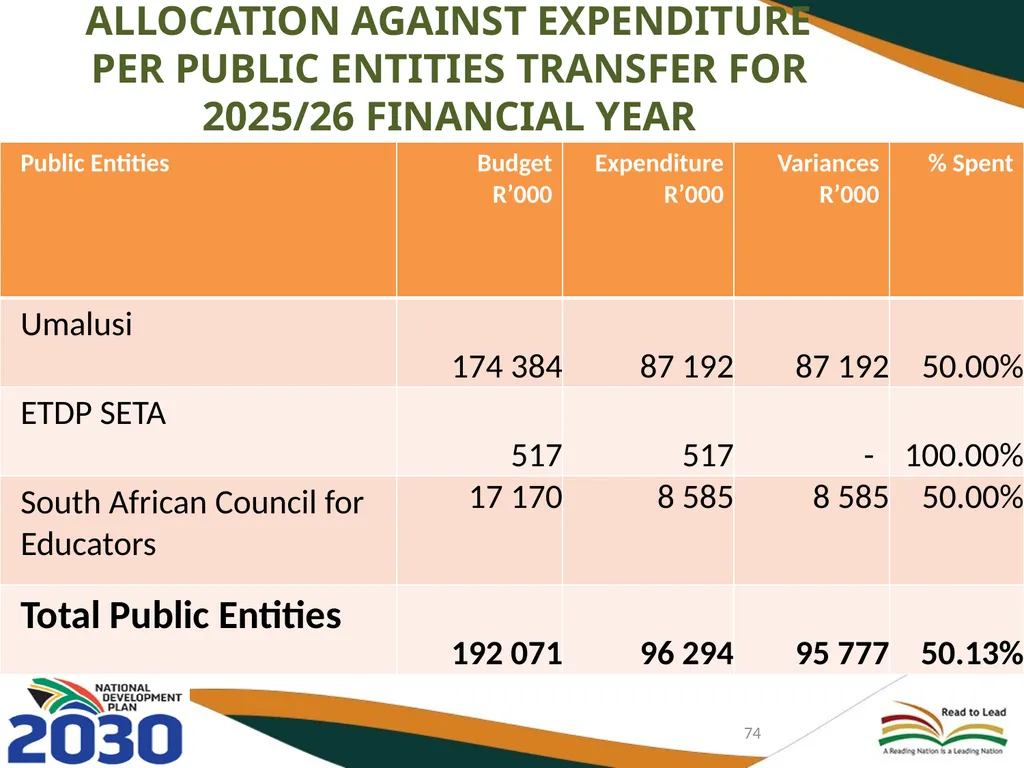
Transfers to Public Entities: R192.1 million
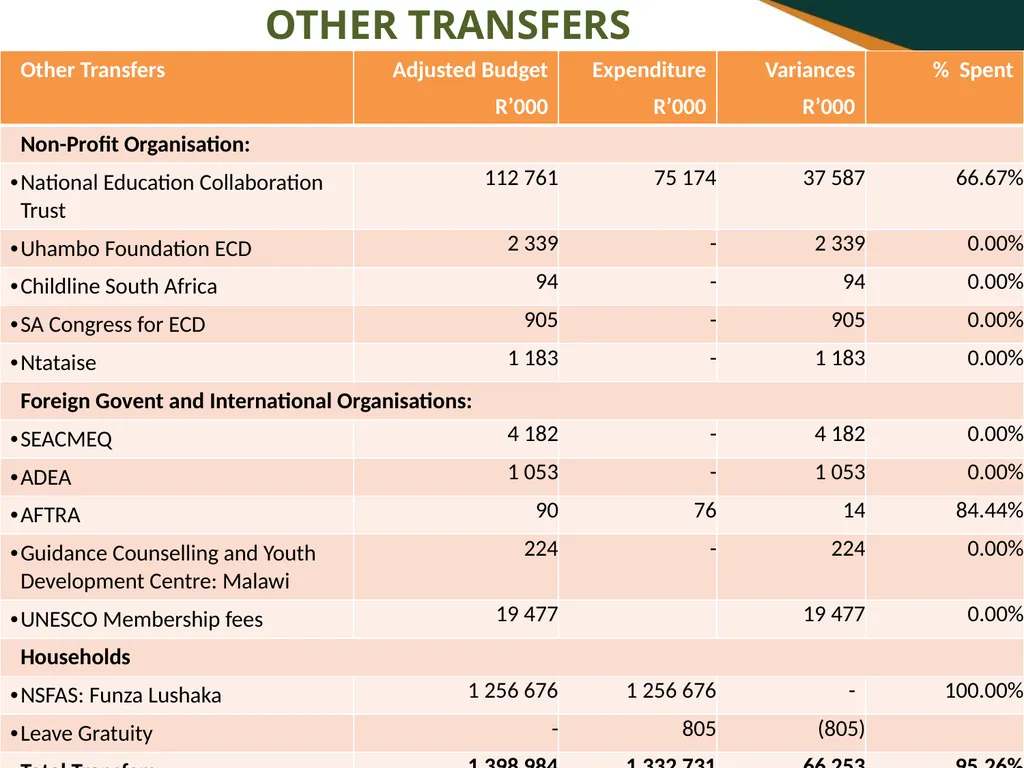
Other Transfers: R1.399 billion
The remainder of the budget R5.334 billion is allocated to the following:
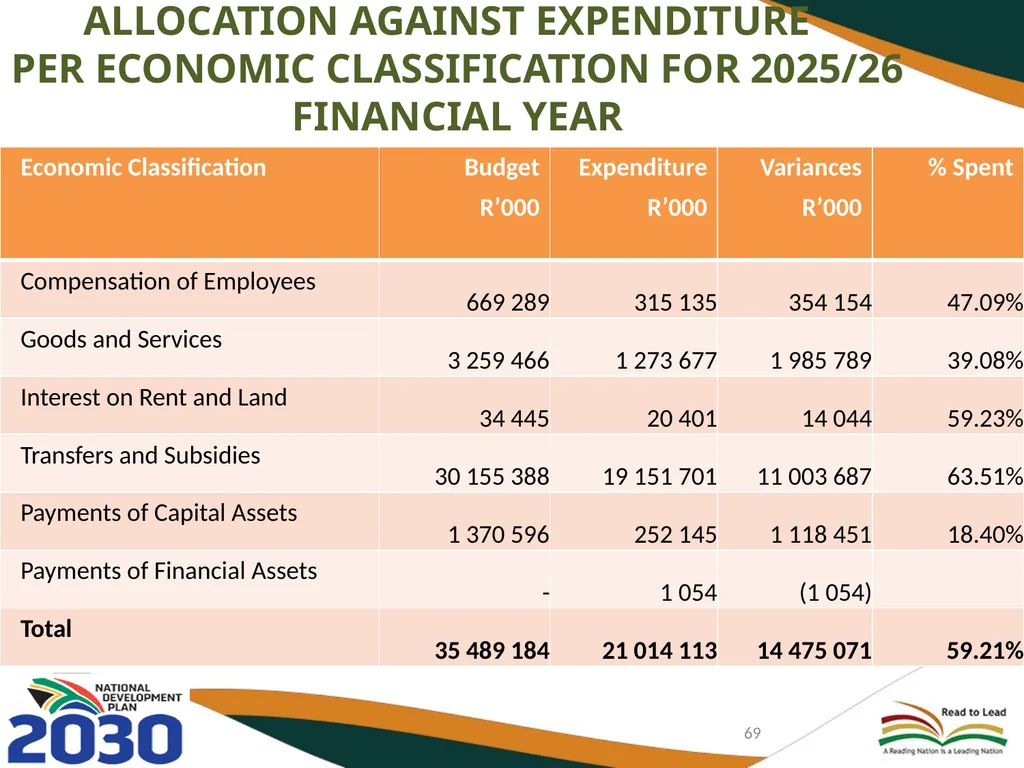
Compensation of Employees: R669.3 million
Goods and Services: R3.259 billion
Interest on Rent and Land: R34.4 million
Payments of Capital Assets: R1.371 billion 65<br>
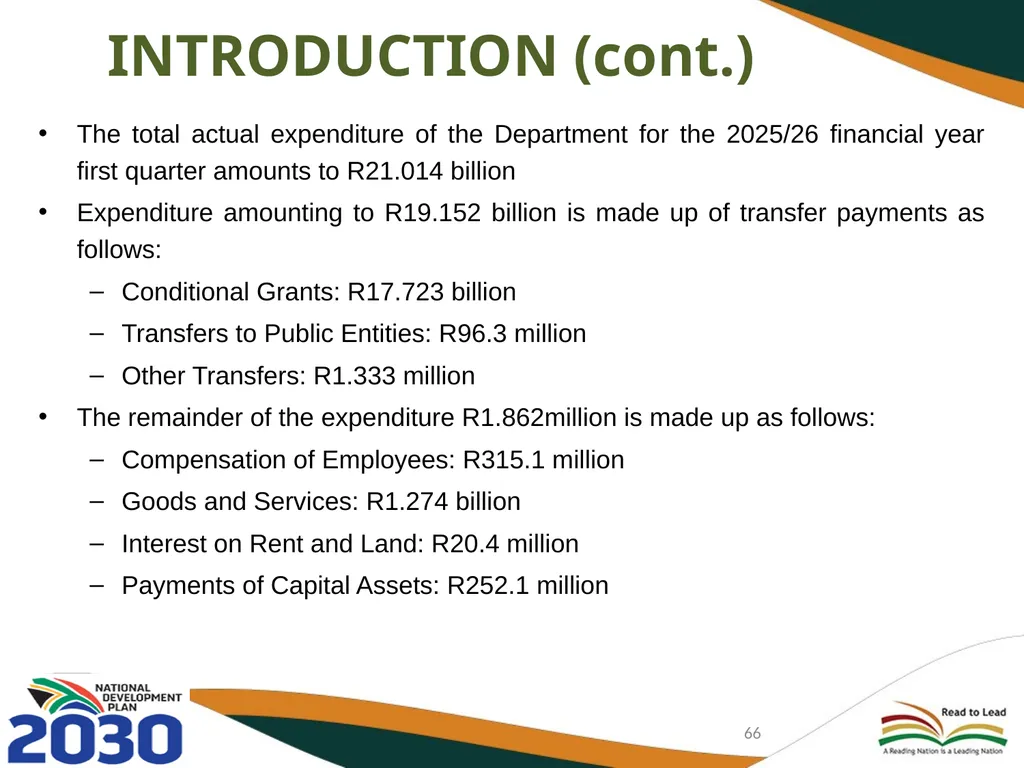
slide66. INTRODUCTION (cont.) The total actual expenditure of the Department for the 2025/26 financial year first quarter amounts to R21.014 billion
Expenditure amounting to R19.152 billion is made up of transfer payments as follows:
Conditional Grants: R17.723 billion
Transfers to Public Entities: R96.3 million
Other Transfers: R1.333 million
The remainder of the expenditure R1.862million is made up as follows:
Compensation of Employees: R315.1 million
Goods and Services: R1.274 billion
Interest on Rent and Land: R20.4 million
Payments of Capital Assets: R252.1 million 66<br>
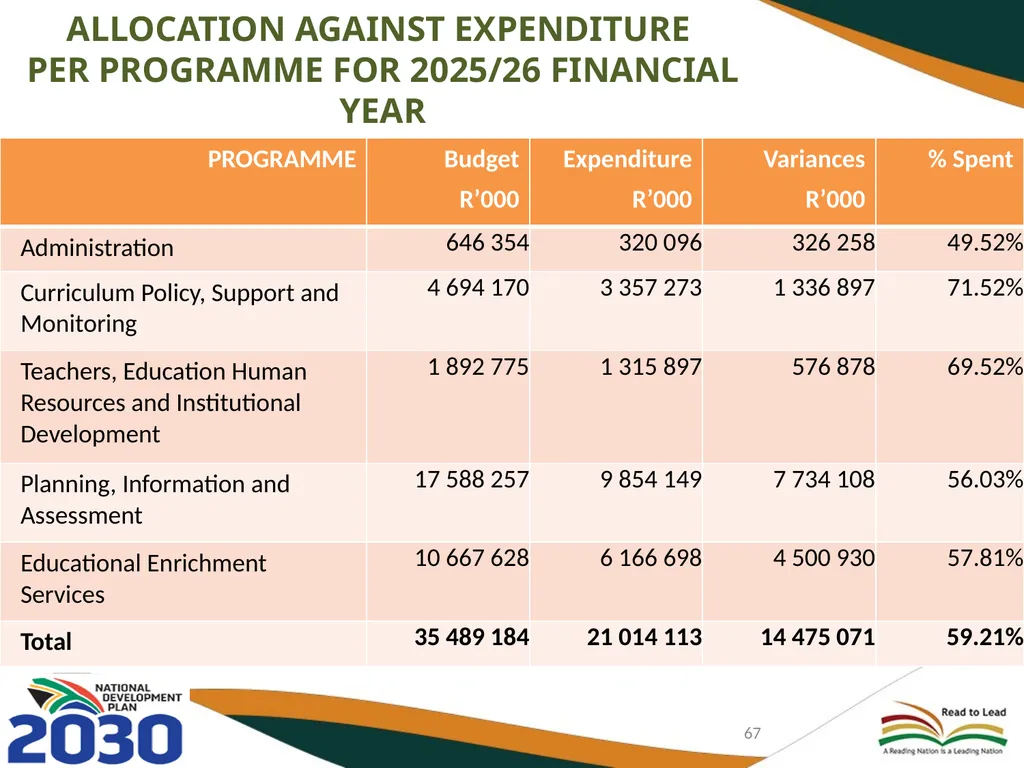
slide67. ALLOCATION AGAINST EXPENDITURE PER PROGRAMME FOR 2025/26 FINANCIAL YEAR 67<br>
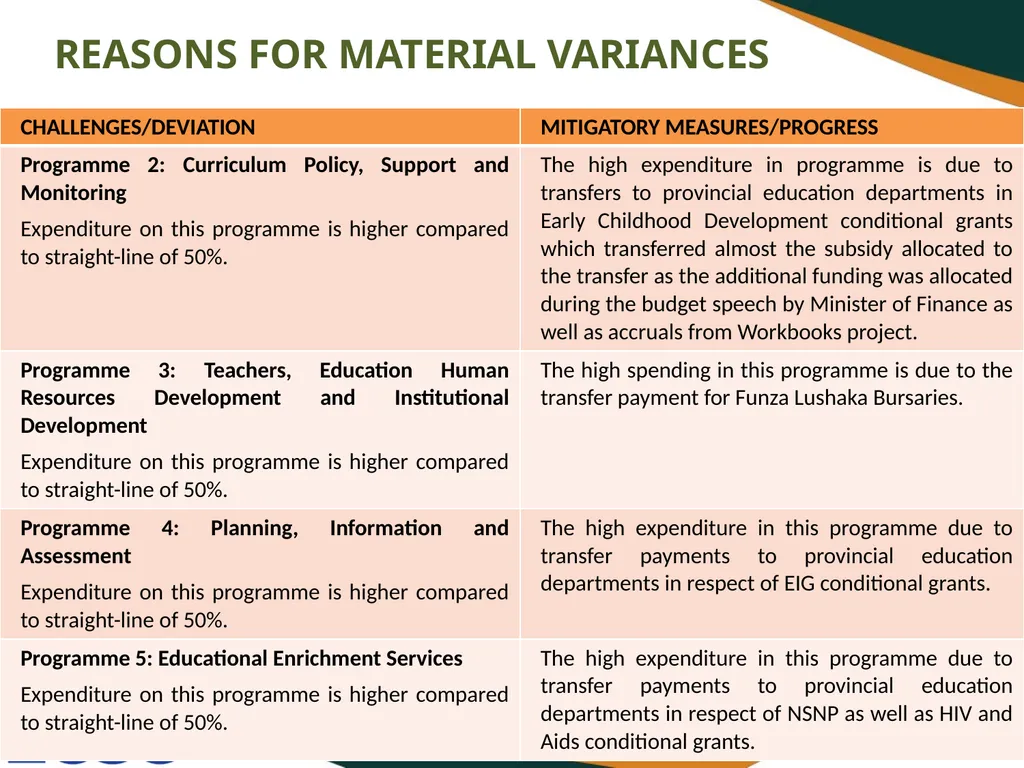
slide68. REASONS FOR MATERIAL VARIANCES 68<br>
slide69. ALLOCATION AGAINST EXPENDITURE PER ECONOMIC CLASSIFICATION FOR 2025/26 FINANCIAL YEAR 69<br>
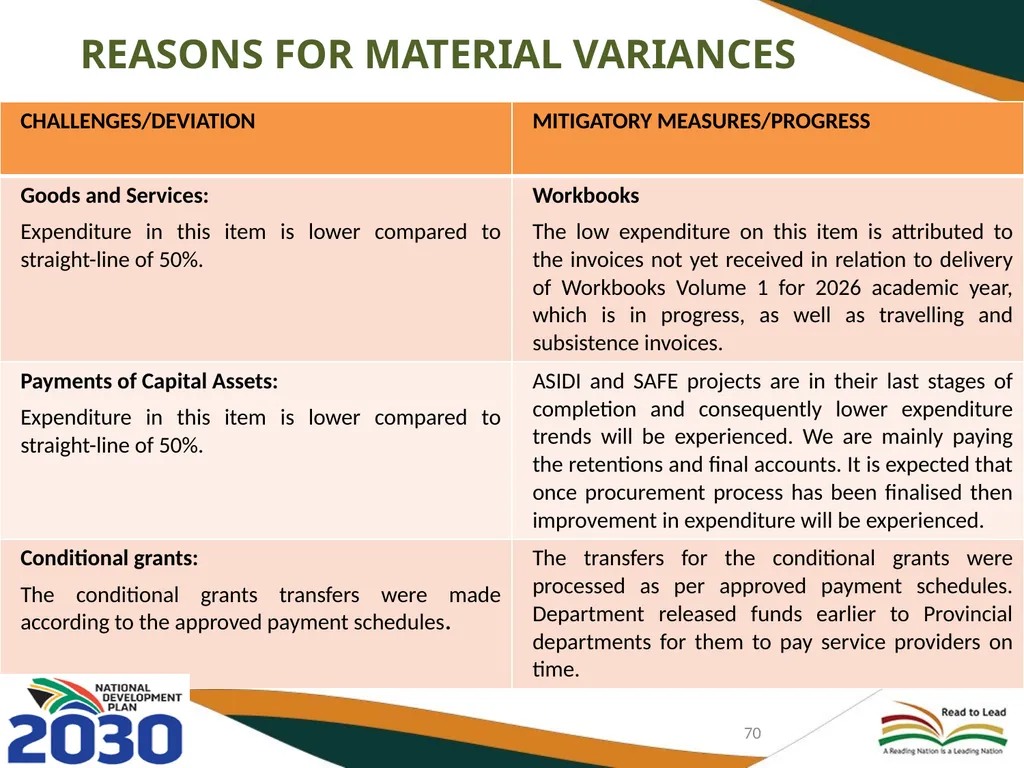
slide70. REASONS FOR MATERIAL VARIANCES 70<br>
slide71. ALLOCATION AGAINST EXPENDITURE PER CONDITIONAL GRANTS 2025/26 FINANCIAL YEAR 71<br>
slide72. OTHER TRANSFERS 72<br>
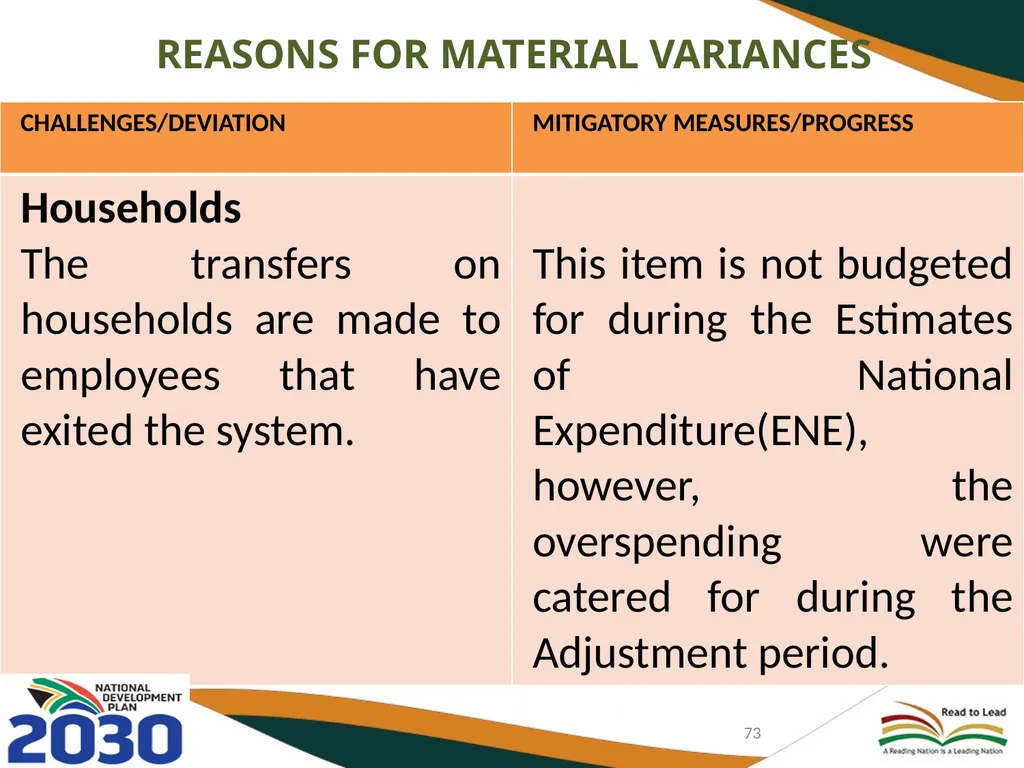
slide73. REASONS FOR MATERIAL VARIANCES 73<br>
slide74. ALLOCATION AGAINST EXPENDITURE PER PUBLIC ENTITIES TRANSFER FOR 2025/26 FINANCIAL YEAR 74<br>
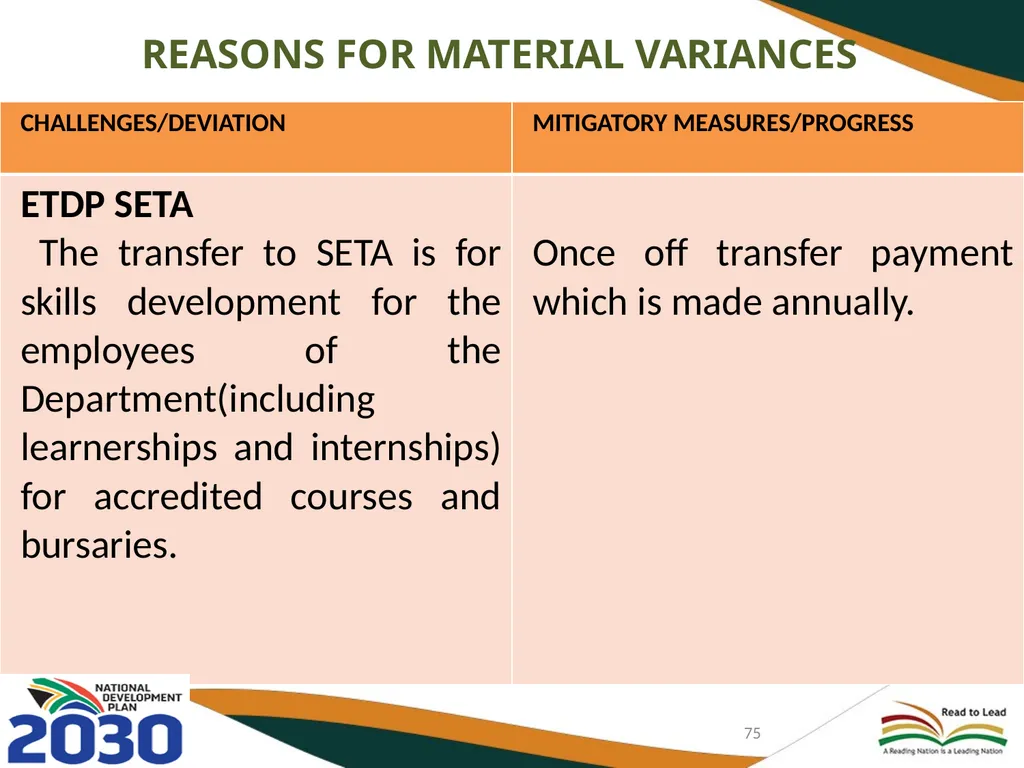
slide75. REASONS FOR MATERIAL VARIANCES 75<br>
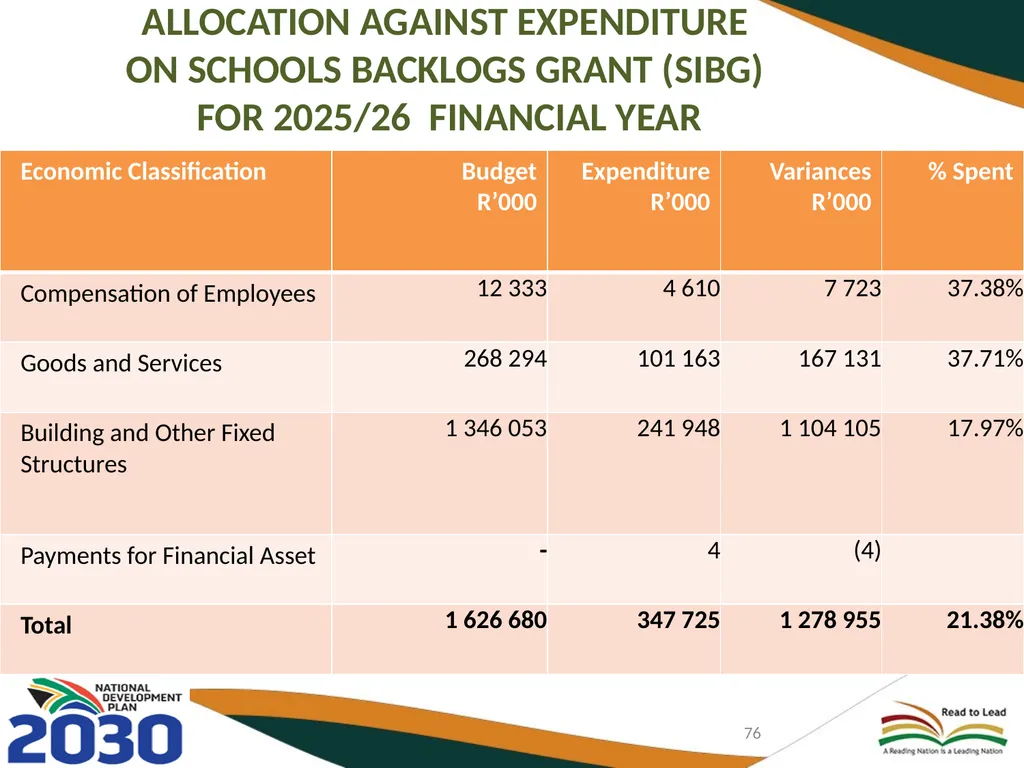
slide76. ALLOCATION AGAINST EXPENDITURE ON SCHOOLS BACKLOGS GRANT (SIBG) FOR 2025/26 FINANCIAL YEAR 76<br>
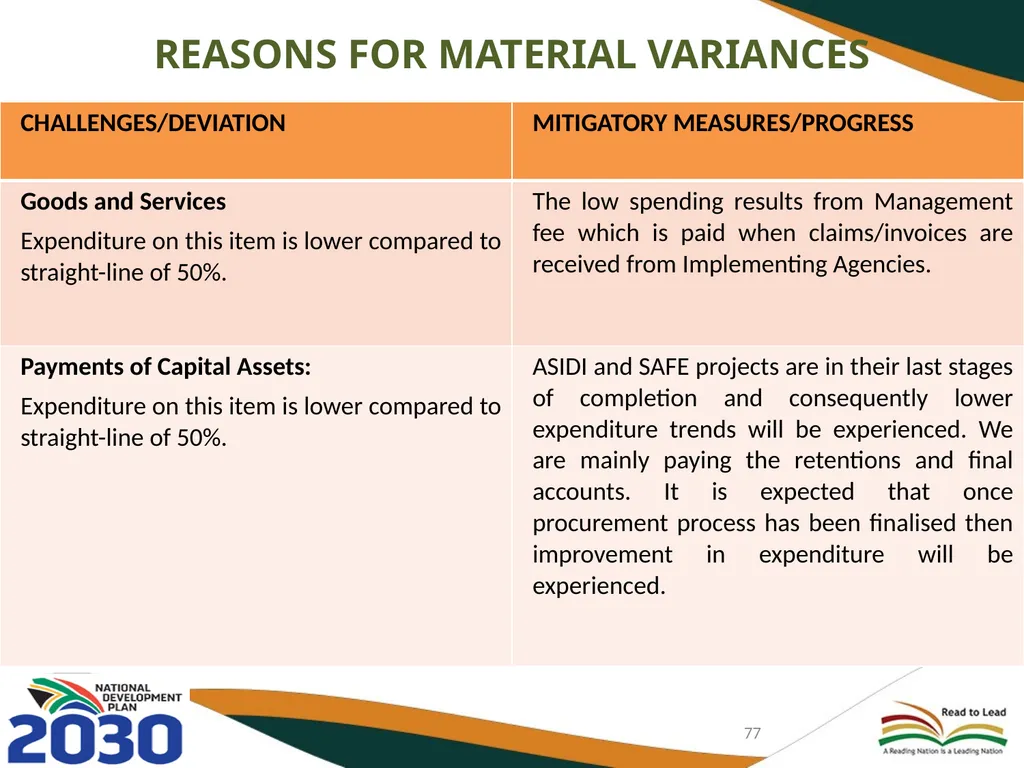
slide77. REASONS FOR MATERIAL VARIANCES 77<br>
slide78. THANK YOU<br>
25 November 2025<br>
slide2. PRESENTATION OUTLINE Performance Indicators and Targets
B) Quarter 2 of 2025/26 Expenditure<br>
slide3. PURPOSE To report to the Portfolio Committee on Basic Education:
The First and Second Quarter Outputs of the Department against the planned targets of the pre-determined objectives in the Annual Performance Plan (APP) for the financial year 2025/26.
2025/26 Expenditure against the Budget<br>
slide4. PROGRAMMES OF THE DEPARTMENT OF BASIC EDUCATION (DBE) The ANNUAL PERFORMANCE PLAN summarises the priorities of the DBE as aligned to the 2024-29 Medium Term Development Plan and the Action Plan to 2029: Towards the Realisation of Schooling 2030.
The activities of the DBE have been structured into five programmes as elaborated in the APP:
Programme 1: Administration
Programme 2: Curriculum Policy, Support and Monitoring
Programme 3: Teachers, Education Human Resources and Institutional Development
Programme 4: Planning, Information and Assessment
Programme 5: Educational Enrichment Services 4<br>
slide5. COMPARISON OF QUARTERLY PERFORMANCE BETWEEN Q1 2024/25 AND Q1 2025/26 5<br>
slide6. COMPARISON OF QUARTER 1 PERFORMANCE… 6 There are 24 quarterly targets in 2025/26, compared to 8 in 2024/25, which represents a 200% increase.<br>
slide7. COMPARISON OF QUARTERLY PERFORMANCE BETWEEN Q2 2024/25 AND Q2 2025/26 7<br>
slide8. COMPARISON OF QUARTER 2 PERFORMANCE… 8 There are 24 quarterly targets and 2 biannual targets in 2025/26, compared to 8 and 1 in 2024/25, which represents a 190% increase.<br>
slide9. MAJOR HIGHLIGHTS Minister of Basic Education, Ms Siviwe Gwarube, participated in the following events:
Second Session of the Bi-National Commission (BNC) between the Republic of South Africa and the Kingdom of Lesotho in Maseru, on 23 April 2025.
The 2025 Education World Forum (EWF) from 18 to 21 May 2025 in London, United Kingdom.
The 12th BRICS Education Ministers Meeting held in Brazil, on 5 June 2025.
Delivered the 2025/26 Budget Vote Debate in Parliament, Cape Town, and National Council of Provinces (NCOP) on 8 and 10 July 2025, respectively, under the theme, Builders vs Breakers: Shaping South Africa’s Future Through Education,.
Jointly with the Minister of Communications and Digital Technologies, Mr Solly Malatsi, handed over smart tablets to learners at Glenvista Primary School in Johannesburg on 31 July 2025 9<br>
slide10. MAJOR HIGHLIGHTS Deputy Minister of Basic Education, Dr Reginah Mhaule, participated in the following events:
First Mpumalanga G20 Provincial Indaba, held at Resort White River on 24 April 2025.
The Innovation Africa 2025 Ministerial Summit for Education, Information and Communication Technology (ICT) and Skills from 28 to 30 April 2025 in Addis Ababa, Ethiopia. Under the theme: “Educate and Skill Africa for the 21st Century“.
67 Minutes of Nelson Mandela Day Initiative in Tembisa on 18 July 2025.
Delivered message of support during the Northern Cape G20 Provincial Indaba in Kimberley held on 7 to 8 August 2025. 10<br>
slide11. MAJOR HIGHLIGHTS The Director-General of Basic Education, Mr Mathanzima Mweli, conducted the following activities:
The Provincial engagements which emphasised that the Sector should become more data-driven to adopt a subject-to-subject diagnostic approach in supporting schools from the General Education and Training (GET) and the Further Education and Training (FET) bands. Visited 75 Education Districts, covered 665 centres and addressed 130 061 learners..
Further engagements were conducted to strengthen Curriculum Implementation in the Capricorn South and Capricorn North Education Districts in Polokwane, Limpopo Province, covering 165 schools and 6,174 learners from 5 to 6 July 2025.
Visited winter camps at Hoërskool Stella in the North West Province, the University of the Free State and Emakhazeni Boarding School in Mpumalanga Province.
Engagement programme as an opportunity to motivate Grade 12 learners as they prepared for the October/November 2025 National Senior Certificate (NSC) examinations. 11<br>
slide12. REVISED 2025/26 APP… New indicators added to align to the MTDP 2024-2029 12<br>
slide13. REVISED 2025/26 APP… Revised indicator titles for MTDP alignment 13<br>
slide14. REVISED 2025/26 APP… Targets reduced due to budget constraints 14<br>
slide15. PROGRAMME 1: ADMINISTRATION The purpose of Programme 1 is to provide strategic leadership, management and support services to the Department. 15<br>
slide16. PROGRAMME 1 INDICATORS… 16<br>
slide17. PROGRAMME 1 INDICATORS 17<br>
slide18. PROGRAMME 1 HIGHLIGHTS Financial Management Services
The Department submitted Annual Financial Statements on 31 July 2025 as required by National Treasury regulations.
HR Development and Social Responsibility
21 Capacity Building Programmes were conducted, and 179 employees attended.
The Workplace Skills Plan 2025/26 and Annual Training Report 2024/25 were submitted to EDTP-SETA and PSETA respectively on the 26 April 2025.
Strategic Planning, Research Evaluation and Monitoring
The Minister tabled the 2024/25 Annual Reports for Umalusi on 25 September 2025, the DBE on 29 September 2025, and the South African Council for Educators (SACE) on 30 September 2025. 18<br>
slide19. PROGRAMME 2: CURRICULUM POLICY, SUPPORT AND MONITORING The purpose of Programme 2 is to develop curriculum and assessment policies and monitor and support their implementation. 19<br>
slide20. PROGRAMME 2 INDICATORS… 20<br>
slide21. PROGRAMME 2 INDICATORS… 21<br>
slide22. PROGRAMME 2 INDICATORS… 22<br>
slide23. PROGRAMME 2 INDICATORS… 23<br>
slide24. PROGRAMME 2 INDICATORS… 24<br>
slide25. PROGRAMME 2 INDICATORS… 25<br>
slide26. PROGRAMME 2 INDICATORS… 26<br>
slide27. PROGRAMME 2 INDICATORS… 27<br>
slide28. PROGRAMME 2 INDICATORS… 28<br>
slide29. PROGRAMME 2 INDICATORS… 29<br>
slide30. PROGRAMME 2 INDICATORS… 30<br>
slide31. PROGRAMME 2 INDICATORS… 31<br>
slide32. PROGRAMME 2 INDICATORS… 32<br>
slide33. PROGRAMME 2 INDICATORS… 33<br>
slide34. PROGRAMME 2 INDICATORS… 34<br>
slide35. PROGRAMME 2 HIGHLIGHTS Curriculum, Implementation and Quality Improvement (GET)
149 schools were monitored for implementing Entrepreneurship Education.
17 schools were monitored on the implementation of the Reading Norms. Monitoring was conducted in four (4) schools in the KwaZulu-Natal province and five (5) schools in the Limpopo province. Monitoring the Reading Norms targeted quintiles 1-3 schools, with a focus on the Intermediate Phase.
33 schools were monitored on Early Grade Reading Assessment (EGRA).
Curriculum, Implementation and Quality Improvement (FET)
Nine provinces were monitored during the Autumn and Winter Vacation classes.
The revised History Curriculum has been crafted and presented at various management levels of the department. The revised History Curriculum for Grades 4-12 was submitted to Umalusi for appraisal.
Second Chance Matric Programme (SCMP)
The Department conducted 15 learner workshops across the provinces.
At these workshops, learners were supplied with hard copies of study materials as well as information on how to prepare for the examinations. More than 5 000 learners attended the workshops. 35<br>
slide36. PROGRAMME 2 HIGHLIGHTS Inclusive Education
3 252 teachers were trained in Inclusive Education Programmes. 584 teachers were trained on literacy strategies, 453 on numeracy, and 2 215 in other areas of Inclusive Education.
75 985 learners with disabilities are enrolled in special schools in the EC, KZN, LP, MP, North West and WC. Support meetings were held with PEDs on 05-11 August 2025 and 10 September 2025 to guide PEDs on addressing the identified reporting challenges.
Early Childhood Development (ECD)
1 314 985 children have access to ECD programmes based on reports from provinces.
MST, Curriculum Innovation & e-Learning
18 schools were monitored on the implementation of the Curriculum and Assessment Policy Statement (CAPS). 36<br>
slide37. PROGRAMME 2 HIGHLIGHTS Q2 Period: 01 July-30 September 2025 37 Workbooks 2025 Delivery Status: All Provinces (Volume 1 Grades 1 - 9 and Grade R)<br>
slide38. PROGRAMME 3: TEACHERS, EDUCATION HUMAN RESOURCES AND INSTITUTIONAL DEVELOPMENT The purpose of Programme 3 is to promote quality teaching and institutional performance through the effective supply, development and utilisation of human resources. 38<br>
slide39. PROGRAMME 3 INDICATORS… 39<br>
slide40. PROGRAMME 3 INDICATORS… 40<br>
slide41. PROGRAMME 3 INDICATORS… 41<br>
slide42. PROGRAMME 3 INDICATORS… 42<br>
slide43. PROGRAMME 3 INDICATORS 43<br>
slide44. PROGRAMME 3 HIGHLIGHTS Education Human Resource Planning, Provisioning and Monitoring
The state of readiness for the declaration and distribution of the post establishments was presented at the HEDCOM Subcommittee on HR Matters, which was held on 20 August 2025, in which PEDs tabled their management plan and progress report on the finalisation and issuing of establishments.
Draft Management plans highlighting streamlined key activities and dates in the declaration and distributing post-establishments to schools were received from all the PEDs.
Continuing Professional Teacher Development
58 Provincial Teacher Development Institutes and District Teacher Development Centres were monitored on functionality.
Initial Teacher Education
The preliminary list of recommended awards shows that 8 647 bursaries were awarded for Initial Teacher as of 30 September 2025. 44<br>
slide45. PROGRAMME 3 HIGHLIGHTS Educator Performance Management and Development and Whole School Evaluation
24 schools monitored onsite in KZN, GP, NC, and LP on the implementation of the Quality Management System (QMS) Collective Agreements 2 of 2020 and 2 of 2022.
Education Labour Relations and Conditions of Service
HEDCOM approved the Draft Collective Agreement on the improvement of the Qualifications of Grade R.
Standard Operating Procedure on the discharge of educators whose names appear in the National Register of Sex Offenders and National Child Protection Register was presented at the Minister’s meeting with District Managers on 28 August 2025, as well as at the National Labour Relations Forum on 11 September 2025.
The presentation aimed at ensuring that District heads understand the procedure of discharging sex offenders and follow due procedure in dealing with those who are alleged to have committed sexual offences. 45<br>
slide46. PROGRAMME 3 HIGHLIGHTS Source: PERSAL, September and PEDs Reports 2025 Absorption of Funza Lushaka graduates 46<br>
slide47. PROGRAMME 3 HIGHLIGHTS Number of qualified educators aged 30 and below appointed at schools for the First- time during the quarter by nature of appointment per province 47 Source: PERSAL September 2025<br>
slide48. PROGRAMME 4: PLANNING, INFORMATION AND ASSESSMENT The purpose of Programme 4 is to promote quality and effective service delivery in the basic education system through planning, implementation and assessment. 48<br>
slide49. PROGRAMME 4 INDICATORS… 49<br>
slide50. PROGRAMME 4 INDICATORS… 50<br>
slide51. PROGRAMME 4 INDICATORS… 51<br>
slide52. PROGRAMME 4 INDICATORS… 52<br>
slide53. PROGRAMME 4 INDICATORS 53<br>
slide54. PROGRAMME 4 HIGHLIGHTS National Assessment
The initial Frameworks and Test Items for the Mother Tongue-Based Bilingual Education (MTBBE) Grade 4 National Assessment were developed.
The DBE held a GEC training workshop from 7-11 April 2025, to prepare for the 2025 GEC First-Phase implementation.
The workshop aimed to enhance provincial coordinators' knowledge and skills in mediating information and training participants on all components of the GEC Assessment Model.
Frameworks for the development of test items were reviewed. The setting of test items will commence in Q3. 54<br>
slide55. PROGRAMME 4 HIGHLIGHTS Early Learning National Assessment
The verification of the 288 sampled schools was completed. The DBE finalised the extraction of electronically collected data from provincial EMIS warehouses. For about 40 schools, the data was manually captured from score sheets. Data verification processes were completed, enabling the generation of a merged Literacy Early Learning National Assessment (ELNA) 2025 national dataset for analysis.
Information and Management Systems
Summary report of all PEDs responses of Term 1 data that were collected from schools supported with evidence. The quality of the data reported was discussed during the annual SA-SAMS advocacy workshop conducted in six (6) provinces to date. 55<br>
slide56. PROGRAMME 4 HIGHLIGHTS Provincial and District Planning and Implementation Support
The DBE conducted monitoring and support visits to 582 underperforming secondary schools in eight provinces.
The visits were primarily aimed at establishing whether districts supported underperforming schools, namely Subject Advisors, Circuit Management, Multidisciplinary Teams, and District Directors.
Other focus areas were curriculum management, utilisation of workbooks, development and implementation of Academic Performance Improvement Plans (APIPs) and the implementation
Planning and Implementation Support
Interviews were held on 15 May 2025 to replace mentors who had reached retirement age. The recommended candidates were submitted to HR for appointment.
Implementation and Monitoring (Infrastructure)
29 schools were provided with Sanitation.
17 new classrooms were built to alleviate overcrowding. 56<br>
slide57. PROGRAMME 5: EDUCATIONAL ENRICHMENT SERVICES The purpose of Programme 5 is to develop policies and programmes to improve the quality of learning in schools. 57<br>
slide58. PROGRAMME 5 INDICATORS… 58<br>
slide59. PROGRAMME 5 INDICATORS… 59<br>
slide60. PROGRAMME 5 INDICATORS… 60<br>
slide61. PROGRAMME 5 INDICATORS 61<br>
slide62. PROGRAMME 5 HIGHLIGHTS National School Nutrition Programme
93 schools were monitored on the National School Nutrition Programme in FS, GP, KZN, NW, NC and WC.
Safety in Education
Ministers of the Departments of Basic Education Ms S Gwarube, MP and the South African Police Services, Mr. S Mchunu, MP signed the revised DBE/SAPS Implementation Collaboration Protocol.
20 Districts have been monitored on the implementation of NSSF.
SASCE
2025 SASCE conducted.
The 2026 Music Syllabus is under typesetting 62<br>
slide63. PROGRAMME 5 HIGHLIGHTS Q2 National School Nutrition Programme (NSNP) Quarter 2 Period: 01 July- 30 September 2025 63<br>
slide64. QUARTER 2 PRESENTATION TO PORTFOLIO COMMITTEE ON BASIC EDUCATION 2025/26 FINANCIAL YEAR 64<br>
slide65. INTRODUCTION The total Appropriation budget of the Department for the 2025/26 financial year amounts to R35.489 billion
85% of the budget amounting to R30.155billion is allocated to transfer payments as follows:
Conditional Grants: R28.564 billion
Transfers to Public Entities: R192.1 million
Other Transfers: R1.399 billion
The remainder of the budget R5.334 billion is allocated to the following:
Compensation of Employees: R669.3 million
Goods and Services: R3.259 billion
Interest on Rent and Land: R34.4 million
Payments of Capital Assets: R1.371 billion 65<br>
slide66. INTRODUCTION (cont.) The total actual expenditure of the Department for the 2025/26 financial year first quarter amounts to R21.014 billion
Expenditure amounting to R19.152 billion is made up of transfer payments as follows:
Conditional Grants: R17.723 billion
Transfers to Public Entities: R96.3 million
Other Transfers: R1.333 million
The remainder of the expenditure R1.862million is made up as follows:
Compensation of Employees: R315.1 million
Goods and Services: R1.274 billion
Interest on Rent and Land: R20.4 million
Payments of Capital Assets: R252.1 million 66<br>
slide67. ALLOCATION AGAINST EXPENDITURE PER PROGRAMME FOR 2025/26 FINANCIAL YEAR 67<br>
slide68. REASONS FOR MATERIAL VARIANCES 68<br>
slide69. ALLOCATION AGAINST EXPENDITURE PER ECONOMIC CLASSIFICATION FOR 2025/26 FINANCIAL YEAR 69<br>
slide70. REASONS FOR MATERIAL VARIANCES 70<br>
slide71. ALLOCATION AGAINST EXPENDITURE PER CONDITIONAL GRANTS 2025/26 FINANCIAL YEAR 71<br>
slide72. OTHER TRANSFERS 72<br>
slide73. REASONS FOR MATERIAL VARIANCES 73<br>
slide74. ALLOCATION AGAINST EXPENDITURE PER PUBLIC ENTITIES TRANSFER FOR 2025/26 FINANCIAL YEAR 74<br>
slide75. REASONS FOR MATERIAL VARIANCES 75<br>
slide76. ALLOCATION AGAINST EXPENDITURE ON SCHOOLS BACKLOGS GRANT (SIBG) FOR 2025/26 FINANCIAL YEAR 76<br>
slide77. REASONS FOR MATERIAL VARIANCES 77<br>
slide78. THANK YOU<br>