First Workshop on Long-term Finance 9-11 July 2012 Summary Report Seyni NAFO, Africa Group .. european capacity building initiative initiative européenne de renforcement des capacités ecbi for sustained capacity building in support of
"First Workshop on Long-term Finance 9-11 July 2012" is the property of its rightful owner. Permission is granted to
download and print the materials on this website for personal, non-commercial use only, and to display it
on your personal computer provided you do not modify the materials and that you retain all copyright
notices contained in the materials. By downloading content from our website, you accept the terms of this
agreement.
Presentation Transcript
01
First Workshop on Long-term Finance
9-11 July 2012
Summary Report
Seyni NAFO, Africa Group .. european capacity building initiative
initiative européenne de renforcement des capacités ecbi for sustained capacity building in support of international climate change negotiations
pour un renforcement durable des capacités en appui aux négociations internationales sur les changements climatiques<br>
02
COP17 – LCA Outcome 127. Decides to undertake a work programme on long-term finance in 2012, including
workshops, to progress on long-term finance in the context of decision 1/CP.16, paragraphs 97-101
130. Decides that the aim of this work programme … is to contribute to the on-going efforts to scale up the mobilization of climate change finance after 2012; the work programme will analyze options for the mobilization of resources from a wide variety of sources, public and private, bilateral and multilateral, including alternative sources and relevant analytical work on climate-related financing needs of developing countries; the analysis will draw upon relevant reports including that of the High-level Advisory Group on Climate Financing and the report on mobilizing climate finance for the G20 and the assessment criteria in the reports, and will also take into account lessons learned from fast-start finance
Requests the co-chairs… to prepare a report on the workshops … for consideration by the Conference of the Parties at its eighteenth session<br>
03
Outline Day 1
Session I: Setting the Scene: Long–term finance
Session II: Understanding Long term finance needs of developing countries
Day 2
Session III: Sources of Climate finance
Session IV: Options for mobilizing climate finance
Day 3
Session V: Lessons learnt from Fast-start finance<br>
04
Session I: Setting the Scene Pr. Sachs, Earth Institute
Tackling Climate change : Rapid and deep decarbonization of world economy, Deep technological change, and Significant « incremental costs »
How to translate commitments into Reality:
Assessment rule for each country (carbon emissions and ability to pay)
Net Carbon tax = carbon tax + feed in subsidy (ensure long term predictable price
Formulation of costed national/local plans
OECD
Scale up and hift investment flows
Engage Private sector (lifting barriers)
Integrated domestic policy framework for Climate finance and investments<br>
05
Session I: continues… AfDB
MDB role: leverage, CC is a development issue, synergy with other institutions
LTF should respond to global and Regional needs
21-31 billion USD by 2015, 52-68 billion YSD by 2030
Particular sources of African Emission (Agro and LULUCF)
Call for Adaptation finance (2.2% of Continent GDP)
EBRD
MDBs can play central role:
Go between private sector and policymakers, leveraging, Piloting, technical assistance<br>
06
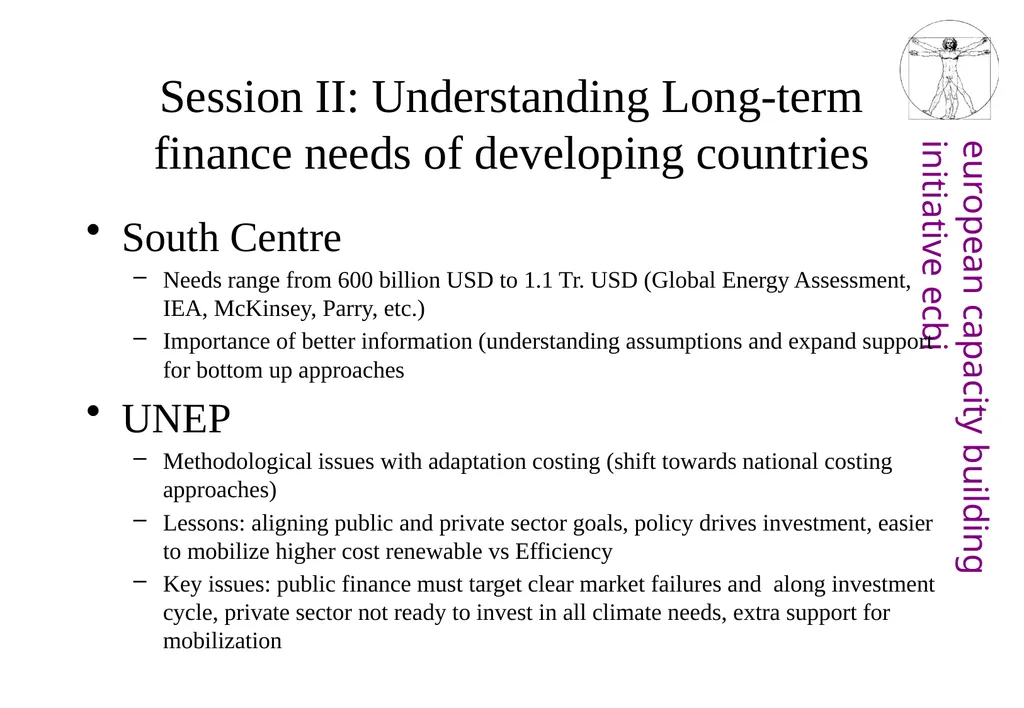
Session II: Understanding Long-term finance needs of developing countries South Centre
Needs range from 600 billion USD to 1.1 Tr. USD (Global Energy Assessment, IEA, McKinsey, Parry, etc.)
Importance of better information (understanding assumptions and expand support for bottom up approaches
UNEP
Methodological issues with adaptation costing (shift towards national costing approaches)
Lessons: aligning public and private sector goals, policy drives investment, easier to mobilize higher cost renewable vs Efficiency
Key issues: public finance must target clear market failures and along investment cycle, private sector not ready to invest in all climate needs, extra support for mobilization<br>
07
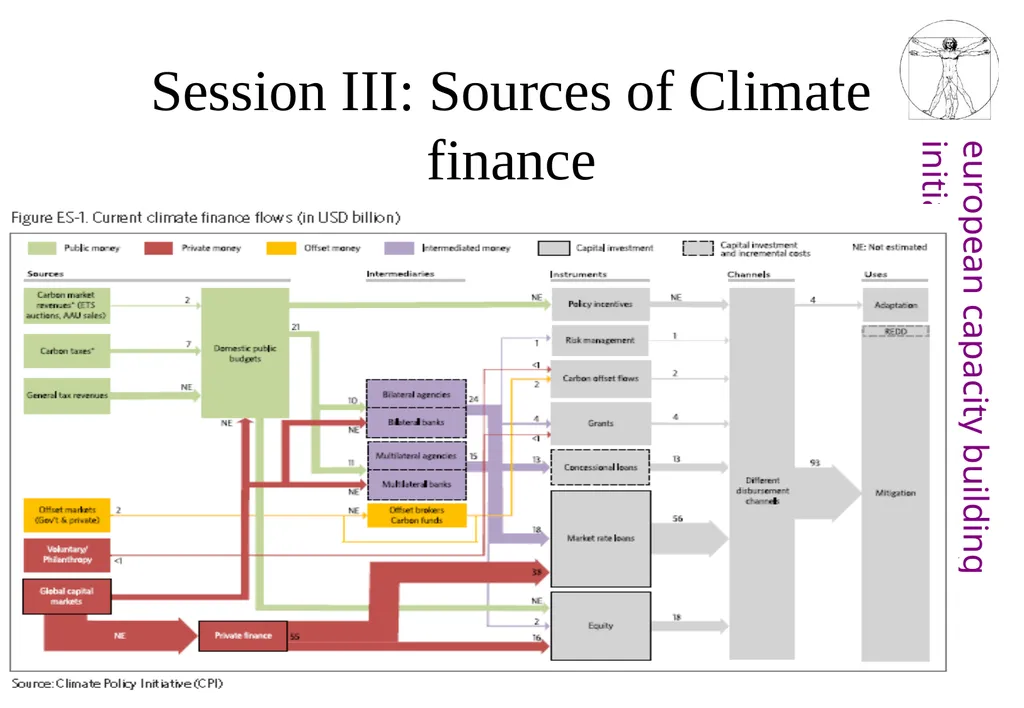
Session III: Sources of Climate finance<br>
08
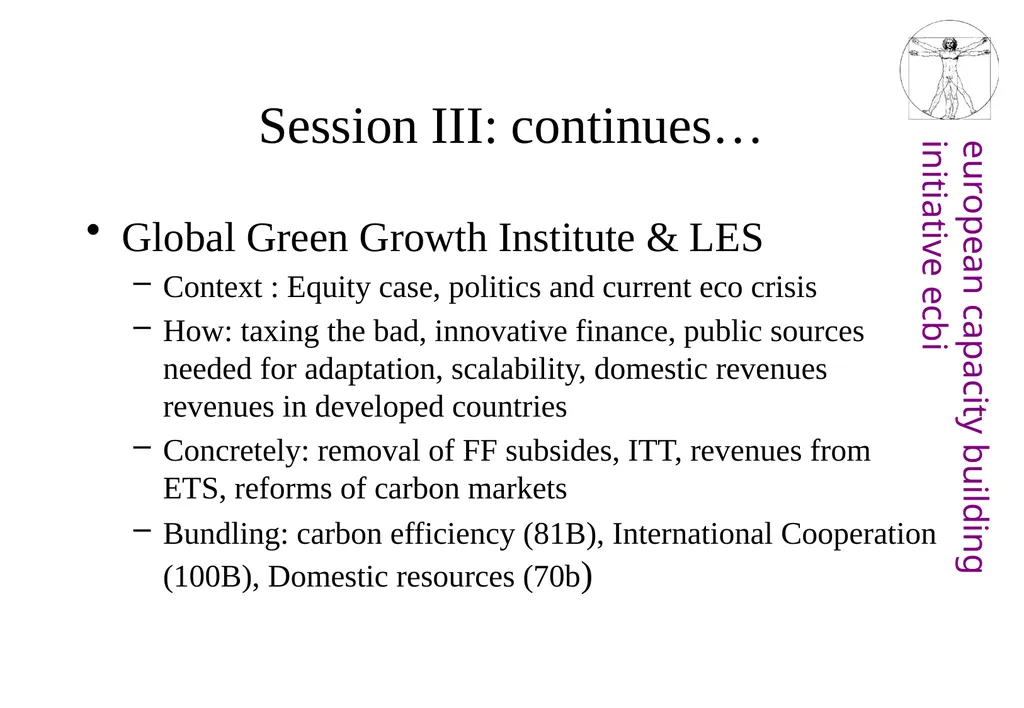
Session III: continues… Global Green Growth Institute & LES
Context : Equity case, politics and current eco crisis
How: taxing the bad, innovative finance, public sources needed for adaptation, scalability, domestic revenues revenues in developed countries
Concretely: removal of FF subsides, ITT, revenues from ETS, reforms of carbon markets
Bundling: carbon efficiency (81B), International Cooperation (100B), Domestic resources (70b)<br>
09
Session III: Continues… World Bank recommendations :
Fossil fuel subsidies: expand inventories of support, implement commitments
Carbon markets: implement targets , continue reform and innovation
Expand MDB pooled financing arrangements
Build inc-country policy and institutions
Generate knowledge and share experience (, SDGs New networks and partnerships, etc.)
Improve MRV of Support (learning an trust)<br>
10
Session III: continues… Summary
Definitional and methodological issues around climate finance
Nobody questions role of Private sector but need to be incentivized
More important = where is the money going to come from and distribution issue
Burden shifting not possible
Clarifications on innovative sources
Actual performances on ground varies<br>
11
Session IV: Options for mobilizing climate finance EBRD (A project-based approach)
Combines sources (concessional finance “EUC, CTF, GEF, Bilateral”, donor finance, technical assistance, grants, etc.) and leveraging (1:4, 1:87 for technical assistance) to deliver commercial loan targeting Renewable project development
SEI, 8.8 billion Euros in Projects since2006
Combines skills (banking, technical, policy) and Support (grants, concessional co-financing, technical assistance policy improvements)<br>
12
Session IV: continues… Standard Bank
Difference between financing (debts, equity) and covering incremental cost (grants, concessional)
3 critical barriers to more private mitigation finance:
No level playing field between high-low carbon investments alternatives;
Regulatory barriers in developing countries (ex: in energy not market/grid access for low carbon tech)
Policy and regulatory investment risks<br>
13
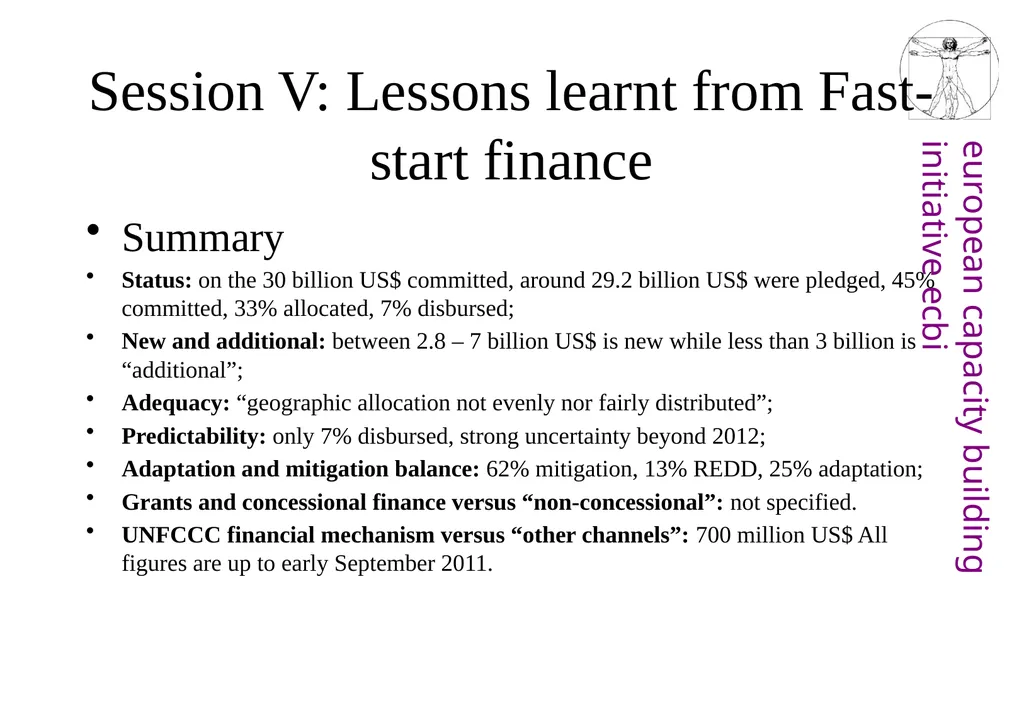
Session V: Lessons learnt from Fast-start finance Summary
Status: on the 30 billion US$ committed, around 29.2 billion US$ were pledged, 45% committed, 33% allocated, 7% disbursed;
New and additional: between 2.8 – 7 billion US$ is new while less than 3 billion is “additional”;
Adequacy: “geographic allocation not evenly nor fairly distributed”;
Predictability: only 7% disbursed, strong uncertainty beyond 2012;
Adaptation and mitigation balance: 62% mitigation, 13% REDD, 25% adaptation;
Grants and concessional finance versus “non-concessional”: not specified.
UNFCCC financial mechanism versus “other channels”: 700 million US$ All figures are up to early September 2011.<br>
14
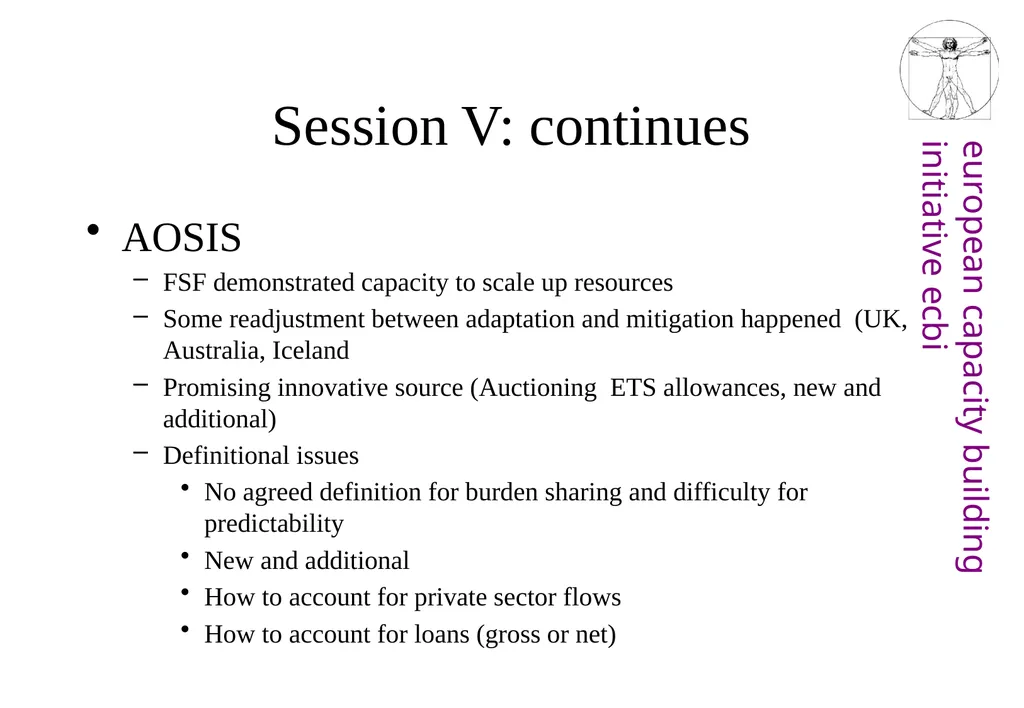
Session V: continues AOSIS
FSF demonstrated capacity to scale up resources
Some readjustment between adaptation and mitigation happened (UK, Australia, Iceland
Promising innovative source (Auctioning ETS allowances, new and additional)
Definitional issues
No agreed definition for burden sharing and difficulty for predictability
New and additional
How to account for private sector flows
How to account for loans (gross or net)<br>
15
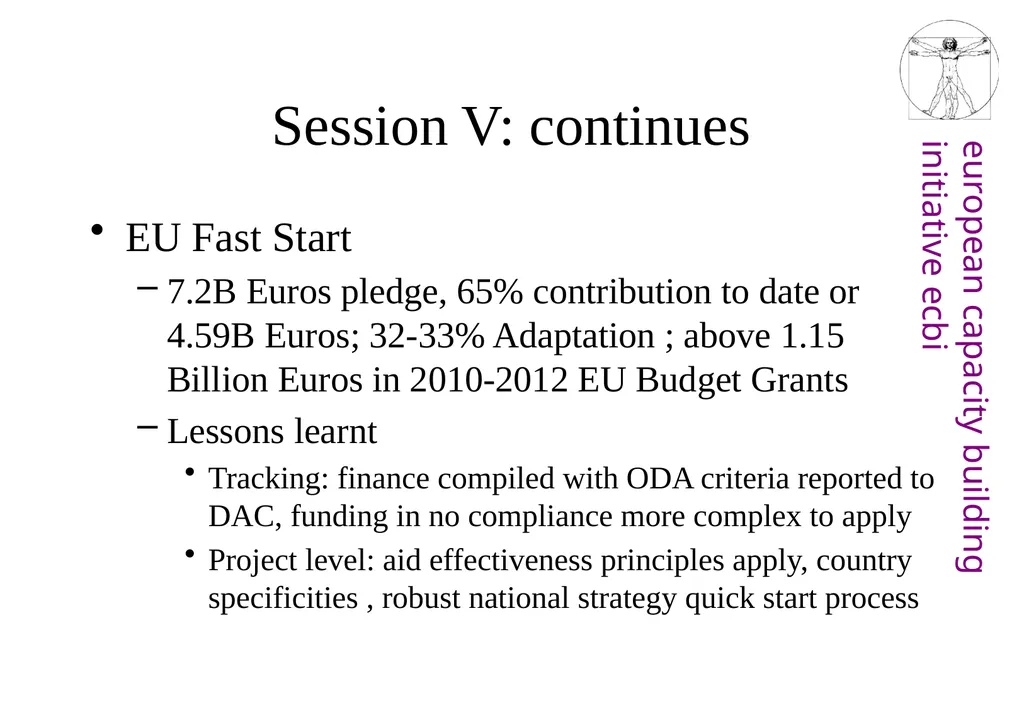
Session V: continues EU Fast Start
7.2B Euros pledge, 65% contribution to date or 4.59B Euros; 32-33% Adaptation ; above 1.15 Billion Euros in 2010-2012 EU Budget Grants
Lessons learnt
Tracking: finance compiled with ODA criteria reported to DAC, funding in no compliance more complex to apply
Project level: aid effectiveness principles apply, country specificities , robust national strategy quick start process<br>