
Food Poisoning Learning objectives At the end of
AM
Published · 44 slides · 0 views

1 / 1




Description
Food Poisoning Learning objectives At the end of the session, the students will be able to: Enumerate the microbial agents of food poisoning Describe the pathogenesis, clinical manifestations of Staphylococcal food poisoning Describe the
Related Topics
Share
Embed code
Download this presentation From Below
"Food Poisoning Learning objectives At the end of" is the property of its rightful owner. Permission is granted to download and print the materials on this website for personal, non-commercial use only, and to display it on your personal computer provided you do not modify the materials and that you retain all copyright notices contained in the materials. By downloading content from our website, you accept the terms of this agreement.
Presentation Transcript
01
Food Poisoning<br>
02
Learning objectives At the end of the session, the students will be able to:
Enumerate the microbial agents of food poisoning
Describe the pathogenesis, clinical manifestations of Staphylococcal food poisoning
Describe the pathogenesis, clinical manifestations of Bacillus cereus food poisoning
Describe the pathogenesis, clinical manifestations of Clostridium perfringens food poisoning
Describe the pathogenesis, clinical manifestations of Botulism
Discuss the lab diagnosis of food poisoning
Discuss the treatment of food poisoning<br>
03
Introduction Illness acquired through consumption of food/ drink contaminated either with microorganisms or their toxins
Usually results in common-source outbreak of diarrhea
600 million people affected with food-borne illness & 4.2 lakh die every year
40% children under 5 years of age affected, 1.25 lakh deaths every year
Symptoms vary (abdominal pain, vomiting, diarrhea, fever, neurological, hepatic, renal syndromes)<br>
04
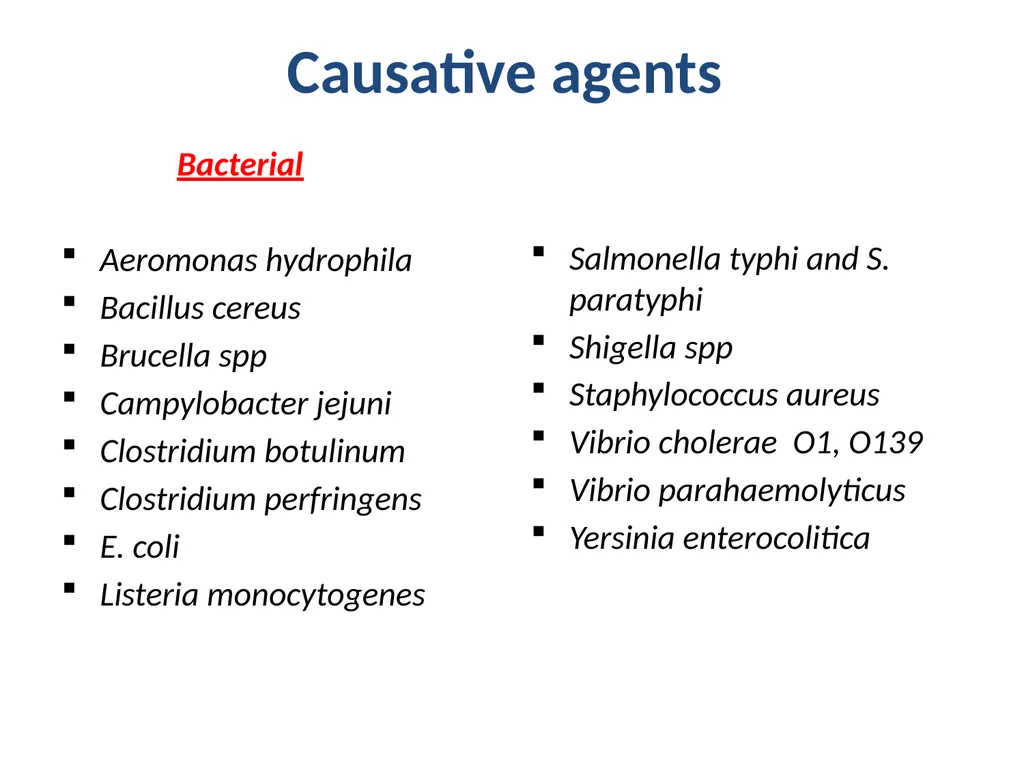
Causative agents Bacterial
Aeromonas hydrophila
Bacillus cereus
Brucella spp
Campylobacter jejuni
Clostridium botulinum
Clostridium perfringens
E. coli
Listeria monocytogenes Salmonella typhi and S. paratyphi
Shigella spp
Staphylococcus aureus
Vibrio cholerae O1, O139
Vibrio parahaemolyticus
Yersinia enterocolitica<br>
Aeromonas hydrophila
Bacillus cereus
Brucella spp
Campylobacter jejuni
Clostridium botulinum
Clostridium perfringens
E. coli
Listeria monocytogenes Salmonella typhi and S. paratyphi
Shigella spp
Staphylococcus aureus
Vibrio cholerae O1, O139
Vibrio parahaemolyticus
Yersinia enterocolitica<br>
05
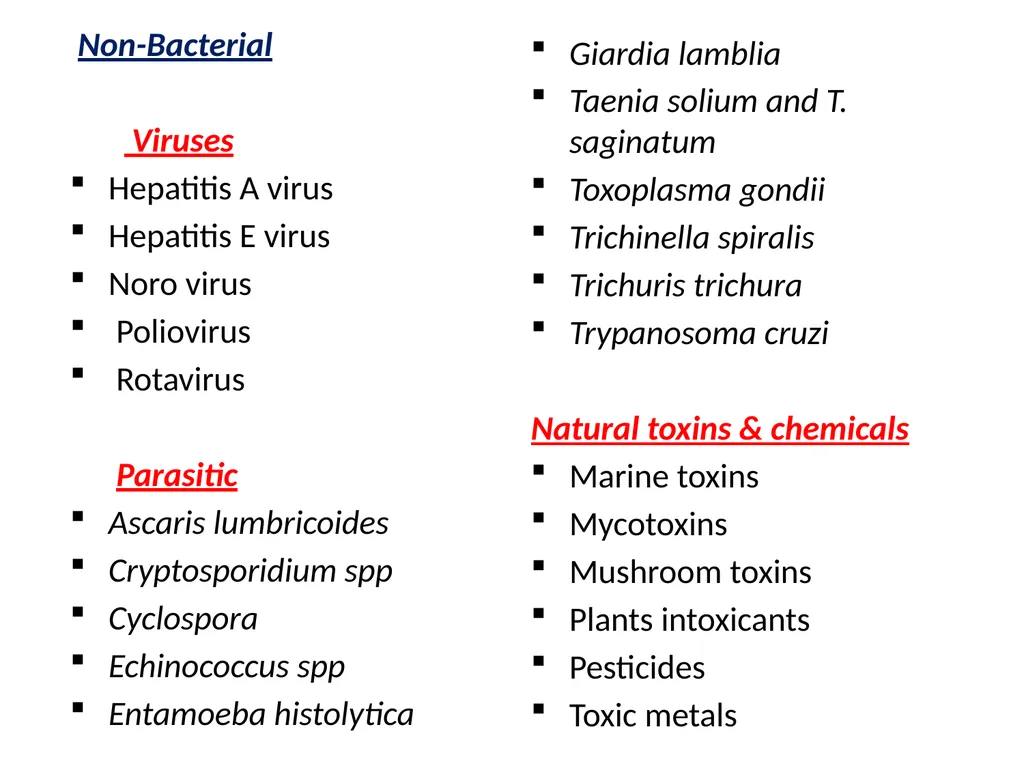
Non-Bacterial
Viruses
Hepatitis A virus
Hepatitis E virus
Noro virus
Poliovirus
Rotavirus
Parasitic
Ascaris lumbricoides
Cryptosporidium spp
Cyclospora
Echinococcus spp
Entamoeba histolytica Giardia lamblia
Taenia solium and T. saginatum
Toxoplasma gondii
Trichinella spiralis
Trichuris trichura
Trypanosoma cruzi
Natural toxins & chemicals
Marine toxins
Mycotoxins
Mushroom toxins
Plants intoxicants
Pesticides
Toxic metals<br>
06
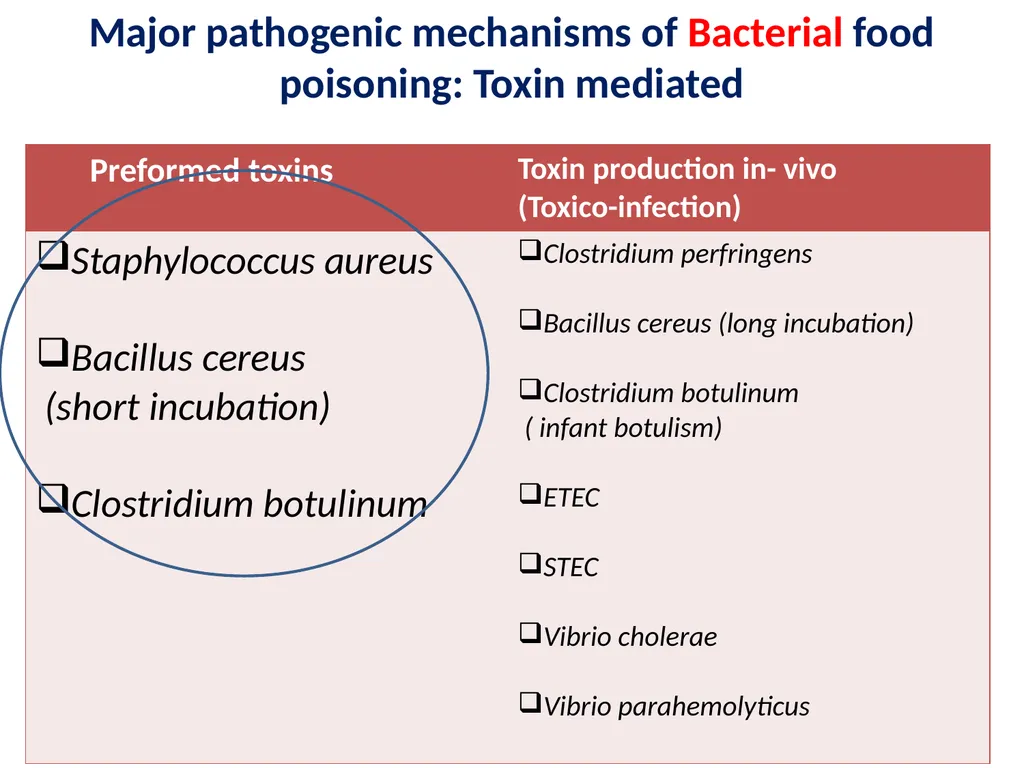
Major pathogenic mechanisms of Bacterial food poisoning: Toxin mediated<br>
07
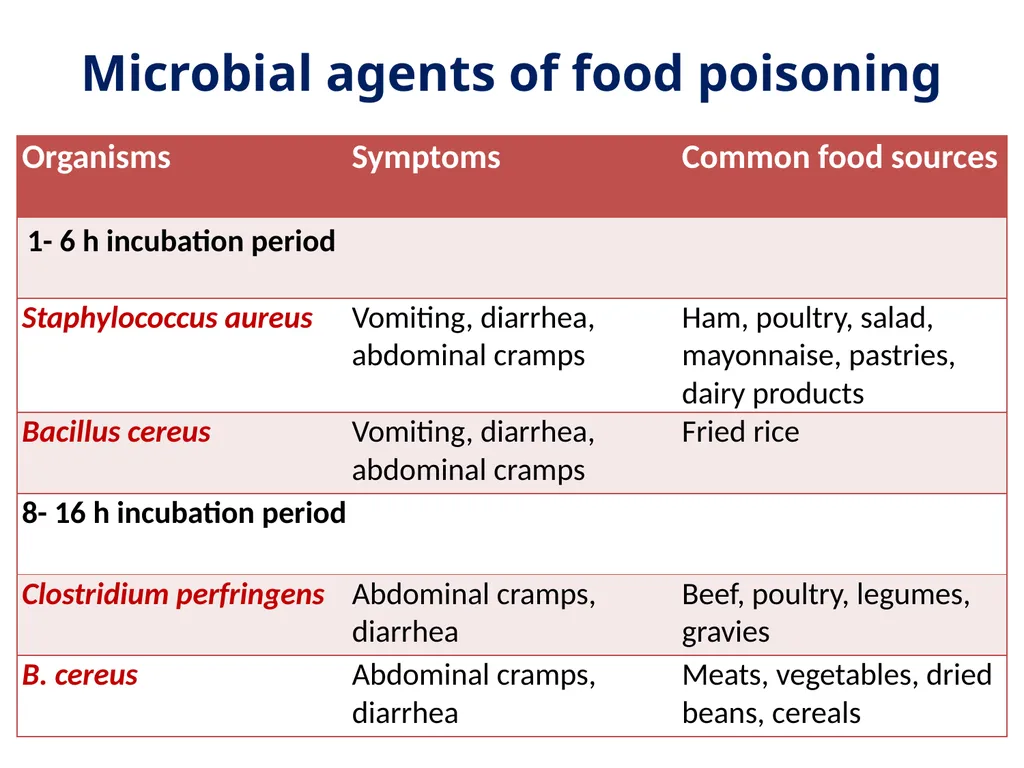
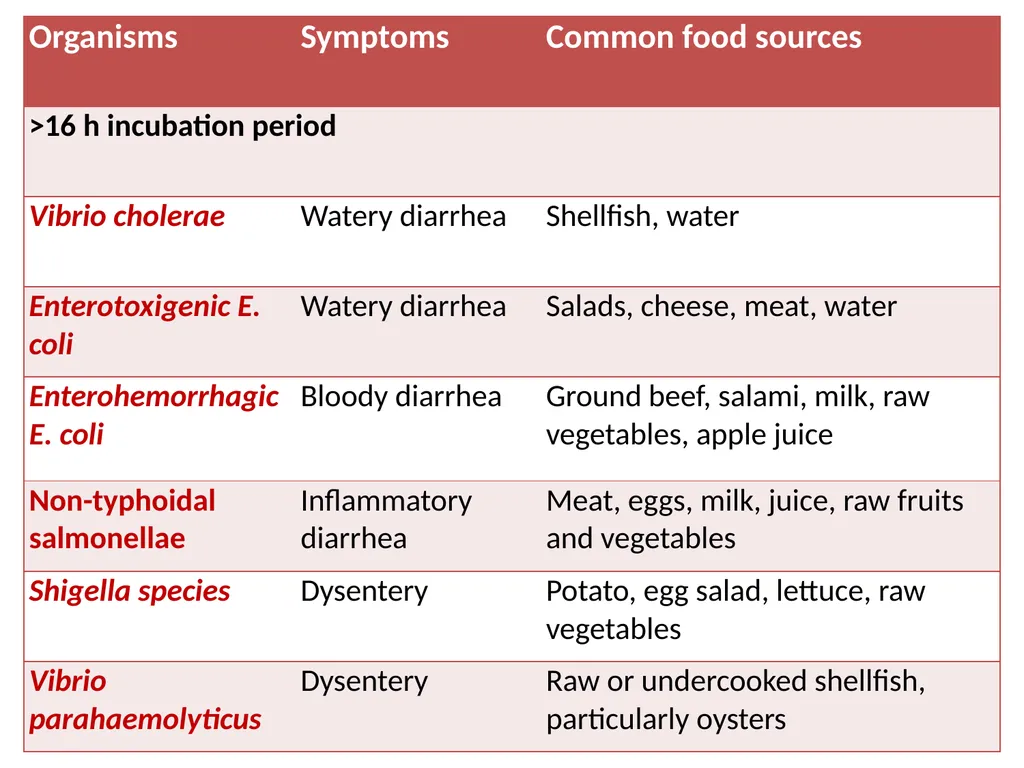
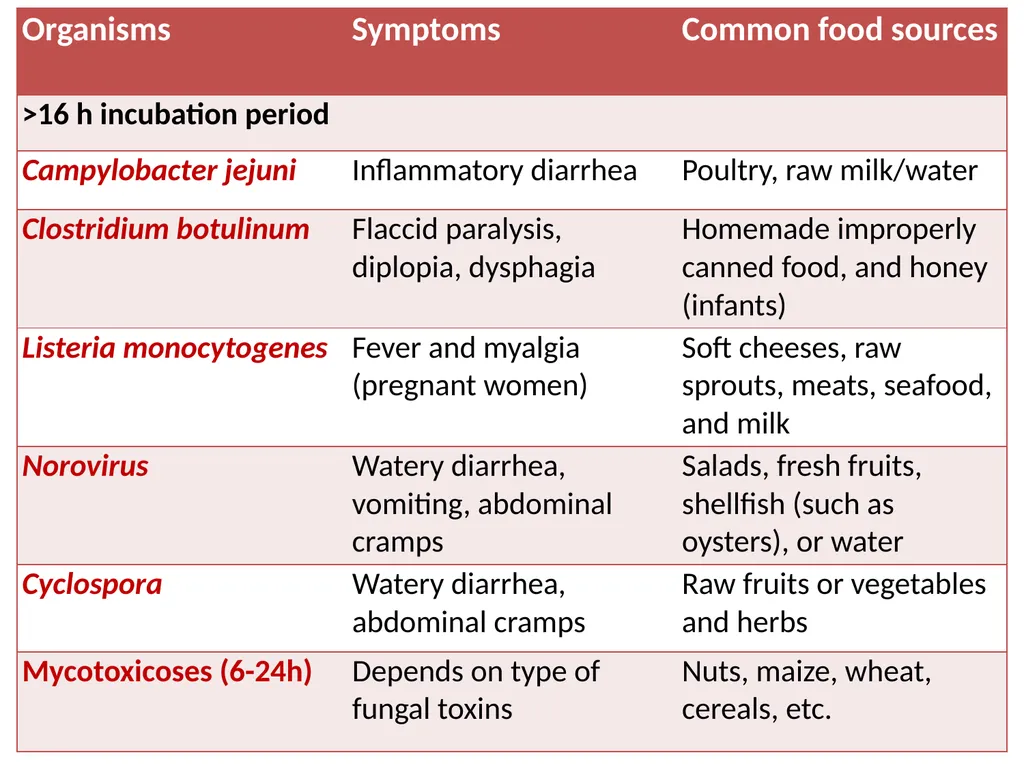
Microbial agents of food poisoning<br>
08
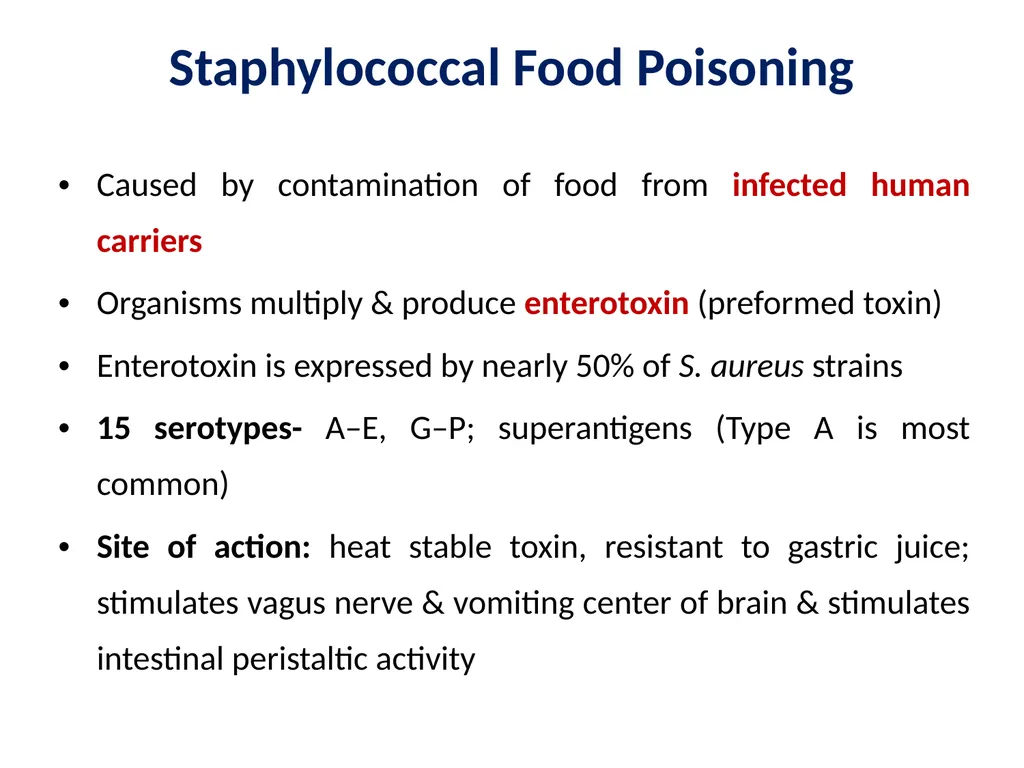
Staphylococcal Food Poisoning Caused by contamination of food from infected human carriers
Organisms multiply & produce enterotoxin (preformed toxin)
Enterotoxin is expressed by nearly 50% of S. aureus strains
15 serotypes- A–E, G–P; superantigens (Type A is most common)
Site of action: heat stable toxin, resistant to gastric juice; stimulates vagus nerve & vomiting center of brain & stimulates intestinal peristaltic activity<br>
09
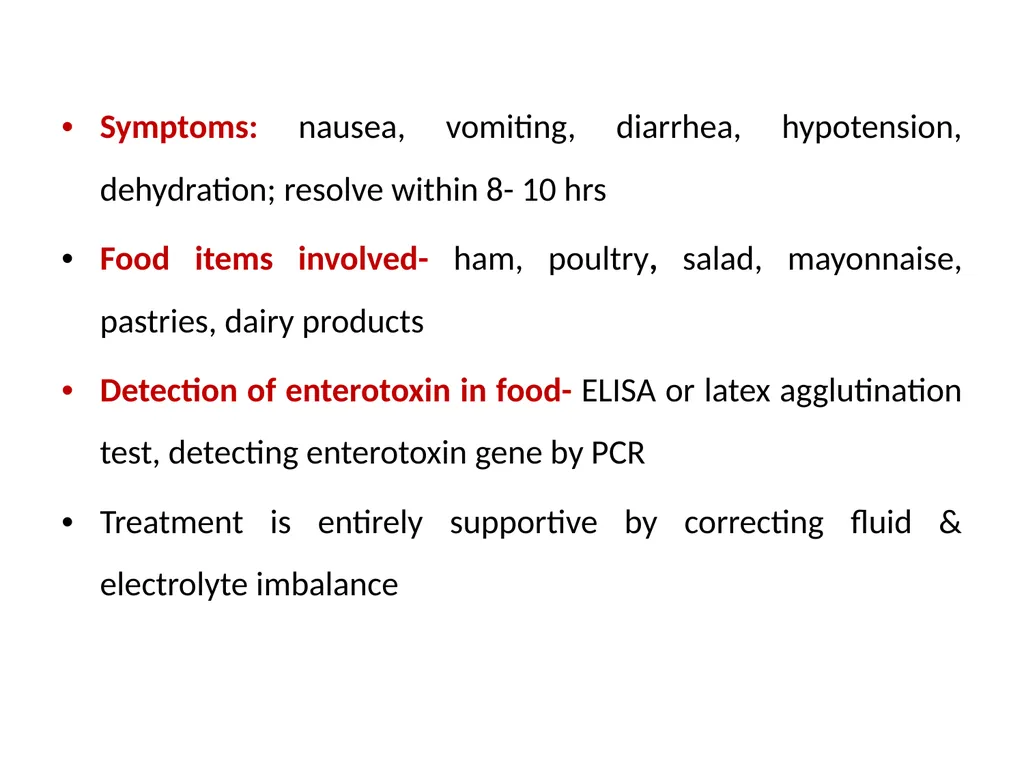
Symptoms: nausea, vomiting, diarrhea, hypotension, dehydration; resolve within 8- 10 hrs
Food items involved- ham, poultry, salad, mayonnaise, pastries, dairy products
Detection of enterotoxin in food- ELISA or latex agglutination test, detecting enterotoxin gene by PCR
Treatment is entirely supportive by correcting fluid & electrolyte imbalance<br>
Food items involved- ham, poultry, salad, mayonnaise, pastries, dairy products
Detection of enterotoxin in food- ELISA or latex agglutination test, detecting enterotoxin gene by PCR
Treatment is entirely supportive by correcting fluid & electrolyte imbalance<br>
10
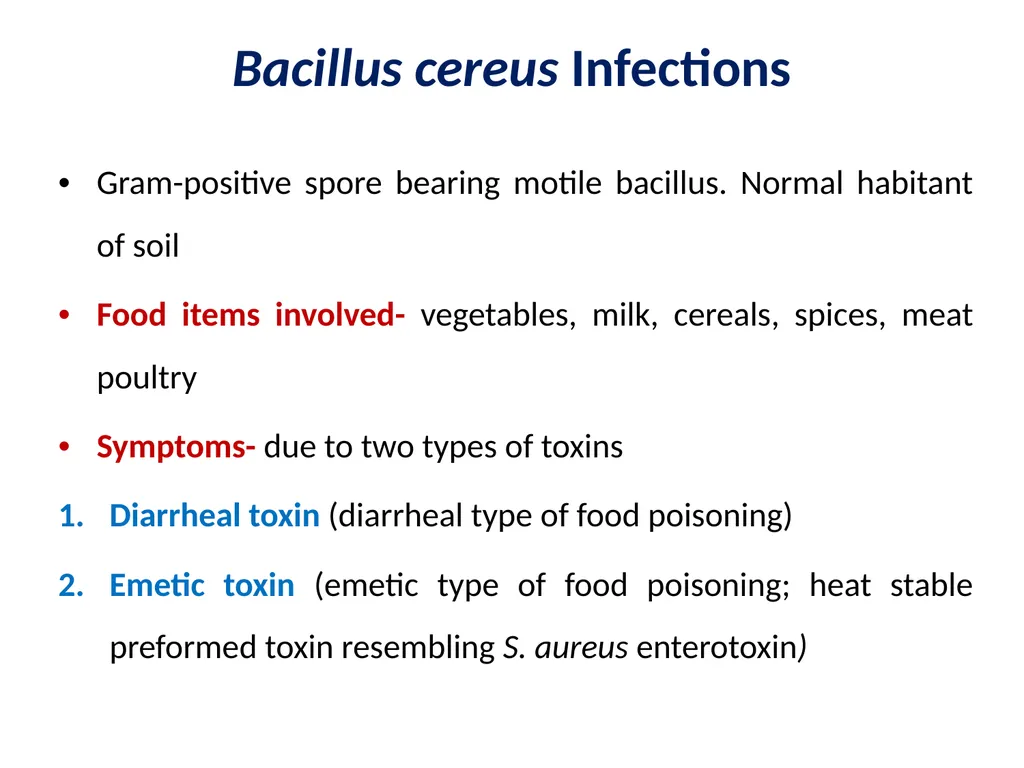
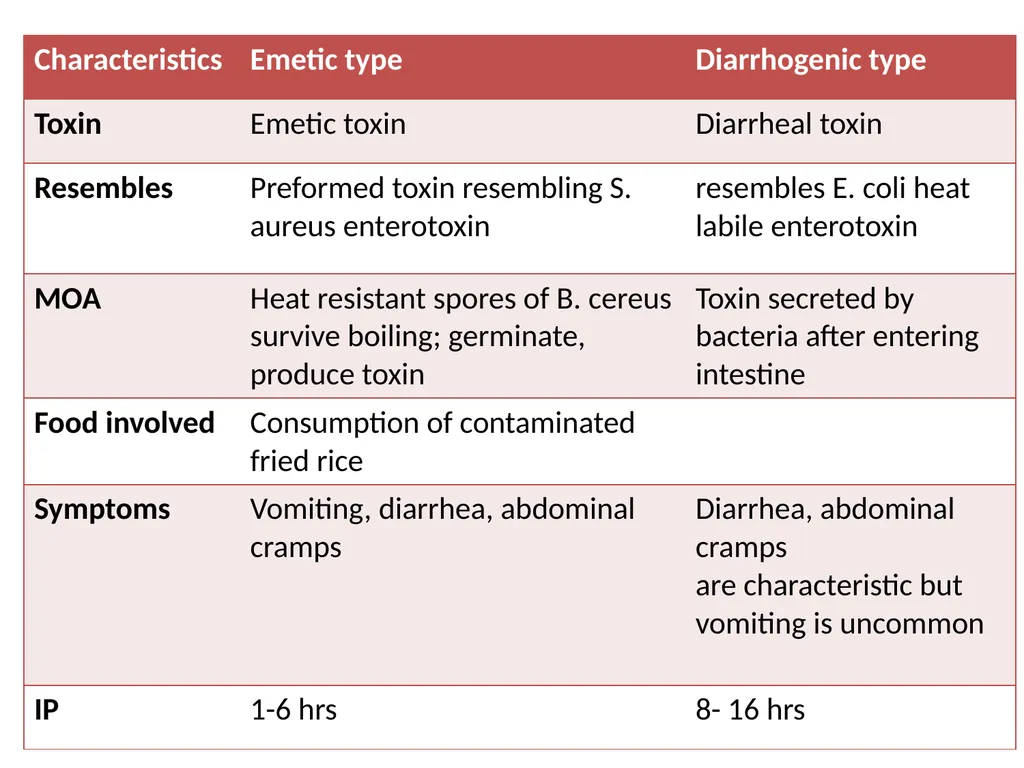
Bacillus cereus Infections Gram-positive spore bearing motile bacillus. Normal habitant of soil
Food items involved- vegetables, milk, cereals, spices, meat poultry
Symptoms- due to two types of toxins
Diarrheal toxin (diarrheal type of food poisoning)
Emetic toxin (emetic type of food poisoning; heat stable preformed toxin resembling S. aureus enterotoxin)<br>
Food items involved- vegetables, milk, cereals, spices, meat poultry
Symptoms- due to two types of toxins
Diarrheal toxin (diarrheal type of food poisoning)
Emetic toxin (emetic type of food poisoning; heat stable preformed toxin resembling S. aureus enterotoxin)<br>
11
Other manifestations
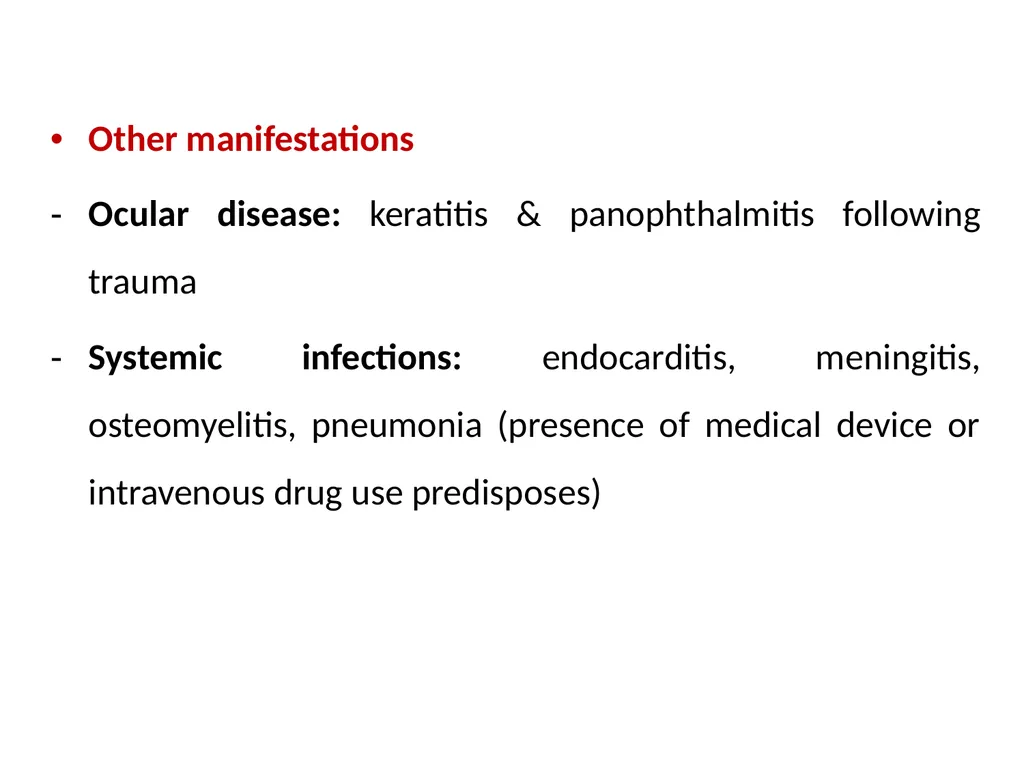
Ocular disease: keratitis & panophthalmitis following trauma
Systemic infections: endocarditis, meningitis, osteomyelitis, pneumonia (presence of medical device or intravenous drug use predisposes)<br>
Ocular disease: keratitis & panophthalmitis following trauma
Systemic infections: endocarditis, meningitis, osteomyelitis, pneumonia (presence of medical device or intravenous drug use predisposes)<br>
12
Laboratory Diagnosis
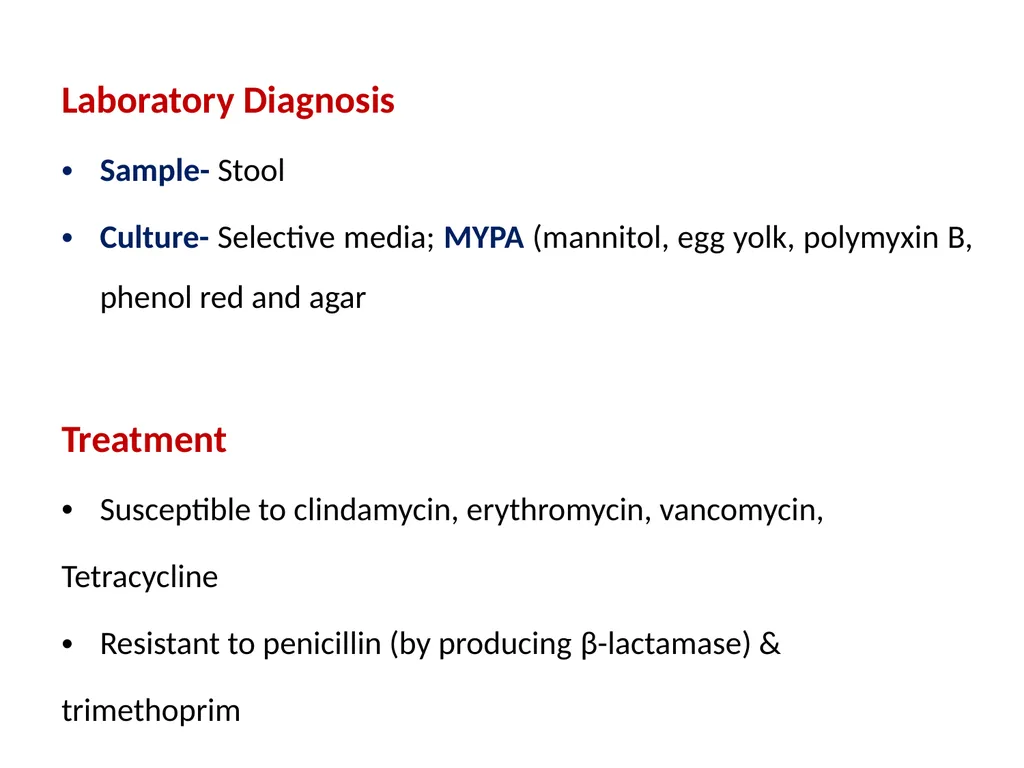
Sample- Stool
Culture- Selective media; MYPA (mannitol, egg yolk, polymyxin B, phenol red and agar
Treatment
Susceptible to clindamycin, erythromycin, vancomycin,
Tetracycline
Resistant to penicillin (by producing β-lactamase) &
trimethoprim<br>
Sample- Stool
Culture- Selective media; MYPA (mannitol, egg yolk, polymyxin B, phenol red and agar
Treatment
Susceptible to clindamycin, erythromycin, vancomycin,
Tetracycline
Resistant to penicillin (by producing β-lactamase) &
trimethoprim<br>
13
Clostridium perfringens food poisoning Gram- positive spore forming (sub terminal) obligate anaerobic bacilli
Capsulated & non motile
Food poisoning caused by C. perfringens type A enterotoxin (encoded by cpe gene)
Incubation period- 6- 24 h
Infective dose- about 108 viable vegetative bacilli producing enterotoxin<br>
Capsulated & non motile
Food poisoning caused by C. perfringens type A enterotoxin (encoded by cpe gene)
Incubation period- 6- 24 h
Infective dose- about 108 viable vegetative bacilli producing enterotoxin<br>
14
MOA- Due to survival of heat- resistant spores in inadequately cooked beef meat, poultry, or legumes.
- After ingestion, toxin is produced in the intestinal tract
Symotoms- moderate to severe abdominal cramps, diarrhea; vomiting, fever are uncommon
Course of disease- begins suddenly, is self-limited <24 hrs
Diagnosis is by detection of entertoxin in feces by enzyme immunoassay
C. perfringens mainly causes skin and soft-tissue infections (gas gangrene)<br>
15
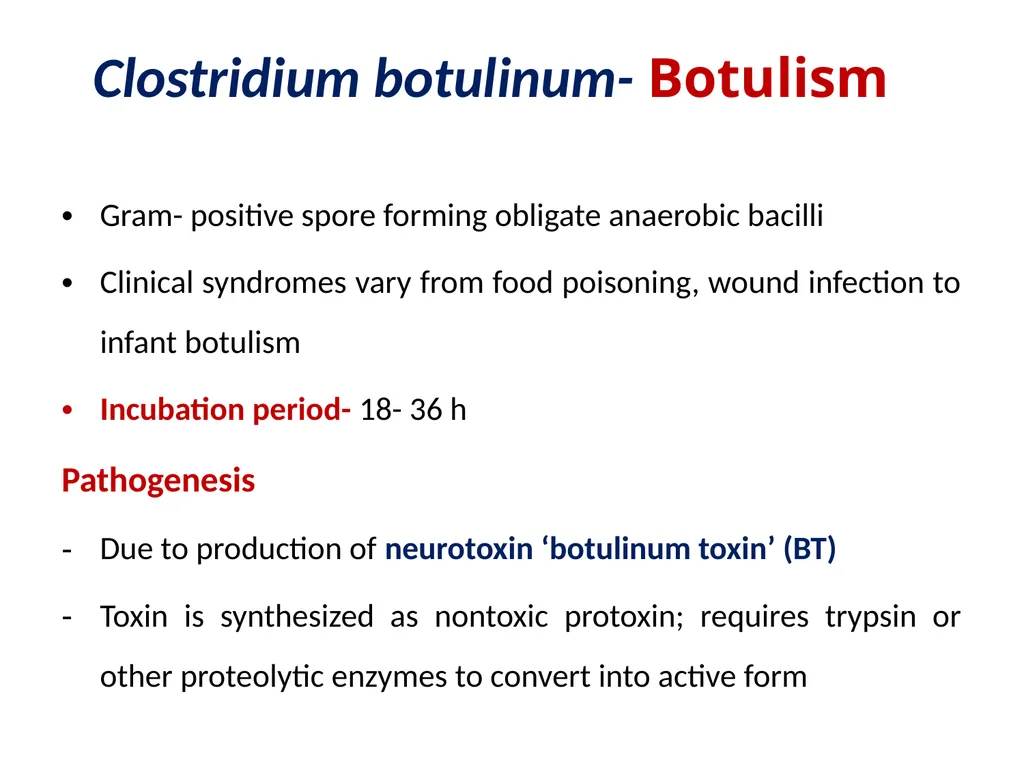
Clostridium botulinum- Botulism Gram- positive spore forming obligate anaerobic bacilli
Clinical syndromes vary from food poisoning, wound infection to infant botulism
Incubation period- 18- 36 h
Pathogenesis
Due to production of neurotoxin ‘botulinum toxin’ (BT)
Toxin is synthesized as nontoxic protoxin; requires trypsin or other proteolytic enzymes to convert into active form<br>
Clinical syndromes vary from food poisoning, wound infection to infant botulism
Incubation period- 18- 36 h
Pathogenesis
Due to production of neurotoxin ‘botulinum toxin’ (BT)
Toxin is synthesized as nontoxic protoxin; requires trypsin or other proteolytic enzymes to convert into active form<br>
16
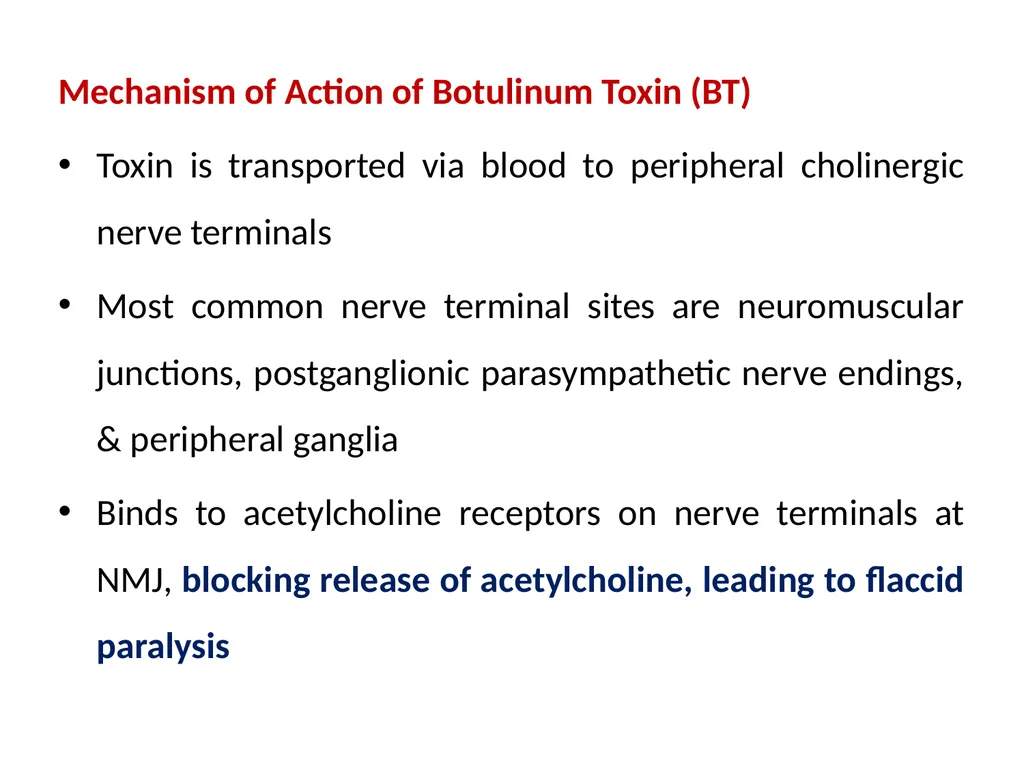
Mechanism of Action of Botulinum Toxin (BT)
Toxin is transported via blood to peripheral cholinergic nerve terminals
Most common nerve terminal sites are neuromuscular junctions, postganglionic parasympathetic nerve endings, & peripheral ganglia
Binds to acetylcholine receptors on nerve terminals at NMJ, blocking release of acetylcholine, leading to flaccid paralysis<br>
17
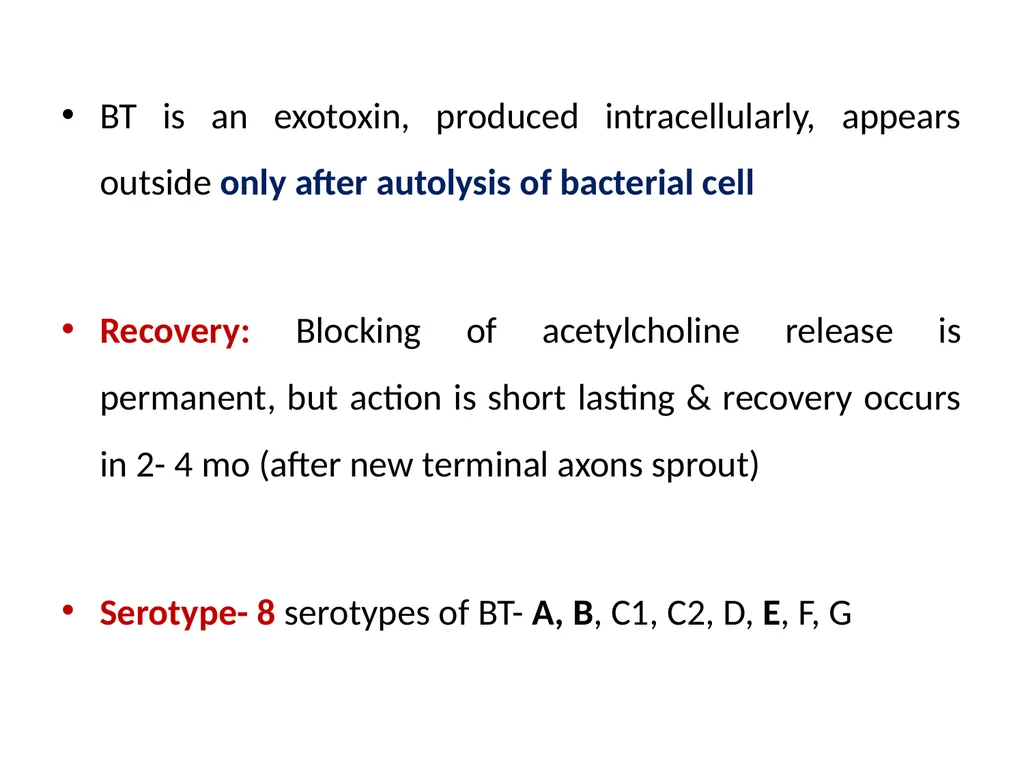
BT is an exotoxin, produced intracellularly, appears outside only after autolysis of bacterial cell
Recovery: Blocking of acetylcholine release is permanent, but action is short lasting & recovery occurs in 2- 4 mo (after new terminal axons sprout)
Serotype- 8 serotypes of BT- A, B, C1, C2, D, E, F, G<br>
Recovery: Blocking of acetylcholine release is permanent, but action is short lasting & recovery occurs in 2- 4 mo (after new terminal axons sprout)
Serotype- 8 serotypes of BT- A, B, C1, C2, D, E, F, G<br>
18
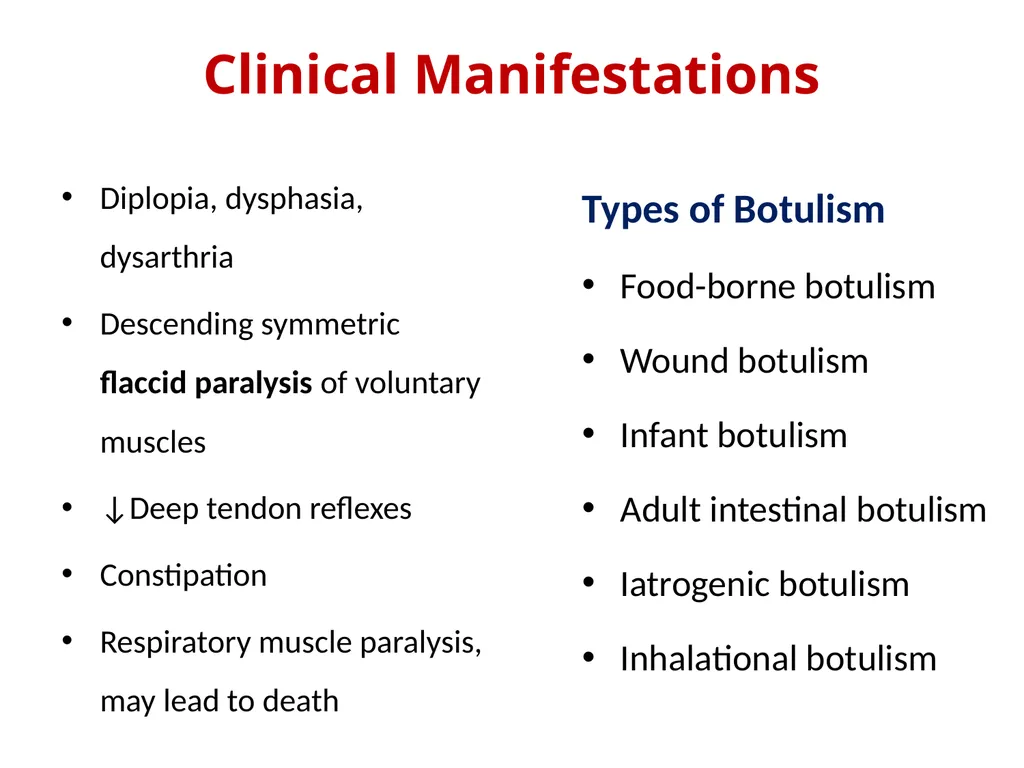
Clinical Manifestations Diplopia, dysphasia, dysarthria
Descending symmetric flaccid paralysis of voluntary muscles
↓Deep tendon reflexes
Constipation
Respiratory muscle paralysis, may lead to death Types of Botulism
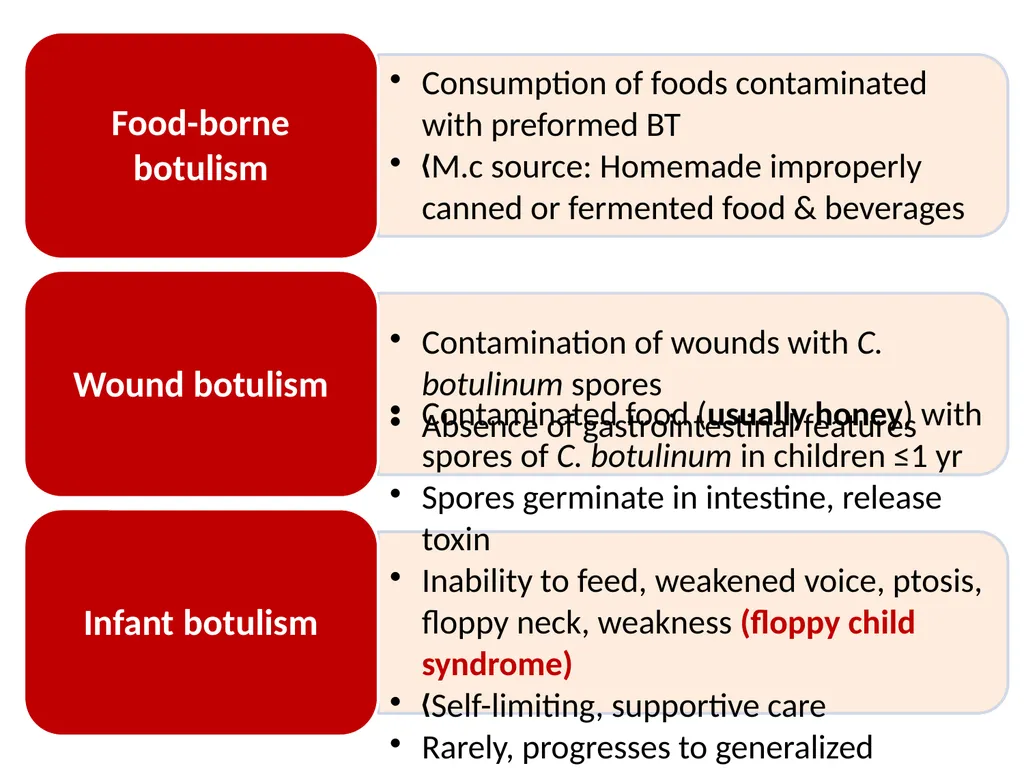
Food-borne botulism
Wound botulism
Infant botulism
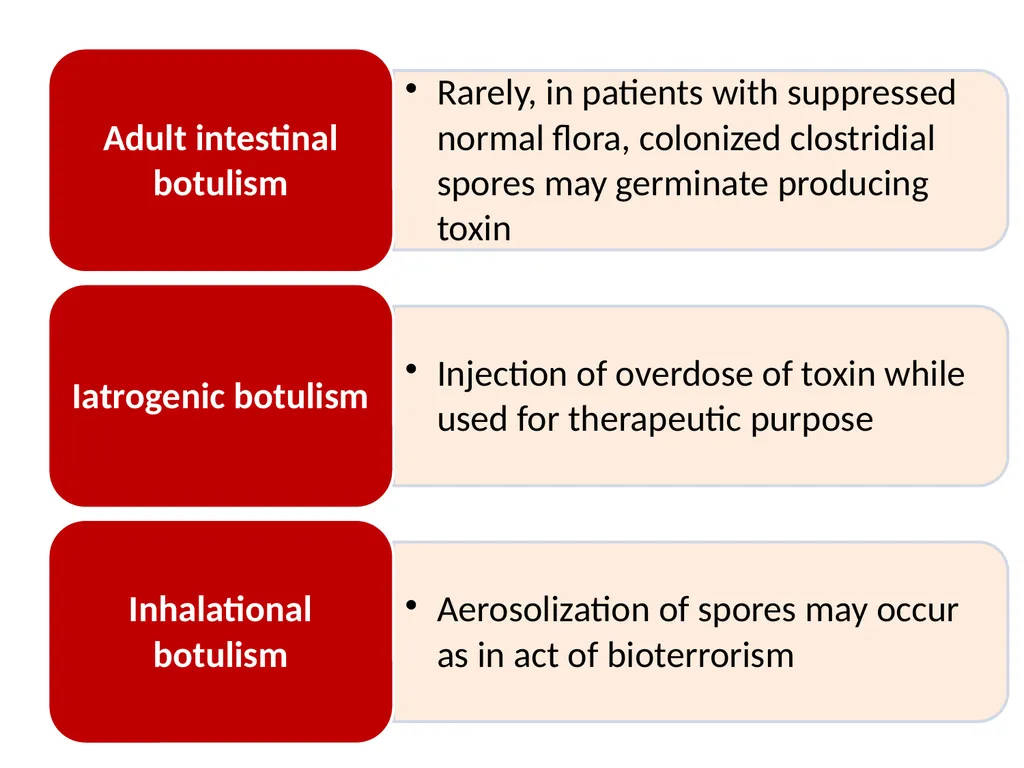
Adult intestinal botulism
Iatrogenic botulism
Inhalational botulism<br>
Descending symmetric flaccid paralysis of voluntary muscles
↓Deep tendon reflexes
Constipation
Respiratory muscle paralysis, may lead to death Types of Botulism
Food-borne botulism
Wound botulism
Infant botulism
Adult intestinal botulism
Iatrogenic botulism
Inhalational botulism<br>
19
Therapeutic uses: As BT produces flaccid paralysis, it can be used therapeutically for treatment of spasmodic conditions- strabismus, blepharospasm, myoclonus
Botulinum toxin is also produced by other clostridia- C. butyricum , C. baratti, C. argentinense<br>
Botulinum toxin is also produced by other clostridia- C. butyricum , C. baratti, C. argentinense<br>
20
Laboratory Diagnosis
Isolation of Bacilli
Toxin Demonstration- Mouse Bioassay<br>
Isolation of Bacilli
Toxin Demonstration- Mouse Bioassay<br>
21
Treatment
Meticulous intensive care support is needed
Botulinum antitoxin- administered immediately on clinical suspicion, without waiting for laboratory confirmation
Earlier the administration, better is the cure rate; antitoxin can neutralize unbound free toxin molecules
In wound botulism, suspected wounds & abscesses should be cleaned, debrided & drained promptly
Antibiotics- penicillin or metronidazole may be useful<br>
22
Facts to note Food poisoning outbreak must be suspected when :
an acute illness
affecting 2 or more persons
with similar gastrointestinal or neurological manifestations
who have shared a common meal<br>
an acute illness
affecting 2 or more persons
with similar gastrointestinal or neurological manifestations
who have shared a common meal<br>
23
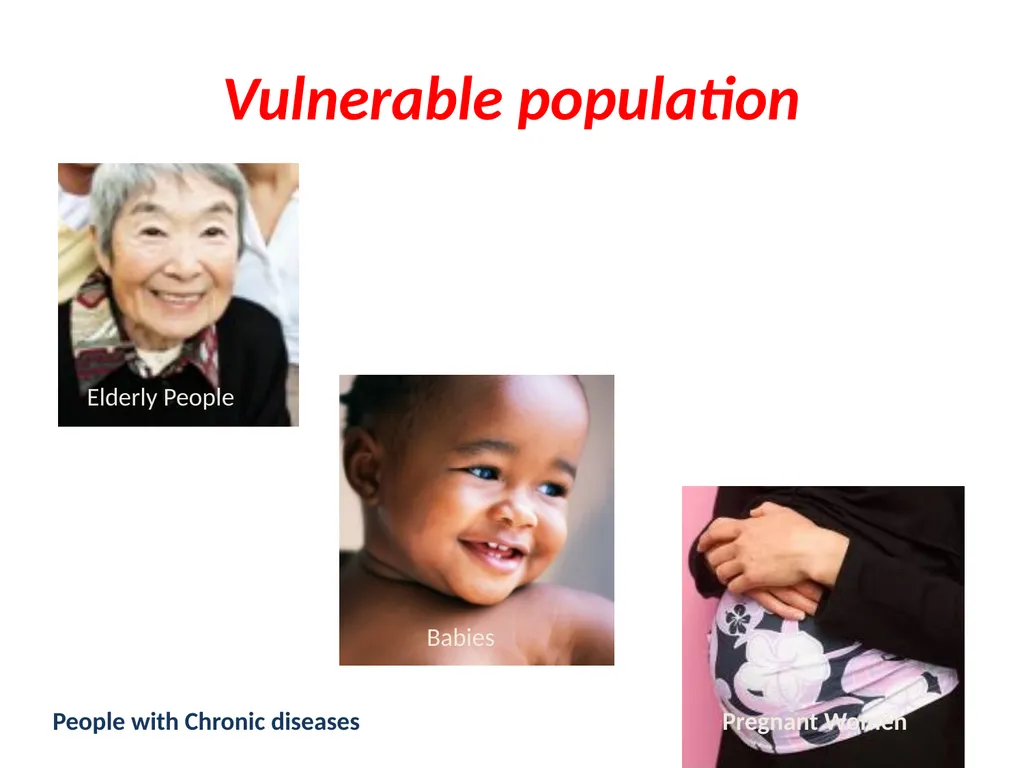
Vulnerable population Elderly People Babies Pregnant Women People with Chronic diseases<br>
24
Laboratory diagnosis Meticulous history taking regarding ingestion of specific foods & time of onset of diarrhea after a meal can provide clues to the bacterial cause of the illness
Vomitus, stool or the suspected food materials are the ideal specimens<br>
Vomitus, stool or the suspected food materials are the ideal specimens<br>
25
Processing of Food Specimens
Viable Plate Count (Direct Quantification)
Identify & report no. of colonies as such or /g sample
Pre-enrichment Culture (helps in recovery of damaged pathogen)
Toxin Detection- ELISA, LAT, PCR<br>
Viable Plate Count (Direct Quantification)
Identify & report no. of colonies as such or /g sample
Pre-enrichment Culture (helps in recovery of damaged pathogen)
Toxin Detection- ELISA, LAT, PCR<br>
26
MYCOTOXICOSES Mycotic poisoning is a rare cause of food poisoning, caused by fungi.
The disease can be classified into two varieties:
1. Mycotoxicosis: Disease produced by consumption of food contaminated with toxins liberated by certain fungi
2. Mycetism: Toxic effects produced by eating poisonous fleshy fungi; usually different types of mushrooms.<br>
The disease can be classified into two varieties:
1. Mycotoxicosis: Disease produced by consumption of food contaminated with toxins liberated by certain fungi
2. Mycetism: Toxic effects produced by eating poisonous fleshy fungi; usually different types of mushrooms.<br>
27
Features of common mycotoxicosis<br>
28
Features of common mycetism<br>
29
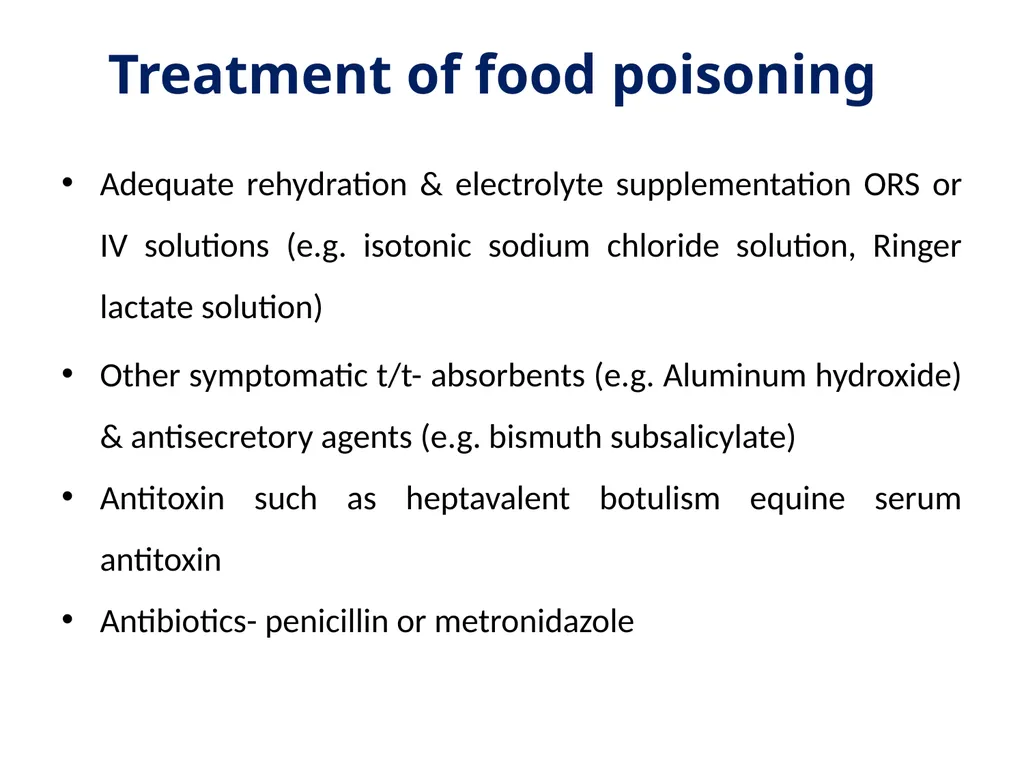
Treatment of food poisoning Adequate rehydration & electrolyte supplementation ORS or IV solutions (e.g. isotonic sodium chloride solution, Ringer lactate solution)
Other symptomatic t/t- absorbents (e.g. Aluminum hydroxide) & antisecretory agents (e.g. bismuth subsalicylate)
Antitoxin such as heptavalent botulism equine serum antitoxin
Antibiotics- penicillin or metronidazole<br>
Other symptomatic t/t- absorbents (e.g. Aluminum hydroxide) & antisecretory agents (e.g. bismuth subsalicylate)
Antitoxin such as heptavalent botulism equine serum antitoxin
Antibiotics- penicillin or metronidazole<br>
30
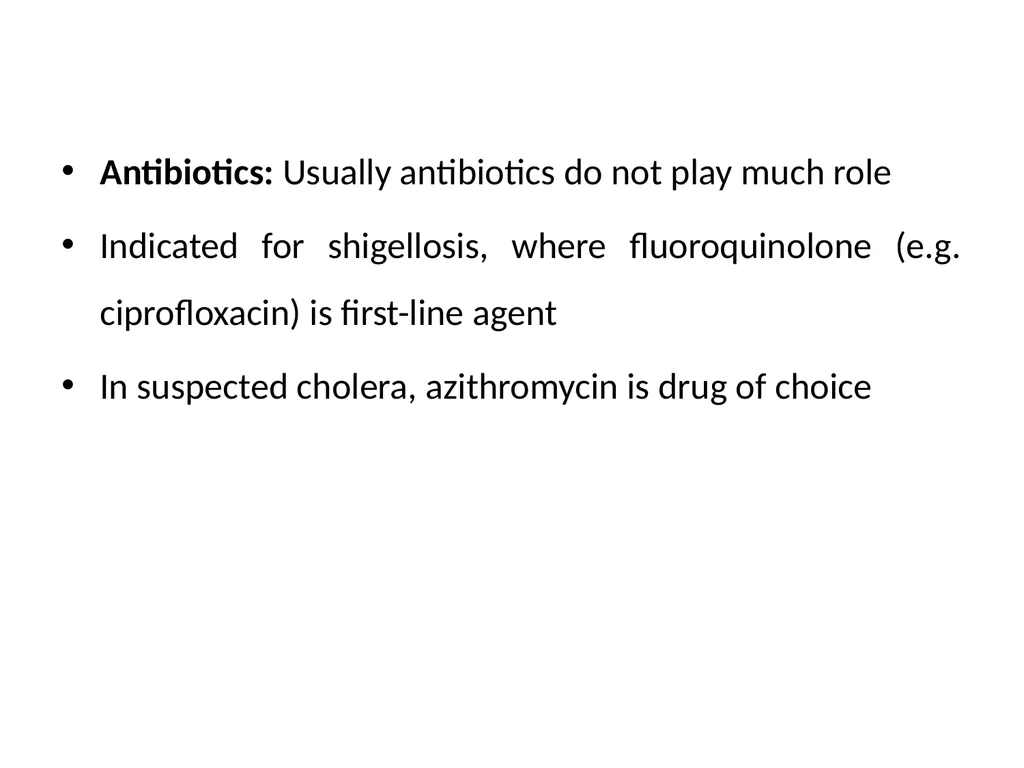
Antibiotics: Usually antibiotics do not play much role
Indicated for shigellosis, where fluoroquinolone (e.g. ciprofloxacin) is first-line agent
In suspected cholera, azithromycin is drug of choice<br>
Indicated for shigellosis, where fluoroquinolone (e.g. ciprofloxacin) is first-line agent
In suspected cholera, azithromycin is drug of choice<br>
31
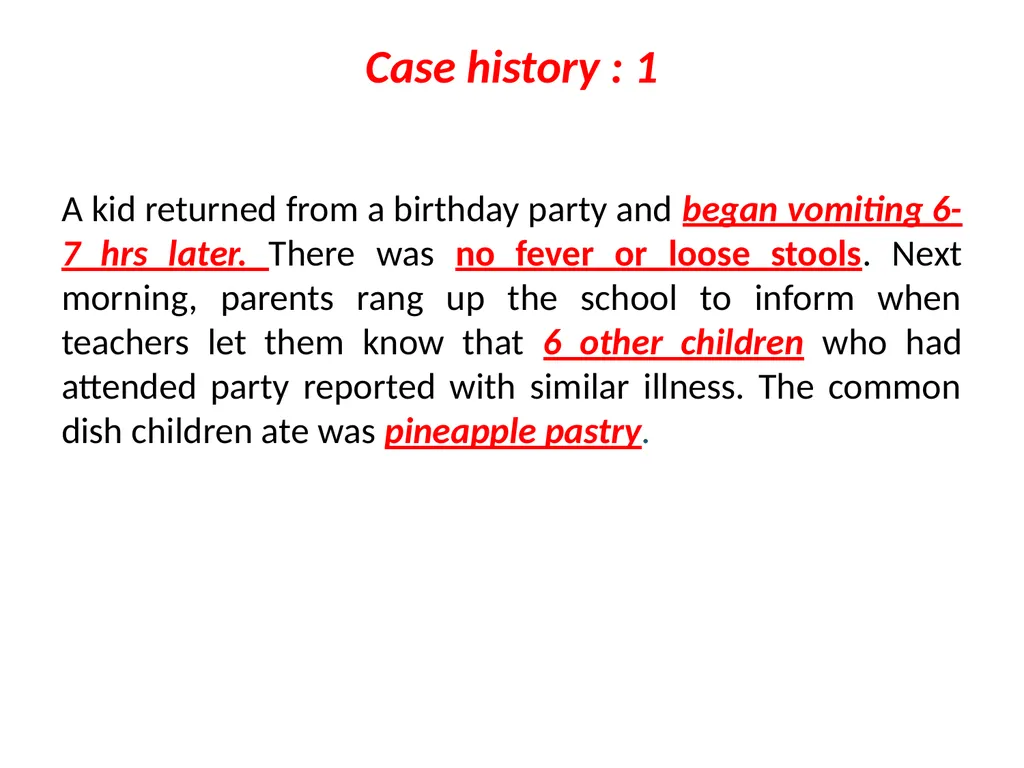
Case history : 1 A kid returned from a birthday party and began vomiting 6-7 hrs later. There was no fever or loose stools. Next morning, parents rang up the school to inform when teachers let them know that 6 other children who had attended party reported with similar illness. The common dish children ate was pineapple pastry.<br>
32
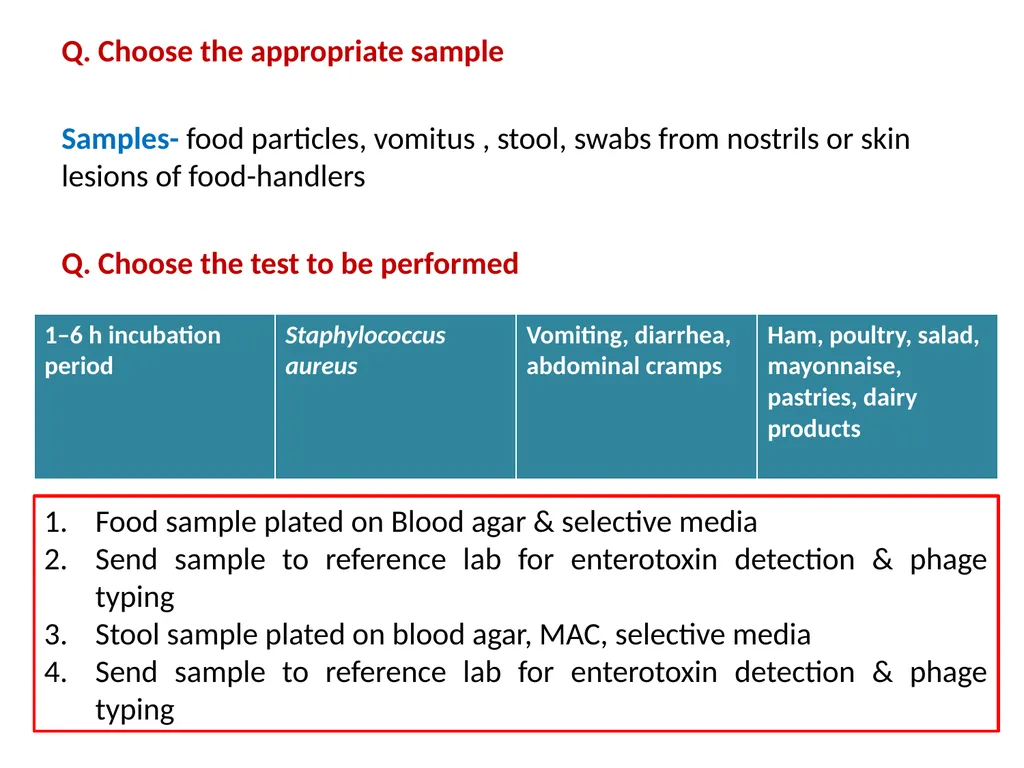
Q. Choose the appropriate sample
Samples- food particles, vomitus , stool, swabs from nostrils or skin lesions of food-handlers
Q. Choose the test to be performed Food sample plated on Blood agar & selective media
Send sample to reference lab for enterotoxin detection & phage typing
Stool sample plated on blood agar, MAC, selective media
Send sample to reference lab for enterotoxin detection & phage typing<br>
33
The pastry was recovered and cream tested positive for Staphylococcus aureus. Further investigations found that a nasal swab taken from the cook was positive for S. aureus.<br>
34
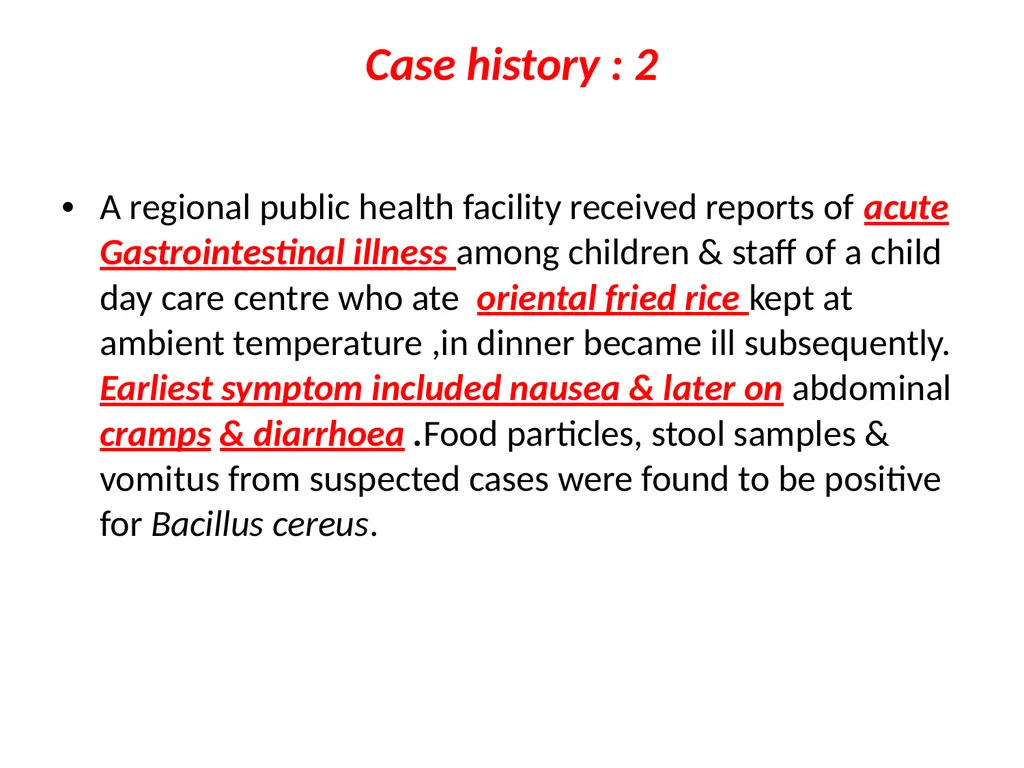
Case history : 2 A regional public health facility received reports of acute Gastrointestinal illness among children & staff of a child day care centre who ate oriental fried rice kept at ambient temperature ,in dinner became ill subsequently. Earliest symptom included nausea & later on abdominal cramps & diarrhoea .Food particles, stool samples & vomitus from suspected cases were found to be positive for Bacillus cereus.<br>
35
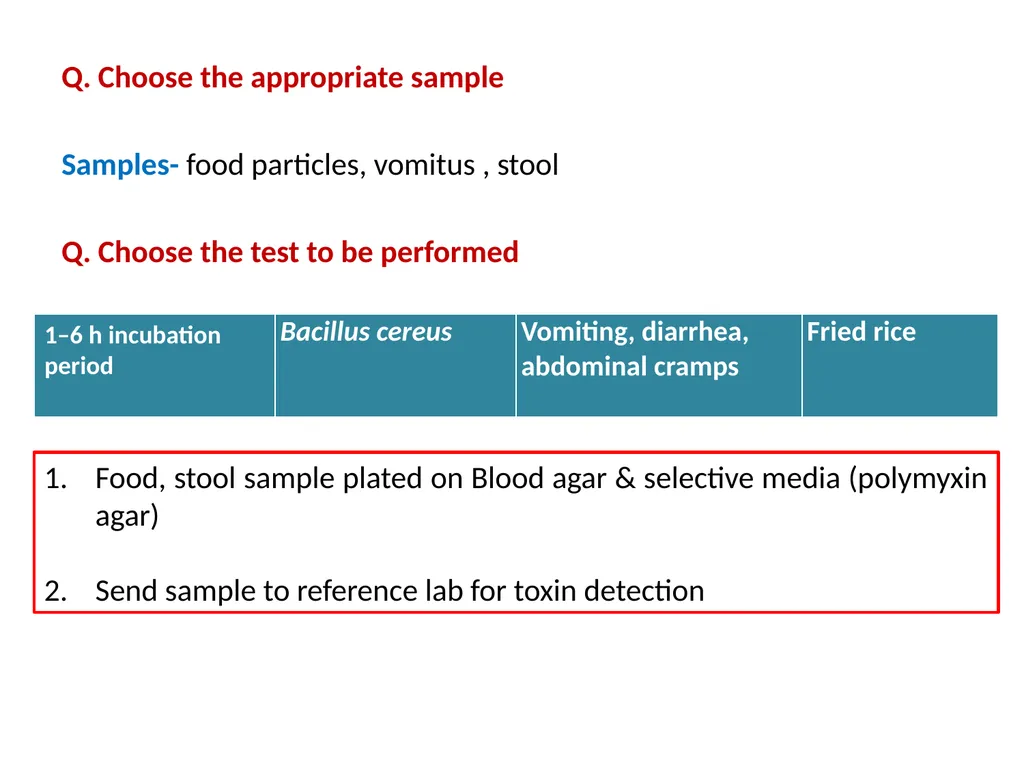
Q. Choose the appropriate sample
Samples- food particles, vomitus , stool
Q. Choose the test to be performed Food, stool sample plated on Blood agar & selective media (polymyxin agar)
Send sample to reference lab for toxin detection<br>
Samples- food particles, vomitus , stool
Q. Choose the test to be performed Food, stool sample plated on Blood agar & selective media (polymyxin agar)
Send sample to reference lab for toxin detection<br>
36
Food particles, stool samples & vomitus from suspected cases were found to be positive for Bacillus cereus<br>
37
Case history : 3 Mrs. Smitha was admitted to hospital with c/c of nausea, vomiting & cramps. Her daughter stated that she is also complaining of blurred vision. Nurse noticed drooping of eyelids & facial muscles of both sides . Her daughter said that she cans her own vegetables & had eaten from those jars yesterday. Paralysis starts developing & soon after her breathing ceases. She was placed on ventilator.<br>
38
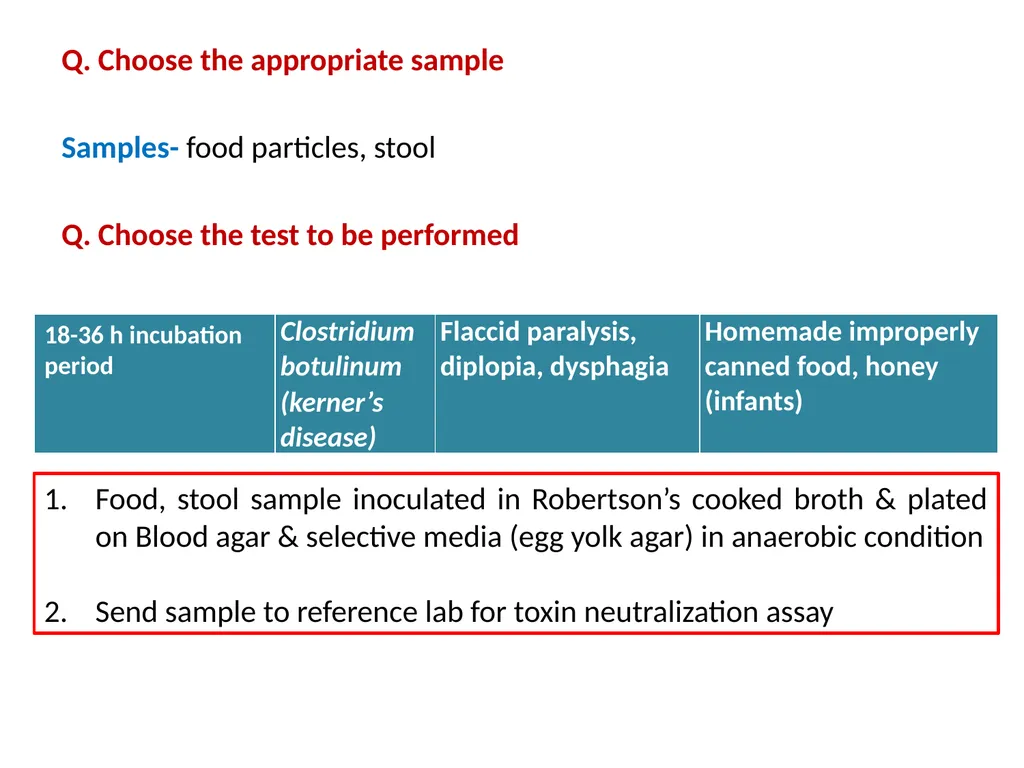
Q. Choose the appropriate sample
Samples- food particles, stool
Q. Choose the test to be performed Food, stool sample inoculated in Robertson’s cooked broth & plated on Blood agar & selective media (egg yolk agar) in anaerobic condition
Send sample to reference lab for toxin neutralization assay<br>
Samples- food particles, stool
Q. Choose the test to be performed Food, stool sample inoculated in Robertson’s cooked broth & plated on Blood agar & selective media (egg yolk agar) in anaerobic condition
Send sample to reference lab for toxin neutralization assay<br>
39
Food, stool samples were found to be positive for Clostridium botulinum<br>
40
Case history : 4 A recent outbreak of foodborne illness was reported after a mass staff luncheon at a school where beef was cooked. Beef was not refrigerated & kept long in kitchen before serving. 103 people got sick with cramps , diarrhoea & dehydration.<br>
41
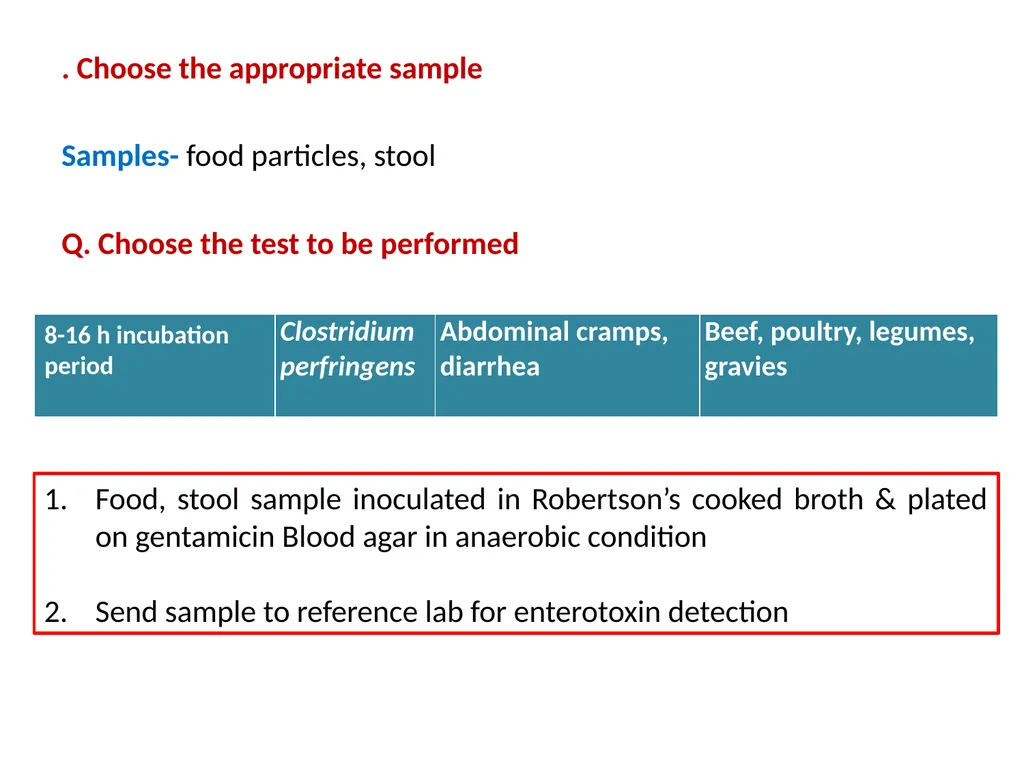
. Choose the appropriate sample
Samples- food particles, stool
Q. Choose the test to be performed Food, stool sample inoculated in Robertson’s cooked broth & plated on gentamicin Blood agar in anaerobic condition
Send sample to reference lab for enterotoxin detection<br>
Samples- food particles, stool
Q. Choose the test to be performed Food, stool sample inoculated in Robertson’s cooked broth & plated on gentamicin Blood agar in anaerobic condition
Send sample to reference lab for enterotoxin detection<br>
42
Food & stool samples taken from cases tested positive for Clostridium perfringens<br>