For Illinois Supervisors Sexual Harassment Prevention Training Agenda Why care about Sexual Harassment? Your Responsibility Employer consequences related to Sexual Harassment What you need to know Prevention, Investigation, and Corrective
"For Illinois Supervisors Sexual Harassment" is the property of its rightful owner. Permission is granted to
download and print the materials on this website for personal, non-commercial use only, and to display it
on your personal computer provided you do not modify the materials and that you retain all copyright
notices contained in the materials. By downloading content from our website, you accept the terms of this
agreement.
Presentation Transcript
01
For Illinois Supervisors Sexual Harassment Prevention Training<br>
02
Agenda Why care about Sexual Harassment?
Your Responsibility
Employer consequences related to Sexual Harassment
What you need to know
Prevention, Investigation, and Corrective Measures
Next Steps<br>
03
It is important to prevent sexual harassment in your workplace because it harms us all.
Each of us has a responsibility and will be held accountable for:
treating others with respect and dignity
reporting incidents immediately, following procedures
cooperating with investigations
supporting victims Why Care About Sexual Harassment?<br>
04
Employer Responsibilities All Illinois employers must provide Sexual Harassment Prevention Training to all employees on an annual basis. Failure to do so is a violation of the Act.
The Employer Group developed the training, will roll it out to current employees, and forward it to all new employees going forward, as of August 1, 2020.
TEG will send the training to all Illinois employees annually starting in 2021.
TEG will collect training acknowledgement forms from employees.<br>
05
Employee Training Information The training provided by TEG meets the legal requirements:
Explanation of sexual harassment consistent with the IHRA
Examples of conduct that constitutes unlawful sexual harassment
Summary of relevant federal and State statutory provisions concerning sexual harassment, including remedies available to victims of sexual harassment
Summary of responsibilities of employers in the prevention, investigation, and corrective measures of sexual harassment<br>
06
Employer Responsibilities Manager/Supervisor Harassment. Employers are strictly liable for sexual harassment perpetrated by members of management regardless of whether the employer knew of the harassment.
Co-Worker & Nonemployee Harassment. Employers are liable for sexual harassment perpetrated by an employee or nonemployee only if the employer knew or reasonably should have known of the harassment and failed to take prompt corrective action.<br>
07
Consequences for Employers Related to Sexual Harassment Employee morale
Poor performance
Excessive use of paid time off
Turnover
Company reputation
Your reputation
Fines between $500 and $5,000
Charges filed with the State of Illinois Department of Human Rights (IDHR) and/or with The U.S. Equal Employment Opportunity Commission (EEOC)<br>
08
What Do You Need to Know? Under the Illinois Human Rights Act, “Sexual harassment” means any unwelcome sexual advances, requests for sexual favors, or any conduct of a sexual nature.
Victims do not solicit or invite this behavior, they regard the conduct as undesirable and offensive
All persons can be victims of sexual harassment regardless of the perpetrator’s or the victim’s gender identity or sexual orientation
Third Parties and Bystanders can also be victims of sexual harassment<br>
09
What are Examples of Inappropriate Conduct? Sexual harassment includes unwelcome conduct of a sexual nature (sexual advances and requests for sexual favors).
Pressure for sexual favors or to go out on a date
Deliberate touching, leaning over, or cornering another person
Sexual looks or gestures or whistling at someone
Sending letters, telephone calls, e-mails, texts, or other sexual messages
Sexual teasing, jokes, remarks, or questions
Sexual comments, sexual innuendos, or sexual stories
Sexual comments about a person’s clothing, body, or looks
Kissing sounds, howling and smacking lips
Telling lies or spreading rumors about a person’s sex life
Touching another employee such as their clothing, hair, or body
Actual or attempted rape or sexual assault<br>
10
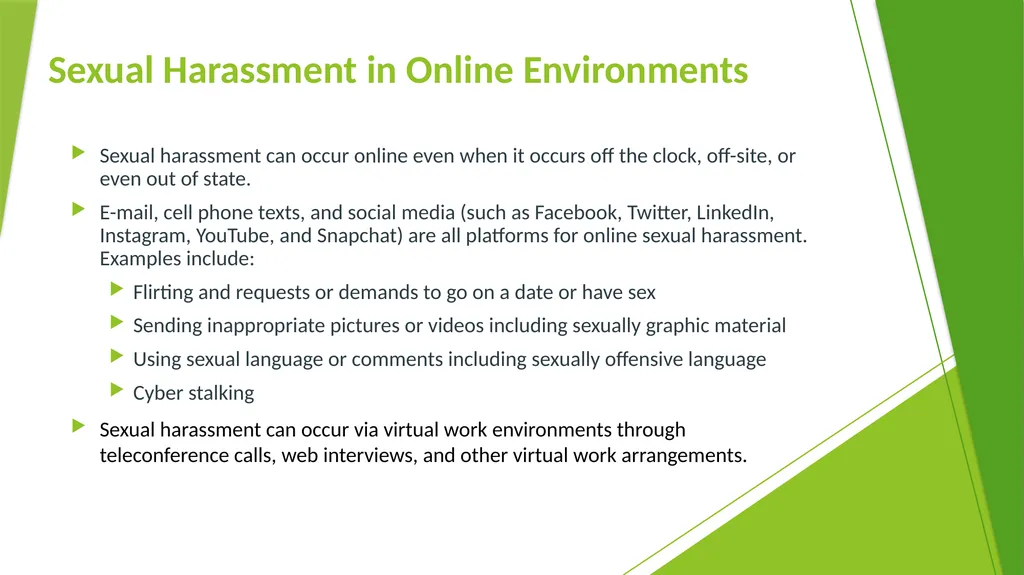
Sexual Harassment in Online Environments Sexual harassment can occur online even when it occurs off the clock, off-site, or even out of state.
E-mail, cell phone texts, and social media (such as Facebook, Twitter, LinkedIn, Instagram, YouTube, and Snapchat) are all platforms for online sexual harassment. Examples include:
Flirting and requests or demands to go on a date or have sex
Sending inappropriate pictures or videos including sexually graphic material
Using sexual language or comments including sexually offensive language
Cyber stalking
Sexual harassment can occur via virtual work environments through teleconference calls, web interviews, and other virtual work arrangements.<br>
11
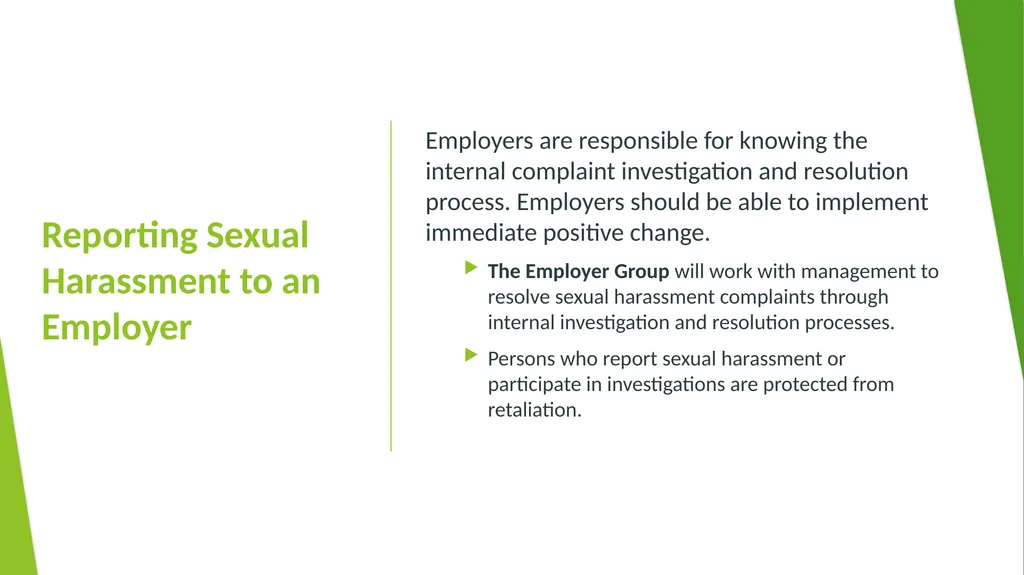
Reporting Sexual Harassment to an Employer Employers are responsible for knowing the internal complaint investigation and resolution process. Employers should be able to implement immediate positive change.
The Employer Group will work with management to resolve sexual harassment complaints through internal investigation and resolution processes.
Persons who report sexual harassment or participate in investigations are protected from retaliation.<br>
12
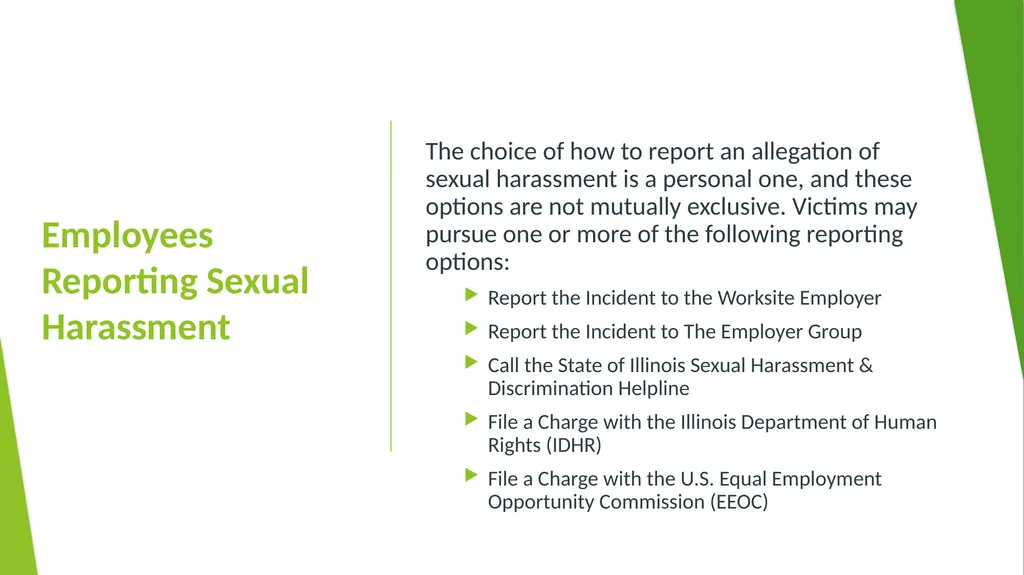
Employees Reporting Sexual Harassment The choice of how to report an allegation of sexual harassment is a personal one, and these options are not mutually exclusive. Victims may pursue one or more of the following reporting options:
Report the Incident to the Worksite Employer
Report the Incident to The Employer Group
Call the State of Illinois Sexual Harassment & Discrimination Helpline
File a Charge with the Illinois Department of Human Rights (IDHR)
File a Charge with the U.S. Equal Employment Opportunity Commission (EEOC)<br>
13
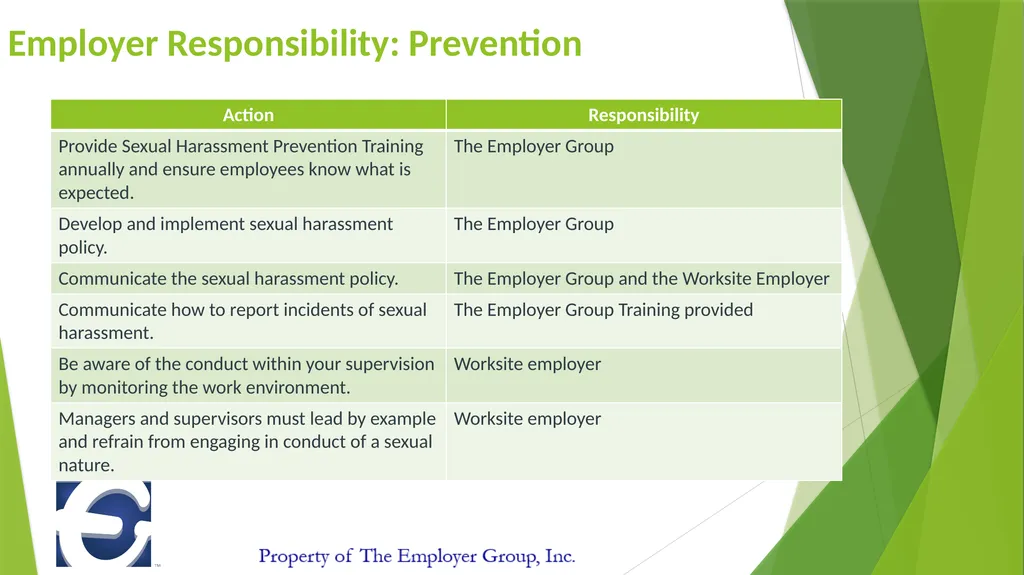
Employer Responsibility: Prevention<br>
14
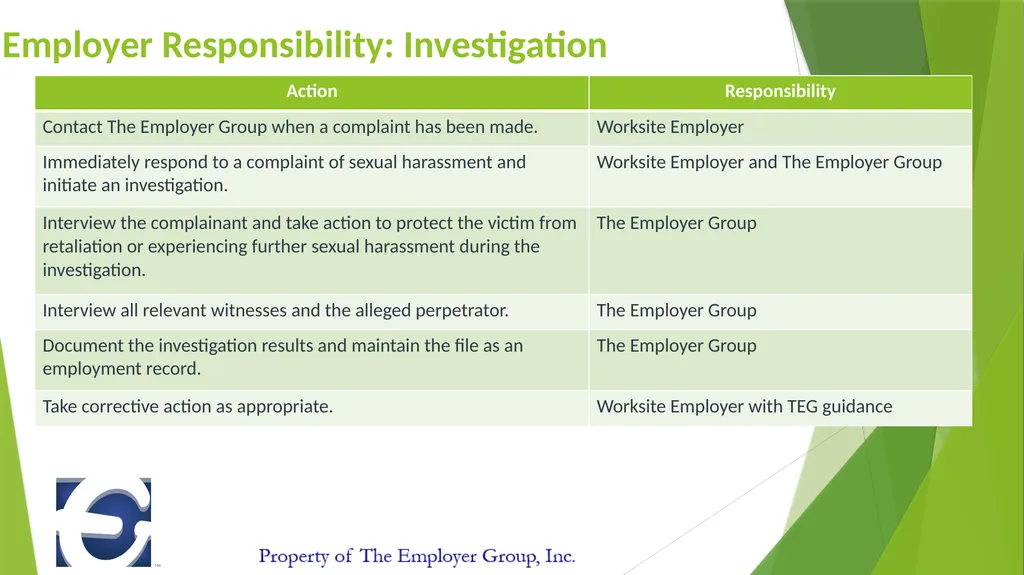
Employer Responsibility: Investigation<br>
15
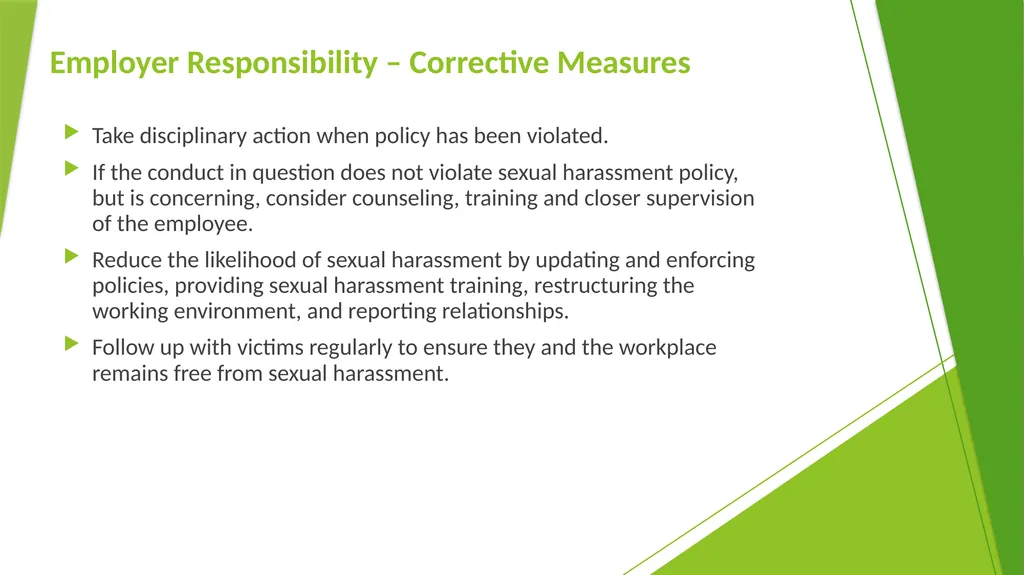
Employer Responsibility – Corrective Measures Take disciplinary action when policy has been violated.
If the conduct in question does not violate sexual harassment policy, but is concerning, consider counseling, training and closer supervision of the employee.
Reduce the likelihood of sexual harassment by updating and enforcing policies, providing sexual harassment training, restructuring the working environment, and reporting relationships.
Follow up with victims regularly to ensure they and the workplace remains free from sexual harassment.<br>
16
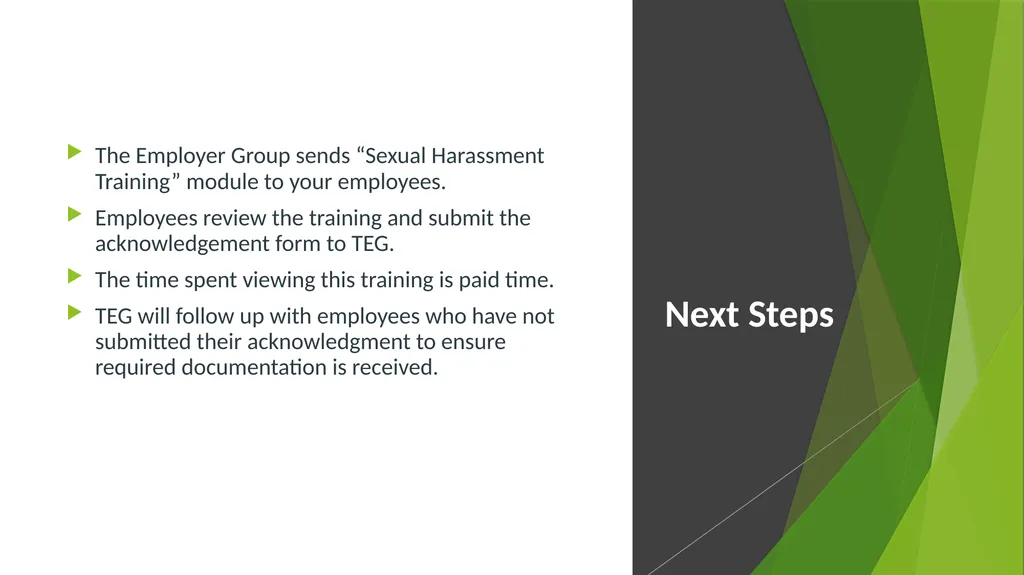
The Employer Group sends “Sexual Harassment Training” module to your employees.
Employees review the training and submit the acknowledgement form to TEG.
The time spent viewing this training is paid time.
TEG will follow up with employees who have not submitted their acknowledgment to ensure required documentation is received. Next Steps<br>