
Force Majeure and Business Interruption May 12,
AS
Published · 22 slides · 0 views

1 / 1
Description
Force Majeure and Business Interruption May 12, 2020 Presented By: Melissa Demorest LeDuc, Esq. Mark S. Demorest, Esq. Demorest Law Firm, PLLC www.demolaw.com Reinier Russell Guus van Lieshout Russell Advocaten B.V. www.russell.nl Carrie
Related Topics
Share
Embed code
Download this presentation From Below
"Force Majeure and Business Interruption May 12," is the property of its rightful owner. Permission is granted to download and print the materials on this website for personal, non-commercial use only, and to display it on your personal computer provided you do not modify the materials and that you retain all copyright notices contained in the materials. By downloading content from our website, you accept the terms of this agreement.
Presentation Transcript
01
Force Majeure and Business Interruption
May 12, 2020
Presented By: Melissa Demorest LeDuc, Esq.
Mark S. Demorest, Esq.
Demorest Law Firm, PLLC
www.demolaw.com Reinier Russell
Guus van Lieshout Russell Advocaten B.V. www.russell.nl Carrie Ward Earp Cohn P.C. www.earpcohn.com<br>
Guus van Lieshout Russell Advocaten B.V. www.russell.nl Carrie Ward Earp Cohn P.C. www.earpcohn.com<br>
02
Understanding Force Majeure Force Majeure is French for “superior force”
Parties may sometimes be excused from performance under a contract when an event outside their control makes performance impossible
Contract provisions are important, but common law and statutory issues must be considered as well
Typical force majeure events
“Act of God”
Natural disasters, earthquakes, fires, floods, etc.
Wars, terrorism, riots, labor disputes (typically strikes)
Governmental regulations or actions<br>
Parties may sometimes be excused from performance under a contract when an event outside their control makes performance impossible
Contract provisions are important, but common law and statutory issues must be considered as well
Typical force majeure events
“Act of God”
Natural disasters, earthquakes, fires, floods, etc.
Wars, terrorism, riots, labor disputes (typically strikes)
Governmental regulations or actions<br>
03
Understanding Force Majeure Black’s Law Dictionary defines an “act of God” as “[a]n overwhelming, unpreventable event caused exclusively by forces of nature, such as an earthquake, flood, or tornado.”
Does a pandemic count as an “act of God”?
Does it fit another “typical” category?<br>
Does a pandemic count as an “act of God”?
Does it fit another “typical” category?<br>
04
Understanding Force Majeure Analysis
Does the contract include a force majeure clause?
Typically included in event contracts, supply agreements, construction contracts, and other contracts requiring specific performance timelines
If so, how does the contract define force majeure events?
Very specific, very general, or in between?
Is performance actually impossible or can it be delayed?
Is there an alternate supply source?
Local vs global effects of pandemic
What about impracticability?<br>
Does the contract include a force majeure clause?
Typically included in event contracts, supply agreements, construction contracts, and other contracts requiring specific performance timelines
If so, how does the contract define force majeure events?
Very specific, very general, or in between?
Is performance actually impossible or can it be delayed?
Is there an alternate supply source?
Local vs global effects of pandemic
What about impracticability?<br>
05
Understanding Force Majeure Analysis - Continued
What are the risks of contract termination?
What relief may the contracting party obtain if a court finds that this was not a force majeure event?
To what extent does a “most favored nation” clause come into play?
What must a party excused from performance do to mitigate the impact of non-performance?
Fact-specific analysis<br>
What are the risks of contract termination?
What relief may the contracting party obtain if a court finds that this was not a force majeure event?
To what extent does a “most favored nation” clause come into play?
What must a party excused from performance do to mitigate the impact of non-performance?
Fact-specific analysis<br>
06
Understanding Force Majeure What if your contract doesn’t include a force majeure clause?
Leases
Rent abatement or suspension
Doctrine of frustration/frustration of purpose
Unforeseen situation
Absence of relevant contract provision (force majeure clause)
“Radically different performance of contract”
Material adverse change clause
Real estate or other purchase agreement
Loan term sheet<br>
Leases
Rent abatement or suspension
Doctrine of frustration/frustration of purpose
Unforeseen situation
Absence of relevant contract provision (force majeure clause)
“Radically different performance of contract”
Material adverse change clause
Real estate or other purchase agreement
Loan term sheet<br>
07
Understanding Force Majeure What if your contract doesn’t include a force majeure clause? - Continued
Defense of impossibility/impracticability of performance
UCC includes impracticability defense
Under Michigan UCC, performance excused where:
Inability to perform is due to compliance with governmental regulations OR
performance becomes impracticable due to occurrence of an “unforeseeable” event<br>
Defense of impossibility/impracticability of performance
UCC includes impracticability defense
Under Michigan UCC, performance excused where:
Inability to perform is due to compliance with governmental regulations OR
performance becomes impracticable due to occurrence of an “unforeseeable” event<br>
08
What to do about existing contracts? Review existing contracts to understand force majeure clauses and possible solutions
Pay attention to notification deadlines
Unintentional waiver or default
Allocation of risk
Communicate with contracting parties
Plan for future performance
Rescheduled event or
Ramping up resumed supply of goods<br>
Pay attention to notification deadlines
Unintentional waiver or default
Allocation of risk
Communicate with contracting parties
Plan for future performance
Rescheduled event or
Ramping up resumed supply of goods<br>
09
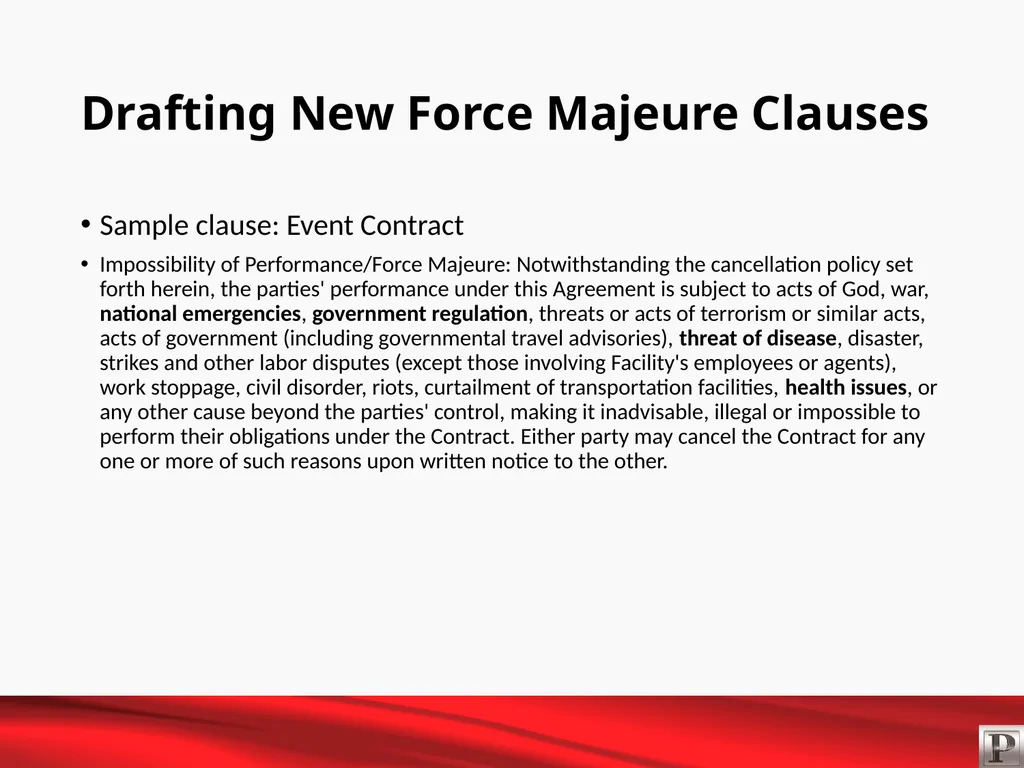
Drafting New Force Majeure Clauses Sample clause: Event Contract
Impossibility of Performance/Force Majeure: Notwithstanding the cancellation policy set forth herein, the parties' performance under this Agreement is subject to acts of God, war, national emergencies, government regulation, threats or acts of terrorism or similar acts, acts of government (including governmental travel advisories), threat of disease, disaster, strikes and other labor disputes (except those involving Facility's employees or agents), work stoppage, civil disorder, riots, curtailment of transportation facilities, health issues, or any other cause beyond the parties' control, making it inadvisable, illegal or impossible to perform their obligations under the Contract. Either party may cancel the Contract for any one or more of such reasons upon written notice to the other.<br>
Impossibility of Performance/Force Majeure: Notwithstanding the cancellation policy set forth herein, the parties' performance under this Agreement is subject to acts of God, war, national emergencies, government regulation, threats or acts of terrorism or similar acts, acts of government (including governmental travel advisories), threat of disease, disaster, strikes and other labor disputes (except those involving Facility's employees or agents), work stoppage, civil disorder, riots, curtailment of transportation facilities, health issues, or any other cause beyond the parties' control, making it inadvisable, illegal or impossible to perform their obligations under the Contract. Either party may cancel the Contract for any one or more of such reasons upon written notice to the other.<br>
10
Drafting New Force Majeure Clauses Event Contract
May also include a cancellation policy that allows the event to be rescheduled without penalty
Carefully review event contracts prepared by event venues (large hotel chains, casinos, etc.)<br>
May also include a cancellation policy that allows the event to be rescheduled without penalty
Carefully review event contracts prepared by event venues (large hotel chains, casinos, etc.)<br>
11
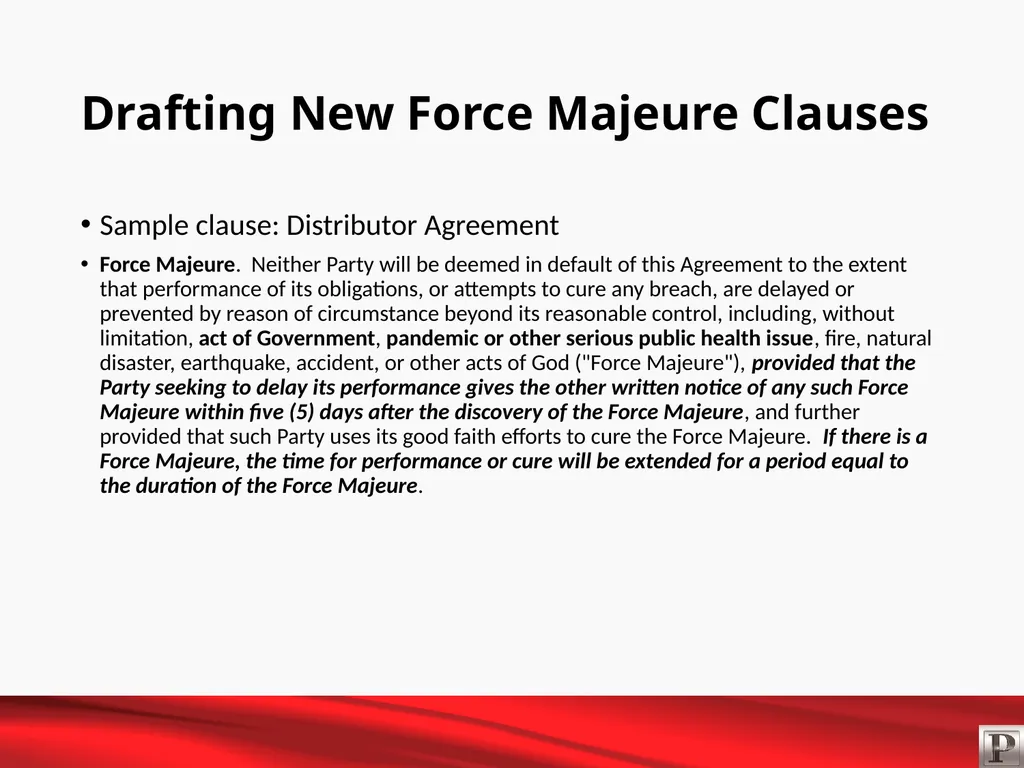
Drafting New Force Majeure Clauses Sample clause: Distributor Agreement
Force Majeure. Neither Party will be deemed in default of this Agreement to the extent that performance of its obligations, or attempts to cure any breach, are delayed or prevented by reason of circumstance beyond its reasonable control, including, without limitation, act of Government, pandemic or other serious public health issue, fire, natural disaster, earthquake, accident, or other acts of God ("Force Majeure"), provided that the Party seeking to delay its performance gives the other written notice of any such Force Majeure within five (5) days after the discovery of the Force Majeure, and further provided that such Party uses its good faith efforts to cure the Force Majeure. If there is a Force Majeure, the time for performance or cure will be extended for a period equal to the duration of the Force Majeure.<br>
Force Majeure. Neither Party will be deemed in default of this Agreement to the extent that performance of its obligations, or attempts to cure any breach, are delayed or prevented by reason of circumstance beyond its reasonable control, including, without limitation, act of Government, pandemic or other serious public health issue, fire, natural disaster, earthquake, accident, or other acts of God ("Force Majeure"), provided that the Party seeking to delay its performance gives the other written notice of any such Force Majeure within five (5) days after the discovery of the Force Majeure, and further provided that such Party uses its good faith efforts to cure the Force Majeure. If there is a Force Majeure, the time for performance or cure will be extended for a period equal to the duration of the Force Majeure.<br>
12
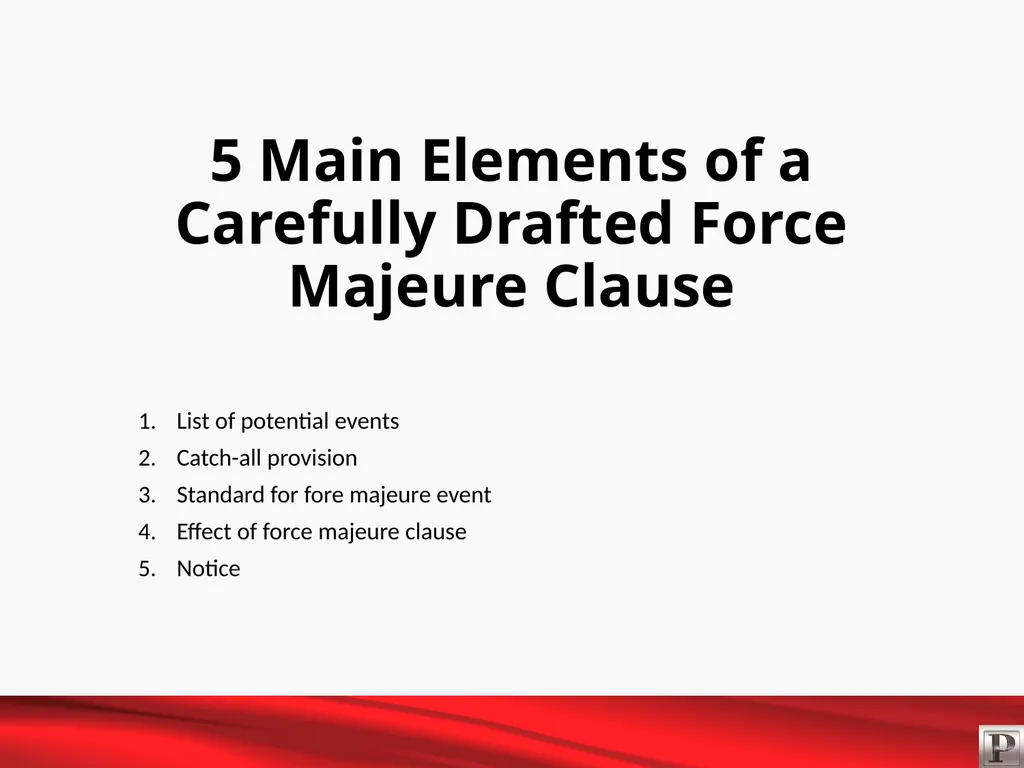
5 Main Elements of a Carefully Drafted Force Majeure Clause List of potential events
Catch-all provision
Standard for fore majeure event
Effect of force majeure clause
Notice<br>
Catch-all provision
Standard for fore majeure event
Effect of force majeure clause
Notice<br>
13
Interpretation of catch-all clauses Not all events can be specified or anticipated and captured in a contract.
Examples:
"including, but not limited to" or similar language to broaden the scope.
"and any other events, including emergencies or non-emergencies," to cover other, unforeseeable events.
Careful consideration should be given so that the catch-all phrase is not interpreted narrowly (e.g., unforeseen events, etc.)<br>
Examples:
"including, but not limited to" or similar language to broaden the scope.
"and any other events, including emergencies or non-emergencies," to cover other, unforeseeable events.
Careful consideration should be given so that the catch-all phrase is not interpreted narrowly (e.g., unforeseen events, etc.)<br>
14
State law issues New York
Strict interpretation.
Triggering force majeure event must make it impossible to perform.
New Jersey, Florida, Delaware, Connecticut
Broad interpretation.
Courts interpret that a force majeure occurs when event makes performance merely impractical—not impossible.
California
California courts take a liberal approach.
California Supreme Court has explained that the meaning of force majeure, “is not necessarily limited to the equivalent of an act of God. The test is whether under the particular circumstances there was such an insuperable interference occurring without the party’s intervention as could not have been prevented by the exercise of prudence, diligence and care.” See Citizens of Humanity LLC v. Caitac Int’l Inc. , No. B215232, at *14 (Cal. Ct. App. Aug. 3, 2010) (“‘Force majeure’ is the equivalent of the common law contract defense of impossibility”); Cal. Civ. Code § 3531 (“The law never requires impossibilities”).
California Civil Code 3526, which states that "no man is responsible for that which no man can control."<br>
Strict interpretation.
Triggering force majeure event must make it impossible to perform.
New Jersey, Florida, Delaware, Connecticut
Broad interpretation.
Courts interpret that a force majeure occurs when event makes performance merely impractical—not impossible.
California
California courts take a liberal approach.
California Supreme Court has explained that the meaning of force majeure, “is not necessarily limited to the equivalent of an act of God. The test is whether under the particular circumstances there was such an insuperable interference occurring without the party’s intervention as could not have been prevented by the exercise of prudence, diligence and care.” See Citizens of Humanity LLC v. Caitac Int’l Inc. , No. B215232, at *14 (Cal. Ct. App. Aug. 3, 2010) (“‘Force majeure’ is the equivalent of the common law contract defense of impossibility”); Cal. Civ. Code § 3531 (“The law never requires impossibilities”).
California Civil Code 3526, which states that "no man is responsible for that which no man can control."<br>
15
Notice Pay attention to time limit on providing notice (e.g., at least 5 days prior to event, prompt notice, etc.)
Timing
Ideal time to cancel is when you are exactly in a situation prescribed in your force majeure clause making performance impossible
Covid-19 is an unfolding event
Business considerations
Practical considerations
Balancing the pros and cons of cancelling event early<br>
Timing
Ideal time to cancel is when you are exactly in a situation prescribed in your force majeure clause making performance impossible
Covid-19 is an unfolding event
Business considerations
Practical considerations
Balancing the pros and cons of cancelling event early<br>
16
Business Interruption Business Interruption Insurance
Insurance coverage is contractual, and depends on the terms of the policy
Review policy, but many policies specifically prohibit claims due to viral illness
Ambiguities in the policy are construed against the insurer
Consult with insurance agent
Consult with attorney with expertise in insurance coverage issues
If you think you may have coverage you must comply with the policy’s notice and proof of loss requirements
Give notice, even if you aren’t sure whether you will actually get coverage!<br>
Insurance coverage is contractual, and depends on the terms of the policy
Review policy, but many policies specifically prohibit claims due to viral illness
Ambiguities in the policy are construed against the insurer
Consult with insurance agent
Consult with attorney with expertise in insurance coverage issues
If you think you may have coverage you must comply with the policy’s notice and proof of loss requirements
Give notice, even if you aren’t sure whether you will actually get coverage!<br>
17
Business Interruption Business Interruption Insurance
Monitor pending litigation to see how this issue develops
Several class actions already filed
Pending legislation in some jurisdiction to require insurers to pay claims
Michigan, Ohio, Massachusetts, New York, New Jersey, Pennsylvania, Louisiana, and other states have introduced bills so far
Michigan House Bill 5739
Would specifically require coverage for COVID-19 related claims in existing business interruption policies, up to policy limits
Limited to <100 employees
Bill introduced but no further action yet
But will this be enforceable if it expands coverage beyond what the insurer bargain for?<br>
Monitor pending litigation to see how this issue develops
Several class actions already filed
Pending legislation in some jurisdiction to require insurers to pay claims
Michigan, Ohio, Massachusetts, New York, New Jersey, Pennsylvania, Louisiana, and other states have introduced bills so far
Michigan House Bill 5739
Would specifically require coverage for COVID-19 related claims in existing business interruption policies, up to policy limits
Limited to <100 employees
Bill introduced but no further action yet
But will this be enforceable if it expands coverage beyond what the insurer bargain for?<br>
18
Business Interruption First Party Property Insurance Policy
Often provides coverage only for direct physical loss (fire, flood, etc.)
Does COVID-19 contamination on premises constitute a physical loss if it prevents occupancy for a period of time?
Generally no coverage for loss due to market conditions or due to fear of contamination
Causation of loss may be difficult to prove
Governmental regulations, order – “Interruption by Civil Authority”
“Denial of Access”
Was it a mandatory closing of the business, or a voluntary closing by the business to prevent contamination/illness?
Does remote work constitute interruption of the business?<br>
Often provides coverage only for direct physical loss (fire, flood, etc.)
Does COVID-19 contamination on premises constitute a physical loss if it prevents occupancy for a period of time?
Generally no coverage for loss due to market conditions or due to fear of contamination
Causation of loss may be difficult to prove
Governmental regulations, order – “Interruption by Civil Authority”
“Denial of Access”
Was it a mandatory closing of the business, or a voluntary closing by the business to prevent contamination/illness?
Does remote work constitute interruption of the business?<br>
19
Business Interruption First Party Property Insurance Policy
Stay at Home Order”- Equivalent to mandatory closing of business if employees are still working remotely?
Common Exclusions (post-SARS) for:
Communicable diseases
Organisms
Viruses
Pandemics
Did insured purchase an extension of coverage to cover infectious diseases?<br>
Stay at Home Order”- Equivalent to mandatory closing of business if employees are still working remotely?
Common Exclusions (post-SARS) for:
Communicable diseases
Organisms
Viruses
Pandemics
Did insured purchase an extension of coverage to cover infectious diseases?<br>
20
Other Possible Insurance Coverage Event Cancellation Insurance
Contingent Business Interruption Coverage
Caused by supplier or customer’s interruption<br>
Contingent Business Interruption Coverage
Caused by supplier or customer’s interruption<br>
21
Questions?<br>
22
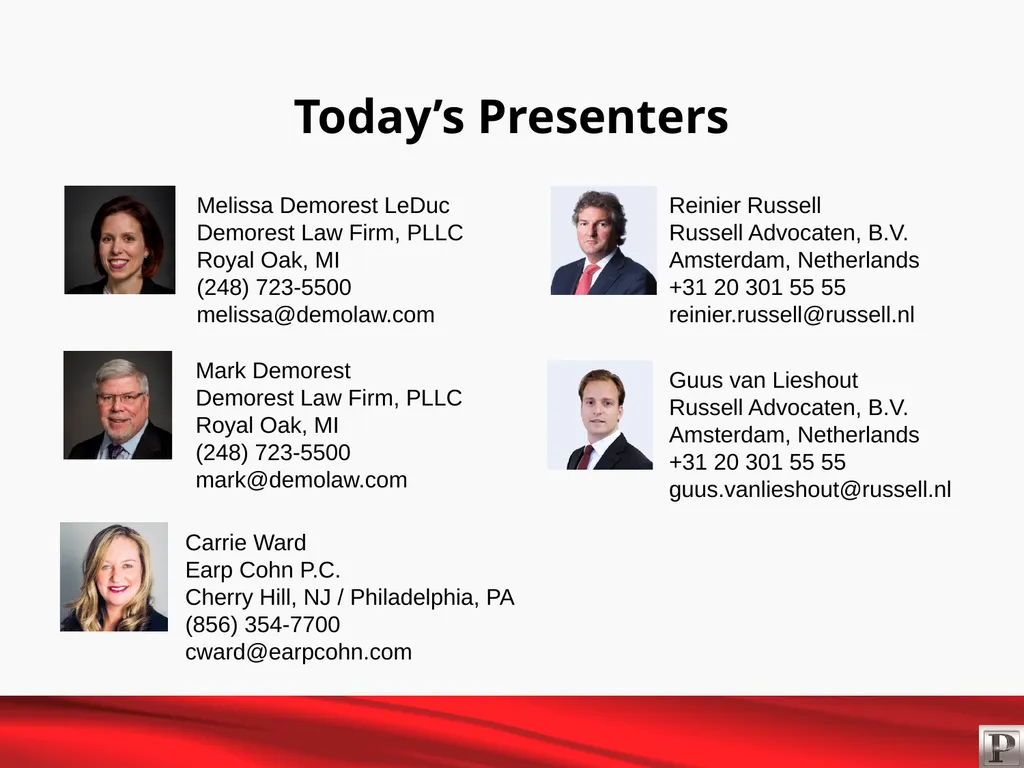
Today’s Presenters<br>