Forensic Science (All images have been redacted)
Description: Forensic Science (All images have been redacted) Copyright 2021, Kelly Knight , All Rights Reserved What do you know about forensics??? Copyright 2021, Kelly Knight , All Rights Reserved Forensic Science LAW SCIENCE FORENSIC SCIENCE
Related Topics
Download Presentation
"Forensic Science (All images have been redacted)" is the property of its rightful owner. Permission is granted to download and print the materials on this website for personal, non-commercial use only, and to display it on your personal computer provided you do not modify the materials and that you retain all copyright notices contained in the materials. By downloading content from our website, you accept the terms of this agreement.
Presentation Transcript
slide1. Forensic Science(All images have been redacted) Copyright © 2021, Kelly Knight , All Rights Reserved<br>
slide2. What do you know about forensics??? Copyright © 2021, Kelly Knight , All Rights Reserved<br>
slide3. Forensic Science LAW + SCIENCE= FORENSIC SCIENCE
Comparing known and unknown Copyright © 2021, Kelly Knight , All Rights Reserved<br>
slide4. What is a forensic scientist? First and foremost: A SCIENTIST!!
Applying scientific knowledge to the law= FORENSIC SCIENTIST Copyright © 2021, Kelly Knight , All Rights Reserved<br>
slide5. What do forensic scientists do? There is no “typical” day for a forensic scientist….
Most work a 40-hour work week
Investigate crimes/offenses using scientific analyses
#1 goal: To speak for the evidence!
Expert Testimony
Testifies for the defense AND the prosecution Copyright © 2021, Kelly Knight , All Rights Reserved<br>
slide6. Forensic Science Disciplines Biology/DNA
Trace
Chemistry
Toxicology
Firearms/Toolmarks
Latent Prints
Computer
Anthropology Wildlife
Jurisprudence
Odontology
Pathology
Psychiatry
Questioned Documents
Entomology
… Copyright © 2021, Kelly Knight , All Rights Reserved<br>
slide7. Where do forensic scientists work? Federal Government & Military Agencies:
DEA
ATF
FBI
CIA
SS
USPS
US Military
United States Fish and Wildlife Law Enforcement
State and local
Medical Examiners Office
Private Industry
Colleges and Universities
Museums Copyright © 2021, Kelly Knight , All Rights Reserved<br>
slide8. How do I become a forensic scientist? Bachelor’s degree (science)
Practice your speaking skills
Practice your note-taking skills
Learn how to write understandably
Have an intellectual curiosity
Have a strong stomach
Personal integrity!
Start thinking about what you’re interested in (science, art, history, etc.)
Try to get involved in anything you can related to your interests (camps, classes at school, research online if possible, internships and shadowing) Copyright © 2021, Kelly Knight , All Rights Reserved<br>
slide9. Questions? Copyright © 2021, Kelly Knight , All Rights Reserved<br>
slide10. What type of forensic evidence could you possibly find at a crime scene?<br>
slide11. Crime Scene Collection Search the scene
Look for clues
Take notes
Collect evidence
Proper packaging/storage
Take evidence to lab Copyright © 2021, Kelly Knight , All Rights Reserved<br>
slide12. Forensic Biology What is DNA?
Holds the code for every cell in your body
Like an instruction manual Copyright © 2021, Kelly Knight , All Rights Reserved<br>
slide13. Where can we find DNA?<br>
slide14. Blood testing-Sero-Stix Fast & easy to presumptively identify blood
Use these to determine if any suspected stains are blood or not
Patch on end of strip contains test reagents
Procedure:
Moisten swab with water
Swab suspected stain
Press stained swab to test patch for a few seconds
Positive=Green to deep blue color Copyright © 2021, Kelly Knight , All Rights Reserved<br>
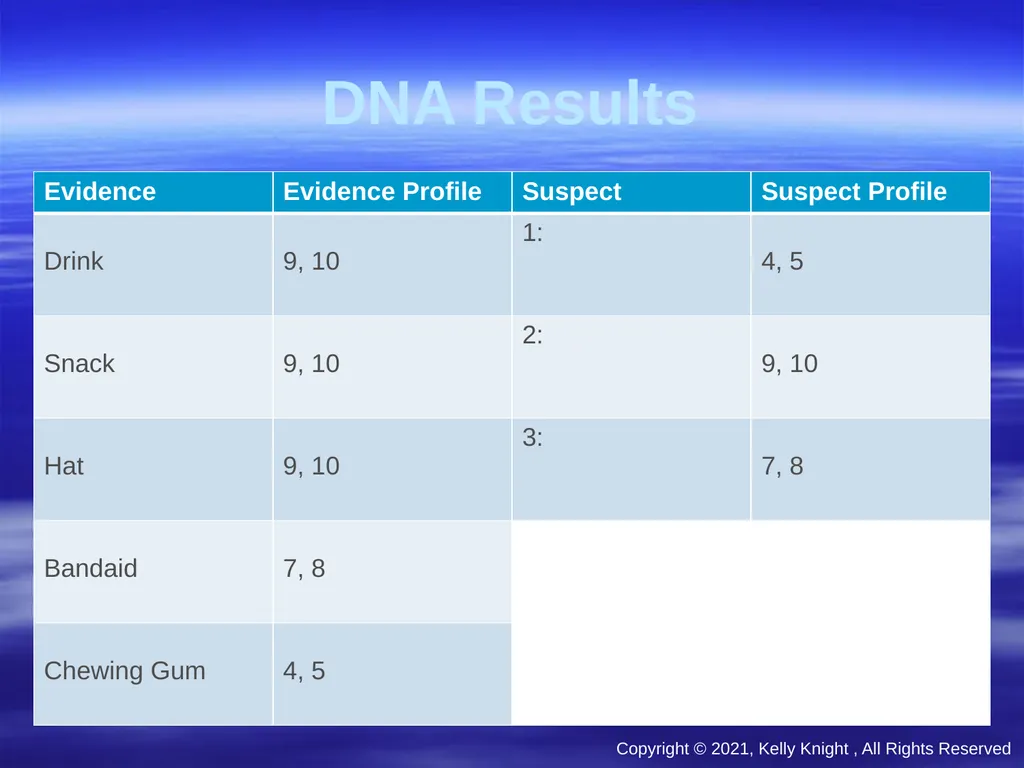
slide15. Police Report: At approximately 0900 hours, the Suspect entered classroom and burglarized locker of Victim. Suspect proceeded to steal the Victim’s iPhone and eat their lunch. Suspect fled scene upon entry of Janitor. Process crime scene for forensic evidence. Copyright © 2021, Kelly Knight , All Rights Reserved<br>
slide16. Evidence From Crime Scene What evidence was collected?
Now let’s look at the results!! Copyright © 2021, Kelly Knight , All Rights Reserved<br>
slide17. The Suspects SUSPECT 1 SUSPECT 2 SUSPECT 3 Copyright © 2021, Kelly Knight , All Rights Reserved<br>
slide18. Loop Whorl Arch Copyright © 2021, Kelly Knight , All Rights Reserved Fingerprint Classification<br>
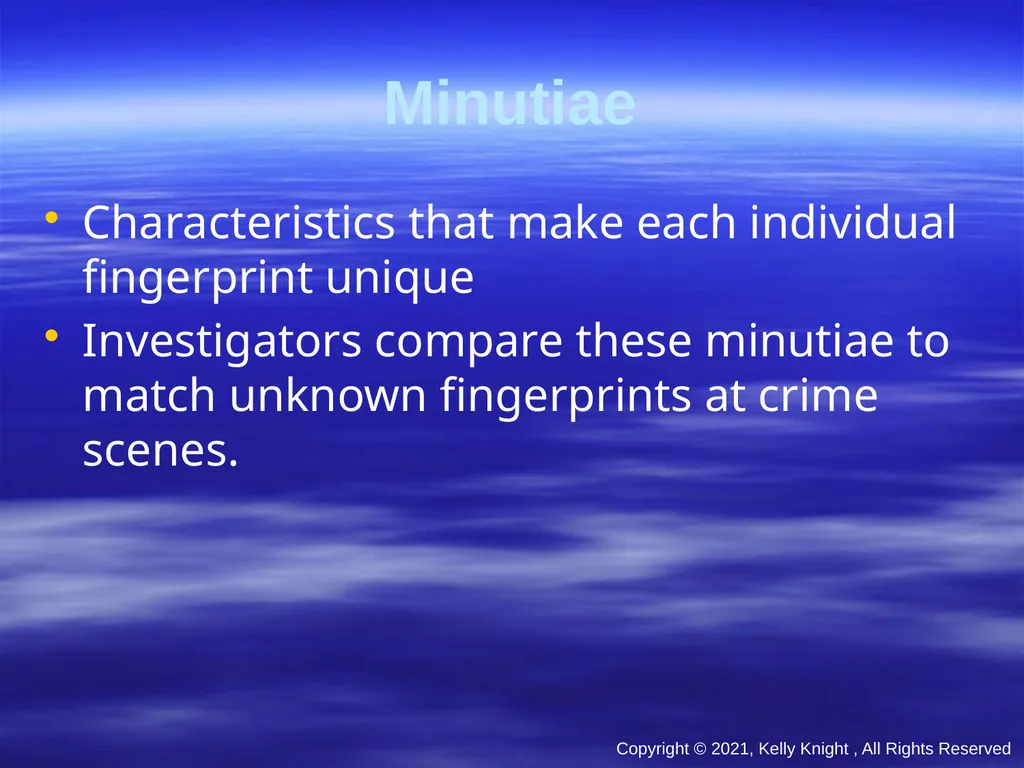
slide19. Copyright © 2021, Kelly Knight , All Rights Reserved Minutiae Characteristics that make each individual fingerprint unique
Investigators compare these minutiae to match unknown fingerprints at crime scenes.<br>
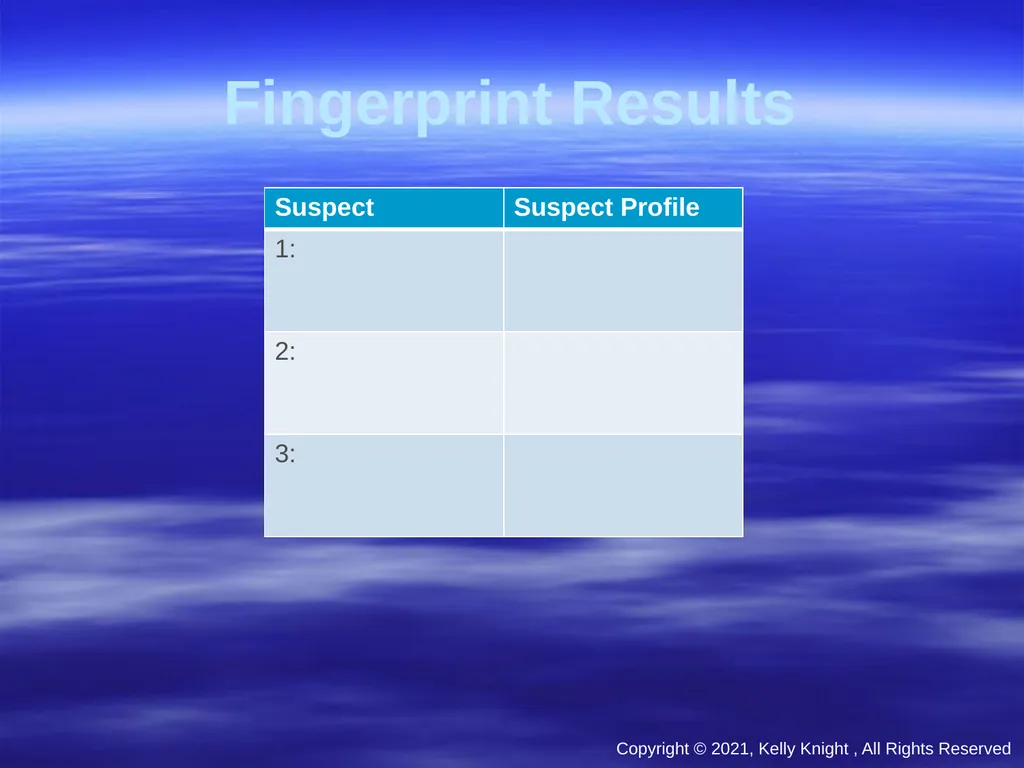
slide20. Fingerprint Results Copyright © 2021, Kelly Knight , All Rights Reserved<br>
slide21. DNA Results Copyright © 2021, Kelly Knight , All Rights Reserved<br>
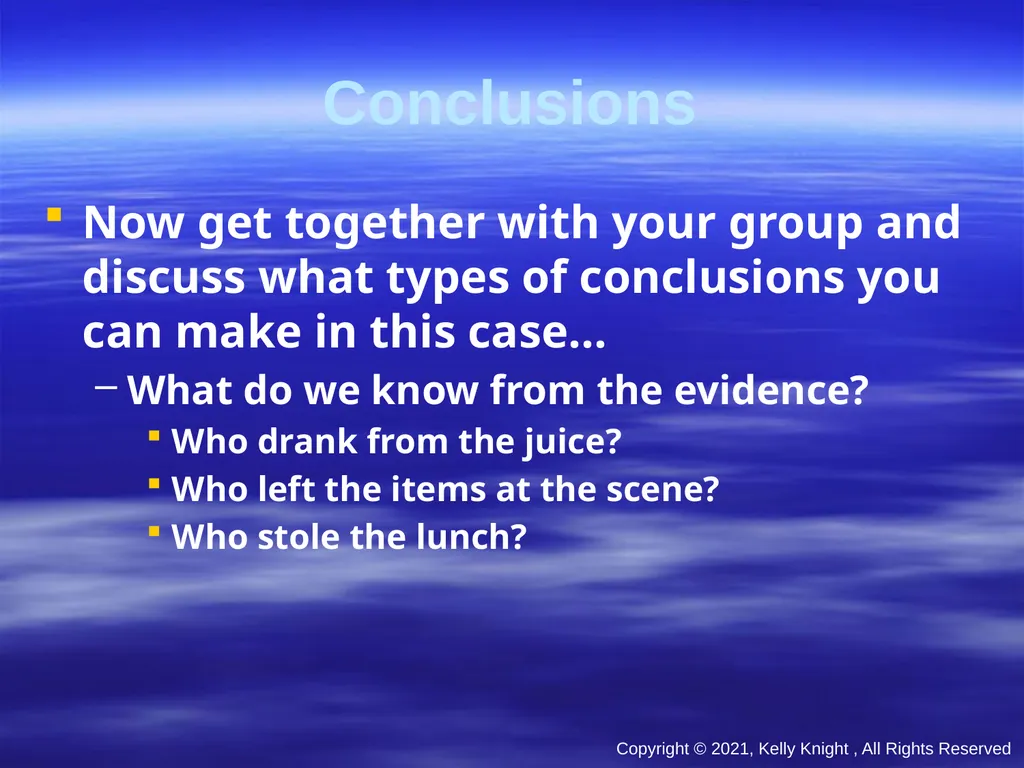
slide22. Conclusions Now get together with your group and discuss what types of conclusions you can make in this case…
What do we know from the evidence?
Who drank from the juice?
Who left the items at the scene?
Who stole the lunch? Copyright © 2021, Kelly Knight , All Rights Reserved<br>
slide23. Did you pick the right suspect? GUILTY!!!! Copyright © 2021, Kelly Knight , All Rights Reserved<br>

slide2. What do you know about forensics??? Copyright © 2021, Kelly Knight , All Rights Reserved<br>
slide3. Forensic Science LAW + SCIENCE= FORENSIC SCIENCE
Comparing known and unknown Copyright © 2021, Kelly Knight , All Rights Reserved<br>
slide4. What is a forensic scientist? First and foremost: A SCIENTIST!!
Applying scientific knowledge to the law= FORENSIC SCIENTIST Copyright © 2021, Kelly Knight , All Rights Reserved<br>
slide5. What do forensic scientists do? There is no “typical” day for a forensic scientist….
Most work a 40-hour work week
Investigate crimes/offenses using scientific analyses
#1 goal: To speak for the evidence!
Expert Testimony
Testifies for the defense AND the prosecution Copyright © 2021, Kelly Knight , All Rights Reserved<br>
slide6. Forensic Science Disciplines Biology/DNA
Trace
Chemistry
Toxicology
Firearms/Toolmarks
Latent Prints
Computer
Anthropology Wildlife
Jurisprudence
Odontology
Pathology
Psychiatry
Questioned Documents
Entomology
… Copyright © 2021, Kelly Knight , All Rights Reserved<br>
slide7. Where do forensic scientists work? Federal Government & Military Agencies:
DEA
ATF
FBI
CIA
SS
USPS
US Military
United States Fish and Wildlife Law Enforcement
State and local
Medical Examiners Office
Private Industry
Colleges and Universities
Museums Copyright © 2021, Kelly Knight , All Rights Reserved<br>
slide8. How do I become a forensic scientist? Bachelor’s degree (science)
Practice your speaking skills
Practice your note-taking skills
Learn how to write understandably
Have an intellectual curiosity
Have a strong stomach
Personal integrity!
Start thinking about what you’re interested in (science, art, history, etc.)
Try to get involved in anything you can related to your interests (camps, classes at school, research online if possible, internships and shadowing) Copyright © 2021, Kelly Knight , All Rights Reserved<br>
slide9. Questions? Copyright © 2021, Kelly Knight , All Rights Reserved<br>
slide10. What type of forensic evidence could you possibly find at a crime scene?<br>
slide11. Crime Scene Collection Search the scene
Look for clues
Take notes
Collect evidence
Proper packaging/storage
Take evidence to lab Copyright © 2021, Kelly Knight , All Rights Reserved<br>
slide12. Forensic Biology What is DNA?
Holds the code for every cell in your body
Like an instruction manual Copyright © 2021, Kelly Knight , All Rights Reserved<br>

slide13. Where can we find DNA?<br>
slide14. Blood testing-Sero-Stix Fast & easy to presumptively identify blood
Use these to determine if any suspected stains are blood or not
Patch on end of strip contains test reagents
Procedure:
Moisten swab with water
Swab suspected stain
Press stained swab to test patch for a few seconds
Positive=Green to deep blue color Copyright © 2021, Kelly Knight , All Rights Reserved<br>
slide15. Police Report: At approximately 0900 hours, the Suspect entered classroom and burglarized locker of Victim. Suspect proceeded to steal the Victim’s iPhone and eat their lunch. Suspect fled scene upon entry of Janitor. Process crime scene for forensic evidence. Copyright © 2021, Kelly Knight , All Rights Reserved<br>
slide16. Evidence From Crime Scene What evidence was collected?
Now let’s look at the results!! Copyright © 2021, Kelly Knight , All Rights Reserved<br>
slide17. The Suspects SUSPECT 1 SUSPECT 2 SUSPECT 3 Copyright © 2021, Kelly Knight , All Rights Reserved<br>
slide18. Loop Whorl Arch Copyright © 2021, Kelly Knight , All Rights Reserved Fingerprint Classification<br>
slide19. Copyright © 2021, Kelly Knight , All Rights Reserved Minutiae Characteristics that make each individual fingerprint unique
Investigators compare these minutiae to match unknown fingerprints at crime scenes.<br>
slide20. Fingerprint Results Copyright © 2021, Kelly Knight , All Rights Reserved<br>
slide21. DNA Results Copyright © 2021, Kelly Knight , All Rights Reserved<br>
slide22. Conclusions Now get together with your group and discuss what types of conclusions you can make in this case…
What do we know from the evidence?
Who drank from the juice?
Who left the items at the scene?
Who stole the lunch? Copyright © 2021, Kelly Knight , All Rights Reserved<br>
slide23. Did you pick the right suspect? GUILTY!!!! Copyright © 2021, Kelly Knight , All Rights Reserved<br>