
Foundations of Qualitative Research 2 Part 2:
TG
Published · 16 slides · 0 views

1 / 1





Description
Foundations of Qualitative Research 2 Part 2: Experiential and critical qualitative research Presentation by Victoria Clarke Associate Professor of Qualitative and Critical Psychology, UWE August 2021 PowerPoint slides from the Braun,
Related Topics
Share
Embed code
Download this presentation From Below
"Foundations of Qualitative Research 2 Part 2:" is the property of its rightful owner. Permission is granted to download and print the materials on this website for personal, non-commercial use only, and to display it on your personal computer provided you do not modify the materials and that you retain all copyright notices contained in the materials. By downloading content from our website, you accept the terms of this agreement.
Presentation Transcript
01
Foundations of Qualitative Research 2
Part 2: Experiential and critical qualitative research Presentation by Victoria Clarke
Associate Professor of Qualitative and Critical Psychology, UWE
August 2021<br>
Associate Professor of Qualitative and Critical Psychology, UWE
August 2021<br>
02
PowerPoint slides from the Braun, Clarke & Hayfield Qualitative Methods Online Teaching & Learning Resources Collaboration (QMOTLRC)<br>
03
Topic overview This is the second of two lectures – each divided into three parts - exploring the values, characteristics, and theoretical and philosophical foundations of qualitative research.
The aim of this second lecture is to provide further grounding in the foundations of qualitative research - introducing some of the concepts and terminology that define qualitative research.
This lecture explores some of defining characteristics of qualitative research and how qualitative research differs from quantitative research.
This lecture also builds on the discussion of different orientations to qualitative research in the first lecture by considering experiential and critical qualitative ‘camps’.
Finally this lecture explores the key concepts of subjectivity and reflexivity and the ontological and epistemological foundations of qualitative research.
There are some opportunities to pause the recording and reflect on your knowledge and understanding of qualitative research.<br>
04
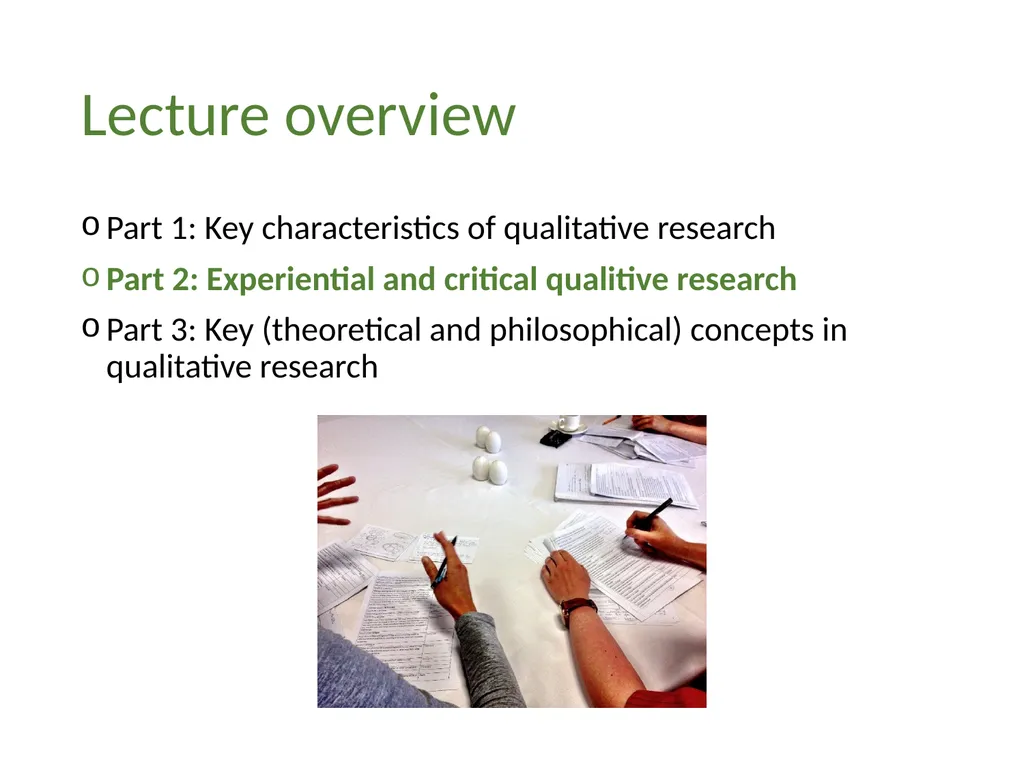
Lecture overview Part 1: Key characteristics of qualitative research
Part 2: Experiential and critical qualitive research
Part 3: Key (theoretical and philosophical) concepts in qualitative research<br>
Part 2: Experiential and critical qualitive research
Part 3: Key (theoretical and philosophical) concepts in qualitative research<br>
05
Pause for reflection 1 If you have listened to Foundations of Qualitative Research 1, pause the recording and make a note of your understanding of –
An empathic orientation to meaning
A suspicious orientation to meaning<br>
An empathic orientation to meaning
A suspicious orientation to meaning<br>
06
Experiential vs. critical qualitative In Foundations of Qualitative Research 1, we discussed different orientations to meaning (empathic vs. suspicious) and different views of language (reflective vs. active).
These broadly map onto two qualitative research ‘camps’ – experiential and critical.
Others argue there are different qualitative research paradigms – positivist, interpretative, post-structuralist and radical is a common mapping (see Grant & Giddings, 2002).
Whether experiential (interpretative) and critical (post-structuralist) are camps or paradigms, the important ‘take away’ is that qualitative research is not ‘one thing’. See Braun & Clarke (2013), Reicher (2000)<br>
07
Experiential qualitative research Experiential research explores the meanings, views, perspectives, experiences and/or practices expressed in the data.
Participants’ interpretations are prioritised, accepted and focused on, rather than being used as a basis for analysing something else.
Not to be confused with un-theorised or non-interpretative research that just summarises things participants said; experiential research is often richly theorised.
Within this framework, researchers envisage a world waiting to be discovered - and, language gives a window onto this.<br>
08
Experiential qualitative example - Hays & Minichiello (2005) The meaning, importance and function of music in the lives of older people Informal in-depth interviews with 52 older people aged 60-98 -
Heterogeneous experiences of music – no training, studied formally at school, careers as professional musicians.
Interviewed in their homes.
The interviews were an “open discussion that centred on the meaning and importance of music in their lives. It placed the life experience of the participants as the focus of the conversation and asked them to reflect on the importance of music in their daily lives, the ways music functioned in their lives and the perceived benefits of being engaged in music making or listening” (p. 439).
Four rounds of interviews – data collection centred on ‘emerging themes’ and ideas grounded in the data.<br>
09
The meaning of music in the lives of older people Conceptual assumptions:
The self as an acting agent capable of using symbols to define their experiences.
Music = a symbol used to construct self-identity and give meaning to experiences and emotions.
Data analysis:
‘Thematic discovery’ – open and axial coding (Strauss & Corbin, 1998).
Results discussed under six headings:
Identity and understanding of self
Connection: Self and others
Well-being, therapy and health
Emotions: Arousal and alignment
Stimulus, fantasy and motivation
Beauty, aesthetics and spirituality<br>
10
The meaning of music in the lives of older people continued “Music was also used as a powerful symbol for how people choose to live their life, assign meaning to experiences, and act and react to his or her world. The following statement is typical of the participants’ explanations for why they were drawn to music and demonstrates people’s personal ties to music:
It’s just incredible. I find it a totally emotional experience, when it’s very, very good, and something very, very beautiful, and you’ve got a load of people involved in this getting to that. I just think it’s one of the greatest experiences you can have. I think it’s a very personal sort of thing though, in terms of how you feel about music. It’s me! (Jane)
Not surprisingly, many older people use music as a way of measuring and maintaining their sense of well-being. Music contributed to their daily physical and psychological health and informants cited examples of how music can provide them with hope for everyday living.” (p. 449)<br>
11
Critical qualitative research Critical research takes an interrogative stance towards the meanings or experiences expressed in the data, and uses them to explore some other phenomenon.
Typically, it seeks to understand the factors influencing, and the effects of, the particular meanings or representations expressed.
It is critical because it doesn’t take data at face value. This means that analysts’ interpretations become more important than participants’.<br>
Typically, it seeks to understand the factors influencing, and the effects of, the particular meanings or representations expressed.
It is critical because it doesn’t take data at face value. This means that analysts’ interpretations become more important than participants’.<br>
12
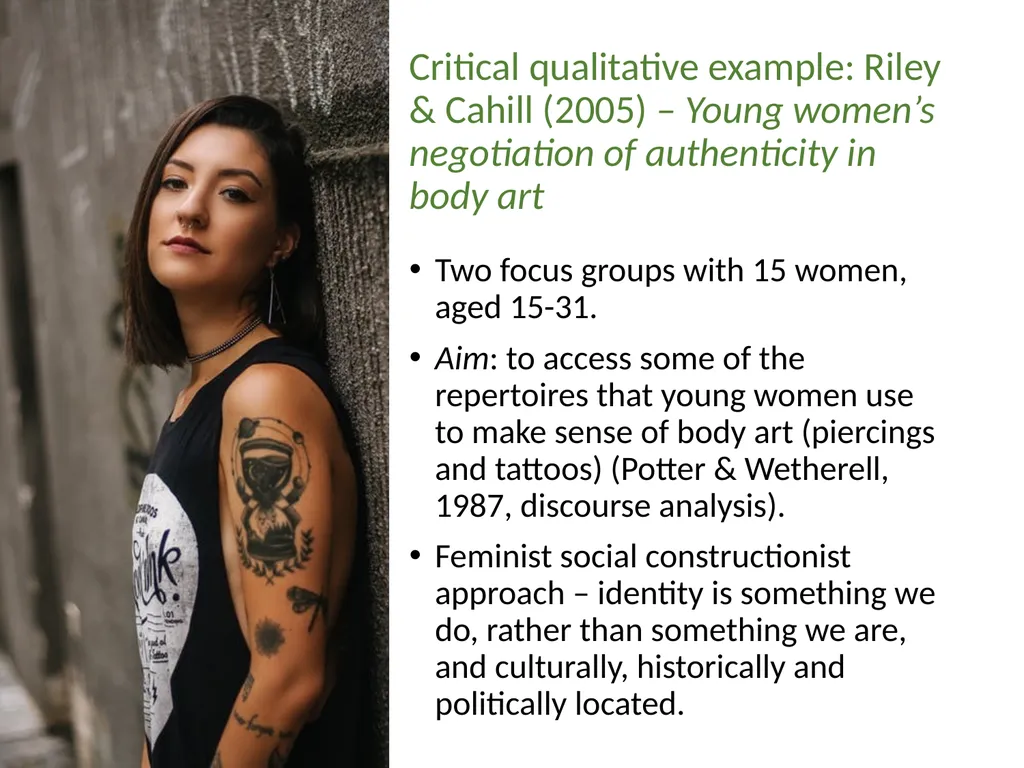
Critical qualitative example: Riley & Cahill (2005) – Young women’s negotiation of authenticity in body art Two focus groups with 15 women, aged 15-31.
Aim: to access some of the repertoires that young women use to make sense of body art (piercings and tattoos) (Potter & Wetherell, 1987, discourse analysis).
Feminist social constructionist approach – identity is something we do, rather than something we are, and culturally, historically and politically located.<br>
13
Young women’s negotiation of authenticity in body art Four themes:
Being your own person – body art represents a particular kind of valued subjectivity – ‘being your own person’ (autonomous, independent, different, brave, cool).
Cultural dilution – changes in the meaning of body art – popular, mainstream - means that it no longer represents a meaningful relationship to one’s identity.
Participants drew on 2 accounts to manage the threat from cultural dilution to being your own person:
Mobilising sub-cultural knowledge: The claim for an authentic identity in relation to body art was gained through the use of exclusive language and information about body art.
Othering: Participants maintained meaning by constructing another group, to which they did not belong, as being the ones without authenticity (motivated by fashion, engagement frivolous, body art lacks personal meaning).<br>
14
Young women’s negotiation of authenticity in body art continued “Moria: believe me that its [Body Art] come into fashion now (.) yeah I know I’ve only had my piercings really recently (.) but it was a change in my life you know I changed from this really (.) sort of straight laced person (.) do whatever my friends did (.) … and now I mean I walk into my local pub and (..) its (.) [the pub] totally different and everyone (.) but erm there’s a girl in my class and she’s a very lovely person (.) but she is (..) not into (.) like (.) … and she saw my tongue pierced and she was like ‘oh (.) I really think that’s nice (.) you know I think I might get it done’ (.) and I was like to her “you should probably think about it for a bit (.) because its not the kind of thing that you should just (.) get done” and er (.) two weeks later she came back and she said to me “do you mind that I got it done” and I was like “no of course not its up to you” but inside I was absolutely seething that she had just taken it so light heartedly ... she saw mine decided it was nice and wanted it done and just got it done (.) but sounding really nasty she’s not the kind of person that could get it done, thought’s like a novelty almost.”<br>
15
Young women’s negotiation of authenticity in body art - analysis of Moira extract “In extract ten Moira negotiates entitlement and meaning to Body Art. She starts by stating that Body Art has become fashionable, but in doing so she is vulnerable to being positioned as someone whose participation in Body Art is motivated by fashion since she does not have longevity in the Body Art scene and so could be understood as part of this recent trend. Moira inoculates against being positioned as a “fashionista” by raising the possibility that she is part of this recent trend (“yes I know I’ve only had my piercings really recently”), but then rejects this argument by positioning her Body Art as deeply meaningful, significant, and personal (“it was a change in my life”). Having established her meaningfulness in relation to Body Art, Moira then develops a critique of others who have recently engaged in Body Art.” (pp. 272-273)<br>
16
References for part 2 Braun, V., & Clarke, V. (2013). Successful qualitative research: A practical guide for beginners. Sage.
Grant, B. M., & Giddings, L. S. (2002). Making sense of methodologies: A paradigm framework for the novice researcher. Contemporary Nurse, 13(1), 10-28.
Hays, T., & Minichiello, V. (2005). The meaning of music in the lives of older people: A qualitative study. Psychology of Music, 33(4), 437-451.
Potter, J., & Wetherell, M. (1987). Discourse and social psychology: Beyond attitudes and behaviour. Sage.
Reicher, S. (2000). Against methodolatry: Some comments on Elliott, Fischer, and Rennie. British Journal of Clinical Psychology, 39(1), 1-6.
Riley, S. C. E., & Cahill, S. (2005). Managing meaning and belonging: Young women’s negotiation of authenticity in body art. Journal of Youth Studies, 8(3), 261-279.<br>