
GANZ Presentation: Self Disclosure Break out



Description: GANZ Presentation: Self Disclosure Break out Groups Introduce yourselves, let each other know a little about where you practice and what your practice is, and share why you came to this discussion tonight. What do we mean by self
Related Topics
Download Presentation
"GANZ Presentation: Self Disclosure Break out" is the property of its rightful owner. Permission is granted to download and print the materials on this website for personal, non-commercial use only, and to display it on your personal computer provided you do not modify the materials and that you retain all copyright notices contained in the materials. By downloading content from our website, you accept the terms of this agreement.
Presentation Transcript
slide1. GANZ Presentation: Self Disclosure<br>
slide2. Break out Groups Introduce yourselves, let each other know a little about where you practice and what your practice is, and share why you came to this discussion tonight.<br>
slide3. What do we mean by “self disclosure”? It goes way beyond what we actually tell our clients. We are actually self-disclosing all the time!
4 different types of self-disclosure:-
Intentional Self Disclosure (ISD)
Intentional verbal or non-verbal disclosure by the T of personal information from outside the session, during a session.<br>
slide4. 2. Inevitable self disclosure
Verbal or non-verbal disclosures where there is no possibility of avoiding them:-
Speech (accent/volume/tone/impediment/analogies/metaphors employed)
Ethnicity or surname
Dress
Office décor/location
Information on website
Non-verbal reactions
Silences
Pregnancy
Absences from sessions<br>
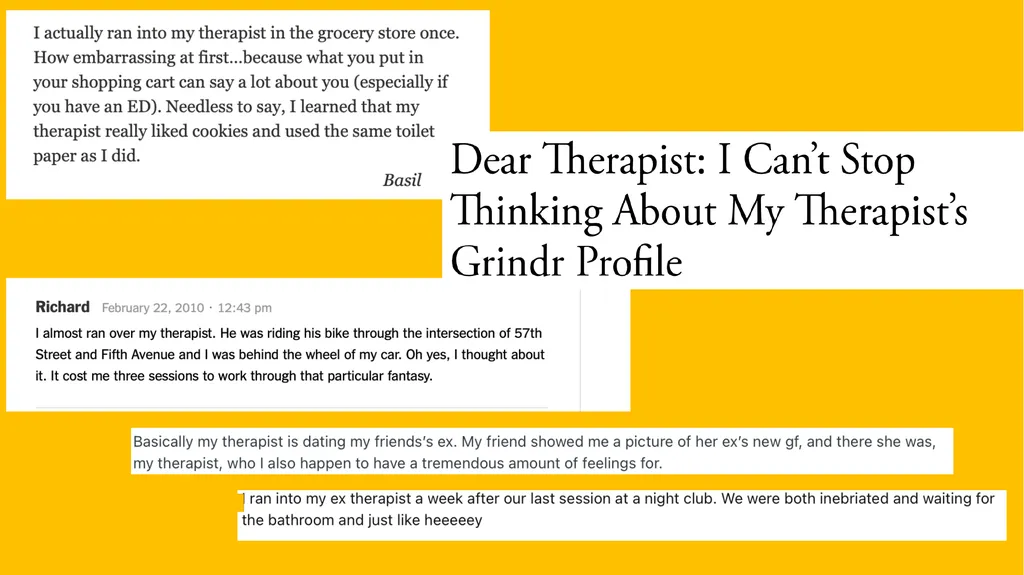
slide5. 3. Accidental self-disclosures Accidental self disclosures are either:-
a) incidental (unplanned) encounters outside the session;
b) spontaneous, unintentional verbal or non-verbal reactions inside the session; or
c) other occurrences (on line/in the media/circumstance),
that reveal therapist’s personal information to their client.<br>
slide7. 4. Immediacy Intentional, verbal disclosure of Therapist’s experience of here-and-now, intrapersonal information
E.g “My stomach dropped when you said that”
“I notice feelings of sadness as you talk about your sister”
Understood as “presence” in Gestalt dialogic theory and method:
“Presence means authentically being present and communicating fully and unreservedly (subject to clinical discrimination)..(The therapist) is free to voice or otherwise express to the patient what she is experiencing as it relates to the task of therapy and the therapeutic encounter” (Yontef and Fairfield, 2008).<br>
slide8. Potential benefits of Immediacy can create the conditions for greater affect regulation in client
models comfort with expression of feelings
may offer validation (confirmation) of experience
may help bring into awareness, something out-of-awareness<br>
slide9. The Neuroscience of Immediacy “Therapist self-disclosure can..help shift the patient’s ANS out of either parasympathetic shutdown..or sympathetic hyperarousal..toward ventral vagal connection..the social engagement system.” (Quillman, 2011; p.2)
Immediacy uses (Left Hemisphere) language to communicate the T’s (Right Hemisphere) experience of herself and her client.<br>
slide10. Caveats on the use of Immediacy “Good Gestalt therapy is freedom to do therapy with spontaneity, liveliness and creativity. But it also entails responsibility to know what you are doing” (Yontef, 1993).<br>
slide11. Break out group discussion (20 mins) What has caught your interest around this information so far?
What are five inevitable self disclosures you make as a therapist and how might these be possibly relevant to the work you do with your clients?
Have you got your own example of an accidental self disclosure you experienced as a client that you could briefly describe and how it was addressed in the therapy afterward? Do you see other options as to how it may have been addressed?
How has the use of immediacy been used effectively for you as a client? - can you give an example and identify what the impact was on you?
Have you experienced the use of immediacy in an unhelpful way? Can you identify if there was something about the timing, intention or delivery that influenced that?<br>
slide12. Intentional Self Disclosure (ISD)<br>
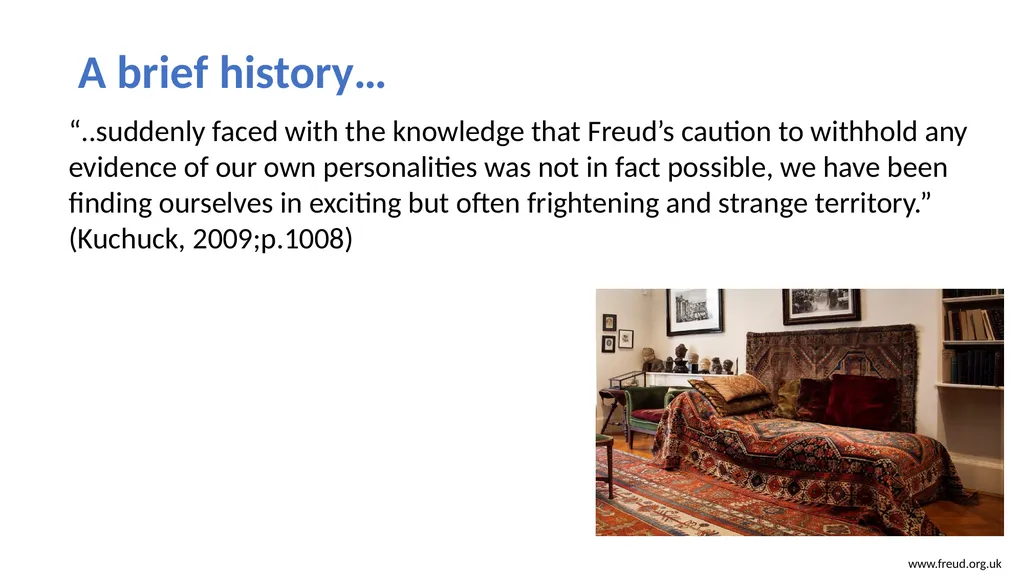
slide13. A brief history… www.freud.org.uk “..suddenly faced with the knowledge that Freud’s caution to withhold any evidence of our own personalities was not in fact possible, we have been finding ourselves in exciting but often frightening and strange territory.” (Kuchuck, 2009;p.1008)<br>
slide14. Pros and cons… Potential benefits:
may be helpful where there is a rupture or therapeutic impasse
may repair /offer a missed developmental or relational experience
may be the most important priority to meet the client in a moment of humanity (Lee and Wheeler speak a lot about “belonging” as an antidote to the isolation of shame)
universality
addressing power differentials
Potential risks:
may be experienced as intrusive
may leave client feeling they have to take care of the T
may take focus away from Client at an inopportune time<br>
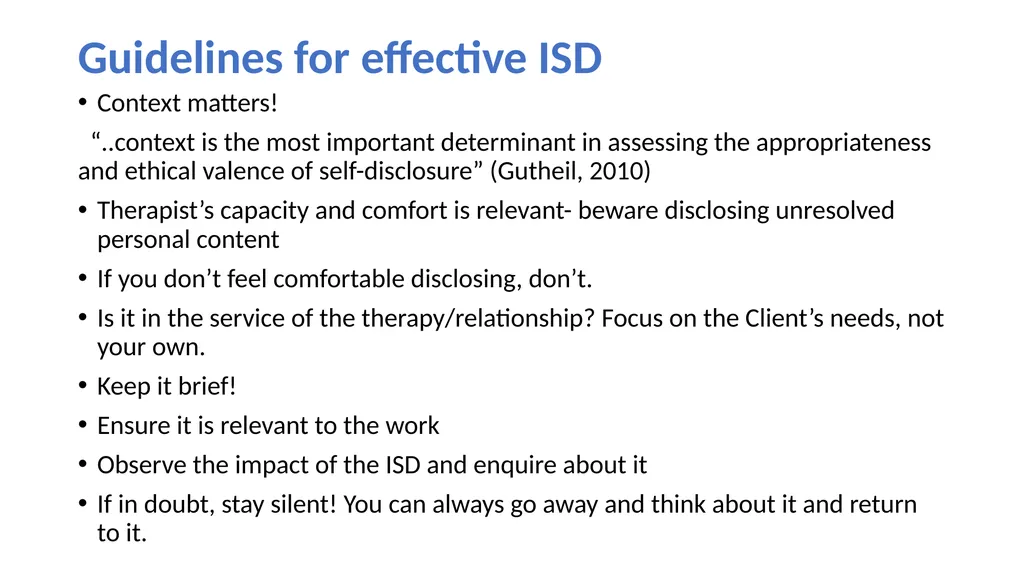
slide15. Guidelines for effective ISD Context matters!
“..context is the most important determinant in assessing the appropriateness and ethical valence of self-disclosure” (Gutheil, 2010)
Therapist’s capacity and comfort is relevant- beware disclosing unresolved personal content
If you don’t feel comfortable disclosing, don’t.
Is it in the service of the therapy/relationship? Focus on the Client’s needs, not your own.
Keep it brief!
Ensure it is relevant to the work
Observe the impact of the ISD and enquire about it
If in doubt, stay silent! You can always go away and think about it and return to it.<br>
slide16. tends to be more effective when used in strong, longer term therapies (Pinto-Coelho, Hill, Kearney et.al.; 2018)<br>
slide17. A final caveat… You are bound to keep the client’s confidentiality, they are not bound to keep yours.<br>
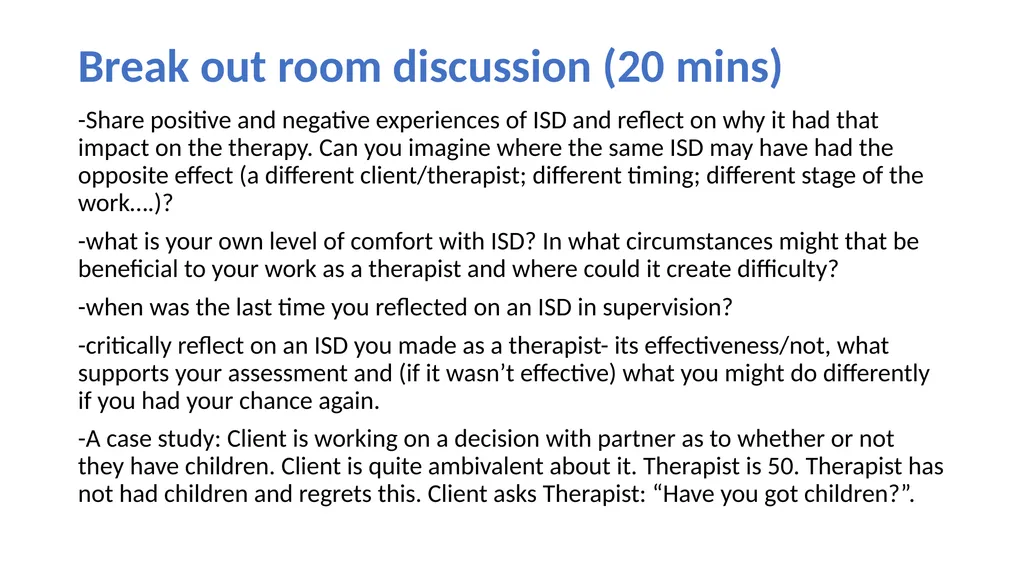
slide18. Break out room discussion (20 mins) -Share positive and negative experiences of ISD and reflect on why it had that impact on the therapy. Can you imagine where the same ISD may have had the opposite effect (a different client/therapist; different timing; different stage of the work….)?
-what is your own level of comfort with ISD? In what circumstances might that be beneficial to your work as a therapist and where could it create difficulty?
-when was the last time you reflected on an ISD in supervision?
-critically reflect on an ISD you made as a therapist- its effectiveness/not, what supports your assessment and (if it wasn’t effective) what you might do differently if you had your chance again.
-A case study: Client is working on a decision with partner as to whether or not they have children. Client is quite ambivalent about it. Therapist is 50. Therapist has not had children and regrets this. Client asks Therapist: “Have you got children?”.<br>
slide19. Ethics and Self Disclosure “the question that must be addressed is not whether it is ethical to self-disclose to clients but rather what content, for what reasons, to whom, and under what circumstances should an ethical therapist disclose?” (Peterson, 2002; p.22)
The 3 ethical principles most relevant to SD:-
- For the good of the client (Beneficence)
Do no harm (Nonmaleficence) and
The fiduciary duty the T owes the client: that the relationship is for the benefit and welfare of the client.<br>
slide20. References Gutheil, T.G. “Ethical aspects of self disclosure in psychotherapy” (2010). Psychiatric Times (May) 39-41.
Hill, C.E, Knox,S and Pinto-Coelho, K.G “Therapist self disclosure and immediacy: a qualitative meta analysis” (2018). 55(4)Psychotherapy. 445-460.
Pinto-Coelho,K.G, Hill, C.E.,Kearney, Sarno, E.L, Sauber, E.S, Baker, S.M, Brady, J., Ireland, G.W. and Hoffman, M.A. “When in doubt, sit quietly: a qualitative investigation of experienced therapists’ perceptions of self disclosure” (2018) 65 (4) Journal of Counseling Psychology pp 440-452
Kuchuck, S. “Do ask, do tell? Narcisstic need as a determinant of analyst self disclosure”( 2009) 96 (6)Psychoanalytic Review pp. 1007-1024
Yalom, I.D. The gift of therapy: reflections on being a therapist, (2002). Piatkus
Yontef, G.M. Awareness, dialogue and process: essays on Gestalt Therapy; (2009) Gestalt Journal Press.<br>
slide2. Break out Groups Introduce yourselves, let each other know a little about where you practice and what your practice is, and share why you came to this discussion tonight.<br>
slide3. What do we mean by “self disclosure”? It goes way beyond what we actually tell our clients. We are actually self-disclosing all the time!
4 different types of self-disclosure:-
Intentional Self Disclosure (ISD)
Intentional verbal or non-verbal disclosure by the T of personal information from outside the session, during a session.<br>
slide4. 2. Inevitable self disclosure
Verbal or non-verbal disclosures where there is no possibility of avoiding them:-
Speech (accent/volume/tone/impediment/analogies/metaphors employed)
Ethnicity or surname
Dress
Office décor/location
Information on website
Non-verbal reactions
Silences
Pregnancy
Absences from sessions<br>
slide5. 3. Accidental self-disclosures Accidental self disclosures are either:-
a) incidental (unplanned) encounters outside the session;
b) spontaneous, unintentional verbal or non-verbal reactions inside the session; or
c) other occurrences (on line/in the media/circumstance),
that reveal therapist’s personal information to their client.<br>
slide7. 4. Immediacy Intentional, verbal disclosure of Therapist’s experience of here-and-now, intrapersonal information
E.g “My stomach dropped when you said that”
“I notice feelings of sadness as you talk about your sister”
Understood as “presence” in Gestalt dialogic theory and method:
“Presence means authentically being present and communicating fully and unreservedly (subject to clinical discrimination)..(The therapist) is free to voice or otherwise express to the patient what she is experiencing as it relates to the task of therapy and the therapeutic encounter” (Yontef and Fairfield, 2008).<br>
slide8. Potential benefits of Immediacy can create the conditions for greater affect regulation in client
models comfort with expression of feelings
may offer validation (confirmation) of experience
may help bring into awareness, something out-of-awareness<br>
slide9. The Neuroscience of Immediacy “Therapist self-disclosure can..help shift the patient’s ANS out of either parasympathetic shutdown..or sympathetic hyperarousal..toward ventral vagal connection..the social engagement system.” (Quillman, 2011; p.2)
Immediacy uses (Left Hemisphere) language to communicate the T’s (Right Hemisphere) experience of herself and her client.<br>
slide10. Caveats on the use of Immediacy “Good Gestalt therapy is freedom to do therapy with spontaneity, liveliness and creativity. But it also entails responsibility to know what you are doing” (Yontef, 1993).<br>
slide11. Break out group discussion (20 mins) What has caught your interest around this information so far?
What are five inevitable self disclosures you make as a therapist and how might these be possibly relevant to the work you do with your clients?
Have you got your own example of an accidental self disclosure you experienced as a client that you could briefly describe and how it was addressed in the therapy afterward? Do you see other options as to how it may have been addressed?
How has the use of immediacy been used effectively for you as a client? - can you give an example and identify what the impact was on you?
Have you experienced the use of immediacy in an unhelpful way? Can you identify if there was something about the timing, intention or delivery that influenced that?<br>
slide12. Intentional Self Disclosure (ISD)<br>
slide13. A brief history… www.freud.org.uk “..suddenly faced with the knowledge that Freud’s caution to withhold any evidence of our own personalities was not in fact possible, we have been finding ourselves in exciting but often frightening and strange territory.” (Kuchuck, 2009;p.1008)<br>
slide14. Pros and cons… Potential benefits:
may be helpful where there is a rupture or therapeutic impasse
may repair /offer a missed developmental or relational experience
may be the most important priority to meet the client in a moment of humanity (Lee and Wheeler speak a lot about “belonging” as an antidote to the isolation of shame)
universality
addressing power differentials
Potential risks:
may be experienced as intrusive
may leave client feeling they have to take care of the T
may take focus away from Client at an inopportune time<br>
slide15. Guidelines for effective ISD Context matters!
“..context is the most important determinant in assessing the appropriateness and ethical valence of self-disclosure” (Gutheil, 2010)
Therapist’s capacity and comfort is relevant- beware disclosing unresolved personal content
If you don’t feel comfortable disclosing, don’t.
Is it in the service of the therapy/relationship? Focus on the Client’s needs, not your own.
Keep it brief!
Ensure it is relevant to the work
Observe the impact of the ISD and enquire about it
If in doubt, stay silent! You can always go away and think about it and return to it.<br>
slide16. tends to be more effective when used in strong, longer term therapies (Pinto-Coelho, Hill, Kearney et.al.; 2018)<br>
slide17. A final caveat… You are bound to keep the client’s confidentiality, they are not bound to keep yours.<br>
slide18. Break out room discussion (20 mins) -Share positive and negative experiences of ISD and reflect on why it had that impact on the therapy. Can you imagine where the same ISD may have had the opposite effect (a different client/therapist; different timing; different stage of the work….)?
-what is your own level of comfort with ISD? In what circumstances might that be beneficial to your work as a therapist and where could it create difficulty?
-when was the last time you reflected on an ISD in supervision?
-critically reflect on an ISD you made as a therapist- its effectiveness/not, what supports your assessment and (if it wasn’t effective) what you might do differently if you had your chance again.
-A case study: Client is working on a decision with partner as to whether or not they have children. Client is quite ambivalent about it. Therapist is 50. Therapist has not had children and regrets this. Client asks Therapist: “Have you got children?”.<br>
slide19. Ethics and Self Disclosure “the question that must be addressed is not whether it is ethical to self-disclose to clients but rather what content, for what reasons, to whom, and under what circumstances should an ethical therapist disclose?” (Peterson, 2002; p.22)
The 3 ethical principles most relevant to SD:-
- For the good of the client (Beneficence)
Do no harm (Nonmaleficence) and
The fiduciary duty the T owes the client: that the relationship is for the benefit and welfare of the client.<br>
slide20. References Gutheil, T.G. “Ethical aspects of self disclosure in psychotherapy” (2010). Psychiatric Times (May) 39-41.
Hill, C.E, Knox,S and Pinto-Coelho, K.G “Therapist self disclosure and immediacy: a qualitative meta analysis” (2018). 55(4)Psychotherapy. 445-460.
Pinto-Coelho,K.G, Hill, C.E.,Kearney, Sarno, E.L, Sauber, E.S, Baker, S.M, Brady, J., Ireland, G.W. and Hoffman, M.A. “When in doubt, sit quietly: a qualitative investigation of experienced therapists’ perceptions of self disclosure” (2018) 65 (4) Journal of Counseling Psychology pp 440-452
Kuchuck, S. “Do ask, do tell? Narcisstic need as a determinant of analyst self disclosure”( 2009) 96 (6)Psychoanalytic Review pp. 1007-1024
Yalom, I.D. The gift of therapy: reflections on being a therapist, (2002). Piatkus
Yontef, G.M. Awareness, dialogue and process: essays on Gestalt Therapy; (2009) Gestalt Journal Press.<br>