
GCSE Required Practical – Biology 1 – Measuring

GCSE Required Practical – Biology 1 – Measuring
1 / 1
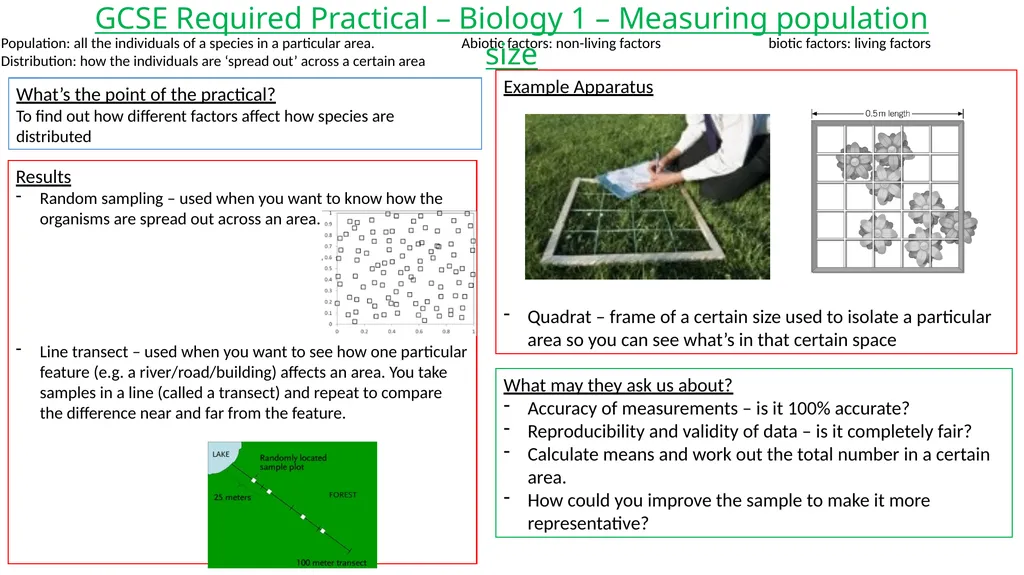
GCSE Required Practical Biology 1 Measuring population size Whats the point of the practical? To find out how different factors affect how species are distributed Example Apparatus Quadrat frame of a certain size used to isolate a

Related Topics

Download this presentation From Below

"GCSE Required Practical – Biology 1 – Measuring" is the property of its rightful owner. Permission is granted to download and print the materials on this website for personal, non-commercial use only, and to display it on your personal computer provided you do not modify the materials and that you retain all copyright notices contained in the materials. By downloading content from our website, you accept the terms of this agreement.

Presentation Transcript

01
GCSE Required Practical – Biology 1 – Measuring population size What’s the point of the practical?
To find out how different factors affect how species are distributed Example Apparatus


Quadrat – frame of a certain size used to isolate a particular area so you can see what’s in that certain space What may they ask us about?
Accuracy of measurements – is it 100% accurate?
Reproducibility and validity of data – is it completely fair?
Calculate means and work out the total number in a certain area.
How could you improve the sample to make it more representative? Population: all the individuals of a species in a particular area. Abiotic factors: non-living factors biotic factors: living factors
Distribution: how the individuals are ‘spread out’ across a certain area Results
Random sampling – used when you want to know how the organisms are spread out across an area.


Line transect – used when you want to see how one particular feature (e.g. a river/road/building) affects an area. You take samples in a line (called a transect) and repeat to compare the difference near and far from the feature.<br>