
Gender Identities G671 What are the
A
Published · 61 slides · 0 views

1 / 1







Description
Gender Identities G671 What are the similaritiesdifferences? Discuss What is the difference between sex and gender? How different do you think your life would be if you had been born the opposite sex to what you wereare? Sex vs. gender
Related Topics
Share
Embed code
Download this presentation From Below
"Gender Identities G671 What are the" is the property of its rightful owner. Permission is granted to download and print the materials on this website for personal, non-commercial use only, and to display it on your personal computer provided you do not modify the materials and that you retain all copyright notices contained in the materials. By downloading content from our website, you accept the terms of this agreement.
Presentation Transcript
01
Gender Identities G671<br>
02
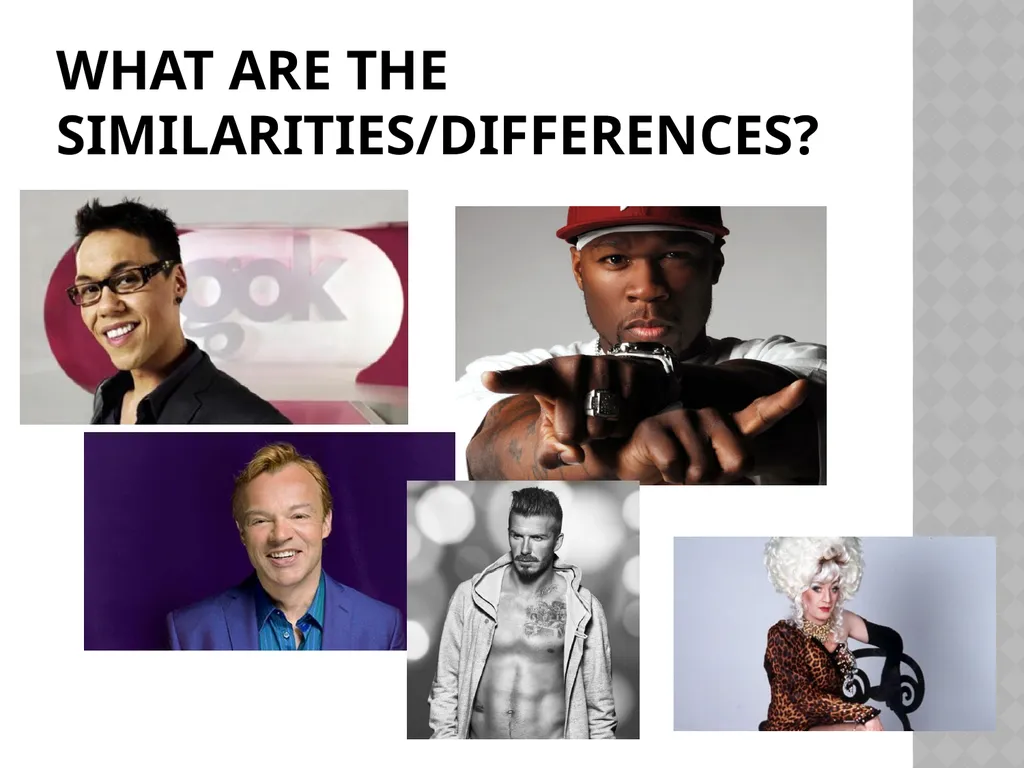
What are the similarities/differences?<br>
03
Discuss What is the difference between sex and gender?
How different do you think your life would be if you had been born the opposite sex to what you were/are?<br>
How different do you think your life would be if you had been born the opposite sex to what you were/are?<br>
04
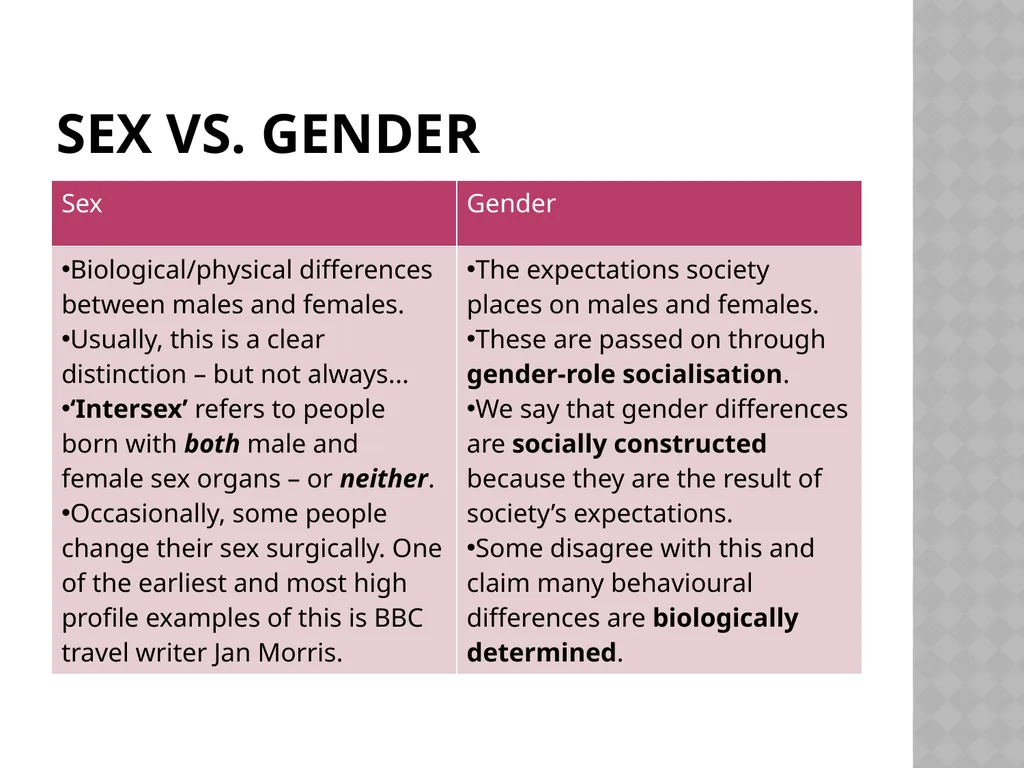
Sex vs. gender<br>
05
Check What do we mean by saying gender is socially constructed?
What is the alternative view?
What do most sociologists believe?<br>
What is the alternative view?
What do most sociologists believe?<br>
06
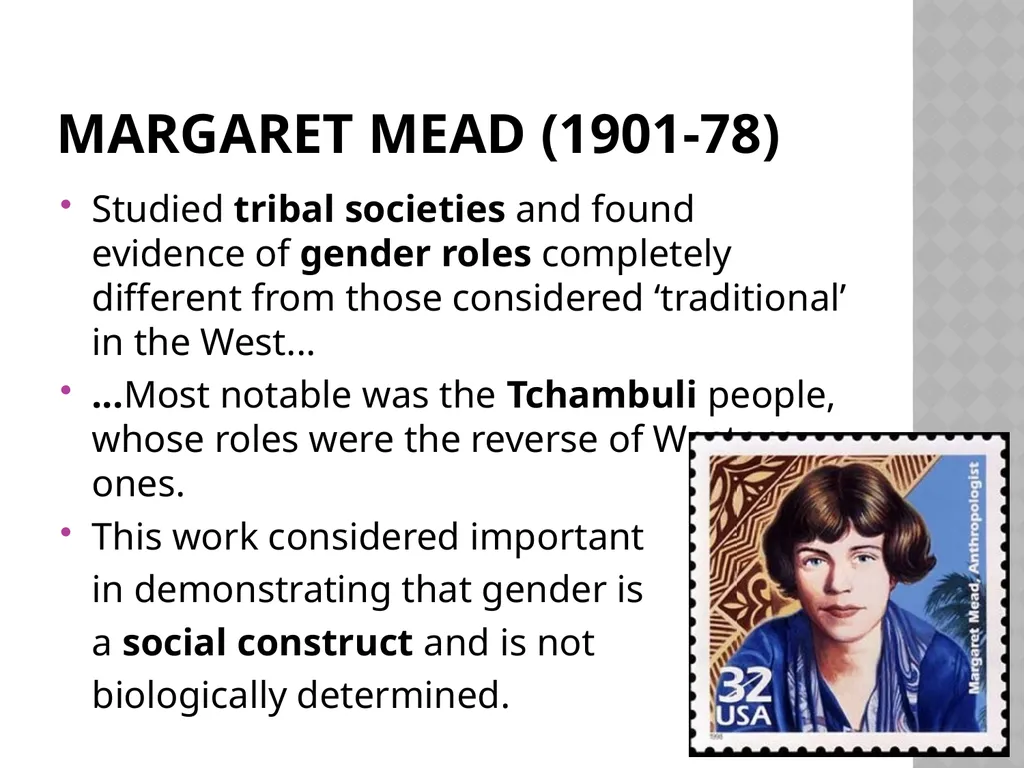
Margaret Mead (1901-78) Studied tribal societies and found evidence of gender roles completely different from those considered ‘traditional’ in the West...
...Most notable was the Tchambuli people, whose roles were the reverse of Western ones.
This work considered important
in demonstrating that gender is
a social construct and is not
biologically determined.<br>
...Most notable was the Tchambuli people, whose roles were the reverse of Western ones.
This work considered important
in demonstrating that gender is
a social construct and is not
biologically determined.<br>
07
Gender Role Socialisation
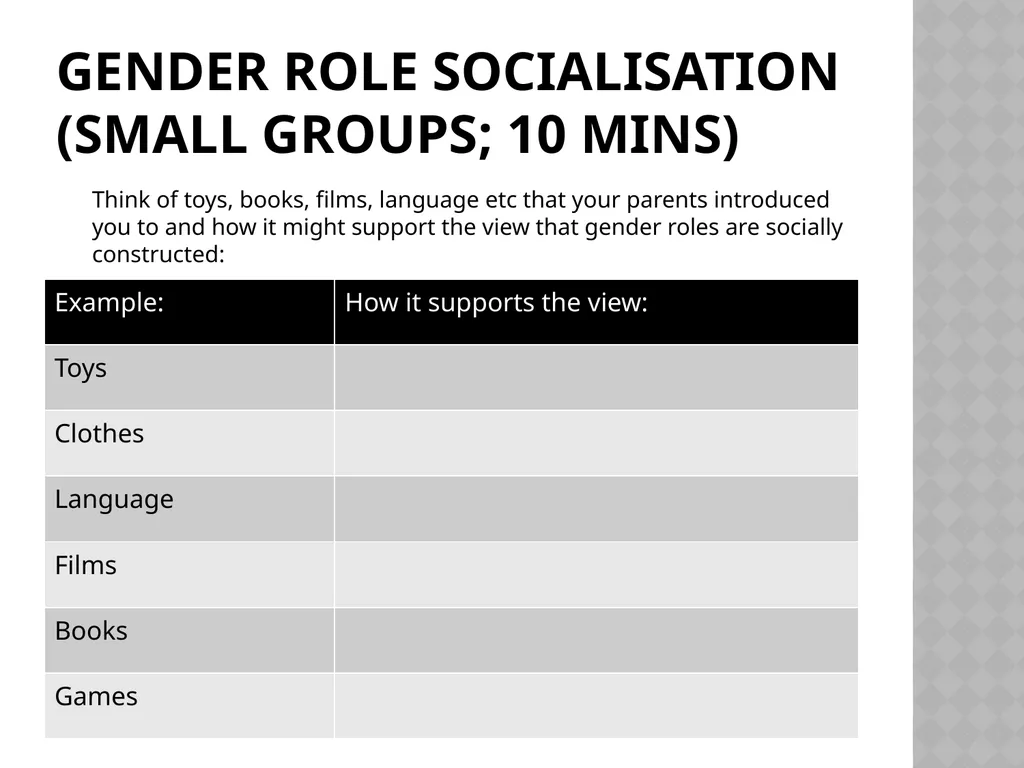
(small groups; 10 mins) Think of toys, books, films, language etc that your parents introduced you to and how it might support the view that gender roles are socially constructed:<br>
08
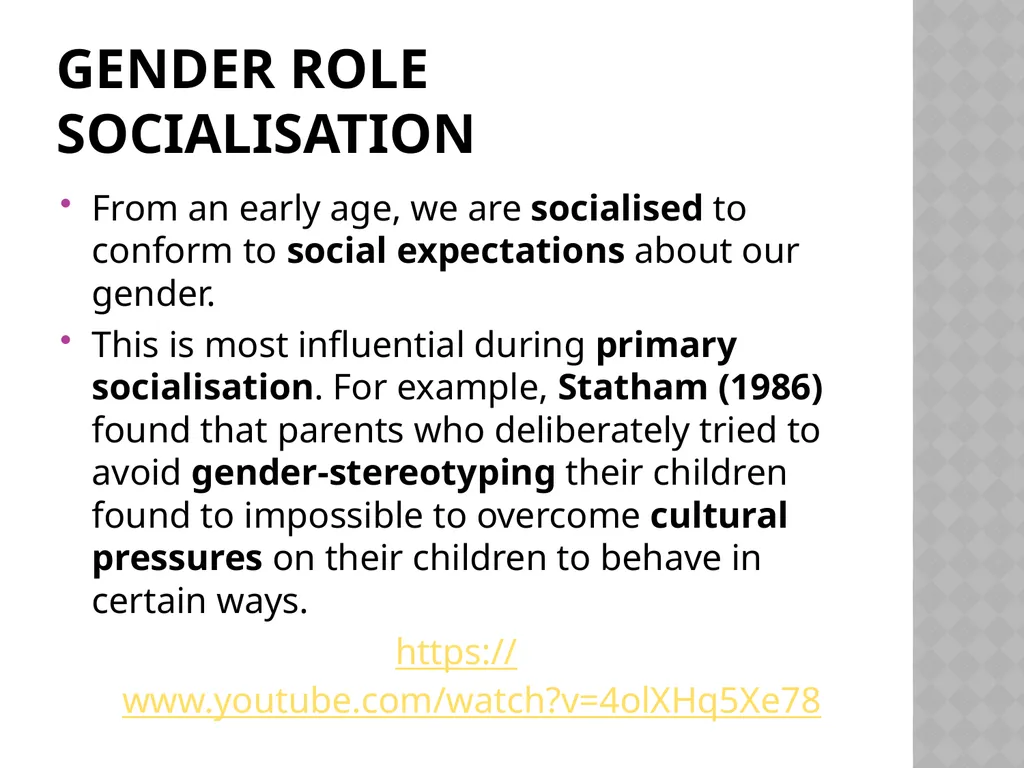
Gender Role socialisation From an early age, we are socialised to conform to social expectations about our gender.
This is most influential during primary socialisation. For example, Statham (1986) found that parents who deliberately tried to avoid gender-stereotyping their children found to impossible to overcome cultural pressures on their children to behave in certain ways.
https://www.youtube.com/watch?v=4olXHq5Xe78<br>
This is most influential during primary socialisation. For example, Statham (1986) found that parents who deliberately tried to avoid gender-stereotyping their children found to impossible to overcome cultural pressures on their children to behave in certain ways.
https://www.youtube.com/watch?v=4olXHq5Xe78<br>
09
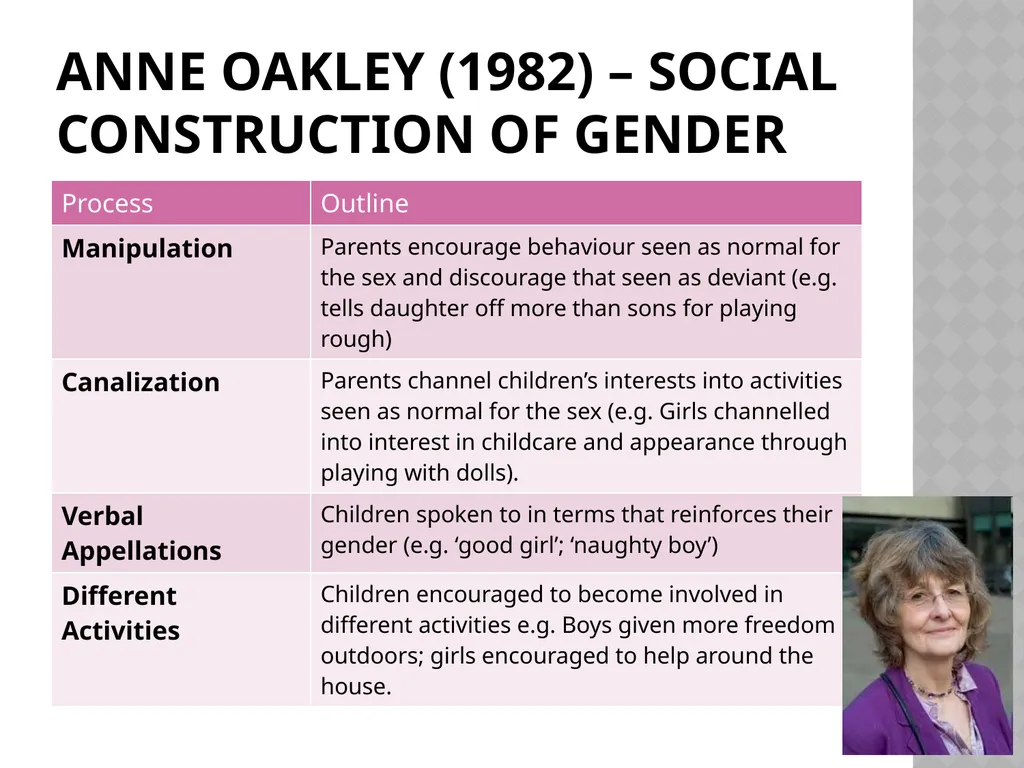
Anne Oakley (1982) – Social construction of gender<br>
10
Written activity Referring to the work of Mead and Oakley (and any other sources you like) write a short essay (500 words) as follows:
Outline the view that gender is socially constructed.<br>
Outline the view that gender is socially constructed.<br>
11
Discuss (5 mins; pairs) What have you done in the last week that might be associated with being ‘male’?
What have you done in the last week that might be associated with being ‘female’?<br>
What have you done in the last week that might be associated with being ‘female’?<br>
12
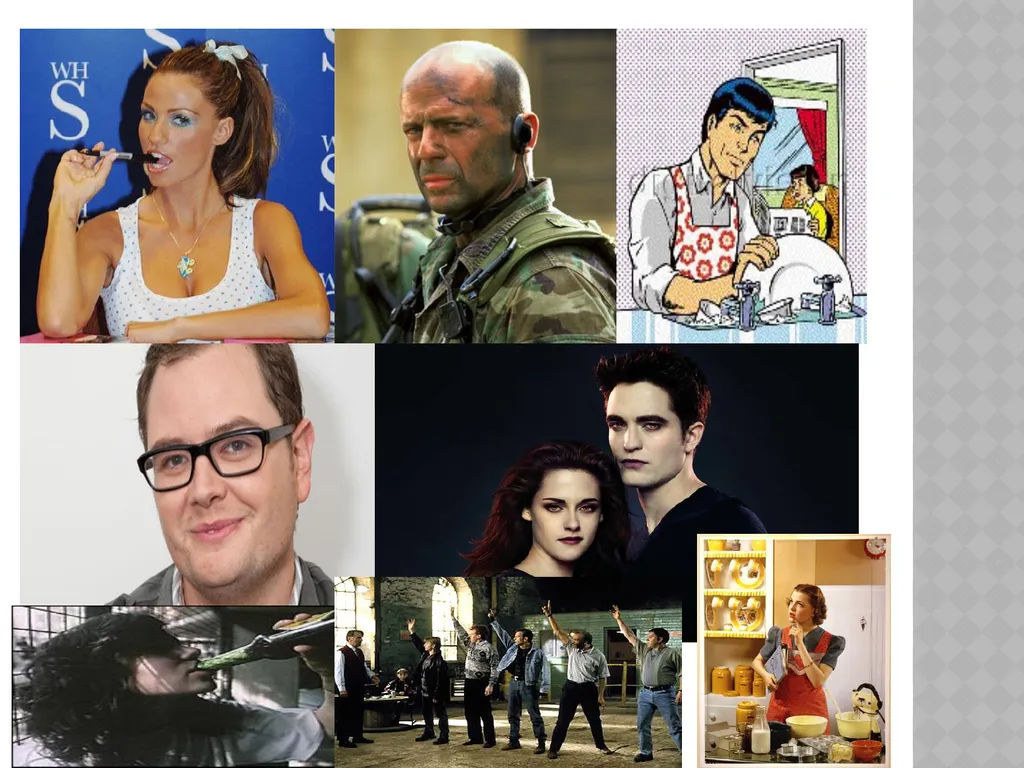
DISCUSS What different ‘types’ of men are there?
What different ‘types’ of women are there?<br>
What different ‘types’ of women are there?<br>
13
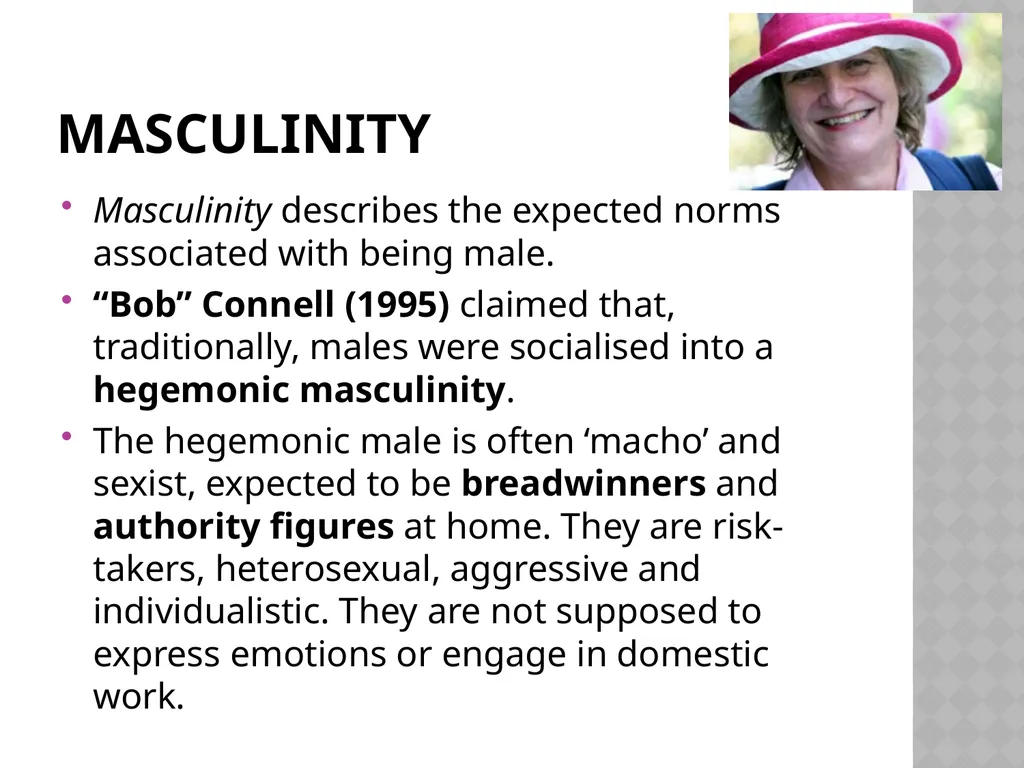
Masculinity Masculinity describes the expected norms associated with being male.
“Bob” Connell (1995) claimed that, traditionally, males were socialised into a hegemonic masculinity.
The hegemonic male is often ‘macho’ and sexist, expected to be breadwinners and authority figures at home. They are risk-takers, heterosexual, aggressive and individualistic. They are not supposed to express emotions or engage in domestic work.<br>
“Bob” Connell (1995) claimed that, traditionally, males were socialised into a hegemonic masculinity.
The hegemonic male is often ‘macho’ and sexist, expected to be breadwinners and authority figures at home. They are risk-takers, heterosexual, aggressive and individualistic. They are not supposed to express emotions or engage in domestic work.<br>
14
Pairs Identify a minimum of five examples from the media of ‘hegemonic males’.
Ext: - How might males and females view these characters differently?<br>
Ext: - How might males and females view these characters differently?<br>
15
Masculinities Connell identified three other forms of masculinity:
Complicit Masculinity: Men who believe in more equal roles within households.
Subordinate Masculinity: Referring mainly to homosexual men; referred to as ‘subordinate’ due to their treatment by wider society at times.
Marginalised Masculinity: A response to the decline of traditional male identities and the rise of women within the workplace.<br>
Complicit Masculinity: Men who believe in more equal roles within households.
Subordinate Masculinity: Referring mainly to homosexual men; referred to as ‘subordinate’ due to their treatment by wider society at times.
Marginalised Masculinity: A response to the decline of traditional male identities and the rise of women within the workplace.<br>
16
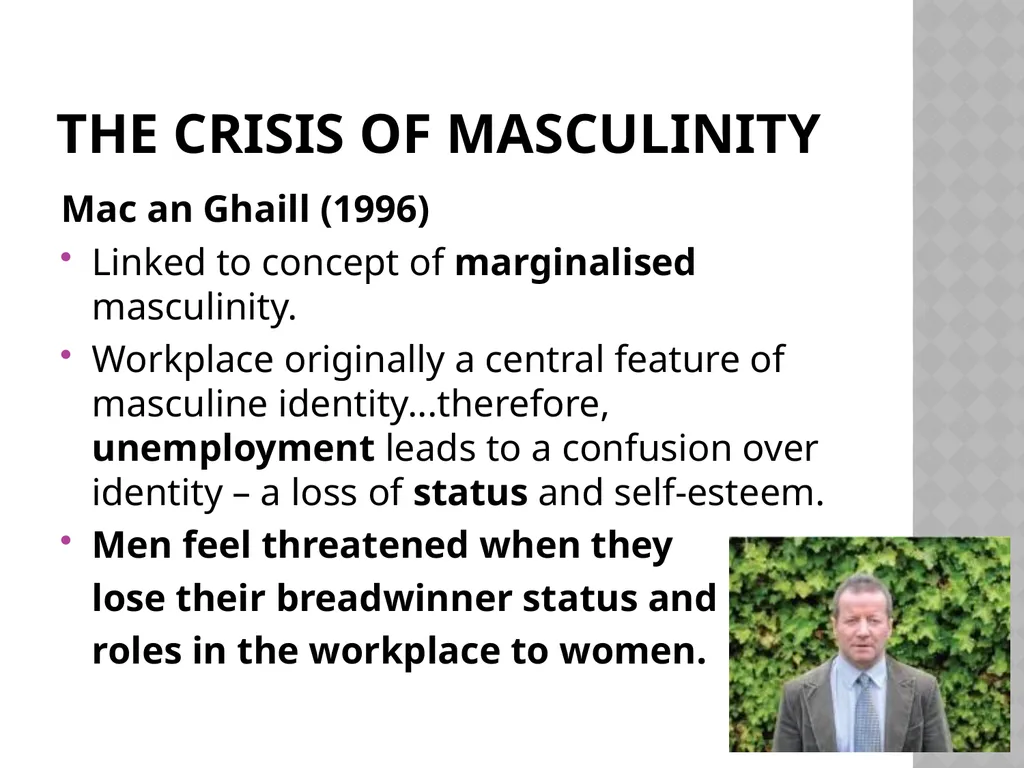
The Crisis of Masculinity Mac an Ghaill (1996)
Linked to concept of marginalised masculinity.
Workplace originally a central feature of masculine identity...therefore, unemployment leads to a confusion over identity – a loss of status and self-esteem.
Men feel threatened when they
lose their breadwinner status and
roles in the workplace to women.<br>
Linked to concept of marginalised masculinity.
Workplace originally a central feature of masculine identity...therefore, unemployment leads to a confusion over identity – a loss of status and self-esteem.
Men feel threatened when they
lose their breadwinner status and
roles in the workplace to women.<br>
17
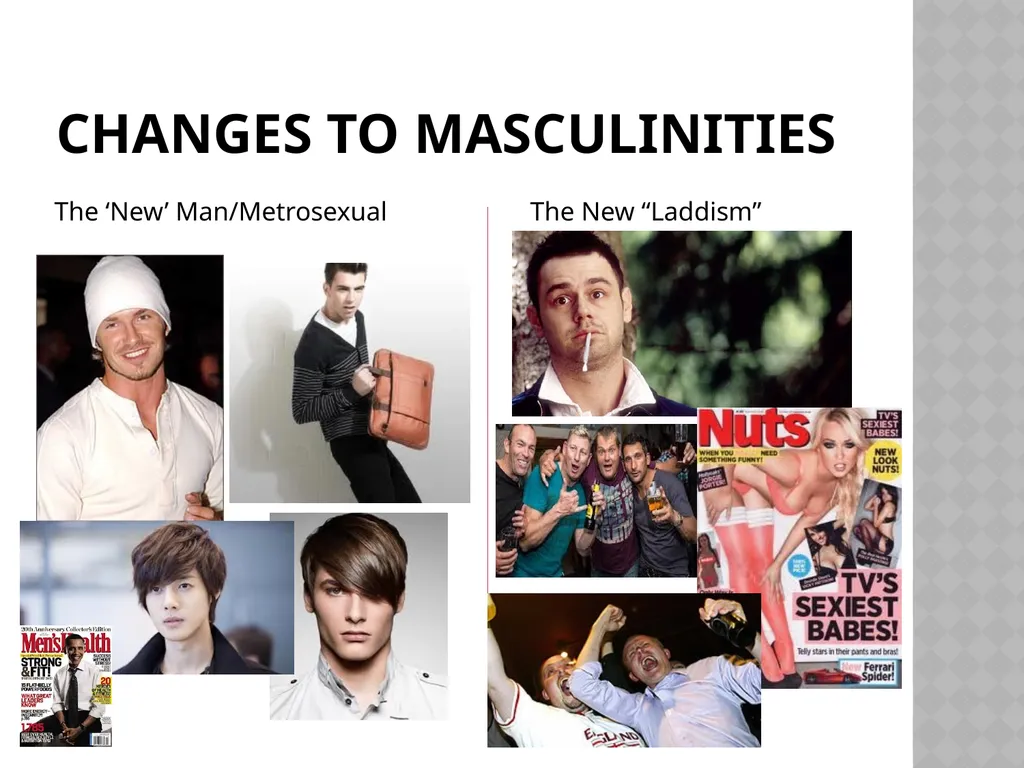
Changes to masculinities The ‘New’ Man/Metrosexual The New “Laddism”<br>
18
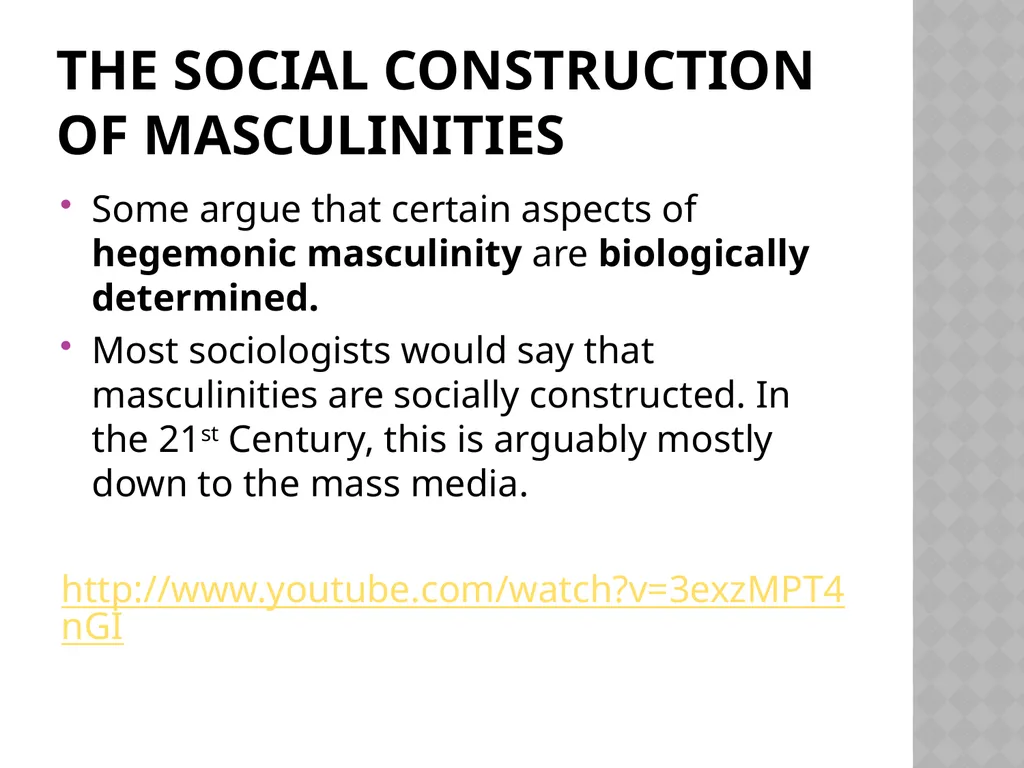
The social construction of masculinities Some argue that certain aspects of hegemonic masculinity are biologically determined.
Most sociologists would say that masculinities are socially constructed. In the 21st Century, this is arguably mostly down to the mass media.
http://www.youtube.com/watch?v=3exzMPT4nGI<br>
Most sociologists would say that masculinities are socially constructed. In the 21st Century, this is arguably mostly down to the mass media.
http://www.youtube.com/watch?v=3exzMPT4nGI<br>
19
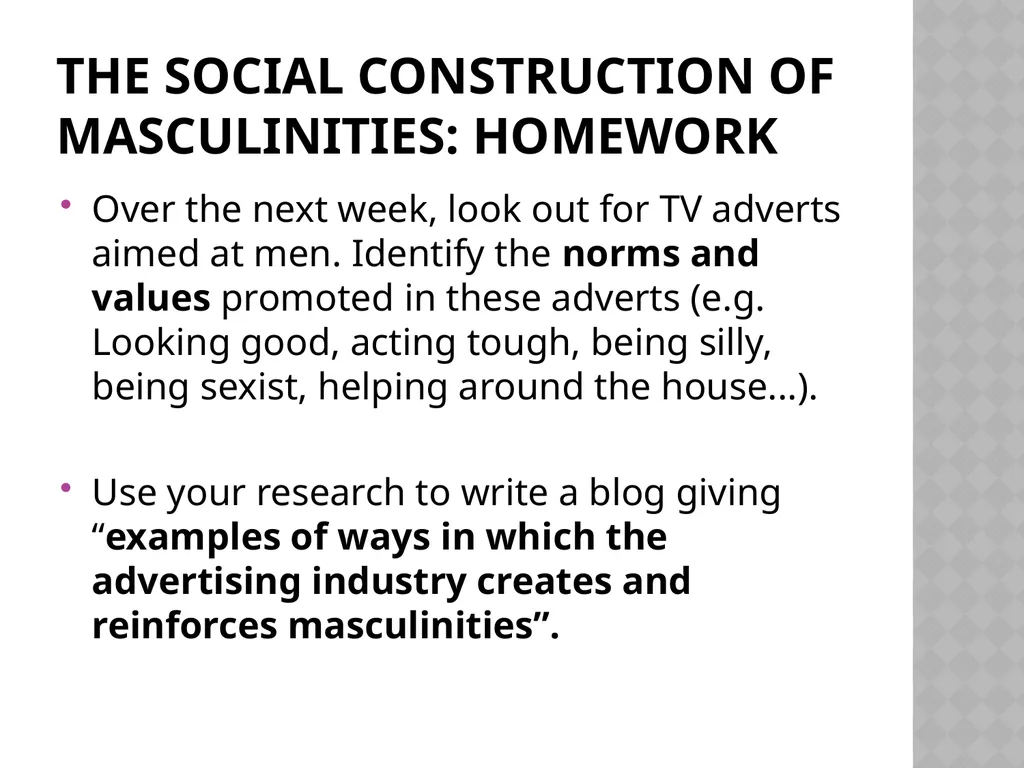
The social construction of masculinities: homework Over the next week, look out for TV adverts aimed at men. Identify the norms and values promoted in these adverts (e.g. Looking good, acting tough, being silly, being sexist, helping around the house...).
Use your research to write a blog giving “examples of ways in which the advertising industry creates and reinforces masculinities”.<br>
Use your research to write a blog giving “examples of ways in which the advertising industry creates and reinforces masculinities”.<br>
20
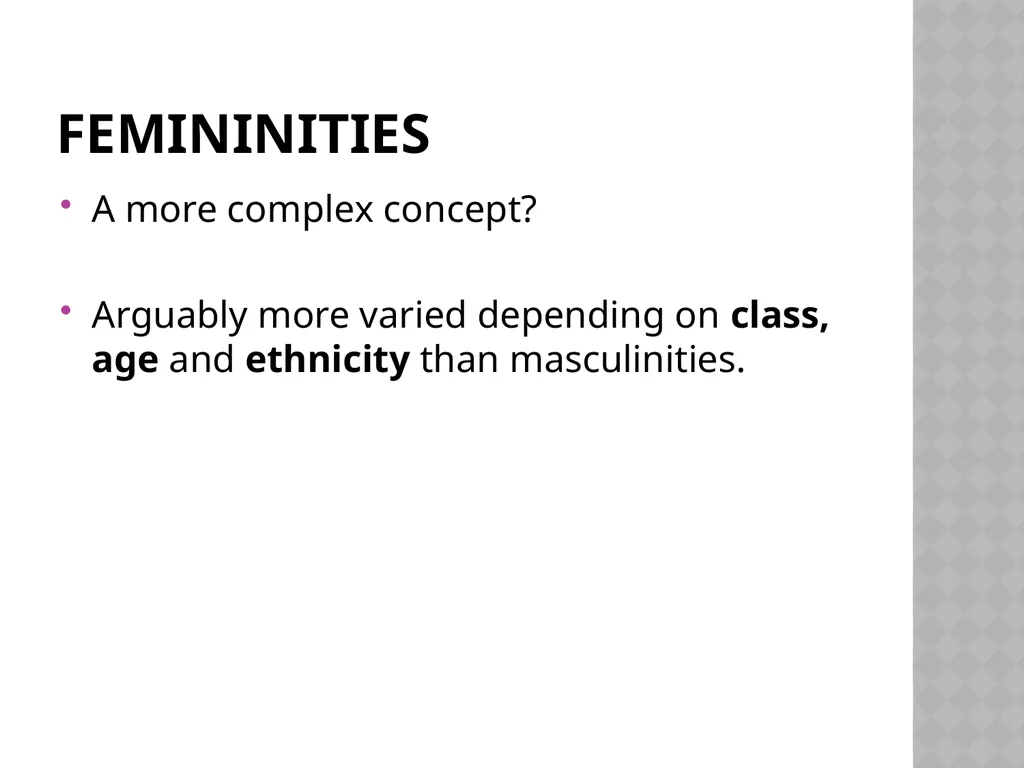
Femininities A more complex concept?
Arguably more varied depending on class, age and ethnicity than masculinities.<br>
Arguably more varied depending on class, age and ethnicity than masculinities.<br>
21
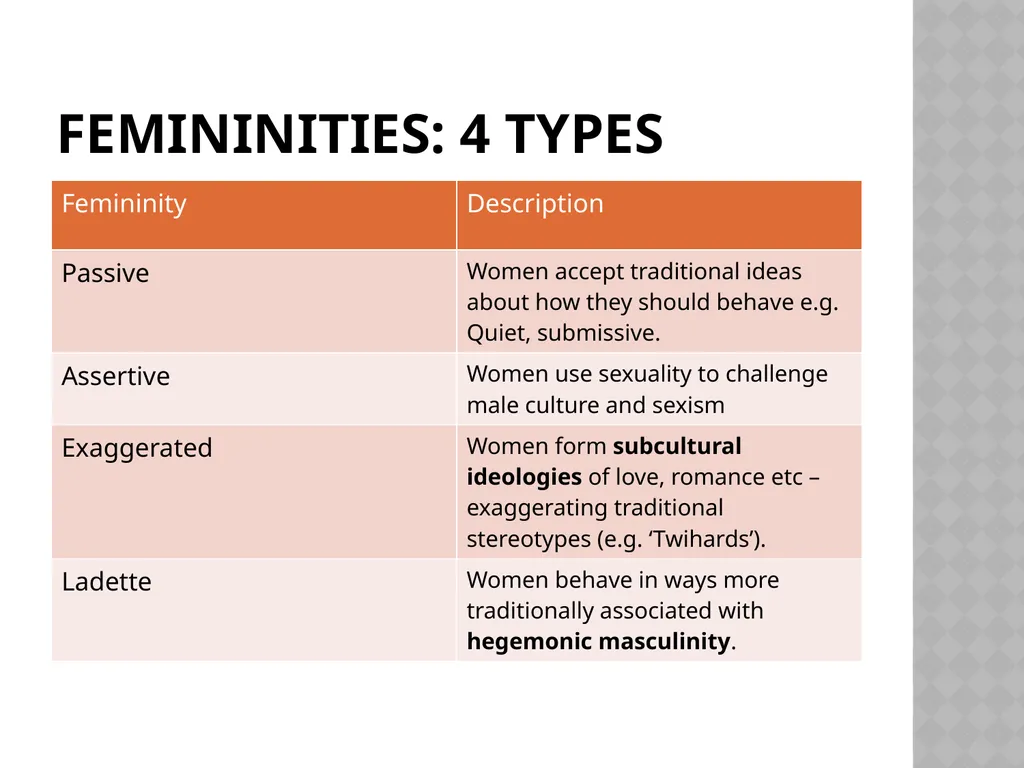
Femininities: 4 Types<br>
22
Groups (15 mins) Design a poster describing either four different masculinities or four different femininities.
Provide written or visual examples for each.
You will present your poster to the group.<br>
Provide written or visual examples for each.
You will present your poster to the group.<br>
23
Socialisation of Gender Identities<br>
24
1. The FAMILY<br>
25
RECAP Anne Oakley’s work on the social construction of gender is one of the most important insights into the role of the family in creating and reinforcing gender identities.<br>
26
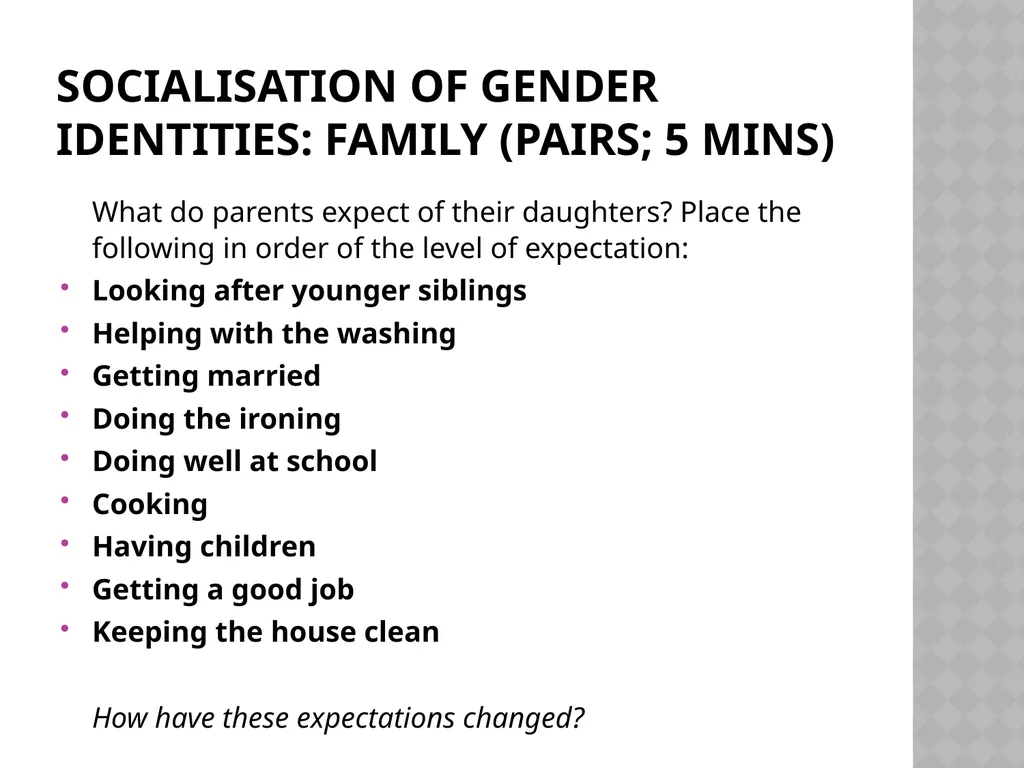
Socialisation of Gender identities: Family (pairs; 5 mins) What do parents expect of their daughters? Place the following in order of the level of expectation:
Looking after younger siblings
Helping with the washing
Getting married
Doing the ironing
Doing well at school
Cooking
Having children
Getting a good job
Keeping the house clean
How have these expectations changed?<br>
Looking after younger siblings
Helping with the washing
Getting married
Doing the ironing
Doing well at school
Cooking
Having children
Getting a good job
Keeping the house clean
How have these expectations changed?<br>
27
Socialisation of Gender identities: Family When talking about their parents, boys describe their mothers as more sensitive and emotionally closer to them than their more distant, detached fathers. (Frosh et al.; 2002)
Men are still regarded as providers and women as carers – despite their increased activity in the labour market. (Charles; 2002)
http://www.fatherhoodinstitute.org/2011/fi-research-summary-fathers-mothers-work-and-family/
Homework: Read and summarise the above article in terms of what it suggests about changing gender roles.<br>
Men are still regarded as providers and women as carers – despite their increased activity in the labour market. (Charles; 2002)
http://www.fatherhoodinstitute.org/2011/fi-research-summary-fathers-mothers-work-and-family/
Homework: Read and summarise the above article in terms of what it suggests about changing gender roles.<br>
28
2. Mass Media<br>
29
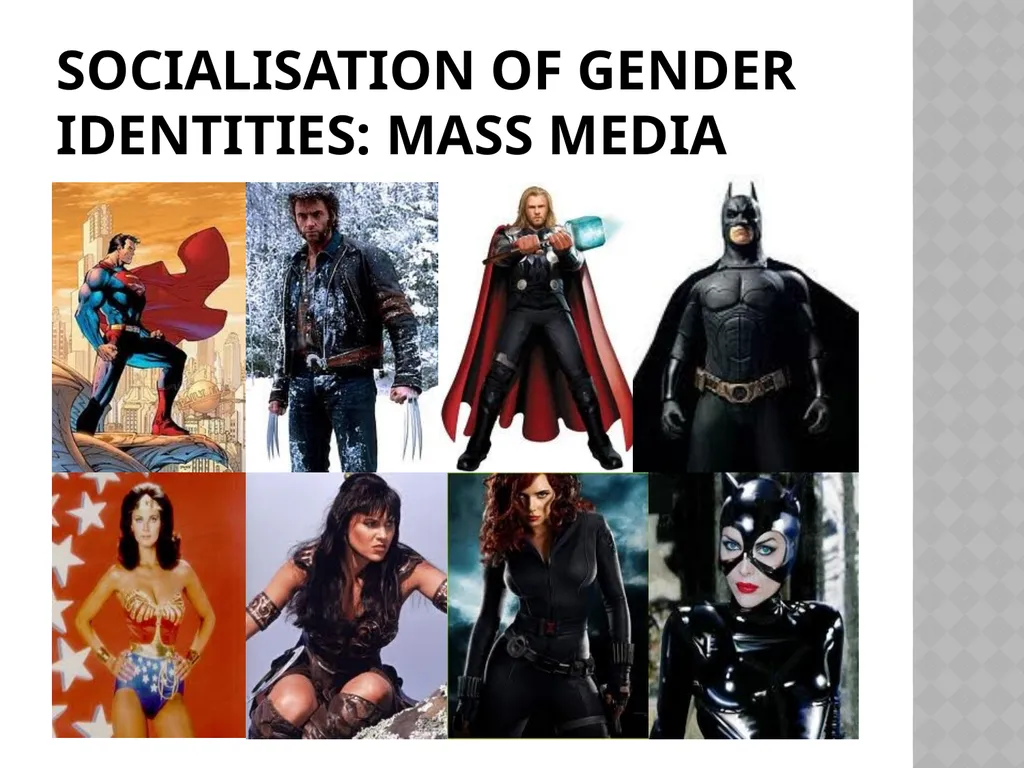
Socialisation of Gender identities: mass media<br>
30
Socialisation of Gender identities: mass media When young children were asked to analyse superhero texts, they could pick out ways in which hegemonic gendered activities were embedded in the stories. When asked to produce their own stories that were not gendered, they struggled. (Marsh & Millard; 2003).<br>
31
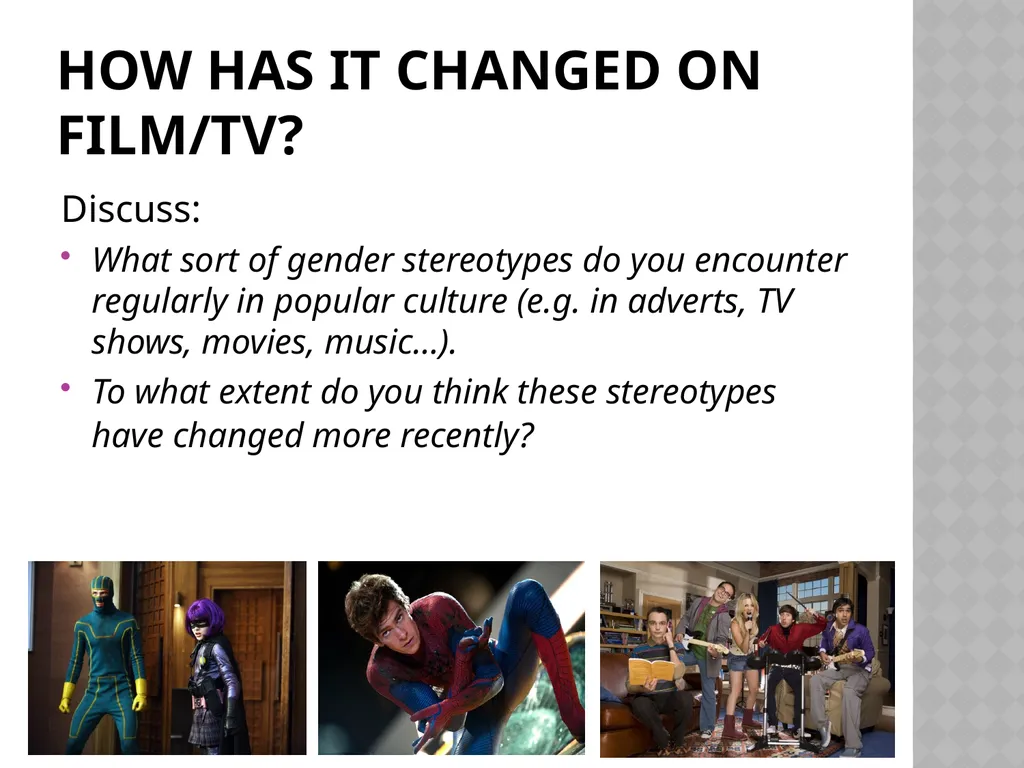
How has it changed on film/TV? Discuss:
What sort of gender stereotypes do you encounter regularly in popular culture (e.g. in adverts, TV shows, movies, music…).
To what extent do you think these stereotypes have changed more recently?<br>
What sort of gender stereotypes do you encounter regularly in popular culture (e.g. in adverts, TV shows, movies, music…).
To what extent do you think these stereotypes have changed more recently?<br>
32
Group Presentation In groups, choose one area of the mass media:
FILMS
TELEVISION
MUSIC
VIDEO GAMES
MAGAZINES/NEWSPAPERS
ADVERTISING
Prepare a 5 min presentation (poster or powerpoint), incorporating some of the theorists in the handout with your own ideas/examples and things already studied.<br>
FILMS
TELEVISION
MUSIC
VIDEO GAMES
MAGAZINES/NEWSPAPERS
ADVERTISING
Prepare a 5 min presentation (poster or powerpoint), incorporating some of the theorists in the handout with your own ideas/examples and things already studied.<br>
33
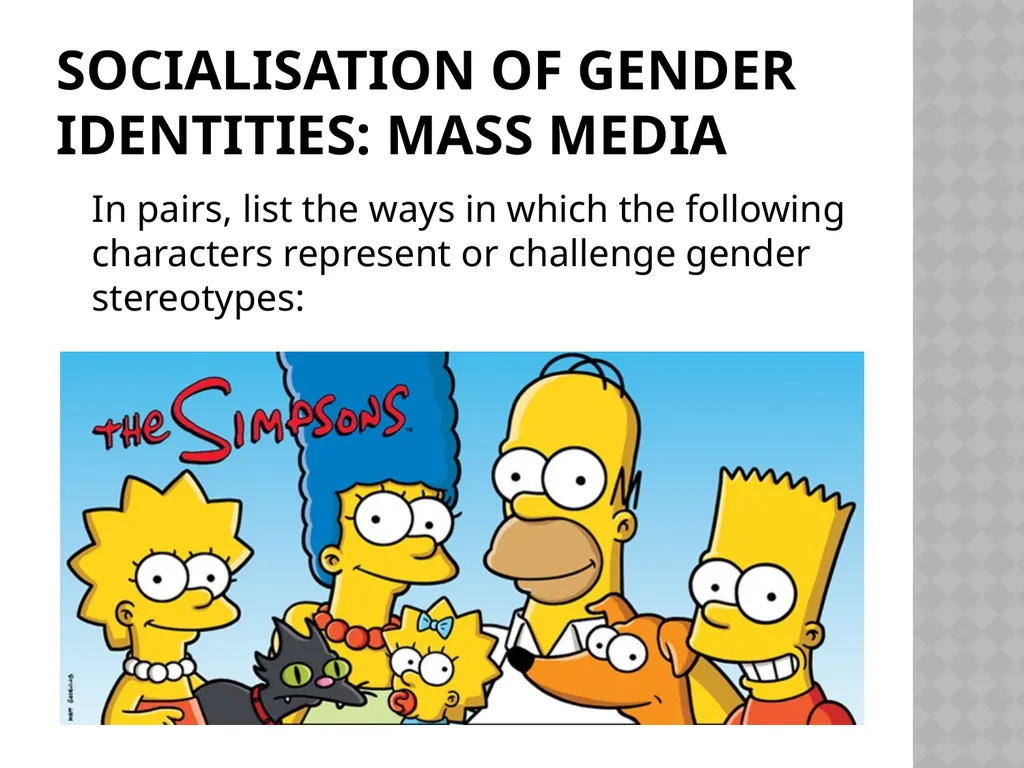
Socialisation of Gender identities: mass media In pairs, list the ways in which the following characters represent or challenge gender stereotypes:<br>
34
3. Religion<br>
35
Write down as many religious prophets and key religious figures as you can. Individually (2mins)<br>
36
Compare your list with a partner.
Share your ideas to extend your individual lists. Pairs (3 mins)<br>
Share your ideas to extend your individual lists. Pairs (3 mins)<br>
37
Combine your lists to collate a single, definitive group list.
In your groups, sub-divide your list by gender. Groups (3 mins)<br>
In your groups, sub-divide your list by gender. Groups (3 mins)<br>
38
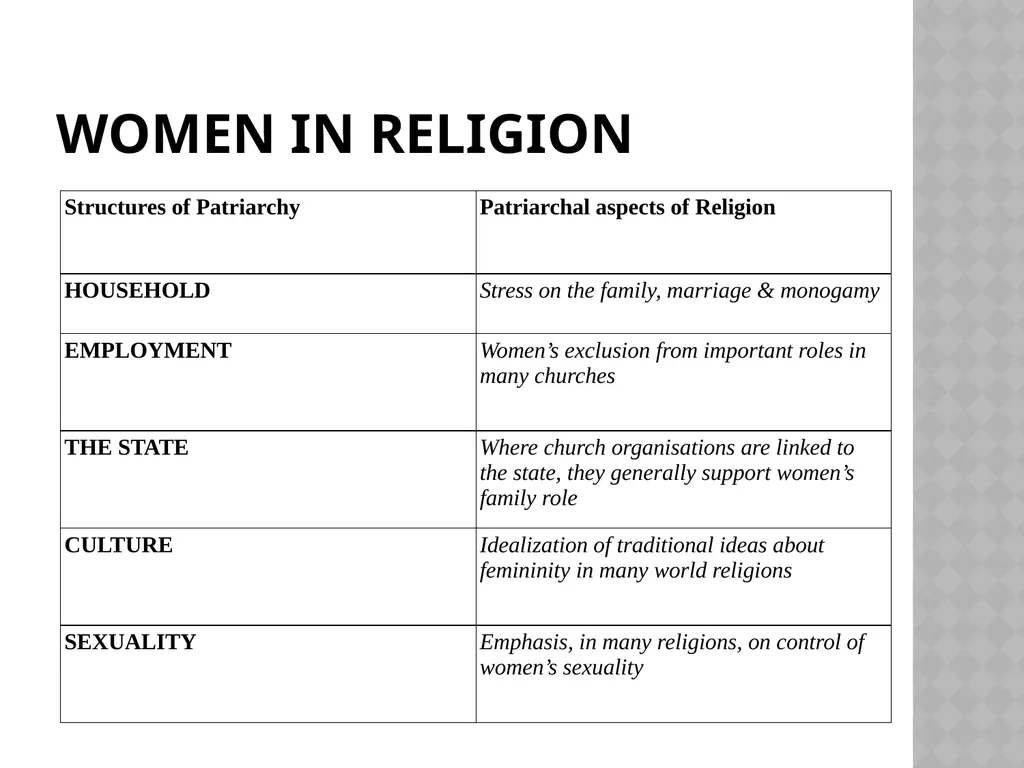
In the religious texts of most ‘mainstream’ religions, significant prophets, apostles etc. tend to be male.
Where women feature, they tend to represent patriarchal ideas of femininity e.g. dangerous seducers or virtuous mothers.
This is just one reason why many feminists argued that religion is patriarchal and discriminates against women. Women in Religion<br>
Where women feature, they tend to represent patriarchal ideas of femininity e.g. dangerous seducers or virtuous mothers.
This is just one reason why many feminists argued that religion is patriarchal and discriminates against women. Women in Religion<br>
39
Women in Religion<br>
40
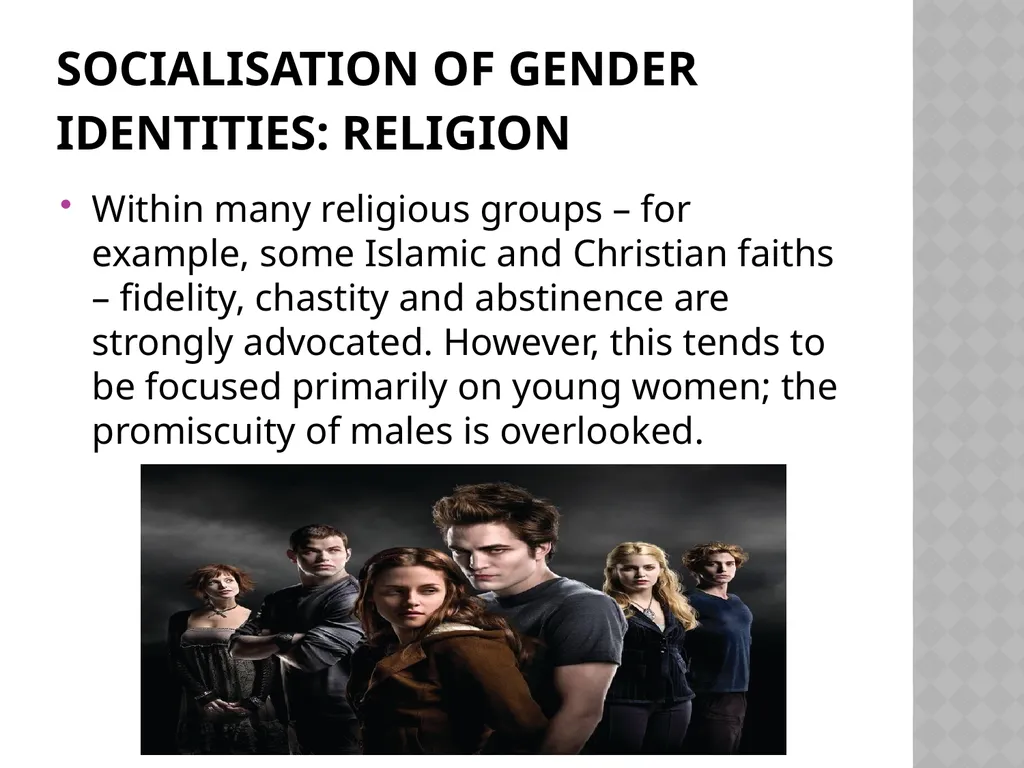
Socialisation of Gender identities: Religion Within many religious groups – for example, some Islamic and Christian faiths – fidelity, chastity and abstinence are strongly advocated. However, this tends to be focused primarily on young women; the promiscuity of males is overlooked.<br>
41
“Blessed art thou Lord our God that I was not born a slave. Blessed art thou Lord our God that I was not born a woman.” – Orthodox Jewish Prayer
“Wives be subject to your husbands, as to the Lord. For the husband is the head of the wife as Christ is head of the church.”
Ephesians 5:22-24
http://www.cybercollege.com/antiwoman.htm Women in Religion<br>
“Wives be subject to your husbands, as to the Lord. For the husband is the head of the wife as Christ is head of the church.”
Ephesians 5:22-24
http://www.cybercollege.com/antiwoman.htm Women in Religion<br>
42
The muslim veil Woodhead (2007) argues that for some Muslim women, religious dress – in particular the veil – has become an important part of their identity.
There is debate about whether the veil oppresses Muslim women or liberates them.
http://www.youtube.com/watch?v=Tu9AdvDaLmA<br>
There is debate about whether the veil oppresses Muslim women or liberates them.
http://www.youtube.com/watch?v=Tu9AdvDaLmA<br>
43
Puttick (1997) Women have always been the biggest
consumers of religion...but have been
served badly by it.
Many religions view being born a women as a punishment...
...The only recourse is to become a well-behaved, submissive wife and mother in order to be ‘reborn’ as a man.<br>
consumers of religion...but have been
served badly by it.
Many religions view being born a women as a punishment...
...The only recourse is to become a well-behaved, submissive wife and mother in order to be ‘reborn’ as a man.<br>
44
4. Education<br>
45
Questions? (Discuss in groups; 5 mins) What are your own experiences of schooling & gender?
Identify ways that boys and girls are treated differently?
Do boys & girls have different attitudes to school work?
Do boys & girls choose different subjects?
Do boys & girls behave differently in the classroom?<br>
Identify ways that boys and girls are treated differently?
Do boys & girls have different attitudes to school work?
Do boys & girls choose different subjects?
Do boys & girls behave differently in the classroom?<br>
46
Formal & hidden curricula Some subjects remain male-dominated (Maths, Physics, IT)
Others are increasingly female dominated (English, Biology....Sociology A Level!)
Why do you think there are some differences in the subjects chosen by boys/girls?
What influence might this be having on society?<br>
Others are increasingly female dominated (English, Biology....Sociology A Level!)
Why do you think there are some differences in the subjects chosen by boys/girls?
What influence might this be having on society?<br>
47
Education & Gender Boys who value academic success are often considered more feminine; those who take part in anti-school subcultures are seen as more traditional, hegemonic males (Frosh; 2002)
Some boys come to school with existing ideas about laddism. Male teachers often respond with tough measures that could be seen as equally ‘macho’ as the laddish behaviour itself (Skelton; 2001)<br>
Some boys come to school with existing ideas about laddism. Male teachers often respond with tough measures that could be seen as equally ‘macho’ as the laddish behaviour itself (Skelton; 2001)<br>
48
Socialisation of Gender identities: Education Females outperform males in SATs, KSs, GCSEs, A Levels, diplomas and degrees.
Truancy rates are significantly higher for males.
Some studies have found that girls receive less attention than boys in the classroom.<br>
Truancy rates are significantly higher for males.
Some studies have found that girls receive less attention than boys in the classroom.<br>
49
In Pairs Read the extract and underline or highlight ways in which the hidden curriculum socialises pupils into gender roles.
(5 mins)<br>
(5 mins)<br>
50
Jackson (2006) The distinction between
masculinities and femininities among young people in schools is becoming blurred.
The introduction of the ‘ladette’ means girls are increasingly rejecting academic success, messing around in class and spending more time on their social lives than on work.<br>
masculinities and femininities among young people in schools is becoming blurred.
The introduction of the ‘ladette’ means girls are increasingly rejecting academic success, messing around in class and spending more time on their social lives than on work.<br>
51
Peer Group<br>
52
Socialisation of Gender identities: Peer Group List the derogatory words used by males towards females and vice versa. What differences can you notice?<br>
53
In Pairs Examine the study by Kitzinger (1995).
What was the purpose of the study and what are its findings?
What does it suggest about the ways in which peer groups can influence the way girls think about themselves?
How might the findings be different if Kitzinger had studied boys instead of girls?<br>
What was the purpose of the study and what are its findings?
What does it suggest about the ways in which peer groups can influence the way girls think about themselves?
How might the findings be different if Kitzinger had studied boys instead of girls?<br>
54
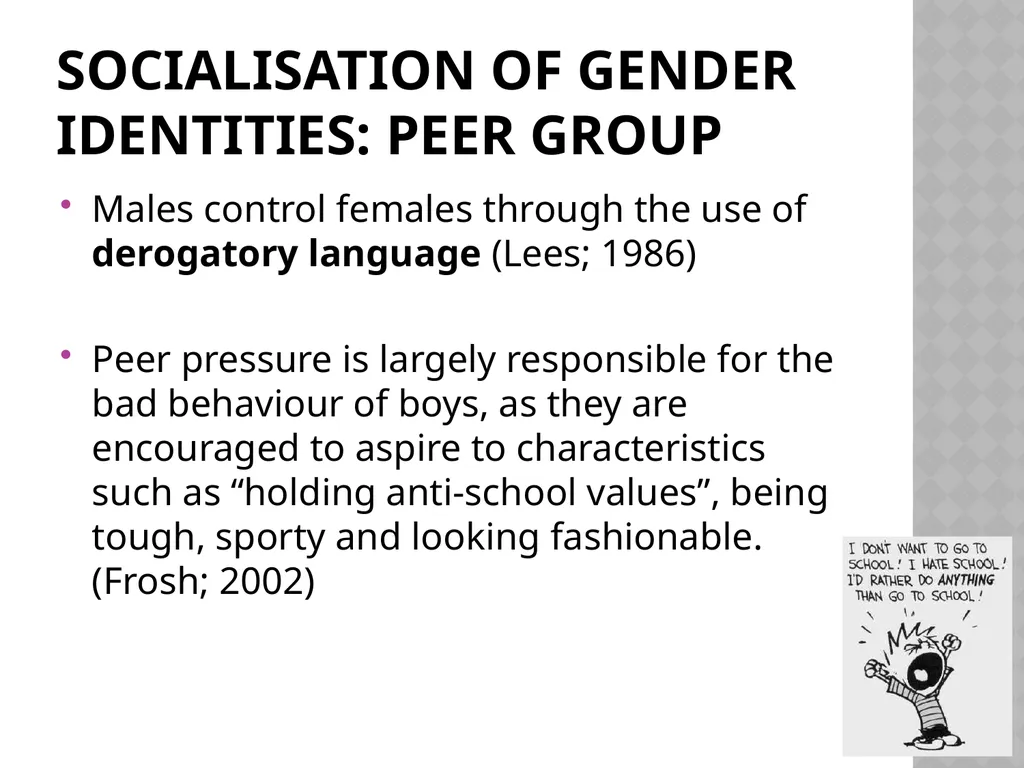
Socialisation of Gender identities: Peer Group Males control females through the use of derogatory language (Lees; 1986)
Peer pressure is largely responsible for the bad behaviour of boys, as they are encouraged to aspire to characteristics such as “holding anti-school values”, being tough, sporty and looking fashionable. (Frosh; 2002)<br>
Peer pressure is largely responsible for the bad behaviour of boys, as they are encouraged to aspire to characteristics such as “holding anti-school values”, being tough, sporty and looking fashionable. (Frosh; 2002)<br>
55
Socialisation of Gender identities: Peer Group Burdsey (2004) studied amateur and
professional footballers.
He found that young Asian footballers would hide their ethnic identity under a ‘laddish’ one in order to join in with post-match activities (watching porn, drinking etc.).
This demonstrates the importance of the peer group in shaping identity.<br>
professional footballers.
He found that young Asian footballers would hide their ethnic identity under a ‘laddish’ one in order to join in with post-match activities (watching porn, drinking etc.).
This demonstrates the importance of the peer group in shaping identity.<br>
56
6. WORKPLACE<br>
57
Socialisation of gender identities: workplace Adkins (1995)
Jobs associated with women have become increasingly sexualised.
Women find they have to take up subordinated femininities in order to keep/maintain work (e.g. Flirting, unwanted advances etc.).
Discuss:
What jobs are women more likely to have than men in the UK?
How have these jobs become more sexualised?<br>
Jobs associated with women have become increasingly sexualised.
Women find they have to take up subordinated femininities in order to keep/maintain work (e.g. Flirting, unwanted advances etc.).
Discuss:
What jobs are women more likely to have than men in the UK?
How have these jobs become more sexualised?<br>
58
Socialisation of gender identities: workplace The Crisis of Masculinity means that working class males have lost their traditional jobs and are unprepared for other skill areas.(Mac an Ghaill; 1994).
...This means that young males who expected to have traditional gender roles are having to rethink more flexible roles e.g. Different masculinities. (Frosh et al; 2002)<br>
...This means that young males who expected to have traditional gender roles are having to rethink more flexible roles e.g. Different masculinities. (Frosh et al; 2002)<br>
59
“THE FULL MONTY” Whilst watching the film:
Identify TEN ways in which the changing nature of work affected masculinities.
In what ways does the peer group shape gender identities in the film?<br>
Identify TEN ways in which the changing nature of work affected masculinities.
In what ways does the peer group shape gender identities in the film?<br>
60
Activity (10 mins + 5 min Presentation) In groups, select one agent of socialisation.
Using your notes, learning and own ideas, devise a 5 min presentation explaining three ways in which your chosen agent of socialisation creates and reinforces gender identities.<br>
Using your notes, learning and own ideas, devise a 5 min presentation explaining three ways in which your chosen agent of socialisation creates and reinforces gender identities.<br>