Geometric Sequences Plus a review of arithmetic
Description: Geometric Sequences Plus a review of arithmetic sequences Definitions Definitions: (yes, thats right, this is important, know these!) A sequence is a set of numbers, called terms, arranged in some particular order. An arithmetic sequence
Related Topics
Download Presentation
"Geometric Sequences Plus a review of arithmetic" is the property of its rightful owner. Permission is granted to download and print the materials on this website for personal, non-commercial use only, and to display it on your personal computer provided you do not modify the materials and that you retain all copyright notices contained in the materials. By downloading content from our website, you accept the terms of this agreement.
Presentation Transcript
slide1. Geometric Sequences Plus a review of arithmetic sequences<br>
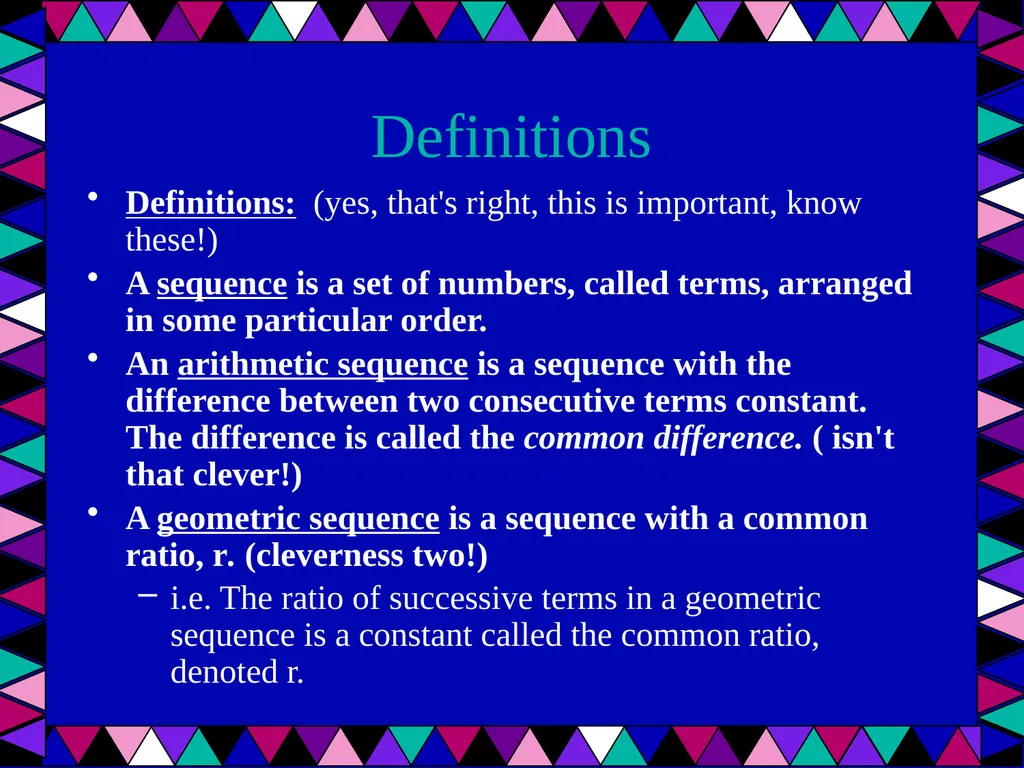
slide2. Definitions Definitions:Â (yes, that's right, this is important, know these!)
A sequence is a set of numbers, called terms, arranged in some particular order.
An arithmetic sequence is a sequence with the difference between two consecutive terms constant. The difference is called the common difference. ( isn't that clever!)
A geometric sequence is a sequence with a common ratio, r. (cleverness two!)
i.e. The ratio of successive terms in a geometric sequence is a constant called the common ratio, denoted r.<br>
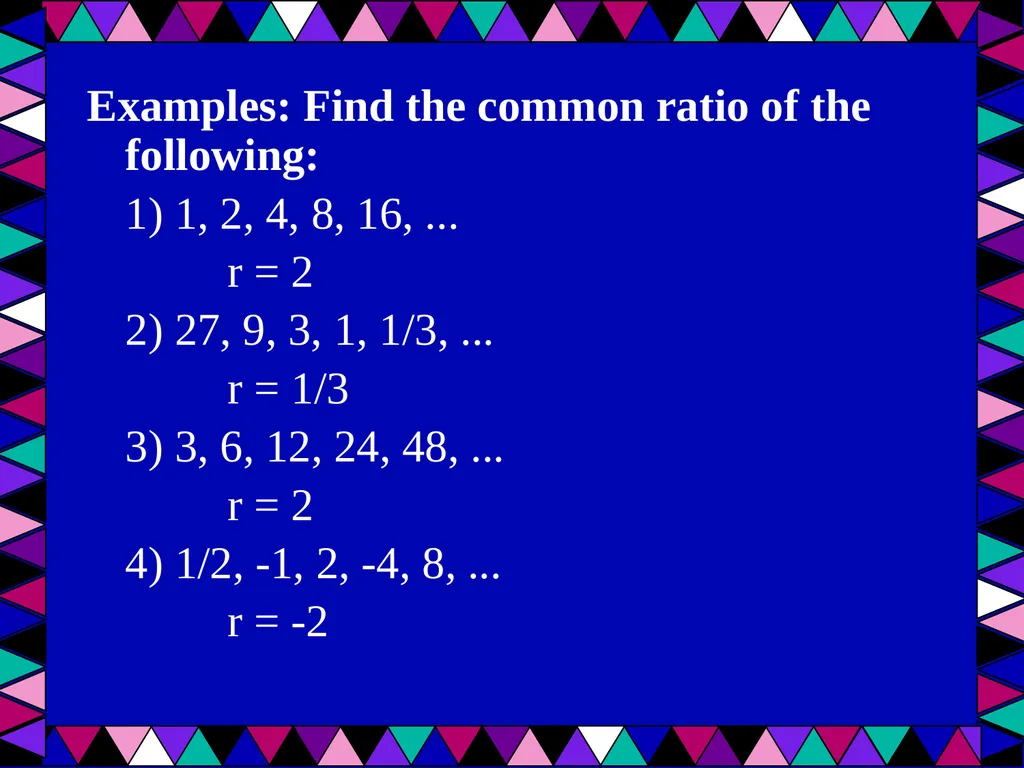
slide3. Examples: Find the common ratio of the following:
1) 1, 2, 4, 8, 16, ...
r = 2
2) 27, 9, 3, 1, 1/3, ...
r = 1/3
3) 3, 6, 12, 24, 48, ...
r = 2
4) 1/2, -1, 2, -4, 8, ...
r = -2<br>
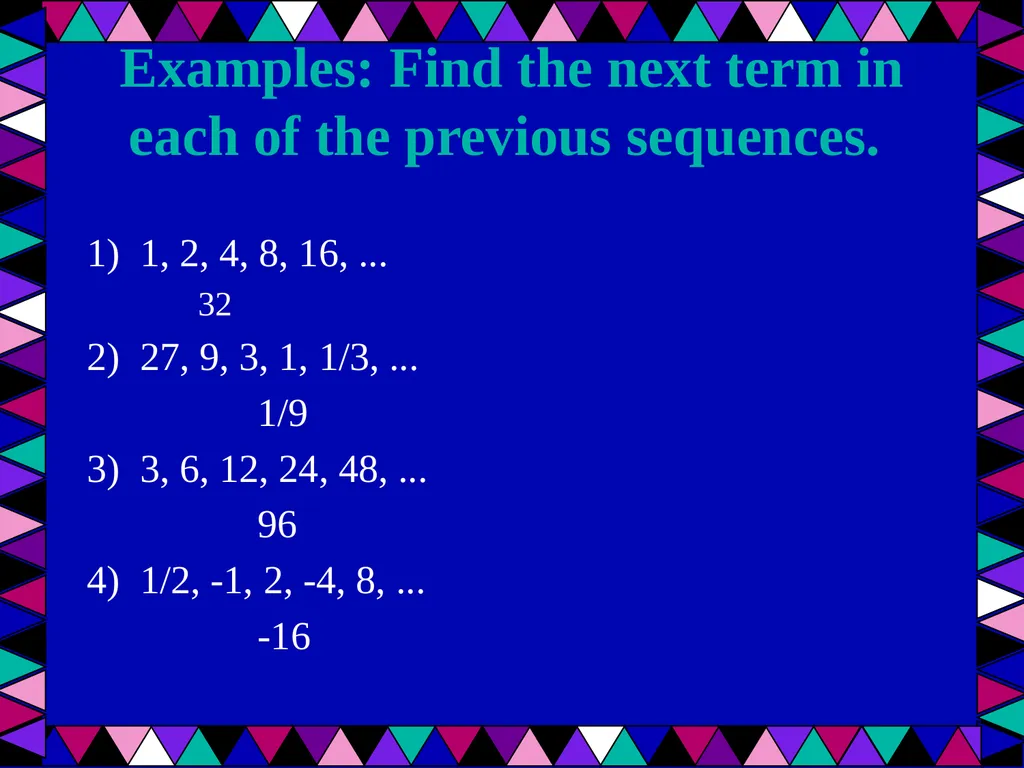
slide4. Examples: Find the next term in each of the previous sequences. 1) 1, 2, 4, 8, 16, ...
32
2) 27, 9, 3, 1, 1/3, ...
1/9
3) 3, 6, 12, 24, 48, ...
96
4) 1/2, -1, 2, -4, 8, ...
-16<br>
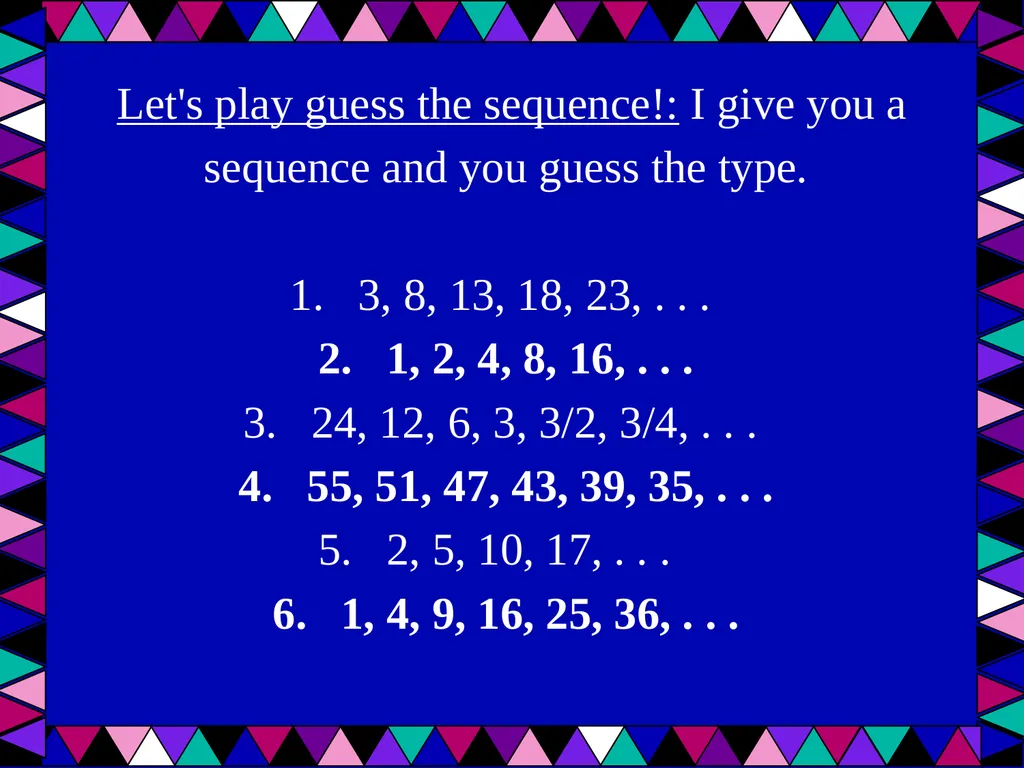
slide5. Let's play guess the sequence!: I give you a
sequence and you guess the type.Â
3, 8, 13, 18, 23, . . . Â
1, 2, 4, 8, 16, . . .
24, 12, 6, 3, 3/2, 3/4, . . .Â
55, 51, 47, 43, 39, 35, . . .
2, 5, 10, 17, . . . Â
1, 4, 9, 16, 25, 36, . . .<br>
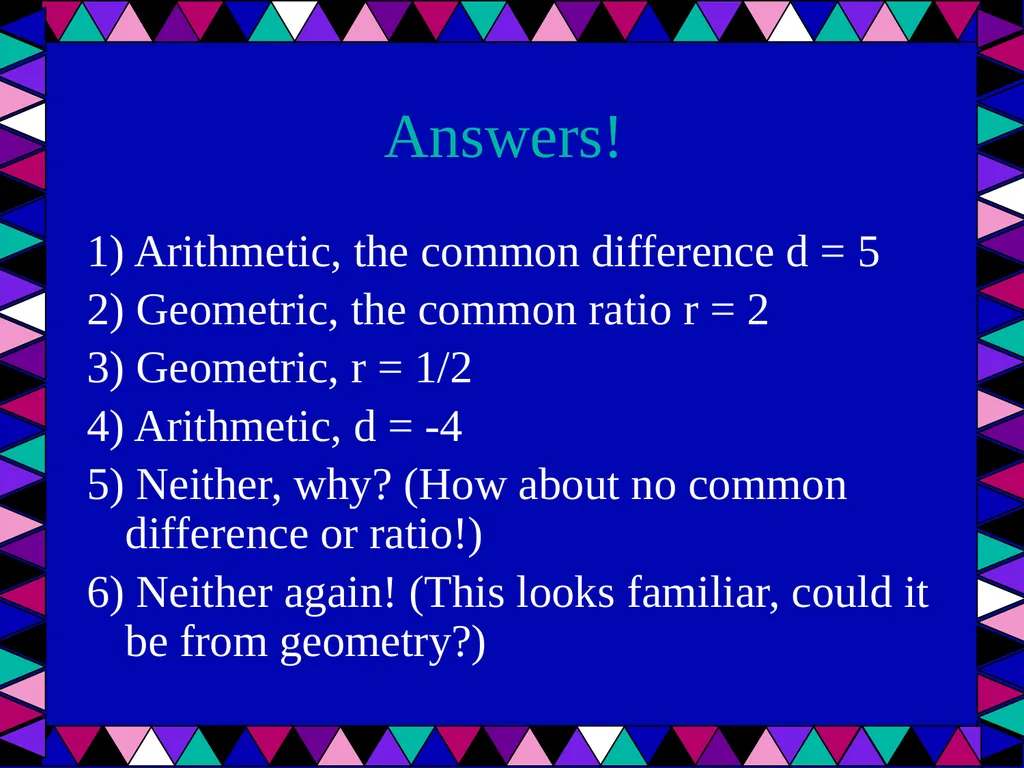
slide6. Answers! 1) Arithmetic, the common difference d = 5
2) Geometric, the common ratio r = 2
3) Geometric, r = 1/2
4) Arithmetic, d = -4
5) Neither, why? (How about no common difference or ratio!)
6) Neither again! (This looks familiar, could it be from geometry?)<br>
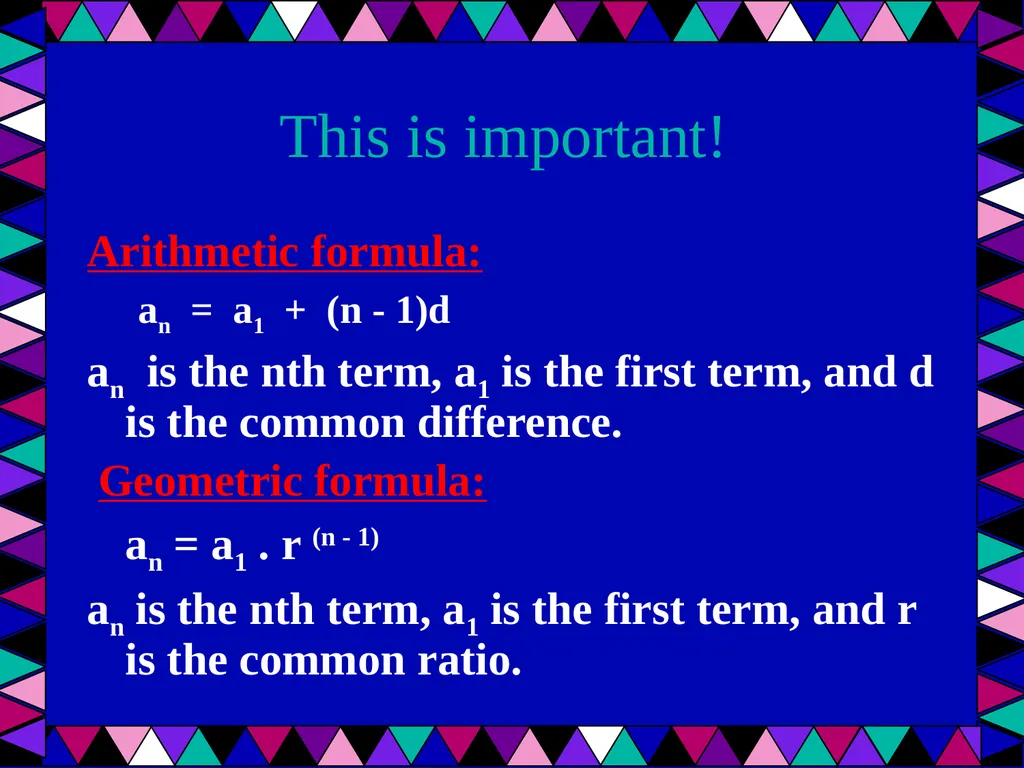
slide7. This is important! Arithmetic formula:Â Â Â Â Â Â
an = a1 + (n - 1)d
an is the nth term, a1 is the first term, and d is the common difference.
Geometric formula:Â Â Â Â Â Â Â Â Â Â
an = a1 . r (n - 1)
an is the nth term, a1 is the first term, and r is the common ratio.<br>
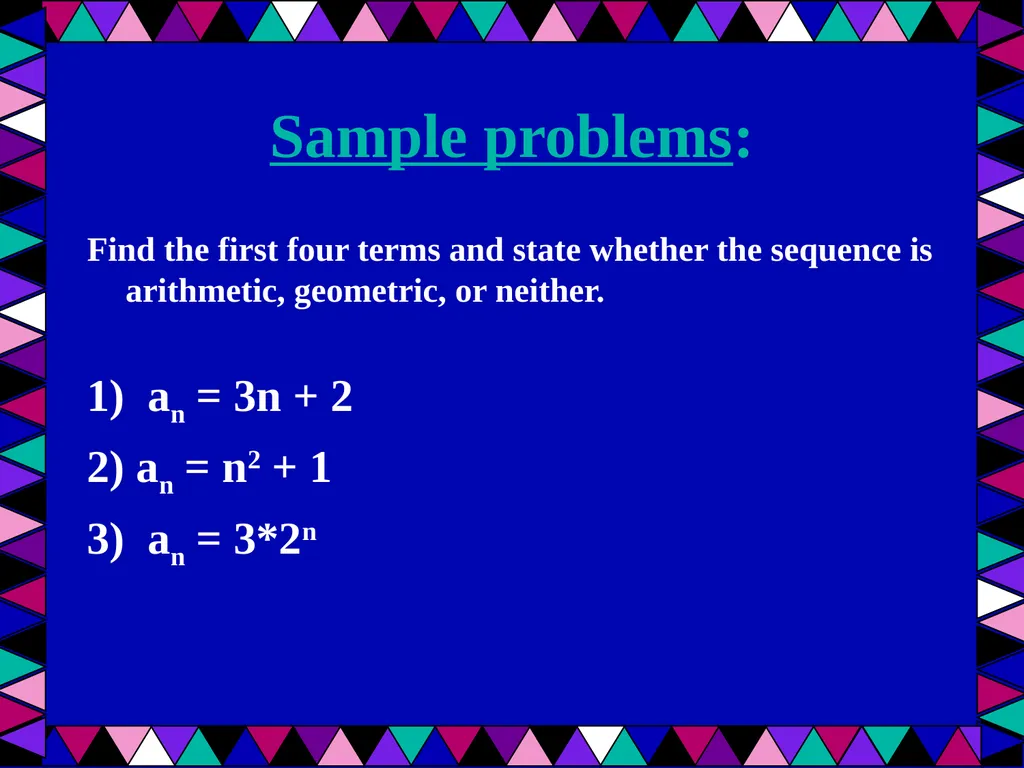
slide8. Sample problems: Find the first four terms and state whether the sequence is arithmetic, geometric, or neither.
1)Â an = 3n + 2Â Â Â
2) an = n2 + 1Â Â
3)Â an = 3*2n<br>
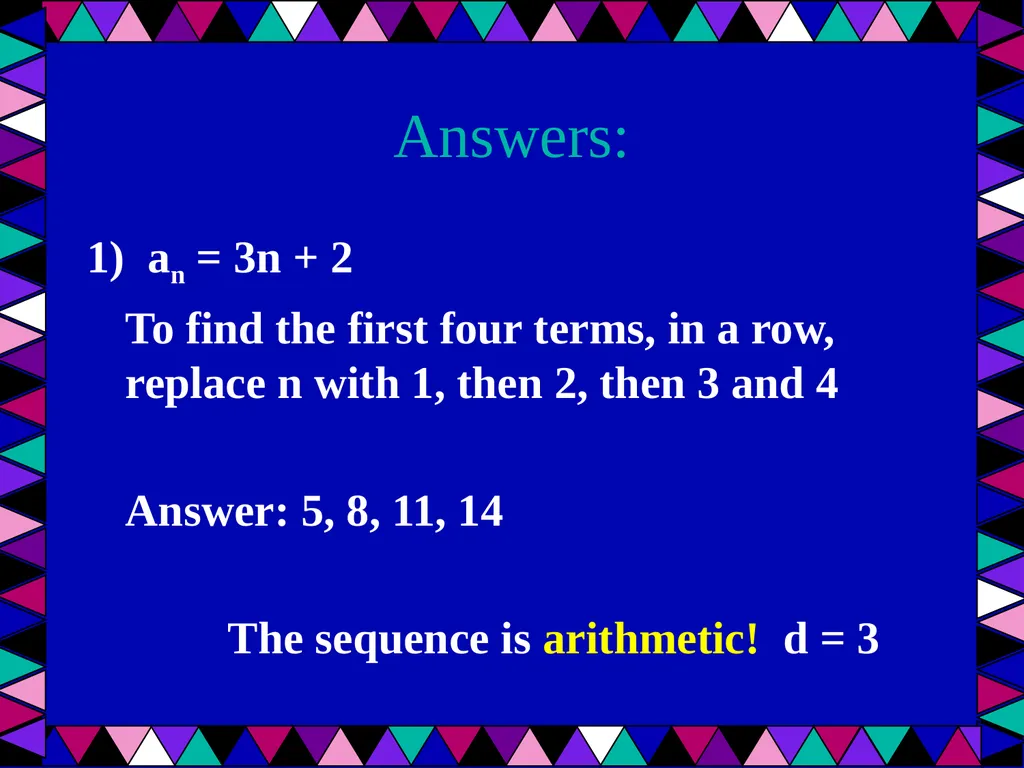
slide9. Answers: 1)Â an = 3n + 2Â Â
To find the first four terms, in a row, replace n with 1, then 2, then 3 and 4
Answer: 5, 8, 11, 14Â Â Â Â Â Â Â Â Â
The sequence is arithmetic! d = 3<br>
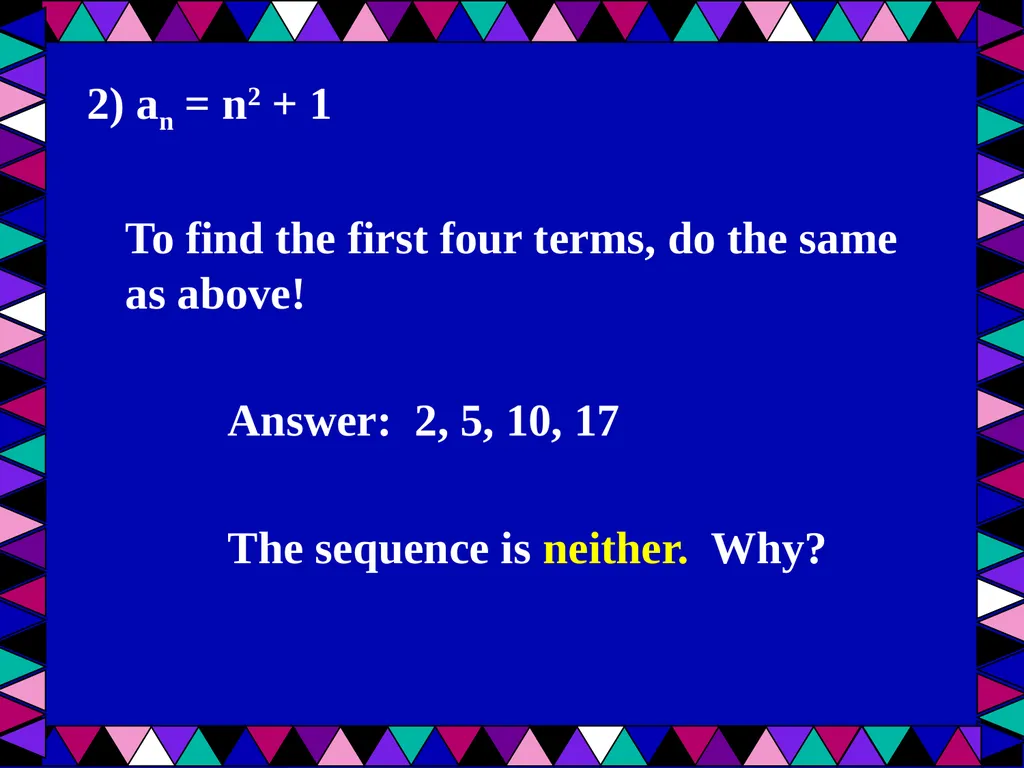
slide10. 2) an = n2 + 1
To find the first four terms, do the same as above!
Answer:Â 2, 5, 10, 17Â Â Â Â Â Â Â Â Â
The sequence is neither. Why?<br>
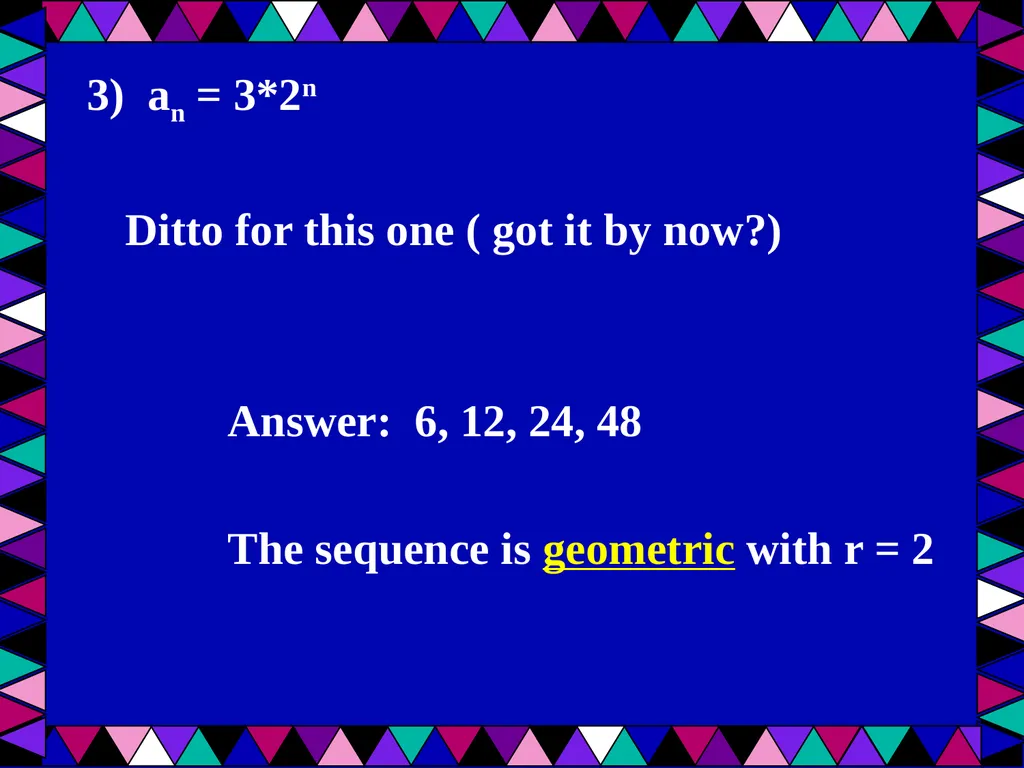
slide11. 3)Â an = 3*2nÂ
Ditto for this one ( got it by now?)
Answer:Â 6, 12, 24, 48Â Â Â Â Â Â Â Â
The sequence is geometric with r = 2<br>
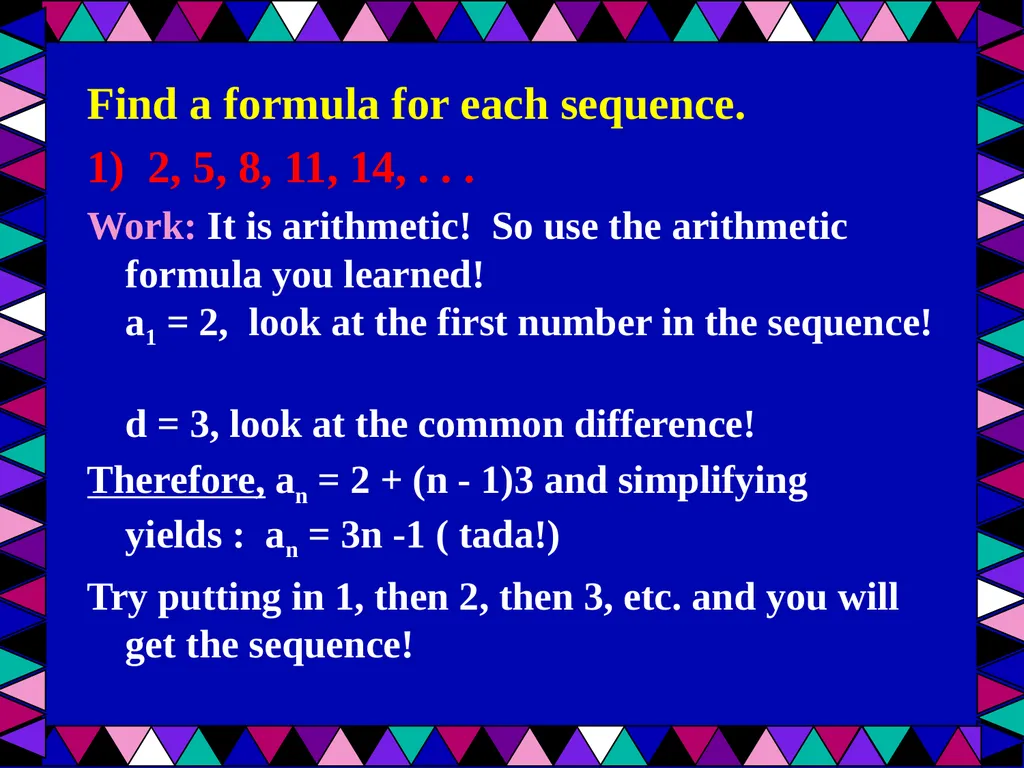
slide12. Find a formula for each sequence.
1)Â 2, 5, 8, 11, 14, . . .
Work: It is arithmetic! So use the arithmetic formula you learned! a1 = 2, look at the first number in the sequence! d = 3, look at the common difference!
Therefore, an = 2 + (n - 1)3 and simplifying yields :Â an = 3n -1 ( tada!)
Try putting in 1, then 2, then 3, etc. and you will get the sequence!<br>
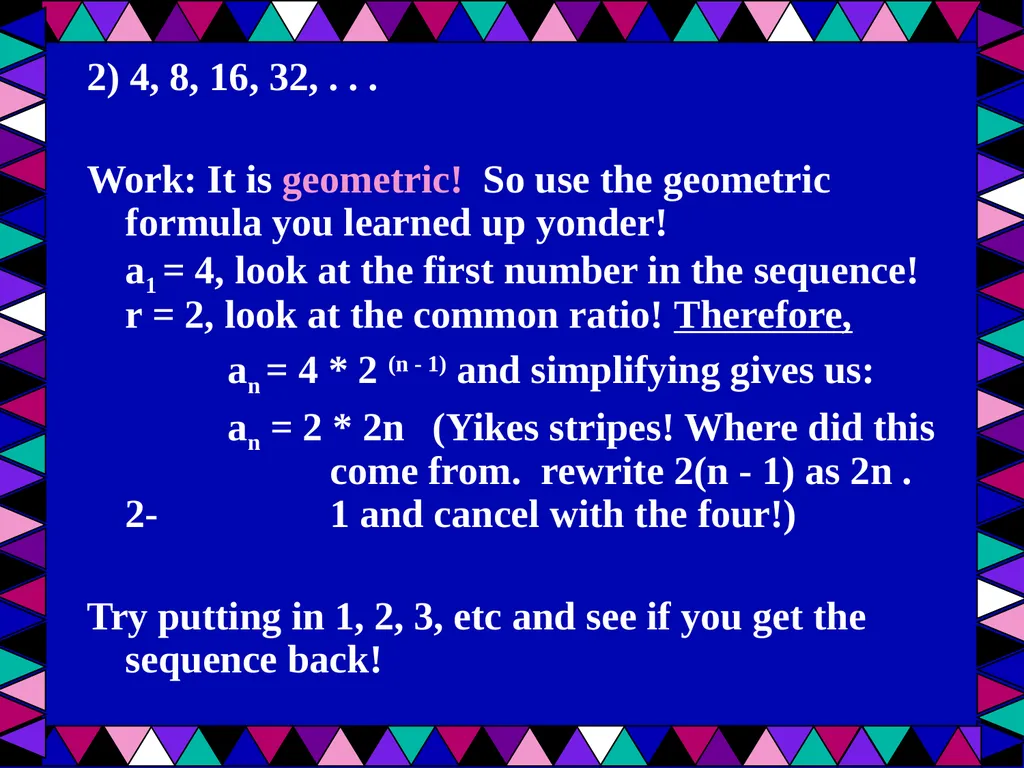
slide13. 2) 4, 8, 16, 32, . . .
Work: It is geometric! So use the geometric formula you learned up yonder! a1 = 4, look at the first number in the sequence! r = 2, look at the common ratio! Therefore,Â
an = 4 * 2 (n - 1) and simplifying gives us:
an = 2 * 2n (Yikes stripes! Where did this come from. rewrite 2(n - 1) as 2n . 2- 1 and cancel with the four!)
Try putting in 1, 2, 3, etc and see if you get the sequence back!<br>
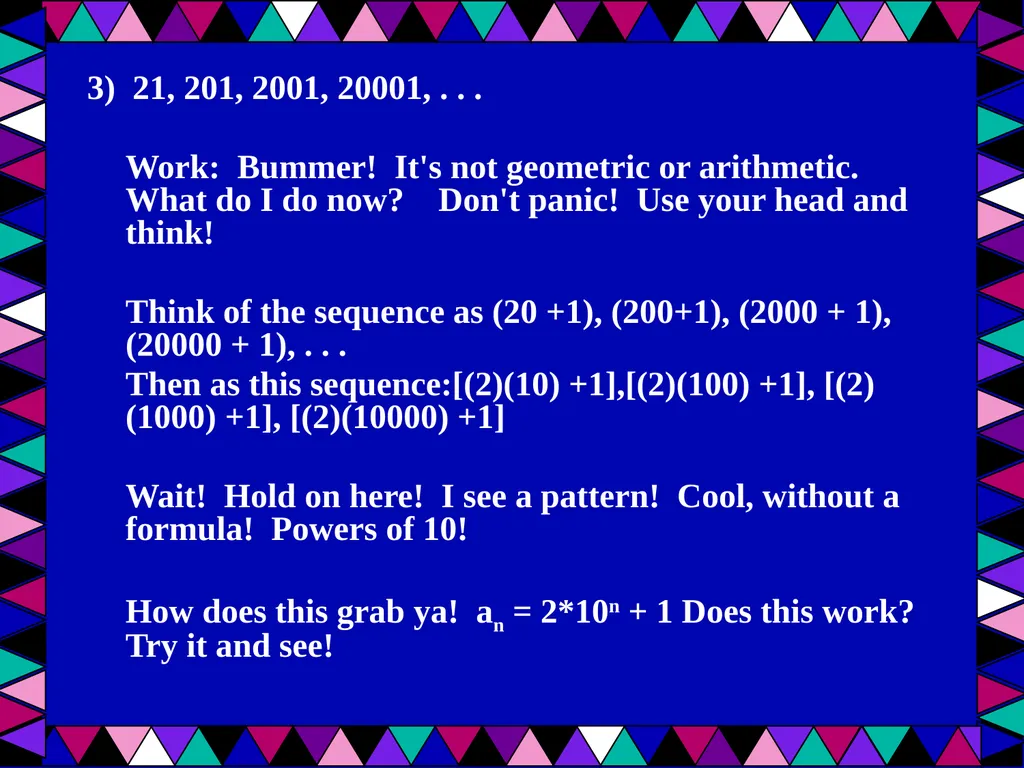
slide14. 3)Â 21, 201, 2001, 20001, . . .
Work: Bummer! It's not geometric or arithmetic. What do I do now?  Don't panic! Use your head and think!
Think of the sequence as (20 +1), (200+1), (2000 + 1), (20000 + 1), . . .
Then as this sequence:[(2)(10) +1],[(2)(100) +1], [(2)(1000) +1], [(2)(10000) +1]
Wait! Hold on here! I see a pattern! Cool, without a formula! Powers of 10!
How does this grab ya! an = 2*10n + 1 Does this work? Try it and see!<br>
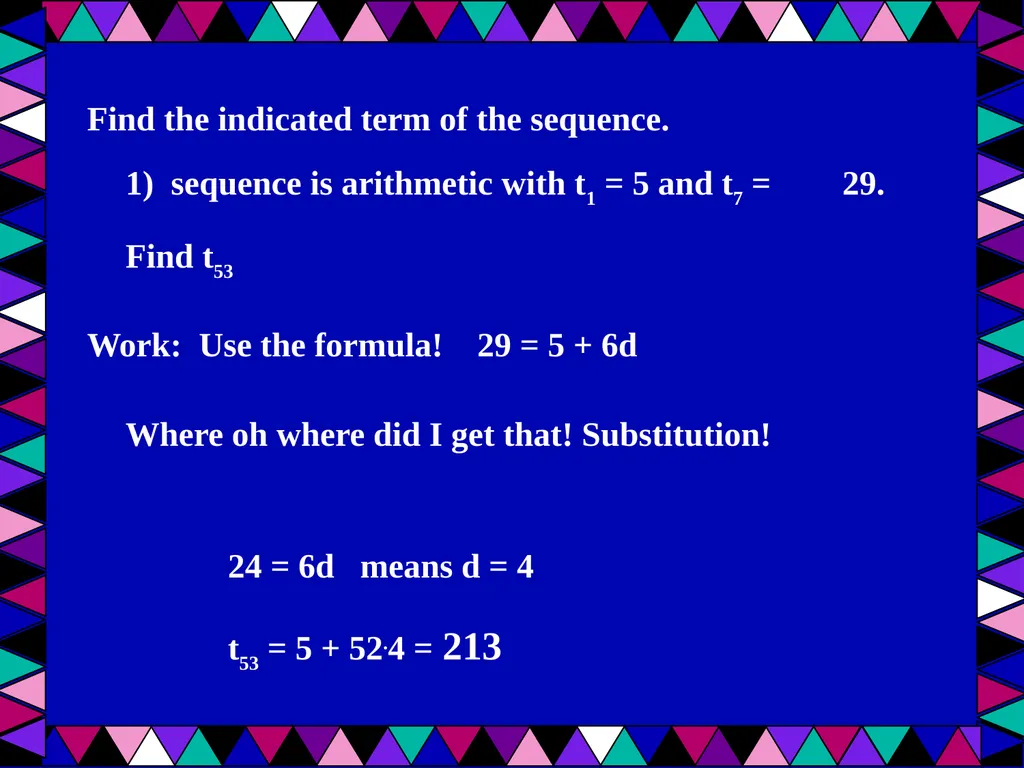
slide15. Find the indicated term of the sequence.
1) sequence is arithmetic with t1 = 5 and t7 = 29.  Find t53
Work: Use the formula!   29 = 5 + 6d
Where oh where did I get that! Substitution! Â Â Â Â Â Â Â Â Â Â Â Â Â Â Â Â Â Â Â Â Â Â Â Â Â Â Â Â Â Â Â Â Â Â Â Â Â Â Â Â Â
24 = 6d  means d = 4 t53 = 5 + 52.4 = 213<br>
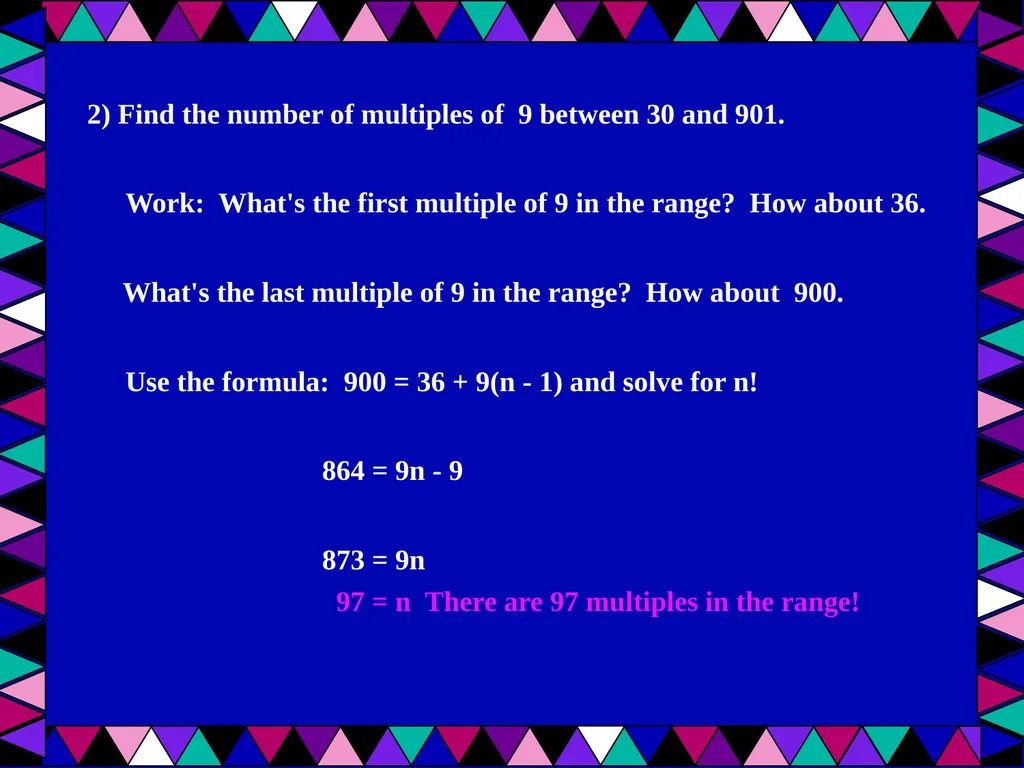
slide16. 2) Find the number of multiples of 9 between 30 and 901.
Work: What's the first multiple of 9 in the range? How about 36.
   What's the last multiple of 9 in the range? How about 900.    Â
Use the formula:Â 900 = 36 + 9(n - 1) and solve for n!
                                864 = 9n - 9
                                873 = 9n
                                  97 = n There are 97 multiples in the range!<br>
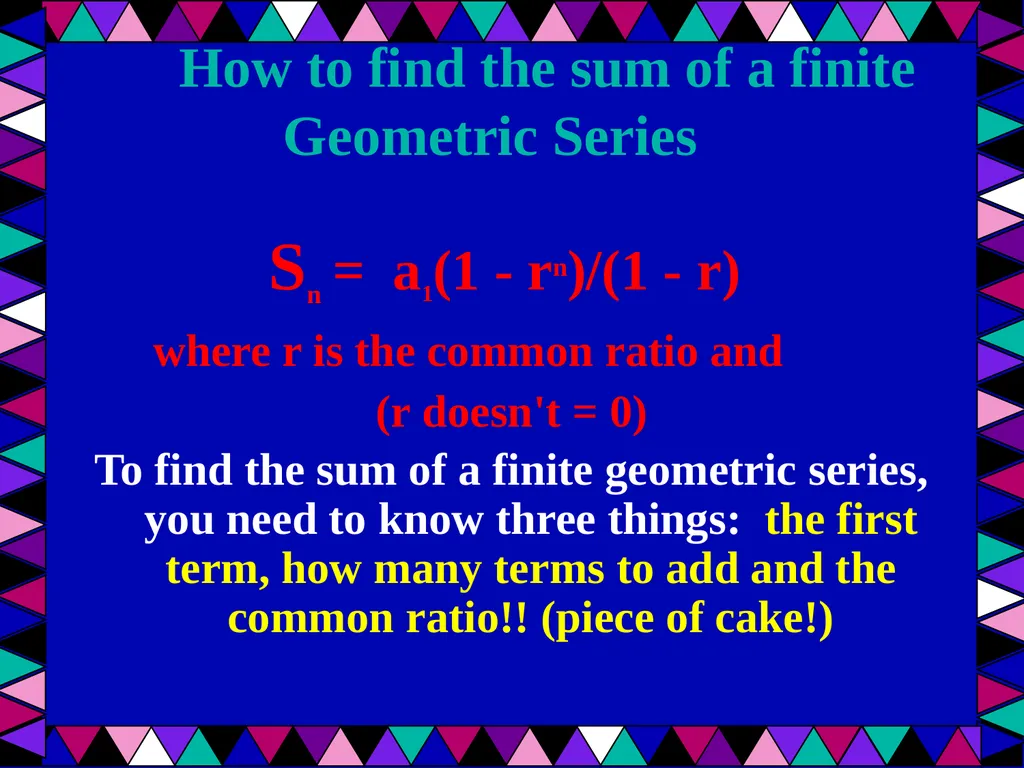
slide17. How to find the sum of a finite Geometric Series Sn =Â a1(1 - rn)/(1 - r)
where r is the common ratio and          Â
(r doesn't = 0)
To find the sum of a finite geometric series, you need to know three things:Â the first term, how many terms to add and the common ratio!! (piece of cake!)<br>
slide18. Definition
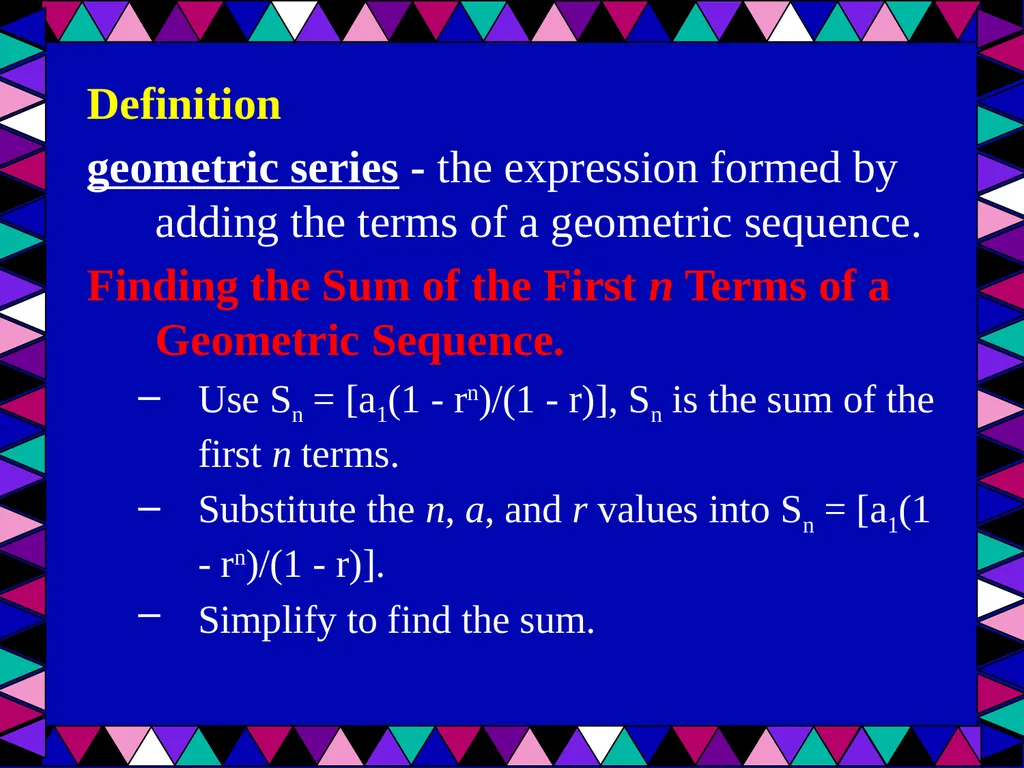
geometric series - the expression formed by adding the terms of a geometric sequence.
Finding the Sum of the First n Terms of a Geometric Sequence.
Use Sn = [a1(1 - rn)/(1 - r)], Sn is the sum of the first n terms.
Substitute the n, a, and r values into Sn = [a1(1 - rn)/(1 - r)].
Simplify to find the sum.<br>
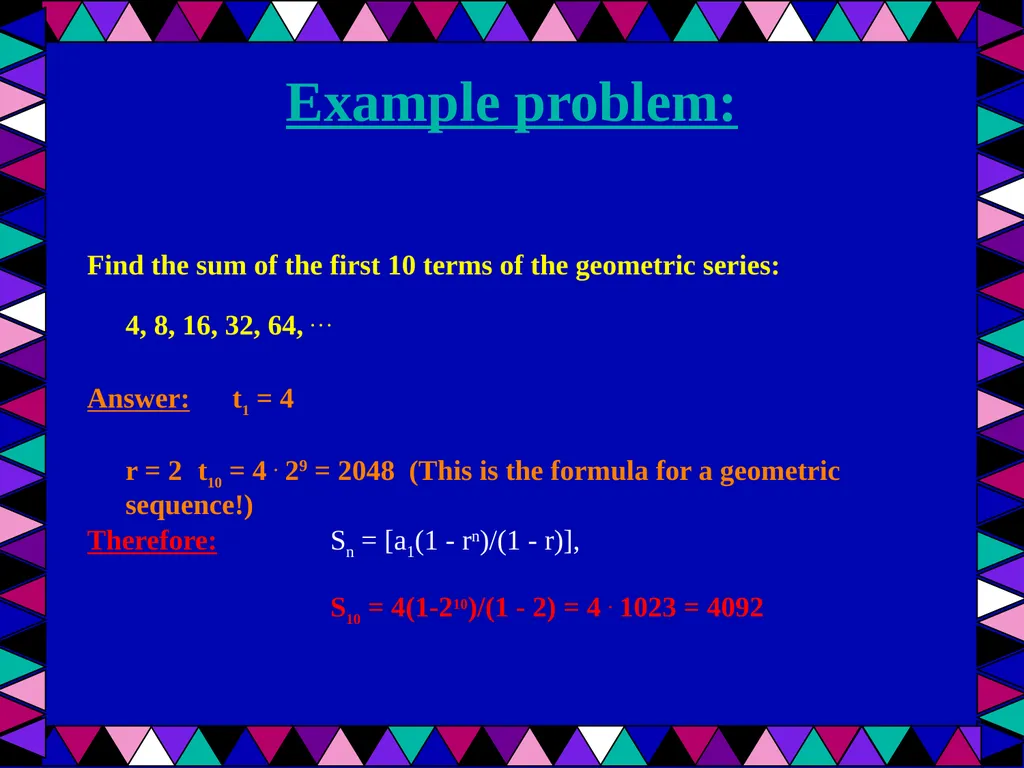
slide19. Example problem: Find the sum of the first 10 terms of the geometric series: 4, 8, 16, 32, 64, . . .
Answer:Â Â Â Â Â t1 = 4
r = 2 t10 = 4 . 29 = 2048 (This is the formula for a geometric sequence!)
Therefore:Â Sn = [a1(1 - rn)/(1 - r)],
S10 = 4(1-210)/(1 - 2) = 4 . 1023 = 4092<br>
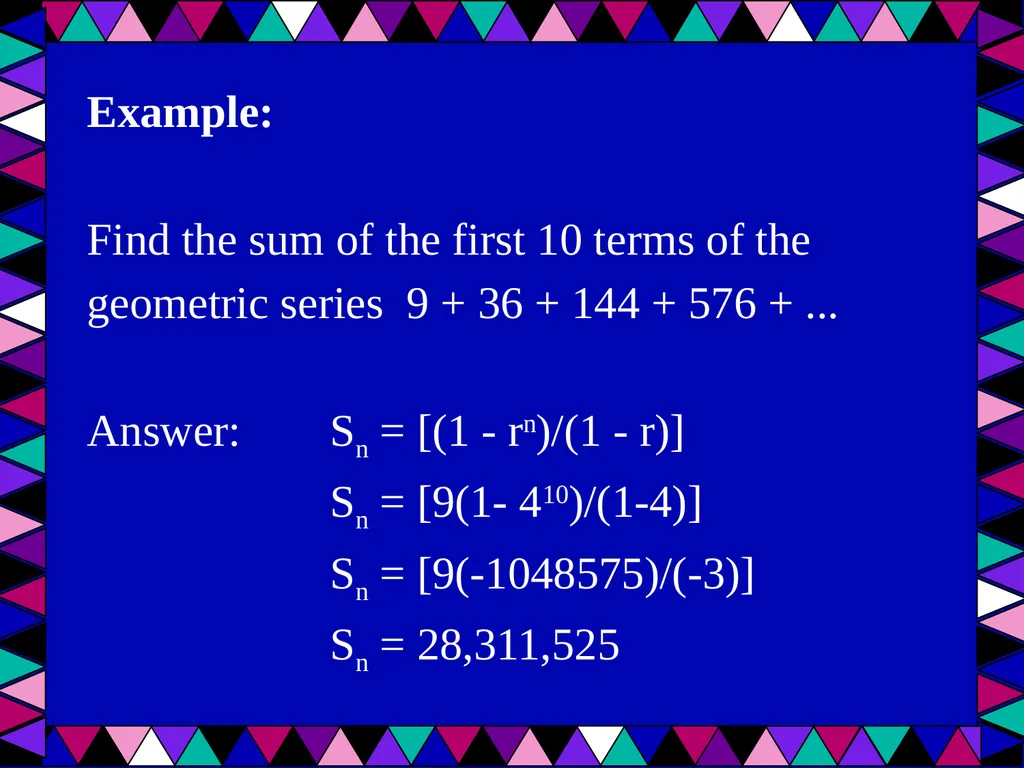
slide20. Example:
Find the sum of the first 10 terms of the
geometric series  9 + 36 + 144 + 576 + ...
Answer: Sn = [(1 - rn)/(1 - r)]
Sn = [9(1- 410)/(1-4)]
Sn = [9(-1048575)/(-3)]
Sn = 28,311,525<br>
slide21. Example:
Find the sum of the first 10 terms of the
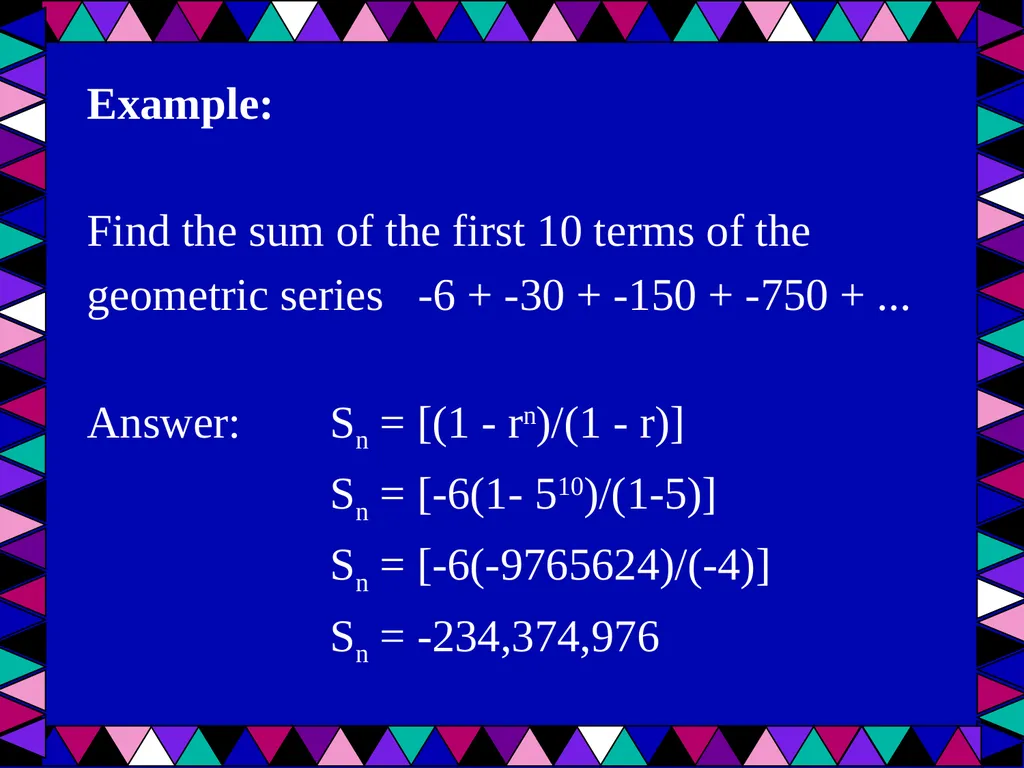
geometric series  -6 + -30 + -150 + -750 + ...
Answer: Sn = [(1 - rn)/(1 - r)]
Sn = [-6(1- 510)/(1-5)]
Sn = [-6(-9765624)/(-4)]
Sn = -234,374,976<br>
slide22. Example:
Find the sum of the first 10 terms of the
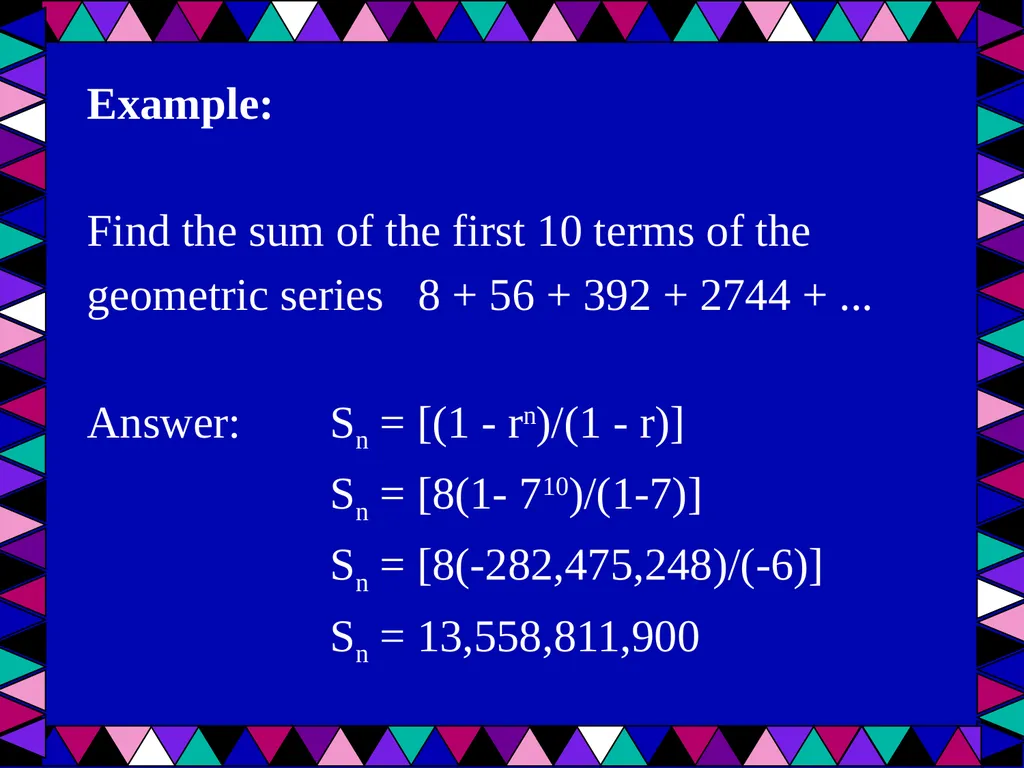
geometric series  8 + 56 + 392 + 2744 + ...
Answer: Sn = [(1 - rn)/(1 - r)]
Sn = [8(1- 710)/(1-7)]
Sn = [8(-282,475,248)/(-6)]
Sn = 13,558,811,900<br>
slide23. Example:
Find the sum of the first 10 terms of the
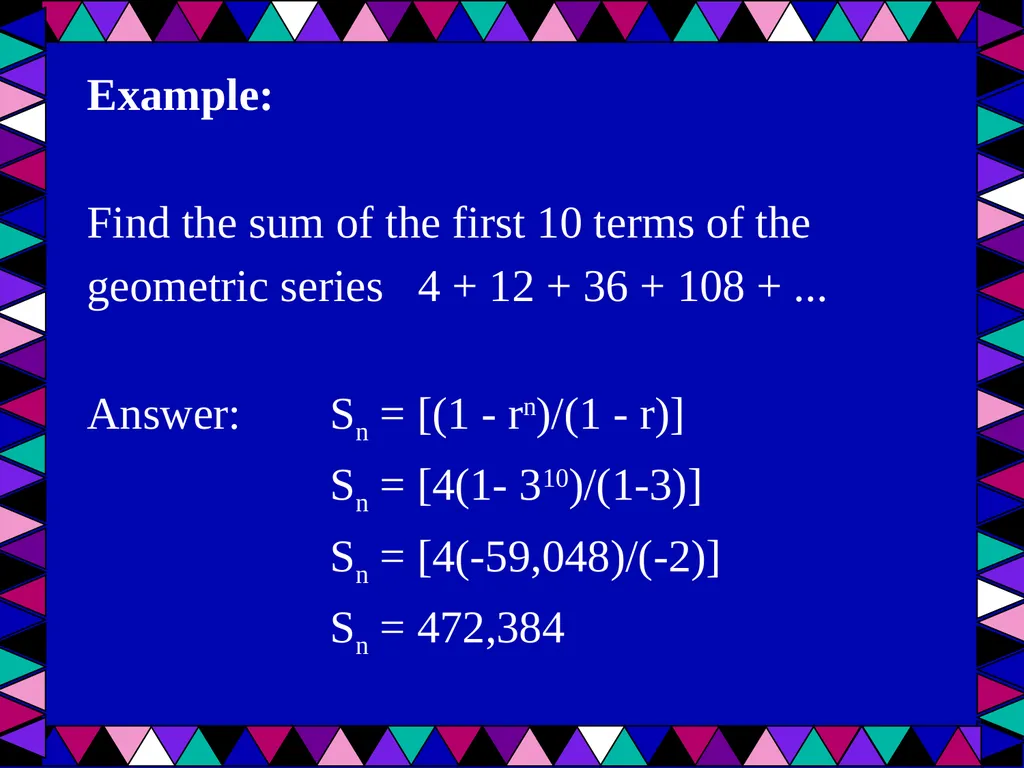
geometric series  4 + 12 + 36 + 108 + ...
Answer: Sn = [(1 - rn)/(1 - r)]
Sn = [4(1- 310)/(1-3)]
Sn = [4(-59,048)/(-2)]
Sn = 472,384<br>

slide2. Definitions Definitions:Â (yes, that's right, this is important, know these!)
A sequence is a set of numbers, called terms, arranged in some particular order.
An arithmetic sequence is a sequence with the difference between two consecutive terms constant. The difference is called the common difference. ( isn't that clever!)
A geometric sequence is a sequence with a common ratio, r. (cleverness two!)
i.e. The ratio of successive terms in a geometric sequence is a constant called the common ratio, denoted r.<br>
slide3. Examples: Find the common ratio of the following:
1) 1, 2, 4, 8, 16, ...
r = 2
2) 27, 9, 3, 1, 1/3, ...
r = 1/3
3) 3, 6, 12, 24, 48, ...
r = 2
4) 1/2, -1, 2, -4, 8, ...
r = -2<br>
slide4. Examples: Find the next term in each of the previous sequences. 1) 1, 2, 4, 8, 16, ...
32
2) 27, 9, 3, 1, 1/3, ...
1/9
3) 3, 6, 12, 24, 48, ...
96
4) 1/2, -1, 2, -4, 8, ...
-16<br>
slide5. Let's play guess the sequence!: I give you a
sequence and you guess the type.Â
3, 8, 13, 18, 23, . . . Â
1, 2, 4, 8, 16, . . .
24, 12, 6, 3, 3/2, 3/4, . . .Â
55, 51, 47, 43, 39, 35, . . .
2, 5, 10, 17, . . . Â
1, 4, 9, 16, 25, 36, . . .<br>
slide6. Answers! 1) Arithmetic, the common difference d = 5
2) Geometric, the common ratio r = 2
3) Geometric, r = 1/2
4) Arithmetic, d = -4
5) Neither, why? (How about no common difference or ratio!)
6) Neither again! (This looks familiar, could it be from geometry?)<br>
slide7. This is important! Arithmetic formula:Â Â Â Â Â Â
an = a1 + (n - 1)d
an is the nth term, a1 is the first term, and d is the common difference.
Geometric formula:Â Â Â Â Â Â Â Â Â Â
an = a1 . r (n - 1)
an is the nth term, a1 is the first term, and r is the common ratio.<br>
slide8. Sample problems: Find the first four terms and state whether the sequence is arithmetic, geometric, or neither.
1)Â an = 3n + 2Â Â Â
2) an = n2 + 1Â Â
3)Â an = 3*2n<br>
slide9. Answers: 1)Â an = 3n + 2Â Â
To find the first four terms, in a row, replace n with 1, then 2, then 3 and 4
Answer: 5, 8, 11, 14Â Â Â Â Â Â Â Â Â
The sequence is arithmetic! d = 3<br>
slide10. 2) an = n2 + 1
To find the first four terms, do the same as above!
Answer:Â 2, 5, 10, 17Â Â Â Â Â Â Â Â Â
The sequence is neither. Why?<br>
slide11. 3)Â an = 3*2nÂ
Ditto for this one ( got it by now?)
Answer:Â 6, 12, 24, 48Â Â Â Â Â Â Â Â
The sequence is geometric with r = 2<br>
slide12. Find a formula for each sequence.
1)Â 2, 5, 8, 11, 14, . . .
Work: It is arithmetic! So use the arithmetic formula you learned! a1 = 2, look at the first number in the sequence! d = 3, look at the common difference!
Therefore, an = 2 + (n - 1)3 and simplifying yields :Â an = 3n -1 ( tada!)
Try putting in 1, then 2, then 3, etc. and you will get the sequence!<br>
slide13. 2) 4, 8, 16, 32, . . .
Work: It is geometric! So use the geometric formula you learned up yonder! a1 = 4, look at the first number in the sequence! r = 2, look at the common ratio! Therefore,Â
an = 4 * 2 (n - 1) and simplifying gives us:
an = 2 * 2n (Yikes stripes! Where did this come from. rewrite 2(n - 1) as 2n . 2- 1 and cancel with the four!)
Try putting in 1, 2, 3, etc and see if you get the sequence back!<br>
slide14. 3)Â 21, 201, 2001, 20001, . . .
Work: Bummer! It's not geometric or arithmetic. What do I do now?  Don't panic! Use your head and think!
Think of the sequence as (20 +1), (200+1), (2000 + 1), (20000 + 1), . . .
Then as this sequence:[(2)(10) +1],[(2)(100) +1], [(2)(1000) +1], [(2)(10000) +1]
Wait! Hold on here! I see a pattern! Cool, without a formula! Powers of 10!
How does this grab ya! an = 2*10n + 1 Does this work? Try it and see!<br>
slide15. Find the indicated term of the sequence.
1) sequence is arithmetic with t1 = 5 and t7 = 29.  Find t53
Work: Use the formula!   29 = 5 + 6d
Where oh where did I get that! Substitution! Â Â Â Â Â Â Â Â Â Â Â Â Â Â Â Â Â Â Â Â Â Â Â Â Â Â Â Â Â Â Â Â Â Â Â Â Â Â Â Â Â
24 = 6d  means d = 4 t53 = 5 + 52.4 = 213<br>
slide16. 2) Find the number of multiples of 9 between 30 and 901.
Work: What's the first multiple of 9 in the range? How about 36.
   What's the last multiple of 9 in the range? How about 900.    Â
Use the formula:Â 900 = 36 + 9(n - 1) and solve for n!
                                864 = 9n - 9
                                873 = 9n
                                  97 = n There are 97 multiples in the range!<br>
slide17. How to find the sum of a finite Geometric Series Sn =Â a1(1 - rn)/(1 - r)
where r is the common ratio and          Â
(r doesn't = 0)
To find the sum of a finite geometric series, you need to know three things:Â the first term, how many terms to add and the common ratio!! (piece of cake!)<br>
slide18. Definition
geometric series - the expression formed by adding the terms of a geometric sequence.
Finding the Sum of the First n Terms of a Geometric Sequence.
Use Sn = [a1(1 - rn)/(1 - r)], Sn is the sum of the first n terms.
Substitute the n, a, and r values into Sn = [a1(1 - rn)/(1 - r)].
Simplify to find the sum.<br>
slide19. Example problem: Find the sum of the first 10 terms of the geometric series: 4, 8, 16, 32, 64, . . .
Answer:Â Â Â Â Â t1 = 4
r = 2 t10 = 4 . 29 = 2048 (This is the formula for a geometric sequence!)
Therefore:Â Sn = [a1(1 - rn)/(1 - r)],
S10 = 4(1-210)/(1 - 2) = 4 . 1023 = 4092<br>
slide20. Example:
Find the sum of the first 10 terms of the
geometric series  9 + 36 + 144 + 576 + ...
Answer: Sn = [(1 - rn)/(1 - r)]
Sn = [9(1- 410)/(1-4)]
Sn = [9(-1048575)/(-3)]
Sn = 28,311,525<br>
slide21. Example:
Find the sum of the first 10 terms of the
geometric series  -6 + -30 + -150 + -750 + ...
Answer: Sn = [(1 - rn)/(1 - r)]
Sn = [-6(1- 510)/(1-5)]
Sn = [-6(-9765624)/(-4)]
Sn = -234,374,976<br>
slide22. Example:
Find the sum of the first 10 terms of the
geometric series  8 + 56 + 392 + 2744 + ...
Answer: Sn = [(1 - rn)/(1 - r)]
Sn = [8(1- 710)/(1-7)]
Sn = [8(-282,475,248)/(-6)]
Sn = 13,558,811,900<br>
slide23. Example:
Find the sum of the first 10 terms of the
geometric series  4 + 12 + 36 + 108 + ...
Answer: Sn = [(1 - rn)/(1 - r)]
Sn = [4(1- 310)/(1-3)]
Sn = [4(-59,048)/(-2)]
Sn = 472,384<br>