
Getting Started – An Overview of the Standards
NS
Published · 44 slides · 0 views

1 / 1
Description
Getting Started An Overview of the Standards Writing Process, Version 2 Intended Audience PC Chairs and Vice Chairs, but open to everyone Information that you will need is located in the PC Chairs Toolkit at this link:
Related Topics
Share
Embed code
Download this presentation From Below
"Getting Started – An Overview of the Standards" is the property of its rightful owner. Permission is granted to download and print the materials on this website for personal, non-commercial use only, and to display it on your personal computer provided you do not modify the materials and that you retain all copyright notices contained in the materials. By downloading content from our website, you accept the terms of this agreement.
Presentation Transcript
01
Getting Started – An Overview of the Standards Writing Process, Version 2 Intended Audience – PC Chairs and Vice Chairs, but open to everyone
Information that you will need is located in the PC Chairs Toolkit at this link: www.ashrae.org/pcchairstoolkit PC Chairs Training: Getting Started Version 2 1<br>
Information that you will need is located in the PC Chairs Toolkit at this link: www.ashrae.org/pcchairstoolkit PC Chairs Training: Getting Started Version 2 1<br>
02
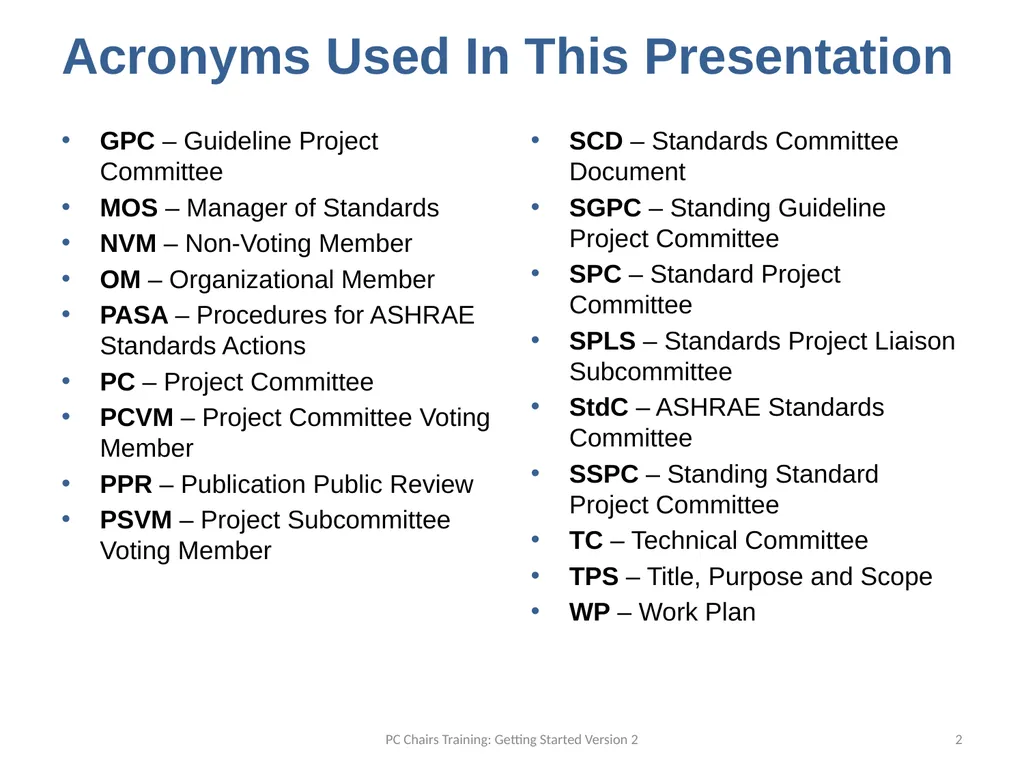
Acronyms Used In This Presentation GPC – Guideline Project Committee
MOS – Manager of Standards
NVM – Non-Voting Member
OM – Organizational Member
PASA – Procedures for ASHRAE Standards Actions
PC – Project Committee
PCVM – Project Committee Voting Member
PPR – Publication Public Review
PSVM – Project Subcommittee Voting Member SCD – Standards Committee Document
SGPC – Standing Guideline Project Committee
SPC – Standard Project Committee
SPLS – Standards Project Liaison Subcommittee
StdC – ASHRAE Standards Committee
SSPC – Standing Standard Project Committee
TC – Technical Committee
TPS – Title, Purpose and Scope
WP – Work Plan 2 PC Chairs Training: Getting Started Version 2<br>
MOS – Manager of Standards
NVM – Non-Voting Member
OM – Organizational Member
PASA – Procedures for ASHRAE Standards Actions
PC – Project Committee
PCVM – Project Committee Voting Member
PPR – Publication Public Review
PSVM – Project Subcommittee Voting Member SCD – Standards Committee Document
SGPC – Standing Guideline Project Committee
SPC – Standard Project Committee
SPLS – Standards Project Liaison Subcommittee
StdC – ASHRAE Standards Committee
SSPC – Standing Standard Project Committee
TC – Technical Committee
TPS – Title, Purpose and Scope
WP – Work Plan 2 PC Chairs Training: Getting Started Version 2<br>
03
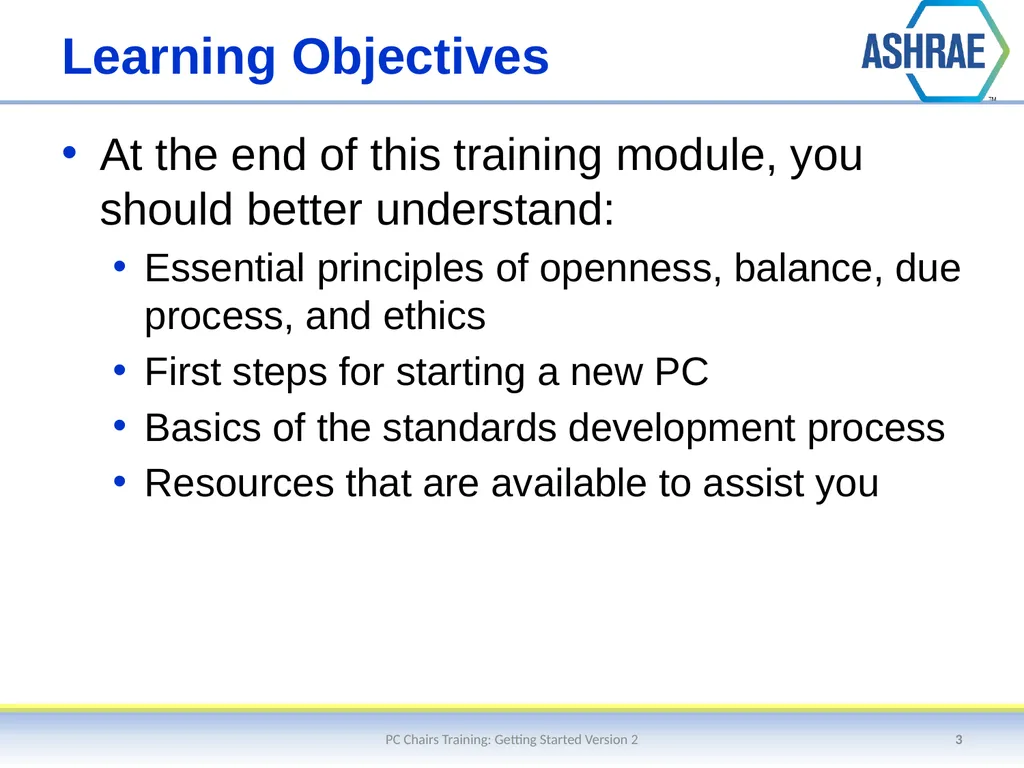
Learning Objectives At the end of this training module, you should better understand:
Essential principles of openness, balance, due process, and ethics
First steps for starting a new PC
Basics of the standards development process
Resources that are available to assist you 3 PC Chairs Training: Getting Started Version 2<br>
Essential principles of openness, balance, due process, and ethics
First steps for starting a new PC
Basics of the standards development process
Resources that are available to assist you 3 PC Chairs Training: Getting Started Version 2<br>
04
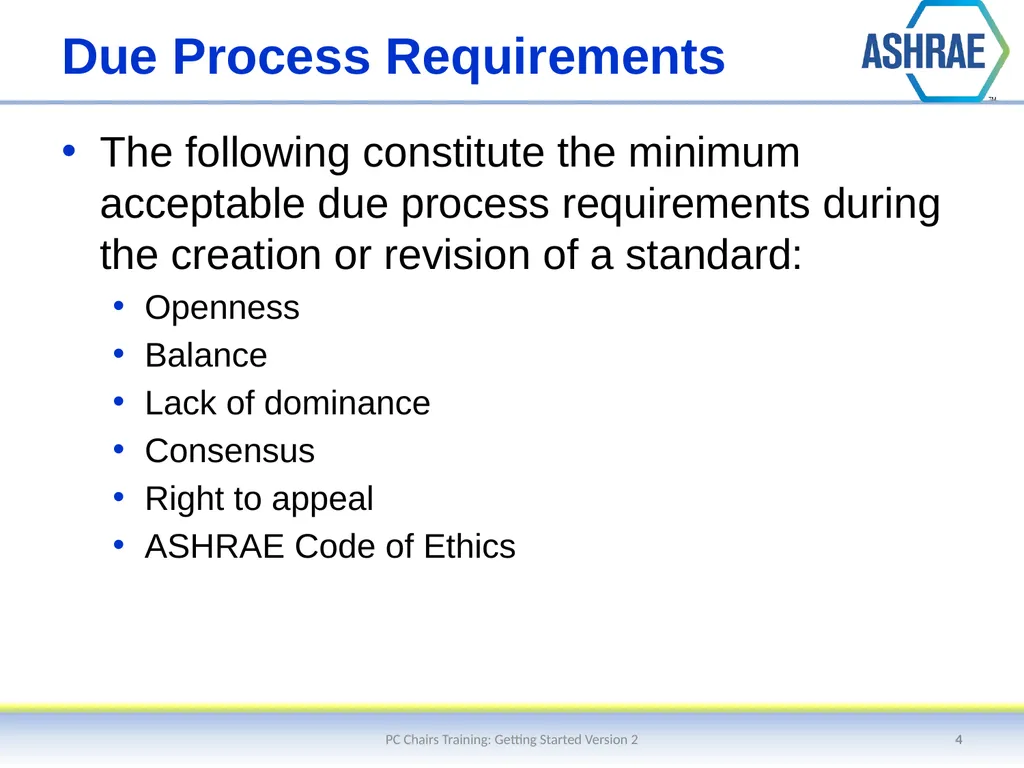
Due Process Requirements The following constitute the minimum acceptable due process requirements during the creation or revision of a standard:
Openness
Balance
Lack of dominance
Consensus
Right to appeal
ASHRAE Code of Ethics PC Chairs Training: Getting Started Version 2 4<br>
Openness
Balance
Lack of dominance
Consensus
Right to appeal
ASHRAE Code of Ethics PC Chairs Training: Getting Started Version 2 4<br>
05
Openness Participation shall be open to all persons who are directly and materially affected by the activity in question:
Participation in a process is not necessarily the same as membership or vote on a committee
Participation can be as simple as submitting a public review comment or a request for interpretation Tip: Participants can include non-ASHRAE members, non-voting members (NVMs), consultants, and International Organizational Liaisons 5 PC Chairs Training: Getting Started Version 2<br>
Participation in a process is not necessarily the same as membership or vote on a committee
Participation can be as simple as submitting a public review comment or a request for interpretation Tip: Participants can include non-ASHRAE members, non-voting members (NVMs), consultants, and International Organizational Liaisons 5 PC Chairs Training: Getting Started Version 2<br>
06
Balance The objective of balance is to ensure that all stakeholders (directly and materially affected interests) related to a TPS are represented on a PC
The criteria for balance is that no single interest category equals more than one-third of voting membership on a PC dealing with safety, and no more than half of voting membership on a PC for all other standards
SPCs and SSPCs must achieve and maintain balance
Balance on GPCs, SGPCs, and all subcommittees is desired but is not required PC Chairs Training: Getting Started Version 2 6<br>
The criteria for balance is that no single interest category equals more than one-third of voting membership on a PC dealing with safety, and no more than half of voting membership on a PC for all other standards
SPCs and SSPCs must achieve and maintain balance
Balance on GPCs, SGPCs, and all subcommittees is desired but is not required PC Chairs Training: Getting Started Version 2 6<br>
07
Balance and Interest Categories ASHRAE’s fundamental principles for guiding the identification and selection of interest categories for any PC align with ANSI Essential Requirements on balance:
The interest categories appropriate to the development of consensus in any given standards activity are a function of the nature of the standard being developed.
Interest categories shall be discretely defined, cover all materially affected parties and differentiate each category from the other categories. 7 PC Chairs Training: Getting Started Version 2<br>
The interest categories appropriate to the development of consensus in any given standards activity are a function of the nature of the standard being developed.
Interest categories shall be discretely defined, cover all materially affected parties and differentiate each category from the other categories. 7 PC Chairs Training: Getting Started Version 2<br>
08
Balance and Interest Categories In defining the interest categories appropriate to a standards activity, consideration shall be given to at least the following categories:
Producer
User
General
Where appropriate, additional interest categories* should be considered where needed to ensure consensus of directly affected and interested parties related to a particular TPS.
Appropriate representative user views shall be actively sought and fully considered in standards activities.
* See “Approved Interest Categories” under the Membership Forms heading on the PC Chairs Toolkit page 8 PC Chairs Training: Getting Started Version 2<br>
Producer
User
General
Where appropriate, additional interest categories* should be considered where needed to ensure consensus of directly affected and interested parties related to a particular TPS.
Appropriate representative user views shall be actively sought and fully considered in standards activities.
* See “Approved Interest Categories” under the Membership Forms heading on the PC Chairs Toolkit page 8 PC Chairs Training: Getting Started Version 2<br>
09
Lack of Dominance The standards development process shall not be dominated by any single interest category, individual or organization.
Dominance means a position or exercise of dominant authority, leadership, or influence by reason of superior leverage, strength, or representation to the exclusion of fair and equitable consideration of other viewpoints. 9 PC Chairs Training: Getting Started Version 2<br>
Dominance means a position or exercise of dominant authority, leadership, or influence by reason of superior leverage, strength, or representation to the exclusion of fair and equitable consideration of other viewpoints. 9 PC Chairs Training: Getting Started Version 2<br>
10
Balance vs. Dominance Balance and a lack of dominance are two distinct considerations:
The existence of a balanced consensus body does not preclude the exercise of dominance.
Similarly, the existence of a less than perfectly balanced consensus body does not necessarily reflect a process in which dominance automatically occurs.
Balance is quantifiable, dominance is not: work with your SPLS Liaison if there is any indication of dominance in your committee. 10 PC Chairs Training: Getting Started Version 2<br>
The existence of a balanced consensus body does not preclude the exercise of dominance.
Similarly, the existence of a less than perfectly balanced consensus body does not necessarily reflect a process in which dominance automatically occurs.
Balance is quantifiable, dominance is not: work with your SPLS Liaison if there is any indication of dominance in your committee. 10 PC Chairs Training: Getting Started Version 2<br>
11
Consensus Consensus defined: Substantial agreement, in the judgment of a duly appointed authority, reached by directly and materially affected interest categories
Substantial agreement means more than a simple majority but not necessarily unanimity
Consensus requires that all views and objections be considered, and that a concerted effort be made toward their resolution 11 PC Chairs Training: Getting Started Version 2<br>
Substantial agreement means more than a simple majority but not necessarily unanimity
Consensus requires that all views and objections be considered, and that a concerted effort be made toward their resolution 11 PC Chairs Training: Getting Started Version 2<br>
12
Other Due Process Requirements Consideration of views and objections:
Prompt consideration shall be given to the written views and objections of all participants, including PC members and those commenting on the TPS or a draft standard
Consensus votes for Standards Actions:
Evidence of consensus shall be documented and requires a “supermajority” 2/3 vote
Appeals:
The impartial handling of procedural appeals regarding any action or inaction. Procedural appeals include whether a technical issue was afforded due process. 12 PC Chairs Training: Getting Started Version 2<br>
Prompt consideration shall be given to the written views and objections of all participants, including PC members and those commenting on the TPS or a draft standard
Consensus votes for Standards Actions:
Evidence of consensus shall be documented and requires a “supermajority” 2/3 vote
Appeals:
The impartial handling of procedural appeals regarding any action or inaction. Procedural appeals include whether a technical issue was afforded due process. 12 PC Chairs Training: Getting Started Version 2<br>
13
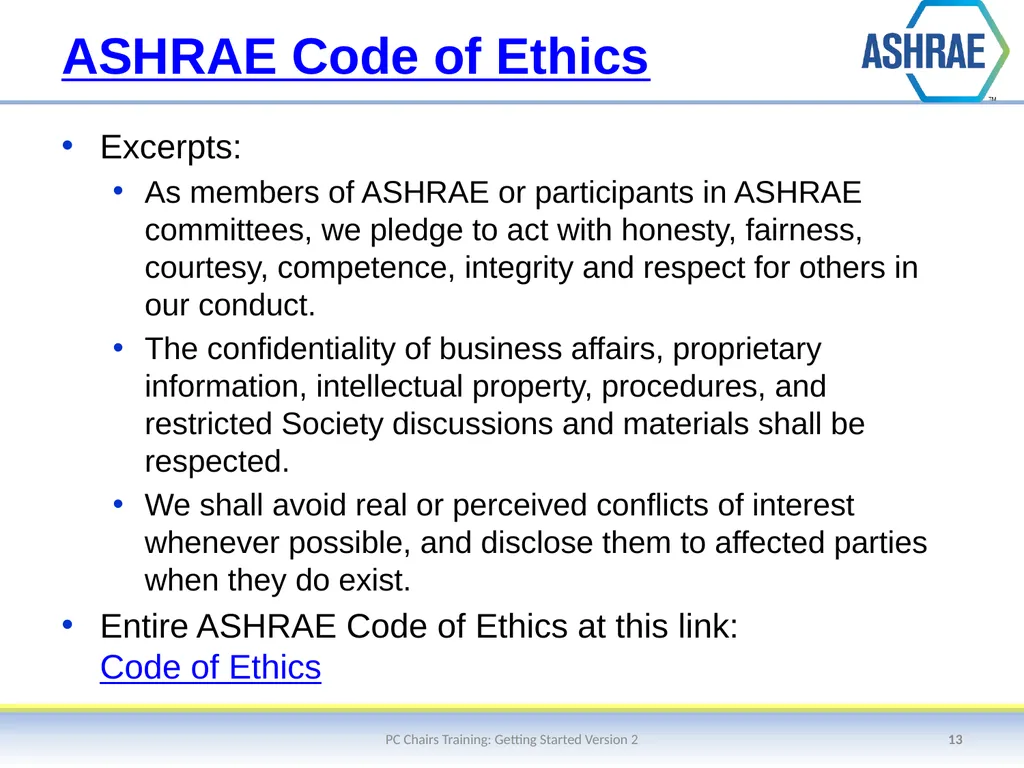
ASHRAE Code of Ethics Excerpts:
As members of ASHRAE or participants in ASHRAE committees, we pledge to act with honesty, fairness, courtesy, competence, integrity and respect for others in our conduct.
The confidentiality of business affairs, proprietary information, intellectual property, procedures, and restricted Society discussions and materials shall be respected.
We shall avoid real or perceived conflicts of interest whenever possible, and disclose them to affected parties when they do exist.
Entire ASHRAE Code of Ethics at this link: Code of Ethics 13 PC Chairs Training: Getting Started Version 2<br>
As members of ASHRAE or participants in ASHRAE committees, we pledge to act with honesty, fairness, courtesy, competence, integrity and respect for others in our conduct.
The confidentiality of business affairs, proprietary information, intellectual property, procedures, and restricted Society discussions and materials shall be respected.
We shall avoid real or perceived conflicts of interest whenever possible, and disclose them to affected parties when they do exist.
Entire ASHRAE Code of Ethics at this link: Code of Ethics 13 PC Chairs Training: Getting Started Version 2<br>
14
First Steps This section will help you understand what you need to do to get the PC started PC Chairs Training: Getting Started Version 2 14<br>
15
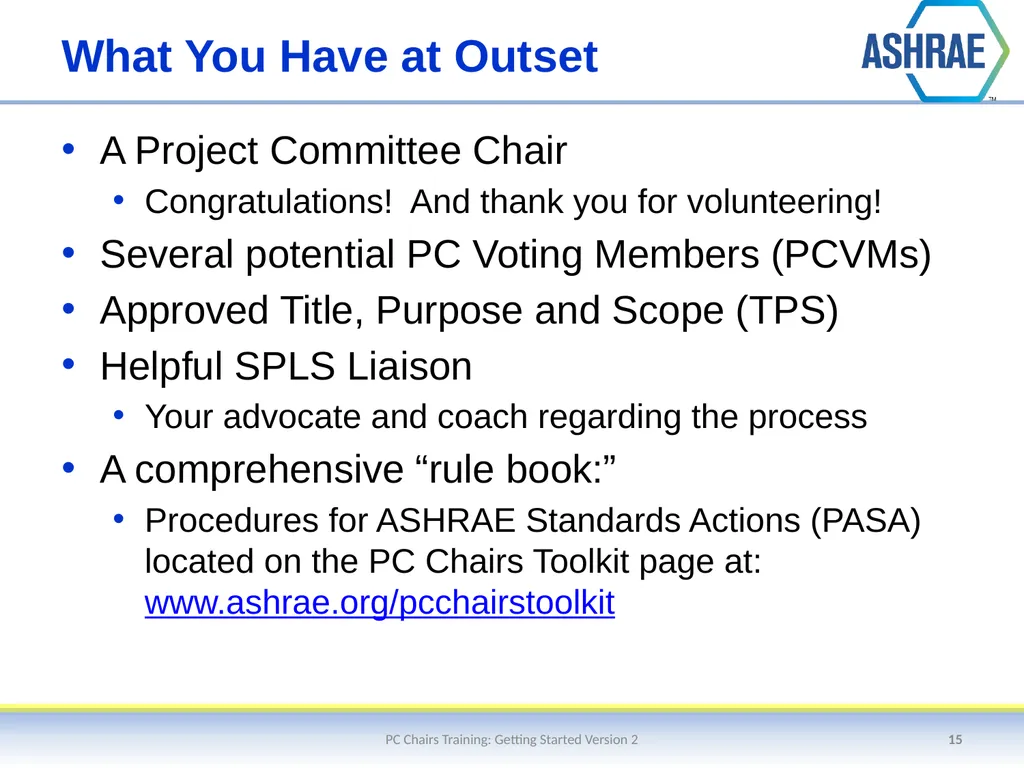
What You Have at Outset A Project Committee Chair
Congratulations! And thank you for volunteering!
Several potential PC Voting Members (PCVMs)
Approved Title, Purpose and Scope (TPS)
Helpful SPLS Liaison
Your advocate and coach regarding the process
A comprehensive “rule book:”
Procedures for ASHRAE Standards Actions (PASA) located on the PC Chairs Toolkit page at: www.ashrae.org/pcchairstoolkit 15 PC Chairs Training: Getting Started Version 2<br>
Congratulations! And thank you for volunteering!
Several potential PC Voting Members (PCVMs)
Approved Title, Purpose and Scope (TPS)
Helpful SPLS Liaison
Your advocate and coach regarding the process
A comprehensive “rule book:”
Procedures for ASHRAE Standards Actions (PASA) located on the PC Chairs Toolkit page at: www.ashrae.org/pcchairstoolkit 15 PC Chairs Training: Getting Started Version 2<br>
16
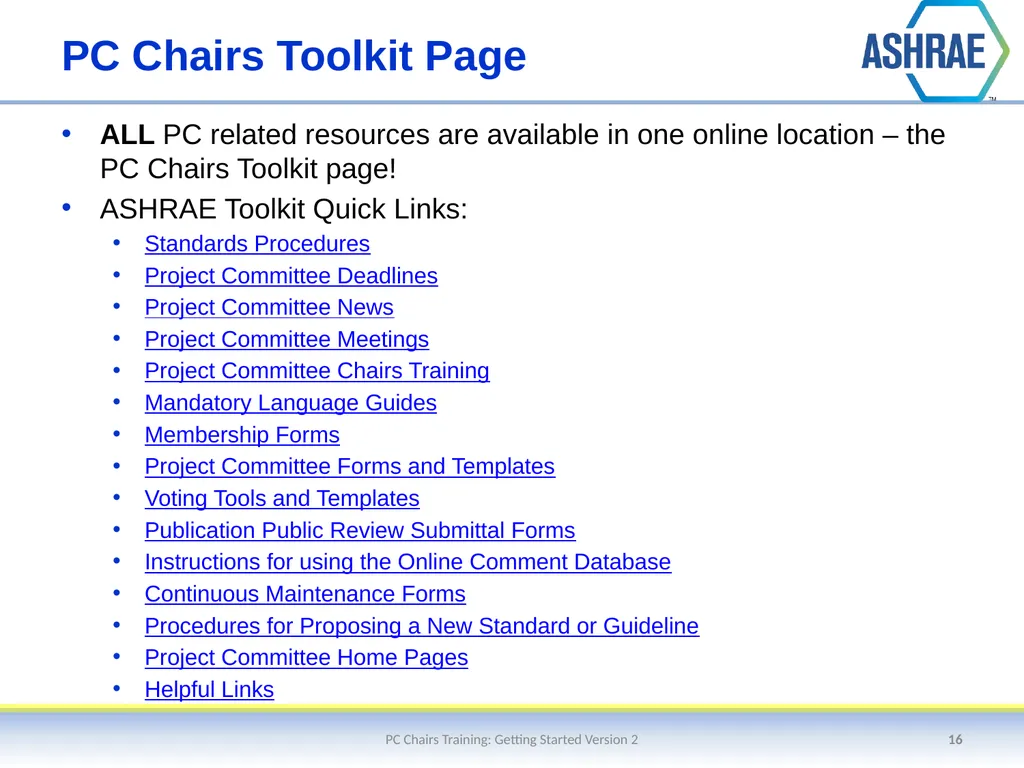
PC Chairs Toolkit Page ALL PC related resources are available in one online location – the PC Chairs Toolkit page!
ASHRAE Toolkit Quick Links:
Standards Procedures
Project Committee Deadlines
Project Committee News
Project Committee Meetings
Project Committee Chairs Training
Mandatory Language Guides
Membership Forms
Project Committee Forms and Templates
Voting Tools and Templates
Publication Public Review Submittal Forms
Instructions for using the Online Comment Database
Continuous Maintenance Forms
Procedures for Proposing a New Standard or Guideline
Project Committee Home Pages
Helpful Links 16 PC Chairs Training: Getting Started Version 2<br>
ASHRAE Toolkit Quick Links:
Standards Procedures
Project Committee Deadlines
Project Committee News
Project Committee Meetings
Project Committee Chairs Training
Mandatory Language Guides
Membership Forms
Project Committee Forms and Templates
Voting Tools and Templates
Publication Public Review Submittal Forms
Instructions for using the Online Comment Database
Continuous Maintenance Forms
Procedures for Proposing a New Standard or Guideline
Project Committee Home Pages
Helpful Links 16 PC Chairs Training: Getting Started Version 2<br>
17
Membership In addition to yourself, request your potential committee members to complete a PC Membership Application form, Bias and Conflict of Interest statement and ASHRAE bio (complete online)
ASHRAE Staff will process all applications and then send you information
You will then completed and submit a Chair's Recommendation Form to your SPLS Liaison and to ASHRAE staff
Remember:
Only one Voting Member (VM) from any organization at anytime.
At least one member in each of the default interest categories listed below, or other approved interest categories for your PC
Producer
User
General
Minimum of 5 VMs before any official business or standards action vote can occur.
SPC/SSPC balance must be achieved before any standards action votes can occur. 17 PC Chairs Training: Getting Started Version 2<br>
ASHRAE Staff will process all applications and then send you information
You will then completed and submit a Chair's Recommendation Form to your SPLS Liaison and to ASHRAE staff
Remember:
Only one Voting Member (VM) from any organization at anytime.
At least one member in each of the default interest categories listed below, or other approved interest categories for your PC
Producer
User
General
Minimum of 5 VMs before any official business or standards action vote can occur.
SPC/SSPC balance must be achieved before any standards action votes can occur. 17 PC Chairs Training: Getting Started Version 2<br>
18
First PC Meeting Schedule PC meeting:
At the next Society Meeting using the SPC Meeting Request Form found on the PC Chairs Toolkit page or the ASHRAE Conference page
Get started as soon as possible!
Prepare an agenda using the sample agenda templates found on the PC Chairs Toolkit page
Distribute agenda 30 days prior to meeting
Attend the PC Chairs’ Breakfast at each Society Meeting (this is a requirement)
Distribute minutes to PC members, your SPLS liaison and ASHRAE staff (required). A minutes template can be found on the PC Chairs Toolkit page.
The earlier the better!
Distribute action items immediately 18 PC Chairs Training: Getting Started Version 2<br>
At the next Society Meeting using the SPC Meeting Request Form found on the PC Chairs Toolkit page or the ASHRAE Conference page
Get started as soon as possible!
Prepare an agenda using the sample agenda templates found on the PC Chairs Toolkit page
Distribute agenda 30 days prior to meeting
Attend the PC Chairs’ Breakfast at each Society Meeting (this is a requirement)
Distribute minutes to PC members, your SPLS liaison and ASHRAE staff (required). A minutes template can be found on the PC Chairs Toolkit page.
The earlier the better!
Distribute action items immediately 18 PC Chairs Training: Getting Started Version 2<br>
19
Work Plan (WP) Establish milestones and estimate completion dates on the Work Plan form found on the PC Chairs Toolkit page
Major project milestones on the WP should include:
Completion of initial PC membership roster
First PC meeting
Completion of first working draft
PC approval for public review
PC approval of responses to public review comments (if any)
PC vote for publication
Discuss your draft WP with your SPLS Liaison, and then submit WP to ASHRAE staff for SPLS approval 19 PC Chairs Training: Getting Started Version 2<br>
Major project milestones on the WP should include:
Completion of initial PC membership roster
First PC meeting
Completion of first working draft
PC approval for public review
PC approval of responses to public review comments (if any)
PC vote for publication
Discuss your draft WP with your SPLS Liaison, and then submit WP to ASHRAE staff for SPLS approval 19 PC Chairs Training: Getting Started Version 2<br>
20
Title, Purpose & Scope (TPS) The TPS is the framework for a Standard or Guideline
A PC must approved the TPS at its first official meeting
If changes are needed, use the Proposed TPS Form found on the Toolkit page, and include:
Rationale for changes
Underscore/strikeout to show changes to original version
A clean, final version of the proposed TPS
PC vote tally to recommend approval
Any change to the TPS must be approved prior to submission of a Publication Public Review draft
Submit document to SPLS Liaison and MOS 20 PC Chairs Training: Getting Started Version 2<br>
A PC must approved the TPS at its first official meeting
If changes are needed, use the Proposed TPS Form found on the Toolkit page, and include:
Rationale for changes
Underscore/strikeout to show changes to original version
A clean, final version of the proposed TPS
PC vote tally to recommend approval
Any change to the TPS must be approved prior to submission of a Publication Public Review draft
Submit document to SPLS Liaison and MOS 20 PC Chairs Training: Getting Started Version 2<br>
21
Working Draft For new standard/guideline, Staff will send you working draft template
Work with PC to create initial Working Draft
For revision standard/guideline, Staff will send you an editable version of currently-published standard/guideline
Save backup copy of original document
Work with PC to revise original document
Update the working draft number and date each time you share a working draft with your PC
Archive previous versions for future reference
ASHRAE copyright language included on the cover of the working draft template prohibits PC member sharing a working draft, in whole or in part, outside of the PC without the express permission of the MOS. 21 PC Chairs Training: Getting Started Version 2<br>
Work with PC to create initial Working Draft
For revision standard/guideline, Staff will send you an editable version of currently-published standard/guideline
Save backup copy of original document
Work with PC to revise original document
Update the working draft number and date each time you share a working draft with your PC
Archive previous versions for future reference
ASHRAE copyright language included on the cover of the working draft template prohibits PC member sharing a working draft, in whole or in part, outside of the PC without the express permission of the MOS. 21 PC Chairs Training: Getting Started Version 2<br>
22
Definitions in SCDs Only include definitions that are necessary to apply the standard or guideline, and are not commonly understood
All definitions shall appear somewhere in the body of the standard or guideline (or they shall not be included)
Requirements shall not be included in definitions
ASHRAE Terminology, found at https://www.ashrae.org/resources--publications/free-resources/ashrae-terminology, is a potential resource for definitions
ASHRAE Terminology definitions, with or without subsequent editing, might fit your purposes, but you are not required to use ASHRAE Terminology definitions PC Chairs Training: Getting Started Version 2 22 Tip: Draft the new or revised standard or guideline by focusing on the requirements and other content while making a list of potential definitions instead of consuming PC time to write the definitions at the outset.<br>
All definitions shall appear somewhere in the body of the standard or guideline (or they shall not be included)
Requirements shall not be included in definitions
ASHRAE Terminology, found at https://www.ashrae.org/resources--publications/free-resources/ashrae-terminology, is a potential resource for definitions
ASHRAE Terminology definitions, with or without subsequent editing, might fit your purposes, but you are not required to use ASHRAE Terminology definitions PC Chairs Training: Getting Started Version 2 22 Tip: Draft the new or revised standard or guideline by focusing on the requirements and other content while making a list of potential definitions instead of consuming PC time to write the definitions at the outset.<br>
23
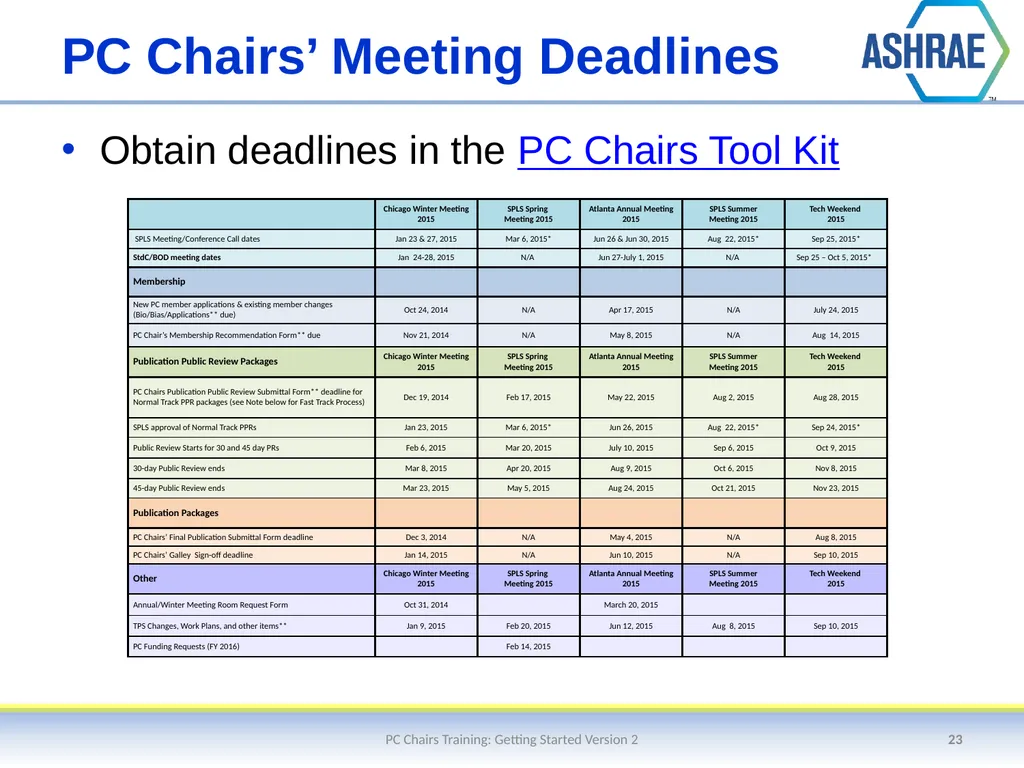
PC Chairs’ Meeting Deadlines Obtain deadlines in the PC Chairs Tool Kit 23 PC Chairs Training: Getting Started Version 2<br>
24
Basics This section will help you understand the basics of the ASHRAE standards development process PC Chairs Training: Getting Started Version 2 24<br>
25
PASA Read PASA – Procedures for ASHRAE Standards Actions
Defines formation, structure, and activities of Project Committees (PCs)
Establishes criteria and procedures for writing and processing Standards Committee Documents (SCDs)
Includes procedures to ensure due process is followed and consensus is achieved 25 PC Chairs Training: Getting Started Version 2<br>
Defines formation, structure, and activities of Project Committees (PCs)
Establishes criteria and procedures for writing and processing Standards Committee Documents (SCDs)
Includes procedures to ensure due process is followed and consensus is achieved 25 PC Chairs Training: Getting Started Version 2<br>
26
Mandatory Language ASHRAE Rules of the Board include these rules:
1.201.004.5 All standards shall be written in definitive mandatory language.
1.201.004.3 Standards that are intended for code use should be concise and written in appropriate code language with simple and direct prescriptive methods for compliance, with alternative performance paths.
1.201.004.6 All guidelines shall be written in informative language.
ASHRAE Guide to Writing Standards in Mandatory Language and the ASHRAE Guide to Writing Standards in Code-Intended Language can be found on the PC Chairs Toolkit page under the heading Mandatory Language Guides PC Chairs Training: Getting Started Version 2 26<br>
1.201.004.5 All standards shall be written in definitive mandatory language.
1.201.004.3 Standards that are intended for code use should be concise and written in appropriate code language with simple and direct prescriptive methods for compliance, with alternative performance paths.
1.201.004.6 All guidelines shall be written in informative language.
ASHRAE Guide to Writing Standards in Mandatory Language and the ASHRAE Guide to Writing Standards in Code-Intended Language can be found on the PC Chairs Toolkit page under the heading Mandatory Language Guides PC Chairs Training: Getting Started Version 2 26<br>
27
Voting Rules Quorum: majority of voting members are present. Without quorum, PC work can continue, but standards action votes cannot be taken
Standards Action: an action recommending or approving publication of a new, revised, or reaffirmed standard or withdrawal of a standard
Except as the actions listed below, PC votes require approval by majority of those voting
The voting actions listed below require (a) affirmative votes from a majority of all PC voting members, and (b) at least two-thirds of those voting, excluding abstentions and unreturned letter ballots
Recommendation for publication public review
Recommendation for publication
Recommendation for issuance or revision of an official interpretation
Use the vote calculations spreadsheet found on the PC Chairs Toolkit page to determine two-thirds vote results 27 PC Chairs Training: Getting Started Version 2<br>
Standards Action: an action recommending or approving publication of a new, revised, or reaffirmed standard or withdrawal of a standard
Except as the actions listed below, PC votes require approval by majority of those voting
The voting actions listed below require (a) affirmative votes from a majority of all PC voting members, and (b) at least two-thirds of those voting, excluding abstentions and unreturned letter ballots
Recommendation for publication public review
Recommendation for publication
Recommendation for issuance or revision of an official interpretation
Use the vote calculations spreadsheet found on the PC Chairs Toolkit page to determine two-thirds vote results 27 PC Chairs Training: Getting Started Version 2<br>
28
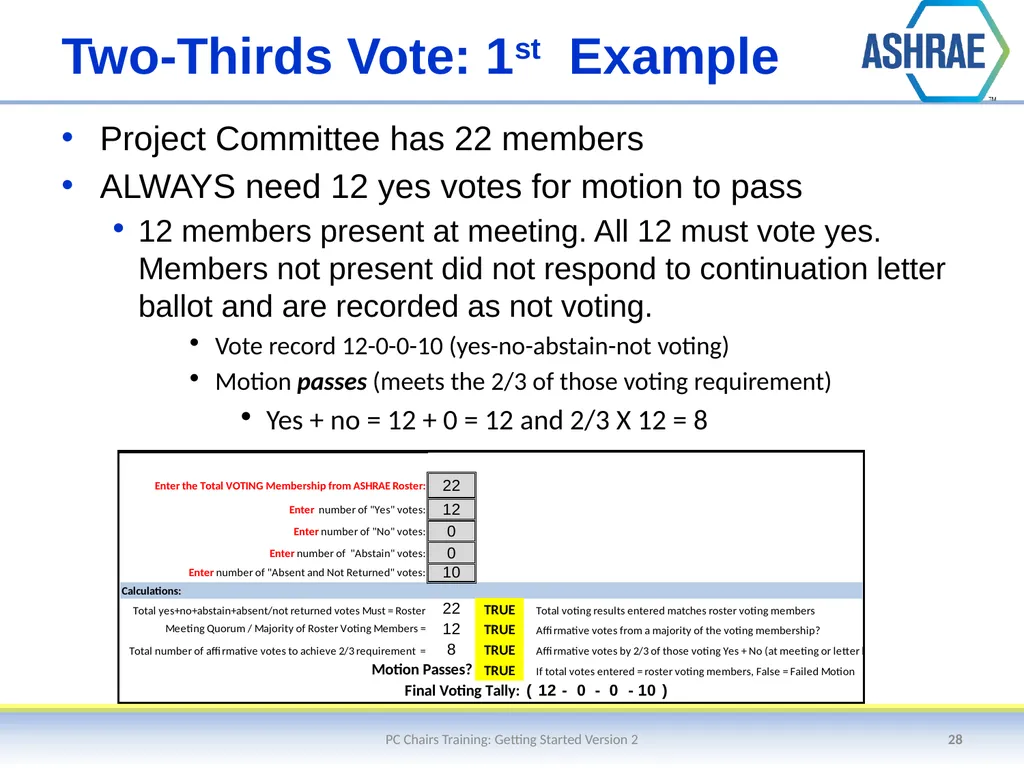
Two-Thirds Vote: 1st Example Project Committee has 22 members
ALWAYS need 12 yes votes for motion to pass
12 members present at meeting. All 12 must vote yes. Members not present did not respond to continuation letter ballot and are recorded as not voting.
Vote record 12-0-0-10 (yes-no-abstain-not voting)
Motion passes (meets the 2/3 of those voting requirement)
Yes + no = 12 + 0 = 12 and 2/3 X 12 = 8 28 PC Chairs Training: Getting Started Version 2<br>
ALWAYS need 12 yes votes for motion to pass
12 members present at meeting. All 12 must vote yes. Members not present did not respond to continuation letter ballot and are recorded as not voting.
Vote record 12-0-0-10 (yes-no-abstain-not voting)
Motion passes (meets the 2/3 of those voting requirement)
Yes + no = 12 + 0 = 12 and 2/3 X 12 = 8 28 PC Chairs Training: Getting Started Version 2<br>
29
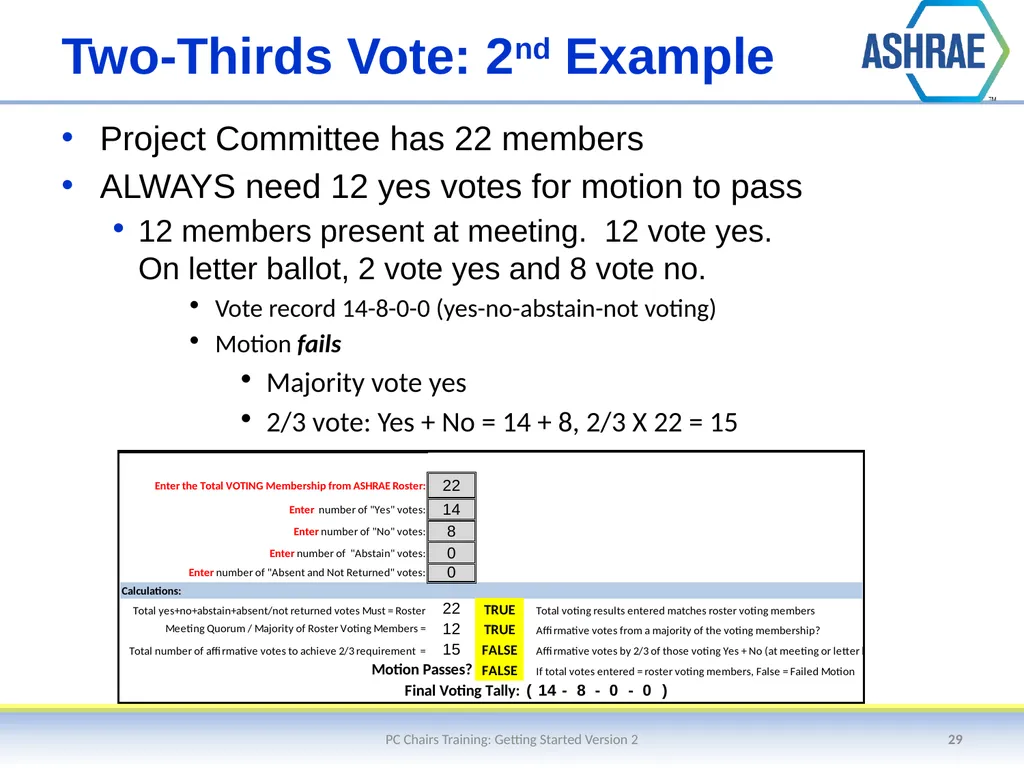
Two-Thirds Vote: 2nd Example Project Committee has 22 members
ALWAYS need 12 yes votes for motion to pass
12 members present at meeting. 12 vote yes. On letter ballot, 2 vote yes and 8 vote no.
Vote record 14-8-0-0 (yes-no-abstain-not voting)
Motion fails
Majority vote yes
2/3 vote: Yes + No = 14 + 8, 2/3 X 22 = 15 29 PC Chairs Training: Getting Started Version 2<br>
ALWAYS need 12 yes votes for motion to pass
12 members present at meeting. 12 vote yes. On letter ballot, 2 vote yes and 8 vote no.
Vote record 14-8-0-0 (yes-no-abstain-not voting)
Motion fails
Majority vote yes
2/3 vote: Yes + No = 14 + 8, 2/3 X 22 = 15 29 PC Chairs Training: Getting Started Version 2<br>
30
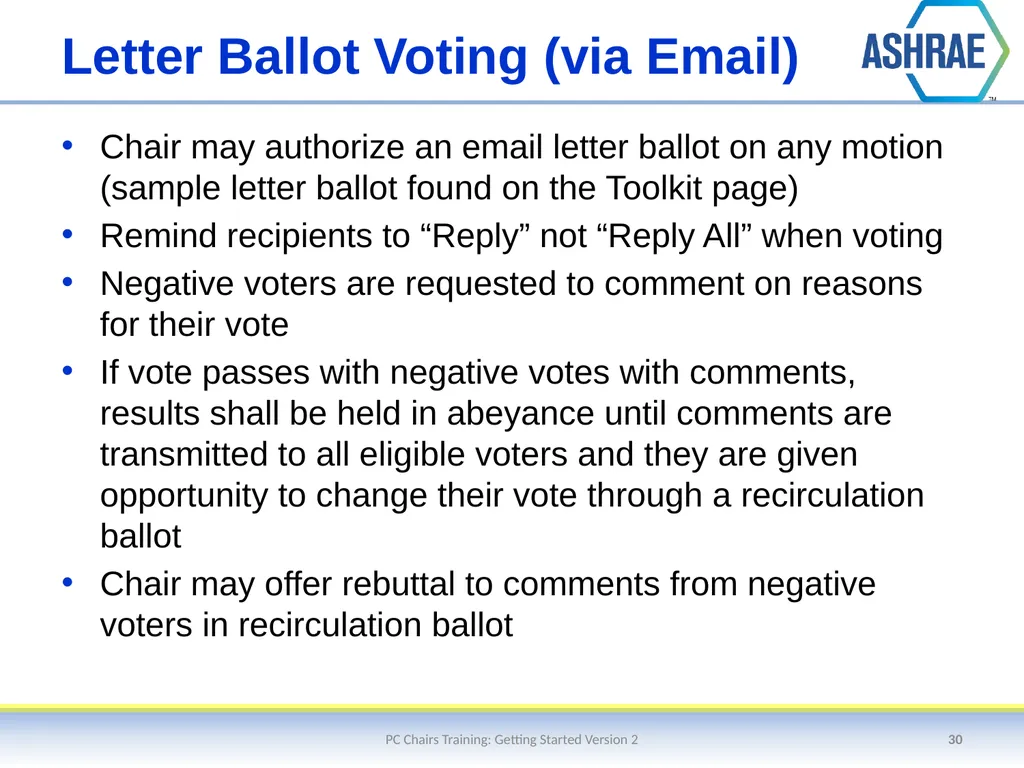
Letter Ballot Voting (via Email) Chair may authorize an email letter ballot on any motion (sample letter ballot found on the Toolkit page)
Remind recipients to “Reply” not “Reply All” when voting
Negative voters are requested to comment on reasons for their vote
If vote passes with negative votes with comments, results shall be held in abeyance until comments are transmitted to all eligible voters and they are given opportunity to change their vote through a recirculation ballot
Chair may offer rebuttal to comments from negative voters in recirculation ballot 30 PC Chairs Training: Getting Started Version 2<br>
Remind recipients to “Reply” not “Reply All” when voting
Negative voters are requested to comment on reasons for their vote
If vote passes with negative votes with comments, results shall be held in abeyance until comments are transmitted to all eligible voters and they are given opportunity to change their vote through a recirculation ballot
Chair may offer rebuttal to comments from negative voters in recirculation ballot 30 PC Chairs Training: Getting Started Version 2<br>
31
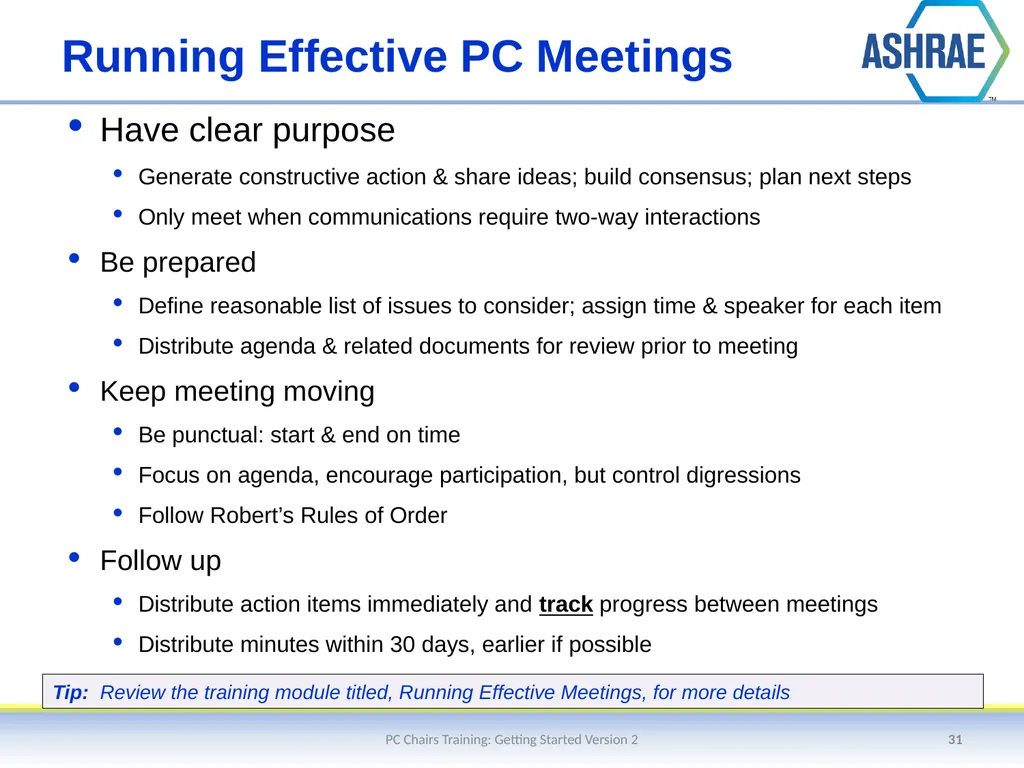
Running Effective PC Meetings Have clear purpose
Generate constructive action & share ideas; build consensus; plan next steps
Only meet when communications require two-way interactions
Be prepared
Define reasonable list of issues to consider; assign time & speaker for each item
Distribute agenda & related documents for review prior to meeting
Keep meeting moving
Be punctual: start & end on time
Focus on agenda, encourage participation, but control digressions
Follow Robert’s Rules of Order
Follow up
Distribute action items immediately and track progress between meetings
Distribute minutes within 30 days, earlier if possible 31 PC Chairs Training: Getting Started Version 2 Tip: Review the training module titled, Running Effective Meetings, for more details<br>
Generate constructive action & share ideas; build consensus; plan next steps
Only meet when communications require two-way interactions
Be prepared
Define reasonable list of issues to consider; assign time & speaker for each item
Distribute agenda & related documents for review prior to meeting
Keep meeting moving
Be punctual: start & end on time
Focus on agenda, encourage participation, but control digressions
Follow Robert’s Rules of Order
Follow up
Distribute action items immediately and track progress between meetings
Distribute minutes within 30 days, earlier if possible 31 PC Chairs Training: Getting Started Version 2 Tip: Review the training module titled, Running Effective Meetings, for more details<br>
32
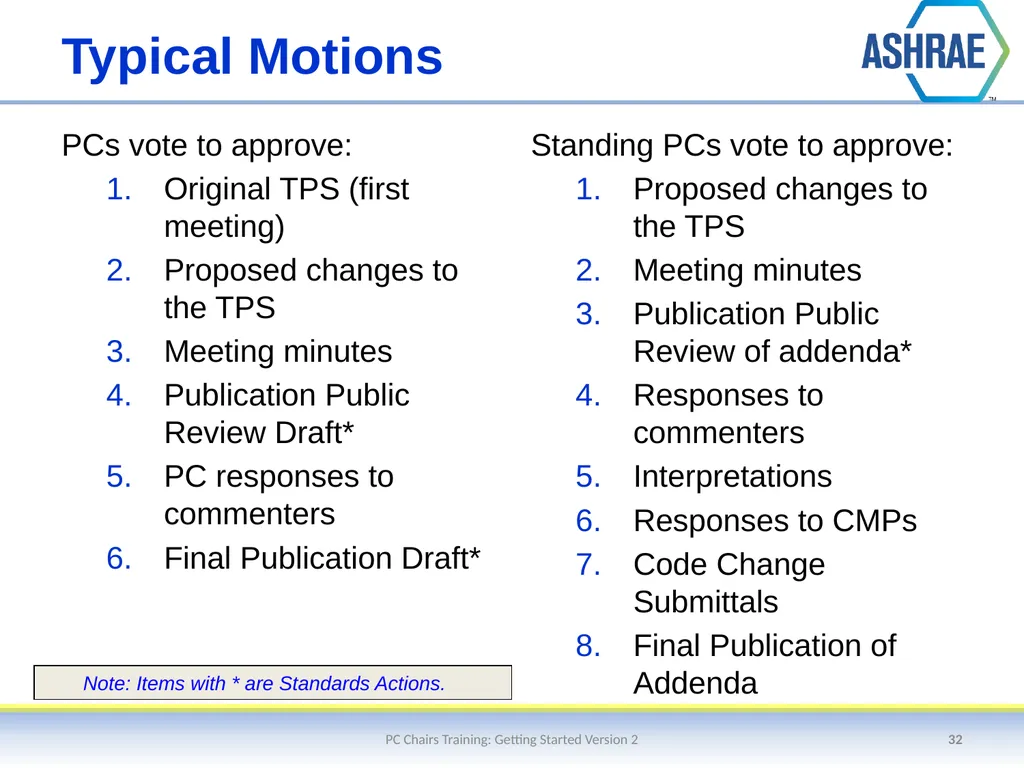
Typical Motions PCs vote to approve:
Original TPS (first meeting)
Proposed changes to the TPS
Meeting minutes
Publication Public Review Draft*
PC responses to commenters
Final Publication Draft* Standing PCs vote to approve:
Proposed changes to the TPS
Meeting minutes
Publication Public Review of addenda*
Responses to commenters
Interpretations
Responses to CMPs
Code Change Submittals
Final Publication of Addenda PC Chairs Training: Getting Started Version 2 32 Note: Items with * are Standards Actions.<br>
Original TPS (first meeting)
Proposed changes to the TPS
Meeting minutes
Publication Public Review Draft*
PC responses to commenters
Final Publication Draft* Standing PCs vote to approve:
Proposed changes to the TPS
Meeting minutes
Publication Public Review of addenda*
Responses to commenters
Interpretations
Responses to CMPs
Code Change Submittals
Final Publication of Addenda PC Chairs Training: Getting Started Version 2 32 Note: Items with * are Standards Actions.<br>
33
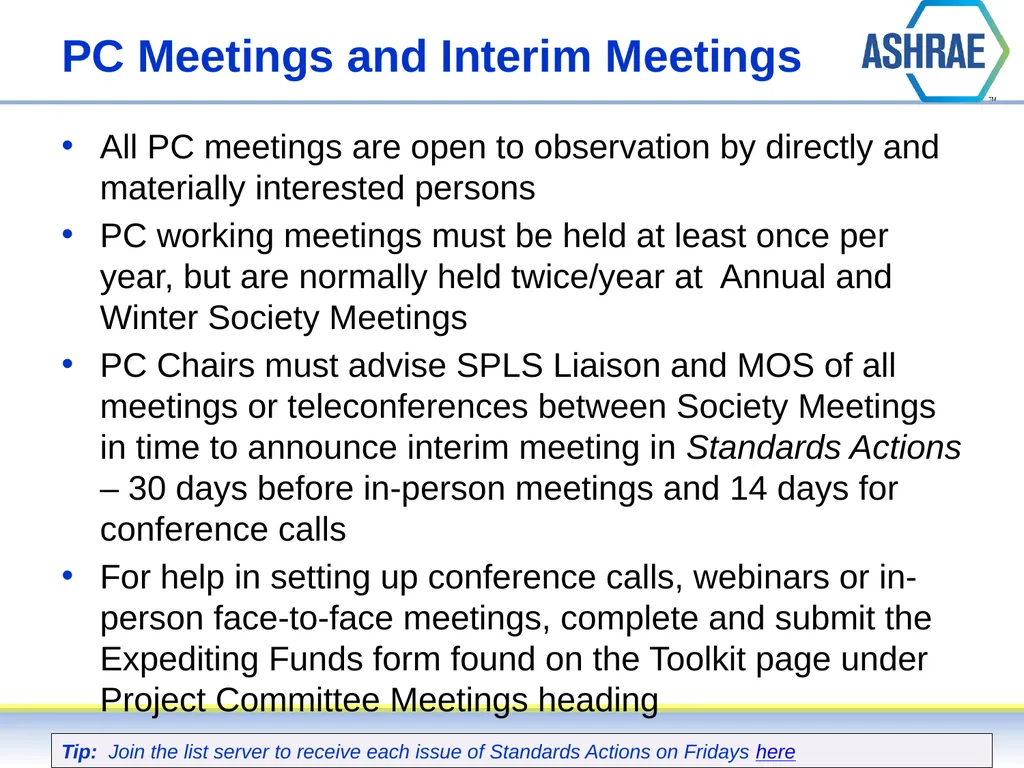
PC Meetings and Interim Meetings All PC meetings are open to observation by directly and materially interested persons
PC working meetings must be held at least once per year, but are normally held twice/year at Annual and Winter Society Meetings
PC Chairs must advise SPLS Liaison and MOS of all meetings or teleconferences between Society Meetings in time to announce interim meeting in Standards Actions – 30 days before in-person meetings and 14 days for conference calls
For help in setting up conference calls, webinars or in-person face-to-face meetings, complete and submit the Expediting Funds form found on the Toolkit page under Project Committee Meetings heading 33 PC Chairs Training: Getting Started Version 2 Tip: Join the list server to receive each issue of Standards Actions on Fridays here<br>
PC working meetings must be held at least once per year, but are normally held twice/year at Annual and Winter Society Meetings
PC Chairs must advise SPLS Liaison and MOS of all meetings or teleconferences between Society Meetings in time to announce interim meeting in Standards Actions – 30 days before in-person meetings and 14 days for conference calls
For help in setting up conference calls, webinars or in-person face-to-face meetings, complete and submit the Expediting Funds form found on the Toolkit page under Project Committee Meetings heading 33 PC Chairs Training: Getting Started Version 2 Tip: Join the list server to receive each issue of Standards Actions on Fridays here<br>
34
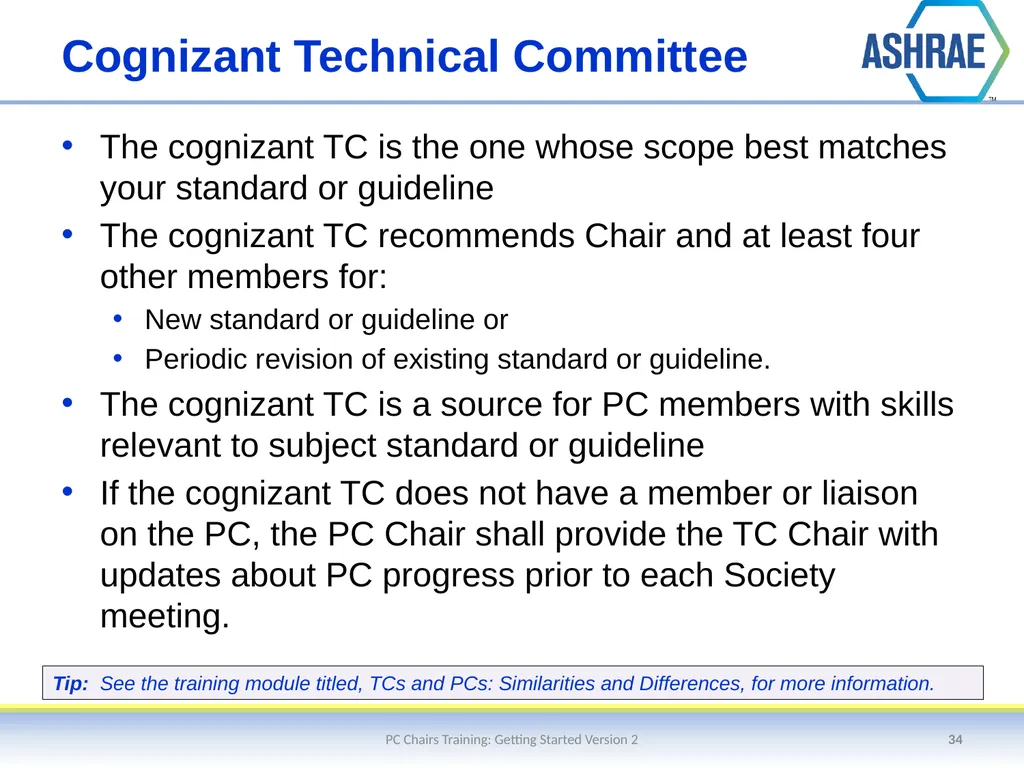
Cognizant Technical Committee The cognizant TC is the one whose scope best matches your standard or guideline
The cognizant TC recommends Chair and at least four other members for:
New standard or guideline or
Periodic revision of existing standard or guideline.
The cognizant TC is a source for PC members with skills relevant to subject standard or guideline
If the cognizant TC does not have a member or liaison on the PC, the PC Chair shall provide the TC Chair with updates about PC progress prior to each Society meeting. 34 PC Chairs Training: Getting Started Version 2 Tip: See the training module titled, TCs and PCs: Similarities and Differences, for more information.<br>
The cognizant TC recommends Chair and at least four other members for:
New standard or guideline or
Periodic revision of existing standard or guideline.
The cognizant TC is a source for PC members with skills relevant to subject standard or guideline
If the cognizant TC does not have a member or liaison on the PC, the PC Chair shall provide the TC Chair with updates about PC progress prior to each Society meeting. 34 PC Chairs Training: Getting Started Version 2 Tip: See the training module titled, TCs and PCs: Similarities and Differences, for more information.<br>
35
PC Websites If a PC website is desired, ASHRAE Staff will assist you with creating your PC’s web site
More information is available on the PC Chairs Toolkit page under Project Committee Home Pages PC Chairs Training: Getting Started Version 2 35<br>
More information is available on the PC Chairs Toolkit page under Project Committee Home Pages PC Chairs Training: Getting Started Version 2 35<br>
36
Resources SPLS Liaison
Other PC Training Modules
Online Resources
Standards Staff 36 PC Chairs Training: Getting Started Version 2<br>
Other PC Training Modules
Online Resources
Standards Staff 36 PC Chairs Training: Getting Started Version 2<br>
37
Your Friendly & Helpful SPLS Liaison Represents PC at StdC:
Membership Changes
Work Plans
TPS Changes
Public Review Drafts
SPLS Liaison contact information is on your PC roster 37 PC Chairs Training: Getting Started Version 2<br>
Membership Changes
Work Plans
TPS Changes
Public Review Drafts
SPLS Liaison contact information is on your PC roster 37 PC Chairs Training: Getting Started Version 2<br>
38
Other PC Training Modules The following training modules are available in a webcast version or in PDF form on the PC Chairs Toolkit page:
An Overview of PC Membership & Balance
Writing Standards in Enforceable Language
Running Effective Meetings
Ethics, Bias, and Conflicts of Interest
Public Review Process Overview
Online Comment Database
TCs and PCs: Similarities and Differences PC Chairs Training: Getting Started Version 2 38<br>
An Overview of PC Membership & Balance
Writing Standards in Enforceable Language
Running Effective Meetings
Ethics, Bias, and Conflicts of Interest
Public Review Process Overview
Online Comment Database
TCs and PCs: Similarities and Differences PC Chairs Training: Getting Started Version 2 38<br>
39
Standards Staff Direct line 678.539.xxxx
Standards Committee
Stephanie Reiniche, Sr. Manager of Standards.......................ext. 1143
sreiniche@ashrae.org
Status of Standards/Guidelines, SPLS and SPC 201
Susan LeBlanc, Standards Administrator………….............ext. 1143
sleblanc@ashrae.org
Procedures, PPIS, SRS and Appeals
Tanisha Meyers-Lisle, Procedures Administrator...............ext. 1111
tmlisle@ashrae.org
Staff Review of Drafts
Carmen Manning, Standards Analyst ....................……..............ext. 1145
cmanning@ashrae.org 39 PC Chairs Training: Getting Started Version 2<br>
Standards Committee
Stephanie Reiniche, Sr. Manager of Standards.......................ext. 1143
sreiniche@ashrae.org
Status of Standards/Guidelines, SPLS and SPC 201
Susan LeBlanc, Standards Administrator………….............ext. 1143
sleblanc@ashrae.org
Procedures, PPIS, SRS and Appeals
Tanisha Meyers-Lisle, Procedures Administrator...............ext. 1111
tmlisle@ashrae.org
Staff Review of Drafts
Carmen Manning, Standards Analyst ....................……..............ext. 1145
cmanning@ashrae.org 39 PC Chairs Training: Getting Started Version 2<br>
40
Standards Staff Direct line 678.539.xxxx
American Standards, Standards 62.1 and 62.2
Mark Weber, Mgr. of Standards - American………….....ext. 1214
mweber@ashrae.org
Codes, CIS, Standards 90.1 and 90.2
Steve Ferguson, Mgr. of Standards - Codes………..…..ext.1138
sferguson@ashrae.org
Codes, Standard 189.1
Bert Etheridge, Asst. Mgr. of Standards-Codes..........…ext. 1125
hetheridge@ashrae.org
International Standards and Standards 15 and 34
Nicole Jones, Asst. Mgr. of Standards-International...............ext. 1151
njones@ashrae.org 40 PC Chairs Training: Getting Started Version 2<br>
American Standards, Standards 62.1 and 62.2
Mark Weber, Mgr. of Standards - American………….....ext. 1214
mweber@ashrae.org
Codes, CIS, Standards 90.1 and 90.2
Steve Ferguson, Mgr. of Standards - Codes………..…..ext.1138
sferguson@ashrae.org
Codes, Standard 189.1
Bert Etheridge, Asst. Mgr. of Standards-Codes..........…ext. 1125
hetheridge@ashrae.org
International Standards and Standards 15 and 34
Nicole Jones, Asst. Mgr. of Standards-International...............ext. 1151
njones@ashrae.org 40 PC Chairs Training: Getting Started Version 2<br>
41
Standards Staff Direct line 678.539.xxxx
PC Membership
Beverly Fulks, Standards Coordinator......................................ext. 1151
bfulks@ashrae.org
PC Membership, SSPCs 15 and 34
Angela McFarlin, Admin. Asst./ International Stds...................ext. 1177
amcfarlin@ashrae.org
PC Membership, SSPCs 90.1, 90.2, 90.4, and 189.1
Katrina Shingles, Admin. Asst…..............................................ext. 1159
kshingles@ashrae.org 41 PC Chairs Training: Getting Started Version 2<br>
PC Membership
Beverly Fulks, Standards Coordinator......................................ext. 1151
bfulks@ashrae.org
PC Membership, SSPCs 15 and 34
Angela McFarlin, Admin. Asst./ International Stds...................ext. 1177
amcfarlin@ashrae.org
PC Membership, SSPCs 90.1, 90.2, 90.4, and 189.1
Katrina Shingles, Admin. Asst…..............................................ext. 1159
kshingles@ashrae.org 41 PC Chairs Training: Getting Started Version 2<br>
42
Questions? 42 PC Chairs Training: Getting Started Version 2<br>
43
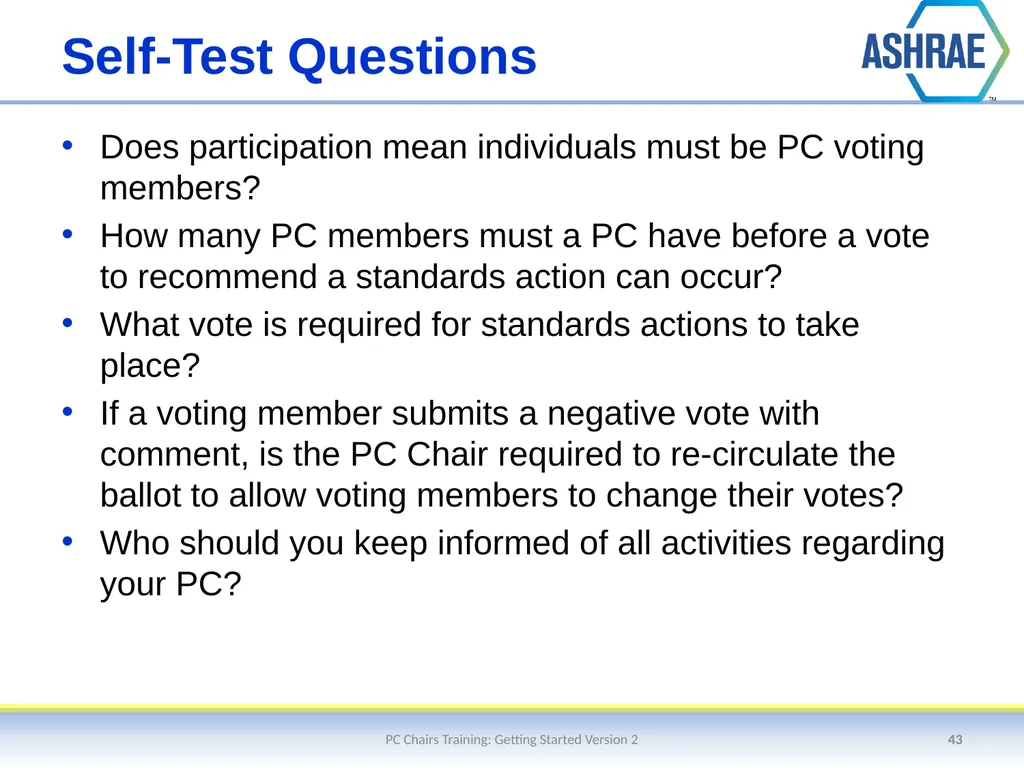
Self-Test Questions Does participation mean individuals must be PC voting members?
How many PC members must a PC have before a vote to recommend a standards action can occur?
What vote is required for standards actions to take place?
If a voting member submits a negative vote with comment, is the PC Chair required to re-circulate the ballot to allow voting members to change their votes?
Who should you keep informed of all activities regarding your PC? 43 PC Chairs Training: Getting Started Version 2<br>
How many PC members must a PC have before a vote to recommend a standards action can occur?
What vote is required for standards actions to take place?
If a voting member submits a negative vote with comment, is the PC Chair required to re-circulate the ballot to allow voting members to change their votes?
Who should you keep informed of all activities regarding your PC? 43 PC Chairs Training: Getting Started Version 2<br>
44
How did you do? If you knew the answers to all the questions
Congratulations! You have mastered the material
If you were able to answer most of the questions (70-99%)
Please review the material you may have missed
If you were unable to answer most of the questions (<70%)
Please review all the material 44 PC Chairs Training: Getting Started Version 2<br>
Congratulations! You have mastered the material
If you were able to answer most of the questions (70-99%)
Please review the material you may have missed
If you were unable to answer most of the questions (<70%)
Please review all the material 44 PC Chairs Training: Getting Started Version 2<br>