Global Water Modules Module 2: Water and Equity Part 1: Equity Issues: The Poor Pay More Accessible, vetted, and modifiable learning modules for faculty on global water security, connecting local and global, developed by Jenny Kehl, PhD.
"Global Water Modules Module 2: Water and Equity" is the property of its rightful owner. Permission is granted to
download and print the materials on this website for personal, non-commercial use only, and to display it
on your personal computer provided you do not modify the materials and that you retain all copyright
notices contained in the materials. By downloading content from our website, you accept the terms of this
agreement.
Presentation Transcript
01
Global Water Modules Module 2:
Water and Equity
Part 1:
Equity Issues: The Poor Pay More
Accessible, vetted, and modifiable learning modules for faculty on global water security, connecting local and global, developed by Jenny Kehl, PhD. Made possible by UWM, CIE, GS, IS National Resource Center
Center for International Education
Global Studies
International Studies<br>
02
Global Water Modules
Module 2:
Water and Equity
Part 1:
Equity Issues: The Poor Pay More National Resource Center
Center for International Education
Global Studies
International Studies<br>
03
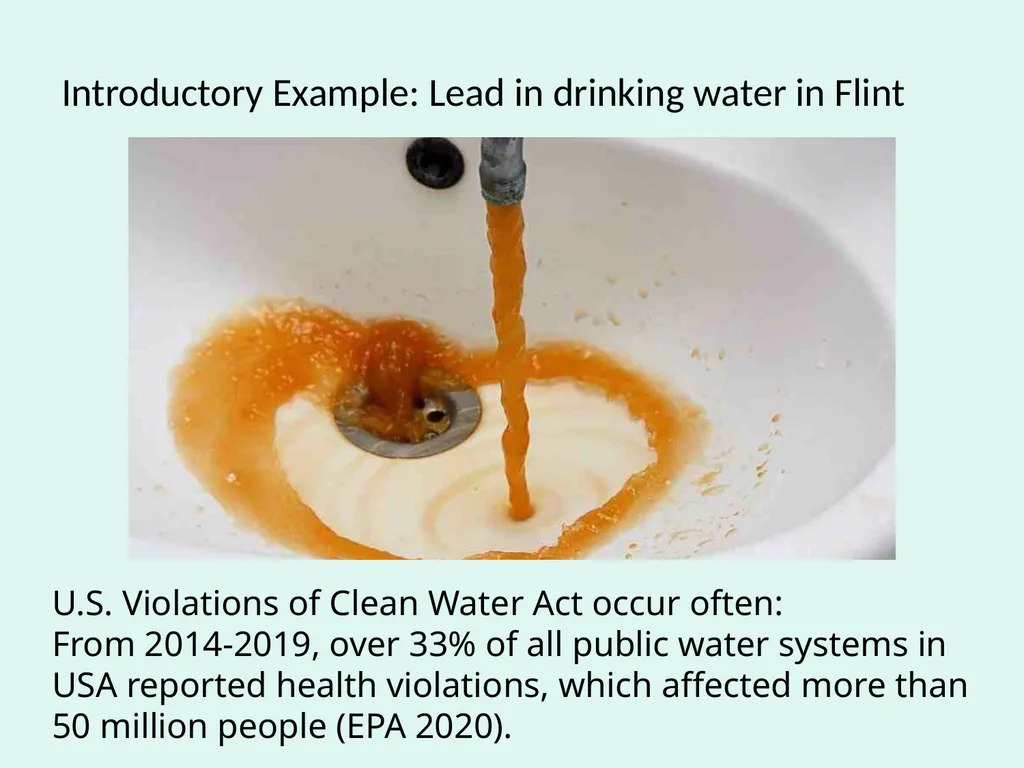
Introductory Example: Lead in drinking water in Flint U.S. Violations of Clean Water Act occur often:
From 2014-2019, over 33% of all public water systems in USA reported health violations, which affected more than 50 million people (EPA 2020).<br>
04
Economic Issue of Environmental Justice “The Poor Pay More” The poor (meaning the economically disenfranchised who live below the USA poverty line) often pay more for access to safe water than other economic classes.
The poor are often compelled to buy bottled water, using a comparatively high percentage of their income, due to failing infrastructure or environmental contamination.
The following slides highlight the elements of “The Poor Pay More” from wealth to health to gender, among other dynamics.<br>
05
Equity Issue: Water and Wealth The poor are more likely to live in environmentally degraded areas,
without access to freshwater,
without water distribution infrastructure,
without the financial means to buy freshwater.<br>
06
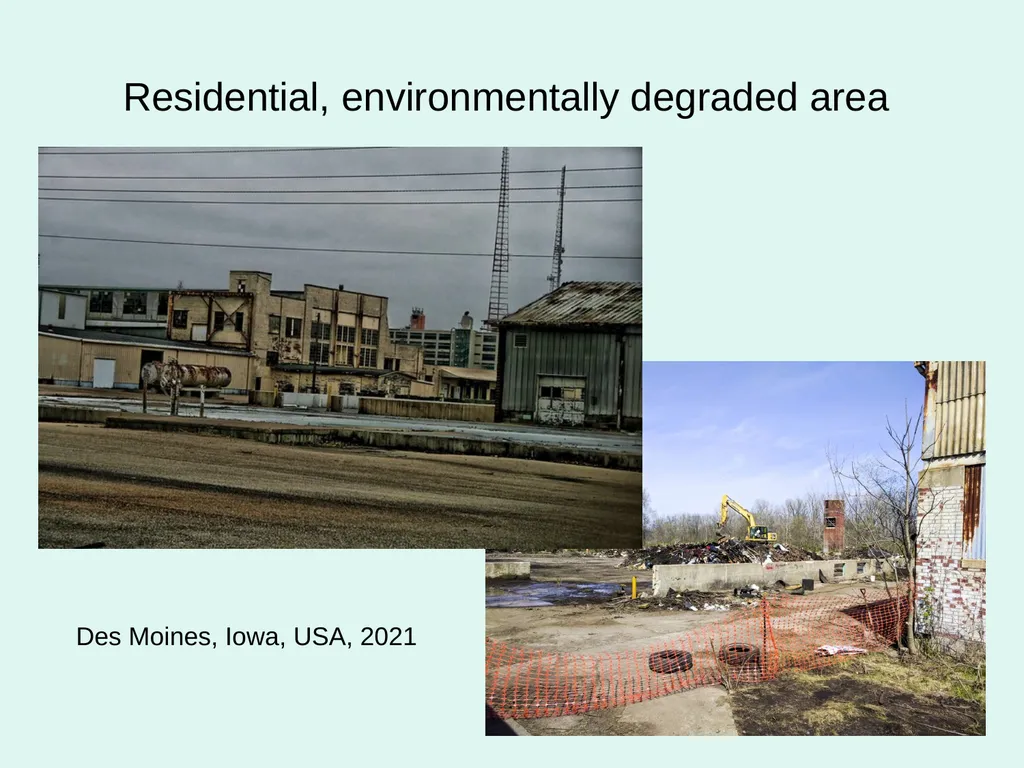
Residential, environmentally degraded area Des Moines, Iowa, USA, 2021<br>
07
Equity Issue: Water and Wealth The poor are less likely to be able to afford water bills and more likely to suffer water cut-offs.<br>
08
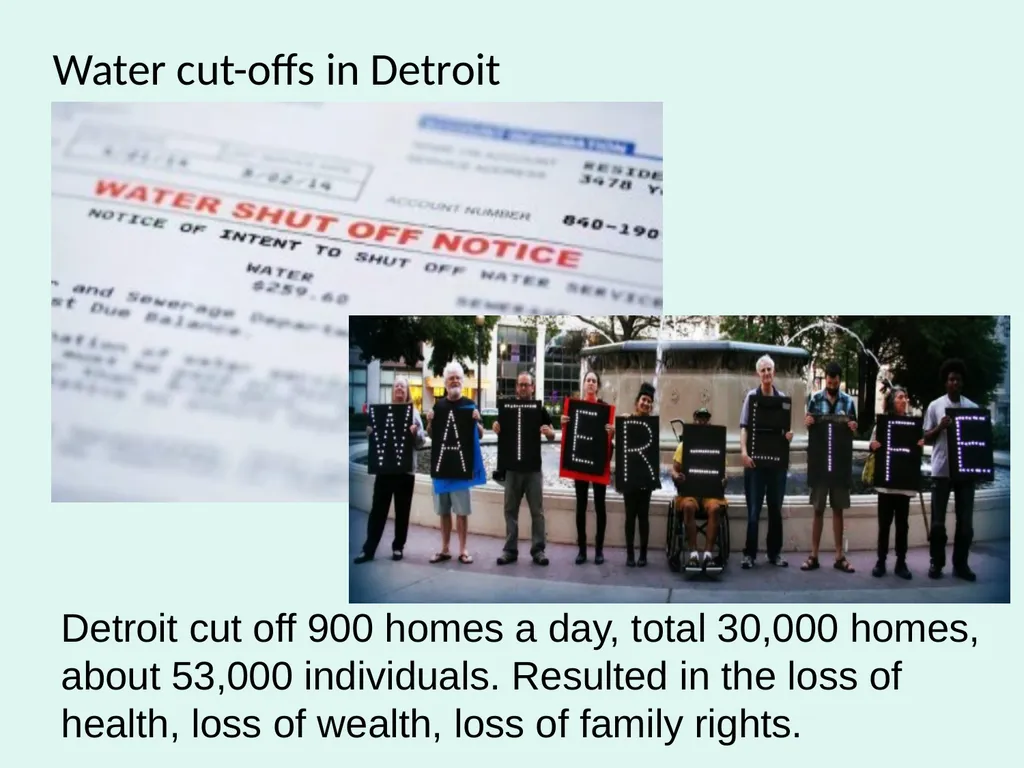
Water cut-offs in Detroit Detroit cut off 900 homes a day, total 30,000 homes, about 53,000 individuals. Resulted in the loss of health, loss of wealth, loss of family rights.<br>
09
Equity Issue: Water and Wealth The poor often pay 10%-15% of their income on water. In situations of water privatization, water rates for the poor often increase to 30-50% of their income.
(Colton, The Economist, Boston, 2012, updated 2020).<br>
10
Equity Issue: Water and Emergency Events The poor are less likely to have the financial means to recover from extreme weather events such as floods and droughts.<br>
11
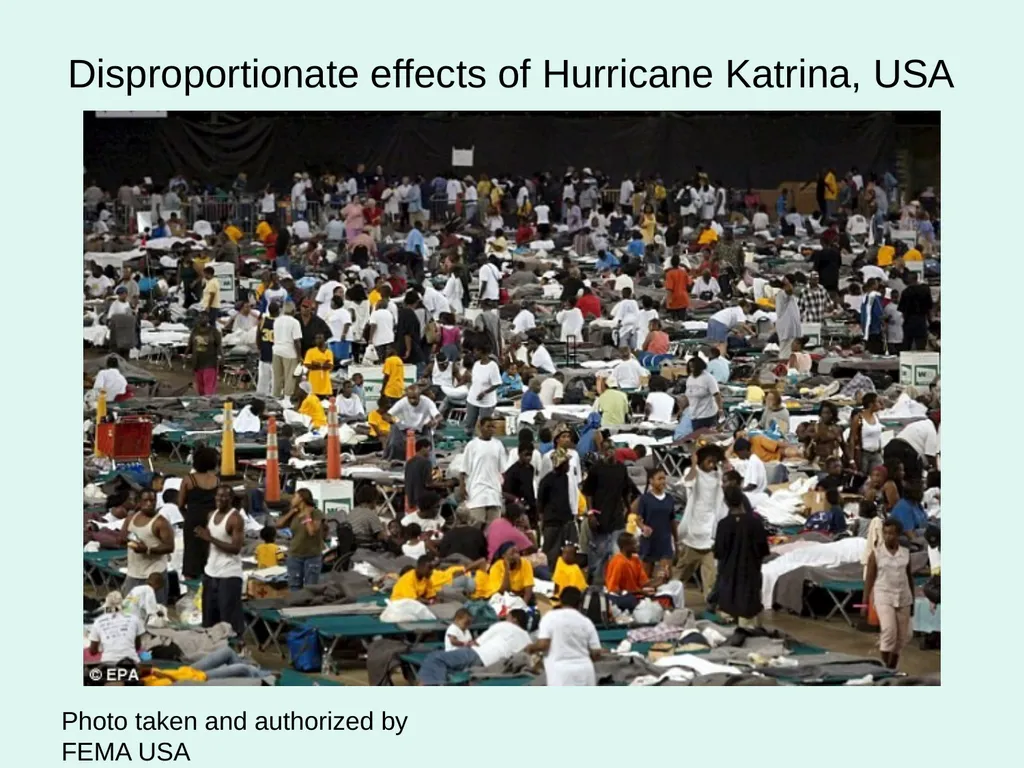
Disproportionate effects of Hurricane Katrina, USA Photo taken and authorized by FEMA USA<br>
12
Equity Issue: Water and Gender The poor are more likely to miss economic opportunities (such as education) to seek out water resources. This responsibility is often given to girls and women, who are known worldwide as “the water carriers.” This disproportionately affects girls and women by disallowing them to attend school or seek out employment opportunities because they often spend 2-3 hours a day pursuing, walking to, and carrying back water.<br>
13
Equity Issue: Water and Health The poor are more likely to suffer health crises as a result of degraded environment and lack of access to safe water for drinking, cooking, cleaning. Suffer from more frequent water-borne illnesses, and cancer clusters.<br>
14
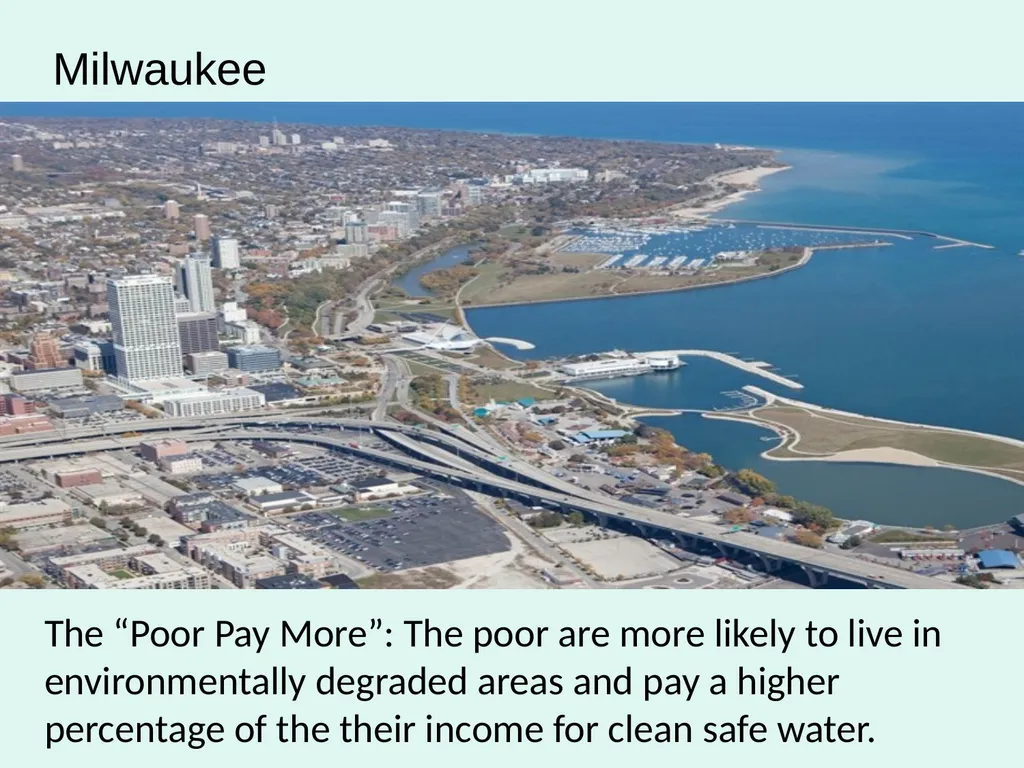
The “Poor Pay More”: The poor are more likely to live in environmentally degraded areas and pay a higher percentage of the their income for clean safe water. Milwaukee<br>
15
MKE delinquent water bills increased 77% from 2000-2010, in 2010 there were over 15,000 accounts delinquent (Vanderwarker 2012) Milwaukee<br>
16
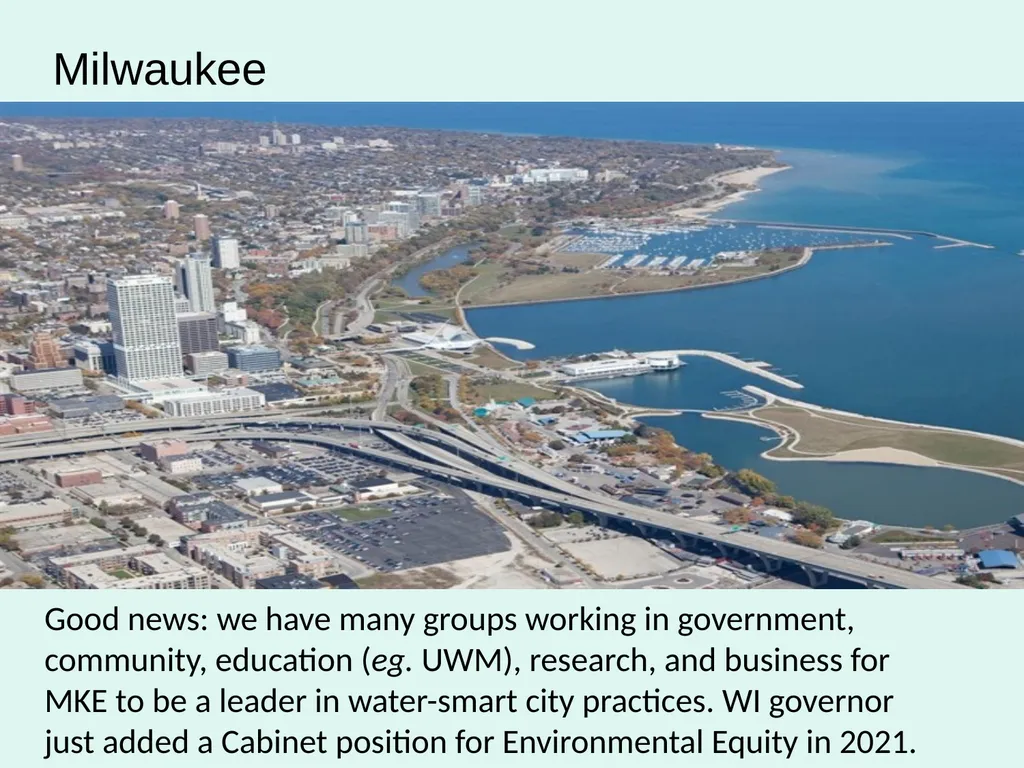
Good news: we have many groups working in government, community, education (eg. UWM), research, and business for MKE to be a leader in water-smart city practices. WI governor just added a Cabinet position for Environmental Equity in 2021. Milwaukee<br>
17
Connecting Local to Global:
One related global example of water inequity in access and the public health consequences is privatization by Coca-Cola in India:
Coca-Cola privatized water resources (rivers, lakes, underground aquifers). The government sold the water sources, changing them from public to private. Coke used the water for:
Making the product, which used most of the potable water,
2) For the industrial processes, after which the water was chemically toxic and it was poured out as pollution.<br>
18
People in that region of India no longer have fresh water to drink.
Their choices are to drink toxic polluted water or Coca-Cola.<br>
19
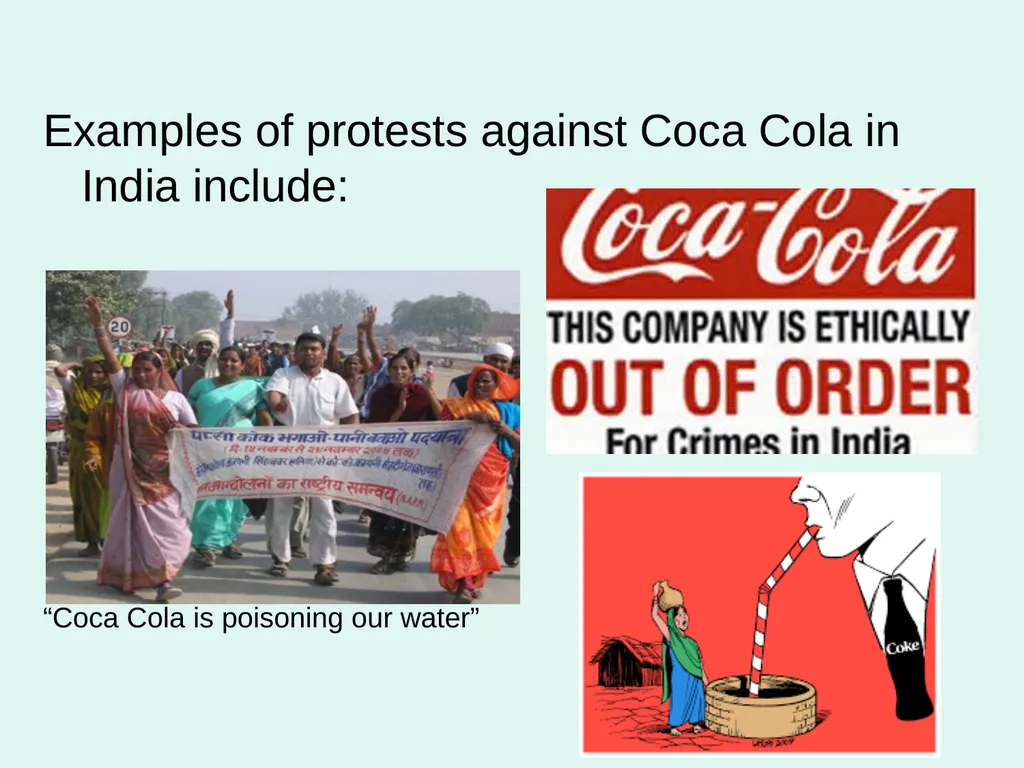
Examples of protests against Coca Cola in India include:
“Coca Cola is poisoning our water”<br>
20
Economic Issue of Environmental Justice “The Poor Pay More” Conclusion:
The poor (meaning the economically disenfranchised who live below the USA poverty line) often pay more for access to safe water, which exposes elements of racial and ethnic inequity based on segregated residential areas that are environmentally degraded, gender inequity, public health crises that disproportionately affect disenfranchised communities, and further loss of economic opportunities.<br>
21
Note on sequencing:
This leads to the question of whether water is a right or a commodity.
This presentation and the introduction of equity v. privatization lead directly into the next presentation on equity GW M3 Part 2 about corporate control of water,
titled “Who owns the water?”<br>
22
Global Water Modules
Module 2:
Water and Equity
Part 1:
Equity Issues: The Poor Pay More Center for International Education
Global Studies
International Studies<br>