
GP collective action 1 August 2024 To Note: This
TD
Published · 16 slides · 0 views

1 / 1
Description
GP collective action 1 August 2024 To Note: This comms pack will be regularly updated and redistributed with new information as more details are confirmed. Any new information or changes made will be highlighted in green. Background This
Related Topics
Share
Embed code
Download this presentation From Below
"GP collective action 1 August 2024 To Note: This" is the property of its rightful owner. Permission is granted to download and print the materials on this website for personal, non-commercial use only, and to display it on your personal computer provided you do not modify the materials and that you retain all copyright notices contained in the materials. By downloading content from our website, you accept the terms of this agreement.
Presentation Transcript
01
GP collective action 1 August 2024 To Note: This comms pack will be regularly updated and redistributed with new information as more details are confirmed. Any new information or changes made will be highlighted in green.<br>
02
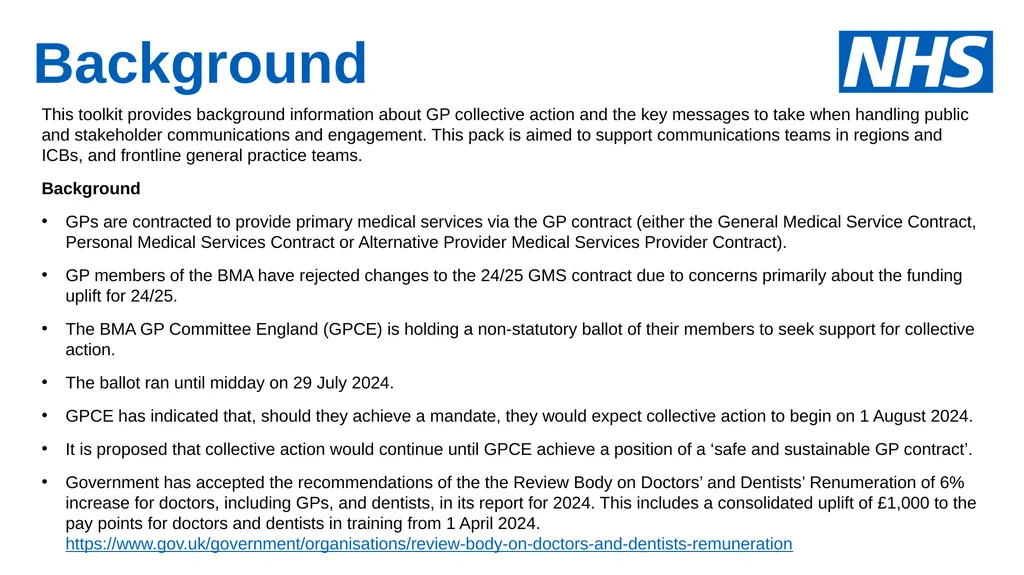
Background This toolkit provides background information about GP collective action and the key messages to take when handling public and stakeholder communications and engagement. This pack is aimed to support communications teams in regions and ICBs, and frontline general practice teams.
Background
GPs are contracted to provide primary medical services via the GP contract (either the General Medical Service Contract, Personal Medical Services Contract or Alternative Provider Medical Services Provider Contract).
GP members of the BMA have rejected changes to the 24/25 GMS contract due to concerns primarily about the funding uplift for 24/25.
The BMA GP Committee England (GPCE) is holding a non-statutory ballot of their members to seek support for collective action.
The ballot ran until midday on 29 July 2024.
GPCE has indicated that, should they achieve a mandate, they would expect collective action to begin on 1 August 2024.
It is proposed that collective action would continue until GPCE achieve a position of a ‘safe and sustainable GP contract’.
Government has accepted the recommendations of the the Review Body on Doctors’ and Dentists’ Renumeration of 6% increase for doctors, including GPs, and dentists, in its report for 2024. This includes a consolidated uplift of £1,000 to the pay points for doctors and dentists in training from 1 April 2024. https://www.gov.uk/government/organisations/review-body-on-doctors-and-dentists-remuneration<br>
Background
GPs are contracted to provide primary medical services via the GP contract (either the General Medical Service Contract, Personal Medical Services Contract or Alternative Provider Medical Services Provider Contract).
GP members of the BMA have rejected changes to the 24/25 GMS contract due to concerns primarily about the funding uplift for 24/25.
The BMA GP Committee England (GPCE) is holding a non-statutory ballot of their members to seek support for collective action.
The ballot ran until midday on 29 July 2024.
GPCE has indicated that, should they achieve a mandate, they would expect collective action to begin on 1 August 2024.
It is proposed that collective action would continue until GPCE achieve a position of a ‘safe and sustainable GP contract’.
Government has accepted the recommendations of the the Review Body on Doctors’ and Dentists’ Renumeration of 6% increase for doctors, including GPs, and dentists, in its report for 2024. This includes a consolidated uplift of £1,000 to the pay points for doctors and dentists in training from 1 April 2024. https://www.gov.uk/government/organisations/review-body-on-doctors-and-dentists-remuneration<br>
03
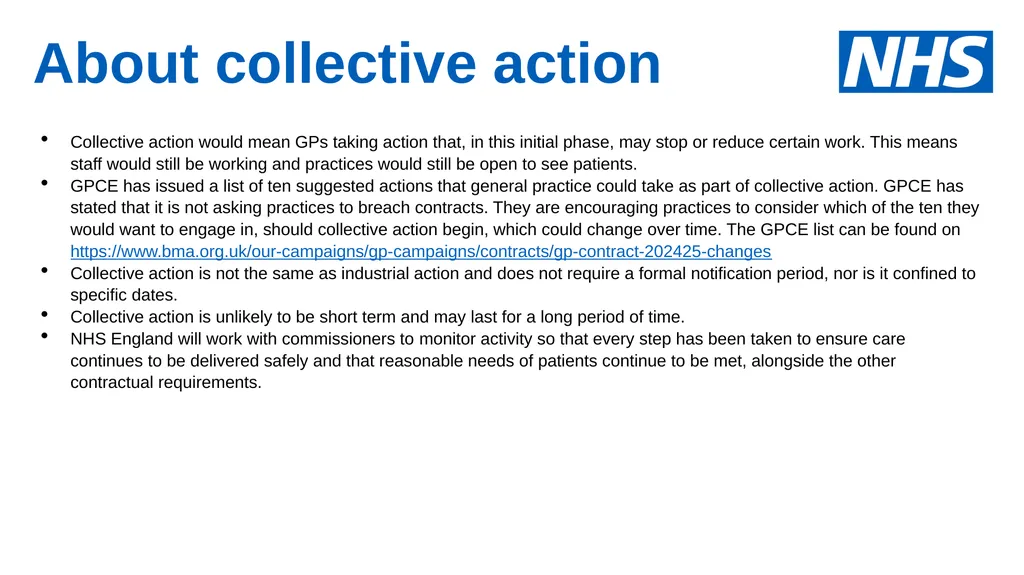
About collective action Collective action would mean GPs taking action that, in this initial phase, may stop or reduce certain work. This means staff would still be working and practices would still be open to see patients.
GPCE has issued a list of ten suggested actions that general practice could take as part of collective action. GPCE has stated that it is not asking practices to breach contracts. They are encouraging practices to consider which of the ten they would want to engage in, should collective action begin, which could change over time. The GPCE list can be found on https://www.bma.org.uk/our-campaigns/gp-campaigns/contracts/gp-contract-202425-changes
Collective action is not the same as industrial action and does not require a formal notification period, nor is it confined to specific dates.
Collective action is unlikely to be short term and may last for a long period of time.
NHS England will work with commissioners to monitor activity so that every step has been taken to ensure care continues to be delivered safely and that reasonable needs of patients continue to be met, alongside the other contractual requirements.<br>
GPCE has issued a list of ten suggested actions that general practice could take as part of collective action. GPCE has stated that it is not asking practices to breach contracts. They are encouraging practices to consider which of the ten they would want to engage in, should collective action begin, which could change over time. The GPCE list can be found on https://www.bma.org.uk/our-campaigns/gp-campaigns/contracts/gp-contract-202425-changes
Collective action is not the same as industrial action and does not require a formal notification period, nor is it confined to specific dates.
Collective action is unlikely to be short term and may last for a long period of time.
NHS England will work with commissioners to monitor activity so that every step has been taken to ensure care continues to be delivered safely and that reasonable needs of patients continue to be met, alongside the other contractual requirements.<br>
04
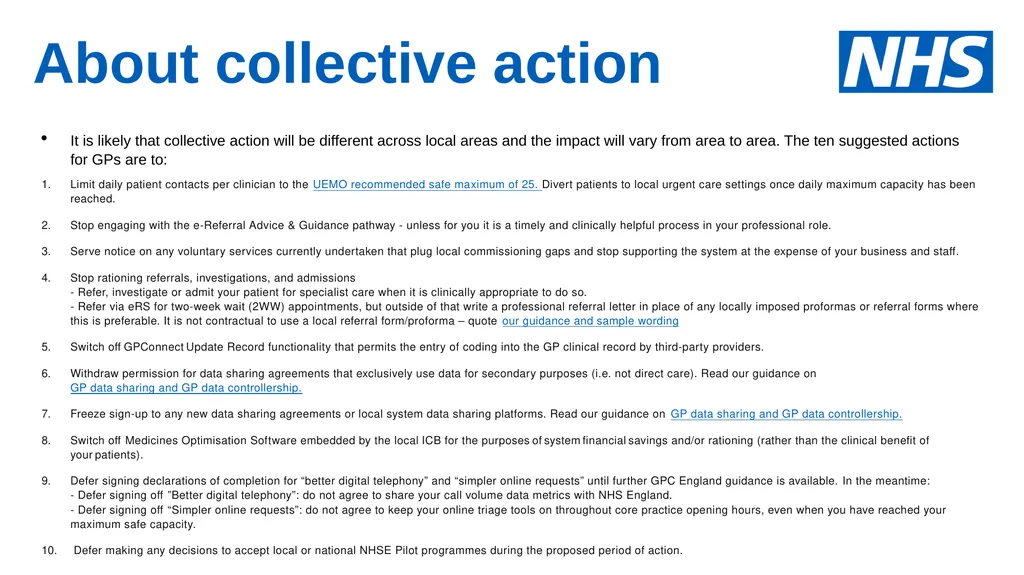
About collective action It is likely that collective action will be different across local areas and the impact will vary from area to area. The ten suggested actions for GPs are to:
Limit daily patient contacts per clinician to the UEMO recommended safe maximum of 25. Divert patients to local urgent care settings once daily maximum capacity has been reached.
Stop engaging with the e-Referral Advice & Guidance pathway - unless for you it is a timely and clinically helpful process in your professional role.
Serve notice on any voluntary services currently undertaken that plug local commissioning gaps and stop supporting the system at the expense of your business and staff.
Stop rationing referrals, investigations, and admissions - Refer, investigate or admit your patient for specialist care when it is clinically appropriate to do so. - Refer via eRS for two-week wait (2WW) appointments, but outside of that write a professional referral letter in place of any locally imposed proformas or referral forms where this is preferable. It is not contractual to use a local referral form/proforma – quote our guidance and sample wording
Switch off GPConnect Update Record functionality that permits the entry of coding into the GP clinical record by third-party providers.
Withdraw permission for data sharing agreements that exclusively use data for secondary purposes (i.e. not direct care). Read our guidance on GP data sharing and GP data controllership.
Freeze sign-up to any new data sharing agreements or local system data sharing platforms. Read our guidance on GP data sharing and GP data controllership.
Switch off Medicines Optimisation Software embedded by the local ICB for the purposes of system financial savings and/or rationing (rather than the clinical benefit of your patients).
Defer signing declarations of completion for “better digital telephony” and “simpler online requests” until further GPC England guidance is available. In the meantime: - Defer signing off ”Better digital telephony”: do not agree to share your call volume data metrics with NHS England. - Defer signing off “Simpler online requests”: do not agree to keep your online triage tools on throughout core practice opening hours, even when you have reached your maximum safe capacity.
Defer making any decisions to accept local or national NHSE Pilot programmes during the proposed period of action.<br>
Limit daily patient contacts per clinician to the UEMO recommended safe maximum of 25. Divert patients to local urgent care settings once daily maximum capacity has been reached.
Stop engaging with the e-Referral Advice & Guidance pathway - unless for you it is a timely and clinically helpful process in your professional role.
Serve notice on any voluntary services currently undertaken that plug local commissioning gaps and stop supporting the system at the expense of your business and staff.
Stop rationing referrals, investigations, and admissions - Refer, investigate or admit your patient for specialist care when it is clinically appropriate to do so. - Refer via eRS for two-week wait (2WW) appointments, but outside of that write a professional referral letter in place of any locally imposed proformas or referral forms where this is preferable. It is not contractual to use a local referral form/proforma – quote our guidance and sample wording
Switch off GPConnect Update Record functionality that permits the entry of coding into the GP clinical record by third-party providers.
Withdraw permission for data sharing agreements that exclusively use data for secondary purposes (i.e. not direct care). Read our guidance on GP data sharing and GP data controllership.
Freeze sign-up to any new data sharing agreements or local system data sharing platforms. Read our guidance on GP data sharing and GP data controllership.
Switch off Medicines Optimisation Software embedded by the local ICB for the purposes of system financial savings and/or rationing (rather than the clinical benefit of your patients).
Defer signing declarations of completion for “better digital telephony” and “simpler online requests” until further GPC England guidance is available. In the meantime: - Defer signing off ”Better digital telephony”: do not agree to share your call volume data metrics with NHS England. - Defer signing off “Simpler online requests”: do not agree to keep your online triage tools on throughout core practice opening hours, even when you have reached your maximum safe capacity.
Defer making any decisions to accept local or national NHSE Pilot programmes during the proposed period of action.<br>
05
Communications Approach National
The BMA have rejected changes to the 24/25 GMS contract with NHS England, so it is appropriate for NHS England to comment.
The dispute also relates to funding and therefore it would also be appropriate for DHSC to comment on finances.
The national messaging in this pack can be used by ICBs and GP practices should they wish.
NHS England and government are working together to avert action and are continuing to engage with GPs, the BMA and other stakeholders.
Given the nature and variability of action, there will not be a single national communications ‘moment’ as with previous IA. We need to be cautious that we are not changing patient behaviour unless there is a clear reason to do so. Proactively, we can acknowledge action is taking place but encourage normal behaviour
However, where there is a specific local change / mitigation we should be factual and directive.<br>
The BMA have rejected changes to the 24/25 GMS contract with NHS England, so it is appropriate for NHS England to comment.
The dispute also relates to funding and therefore it would also be appropriate for DHSC to comment on finances.
The national messaging in this pack can be used by ICBs and GP practices should they wish.
NHS England and government are working together to avert action and are continuing to engage with GPs, the BMA and other stakeholders.
Given the nature and variability of action, there will not be a single national communications ‘moment’ as with previous IA. We need to be cautious that we are not changing patient behaviour unless there is a clear reason to do so. Proactively, we can acknowledge action is taking place but encourage normal behaviour
However, where there is a specific local change / mitigation we should be factual and directive.<br>
06
Communications Approach ICBs
ICBs will need to assess the impact of collective action based upon local commissioning arrangements. To support this, ICB communications leads should coordinate with their primary care commissioning leads as well as EPRR leads.
Due to different local commissioning arrangements and uptake among practices, there is likely to be variation across practices and ICBs, which will mean the impact will vary. ICB communications leads will need to work with colleagues within their ICBs to develop specific local messaging.
ICBs will lead on messaging across their system. This should focus upon encouraging patients to continue using services as normal during any action. However, where there are specific local examples that require mitigation (such as a service no longer being provided at a practice and patients needing to go somewhere else), communications about these mitigations should be factual and directional rather than commentating upon the dispute or the action itself.
Practice level
GPs should advise members of the public about changes to their services at practices. It is important to advise the public in advance to ensure their duty of care to their registered patients is discharged appropriately. Practices will need to ensure that local and national contractual requirements continue to be met throughout the period.<br>
ICBs will need to assess the impact of collective action based upon local commissioning arrangements. To support this, ICB communications leads should coordinate with their primary care commissioning leads as well as EPRR leads.
Due to different local commissioning arrangements and uptake among practices, there is likely to be variation across practices and ICBs, which will mean the impact will vary. ICB communications leads will need to work with colleagues within their ICBs to develop specific local messaging.
ICBs will lead on messaging across their system. This should focus upon encouraging patients to continue using services as normal during any action. However, where there are specific local examples that require mitigation (such as a service no longer being provided at a practice and patients needing to go somewhere else), communications about these mitigations should be factual and directional rather than commentating upon the dispute or the action itself.
Practice level
GPs should advise members of the public about changes to their services at practices. It is important to advise the public in advance to ensure their duty of care to their registered patients is discharged appropriately. Practices will need to ensure that local and national contractual requirements continue to be met throughout the period.<br>
07
Key messages for the public The NHS is asking the public to come forward as usual for care during collective action
If you have an appointment with your GP practice, you should attend as usual, unless you are told otherwise.
Practices will still be open and see patients and you can book appointments through your GP practice. However, some GPs may direct patients to other local services.
During collective action practices are still required to fulfil their contracts. This essentially means:
Practices are required to be open between 0800 and 1830 Monday to Friday.
Practices should provide reasonable care to patients. This includes:
Making appointments available
Providing advice or care to patients by another means
Giving advice on alternative services
Providing access to prescriptions, long terms condition management, vaccinations, diagnoses and referral (including where clinically urgent)
Practices also need to take into account:
The needs of a patient to avoid risks to patient safety
The benefits to patients of providing continuity of care.
Your GP practice will be able to explain the impact on you and what you need to do.<br>
If you have an appointment with your GP practice, you should attend as usual, unless you are told otherwise.
Practices will still be open and see patients and you can book appointments through your GP practice. However, some GPs may direct patients to other local services.
During collective action practices are still required to fulfil their contracts. This essentially means:
Practices are required to be open between 0800 and 1830 Monday to Friday.
Practices should provide reasonable care to patients. This includes:
Making appointments available
Providing advice or care to patients by another means
Giving advice on alternative services
Providing access to prescriptions, long terms condition management, vaccinations, diagnoses and referral (including where clinically urgent)
Practices also need to take into account:
The needs of a patient to avoid risks to patient safety
The benefits to patients of providing continuity of care.
Your GP practice will be able to explain the impact on you and what you need to do.<br>
08
Key messages for the public Patients can use 111 online for health needs, and only using 999 if it is a serious or life-threatening emergency. For more information on when to call 999 and when to go to A&E, you can visit the NHS UK website.
Your local pharmacist may also be able to offer treatment and some prescription medicine for some conditions, without you needing to see a GP (this is called Pharmacy First). Conditions they can treat as part of Pharmacy First are:
earache (aged 1 to 17 years)
impetigo (aged 1 year and over)
infected insect bites (aged 1 year and over)
shingles (aged 18 years and over)
sinusitis (aged 12 years and over)
sore throat (aged 5 years and over)
urinary tract infections or UTIs (women aged 16 to 64 years)
If you go to a pharmacy with one of these conditions, the pharmacist will offer you advice, treatment or refer you to a GP or other healthcare professional if needed.<br>
Your local pharmacist may also be able to offer treatment and some prescription medicine for some conditions, without you needing to see a GP (this is called Pharmacy First). Conditions they can treat as part of Pharmacy First are:
earache (aged 1 to 17 years)
impetigo (aged 1 year and over)
infected insect bites (aged 1 year and over)
shingles (aged 18 years and over)
sinusitis (aged 12 years and over)
sore throat (aged 5 years and over)
urinary tract infections or UTIs (women aged 16 to 64 years)
If you go to a pharmacy with one of these conditions, the pharmacist will offer you advice, treatment or refer you to a GP or other healthcare professional if needed.<br>
09
Key messages for the public The NHS has a duty to provide the best care possible for patients with the resources we have.
The NHS and government are working to avert collection action.
Government has accepted the recommendations of the the Review Body on Doctors’ and Dentists’ Renumeration of 6% increase for doctors, including GPs, and dentists, in its report for 2024. This includes a consolidated uplift of £1,000 to the pay points for doctors and dentists in training from 1 April 2024. https://www.gov.uk/government/organisations/review-body-on-doctors-and-dentists-remuneration
More than 1,000 newly qualified GPs will be recruited thanks to government action to remove red tape currently preventing surgeries from hiring doctors.
The NHS is working hard to plan for disruption and to mitigate this where possible. The nature of the collective action means that the impacts will vary at different GP practices and from area to area.
We anticipate that this action will cause disruption across the NHS.
NHS England will be closely monitoring any action taken and will work with local commissioners to make sure that practices continue to fulfil their contractual requirements and that patient care is safely delivered.
Government is responsible for agreeing the funding package for general practice to provide services and care to patients, based on recommendations from DDRB on pay uplifts and advice from NHS England on overall contract funding requirements.<br>
The NHS and government are working to avert collection action.
Government has accepted the recommendations of the the Review Body on Doctors’ and Dentists’ Renumeration of 6% increase for doctors, including GPs, and dentists, in its report for 2024. This includes a consolidated uplift of £1,000 to the pay points for doctors and dentists in training from 1 April 2024. https://www.gov.uk/government/organisations/review-body-on-doctors-and-dentists-remuneration
More than 1,000 newly qualified GPs will be recruited thanks to government action to remove red tape currently preventing surgeries from hiring doctors.
The NHS is working hard to plan for disruption and to mitigate this where possible. The nature of the collective action means that the impacts will vary at different GP practices and from area to area.
We anticipate that this action will cause disruption across the NHS.
NHS England will be closely monitoring any action taken and will work with local commissioners to make sure that practices continue to fulfil their contractual requirements and that patient care is safely delivered.
Government is responsible for agreeing the funding package for general practice to provide services and care to patients, based on recommendations from DDRB on pay uplifts and advice from NHS England on overall contract funding requirements.<br>
10
Information on General Practice General practice is at the heart of the NHS, and the hard work of GPs and their teams is hugely valued and appreciated.
General practice is delivering more than a million appointments every day and half a million more every week than pre-pandemic. This has been possible because of the hard work of staff and through significantly increased investment since 2019, which has grown the general practice workforce by 27% to meet rising demand and the needs of an ageing population.
General practice teams have been working hard to continue to provide care to patients - despite the challenges faced by the health system. However, many patients tell us that they’re not able to get an appointment. So, we know there is more we need to do to give people the service and care they need.
The number of people in England aged 70 or over is up around a third on 2010, from 6.1 million to 8.1 million, and this group has, on average, five times more GP appointments than young people.
Over the past two years, the NHS and government have been focusing efforts on reducing the pressure on general practice teams before taking steps to introduce wider reforms and change. This has meant tackling some of the issues around improving patient access and reducing the pressure on the workforce, such as cutting bureaucracy, supporting teams with training and providing digital tools to help them better manage demand with the available capacity and resources.<br>
General practice is delivering more than a million appointments every day and half a million more every week than pre-pandemic. This has been possible because of the hard work of staff and through significantly increased investment since 2019, which has grown the general practice workforce by 27% to meet rising demand and the needs of an ageing population.
General practice teams have been working hard to continue to provide care to patients - despite the challenges faced by the health system. However, many patients tell us that they’re not able to get an appointment. So, we know there is more we need to do to give people the service and care they need.
The number of people in England aged 70 or over is up around a third on 2010, from 6.1 million to 8.1 million, and this group has, on average, five times more GP appointments than young people.
Over the past two years, the NHS and government have been focusing efforts on reducing the pressure on general practice teams before taking steps to introduce wider reforms and change. This has meant tackling some of the issues around improving patient access and reducing the pressure on the workforce, such as cutting bureaucracy, supporting teams with training and providing digital tools to help them better manage demand with the available capacity and resources.<br>
11
Information on General Practice Other measures have included:
introducing simpler and more flexible contractual arrangements, where possible, to help practices free up time.
reducing the number of metrics to reduce administrative burden, which includes:
in 24/25 suspending and income protecting 32 out of the 76 Quality and Outcomes Framework (QOF) indicators;
reducing the number of Investment and Impact Fund (IIF) indicators from five to two; and,
increasing the Capacity and Access Payment (CAP) by £46m to £292m by retiring three IIF indicators.
Introducing more financial flexibilities to help with cash flow
Publishing the two-year Delivery plan for recovering access to primary care in May 2023, which sets out how the NHS seeks to support the recovery of primary care services through these four areas:
Empowering patients to manage their own health including using the NHS App, self-referral pathways and through more services offered by community pharmacy. This will relieve pressure on general practice.
Implementing Modern General Practice Access to tackle the 8am rush, provide rapid assessment and response, and avoid asking patients to ring back another day to book an appointment.
Building capacity to deliver more appointments from more staff than ever before and add flexibility to the types of staff recruited and how they are deployed.
Cutting bureaucracy and reduce the workload across the interface between primary and secondary care, and the burden of medical evidence requests so practices have more time to meet the clinical needs of their patients.<br>
introducing simpler and more flexible contractual arrangements, where possible, to help practices free up time.
reducing the number of metrics to reduce administrative burden, which includes:
in 24/25 suspending and income protecting 32 out of the 76 Quality and Outcomes Framework (QOF) indicators;
reducing the number of Investment and Impact Fund (IIF) indicators from five to two; and,
increasing the Capacity and Access Payment (CAP) by £46m to £292m by retiring three IIF indicators.
Introducing more financial flexibilities to help with cash flow
Publishing the two-year Delivery plan for recovering access to primary care in May 2023, which sets out how the NHS seeks to support the recovery of primary care services through these four areas:
Empowering patients to manage their own health including using the NHS App, self-referral pathways and through more services offered by community pharmacy. This will relieve pressure on general practice.
Implementing Modern General Practice Access to tackle the 8am rush, provide rapid assessment and response, and avoid asking patients to ring back another day to book an appointment.
Building capacity to deliver more appointments from more staff than ever before and add flexibility to the types of staff recruited and how they are deployed.
Cutting bureaucracy and reduce the workload across the interface between primary and secondary care, and the burden of medical evidence requests so practices have more time to meet the clinical needs of their patients.<br>
12
Media Approach The information in this toolkit (unless otherwise indicated) can be used to respond to media on background. The holding line below can be used if you must issue a line.
Please contact your regional media team before issuing any other lines in response to any media queries.
Broadcast bids should be coordinated and approved by the national team.
Current line – release to follow
An NHS spokesperson said:
“GPs and their teams are the bedrock of the NHS. But, across the country, they are under huge pressure and working incredibly hard to deliver more appointments for patients than ever.”
“We are continuing to work with GPs, the BMA and the government to avert any potential action. but, in the meantime, the NHS has a duty to plan for any possible disruption and to ensure services continue to be provided for patients. So we will continue to work with local systems to help them plan in the event that collective action does go ahead.”<br>
Please contact your regional media team before issuing any other lines in response to any media queries.
Broadcast bids should be coordinated and approved by the national team.
Current line – release to follow
An NHS spokesperson said:
“GPs and their teams are the bedrock of the NHS. But, across the country, they are under huge pressure and working incredibly hard to deliver more appointments for patients than ever.”
“We are continuing to work with GPs, the BMA and the government to avert any potential action. but, in the meantime, the NHS has a duty to plan for any possible disruption and to ensure services continue to be provided for patients. So we will continue to work with local systems to help them plan in the event that collective action does go ahead.”<br>
13
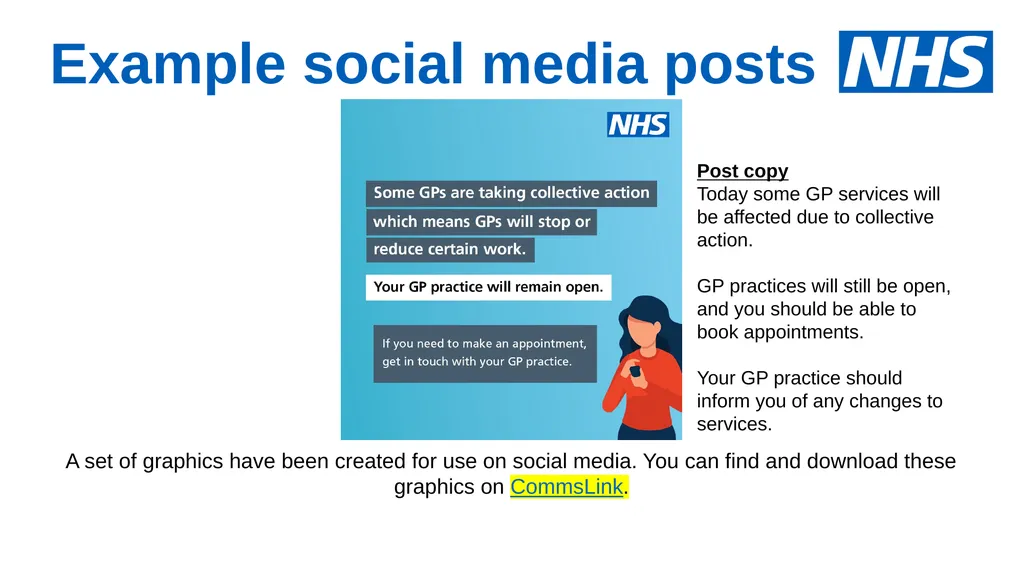
Example social media posts A set of graphics have been created for use on social media. You can find and download these graphics on CommsLink. Post copy
Today some GP services will be affected due to collective action.
GP practices will still be open, and you should be able to book appointments.
Your GP practice should inform you of any changes to services.<br>
Today some GP services will be affected due to collective action.
GP practices will still be open, and you should be able to book appointments.
Your GP practice should inform you of any changes to services.<br>
14
FAQs What is happening?
The BMA has announced that GPs will take collective action should their ballot outcome support this course of action. This means that GPs may choose to make changes to some aspects of how they work. Practices will still be open and will still see patients. However, some GPs may operate differently. Where this happens, patients may be directed to other local services to make sure that safe provision of care remains.
This is a non-statutory ballot for collective action, which means GPs should not be taking any action that would breach their contract.
I thought GPs were the NHS?
GPs are independent contractors who are contracted to provide NHS services. During collective action, GPs will still be working and will still be providing the NHS services that they are contracted to provide.<br>
The BMA has announced that GPs will take collective action should their ballot outcome support this course of action. This means that GPs may choose to make changes to some aspects of how they work. Practices will still be open and will still see patients. However, some GPs may operate differently. Where this happens, patients may be directed to other local services to make sure that safe provision of care remains.
This is a non-statutory ballot for collective action, which means GPs should not be taking any action that would breach their contract.
I thought GPs were the NHS?
GPs are independent contractors who are contracted to provide NHS services. During collective action, GPs will still be working and will still be providing the NHS services that they are contracted to provide.<br>
15
FAQs What is the impact of collective action?
During collective action practices are still required to fulfil their contracts, this essentially means:
Practices are required to be open between 0800 and 1830 – Monday to Friday.
Practices should provide reasonable care to patients this includes:
Making appointments available
Providing advice or care to patients by another means
Give advice on alternative services
Providing access to prescriptions, long terms condition management, vaccinations, diagnoses and referral (including where clinically urgent)
Practices also need to take into account:
The needs of a patient to avoid risks to patient safety
The benefits to patients of providing continuity of care.
The NHS is working hard to plan for disruption and to mitigate this where possible. GPs are choosing to take this action but the nature of the collective action means that the impacts will vary at different GP practices and area by area. We anticipate that this action will cause disruption across the NHS as patients may need to attend other services, this could mean appointments for some services not being at your usual GP practice and instead being somewhere else.<br>
During collective action practices are still required to fulfil their contracts, this essentially means:
Practices are required to be open between 0800 and 1830 – Monday to Friday.
Practices should provide reasonable care to patients this includes:
Making appointments available
Providing advice or care to patients by another means
Give advice on alternative services
Providing access to prescriptions, long terms condition management, vaccinations, diagnoses and referral (including where clinically urgent)
Practices also need to take into account:
The needs of a patient to avoid risks to patient safety
The benefits to patients of providing continuity of care.
The NHS is working hard to plan for disruption and to mitigate this where possible. GPs are choosing to take this action but the nature of the collective action means that the impacts will vary at different GP practices and area by area. We anticipate that this action will cause disruption across the NHS as patients may need to attend other services, this could mean appointments for some services not being at your usual GP practice and instead being somewhere else.<br>
16
FAQs When is this happening?
The nature of collective action means that it does not need a formal notice period, the BMA has indicated that this could mean action starting on 1 August 2024. As the action does not involve a breach of contract and practices will remain open, it could potentially continue for an unspecified but potentially significant period of time.
Is this safe?
Patient safety is a priority and the usual rules and considerations around safety continue to apply. GPs should not take any action that puts patient safety at risk.
Can I still get an appointment at my GP?
Yes, practices will still be open and you can book appointments through your practice. If you have an appointment, you should attend unless your GP practice tell you otherwise. Your GP practice should inform you of any changes to services.
What is NHS England doing about this?
The NHS and government is working hard to avert collective action and to plan for disruption and to mitigate this where possible. The nature of the collective action means that the impacts will vary at different GP practices. NHS England is working closely with government to review options for providing additional funding to further support general practice, subject to funding availability constraints.<br>
The nature of collective action means that it does not need a formal notice period, the BMA has indicated that this could mean action starting on 1 August 2024. As the action does not involve a breach of contract and practices will remain open, it could potentially continue for an unspecified but potentially significant period of time.
Is this safe?
Patient safety is a priority and the usual rules and considerations around safety continue to apply. GPs should not take any action that puts patient safety at risk.
Can I still get an appointment at my GP?
Yes, practices will still be open and you can book appointments through your practice. If you have an appointment, you should attend unless your GP practice tell you otherwise. Your GP practice should inform you of any changes to services.
What is NHS England doing about this?
The NHS and government is working hard to avert collective action and to plan for disruption and to mitigate this where possible. The nature of the collective action means that the impacts will vary at different GP practices. NHS England is working closely with government to review options for providing additional funding to further support general practice, subject to funding availability constraints.<br>