
Growth of functions CSE 3318 – Algorithms and Data



Description: Growth of functions CSE 3318 Algorithms and Data Structures Alexandra Stefan Based on presentations by Vassilis Athitsos and Bob Weems University of Texas at Arlington 1 9102024 Math Background book reference 2 Book Read chapter 3
Related Topics
Download Presentation
"Growth of functions CSE 3318 – Algorithms and Data" is the property of its rightful owner. Permission is granted to download and print the materials on this website for personal, non-commercial use only, and to display it on your personal computer provided you do not modify the materials and that you retain all copyright notices contained in the materials. By downloading content from our website, you accept the terms of this agreement.
Presentation Transcript
slide1. Growth of functions CSE 3318 – Algorithms and Data Structures
Alexandra Stefan
Based on presentations by
Vassilis Athitsos and Bob Weems
University of Texas at Arlington 1 9/10/2024<br>
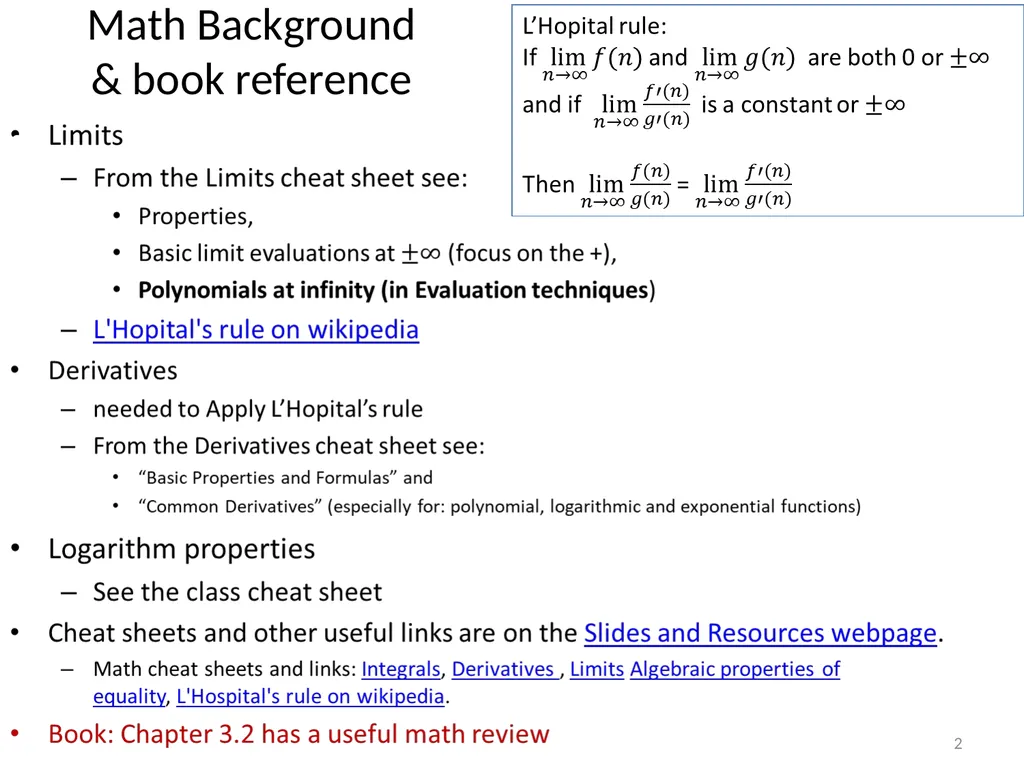
slide2. Math Background & book reference 2<br>
slide3. Book Read chapter 3
Including 3.2 which has useful math review 3<br>
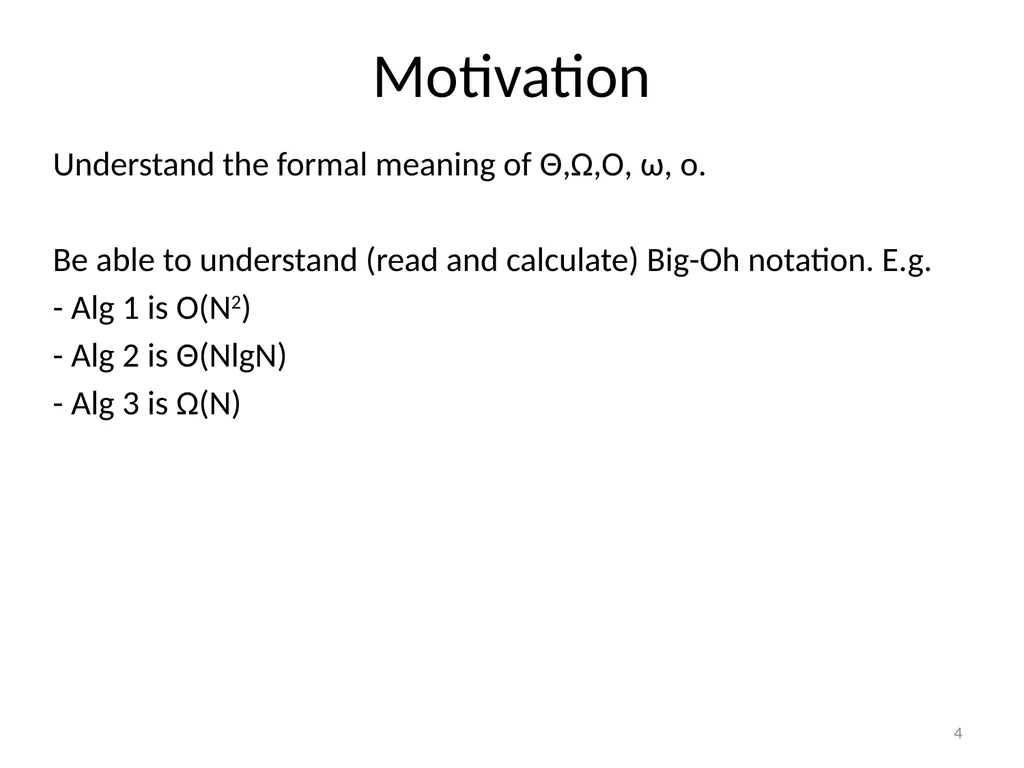
slide4. Motivation Understand the formal meaning of Θ,Ω,Ο, ω, o.
Be able to understand (read and calculate) Big-Oh notation. E.g.
- Alg 1 is O(N2)
- Alg 2 is Θ(NlgN)
- Alg 3 is Ω(N) 4<br>
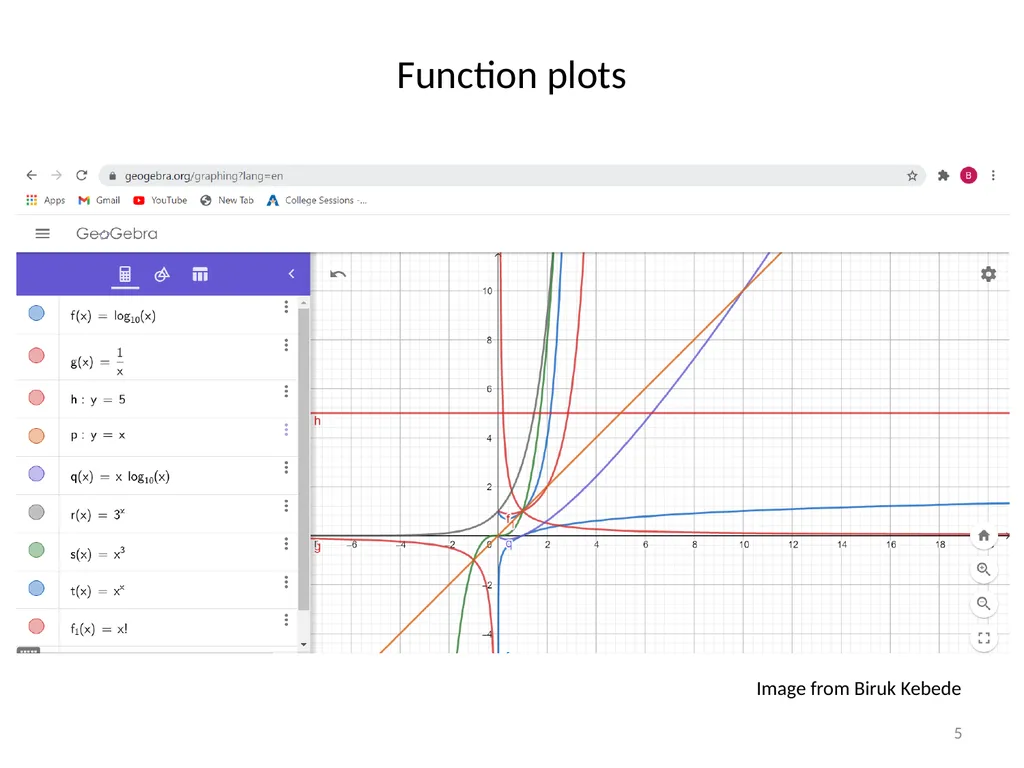
slide5. Function plots 5 Image from Biruk Kebede<br>
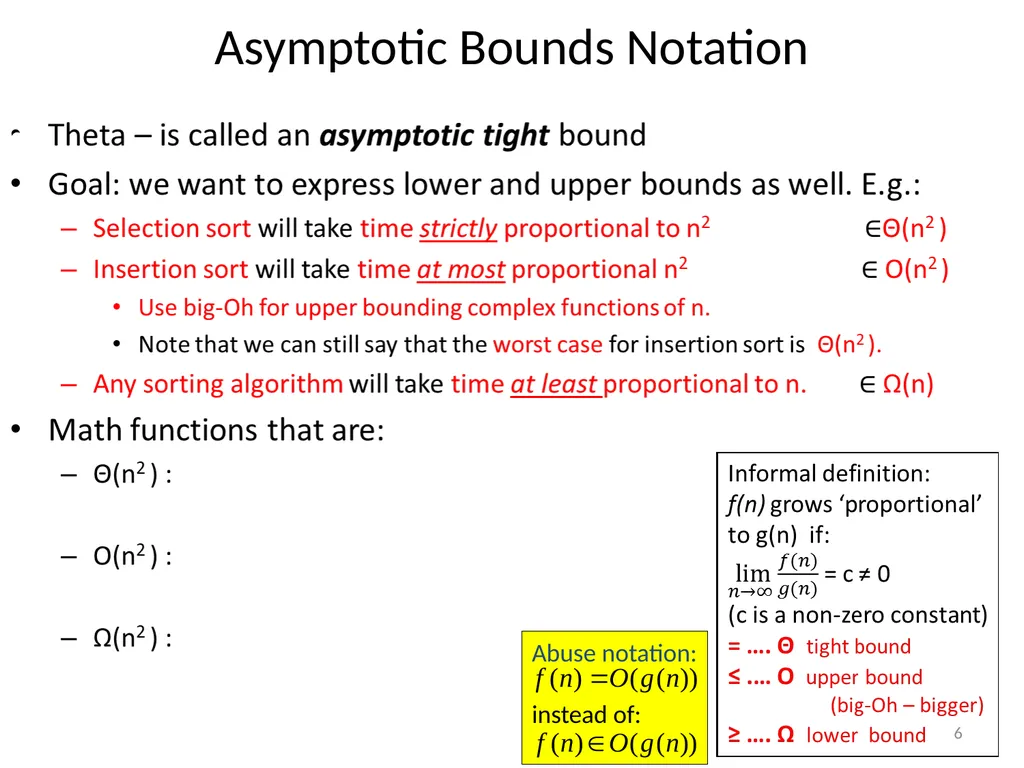
slide6. Asymptotic Bounds Notation 6 Abuse notation:
instead of:<br>
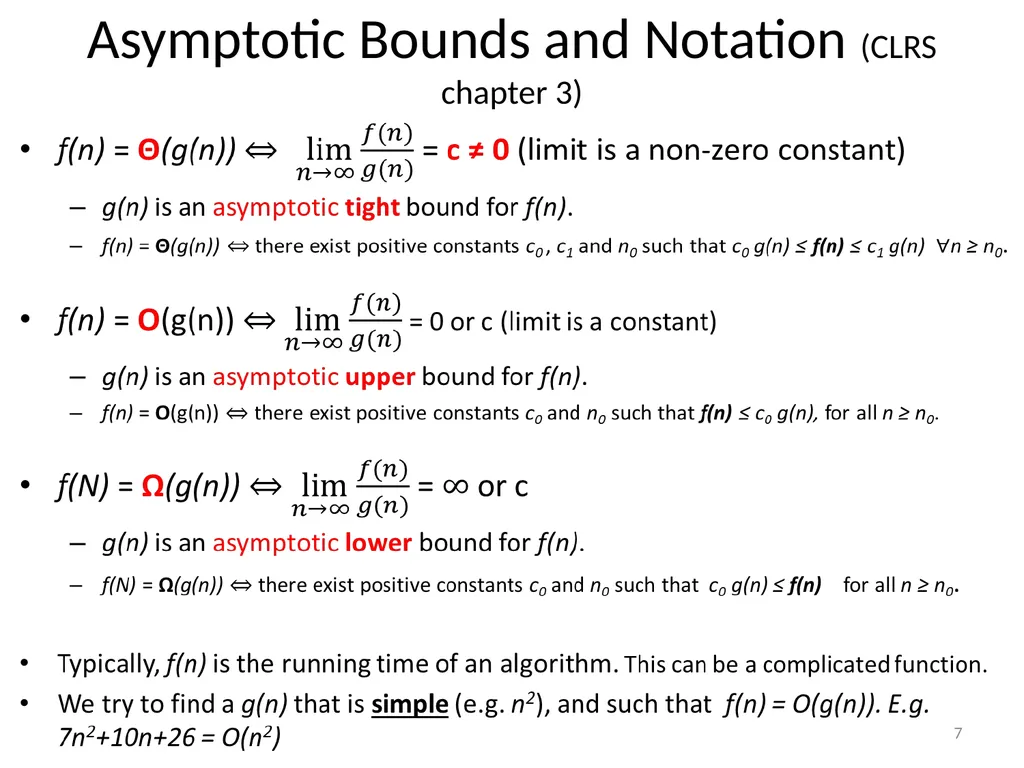
slide7. Asymptotic Bounds and Notation (CLRS chapter 3) 7<br>
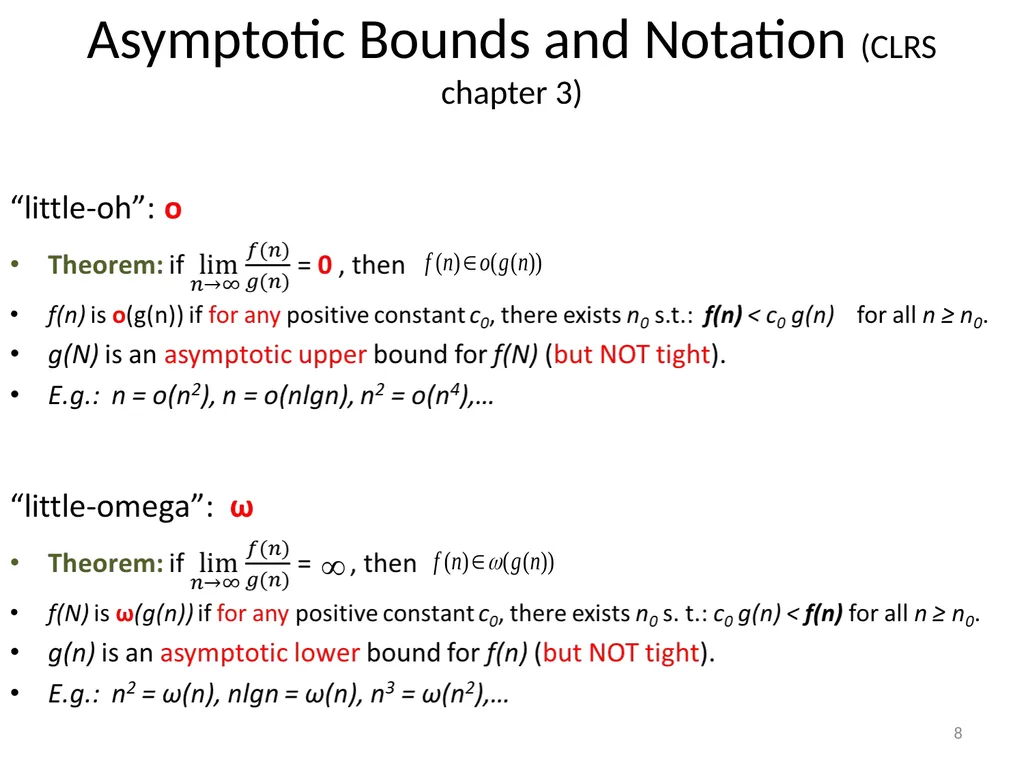
slide8. 8 Asymptotic Bounds and Notation (CLRS chapter 3)<br>
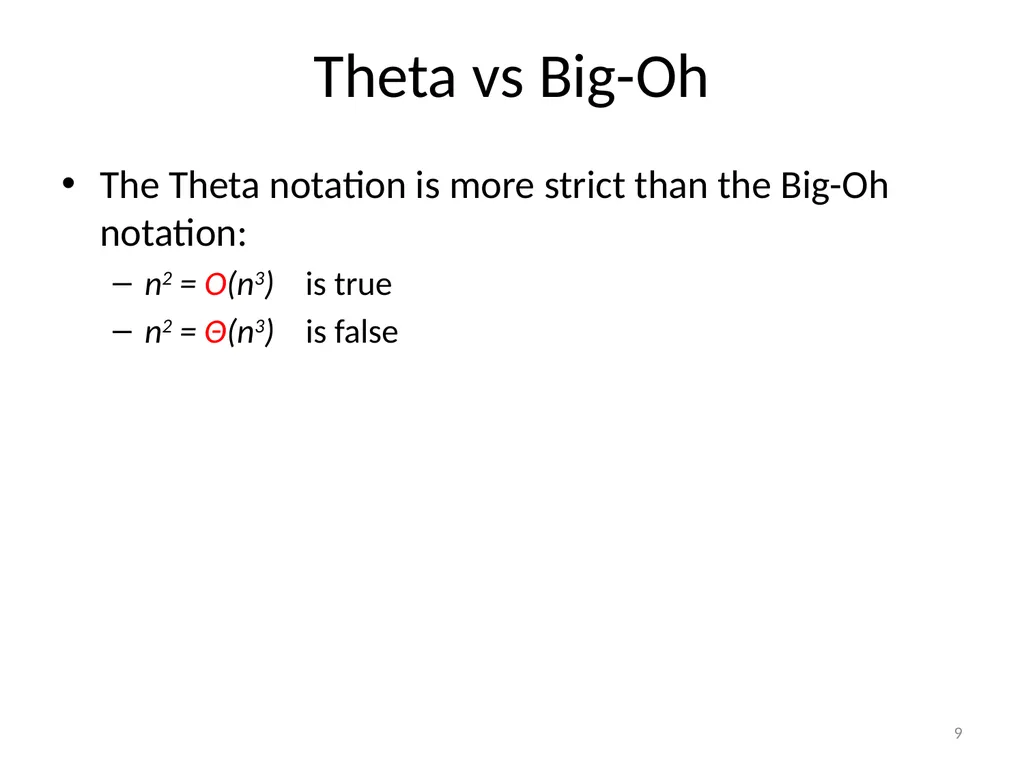
slide9. Theta vs Big-Oh The Theta notation is more strict than the Big-Oh notation:
n2 = O(n3) is true
n2 = Θ(n3) is false 9<br>
slide10. Properties of O, Ω and Θ 10<br>
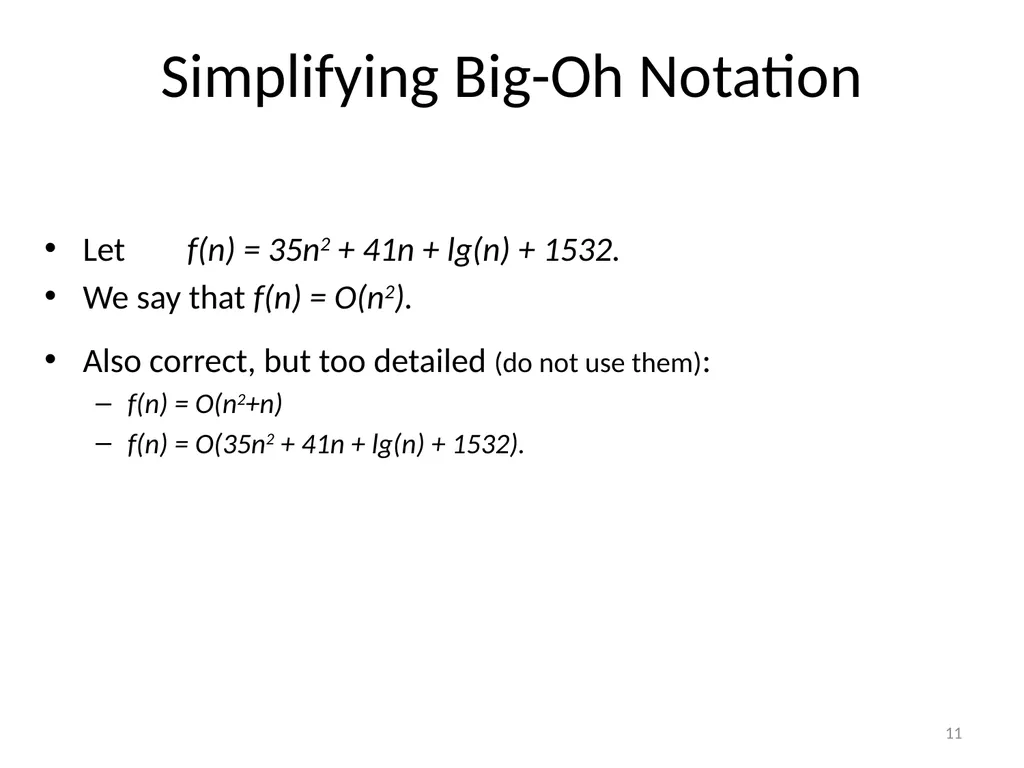
slide11. Simplifying Big-Oh Notation Let f(n) = 35n2 + 41n + lg(n) + 1532.
We say that f(n) = O(n2).
Also correct, but too detailed (do not use them):
f(n) = O(n2+n)
f(n) = O(35n2 + 41n + lg(n) + 1532). 11<br>
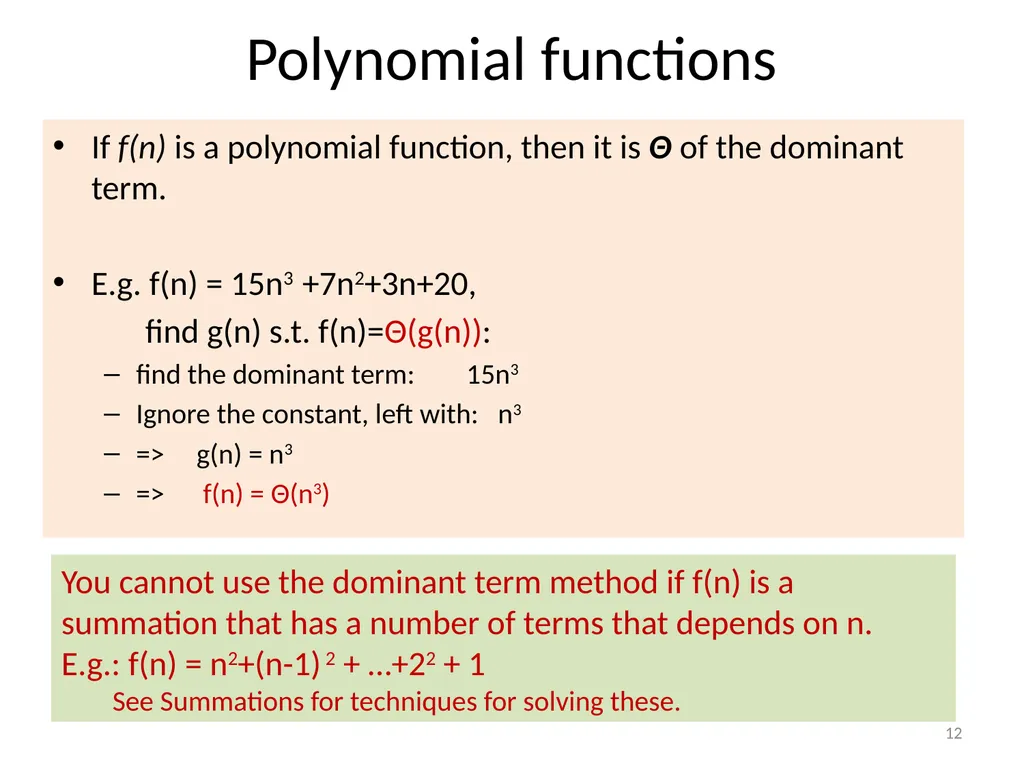
slide12. Polynomial functions If f(n) is a polynomial function, then it is Θ of the dominant term.
E.g. f(n) = 15n3 +7n2+3n+20,
find g(n) s.t. f(n)=Θ(g(n)):
find the dominant term: 15n3
Ignore the constant, left with: n3
=> g(n) = n3
=> f(n) = Θ(n3) 12 You cannot use the dominant term method if f(n) is a summation that has a number of terms that depends on n. E.g.: f(n) = n2+(n-1) 2 + …+22 + 1
See Summations for techniques for solving these.<br>
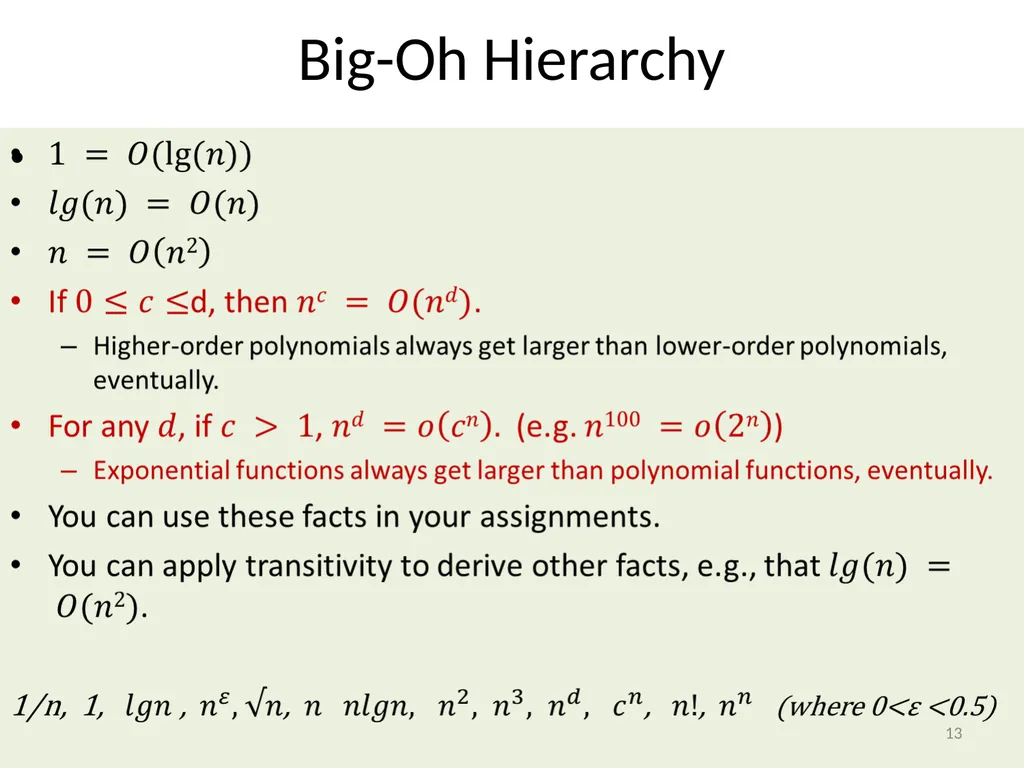
slide13. Big-Oh Hierarchy 13<br>
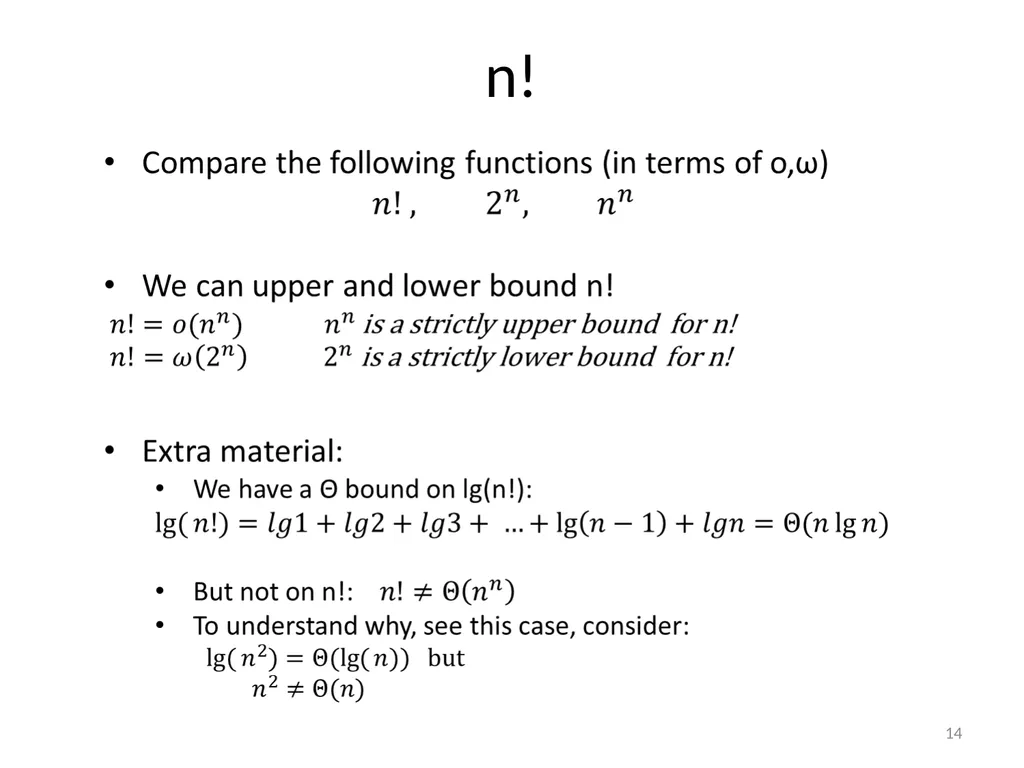
slide14. n! 14<br>
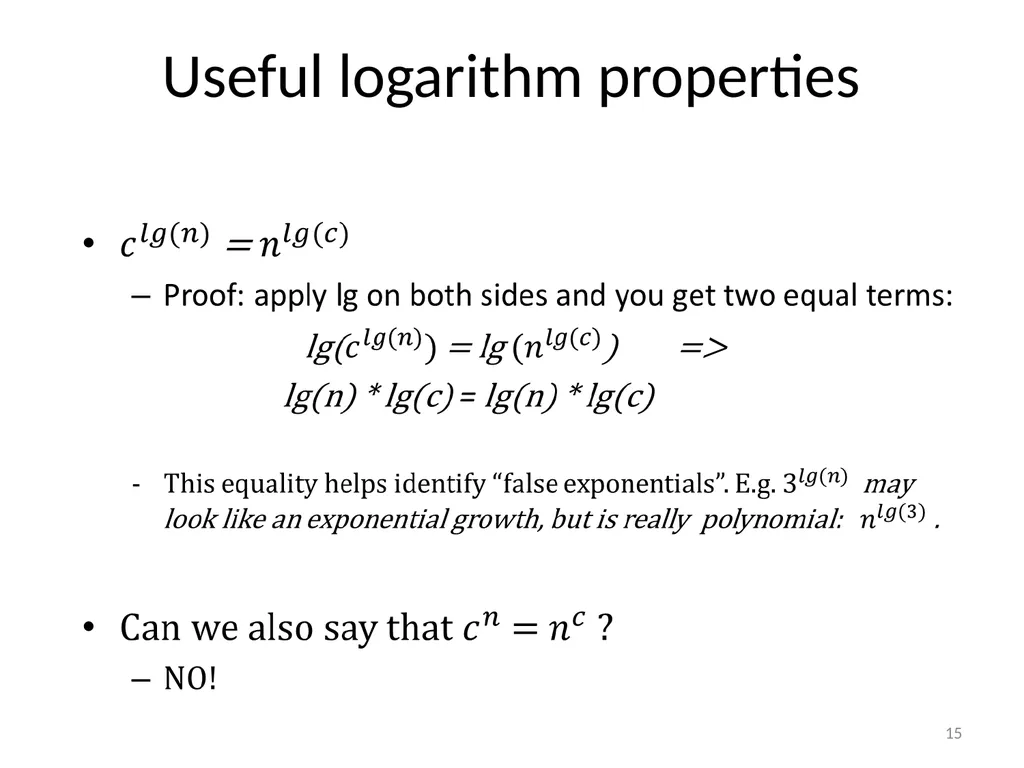
slide15. Useful logarithm properties 15<br>
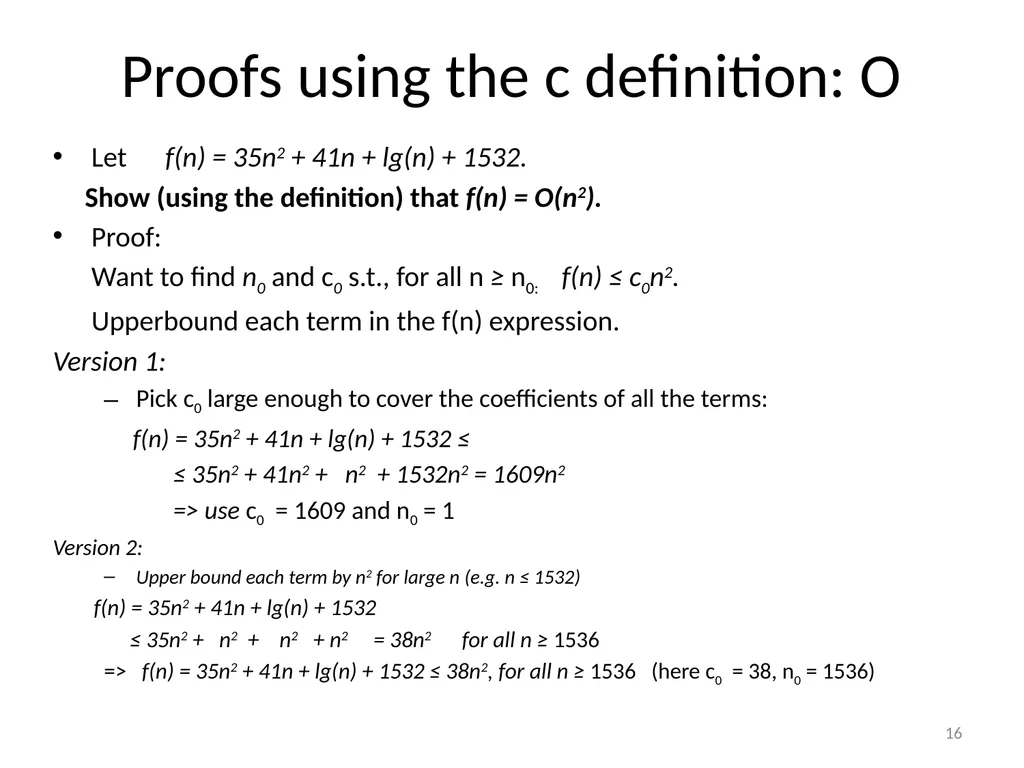
slide16. Proofs using the c definition: O Let f(n) = 35n2 + 41n + lg(n) + 1532.
Show (using the definition) that f(n) = O(n2).
Proof:
Want to find n0 and c0 s.t., for all n ≥ n0: f(n) ≤ c0n2.
Upperbound each term in the f(n) expression.
Version 1:
Pick c0 large enough to cover the coefficients of all the terms:
f(n) = 35n2 + 41n + lg(n) + 1532 ≤
≤ 35n2 + 41n2 + n2 + 1532n2 = 1609n2
=> use c0 = 1609 and n0 = 1
Version 2:
Upper bound each term by n2 for large n (e.g. n ≤ 1532)
f(n) = 35n2 + 41n + lg(n) + 1532
≤ 35n2 + n2 + n2 + n2 = 38n2 for all n ≥ 1536
=> f(n) = 35n2 + 41n + lg(n) + 1532 ≤ 38n2, for all n ≥ 1536 (here c0 = 38, n0 = 1536) 16<br>
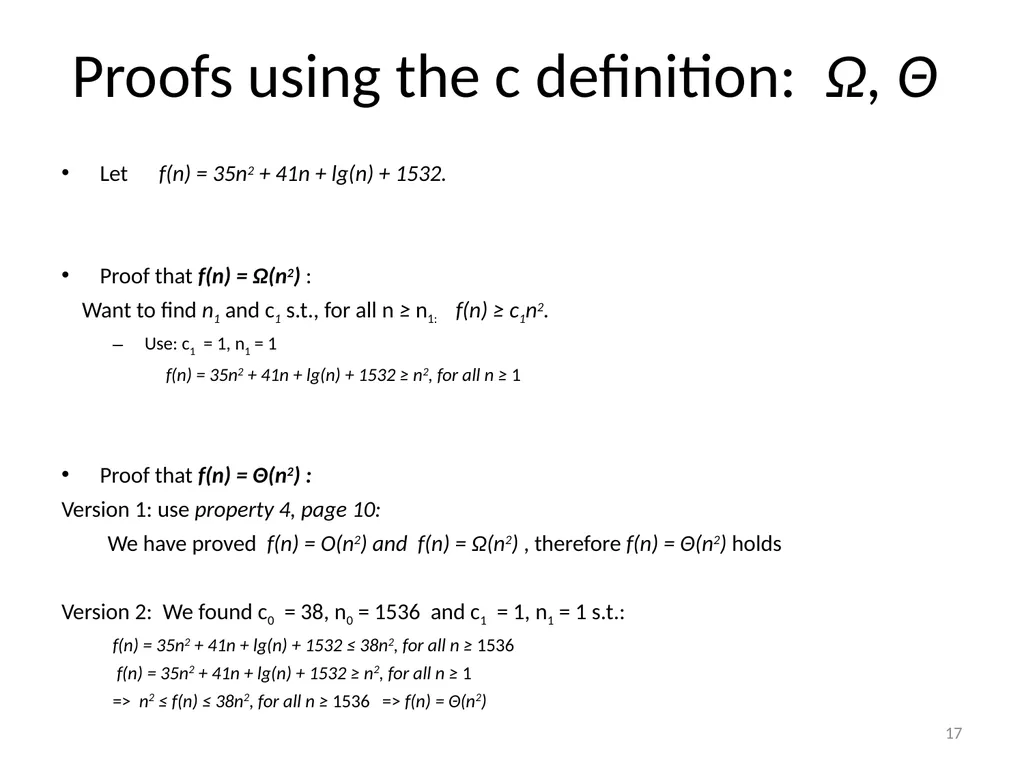
slide17. Proofs using the c definition: Ω, Θ Let f(n) = 35n2 + 41n + lg(n) + 1532.
Proof that f(n) = Ω(n2) :
Want to find n1 and c1 s.t., for all n ≥ n1: f(n) ≥ c1n2.
Use: c1 = 1, n1 = 1
f(n) = 35n2 + 41n + lg(n) + 1532 ≥ n2, for all n ≥ 1
Proof that f(n) = Θ(n2) :
Version 1: use property 4, page 10:
We have proved f(n) = O(n2) and f(n) = Ω(n2) , therefore f(n) = Θ(n2) holds
Version 2: We found c0 = 38, n0 = 1536 and c1 = 1, n1 = 1 s.t.:
f(n) = 35n2 + 41n + lg(n) + 1532 ≤ 38n2, for all n ≥ 1536
f(n) = 35n2 + 41n + lg(n) + 1532 ≥ n2, for all n ≥ 1
=> n2 ≤ f(n) ≤ 38n2, for all n ≥ 1536 => f(n) = Θ(n2) 17<br>
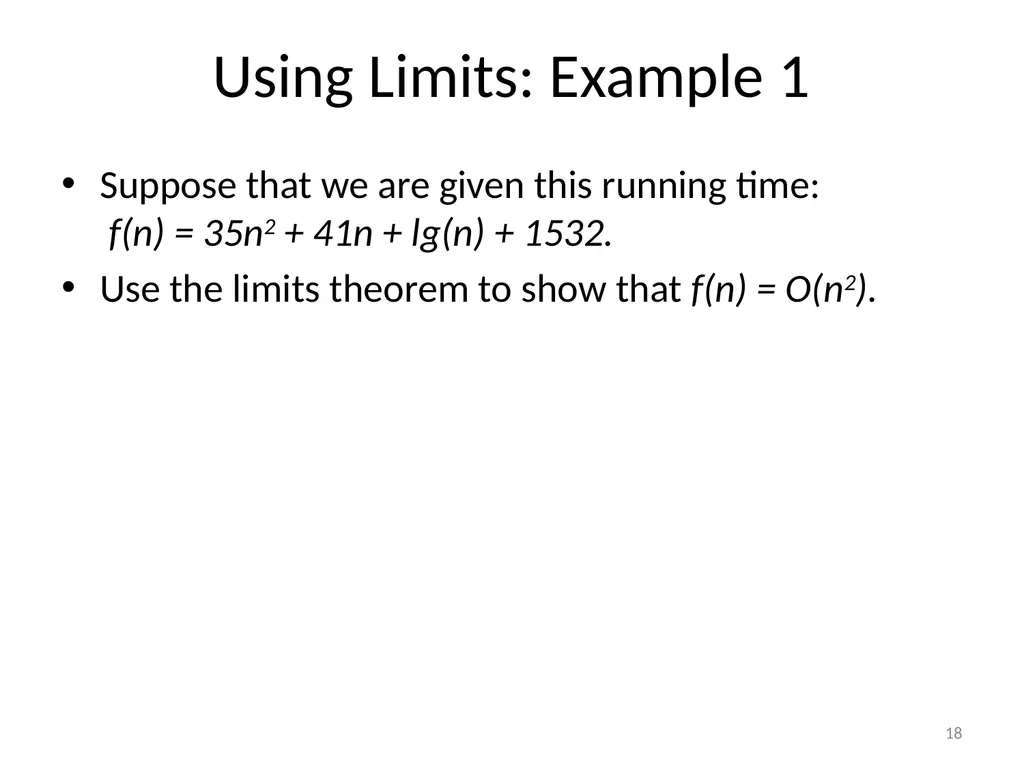
slide18. Using Limits: Example 1 Suppose that we are given this running time: f(n) = 35n2 + 41n + lg(n) + 1532.
Use the limits theorem to show that f(n) = O(n2). 18<br>
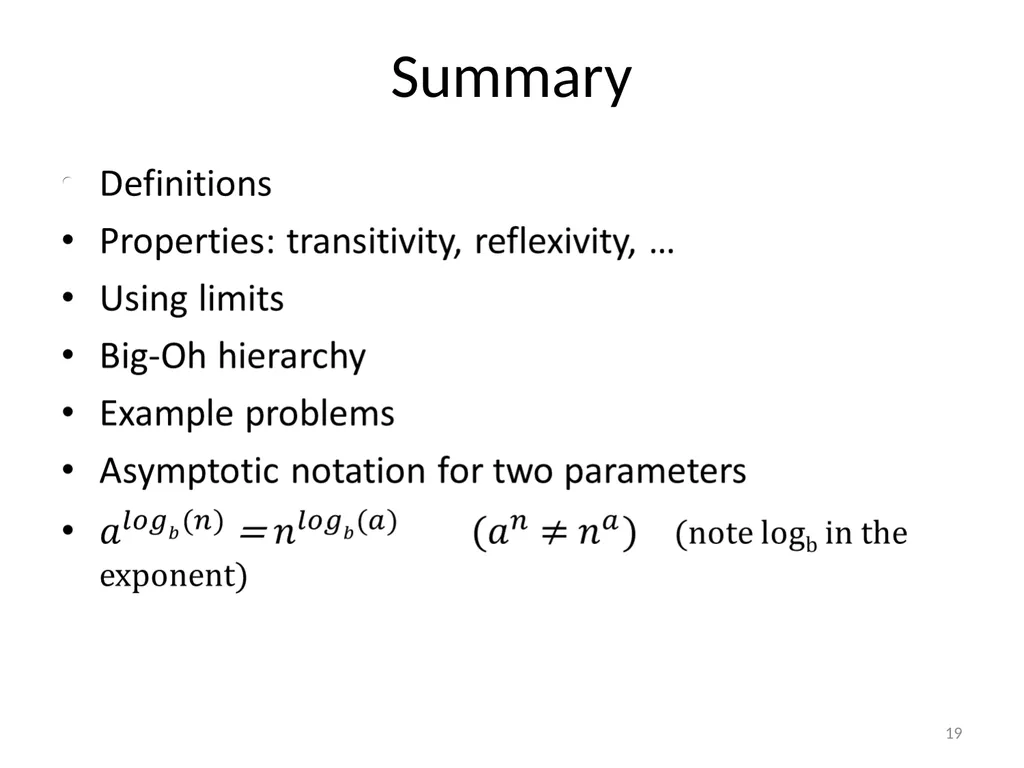
slide19. Summary 19<br>
slide20. EXTRA NOT REQUIRED 20<br>
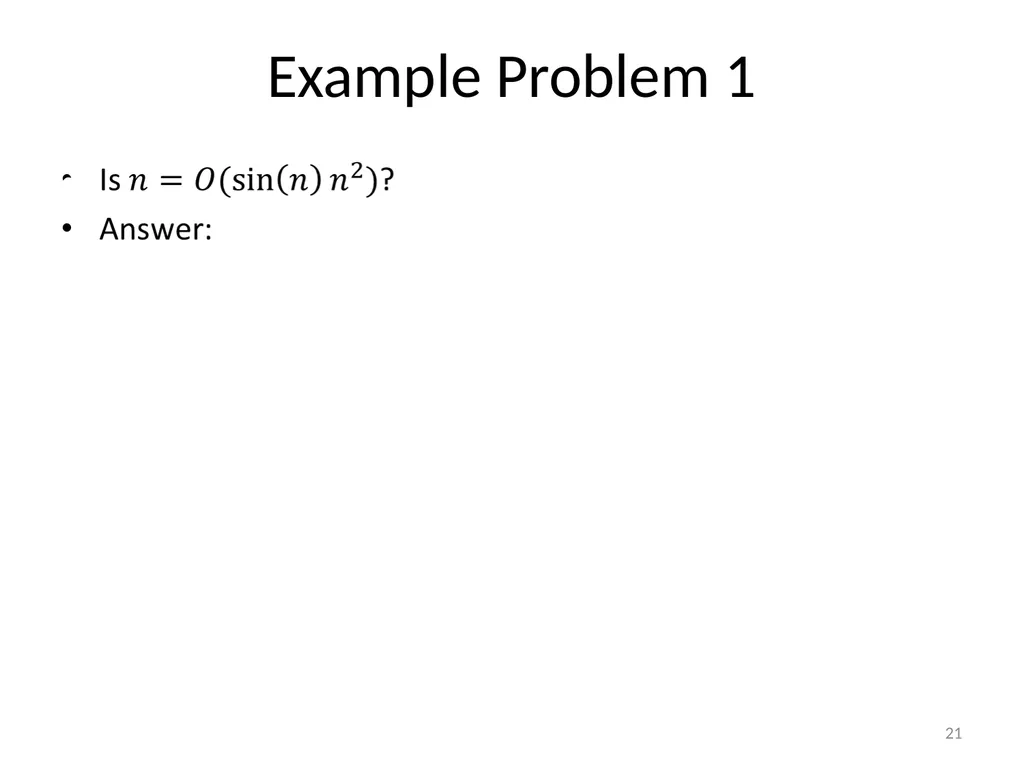
slide21. Example Problem 1 21<br>
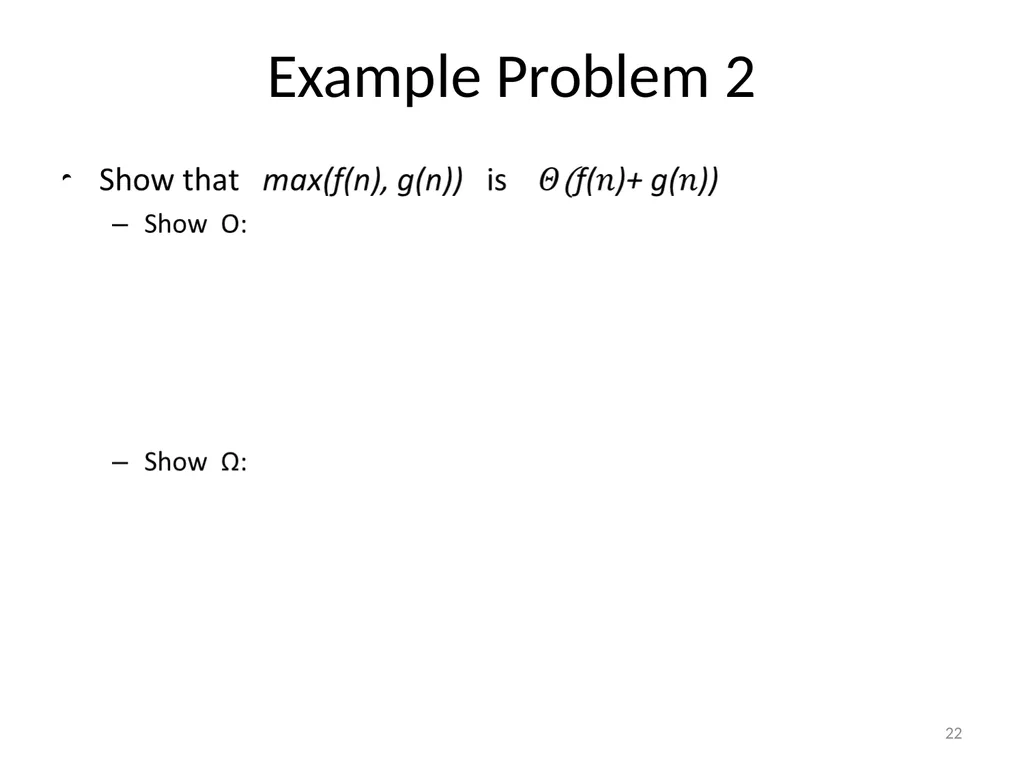
slide22. Example Problem 2 22<br>
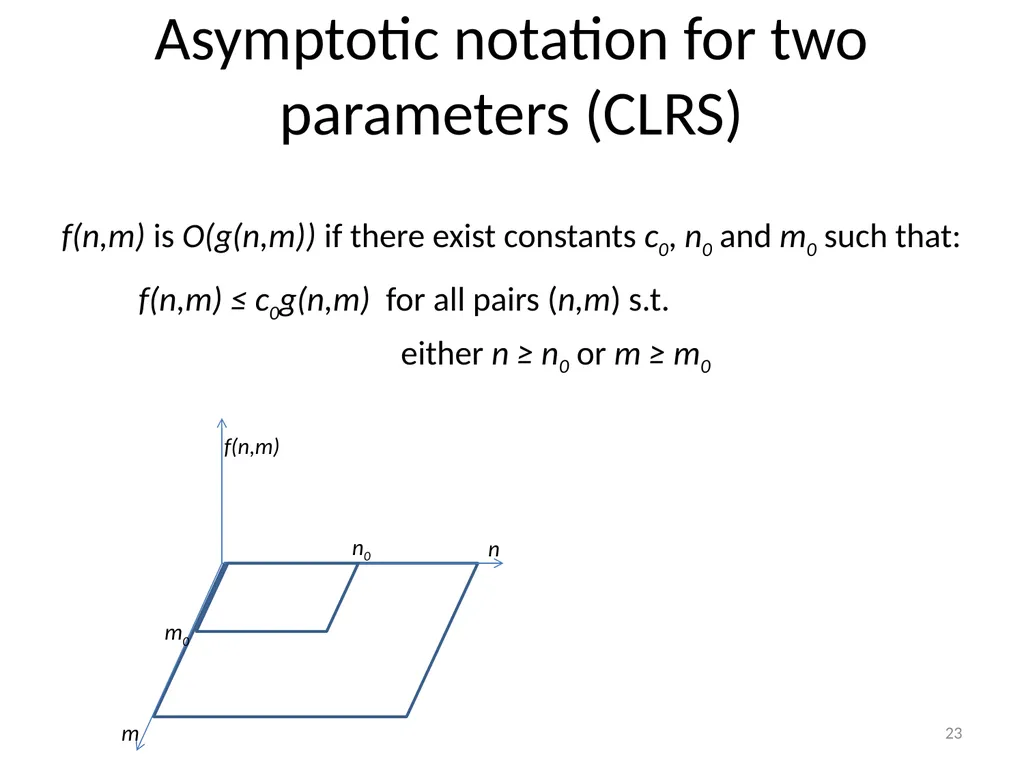
slide23. Asymptotic notation for two parameters (CLRS) f(n,m) is O(g(n,m)) if there exist constants c0, n0 and m0 such that: f(n,m) ≤ c0g(n,m) for all pairs (n,m) s.t.
either n ≥ n0 or m ≥ m0 23<br>
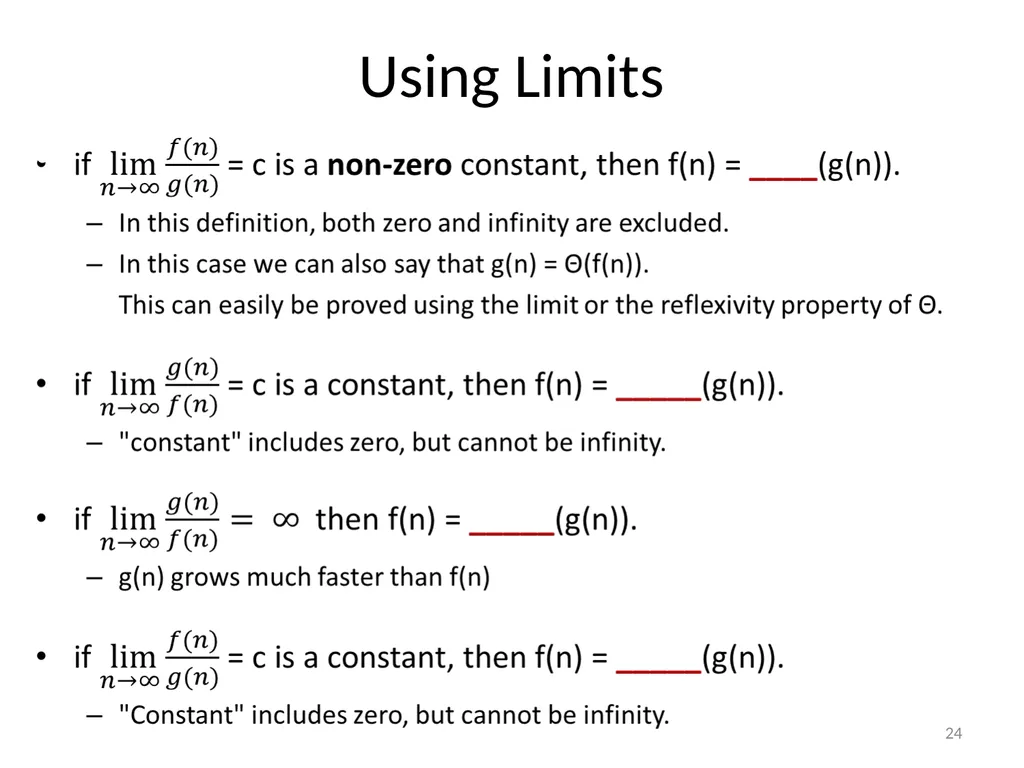
slide24. Using Limits 24<br>
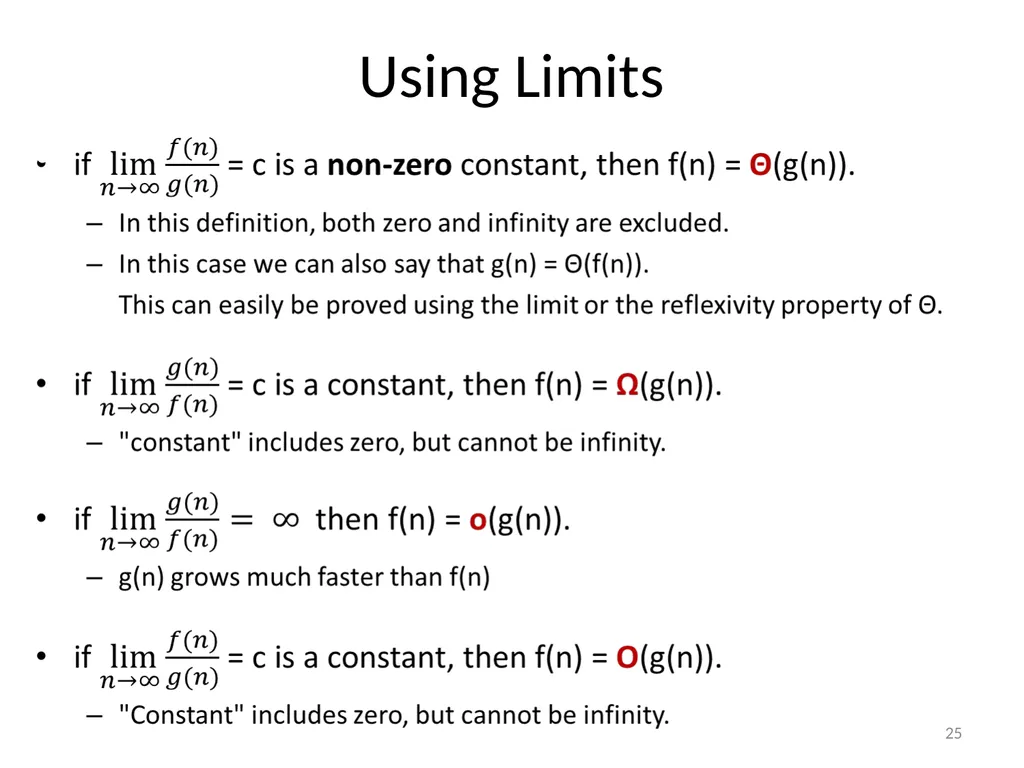
slide25. Using Limits 25<br>
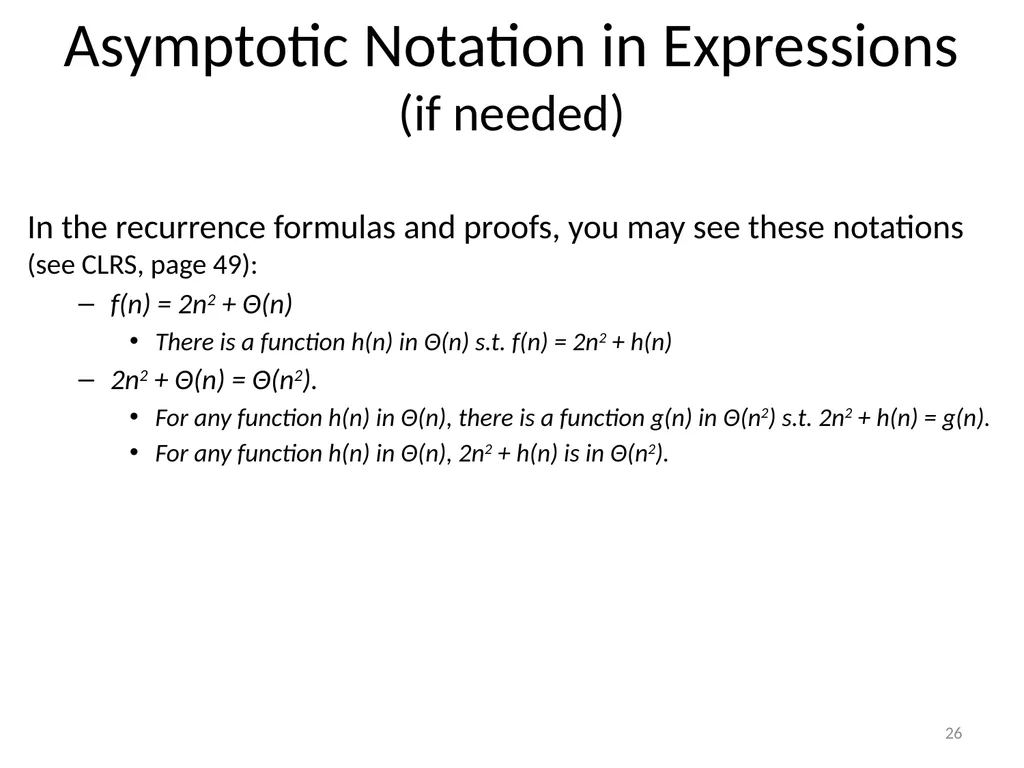
slide26. Asymptotic Notation in Expressions (if needed) In the recurrence formulas and proofs, you may see these notations (see CLRS, page 49):
f(n) = 2n2 + Θ(n)
There is a function h(n) in Θ(n) s.t. f(n) = 2n2 + h(n)
2n2 + Θ(n) = Θ(n2).
For any function h(n) in Θ(n), there is a function g(n) in Θ(n2) s.t. 2n2 + h(n) = g(n).
For any function h(n) in Θ(n), 2n2 + h(n) is in Θ(n2). 26<br>
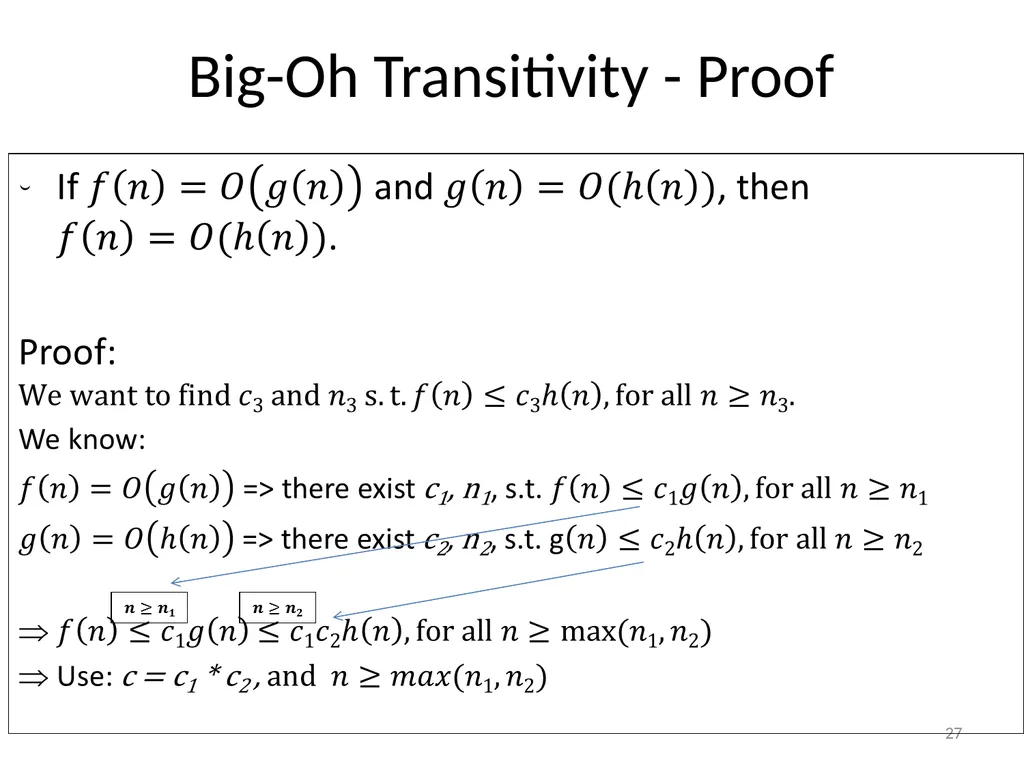
slide27. Big-Oh Transitivity - Proof 27<br>
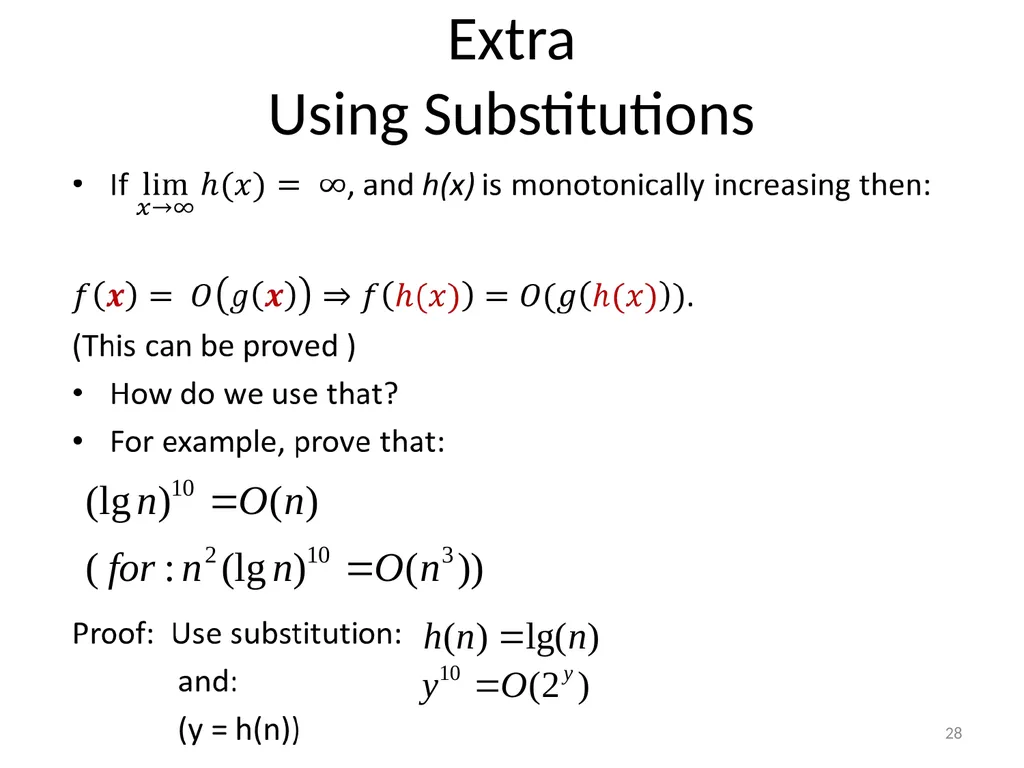
slide28. Extra Using Substitutions 28<br>
Alexandra Stefan
Based on presentations by
Vassilis Athitsos and Bob Weems
University of Texas at Arlington 1 9/10/2024<br>
slide2. Math Background & book reference 2<br>
slide3. Book Read chapter 3
Including 3.2 which has useful math review 3<br>
slide4. Motivation Understand the formal meaning of Θ,Ω,Ο, ω, o.
Be able to understand (read and calculate) Big-Oh notation. E.g.
- Alg 1 is O(N2)
- Alg 2 is Θ(NlgN)
- Alg 3 is Ω(N) 4<br>
slide5. Function plots 5 Image from Biruk Kebede<br>
slide6. Asymptotic Bounds Notation 6 Abuse notation:
instead of:<br>
slide7. Asymptotic Bounds and Notation (CLRS chapter 3) 7<br>
slide8. 8 Asymptotic Bounds and Notation (CLRS chapter 3)<br>
slide9. Theta vs Big-Oh The Theta notation is more strict than the Big-Oh notation:
n2 = O(n3) is true
n2 = Θ(n3) is false 9<br>
slide10. Properties of O, Ω and Θ 10<br>
slide11. Simplifying Big-Oh Notation Let f(n) = 35n2 + 41n + lg(n) + 1532.
We say that f(n) = O(n2).
Also correct, but too detailed (do not use them):
f(n) = O(n2+n)
f(n) = O(35n2 + 41n + lg(n) + 1532). 11<br>
slide12. Polynomial functions If f(n) is a polynomial function, then it is Θ of the dominant term.
E.g. f(n) = 15n3 +7n2+3n+20,
find g(n) s.t. f(n)=Θ(g(n)):
find the dominant term: 15n3
Ignore the constant, left with: n3
=> g(n) = n3
=> f(n) = Θ(n3) 12 You cannot use the dominant term method if f(n) is a summation that has a number of terms that depends on n. E.g.: f(n) = n2+(n-1) 2 + …+22 + 1
See Summations for techniques for solving these.<br>
slide13. Big-Oh Hierarchy 13<br>
slide14. n! 14<br>
slide15. Useful logarithm properties 15<br>
slide16. Proofs using the c definition: O Let f(n) = 35n2 + 41n + lg(n) + 1532.
Show (using the definition) that f(n) = O(n2).
Proof:
Want to find n0 and c0 s.t., for all n ≥ n0: f(n) ≤ c0n2.
Upperbound each term in the f(n) expression.
Version 1:
Pick c0 large enough to cover the coefficients of all the terms:
f(n) = 35n2 + 41n + lg(n) + 1532 ≤
≤ 35n2 + 41n2 + n2 + 1532n2 = 1609n2
=> use c0 = 1609 and n0 = 1
Version 2:
Upper bound each term by n2 for large n (e.g. n ≤ 1532)
f(n) = 35n2 + 41n + lg(n) + 1532
≤ 35n2 + n2 + n2 + n2 = 38n2 for all n ≥ 1536
=> f(n) = 35n2 + 41n + lg(n) + 1532 ≤ 38n2, for all n ≥ 1536 (here c0 = 38, n0 = 1536) 16<br>
slide17. Proofs using the c definition: Ω, Θ Let f(n) = 35n2 + 41n + lg(n) + 1532.
Proof that f(n) = Ω(n2) :
Want to find n1 and c1 s.t., for all n ≥ n1: f(n) ≥ c1n2.
Use: c1 = 1, n1 = 1
f(n) = 35n2 + 41n + lg(n) + 1532 ≥ n2, for all n ≥ 1
Proof that f(n) = Θ(n2) :
Version 1: use property 4, page 10:
We have proved f(n) = O(n2) and f(n) = Ω(n2) , therefore f(n) = Θ(n2) holds
Version 2: We found c0 = 38, n0 = 1536 and c1 = 1, n1 = 1 s.t.:
f(n) = 35n2 + 41n + lg(n) + 1532 ≤ 38n2, for all n ≥ 1536
f(n) = 35n2 + 41n + lg(n) + 1532 ≥ n2, for all n ≥ 1
=> n2 ≤ f(n) ≤ 38n2, for all n ≥ 1536 => f(n) = Θ(n2) 17<br>
slide18. Using Limits: Example 1 Suppose that we are given this running time: f(n) = 35n2 + 41n + lg(n) + 1532.
Use the limits theorem to show that f(n) = O(n2). 18<br>
slide19. Summary 19<br>
slide20. EXTRA NOT REQUIRED 20<br>
slide21. Example Problem 1 21<br>
slide22. Example Problem 2 22<br>
slide23. Asymptotic notation for two parameters (CLRS) f(n,m) is O(g(n,m)) if there exist constants c0, n0 and m0 such that: f(n,m) ≤ c0g(n,m) for all pairs (n,m) s.t.
either n ≥ n0 or m ≥ m0 23<br>
slide24. Using Limits 24<br>
slide25. Using Limits 25<br>
slide26. Asymptotic Notation in Expressions (if needed) In the recurrence formulas and proofs, you may see these notations (see CLRS, page 49):
f(n) = 2n2 + Θ(n)
There is a function h(n) in Θ(n) s.t. f(n) = 2n2 + h(n)
2n2 + Θ(n) = Θ(n2).
For any function h(n) in Θ(n), there is a function g(n) in Θ(n2) s.t. 2n2 + h(n) = g(n).
For any function h(n) in Θ(n), 2n2 + h(n) is in Θ(n2). 26<br>
slide27. Big-Oh Transitivity - Proof 27<br>
slide28. Extra Using Substitutions 28<br>