Hi Year 4, For the next 2 weeks you will work your way through 2 PowerPoints called All About France. I have attached a worksheet which you can start to fill in and you will complete it next week, when you have seen the second PowerPoint.
"Hi Year 4, For the next 2 weeks you will" is the property of its rightful owner. Permission is granted to
download and print the materials on this website for personal, non-commercial use only, and to display it
on your personal computer provided you do not modify the materials and that you retain all copyright
notices contained in the materials. By downloading content from our website, you accept the terms of this
agreement.
Presentation Transcript
01
Hi Year 4, For the next 2 weeks you will work your way through 2 PowerPoints called All About France. I have attached a worksheet which you can start to fill in and you will complete it next week, when you have seen the second PowerPoint. It’s very interesting to learn some key facts about France. Enjoy! Madame Betson.<br>
02
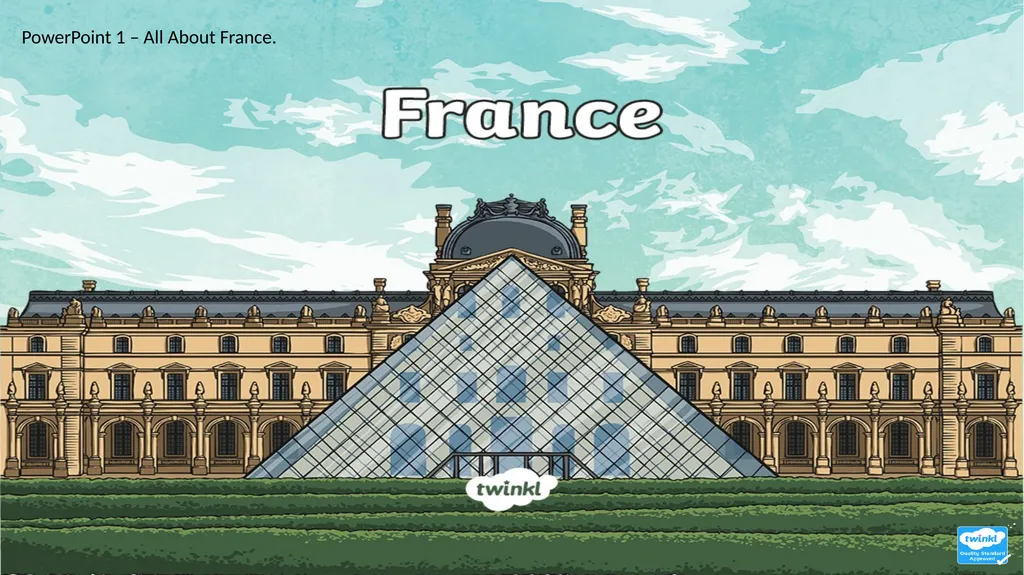
PowerPoint 1 – All About France.<br>
03
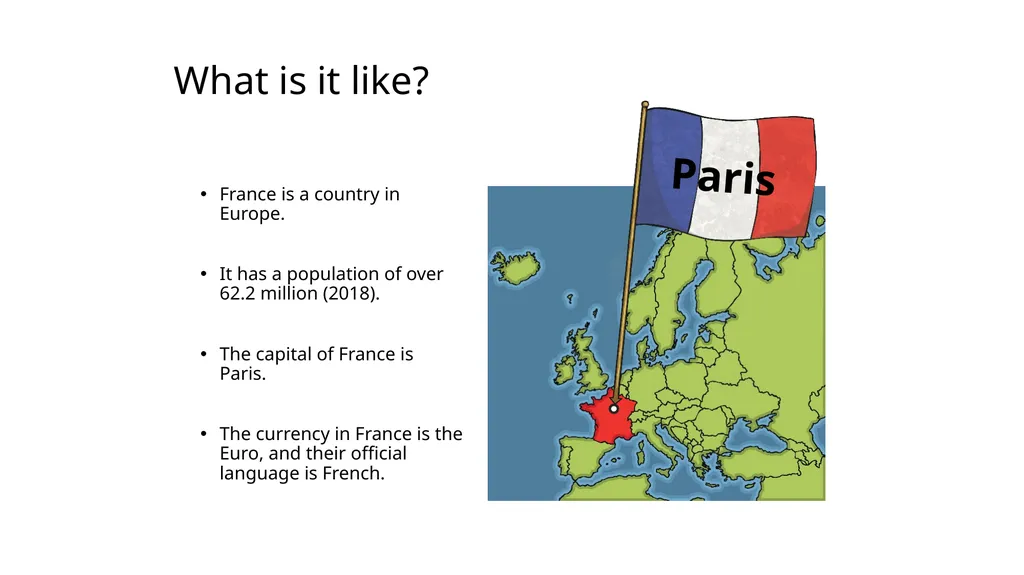
What is it like? France is a country in Europe.
It has a population of over 62.2 million (2018).
The capital of France is Paris.
The currency in France is the Euro, and their official language is French.<br>
04
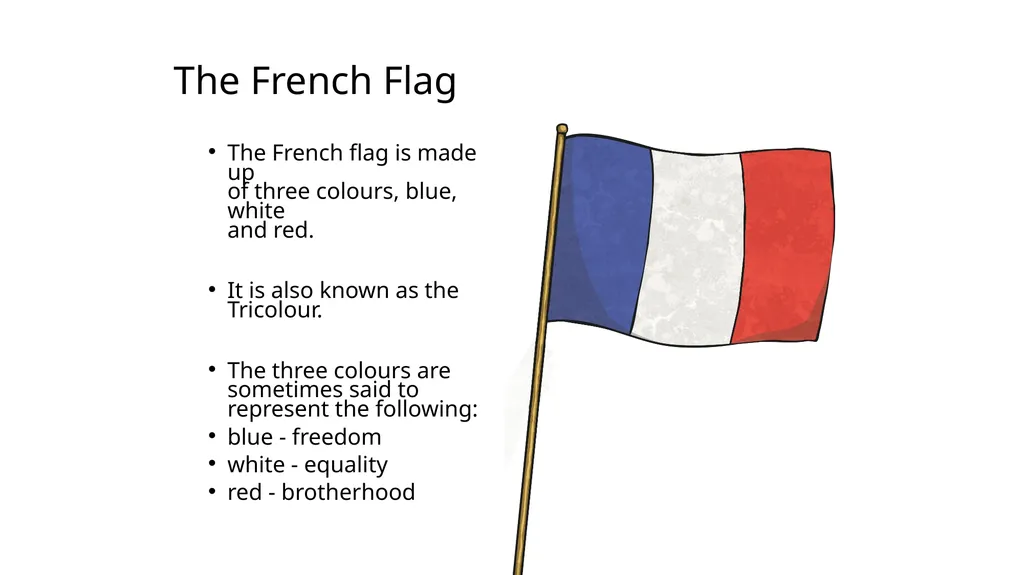
The French Flag The French flag is made up of three colours, blue, white and red.
It is also known as the Tricolour.
The three colours are sometimes said to represent the following:
blue - freedom
white - equality
red - brotherhood<br>
05
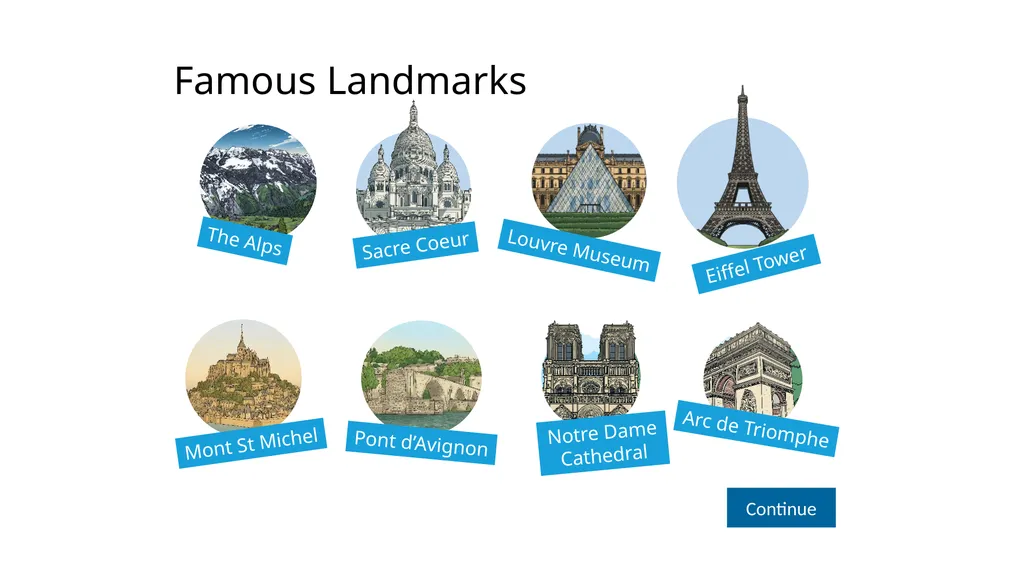
Famous Landmarks Continue<br>
06
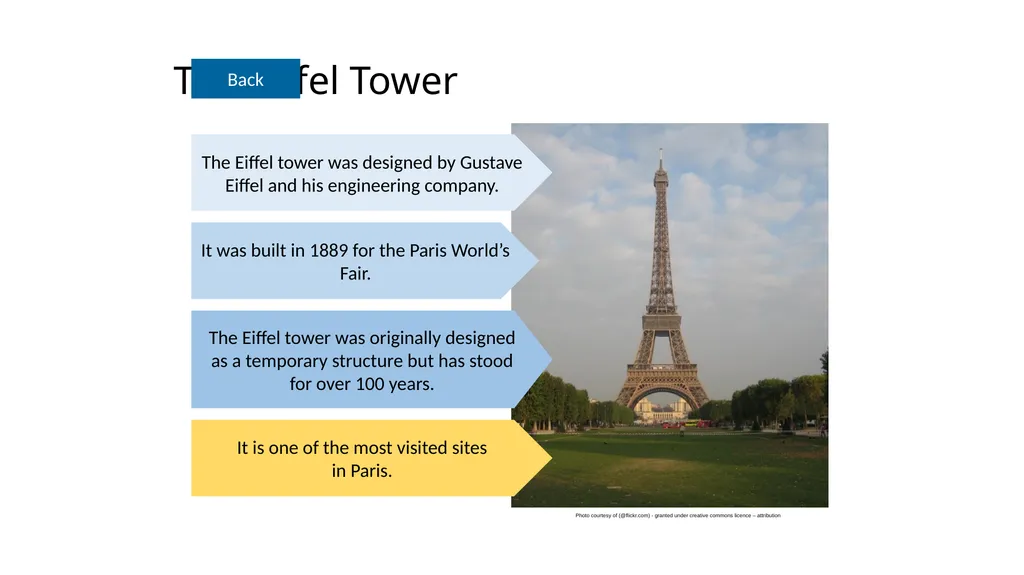
The Eiffel Tower Photo courtesy of (@flickr.com) - granted under creative commons licence – attribution The Eiffel tower was designed by Gustave Eiffel and his engineering company. It was built in 1889 for the Paris World’s Fair. The Eiffel tower was originally designed as a temporary structure but has stood for over 100 years. It is one of the most visited sites
in Paris. Back<br>
07
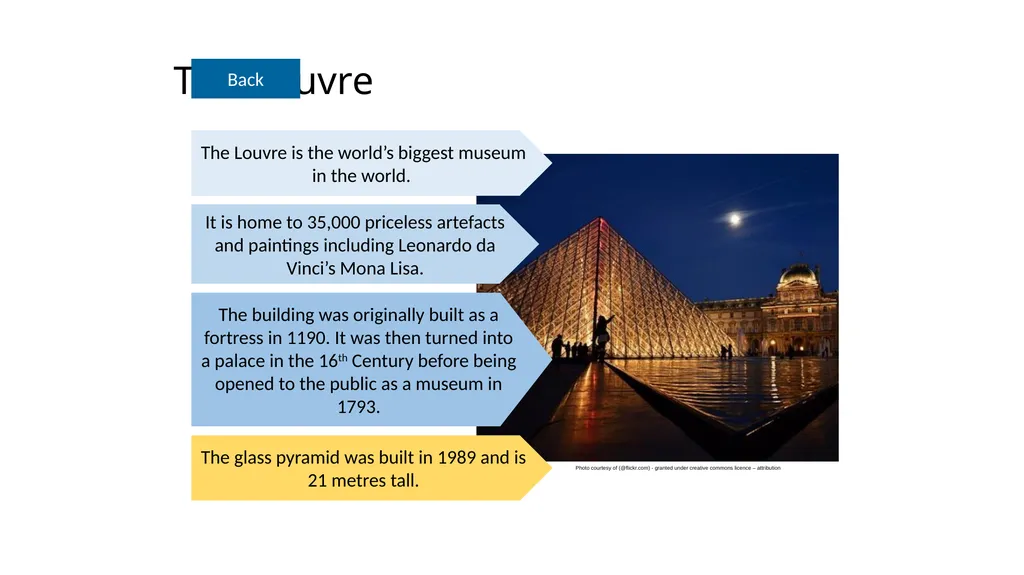
The Louvre Photo courtesy of (@flickr.com) - granted under creative commons licence – attribution The Louvre is the world’s biggest museum in the world. It is home to 35,000 priceless artefacts and paintings including Leonardo da Vinci’s Mona Lisa. The building was originally built as a fortress in 1190. It was then turned into a palace in the 16th Century before being opened to the public as a museum in 1793. The glass pyramid was built in 1989 and is 21 metres tall. Back<br>
08
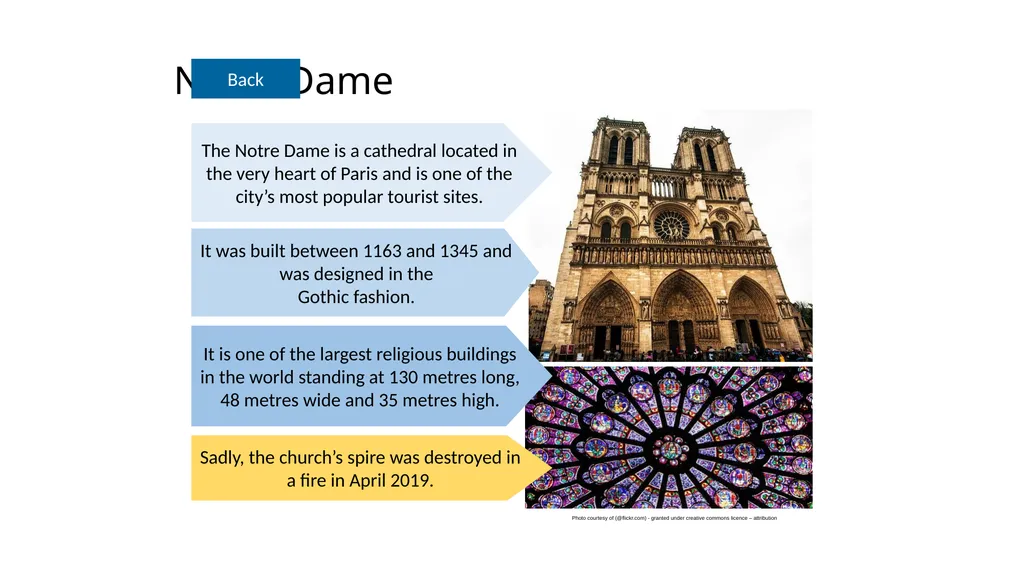
Notre Dame Photo courtesy of (@flickr.com) - granted under creative commons licence – attribution The Notre Dame is a cathedral located in the very heart of Paris and is one of the city’s most popular tourist sites. It was built between 1163 and 1345 and was designed in the Gothic fashion. It is one of the largest religious buildings in the world standing at 130 metres long, 48 metres wide and 35 metres high. Sadly, the church’s spire was destroyed in a fire in April 2019. Back<br>
09
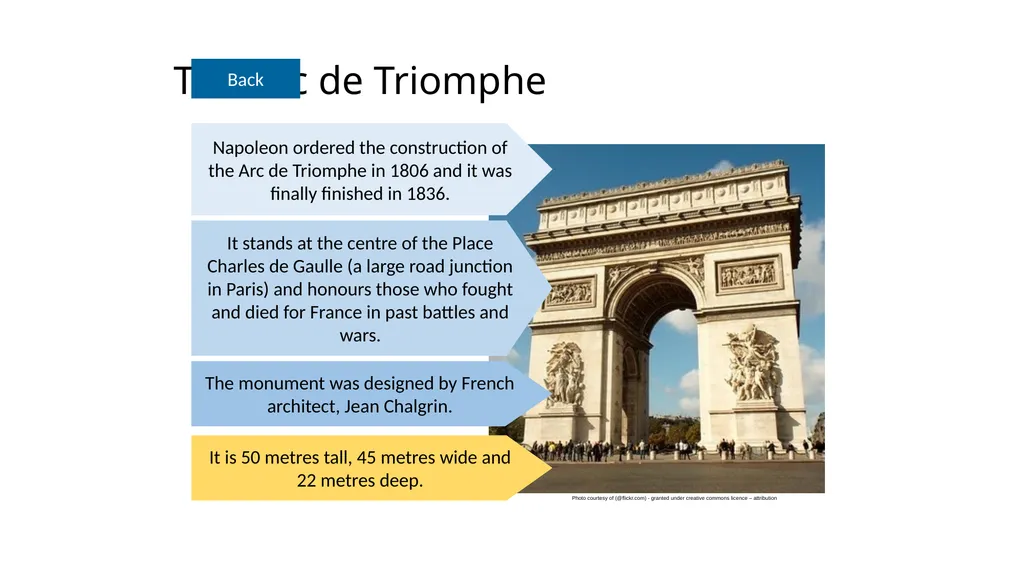
The Arc de Triomphe Photo courtesy of (@flickr.com) - granted under creative commons licence – attribution Napoleon ordered the construction of the Arc de Triomphe in 1806 and it was finally finished in 1836. It stands at the centre of the Place Charles de Gaulle (a large road junction in Paris) and honours those who fought and died for France in past battles and wars. The monument was designed by French architect, Jean Chalgrin. It is 50 metres tall, 45 metres wide and 22 metres deep. Back<br>
10
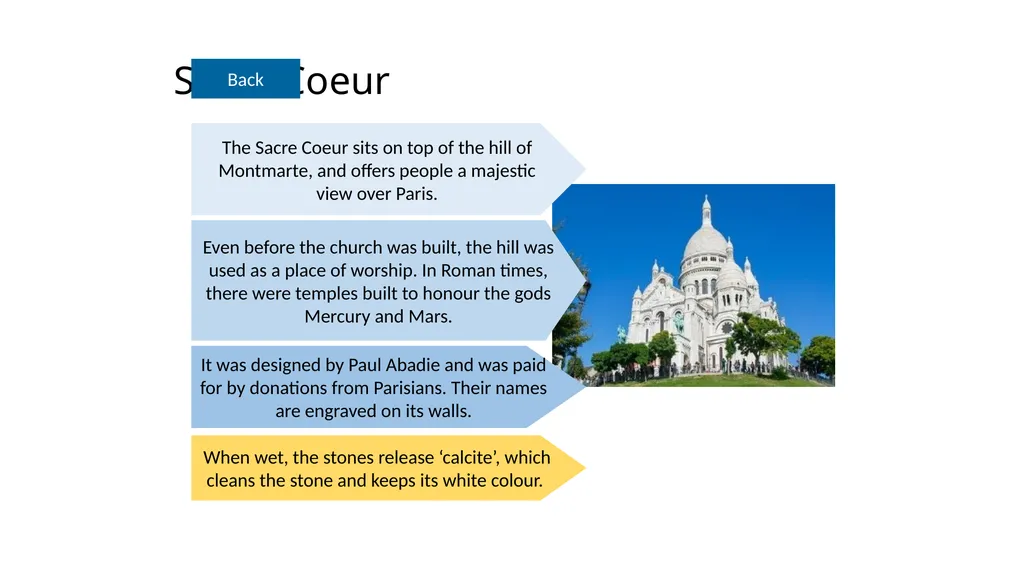
Sacre Coeur The Sacre Coeur sits on top of the hill of Montmarte, and offers people a majestic view over Paris. Even before the church was built, the hill was used as a place of worship. In Roman times, there were temples built to honour the gods Mercury and Mars. It was designed by Paul Abadie and was paid for by donations from Parisians. Their names are engraved on its walls. When wet, the stones release ‘calcite’, which cleans the stone and keeps its white colour. Back<br>
11
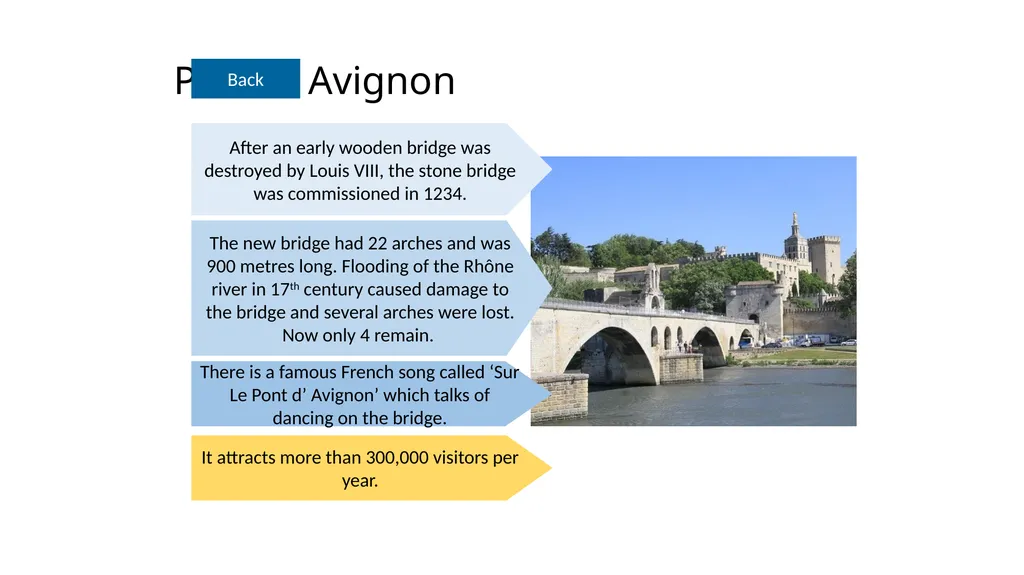
Pont d’ Avignon After an early wooden bridge was destroyed by Louis VIII, the stone bridge was commissioned in 1234. The new bridge had 22 arches and was 900 metres long. Flooding of the Rhône river in 17th century caused damage to the bridge and several arches were lost. Now only 4 remain. There is a famous French song called ‘Sur Le Pont d’ Avignon’ which talks of dancing on the bridge. It attracts more than 300,000 visitors per year. Back<br>
12
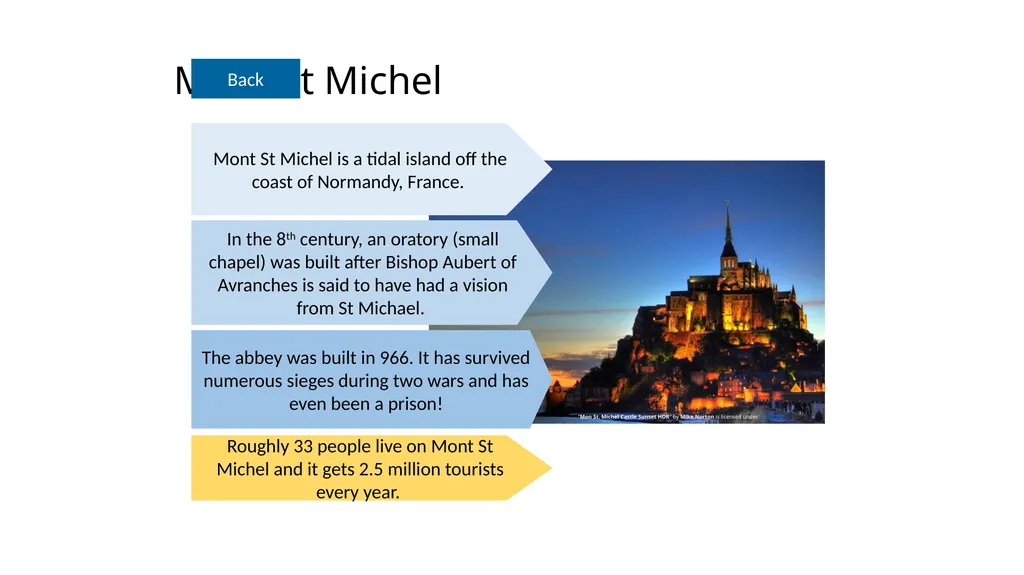
Mont St Michel Mont St Michel is a tidal island off the coast of Normandy, France. In the 8th century, an oratory (small chapel) was built after Bishop Aubert of Avranches is said to have had a vision from St Michael. The abbey was built in 966. It has survived numerous sieges during two wars and has even been a prison! Roughly 33 people live on Mont St Michel and it gets 2.5 million tourists every year. Back “Mon St. Michel Castle Sunset HDR” by Mike Norton is licensed under CC BY 2.0<br>
13
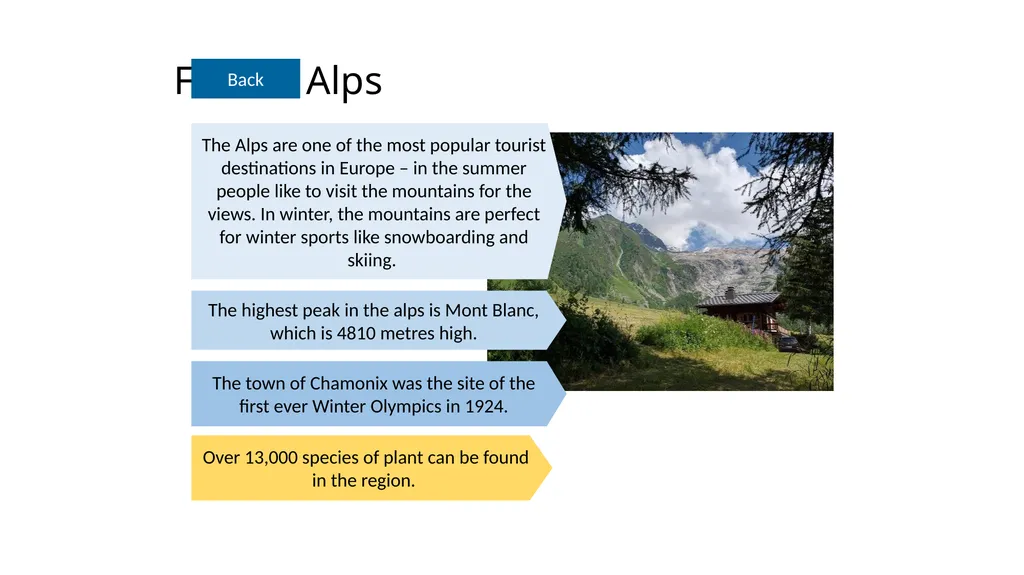
French Alps The Alps are one of the most popular tourist destinations in Europe – in the summer people like to visit the mountains for the views. In winter, the mountains are perfect for winter sports like snowboarding and skiing. The highest peak in the alps is Mont Blanc, which is 4810 metres high. The town of Chamonix was the site of the first ever Winter Olympics in 1924. Over 13,000 species of plant can be found in the region. Back<br>