
High-Level Overview Josephine Hanley, ACCA Fair
NS
Published · 22 slides · 0 views

1 / 1
Description
High-Level Overview Josephine Hanley, ACCA Fair Labor Standards Act Overtime 1 2 FLSA Overtime 3 Fair Labor Standards Act (FLSA) 4 Is FLSA Overtime New? 5 Impact of FLSA Overtime Violations 6 Classification: FLSA Exempt or Non-Exempt FLSA
Related Topics
Share
Embed code
Download this presentation From Below
"High-Level Overview Josephine Hanley, ACCA Fair" is the property of its rightful owner. Permission is granted to download and print the materials on this website for personal, non-commercial use only, and to display it on your personal computer provided you do not modify the materials and that you retain all copyright notices contained in the materials. By downloading content from our website, you accept the terms of this agreement.
Presentation Transcript
01
High-Level Overview
Josephine Hanley, ACCA Fair Labor Standards Act Overtime 1<br>
Josephine Hanley, ACCA Fair Labor Standards Act Overtime 1<br>
02
2<br>
03
FLSA Overtime 3<br>
04
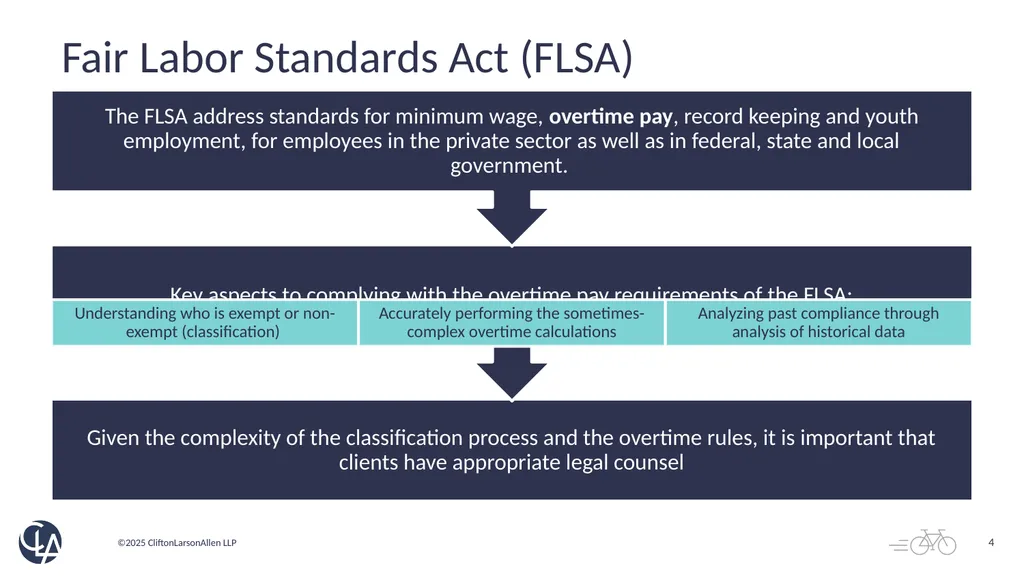
Fair Labor Standards Act (FLSA) 4<br>
05
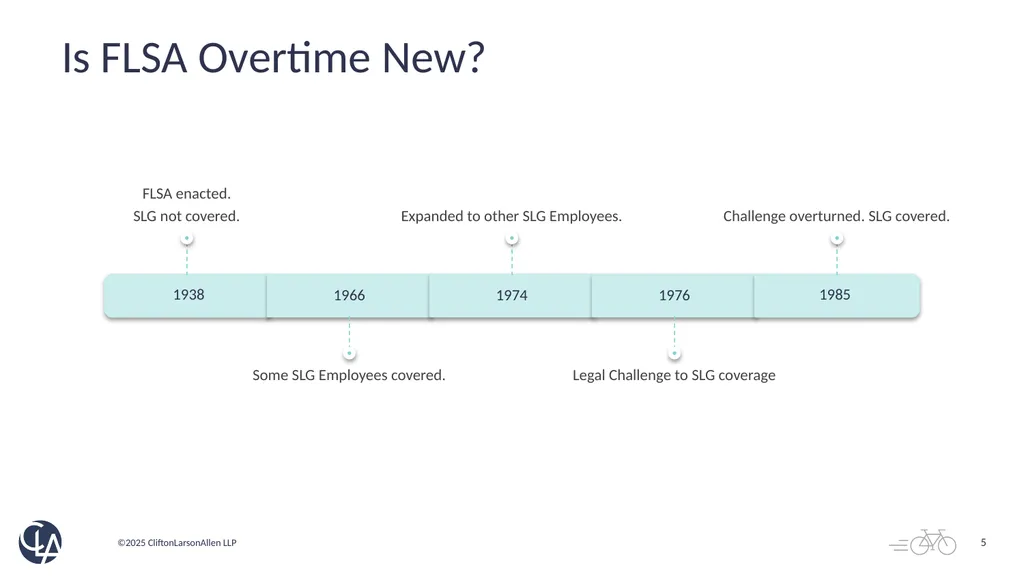
Is FLSA Overtime New? 5<br>
06
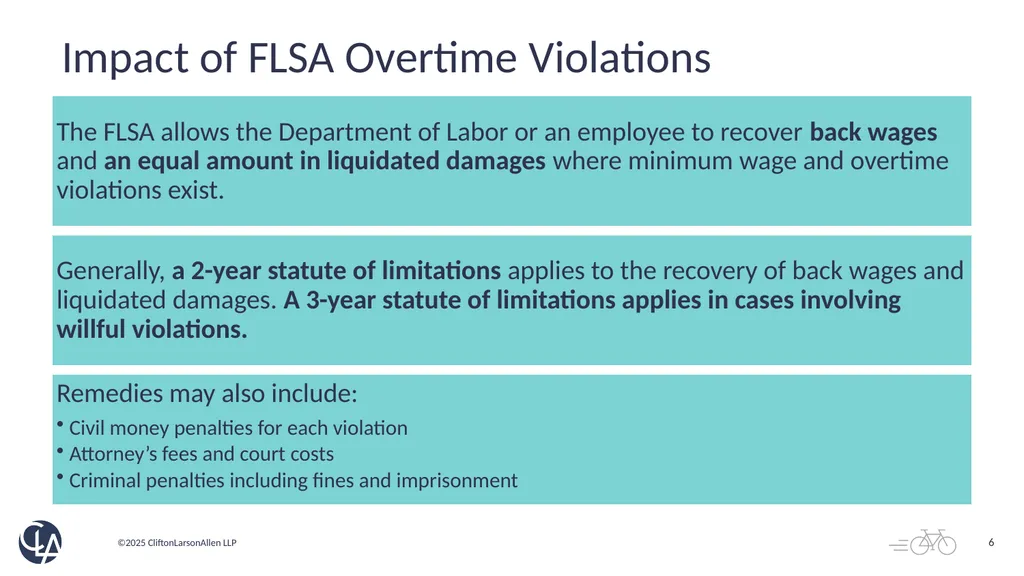
Impact of FLSA Overtime Violations 6<br>
07
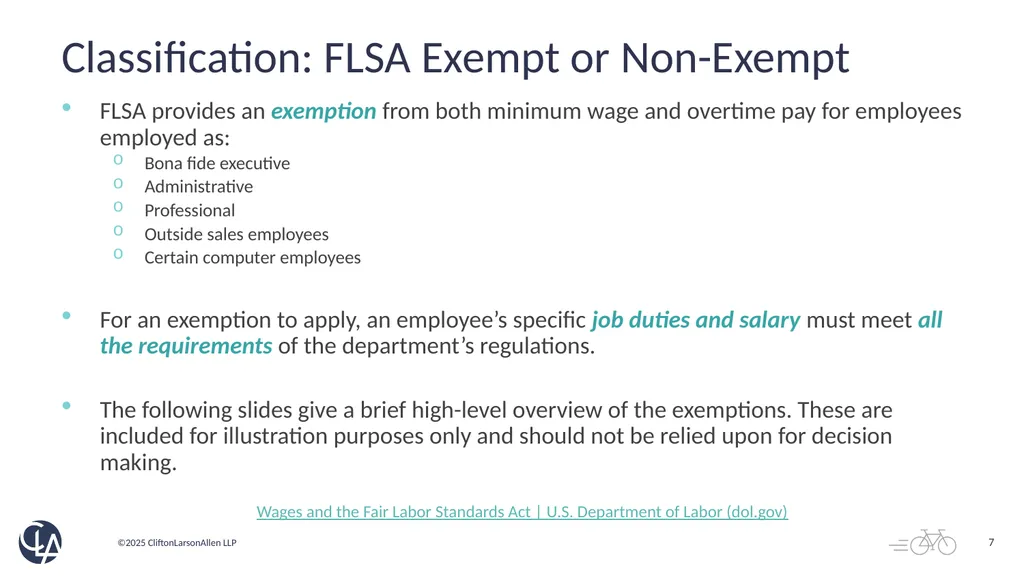
Classification: FLSA Exempt or Non-Exempt FLSA provides an exemption from both minimum wage and overtime pay for employees employed as:
Bona fide executive
Administrative
Professional
Outside sales employees
Certain computer employees
For an exemption to apply, an employee’s specific job duties and salary must meet all the requirements of the department’s regulations.
The following slides give a brief high-level overview of the exemptions. These are included for illustration purposes only and should not be relied upon for decision making. Wages and the Fair Labor Standards Act | U.S. Department of Labor (dol.gov) 7<br>
Bona fide executive
Administrative
Professional
Outside sales employees
Certain computer employees
For an exemption to apply, an employee’s specific job duties and salary must meet all the requirements of the department’s regulations.
The following slides give a brief high-level overview of the exemptions. These are included for illustration purposes only and should not be relied upon for decision making. Wages and the Fair Labor Standards Act | U.S. Department of Labor (dol.gov) 7<br>
08
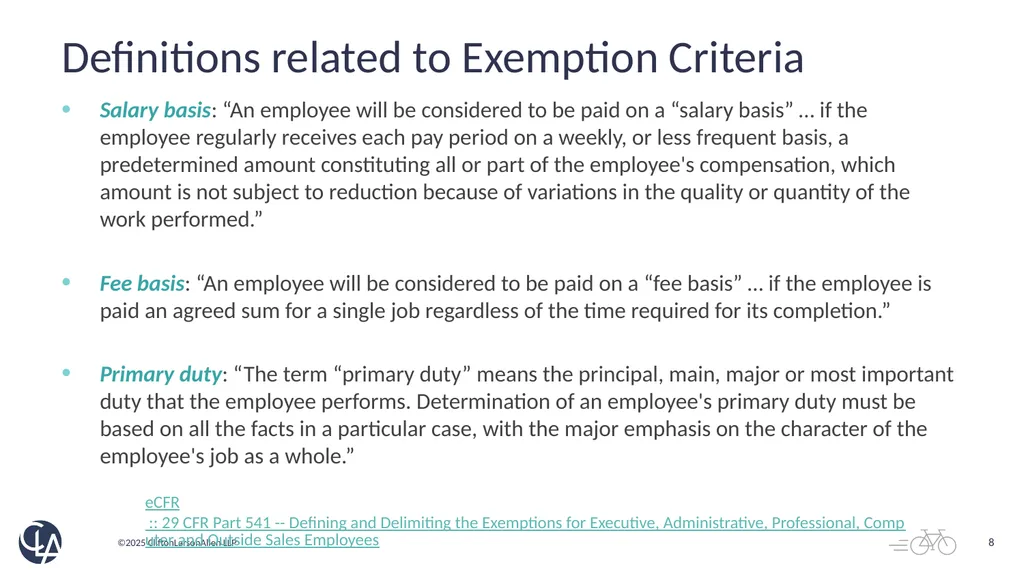
Definitions related to Exemption Criteria Salary basis: “An employee will be considered to be paid on a “salary basis” … if the employee regularly receives each pay period on a weekly, or less frequent basis, a predetermined amount constituting all or part of the employee's compensation, which amount is not subject to reduction because of variations in the quality or quantity of the work performed.”
Fee basis: “An employee will be considered to be paid on a “fee basis” … if the employee is paid an agreed sum for a single job regardless of the time required for its completion.”
Primary duty: “The term “primary duty” means the principal, main, major or most important duty that the employee performs. Determination of an employee's primary duty must be based on all the facts in a particular case, with the major emphasis on the character of the employee's job as a whole.” 8 eCFR :: 29 CFR Part 541 -- Defining and Delimiting the Exemptions for Executive, Administrative, Professional, Computer and Outside Sales Employees<br>
Fee basis: “An employee will be considered to be paid on a “fee basis” … if the employee is paid an agreed sum for a single job regardless of the time required for its completion.”
Primary duty: “The term “primary duty” means the principal, main, major or most important duty that the employee performs. Determination of an employee's primary duty must be based on all the facts in a particular case, with the major emphasis on the character of the employee's job as a whole.” 8 eCFR :: 29 CFR Part 541 -- Defining and Delimiting the Exemptions for Executive, Administrative, Professional, Computer and Outside Sales Employees<br>
09
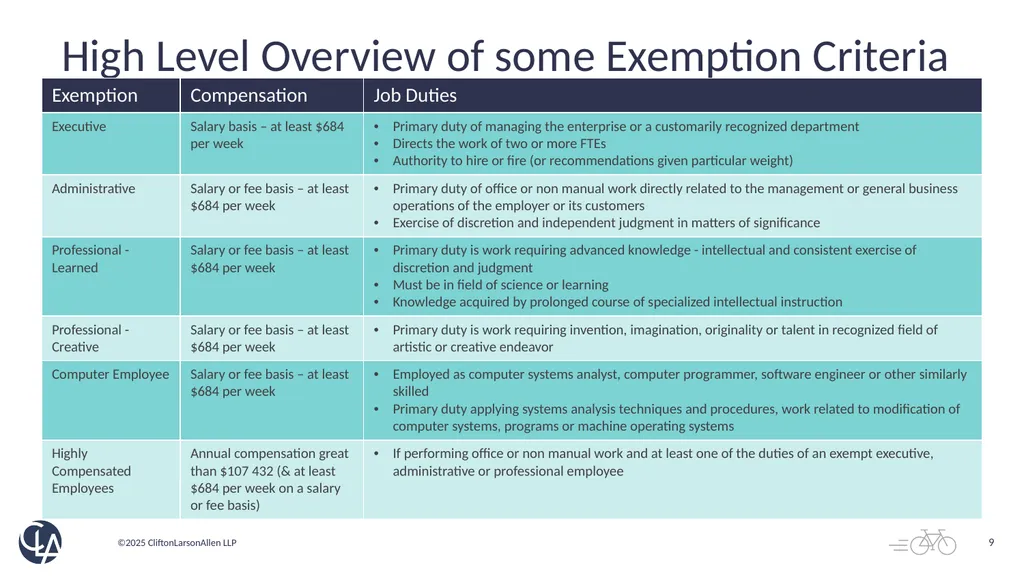
High Level Overview of some Exemption Criteria 9<br>
10
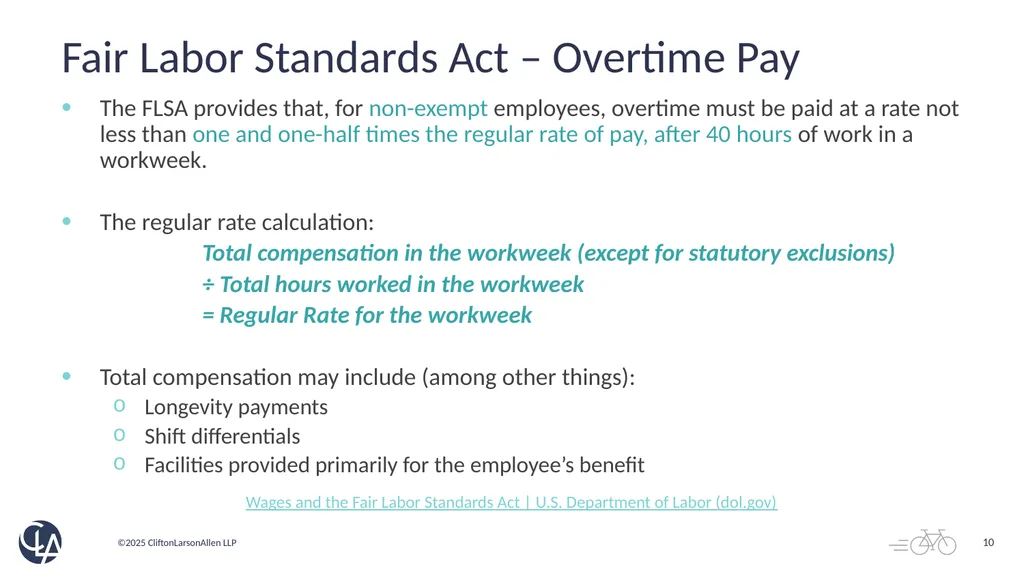
Fair Labor Standards Act – Overtime Pay The FLSA provides that, for non-exempt employees, overtime must be paid at a rate not less than one and one-half times the regular rate of pay, after 40 hours of work in a workweek.
The regular rate calculation:
Total compensation in the workweek (except for statutory exclusions)
÷ Total hours worked in the workweek
= Regular Rate for the workweek
Total compensation may include (among other things):
Longevity payments
Shift differentials
Facilities provided primarily for the employee’s benefit 10 Wages and the Fair Labor Standards Act | U.S. Department of Labor (dol.gov)<br>
The regular rate calculation:
Total compensation in the workweek (except for statutory exclusions)
÷ Total hours worked in the workweek
= Regular Rate for the workweek
Total compensation may include (among other things):
Longevity payments
Shift differentials
Facilities provided primarily for the employee’s benefit 10 Wages and the Fair Labor Standards Act | U.S. Department of Labor (dol.gov)<br>
11
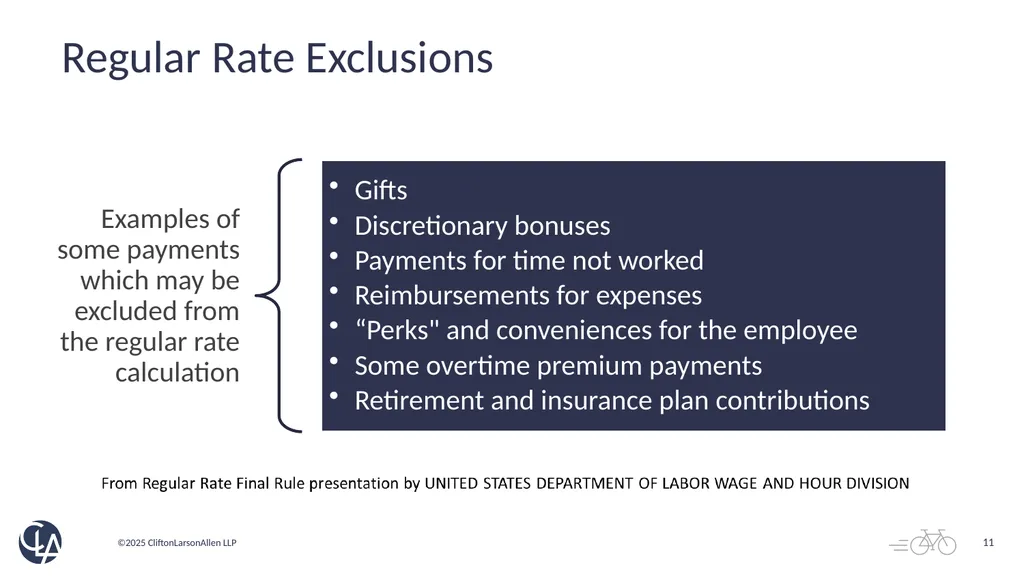
Regular Rate Exclusions 11<br>
12
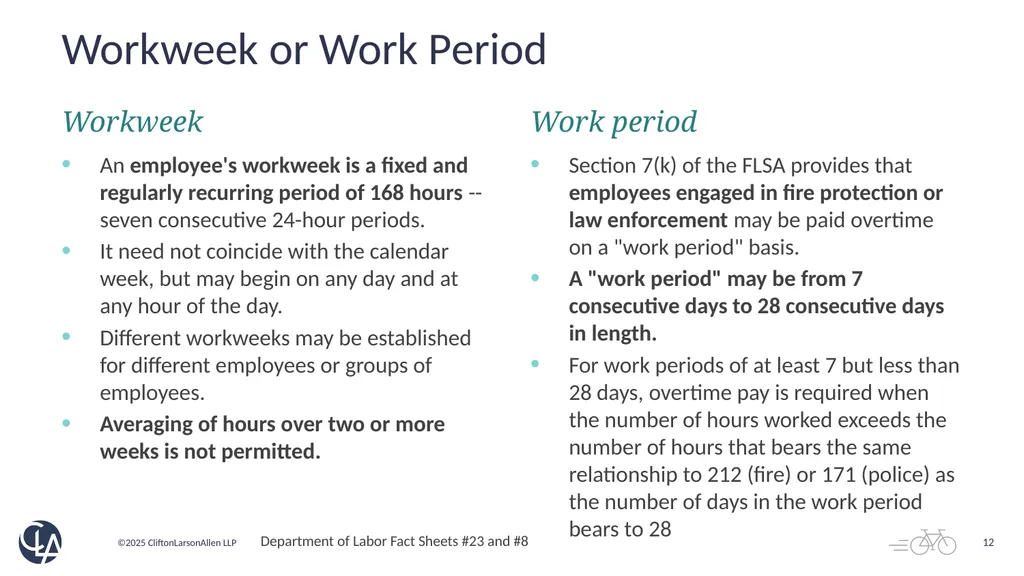
Workweek An employee's workweek is a fixed and regularly recurring period of 168 hours -- seven consecutive 24-hour periods.
It need not coincide with the calendar week, but may begin on any day and at any hour of the day.
Different workweeks may be established for different employees or groups of employees.
Averaging of hours over two or more weeks is not permitted. Work period Section 7(k) of the FLSA provides that employees engaged in fire protection or law enforcement may be paid overtime on a "work period" basis.
A "work period" may be from 7 consecutive days to 28 consecutive days in length.
For work periods of at least 7 but less than 28 days, overtime pay is required when the number of hours worked exceeds the number of hours that bears the same relationship to 212 (fire) or 171 (police) as the number of days in the work period bears to 28 Workweek or Work Period 12 Department of Labor Fact Sheets #23 and #8<br>
It need not coincide with the calendar week, but may begin on any day and at any hour of the day.
Different workweeks may be established for different employees or groups of employees.
Averaging of hours over two or more weeks is not permitted. Work period Section 7(k) of the FLSA provides that employees engaged in fire protection or law enforcement may be paid overtime on a "work period" basis.
A "work period" may be from 7 consecutive days to 28 consecutive days in length.
For work periods of at least 7 but less than 28 days, overtime pay is required when the number of hours worked exceeds the number of hours that bears the same relationship to 212 (fire) or 171 (police) as the number of days in the work period bears to 28 Workweek or Work Period 12 Department of Labor Fact Sheets #23 and #8<br>
13
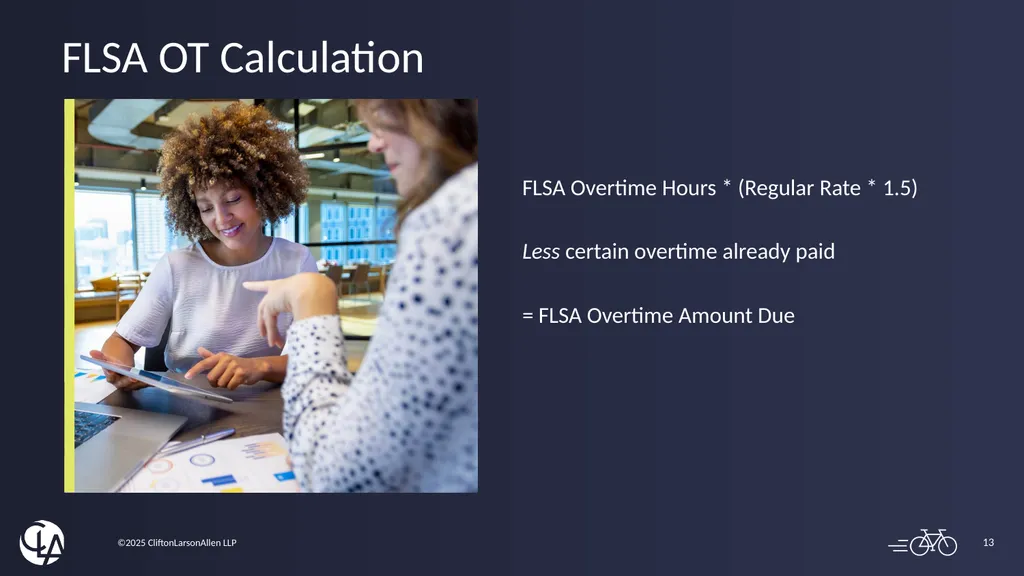
FLSA OT Calculation FLSA Overtime Hours * (Regular Rate * 1.5)
Less certain overtime already paid
= FLSA Overtime Amount Due<br>
Less certain overtime already paid
= FLSA Overtime Amount Due<br>
14
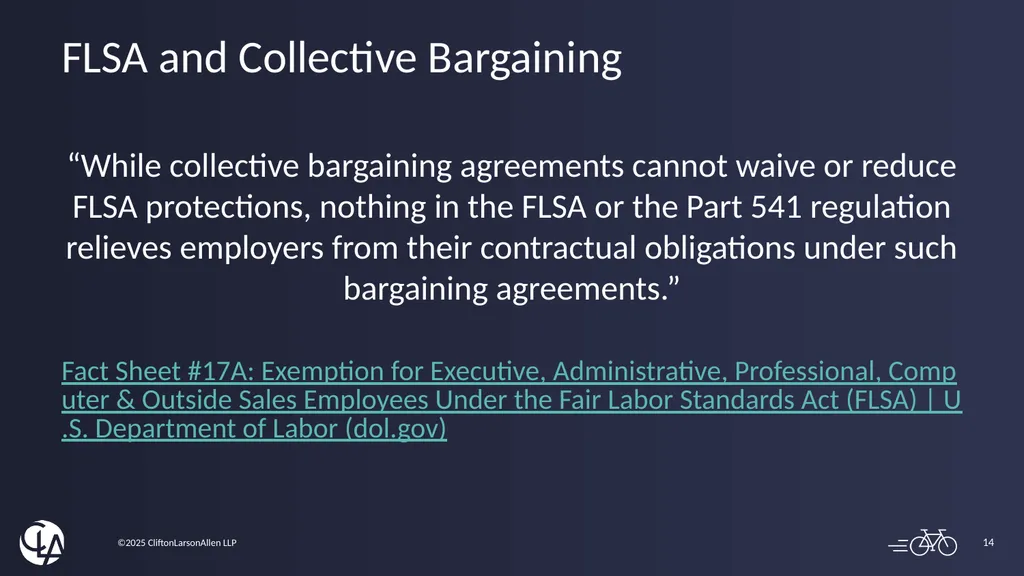
FLSA and Collective Bargaining “While collective bargaining agreements cannot waive or reduce FLSA protections, nothing in the FLSA or the Part 541 regulation relieves employers from their contractual obligations under such bargaining agreements.”
Fact Sheet #17A: Exemption for Executive, Administrative, Professional, Computer & Outside Sales Employees Under the Fair Labor Standards Act (FLSA) | U.S. Department of Labor (dol.gov)<br>
Fact Sheet #17A: Exemption for Executive, Administrative, Professional, Computer & Outside Sales Employees Under the Fair Labor Standards Act (FLSA) | U.S. Department of Labor (dol.gov)<br>
15
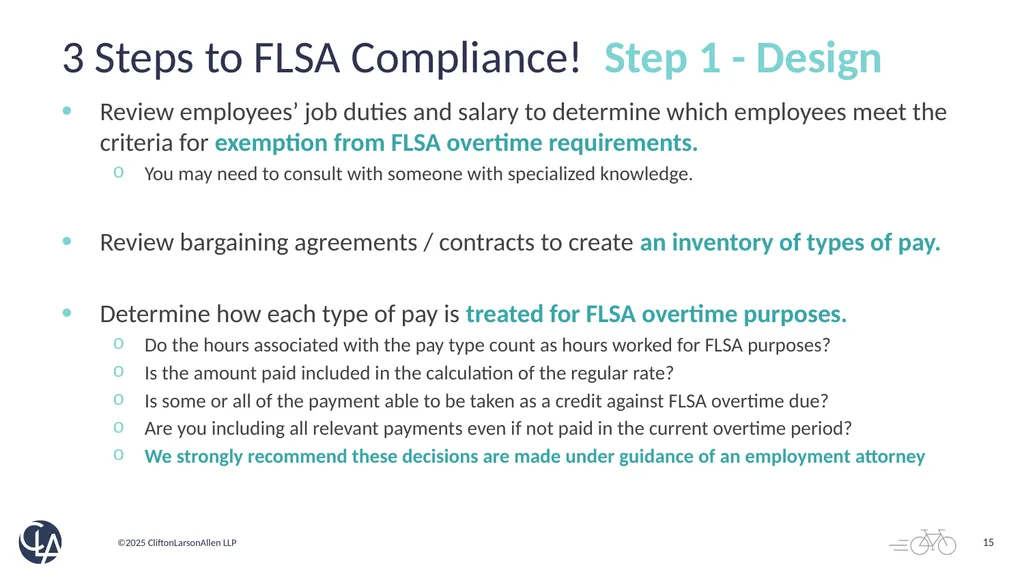
3 Steps to FLSA Compliance! Step 1 - Design Review employees’ job duties and salary to determine which employees meet the criteria for exemption from FLSA overtime requirements.
You may need to consult with someone with specialized knowledge.
Review bargaining agreements / contracts to create an inventory of types of pay.
Determine how each type of pay is treated for FLSA overtime purposes.
Do the hours associated with the pay type count as hours worked for FLSA purposes?
Is the amount paid included in the calculation of the regular rate?
Is some or all of the payment able to be taken as a credit against FLSA overtime due?
Are you including all relevant payments even if not paid in the current overtime period?
We strongly recommend these decisions are made under guidance of an employment attorney 15<br>
You may need to consult with someone with specialized knowledge.
Review bargaining agreements / contracts to create an inventory of types of pay.
Determine how each type of pay is treated for FLSA overtime purposes.
Do the hours associated with the pay type count as hours worked for FLSA purposes?
Is the amount paid included in the calculation of the regular rate?
Is some or all of the payment able to be taken as a credit against FLSA overtime due?
Are you including all relevant payments even if not paid in the current overtime period?
We strongly recommend these decisions are made under guidance of an employment attorney 15<br>
16
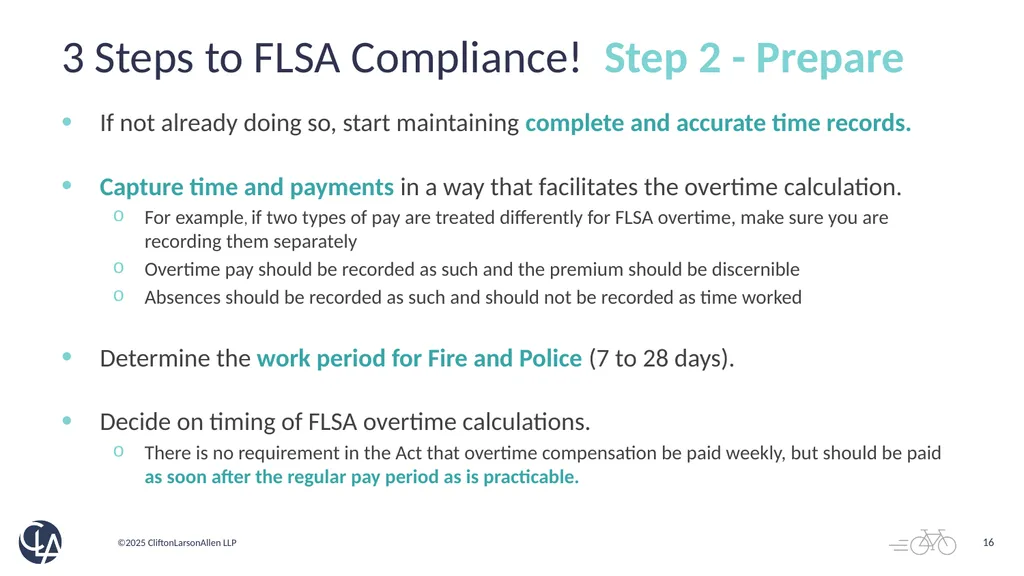
3 Steps to FLSA Compliance! Step 2 - Prepare If not already doing so, start maintaining complete and accurate time records.
Capture time and payments in a way that facilitates the overtime calculation.
For example, if two types of pay are treated differently for FLSA overtime, make sure you are recording them separately
Overtime pay should be recorded as such and the premium should be discernible
Absences should be recorded as such and should not be recorded as time worked
Determine the work period for Fire and Police (7 to 28 days).
Decide on timing of FLSA overtime calculations.
There is no requirement in the Act that overtime compensation be paid weekly, but should be paid as soon after the regular pay period as is practicable. 16<br>
Capture time and payments in a way that facilitates the overtime calculation.
For example, if two types of pay are treated differently for FLSA overtime, make sure you are recording them separately
Overtime pay should be recorded as such and the premium should be discernible
Absences should be recorded as such and should not be recorded as time worked
Determine the work period for Fire and Police (7 to 28 days).
Decide on timing of FLSA overtime calculations.
There is no requirement in the Act that overtime compensation be paid weekly, but should be paid as soon after the regular pay period as is practicable. 16<br>
17
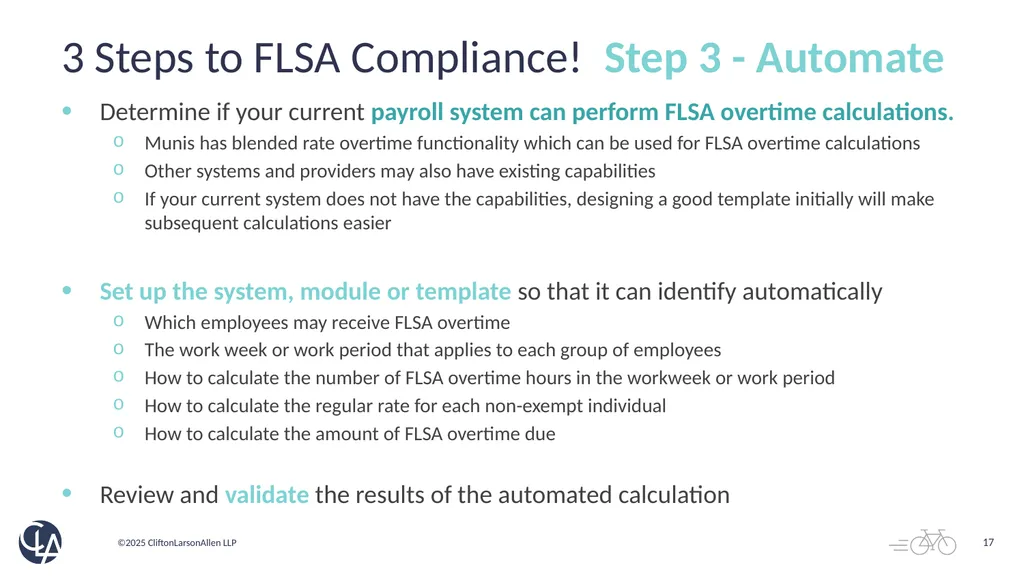
3 Steps to FLSA Compliance! Step 3 - Automate Determine if your current payroll system can perform FLSA overtime calculations.
Munis has blended rate overtime functionality which can be used for FLSA overtime calculations
Other systems and providers may also have existing capabilities
If your current system does not have the capabilities, designing a good template initially will make subsequent calculations easier
Set up the system, module or template so that it can identify automatically
Which employees may receive FLSA overtime
The work week or work period that applies to each group of employees
How to calculate the number of FLSA overtime hours in the workweek or work period
How to calculate the regular rate for each non-exempt individual
How to calculate the amount of FLSA overtime due
Review and validate the results of the automated calculation 17<br>
Munis has blended rate overtime functionality which can be used for FLSA overtime calculations
Other systems and providers may also have existing capabilities
If your current system does not have the capabilities, designing a good template initially will make subsequent calculations easier
Set up the system, module or template so that it can identify automatically
Which employees may receive FLSA overtime
The work week or work period that applies to each group of employees
How to calculate the number of FLSA overtime hours in the workweek or work period
How to calculate the regular rate for each non-exempt individual
How to calculate the amount of FLSA overtime due
Review and validate the results of the automated calculation 17<br>
18
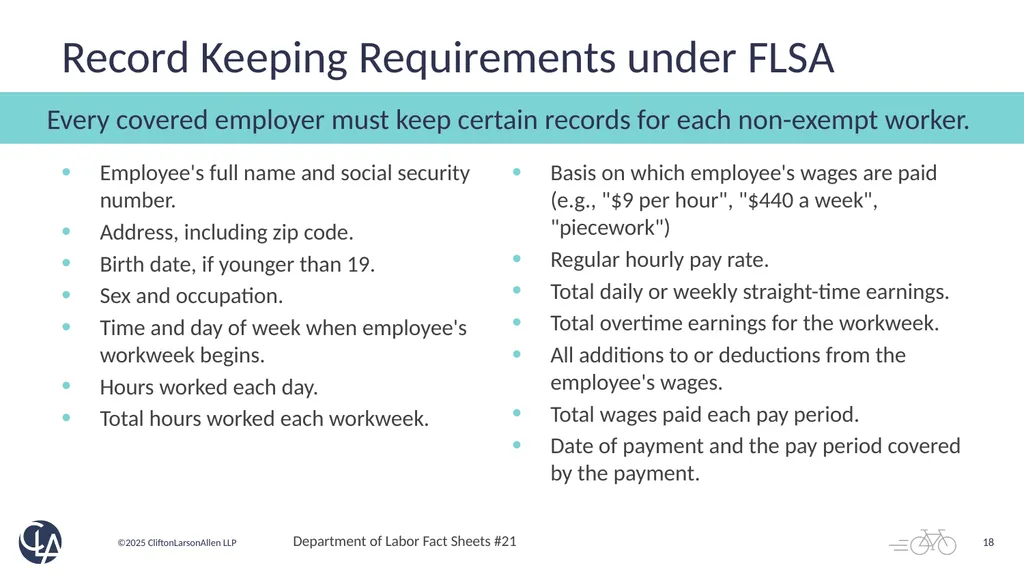
Record Keeping Requirements under FLSA Employee's full name and social security number.
Address, including zip code.
Birth date, if younger than 19.
Sex and occupation.
Time and day of week when employee's workweek begins.
Hours worked each day.
Total hours worked each workweek.
Basis on which employee's wages are paid (e.g., "$9 per hour", "$440 a week", "piecework")
Regular hourly pay rate.
Total daily or weekly straight-time earnings.
Total overtime earnings for the workweek.
All additions to or deductions from the employee's wages.
Total wages paid each pay period.
Date of payment and the pay period covered by the payment. 18 Department of Labor Fact Sheets #21 Every covered employer must keep certain records for each non-exempt worker.<br>
Address, including zip code.
Birth date, if younger than 19.
Sex and occupation.
Time and day of week when employee's workweek begins.
Hours worked each day.
Total hours worked each workweek.
Basis on which employee's wages are paid (e.g., "$9 per hour", "$440 a week", "piecework")
Regular hourly pay rate.
Total daily or weekly straight-time earnings.
Total overtime earnings for the workweek.
All additions to or deductions from the employee's wages.
Total wages paid each pay period.
Date of payment and the pay period covered by the payment. 18 Department of Labor Fact Sheets #21 Every covered employer must keep certain records for each non-exempt worker.<br>
19
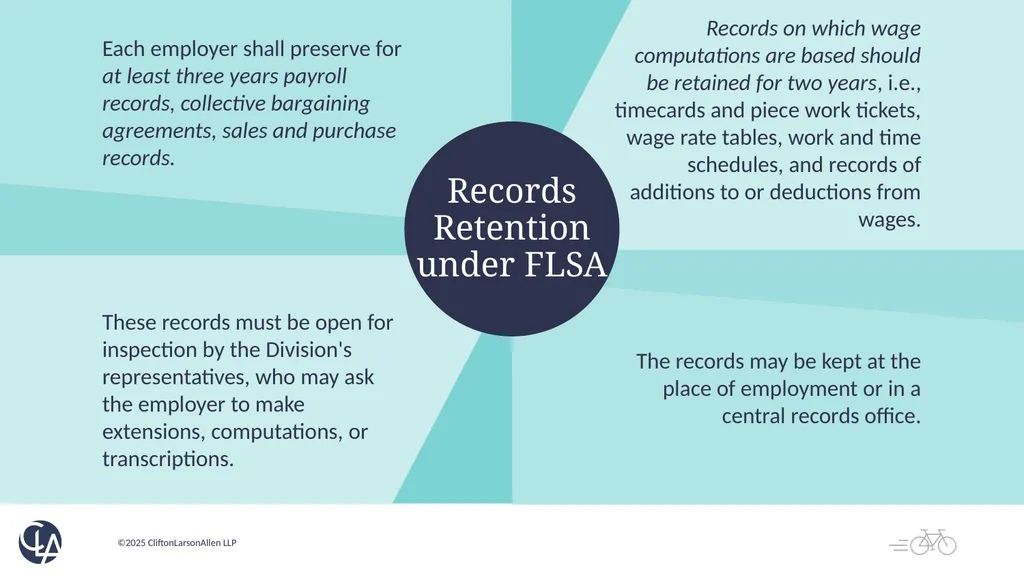
Records on which wage computations are based should be retained for two years, i.e., timecards and piece work tickets, wage rate tables, work and time schedules, and records of additions to or deductions from wages. The records may be kept at the place of employment or in a central records office. These records must be open for inspection by the Division's representatives, who may ask the employer to make extensions, computations, or transcriptions. Each employer shall preserve for at least three years payroll records, collective bargaining agreements, sales and purchase records. Records Retention under FLSA<br>
20
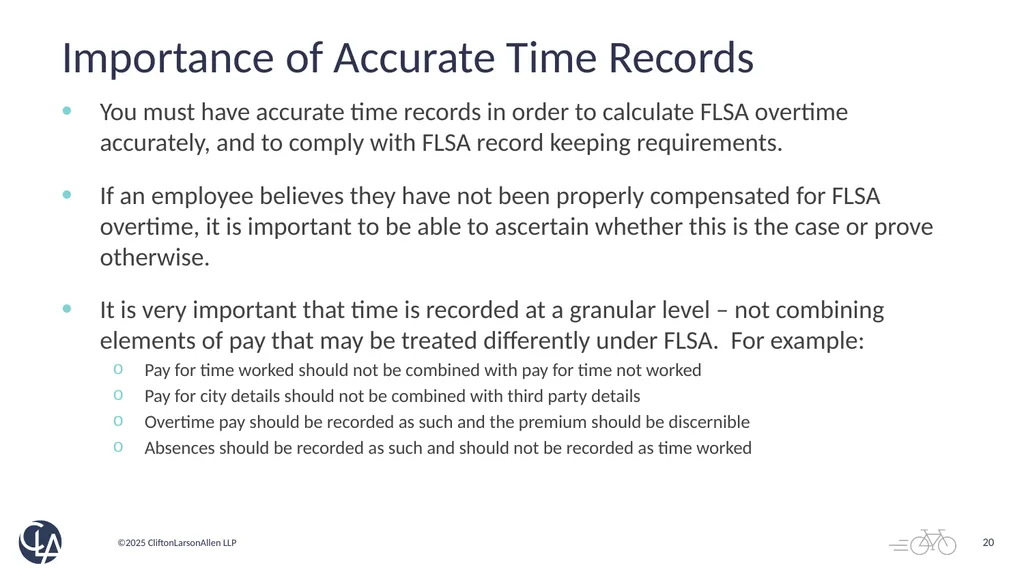
Importance of Accurate Time Records You must have accurate time records in order to calculate FLSA overtime accurately, and to comply with FLSA record keeping requirements.
If an employee believes they have not been properly compensated for FLSA overtime, it is important to be able to ascertain whether this is the case or prove otherwise.
It is very important that time is recorded at a granular level – not combining elements of pay that may be treated differently under FLSA. For example:
Pay for time worked should not be combined with pay for time not worked
Pay for city details should not be combined with third party details
Overtime pay should be recorded as such and the premium should be discernible
Absences should be recorded as such and should not be recorded as time worked 20<br>
If an employee believes they have not been properly compensated for FLSA overtime, it is important to be able to ascertain whether this is the case or prove otherwise.
It is very important that time is recorded at a granular level – not combining elements of pay that may be treated differently under FLSA. For example:
Pay for time worked should not be combined with pay for time not worked
Pay for city details should not be combined with third party details
Overtime pay should be recorded as such and the premium should be discernible
Absences should be recorded as such and should not be recorded as time worked 20<br>
21
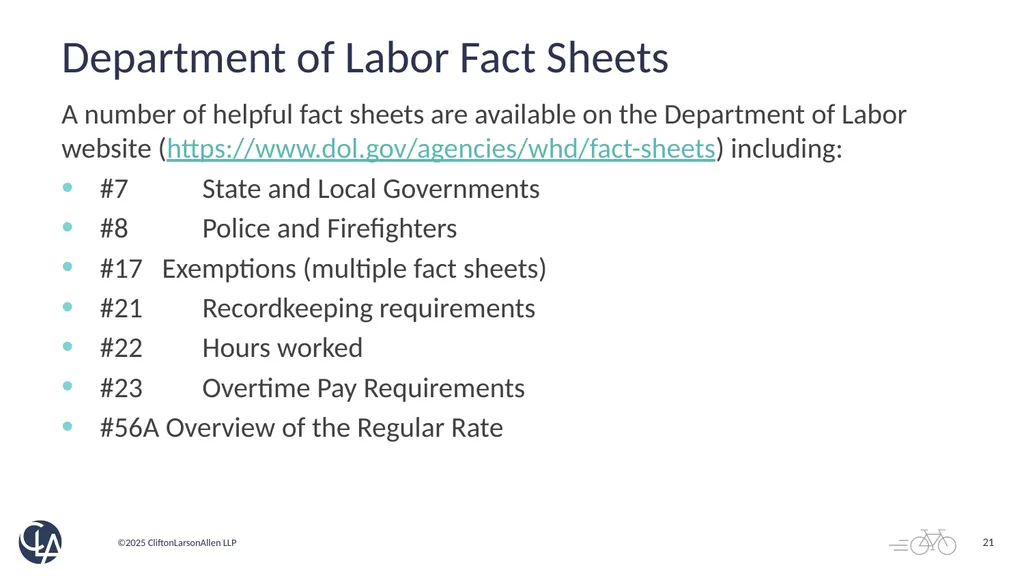
Department of Labor Fact Sheets A number of helpful fact sheets are available on the Department of Labor website (https://www.dol.gov/agencies/whd/fact-sheets) including:
#7 State and Local Governments
#8 Police and Firefighters
#17 Exemptions (multiple fact sheets)
#21 Recordkeeping requirements
#22 Hours worked
#23 Overtime Pay Requirements
#56A Overview of the Regular Rate 21<br>
#7 State and Local Governments
#8 Police and Firefighters
#17 Exemptions (multiple fact sheets)
#21 Recordkeeping requirements
#22 Hours worked
#23 Overtime Pay Requirements
#56A Overview of the Regular Rate 21<br>
22
Shawn McGoldrick, CGA, MBA
shawn.mcgoldrick@CLAconnect.com
Kathy Laws, CPSP, SHRM-CP, MHR
kathy.laws@CLAconnect.com
Josephine Hanley, ACCA
josephine.hanley@CLAconnect.com 22<br>
shawn.mcgoldrick@CLAconnect.com
Kathy Laws, CPSP, SHRM-CP, MHR
kathy.laws@CLAconnect.com
Josephine Hanley, ACCA
josephine.hanley@CLAconnect.com 22<br>