04
Try and implement a full pixel pipeline using CUDA
From triangle setup to ROP
Obey fundamental requirements of gfx pipe
Maintain input order
Hole-free rasterizer with correct rasterization rules
Prefer speed over features Our Approach<br>
05
Establish a firm data point through careful experiment
Provide fully programmable platform for exploring algorithms that extend the hardware gfx pipe
Ideas for future hardware
Ultimate goal = flexibility of software, performance of fixed-function hardware Project Goals Programmable ROP
Stochastic rasterization
Non-linear rasterization
Non-quad derivatives Quad merging
Decoupled sampling
Compact after discard
etc.<br>
06
Very simple rasterization pipeline
Each triangle processed by one thread
Blit pixels directly to DRAM using atomics
Limitations
Cannot retain inputs order
Limited support for ROP operations (dictated by atomics)
Large triangles game over
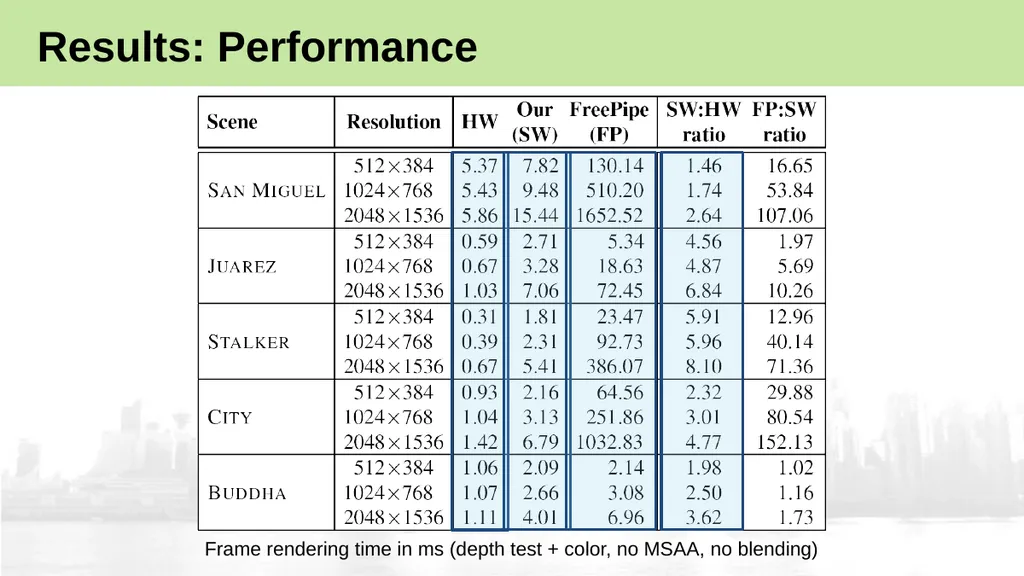
We are 15x faster on average
Larger difference for high resolutions Previous Work: FreePipe [Liu et al. 2010]<br>
07
Run everything in parallel
We need a lot of threads to fill the machine
Minimize amount of synchronization
Avoid excessive use of atomics
Focus on load balancing
Graphics workloads are wild Design Considerations<br>
08
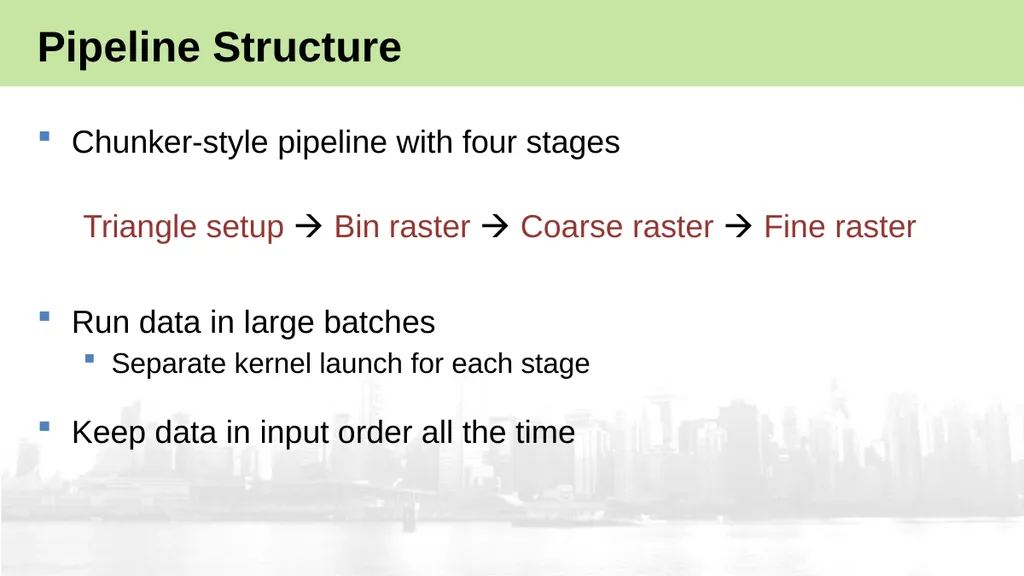
Chunker-style pipeline with four stages
Triangle setup Bin raster Coarse raster Fine raster
Run data in large batches
Separate kernel launch for each stage
Keep data in input order all the time Pipeline Structure<br>
09
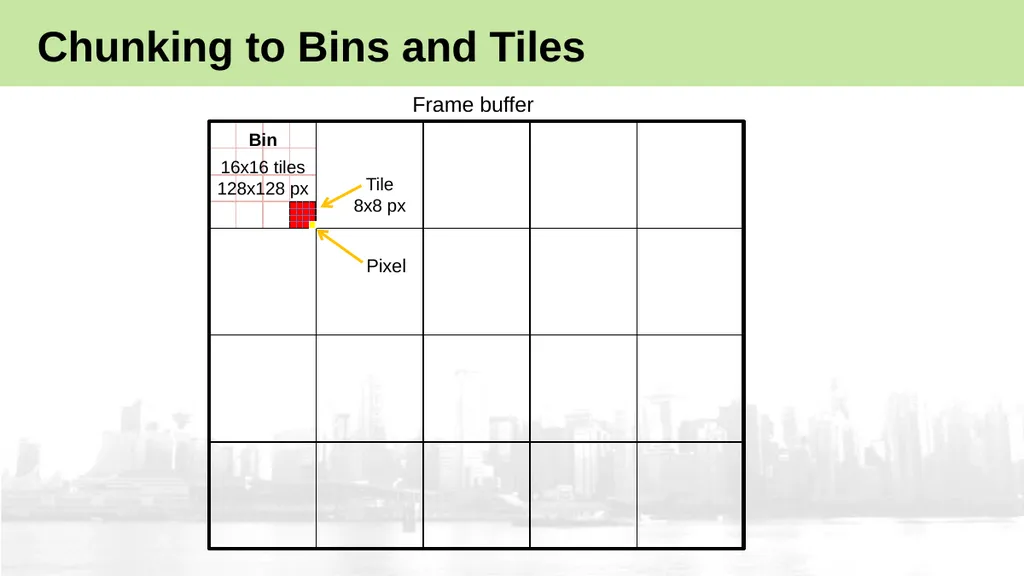
Chunking to Bins and Tiles Frame buffer Bin
�16x16 tiles
128x128 px Tile
8x8 px Pixel<br>
10
Quick look at each stage
More details in the paper Pipeline Stages<br>
11
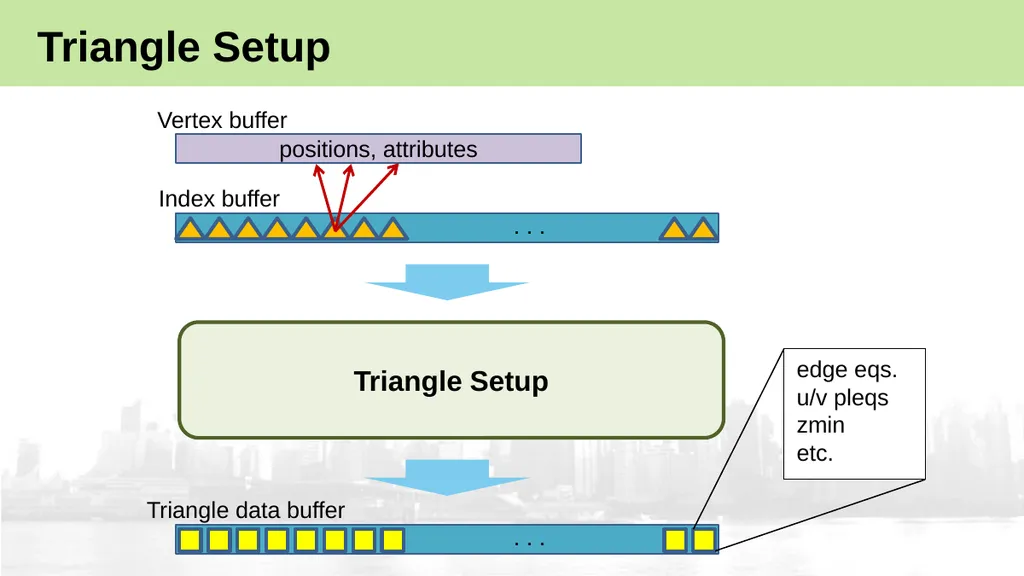
Triangle Setup positions, attributes Vertex buffer Index buffer . . . Triangle Setup Triangle data buffer . . . edge eqs.
u/v pleqs
zmin
etc.<br>
12
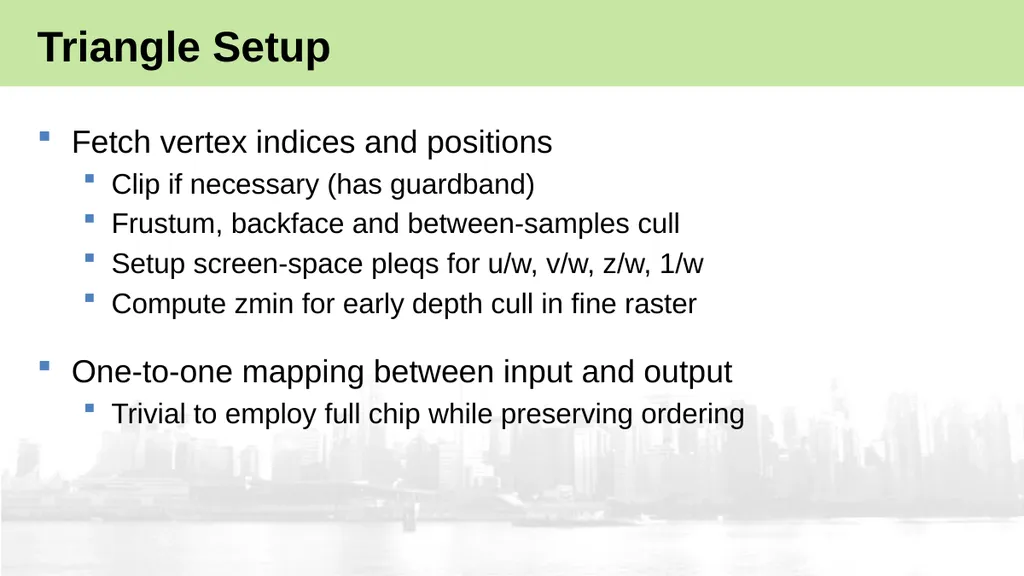
Fetch vertex indices and positions
Clip if necessary (has guardband)
Frustum, backface and between-samples cull
Setup screen-space pleqs for u/w, v/w, z/w, 1/w
Compute zmin for early depth cull in fine raster
One-to-one mapping between input and output
Trivial to employ full chip while preserving ordering Triangle Setup<br>
13
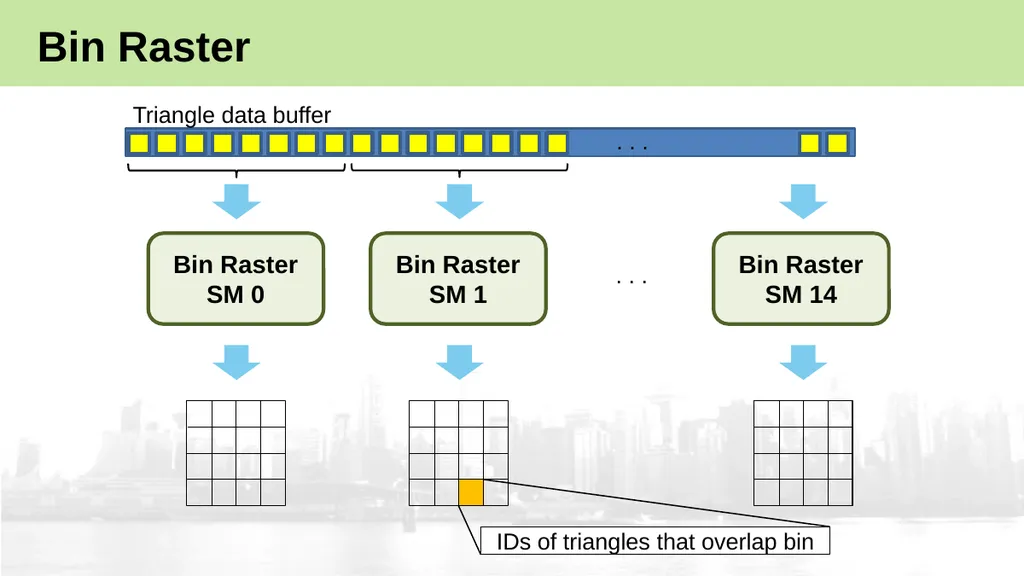
Bin Raster Bin Raster
SM 0 Triangle data buffer . . . Bin Raster
SM 1 Bin Raster
SM 14 . . . IDs of triangles that overlap bin<br>
14
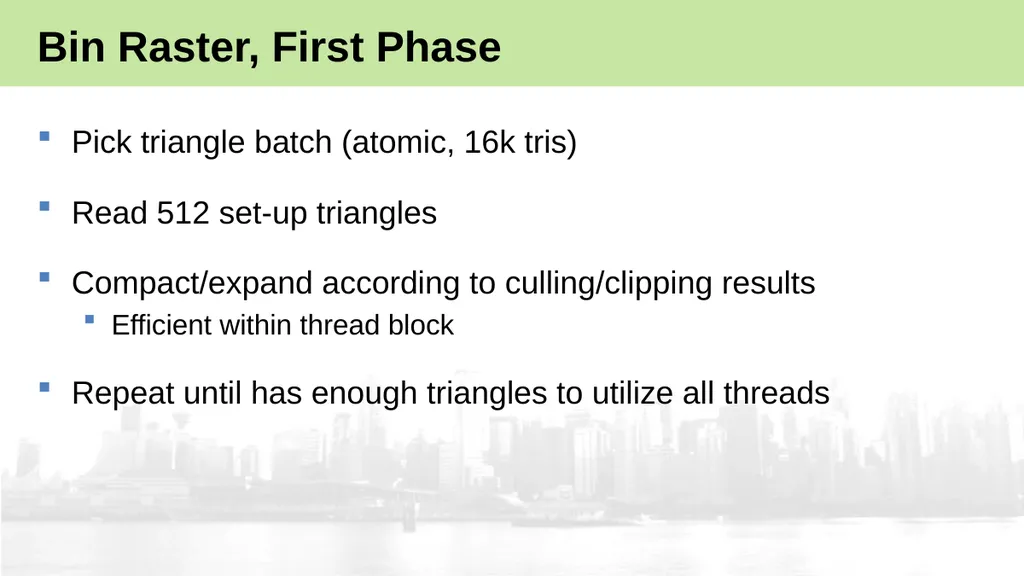
Pick triangle batch (atomic, 16k tris)
Read 512 set-up triangles
Compact/expand according to culling/clipping results
Efficient within thread block
Repeat until has enough triangles to utilize all threads Bin Raster, First Phase<br>
15
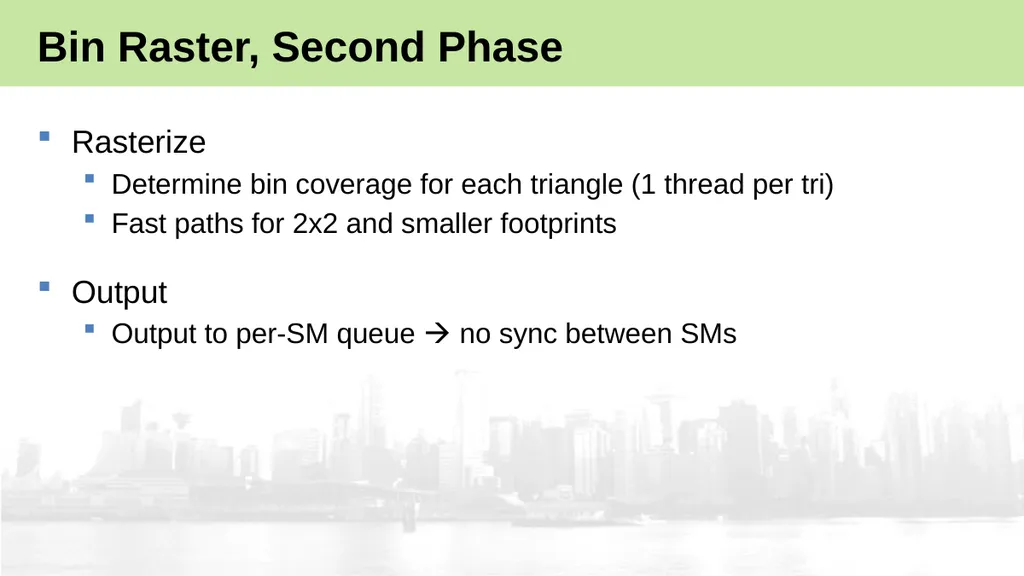
Rasterize
Determine bin coverage for each triangle (1 thread per tri)
Fast paths for 2x2 and smaller footprints
Output
Output to per-SM queue no sync between SMs Bin Raster, Second Phase<br>
16
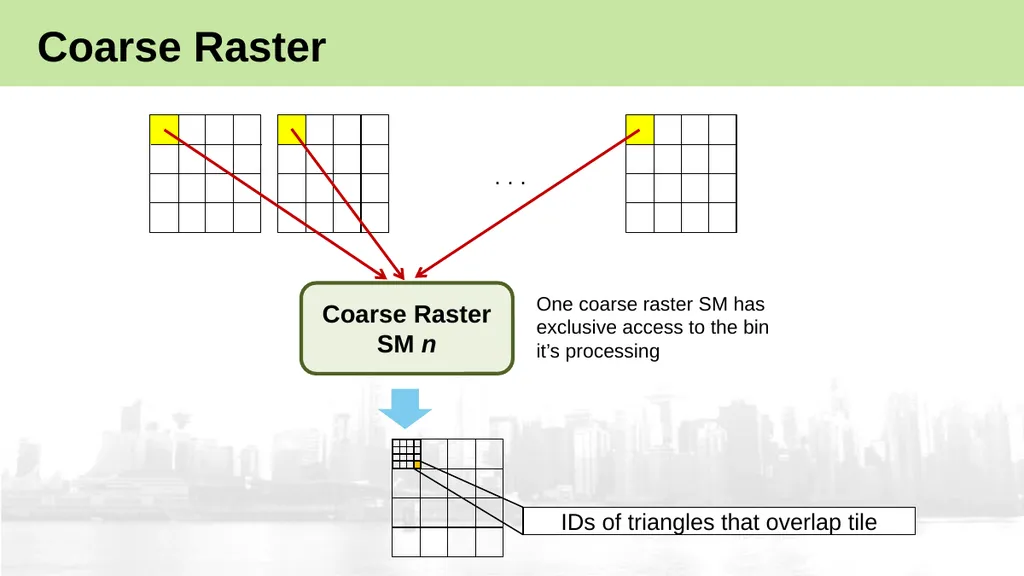
Coarse Raster . . . IDs of triangles that overlap tile One coarse raster SM has�exclusive access to the bin�it’s processing Coarse Raster
SM n<br>
17
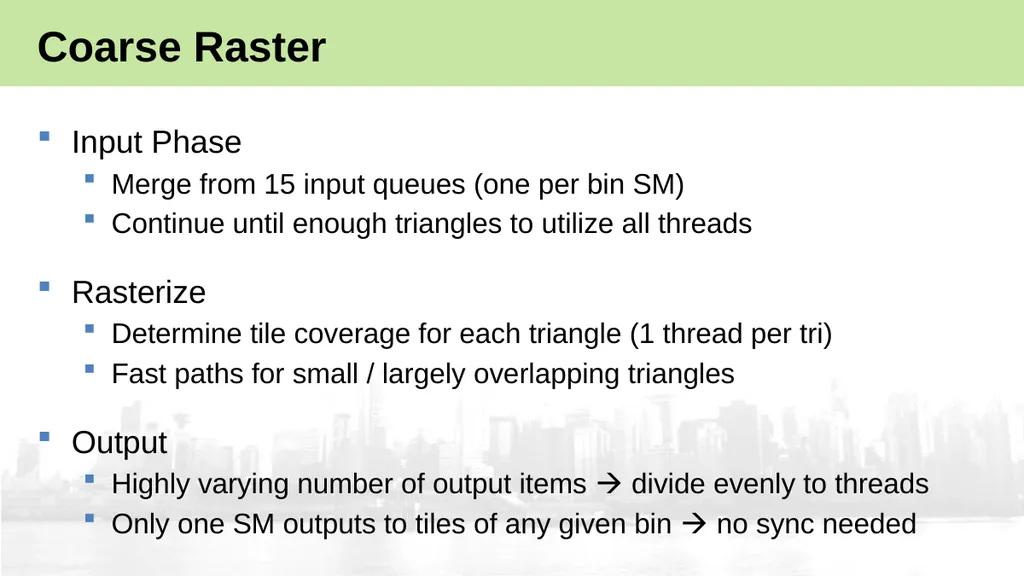
Input Phase
Merge from 15 input queues (one per bin SM)
Continue until enough triangles to utilize all threads
Rasterize
Determine tile coverage for each triangle (1 thread per tri)
Fast paths for small / largely overlapping triangles
Output
Highly varying number of output items divide evenly to threads
Only one SM outputs to tiles of any given bin no sync needed Coarse Raster<br>
18
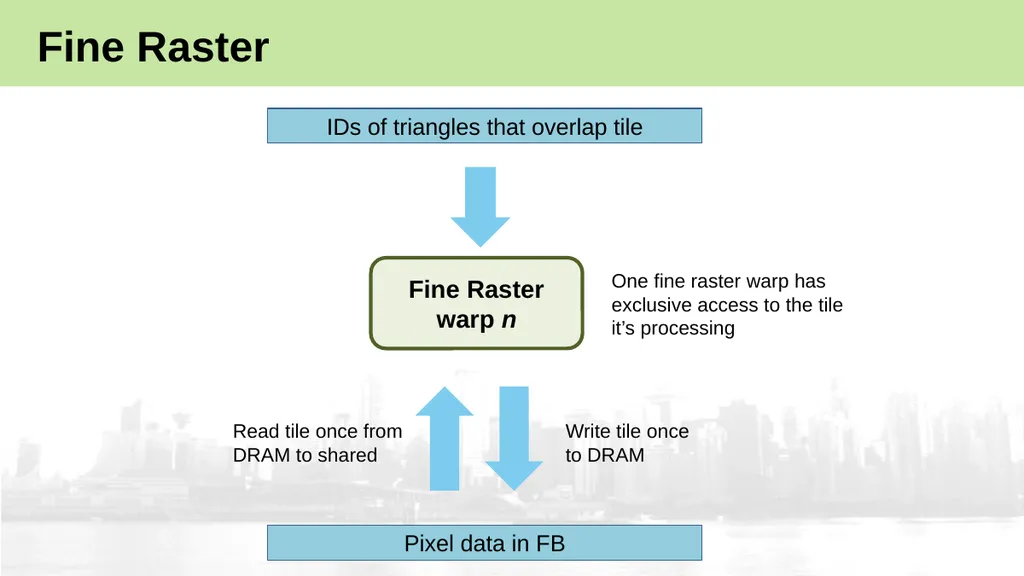
Fine Raster IDs of triangles that overlap tile Pixel data in FB One fine raster warp has�exclusive access to the tile�it’s processing Write tile once�to DRAM Read tile once from�DRAM to shared Fine Raster
warp n<br>
19
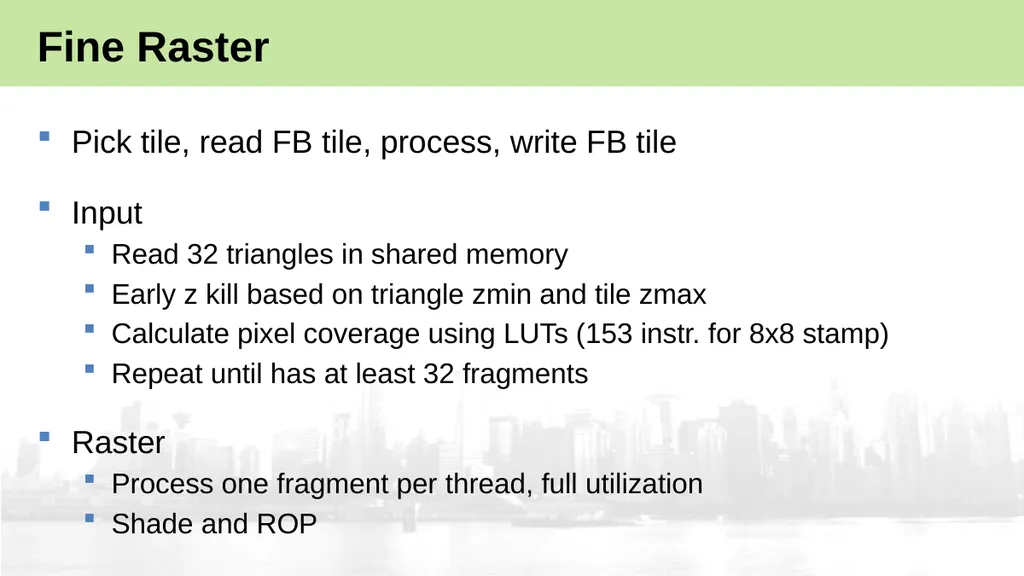
Pick tile, read FB tile, process, write FB tile
Input
Read 32 triangles in shared memory
Early z kill based on triangle zmin and tile zmax
Calculate pixel coverage using LUTs (153 instr. for 8x8 stamp)
Repeat until has at least 32 fragments
Raster
Process one fragment per thread, full utilization
Shade and ROP Fine Raster<br>
20
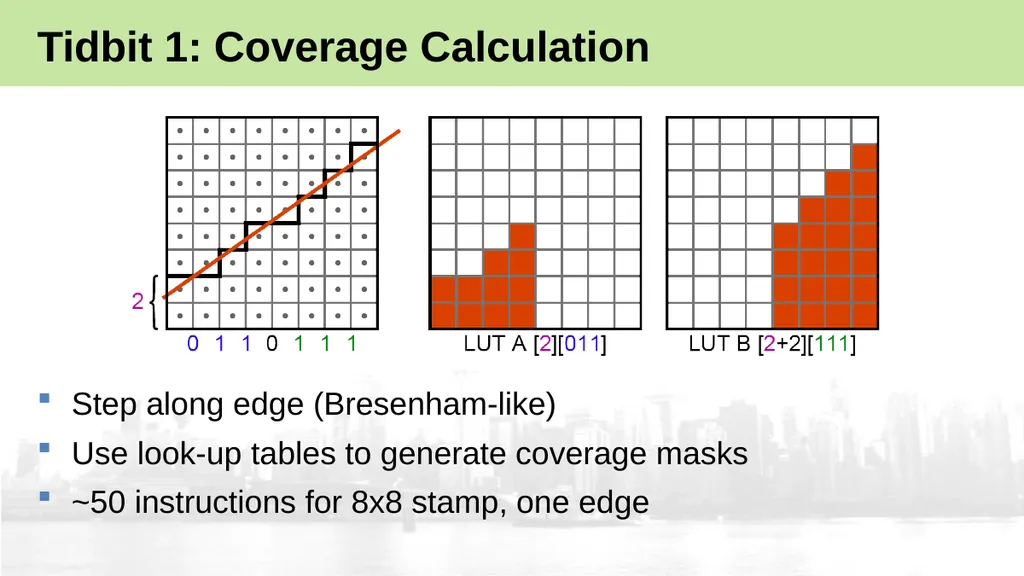
Tidbit 1: Coverage Calculation Step along edge (Bresenham-like)
Use look-up tables to generate coverage masks
~50 instructions for 8x8 stamp, one edge<br>
21
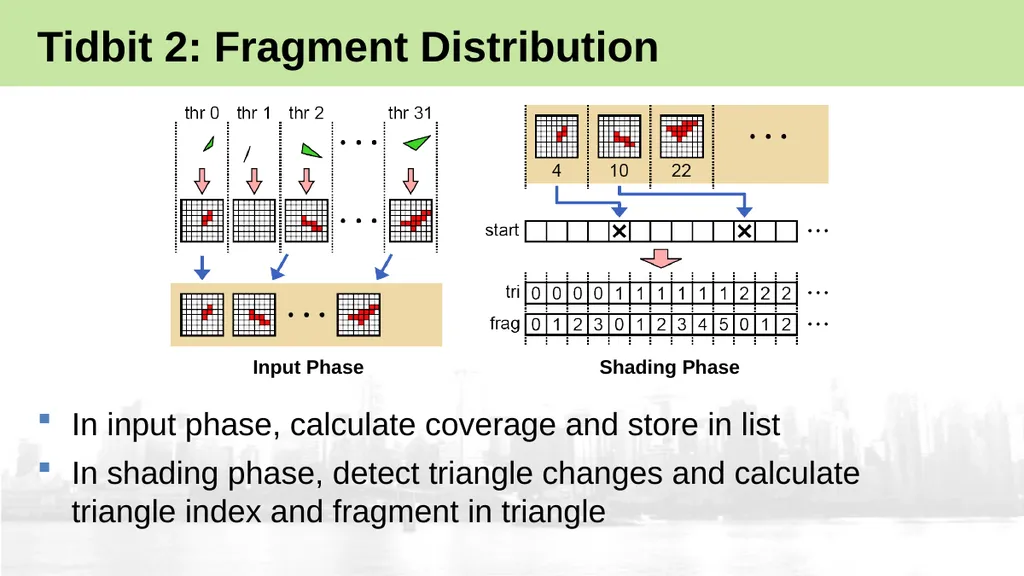
Tidbit 2: Fragment Distribution In input phase, calculate coverage and store in list
In shading phase, detect triangle changes and calculate triangle index and fragment in triangle Input Phase Shading Phase<br>
22
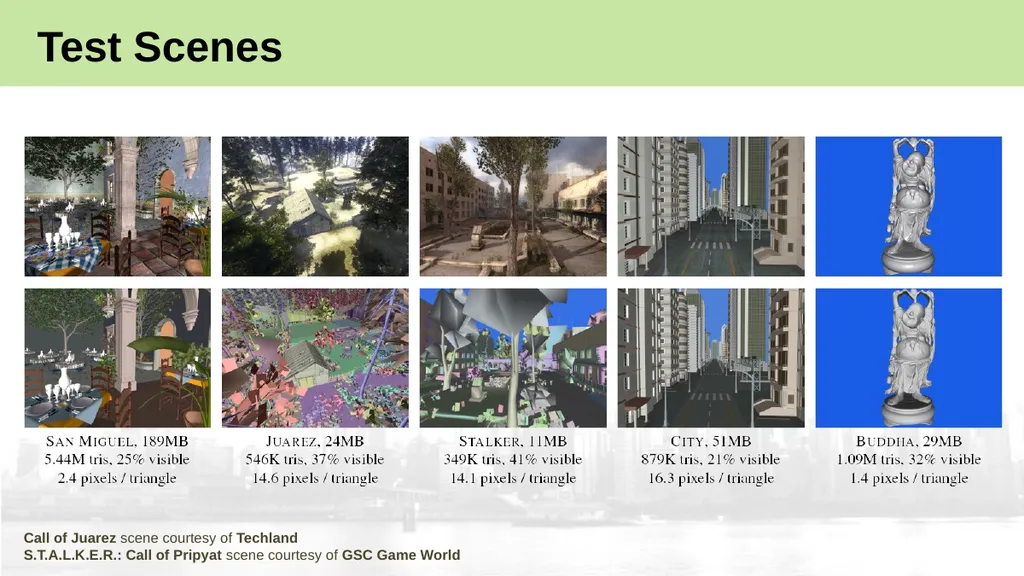
Test Scenes Call of Juarez scene courtesy of Techland
S.T.A.L.K.E.R.: Call of Pripyat scene courtesy of GSC Game World<br>
23
Results: Performance Frame rendering time in ms (depth test + color, no MSAA, no blending)<br>
24
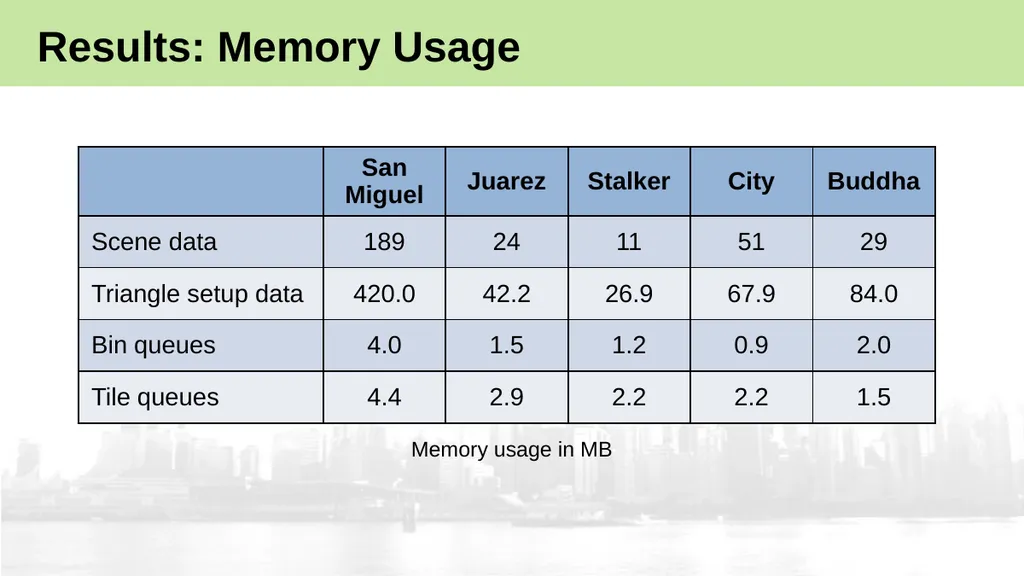
Results: Memory Usage Memory usage in MB<br>
25
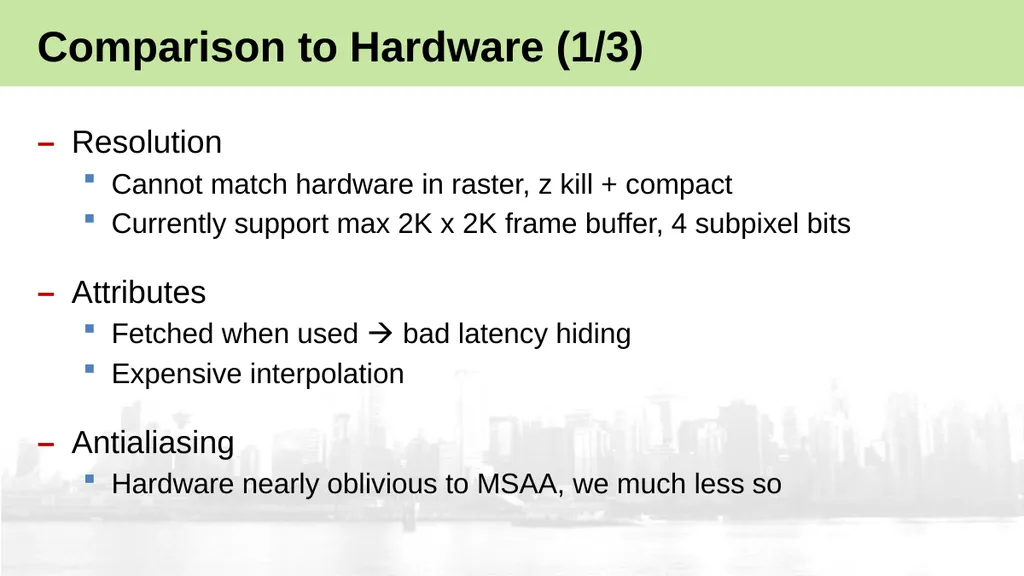
Comparison to Hardware (1/3) – Resolution
Cannot match hardware in raster, z kill + compact
Currently support max 2K x 2K frame buffer, 4 subpixel bits
– Attributes
Fetched when used bad latency hiding
Expensive interpolation
– Antialiasing
Hardware nearly oblivious to MSAA, we much less so<br>
26
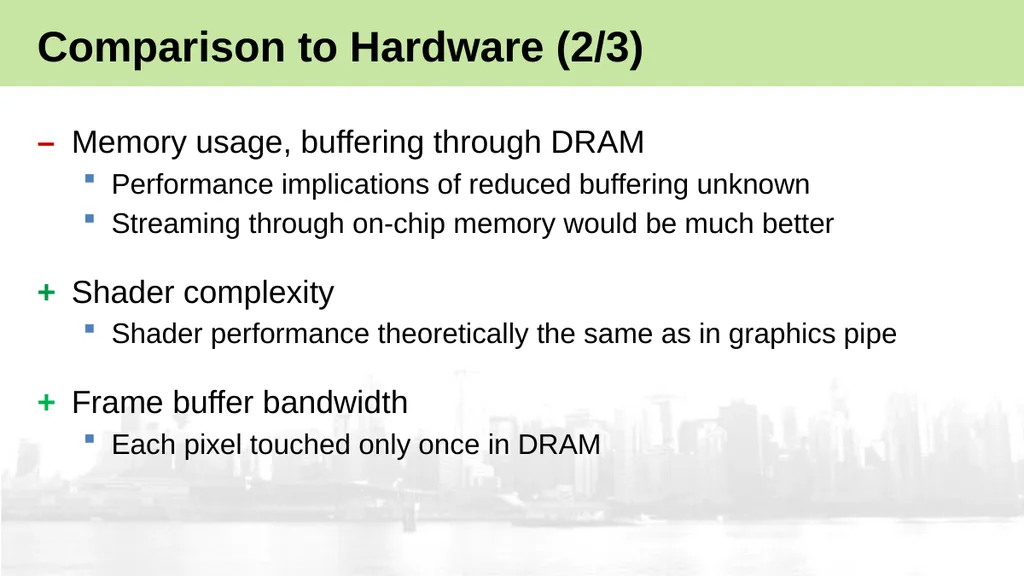
Comparison to Hardware (2/3) – Memory usage, buffering through DRAM
Performance implications of reduced buffering unknown
Streaming through on-chip memory would be much better
+ Shader complexity
Shader performance theoretically the same as in graphics pipe
+ Frame buffer bandwidth
Each pixel touched only once in DRAM<br>
27
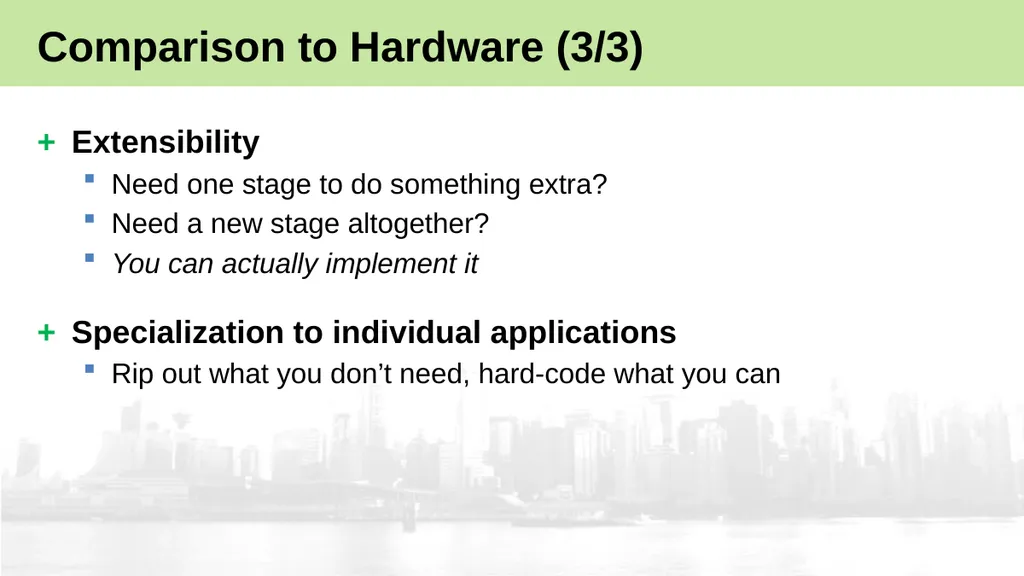
Comparison to Hardware (3/3) + Extensibility
Need one stage to do something extra?
Need a new stage altogether?
You can actually implement it
+ Specialization to individual applications
Rip out what you don’t need, hard-code what you can<br>
28
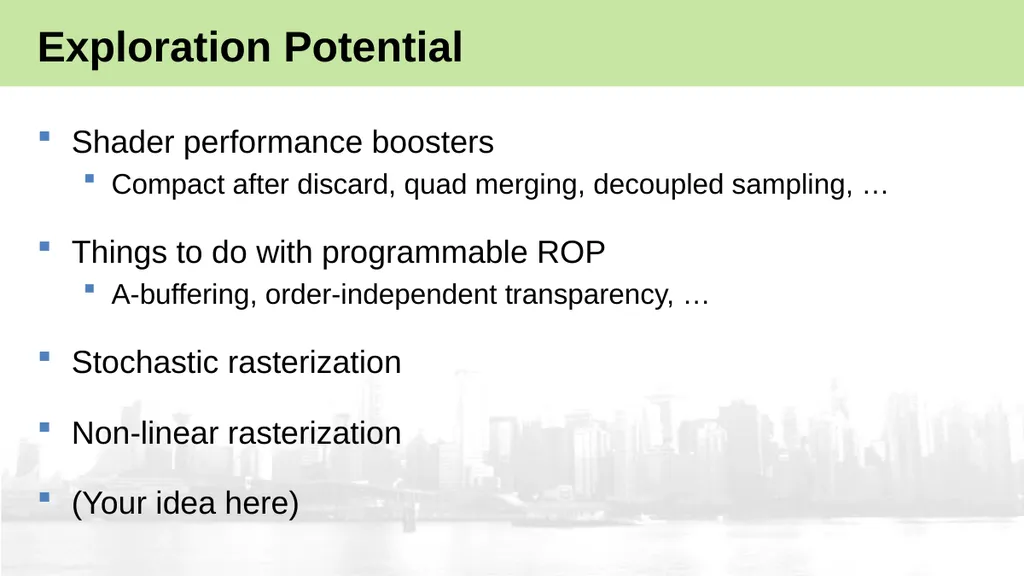
Shader performance boosters
Compact after discard, quad merging, decoupled sampling, …
Things to do with programmable ROP
A-buffering, order-independent transparency, …
Stochastic rasterization
Non-linear rasterization
(Your idea here) Exploration Potential<br>
29
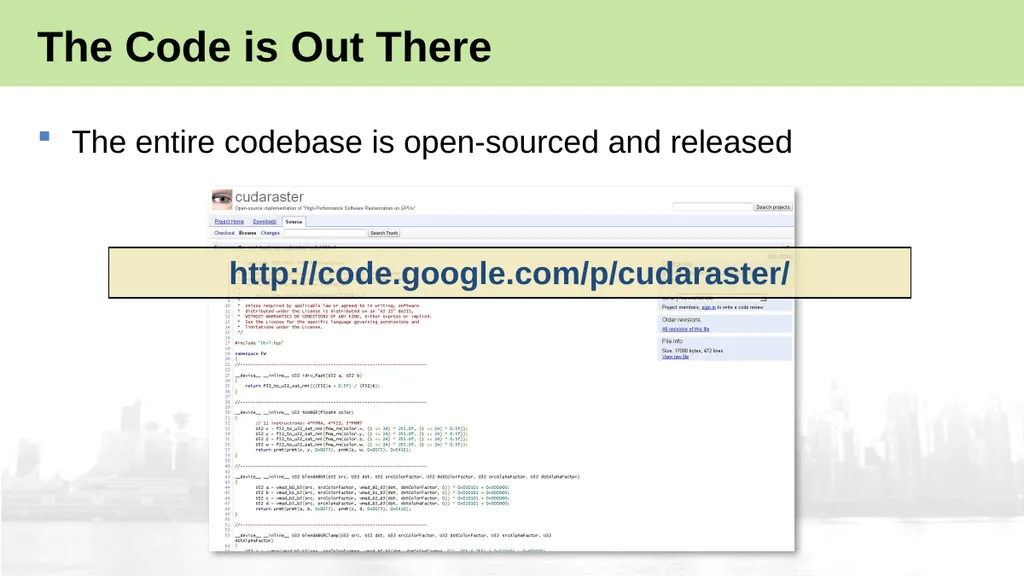
The Code is Out There http://code.google.com/p/cudaraster/ The entire codebase is open-sourced and released<br>
30
Thank You Questions<br>