Historical Interpretations Copy following for timeline TraditionalOrthodox Revisionist Post Revisionist ContemporaryPost 1991 TraditionalOrthodox This view follows the official US interpretation of the beginning of the Cold War The
"Historical Interpretations Copy following for" is the property of its rightful owner. Permission is granted to
download and print the materials on this website for personal, non-commercial use only, and to display it
on your personal computer provided you do not modify the materials and that you retain all copyright
notices contained in the materials. By downloading content from our website, you accept the terms of this
agreement.
Presentation Transcript
01
Historical Interpretations Copy following for timeline<br>
02
Traditional/Orthodox Revisionist<br>
03
Post Revisionist Contemporary/Post 1991<br>
04
Traditional/Orthodox This view follows the official US interpretation of the beginning of the Cold War The breakdown of relations was a direct result of Stalin's violation of the Yalta accords, the imposition of Soviet-dominated governments on an unwilling Eastern Europe, and aggressive Soviet expansionism Stalin was trying to build up a Soviet empire in accordance with Marxist theory USA had to act defensively<br>
05
Revisionist This view sees :
USA commitment to maintaining an 'open door' for American trade in world markets USA provocations and imperial ambitions were at least equally to blame Truman had not understood how much Russia had suffered in WWII Onset of Cold War due to 'dollar diplomacy' and needs of capitalism Stalin was a pragmatic leader, needed security The use of the Atomic bomb was the first move by the USA in the Cold War<br>
06
Post Revisionist This view claims that neither side can be held solely responsible for the Cold War Focused on mutual misperception, mutual reactivity and shared responsibility between the superpowers America didn't understand Stalin's fears and need to defend himself after the war Two military establishments, USA and USSR, were both seeking world domination Both superpowers overestimated the strength and threat of the other.<br>
07
Contemporary/Post 1991 This view sees that the collapse of the Soviet Union and the Eastern European bloc in the early 1990s allowed scholars and historians (from both East and West) to finally gain access to archival evidence that was inaccessible to researchers throughout the Cold War. Such unprecedented opportunities gave rise to a new field in history. This new perspective values the importance of the superpowers' allies during the Cold War, instead of just at the superpowers themselves.<br>
08
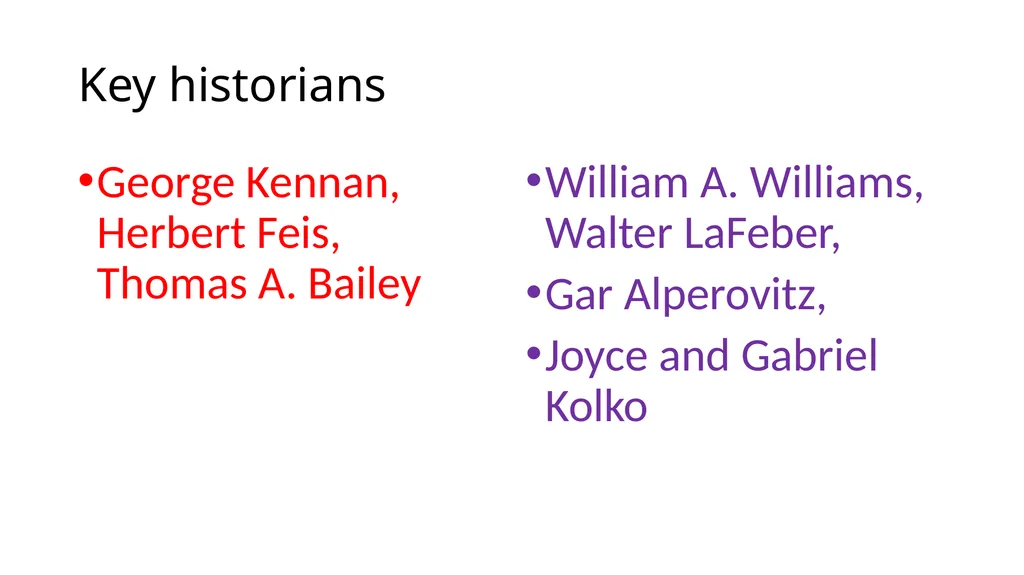
Key historians George Kennan, Herbert Feis, Thomas A. Bailey William A. Williams, Walter LaFeber,
Gar Alperovitz,
Joyce and Gabriel Kolko<br>
09
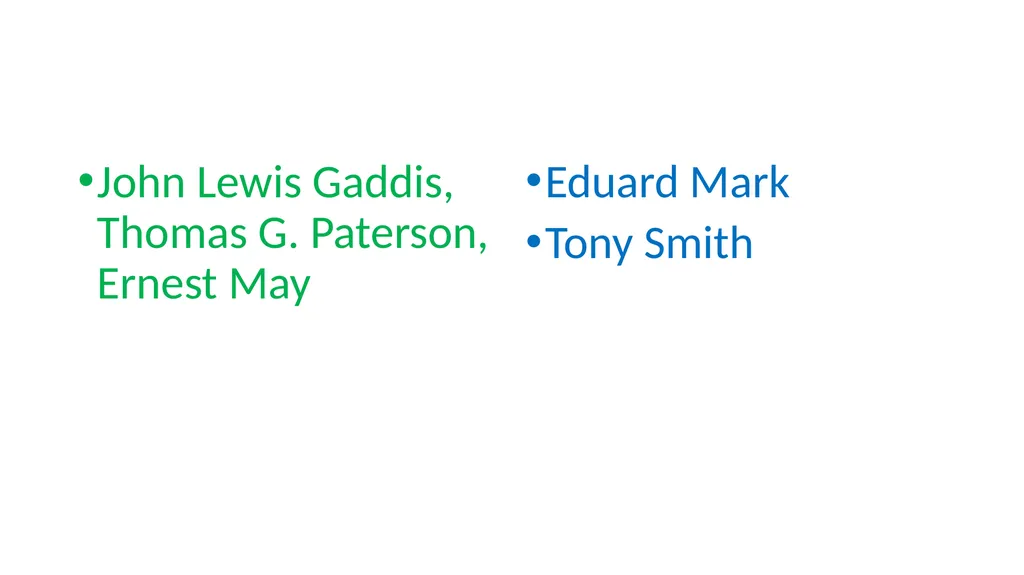
John Lewis Gaddis, Thomas G. Paterson, Ernest May Eduard Mark
Tony Smith<br>