
HMH Science Dimensions Physics Unit 2: Energy and
A
Published · 36 slides · 0 views

1 / 1
Description
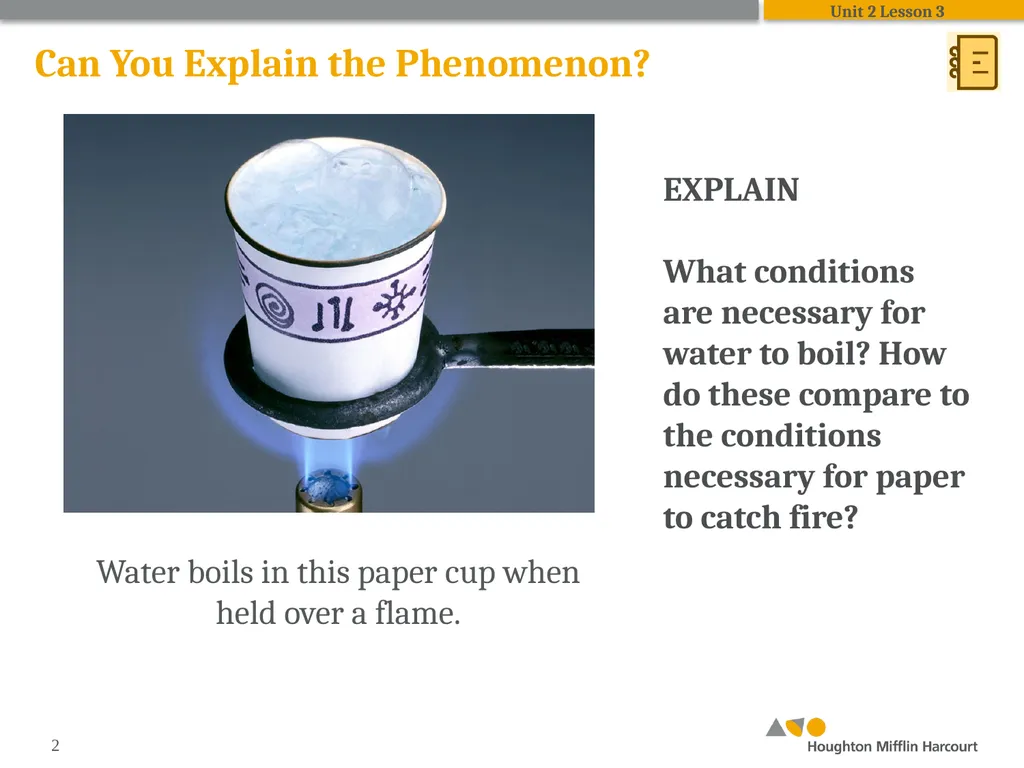
HMH Science Dimensions Physics Unit 2: Energy and Motion Lesson 3: Transferring Thermal Energy Can You Explain the Phenomenon? 2 Unit 2 Lesson 3 EXPLAIN What conditions are necessary for water to boil? How do these compare to the conditions
Related Topics
Download this presentation From Below
"HMH Science Dimensions Physics Unit 2: Energy and" is the property of its rightful owner. Permission is granted to download and print the materials on this website for personal, non-commercial use only, and to display it on your personal computer provided you do not modify the materials and that you retain all copyright notices contained in the materials. By downloading content from our website, you accept the terms of this agreement.
Share
Embed code
Presentation Transcript
01
HMH Science Dimensions
Physics
Unit 2: Energy and Motion
Lesson 3: Transferring Thermal Energy<br>
Physics
Unit 2: Energy and Motion
Lesson 3: Transferring Thermal Energy<br>
02
Can You Explain the Phenomenon? 2 Unit 2 Lesson 3 EXPLAIN
What conditions are necessary for water to boil? How do these compare to the conditions necessary for paper to catch fire? Water boils in this paper cup when held over a flame.<br>
What conditions are necessary for water to boil? How do these compare to the conditions necessary for paper to catch fire? Water boils in this paper cup when held over a flame.<br>
03
Temperature and Particle Motion 3 Unit 2 Lesson 3 Kinetic energy can be understood at the microscopic (small, not directly-observable) and macroscopic (large, directly-observable) levels.
At both scales, kinetic energy is related to the motion of particles and objects.
INFER
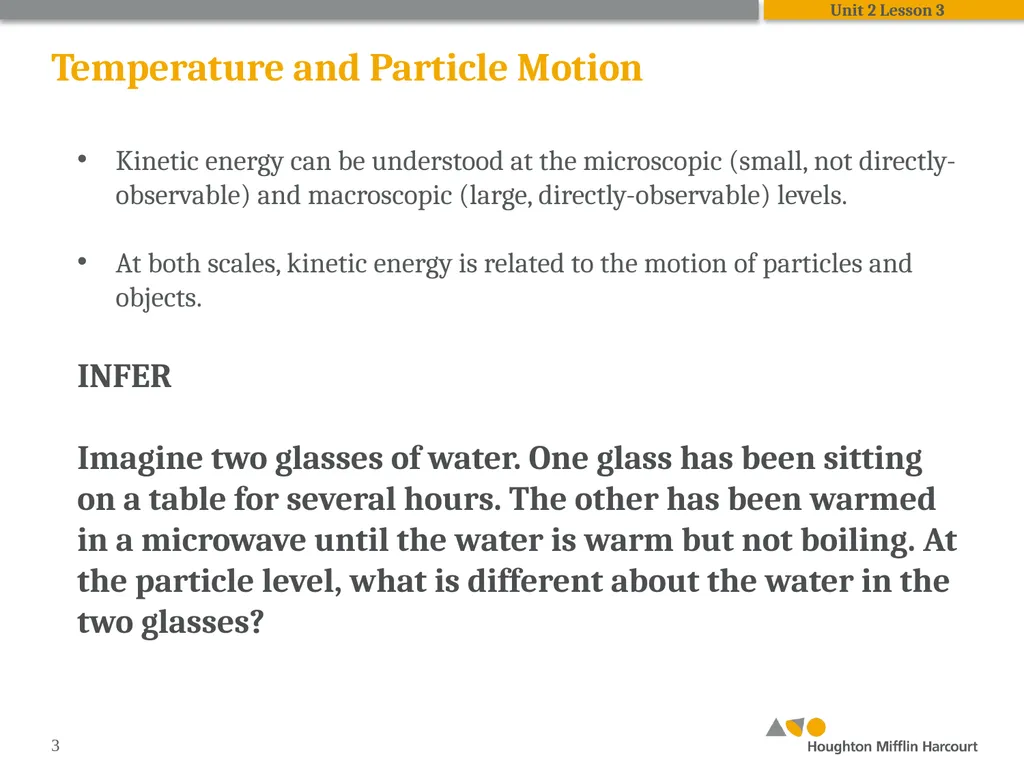
Imagine two glasses of water. One glass has been sitting on a table for several hours. The other has been warmed in a microwave until the water is warm but not boiling. At the particle level, what is different about the water in the two glasses?<br>
At both scales, kinetic energy is related to the motion of particles and objects.
INFER
Imagine two glasses of water. One glass has been sitting on a table for several hours. The other has been warmed in a microwave until the water is warm but not boiling. At the particle level, what is different about the water in the two glasses?<br>
04
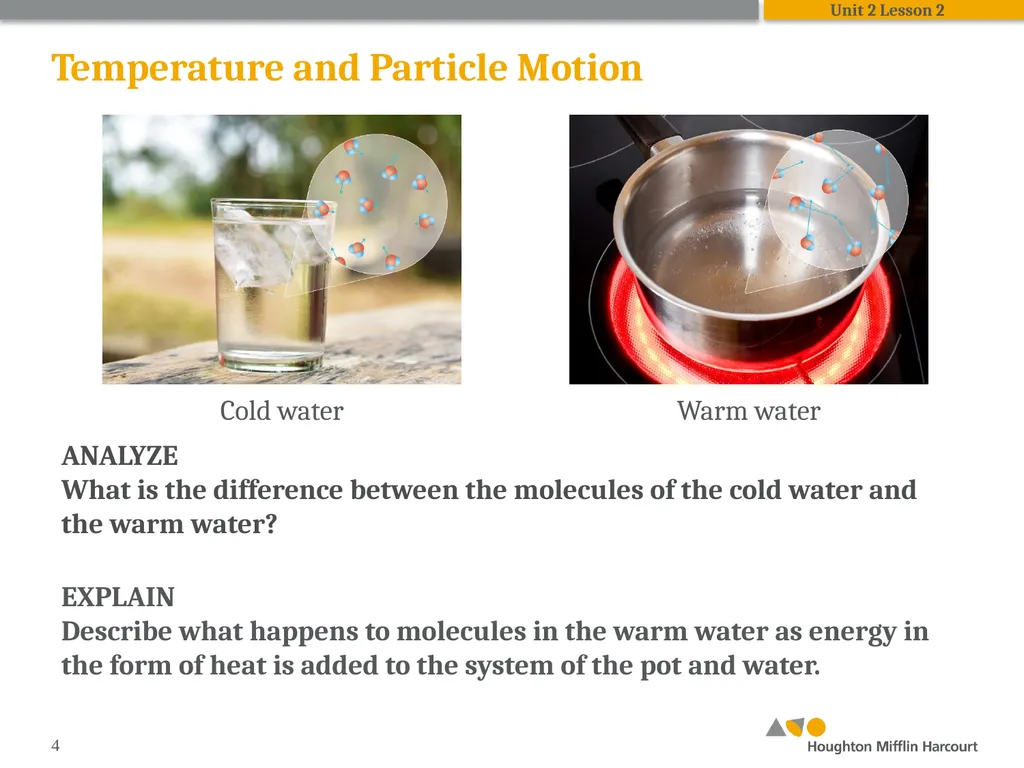
Temperature and Particle Motion 4 Unit 2 Lesson 2 Cold water Warm water EXPLAIN
Describe what happens to molecules in the warm water as energy in the form of heat is added to the system of the pot and water. ANALYZE
What is the difference between the molecules of the cold water and the warm water?<br>
Describe what happens to molecules in the warm water as energy in the form of heat is added to the system of the pot and water. ANALYZE
What is the difference between the molecules of the cold water and the warm water?<br>
05
Temperature and Particle Motion 5 Unit 2 Lesson 3 The total kinetic energy of the particles in a substance is described as thermal energy.
Thermal energy is related to the motion and therefore to the kinetic energy of an object's atoms or molecules.
Temperature is a measure of the average kinetic energy of the particles in a sample, so it does not depend on the amount of mass present.<br>
Thermal energy is related to the motion and therefore to the kinetic energy of an object's atoms or molecules.
Temperature is a measure of the average kinetic energy of the particles in a sample, so it does not depend on the amount of mass present.<br>
06
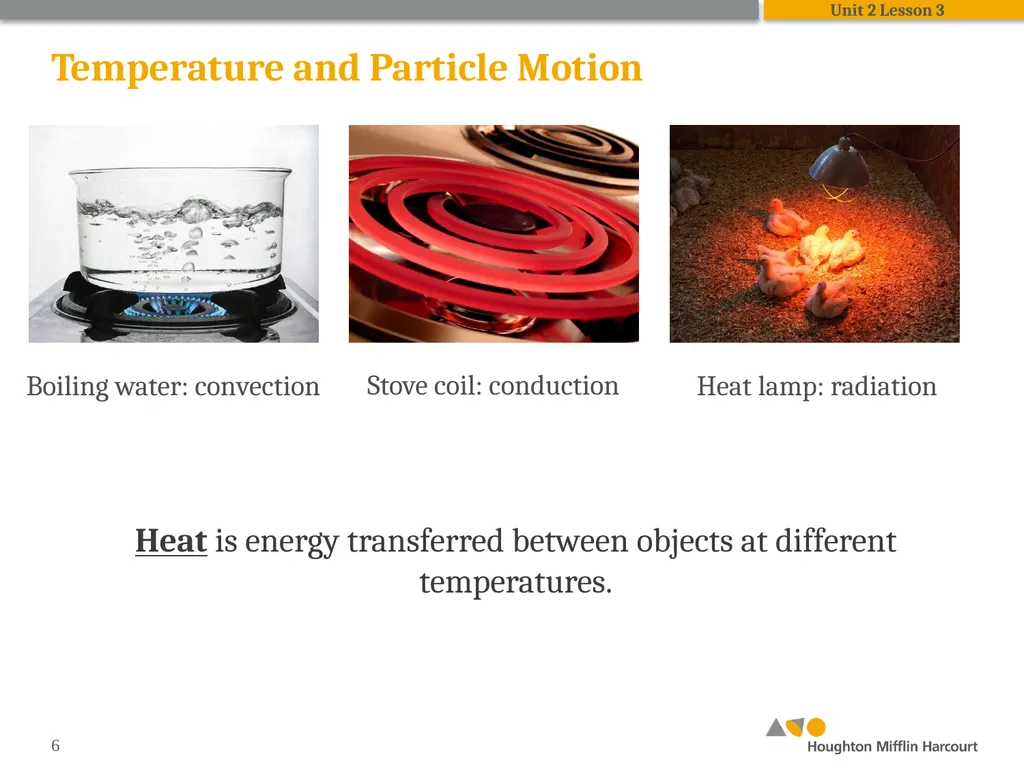
Temperature and Particle Motion 6 Unit 2 Lesson 3 Boiling water: convection Stove coil: conduction Heat lamp: radiation Heat is energy transferred between objects at different temperatures.<br>
07
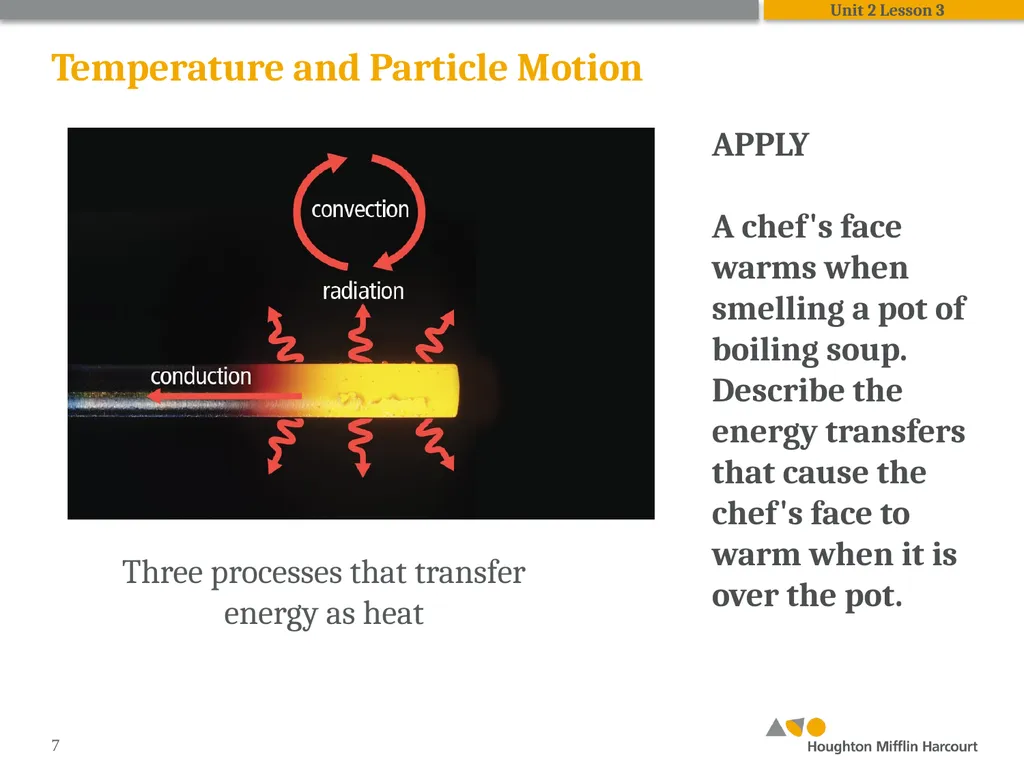
Temperature and Particle Motion 7 Unit 2 Lesson 3 Three processes that transfer energy as heat APPLY
A chef's face warms when smelling a pot of boiling soup. Describe the energy transfers that cause the chef's face to warm when it is over the pot.<br>
A chef's face warms when smelling a pot of boiling soup. Describe the energy transfers that cause the chef's face to warm when it is over the pot.<br>
08
Temperature and Particle Motion 8 Unit 2 Lesson 3 Energy Transfer by Fluid Motion
Energy Transfer by Particle Collisions
EXPLAIN
Compare and contrast how energy is transferred as heat through convection and conduction.<br>
Energy Transfer by Particle Collisions
EXPLAIN
Compare and contrast how energy is transferred as heat through convection and conduction.<br>
09
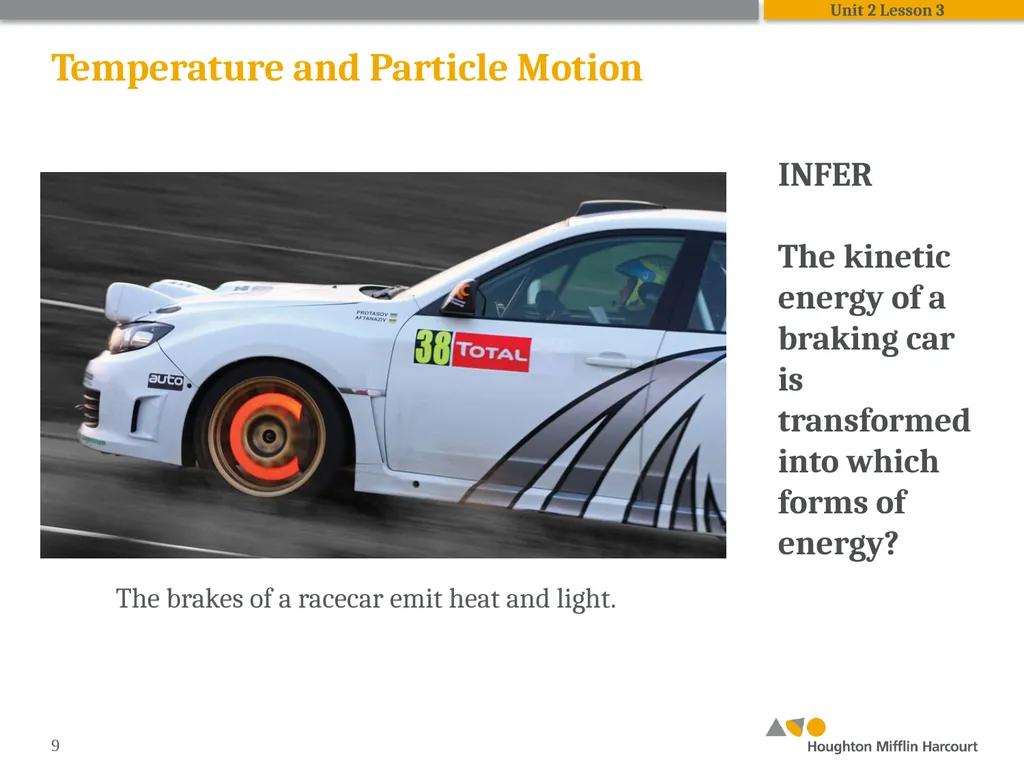
Temperature and Particle Motion 9 Unit 2 Lesson 3 The brakes of a racecar emit heat and light. INFER
The kinetic energy of a braking car is transformed into which forms of energy?<br>
The kinetic energy of a braking car is transformed into which forms of energy?<br>
10
Temperature and Particle Motion
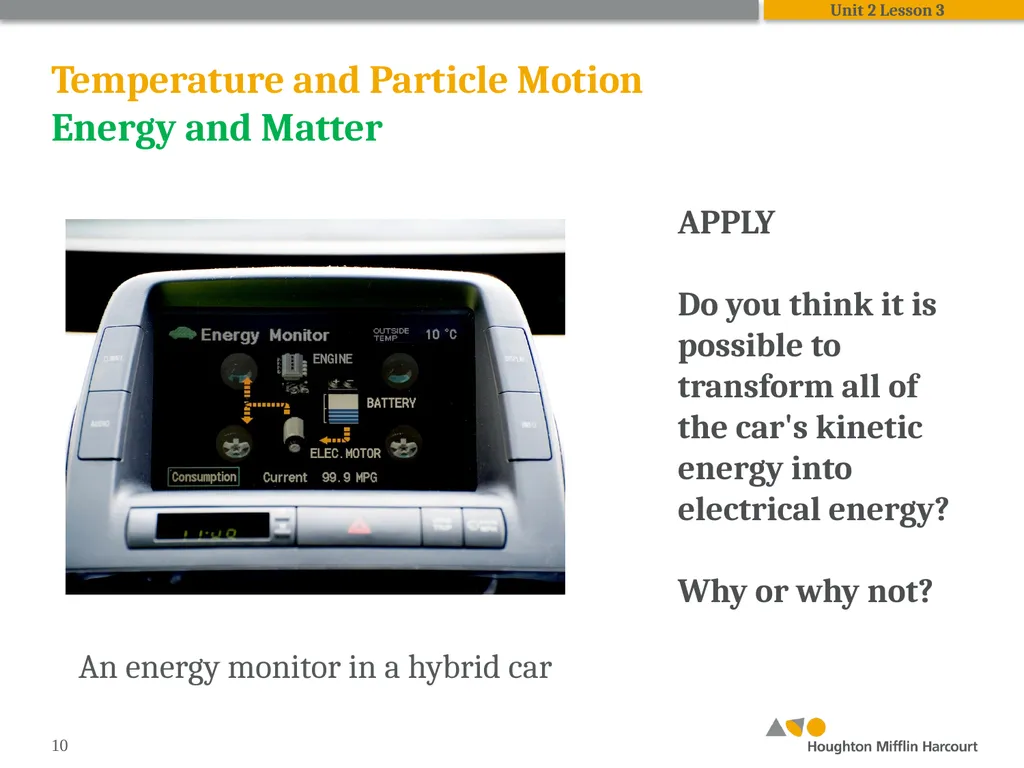
Energy and Matter 10 Unit 2 Lesson 3 An energy monitor in a hybrid car APPLY
Do you think it is possible to transform all of the car's kinetic energy into electrical energy?
Why or why not?<br>
Do you think it is possible to transform all of the car's kinetic energy into electrical energy?
Why or why not?<br>
11
Temperature and Particle Motion 11 Unit 2 Lesson 3 Use your knowledge of thermal energy, temperature, and modes of energy transfer to explain how energy is transferred in the system of the burner, paper cup, and water.<br>
12
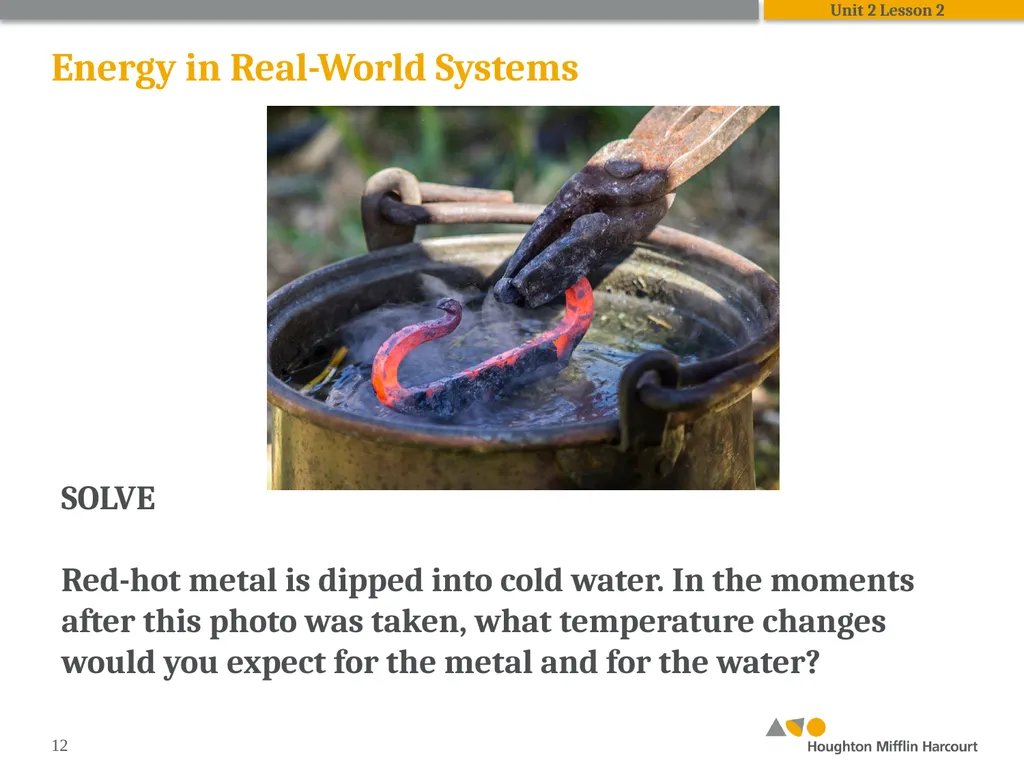
Energy in Real-World Systems 12 Unit 2 Lesson 2 SOLVE
Red-hot metal is dipped into cold water. In the moments after this photo was taken, what temperature changes would you expect for the metal and for the water?<br>
Red-hot metal is dipped into cold water. In the moments after this photo was taken, what temperature changes would you expect for the metal and for the water?<br>
13
Energy in Real-World Systems 13 Unit 2 Lesson 3 When the red-hot metal came in contact with the water, energy was transferred until they reached the same temperature between their initial temperatures.
This new state, in which the system's final temperature is between the starting temperatures of the metal and the water, is called thermal equilibrium.<br>
This new state, in which the system's final temperature is between the starting temperatures of the metal and the water, is called thermal equilibrium.<br>
14
14 Unit 2 Lesson 3 Energy in Real-World Systems
Hands-On Lab: Predicting Temperature RESEARCH QUESTION
What factors must be measured in order to accurately predict the final temperature of a mixture of two substances?<br>
What factors must be measured in order to accurately predict the final temperature of a mixture of two substances?<br>
15
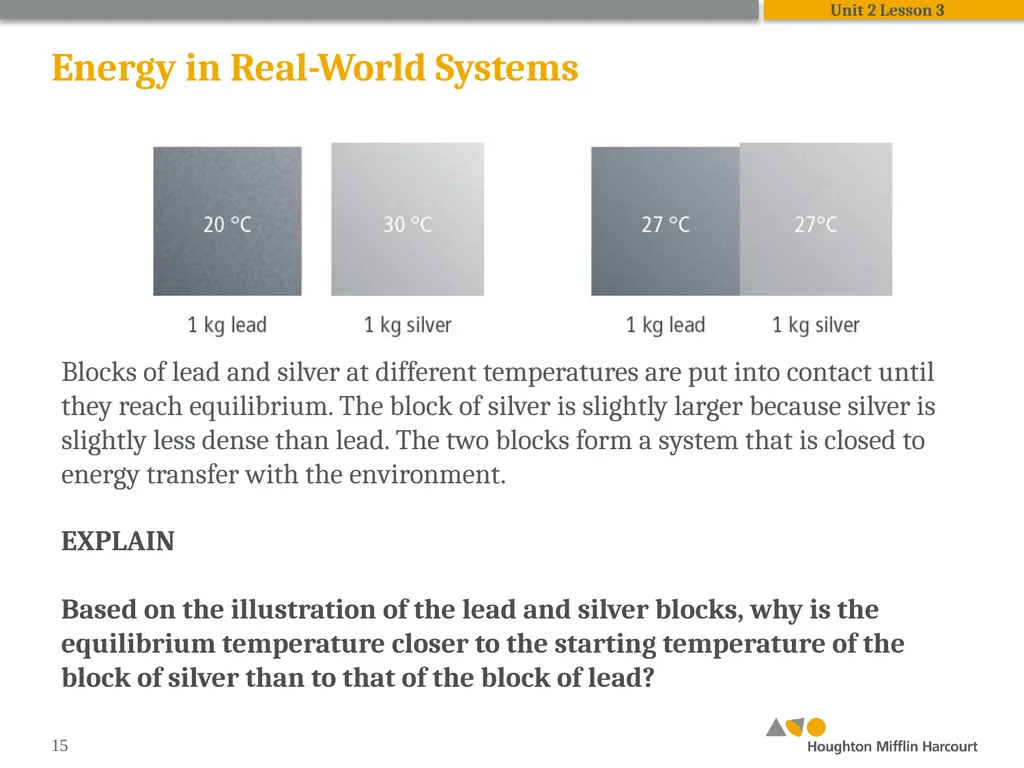
Energy in Real-World Systems 15 Unit 2 Lesson 3 Blocks of lead and silver at different temperatures are put into contact until they reach equilibrium. The block of silver is slightly larger because silver is slightly less dense than lead. The two blocks form a system that is closed to energy transfer with the environment. EXPLAIN
Based on the illustration of the lead and silver blocks, why is the equilibrium temperature closer to the starting temperature of the block of silver than to that of the block of lead?<br>
Based on the illustration of the lead and silver blocks, why is the equilibrium temperature closer to the starting temperature of the block of silver than to that of the block of lead?<br>
16
Energy in Real-World Systems
Systems and System Models 16 Unit 2 Lesson 3 APPLY
What initial conditions should climate scientists consider when modeling how the ice would respond to atmospheric and oceanic temperature changes? When investigating systems, scientists must understand the boundaries and initial conditions in order to conduct analysis.<br>
What initial conditions should climate scientists consider when modeling how the ice would respond to atmospheric and oceanic temperature changes? When investigating systems, scientists must understand the boundaries and initial conditions in order to conduct analysis.<br>
17
Energy in Real-World Systems
Problem Solving 17 Analyze
Plan
Solve
Check Your Work Unit 2 Lesson 3 SOLVE
If 301 J of energy is transferred to a sample of water by a Joule's apparatus, from what height must a 10.0 kg block be dropped to deliver this energy?<br>
Plan
Solve
Check Your Work Unit 2 Lesson 3 SOLVE
If 301 J of energy is transferred to a sample of water by a Joule's apparatus, from what height must a 10.0 kg block be dropped to deliver this energy?<br>
18
Energy in Real-World Systems 18 Unit 2 Lesson 3 Use what you have learned about thermal equilibrium to explain the energy transfers in the system of the burner, paper cup, and water.<br>
19
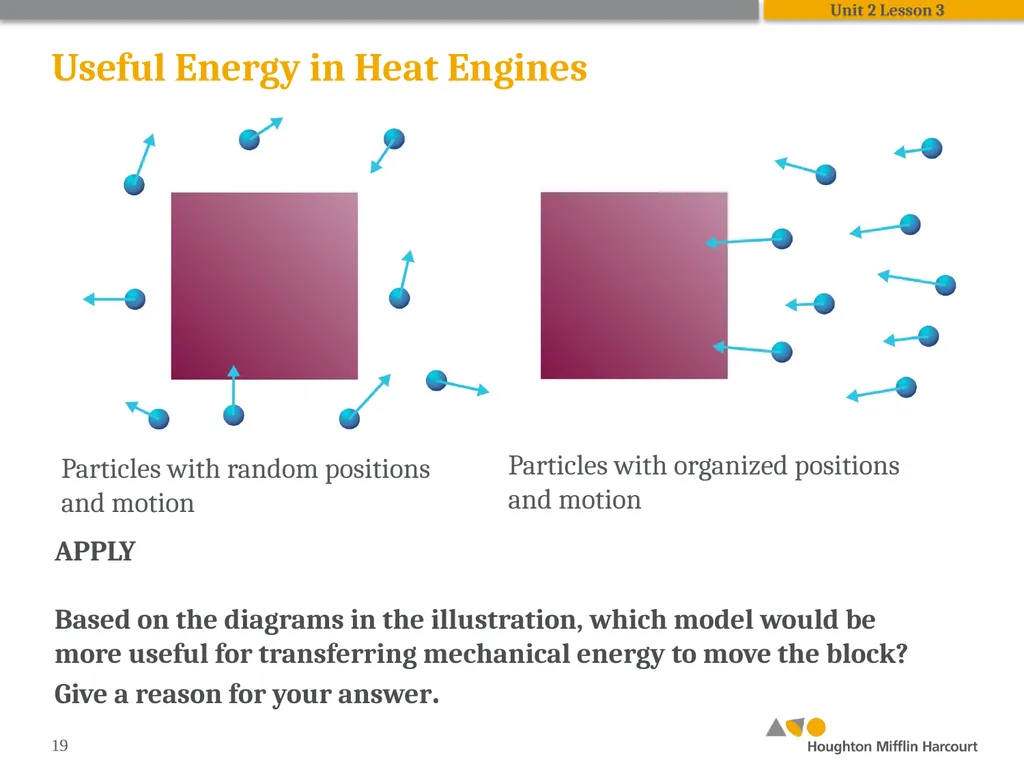
Useful Energy in Heat Engines 19 Unit 2 Lesson 3 Particles with random positions and motion Particles with organized positions and motion APPLY
Based on the diagrams in the illustration, which model would be more useful for transferring mechanical energy to move the block? Give a reason for your answer.<br>
Based on the diagrams in the illustration, which model would be more useful for transferring mechanical energy to move the block? Give a reason for your answer.<br>
20
Energy in Real-World Systems 20 Unit 2 Lesson 3 How can considering organized and unorganized distributions of energy help you design your Impractical Machine in the unit project? Where in your machine should energy be concentrated? Where in your machine will energy be dispersed?<br>
21
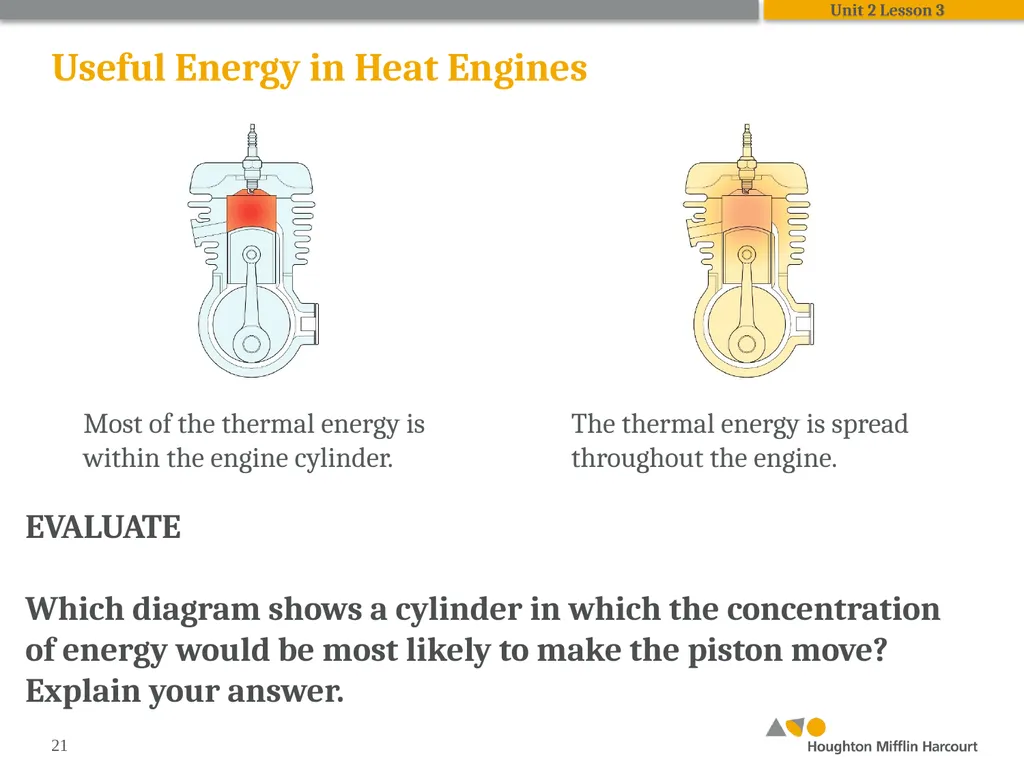
Useful Energy in Heat Engines 21 Unit 2 Lesson 3 Most of the thermal energy is within the engine cylinder. The thermal energy is spread throughout the engine. EVALUATE
Which diagram shows a cylinder in which the concentration of energy would be most likely to make the piston move? Explain your answer.<br>
Which diagram shows a cylinder in which the concentration of energy would be most likely to make the piston move? Explain your answer.<br>
22
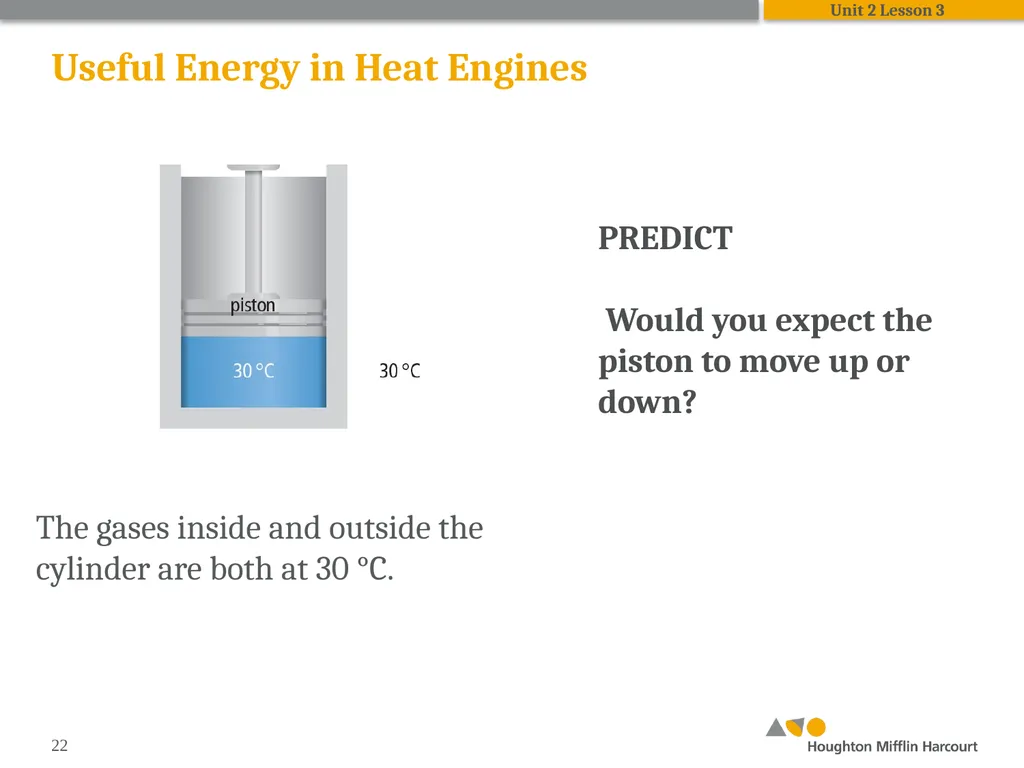
Useful Energy in Heat Engines 22 Unit 2 Lesson 3 The gases inside and outside the cylinder are both at 30 °C. PREDICT
Would you expect the piston to move up or down?<br>
Would you expect the piston to move up or down?<br>
23
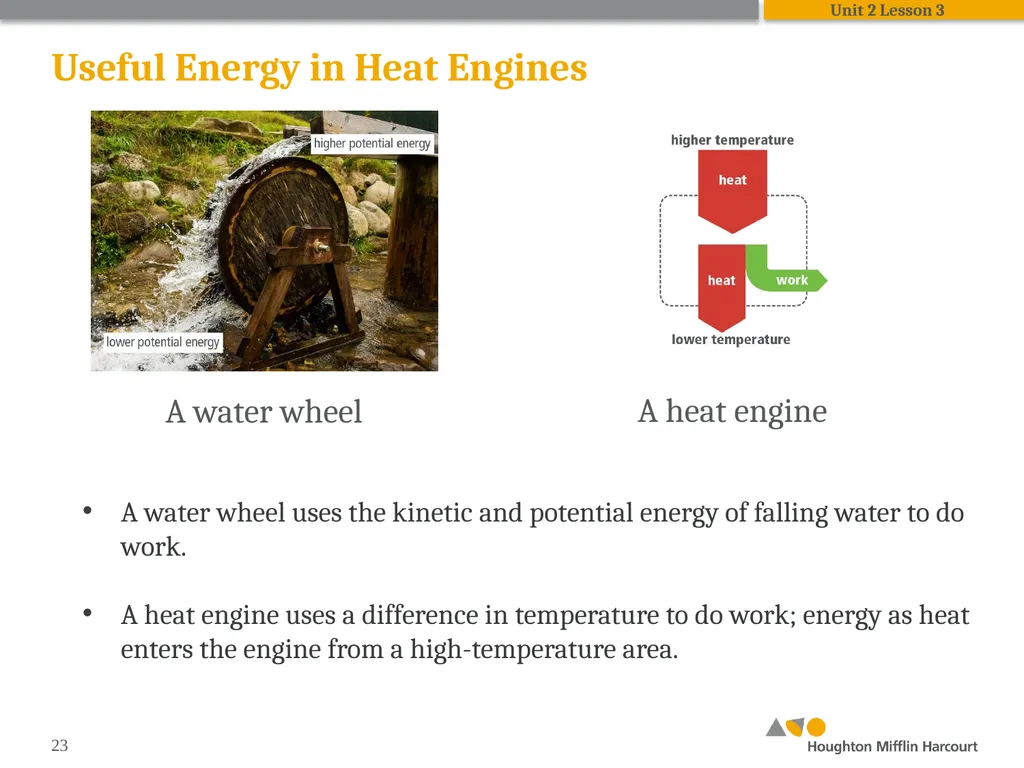
Useful Energy in Heat Engines 23 Unit 2 Lesson 3 A water wheel A heat engine A water wheel uses the kinetic and potential energy of falling water to do work.
A heat engine uses a difference in temperature to do work; energy as heat enters the engine from a high-temperature area.<br>
A heat engine uses a difference in temperature to do work; energy as heat enters the engine from a high-temperature area.<br>
24
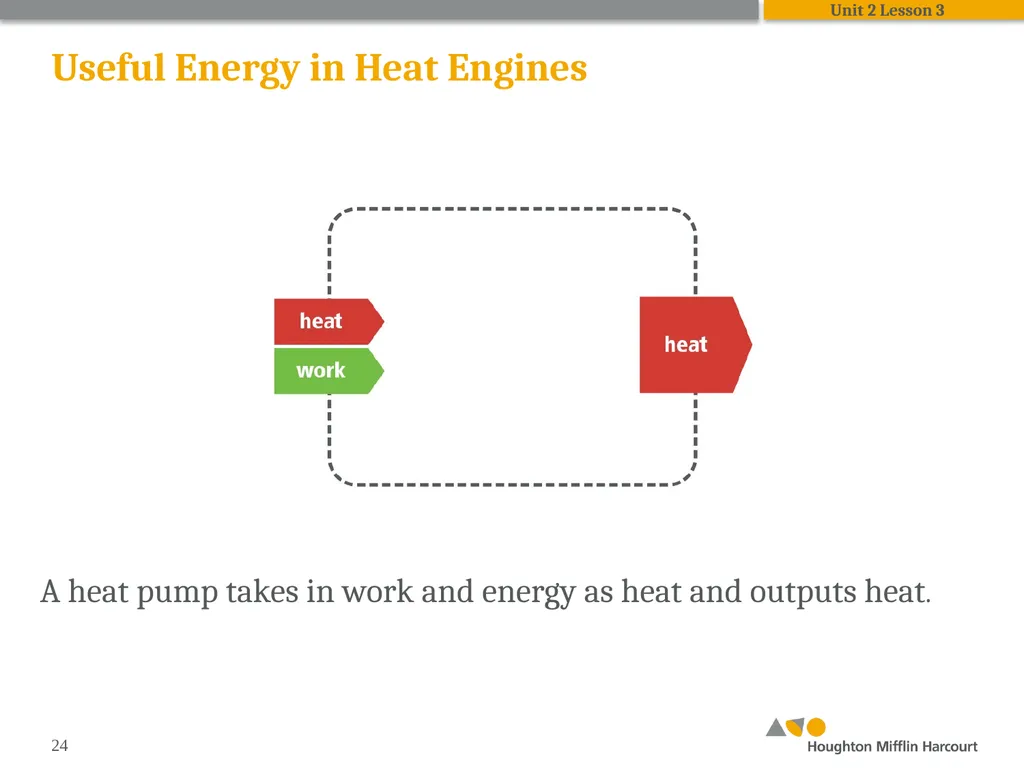
Useful Energy in Heat Engines 24 Unit 2 Lesson 3 A heat pump takes in work and energy as heat and outputs heat.<br>
25
25 Unit 2 Lesson 3 Useful Energy in Heat Engines
Engineering – Engine Efficiency Conduct research to compare the fuel efficiency and pollutant levels of cars and motorcycles. In a report, cite multiple reliable sources to support a claim about how engine size and complexity can affect these factors. Engines give off considerable waste heat.
Reducing this waste heat makes the engine more efficient because more work is output for the same input of energy<br>
Reducing this waste heat makes the engine more efficient because more work is output for the same input of energy<br>
26
Useful Energy in Heat Engines
Problem Solving 26 Analyze
Plan
Solve Unit 2 Lesson 3 SOLVE
A rolling cart has an initial energy of 85 J. Pushing the cart adds 21 J of energy to the system, and some energy is lost. The system now has 98 J of total energy. What was ΔQ?
When a balloon is left in a hot car, it expands. Suppose that the balloon receives 0.20 J of energy in the form of heat and does 0.10 J of work by expanding. If the initial energy of the system was 1.3 J, what is the final energy?<br>
Plan
Solve Unit 2 Lesson 3 SOLVE
A rolling cart has an initial energy of 85 J. Pushing the cart adds 21 J of energy to the system, and some energy is lost. The system now has 98 J of total energy. What was ΔQ?
When a balloon is left in a hot car, it expands. Suppose that the balloon receives 0.20 J of energy in the form of heat and does 0.10 J of work by expanding. If the initial energy of the system was 1.3 J, what is the final energy?<br>
27
Useful Energy in Heat Engines 27 Unit 2 Lesson 3 Think again about the system of the burner, paper cup, and water. How is energy distributed in this system?
Where is energy in the system concentrated or dispersed?<br>
Where is energy in the system concentrated or dispersed?<br>
28
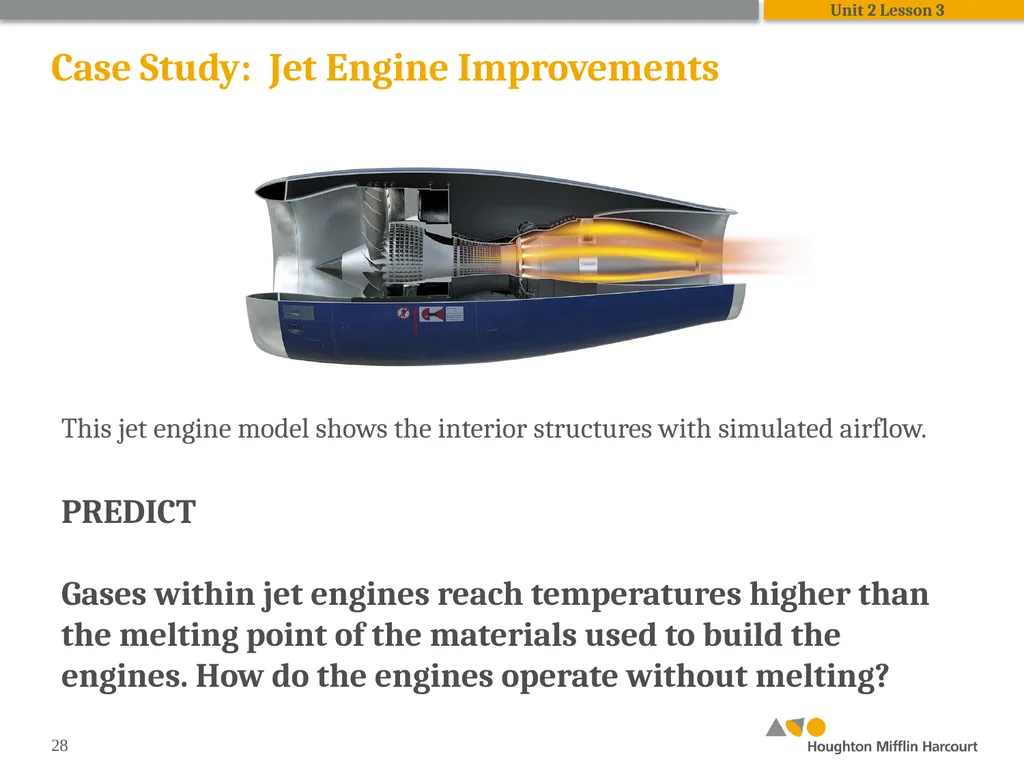
Case Study: Jet Engine Improvements 28 Unit 2 Lesson 3 PREDICT
Gases within jet engines reach temperatures higher than the melting point of the materials used to build the engines. How do the engines operate without melting? This jet engine model shows the interior structures with simulated airflow.<br>
Gases within jet engines reach temperatures higher than the melting point of the materials used to build the engines. How do the engines operate without melting? This jet engine model shows the interior structures with simulated airflow.<br>
29
Case Study: Jet Engine Improvements 29 Unit 2 Lesson 3 EXPLAIN
Jet engines take in fuel and air as matter inputs. They eject exhaust gases as matter outputs. What are the energy inputs and outputs of a jet engine system? EVALUATE
Consider the various simplifications in the jet engine model. What factors are not represented that might affect real-world jet engine performance?<br>
Jet engines take in fuel and air as matter inputs. They eject exhaust gases as matter outputs. What are the energy inputs and outputs of a jet engine system? EVALUATE
Consider the various simplifications in the jet engine model. What factors are not represented that might affect real-world jet engine performance?<br>
30
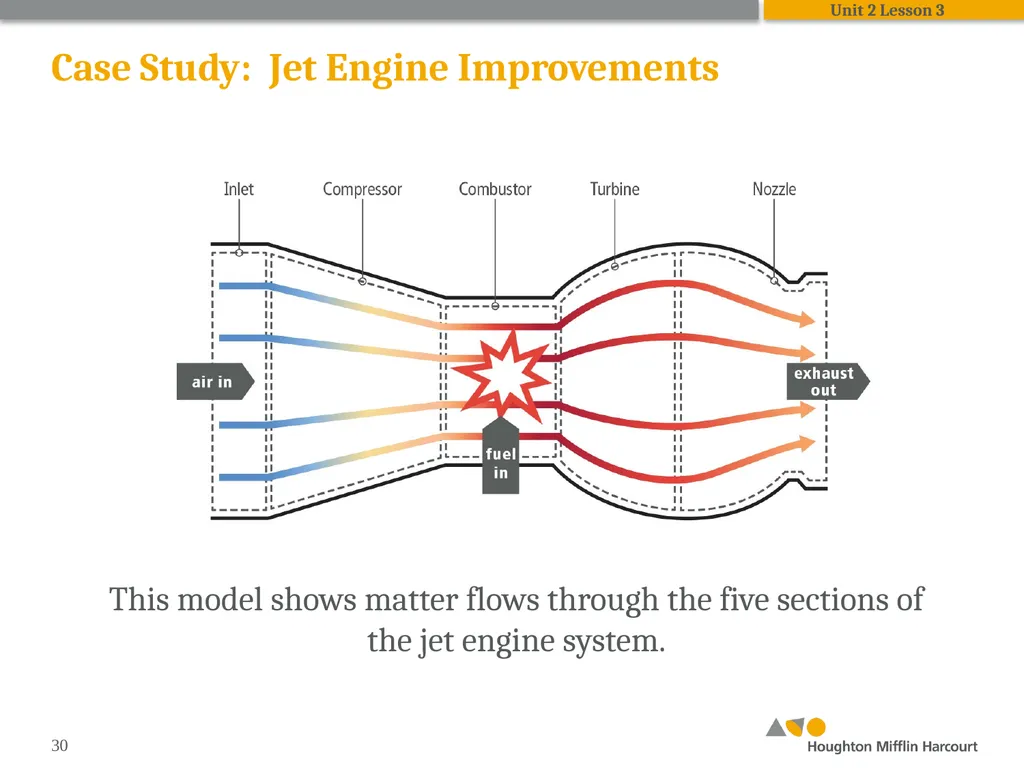
Case Study: Jet Engine Improvements 30 Unit 2 Lesson 3 This model shows matter flows through the five sections of the jet engine system.<br>
31
31 Unit 2 Lesson 3 Useful Energy in Heat Engines
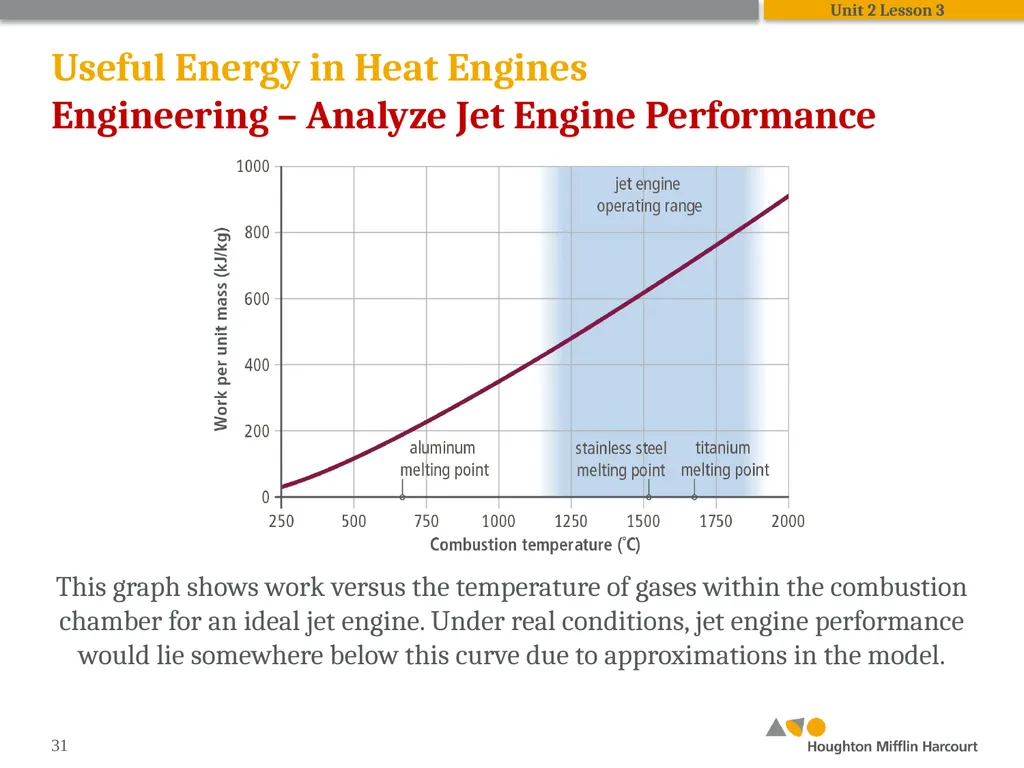
Engineering – Analyze Jet Engine Performance This graph shows work versus the temperature of gases within the combustion chamber for an ideal jet engine. Under real conditions, jet engine performance would lie somewhere below this curve due to approximations in the model.<br>
32
Case Study: Jet Engine Improvements 32 Unit 2 Lesson 3 GATHER EVIDENCE
Look at the photo of the golf ball flattening as it is hit by a golf club. What forms of energy are represented in the photo, and what evidence supports your statements? EXPLAIN
Explain how you think design features in a jet engine use the transfer and transformation of energy to prevent the metal walls of the engine from melting.<br>
Look at the photo of the golf ball flattening as it is hit by a golf club. What forms of energy are represented in the photo, and what evidence supports your statements? EXPLAIN
Explain how you think design features in a jet engine use the transfer and transformation of energy to prevent the metal walls of the engine from melting.<br>
33
Case Study: Jet Engine Improvements 33 Unit 2 Lesson 3 Compare what happens to thermal energy in the system of the burner, paper cup, and water with the thermal energy in the jet engine combustion chamber.
What keeps the cup from catching fire?
What keeps the metal walls of the engine from melting?<br>
What keeps the cup from catching fire?
What keeps the metal walls of the engine from melting?<br>
34
34 Continue Your Exploration Choose one of the paths below to continue your exploration:
Heat Engines
Build a Heat Engine
Careers in Science: Firefighter
Freezing Discrepancy Unit 2 Lesson 3<br>
Heat Engines
Build a Heat Engine
Careers in Science: Firefighter
Freezing Discrepancy Unit 2 Lesson 3<br>
35
Can You Explain the Phenomenon? 35 Unit 2 Lesson 3 Refer to your notes in your Evidence Notebook to make a claim about the energy transfers and transformations that occur such that the water boils before the paper cup catches fire. Your explanation should include a discussion of the following:
Claim How do energy transfers and transformations cause the water to boil before the paper cup catches fire?
Evidence What evidence supports your claim about the energy transfers and transformations in this system?
Reasoning How does your evidence support your claim about the energy transfers and transformations in this system?<br>
Claim How do energy transfers and transformations cause the water to boil before the paper cup catches fire?
Evidence What evidence supports your claim about the energy transfers and transformations in this system?
Reasoning How does your evidence support your claim about the energy transfers and transformations in this system?<br>
36
Image Credits Unit 2 Lesson 3
boiling water in paper cup Richard Megna/Fundamental Photographs, New York; ice water in glass ©Suparat Malipoom/EyeEm/Getty Images; water boiling on stove ©Gregory_DUBUS/iStock/Getty Images Plus/Getty Images; clear pot of boiling water ©iStockPhoto.com; chicks under heat lamp ©Shannon Hibberd/Getty Images; hot electric burner ©gwmullis/Getty Images; race car ©Tom Banks/Moment Editorial/Getty Images; hybrid dashboard ©Alvey & Towers Picture Library/Alamy; quenching metal ©Mauro Matacchione/iStock/Getty Images 36<br>
boiling water in paper cup Richard Megna/Fundamental Photographs, New York; ice water in glass ©Suparat Malipoom/EyeEm/Getty Images; water boiling on stove ©Gregory_DUBUS/iStock/Getty Images Plus/Getty Images; clear pot of boiling water ©iStockPhoto.com; chicks under heat lamp ©Shannon Hibberd/Getty Images; hot electric burner ©gwmullis/Getty Images; race car ©Tom Banks/Moment Editorial/Getty Images; hybrid dashboard ©Alvey & Towers Picture Library/Alamy; quenching metal ©Mauro Matacchione/iStock/Getty Images 36<br>