
Hospitality Studies Grade 9 www.futuremanagers.com
MS
Published · 63 slides · 0 views

1 / 1

Description
Hospitality Studies Grade 9 www.futuremanagers.com INTRODUCTION Hospitality can be defined as a friendly and generous reception and entertainment of guests or the business of providing food, drink and accommodation for customers.
Related Topics
Download this presentation From Below
"Hospitality Studies Grade 9 www.futuremanagers.com" is the property of its rightful owner. Permission is granted to download and print the materials on this website for personal, non-commercial use only, and to display it on your personal computer provided you do not modify the materials and that you retain all copyright notices contained in the materials. By downloading content from our website, you accept the terms of this agreement.
Share
Embed code
Presentation Transcript
01
Hospitality Studies
Grade 9<br>
Grade 9<br>
02
www.futuremanagers.com INTRODUCTION
Hospitality can be defined as a friendly and generous reception and entertainment of guests or the business of providing food, drink and accommodation for customers. Hospitality Studies explores the different interrelated sectors in the hospitality industry and is closely linked to tourism. It covers a wide range of topics such as hygiene, nutrition and menu planning, food production, food and beverage services, housekeeping and room service, guest relations and client services. Module 1: Hospitality industry sectors and careers<br>
Hospitality can be defined as a friendly and generous reception and entertainment of guests or the business of providing food, drink and accommodation for customers. Hospitality Studies explores the different interrelated sectors in the hospitality industry and is closely linked to tourism. It covers a wide range of topics such as hygiene, nutrition and menu planning, food production, food and beverage services, housekeeping and room service, guest relations and client services. Module 1: Hospitality industry sectors and careers<br>
03
www.futuremanagers.com Module 1: Hospitality industry sectors and careers (continued) THE ACCOMMODATION SECTOR IN THE HOSPITALITY INDUSTRY
The accommodation sector is a crucial component of the hospitality industry. It includes various types of establishments that provide lodging and related services to travellers and guests. The sector caters to a diverse range of customers, including tourists, business travellers, and individuals seeking temporary accommodation.<br>
The accommodation sector is a crucial component of the hospitality industry. It includes various types of establishments that provide lodging and related services to travellers and guests. The sector caters to a diverse range of customers, including tourists, business travellers, and individuals seeking temporary accommodation.<br>
04
www.futuremanagers.com Module 1: Hospitality industry sectors and careers (continued) ESTABLISHMENTS IN THE ACCOMMODATION SECTOR: HOTELS
Hotels in South Africa vary in size, from small boutique hotels to large luxury resorts. They typically offer a range of amenities and services, such as restaurants, bars, swimming pools, fitness centers, and concierge services. Hotels often have multiple room options, including standard rooms, suites, and executive rooms. They usually provide daily housekeeping and room service. Hotels are more formal and offer a consistent level of service.<br>
Hotels in South Africa vary in size, from small boutique hotels to large luxury resorts. They typically offer a range of amenities and services, such as restaurants, bars, swimming pools, fitness centers, and concierge services. Hotels often have multiple room options, including standard rooms, suites, and executive rooms. They usually provide daily housekeeping and room service. Hotels are more formal and offer a consistent level of service.<br>
05
www.futuremanagers.com Module 1: Hospitality industry sectors and careers (continued) ESTABLISHMENTS IN THE ACCOMMODATION SECTOR: GUEST HOUSES
Guest houses are usually smaller establishments, often family-run, that offer a more personal and intimate experience. They typically have fewer rooms compared to hotels and are often located in residential areas or scenic locations. Guest houses provide comfortable rooms with private bathrooms, and some may offer communal spaces, like lounges or gardens. Breakfast is often included in the room rate.<br>
Guest houses are usually smaller establishments, often family-run, that offer a more personal and intimate experience. They typically have fewer rooms compared to hotels and are often located in residential areas or scenic locations. Guest houses provide comfortable rooms with private bathrooms, and some may offer communal spaces, like lounges or gardens. Breakfast is often included in the room rate.<br>
06
www.futuremanagers.com Module 1: Hospitality industry sectors and careers (continued) ESTABLISHMENTS IN THE ACCOMMODATION SECTOR: B&BS
B&B accommodation literally means that you will get a bed and a breakfast if you book with the establishment. B&Bs are similar to guest houses, but they often have a stronger focus on providing breakfast for guests. B&Bs are typically smaller accommodations with a limited number of rooms, usually located within a private home or converted residence. The owners or hosts live on-site, creating a homely and welcoming atmosphere.<br>
B&B accommodation literally means that you will get a bed and a breakfast if you book with the establishment. B&Bs are similar to guest houses, but they often have a stronger focus on providing breakfast for guests. B&Bs are typically smaller accommodations with a limited number of rooms, usually located within a private home or converted residence. The owners or hosts live on-site, creating a homely and welcoming atmosphere.<br>
07
www.futuremanagers.com Module 1: Hospitality industry sectors and careers (continued) ESTABLISHMENTS IN THE ACCOMMODATION SECTOR: CULTURAL VILLAGES
South Africa offers a fascinating mixture of cultures rich in tradition, language and crafts. The villages are often situated in rural or traditional areas, allowing visitors to learn about local customs, traditions, and indigenous cultures. Guests can participate in cultural activities, such as traditional dancing, storytelling, crafts, and cooking and having traditional food.
Cultural villages typically consist of traditional-style huts or lodges.<br>
South Africa offers a fascinating mixture of cultures rich in tradition, language and crafts. The villages are often situated in rural or traditional areas, allowing visitors to learn about local customs, traditions, and indigenous cultures. Guests can participate in cultural activities, such as traditional dancing, storytelling, crafts, and cooking and having traditional food.
Cultural villages typically consist of traditional-style huts or lodges.<br>
08
www.futuremanagers.com Module 1: Hospitality industry sectors and careers (continued) THE FOOD AND BEVERAGE SECTOR AND WHAT IT ENTAILS
The food and beverage sector in the hospitality industry includes all activities related to the preparation, presentation, and service of food and beverages in various establishments, such as hotels, restaurants, cafes, bars, resorts, catering companies, and other hospitality venues. It plays an important role in adding to the overall experience of customers and brings in a significant income for many businesses within the industry.<br>
The food and beverage sector in the hospitality industry includes all activities related to the preparation, presentation, and service of food and beverages in various establishments, such as hotels, restaurants, cafes, bars, resorts, catering companies, and other hospitality venues. It plays an important role in adding to the overall experience of customers and brings in a significant income for many businesses within the industry.<br>
09
www.futuremanagers.com Module 1: Hospitality industry sectors and careers (continued) SAMPLE OF TYPES OF FOOD AND BEVERAGE ESTABLISHMENTS FOUND IN THE HOSPITALITY SECTOR
Formal fine dining;
Coffee shops; and
Delis.<br>
Formal fine dining;
Coffee shops; and
Delis.<br>
10
www.futuremanagers.com Module 1: Hospitality industry sectors and careers (continued) HOSTING PERMISSION
Restaurants typically need permission to host events or special gatherings when they deviate from their regular operations and intend to use their premises for specific purposes. Some common scenarios when restaurants need permission to host: Large events & parties, live entertainment, outdoor seating & patio use, alcohol use and special events & promotions.<br>
Restaurants typically need permission to host events or special gatherings when they deviate from their regular operations and intend to use their premises for specific purposes. Some common scenarios when restaurants need permission to host: Large events & parties, live entertainment, outdoor seating & patio use, alcohol use and special events & promotions.<br>
11
www.futuremanagers.com Module 1: Hospitality industry sectors and careers (continued) LOGISTICAL PLANNING
Setting up a restaurant involves careful logistical planning to ensure a smooth and efficient operation. Some key aspects to consider: Concept and business plan;
Location and space;
Licenses, permits, and legal requirements;
Equipment and supplies;
Menu planning and inventory;
Staffing and training;
Supplier relationships;
Technology and POS systems;
Marketing and promotion; and
Soft opening and launch.<br>
Setting up a restaurant involves careful logistical planning to ensure a smooth and efficient operation. Some key aspects to consider: Concept and business plan;
Location and space;
Licenses, permits, and legal requirements;
Equipment and supplies;
Menu planning and inventory;
Staffing and training;
Supplier relationships;
Technology and POS systems;
Marketing and promotion; and
Soft opening and launch.<br>
12
www.futuremanagers.com Module 1: Hospitality industry sectors and careers (continued) CAREER PATHS IN THE HOSPITALITY INDUSTRY AND ENTREPRENEURSHIP OPPORTUNITIES
As a hospitality student, there are several career paths you can pursue that can lead to entrepreneurial opportunities in the hospitality industry. Here are some options to consider:
Event planning;
Food and beverage management; and
Bed and Breakfast owner.<br>
As a hospitality student, there are several career paths you can pursue that can lead to entrepreneurial opportunities in the hospitality industry. Here are some options to consider:
Event planning;
Food and beverage management; and
Bed and Breakfast owner.<br>
13
www.futuremanagers.com Module 1: Hospitality industry sectors and careers (continued) TEAMWORK
Teamwork in the workplace means that individual people who combine their strengths and support each other, can deliver more than each of them can deliver on their own. Individual and team roles need to be clearly defined, goals and objectives need to be achievable, and feedback and development discussions should be constructive.<br>
Teamwork in the workplace means that individual people who combine their strengths and support each other, can deliver more than each of them can deliver on their own. Individual and team roles need to be clearly defined, goals and objectives need to be achievable, and feedback and development discussions should be constructive.<br>
14
www.futuremanagers.com INTRODUCTION
Workplace environments must be hygienic and safe for all employees, visitors or customers. Safety is an extremely important consideration in any workplace. Health and safety in South Africa are regulated by various government bodies. Module 2: Hygiene, health and safety<br>
Workplace environments must be hygienic and safe for all employees, visitors or customers. Safety is an extremely important consideration in any workplace. Health and safety in South Africa are regulated by various government bodies. Module 2: Hygiene, health and safety<br>
15
www.futuremanagers.com Module 2: Hygiene, health and safety (continued) PERSONAL HYGIENE
There are several ways to practice personal hygiene:
Washing/sanitising of hands;
Glove usage; and
Where necessary: Using a face mask.<br>
There are several ways to practice personal hygiene:
Washing/sanitising of hands;
Glove usage; and
Where necessary: Using a face mask.<br>
16
www.futuremanagers.com Module 2: Hygiene, health and safety (continued) GENERAL HYGIENE IN THE FOOD PREPARATION AREA
Maintaining proper hygiene in the food preparation area is essential to ensure the safety and quality of the food being prepared. Some general hygiene practices to follow:
Personal hygiene;
Keep the food preparation area clean and free from clutter;
Storing and handling ingredients correctly; and
Safe handling of utensils and equipment.<br>
Maintaining proper hygiene in the food preparation area is essential to ensure the safety and quality of the food being prepared. Some general hygiene practices to follow:
Personal hygiene;
Keep the food preparation area clean and free from clutter;
Storing and handling ingredients correctly; and
Safe handling of utensils and equipment.<br>
17
www.futuremanagers.com Module 2: Hygiene, health and safety (continued) PEST CONTROL
Dealing quickly with pests, like rodents (mice and rats), flies, cockroaches, weevils and ants that are found in the hospitality kitchen and storerooms are important to maintain a clean and hygienic environment and prevent bad reviews from customers.<br>
Dealing quickly with pests, like rodents (mice and rats), flies, cockroaches, weevils and ants that are found in the hospitality kitchen and storerooms are important to maintain a clean and hygienic environment and prevent bad reviews from customers.<br>
18
www.futuremanagers.com Module 2: Hygiene, health and safety (continued) FOOD WASTE
Restaurant food waste can be classified into:
Kitchen food waste (KFW) – waste produced at the preparatory stage due to overcooking, improper storage, over-peeling, etc.
Client food waste (CFW) – waste produced as clients leave leftovers on their plates.<br>
Restaurant food waste can be classified into:
Kitchen food waste (KFW) – waste produced at the preparatory stage due to overcooking, improper storage, over-peeling, etc.
Client food waste (CFW) – waste produced as clients leave leftovers on their plates.<br>
19
www.futuremanagers.com Module 2: Hygiene, health and safety (continued) FOOD WASTE: GUIDELINES TO MANAGE FOOD WASTE
Some guidelines to help you manage food waste effectively: Inventory management;
Menu planning;
Offer half portions;
Staff training;
Improve the communication between the kitchen and waiters or servers;
Proper food storage;
Do not throw away food;
Tracking and analysis;
Communication with customers; and
Continuous improvement.<br>
Some guidelines to help you manage food waste effectively: Inventory management;
Menu planning;
Offer half portions;
Staff training;
Improve the communication between the kitchen and waiters or servers;
Proper food storage;
Do not throw away food;
Tracking and analysis;
Communication with customers; and
Continuous improvement.<br>
20
www.futuremanagers.com Module 2: Hygiene, health and safety (continued) REDUCE, RE-USE, RECYCLE, UPCYCLE
Reduce, Re-use, Recycle, Upcycle” is a set of principles commonly known as the “4 Rs” and is used to promote environmentally sustainable practices. The “Reduce, Re-use, Recycle” method of waste disposal should be used in order for hospitality establishments to be more responsible in terms of waste creation and disposal due to environmental concerns.<br>
Reduce, Re-use, Recycle, Upcycle” is a set of principles commonly known as the “4 Rs” and is used to promote environmentally sustainable practices. The “Reduce, Re-use, Recycle” method of waste disposal should be used in order for hospitality establishments to be more responsible in terms of waste creation and disposal due to environmental concerns.<br>
21
www.futuremanagers.com INTRODUCTION
Menu planning is one of the most important jobs of a chef or caterer to be able to run a successful food service business. It involves the process of designing and organising a menu that offers a selection of dishes and beverages to be served to customers. Menu planning requires careful consideration of various factors, such as customer preferences, dietary requirements, ingredient availability, and overall business goals. Module 3: Nutrition and menu planning<br>
Menu planning is one of the most important jobs of a chef or caterer to be able to run a successful food service business. It involves the process of designing and organising a menu that offers a selection of dishes and beverages to be served to customers. Menu planning requires careful consideration of various factors, such as customer preferences, dietary requirements, ingredient availability, and overall business goals. Module 3: Nutrition and menu planning<br>
22
www.futuremanagers.com Module 3: Nutrition and menu planning (continued) MENU PLANNING
Menu planning means to compose a series of dishes for a meal that will provide nutritious food, tempt the appetite and satisfy the guest. Composing a menu is an art and needs the careful selection of dishes for each different course, so that each dish will harmonise or complements others.<br>
Menu planning means to compose a series of dishes for a meal that will provide nutritious food, tempt the appetite and satisfy the guest. Composing a menu is an art and needs the careful selection of dishes for each different course, so that each dish will harmonise or complements others.<br>
23
www.futuremanagers.com Module 3: Nutrition and menu planning (continued) THE TWO MAIN TYPES OF MENUS THAT ARE SERVED IN RESTAURANTS
A table d’hôte menu or a prix fixe menu (set price menu), is a type of menu offered by restaurants where a set meal is offered at a fixed price.
An à la carte menu (literally meaning “from the card”) is a menu where each of the dishes on the menu are individually priced meaning that you pay for each item that you choose, separately.<br>
A table d’hôte menu or a prix fixe menu (set price menu), is a type of menu offered by restaurants where a set meal is offered at a fixed price.
An à la carte menu (literally meaning “from the card”) is a menu where each of the dishes on the menu are individually priced meaning that you pay for each item that you choose, separately.<br>
24
www.futuremanagers.com Module 3: Nutrition and menu planning (continued) THE DIFFERENT COURSES OF A MEAL
A course is the term used to describe a dish, or set of dishes served together, forming one of the consecutive (following) parts of a meal. A menu should be logically divided into courses.
A typical 3-course meal includes an appetiser, main course, and dessert.
A formal dinner menu typically consists of several courses, each with its own distinct dishes.<br>
A course is the term used to describe a dish, or set of dishes served together, forming one of the consecutive (following) parts of a meal. A menu should be logically divided into courses.
A typical 3-course meal includes an appetiser, main course, and dessert.
A formal dinner menu typically consists of several courses, each with its own distinct dishes.<br>
25
www.futuremanagers.com Module 3: Nutrition and menu planning (continued) PRICE A MENU
Pricing a menu in the hospitality industry involves a combination of factors. The menu should be profitable (make money) and meet market demand while keeping the cost of ingredient, preparation time, labour costs, portion sizes, and competition in mind.<br>
Pricing a menu in the hospitality industry involves a combination of factors. The menu should be profitable (make money) and meet market demand while keeping the cost of ingredient, preparation time, labour costs, portion sizes, and competition in mind.<br>
26
www.futuremanagers.com KITCHEN BRIGADE AND THEIR ROLES AND RESPONSIBILITIES
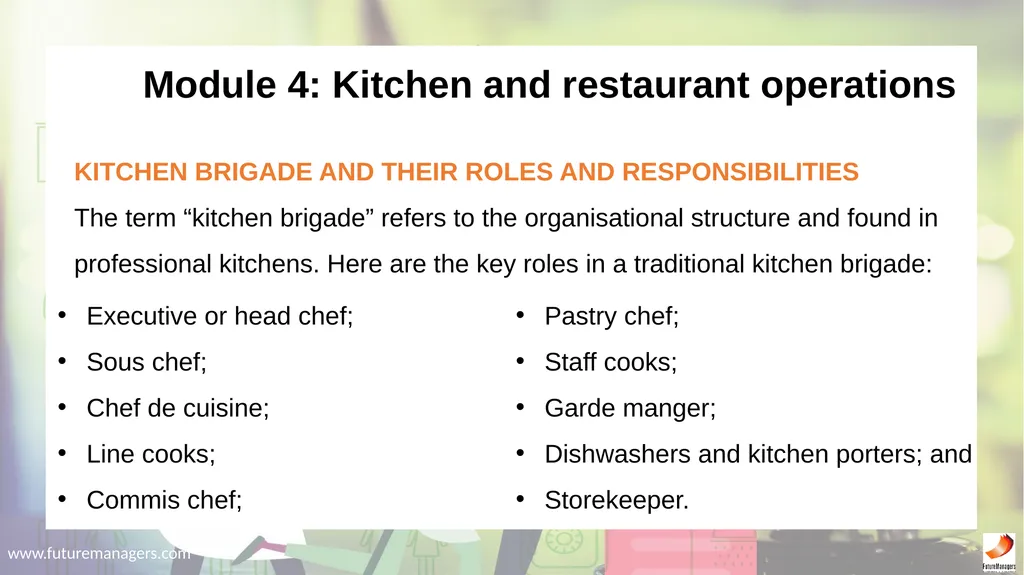
The term “kitchen brigade” refers to the organisational structure and found in professional kitchens. Here are the key roles in a traditional kitchen brigade: Module 4: Kitchen and restaurant operations Executive or head chef;
Sous chef;
Chef de cuisine;
Line cooks;
Commis chef;
Pastry chef;
Staff cooks;
Garde manger;
Dishwashers and kitchen porters; and
Storekeeper.<br>
The term “kitchen brigade” refers to the organisational structure and found in professional kitchens. Here are the key roles in a traditional kitchen brigade: Module 4: Kitchen and restaurant operations Executive or head chef;
Sous chef;
Chef de cuisine;
Line cooks;
Commis chef;
Pastry chef;
Staff cooks;
Garde manger;
Dishwashers and kitchen porters; and
Storekeeper.<br>
27
www.futuremanagers.com Module 4: Kitchen and restaurant operations (continued) RECIPES AND TERMINOLOGY: RECIPES
Interpreting a recipe involves understanding the ingredients, measurements, cooking techniques, instruction and the steps necessary to prepare a dish.<br>
Interpreting a recipe involves understanding the ingredients, measurements, cooking techniques, instruction and the steps necessary to prepare a dish.<br>
28
www.futuremanagers.com Module 4: Kitchen and restaurant operations (continued) MISE EN PLACE
“Mise en place” is a French culinary term that means “putting in place” or “setting up”. It refers to the preparation and organisation of ingredients and equipment before cooking or serving a dish.<br>
“Mise en place” is a French culinary term that means “putting in place” or “setting up”. It refers to the preparation and organisation of ingredients and equipment before cooking or serving a dish.<br>
29
www.futuremanagers.com Module 4: Kitchen and restaurant operations (continued) METRIC MEASUREMENTS
The correct measurement of raw ingredients, both liquid and dry, will ensure not only the taste of the product, but also the proper consistency and density.
In South Africa, the metric system is used:
grams (g) or kilograms (kg) for measuring weight, and
millilitres (ml) or litres (l) to measure liquids.<br>
The correct measurement of raw ingredients, both liquid and dry, will ensure not only the taste of the product, but also the proper consistency and density.
In South Africa, the metric system is used:
grams (g) or kilograms (kg) for measuring weight, and
millilitres (ml) or litres (l) to measure liquids.<br>
30
www.futuremanagers.com Module 4: Kitchen and restaurant operations (continued) COSTING
Food cost refers to the cost incurred in purchasing or producing food items in a restaurant, cafe, or any food service establishment. Food costing is important to know as it has a direct effect on the profitability of a restaurant. It is the cost of your ingredients and does not include other costs, such as labour and overheads. To calculate food cost, you need to consider inventory, purchases, usage & wastage.<br>
Food cost refers to the cost incurred in purchasing or producing food items in a restaurant, cafe, or any food service establishment. Food costing is important to know as it has a direct effect on the profitability of a restaurant. It is the cost of your ingredients and does not include other costs, such as labour and overheads. To calculate food cost, you need to consider inventory, purchases, usage & wastage.<br>
31
www.futuremanagers.com Module 4: Kitchen and restaurant operations (continued) COOKING METHODS
Moist heat cooking methods include any techniques that involve cooking with moisture, e.g. steam, water, stock, wine, or some other liquid.
Dry heat cooking refers to any cooking technique where the heat is transferred to the food item without using any moisture.<br>
Moist heat cooking methods include any techniques that involve cooking with moisture, e.g. steam, water, stock, wine, or some other liquid.
Dry heat cooking refers to any cooking technique where the heat is transferred to the food item without using any moisture.<br>
32
www.futuremanagers.com INTRODUCTION
The term food commodities refers to any product that comes from a farm animal or crop and which is intended for human consumption in its raw or processed state (synonyms for commodities are products and goods). It can also refer to the ingredients needed to produce different varieties of foods. Module 5: Food commodities<br>
The term food commodities refers to any product that comes from a farm animal or crop and which is intended for human consumption in its raw or processed state (synonyms for commodities are products and goods). It can also refer to the ingredients needed to produce different varieties of foods. Module 5: Food commodities<br>
33
www.futuremanagers.com Module 5: Food commodities (continued) IDENTIFY MAIZE PRODUCTS AND UNDERSTAND THEIR USES IN FOOD PRODUCTION
Maize is a grain crop that is commonly called mielie (Afrikaans) or mealie (English) in South Africa. Maize, mielie, mealie and corn are all the same thing. Maize is the most common staple food of South Africa and many other countries in the world. It contains approximately 72% starch, 10% protein, and 4% fat, supplying a substantial amount of energy for humans.<br>
Maize is a grain crop that is commonly called mielie (Afrikaans) or mealie (English) in South Africa. Maize, mielie, mealie and corn are all the same thing. Maize is the most common staple food of South Africa and many other countries in the world. It contains approximately 72% starch, 10% protein, and 4% fat, supplying a substantial amount of energy for humans.<br>
34
www.futuremanagers.com Module 5: Food commodities (continued) UNDERSTAND AND BE ABLE TO USE QUICK-FLOUR MIXTURES
Quick-flour mixtures or baking mix is a shortcut that can be used in baking goods. Some of the ingredients are premixed or combined and with or without a few other ingredients added, can then be baked. Ingredients included in quick-flour mixes can include flour, liquid, leavening agents, shortening or fat, sugar, salt, spices and flavourings. Examples of quick- flour mixtures are quick breads, yeast breads, cakes, muffins, flapjacks, pancakes, cookies, waffles and pastries.<br>
Quick-flour mixtures or baking mix is a shortcut that can be used in baking goods. Some of the ingredients are premixed or combined and with or without a few other ingredients added, can then be baked. Ingredients included in quick-flour mixes can include flour, liquid, leavening agents, shortening or fat, sugar, salt, spices and flavourings. Examples of quick- flour mixtures are quick breads, yeast breads, cakes, muffins, flapjacks, pancakes, cookies, waffles and pastries.<br>
35
www.futuremanagers.com Module 5: Food commodities (continued) CLASSIFY SALADS AND SALAD DRESSINGS AND PREPARE SOME OF THESE SALADS
Salads can be classified into two main categories: raw salads and cooked salads. These categories are based on whether the ingredients in the salad are raw or cooked. Salad dressings are sauces or emulsions that are used to add to the flavours of salads. They can be creamy mayonnaise based, oil and vinegar (vinaigrette) based, or based on various other ingredients to suit different tastes and preferences.<br>
Salads can be classified into two main categories: raw salads and cooked salads. These categories are based on whether the ingredients in the salad are raw or cooked. Salad dressings are sauces or emulsions that are used to add to the flavours of salads. They can be creamy mayonnaise based, oil and vinegar (vinaigrette) based, or based on various other ingredients to suit different tastes and preferences.<br>
36
www.futuremanagers.com Module 5: Food commodities (continued) UNDERSTAND TEA AND COFFEE SERVICE
Serving coffee to a customer involves several steps to ensure a pleasant experience. Here is a general guide on how to serve coffee:
Prepare the coffee;
Gather necessary supplies;
Clean and prepare the cup;
Serve the coffee; and
Interact with the customer.<br>
Serving coffee to a customer involves several steps to ensure a pleasant experience. Here is a general guide on how to serve coffee:
Prepare the coffee;
Gather necessary supplies;
Clean and prepare the cup;
Serve the coffee; and
Interact with the customer.<br>
37
www.futuremanagers.com Module 5: Food commodities (continued) UNDERSTAND WHAT A HARVEST TABLE IS AND HOW TO SET IT UP
A harvest table of food typically refers to a large table that is filled with a bountiful display of food items, often including seasonal fruits and vegetables, cold meats, cheeses, preserves and other delicacies. Harvest tables are often used for communal meals or celebrations, like weddings. Keep in mind that a harvest table is generally an appetizer, replacing the standard wedding canapes.<br>
A harvest table of food typically refers to a large table that is filled with a bountiful display of food items, often including seasonal fruits and vegetables, cold meats, cheeses, preserves and other delicacies. Harvest tables are often used for communal meals or celebrations, like weddings. Keep in mind that a harvest table is generally an appetizer, replacing the standard wedding canapes.<br>
38
www.futuremanagers.com INTRODUCTION
The main purpose of food and beverage service is to make customers feel comfortable by providing delicious foods and beverages and good service. The restaurant staff, managers and waiters are responsible for looking after the customers. Effective communication and good interpersonal skills are needed to look after and carry out customer orders and see to their needs. Module 6: Food and beverage service and customer care<br>
The main purpose of food and beverage service is to make customers feel comfortable by providing delicious foods and beverages and good service. The restaurant staff, managers and waiters are responsible for looking after the customers. Effective communication and good interpersonal skills are needed to look after and carry out customer orders and see to their needs. Module 6: Food and beverage service and customer care<br>
39
www.futuremanagers.com Module 6: Food and beverage service and customer care (continued) THE RESTAURANT BRIGADE
The following is a common hierarchy that is found in many restaurants: Restaurant manager/general manager;
Assistant manager;
Head chef/kitchen manager;
Front-of-House Manager or Maître’d;
Head Server/Captain;
Servers/Waitstaff/Waitrons;
Bartenders;
Host/Hostess; and
Bussers/Food runners.<br>
The following is a common hierarchy that is found in many restaurants: Restaurant manager/general manager;
Assistant manager;
Head chef/kitchen manager;
Front-of-House Manager or Maître’d;
Head Server/Captain;
Servers/Waitstaff/Waitrons;
Bartenders;
Host/Hostess; and
Bussers/Food runners.<br>
40
www.futuremanagers.com Module 6: Food and beverage service and customer care (continued) SERVING OF COLD BEVERAGES
Cold beverages include fruit and vegetable juices, mocktails, cold versions of tea and coffee, milkshakes, smoothies, carbonated drinks, like Coke and Fanta, and water. The waiter should share the drink menu and take the drink order very quickly after the customers have been shown to their table.<br>
Cold beverages include fruit and vegetable juices, mocktails, cold versions of tea and coffee, milkshakes, smoothies, carbonated drinks, like Coke and Fanta, and water. The waiter should share the drink menu and take the drink order very quickly after the customers have been shown to their table.<br>
41
www.futuremanagers.com Module 6: Food and beverage service and customer care (continued) SERVING HOT BEVERAGES
The specific tea service process may vary depending on the restaurant’s style, customer preferences, or regional customs. Adapt the steps as needed to create a delightful tea experience for your customers.<br>
The specific tea service process may vary depending on the restaurant’s style, customer preferences, or regional customs. Adapt the steps as needed to create a delightful tea experience for your customers.<br>
42
www.futuremanagers.com Module 6: Food and beverage service and customer care (continued) SET A TEA TRAY
When setting up a tea tray in a restaurant, is a suggested mise en place:
Determine the tea selection;
Gather teapots and infusers;
Ensure there is hot water;
Prepare the tea accessories;
Select suitable cups, saucers, and plates; and
Arrange clean, folded napkins on the tray for guests to use.<br>
When setting up a tea tray in a restaurant, is a suggested mise en place:
Determine the tea selection;
Gather teapots and infusers;
Ensure there is hot water;
Prepare the tea accessories;
Select suitable cups, saucers, and plates; and
Arrange clean, folded napkins on the tray for guests to use.<br>
43
www.futuremanagers.com Module 6: Food and beverage service and customer care (continued) VENUE SET-UP FOR A POP-UP FOOD STALL OR RESTAURANT AT CRAFTERS OR FARMERS MARKET
A pop-up food stall or restaurant is a temporary food establishment that operates in a particular location for a limited period of time. It is often set up in public spaces, such as parks, markets, festivals, or even on the sidewalk. Pop-up food stalls or restaurants offer a wide variety of food and beverages, ranging from quick snacks to full meals.<br>
A pop-up food stall or restaurant is a temporary food establishment that operates in a particular location for a limited period of time. It is often set up in public spaces, such as parks, markets, festivals, or even on the sidewalk. Pop-up food stalls or restaurants offer a wide variety of food and beverages, ranging from quick snacks to full meals.<br>
44
www.futuremanagers.com Module 6: Food and beverage service and customer care (continued) CUSTOMER NEEDS
When serving food at crafters markets, it is important to understand the needs and preferences of your customers and consider: Quality and freshness;
Dietary preferences and restrictions;
Variety and options;
Quick and efficient service;
Sustainability;
Clear communication;
Pleasant ambiance; and
Engagement and personalisation.<br>
When serving food at crafters markets, it is important to understand the needs and preferences of your customers and consider: Quality and freshness;
Dietary preferences and restrictions;
Variety and options;
Quick and efficient service;
Sustainability;
Clear communication;
Pleasant ambiance; and
Engagement and personalisation.<br>
45
www.futuremanagers.com Module 6: Food and beverage service and customer care (continued) PRACTICE GOOD CUSTOMER SERVICE AND CARE BY PROMOTING QUALITY SERVICE AND PRODUCTS
Making a good first impression is extremely important in any service-based industry, and a restaurant is no different. The role of quality human interactions is extremely important to the success of a restaurant. Understanding guest personalities and their preferences is important.<br>
Making a good first impression is extremely important in any service-based industry, and a restaurant is no different. The role of quality human interactions is extremely important to the success of a restaurant. Understanding guest personalities and their preferences is important.<br>
46
www.futuremanagers.com INTRODUCTION
An entrepreneur is someone who comes up with a great idea for a business and then turns that idea into a reality. Entrepreneurs are creative thinkers and problem solvers who see opportunities where others might not. Therefore, being an entrepreneur is like being an imaginative problem-solver who takes action to turn their ideas into successful businesses. Module 7: Entrepreneurship<br>
An entrepreneur is someone who comes up with a great idea for a business and then turns that idea into a reality. Entrepreneurs are creative thinkers and problem solvers who see opportunities where others might not. Therefore, being an entrepreneur is like being an imaginative problem-solver who takes action to turn their ideas into successful businesses. Module 7: Entrepreneurship<br>
47
www.futuremanagers.com Module 7: Entrepreneurship (continued) THE CHARACTERISTICS OF AN ENTRPRENEUR Visionary;
Passionate and self-motivated;
Risk-taker;
Innovative and creative;
Problem-solver;
Resilient;
Proactive and action-oriented;
Strong leadership skills;
Flexibility and adaptability; and
Persistence.<br>
Passionate and self-motivated;
Risk-taker;
Innovative and creative;
Problem-solver;
Resilient;
Proactive and action-oriented;
Strong leadership skills;
Flexibility and adaptability; and
Persistence.<br>
48
www.futuremanagers.com Module 7: Entrepreneurship (continued) DEVELOP ENTREPRENEURIAL SKILLS AND A MINDSET
Entrepreneurial skills that you need to develop to start and maintain a successful business of your own include: Interpersonal skills;
Leadership; Teamwork; Management skills;
Financial skills;
Critical thinking;
Problem-solving skills;
Drive;
Coping with things not working; and
Continuous learning.<br>
Entrepreneurial skills that you need to develop to start and maintain a successful business of your own include: Interpersonal skills;
Leadership; Teamwork; Management skills;
Financial skills;
Critical thinking;
Problem-solving skills;
Drive;
Coping with things not working; and
Continuous learning.<br>
49
www.futuremanagers.com Module 7: Entrepreneurship (continued) IDENTIFY SELF-EMPLOYMENT OPPORTUNITIES
Here are some steps you can follow to identify opportunities:
Discover your passion and research different options;
Find a need or a problem; Consider your skills and resources;
Create a business plan and test your idea;
Get the necessary permits and licenses; and
Start your business.<br>
Here are some steps you can follow to identify opportunities:
Discover your passion and research different options;
Find a need or a problem; Consider your skills and resources;
Create a business plan and test your idea;
Get the necessary permits and licenses; and
Start your business.<br>
50
www.futuremanagers.com Module 7: Entrepreneurship (continued) ADVANTAGES OF SELF-EMPLOYMENT
Self-employment in South Africa can offer several advantages to individuals. Being an entrepreneur is like being an explorer and an inventor all at once! It means starting your own business or creating something new that can help people or make their lives better.<br>
Self-employment in South Africa can offer several advantages to individuals. Being an entrepreneur is like being an explorer and an inventor all at once! It means starting your own business or creating something new that can help people or make their lives better.<br>
51
www.futuremanagers.com Module 7: Entrepreneurship (continued) THE CONTRIBUTION OF ENTREPRENEURS TO THE SOUTH AFRICAN ECONOMY
Food entrepreneurs play a significant role in contributing to the South African economy. Their activities span various sectors of the food industry, including agriculture, food processing, retail, and hospitality. Job creation, export opportunities, small business development, adding to tourism and travel and innovation are all contributed to the economy through food entrepreneurship.<br>
Food entrepreneurs play a significant role in contributing to the South African economy. Their activities span various sectors of the food industry, including agriculture, food processing, retail, and hospitality. Job creation, export opportunities, small business development, adding to tourism and travel and innovation are all contributed to the economy through food entrepreneurship.<br>
52
www.futuremanagers.com Module 7: Entrepreneurship (continued) MARKETING STRATEGY FOR AN ENTREPRENEURIAL VENTURE
Define your target audience;
Develop a statement;
Set up a display;
Offer competitive pricing;
Communicate through multiple channels and leverage word-of-mouth
Offer tasting samples; and
Provide recipes and cooking tips.<br>
Define your target audience;
Develop a statement;
Set up a display;
Offer competitive pricing;
Communicate through multiple channels and leverage word-of-mouth
Offer tasting samples; and
Provide recipes and cooking tips.<br>
53
www.futuremanagers.com INTRODUCTION
Financial management in hospitality refers to the process of managing the financial resources of a hospitality business, such as a hotel, restaurant, pop-up stall, food truck or coffee-shop, in order to achieve its financial objectives. It involves balancing the needs of the business with the financial resources available in order to achieve long-term success. Module 8: Financial management<br>
Financial management in hospitality refers to the process of managing the financial resources of a hospitality business, such as a hotel, restaurant, pop-up stall, food truck or coffee-shop, in order to achieve its financial objectives. It involves balancing the needs of the business with the financial resources available in order to achieve long-term success. Module 8: Financial management<br>
54
www.futuremanagers.com Module 8: Financial management (continued) STOCK CONTROL
Stock control in a hospitality kitchen refers to the process of effectively managing and monitoring the inventory of food and supplies. It involves ensuring that the right quantity of ingredients and items are available at the right time while minimising waste and maintaining cost efficiency.<br>
Stock control in a hospitality kitchen refers to the process of effectively managing and monitoring the inventory of food and supplies. It involves ensuring that the right quantity of ingredients and items are available at the right time while minimising waste and maintaining cost efficiency.<br>
55
www.futuremanagers.com Module 8: Financial management (continued) PRACTICE STOCK CONTROL
There are practices to take care in with stock control:
Taking delivery of stock which entails inspecting the goods are quality and reconciling inventory and invoices; and
Storing the stock which is vital to reduce waste.
Rotating the stock of ingredients and food means making sure that you use the oldest food first and keep track of what you have so nothing goes bad.<br>
There are practices to take care in with stock control:
Taking delivery of stock which entails inspecting the goods are quality and reconciling inventory and invoices; and
Storing the stock which is vital to reduce waste.
Rotating the stock of ingredients and food means making sure that you use the oldest food first and keep track of what you have so nothing goes bad.<br>
56
www.futuremanagers.com Module 8: Financial management (continued) PRICING TECHNIQUES
Pricing techniques or strategies in the food service industry refer to the methods used to determine the prices of food and beverages offered by restaurants, cafes, or other food establishments. Pricing strategies may vary depending on the specific goals and target market of the food establishment and therefore, it is essential to consider factors like costs, competition, customer preferences, and market conditions when determining the pricing strategy for a food service business.<br>
Pricing techniques or strategies in the food service industry refer to the methods used to determine the prices of food and beverages offered by restaurants, cafes, or other food establishments. Pricing strategies may vary depending on the specific goals and target market of the food establishment and therefore, it is essential to consider factors like costs, competition, customer preferences, and market conditions when determining the pricing strategy for a food service business.<br>
57
www.futuremanagers.com Module 8: Financial management (continued) ADDING PROFIT TO A PRODUCT, SERVICE OR MENU ITEM
Adding profit to a menu item involves determining the cost of the ingredients used in the dish and then setting a price that allows you to cover your costs while also generating a profit.<br>
Adding profit to a menu item involves determining the cost of the ingredients used in the dish and then setting a price that allows you to cover your costs while also generating a profit.<br>
58
www.futuremanagers.com INTRODUCTION
Operational planning refers to the methods used to meet the goals set by the business. The plan will identify the specific tasks that need to be completed in order to achieve these goals as well as the resources that will be needed to complete them. The planning process will also help to identify the specific areas of the business that need improvement, and the resources needed to make these improvements. Module 9: Operational planning<br>
Operational planning refers to the methods used to meet the goals set by the business. The plan will identify the specific tasks that need to be completed in order to achieve these goals as well as the resources that will be needed to complete them. The planning process will also help to identify the specific areas of the business that need improvement, and the resources needed to make these improvements. Module 9: Operational planning<br>
59
www.futuremanagers.com Module 9: Operational planning (continued) THE ROLE AND FUNCTIONS OF THE MAINTENANCE DEPARTMENT AND STAFF IN HOSPITALITY ESTABLISHMENTS, RESTAURANTS AND KITCHENS
Maintenance staff plays a crucial role in guest or customer satisfaction within the hospitality sector. The appearance, functionality, and overall condition of a hotel or any hospitality establishment can significantly impact the guest experience. The role of the maintenance department is a 24-hour, vitally important function of any hospitality establishment.<br>
Maintenance staff plays a crucial role in guest or customer satisfaction within the hospitality sector. The appearance, functionality, and overall condition of a hotel or any hospitality establishment can significantly impact the guest experience. The role of the maintenance department is a 24-hour, vitally important function of any hospitality establishment.<br>
60
www.futuremanagers.com Module 9: Operational planning (continued) MAINTENANCE AND CUSTOMER SATISFACTION
Maintenance plays a crucial role in customer satisfaction within the hospitality sector. The appearance, functionality, and overall condition of a hotel or any hospitality establishment can significantly impact the guest experience.<br>
Maintenance plays a crucial role in customer satisfaction within the hospitality sector. The appearance, functionality, and overall condition of a hotel or any hospitality establishment can significantly impact the guest experience.<br>
61
www.futuremanagers.com Module 9: Operational planning (continued) THE ROLE OF FRONT OFFICE IN A HOSPITALITY ESTABLISHMENT
The front office serves as the first point of contact for guests, and their interactions with the front office staff significantly influence their overall experience. It is an essential department in both hotels and restaurants and is responsible for handling various tasks related to guest services and administrative functions.<br>
The front office serves as the first point of contact for guests, and their interactions with the front office staff significantly influence their overall experience. It is an essential department in both hotels and restaurants and is responsible for handling various tasks related to guest services and administrative functions.<br>
62
www.futuremanagers.com Module 9: Operational planning (continued) THE SYSTEMS USED AND THE STANDARD PROCEDURES AND FUNCTIONS OF THE FRONT OFFICE
Basic systems are commonly used to ensure smooth operations and provide excellent customer service. These systems include:
Reservation system;
Point of sale (POS) system;
Order management system; and
Guest management system.<br>
Basic systems are commonly used to ensure smooth operations and provide excellent customer service. These systems include:
Reservation system;
Point of sale (POS) system;
Order management system; and
Guest management system.<br>
63
www.futuremanagers.com Module 9: Operational planning (continued) THE IMPORTANCE OF DETAIL AND ACCURACY WHEN WORKING IN FRONT OFFICE
Detail and accuracy are vital in the front office of a hotel or restaurant to deliver exceptional guest experiences, uphold professionalism, ensure efficiency, facilitate communication, resolve problems, maintain financial accountability, and meet legal requirements. These qualities contribute to the overall success and reputation of the establishment.<br>
Detail and accuracy are vital in the front office of a hotel or restaurant to deliver exceptional guest experiences, uphold professionalism, ensure efficiency, facilitate communication, resolve problems, maintain financial accountability, and meet legal requirements. These qualities contribute to the overall success and reputation of the establishment.<br>