
How Businesses Create Value AP Business with









Description: How Businesses Create Value AP Business with Personal Finance Topic 1.1 Extended Notes 1 Learning Goals Explain what it means for a business to create value. Identify the resources businesses use to create goods and services.
Related Topics
Download Presentation
"How Businesses Create Value AP Business with" is the property of its rightful owner. Permission is granted to download and print the materials on this website for personal, non-commercial use only, and to display it on your personal computer provided you do not modify the materials and that you retain all copyright notices contained in the materials. By downloading content from our website, you accept the terms of this agreement.
Presentation Transcript
slide1. How Businesses Create Value AP Business with Personal Finance
Topic 1.1 • Extended Notes 1<br>
slide2. Learning Goals • Explain what it means for a business to create value.
• Identify the resources businesses use to create goods and services.
• Explain customer perceived value and why it differs among consumers.
• Distinguish among price, cost, revenue, and profit.
• Explain how businesses increase value and develop competitive advantage.
• Connect business value creation to personal finance decisions. 2<br>
slide3. 1. What Is Value Creation? • Value creation is the process of transforming resources into a good or service customers perceive as valuable.
• Customers compare the benefits they receive with the price and other sacrifices required to obtain the product.
• A product does not automatically create value simply because it is produced.
• Successful businesses understand what customers value and design their operations around those needs.
• Core idea: businesses create value for customers while trying to capture enough of that value to earn profit. 3<br>
slide4. 2. Why Businesses Exist • Businesses identify opportunities, solve problems, satisfy wants and needs, and organize resources.
• They combine resources to produce goods or services.
• They create value by transforming inputs into outputs customers are willing to purchase.
• They capture value through sales revenue and attempt to earn profit after paying costs.
• Business success requires both customer value and financial sustainability. 4<br>
slide5. 3. Resources Used to Create Value • Labor: human effort, skills, knowledge, creativity, and time.
• Capital: equipment, buildings, technology, tools, and other productive assets.
• Materials and inputs: physical resources used to make the final product.
• Information: market research, customer data, forecasts, and knowledge used for decisions.
• Entrepreneurship: identifying opportunities, organizing resources, taking risks, and making decisions. 5<br>
slide6. 4. The Value-Creation Process • Resources → Business Activities → Product/Service → Customer Perceived Value → Revenue → Profit
• Business activities include designing, producing, marketing, transporting, selling, and providing service.
• The final output is valuable when customers believe its benefits justify what they give up.
• Revenue comes from sales; profit depends on the relationship between revenue and total costs. 6<br>
slide7. 5. Customer Perceived Value • Customer perceived value is the customer's assessment of the benefits received compared with the sacrifices required.
• Benefits may include quality, convenience, reliability, enjoyment, status, speed, safety, design, and personalization.
• Sacrifices may include price, time, effort, transportation, inconvenience, and risk.
• Different customers can value the same product differently because their preferences and circumstances differ. 7<br>
slide8. 6. Value Is More Than Price • Price tells us what the customer pays; it does not tell us how valuable the product feels to the customer.
• A higher-priced product may provide greater perceived value through quality, convenience, branding, or experience.
• A low-priced product may provide poor value if it breaks quickly or creates significant inconvenience.
• Businesses try to increase perceived benefits while controlling the costs of delivering those benefits. 8<br>
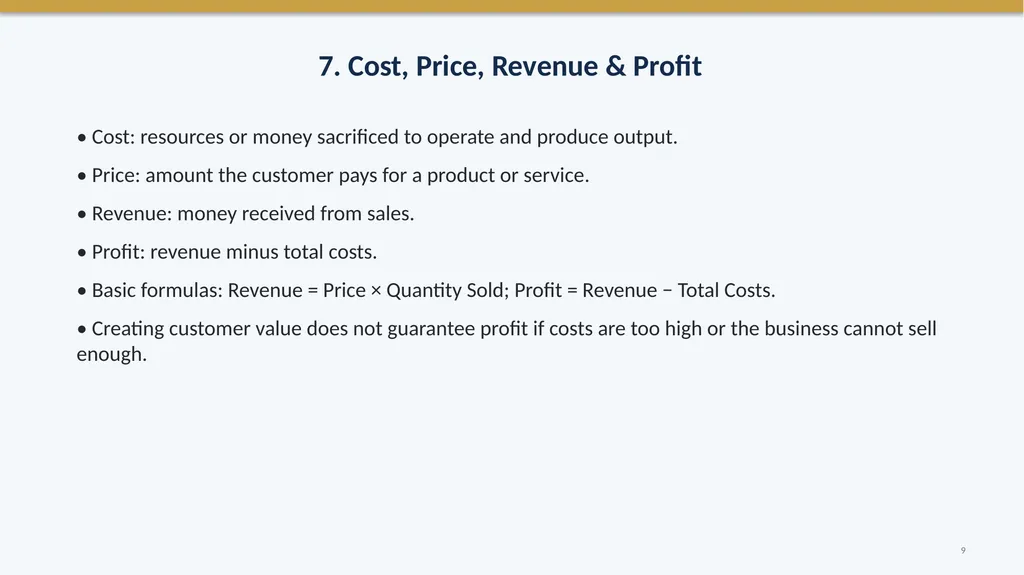
slide9. 7. Cost, Price, Revenue & Profit • Cost: resources or money sacrificed to operate and produce output.
• Price: amount the customer pays for a product or service.
• Revenue: money received from sales.
• Profit: revenue minus total costs.
• Basic formulas: Revenue = Price × Quantity Sold; Profit = Revenue − Total Costs.
• Creating customer value does not guarantee profit if costs are too high or the business cannot sell enough. 9<br>
slide10. 8. Example: Customized Water Bottles • A student buys plain water bottles and adds personalized designs.
• Direct production cost = $4 per bottle.
• Selling price = $12 per bottle.
• The business adds value through personalization, design, packaging, branding, and convenience.
• The $8 difference between price and direct unit cost is not automatically final profit because other expenses may exist.
• Key question: Why would a customer pay $12 for something that costs only $4 to produce? 10<br>
slide11. 9. How Businesses Increase Value • Improve quality: use better materials or more reliable processes.
• Increase convenience: make products easier or faster to buy and use.
• Add features: provide benefits customers actually value.
• Build a strong brand: create recognition, trust, identity, and emotional connection.
• Use technology: automate, personalize, improve performance, or simplify access.
• Innovate: develop or improve products, services, processes, or business models. 11<br>
slide12. 10. More Ways to Increase Value • Improve customer service and reduce customer frustration.
• Personalize products to individual preferences.
• Improve design, usability, appearance, or functionality.
• Reduce customer risk through warranties, guarantees, security, or reliability.
• Improve distribution and delivery speed.
• Create an experience that competitors do not easily duplicate. 12<br>
slide13. 11. Competitive Advantage • Competitive advantage is a factor that allows a business to compete more effectively than its rivals.
• Businesses may compete through lower costs, higher quality, stronger branding, better technology, faster delivery, or superior service.
• Customers have choices, so businesses need a reason for customers to choose them.
• A competitive advantage is most useful when it is valuable to customers and difficult for competitors to copy. 13<br>
slide14. 12. Innovation and Value Creation • Innovation does not always mean inventing something completely new.
• Businesses can innovate by improving an existing product, changing delivery, reducing costs, or improving the customer experience.
• Examples: online ordering, personalized recommendations, subscription models, redesigned packaging, and faster delivery.
• Innovation can increase customer value and/or allow the business to operate more efficiently. 14<br>
slide15. 13. Value Creation vs. Value Capture • Value creation = making a product or service that customers value.
• Value capture = turning that created value into revenue and ultimately profit.
• A business can create substantial value but still struggle financially if its costs are too high.
• A business must balance customer benefits, price, demand, and costs.
• The goal is not simply to create value—it is to create value sustainably. 15<br>
slide16. 14. Connection to Personal Finance • Consumers also make value decisions every day.
• Ask: 'Are the benefits I receive worth the money, time, effort, and alternatives I give up?'
• A $30 subscription may be valuable to a frequent user but wasteful to someone who rarely uses it.
• A more expensive product may be the better value if it lasts longer or provides important benefits.
• Personal finance is therefore closely connected to the business concept of perceived value. 16<br>
slide17. 15. Opportunity Cost and Value • Resources are scarce, so every choice has an opportunity cost.
• Consumers give up alternative uses of their money when they purchase something.
• Businesses also face opportunity costs when allocating money, workers, time, and equipment.
• A strong value decision considers both the benefits of the choice and the next-best alternative given up. 17<br>
slide18. 16. AP-Style Application • Scenario: A student sells personalized water bottles for $15 each. The bottle and personalization materials cost $6 per unit.
• Identify two resources the student needs.
• Explain how personalization creates customer value.
• Calculate the difference between selling price and direct unit cost.
• Suggest one way to increase perceived value without significantly increasing production cost.
• Explain why a $12 competitor might still lose customers. 18<br>
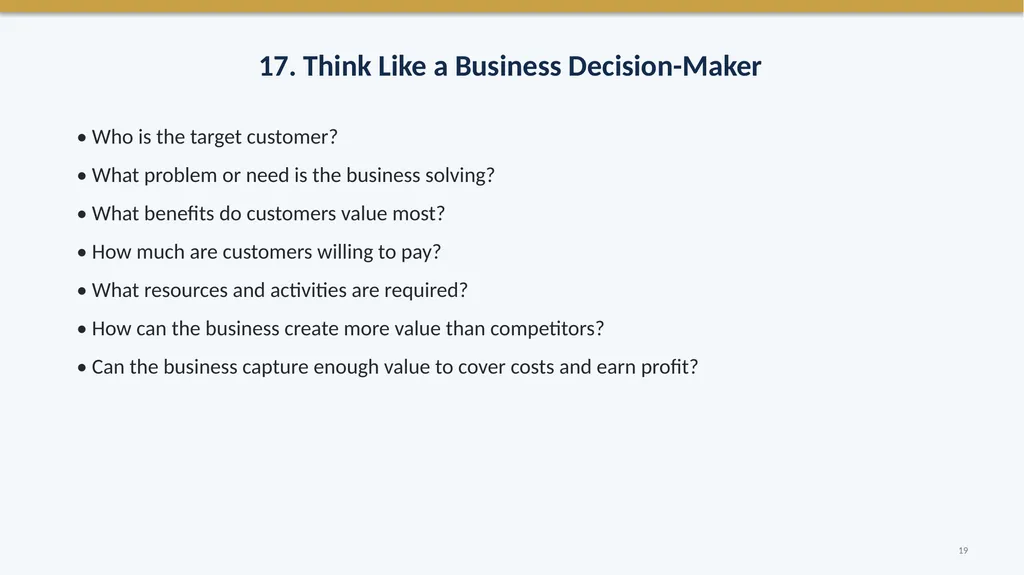
slide19. 17. Think Like a Business Decision-Maker • Who is the target customer?
• What problem or need is the business solving?
• What benefits do customers value most?
• How much are customers willing to pay?
• What resources and activities are required?
• How can the business create more value than competitors?
• Can the business capture enough value to cover costs and earn profit? 19<br>
slide20. 18. Key Vocabulary • Value creation — producing goods or services customers perceive as valuable.
• Customer perceived value — perceived benefits compared with price and other sacrifices.
• Resources — inputs used to produce goods or services.
• Entrepreneurship — identifying opportunities, organizing resources, taking risks, and making decisions.
• Revenue — money received from sales.
• Profit — revenue minus costs.
• Competitive advantage — a factor that helps a business outperform rivals.
• Innovation — developing or improving products, services, processes, or business models.
• Opportunity cost — the next-best alternative given up. 20<br>
slide21. 19. Quick Review • What is the difference between creating value and making a product?
• Why can two customers perceive different values for the same product?
• How can branding increase perceived value?
• Why is price not the same as value?
• What is the difference between revenue and profit?
• How can a business create value while reducing costs?
• Why is competitive advantage important?
• How does opportunity cost affect consumer decisions? 21<br>
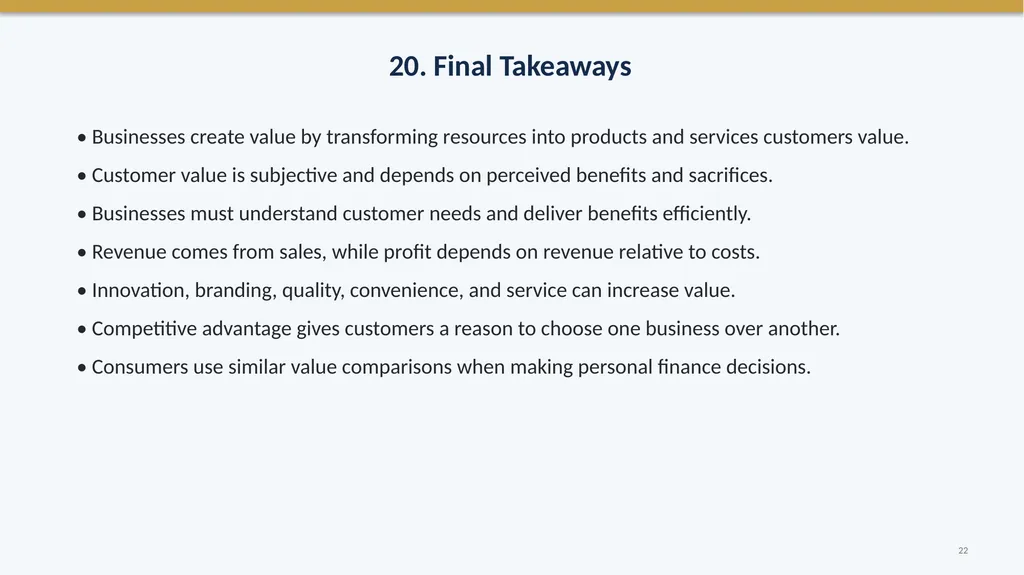
slide22. 20. Final Takeaways • Businesses create value by transforming resources into products and services customers value.
• Customer value is subjective and depends on perceived benefits and sacrifices.
• Businesses must understand customer needs and deliver benefits efficiently.
• Revenue comes from sales, while profit depends on revenue relative to costs.
• Innovation, branding, quality, convenience, and service can increase value.
• Competitive advantage gives customers a reason to choose one business over another.
• Consumers use similar value comparisons when making personal finance decisions. 22<br>
slide2. Learning Goals • Explain what it means for a business to create value.
• Identify the resources businesses use to create goods and services.
• Explain customer perceived value and why it differs among consumers.
• Distinguish among price, cost, revenue, and profit.
• Explain how businesses increase value and develop competitive advantage.
• Connect business value creation to personal finance decisions. 2<br>
slide3. 1. What Is Value Creation? • Value creation is the process of transforming resources into a good or service customers perceive as valuable.
• Customers compare the benefits they receive with the price and other sacrifices required to obtain the product.
• A product does not automatically create value simply because it is produced.
• Successful businesses understand what customers value and design their operations around those needs.
• Core idea: businesses create value for customers while trying to capture enough of that value to earn profit. 3<br>
slide4. 2. Why Businesses Exist • Businesses identify opportunities, solve problems, satisfy wants and needs, and organize resources.
• They combine resources to produce goods or services.
• They create value by transforming inputs into outputs customers are willing to purchase.
• They capture value through sales revenue and attempt to earn profit after paying costs.
• Business success requires both customer value and financial sustainability. 4<br>
slide5. 3. Resources Used to Create Value • Labor: human effort, skills, knowledge, creativity, and time.
• Capital: equipment, buildings, technology, tools, and other productive assets.
• Materials and inputs: physical resources used to make the final product.
• Information: market research, customer data, forecasts, and knowledge used for decisions.
• Entrepreneurship: identifying opportunities, organizing resources, taking risks, and making decisions. 5<br>
slide6. 4. The Value-Creation Process • Resources → Business Activities → Product/Service → Customer Perceived Value → Revenue → Profit
• Business activities include designing, producing, marketing, transporting, selling, and providing service.
• The final output is valuable when customers believe its benefits justify what they give up.
• Revenue comes from sales; profit depends on the relationship between revenue and total costs. 6<br>
slide7. 5. Customer Perceived Value • Customer perceived value is the customer's assessment of the benefits received compared with the sacrifices required.
• Benefits may include quality, convenience, reliability, enjoyment, status, speed, safety, design, and personalization.
• Sacrifices may include price, time, effort, transportation, inconvenience, and risk.
• Different customers can value the same product differently because their preferences and circumstances differ. 7<br>
slide8. 6. Value Is More Than Price • Price tells us what the customer pays; it does not tell us how valuable the product feels to the customer.
• A higher-priced product may provide greater perceived value through quality, convenience, branding, or experience.
• A low-priced product may provide poor value if it breaks quickly or creates significant inconvenience.
• Businesses try to increase perceived benefits while controlling the costs of delivering those benefits. 8<br>
slide9. 7. Cost, Price, Revenue & Profit • Cost: resources or money sacrificed to operate and produce output.
• Price: amount the customer pays for a product or service.
• Revenue: money received from sales.
• Profit: revenue minus total costs.
• Basic formulas: Revenue = Price × Quantity Sold; Profit = Revenue − Total Costs.
• Creating customer value does not guarantee profit if costs are too high or the business cannot sell enough. 9<br>
slide10. 8. Example: Customized Water Bottles • A student buys plain water bottles and adds personalized designs.
• Direct production cost = $4 per bottle.
• Selling price = $12 per bottle.
• The business adds value through personalization, design, packaging, branding, and convenience.
• The $8 difference between price and direct unit cost is not automatically final profit because other expenses may exist.
• Key question: Why would a customer pay $12 for something that costs only $4 to produce? 10<br>
slide11. 9. How Businesses Increase Value • Improve quality: use better materials or more reliable processes.
• Increase convenience: make products easier or faster to buy and use.
• Add features: provide benefits customers actually value.
• Build a strong brand: create recognition, trust, identity, and emotional connection.
• Use technology: automate, personalize, improve performance, or simplify access.
• Innovate: develop or improve products, services, processes, or business models. 11<br>
slide12. 10. More Ways to Increase Value • Improve customer service and reduce customer frustration.
• Personalize products to individual preferences.
• Improve design, usability, appearance, or functionality.
• Reduce customer risk through warranties, guarantees, security, or reliability.
• Improve distribution and delivery speed.
• Create an experience that competitors do not easily duplicate. 12<br>
slide13. 11. Competitive Advantage • Competitive advantage is a factor that allows a business to compete more effectively than its rivals.
• Businesses may compete through lower costs, higher quality, stronger branding, better technology, faster delivery, or superior service.
• Customers have choices, so businesses need a reason for customers to choose them.
• A competitive advantage is most useful when it is valuable to customers and difficult for competitors to copy. 13<br>
slide14. 12. Innovation and Value Creation • Innovation does not always mean inventing something completely new.
• Businesses can innovate by improving an existing product, changing delivery, reducing costs, or improving the customer experience.
• Examples: online ordering, personalized recommendations, subscription models, redesigned packaging, and faster delivery.
• Innovation can increase customer value and/or allow the business to operate more efficiently. 14<br>
slide15. 13. Value Creation vs. Value Capture • Value creation = making a product or service that customers value.
• Value capture = turning that created value into revenue and ultimately profit.
• A business can create substantial value but still struggle financially if its costs are too high.
• A business must balance customer benefits, price, demand, and costs.
• The goal is not simply to create value—it is to create value sustainably. 15<br>
slide16. 14. Connection to Personal Finance • Consumers also make value decisions every day.
• Ask: 'Are the benefits I receive worth the money, time, effort, and alternatives I give up?'
• A $30 subscription may be valuable to a frequent user but wasteful to someone who rarely uses it.
• A more expensive product may be the better value if it lasts longer or provides important benefits.
• Personal finance is therefore closely connected to the business concept of perceived value. 16<br>
slide17. 15. Opportunity Cost and Value • Resources are scarce, so every choice has an opportunity cost.
• Consumers give up alternative uses of their money when they purchase something.
• Businesses also face opportunity costs when allocating money, workers, time, and equipment.
• A strong value decision considers both the benefits of the choice and the next-best alternative given up. 17<br>
slide18. 16. AP-Style Application • Scenario: A student sells personalized water bottles for $15 each. The bottle and personalization materials cost $6 per unit.
• Identify two resources the student needs.
• Explain how personalization creates customer value.
• Calculate the difference between selling price and direct unit cost.
• Suggest one way to increase perceived value without significantly increasing production cost.
• Explain why a $12 competitor might still lose customers. 18<br>
slide19. 17. Think Like a Business Decision-Maker • Who is the target customer?
• What problem or need is the business solving?
• What benefits do customers value most?
• How much are customers willing to pay?
• What resources and activities are required?
• How can the business create more value than competitors?
• Can the business capture enough value to cover costs and earn profit? 19<br>
slide20. 18. Key Vocabulary • Value creation — producing goods or services customers perceive as valuable.
• Customer perceived value — perceived benefits compared with price and other sacrifices.
• Resources — inputs used to produce goods or services.
• Entrepreneurship — identifying opportunities, organizing resources, taking risks, and making decisions.
• Revenue — money received from sales.
• Profit — revenue minus costs.
• Competitive advantage — a factor that helps a business outperform rivals.
• Innovation — developing or improving products, services, processes, or business models.
• Opportunity cost — the next-best alternative given up. 20<br>
slide21. 19. Quick Review • What is the difference between creating value and making a product?
• Why can two customers perceive different values for the same product?
• How can branding increase perceived value?
• Why is price not the same as value?
• What is the difference between revenue and profit?
• How can a business create value while reducing costs?
• Why is competitive advantage important?
• How does opportunity cost affect consumer decisions? 21<br>
slide22. 20. Final Takeaways • Businesses create value by transforming resources into products and services customers value.
• Customer value is subjective and depends on perceived benefits and sacrifices.
• Businesses must understand customer needs and deliver benefits efficiently.
• Revenue comes from sales, while profit depends on revenue relative to costs.
• Innovation, branding, quality, convenience, and service can increase value.
• Competitive advantage gives customers a reason to choose one business over another.
• Consumers use similar value comparisons when making personal finance decisions. 22<br>