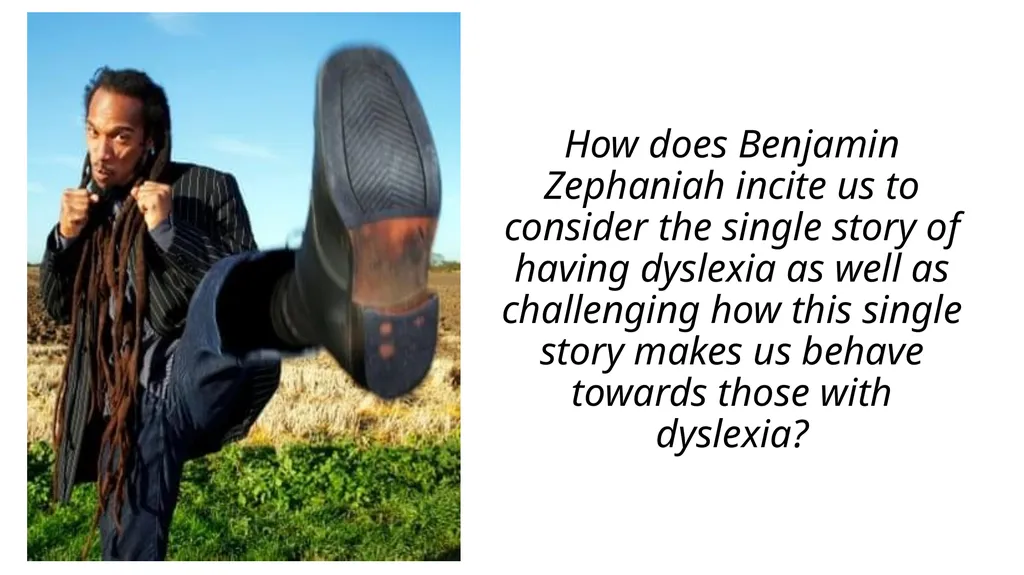
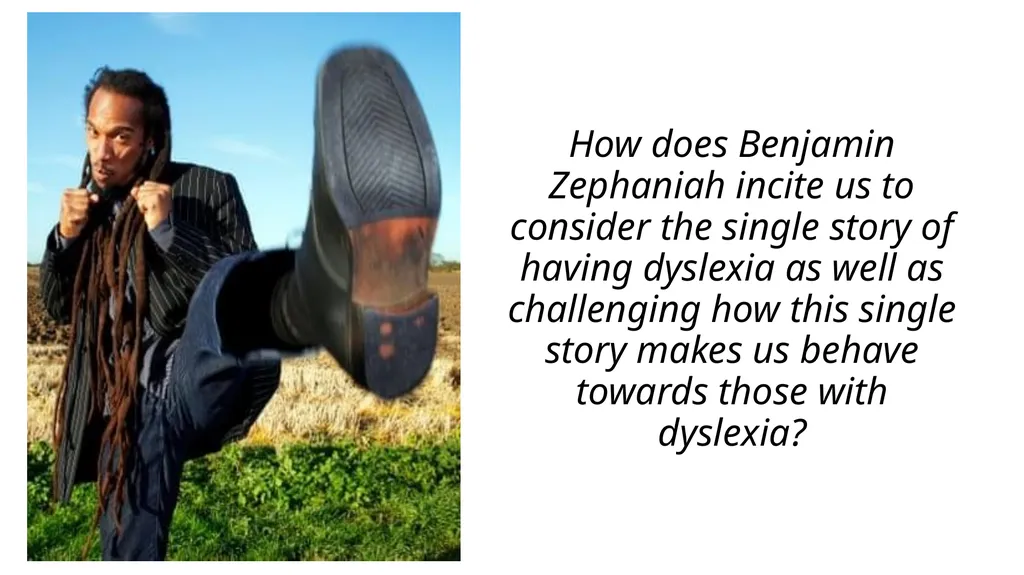
How does Benjamin Zephaniah incite us to consider the single story of having dyslexia as well as challenging how this single story makes us behave towards those with dyslexia? Benjamin Zephaniah. Benjamin Zephaniah was born in Birmingham in
"How does Benjamin Zephaniah incite us to consider" is the property of its rightful owner. Permission is granted to
download and print the materials on this website for personal, non-commercial use only, and to display it
on your personal computer provided you do not modify the materials and that you retain all copyright
notices contained in the materials. By downloading content from our website, you accept the terms of this
agreement.
Presentation Transcript
01
How does Benjamin Zephaniah incite us to consider the single story of having dyslexia as well as challenging how this single story makes us behave towards those with dyslexia?<br>
02
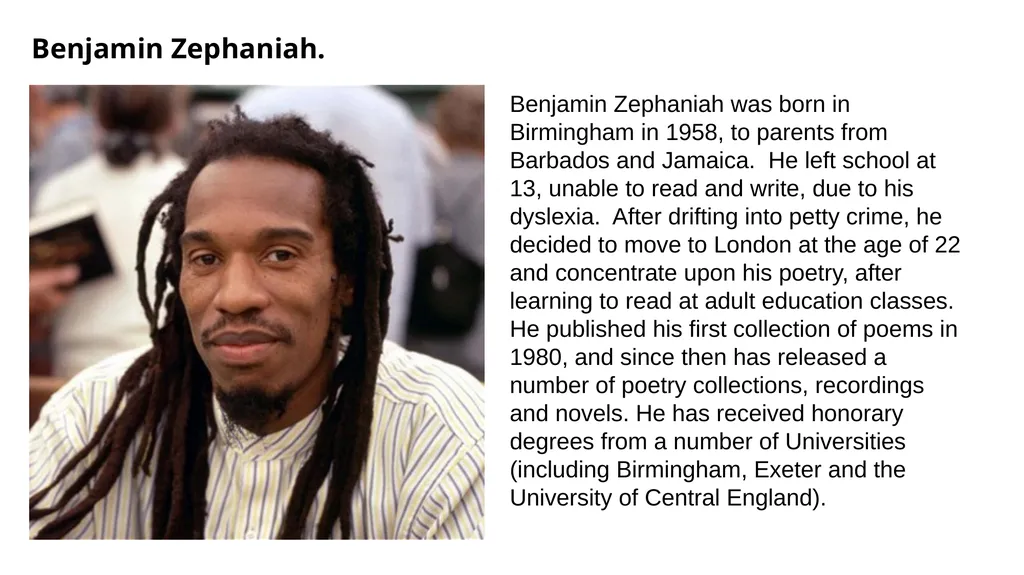
Benjamin Zephaniah. Benjamin Zephaniah was born in Birmingham in 1958, to parents from Barbados and Jamaica. He left school at 13, unable to read and write, due to his dyslexia. After drifting into petty crime, he decided to move to London at the age of 22 and concentrate upon his poetry, after learning to read at adult education classes. He published his first collection of poems in 1980, and since then has released a number of poetry collections, recordings and novels. He has received honorary degrees from a number of Universities (including Birmingham, Exeter and the University of Central England).<br>
03
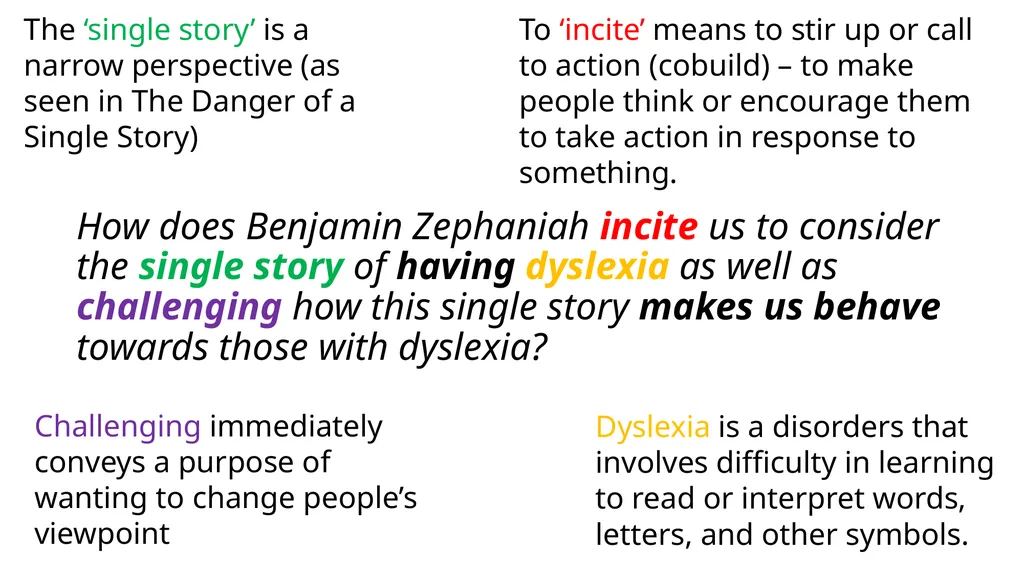
How does Benjamin Zephaniah incite us to consider the single story of having dyslexia as well as challenging how this single story makes us behave towards those with dyslexia? To ‘incite’ means to stir up or call to action (cobuild) – to make people think or encourage them to take action in response to something. The ‘single story’ is a narrow perspective (as seen in The Danger of a Single Story) Dyslexia is a disorders that involves difficulty in learning to read or interpret words, letters, and other symbols. Challenging immediately conveys a purpose of wanting to change people’s viewpoint<br>
04
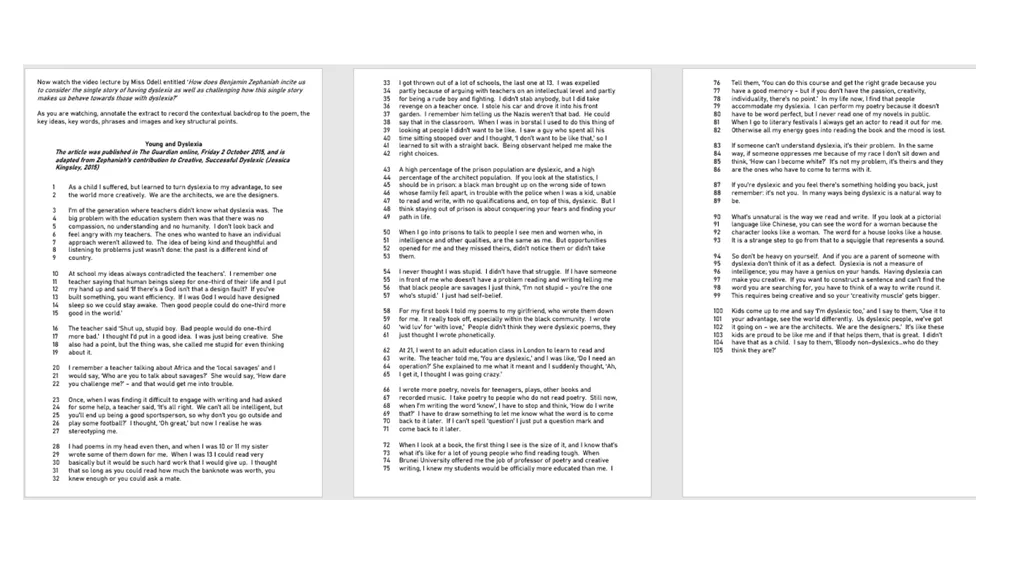
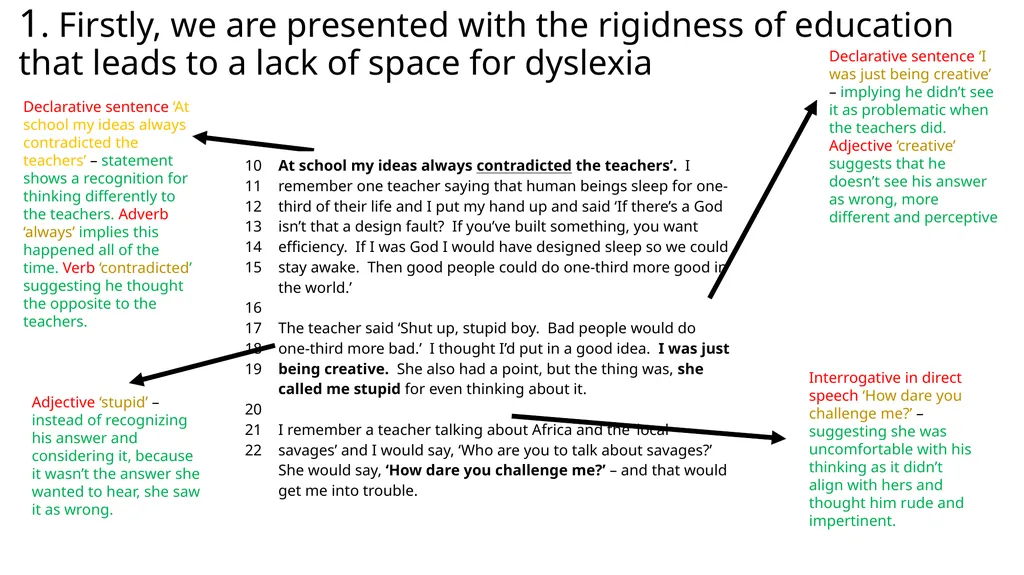
1. Firstly, we are presented with the rigidness of education that leads to a lack of space for dyslexia Declarative sentence ‘At school my ideas always contradicted the teachers’ – statement shows a recognition for thinking differently to the teachers. Adverb ‘always’ implies this happened all of the time. Verb ‘contradicted’ suggesting he thought the opposite to the teachers. Declarative sentence ‘I was just being creative’ – implying he didn’t see it as problematic when the teachers did. Adjective ‘creative’ suggests that he doesn’t see his answer as wrong, more different and perceptive Adjective ‘stupid’ – instead of recognizing his answer and considering it, because it wasn’t the answer she wanted to hear, she saw it as wrong. Interrogative in direct speech ‘How dare you challenge me?’ – suggesting she was uncomfortable with his thinking as it didn’t align with hers and thought him rude and impertinent.<br>
05
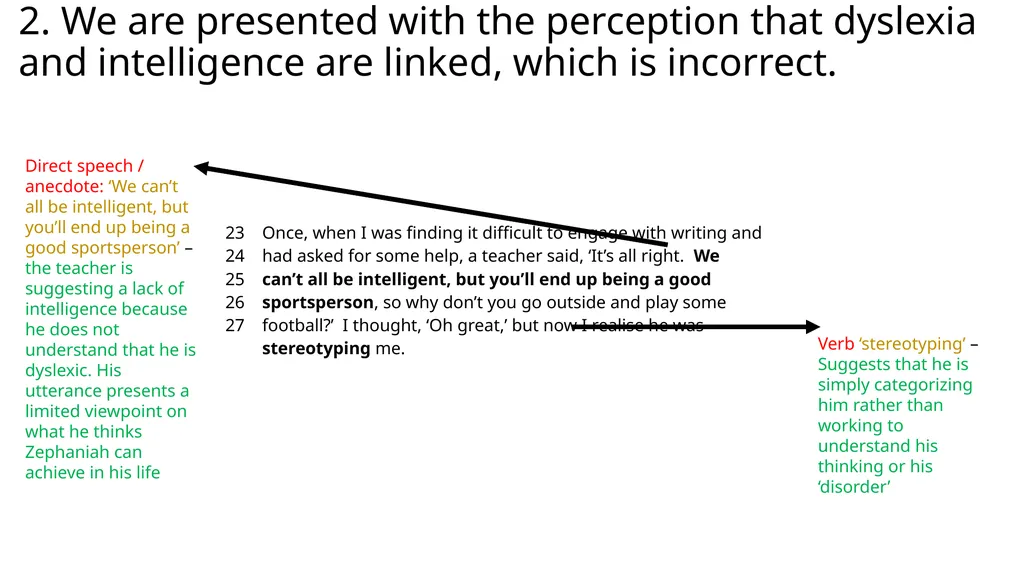
2. We are presented with the perception that dyslexia and intelligence are linked, which is incorrect. Direct speech / anecdote: ‘We can’t all be intelligent, but you’ll end up being a good sportsperson’ – the teacher is suggesting a lack of intelligence because he does not understand that he is dyslexic. His utterance presents a limited viewpoint on what he thinks Zephaniah can achieve in his life Verb ‘stereotyping’ – Suggests that he is simply categorizing him rather than working to understand his thinking or his ‘disorder’<br>
06
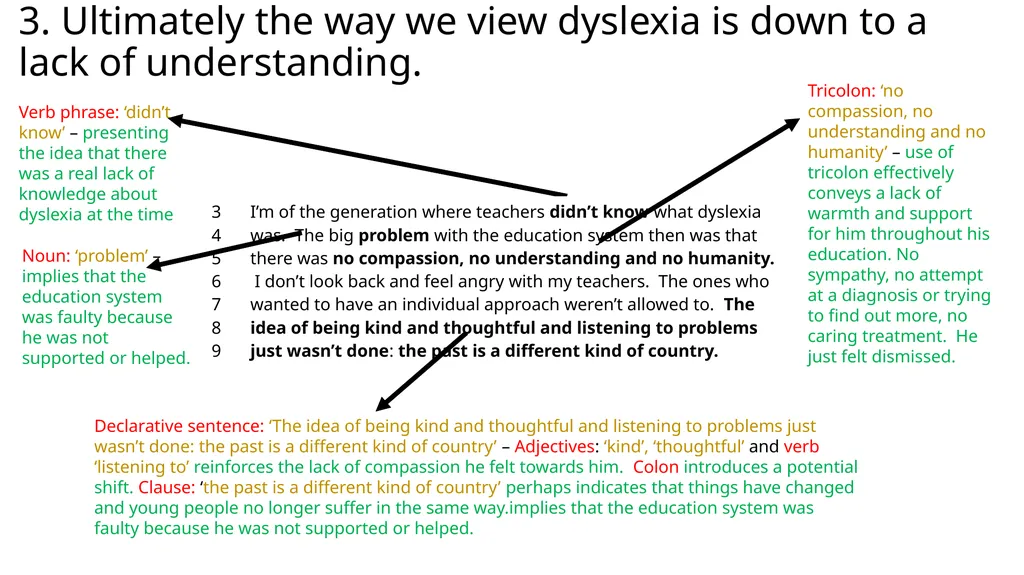
3. Ultimately the way we view dyslexia is down to a lack of understanding. Verb phrase: ‘didn’t know’ – presenting the idea that there was a real lack of knowledge about dyslexia at the time Noun: ‘problem’ – implies that the education system was faulty because he was not supported or helped. Tricolon: ‘no compassion, no understanding and no humanity’ – use of tricolon effectively conveys a lack of warmth and support for him throughout his education. No sympathy, no attempt at a diagnosis or trying to find out more, no caring treatment. He just felt dismissed. Declarative sentence: ‘The idea of being kind and thoughtful and listening to problems just wasn’t done: the past is a different kind of country’ – Adjectives: ‘kind’, ‘thoughtful’ and verb ‘listening to’ reinforces the lack of compassion he felt towards him. Colon introduces a potential shift. Clause: ‘the past is a different kind of country’ perhaps indicates that things have changed and young people no longer suffer in the same way.implies that the education system was faulty because he was not supported or helped.<br>
07
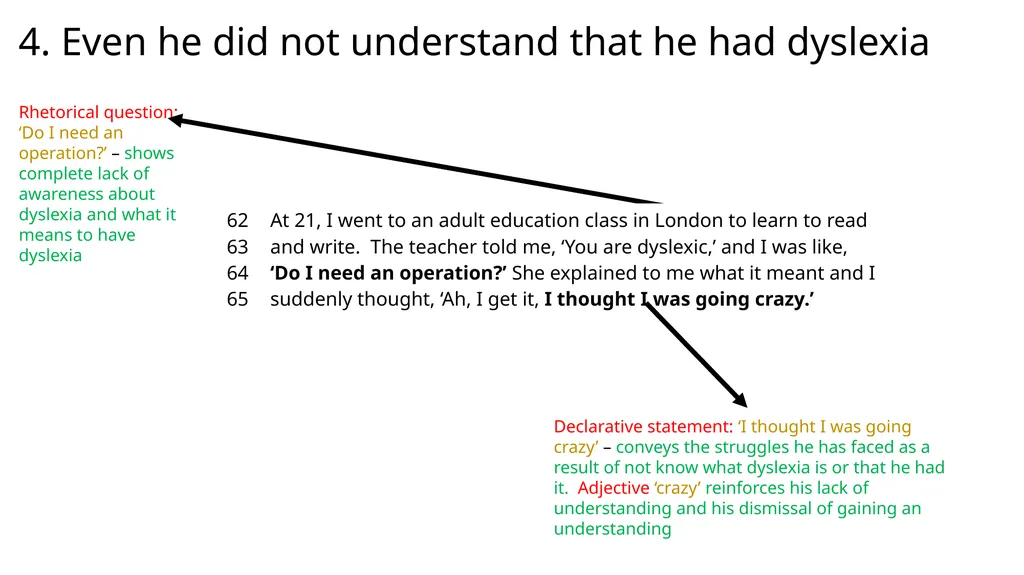
4. Even he did not understand that he had dyslexia Rhetorical question: ‘Do I need an operation?’ – shows complete lack of awareness about dyslexia and what it means to have dyslexia Declarative statement: ‘I thought I was going crazy’ – conveys the struggles he has faced as a result of not know what dyslexia is or that he had it. Adjective ‘crazy’ reinforces his lack of understanding and his dismissal of gaining an understanding<br>
08
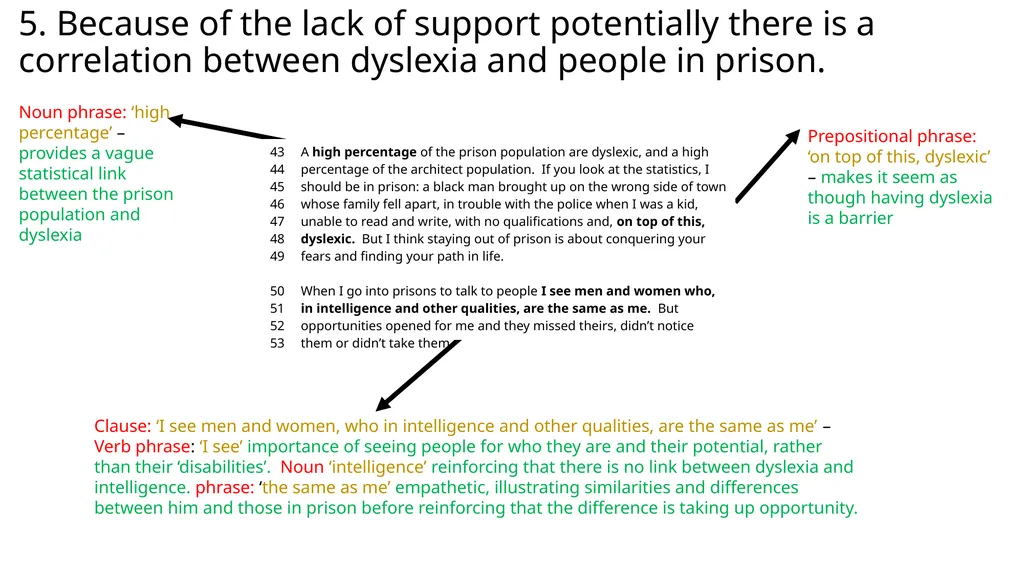
5. Because of the lack of support potentially there is a correlation between dyslexia and people in prison. Noun phrase: ‘high percentage’ – provides a vague statistical link between the prison population and dyslexia Prepositional phrase: ‘on top of this, dyslexic’ – makes it seem as though having dyslexia is a barrier Clause: ‘I see men and women, who in intelligence and other qualities, are the same as me’ – Verb phrase: ‘I see’ importance of seeing people for who they are and their potential, rather than their ‘disabilities’. Noun ‘intelligence’ reinforcing that there is no link between dyslexia and intelligence. phrase: ‘the same as me’ empathetic, illustrating similarities and differences between him and those in prison before reinforcing that the difference is taking up opportunity.<br>
09
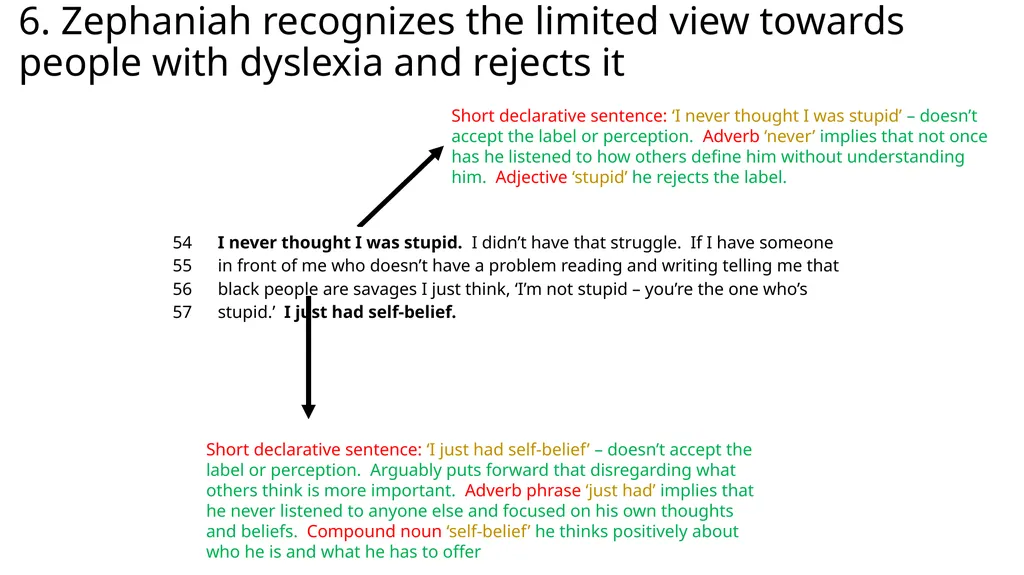
6. Zephaniah recognizes the limited view towards people with dyslexia and rejects it Short declarative sentence: ‘I never thought I was stupid’ – doesn’t accept the label or perception. Adverb ‘never’ implies that not once has he listened to how others define him without understanding him. Adjective ‘stupid’ he rejects the label. Short declarative sentence: ‘I just had self-belief’ – doesn’t accept the label or perception. Arguably puts forward that disregarding what others think is more important. Adverb phrase ‘just had’ implies that he never listened to anyone else and focused on his own thoughts and beliefs. Compound noun ‘self-belief’ he thinks positively about who he is and what he has to offer<br>
10
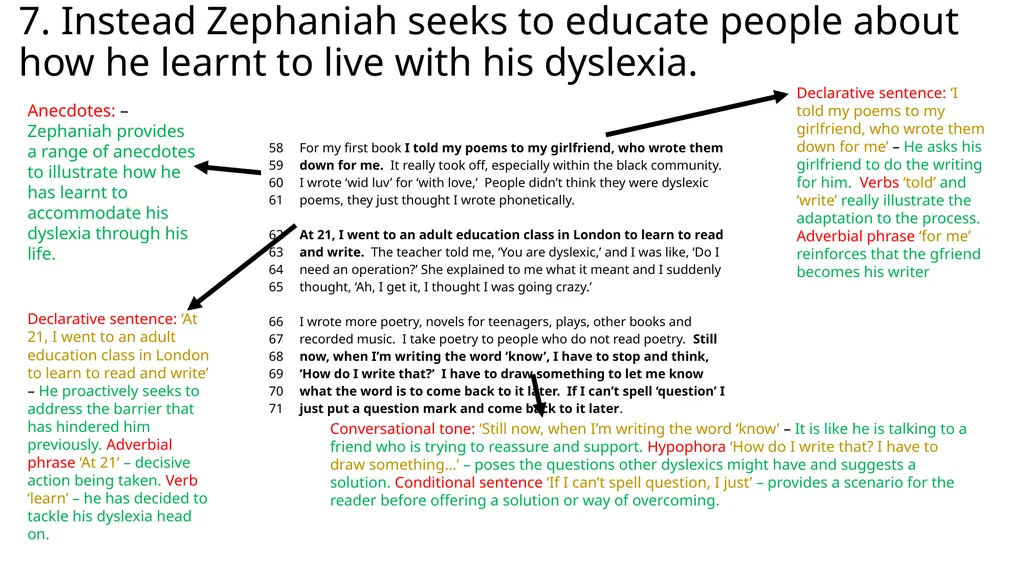
7. Instead Zephaniah seeks to educate people about how he learnt to live with his dyslexia. Anecdotes: – Zephaniah provides a range of anecdotes to illustrate how he has learnt to accommodate his dyslexia through his life. Declarative sentence: ‘I told my poems to my girlfriend, who wrote them down for me’ – He asks his girlfriend to do the writing for him. Verbs ‘told’ and ‘write’ really illustrate the adaptation to the process. Adverbial phrase ‘for me’ reinforces that the gfriend becomes his writer Declarative sentence: ‘At 21, I went to an adult education class in London to learn to read and write’ – He proactively seeks to address the barrier that has hindered him previously. Adverbial phrase ‘At 21’ – decisive action being taken. Verb ‘learn’ – he has decided to tackle his dyslexia head on. Conversational tone: ‘Still now, when I’m writing the word ‘know’ – It is like he is talking to a friend who is trying to reassure and support. Hypophora ‘How do I write that? I have to draw something…’ – poses the questions other dyslexics might have and suggests a solution. Conditional sentence ‘If I can’t spell question, I just’ – provides a scenario for the reader before offering a solution or way of overcoming.<br>
11
8. Zephaniah encourages people to have self-belief and view being dyslexic in a different way. Verb: ‘suffered’ he recognizes having dyslexia has been hard. Conjunction: ‘but’ – however Noun: ‘advantage’ he chooses to see it differently and positively. Adverb ‘creatively’ he recognizes his creativity. Parallel structure: ‘We are…we are’ Metaphor: ‘architects’, ‘designers’ creative thinkers and builders. A position within society. A responsibility. Imperatives: ‘just remember: it’s not you’ offers advice to encourage people with dyslexia to realise they are not the problem. People who judge them wrongly, are. Adjective: ‘natural’ argues that having dyslexia is normal.<br>
12
How does Benjamin Zephaniah incite us to consider the single story of having dyslexia as well as challenging how this single story makes us behave towards those with dyslexia?<br>