
How does Blake present power in the poem ‘The
CP
Published · 14 slides · 0 views

1 / 1
Description
How does Blake present power in the poem The Tyger? William Blake William Blake is a famous English poet and artist. He was born into a working class London family and only attended school until he was ten years old. He was an early
Related Topics
Share
Embed code
Download this presentation From Below
"How does Blake present power in the poem ‘The" is the property of its rightful owner. Permission is granted to download and print the materials on this website for personal, non-commercial use only, and to display it on your personal computer provided you do not modify the materials and that you retain all copyright notices contained in the materials. By downloading content from our website, you accept the terms of this agreement.
Presentation Transcript
01
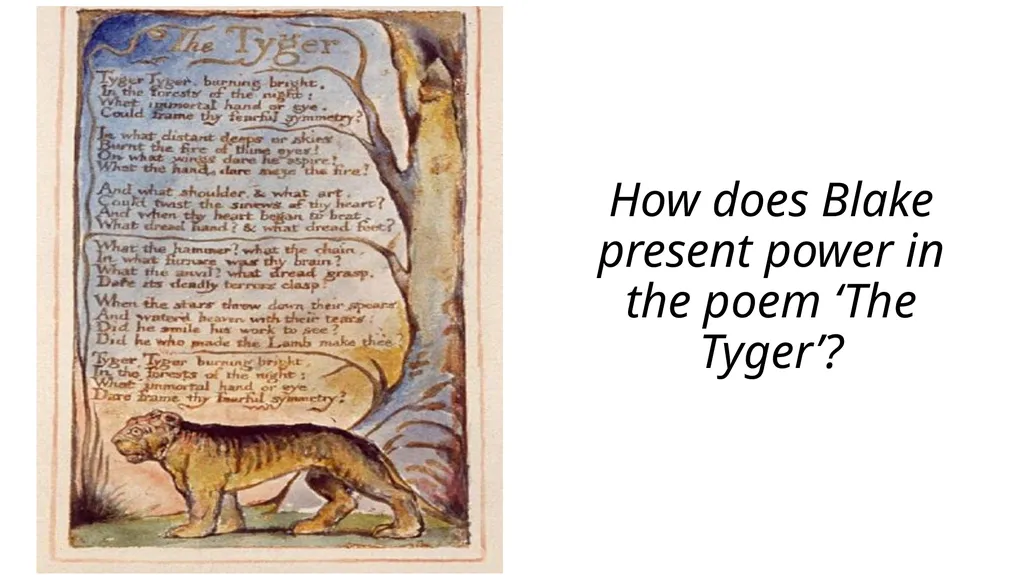
How does Blake present power in the poem ‘The Tyger’?<br>
02
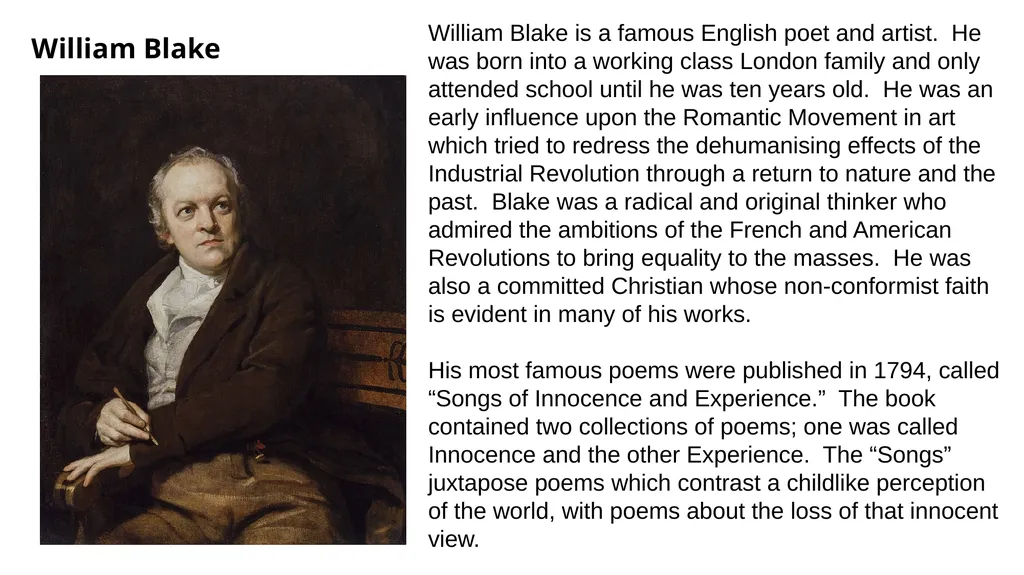
William Blake William Blake is a famous English poet and artist. He was born into a working class London family and only attended school until he was ten years old. He was an early influence upon the Romantic Movement in art which tried to redress the dehumanising effects of the Industrial Revolution through a return to nature and the past. Blake was a radical and original thinker who admired the ambitions of the French and American Revolutions to bring equality to the masses. He was also a committed Christian whose non-conformist faith is evident in many of his works.
His most famous poems were published in 1794, called “Songs of Innocence and Experience.” The book contained two collections of poems; one was called Innocence and the other Experience. The “Songs” juxtapose poems which contrast a childlike perception of the world, with poems about the loss of that innocent view.<br>
His most famous poems were published in 1794, called “Songs of Innocence and Experience.” The book contained two collections of poems; one was called Innocence and the other Experience. The “Songs” juxtapose poems which contrast a childlike perception of the world, with poems about the loss of that innocent view.<br>
03
Background and summary ‘The Tyger’ is located in the Experience section of the ‘Songs’. It is therefore part of the grouping of poems told from the point of view of an experienced speaker who has lost a childlike view of the world. In the 1790s in London there were few opportunities to see tigers. Therefore the animals had a mythic status as powerful beasts. The spelling of tiger is odd in the poem because at the time Blake was writing the spellings of words had not yet been fixed.
The poem is spoken directly to a tiger. The speaker asks the tiger what sort of a creator would make an animal which is both beautiful and deadly. The poem dwells on this thought, but never provides an adequate answer. Instead, it communicates the poet’s wonder at the way God is responsible for bringing both goodness and evil to mankind.<br>
The poem is spoken directly to a tiger. The speaker asks the tiger what sort of a creator would make an animal which is both beautiful and deadly. The poem dwells on this thought, but never provides an adequate answer. Instead, it communicates the poet’s wonder at the way God is responsible for bringing both goodness and evil to mankind.<br>
04
How does Blake present power in the poem ‘The Tyger’?<br>
05
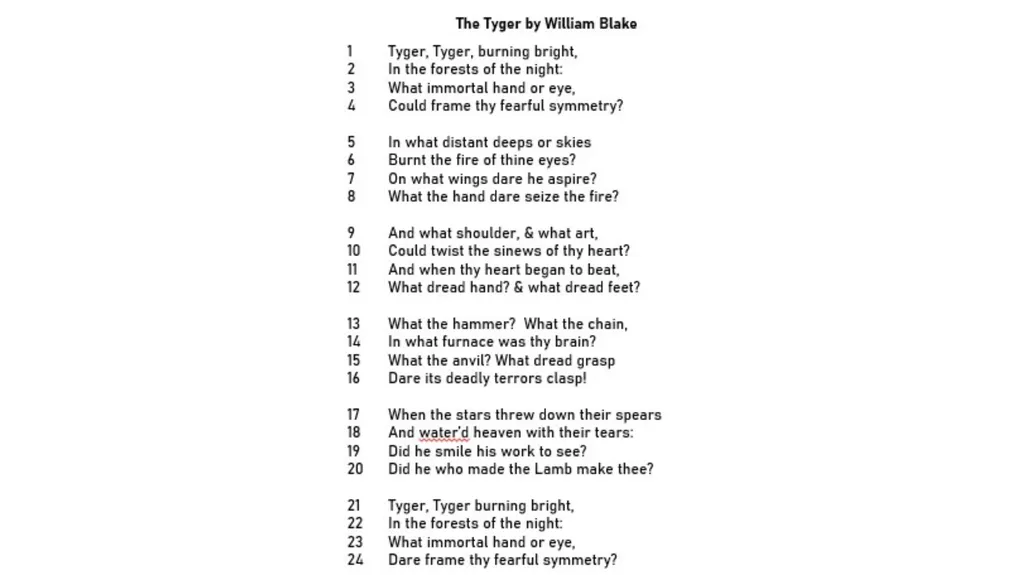
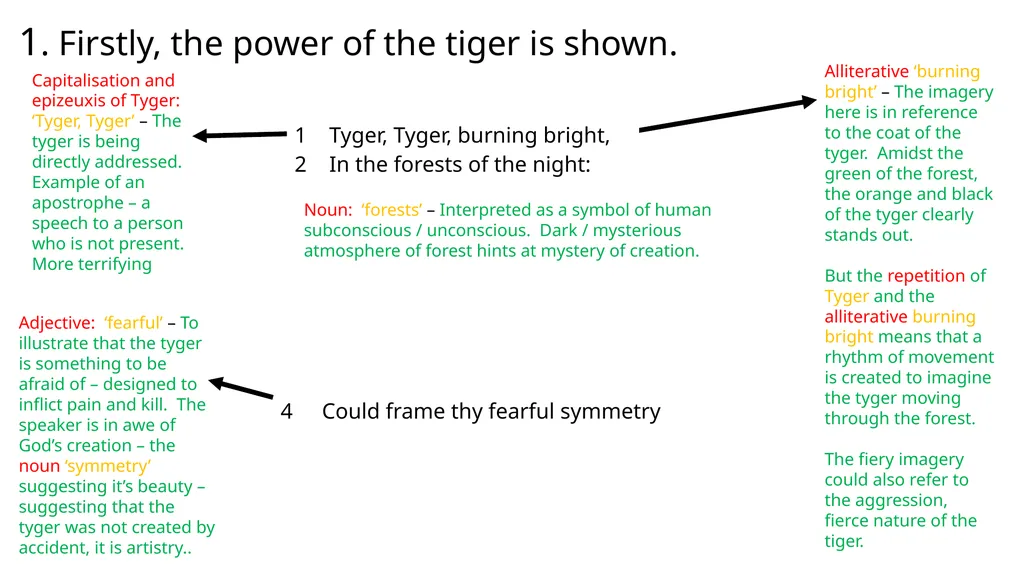
1. Firstly, the power of the tiger is shown. Capitalisation and epizeuxis of Tyger: ‘Tyger, Tyger’ – The tyger is being directly addressed. Example of an apostrophe – a speech to a person who is not present. More terrifying Alliterative ‘burning bright’ – The imagery here is in reference to the coat of the tyger. Amidst the green of the forest, the orange and black of the tyger clearly stands out.
But the repetition of Tyger and the alliterative burning bright means that a rhythm of movement is created to imagine the tyger moving through the forest.
The fiery imagery could also refer to the aggression, fierce nature of the tiger. Adjective: ‘fearful’ – To illustrate that the tyger is something to be afraid of – designed to inflict pain and kill. The speaker is in awe of God’s creation – the noun ‘symmetry’ suggesting it’s beauty – suggesting that the tyger was not created by accident, it is artistry.. Noun: ‘forests’ – Interpreted as a symbol of human subconscious / unconscious. Dark / mysterious atmosphere of forest hints at mystery of creation.<br>
But the repetition of Tyger and the alliterative burning bright means that a rhythm of movement is created to imagine the tyger moving through the forest.
The fiery imagery could also refer to the aggression, fierce nature of the tiger. Adjective: ‘fearful’ – To illustrate that the tyger is something to be afraid of – designed to inflict pain and kill. The speaker is in awe of God’s creation – the noun ‘symmetry’ suggesting it’s beauty – suggesting that the tyger was not created by accident, it is artistry.. Noun: ‘forests’ – Interpreted as a symbol of human subconscious / unconscious. Dark / mysterious atmosphere of forest hints at mystery of creation.<br>
06
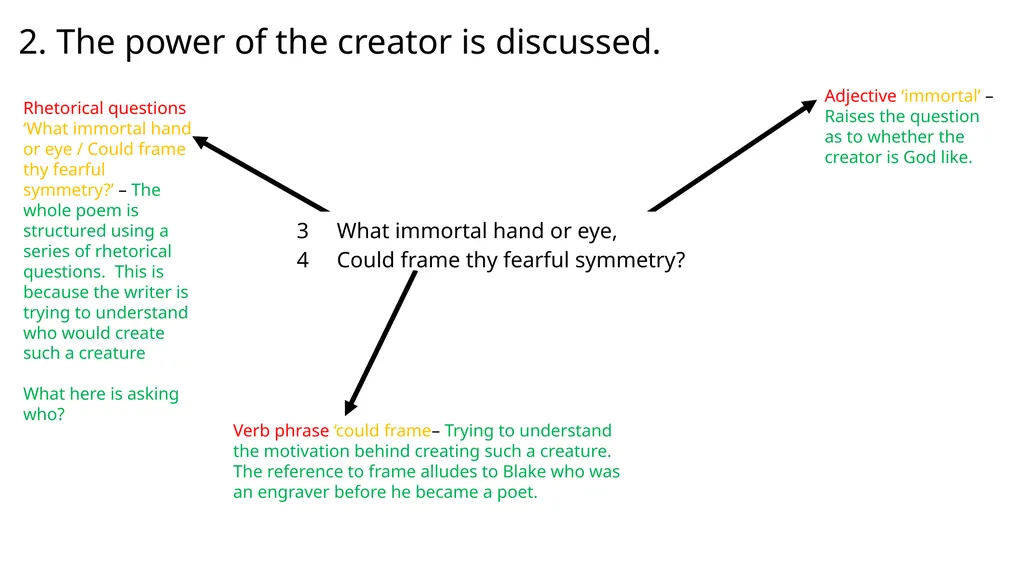
2. The power of the creator is discussed. Rhetorical questions ‘What immortal hand or eye / Could frame thy fearful symmetry?’ – The whole poem is structured using a series of rhetorical questions. This is because the writer is trying to understand who would create such a creature
What here is asking who? Verb phrase ‘could frame– Trying to understand the motivation behind creating such a creature. The reference to frame alludes to Blake who was an engraver before he became a poet. Adjective ‘immortal’ – Raises the question as to whether the creator is God like.<br>
What here is asking who? Verb phrase ‘could frame– Trying to understand the motivation behind creating such a creature. The reference to frame alludes to Blake who was an engraver before he became a poet. Adjective ‘immortal’ – Raises the question as to whether the creator is God like.<br>
07
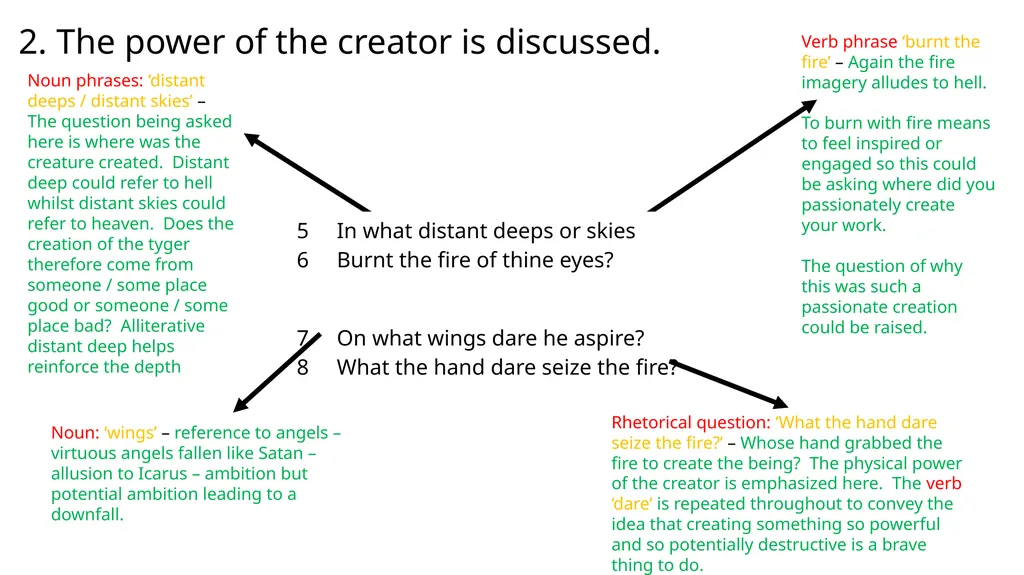
2. The power of the creator is discussed. Noun phrases: ‘distant deeps / distant skies’ – The question being asked here is where was the creature created. Distant deep could refer to hell whilst distant skies could refer to heaven. Does the creation of the tyger therefore come from someone / some place good or someone / some place bad? Alliterative distant deep helps reinforce the depth Verb phrase ‘burnt the fire’ – Again the fire imagery alludes to hell.
To burn with fire means to feel inspired or engaged so this could be asking where did you passionately create your work.
The question of why this was such a passionate creation could be raised. Noun: ‘wings’ – reference to angels – virtuous angels fallen like Satan – allusion to Icarus – ambition but potential ambition leading to a downfall. Rhetorical question: ‘What the hand dare seize the fire?’ – Whose hand grabbed the fire to create the being? The physical power of the creator is emphasized here. The verb ‘dare’ is repeated throughout to convey the idea that creating something so powerful and so potentially destructive is a brave thing to do.<br>
To burn with fire means to feel inspired or engaged so this could be asking where did you passionately create your work.
The question of why this was such a passionate creation could be raised. Noun: ‘wings’ – reference to angels – virtuous angels fallen like Satan – allusion to Icarus – ambition but potential ambition leading to a downfall. Rhetorical question: ‘What the hand dare seize the fire?’ – Whose hand grabbed the fire to create the being? The physical power of the creator is emphasized here. The verb ‘dare’ is repeated throughout to convey the idea that creating something so powerful and so potentially destructive is a brave thing to do.<br>
08
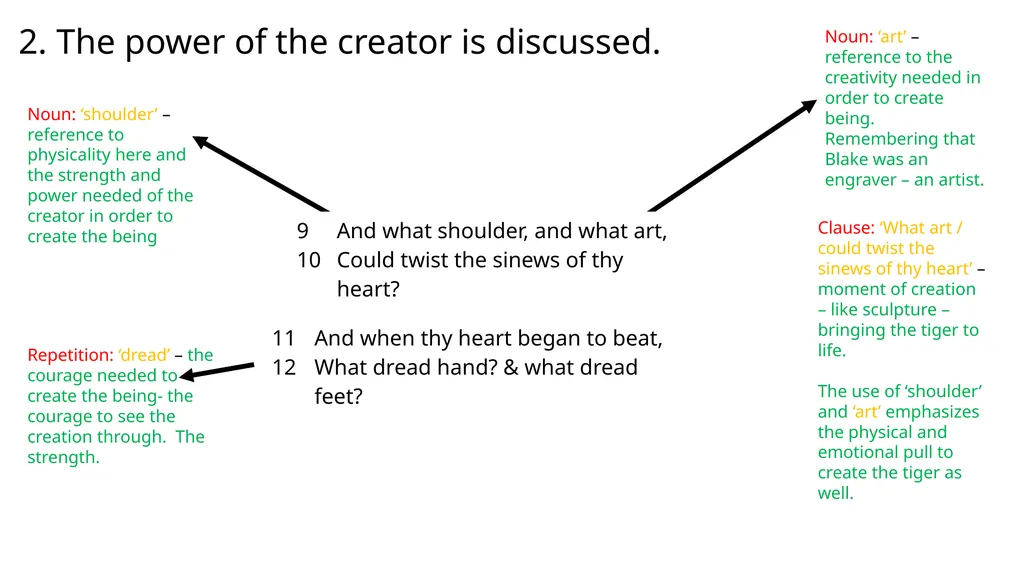
2. The power of the creator is discussed. Noun: ‘shoulder’ – reference to physicality here and the strength and power needed of the creator in order to create the being Clause: ‘What art / could twist the sinews of thy heart’ – moment of creation – like sculpture – bringing the tiger to life.
The use of ‘shoulder’ and ‘art’ emphasizes the physical and emotional pull to create the tiger as well. Repetition: ‘dread’ – the courage needed to create the being- the courage to see the creation through. The strength. Noun: ‘art’ – reference to the creativity needed in order to create being. Remembering that Blake was an engraver – an artist.<br>
The use of ‘shoulder’ and ‘art’ emphasizes the physical and emotional pull to create the tiger as well. Repetition: ‘dread’ – the courage needed to create the being- the courage to see the creation through. The strength. Noun: ‘art’ – reference to the creativity needed in order to create being. Remembering that Blake was an engraver – an artist.<br>
09
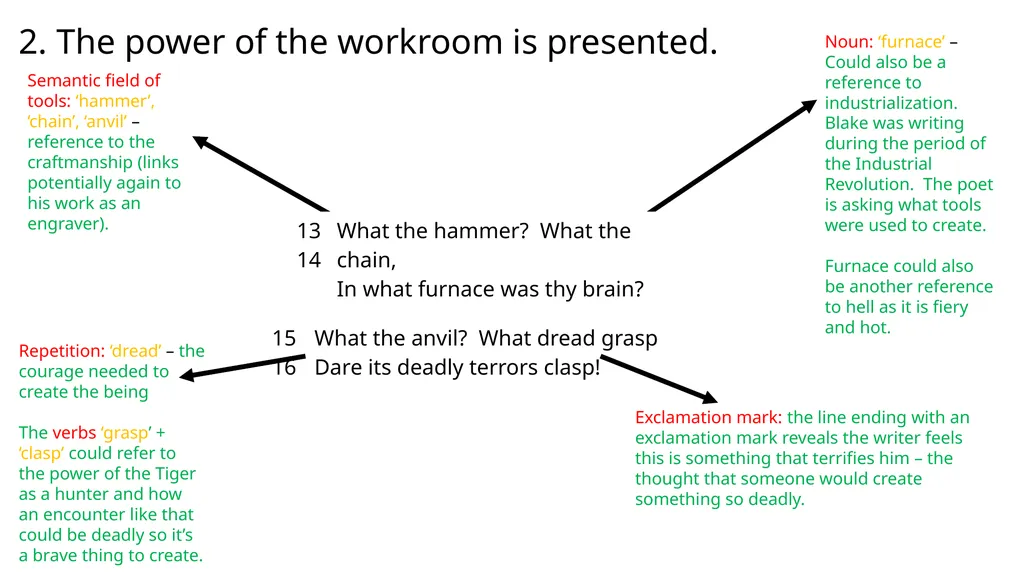
2. The power of the workroom is presented. Semantic field of tools: ‘hammer’, ‘chain’, ‘anvil’ – reference to the craftmanship (links potentially again to his work as an engraver). Noun: ‘furnace’ – Could also be a reference to industrialization. Blake was writing during the period of the Industrial Revolution. The poet is asking what tools were used to create.
Furnace could also be another reference to hell as it is fiery and hot. Repetition: ‘dread’ – the courage needed to create the being
The verbs ‘grasp’ + ‘clasp’ could refer to the power of the Tiger as a hunter and how an encounter like that could be deadly so it’s a brave thing to create. Exclamation mark: the line ending with an exclamation mark reveals the writer feels this is something that terrifies him – the thought that someone would create something so deadly.<br>
Furnace could also be another reference to hell as it is fiery and hot. Repetition: ‘dread’ – the courage needed to create the being
The verbs ‘grasp’ + ‘clasp’ could refer to the power of the Tiger as a hunter and how an encounter like that could be deadly so it’s a brave thing to create. Exclamation mark: the line ending with an exclamation mark reveals the writer feels this is something that terrifies him – the thought that someone would create something so deadly.<br>
10
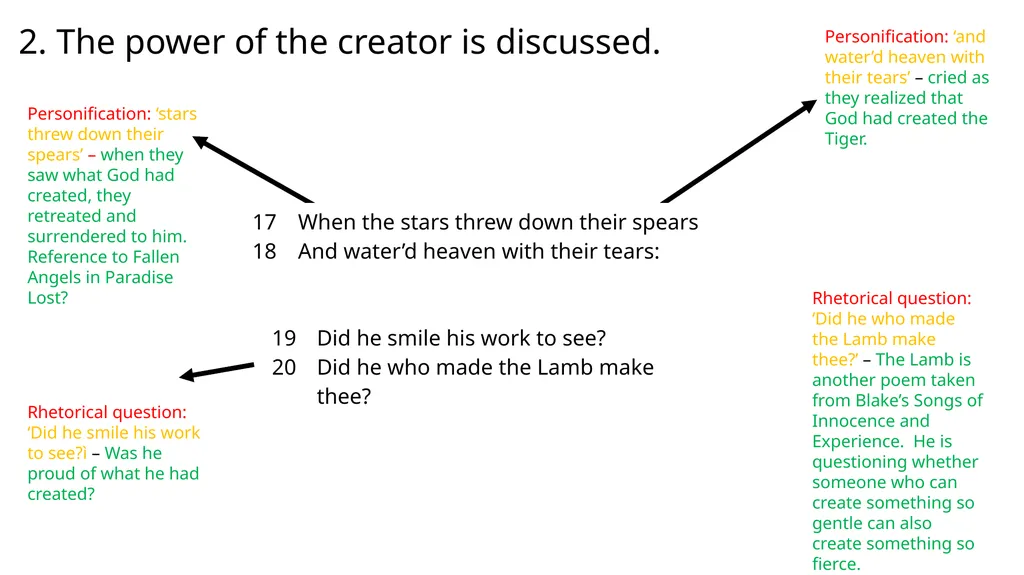
2. The power of the creator is discussed. Personification: ‘stars threw down their spears’ – when they saw what God had created, they retreated and surrendered to him. Reference to Fallen Angels in Paradise Lost? Rhetorical question: ‘Did he who made the Lamb make thee?’ – The Lamb is another poem taken from Blake’s Songs of Innocence and Experience. He is questioning whether someone who can create something so gentle can also create something so fierce. Rhetorical question: ‘Did he smile his work to see?ì – Was he proud of what he had created? Personification: ‘and water’d heaven with their tears’ – cried as they realized that God had created the Tiger.<br>
11
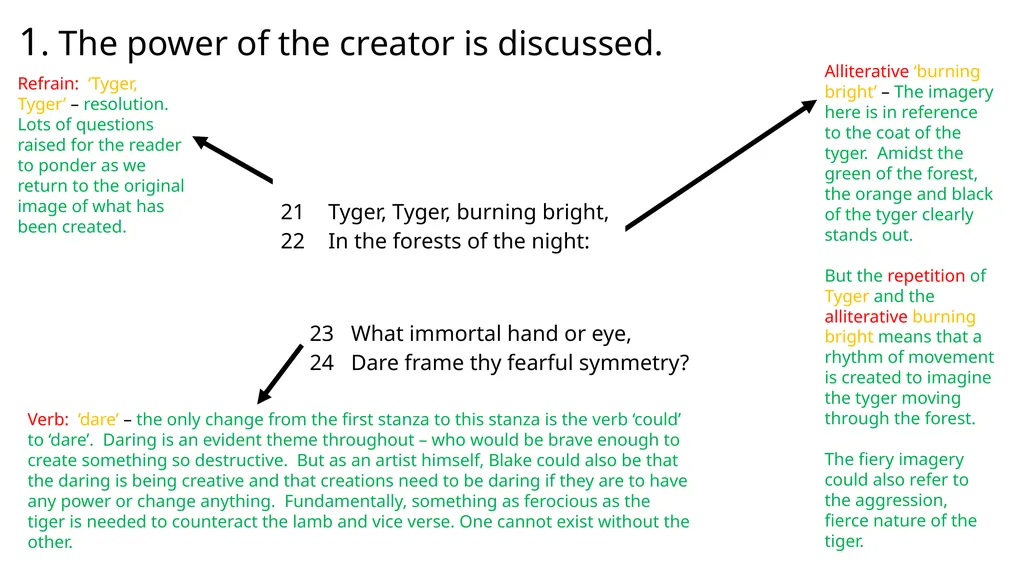
1. The power of the creator is discussed. Refrain: ‘Tyger, Tyger’ – resolution. Lots of questions raised for the reader to ponder as we return to the original image of what has been created. Alliterative ‘burning bright’ – The imagery here is in reference to the coat of the tyger. Amidst the green of the forest, the orange and black of the tyger clearly stands out.
But the repetition of Tyger and the alliterative burning bright means that a rhythm of movement is created to imagine the tyger moving through the forest.
The fiery imagery could also refer to the aggression, fierce nature of the tiger. Verb: ‘dare’ – the only change from the first stanza to this stanza is the verb ‘could’ to ‘dare’. Daring is an evident theme throughout – who would be brave enough to create something so destructive. But as an artist himself, Blake could also be that the daring is being creative and that creations need to be daring if they are to have any power or change anything. Fundamentally, something as ferocious as the tiger is needed to counteract the lamb and vice verse. One cannot exist without the other.<br>
But the repetition of Tyger and the alliterative burning bright means that a rhythm of movement is created to imagine the tyger moving through the forest.
The fiery imagery could also refer to the aggression, fierce nature of the tiger. Verb: ‘dare’ – the only change from the first stanza to this stanza is the verb ‘could’ to ‘dare’. Daring is an evident theme throughout – who would be brave enough to create something so destructive. But as an artist himself, Blake could also be that the daring is being creative and that creations need to be daring if they are to have any power or change anything. Fundamentally, something as ferocious as the tiger is needed to counteract the lamb and vice verse. One cannot exist without the other.<br>
12
Structure Six quatrains – stanzas of four lines
End-stopped – punctuation at the end of the line
Rhetorical questions – symbolic of all the things in humanity that we find hard to understand
Regular rhyme scheme – rhythmic, rhythm of work, rhythm of Tiger moving through the forest etc.<br>
End-stopped – punctuation at the end of the line
Rhetorical questions – symbolic of all the things in humanity that we find hard to understand
Regular rhyme scheme – rhythmic, rhythm of work, rhythm of Tiger moving through the forest etc.<br>
13
How does Blake present power in the poem ‘The Tyger’?<br>