
How to develop a competitive research protocol Dr.
TG
Published · 43 slides · 0 views

1 / 1

Description
How to develop a competitive research protocol Dr. Raqibat Idris, MBBS, DO, MPH Geneva Foundation for Medical Education and Research Training course in research methodology and research protocol development Geneva 2022 Overview of
Related Topics
Share
Embed code
Download this presentation From Below
"How to develop a competitive research protocol Dr." is the property of its rightful owner. Permission is granted to download and print the materials on this website for personal, non-commercial use only, and to display it on your personal computer provided you do not modify the materials and that you retain all copyright notices contained in the materials. By downloading content from our website, you accept the terms of this agreement.
Presentation Transcript
01
How to develop a competitive research protocol
Dr. Raqibat Idris, MBBS, DO, MPH
Geneva Foundation for Medical Education and Research
Training course in research methodology and
research protocol development
Geneva 2022<br>
Dr. Raqibat Idris, MBBS, DO, MPH
Geneva Foundation for Medical Education and Research
Training course in research methodology and
research protocol development
Geneva 2022<br>
02
Overview of presentation This presentation will:
Explain what research is
Define research protocol and explain its purpose
Describe the main elements of a research protocol
List the criteria for research protocol review<br>
Explain what research is
Define research protocol and explain its purpose
Describe the main elements of a research protocol
List the criteria for research protocol review<br>
03
Introduction A research is:
A planned investigation that uses scientific methodology to solve an important problem and generates a new knowledge.
It tests hypothesis, answers existing questions, produces new queries, finds solutions.
To be termed a research, an investigation must be valid (logical procedure), reliable (quality measurements) with unbiased conclusion. Faryadi, 2012<br>
A planned investigation that uses scientific methodology to solve an important problem and generates a new knowledge.
It tests hypothesis, answers existing questions, produces new queries, finds solutions.
To be termed a research, an investigation must be valid (logical procedure), reliable (quality measurements) with unbiased conclusion. Faryadi, 2012<br>
04
What is a research protocol? A research protocol or proposal is a written detailed plan of a study.
It informs on what will be done? why? and how?
It clarifies ideas and directs focus to all aspects of the investigation.
It guides research, especially if there are multiple investigators.
It is necessary for institutional ethical approvals.
It is necessary for fund application. Al-Riyami, 2008; Fathalla, 2004<br>
It informs on what will be done? why? and how?
It clarifies ideas and directs focus to all aspects of the investigation.
It guides research, especially if there are multiple investigators.
It is necessary for institutional ethical approvals.
It is necessary for fund application. Al-Riyami, 2008; Fathalla, 2004<br>
05
Criteria for a good research protocol A good research protocol should:
Answer the study question(s)
Achieve the study objectives
Be doable/feasible
Be replicable, that is, the information provided should be sufficient enough to permit study replicability
Convincingly show the importance of the research, the research process and the competence of the investigators Al-Riyami, 2008; Fathalla, 2004<br>
Answer the study question(s)
Achieve the study objectives
Be doable/feasible
Be replicable, that is, the information provided should be sufficient enough to permit study replicability
Convincingly show the importance of the research, the research process and the competence of the investigators Al-Riyami, 2008; Fathalla, 2004<br>
06
Elements of a research protocol Project title
Project Summary / Abstract
Project description
Dissemination of results and publication
Ethical considerations
Timetable
Problems anticipated
Budget
References
Research team
Annexes<br>
Project Summary / Abstract
Project description
Dissemination of results and publication
Ethical considerations
Timetable
Problems anticipated
Budget
References
Research team
Annexes<br>
07
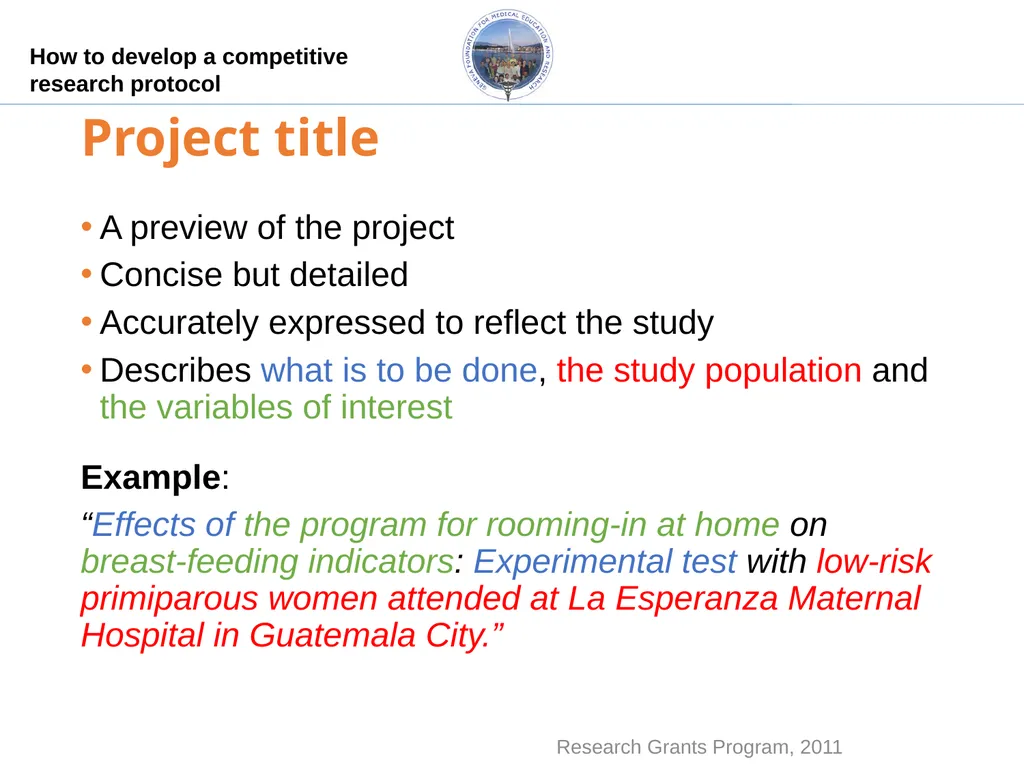
Project title A preview of the project
Concise but detailed
Accurately expressed to reflect the study
Describes what is to be done, the study population and the variables of interest
Example:
“Effects of the program for rooming-in at home on breast-feeding indicators: Experimental test with low-risk primiparous women attended at La Esperanza Maternal Hospital in Guatemala City.” Research Grants Program, 2011<br>
Concise but detailed
Accurately expressed to reflect the study
Describes what is to be done, the study population and the variables of interest
Example:
“Effects of the program for rooming-in at home on breast-feeding indicators: Experimental test with low-risk primiparous women attended at La Esperanza Maternal Hospital in Guatemala City.” Research Grants Program, 2011<br>
08
Project summary / abstract A brief outline of the entire project of about 300 words
Should stand alone
Should briefly and clearly state:
The research problem
The main research questions and or hypotheses
The justification for the research- how will it differ from existing studies
The research objectives
The study design- what will be done? by whom? to who? when? how? and for how long?
The expected outcomes
Anticipated problems- scientific, ethical, managerial UNDP, UNFPA, WHO and World Bank, 2003 WHO, 2016<br>
Should stand alone
Should briefly and clearly state:
The research problem
The main research questions and or hypotheses
The justification for the research- how will it differ from existing studies
The research objectives
The study design- what will be done? by whom? to who? when? how? and for how long?
The expected outcomes
Anticipated problems- scientific, ethical, managerial UNDP, UNFPA, WHO and World Bank, 2003 WHO, 2016<br>
09
Project description Research problem identification
Research problem justification/rationale
Literature review
Study goals and objectives
Research question / Hypothesis
Study design
Research methodology
Expected outcomes of the study<br>
Research problem justification/rationale
Literature review
Study goals and objectives
Research question / Hypothesis
Study design
Research methodology
Expected outcomes of the study<br>
10
1. Research problem identification Explains the research problem
Should answer the following questions in a logical flow:
What is the problem?
Magnitude/ significance of the problem- who is affected? Frequency of occurrence? Of public health interest?
Are the causes of the problem known? Consensus? Controversies?
Solvability of the problem- can the problem be solved? what has been done? what are the effects?
Need for research to address the problem- any knowledge gap? Research Grants Program, 2011<br>
Should answer the following questions in a logical flow:
What is the problem?
Magnitude/ significance of the problem- who is affected? Frequency of occurrence? Of public health interest?
Are the causes of the problem known? Consensus? Controversies?
Solvability of the problem- can the problem be solved? what has been done? what are the effects?
Need for research to address the problem- any knowledge gap? Research Grants Program, 2011<br>
11
2. Research problem justification / rationale Argues why the research should be done
Should answer the following questions:
Country needs- does it fit into current local or national priorities?
What knowledge/ information will it provide? New knowledge?
Contribution of research results – what is the relevance of the knowledge? Population benefits? Improved understanding of the problem- gaps, controversies? Influence policy?
What are the plans to disseminate result?
How will the results be applied? Who will benefit? Hilsden and Verhoef, 2004; Research Grants Program, 2011<br>
Should answer the following questions:
Country needs- does it fit into current local or national priorities?
What knowledge/ information will it provide? New knowledge?
Contribution of research results – what is the relevance of the knowledge? Population benefits? Improved understanding of the problem- gaps, controversies? Influence policy?
What are the plans to disseminate result?
How will the results be applied? Who will benefit? Hilsden and Verhoef, 2004; Research Grants Program, 2011<br>
12
3. Literature review A summary of the critical review of literatures on the research problem
Puts the research problem into perspective
Justifies the new research by identifying gaps and weaknesses in existing literature
Should be thorough, logical and well organized
Should include current and relevant literature
Should focus on original research and systematic reviews
Should include literatures that supports or disproves researcher’s point of view Hilsden and Verhoef, 2004<br>
Puts the research problem into perspective
Justifies the new research by identifying gaps and weaknesses in existing literature
Should be thorough, logical and well organized
Should include current and relevant literature
Should focus on original research and systematic reviews
Should include literatures that supports or disproves researcher’s point of view Hilsden and Verhoef, 2004<br>
13
4. Study goals and objectives Study goal
Aim/ General objective
Informs broadly on what the research proposal will do
An ideal study goal:
Should be clear
Should state the purpose of the study, that is, what it aims to achieve and why
Should define what will be described, determined, identified, compared, and, where there are hypotheses, it should indicate what will be confirmed Research Grants Program, 2011 WHO, 2016<br>
Aim/ General objective
Informs broadly on what the research proposal will do
An ideal study goal:
Should be clear
Should state the purpose of the study, that is, what it aims to achieve and why
Should define what will be described, determined, identified, compared, and, where there are hypotheses, it should indicate what will be confirmed Research Grants Program, 2011 WHO, 2016<br>
14
4. Study goals and objectives cont’d. Specific study objectives:
Statements of the research questions
Should be formulated before starting the research
Indicate how the study will accomplish its goals
Introduce the study design
Should be simple, concise and specific Research Grants Program, 2011; WHO, 2016<br>
Statements of the research questions
Should be formulated before starting the research
Indicate how the study will accomplish its goals
Introduce the study design
Should be simple, concise and specific Research Grants Program, 2011; WHO, 2016<br>
15
Example of study goal and objectives General objective (study goal)
“To verify the differences in the length of time low-risk primiparous women breast-feed when they participate in the program for rooming-in at home as compared to those who do not participate.”
Specific objectives:
1. “To estimate the prevalence of breast-feeding in low-risk primiparous women covered by the program for rooming-in at home and the prevalence of breast-feeding in primiparous women that receive standard health care.”
2. “To determine the existence of statistically significant differences in the prevalence of breast-feeding in the group of women who receive standard health care and the group treated at home.”
3. “To identify the protective factors that from the women's perspective help to explain the differences in the prevalence of breast-feeding according to the type of attention received.” Research Grants Program, 2011<br>
“To verify the differences in the length of time low-risk primiparous women breast-feed when they participate in the program for rooming-in at home as compared to those who do not participate.”
Specific objectives:
1. “To estimate the prevalence of breast-feeding in low-risk primiparous women covered by the program for rooming-in at home and the prevalence of breast-feeding in primiparous women that receive standard health care.”
2. “To determine the existence of statistically significant differences in the prevalence of breast-feeding in the group of women who receive standard health care and the group treated at home.”
3. “To identify the protective factors that from the women's perspective help to explain the differences in the prevalence of breast-feeding according to the type of attention received.” Research Grants Program, 2011<br>
16
5. Research question / hypothesis A good research question should be:
Simple
Clear and unambiguous
Focused
Realistic
Answerable- clearly indicate what data will be needed to answer the question and how it will be collected
Logical if there are more than one questions
Expressed as a question Aveyard, 2014<br>
Simple
Clear and unambiguous
Focused
Realistic
Answerable- clearly indicate what data will be needed to answer the question and how it will be collected
Logical if there are more than one questions
Expressed as a question Aveyard, 2014<br>
17
5. Research question / hypothesis cont’d. Acronyms to refine and focus questions:
PICO: Population, Intervention or Issue, Comparison or Context and Outcome
SPIDER: Sample, Phenomena of Interest, Design, Evaluation and Research (specific to qualitative research) Aveyard, 2014<br>
PICO: Population, Intervention or Issue, Comparison or Context and Outcome
SPIDER: Sample, Phenomena of Interest, Design, Evaluation and Research (specific to qualitative research) Aveyard, 2014<br>
18
5. Research question / hypothesis cont’d. Research hypothesis
Used in analytical studies
A declaration of the relationship between two or more variables, one being dependent
Tentatively predicts the research outcome
Should clearly state the variables that may be likely associated and the population of interest
How is it expressed?
Null hypothesis - there is no association between the variables of interest.
Alternative hypothesis - there is an association between the variables. Cherry, 2019; Bruce et al., 2008<br>
Used in analytical studies
A declaration of the relationship between two or more variables, one being dependent
Tentatively predicts the research outcome
Should clearly state the variables that may be likely associated and the population of interest
How is it expressed?
Null hypothesis - there is no association between the variables of interest.
Alternative hypothesis - there is an association between the variables. Cherry, 2019; Bruce et al., 2008<br>
19
Examples Study purpose:
“The purpose of this study is to determine if there are differences in pain control with nurse versus patient administered analgesia following surgery.”
Research question:
“Does the administration of analgesic by nurses vs. by patients themselves affect pain intensity during postoperative recovery in older adults?”
Hypothesis:
“Patients who self-administered narcotics will be more satisfied than patients who receive narcotics administered by nurses.” Hilsden and Verhoef, 2004<br>
“The purpose of this study is to determine if there are differences in pain control with nurse versus patient administered analgesia following surgery.”
Research question:
“Does the administration of analgesic by nurses vs. by patients themselves affect pain intensity during postoperative recovery in older adults?”
Hypothesis:
“Patients who self-administered narcotics will be more satisfied than patients who receive narcotics administered by nurses.” Hilsden and Verhoef, 2004<br>
20
6. Study design Determines the credibility of the study
State and justify the study design
Choice depends on:
The research question / hypothesis
Comparison with alternative study designs
Feasibility, resource availability, timeline, ethical consideration Hilsden and Verhoef, 2004; WHO, 2016<br>
State and justify the study design
Choice depends on:
The research question / hypothesis
Comparison with alternative study designs
Feasibility, resource availability, timeline, ethical consideration Hilsden and Verhoef, 2004; WHO, 2016<br>
21
6. Study design cont’d. Types of design:
Qualitative or quantitative
Observational or interventional
Descriptive or analytic
Cross-sectional or longitudinal Hilsden and Verhoef, 2004; WHO, 2016<br>
Qualitative or quantitative
Observational or interventional
Descriptive or analytic
Cross-sectional or longitudinal Hilsden and Verhoef, 2004; WHO, 2016<br>
22
7. Research Methodology Most important aspect of a protocol, and should be written in detail.
Provides details and justification of the techniques and procedures that will be employed to achieve the proposed objectives. WHO, 2016<br>
Provides details and justification of the techniques and procedures that will be employed to achieve the proposed objectives. WHO, 2016<br>
23
7. Research Methodology cont’d. The following information should be provided:
Variables
Study population/ research setting, sampling, sample size, selection of samples- cases, controls, inclusion and exclusion criteria, criteria for discontinuation
Proposed intervention, if any: What is it? Who will administer it? Where? What is the extent? How often? How will subjects be allocated? Safety considerations? Follow-ups? Fathalla and Fathalla, 2004; Hilsden and Verhoef, 2004; WHO, 2016<br>
Variables
Study population/ research setting, sampling, sample size, selection of samples- cases, controls, inclusion and exclusion criteria, criteria for discontinuation
Proposed intervention, if any: What is it? Who will administer it? Where? What is the extent? How often? How will subjects be allocated? Safety considerations? Follow-ups? Fathalla and Fathalla, 2004; Hilsden and Verhoef, 2004; WHO, 2016<br>
24
7. Research Methodology cont’d. All procedure for data collection: data collection instruments, pilot testing, recruitment of study participants, data quality control
Data management and analysis: data coding, monitoring and verification, computer software, statistical methods, sample size justification, study power, significance level Fathalla and Fathalla, 2004; Hilsden and Verhoef, 2004; WHO, 2016<br>
Data management and analysis: data coding, monitoring and verification, computer software, statistical methods, sample size justification, study power, significance level Fathalla and Fathalla, 2004; Hilsden and Verhoef, 2004; WHO, 2016<br>
25
8. Expected Outcomes of the Study Should answer the following questions:
What new evidence will be obtained from the study?
How will the evidence contribute to improvement in knowledge?
Who will benefit or use the findings?
Any effect on health care, health systems or policies? WHO, 2016<br>
What new evidence will be obtained from the study?
How will the evidence contribute to improvement in knowledge?
Who will benefit or use the findings?
Any effect on health care, health systems or policies? WHO, 2016<br>
26
Dissemination and publication of study findings How will research findings be communicated and to who?
Should include dissemination to participants or communities and policy makers as applicable.
Findings can be disseminated through:
Internal seminars
Regular reporting to stakeholders
Publications, for example journal articles, reviews or book chapters
Conference presentations
Exhibitions
Outreaches and public engagement events The University of Edinburgh, 2015 WHO, 2016<br>
Should include dissemination to participants or communities and policy makers as applicable.
Findings can be disseminated through:
Internal seminars
Regular reporting to stakeholders
Publications, for example journal articles, reviews or book chapters
Conference presentations
Exhibitions
Outreaches and public engagement events The University of Edinburgh, 2015 WHO, 2016<br>
27
Ethical Considerations Based on the principles of autonomy, beneficence (doing good), non-maleficence (avoiding harm) and justice.
Should consider:
Study validity
Recruitment
Ethical approval for the study- local, institutional, national ethic committee
Informed consent process
Other issues that may be of ethical concern especially when the study involves human subjects Fathalla and Fathalla, 2004; Hilsden and Verhoef, 2004<br>
Should consider:
Study validity
Recruitment
Ethical approval for the study- local, institutional, national ethic committee
Informed consent process
Other issues that may be of ethical concern especially when the study involves human subjects Fathalla and Fathalla, 2004; Hilsden and Verhoef, 2004<br>
28
Ethical Considerations cont’d. The following should be clearly stated:
Known benefits, risks and disadvantages
Information to be provided to subjects and how
Extent and alternative to participation
Incentives to be provided to subjects if any
Treatment to be provided to subjects if any
Information confidentiality Fathalla and Fathalla, 2004; Hilsden and Verhoef, 2004<br>
Known benefits, risks and disadvantages
Information to be provided to subjects and how
Extent and alternative to participation
Incentives to be provided to subjects if any
Treatment to be provided to subjects if any
Information confidentiality Fathalla and Fathalla, 2004; Hilsden and Verhoef, 2004<br>
29
Timeline Specifies the duration for each project
Provides the detailed monthly timeline for each activity
Consider:
Preparatory stage- training of research workers, equipment procurement,
Pilot studies
Data collection
Data analysis
Report writing
Milestones- for long-term projects Fathalla and Fathalla, 2004; Hilsden and Verhoef, 2004<br>
Provides the detailed monthly timeline for each activity
Consider:
Preparatory stage- training of research workers, equipment procurement,
Pilot studies
Data collection
Data analysis
Report writing
Milestones- for long-term projects Fathalla and Fathalla, 2004; Hilsden and Verhoef, 2004<br>
30
Problems anticipated State all the obstacles or difficulties that can prevent the realization of project within stipulated timeline and budget.
Explain how the obstacles would be overcome. Fathalla and Fathalla, 2004<br>
Explain how the obstacles would be overcome. Fathalla and Fathalla, 2004<br>
31
Budget Itemize and justify the budget.
For long-term projects, provide detail budget for at least the first year and outline budget for subsequent years.
Realistic budget- too much or too little may lead to unsuccessful funding application.
Types of expenses include: personnel (include names and contributions to project), equipment, supplies, patient care and costs, travel, data processing, communications, secretarial expenses, publication/dissemination of research findings. Fathalla and Fathalla, 2004<br>
For long-term projects, provide detail budget for at least the first year and outline budget for subsequent years.
Realistic budget- too much or too little may lead to unsuccessful funding application.
Types of expenses include: personnel (include names and contributions to project), equipment, supplies, patient care and costs, travel, data processing, communications, secretarial expenses, publication/dissemination of research findings. Fathalla and Fathalla, 2004<br>
32
Referencing Cite relevant and current literatures
All sources of information must be cited - avoid plagiarism
All cited authors in the text should be in the reference list
All listed references must have been cited in the text
References should be cited and listed sequentially
Reference style should be uniform
Formatting should be consistent The University of Edinburgh, 2015<br>
All sources of information must be cited - avoid plagiarism
All cited authors in the text should be in the reference list
All listed references must have been cited in the text
References should be cited and listed sequentially
Reference style should be uniform
Formatting should be consistent The University of Edinburgh, 2015<br>
33
Research team Describe the role and responsibility of each member of the team.
Include information on previous studies or preliminary work done on the research problem by the investigators.
Attached Curriculum vitae (CV) of investigators of investigators: this shows the competence of the investigator to conduct the research. UNDP, UNFPA, WHO and World Bank, 2003<br>
Include information on previous studies or preliminary work done on the research problem by the investigators.
Attached Curriculum vitae (CV) of investigators of investigators: this shows the competence of the investigator to conduct the research. UNDP, UNFPA, WHO and World Bank, 2003<br>
34
Annexes Include the following as appropriate:
Interview protocols
Sample of informed consent forms
Cover letters sent to appropriate stakeholders
Official letters for permission to conduct research
Original study instrument, written permission to re-reproduce instrument or proof of purchase of instrument
Other support for the project
Collaboration with other scientists or research institutions
Link to other projects
Financing and insurance Al-Riyami, 2008; WHO, 2016<br>
Interview protocols
Sample of informed consent forms
Cover letters sent to appropriate stakeholders
Official letters for permission to conduct research
Original study instrument, written permission to re-reproduce instrument or proof of purchase of instrument
Other support for the project
Collaboration with other scientists or research institutions
Link to other projects
Financing and insurance Al-Riyami, 2008; WHO, 2016<br>
35
General considerations Include table of contents
Include list of acronyms/ abbreviations in alphabetical order
Explain technical terms if used
Be logical in flow of thoughts and use section headings
Keep tense and voice consistent- present versus past tense and active versus passive voice
Keep sentences short and use paragraphs appropriately
Avoid repetitions
Be consistent in formatting- font size, font style
Make effective use of tables, figures and charts
Make sure your proposal stand out Bates College, n.d.; The University of Edinburgh, 2015<br>
Include list of acronyms/ abbreviations in alphabetical order
Explain technical terms if used
Be logical in flow of thoughts and use section headings
Keep tense and voice consistent- present versus past tense and active versus passive voice
Keep sentences short and use paragraphs appropriately
Avoid repetitions
Be consistent in formatting- font size, font style
Make effective use of tables, figures and charts
Make sure your proposal stand out Bates College, n.d.; The University of Edinburgh, 2015<br>
36
Points to note when applying for funding Apply to funders whose program goals are related to your project.
Understand and follow the guidelines/instructions of funders.
Know the method of application, submission, timeline and budget limits.
Provide sufficient description of project.
Follow guidelines and instructions for the style and organization of your proposal- formatting, spacing, paging, word limits etc.
Show enthusiasm and commitment. Bates College, n.d.<br>
Understand and follow the guidelines/instructions of funders.
Know the method of application, submission, timeline and budget limits.
Provide sufficient description of project.
Follow guidelines and instructions for the style and organization of your proposal- formatting, spacing, paging, word limits etc.
Show enthusiasm and commitment. Bates College, n.d.<br>
37
Sources of research funding Public
Governmental organizations - health ministries, health institutes, universities, national research councils
Intergovernmental organizations- World Health Organization
Private
Not-for-profit organizations - non-governmental organizations and philanthropists, e.g. Rockefeller Foundation, Bill and Melinda Gates Foundation
Profit making industries- pharmaceutical companies
Intermediary organizations, e.g.
PATH (Program for Appropriate Technology in Health),
Population Council UNDP, UNFPA, WHO and World Bank, 2003<br>
Governmental organizations - health ministries, health institutes, universities, national research councils
Intergovernmental organizations- World Health Organization
Private
Not-for-profit organizations - non-governmental organizations and philanthropists, e.g. Rockefeller Foundation, Bill and Melinda Gates Foundation
Profit making industries- pharmaceutical companies
Intermediary organizations, e.g.
PATH (Program for Appropriate Technology in Health),
Population Council UNDP, UNFPA, WHO and World Bank, 2003<br>
38
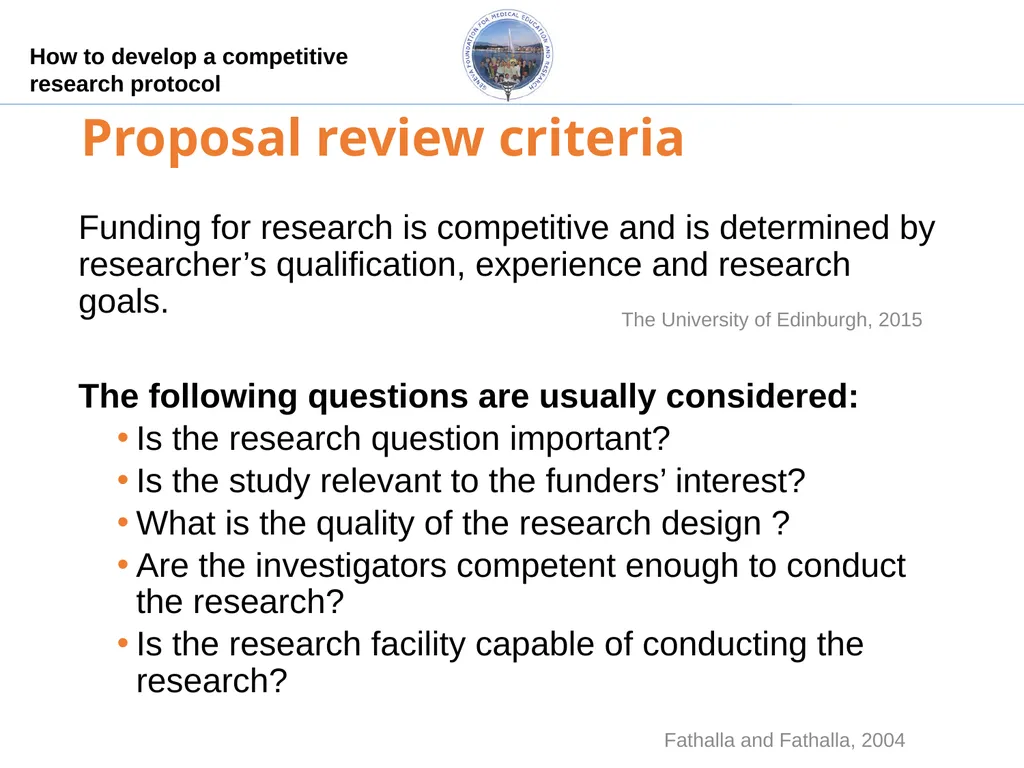
Proposal review criteria Funding for research is competitive and is determined by researcher’s qualification, experience and research goals.
The following questions are usually considered:
Is the research question important?
Is the study relevant to the funders’ interest?
What is the quality of the research design ?
Are the investigators competent enough to conduct the research?
Is the research facility capable of conducting the research? Fathalla and Fathalla, 2004 The University of Edinburgh, 2015<br>
The following questions are usually considered:
Is the research question important?
Is the study relevant to the funders’ interest?
What is the quality of the research design ?
Are the investigators competent enough to conduct the research?
Is the research facility capable of conducting the research? Fathalla and Fathalla, 2004 The University of Edinburgh, 2015<br>
39
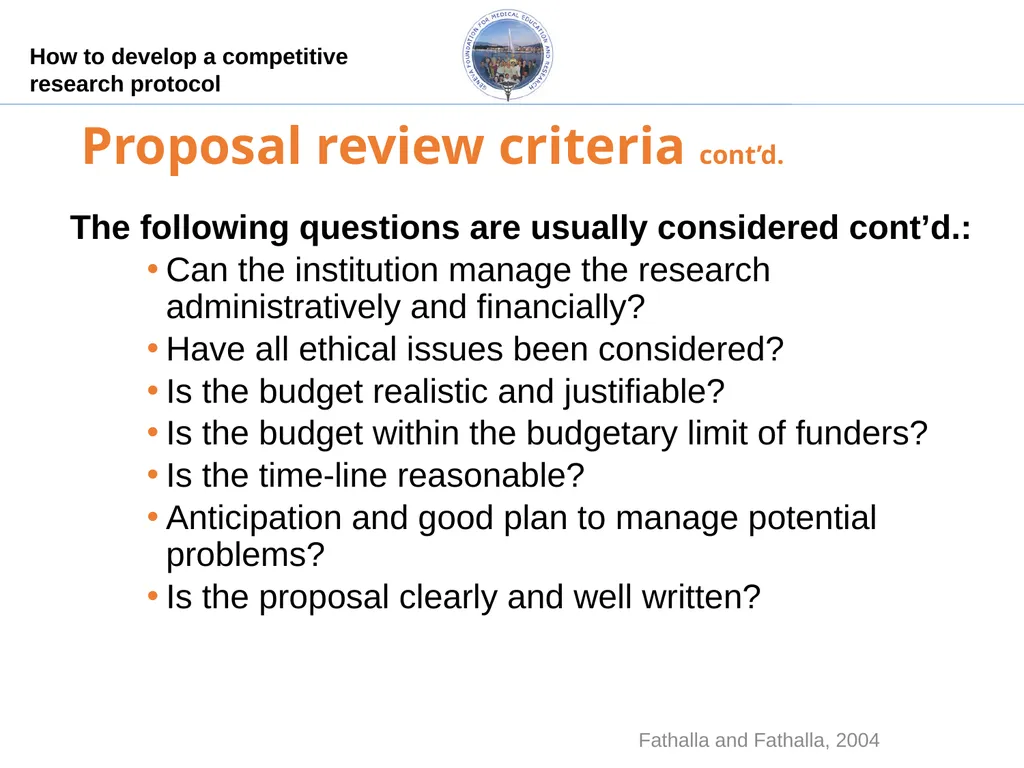
Proposal review criteria cont’d. The following questions are usually considered cont’d.:
Can the institution manage the research administratively and financially?
Have all ethical issues been considered?
Is the budget realistic and justifiable?
Is the budget within the budgetary limit of funders?
Is the time-line reasonable?
Anticipation and good plan to manage potential problems?
Is the proposal clearly and well written? Fathalla and Fathalla, 2004<br>
Can the institution manage the research administratively and financially?
Have all ethical issues been considered?
Is the budget realistic and justifiable?
Is the budget within the budgetary limit of funders?
Is the time-line reasonable?
Anticipation and good plan to manage potential problems?
Is the proposal clearly and well written? Fathalla and Fathalla, 2004<br>
40
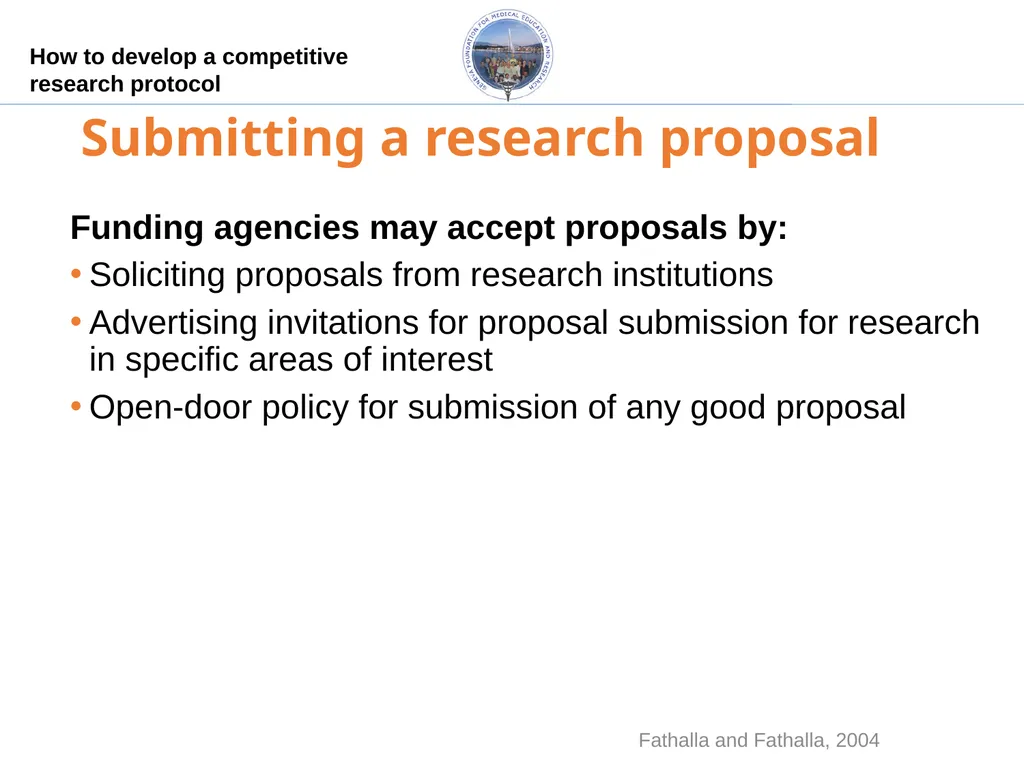
Submitting a research proposal Funding agencies may accept proposals by:
Soliciting proposals from research institutions
Advertising invitations for proposal submission for research in specific areas of interest
Open-door policy for submission of any good proposal Fathalla and Fathalla, 2004<br>
Soliciting proposals from research institutions
Advertising invitations for proposal submission for research in specific areas of interest
Open-door policy for submission of any good proposal Fathalla and Fathalla, 2004<br>
41
Thank you and good luck with your research!<br>
42
References Al-Riyami A. How to prepare a Research Proposal. Oman Med J. 2008 Apr;23(2):66-9. Available from: https://www.ncbi.nlm.nih.gov/pmc/articles/PMC3282423/
Aveyard H. Doing a Literature Review in Health and Social Care: A Practical Guide. 3rd ed. Maidenhead: Open University Press. Oxford: Routledge; 2014.
Bates College. Tips for preparing a strong grant proposal. Bates College; no date. Available from: http://www.bates.edu/academics/files/2014/11/Tips-for-Preparing-a-Strong-Grant-Proposal.pdf
Bruce N, Stanistreet D, Pope D. Quantitative methods for health research: a practical interactive guide to epidemiology and statistics. 2nd ed. Chichester: Wiley; 2008.
Cherry K. Forming a Good Hypothesis for Scientific Research. Verywellmind [Internet] https://www.verywellmind.com/what-is-a-hypothesis-2795239 (Accessed: 26 December 2019).
Faryadi Q. How to write your PhD proposal: A step-by-step guide. American International Journal of Contemporary Research. 2012;2(4):111–115.
Fathalla MF, Fathalla MM. A practical guide for health researchers (WHO Regional Publications, Eastern Mediterranean. Series 30). WHO; 2004. Available from: https://apps.who.int/iris/rest/bitstreams/527138/retrieve<br>
Aveyard H. Doing a Literature Review in Health and Social Care: A Practical Guide. 3rd ed. Maidenhead: Open University Press. Oxford: Routledge; 2014.
Bates College. Tips for preparing a strong grant proposal. Bates College; no date. Available from: http://www.bates.edu/academics/files/2014/11/Tips-for-Preparing-a-Strong-Grant-Proposal.pdf
Bruce N, Stanistreet D, Pope D. Quantitative methods for health research: a practical interactive guide to epidemiology and statistics. 2nd ed. Chichester: Wiley; 2008.
Cherry K. Forming a Good Hypothesis for Scientific Research. Verywellmind [Internet] https://www.verywellmind.com/what-is-a-hypothesis-2795239 (Accessed: 26 December 2019).
Faryadi Q. How to write your PhD proposal: A step-by-step guide. American International Journal of Contemporary Research. 2012;2(4):111–115.
Fathalla MF, Fathalla MM. A practical guide for health researchers (WHO Regional Publications, Eastern Mediterranean. Series 30). WHO; 2004. Available from: https://apps.who.int/iris/rest/bitstreams/527138/retrieve<br>
43
References Hilsden RJ, Verhoef MJ. Writing an effective research proposal. University of Calgary; 2004. Available from: https://people.ucalgary.ca/~rhilsden/Protocol_writing_handout_2004.pdf
Research Grants Program. Guide for writing a research protocol. Washington: Pan American Health Organization; 2011.
The University of Edinburgh. How to write a good postgraduate research proposal. The University of Edinburgh; 2015. Available from: https://www.ed.ac.uk/files/imports/fileManager/HowToWriteProposal090415.pdf
UNDP, UNFPA, WHO and World Bank Special Programme of Research, Development and Research Training in Human Reproduction. Preparing a research project proposal: Guideline and forms. 4th ed. WHO; 2003. Available from: http://www.gfmer.ch/SRH-Course-2011/research-methodology/pdf/WHO-proposal-guidelines-forms-2003.pdf
World Health Organization. Recommended format for a Research Protocol. World Health Organization; c2022. Available from: https://www.who.int/groups/research-ethics-review-committee/recommended-format-for-a-research-protocol<br>
Research Grants Program. Guide for writing a research protocol. Washington: Pan American Health Organization; 2011.
The University of Edinburgh. How to write a good postgraduate research proposal. The University of Edinburgh; 2015. Available from: https://www.ed.ac.uk/files/imports/fileManager/HowToWriteProposal090415.pdf
UNDP, UNFPA, WHO and World Bank Special Programme of Research, Development and Research Training in Human Reproduction. Preparing a research project proposal: Guideline and forms. 4th ed. WHO; 2003. Available from: http://www.gfmer.ch/SRH-Course-2011/research-methodology/pdf/WHO-proposal-guidelines-forms-2003.pdf
World Health Organization. Recommended format for a Research Protocol. World Health Organization; c2022. Available from: https://www.who.int/groups/research-ethics-review-committee/recommended-format-for-a-research-protocol<br>