HOW TO GET A BILLION INDIANS ONLINE BY 2020 Laleema Senanayake LIRNEasia, 10.06.2016 INTRODUCTION 1 Billion Internet users in India by 2020 Inclusive digital revolution Multiple initiatives by central and state government of India Vision:
Related Topics
Share
Embed code
Download this presentation From Below
"HOW TO GET A BILLION INDIANS ONLINE BY 2020" is the property of its rightful owner. Permission is granted to
download and print the materials on this website for personal, non-commercial use only, and to display it
on your personal computer provided you do not modify the materials and that you retain all copyright
notices contained in the materials. By downloading content from our website, you accept the terms of this
agreement.
Presentation Transcript
01
HOW TO GET A BILLION INDIANS ONLINE BY 2020 Laleema Senanayake
LIRNEasia, 10.06.2016<br>
02
INTRODUCTION 1 Billion Internet users in India by 2020
Inclusive digital revolution
Multiple initiatives by central and state government of India
Vision: Transform India into digitally empowered society and knowledge economy
It is important that the population is connected to Internet to directly benefit from these services
746 million unique Internet users by 2020 (Analysys Mason’s proprietary market forecast model)
Additional 254 million unique Internet users (digitally un-served and under-served)
Commitment by key stakeholders: government, operators, consumer Internet companies and technology companies<br>
03
KEY QUESTIONS? A billion Internet connected Indians by 2020- Is it realistic?
Key impediments for connecting the digitally un-served and under-served population
Potential business models for addressing issues around access and services
Most appropriate business model required to connect a billion Indians to Internet
Input from industry participants and industry experts and publicly available information 3<br>
04
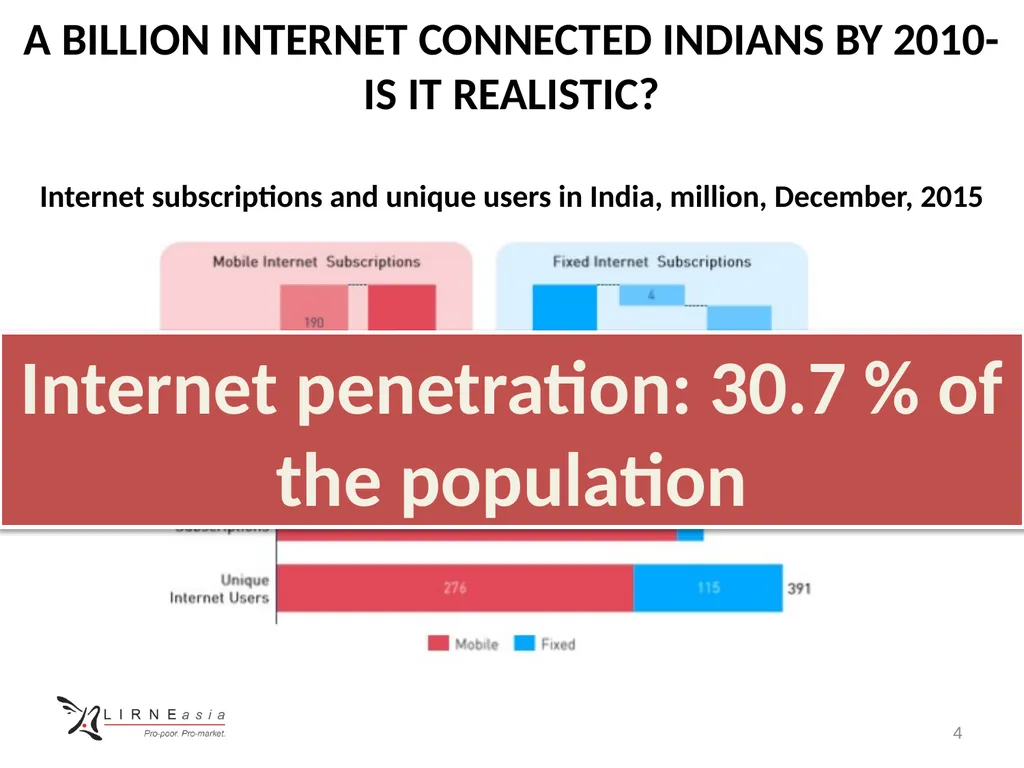
A BILLION INTERNET CONNECTED INDIANS BY 2010- IS IT REALISTIC? 4 Internet subscriptions and unique users in India, million, December, 2015 Internet penetration: 30.7 % of the population<br>
05
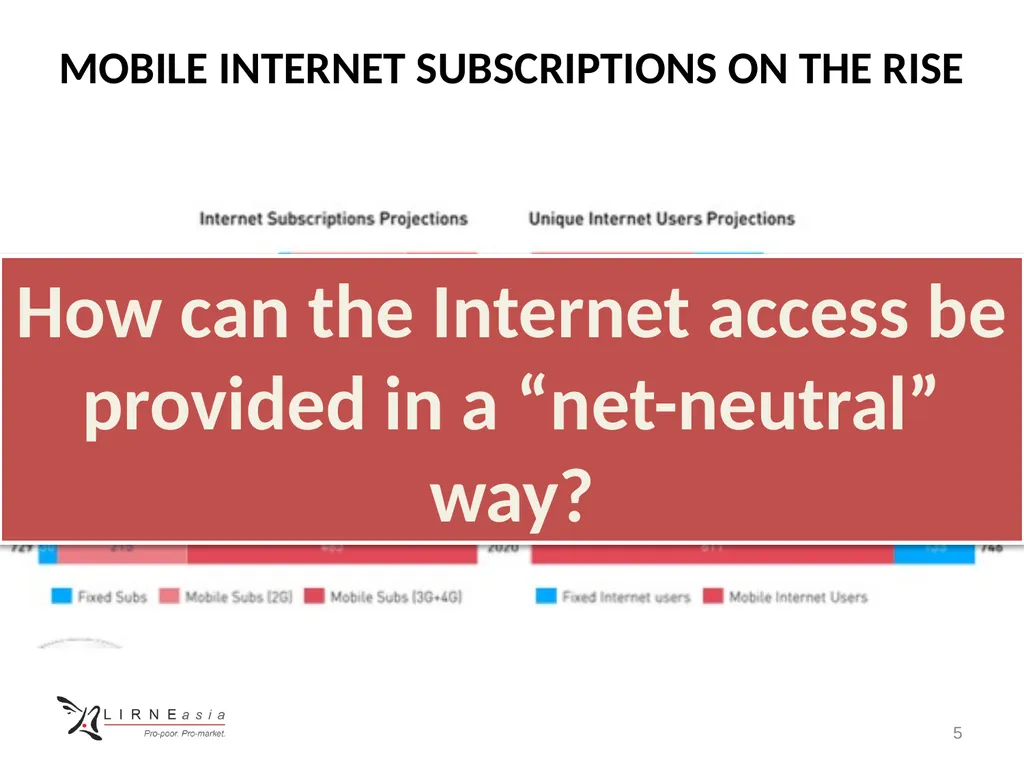
MOBILE INTERNET SUBSCRIPTIONS ON THE RISE Mobile Internet subscriptions: 220 million in 2013 to 310 million in Dec 2015
Rapid expansion of 3G and LTE networks
Penetration of 3G and LTE enabled smartphones
Auction of spectrum
Change in market dynamics with the launch of LTE services by Reliance Jio
Access to wired/ fixed networks will be limited
Analysis masons propriety market forecast model (circle-level forecast using benchmarking, regression analysis, affordability assessment etc.) 5 How can the Internet access be provided in a “net-neutral” way?<br>
06
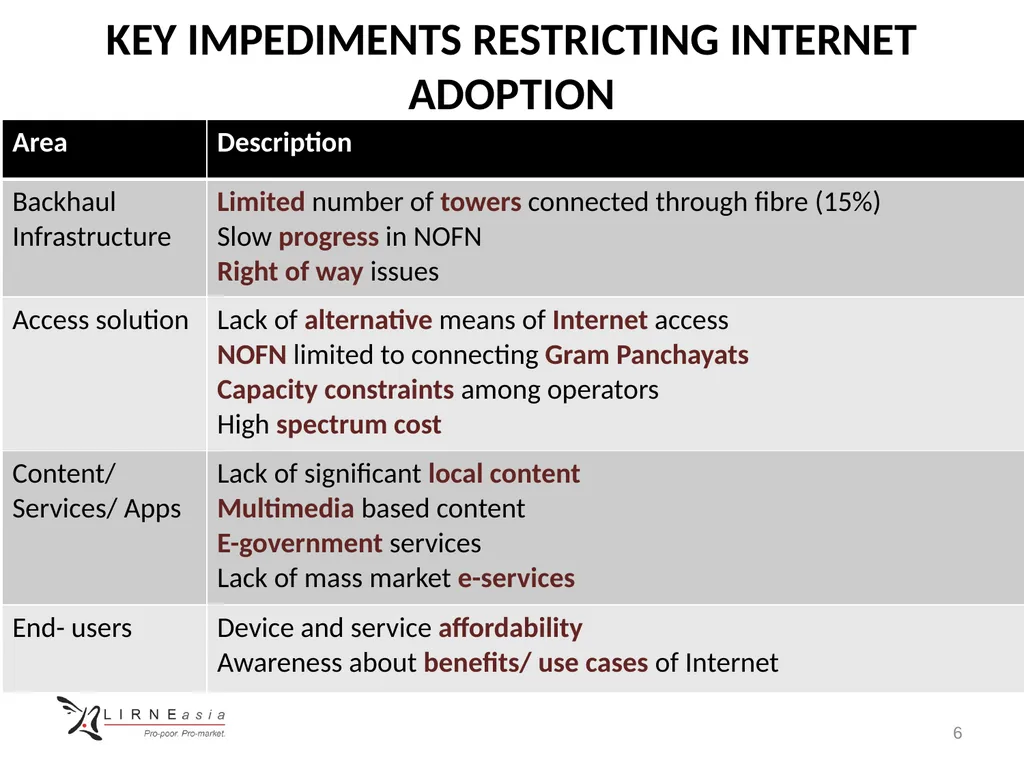
KEY IMPEDIMENTS RESTRICTING INTERNET ADOPTION 6<br>
07
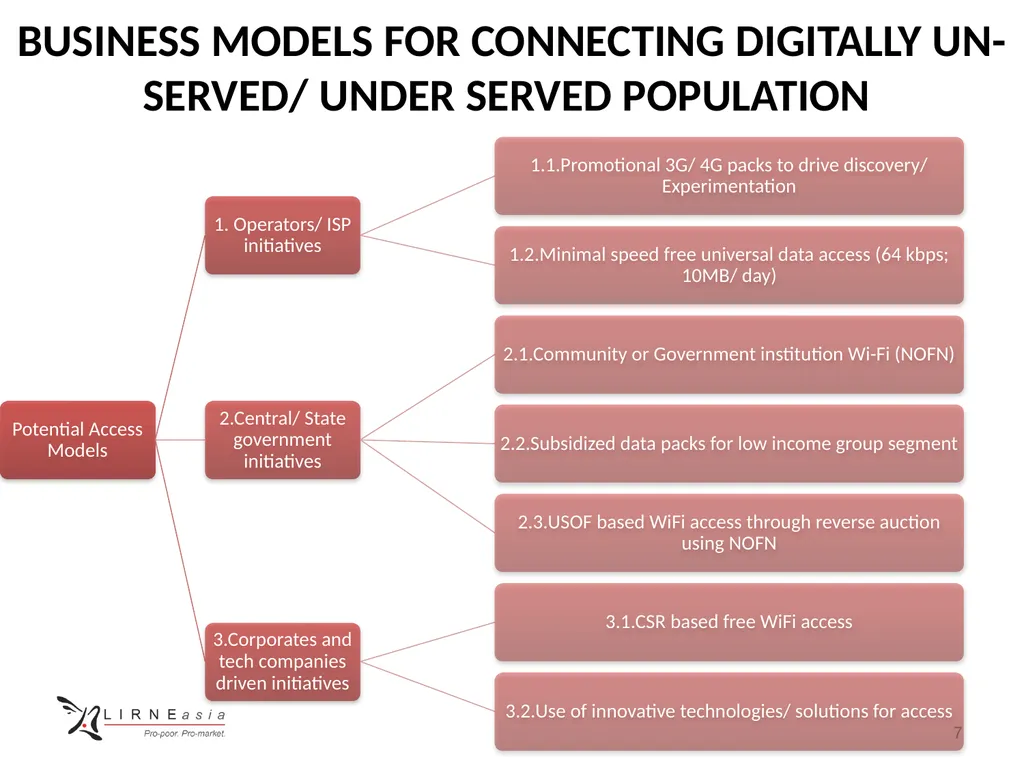
BUSINESS MODELS FOR CONNECTING DIGITALLY UN-SERVED/ UNDER SERVED POPULATION 7<br>
08
8 Operators/ ISP Initiatives<br>
09
1. Promotional 3G/ 4G packs to drive discovery/ Experimentation
Pros:
Low entry barrier of data services may act as a motivator for non users/ voice only users to experiment with various data services
Win-win for operators who are looking to drive revenue from data services and consumers who get access to services at a lower cost
Cons
High possibility of initial users dropping out following the promotional period
Given the limited available spectrum, operators might not be interested in offering subsidized data packs initially in urban areas
Does not address the issue around creating awareness and educating the users on potential benefits of Internet within limited promotional time frame 9<br>
10
2. Minimal speed free universal data access
Pros:
Free services will facilitate experimentation and discovery of low bandwidth services
Post initial experience and discovery, users might consider opting for regular data packs
Cons
Given the limited available spectrum, operators might not be interested in offering subsidized data packs initially in urban areas
Low speed Internet might not provide the kind of experience to motivate the user for regular data usage 10<br>
11
11 Central/ State government initiatives<br>
12
3. Community or government institution WiFi (NOFN backhaul)
Pros:
End to end planning and funding by government will eliminate concerns over business viability
High level utilization of up coming NOFN infrastructure
Cons
Involvement of multiple stakeholders could create roll out issues
Providing a ubiquitous WiFi network covering the entire area will be a challenge
Speed of deployment and success of such programs can potentially be an issue 12<br>
13
4. Subsidized data packs for low income segments
Pros:
Potential to address affordability issue among low- income groups
Act as extension of NOFN program
Will facilitate successful implementation of other e- government programs that will help drive economic growth
Cons
Speedy development and execution of such subsidy program could be a challenge
Does not address smart phone/ access device affordability issue 13<br>
14
5. USOF based WiFi access through reverse auction using NOFN as backhaul
Pros:
Proven model as structure, so can be quickly implemented
Fast and affective deployment of the access infrastructure can be dictated based on rollout milestones and associated penalties for missing them
Cons
With limited government control, private operators/ service providers may not stick to the timelines
Lack of interest among private companies due to poor business case 14<br>
15
15 Corporates and tech companies driven initiatives<br>
16
6. CSR based WiFi access
Pros:
Relatively faster and effective deployment due to the involvement of private sector
Utilization of NOFN infrastructure
Cons
Mass scale WiFi network deployment could be challenge
Continuous funding support for sustaining long term program 16<br>
17
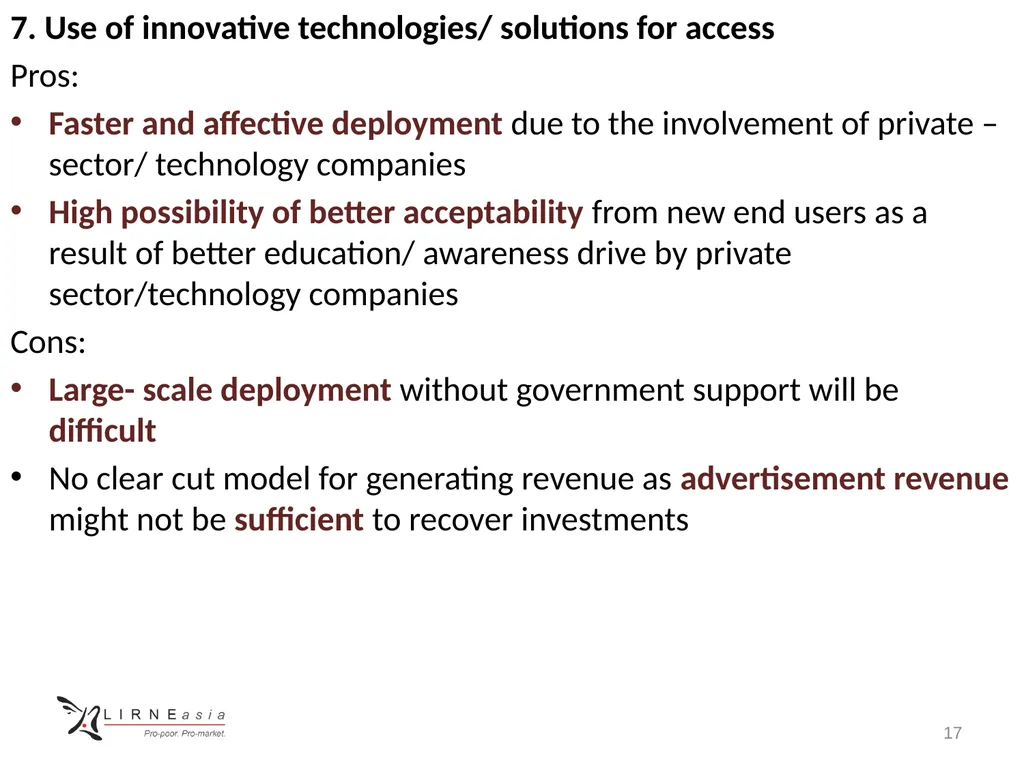
7. Use of innovative technologies/ solutions for access
Pros:
Faster and affective deployment due to the involvement of private – sector/ technology companies
High possibility of better acceptability from new end users as a result of better education/ awareness drive by private sector/technology companies
Cons:
Large- scale deployment without government support will be difficult
No clear cut model for generating revenue as advertisement revenue might not be sufficient to recover investments 17<br>
18
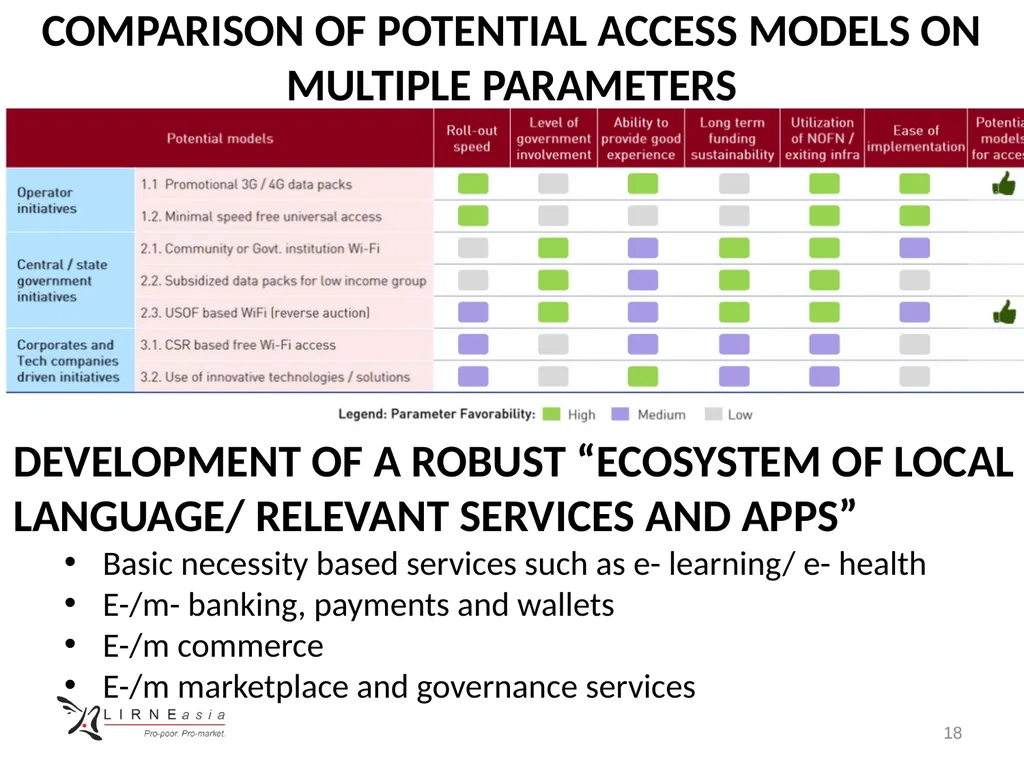
18 COMPARISON OF POTENTIAL ACCESS MODELS ON MULTIPLE PARAMETERS DEVELOPMENT OF A ROBUST “ECOSYSTEM OF LOCAL LANGUAGE/ RELEVANT SERVICES AND APPS”
Basic necessity based services such as e- learning/ e- health
E-/m- banking, payments and wallets
E-/m commerce
E-/m marketplace and governance services<br>
19
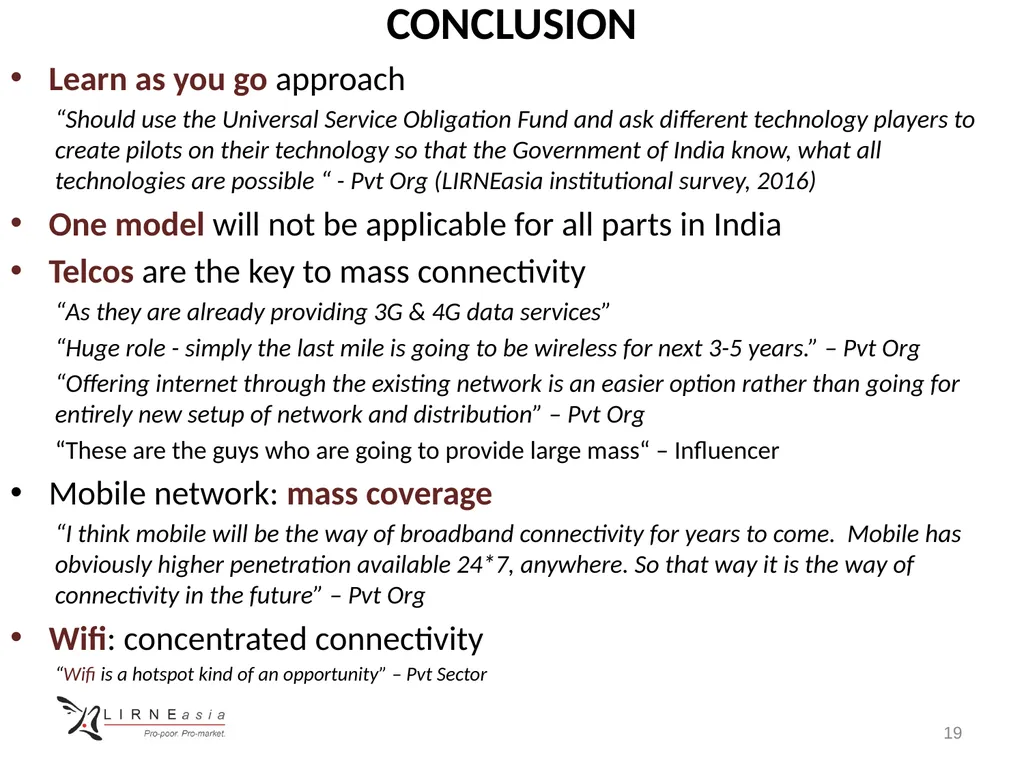
CONCLUSION Learn as you go approach
“Should use the Universal Service Obligation Fund and ask different technology players to create pilots on their technology so that the Government of India know, what all technologies are possible “ - Pvt Org (LIRNEasia institutional survey, 2016)
One model will not be applicable for all parts in India
Telcos are the key to mass connectivity
“As they are already providing 3G & 4G data services”
“Huge role - simply the last mile is going to be wireless for next 3-5 years.” – Pvt Org
“Offering internet through the existing network is an easier option rather than going for entirely new setup of network and distribution” – Pvt Org
“These are the guys who are going to provide large mass“ – Influencer
Mobile network: mass coverage
“I think mobile will be the way of broadband connectivity for years to come. Mobile has obviously higher penetration available 24*7, anywhere. So that way it is the way of connectivity in the future” – Pvt Org
Wifi: concentrated connectivity
“Wifi is a hotspot kind of an opportunity” – Pvt Sector 19<br>
20
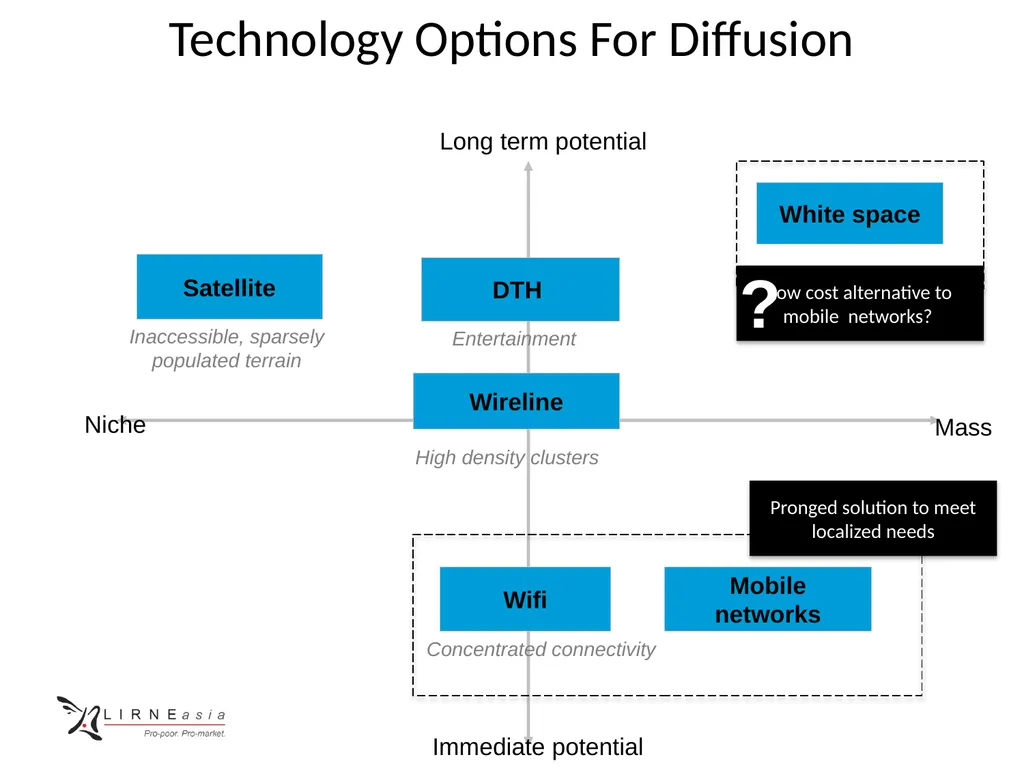
Technology Options For Diffusion Niche Mass Long term potential Immediate potential Mobile networks White space<br>
21
Increase digital literacy
Develop support services (electricity)
“In the initial flush of things, people will be using it for entertainment. But in course of time people will understand the power of the medium” – Pvt Org
“It is very clear that once the demand factor gets out to the end user, that there will be pretty heavy demand ” – Influencer
1st & biggest gainer of rural net access, providing access to existing content is enterteinment followed by online shopping, education and banking/ financial services 21 CONCLUSION<br>