
How to Get Started if You Hate to Write ©

Description: How to Get Started if You Hate to Write 2023 The Board of Trustees of the University of Illinois All rights reserved. Celia M. Elliott Department of Physics cmelliotillinois.edu Part IOutlining One thing Ive learned in physics, you
Related Topics
Download Presentation
"How to Get Started if You Hate to Write ©" is the property of its rightful owner. Permission is granted to download and print the materials on this website for personal, non-commercial use only, and to display it on your personal computer provided you do not modify the materials and that you retain all copyright notices contained in the materials. By downloading content from our website, you accept the terms of this agreement.
Presentation Transcript
slide1. How to Get Started if You Hate to Write © 2023 The Board of Trustees of the University of Illinois
All rights reserved. Celia M. Elliott
Department of Physics
cmelliot@illinois.edu Part I―Outlining<br>
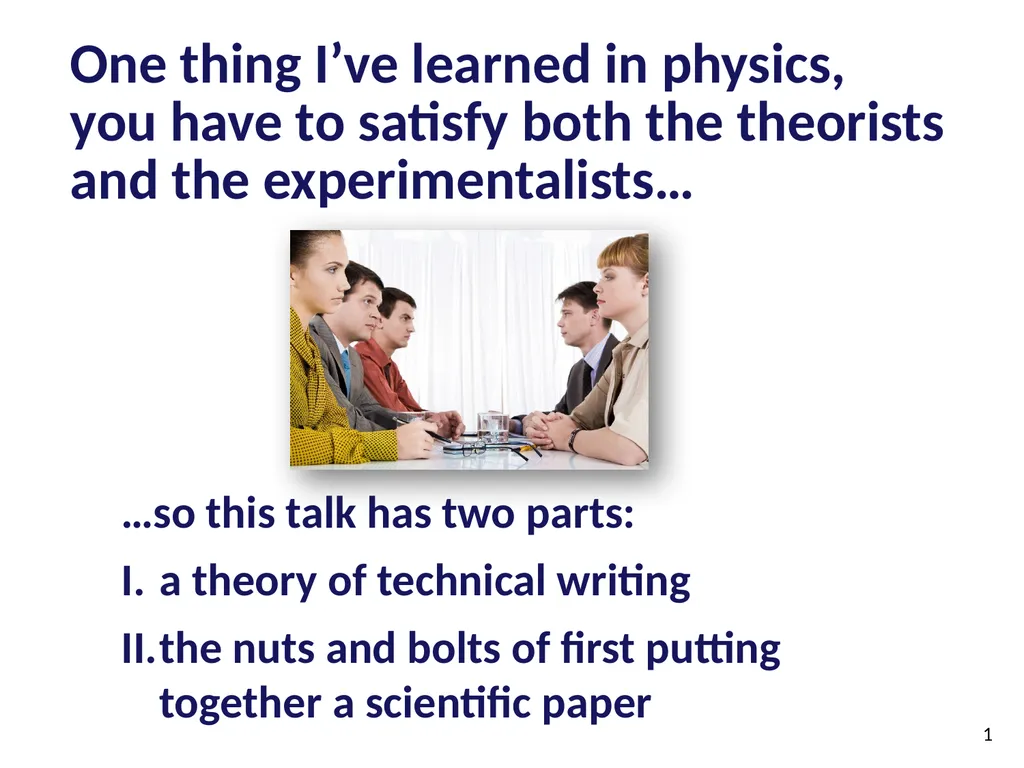
slide2. One thing I’ve learned in physics, you have to satisfy both the theorists and the experimentalists… …so this talk has two parts:
a theory of technical writing
the nuts and bolts of first putting together a scientific paper 1<br>
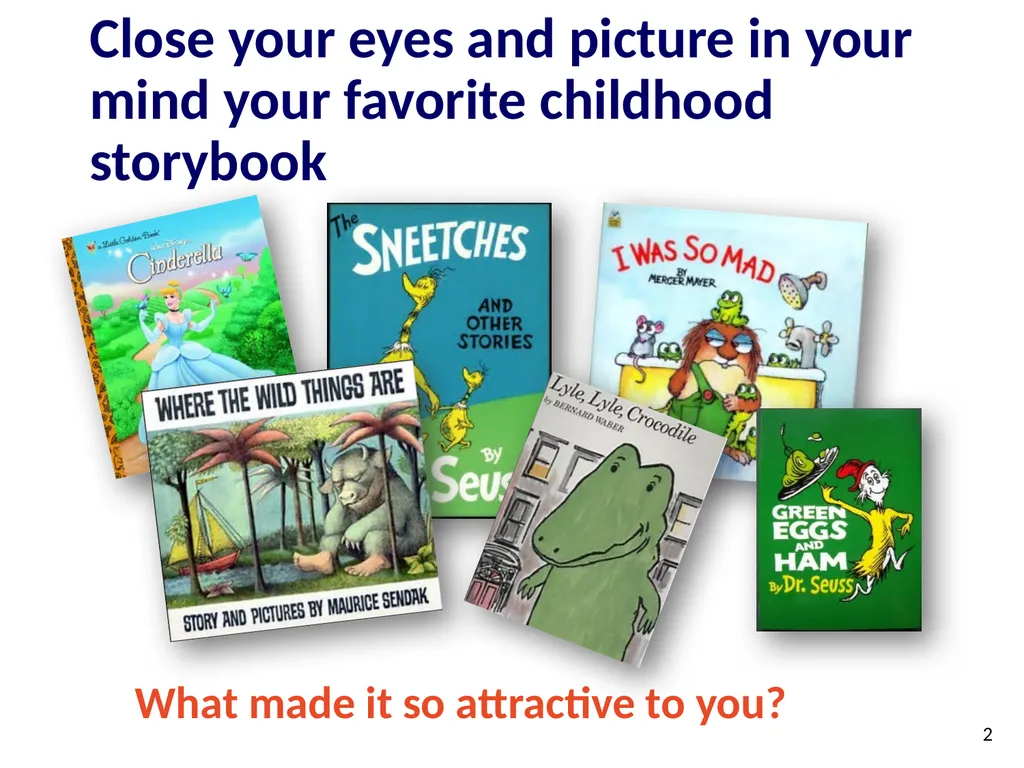
slide3. What made it so attractive to you? Close your eyes and picture in your mind your favorite childhood storybook 2<br>
slide4. Guess what! Nothing has really changed since you were 5. I’m going to guess that book had Words you understood
Interesting, engaging pictures
A simple, direct storyline
Clear connections and transitions
A satisfying ending
Ideas that captured your imagination and expanded your horizons 3<br>
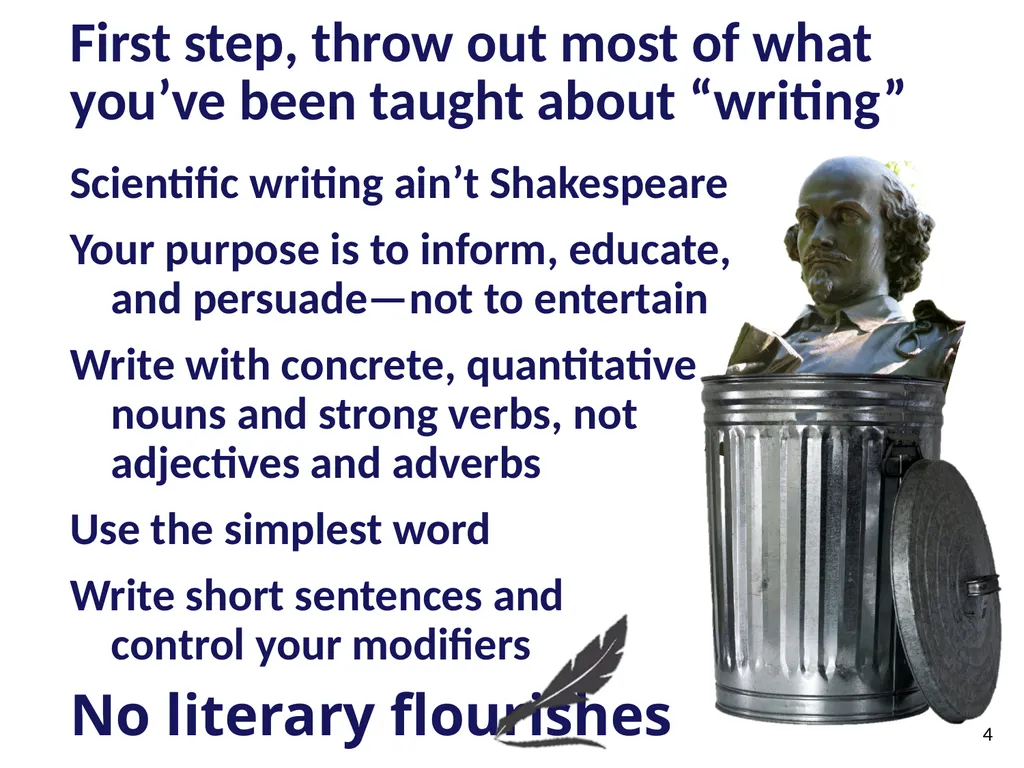
slide5. First step, throw out most of what you’ve been taught about “writing” Scientific writing ain’t Shakespeare
Your purpose is to inform, educate, and persuade—not to entertain
Write with concrete, quantitative nouns and strong verbs, not adjectives and adverbs
Use the simplest word
Write short sentences and control your modifiers
No literary flourishes 4<br>
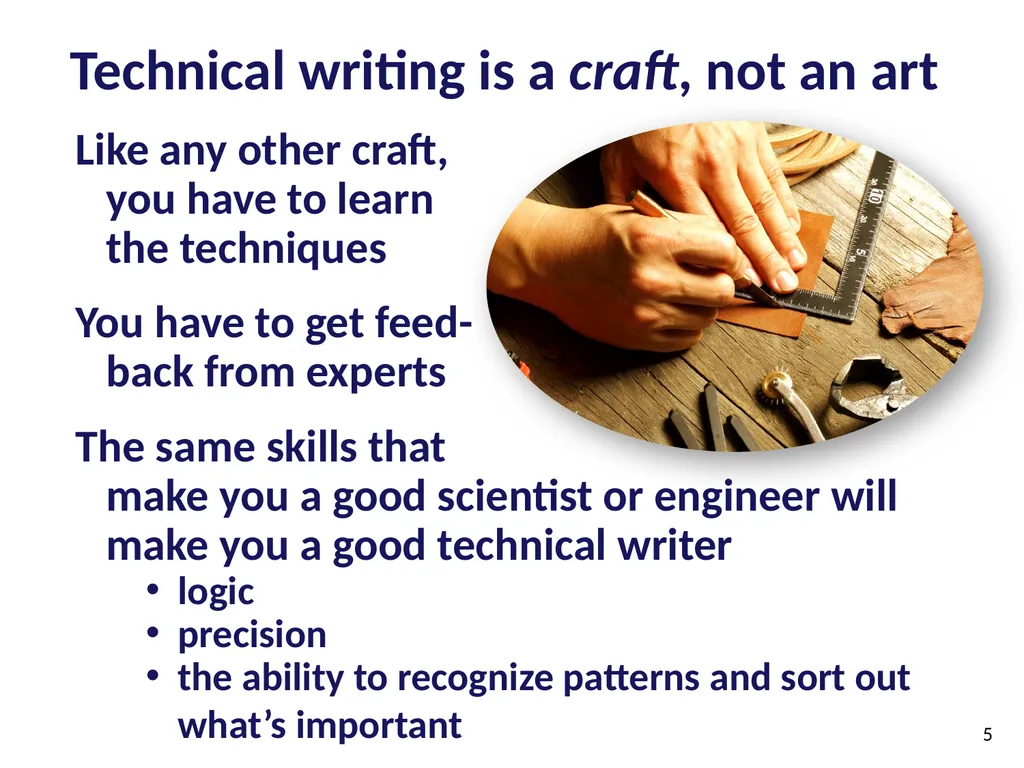
slide6. Technical writing is a craft, not an art Like any other craft, you have to learn the techniques
You have to get feed- back from experts
The same skills that make you a good scientist or engineer will make you a good technical writer
logic
precision
the ability to recognize patterns and sort out what’s important 5<br>
slide7. Successful science writing is Written with the reader in mind
Logically constructed—think “linear”
Clearly and succinctly expressed
Precisely and simply worded
Written to inform and persuade 6<br>
slide8. As you are thinking about your writing task, first ask yourself four questions: What is my purpose in writing this document? What’s my ultimate goal?
Who is going to read it? What do they already know, and what am I going to have to explain? What do they want to get out of this paper?
What one thing do I want the reader to remember? What’s the “take-away” message?
What are my space/time/page constraints? 7<br>
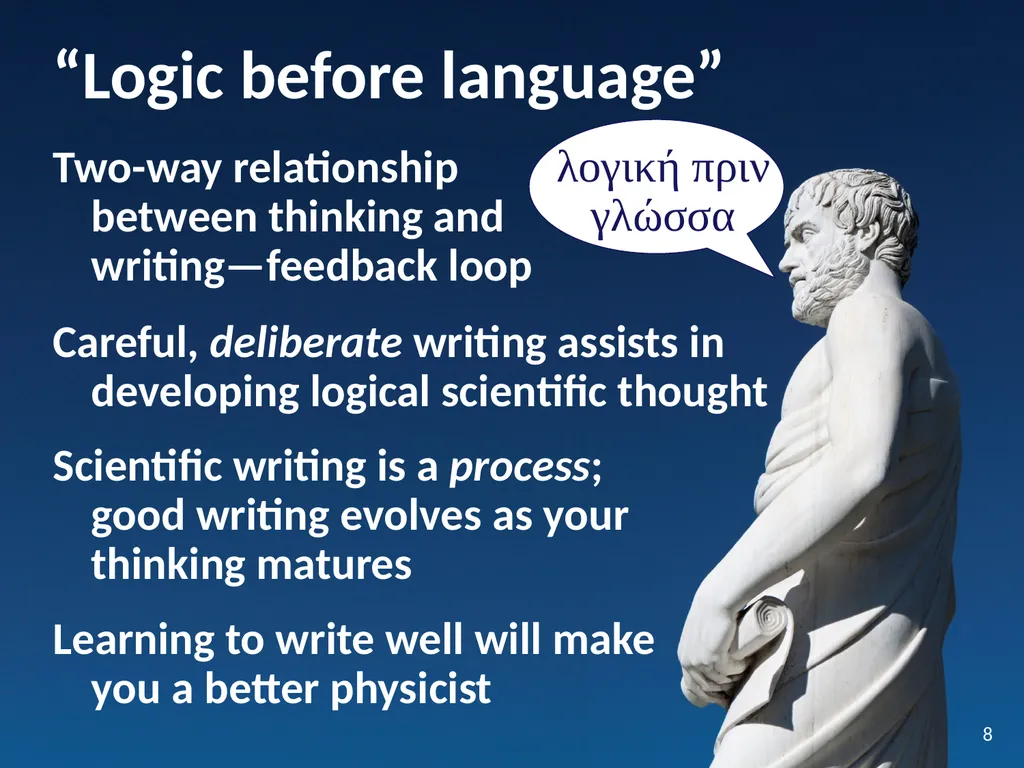
slide9. Logic before language! or Think first, then write λογική πριν γλώσσα “Logic before language” Two-way relationship between thinking and writing—feedback loop Careful, deliberate writing assists in developing logical scientific thought
Scientific writing is a process; good writing evolves as your thinking matures
Learning to write well will make you a better physicist 8<br>
slide10. Novice writers use the “core dump” method —inefficient and produces poor results Always start from a plan—always!
Promotes thinking
Easiest way to get started if you don’t like to write
Gives you control over length and focus
Increases the logical persuasiveness* and coherence of your final paper (or talk) *“Persuasion in Technical Communications,” http://people.physics.illinois.edu/Celia/Persuasion.pdf 9<br>
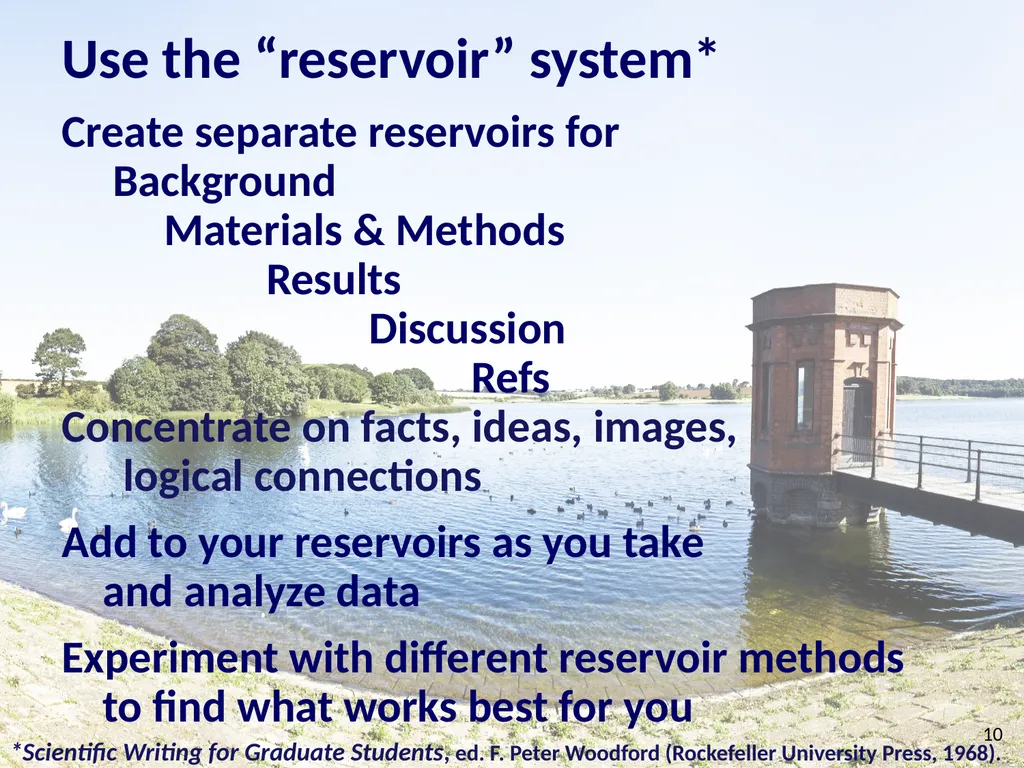
slide11. Use the “reservoir” system* Create separate reservoirs for Background Materials & Methods
Results
Discussion Refs
Concentrate on facts, ideas, images, logical connections
Add to your reservoirs as you take and analyze data
Experiment with different reservoir methods to find what works best for you *Scientific Writing for Graduate Students, ed. F. Peter Woodford (Rockefeller University Press, 1968). 10<br>
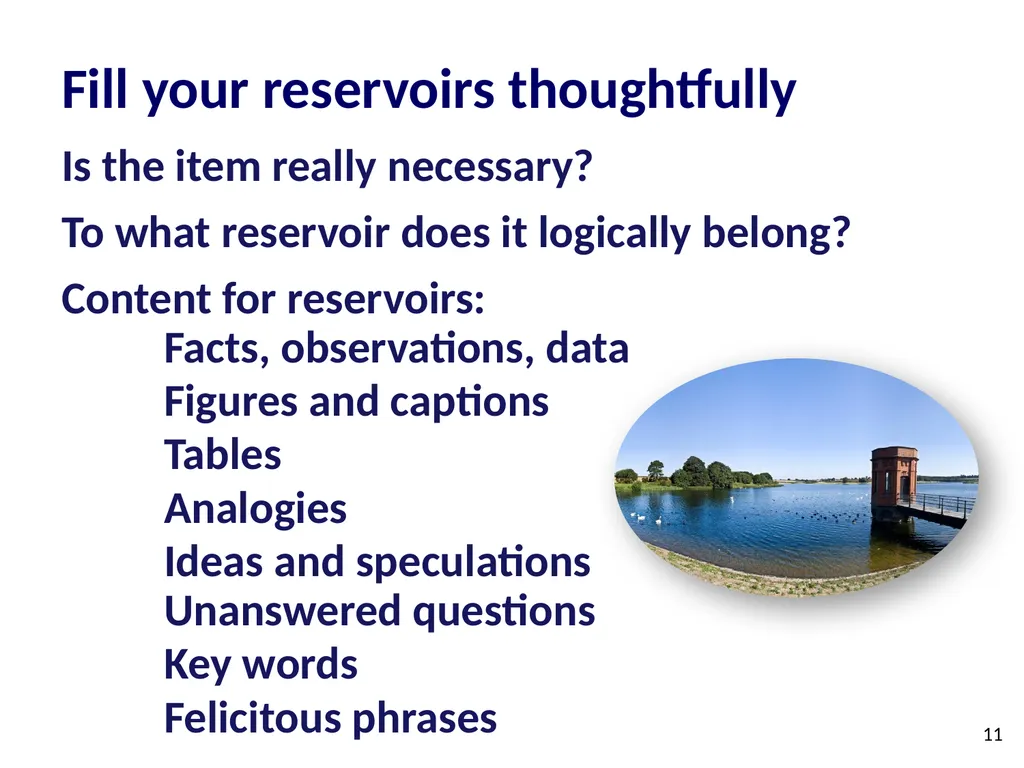
slide12. Fill your reservoirs thoughtfully Is the item really necessary?
To what reservoir does it logically belong?
Content for reservoirs:
Facts, observations, data
Figures and captions
Tables
Analogies
Ideas and speculations Unanswered questions
Key words
Felicitous phrases 11<br>
slide13. Now you’re ready to start building a coherent narrative In the next steps, we’ll take the content of our reservoirs and make a plan to guide the building
of our paper 12<br>
slide14. RULE #1: Never write anything without first analyzing your audience Who is going to read my paper?
What do they already know? (words, concepts, methods)
What don’t they know that I will have to explain?
Where might they become confused?
Where can I send them for more information?
What is most important for them to understand? 13<br>
slide15. RULE #2: Tell a good story Orient the reader with a solid introduction
Emphasize what is new
Use language that is understandable and meaningful for your reader
Arrange the narrative so the logic is clear— use transitional statements to guide your reader
Provide clear, visually interesting, memorable figures
Provide a strong summary; don’t just trail off at the end 14<br>
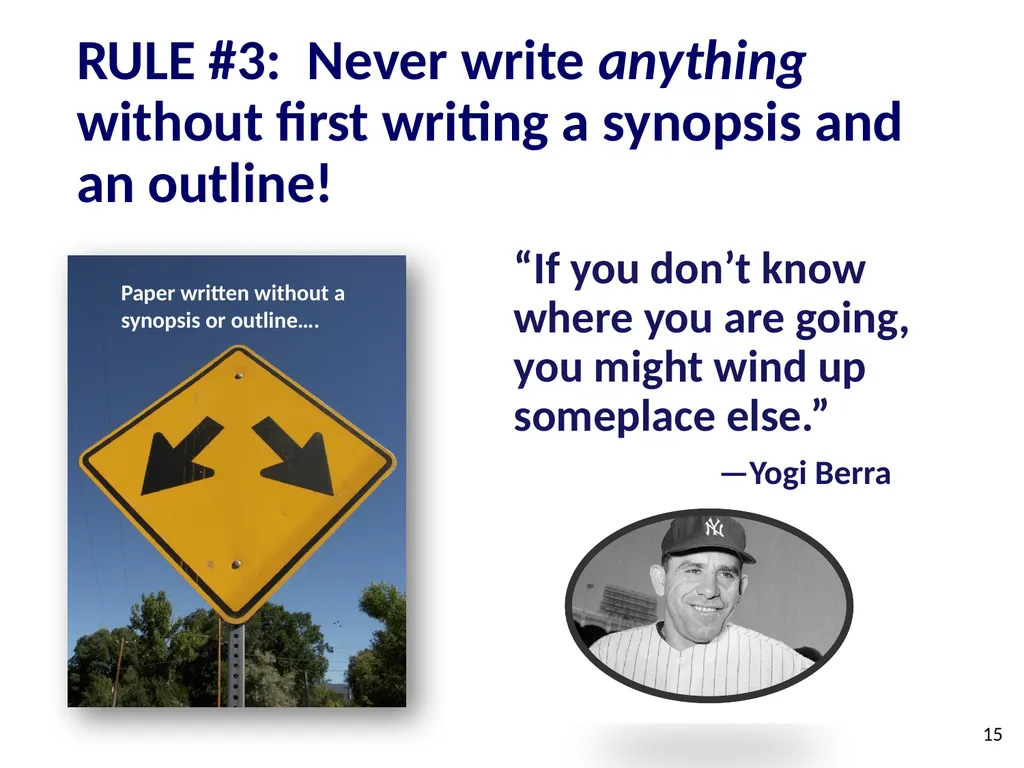
slide16. RULE #3: Never write anything without first writing a synopsis and an outline! “If you don’t know where you are going, you might wind up someplace else.”
—Yogi Berra Paper written without a synopsis or outline…. 15<br>
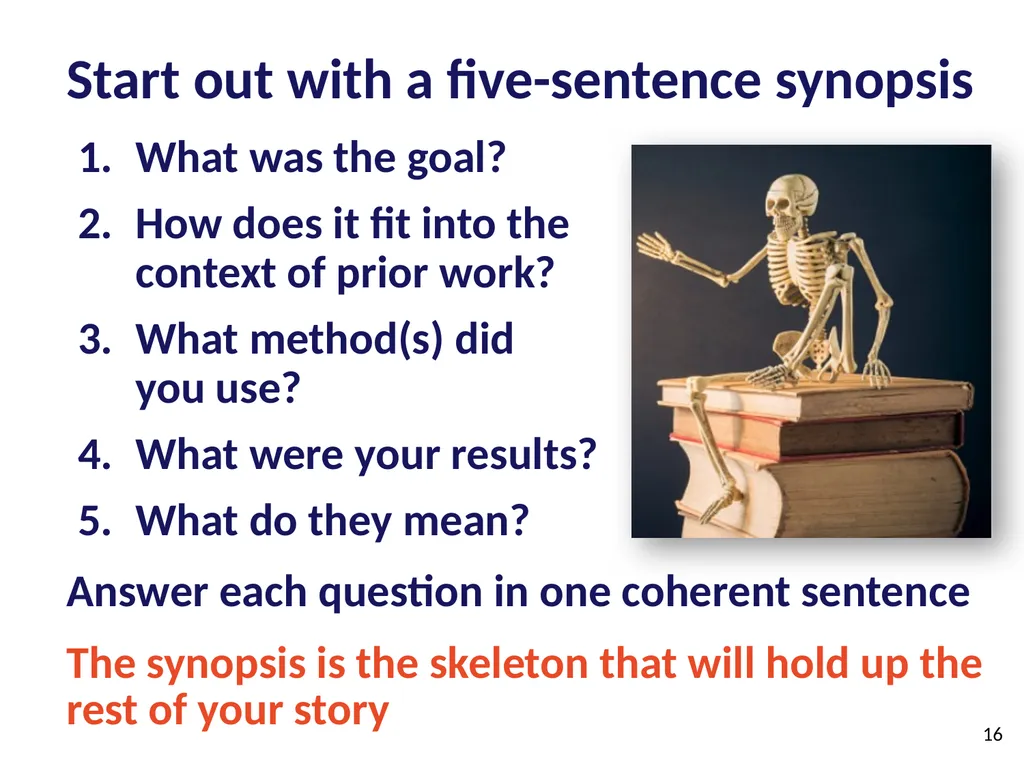
slide17. Start out with a five-sentence synopsis What was the goal?
How does it fit into the context of prior work?
What method(s) did you use?
What were your results?
What do they mean? Answer each question in one coherent sentence
The synopsis is the skeleton that will hold up the rest of your story 16<br>
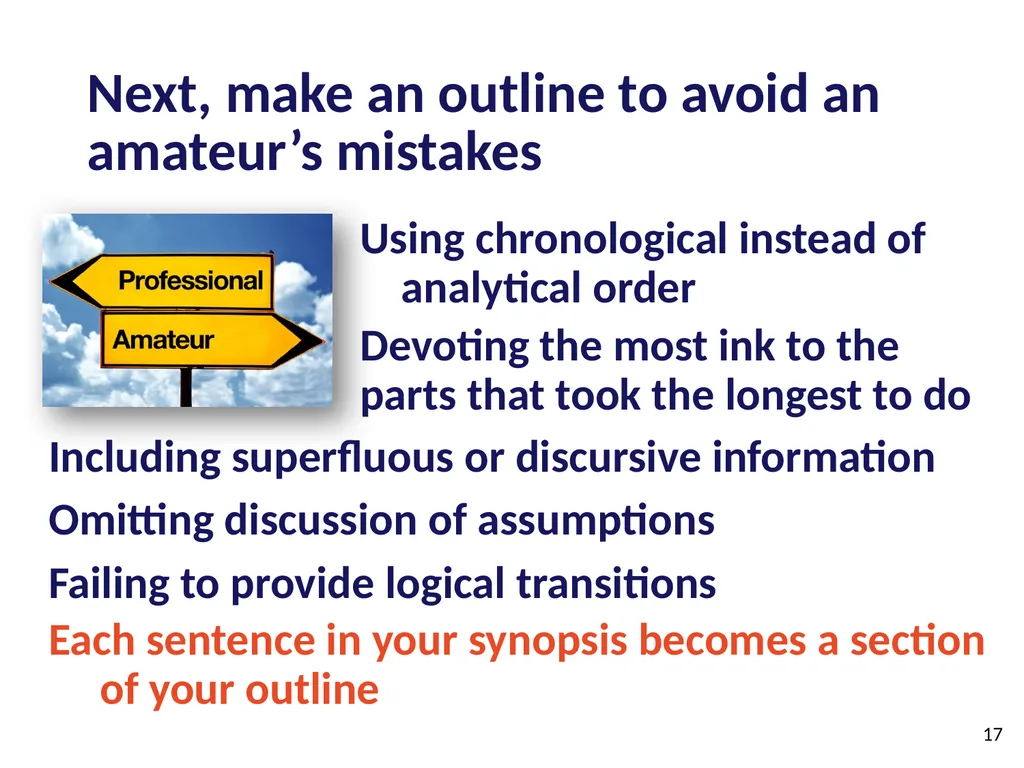
slide18. Next, make an outline to avoid an amateur’s mistakes Using chronological instead of analytical order
Devoting the most ink to the parts that took the longest to do Including superfluous or discursive information
Omitting discussion of assumptions
Failing to provide logical transitions
Each sentence in your synopsis becomes a section of your outline 17<br>
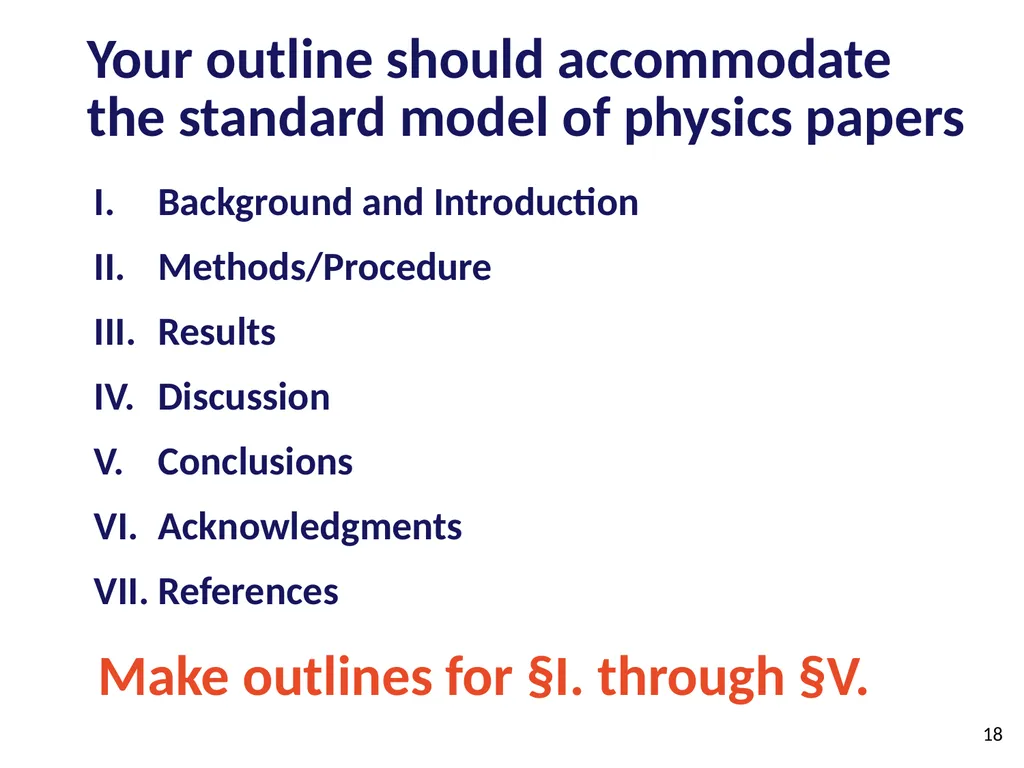
slide19. Your outline should accommodate the standard model of physics papers Make outlines for §I. through §V. Background and Introduction
Methods/Procedure
Results
Discussion
Conclusions
Acknowledgments
References 18<br>
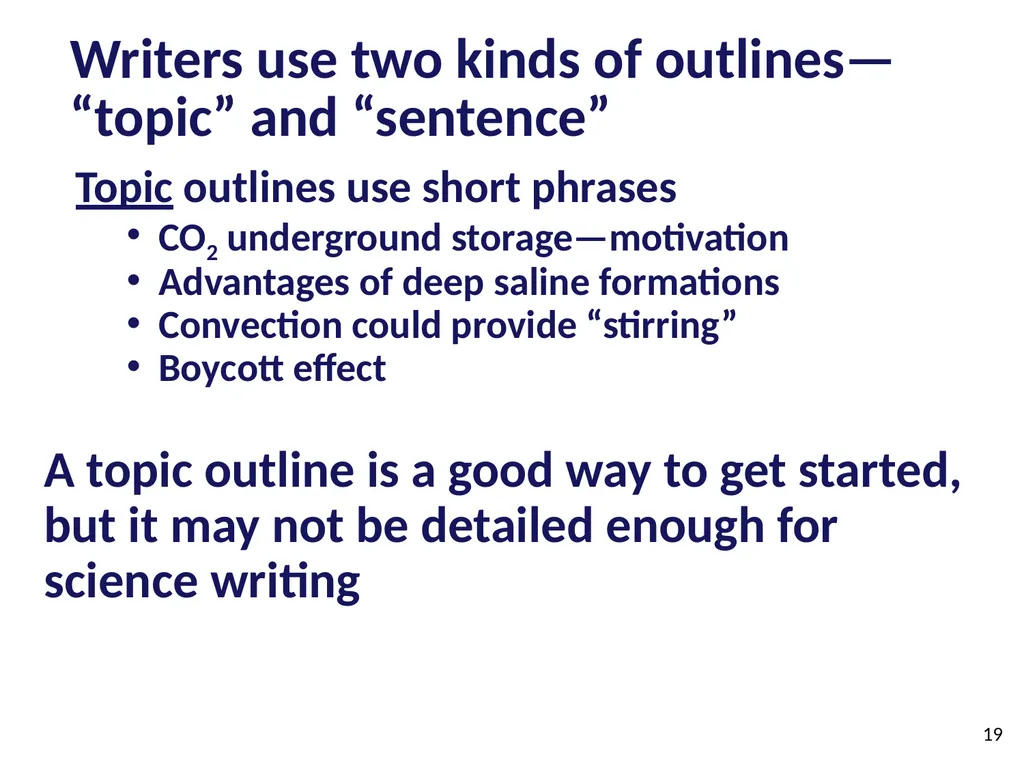
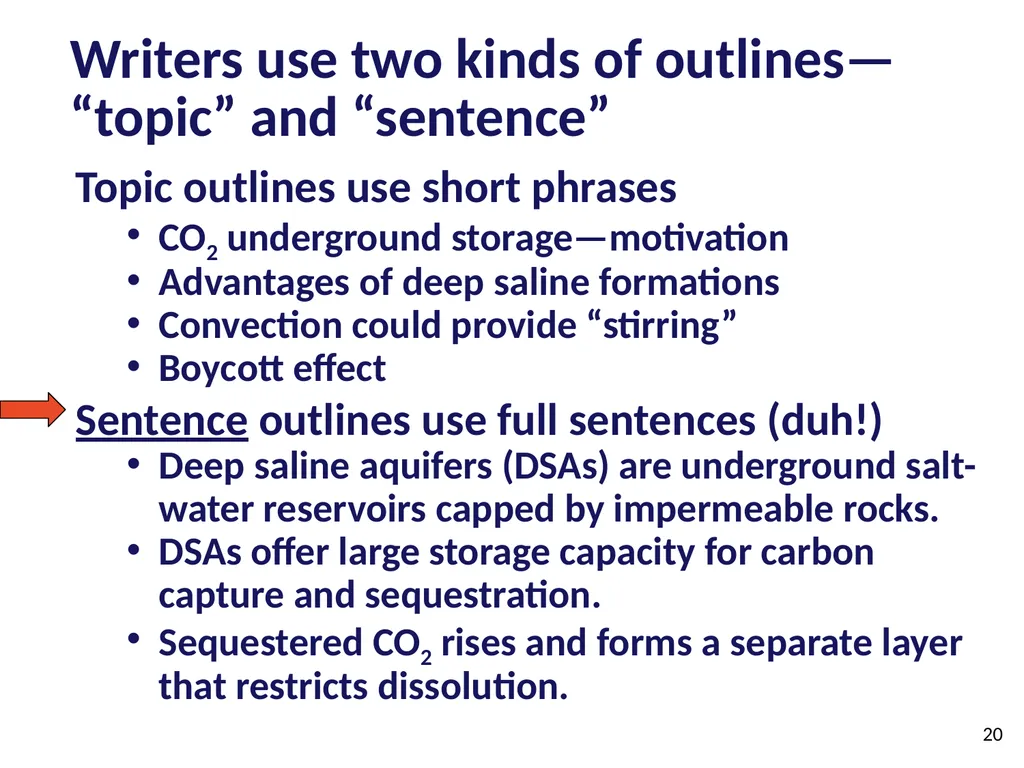
slide20. Writers use two kinds of outlines— “topic” and “sentence” Topic outlines use short phrases
CO2 underground storage—motivation
Advantages of deep saline formations
Convection could provide “stirring”
Boycott effect A topic outline is a good way to get started, but it may not be detailed enough for science writing 19<br>
slide21. Writers use two kinds of outlines— “topic” and “sentence” Topic outlines use short phrases
CO2 underground storage—motivation
Advantages of deep saline formations
Convection could provide “stirring”
Boycott effect
Sentence outlines use full sentences (duh!)
Deep saline aquifers (DSAs) are underground salt-water reservoirs capped by impermeable rocks.
DSAs offer large storage capacity for carbon capture and sequestration.
Sequestered CO2 rises and forms a separate layer that restricts dissolution. 20<br>
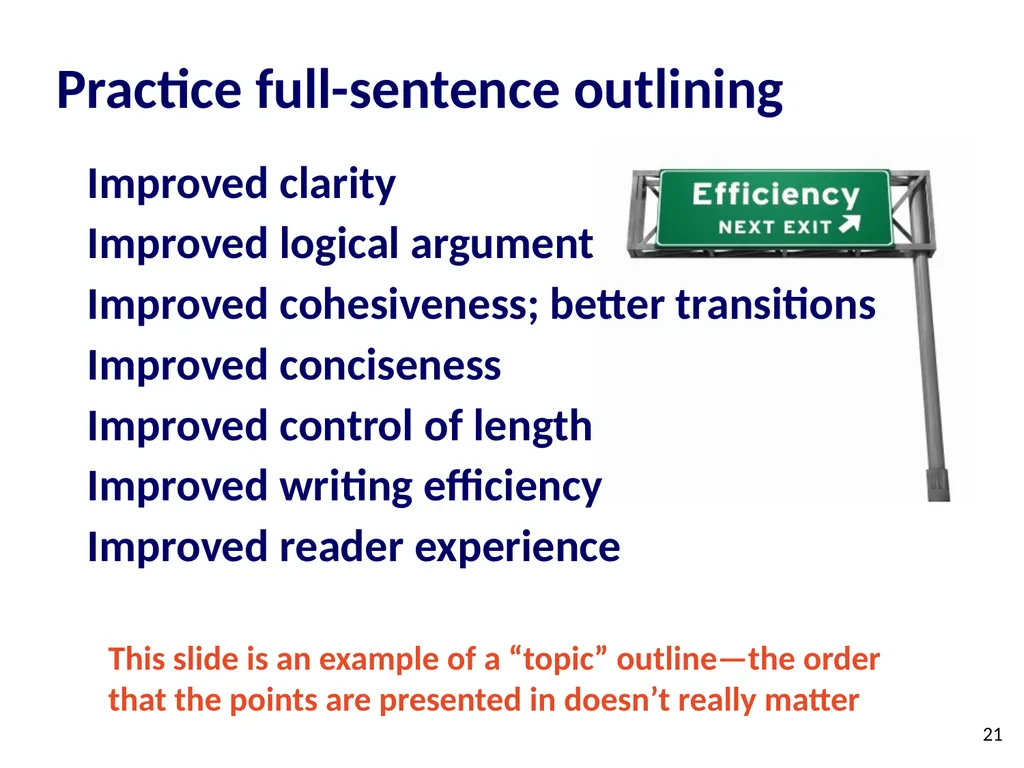
slide22. Practice full-sentence outlining Improved clarity
Improved logical argument
Improved cohesiveness; better transitions
Improved conciseness
Improved control of length
Improved writing efficiency
Improved reader experience This slide is an example of a “topic” outline—the order that the points are presented in doesn’t really matter 21<br>
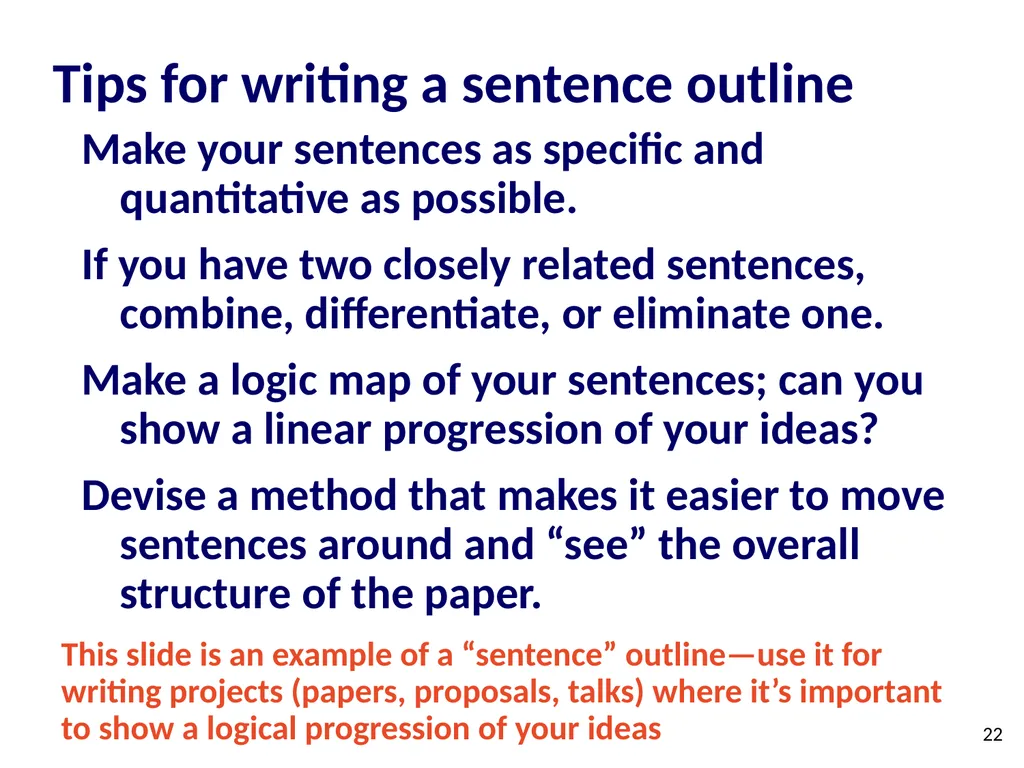
slide23. Tips for writing a sentence outline Make your sentences as specific and quantitative as possible.
If you have two closely related sentences, combine, differentiate, or eliminate one.
Make a logic map of your sentences; can you show a linear progression of your ideas?
Devise a method that makes it easier to move sentences around and “see” the overall structure of the paper. This slide is an example of a “sentence” outline—use it for writing projects (papers, proposals, talks) where it’s important to show a logical progression of your ideas 22<br>
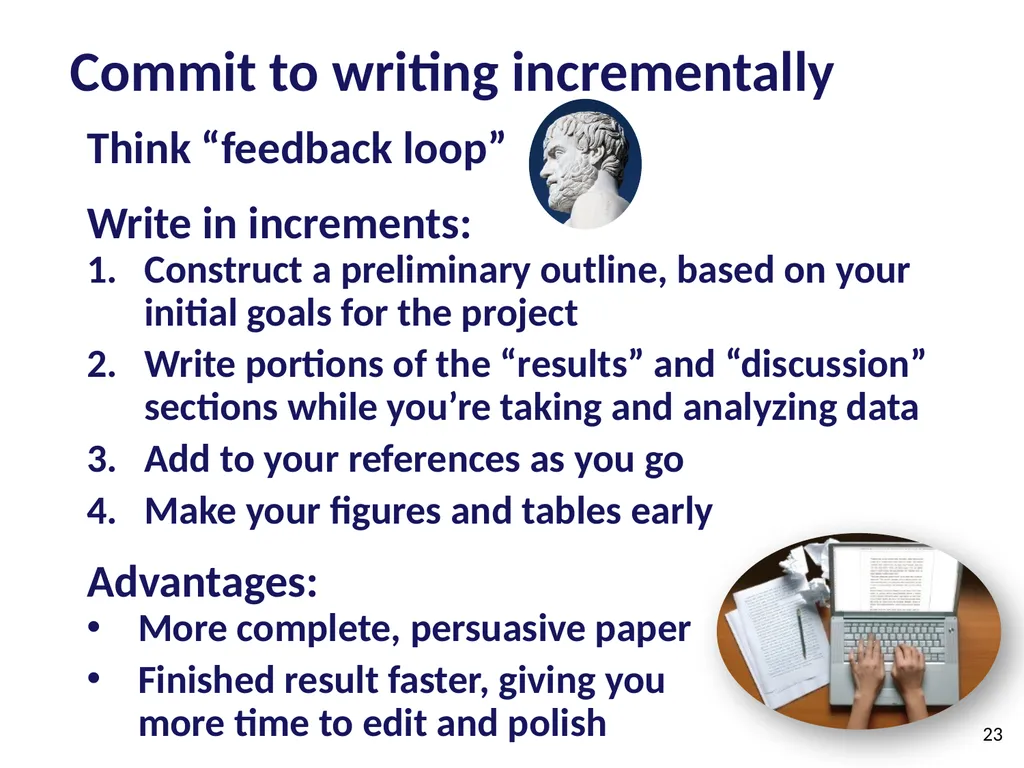
slide24. Commit to writing incrementally Think “feedback loop”
Write in increments:
Construct a preliminary outline, based on your initial goals for the project
Write portions of the “results” and “discussion” sections while you’re taking and analyzing data
Add to your references as you go
Make your figures and tables early
Advantages:
More complete, persuasive paper
Finished result faster, giving you more time to edit and polish 23<br>
slide25. Expect to rewrite—many times 24<br>
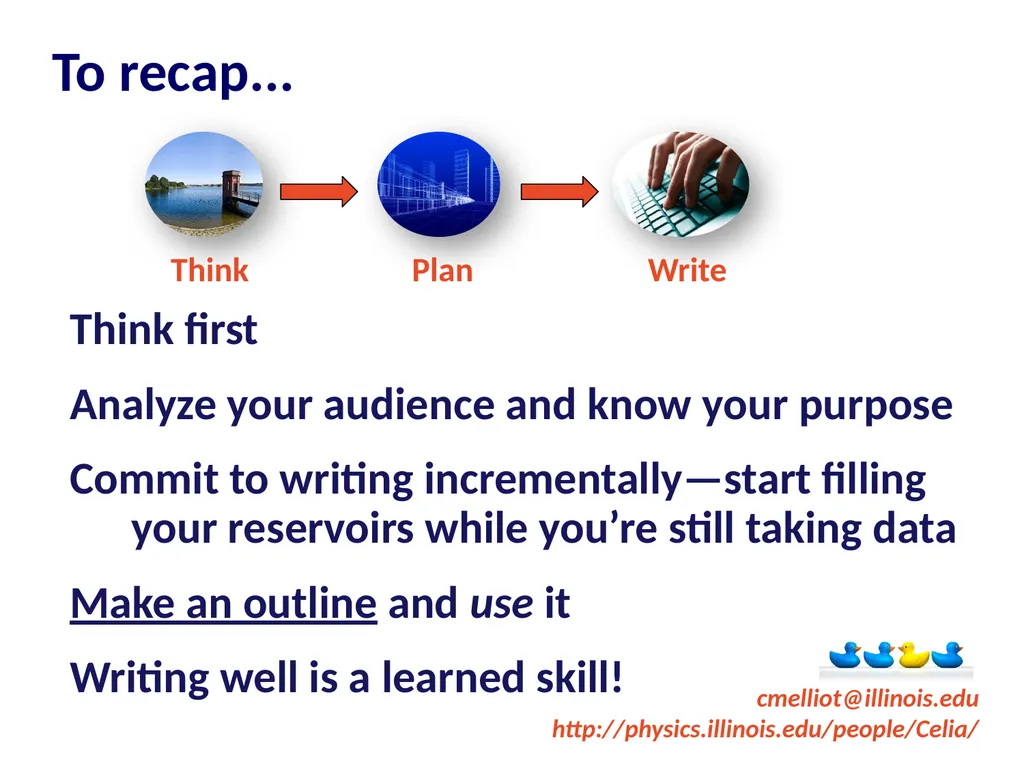
slide26. To recap... Think Write Plan cmelliot@illinois.edu http://physics.illinois.edu/people/Celia/ Think first
Analyze your audience and know your purpose
Commit to writing incrementally—start filling your reservoirs while you’re still taking data
Make an outline and use it
Writing well is a learned skill!<br>
All rights reserved. Celia M. Elliott
Department of Physics
cmelliot@illinois.edu Part I―Outlining<br>
slide2. One thing I’ve learned in physics, you have to satisfy both the theorists and the experimentalists… …so this talk has two parts:
a theory of technical writing
the nuts and bolts of first putting together a scientific paper 1<br>
slide3. What made it so attractive to you? Close your eyes and picture in your mind your favorite childhood storybook 2<br>
slide4. Guess what! Nothing has really changed since you were 5. I’m going to guess that book had Words you understood
Interesting, engaging pictures
A simple, direct storyline
Clear connections and transitions
A satisfying ending
Ideas that captured your imagination and expanded your horizons 3<br>
slide5. First step, throw out most of what you’ve been taught about “writing” Scientific writing ain’t Shakespeare
Your purpose is to inform, educate, and persuade—not to entertain
Write with concrete, quantitative nouns and strong verbs, not adjectives and adverbs
Use the simplest word
Write short sentences and control your modifiers
No literary flourishes 4<br>
slide6. Technical writing is a craft, not an art Like any other craft, you have to learn the techniques
You have to get feed- back from experts
The same skills that make you a good scientist or engineer will make you a good technical writer
logic
precision
the ability to recognize patterns and sort out what’s important 5<br>
slide7. Successful science writing is Written with the reader in mind
Logically constructed—think “linear”
Clearly and succinctly expressed
Precisely and simply worded
Written to inform and persuade 6<br>
slide8. As you are thinking about your writing task, first ask yourself four questions: What is my purpose in writing this document? What’s my ultimate goal?
Who is going to read it? What do they already know, and what am I going to have to explain? What do they want to get out of this paper?
What one thing do I want the reader to remember? What’s the “take-away” message?
What are my space/time/page constraints? 7<br>
slide9. Logic before language! or Think first, then write λογική πριν γλώσσα “Logic before language” Two-way relationship between thinking and writing—feedback loop Careful, deliberate writing assists in developing logical scientific thought
Scientific writing is a process; good writing evolves as your thinking matures
Learning to write well will make you a better physicist 8<br>
slide10. Novice writers use the “core dump” method —inefficient and produces poor results Always start from a plan—always!
Promotes thinking
Easiest way to get started if you don’t like to write
Gives you control over length and focus
Increases the logical persuasiveness* and coherence of your final paper (or talk) *“Persuasion in Technical Communications,” http://people.physics.illinois.edu/Celia/Persuasion.pdf 9<br>
slide11. Use the “reservoir” system* Create separate reservoirs for Background Materials & Methods
Results
Discussion Refs
Concentrate on facts, ideas, images, logical connections
Add to your reservoirs as you take and analyze data
Experiment with different reservoir methods to find what works best for you *Scientific Writing for Graduate Students, ed. F. Peter Woodford (Rockefeller University Press, 1968). 10<br>
slide12. Fill your reservoirs thoughtfully Is the item really necessary?
To what reservoir does it logically belong?
Content for reservoirs:
Facts, observations, data
Figures and captions
Tables
Analogies
Ideas and speculations Unanswered questions
Key words
Felicitous phrases 11<br>
slide13. Now you’re ready to start building a coherent narrative In the next steps, we’ll take the content of our reservoirs and make a plan to guide the building
of our paper 12<br>
slide14. RULE #1: Never write anything without first analyzing your audience Who is going to read my paper?
What do they already know? (words, concepts, methods)
What don’t they know that I will have to explain?
Where might they become confused?
Where can I send them for more information?
What is most important for them to understand? 13<br>
slide15. RULE #2: Tell a good story Orient the reader with a solid introduction
Emphasize what is new
Use language that is understandable and meaningful for your reader
Arrange the narrative so the logic is clear— use transitional statements to guide your reader
Provide clear, visually interesting, memorable figures
Provide a strong summary; don’t just trail off at the end 14<br>
slide16. RULE #3: Never write anything without first writing a synopsis and an outline! “If you don’t know where you are going, you might wind up someplace else.”
—Yogi Berra Paper written without a synopsis or outline…. 15<br>
slide17. Start out with a five-sentence synopsis What was the goal?
How does it fit into the context of prior work?
What method(s) did you use?
What were your results?
What do they mean? Answer each question in one coherent sentence
The synopsis is the skeleton that will hold up the rest of your story 16<br>
slide18. Next, make an outline to avoid an amateur’s mistakes Using chronological instead of analytical order
Devoting the most ink to the parts that took the longest to do Including superfluous or discursive information
Omitting discussion of assumptions
Failing to provide logical transitions
Each sentence in your synopsis becomes a section of your outline 17<br>
slide19. Your outline should accommodate the standard model of physics papers Make outlines for §I. through §V. Background and Introduction
Methods/Procedure
Results
Discussion
Conclusions
Acknowledgments
References 18<br>
slide20. Writers use two kinds of outlines— “topic” and “sentence” Topic outlines use short phrases
CO2 underground storage—motivation
Advantages of deep saline formations
Convection could provide “stirring”
Boycott effect A topic outline is a good way to get started, but it may not be detailed enough for science writing 19<br>
slide21. Writers use two kinds of outlines— “topic” and “sentence” Topic outlines use short phrases
CO2 underground storage—motivation
Advantages of deep saline formations
Convection could provide “stirring”
Boycott effect
Sentence outlines use full sentences (duh!)
Deep saline aquifers (DSAs) are underground salt-water reservoirs capped by impermeable rocks.
DSAs offer large storage capacity for carbon capture and sequestration.
Sequestered CO2 rises and forms a separate layer that restricts dissolution. 20<br>
slide22. Practice full-sentence outlining Improved clarity
Improved logical argument
Improved cohesiveness; better transitions
Improved conciseness
Improved control of length
Improved writing efficiency
Improved reader experience This slide is an example of a “topic” outline—the order that the points are presented in doesn’t really matter 21<br>
slide23. Tips for writing a sentence outline Make your sentences as specific and quantitative as possible.
If you have two closely related sentences, combine, differentiate, or eliminate one.
Make a logic map of your sentences; can you show a linear progression of your ideas?
Devise a method that makes it easier to move sentences around and “see” the overall structure of the paper. This slide is an example of a “sentence” outline—use it for writing projects (papers, proposals, talks) where it’s important to show a logical progression of your ideas 22<br>
slide24. Commit to writing incrementally Think “feedback loop”
Write in increments:
Construct a preliminary outline, based on your initial goals for the project
Write portions of the “results” and “discussion” sections while you’re taking and analyzing data
Add to your references as you go
Make your figures and tables early
Advantages:
More complete, persuasive paper
Finished result faster, giving you more time to edit and polish 23<br>
slide25. Expect to rewrite—many times 24<br>
slide26. To recap... Think Write Plan cmelliot@illinois.edu http://physics.illinois.edu/people/Celia/ Think first
Analyze your audience and know your purpose
Commit to writing incrementally—start filling your reservoirs while you’re still taking data
Make an outline and use it
Writing well is a learned skill!<br>